


Technorati Tags: State Department and Secretary of State or Iran and Iran Nuclear Issue, or R. Nicholas Burns and Political Affairs or Condoleezza Rice, or Robert Joseph and Arms Control and International Security, or PODCAST
Briefing on the Iran Nuclear Issue, file is mp3 format for PODCAST, running time is 35:45, R. Nicholas Burns, Under Secretary of State for Political Affairs; Robert Joseph, Under Secretary for Arms Control and International Security (11:45 a.m. EDT)
MR. ERELI: Welcome, everybody, to this special briefing with Under Secretary of State for Political Affairs Nicholas Burns and Under Secretary of State for Arms Control and International Security Bob Joseph. Both officials have just returned from trips abroad on the issue of Iran's nuclear program. They're here to tell you about those visits and give you an update on where we are on our diplomacy on this. We'll begin with Under Secretary Burns and then go to Under Secretary Joseph. I'd ask you to keep your questions very short because the gentlemen have to leave in about 25 minutes.
Thank you.
UNDER SECRETARY BURNS: Good morning. Nice to see all of you. Let me just tell you about a trip that I made to Moscow this week where I represented the United States at talks among the P-5 countries and Germany, so that was Russia, China, Britain, France and Germany, one in the series of talks we've had at the political director level but also at the ministerial level about how to isolate Iran and how to pressure Iran, place pressure on Iran, to put its nuclear programs into suspension and to return to negotiations, which is the short-term objective here. We also had meetings of the G-8 in Moscow and there's no question now in our mind that Iran is probably now the leading issue to be discussed when the G-8 foreign ministers get together at the end of June and when our leaders get together in St. Petersburg in the middle of July.
I was struck in the two days of meetings that I had both with the Perm 5 as well as with the G-8 countries, I was struck by how much the atmosphere has changed. As for you know, for the last year the United States has been supporting the EU negotiating efforts and we've also been very supportive of the Russian efforts to try to get -- or the Russian proposal that's been made to try to get Iran to return to its senses and to return to a rational discussion with the international community about its very obvious attempt to create a nuclear weapons capability for itself.
For many months over the past year, countries were not willing to entertain the idea of sanctions. And for many months, countries were not willing to think about concerted action in the Security Council that would effectively block Iran and then push it back diplomatically so that it could not achieve its purposes. And I think the atmosphere has changed. It's changed because you've seen over the last four months Iran take a series of steps -- the January steps to take the seals off, but also the steps last week where they made this big public show of going forward to enrichment and then they predicted -- they said what they'd be doing throughout the rest of the year to take that enrichment program forward.
Under Secretary Joseph will describe to you our view of that, but diplomatically the consequence of it was that in all of our discussions each country, including Russia and China, said it is their policy that Iran should not have nuclear weapons. Each country said that we all ought to act now collectively to ensure that we speak with one voice and take one series of actions designed to isolate the Iranians and, if necessary, to think about punitive diplomatic, economic measures for Iran to stop its current efforts. And I was struck by the change in atmosphere and, if you will, the sense of urgency as we think about the actions in the Security Council in May and June to make sure that we are operating together.
We all agreed that while we're willing to support efforts to see civil nuclear power made available to the Iranian people, none of us are willing to see a nuclear weapons capability produced. And for the first time, all countries said that action had to be considered. Now, the majority of countries in the room said that they were already considering sanctions of a collective or individual nature. You've seen the announcement by the European Union that they are considering a specific list of sanctions. You know that the United States, which has had sanctions in place for 26 years, is also willing to support these efforts. And if there's any other way that we could possibly sanction Iran, we would entertain that possibility.
And I can't speak and I won't speak for the other countries in the room, but there was an agreement that we now had to think specifically about how to translate our agreement on action into something specific at the UN Security Council. We did not agree on the specific tactical way forward, but I think what you'll see in the next couple of weeks is a very intensive diplomatic effort among the P-5 countries to think together about how we can place this kind of pressure on Iran.
There'll be meetings in the first week of May of the P-5 political directors in Europe to continue the talks that we had this week. There will certainly be an effort made in the Security Council in the beginning of May to introduce probably a Chapter 7 resolution that would require Iran to come back into suspension regarding its nuclear activities. And I think you'll see at a variety of levels, this issue come to the fore as one of the major international negotiating efforts. There's no question about that.
We think it's time for countries to use their leverage with Iran. We think it's time for countries to use their leverage. And therefore, we think it's important that countries prohibit the use -- the export of dual-use technologies that Iran can make use of in constructing its nuclear program. We think it's very important that countries like Russia, for instance, freeze any arms sales planned for Iran. Russia announced in December 2005 a sale of Tor anti-aircraft missiles to Iran. We hope and we trust that that deal will not go forward because this is not time for business as usual with the Iranian Government.
So we think it's time for countries to use their leverage individually and we think it's time for countries to band together collectively to make the same effort. And that's a very important point that was just -- that I discussed and other members discussed with the P-5 as well as the G-8. I think you'll see, two different groups dealing with this issue of Iran. One will be the P-5 and the Security Council and the second will be the G-8 in the way that I have described.
One final point. The discussion now internationally is even broader in terms of our concerns about Iran than the nuclear issue. A number of countries in the P-5 and G-8 spoke up against Iran's leading support for terrorism in the Middle East, as well as a concern about its more aggressive policy in the region, as well as concern about the human rights situation inside Iran.
So what the United States Government has been trying to do is we've now got a fully developed comprehensive policy towards Iran which focuses on the nuclear issue, but also on the counterterrorism problem, also on the effort to try to promote democracy and human rights inside Iran, as well as work with countries in the region of the Middle East to see if we can't altogether send a signal to Iran that its current behavior is quite unacceptable.
That's what I wanted to say in terms of opening remarks. I think Under Secretary Joseph has some as well to offer and then both of us will be happy to answer your questions.
UNDER SECRETARY JOSEPH: Good morning. Let me just say a few words about what is going on on the ground in Iran with regard to its nuclear activities and also a few observations about the visit that I made to the Gulf. I returned last Friday, having visited the Gulf states, including Bahrain and the UAE, Oman, Kuwait, Saudi Arabia, Qatar, and then on the way home, Egypt.
First, in terms of activities on the ground in Iran, it's fair to say, I believe, that the Iranians have put both feet on the accelerator. They're moving very quickly to establish new realities on the ground associated with their nuclear program. You're all aware, I think, of the announcements that were made by the Iranian leadership on the 11th of April. The claims that were made in those announcements have yet to be confirmed, but for the most part we see little reason to doubt them.
The Iranians claim that they had converted enough uranium for 110 tons of UF-6, UF-6 being the feed material for centrifuges. This is enough material for more than 10 weapons. The Iranians have said that they actually produced enriched uranium to 3.5 percent. If you can produce to 3.5 percent, you're well on your way to producing enriched uranium at a much higher content, including weapons grade material.
Perhaps most disturbing, at least in my calculation, is the announcement that they are operating a centrifuge cascade consisting of 164 centrifuges. Now, I'm a political scientist, not a nuclear physicist, but every nuclear physicist that I have talked to in the past has always suggested that 164 is a key number, because once you're able to operate, over a sustained period of time, 164 centrifuges in cascade and feed into that this material, this UF-6 that I talked about, you're well on your way to an industrial scale capability in terms of the production of enriched uranium.
In the context of Iranian plans, the Iranian Government also announced that they intended to have 3,000 centrifuges installed at Natanz by the end of the year. Three thousand centrifuges is much more than one needs to produce enough enriched uranium, if properly configured, for more than one nuclear weapon a year. And they also said that they intended to move to 50,000 or more centrifuges at Natanz in terms of their long-term goals.
You also may have read some of the recent press on the claim by the Iranian President that they're moving with research and development on the next generation of centrifuge, the P-2 centrifuge, which, according to Iranian claims, is four times as efficient as the P-1.
I think this clearly gives you an idea of what the Iranian goals are in this context. And I think you have to look at these claims in the context of continued unwillingness by Iran to cooperate with the IAEA in addressing the major outstanding questions that have been raised time and time again by Dr. ElBaradei and by the IAEA inspectors in reports to the Board of Governors.
These questions deal with the history of the centrifuges, including the P-2s. They deal with indications of weaponization by Iran. And they also, of course, deal with the call by the entire Board and now by the Security Council to have Iran suspend its enrichment-related activities and also to stop its move to acquire a heavy water research reactor that would be configured to produce plutonium, the other fissile material that is appropriate for nuclear weapons.
Iran has clearly demonstrated that it is not willing to cooperate and that it is determined, despite calls for compromise and despite calls for negotiation, determined to move forward in complete defiance of the international community.
Just a few words on my trip to the Gulf. The purpose was to consult with the Gulf countries about the threat from Iran and what we might be able to do together. We discussed a number of counter-proliferation initiatives that we might be able to take. We talked about working in the context of the Proliferation Security Initiative, an initiative that now involves over 70 countries who are committed to stopping the trade in proliferation materials. We talked about how that could be best applied to Iran to stop the transfer of sensitive materials and technologies associated with their WMD and missile programs. That initiative has already had an impact on Iranian programs and we intend to use that as a tool to achieve even greater effect.
We talked about financial measures, what we can do together to disrupt the proliferation activities by taking certain measures in the financial area, in terms of banking transactions or closing front companies, the type of actions that can have an effect on Iran's ability to acquire more technology and expertise from the outside.
And we also talked about other defensive measures that we might be able to pursue together, including greater cooperation on missile defense, as one example. Iran has the largest ballistic missile offensive capability and it's a capability that's growing significantly. And we talked about the prospect for working together to provide a defense against that mode of delivery.
We also talked about the prospect for training and exercising in the area of chemical and biological defense. Remember that Iran is not only pursuing a nuclear weapons capability, but is assessed to have a biological and chemical offensive program as well.
These efforts, these defensive measures that I have mentioned, are intended to reinforce the prospects for the success of our diplomacy in New York and Vienna and elsewhere. They are not in competition, but they are reinforcing. Let me stop there and we'll take questions.
MR. ERELI: Peter.
QUESTION: I have one question for Under Secretary Burns and one for Under Secretary Joseph. Nick, we got a week to go before April 28th. The Russians, for one, are saying that they're not going to apply sanctions because they see no proof that Iran is heading towards a nuclear weapon, so it seems like that international consensus is not as solid as you might suggest. What do you think the prospects are after April 28th?
And Under Secretary Joseph, given all the data that you've given us, what is the latest estimate on how close Iran is to a nuclear bomb or to that famous point of no return?
UNDER SECRETARY BURNS: It's always interesting to match what you hear privately in negotiations versus what people say publicly. The message privately was that we do not have an agreement yet among the P-5 about the specific tactic that all of us should embrace at the Security Council, but we do have the following agreement: that after Mr. ElBaradei -- Dr. ElBaradei reports to the Security Council and the IAEA on April 28th -- and there's only one thing he can really report, and that is that Iran is not in compliance with the terms of the presidential statement issued by the Security Council. After last week's announcement, Iran has flown by the red lines, flown over the red lines established by the UN Security Council. So assuming a negative report, which we do, the commitment that all of us have together is that we're going to meet on May 2nd in Paris, the P-5 political directors, and we will try to determine what collective action we should take together -- collective action together in the Security Council -- and try to agree on a series of measures in the Security Council designed to send a very strong signal to the Iranians that they are out of line.
Now, I don't want to mislead you here. Russia and China have not agreed to what that specific action should be. But they said to us in private that they believe that there should be some kind of effort made by the Security Council beyond where we've been. And where we've been is we've been offering these resolutions and presidential statements. It's now time for some type of action to be taken because what we hear is it's not in the -- the Russians and Chinese tell us they don't want to have -- see Iran have a nuclear weapon. They understand that Iran has to be now strongly encouraged to pull back from where it is.
So the diplomacy, the trick, the challenge of a diplomacy in the next several weeks, will be to try to agree on that specific action. You know where we're coming from. It's time for countries to use their leverage and use their influence. And words sometimes just aren't sufficient in diplomacy; they have to be combined with action. I'm talking about diplomatic action. There are a lot of countries that trade with Iran that have billion dollar trade relations and they ought to begin to rethink those commercial trade relationships. There are a lot of countries that allow the export of dual-use technologies and the position of the United States is that that should be prohibited. All countries should refrain from military sales and arms sales and we pressed that issue the other day and we'll continue to press that issue.
One last thing. The diplomacy here is very challenging. It is likely to extend sometime into the future. We're not going to see in the next week or two any kind of a breakthrough, but we are seeing something very significant. A year ago today, there was no international coalition designed to force Iran off its nuclear weapons track and there is now. And it includes the United States and Canada and all the European countries and Japan and Australia and India and Brazil, all the countries, and Russia and China, that have voted to rebuke Iran.
Now you have two groups, the G-8 and the P-5, that are saying -- that have committed to work on a multilateral basis to send this signal to Iran. So I can't predict where the Security Council will be a month from today. But my sense is that the Iranians have miscalculated again, that this high-profile announcement last week with the President of Iran and holding up, you know, the product of what they'd done in the enrichment process has backfired on them. I sensed real concern on the part of Russia and China as to what the Iranians are up to. Now let's see if we can translate that into effective action at the Security Council to preserve the credibility of the Security Council, which is what is at stake here.
UNDER SECRETARY JOSEPH: Let me just say that on my visit to the Gulf, the same concern that Nick just described was very apparent in all of the countries that I visited.
With regard to the question of when Iran might have a nuclear weapons capability, the DNI, Ambassador Negroponte, has spoken to that. I would just say that with regard to the question of the point of no return, there are different answers to that. Some will say that the point of no return is when Iran has produced enough fissile material for a nuclear weapon. Others might argue that it's the point in which they have successfully weaponized this. There is an earlier point of no return, and that is when Iran has acquired the confidence and the capability of running centrifuges over a sustained period of time, allowing it to produce enrichment uranium. And again, the key point there has always in the past been the 164-cascade centrifuge. So the answer I would give you is we are very close to that point of no return. And I think that's a view that was shared -- that is shared by many others.
MR. ERELI: John.
QUESTION: How do we know if we can believe the statements that are coming out of Iran and that their claims are -- how do we know that they're not exaggerating and how much confidence do we really have in our intelligence on Iran, any more than we had with Iraq?
UNDER SECRETARY JOSEPH: The IAEA is in the process of taking samples and will, I think in time, be able to confirm the claims that have been made.
UNDER SECRETARY BURNS: Can I also -- can I also just add to that it's -- no one is trying to -- as we arrange our diplomacy, there's a clear separation between dealing with Iran and what happened with Iraq in 2002 and '3. One of the remarkable aspects of the diplomacy concerning Iran is not a single country of which I'm aware believes that Iran's nuclear program is for peaceful purposes. Everyone assumes -- the whole basis of what's happening in the Security Council is that Iran is trying to achieve a nuclear weapons capability. And now we have this extraordinary situation where for a couple of years the Iranians told the IAEA we're not engaged in P-2 centrifuge research and then the President of Iran last week said we are engaged in P-2 centrifuge research.
So the inconsistency, I would say the covering up of the reality and the facts by the Government of Iran, is quite profound here. And what's happening now is that you had the Iranians just a couple of months ago telling the international press we're not going to engage in enrichment and we're not going to go to 164. Last week, they said they'd go to 3,000 centrifuges in research by the end of this year. So we're just judging Iran on what it's saying it's doing. It's crossing every international red line, which has produced this movement against and back -- I think backlash against Iraq -- Iran, excuse me.
QUESTION: In your opening statement, you mentioned actions in the Security Council in May and June. Should we infer from that that there's going to be some sort of 30-day trigger in May and what happens in June if the Iranians continue to be unresponsive?
UNDER SECRETARY BURNS: The aggrieved party here are the three European countries who for three years have been negotiating with the Iranians. They had their negotiations summarily and unilaterally disrupted by the Iranians last year. So I expect that those European countries, led by Britain and France, the two permanent members of the Security Council from Europe, that they'll come forward likely with a Chapter 7 resolution in the early part of May. I think that that diplomacy -- you all know about diplomacy in New York -- it's iterative, it's sometimes incremental, and so it's like to take a little bit of time to work through the debate and the negotiations. And it may be that there are several avenues that are pursued in the Security Council designed to isolate and put some pressure on the Iranians. And we still need to work out with the Europeans over the next week or so exactly what they will put forward, and we'll be working with the Russians and Chinese as well. Therefore, that's the reason for the May 2nd meeting in Paris and many other subsequent meetings. You're going to see a lot of activity at many levels of government here.
MR. ERELI: James.
QUESTION: One for each of you.
MR. ERELI: Just one question.
QUESTION: Okay. Secretary Burns, you mentioned that you pressed the point with the Russians very recently about these anti-aircraft sales. What was the response you got and how optimistic are you that you'll be able to prevent that sale from going through?
UNDER SECRETARY BURNS: I think you saw some of the -- a part of the response yesterday when the Russian Foreign Ministry spokesman said that they intended to go forward with these arms sales. It just doesn't stand to reason that Russia would continue with arms sales, particularly of the type envisioned, Tor missiles, to Iran. Iran is a country that is violating every international agreement it's made on the nuclear issue, both with the IAEA and now with the Security Council. It's not complying with the statements of the Security Council. We know what it's doing in terms of its now more aggressive policy in its own region. So we'll continue to work at it. We felt it was important to press the issue. We'll continue to press the issue.
QUESTION: Following up on that, related to sanctions, the United States seems to feel that absent a Security Council -- a unified Security Council action, that all the countries, including the Europeans, should have their own sanctions ready to go. But the European -- this is something that the Europeans indicate they strongly disagree on, that only a collective Security Council action is going to be effective. They don't think that kind of thing would be effective. Is there a disagreement, a difference of views here between us and our European allies?
UNDER SECRETARY BURNS: Steve, I don't think so. We, the United States, have committed ourselves to this very intensive process in the Security Council and we understand that for many countries, given the ways their laws work and relations with parliaments, that the force of a Security Council resolution, say a Chapter 7 resolution, is sometimes necessary -- the reality of it -- before they can take individual action. So we understand that and we have been now, for the last year, supporting the EU effort. And the reason for my trip to Moscow this week was to commit the United States to a diplomatic process in New York in a very intensive way.
But one of the points that Secretary Rice has made and that a number of others of us have made is that this issue is too important to be hung up for months or years in the Security Council. We are dedicating ourselves to the Security Council process and you'll see the United States be as actively engaged as anybody; but if the Security Council cannot act over a reasonable period of time, then there will be an opportunity for groups of countries to organize themselves together for the purpose of isolating the Iranians diplomatically and economically.
So it's not beyond the realm of the possible that, at some point in the future, a group of countries could get together, if the Security Council is not able to act, to take collective economic action or a collective action on sanctions. That's important because those that might prevent the Security Council from acting effectively need to understand that the international community has to find a way and will find a way to express our displeasure with the Iranians.
MR. ERELI: Last question to Anne.
QUESTION: It sounds as if you're already sort of pursuing that second track in parallel with the Security Council. I mean, you went to Europe and to Moscow, in part, to talk to the Europeans about sanctions they could raise or, you know, asset forfeiture and that sort of thing that would be country-specific and apart from the Security Council. And now you're talking about stopping arms sales and the weighing of other countries' individual leverage.
Which one do you think has the greater likelihood of ultimate success? And do you undermine the Security Council process by talking about the other things at the same time?
UNDER SECRETARY BURNS: No, we're just talking about the reality of how the world works and diplomacy works. There's never, I think, been any issue over the last 40 or 50 years that's been exclusively in the domain of the Security Council or one channel. You've got to work through a variety of channels. But let me say this. We are devoted and dedicated to making the Security Council process effective. We're putting an enormous amount of energy and a lot of resources into thinking through how the Security Council can be effective.
So we haven't given up on diplomacy. We have not given up on the Security Council. And the largest part of our effort is going to be through the Security Council. I'm just suggesting what Secretary Rice has suggested and others have, that it's very important that we have a number of avenues through which we can pursue action -- diplomatic, economic action against Iran. And the United States is not alone in saying this. The European Union announced 10 days ago they are considering a basket of sanctions. Among the efforts being talked about internationally, behind closed doors and also publicly, are targeted sanctions against the Iranian leadership to make it impossible for them to travel, visa sanctions, prohibition on export of dual-use technologies that can serve their nuclear industry, and other measures like that.
And so it's very important that the Security Council succeed and the United States will do everything in its power to help the Security Council succeed. But obviously, in the way that the world works, countries have a multiplicity of relationships with Iran -- we don't, but many other countries do -- and they ought to be using that leverage, whether it's through the Security Council or outside the Security Council. And it's also important for countries to know that if, for any reason, the Security Council can't succeed, there will be an effort made and there are avenues available to us to apply the kind of pressure that we need to apply.
MR. ERELI: Thank you very much. Do you have anything to add, Bob?
UNDER SECRETARY JOSEPH: I would just add that this is likely the greatest strategic threat that we face as a nation and that faces the international community. A nuclear-armed Iran is something that we simply cannot tolerate and this is a sense that is shared very widely by most states. A nuclear-armed Iran would represent, I think, a direct threat not only to us and not only to the countries in the region, but to the entire nuclear nonproliferation regime. It would represent a threat to stability in the region, because a nuclear-armed Iran, I believe, would be emboldened to take even more aggressive actions through the use of terrorism and other means. One can also contemplate the proliferation consequences of a nuclear-armed Iran.
We need to use every tool at our disposal. Diplomacy is key. Our economic tools, our intelligence tools, every tool that we have needs to be brought to bear against this threat. Thank you.
MR. ERELI: A couple more. Elise.
QUESTION: There's been a lot of speculation over the last week that the U.S. is looking to talk to Iran beyond the narrow talks on Iraq -- talk to Iran beyond the narrow confines of Iraq. There has been reports that a Mr. -- an Iranian official, Mr. Nahavandian, was in town looking to meet with U.S. officials and there were also reports that the U.S. is using its longtime intermediary, Mr. Ghorbanifar. So could you speak to these reports? Is there anything to it? Is the U.S. looking to have any direct negotiations with Iran on the nuclear issue?
UNDER SECRETARY BURNS: There's nothing to those reports. The Iranian gentleman in question may have been wandering around Washington, but I am absolutely sure he did not have any conversations with any American Government officials and that we weren't seeking those conversations. He apparently is a green card holder, so he got himself into the United States. This is an issue for DHS now to handle and DHS is, and I'd direct your questions there. But he did not have discussions with American Government officials and we would not have met with him, had he knocked on the door of the State Department.
There are no discussions underway of the type that you have talked about. As you know, we do not have -- we are not talking to the Iranians directly about this nuclear issue. We're not part of the negotiations with them. When I was in Moscow, an Iranian delegation showed up and they met with the Europeans and Russians directly after our meeting, but I was not there and I was never intended to be there.
The only conversations we've had with the Iranians were a couple of weeks ago and we told you about this when -- after the earthquake, when I called the Iranian Ambassador to the United Nations, Dr. Zarif, to offer, on behalf of our government, humanitarian assistance. And he called me back the next day with the answer that the Iranian Government was very appreciative of the offer, but they felt they could handle that particular natural disaster on their own. That's the extent of it, so there are no discussions underway.
QUESTION: No discussions with Mr. Ghorbanifar either?
UNDER SECRETARY BURNS: No, no.
MR. ERELI: Charlie.
QUESTION: Nick, you also met in Moscow with the Chinese -- your counterpart. Can you -- and he had just come from Tehran. Can you bring us up to date on what he might have reported to you about any thinking in Tehran, aside from what we've seen Iranian officials say? Is there anything else he offered you?
UNDER SECRETARY BURNS: Charlie, I don't think it would be appropriate for me to speak on behalf of the Chinese Government about what they said, but let me just say that Assistant Minister Qui Tyankai came to Moscow after his trip to Tehran, where he had meetings with Dr. Larijani and others, and we understand that the Chinese delivered a fairly stiff message to the Iranian leadership last weekend. And we certainly appreciate the Chinese position to be that China does not wish Iran to have nuclear weapons, that China is very disturbed by the steps taken by the Iranian Government last week on enrichment. And I found in my meetings with Assistant Minister Qui bilaterally -- we met together for about an hour-and-a-half -- as well as in the meetings that he and I participated in among the P-5, that China's voice was very strong in this regard.
And we very much appreciated that very constructive attitude of the Government of China and we certainly want to pursue with the Chinese a very intensive bilateral discussion about Iran because we sense that we have a lot of common ground with the Chinese, as we do with the other countries.
MR. ERELI: Okay. This is really the last question.
Farah.
QUESTION: A lot of scientists believe that Iran is deliberately hyping their nuclear progress so that the international community would believe that Iran -- that the program has already gone too far to turn back and that the international community would accept it. And I'm wondering if you think -- what you think of that theory and whether or not it's a good theory, given that -- or it's a good strategy, given that the United States Government and the international community does seem to be accepting some other nuclear programs that have grown up outside of the nonproliferation regimes, such as the Indian program. And you mentioned that this is a threat to the nonproliferation regime, so I was hoping you can talk about that.
UNDER SECRETARY JOSEPH: Well, I have seen speculation to that effect. And there are certain claims that Iran has made that must be confirmed. As I mentioned, the IAEA will be on the ground. They've already taken samples. And we should have greater clarity.
But there still will be many things that we don't know; for example, if in fact, the 164-centrifuge cascade is up and running, we won't have a good sense, I think, of how many difficulties, technical difficulties, they've encountered. There are gaps that are going to exist in our knowledge.
Could they be hyping it? Sure, they could be hyping it. But we're very concerned by what we have seen and we're very concerned by the conversion of the uranium, by the enrichment which we believe has happened. These are real milestones that one can see Iran crossing on the path to full-scale enrichment. Recently, there have been press reports about additional 164-centrifuge cascades. This is very troubling. But we do need to confirm the facts on the ground.
MR. ERELI: I'm sorry. We've got to run. Thanks.
UNDER SECRETARY JOSEPH: Thank you.
UNDER SECRETARY BURNS: Thank you.
2006/400, Released on April 21, 2006
Related: Keywords State Department, Wednesday, April 05, 2006 State Department Podcast, VIDEO and Text 04/03/06, Thursday, March 30, 2006 State Department Podcast, VIDEO and Text 03/29/06, Monday, April 03, 2006 Secretary Rice With Foreign Secretary Straw, Baghdad, Friday, March 31, 2006 Rice in Berlin To Discuss Iran with P-5 plus 1, Friday, March 31, 2006 UNHCR Worker’s Death in Sudan Attack, Friday, March 31, 2006 Statement on China's treatment of Kim Chun-Hee, Thursday, March 30, 2006 State Department Podcast, VIDEO and Text 03/29/06, Thursday, March 23, 2006 State Department Podcast, VIDEO and Text 03/22/06, Monday, March 13, 2006 State Department Podcast, VIDEO and Text 03/13/06, Wednesday, March 01, 2006 State Department Podcast and Text 02/28/06, Wednesday, February 22, 2006 State Department Podcast and Text 02/21/06, Monday, February 13, 2006 State Department Podcast and Text 02/10/06, Thursday, February 09, 2006 State Department Podcast and Text 02/08/06, Friday, January 27, 2006 State Department Podcast and Text 01/25/06, Friday, January 27, 2006 Rice on Palestinian Elections (PODCAST), Tuesday, January 24, 2006 State Department Podcast and Text 01/23/06 ,
Monday, April 24, 2006
Briefing on the Iran Nuclear Issue (PODCAST)
0
comments
||
||

President Bush to Host Danish Prime Minister Anders Fogh Rasmussen
Technorati Tags: President Bush and White House or Danish Prime Minister and Anders Fogh Rasmussen, or Camp David and United Nations Security Council, or Denmark
UPDATE June 10, 2006 President Bush and Prime Minister Rasmussen of Denmark Participate in Joint Press Availability, FULL STREAMING VIDEO, - - PRESIDENT BUSH: Good day. Welcome to Camp David. More importantly, welcome to Camp David to the Prime Minister and his wife. Mr. Prime Minister, we're glad you're here. Welcome.
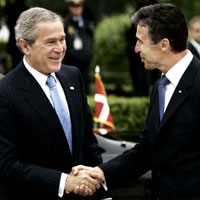 | President Bush to Host Danish Prime Minister Anders Fogh Rasmussen at Camp David. Prime Minister Anders Fogh Rasmussen greets President Bush upon arrival at Marienborg, the Prime Minister's official residence. Photo by Hans-Jørgen Hvolby. |
# # # For Immediate Release, Office of the Press Secretary, April 21, 2006
RELATED: Keywords, President to Welcome, Wednesday, April 12, 2006 President Bush to Welcome German Chancellor Merkel, Wednesday, April 12, 2006 President Bush welcomes Ghana President John A. Kufuor, Wednesday, March 29, 2006 President Bush Welcomes President Obasanjo of Nigeria, Thursday, March 23, 2006 President Welcomes President Sirleaf of Liberia (VIDEO), Friday, March 17, 2006 President Welcomes Irish Prime Minister Ahern (VIDEO), Saturday, February 11, 2006 President Bush Welcomes President of Poland (VIDEO), Friday, February 10, 2006 President Bush Welcomes King Abdullah (VIDEO),
0
comments
||
||
Sunday, April 23, 2006
Teens embrace vintage vinyl, resist corporate control of music industry
Technorati Tags: Psychological Science or behavior and influences or vintage vinyl and corporate control or LPs and memory or music and Psychology or music industry
Teens embrace vintage vinyl, resist corporate control of music industry, Take those old records off the shelf, Apr 20/06, by Jenny Hall
 | Listening to records — the old fashioned vinyl discs long believed to have been made obsolete by CDs and music downloading — is for many young people a form of resistance against the music industry’s corporate taste-makers, |
In multiple interviews, Hayes’ research subjects said they liked the visual appeal of LP jackets and the act of scouring shops and conventions for hard-to-find releases. They overwhelmingly insisted that the sound quality of LPs was superior to that of modern formats and characterized LPs and the artists of the past as more authentic than the barrage of youth-oriented music being aggressively marketed at them today.
In a paper published in the February 2006 issue of Popular Music and Society, Hayes finds that though these reasons for preferring LPs were important, it was the physical interaction required by an LP — the need to gently place a needle on a record, to flip the record and to care for it — that really engaged his subjects. Indeed, he says, their “active involvement in negotiating the pops, skips and crackles endemic to most second-hand records” was essential to the experience and lent the music an air of authenticity.
Hayes argues that an affection for vinyl is liberating for these young people and helps them mark themselves as different from their peers as they reject the music industry’s attempts to define what’s popular and to regulate format. Their preferences are a form of resistance: “Through their retrogressive tastes and practices, these youth effectively disrupt the music industry’s efforts to define and regulate their consumer identities.”
Contact: David Hayes, Ontario Institute for Studies in Education of the University of Toronto e-mail: dhayes@oise.utoronto.ca, 416-526-6338 or 416-466-5754
More stories on Social Sciences Business and Law --- Discuss this story ---
Also today, in News@UofT: Paint-on laser could rescue computer chip industry --- U of T joins city for Earth Day 20-minute makeover
Related: Keyword biology, Sunday, April 16, 2006 Other people influence us and we don't even know it!, Tuesday, January 04, 2005 The Cassini-Huygens mission to Saturn, Sunday, March 20, 2005 Agriculture Secretary Mike Johanns, bovine spongiform encephalopathy (BSE), Thursday, March 24, 2005 Fish Oil Holds Promise in Alzheimer's Fight, Sunday, April 10, 2005 National Human Genome Research Institute (NHGRI), Friday, April 15, 2005 Study uncovers bacteria's worst enemy , Sunday, May 01, 2005 Yes, it is an exoplanet 2M1207 system, Friday, May 20, 2005 a polysaccharide called hyaluronan, Tuesday, May 24, 2005 pseudoneglect phenomenon, Friday, June 03, 2005 DOE JGI sequences DNA from extinct cave bear, Monday, June 06, 2005 From a Few Wild Ancestors, a Citrus Cornucopia, Tuesday, June 07, 2005 NHGRI Selects 13 More Organisms for Genome Sequencing, Sunday, July 24, 2005 Prehistoric Native Americans maize cultivation , Sunday, July 31, 2005 Protein 97 Synapse-associated (SAP97), Sunday, August 07, 2005 universal flu vaccine, Sunday, August 07, 2005 Smoking gun for Alzheimer's disease, Sunday, August 07, 2005 placental tissue, embryonic stem cells, Sunday, August 21, 2005 female senior faculty are still rare, Sunday, September 18, 2005 more rain would benefit New Orleans,
0
comments
||
||
DEADLY ASTRONOMICAL EVENT NOT LIKELY TO HAPPEN IN OUR GALAXY
Technorati Tags: ASTRONOMICAL or GALAXY and Earth or gamma radiation and gamma ray burst or supernova and light years or astronomers and heavy elements or stars and physics or universe and nanostructures or Milky Way
DEADLY ASTRONOMICAL EVENT NOT LIKELY TO HAPPEN IN OUR GALAXY, STUDY FINDS
 |
| The afterglow of GRB 030329 (white dot in center of image), as detected on April 15, 2003, by the Advanced Camera for Surveys on the Hubble Space Telescope. Ohio State University astronomers and their colleagues recently used data from this event and three others to determine that a gamma ray burst is unlikely ever to occur in the Milky Way galaxy. Credit: The European Space Agency / NASA / Andrew Fruchter (STScI), Andrew Levan (Leicester Univ.), GOSH Collaboration. |
Some scientists have wondered whether a deadly astronomical event called a gamma ray burst could happen in a galaxy like ours, but a group of astronomers at Ohio State University and their colleagues have determined that such an event would be nearly impossible.
Gamma ray bursts (GRBs) are high-energy beams of radiation that shoot out from the north and south magnetic poles of a particular kind of star during a supernova explosion, explained Krzysztof Stanek, associate professor of astronomy at Ohio State. Scientists suspect that if a GRB were to occur near our solar system, and one of the beams were to hit Earth, it could cause mass extinctions all over the planet.
The GRB would have to be less than 3,000 light years away to pose a danger, Stanek said. One light year is approximately 6 trillion miles, and our galaxy measures 100,000 light years across. So the event would not only have to occur in our galaxy, but relatively close by, as well.
In the new study, which Stanek and his coauthors submitted to the Astrophysical Journal, they found that GRBs tend to occur in small, misshapen galaxies that lack heavy chemical elements (astronomers often refer to all elements other than the very lightest ones -- hydrogen, helium, and lithium -- as metals). Even among metal-poor galaxies, the events are rare -- astronomers only detect a GRB once every few years.
But the Milky Way is different from these GRB galaxies on all counts -- it's a large spiral galaxy with lots of heavy elements.
The astronomers did a statistical analysis of four GRBs that happened in nearby galaxies, explained Oleg Gnedin, a postdoctoral researcher at Ohio State. They compared the mass of the four host galaxies, the rate at which new stars were forming in them, and their metal content to other galaxies catalogued in the Sloan Digital Sky Survey.
Though four may sound like a small sample compared to the number of galaxies in the universe, these four were the best choice for the study because astronomers had data on their composition, Stanek said. All four were small galaxies with high rates of star formation and low metal content.
Of the four galaxies, the one with the most metals -- the one most similar to ours -- hosted the weakest GRB. The astronomers determined that the odds of a GRB occurring in a galaxy like that one to be approximately 0.15 percent.
And the Milky Way's metal content is twice as high as that galaxy, so our odds of ever having a GRB would be even lower than 0.15 percent.
"We didn't bother to compute the odds for our galaxy, because 0.15 percent seemed low enough," Stanek said.
He figures that most people weren't losing sleep over the possibility of an Earth-annihilating GRB. "I wouldn't expect the stock market to go up as a result of this news, either," he said. "But there are a lot of people who have wondered whether GRBs could be blamed for mass extinctions early in Earth's history, and our work suggests that this is not the case."
Astronomers have studied GRBs for more than 40 years, and only recently determined where they come from. In fact, Stanek led the team that tied GRBs to supernovae in 2003.
He and Gnedin explained that when a very massive, rapidly rotating star explodes in a supernova, its magnetic field directs gamma radiation to flow only out of the star's north and south magnetic poles, forming high-intensity jets.
Scientists have measured the energies of these events and assumed -- rightly so, Stanek said -- that such high-intensity radiation could destroy life on a planet. That's why some scientists have proposed that a GRB could have been responsible for a mass extinction that occurred on Earth 450 million years ago.
Now it seems that gamma ray bursts may not pose as much a danger to Earth or any other potential life in the universe, either, since they are unlikely to occur where life would develop.
Planets need metals to form, Stanek said, so a low-metal galaxy would probably have fewer planets, and fewer chances for life.
He added that he didn't originally intend to address the question of mass extinctions. The study grew out of a group discussion during the Ohio State Department of Astronomy's "morning coffee" -- a daily half-hour where faculty and students review new astronomy journal articles that have been posted to Internet preprint servers overnight. In February, Stanek published a paper on a GRB he had observed, and during coffee someone asked whether he thought it was just a coincidence that these events seem to happen in small, metal-poor galaxies.
My initial reaction was that it's not a coincidence, and everyone just knows that GRBs happen in metal-poor galaxies. But then people asked, 'Is it really that well known? Has anybody actually proven it to be true?' And we realized that nobody had."
As a result, the list of coauthors on the paper includes astronomers across a broad range of expertise, which Stanek said is somewhat unusual in these days of specialized research. The coauthors were among faculty gathered for coffee that day, plus a few friends they recruited to help them: Stanek and Gnedin; John Beacom, assistant professor of physics and astronomy; Jennifer Johnson, assistant professor of astronomy; Juna Kollmeier, a graduate student; Andrew Gould, Marc Pinsonneault, Richard Pogge, and David Weinberg, all professors of astronomy at Ohio State; and Maryam Modjaz, a graduate student at the Harvard-Smithsonian Center for Astrophysics.
This work was sponsored by the National Science Foundation. #
Contact: Krzysztof Stanek, (614) 292-3433; Stanek.32@osu.edu
Oleg Gnedin, (614) 292-3099; Gnedin.1@osu.edu
Written by Pam Frost Gorder, (614) 292-9475; Gorder.1@osu.edu
Related: Keyword Nanotech Sunday, Sunday, April 16, 2006 Self-Powered Nanoscale Devices, Sunday, April 09, 2006 Nanopore Method Genome Sequencing, Sunday, April 02, 2006 Quantum dot method rapidly identifies bacteria, March 26, 2006 'Custom' nanoparticles, cancer diagnosis and treatment, Sunday, March 26, 2006, Green nanochemistry, American Chemical Society symposium, Sunday, March 19, 2006 nanotechnologists demonstrate artificial muscles powered by highly energetic fuels, Sunday, Sunday, March 12, 2006 magnetic phenomenon may improve RAM memories, February 26, 2006 Nanoscience study shows that quantum dots 'talk', Sunday, February 26, 2006 Nano-bots to undertake major tasks?, Sunday, February 19, 2006 Nanotech to improve health care delivery, Sunday, February 19, 2006 nano-canary in the nanotoxicology coalmine, Sunday, December 04, 2005 Nano-cages 'fill up' with hydrogen, Sunday, November 13, 2005 Testing toxicity of nanomaterials, Sunday, October 23, 2005 single-molecule car, 'Nanocar', Sunday, August 28, 2005 Writing at the nanoscale, Thursday, May 26, 2005 discontinuous palladium, siloxane self-assembled monolayer, Sunday, May 08, 2005 Center for Nanoscale Materials, Monday, April 25, 2005 Nanomagnets, Nanocomposite, Monday, March 21, 2005 porphyrin tubes may lead to new nanodevices, inexpensive hydrogen fuel
0
comments
||
||
Saturday, April 22, 2006
Earth Day 2006
 | EPA's Earth Day Web site offers you many tips and fun ways to protect the environment and your health every day.  |
Message from EPA's Administrator, Steve Johnson:"Our nation's environmental accomplishments are rooted in our goal to leave the Earth a better place than when we found it. President Bush and I invite you to nurture the health of our global environment by renewing your environmental ambitions this Earth Day." Steve Johnson's Earth Day message to EPA employees
Young environmentalists recognized Apr 20 - President George W. Bush and EPA Administrator Stephen L. Johnson presented 49 students from across the nation with the 2005 President's Environmental Youth Awards, honoring the students' achievements in environmental protection. News release --- The 2005 PEYA awards
EPA Administrator: Steve Johnson's page
Biography
Speeches
Action Plan
Technorati Tags: President Bush and White House or Earth Day and EPA, or Environmental Protection Agency and Stephen L. Johnson, or Clear Skies legislation, and Clean and Safe Water, or hydrogen fuel cells, and Advanced Energy Initiative,
Related: Keywords National Day, Friday, March 25, 2005 Greek Independence Day, 2005, Friday, April 01, 2005 National Former Prisoner of War Recognition Day, 2005, Tuesday, April 19, 2005 Education and Sharing Day, U.S.A., 2005, Tuesday, May 03, 2005 National Day of Prayer, 2005, Thursday, May 05, 2005 Mother's Day, 2005, Friday, June 03, 2005 National Child's Day, 2005, Saturday, July 23, 2005 Parents' Day, 2005, Tuesday, August 16, 2005 National Airborne Day, 2005, Friday, August 26, 2005 Women's Equality Day, 2005, Friday, September 09, 2005 National Day of Prayer and Remembrance for the Victims of Hurricane Katrina, Saturday, September 10, 2005 Patriot Day, 2005, Sunday, September 18, 2005 Family Day, 2005, Saturday, October 01, 2005 Child Health Day, 2005, Thursday, October 06, 2005 German-American Day, 2005, Thursday, November 03, 2005 Veterans Day, 2005, Thursday, November 24, 2005 Thanksgiving Day, 2005
0
comments
||
||
Presidential Podcast 04/22/06
Presidential Podcast 04/22/06  Subscribe to Our Odeo Podcast Channel and receive the Presidential Radio Address each week. Featuring real audio and full text transcript
Technorati Tags: President Bush and White House or economy and energy prices, or war on terror and immigration reform, or American Competitiveness Initiative, and Earth Day, or hydrogen fuel cells, and Advanced Energy Initiative,
Related: Keywords radio address, podcast, Saturday, April 15, 2006 Presidential Podcast 04/15/06, Saturday, April 08, 2006 Presidential Podcast 04/08/06, Saturday, Saturday, April 01, 2006 Presidential Podcast 04/01/06, March 18, 2006 Presidential Podcast 03/18/06, Saturday, March 11, 2006 bush radio address 03/11/06 full audio, text transcript, Saturday, March 04, 2006 bush radio address 03/04/06 full audio, text transcript, Saturday, February 25, 2006 bush radio address 02/25/06 full audio, text transcript, Saturday, February 18, 2006 bush radio address 02/18/06 full audio, text transcript, Saturday, February 04, 2006 bush radio address 02/04/06 full audio, text transcript, Saturday, January 28, 2006, bush radio address 01/28/06 full audio, text transcript, Saturday, January 21, 2006 bush radio address 01/21/06 full audio, text transcript, Saturday, January 14, 2006 bush radio address 01/14/06 full audio, text transcript, Saturday, January 07, 2006 bush radio address 01/07/06 full audio, text transcript, Saturday, December 31, 2005 bush radio address 12/31/05 full audio, text transcript, Saturday, December 24, 2005 bush radio address 12/24/05 full audio, text transcript,
0
comments
||
||
bush radio address 04/22/06 full audio, text transcript
 | bush radio address 04/22/06 full audio, text transcript PODCAST President's Radio Address In Focus: Jobs and Economy |
Subscribe to Our Odeo Podcast Channel and receive the Presidential Radio Address each week. Featuring real audio and full text transcript.THE PRESIDENT: Good morning. This weekend I am traveling in California, where I'm focusing on important issues for our Nation's future, including our economy, energy prices, the war on terror, and immigration reform.
America's economy is strong, and we need to keep it strong in an increasingly competitive world. The talent and innovative spirit of our people have driven America's economic growth. To maintain our economic leadership, our Nation must stay on the leading edge of innovation -- so I have proposed the American Competitiveness Initiative.
One important part of this initiative is improving math and science education for our young people, so they have the right skills to succeed in the 21st century economy. On Friday in San Jose, I had the chance to visit Cisco Systems, a company that understands the importance of preparing the next generation for the high-tech jobs of tomorrow.
Through its Networking Academy Program, Cisco is helping to train high school students in math, science, and information technology skills. By ensuring that we have a skilled workforce for the future, companies like Cisco are helping America compete with confidence, and keeping our economy growing, and creating new jobs for our citizens.
Saturday is Earth Day, and many of you are asking how we can meet our growing energy needs while protecting our environment. The key is technology. So I have proposed the Advanced Energy Initiative to change the way we power our homes, businesses, and cars. I will visit the California Fuel Cell Partnership to take a closer look at hydrogen fuel cells, one of the exciting new technologies supported by my initiative. These fuel cells have the potential to revolutionize the way we power our cars by giving us vehicles that will emit no pollution and will be more efficient than gas-powered cars.
My Advanced Energy Initiative will also help improve hybrid vehicles -- cars and trucks that run partly on electricity and help drivers save gas. We're funding research into a new generation of plug-in hybrid vehicles that could be recharged in electrical outlets and could allow many drivers to make their daily commute using no gasoline.
By developing these and other new sources of clean renewable energy like ethanol, we will continue growing our economy, reduce energy prices and protect our environment, and make America less dependent on foreign oil.
Americans are asking about our progress toward victory in the war on terror. I have confidence in the outcome of this struggle because I know the character of the people who wear our Nation's uniform. On Sunday, I will attend church and have lunch with Marine Corps and Navy personnel and their families at the Twentynine Palms base. I will tell them how honored I am to be their Commander in Chief and express the gratitude of all Americans for their service in the cause of freedom.
Since September the 11th, 2001, the men and women of our military have overthrown a cruel regime in Afghanistan, captured or killed many al Qaeda terrorists, liberated Iraq, and made America more secure from terrorist dangers. We're fighting the terrorists abroad so we do not have to face them here at home. By taking the fight to the terrorists and bringing liberty and hope to a troubled region, our courageous troops are making the world a safer place.
On Monday, I'll visit Irvine, California, to discuss immigration reform with the local community. Immigration is an emotional issue. And it's sparked passionate debate. When we discuss immigration, we're talking about the integrity of our borders, the enforcement of our laws, and the character of our Nation.
Here's what I believe: America does not have to choose between being a welcoming society and being a lawful society. We can be both at the same time. In the coming weeks, I'll press Congress to pass comprehensive immigration reform that secures our border, enforces our laws, meets the needs of our economy, and upholds our highest ideals.
We must also ensure that all immigrants assimilate into our society and learn our customs, our values, and our language. America is a land of immigrants and a Nation of laws. And we must stay true to both parts of this great heritage.
As Congress returns from its recess, its members have important and consequential work before them. I urge them to act on my initiatives to keep America competitive, to promote alternative sources of energy, reform our immigration system, and continue their support of our troops fighting in the global war on terror.
By taking these steps, we'll maintain America's strength. And a strong America will help lead the world to a future of greater freedom and prosperity and peace.
Thank you for listening.
END For Immediate Release, April 22, 2006
Technorati Tags: President Bush and White House or economy and energy prices, or war on terror and immigration reform, or American Competitiveness Initiative, and Earth Day, or hydrogen fuel cells, and Advanced Energy Initiative,
Related: Keywords radio address, podcast, Saturday, April 15, 2006 bush radio address 04/15/06 full audio, text transcript, Saturday, April 08, 2006 bush radio address 04/08/06 full audio, text transcript, Saturday, April 01, 2006 bush radio address 04/01/06 full audio, text transcript, Saturday, March 25, 2006 bush radio address 03/25/06 full audio, text transcript, Saturday, March 18, 2006 bush radio address 03/18/06 full audio, text transcript, Saturday, March 11, 2006 bush radio address 03/11/06 full audio, text transcript, Saturday, March 04, 2006 bush radio address 03/04/06 full audio, text transcript, Saturday, February 25, 2006 bush radio address 02/25/06 full audio, text transcript, Saturday, February 18, 2006 bush radio address 02/18/06 full audio, text transcript, Saturday, February 04, 2006 bush radio address 02/04/06 full audio, text transcript, Saturday, January 28, 2006, bush radio address 01/28/06 full audio, text transcript, Saturday, January 21, 2006 bush radio address 01/21/06 full audio, text transcript, Saturday, January 14, 2006 bush radio address 01/14/06 full audio, text transcript, Saturday, January 07, 2006 bush radio address 01/07/06 full audio, text transcript, Saturday, December 31, 2005 bush radio address 12/31/05 full audio, text transcript,
0
comments
||
||
Freedom Calendar 04/22/06 - 04/29/06
April 22, 1981, President Ronald Reagan establishes first annual Days of Remembrance of Victims of the Holocaust.
April 23, 1971, Republican appointee Herbert Choy becomes first Asian-American federal judge, named by President Richard Nixon to U.S. Court of Appeals.
April 24, 1974, James M. Rogers, Jr. is first African-American selected National Teacher of the Year, by President Richard Nixon.
April 25, 1975, Appointed by President Gerald Ford, Dick Yin Wong becomes first Asian-American to serve as judge on a U.S. District Court.
April 26, 1999, Legislation authored by U.S. Senator Spencer Abraham (R-MI) awarding Congressional Gold Medal to civil rights pioneer Rosa Parks is transmitted to President.
April 27, 1822, Birth of Republican President Ulysses Grant; championed and enforced Republican legislation to safeguard civil rights of African-Americans.
April 28, 1971, Rear Admiral Samuel Lee Gravely becomes first African-American to achieve Flag Rank in U.S. Navy, promoted by President Richard Nixon.
April 29, 1877, Death of Republican Gov. William Brownlow, who led fight for Tennessee’s ratification of 14th Amendment guaranteeing due process and equal protection of the laws.
“Much can be done by law towards putting women on a footing of complete and entire equal rights with man — including the right to vote, the right to hold and use property, and the right to enter any profession she desires on the same terms as the man...Women should have free access to every field of labor which they care to enter, and when their work is as valuable as that of a man it should be paid as highly.”
Theodore Roosevelt, 26th President of the United States
SOURCE: Republican Freedom Calendar
Technorati Tags: President Bush and Freedom Calendar or NAACP and Republicans or African-Americans and Ronald Reagan or right to vote and Civil Rights or Abraham Lincoln and Frederick Douglass or 40 acres and a mule or Brown v. Board of Education and Martin Luther King or Dred Scott
Related: Keywords Freedom Calendar, Saturday, April 15, 2006 Freedom Calendar 04/15/06 - 04/22/06, Saturday, April 08, 2006 Freedom Calendar 04/08/06 - 04/15/06, Saturday, April 01, 2006 Freedom Calendar 04/01/06 - 04/08/06, Saturday, March 25, 2006 Freedom Calendar 03/25/06 - 04/01/06, Saturday, March 18, 2006 Freedom Calendar 03/18/06 - 03/25/06, Saturday, March 11, 2006 Freedom Calendar 03/11/06 - 03/18/06, Saturday, March 04, 2006 Freedom Calendar 03/04/06 - 03/11/06, Saturday, February 25, 2006 Freedom Calendar 02/18/06 - 03/04/06, Saturday, February 18, 2006 Freedom Calendar 02/18/06 - 02/25/06, Saturday, February 11, 2006 Freedom Calendar 02/11/06 - 02/18/06, Saturday, February 04, 2006 Freedom Calendar 02/04/06 - 02/11/06, Saturday, January 28, 2006 Freedom Calendar 01/28/06 - 02/04/06, Saturday, January 21, 2006 Freedom Calendar 01/21/06 - 01/28/06, Saturday, January 14, 2006 Freedom Calendar 01/14/06 - 01/21/06, Saturday, January 07, 2006 Freedom Calendar 01/07/06 - 01/14/06, Saturday, December 31, 2005 Freedom Calendar 12/31/05 - 01/07/06, Saturday, December 24, 2005 Freedom Calendar 12/24/05 - 12/31/05, Saturday, December 17, 2005 Freedom Calendar 12/17/05 - 12/24/05,
0
comments
||
||
Discurso Radial del Presidente a la Nación 04/22/06
| forre el audio de la dirección de radio 04/22/06 por completo, transcripción del texto PODCAST Discurso Radial del Presidente  En Foco: Inmigración |
EL PRESIDENTE: Buenos Días. Este fin de semana estoy de viaje en California enfocando temas importantes para el futuro de nuestra Nación... incluyendo nuestra economía... los precios de energía... la guerra contra el terror... y la reforma migratoria.
La economía de Estados Unidos está fuerte - y necesitamos mantenerla fuerte en un mundo cada vez más competitivo. El talento y el espíritu innovador de nuestra población han impulsado el crecimiento económico de Estados Unidos. Para mantener nuestro liderazgo económico, nuestra Nación necesita mantenerse a la vanguardia de la innovación por lo cual he propuesto la Iniciativa de Competitividad Estadounidense.
Una parte importante de esta iniciativa consiste en mejorar la educación en matemáticas y ciencias para nuestros jóvenes para que tengan las habilidades adecuadas para lograr éxito en la economía del siglo 21. El viernes en San José tuve la oportunidad de visitar Cisco Systems, una compañía que comprende la importancia de preparar la siguiente generación para los empleos de alta tecnología del mañana. A través de su programa de Networking Academy, (Academia para Establecimiento de Contactos) Cisco está ayudando a capacitar a alumnos de secundaria en matemáticas, ciencias y habilidades de tecnología de información. Al asegurar que tengamos una población activa capacitada para el futuro, compañías como Cisco están ayudando a Estados Unidos a competir con confianza - y ayudando a nuestra economía a crecer y crear nuevos empleos para nuestros ciudadanos.
El sábado es el Día de la Tierra, y muchos de ustedes se preguntan cómo podemos satisfacer nuestras crecientes necesidades energéticas y al mismo tiempo proteger a nuestro medio ambiente. La clave es la tecnología - por lo cual he propuesto la Iniciativa de Energía Avanzada para cambiar la manera en que damos energía a nuestros hogares, negocios y automóviles. Visitaré la Asociación Californiana de Células de Combustible - una de las nuevas tecnologías interesantes apoyadas por mi iniciativa. Estas células de combustible tienen el potencial de revolucionar la manera en que propulsamos a nuestros automóviles, dándonos vehículos que no emitirán contaminantes y serán más eficientes que los automóviles propulsados por gasolina. Mi Iniciativa de Energía Avanzada también ayudará a mejorar los vehículos híbridos - automóviles y camiones que operan parcialmente con electricidad y ayudan a los conductores a ahorrar en gasolina. Estamos financiando la investigación en una nueva generación de vehículos híbridos que se enchufan y que podrían recargarse en tomas eléctricas y permitir a muchos conductores ir y venir del trabajo a diario sin usar gasolina. Al desarrollar estas y otras nuevas fuentes de energía limpia y renovable, como el etanol, seguiremos haciendo crecer a nuestra economía, reduciremos los precios energéticos y protegeremos a nuestro medio ambiente, haciendo que Estados Unidos dependa menos en petróleo extranjero.
Los estadounidenses se preguntan sobre nuestro progreso hacia la victoria en la guerra contra el terror. Yo tengo confianza en el desenlace de esta lucha, pues conozco el carácter de las personas que portan el uniforme de nuestra Nación. El domingo iré a la iglesia y almorzaré con personal de la Infantería de Marina y de la Marina y sus familias en la base Twenty-Nine Palms. Les diré lo honrado que me siento de ser su Comandante en Jefe - y expresarles la gratitud de todos los estadounidenses por su servicio en la causa de la libertad. Desde el 11 de setiembre, 2001 los hombres y mujeres de nuestras fuerzas armadas han derrotado un régimen cruel en Afganistán, han capturado o dado muerte a muchos terroristas al- Qaida, han liberado a Irak y han hecho que Estados Unidos esté más seguro contra peligros terroristas. Estamos luchando contra los terroristas en el extranjero para no tener que enfrentarlos en casa. Al llevar la lucha a los terroristas y traer la libertad y la esperanza a una región en conflicto, nuestras tropas valientes están haciendo del mundo un lugar más seguro.
El lunes visitaré Irvine, California para discutir la reforma migratoria con la comunidad local. La inmigración es un tema emocional y ha hecho estallar un debate apasionado. Cuando discutimos inmigración, estamos hablando de la integridad de nuestras fronteras... del cumplimiento de nuestras leyes... y del carácter de nuestra Nación. Esto es lo que yo creo: Estados Unidos no tiene que escoger entre ser una sociedad acogedora y ser una sociedad donde se cumplen las leyes - podemos ser las dos cosas al mismo tiempo. En las semanas por venir, le pediré al Congreso que aprueba una reforma migratoria integral que traiga seguridad a nuestra frontera... haga cumplir nuestras leyes... cumpla con las necesidades de nuestra economía... y sostenga nuestros ideales más elevados. También debemos asegurar que todos los inmigrantes se asimilen en nuestra sociedad y aprendan nuestras costumbres, nuestros valores y nuestro idioma. Estados Unidos es un país de inmigrantes y una nación de leyes - y debemos ser fieles a ambas partes de este gran legado.
Al regresar el Congreso de su receso, sus miembros tienen trabajo importante y consecuente por delante. Les pido que tomen acción en cuanto a mis iniciativas para mantener competitivo a Estados Unidos... para promover fuentes alternativas de energía... reformar nuestro sistema migratorio... y continuar apoyando a nuestras tropas que luchan en la guerra global contra el terror. Al tomar estos pasos, mantendremos la fuerza de Estados Unidos - y un Estados Unidos fuerte ayudará a llevar el mundo a un futuro de mayor libertad y prosperidad y paz.
Gracias por escuchar.
Para su publicación inmediata, Oficina del Secretario de Prensa, 22 de abril de 2006
Etiquetas De Technorati: Discurso Radial del Presidente a la Nación, y Presidente Bush, o economía, y costes de la energía, o guerra en terror, y reforma de la inmigración, o Iniciativa Americana De la Competitividad, y Día De la Tierra, o Iniciativa Avanzada De la Energía,
Relacionado: Dirección de radio de las palabras claves, podcast, Sábado, De Abril El 15 De 2006 Discurso Radial del Presidente a la Nación 04/15/06, Sábado, De Abril El 08 De 2006 Discurso Radial del Presidente a la Nación 04/08/06, Monday, April 03, 2006 Rice urge progreso en cuanto a gobierno en Iraq, Saturday, April 01, 2006 Discurso Radial del Presidente a la Nación 04/01/06, Lunes, De Marcha La 27 De 2006 Declaraciones Del Presidente Después De Reunión Sobre La Reforma Inmigratoria, sábado, de marcha la 25 de 2006 Discurso Radial del Presidente a la Nación 03/18/06, sábado, de marcha la 18 de 2006 Discurso Radial del Presidente a la Nación 03/18/06,
0
comments
||
||


