Technorati Tags: President Bush and White House or Scott McClellan and gas prices, or energy prices and oil, or National Economic Council, and comprehensive energy plan, or Secretary Rumsfeld and VIDEO or Advanced Energy Initiative and Strategic Petroleum Reserve or refining capacity and Egypt or Hamas and Iran or CIA
You heard the President talk earlier today about some short-term steps we're taking to address high gas prices, as well as our efforts in the long run to address the root cause of high energy prices. This is something that has been building for decades. It's not something that we got into overnight, it's not something we're going to get out overnight -- get out of overnight. But the President is concerned particularly with the summer travel season coming up about rising gas prices. And there are steps that we can take in the short-run to help address those high energy prices.
And we also need to continue to move forward in a bipartisan way on the President's initiative to really transform the way we power our cars and our trucks, and reduce our dependence on foreign sources of oil. As the President said, we're addicted to oil, and we need to reduce our dependence on foreign sources of oil. That's how we're going to solve this problem over the long run. In the meantime, we are going to continue to look for ways we can help address high gas prices in the short run. And that's what the President talked about earlier.
With that said, our Director of the National Economic Council, Al Hubbard, is going to be holding a conference call at 2:15 p.m. today to discuss President's four-point plan for addressing high gas prices in greater detail, and answer some of the questions you might have on specific issues relating to it.
With that, I'll be glad to go to your questions.
Q Scott, let me try one before Mr. Hubbard. What do you think the impact is going to be at the pump of relaxing environmental rules, and how soon do you think that will show up?
MR. McCLELLAN: Well, you heard the President talk about how supplies are tight. Global demand is rising faster than supply. And that's one of the reasons we're in this situation. He laid out the reasons why gas prices are high right now, and he talked about how experts predict that gas prices will continue to be high over the summer. And when supplies are tight like this, every little bit helps.
And that's why we're acting on a number of fronts to address high gas prices in the short run. And these are all steps that we believe can help in the short run while we continue to work and move forward on a comprehensive solution to eliminate the cause of high gas prices. That's the way that we're ultimately address this issue and solve it for the long run. We have got to reduce our dependence on foreign crude.
Q Well, so are you saying that you don't think there is going to be a significant impact on prices?
MR. McCLELLAN: Well, there are steps we can take in the short run, and that's what the President was talking about today. And that's what we're going to do to help address the situation. As the President talked about in his remarks, our economy is strong and growing. And we have a very strong economy. We have seen millions of jobs created over the last few years, an unemployment rate that is down to 4.7 percent.
But high gas prices are like an additional tax on working families and working Americans. It puts a strain on families that are trying to live within a budget. It puts a strain on small businesses that are trying to create jobs. It puts a strain on farmers that are trying to get product to market. So we have a responsibility at the federal level to do all we can to help address that situation, and that's why the President is continuing to take the steps that he outlined.
Remember just last year, we passed a comprehensive energy plan, and that's an important approach for the long run, and an important and comprehensive way to address the root cause of why we have high energy prices. Again, this is something that has been building for decades. And it's not something we're going to get out overnight. But we have a responsibility to help address it in the short run, and that's what these steps will do.
Q A lot of Americans are going to listen to what the President had to say today; they're going to digest the four-point plan, and the first question is going to be, that's fine; what does it mean dollars and cents to me in the near-term, this summer when they gas up to go on vacation? So can you give us any indication as to that will translate to -- rough dollars and cents -- in terms of a difference --
MR. McCLELLAN: Well, I think, Jim, that depends on a lot of factors. You've got China and India playing in the global market now. And they are -- they have an increase in demand for oil. You have a refining capacity that is still coming back up in the aftermath of the hurricanes. And it has made significant progress. But this is a recurring problem that we see year after year. We saw rising gas prices last summer. We've seen it in the years before. That's why I pointed out it's been building for decades.
But what we're doing today and continuing to do is build upon the initiatives we've put in place. The President is concerned about the impact it is having on families. And that's why these steps will help address those rising gas prices.
Q Every expert that I've talked with says, you know what, at the end of the day, this isn't a Democratic or Republican issue.
MR. McCLELLAN: Absolutely not.
Q At the end of the day, there's just not a whole lot anybody can do.
MR. McCLELLAN: No, and one of the things that the President emphasized today is that this is something that we can work together on to do for the American people. The Advanced Energy Initiative is a bold proposal that will really go to the root cause of why we are in this situation today.
Again, it's not something that happened overnight. It's something that's been building for a long period of time. And we need to continue to act on that front. But in the short run, there are some steps we can take. And I think I've talked about that in this room before. The President has talked about it, as well. And energy companies have a responsibility, too. The President pointed that out.
When the price of oil is at record levels, energy companies should be reinvesting some of their profits back into alternative sources of energy, new technologies, increasing domestic supply, increasing refining capacity. Those are all steps that can help. All of us have a responsibility to act when we're in a situation like this.
There are also steps that consumers can take to help address this situation, as well. And the Department of Energy has put that out.
Go ahead.
Q Scott, so given China and India's demand and these other things you list, it seems unlikely that Americans will see any difference at the pump any time soon, certainly not this summer.
MR. McCLELLAN: No, that's what I was just pointing out, and that's what the President talked about in his remarks today is that these steps can help address high gas prices, and help reduce gas prices, but this is a problem that has been building for decades, and we've got to find a solution for the long run that will eliminate the cause of why we are in this situation today. And that's why we're continuing to act. We have acted, we're continuing to act, and the President is concerned about the strain that it puts on families and working Americans.
Q So it's unlikely that Americans will see any lowering of gas prices this summer or even in the fall?
MR. McCLELLAN: No, I didn't say that. In fact, these steps can help address high gas prices. But what I said was that experts, and the President talked about that in his remarks, predict that we'll continue to see high gas prices over the busy summer travel period because of the supply situation. This is a supply and demand problem that we are in, and that's why the President is acting on a number of fronts -- first and foremost to make sure that consumers are treated fairly, to make sure that there's no price gouging.
We will not tolerate price gouging, and that's why this administration has continued to act to make sure that when you have the spike in gas prices that there is not unfair manipulation of prices or any price gouging going on in the market.
But the President also announced some other steps that we're taking, such as deferring deposits to the Strategic Petroleum Reserve for a short period of time and then -- delaying those deposits, and then we'll start filling it again back in the fall. The Strategic Petroleum Reserve has a large amount of oil in it right now that we believe is sufficient in case there is a major supply disruption. So that's why we took that step. And then there are other steps we're taking, too, such as calling on Congress to speed up the permitting process for refineries. We have to address it on all fronts, and every step we take can help a little bit to address it in the short run.
Q Some members of Congress are saying that the only way that the President can really send a get-tough message to the oil companies is to impose a windfall profits tax. What's the administration's policy --
MR. McCLELLAN: Well, I think the President actually talked about this in his remarks earlier today. There are some Democrats, in the past, who have advocated raising taxes or capping prices. And that is a failed approach. It's a failed command-and-control approach of the past. We have seen that approach tried, tried in the '70s. The President has a better approach. He believes that that would be the wrong approach, if someone is advocating raising taxes or capping prices. Energy companies don't need to be receiving taxpayer funded incentives when the price of oil is at record levels. And the President made that very clear in his remarks. And energy companies have a responsibility to reinvest their profits back into alternative sources of energies, new technologies, expanding domestic production and expanding refining capacity.
Go ahead, Connie.
Q Three Middle East questions. And first of all, I just want to say, we're going to miss you, and I hope you'll miss us.
MR. McCLELLAN: I'm still here for a little while.
Q I've got Egypt, Hamas and Iran. Which one do you want first?
MR. McCLELLAN: Go ahead.
Q Okay, Egypt. Will the U.S. help Egypt in any way beefing up security or with more financial assistance?
MR. McCLELLAN: Well, our embassy yesterday indicated that we have offered to assist in any way that is needed. The President had a good call with President Mubarak earlier this morning. The President extended our condolences on behalf of the American people for the loss of life. There were a number of Egyptians who lost their life. A number of people were wounded, as well, including, I think, four American citizens was the last I heard.
So the victims and their families remain in our thoughts and prayers. President Mubarak indicated that he was going to pursue those who are responsible and bring them to justice. We remain engaged in a global war on terrorism, and the United States stands strongly with the Egyptian people as we wage this war and prevail in this war on terrorism. We will continue to take the fight to the enemy abroad.
Q What happens with Iran tomorrow when they say they're not going to meet the deadline, the U.N. deadline?
MR. McCLELLAN: Not meet the deadline --
Q The U.N. deadline regarding nuclear enrichment. They're already made that announcement.
MR. McCLELLAN: Well, I think they've said a lot of things, and I think they've said more than just what you said. I mean, I think they've said that they intend to continue their enrichment activity. The United Nations Security Council and the IAEA board made very clear what the regime needs to do. The regime is continuing to move in the opposite direction. The Security Council will be receiving a report from the Director General of the International Atomic Energy Agency here later this week. We expect that it will show that the regime remains in non-compliance with its obligations, given that the regime has publicly said it is continuing to move forward on enrichment-related activity.
It's time for the Security Council to look at the next step. Secretary Rice has talked about that. It's time for the Security Council to look at what action needs to be taken for this regime's continued defiance. This is a regime that continues to move on the opposite direction. It needs to be building confidence with the international community. Instead, it is defying the international community. And it's important to continue to keep international pressure on the regime to come clean and comply with its obligations. I think you're seeing by their statements that they only want to escalate the situation, that they are continuing to move forward on defying the international community, and that somewhat ends any premise that their program is for peaceful purposes. That has been our concern all along, that they are developing nuclear weapons under the cover of a civilian program. That's why we're working to find a diplomatic solution to get the regime to change course.
Q Hamas and Osama bin Laden's statements that the U.S. has cut aid to the Palestinians, do you want to counter that?
MR. McCLELLAN: Well, I think we expressed our views on the most recent statements by Osama bin Laden the other day. Clearly this is a leader and head of an organization that is under a lot of pressure and that is on the run. We are winning the war on terrorism, but the threats remain. We remain engaged in the war on terrorism. We take the threats seriously. That's why we're doing everything within our power to continue to take the fight to the enemy and continue to prevail in this war on terrorism. And that's exactly what we will keep doing as long as this President is in office.
Q -- the U.S. still giving aid to the Palestinians, just not for Hamas?
MR. McCLELLAN: We are continuing to provide humanitarian assistance to the Palestinian people. We actually increased some of that aid. But one thing we will not do is deal with an organization that advocates violence and terrorism as a means to attain its objectives. And this is an organization that -- and government now that the United Nations and the rest of -- or the Quartet has called on to renounce violence, to recognize Israel's right to exist, and to work with the international community by abiding by the previous agreements of the Palestinian Authority. And that's what it needs to do. It has a choice to make. But as long as it continues to hold the policies that it does, and does not meet those commitments, we will not deal with Hamas.
Go ahead.
Q Scott, two questions. First one, the President told his audience this morning that he spoke to Prime Minister Tony Blair this morning.
MR. McCLELLAN: That's right.
Q Can you give us a little bit of a read-out? Did they discuss the Egyptian bombings? And did they --
MR. McCLELLAN: This is a new guy at the White House. They speak on virtually a weekly or bimonthly basis, and we don't get into reading out those calls. But obviously, they did talk about the formation of the Iraqi government. This is a very hopeful moment. It's something the President talked about with the bipartisan group of senators that were here earlier today. No matter where you stood before or where you stood on some of the decisions that were made, we can all agree that this is a hopeful moment and the Iraqi leaders are really laying the foundation for a democratic Iraq to emerge in the broader Middle East.
Q The second question, has the President been briefed at all on the CIA's firing of Mary McCarthy for allegedly leaking classified information? Does he have any reaction to this?
MR. McCLELLAN: Well, that was a decision that was made by, I think, the Central Intelligence Agency. I think they put out a statement on that last week. Remember, Director Goss had talked about how there had been some unauthorized leaks of classified information that had severely harmed our national security. And in that statement he talked about how he directed that there be an internal investigation undertaken. And as a result of that investigation, there was some action that they took last week.
Q So how is it, though, that the CIA was able to act so quickly in somebody who they think linked classified information? Here it is almost three years after Valerie Plame's name was leaked, the White House still doesn't know who leaked that information. How is it that the CIA --
MR. McCLELLAN: You mean -- the White House is not the one leading that investigation. That is being led by a special prosecutor.
Q Could the President call on the CIA Director to get to the bottom of it? There's a criminal matter going on with Mary McCarthy now. At least the Justice Department is looking at it, so it's not like a criminal matter --
MR. McCLELLAN: What the President directed was that we cooperate fully with the special prosecutor. And that's what we've done.
Q But how is it that the CIA was able to get to the bottom of that one case so quickly, and we still don't know --
MR. McCLELLAN: Well, I think they talked about it, and how they conducted an internal investigation to get to the bottom of the matter. The leaking of classified information is a very serious matter. And the unauthorized disclosure of classified information can severely harm our national security. We have talked previously about the terrorist surveillance program and how the unauthorized disclosure of that program has shown the enemy our playbook. We are engaged in a difficult and long war against a bunch of ideological extremists who want to do everything they can to stop the advance of freedom in this world and want to harm innocent Americans and innocent people in the civilized world. And that's why it's important that we not show them our playbook. So the leaking of classified information is a matter that the President takes very seriously.
Go ahead.
Q Two questions. What our poll says, I think, the President is doing his best in many areas. How would the President assess his 1,000 days in office? And also, don't you think that by bringing oil prices down and Osama bin Laden at home, or to justice will bring his ratings up?
MR. McCLELLAN: Well, the President is focused on getting things done for the American people and building a safer world and more prosperous America. We have accomplished much over the last few years, and there's much that the President wants to accomplish in the remaining thousand days. And we will continue to move forward aggressively to get things done for the American people, and look at ways that we can work in a bipartisan way to accomplish important priorities for the American people. That's what the President outlined in his State of the Union address.
Go ahead.
Q Second, on Iran -- not on Iran. I would agree with the Washington Post editorial the other day that the lady, Wenyi Wang, who protested on the White House lawn, of course, there's no doubt about it that she used the wrong platform to protest. But at the same time, don't you think she had a message for both Presidents how the Chinese are being prosecuted in China, and human rights and millions are being killed or sent in labor camps, and there are -- like Tibetans and others? So how President took this message and the Chinese President?
MR. McCLELLAN: You've set aside your question. The President talked -- or expressed his regret for the incident taking place here at the White House. Certainly, people have a right to express their views and do so in a peaceful way. But the President talked about that issue last week through people that participated in those meetings. And in terms of our concerns when it comes to religious freedom and human rights, we express those very clearly to governments around the world.
Go ahead, Carl.
Q Gas prices again, Scott. On the subject of the ongoing -- or the new investigation into whether or not there may or may not be price gouging by the attorneys general, as directed by the FTC and the DOJ, has there been any indication from previous FTC studies in the wake of Katrina, or for that matter, information that has merely crossed the White House transom that suggests that there has been collusion in the oil industry, or with gas --
MR. McCLELLAN: Well, I think that the FTC or the Department of Energy is probably the best place to talk about what has occurred. They have publicly talked about what they have found. And they talked about what they found in the aftermath of Hurricane Katrina. I believe they put out a release on it. They said while they looked into it, they found most people were acting responsibly. But they did find some instance that caused them concern.
But the President believes this is an important area where we need to focus, making sure that consumers are being treated fairly, particularly when you have gas prices that have been going up. And that's why he pointed out that the FTC has been investigating whether prices have been unfairly manipulated in the aftermath of the hurricanes. The President also talked about how he's directed the Department of Justice to work with the FTC and the Department of Energy to conduct inquiries into possible cheating or illegal manipulation.
And then today, the FTC head and the Attorney General sent a letter to the 50 state attorneys general saying that it's important that you aggressively look after this to make sure this isn't happening, and we're here to assist you as you do so.
We will not tolerate any price gouging, particularly when you have a situation like this where gas prices have been going up.
Q You talked earlier about how the summer spike is a recurring problem, something we've seen year after year. Is that recurring problem now something that you're suggesting the American people have to accept and come to grips with?
MR. McCLELLAN: No, because we can address it by moving forward on the President's Advanced Energy Initiative, and really transforming the way we power our cars and our trucks. That's why the President said, we need to get off our dependence on foreign oil. We need to look at new ways to get energy. And the President has outlined some very practical steps that we can take. And we need to begin now.
Remember, if we -- the President talked about expanding domestic production in his remarks, as well. There are four key parts to his plan that he outlined. If ANWR had passed and been implemented, we would have additional oil available today. It was passed a decade ago, yet it was vetoed by his predecessor.
So we have to act on all fronts. And that's why the President outlined the steps that we've been taking and are continuing to take to address things in the short run.
Q If we can just sort of split the long term versus the short run, then. In the context of the short run, with all the initiatives that the President -- the four-point plan today and the things the President is doing in the immediate, just because this has been a lengthy discussion here this morning, what are you saying to the guy out in Iowa who is about to go to the gas pumps and see extraordinary prices, and that's going to affect his budget? Should he be expecting what the President unrolled today to have an affect on holding the price where it is, ceasing its rise, or beginning its drop?
MR. McCLELLAN: What the President said in his remarks is what he would say to that person you mentioned, that this has been building for decades. We're not going to get out of it overnight. But there are steps that we can take at the federal level in the short run, and we're going to do every little bit we can to help reduce gas prices in the short run. This is a problem that we got into over decades of increased reliance on foreign sources of energy.
And to get out of it, we have to go and address the root cause of high energy prices. The root cause is that we're dependent on foreign oil, that we are addicted to oil. And that's why the President outlined a plan that is very far- reaching in its impact. It will transform the way we power our cars and our trucks and other vehicles.
Q Last one. Moments ago on the Hill, Senator Schumer of New York suggested that the President's remarks today, while welcome, left out, get tough on big oil. What sort of --
MR. McCLELLAN: The President made a very public comment calling on the energy companies to meet their responsibility to help reduce gas prices. Remember, let's look at where things stood last year. Many Democrats voted against the comprehensive energy plan that this President advocated from very early on in his administration and was finally passed last year. That is a plan that will help expand conservation, help develop new technologies to look at alternative sources of energy, like the President has outlined in his Advanced Energy Initiative.
It was Democrats, many Democrats, that have voted against efforts to expand domestic production capacity here at home and oppose efforts like opening up a small portion of ANWR to environmentally responsible exploration and production.
So I think the record is very clear. We're focused on practical solutions and acting on all fronts. Some are focused on playing politics.
Go ahead.
Q To follow up on his previous question. Do you not know what these -- the effect of these steps will be on gasoline prices, or are you just not --
MR. McCLELLAN: Well, I'll let other people who are more expert in this than me focus on this issue. But I think it --
Q Does the administration not know --
MR. McCLELLAN: Keith, you have to understand the situation we're in and the fact that this is a supply and demand issue. Supplies are tight because of the demand for oil, because we are in a global market now, where you have countries like China and India that are growing and increasing their demand for oil.
Now, there are some -- there are some parts that are temporarily affecting the increase in the price of oil, such as the switch in fuel mix that goes on now from MTBE to ethanol. And so I think it depends on a variety of factors. But what we ultimately have to do in the long run is get off our dependence on foreign sources of energy.
Q But my question is, these steps each have a cost. You're not putting as much into strategic reserve as you'd like. There's an environmental cost. Why would you take steps that have costs without knowing what the benefit would be?
MR. McCLELLAN: Well, all these steps will help address high gas prices in the short run. The benefit is that it will help consumers. But the ultimate solution to the problem that we are in today requires that we reduce our dependence on foreign sources of energy.
Q Okay, just lastly, you've asked the Justice Department -- the President has asked the Justice Department again to look at possible price gouging. Is there any evidence that there actually is price gouging going on?
MR. McCLELLAN: Well, that's why I think -- Terry or Jim asked that question earlier in the briefing. And you should go and look at -- the Department of Energy has a website that people can go to and report possible price gouging. And they talked about it in the aftermath of the hurricane how they found most people were acting responsibly, but there were some bad actors within that. And we're going to take action if we find it.
Q What I'm asking -- you're taking action and you're --
MR. McCLELLAN: Well, it's not only --
Q -- asking the Justice Department to look at something, these are the police coming to look for something, do you have any evidence that --
MR. McCLELLAN: It's also the state attorneys general -- the state attorneys general that have primary authority over this. And when gas prices are spiking like this, you have a responsibility to make sure that people aren't illegally manipulating price or engaging in price gouging. And that's what we're going to do. We're going to continue to take all these steps to help address high gas prices and to make sure that American consumers are treated fairly.
Q So the standard -- it sounds like the standard is, when people make a lot of money, you've got to take a look to see if they're doing something illegal --
MR. McCLELLAN: No, when you have gas prices that are spiking, you need to make sure you're acting on all fronts to do your part at the federal level to reduce those gas prices. Now, there's only so much you can do in the short run. But that's why we're taking these steps. In the long run, we need to go to the root cause.
Go ahead, Victoria.
Q Does the President support Senator Clinton's move to have the generals who are calling for Secretary Rumsfeld's ouster, if you like, to testify before the Senate Armed Services Committee?
MR. McCLELLAN: The President strongly supports Secretary Rumsfeld and the job that he's doing. And we've talked about that repeatedly. And there are a number of generals who have come out and said very publicly -- former generals -- that he is someone who is a strong leader, and the type of leader we need during this critical period in our history where we remain engaged in a war, and we remain engaged in transforming our military to better meet the threats of the 21st century.
In terms of what the Senate does, they have their responsibilities. And they have their steps that they can take. The President has made very clear what his view is.
Q Senator Clinton said in a letter to Senator Warner that a hearing would help ensure that we learn from past experiences and better shape future operations. Is that not something that the White House is --
MR. McCLELLAN: I think the President has made his views very clear, Victoria.
Go ahead, Les.
Q Scott, a two-part. The President is the chief executive charged with enforcing the laws of the United States. And the law says an illegal entrant is to be deported. Yet yesterday he said mass deportation wouldn't work. And my question: By articulating that policy, isn't the President violating his executive duties?
MR. McCLELLAN: Les, the President has made very clear that we have a responsibility to enforce our laws. We are also a nation of immigrants, and we can be both. We can enforce our laws or do both, and we can be a nation of immigrants. We have an immigration problem in this country, and the President has outlined a commonsense and practical way to fix the system. And we need to take a comprehensive look at it. We have taken a number of steps to better secure our borders. Funding has increased substantially for border security under this administration. We've called for additional increases in our most recent budget. We substantially -- or significantly increased the number of Border Patrol agents. We're deploying new technologies along the border. We are stepping up our efforts to make sure that our laws on the interior -- in the interior are enforced. But we also need to look at the reality of the situation.
We have -- I think it's an estimated 12 million undocumented people in this country. There is an economic need that some of those people are filling, jobs that Americans are not wanting to do. And the President believes that if we're going to fix the immigration system, we need to do it in a comprehensive way. And that means including a temporary guest worker program, which will help relieve pressure off the border.
We will enforce our laws, and we will continue to take steps to strengthen our borders. But we also need to address this problem and fix our immigration system. And if we're going to do so, you've got to do it in a comprehensive way.
Now, the President is meeting here shortly with a bipartisan group of senators who have been involved in moving forward on comprehensive immigration reform. Just before they recessed, they were able to come to what looked like a promising agreement to move forward on comprehensive reform. The President talked a little bit about that agreement yesterday, and talked about how it has an interesting approach to addressing this issue, where if you're here five years or less, you're treated differently from if you're here five years or more.
And the President is going to be urging these senators to break the impasse and resolve these issues so that they can move ahead on comprehensive immigration reform and get this done. It's an important priority. It's a priority that the President is strongly committed to. That's why yesterday in California, he was talking about it, and talked about his views.
Go ahead.
Q London's Daily Telegraph quotes Israeli Defense Minister Shaul Mofaz as saying, "Of all the threats we face, Iran is the biggest. Since Hitler, we have not faced such a threat." And my question: Does the Bush administration disagree with this statement and with a probable Israeli nuclear attack to prevent an Iranian nuclear bombing of Tel Aviv?
MR. McCLELLAN: Well, Les, we believe it is a serious threat, and that's why we're working with international community to resolve this in a diplomatic way and keep the pressure on the regime in Iran to change its behavior and to come into compliance with its international obligations. This is a regime that continues to isolate itself and its people from the rest of the international community.
Q It tears down everything that the President has suggested.
MR. McCLELLAN: Yes, you can understand how --
Q How do you know when they're going to lay a bomb --
MR. McCLELLAN: It's not the President, it's the international community. The international community is united in our desire to prevent the regime from developing a nuclear weapon. That's why we are working to address this issue through the Security Council and with other partners and friends in the international community.
We spelled out very clearly, the international community did, what the regime needs to do. This is a regime that continues to defy the international community and move in the opposite direction.
Go ahead, Sarah.
Q Thank you. Scott, signaled in the recent polls, even though the President says he doesn't pay attention to them, all the politicians do. What does the President plan to do differently between now and November to get Republicans elected or reelected?
MR. McCLELLAN: Well, the President is going to continue focusing on the priorities the American people care most about and continue pressing ahead to get things done that will help the American people. The President recognizes that while our economy is strong and growing because of the tax relief we put in place, there is more that we need to do. That's why he outlined the Competitiveness Initiative, an initiative that will help keep America at the forefront of innovation and keep us the most competitive economy in the world. That's why he outlined a number of health care initiatives, to make health care more affordable and accessible for all Americans.
That's why we are moving forward on the prescription drug benefit for America's seniors. And you're seeing great response from the seniors who have signed up for that program. They're realizing significant savings, they're very happy with the coverage that they're receiving. The enrollment period is coming up here on May 15th -- ending on May 15th. And we're continuing to urge seniors to take a look at the options that are now available to them and to reach out to their family members and get help, or reach out to others who can help -- help them come to the decisions to choose the kind of health care that best fits their individual needs.
That's why we're moving forward on the Advanced Energy Initiative, urging Congress to pass this important initiative. The latest rise in gas prices should only create a greater sense of urgency for Congress to come together and move ahead on the President's energy policies.
We took an important step last year, but there's more that we need to do to address this situation so that we don't continue to be dependant on foreign sources of energy or be at the whim of some country that is hostile to America and could be destabilizing to the region from where that oil is being imported.
Go ahead, Stephen.
Q On today's bipartisan meeting, how is the invite list for that put together? Is there something common -- in common for the folks who are invited?
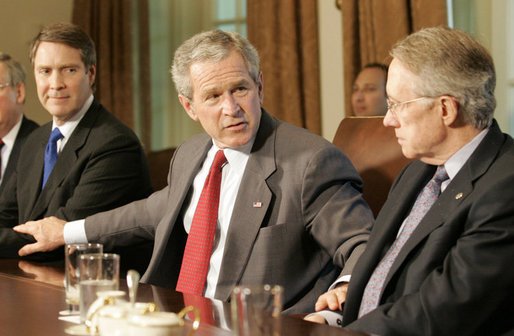
MR. McCLELLAN: Well, we have a number of meetings that have been going on with members of Congress and that are continuing to go on. This morning, the President met with a bipartisan group of senators to talk about the latest developments in Iraq. And they heard form our Ambassador, Ambassador Khalilzad, and they heard from General Casey. This afternoon is on immigration reform. Tomorrow, he's going to have another meeting on Iraq with some House members. So this is part of the President's outreach. These are people who have been very involved in this issue, and people that I think are committed to finding a way forward to get comprehensive reform done and moving beyond the procedural tactics that have held this agreement from going forward.
Go ahead.
Q The President --
MR. McCLELLAN: The Canadian.
Q Thank you, very much. A non-hostile country -- (laughter.) The President made a phone call to Prime Minister Harper on the weekend. Can you tell us about the contents of that call?
MR. McCLELLAN: Sure.
Q And two, was there, from the President, an offer to compromise, a solution on softwood lumber?
MR. McCLELLAN: The President had a good conversation with Prime Minister Harper. The President extended the condolences on behalf of the American people for the loss of the Canadian soldiers in Afghanistan. They talked about a range of other issues. One of the issues that was discussed was the softwood lumber issue. The President would like to see this resolved. I know that the Prime Minister would like to see it resolved. And both leaders reiterated their commitment to resolving the matter. We remain in discussions with Canadian officials about how to move forward and get this resolved.
Q But did that commitment get as far as a substantial --
MR. McCLELLAN: Well, I think I'll leave it where I did for now. Hopefully we can continue to make progress and resolve this matter.
Q Thank you.
MR. McCLELLAN: Thank you.
END 1:37 P.M. EDT For Immediate Release, Office of the Press Secretary, April 25, 2006
Related: Keywords Press Briefing Scott McClellan, Tuesday, April 11, 2006 Press Briefing Scott McClellan 04/10/06 (VIDEO), Wednesday, April 05, 2006 Press Briefing Scott McClellan 04/04/06 (VIDEO), Wednesday, March 29, 2006 Press Briefing Scott McClellan 03/28/06 (VIDEO), Friday, March 24, 2006 Press Briefing Scott McClellan 03/23/06 (VIDEO), Sunday, March 19, 2006 Press Briefing Scott McClellan 03/17/06 (VIDEO), Friday, March 17, 2006 Press Briefing Scott McClellan 03/15/06 (VIDEO), Wednesday, March 15, 2006 Press Briefing Scott McClellan 03/13/06 (VIDEO), Friday, March 10, 2006 Press Briefing Scott McClellan 03/09/06 (VIDEO), Tuesday, March 07, 2006 Press Briefing Scott McClellan 03/07/06 (VIDEO), Tuesday, February 28, 2006 Press Briefing Scott McClellan 02/27/06 (VIDEO), Friday, February 17, 2006 Press Briefing Scott McClellan 02/16/06 (VIDEO), Friday, February 17, 2006 Press Briefing Scott McClellan 02/14/06 (VIDEO), Tuesday, February 14, 2006 Press Briefing Scott McClellan 02/13/06 (VIDEO), Thursday, January 19, 2006 Press Briefing Scott McClellan 01/18/06 (VIDEO), Friday, December 16, 2005Press Briefing, Scott McClellan, Levee Reconstruction (VIDEO), Tuesday, December 06, 2005 Press Briefing Scott McClellan (VIDEO) 12/06/05, Thursday, November 10, 2005 Press Briefing by Scott McClellan 11/09/05 (VIDEO,