


Technorati Tags: President Bush or White House or Nominations and Rob Portman or Office of Management and Budget and United States Trade Representative or Susan C. Schwab
President George W. Bush today announced his intention to nominate two individuals to serve in his Administration:
The President intends to nominate Rob Portman, of Ohio, to be Director of the Office of Management and Budget. Ambassador Portman currently serves as United States Trade Representative. Prior to this, he served in the United States House of Representatives. He was a member of the Ways and Means Committee and its subcommittee on Trade. He served as Vice Chairman of the Budget Committee and Chairman of the House Republican Leadership. Earlier in his career, Ambassador Portman practiced international trade law at the Washington, DC law firm of Patton Boggs. He also served in President George H. W. Bush's Administration as Associate Counsel to the President and later as Deputy Assistant to the President and Director of the White House Office of Legislative Affairs. He received his bachelor's degree from Dartmouth College and his JD from the University of Michigan.
The President intends to nominate Susan C. Schwab, of Maryland, to be United States Trade Representative, with the Rank of Ambassador Extraordinary and Plenipotentiary. Ambassador Schwab currently serves as Deputy United States Trade Representative. Prior to this, she was the President and CEO of the University of Maryland Foundation, Inc. and USM Vice Chancellor for Advancement. She also served as Dean of the University of Maryland School of Public Policy. Earlier in her career, Ambassador Schwab served as Director of Corporate Business Development for Motorola, Inc. Ambassador Schwab also served as Assistant Secretary of Commerce and Director General for the U.S. & Foreign Commercial Service. Ambassador Schwab received her bachelor's degree from Williams College, her master's degree from Stanford University and her PhD from The George Washington University.
# # #, For Immediate Release, Office of the Press Secretary, April 18, 2006, Personnel Announcement.
RELATED: Keywords announced his intention to nominate, Friday, May 12, 2006 President to nominate one and appoint nine, Friday, May 12, 2006 President to nominate six and appoint two, Thursday, April 20, 2006 President to nominate four and appoint three, Thursday, Thursday, April 20, 2006 President to nominate four and appoint four, April 20, 2006 President to name four, Thursday, April 20, 2006 President to nominate Daniel L. Cooper, Thursday, April 20, 2006 President to nominate four, appoint sixteen and designate one, Friday, April 07, 2006 President to nominate one appoint five and designate one, Friday, April 07, 2006 President to nominate three and designate one, Friday, April 07, 2006 President to nominate three and appoint two, Friday, April 07, 2006 President to nominate one, Friday, April 07, 2006 President to nominate seven, appoint eight and designate one, Monday, March 06, 2006 President has nominated four and designated one, Monday, March 06, 2006 President names three individuals to serve in his Administration, Monday, March 06, 2006 4 Nominations Sent to the Senate, Friday, March 03, 2006 4 Nominations Sent to the Senate, Friday, March 03, 2006 President to nominate one and appoint seven,
Friday, May 12, 2006
President to nominate two
0
comments
||
||

President to nominate one and appoint nine
Technorati Tags: President Bush or White House or Nominations and Federal Procurement Policy or Office of Management and Budget and Holocaust Memorial Council or Department of Interior
President George W. Bush today announced his intention to nominate one individual and appoint nine individuals to serve in his Administration:
The President intends to nominate Paul A. Denett, of Virginia, to be Administrator for Federal Procurement Policy at the Office of Management and Budget. Mr. Denett is currently Vice President of Contracting Programs at ESI International. Prior to this, he was Senior Vice President for Program Development and Government Affairs at Star Mountain Incorporated. Earlier in his career, he served as Director of Administration, Director of the Office of Acquisition and Property Management, and Senior Procurement Executive at the Department of Interior. Mr. Denett has also served as the Director of the Office of Procurement and Senior Procurement Executive at the Department of the Treasury. He received his bachelor's degree from Nasson College and his master's degree from The George Washington University.
The President intends to appoint the following individuals to be Members of the United States Holocaust Memorial Council, for the remainder of five-year terms expiring January 15, 2011: Debra Abrams, of Florida Rebbetzin Esther Jungreis, of New York Norma Lerner, of Ohio Marvin A. Pomerantz, of Iowa Alan Neil Rechtshaffen, of New York J. Philip Rosen, of New York Elie Wiesel, of New York Bradley David Wine, of Maryland Judith Yudof, of Texas # # #
For Immediate Release, Office of the Press Secretary, April 17, 2006, Personnel Announcement
RELATED: Keywords announced his intention to nominate, Friday, May 12, 2006 President to nominate six and appoint two, Thursday, April 20, 2006 President to nominate four and appoint three, Thursday, Thursday, April 20, 2006 President to nominate four and appoint four, April 20, 2006 President to name four, Thursday, April 20, 2006 President to nominate Daniel L. Cooper, Thursday, April 20, 2006 President to nominate four, appoint sixteen and designate one, Friday, April 07, 2006 President to nominate one appoint five and designate one, Friday, April 07, 2006 President to nominate three and designate one, Friday, April 07, 2006 President to nominate three and appoint two, Friday, April 07, 2006 President to nominate one, Friday, April 07, 2006 President to nominate seven, appoint eight and designate one, Monday, March 06, 2006 President has nominated four and designated one, Monday, March 06, 2006 President names three individuals to serve in his Administration, Monday, March 06, 2006 4 Nominations Sent to the Senate, Friday, March 03, 2006 4 Nominations Sent to the Senate, Friday, March 03, 2006 President to nominate one and appoint seven,
0
comments
||
||
Thursday, May 11, 2006
State Department Podcast, VIDEO and Text 05/11/06
Technorati Tags: State Department and Secretary of State or Iran and LEBANON, or ETHIOPIA and MEXICO or Condoleezza Rice, or SUDAN and NORTH KOREA,, or UNITED KINGDOM, and CAMBODIA,
Daily Press Briefing, Spokesman Sean McCormack, FULL STREAMING VIDEO, file is real media format, running time is 36:14 PODCAST, file is MP3 for PODCAST, running time is 36:02 Washington, DC, May 10, 2006
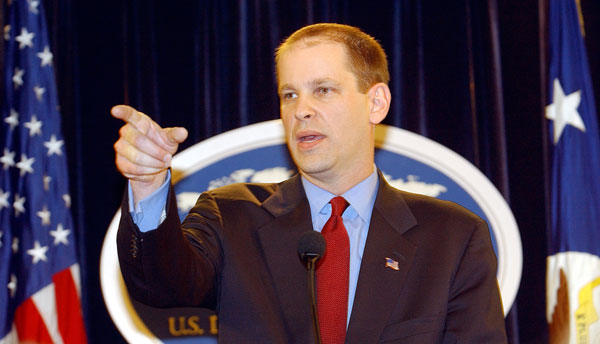 | Department Spokesman Sean McCormack (shown during the Daily Press Briefing) was sworn in as Assistant Secretary for Public Affairs and Department Spokesman on June 2, 2005. |
MR. MCCORMACK: Good afternoon, everybody. I don't have any opening statements, so we can get right into whatever questions you may have.
QUESTION: What do you think the Europeans might do to repackage? Does that mean new proposals, a new emphasis? What's the expectation that the Europeans can do that somehow will turn this situation around?
MR. MCCORMACK: This is on Iran?
QUESTION: I'm sorry. On Iran, yes.
MR. MCCORMACK: Well, Barry, this has been the subject -- topic of discussion over the past couple days. Up in New York, Secretary Rice had meetings at the ministerial level with the P-5 +1. There were political directors then brought in for a subsequent meeting. She had dinner last night with Foreign Minister Douste-Blazy. It was one of the topics of conversation there. So where we have come out and you've heard from Secretary Rice is that we believe that it's advisable and certainly understandable to take another couple of weeks here to see if we can bring the entire Security Council along on a package and that in that package, it would provide a set of choices for the Iranian regime. You've heard about those choices from Secretary Rice.
On one hand, would be a series of incentives so that they could choose the pathway to a peaceful nuclear program that would also have with it objective guarantees, so that the world is assured that Iran isn't going to try to develop a nuclear weapon under the guise of that peaceful nuclear program. On the other hand, if they choose another -- the other pathway, which is the pathway they now find themselves on, one of defiance and obstructionism, there will be consequences, diplomatic consequences to choosing that pathway.
So we thought that it was a good idea to continue some of the diplomatic discussions for the next couple of weeks here. I want to make one -- underline one thing and you've heard this a couple times from the Secretary already this morning and that is that regardless of the outcome of these discussions with the P-5 and then the wider Security Council, there will be action in the Security Council and we'll see exactly what that action is over the course of the next couple weeks.
As a process point for you, Under Secretary Nick Burns is going to be traveling to London on Monday* so that's the next step in this process in terms of formal consultations at the political director level. And I would expect at that point that the Europeans are going to surface some of their ideas about what incentives might be out there. We're also going to talk about what consequences, what penalties, diplomatic penalties, there might be if the Iranian regime chooses that other pathway. So that will be the topic of discussion. I would expect that there are also going to be informal consultations that Nick has over the telephone and also try to keep you up to date on any conversations that the Secretary has on the topic.
QUESTION: Does parallel – the London talks are parallel to the Brussels talks?
MR. MCCORMACK: Well, the Brussels talks, I think, are in an internal EU.
QUESTION: One doesn't obviate the other.
MR. MCCORMACK: Right. No, exactly. I think the EU wants to get together and talk about what some of their ideas that they might surface regarding incentives. But the P-5+1 meeting is going to be in London so that's going -- the EU-3 will bring to the table its ideas. We'll certainly be part of those discussions as well.
QUESTION: I'm having a little problem, and then I'll let up, understanding the two week concept. This is two weeks for Iran to come to its senses? It's two weeks for the Europeans to repackage and then you go back to the Security Council. What if nothing really changes, you're going to move for a resolution anyhow? I don't understand the two week measurement, the two week --
MR. MCCORMACK: Don't hold us to two weeks from today there's going to be -- we're going to be sitting on the Security Council. It's a couple of weeks.
On the first part of your question about the Iranians, they can choose at any moment and start cooperating with the international community. Given their behavior over the past couple of years, I don't think anybody has that expectation right now. But certainly we, as well as the rest of the world, would welcome that.
In terms of the next couple weeks, we just thought that that was a reasonable timeframe, Barry, after Secretary Rice had her consultations with her counterparts to work a little bit more of the diplomacy, to have Secretary Rice and her counterparts be able to sit down and take a look at some of the ideas that the political directors have surfaced. I would expect also, in addition to working -- as part of this package, they're going to be also talking about language for a Security Council resolution. So this is really trying to take all the various elements that might be in play here, Barry, and have them fleshed out in the course of these discussions with the political directors meeting and then at the ministerial level.
On top of that, I would also expect that there would be separate discussions and a separate line of thought concerning what actions states might take on their own or like-minded states might take together to look at the financial side of this. Secretary Rice mentioned that this morning as well. So there are a number of different elements ongoing on parallel, yet related tracks, Barry.
QUESTION: I promised to let up, but I forgot one thing.
MR. MCCORMACK: Okay.
QUESTION: There's an article in the Time magazine, it would seem a letter to Time magazine. I don't know if you know about this. A representative of Khameini now offering what is described as new possibilities of solving the impasse. Maybe we won't drop out of the NPT Treaty, maybe they'd consider an IAEA protocol providing for intrusive and snap inspections. I don't know if you've seen this?
MR. MCCORMACK: I've seen the news reports about it, Barry.
QUESTION: Is that a --
MR. MCCORMACK: From Rohani, who used to be the negotiator --
QUESTION: Yeah.
MR. MCCORMACK: -- and I think he was dismissed by the current regime. He has a position, I think within the sort of structure of that regime there. Yeah, we've seen it, Barry. Look, there are appropriate fora where the Iranians could surface any proposals that they might have if they have something new to say, whether that's with the EU-3 or with the Russians. I think just as a very brief comment without getting into the details, I don't think that there's really anything new that was in there. And I think it really doesn't address the core issue about enrichment. It still talks about enrichment on Iranian territory.
Yes, James.
QUESTION: How are you?
MR. MCCORMACK: Good.
QUESTION: Is it accurate to say then that the United States agreed to this initiative without knowing the exact contents of what this package would be?
MR. MCCORMACK: Well, what we did -- what we agreed to, James, was a process. And we thought that it was important to give the diplomatic process a little more time, as I said, a couple of weeks. And there is a level of trust among our -- the partners in the P-5+1 where there's going to be a good discussion, forthright and something that is -- that everybody brings their best intentions to the table. And so we'll see how that diplomatic process comes out. We hope that we are able to come up with this -- come up with a package.
But as I pointed out earlier, there will be some action in the Security Council and we'll see exactly what that action is. I think we'll have a little more clarity on that as we move forward over the next couple of weeks here, but we have previously said that, at a minimum, what we are seeking is a Chapter 7 resolution that would call upon Iran if, in fact -- actually, a Chapter 7 resolution would require Iran to comply with the previous demands of the Security Council as well as the IAEA. So that's a starting point.
QUESTION: If you'll indulge me, just a couple here.
MR. MCCORMACK: Sure.
QUESTION: You've been very candid in saying that -- and the Secretary's been very candid in saying that you felt that this was a reasonable price to pay. What were you buying by paying that?
MR. MCCORMACK: Well, what I had talked about before is what we want to try to do is bring along as many members of the Security Council as we possibly can because it is -- that has been one of our strategic objectives in conducting this diplomacy over the past year or so, and that is to build a broader and broader and deeper consensus on these issues. And we've accomplished that and so we are now in a new phase of the diplomacy and we want to try to bring as many members of the Council along as possible. And we think that spending a couple more weeks working the diplomacy at a high level, at an intensive level, is worth it.
QUESTION: Both the Secretary and you have said that the purpose of this initiative is to make very clear to the Iranians what would await them if they cooperate and comply and what would befall them if they don't. But you have also said dozens of times from this very podium the Iranians know full well what they need to do to be in compliance. So why do you suddenly take the view now that they might not know and it needs to be made clear for them?
MR. MCCORMACK: Well, I think it does a couple of things, James. I think if we are able to put together this package, it lays out for the world exactly what these very clear choices are. And I think that also -- that, in and of itself, has a uniting effect on the international community.
QUESTION: Did the presidential statement not lay that out?
MR. MCCORMACK: No, what the presidential statement did, James, is it repeated what the IAEA Board of Governors statement asked Iran to do. And the presidential statement has -- it has the force of requesting a country to do something. It doesn't have the force of international law as does a Chapter 7 resolution. So in terms of spending a couple of weeks to bring others in there and construct this package, we think that that, in and of itself, has a positive effect on bringing the international community together.
What it also does is it lays out very clearly for the regime a set of choices. They would find themselves at a crossroads in terms of the diplomacy.
QUESTION: Didn't they already face that crossroads? Did they not already --
MR. MCCORMACK: You could argue clearly, James, that they have faced this set of choices a number of times over again. But what the difference here would be, this would be the international community coming to them in the form of the Security Council or members of the Security Council saying here are your clear choices. Previously, they've had these choices in more informal settings, whether that's in negotiations with the EU-3 or in negotiations with the Russians.
So but what this would do is it would lay out in public for the world to see, as well as for the Iranian people to see, exactly what the choices are that are before this regime. And we'll see what kind of choices this regime will make on behalf of the Iranian people. One of the things I've talked about before is it is not at all clear that the regime has shared with the Iranian people exactly the incentives that have been placed before them, whether that's with the EU-3 or with the Russians.
In the case that we do come up with this package, the Iranian people will have a clear view of the choices before them, before this regime, a clear choice to take a pathway of a different kind of relationship than it looks like they will have now with the rest of the world if they continue down the current path, or the choice of continuing down the current -- down the path on which they find themselves now of continuing -- of greater and greater isolation. That's not certainly what we would want for the Iranian people but, again, their regime has now put them in this situation.
QUESTION: One last one, and I appreciate your forbearance and that of my colleagues.
MR. MCCORMACK: Sure. We have time.
QUESTION: In saying that you feel that a couple of weeks, which you're now defining as perhaps more than two --
MR. MCCORMACK: I'm not -- I'm just trying to give myself a little bit of leeway in terms of a day here and a day there.
QUESTION: If a couple of weeks is a price that you felt -- and the Secretary said this explicitly -- is not too much to pay, that obviously reflects a calculation made in the context of time here and the urgency involved. And I wonder what you would think would be too high a price to pay? In other words, I'm trying to get from you some assessment as to what the real timeline for diplomacy is here. If two weeks is not too much to pay, what would be too much to pay? How much time do you really have to continue a diplomatic course?
MR. MCCORMACK: Well, I think the root of your question is, well, what's the world's -- what's our assessment of where Iran stands in terms of its nuclear weapons program. There are public estimates to that effect; I would point you to the intelligence community. I know Ambassador Negroponte has talked about it recently in testimony that he has had up on Capitol Hill.
QUESTION: And Bob Joseph said we're very close to the point of no return recently.
MR. MCCORMACK: Again, it is -- what is clear is that the Iranians are proceeding along with their nuclear program. But in terms of our assessments of where they stand, we have public assessments, they're out there. I would point you to those assessments.
I would note, however, that in making these assessments, we're dealing with a hard target in terms of a closed society and a regime that is very clearly trying to hide what it is doing from the rest of the world and those are difficult assessments to make. But what you have out there in public right now is the best assessment of the intelligence community.
QUESTION: So you would -- I mean, when saying that two weeks is not too much of a price to pay, it suggests -- could you disabuse people who might tend to see that statement as a suggestion from you that, you know, there isn't a terrific urgency about this time wise?
MR. MCCORMACK: I would say that there is a sense of urgency in the need to mobilize the international community on this topic. Multilateral diplomacy takes some time; there is a certain rhythm to it. What we are trying to do is move in -- sort of increase the pace of that rhythm, I think. And you've seen that over the past several months. It took many weeks to negotiate that IAEA Board of Governors statement and it took a shorter time to negotiate the presidential statement. And what we're now looking at is, again, a shorter period of time to put together this package, which I would expect will also include penalties in the form of a Security Council resolution.
Jonathan Karl.
QUESTION: Sean, how big of a problem has Russia been in this process? I mean, if you can't even get the Russians to postpone arms sales to Iran while all this is going on, do you really think that they can be brought along to anything that would have any kind of serious bite to it coming out of the UN Security Council?
MR. MCCORMACK: These are weighty issues. This is serious stuff. And the Russian government -- Russia, which shares a border with Iran, is very, I think, very concerned about Iran's continuing down the pathway to developing a nuclear weapon. So we all have the same strategic objective. I think it's clear that we have had tactical differences along the way, over the past several months. But when we have -- when we've really focused on narrowing and closing those differences, we have, at the IAEA and with the presidential statement. And we're, again, willing to invest some time to bring the Russians, to bring the Chinese, as well as others onboard with this package. And I don't think Secretary Rice and the President would have made the decision to take this course if we didn't have some reasonable expectation that we could bring along other members of the Council, including Russia and China.
QUESTION: What about the speech today from President Putin, his state-of-the-nation speech, where he compared the United States to a voracious wolf and said, "We are aware of what is going on in the world. Comrade Wolf knows whom to eat, it eats without listening and it's clearly not going to listen to anyone." What does that say about the state of Russia-U.S. relations and the prospects for bringing them along on this?
MR. MCCORMACK: Secretary Rice has talked about this. We have, in many areas, a strong partnership with Russia. As for differences, you've heard about them in public over the past several months, Secretary Rice has talked about them, President Bush has talked about them, Vice President Cheney has talked about them. But we do have the kind of relationship where, if we do have differences, we'll speak about them frankly. And there are a lot of different issues on the table between the United States and Russia and we're going to try to push forward on those areas where we can. And where we have differences, we're going to try to work through them.
QUESTION: But can you specific for me on this "comrade wolf," the "voracious wolf" comment?
MR. MCCORMACK: I hadn't seen it, Jonathan, honestly. I haven't seen it before you just mentioned it.
QUESTION: You didn't see the wolf or the comment?
MR. MCCORMACK: I had not heard the comment before Jonathan brought it up. So in fairness, I'd like to take a look at it before I offer a specific response. I'm not commenting that you are not giving me the entire quote, but I'd like to take a look at the whole thing.
Teri.
QUESTION: Same issue.
MR. MCCORMACK: Same issue.
QUESTION: You say quite –
QUESTION: Wolfs?
QUESTION: Wolfs. Of course. (Inaudible). No. You say that you don't think that the Secretary and the President wouldn't have agreed to this if they didn't have a reasonable expectation that the other members would come along at the end of this two-week price to pay. Do you have something stronger than that from Russia and China? Because otherwise, what makes you think you're not going to be in the same position with them at the end of two or so weeks? You must have had something more tangible from them that this was their last delaying tactic, or what's the use?
MR. MCCORMACK: Well, I'm certainly not using the word or phrase "delaying tactic." I'll let them speak for themselves. But the conversations up in New York were constructive. They were useful. The ministers had an opportunity over the course of two hours, just the ministers, to talk about this issue. And they really drilled down on the issue, not only looking at where we are but how this – diplomatically -- how this plays out. And it was as a result of those conversations that we agreed to give this some more time, give it another couple of weeks.
In terms of the specific exchanges, I'm not going to get into those. But I would just point out, as I have said before, everybody said that we wouldn't get a vote out of the IAEA, that we wouldn't get a strong statement out of the Board of Governors. Everybody said that we weren't going to be able to get a presidential statement. And we have gotten those things. And we have worked cooperatively with the Russian Government on -- in both of those cases and that same spirit of cooperation, I would argue, continues now and is part of the reason why we're going to be having these discussions over the next couple of weeks.
QUESTION: But since every reference to this is a finite -- is as a finite period, there must be an end point at which you think the circumstances will change, not necessarily in Iran but in the Security Council, in the P-5.
MR. MCCORMACK: That's why Secretary Rice, the President and people that work for them get paid the big bucks, to make those sorts of judgments. And, clearly, as a result of the history of the diplomacy, the weight of the issues and the fact that we share the same strategic objective, we made the assessment that it was worthwhile to put in this time that we have a reasonable expectation that we will be able to build a consensus. So I can't offer any, I think, deeper explanation than that. People make these judgments every single day about the course of diplomacy, how fast to push, when to call an end to diplomacy. So those are the kinds of decisions that Secretary Rice and her team and the White House make every single day.
Joel.
QUESTION: While you've been in New York at the UN, it appears that President Ahmadi-Nejad is off to Indonesia and he's again talking trash talk. He's saying that the United States is pushing the Europeans with hypocrisy and also calling it the big lie to end their nuke program. And he was putting in place a "Satan Park" at the former U.S. Embassy. Clearly, it's not just the nuke program but other forms of their behavior. Why should we even pay any attention to both he and/or the cleric regime in Iran?
MR. MCCORMACK: Well, look, we've seen the sort of overblown -- overheated rhetoric from President Ahmadi-Nejad before. Look, he's the president of the country and this is a -- it's an important culture with a deep history. The Iranian people have a lot to offer the world and we want to do what we can to see that they are able to make that contribution to the world, that we are able to benefit from their culture and their society as well.
But the current regime is engaged in a number of behaviors that are of real concern to the international community, whether it's developing nuclear weapons or being the central banker for terror or their treatment of their own people. The human rights situation in Iran is really deplorable. So that is the reason. That is the reason why the international community really is focusing its attention on the variety of behaviors that this regime is engaging in.
QUESTION: And a follow-up. There's a Gulf summit that just concluded with a cooperation council and they're saying that the Gulf Arabs have asked Iran to guarantee no atomic bombs. Have you in any way monitored their particular meetings there?
And also, right at this hour Under Secretary Karen Hughes is delivering a speech to the Council of Foreign Relations in New York City. What specifically will be in her speech and what media concerns would she be speaking to?
MR. MCCORMACK: Well, you're just going to have to look at the transcript of that, Joel. I appreciate your being here as opposed to tuning into the speech. You know, in terms of the GCC, the Gulf Cooperation Council, the states of the Gulf have a real interest in seeing that Iran does not have a nuclear weapon. It would be a destabilizing event for the entire region, so I think that you are hearing very clearly from an increasing number of states and Iran's neighbors that they call upon Iran not to develop a nuclear weapon and to turn back from the path that it is now on.
Yes, Nicholas.
QUESTION: Can we go to Palestinians?
MR. MCCORMACK: I don't know. Do we have anything else? Charlie.
QUESTION: Just clarification. Nick Burns in London Monday. Leaves Monday or leaves Sunday to be there for a Monday meeting?
MR. MCCORMACK: I think the meetings are on Monday, Charlie. Let me check afterward and we'll confirm that for you. But I believe the meetings are Monday.
QUESTION: And that's his only stop, as far as we know so far?
MR. MCCORMACK: As far as I know. I'll check if we have any -- if he has any other stops, we'll let you know.
Yes, ma'am.
QUESTION: Could you be a little bit more specific on the incentive? I understand Douste-Blazy talked yesterday about the partnership with Iran on civil nuclear energy. What does that mean?
MR. MCCORMACK: In terms of -- there have been offers on the table with respect to how the Iranians could have a civilian nuclear program and that I expect would be a big part of what the political directors and the ministers talk about as part of this package. I don't have anything -- any specific insights to that aspect of it, but we'll -- as these things develop and as appropriate, we'll try to keep you updated on the discussions.
QUESTION: Thank you.
MR. MCCORMACK: Yes. Anything else on Iran? Yes, David.
QUESTION: Sean, you've spoken of the generation of the incentives package as kind of a collective process with the Europeans, so I'm just wondering if the United States itself is going to, you know, in a sense, pony up an incentive or two? You did it a year ago.
MR. MCCORMACK: David, I'm going to let the diplomacy play out on this. Let's let the first meetings take place. I will try to keep you updated on those discussions and I would add the caveat, as appropriate, as we want to be able to have open, honest, productive discussions with the other members of the P-5+1 and sometimes that's best done in private, but we will try to keep you updated.
QUESTION: But you don't rule it out?
MR. MCCORMACK: Let's let the meeting take place. Let's see how the diplomacy plays out.
Yes. Anything else on Iran? Okay, Nicholas.
QUESTION: The Palestinians and the new mechanism that was talked about yesterday. I know that this came up, but can you talk more about the accountability issue. Because, as you know, many people in this country when they hear arrangements like this they think of oil-for-food and what happened in its aftermath. What -- how concerned is the Secretary, how concerned are you that, especially kind of (inaudible) might think that something like this might happen again in the end, when we look at it two or three years from now. And how are you going to do it without having to go through Hamas, because it seems that at some point Hamas will have to be involved in the distribution of the funds?
MR. MCCORMACK: Well, those are all very good questions and those are all questions that the EU is going to be thinking about and working on as it comes up with the specifics of this mechanism. The Quartet statement yesterday, which I think everybody has had a chance to look at, specifically mentions transparency and accountability. And we are -- it also, in addition to those two things, mentions that this would be limited in duration and limited in scope.
So as for the specifics: how you do the monitoring, how you ensure that the aid really gets to the Palestinian people, it gets to those affected by it and that the use of the aid is effective are -- those are all questions that need to be answered. And the EU-3** has said that they are going to take the lead in developing this mechanism. We, of course, will be in consultation with them. Assistant Secretary Welch, I think is, on any given day, talking to his counterparts within the EU-3 on Quartet-related issues. So we don't have the answers on that yet.
I would note that Commissioner Ferrero-Waldner yesterday talked about specifically the point about Hamas and that they were -- they're going in -- the intention here is that this aid would be delivered directly to those in need, using a mechanism that would bypass a Hamas-led government. So I guess more to follow on -- that's the short answer to your question.
QUESTION: So it sounds like you don't have any fears that anything close to oil to food might happen in the end when this is all done.
MR. MCCORMACK: I certainly wouldn't, at this point, draw any such comparisons. I think that -- look, the international community has learned quite a bit from how that operation was, in fact, implemented so people will take away those lessons. And as you see in the Quartet statement, transparency and accountability are two of the most important priorities as the experts work to develop what this mechanism might look like.
QUESTION: Sean.
MR. MCCORMACK: Yes. Samir.
QUESTION: When do you expect the Security Council to vote on the resolution regarding Lebanon?
MR. MCCORMACK: Resolution regarding Lebanon -- in the near future, Samir. I can't give you the exact date. I would expect in the matter of days. I can't tell you exactly when though. I know that they have a pretty full calendar on the Security Council, but it's a priority along with passage of the Darfur resolution.
QUESTION: Was there full agreement with the French Foreign Minister yesterday when he met with Secretary Rice about --
MR. MCCORMACK: I think we -- there was a real convergence of views on the issue. As you know, we've worked very closely with the French Government and Secretary Rice has worked very closely with her counterpart, Foreign Minister Douste-Blazy, on this issue. It's been a real partnership. And I would expect that we will -- we would hope that we'd be able to get this resolution through the Security Council in short order. But I don't have a specific date for the vote for you.
Libby.
QUESTION: Do you have anything on the reports that an American oil worker was shot to death in southern Nigeria? It was just before we came out here, I think.
MR. MCCORMACK: No. We'll check for you.
QUESTION: Thank you.
MR. MCCORMACK: Yes, ma'am.
QUESTION: Darfur. What's your reaction that Minni Menawi, the head of the rebellious movement, wants to freeze the Abuja peace agreement?
MR. MCCORMACK: I haven't -- I have to confess, I haven't seen those reports. I'll be happy to check in for you and get a reaction. But we, I think, generally speaking, we would hope that the agreement moves forward on the timetable that the parties agreed to.
Yes, ma'am.
QUESTION: Do you have any detail about North Korean defectors arrived in the United States last week?
MR. MCCORMACK: Consistent with past practice on these kinds of questions, I don't really have a whole lot of details for you. The United States was very pleased to be able to welcome in several individuals. But as for the details of how they arrived here and the vetting process, those are things I'm just not going to get into.
Yes, sir.
QUESTION: Thank you. Regarding Ethiopia, I know you have the statement on May 3rd regarding Ethiopia and can you elaborate on what you meant on "extremist opposition" and can you elaborate on last week's statement?
MR. MCCORMACK: I don't really have anything to add to the statement today. If there's anything else, we'll certainly get it to you. But at this point, we don't have anything new to add.
QUESTION: Okay. What's your reaction on the prime minister introduces new cabinet for the (inaudible) administration and do you have anything to say about -- because he introduced yesterday the new --
MR. MCCORMACK: I'll check to see if we have anything for you.
QUESTION: All right.
MR. MCCORMACK: Yes, sir.
QUESTION: I don't if you're aware of the letter that was written by the attorney, Thomas (inaudible) from Arizona. It's about the immigration issues in their county, asking for the State Department to intervene, saying that the Mexico Government is trying to dismantle the new law in Arizona on illegal immigration. If you -- he wrote it to Secretary Rice.
MR. MCCORMACK: I'm not sure that she has, in fact, received the letter. She gets a lot of correspondence in the course of the week. But in terms of activity that relates to control of the border, I think that that's really an issue for the Department of Homeland Security. And if there's anything with respect to this letter, if she's going to reply to it or somebody else is going to reply to it -- it's up to the correspondent to make that correspondence public. It's not up to us to do that.
Yes, Joel.
QUESTION: Returning to questions about the Palestinian-Israel crisis. There was another shipment of explosives that were seized between Egypt and the Gaza Strip. Now, in the Sinai we have -- or there has been a UN monitoring-type force, there's a headquarters there. Do they have any input and should they also be doing some work to intercede? This was obviously done from off the coast out in the Mediterranean. And also Israel giving, literally, to the Hamas a equivocal end of year; in other words, if by the end of this year there is no further reconciliation with them, Israel threatens to do a lot of things unilaterally. Do you have any thoughts concerning that?
MR. MCCORMACK: Joel, in terms of the multinational force in the Sinai, I don't think that that's part of their mandate. They have a very specific mandate working on another issue.
Dave.
QUESTION: Could you answer about the arms shipment that was intercepted?
MR. MCCORMACK: Well, that's why -- that's the point I was trying to get at. I don't have any information on that.
QUESTION: The second largest -- I mean, that was a really big deal when it happened in 2001 or 2 -- 1.
MR. MCCORMACK: I'll try to find some more information for you on that. You know, I wasn't made aware of it before I came out here.
QUESTION: Do you have a reaction to the British Attorney General saying the Guantanamo prison is unacceptable; it should be closed?
MR. MCCORMACK: Look, we've --
QUESTION: It sounds like Blair said similar --
MR. MCCORMACK: And the President has talked about the fact that we'd like nothing better than at some point in the future to close down Guantanamo. Nobody wants to be a jailer for the world. And in fact, we have moved many detainees from Guantanamo back to their home countries or their country of origin, under agreements that would ensure that they're not -- they don't go in the front door and head out the back. And also that they won't be tortured; that they will be treated humanely.
Just the other day, we released several Uighurs; they're now in Albania. So there is a process here for trying to move people through. They do have access to a judicial review, that in the wake of the Supreme Court decision. Again, at some point in the future, we'd like nothing better than to close down Guantanamo. But the fact of the matter is that the people there are dangerous people and we don't -- one thing we don't want to do is release people now who might at some point in the future end up on the battlefield facing our troops or somebody's else's troops or committing acts of terrorism against innocent civilians.
Dave.
QUESTION: Sean, Cambodia, apparently has made some progress in recent days in a very long process of putting together a tribunal to try people from the Pol Pot era. I'm wondering if the U.S. is aware of that. What’s your reaction to it?
MR. MCCORMACK: We'll check to see if there's anything for you, Dave.
QUESTION: Okay.
MR. MCCORMACK: Okay. Thank you.
(The briefing was concluded at 1:37 p.m.), DPB # 77
Related: Keywords State Department, Wednesday, May 03, 2006 Secretary Rice, James Wolfensohn, Gaza Disengagement (PODCAST), Thursday, April 27, 2006 Remarks at Stakeout Secretary Condoleezza Rice, Friday, April 21, 2006 Secretary Rice to Travel to Europe, Friday, April 21, 2006 The Face of the State Department (VIDEO), Thursday, April 13, 2006 Secretary Rice Holds Talks with Equatorial Guinean President, Tuesday, April 11, 2006 State Department Podcast, VIDEO and Text 04/10/06, Wednesday, April 05, 2006 State Department Podcast, VIDEO and Text 04/03/06, Thursday, March 30, 2006 State Department Podcast, VIDEO and Text 03/29/06, Monday, April 03, 2006 Secretary Rice With Foreign Secretary Straw, Baghdad, Friday, March 31, 2006 Rice in Berlin To Discuss Iran with P-5 plus 1, Friday, March 31, 2006 UNHCR Worker’s Death in Sudan Attack, Friday, March 31, 2006 Statement on China's treatment of Kim Chun-Hee, Thursday, March 30, 2006 State Department Podcast, VIDEO and Text 03/29/06, Thursday, March 23, 2006 State Department Podcast, VIDEO and Text 03/22/06, Monday, March 13, 2006 State Department Podcast, VIDEO and Text 03/13/06, Wednesday, March 01, 2006 State Department Podcast and Text 02/28/06, Wednesday, February 22, 2006 State Department Podcast and Text 02/21/06,
0
comments
||
||
President Discusses NSA Surveillance Program (VIDEO)
Technorati Tags: President Bush and White House or September the 11th and VIDEO and NSA Surveillance Program or War on Terror and Iraq or al Qaeda and terrorists or domestic phone calls and National Security Agency or Congress
President Bush Discusses NSA Surveillance Program, FULL STREAMING VIDEO, Diplomatic Reception Room,  , 12:03 P.M. EDT.
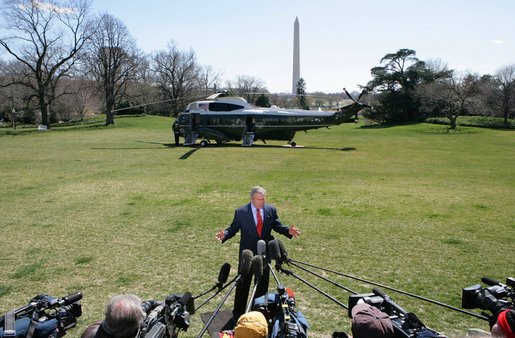 | THE PRESIDENT: After September the 11th, I vowed to the American people that our government would do everything within the law to protect them against another terrorist attack. |
Today there are new claims about other ways we are tracking down al Qaeda to prevent attacks on America. I want to make some important points about what the government is doing and what the government is not doing.
First, our international activities strictly target al Qaeda and their known affiliates. Al Qaeda is our enemy, and we want to know their plans. Second, the government does not listen to domestic phone calls without court approval. Third, the intelligence activities I authorized are lawful and have been briefed to appropriate members of Congress, both Republican and Democrat. Fourth, the privacy of ordinary Americans is fiercely protected in all our activities.
We're not mining or trolling through the personal lives of millions of innocent Americans. Our efforts are focused on links to al Qaeda and their known affiliates. So far we've been very successful in preventing another attack on our soil.
As a general matter, every time sensitive intelligence is leaked, it hurts our ability to defeat this enemy. Our most important job is to protect the American people from another attack, and we will do so within the laws of our country.
Thank you.
END 12:05 P.M. EDT, For Immediate Release, Office of the Press Secretary, May 11, 2006
USATODAY.com - NSA has massive database of Americans' phone calls - The National Security Agency has been secretly collecting the phone call records of tens of millions of Americans, using data provided by AT&T, Verizon and BellSouth, people with direct knowledge of the arrangement told USA TODAY.
Related: Keyword Iraq, Monday, March 20, 2006 Third Anniversary of Beginning of Iraq Liberation (VIDEO), Tuesday, March 14, 2006 President Discusses Freedom and Democracy in Iraq, 03/13/05 VIDEO, Thursday, March 09, 2006 President Signs USA PATRIOT Act (VIDEO), Saturday, February 25, 2006 President Addresses American Legion, Discusses Global War on Terror (VIDEO), Wednesday, January 25, 2006 President Discusses War on Terror at K-State (VIDEO), Wednesday, January 04, 2006 President Discusses War on Terror Following Pentagon Briefing (VIDEO), Monday, December 19, 2005 President's Address to the Nation (VIDEO) 12/18/05, Thursday, December 15, 2005 President, McCain, Warner, Discusses Interrogation, Wednesday, December 14, 2005 Iraqi Elections, Victory in the War on Terror (VIDEO), Monday, December 12, 2005 President Discusses War on Terror and Upcoming Iraqi Elections (VIDEO), Sunday, July 17, 2005 Soldiers charged with assault on suspected insurgents, Sunday, July 24, 2005 Iraqi, American Women Discuss Constitution, Women's Rights, Thursday, July 28, 2005 Killing of Algerian Diplomats to Iraq, Saturday, August 06, 2005 Operation Quick Strike,
0
comments
||
||
Wednesday, May 10, 2006
Federal Open Market Committee Statement 05/10/06
Technorati Tags: President Bush and Dr. Ben S. Bernanke or Ben S. Bernanke and Ben Bernanke or Bernanke and Federal Reserve or Chairman of the Federal Reserve and Monetary policy or Federal Open Market Committee and federal funds rate
 |
Economic growth has been quite strong so far this year. The Committee sees growth as likely to moderate to a more sustainable pace, partly reflecting a gradual cooling of the housing market and the lagged effects of increases in interest rates and energy prices.
As yet, the run-up in the prices of energy and other commodities appears to have had only a modest effect on core inflation, ongoing productivity gains have helped to hold the growth of unit labor costs in check, and inflation expectations remain contained. Still, possible increases in resource utilization, in combination with the elevated prices of energy and other commodities, have the potential to add to inflation pressures.
The Committee judges that some further policy firming may yet be needed to address inflation risks but emphasizes that the extent and timing of any such firming will depend importantly on the evolution of the economic outlook as implied by incoming information. In any event, the Committee will respond to changes in economic prospects as needed to support the attainment of its objectives.
Voting for the FOMC monetary policy action were: Ben S. Bernanke, Chairman; Timothy F. Geithner, Vice Chairman; Susan S. Bies; Jack Guynn; Donald L. Kohn; Randall S. Kroszner; Jeffrey M. Lacker; Mark W. Olson; Sandra Pianalto; Kevin M. Warsh; and Janet L. Yellen.
In a related action, the Board of Governors unanimously approved a 25-basis-point increase in the discount rate to 6 percent. In taking this action, the Board approved the requests submitted by the Boards of Directors of the Federal Reserve Banks of Boston, New York, Philadelphia, Cleveland, Richmond, Atlanta, Chicago, St. Louis, Minneapolis, Dallas, and San Francisco.
2006 Monetary policy, Release Date: May 10, 2006, For immediate release
Related: Tuesday, March 28, 2006 Federal Open Market Committee Statement 03/28/06, Wednesday, February 15, 2006 Chairman Ben S. Bernanke, Semiannual Monetary Policy Report, Monday, February 06, 2006 President Attends Swearing-In Ceremony for Federal Reserve Chairman Ben Bernanke VIDEO, Monday, October 24, 2005 Appointment Ben Bernanke Federal Reserve (VIDEO), Monday, October 24, 2005 Biography of Dr. Ben S. Bernanke, Tuesday, June 21, 2005 President Congratulates CEA Chairman Ben Bernanke (VIDEO)
0
comments
||
||
Secretary Rice, EU Secretary General Javier Solana on Iran, VIDEO, PODCAST, TEXT
Technorati Tags: State Department and Secretary of State or Javier Solana and European Union, or Iran and EU or Condoleezza Rice, or UN and Security Council,
Remarks With Javier Solana, Secretary General of the Council of the European Union and High Representative for the Common Foreign and Security Policy Before Their Meeting. VIDEO, file is windows media format, running time is 1:03, PODCAST, file is mp3 format for podcast, running time is 1:03
Secretary Condoleezza Rice, Washington, DC, May 10, 2006, (11:00 a.m. EST)
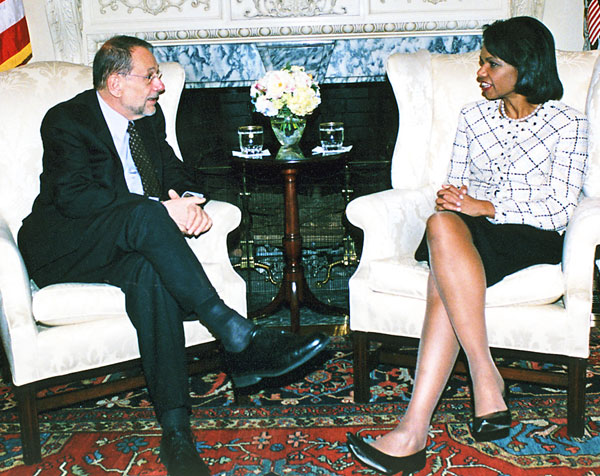 | Secretary Rice speaks with His Excellency Javier Solana, Secretary General of the Council of the European Union and High Representative for the Common Foreign and Security Policy. |
SECRETARY RICE: Hello, everyone.
QUESTION: Good morning. Mr. Solana, will there be new incentives to turn Iran around? (Inaudible) -- it looks like we've had a disaster.
SECRETARY GENERAL SOLANA: We have (inaudible) with a lot of intelligence and a lot of cooperation.
QUESTION: Will you be ready by Monday?
SECRETARY GENERAL SOLANA: I don't think that by Monday because today's --
QUESTION: Monday in Brussels.
SECRETARY GENERAL SOLANA: Monday, in fact, we will talk about, but it will not be finalized (inaudible).
SECRETARY RICE: Barry, let me just note, of course the other part of this is that we will have Security Council action and the issue is to make certain that Iran knows that there are two options that have been there all along, which is that they can have a civil nuclear program that is appropriate and that the international community supports or they can face isolation. And there will be Security Council action. We felt that two weeks to continue to try to work for Council unity was well worth it.
QUESTION: Thank you.
2006/480 Released on May 10, 2006
Related: Keywords State Department, Wednesday, May 03, 2006 Secretary Rice, James Wolfensohn, Gaza Disengagement (PODCAST), Thursday, April 27, 2006 Remarks at Stakeout Secretary Condoleezza Rice, Friday, April 21, 2006 Secretary Rice to Travel to Europe, Friday, April 21, 2006 The Face of the State Department (VIDEO), Thursday, April 13, 2006 Secretary Rice Holds Talks with Equatorial Guinean President, Tuesday, April 11, 2006 State Department Podcast, VIDEO and Text 04/10/06, Wednesday, April 05, 2006 State Department Podcast, VIDEO and Text 04/03/06, Thursday, March 30, 2006 State Department Podcast, VIDEO and Text 03/29/06, Monday, April 03, 2006 Secretary Rice With Foreign Secretary Straw, Baghdad, Friday, March 31, 2006 Rice in Berlin To Discuss Iran with P-5 plus 1, Friday, March 31, 2006 UNHCR Worker’s Death in Sudan Attack, Friday, March 31, 2006 Statement on China's treatment of Kim Chun-Hee, Thursday, March 30, 2006 State Department Podcast, VIDEO and Text 03/29/06, Thursday, March 23, 2006 State Department Podcast, VIDEO and Text 03/22/06, Monday, March 13, 2006 State Department Podcast, VIDEO and Text 03/13/06, Wednesday, March 01, 2006 State Department Podcast and Text 02/28/06, Wednesday, February 22, 2006 State Department Podcast and Text 02/21/06,
0
comments
||
||
Tuesday, May 09, 2006
Vice President's Remarks with Prime Minister Ivo Sanader of Croatia
Technorati Tags: Croatia and Ivo Sanader or Dubrovnik and Vice President ot President Bush and EU or Dick Cheney and VICE PRESIDENT CHENEY or NATO and Europe
Vice President's Remarks at a Dinner with Prime Minister Ivo Sanader of Croatia, The Nautica Restaurant, Dubrovnik, Croatia, 6:55 P.M. (Local)
 | Vice President Dick Cheney talks with Croatian Prime Minister Ivo Sanader before a dinner meeting, Saturday, May 6, 2006, in the Old City of Dubrovnik, Croatia. |
PRIME MINISTER SANADER: Ladies and gentlemen, let me welcome Vice President Cheney to Dubrovnik, Croatia. It is a great honor and a huge step forward in our bilateral relationship. We consider this visit of the Vice President of the United States of America as a friendly and supportive move to Croatia. We are looking forward to closely cooperating with the United States in the future. Croatia is preparing itself for the full membership of the EU and NATO. And we know that we can count on the U.S. support. And finally, we believe strongly in transatlantic partnership. There is no alternative to this. Europe has always had the U.S. as a partner in difficult times in the First World War, the Second World War, also in the recent history in our territory here. And we believe that this partnership should be strengthened and deepened. Thank you.
VICE PRESIDENT CHENEY: Thank you, Mr. Prime Minister. And I'm delighted to be here this evening, and to have the opportunity to spend some time with our host, Prime Minister Sanader. It's a very important developing relationship that the United States has with Croatia. I think all Americans have been tremendously impressed with how far Croatia has come since the last few years. We are strongly supportive of Croatia becoming a full member of the transatlantic community -- both in terms of working with NATO and the European Community. We also are deeply appreciative of the role that Croatia has played in Afghanistan, that is partners in the coalition and dealing with a very difficult situation in that part of the world. So I'm delighted to be here tonight. It's a beautiful setting and I look forward to our conversation.
END 6:58 P.M. (Local) For Immediate Release, Office of the Vice President, May 6, 2006
Relared: Keywords Vice President Cheney, Tuesday, May 09, 2006 Vice President's Remarks with President Nursultan Nazarbayev of Kazakhstan, Tuesday, May 09, 2006 Vice President's Remarks with Ukrainian President Viktor, Yushchenko, Tuesday, May 09, 2006 Vice President Cheney and Lithuanian President Valdus Adamkus, Monday, April 17, 2006 Vice President Cheney and Mrs. Cheney Release 2005 Income Tax Return, Thursday, February 16, 2006 Interview of the Vice President by Brit Hume (VIDEO), Wednesday, February 15, 2006 Update by the Office of the Vice President, Saturday, January 21, 2006 Vice President, Neil Cavuto, FOX News (VIDEO), Friday, January 13, 2006 Vice President to Travel to Egypt and Saudi Arabia, Friday, January 06, 2006 Vice President's Remarks on Iraq and the War on Terror (VIDEO), Thursday, November 17, 2005 Vice President's Remarks 11/16/05, Monday, October 31, 2005 Vice President appointed David S. Addington chief of staff, Saturday, October 29, 2005 Vice President's Statement on Libby Resignation, Friday, October 28, 2005 Resignation of Scooter Libby (VIDEO, Tuesday, October 04, 2005 Remarks by the Vice President to Second Marine Expeditionary Force,
0
comments
||
||
Vice President's Remarks with President Nursultan Nazarbayev of Kazakhstan
Technorati Tags: Nursultan Nazarbayev and Kazakhstan or Astana and Vice President ot President Bush and Central Asia or Dick Cheney and VICE PRESIDENT CHENEY or Russia and G8
Vice President's Remarks in a Press Availability with President Nursultan Nazarbayev of the Republic of Kazakhstan, The Presidential Palace, Astana, Kazakhstan, 8:07 P.M. (Local)
 | Vice President Dick Cheney and Kazakh President Nursultan Nazarbayev speak to the press following their meeting at the Presidential Palace in Astana, Kazakhstan, Friday, May 5, 2006. |
PRESIDENT NAZARBAYEV: (As translated.) Distinguished Mr. Vice President, dear representatives of mass media, dear, ladies and gentlemen, today the Vice President of the United States of America, Mr. Richard Cheney is paying his first official visit to the Republic of Kazakhstan. Previous guests of such a high rank visited our country back in December 1993, that was Mr. Albert Gore. Therefore, I would like to stress the specific significance of today's event and welcome the delegation.
And the United States is the largest foreign investor in Kazakhstan that invested 12 billion U.S. dollars to our economy so far, and our trade volume has reached 2 billion U.S. dollars, and 374 ventures and enterprises of the United States work in Kazakhstan currently.
Within the framework of the visit, we have carried out the meeting between our delegations that took place in an open and trusted atmosphere that is inherent to the Kazakhstani-American relations. We have discussed bilateral issues in the energy sector, security, and mostly we have discussed trade and economic collaboration issues.
And we also exchanged views on the geopolitical situation in Central Asia, regional integration processes that take place in the Caspian region and on the territory of Eurasia. During the visit an amendment to the agreement between the Minister of Energy and Mineral Resources of the Republic of Kazakhstan and the U.S. Department of Defense have been signed. And it foresees that the United States will allocate an amount of $158 million for -- national projects.
And they've also signed a memorandum of understanding between the two governments for the economic development up to the year of 2010 in order to co-finance Kazakhstani projects in business field, and also an agreement on the prevention of illicit trafficking of nuclear materials. This document significantly forced interaction on the mentioned aspects and allowed to contribute jointly to stronger nonproliferation regime, regional and global stability and security.
And we also agreed that American companies will provide the assistance in the modernization of Kazakhstan, as well to our efforts to join the team of the 50 most competitive nations of the world. Implementing breakthrough projects in high technology and export-oriented production in Kazakhstan was also discussed in this respect. Opening joint ventures in biotechnology and space exploration, establishment of joint scientific research and educational centers have very bright perspectives.
We also discussed very eagerly our collaboration in the energy sector, and in this respect development of nuclear collaboration between the two countries is very important. And our experience of long lasting and fruitful cooperation with the U.S. in the field of nonproliferation encourages this to the full. And Kazakhstan has initiated the possibility to establish a permanent bilateral working structure to implement the reached agreements and outlined objectives.
And joint efforts to stand against challenges of international terrorism, religious extremism, separatism, illegal drug traffic, and organized crime have been a very crucial part of our negotiation. And security in Central Asia in this region is a key part of our bilateral cooperation. And we've always been collaborating with the United States in this area, and we will continue this cooperation. The rich agreements and results of this important visit come from the aspiration of Kazakhstan and the United States to further gradual develop our bilateral relations. And I'm confident that the strategic cooperation between Kazakhstan and the United States will serve to the prosperity of Kazakhstan and all nations of Central Asia.
Thank you for your attention.
VICE PRESIDENT CHENEY: Well, thank you very much, Mr. President. And I'm delighted to be here as a guest of President Nazarbayev today. We met some years ago and I consider him my friend, and I'm delighted to have the opportunity to visit him here in this beautiful new capital of Kazakhstan.
And on behalf of the President, George Bush, and the American people, I want to extend our best wishes from the American people to the people of Kazakhstan.
The President and I just had a very good meeting. And I had the opportunity to thank the President for the contributions that Kazakhstan has made to our coalition's efforts in Iraq and in the global war on terror. We talked about ways to strengthen our bilateral relations, ways we could work together to advance the security and the prosperity of this region of the globe.
We admire this nation's many contributions to our world, and the United States is proud to count Kazakhstan as a friend. Your nation has abundant resources and an even greater supply of human talent. And America has tremendous confidence in your future as a successful, independent, sovereign and prosperous nation.
Kazakhstan also has a vital role to play in ensuring prosperity, stability and peace across Central Asia. All the nations of this region have the right to determine their own destiny, to institute reforms and to work with others to ensure a future of hope across Central Asia. The way forward is clear; continue democratic and economic reforms, the rule of law, fighting corruption, accountability of institutions and sound security policies. These are the keys to progress, and nations that follow such a course will find themselves on a path to greatness.
The vision we affirm today is a community of sovereign states that grow in liberty and prosperity, trade and freedom and strive together for a century of peace. Standing in this modern capital city, I am proud to affirm the strong ties between Kazakhstan and the United States. We have great respect, Mr. President, for all that you have accomplished in the last 15 years. And we are proud to be your strategic partner. My country looks forward to continued friendship between us as we work to enhance security to defend the peace and to build a better world.
And once again, Mr. President, my warmest thanks for your hospitality. Thank you.
Q Mr. Vice President, you spoke forcefully yesterday about the importance of democratic reform, and you've just mentioned it here again in your remarks, how would you evaluate Kazakhstan along those lines? And what did you say to the President about those issues?
VICE PRESIDENT CHENEY: Well, I have previously expressed my admiration for what has transpired here in Kazakhstan over the last 15 years. Both in terms of economic development, as well as political development. I think the record speaks for itself.
MODERATOR: The question was (As translated.)
VICE PRESIDENT CHENEY: And I'll start my answer over again -- (Laughter.) I have expressed my admiration for all that's been accomplished here in Kazakhstan in the last 15 years, both in the economic and the political realm. The President discussed with me the Commission on Democracy that he's established. We support that effort and look forward to continuing to work with the government of Kazakhstan in the area of the future kinds of developments that have been such an important part of all that's been done over the last 15 years both in the economic and the political arena.
Q (As translated) This is a question to the President, Mr. President, today you have mentioned about the role of Kazakhstan in global and regional security, but can you elaborate more on what specific role can Kazakhstan play in strengthening regional and global security and stability?
PRESIDENT NAZARBAYEV: (As translated.) Well, first of all, Kazakhstan is by itself a very secure, stable country, despite the fact that we have 130 different nationalities and ethnic groups and 45 different religions peacefully coexisting in this country. And Kazakhstan initiated the idea of Eurasian Union and Central Asian Cooperation Union. And based on the economic achievements of Kazakhstan, today our country is exporting its own capital to the neighboring country, thus assisting economic development of the neighboring countries of the region. And Kazakhstan was the country that initiated the conference on interaction and confidence-building measures in Asia, and the second summit of this conference will take place in Kazakhstan in June.
And this year also in Kazakhstan, we will host the Second Conference of Global Religions. And I think this is a big contribution towards integration, not only in this region but also in the world in general. And recalling the fact that Kazakhstan was the country who first renounced its nuclear arsenal, the fourth largest nuclear arsenal in the world and shut down its nuclear test site, I think this is the greatest contribution of Kazakhstan to global security and stability.
Q Yes, Matt Spetalnick, with Reuters. Mr. Vice President, the Kremlin has dismissed your criticism of Russia's record of democracy and its energy policy as "incomprehensible." Can you respond to that and explain how are you going to get this message across if they don't want to hear it? And what this could bode for the G8 Summit?
And for Mr. President, what do you think of the rising tensions between these two major powers?
THE VICE PRESIDENT: I haven't had an opportunity to -- excuse me.
MODERATOR: Excuse me -- which superpowers you were talking about, sir? United States and Russia?
Q United States and Russia. (Laughter.)
THE VICE PRESIDENT: I haven't had an opportunity to study the response out of Moscow. The speech was very carefully crafted. It made the point that we don't look upon Russia as an enemy by any means, that we want them as a strong friend and ally. But I also made it clear that we had some concerns with respect to the extent to which they seem to resist the development of strong democracies, if you will, in those areas represented by the governments that were represented at the conference in Vilnius in Lithuania.
And I expressed the concern that I heard repeated by many of the people I interacted with at the conference that Russia is using its control over energy resources to gain political leverage of various kinds on those governments that were represented at the conference.
I expect the G8 conference will go forward as scheduled in Petersburg, and that we'll all benefit from a free, open, and honest exchange of views at that conference.
PRESIDENT NAZARBAYEV: (As translated) Well, first of all, I think that there is no such thing as confrontation between United States and Russia. We think that there is a friendly exchange of opinions and views. And we all have to know that every country has their own way of solving their own problems, and that is called politics. And we have to respect politics of every country. But every country also has a right to voice their opinion of what is happening in another country. And if that would be done in a friendly manner, I think we will just benefit from that.
Q (As translated) Well, this question is directed to Mr. Vice President. Sir, we know you as a very experienced politician since the administration of President Nixon. And what is your personal position with respect to Iranian nuclear program? And how you would comment the position of Russia when they said that in the U.N. resolution they should be embodied -- there should be a political and legal solution to the Iranian problem?
VICE PRESIDENT CHENEY: We -- and these are my views as well -- think that we need to find a way diplomatically to avoid the kind of problems that would result from an Iran that developed nuclear weapons. I believe there's an international consensus that is held by most of the governments of the region, indeed, around the world that there's no need for Iran to acquire nuclear weapons. The United States is working with others to try to find a diplomatic solution that will avoid a confrontation over this issue. I, frankly, think that the example provided by Kazakhstan some years ago when they achieved independence by giving up the inventory of nuclear weapons that were deployed in Kazakhstan was an outstanding example that the Iranians might want to consider.
MODERATOR: Thank you very much.
END 8:31 P.M. (Local), For Immediate Release, Office of the Vice President, May 5, 2006
Relared: Keywords Vice President Cheney, Tuesday, May 09, 2006 Vice President's Remarks with Ukrainian President Viktor, Yushchenko, Tuesday, May 09, 2006 Vice President Cheney and Lithuanian President Valdus Adamkus, Monday, April 17, 2006 Vice President Cheney and Mrs. Cheney Release 2005 Income Tax Return, Thursday, February 16, 2006 Interview of the Vice President by Brit Hume (VIDEO), Wednesday, February 15, 2006 Update by the Office of the Vice President, Saturday, January 21, 2006 Vice President, Neil Cavuto, FOX News (VIDEO), Friday, January 13, 2006 Vice President to Travel to Egypt and Saudi Arabia, Friday, January 06, 2006 Vice President's Remarks on Iraq and the War on Terror (VIDEO), Thursday, November 17, 2005 Vice President's Remarks 11/16/05, Monday, October 31, 2005 Vice President appointed David S. Addington chief of staff, Saturday, October 29, 2005 Vice President's Statement on Libby Resignation, Friday, October 28, 2005 Resignation of Scooter Libby (VIDEO, Tuesday, October 04, 2005 Remarks by the Vice President to Second Marine Expeditionary Force, Monday, September 26, 2005 Statement on Vice President Cheney's Medical Procedure,
0
comments
||
||
Vice President's Remarks with Ukrainian President Viktor, Yushchenko
Technorati Tags: Ukrainian and Viktor Yushchenko or Vilnius+Lithuania and Vice President ot President Bush and Eastern Europe or Dick Cheney and VICE PRESIDENT CHENEY or NATO and Ukraine
Vice President's Remarks at a Breakfast Meeting with Ukrainian President Viktor, Yushchenko at the Vilnius Conference 2006, Reval Hotel Lietuva, Vilnius, Lithuania, 8:04 A.M. (Local)
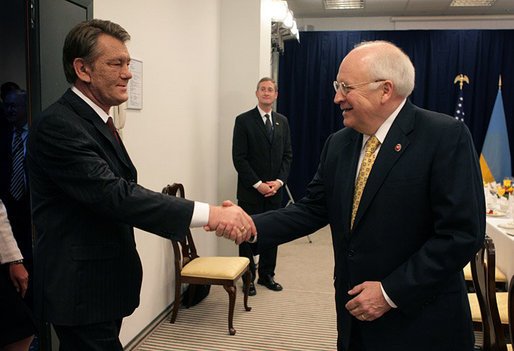 | Vice President Dick Cheney and Ukrainian President Viktor Yushchenko greet one another before beginning a breakfast meeting, Thursday, May 4, 2006 in Vilnius, Lithuania. |
THE VICE PRESIDENT: Delighted to have the opportunity this morning to spend some time with my old friend President Yushchenko from Ukraine. This is our third meeting, I believe. We've met previously in Poland and then in Washington. Developments in Ukraine are extraordinarily important, and all of us who support the development of freedom and democracy have been impressed with what our friends in Ukraine have achieved, and want to do everything we can to be of assistance in the days ahead. So welcome, Mr. President.
PRESIDENT YUSHCHENKO: Mr. Vice President, and your American colleagues, our bilateral relations belong to the highest category of strategic partnership. And we pay a lot of attention to the content of the negotiations. So I can say that over the last 12 months we managed to achieve quite significant progress. And most of that significant progress is associated with democratic developments that take place in Ukraine. Free and fair elections to Ukrainian parliament and local bodies of self-government was an important test for us. Probably for the first time, Ukrainian authorities were highly assessed by Ukrainian community -- by international community, including the Americans. We appreciate your help. And once again, we value our bilateral relations very highly. And we would like to thank the American side for that friendly attention that is being paid to the democratic developments in Ukraine. Thank you.
END 8:07 A.M. (Local), For Immediate Release, Office of the Vice President, May 4, 2006
Relared: Keywords Vice President Cheney, Tuesday, May 09, 2006 Vice President Cheney and Lithuanian President Valdus Adamkus, Monday, April 17, 2006 Vice President Cheney and Mrs. Cheney Release 2005 Income Tax Return, Thursday, February 16, 2006 Interview of the Vice President by Brit Hume (VIDEO), Wednesday, February 15, 2006 Update by the Office of the Vice President, Saturday, January 21, 2006 Vice President, Neil Cavuto, FOX News (VIDEO), Friday, January 13, 2006 Vice President to Travel to Egypt and Saudi Arabia, Friday, January 06, 2006 Vice President's Remarks on Iraq and the War on Terror (VIDEO), Thursday, November 17, 2005 Vice President's Remarks 11/16/05, Monday, October 31, 2005 Vice President appointed David S. Addington chief of staff, Saturday, October 29, 2005 Vice President's Statement on Libby Resignation, Friday, October 28, 2005 Resignation of Scooter Libby (VIDEO, Tuesday, October 04, 2005 Remarks by the Vice President to Second Marine Expeditionary Force, Monday, September 26, 2005 Statement on Vice President Cheney's Medical Procedure, Tuesday, September 06, 2005 President Meets with Cabinet (VIDEO),
0
comments
||
||


