Saturday, May 27, 2006

President Bush and Prime Minister Tony Blair (VIDEO)

Technorati Tags: and or and or and or and or

President Bush and Prime Minister Tony Blair of the United Kingdom Participate in Joint Press Availability, FULL STREAMING VIDEO, The East Room in Focus: Global Diplomacy, 7:31 P.M. EDT.
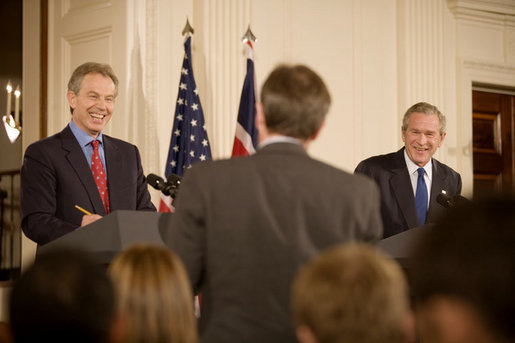
President George W. Bush and British Prime Minister Tony Blair participate in a joint news conference Thursday evening May 25, 2006 in the East Room of the White House, where the two leaders vowed their support to the new government of Iraq. White House photo by Eric Draper.President George W. Bush and British Prime Minister Tony Blair participate in a joint news conference Thursday evening May 25, 2006 in the East Room of the White House, where the two leaders vowed their support to the new government of Iraq.
White House photo by Eric Draper.

PRESIDENT BUSH: Thank you all. Good evening. I want to thank Prime Minister Tony Blair for coming to Washington to discuss his recent visit to Iraq. The Prime Minister met with key leaders of the new Iraqi government that represents the will of the Iraqi people and reflects their nation's diversity. As Prime Minister Blair will tell you, Iraqi Prime Minister Maliki outlined an aggressive agenda to bring security to the Iraqi people, to improve electricity and other essential services, and to pursue a strategy for national reconciliation.


The agenda that Prime Minister Maliki has outlined demonstrates that Iraq's new government understands its duty to deliver real improvements in the daily lives of the Iraqi people. The formation of a new government represents a new beginning for Iraq and a new beginning for the relationship between Iraq and our coalition. The United States and Great Britain will work together to help this new democracy succeed. We'll take advantage of this moment of opportunity and work with Iraq's new government to strengthen its young democracy and achieve victory over our common enemies.

As we celebrate this historic moment, it's important to recall how we got there, and take stock on how far we've come over the last three years. The violence and bloodshed in Iraq has been difficult for the civilized world to comprehend. The United States and Great Britain have lost some of our finest men and women in combat. The car bombings and suicide attacks and other terrorist acts have also inflicted great suffering on the Iraqi people. And Iraqis have increasingly become the principal victims of terror and sectarian reprisal.

Yet, in the face of this ongoing violence, each time the Iraqi people voiced their opinion, they chose freedom. In three different elections, millions of Iraqis turned out to the polls and cast their ballots. Because of their courage, the Iraqis now have a government of their choosing, elected under the most modern and democratic constitution in the Arab world. The birth of a free and democratic Iraq was made possible by the removal of a cruel dictator.

The decision to remove Saddam Hussein from power was controversial. We did not find the weapons of mass destruction that we all believed were there -- and that's raised questions about whether the sacrifice in Iraq has been worth it. Despite setbacks and missteps, I strongly believe we did and are doing the right thing. Saddam Hussein was a menace to his people; he was a state sponsor of terror; he invaded his neighbors. Investigations proved he was systematically gaming the oil-for-food program in an effort to undermine sanctions, with the intent of restarting his weapons programs once the sanctions collapsed and the world looked away.

If Saddam Hussein were in power today, his regime would be richer, more dangerous and a bigger threat to the region and the civilized world. The decision to remove Saddam Hussein was right.

But not everything since liberation has turned out as the way we had expected or hoped. We've learned from our mistakes, adjusted our methods, and have built on our successes. From changing the way we train the Iraqi security forces to rethinking the way we do reconstruction, our commanders and our diplomats in Iraq are constantly adapting to the realities on the ground. We've adapted our tactics, yet the heart of our strategy remains the same: to support the emergence of a free Iraq that can govern itself, sustain itself, and defend itself.

All our efforts over the past three years have been aimed towards this goal. This past weekend, the world watched as Iraqis stood up a free and democratic government in the heart of the Middle East. With our help, Iraq will be a powerful force for good in a troubled region, and a steadfast ally in the war on terror.

With the emergence of this government, something fundamental changed in Iraq last weekend. While we can expect more violence in the days and weeks ahead, the terrorists are now fighting a free and constitutional government. They're at war with the people of Iraq, and the Iraqi people are determined to defeat this enemy, and so are Iraq's new leaders, and so are the United States and Great Britain.

It is vital that Iraq's new government seize this opportunity to heal old wounds and set aside sectarian differences and move forward as one nation. As Prime Minister Maliki has made his priorities clear, we have learned they're the right priorities. He's said he will focus on improving the security situation in Baghdad and other parts of the country. He has declared he will use maximum force to defeat the terrorists. He's vowed to eliminate illegal militias and armed gangs. He wants to accelerate the training of the Iraqi security forces so they can take responsibility from coalition forces for security throughout Iraq. He wants to improve health care and housing and jobs, so the benefits of a free society will reach every Iraqi citizen.

Our coalition will seize this moment, as well. I look forward for continued in-depth discussions with Tony Blair, so we can develop the best approach in helping the new Iraqi government achieve its objectives. The new government of Iraq will have the full support of our two countries and our coalition, and we will work to engage other nations around the world to ensure that constitutional democracy in Iraq succeeds and the terrorists are defeated.


Mr. Prime Minister.

PRIME MINISTER BLAIR: Thank you, Mr. President, and can I say what a pleasure it is to be with you again at the White House. And thank you for your welcome.

As everyone knows, I was in Iraq earlier in this week, in Baghdad. And I was able to discuss with the new leaders of Iraq firsthand their experience and their hopes and expectations for the future. And I came away thinking that the challenge is still immense, but I also came away more certain than ever that we should rise to it. And though it is, at times, daunting, it is also utterly inspiring to see people from all the different parts of the community in Iraq -- the Sunni, the Shia, the Kurds -- sitting down together, all of them democratic leaders, democratically elected by their people; elected for a four-year term; elected and choosing to come together as a government of national unity, and completely determined to run their country in a different way for the future.

Anybody who studies the program of the Iraqi government can't fail to see the similarities with the type of program that any of us would want to see for our countries. And what is remarkable about it is that they put the emphasis, of course, on the issues to do with economic recovery and reconstruction and all the problems of infrastructure that they have in their country, but they also very clearly commit themselves to reconciliation between the different parts of the country, to the fight against sectarianism, and to the defeat of terrorism.

And I think what is important now is to say that after three years, which have been very, very difficult indeed, and when at times it looked impossible for the democratic process to work, I think after these three years and the democratic process working and producing this government, then it is our duty, but it is also the duty of the whole of the international community, to get behind this government and support it, because the other thing that came across to me very strongly from talking to them was that the reason there is bloodshed and violence in Iraq is that the very forces that we are confronting everywhere, including in our own countries, who want to destroy our way of life, also want to destroy their hope of having the same type of life. In other words, the very forces that are creating this violence and bloodshed and terrorism in Iraq are those that are doing it in order to destroy the hope of that country and its people to achieve democracy, the rule of law and liberty.

And I think there is a pattern here for us in the international community. I know the decision to remove Saddam was deeply divisive for the international community, and deeply controversial. And there's no point in rehearsing those arguments over and over again. But whatever people's views about the wisdom of that decision, now that there is a democratic government in Iraq, elected by its people, and now they are confronted with those whose mission it is to destroy the hope of democracy, then our sense of mission should be equal to that and we should be determined to help them defeat this terrorism and violence.

And I believe very, very strongly, indeed -- even more so having talked to the leaders there and now coming back and examining our own situation and how we help -- I'm more than ever convinced that what is important for them in Iraq is to know that we will stand firm with them in defeating these forces of reaction.

I believe the same, incidentally, is true of the struggle in Afghanistan, where, again, exactly the same forces of terrorism and reaction want to defeat the hopes of people for progress. I would also like to think -- and this is something the President and I were discussing earlier, we will carry on discussing over tonight and tomorrow -- and that is the importance of trying to unite the international community behind an agenda that means, for example, action on global poverty in Africa, and issues like Sudan; it means a good outcome to the world trade round, which is vital for the whole of the civilized world, vital for developing countries, but also vital for countries such as ourselves, for progress in the Middle East, and for ensuring that the global values that people are actually struggling for today in Iraq are global values we take everywhere and fight for everywhere that we can in our world today.

So I would like to pay tribute also to the work that our forces do there. I think both our countries can be immensely proud of their heroism and their commitment and their dedication.

But one very interesting thing happened to me when I was there and talking to some of our armed forces, and talking, also, to the Iraqi soldiers that were working alongside them, and that is, for all the differences in culture and background and nationality, both of them were working together in a common cause, and that was to help a country that was once a brutalized dictatorship, become a country that enjoys the same rights and the same freedoms that we take for granted here, and in the United Kingdom. And for all the hardship and the challenge of the past few years, I still think that is a cause worth standing up for.

Thank you, Mr. President.

PRESIDENT BUSH: Terry.

Q Mr. President, Pentagon officials have talked about prospects for reducing American forces in Iraq to about 100,000 by year's end. Does the formation of a unity government in Iraq put you on a sound footing to achieve that number?

And Mr. Prime Minister, is it realistic to think that Iraqi forces will be able to take control of all Iraq by the end of next year as Mr. Malaki suggests?

PRESIDENT BUSH: First of all, we're going to work with our partners in Iraq, the new government, to determine the best way forward in achieving an objective, which is an Iraq that can govern itself and sustain itself and defend itself.

I have said to the American people, as the Iraqis stand up, we'll stand down. But I've also said that our commanders on the ground will make that decision. And I have -- we'll talk to General Casey once he is -- conferred with the new government of Iraq. They don't have a defense minister yet; they're in the process of getting a defense minister. So it probably makes a lot of sense for our commander on the ground to wait until their defense structure is set up before we discuss with them, and he with me, the force levels necessary to achieve our objective.

Q So the 100,000 --

PRESIDENT BUSH: That's some speculation in the press that I -- they haven't talked to me about. And as the Commander-in-Chief, they eventually will talk to me about it. But the American people need to know that we'll keep the force level there necessary to win. And it's important for the American people to know that politics isn't going to make the decision as to the size of our force level. The conditions on the ground will make the decision. And part of the conditions on the ground, Terry, is a new government, and we believe the new government is going to make a big difference in the lives of the Iraqi people.

I told you earlier that when you attack an Iraqi now, you're at war with an Iraqi government that's constitutionally elected. And that's a different attitude from the way it's been in the past.

PRIME MINISTER BLAIR: I think it's possible for the Iraqi security forces to take control progressively of their country. That's exactly the strategy we've outlined at the beginning. And I think it's possible to happen in the way that Prime Minister Maliki said. For that to happen, obviously, the first thing that we need is a strong government in Baghdad that is prepared to enforce its writ throughout the country. My very strong feeling, having talked to the leaders there, is that they intend theirs to be such a government.

Secondly, what they intend is to come down very hard on those people who want to create the circumstances where it's difficult for the Iraqi forces to be in control. And the truth of the matter is there is no excuse now for anyone to engage in violence in Iraq. I mean, if people's worry is to do with being excluded from the political process, everybody has got their place in the political process today. And, obviously, there are still issues to do with the capability of the Iraqi forces, but all the time they are building up, both in number and in capability, and we've got to support that all the way through.

But I'll tell you one interesting thing from talking to all the different groups -- because sometimes, certainly in our country, the impression is given that the Iraqi people wish that we were gone from Iraq and weren't there any longer in support of the Iraqi government or the Iraqi forces. Not a single one of the people I talked to, not one of the political leaders, from whatever part of the spectrum in Iraq that I talked to -- and these are all people from all the different communities elected by their people -- not one of them wanted us to pull out precipitately. All of them wanted us to stick with it and see the job done.

Now, of course, they want to take back control of their own country fully -- and we want them to do that. But when Prime Minister Maliki talked about an objective timetable, what he meant was a timetable governed by conditions on the ground. And we will be working with them now in the coming period of time to see how we can put that framework together. But they have a very, very clear sense of what they want the multinational force to do. They want us there in support until they've got the capability, and then they want us to leave and them to take full charge of their country. And I believe that can happen.

Q One gets a clear sense of your mutual relief that a government has now been formed, an elected government has been formed in Iraq. But, nonetheless, the current Secretary General of the United Nations has said that he believes that the invasion of Iraq was probably illegal. When you look at your legacy and you look ahead to the reforms in the United Nations you want to see, are you really saying that what you'd actually like to see is a United Nations which could take preemptive action legally?

PRIME MINISTER BLAIR: I think what we need to do is to recognize that there are threats in our world today that require us to act earlier and more effectively. And I think we can debate the institutional structure within which that should happen in the United Nations and elsewhere, but I also think that when we look at this global terrorism that we face, there is -- to me, at any rate -- a very clear link between the terrorism that is afflicting virtually every country in the Western world, either in actuality or potentially, the terrorism that is happening all over different countries of the Middle East and in Asia and elsewhere, and the terrorism that is there in Iraq and Afghanistan.

And one of the things I think, certainly for our people they find most difficult to understand, is, they will say, well, is it -- can it be worth everything that we are doing? I mean, it's such a huge sacrifice that is being made. Can it be worth it? And I think the answer to that is, it is worth it to those engaged in this violence and terrorism to try to stop us, and we should have the same faith and confidence in our determination to succeed as they have in their determination to make us fail.

And I think that is an issue for the whole of the international community, because I've got no doubt at all that if we do succeed, as I believe that we will in Iraq, difficult though it will be, and we succeed in Afghanistan, then the whole of this global terrorism will suffer a defeat. And that's why I think we need an international community that's capable of recognizing these problems and acting on them.

PRESIDENT BUSH: I'd like to see a United Nations that's effective, one that joins us in trying to rid the world of tyranny, one that is willing to advance human rights and human dignity at its core, one that's an unabashed organization -- is unabashed in their desire to spread freedom. That's what I'd like to see, because I believe that freedom will yield to peace. I also believe freedom is universal. I don't believe freedom is just a concept only for America or Great Britain. It's a universal concept. And it troubles me to know that there are people locked in tyrannical societies that suffer. And the United Nations ought to be clear about its desire to liberate people from the clutches of tyranny. That's what the United Nations ought to be doing, as far as I'm concerned.

Yes, Steve.

Q Thank you, Mr. President. How close are you to an agreement on a package of incentives for Iran? And what does Iran stand to gain if it were to give up its enrichment program? And why are you ignoring these recent back-channel overtures from Iran?

PRESIDENT BUSH: We spent a great deal of time talking about the Iranian issue, and one of the goals that Tony and I had was to convince others in the world that Iran, with a nuclear weapon, would be very dangerous, and therefore, we do have a common goal. And the fundamental question is, how do you achieve that goal, obviously. We want to do it diplomatically.

Right now, we, as a matter of fact, spent a lot of time upstairs talking about how to convince the Iranians that this coalition we put together is very serious. One option, of course, is through the United Nations Security Council. And we strategized about how do we convince other partners that the Security Council is the way to go if the Iranians won't suspend like the EU3 has asked them to do. The Iranians walked away from the table. They're the ones who made the decision, and the choice is theirs. Now, if they would like to see an enhanced package, the first thing they've got to do is suspend their operations, for the good of the world. It's incredibly dangerous to think of an Iran with a nuclear weapon.

And therefore, Steve, to answer your questions, of course, we'll look at all options, but it's their choice right now. They're the folks who walked away from the table. They're the ones who said that, your demands don't mean anything to us.

Now, in terms of -- you said back channels --

Q Back-channel overtures.

PRESIDENT BUSH: Well, I read the letter of the President and I thought it was interesting. It was, like, 16 or 17 single-spaced typed pages of -- but he didn't address the issue of whether or not they're going to continue to press for a nuclear weapon. That's the issue at hand.

And so it's -- we have no beef with the Iranian people. As a matter of fact, the United States respects the culture and history of Iran, and we want there to be an Iran that's confident, and an Iran that answers to the needs of the -- we want women in Iran to be free. At the same time, we're going to continue to work with a government that is intransigent, that won't budge. And so we've got to continue to work to convince them that we're serious; that if they want to be isolated from the world, we will work to achieve that.

Q Should this enhanced package include a light-water reactor and a security guarantee?

PRESIDENT BUSH: Steve, you're responding to press speculation. I've just explained to you that the Iranians walked away from the table, and that I think we ought to be continuing to work on ways to make it clear to them that they will be isolated. And one way to do that is to continue to work together through the United Nations Security -- if they suspend and have the IAEA in there making sure that the suspension is real, then, of course, we'll talk about ways forward, incentives.

Q Prime Minister, you've both talked a little about the U.N. I know that you believe the U.N. needs vigorous leadership and you're going to pick up on these themes in your speech tomorrow. Is that a job application? And, if not --

PRESIDENT BUSH: Wait a minute. (Laughter.)

Q -- do you both have a sense -- do you have someone in mind? And, if not, how are you going to get the reform at the U.N. you want to see?

PRIME MINISTER BLAIR: No, no and I'm not sure -- (laughter) -- is the answer to those ones. Look, what we want to do is to make sure the U.N. is an effective instrument of multilateral action. That's what everyone wants to see. And the fact is there are multiple problems in the world; they require the international community to respond on a collective basis -- but you've got to have an effective set of multilateral institutions to do that. And that's true whether you're tackling global poverty or trying to resolve disputes or, indeed, when you're dealing with issues like Iran.

The whole point about the international community today is that these problems are urgent, they need to be tackled. If they're not tackled the consequences are very quickly felt around the world, and you've got to have institutions that are capable of taking them on and tackling them and getting action taken.

Now, we were just talking about Iran a moment ago. I mean, we want to have this resolved through the process of the multilateral institutions. There's a way we can do this. I mean, after all, we are the ones saying the Atomic Energy Authority, their duties and obligations they lay upon Iran should be adhered to. And we've got absolutely no quarrel with the Iranian people. The Iranian people are a great people; Iran is a great country. But it needs a government that is going to recognize that part of being a great country is to be in line with your international obligations, and to cease supporting those people in different parts of the world who want, by terrorism and violence, to disrupt the process of democracy.

So I think that our position with Iran is a very reasonable one, and we want to see how we can make progress and help them to do the things that we believe that they should do, but they must understand that the will of the international community is sure and is clear, and that is that the obligations that are upon them have got to be adhered to.

PRESIDENT BUSH: Stretch.

Q Thank you, Mr. President.

PRESIDENT BUSH: I call him Stretch.

Q And I've been called worse. (Laughter.) Has Treasury Secretary Snow given you any indication that he intends to leave his job any time soon?

PRESIDENT BUSH: Secretary of Treasury Snow?

Q Has he given you any indication he intends to leave his job any time soon? And related to that, Americans -- macroeconomic numbers are indeed good, but many Americans are concerned, increasingly concerned about rising health care costs, costs of gasoline. And does that make it hard for your administration, Treasury Secretary Snow, and everyone else to continue to talk up the economy?

PRESIDENT BUSH: No, he has not talked to me about resignation. I think he's doing a fine job. After all, our economy is -- it's strong. We grew at 3.5 percent last year; a good, strong first quarter this year. We added five -- 2.5 million new jobs, we've got 4.7 percent unemployment rate nationwide. Productivity is up, home ownership is high, small businesses are doing well. He's done a fine job.

And our -- obviously, people are concerned about rising fuel prices -- all the more reason to get off oil and to promote alternatives, such as ethanol or battery technologies that will enable us to drive the first 40 miles on electricity. We're spending about $1.2 billion over the next 10 years to develop hydrogen fuel cells. We want -- we need to get away from hydrocarbons here in America, for economic security, for national security, and for environmental reasons, as well.

One way we could help alleve gasoline prices here in America is for the Congress to pass some regulatory relief so we can actually expand refining capacity. We haven't built a new refinery here since the 1970s. And curiously enough, when demand for a product goes up with tight supply, price follows. And so we put out some logical ways for Congress to work with the administration to relieve price pressures on gasoline.

As far as health care goes, there are some practical ways to deal with health care costs, and one of the most practical ways is to get rid of these junk lawsuits that are running good doctors out of practice and running up the price of medicine. Passed it out of the House. They can't get it out of the Senate because the lawyers won't let it out. But we put forth a common-sense practice to deal with rising health care costs, as well.

Q You both presented the Iraqi government as a substantial vindication of the conflict. Do you also accept, as a matter of harsh political reality, that the Iraq conflict has also left both of you politically weakened and, whether justly or unjustly, less able to give the kind of moral leadership that you're discussing today?

PRESIDENT BUSH: No question that the Iraq war has created a sense of consternation here in America. I mean, when you turn on your TV screen and see innocent people die, day in and day out, it affects the mentality of our country.

But here's what they're asking in America. They're asking, can we win? That's what they want to know. Do we have a strategy for victory? And so the talk about the unity government -- you might remember there was some -- a lot of speculation as to whether there would even be a unity government. A couple of months ago, people were saying, well, they can't even get a unity government going. But we have a unity government -- a Kurd President, a Prime Minister who is a Shia, a Speaker who is a Sunni. These are strong leaders. It's an indication that progress is being made.

Part of progress, of course, is on the political track. You know, we had elections in Iraq; 12 million people voted last December. Now, it seems like an eternity ago, I know, like a decade. But that's not all that long ago in the larger scope of things. Twelve million people said, we want to be free. It was an astounding moment. And this unity government is now formed, as a result of those elections, under a constitution approved by the Iraqi people. That's progress. It's certainly a far sight from the days of a tyrant who killed hundreds of thousands of his own people and used weapons of mass destruction and threatened the neighborhood. I mean, that is progress.

No question, however, that the suiciders and the killers and the IEDs and the deaths have an effect on the American people. But one of the reasons that I appreciate Tony coming is that he brings a fresh perspective of what he saw, and the American people need to know we are making progress toward a goal of an Iraq that can defend itself, sustain itself and govern itself. That will deny the terrorists a safe haven.

You know, al Qaeda has made it clear what their intentions are in Iraq. I'm sure you've read some of the intercepts that are laid out there for people to see. And they have made it clear that it's just a matter of time for countries like Great Britain and the United States to leave. In other words, if they make life miserable enough, we'll leave. And they want us to leave because they want a safe haven from which to launch attacks, not only on us, but on moderate Muslim governments, as well. These people are totalitarians. They're Islamic fascists. They have a point of view, they have a philosophy, and they want to impose that philosophy on the rest of the world. And Iraq just happens to be a -- one of the battles in the war on terror.

And Tony brings up a good point: Why are they resisting so hard, what is it about democracy they can't stand? Well, what they can't stand about democracy is this: Democracy is the exact opposite of what they believe. They believe they can impose their will, they believe there's no freedom of religion, they believe there's no women's rights. They have a -- they have a dark vision of the world, and that's why they're resisting so mightily.

So yes, I can understand why the American people are troubled by the war in Iraq. I understand that. But I also believe the sacrifice is worth it and is necessary, and I believe a free Iraq is not only going to make ourselves more secure, but it's going to serve as a powerful example in the Middle East.

You know, foreign policy, for awhile, just basically said, if it seems okay on the surface, just let it be. And guess what happened? There was resentment and hatred that enabled these totalitarians to recruit and to kill, which they want to continue to do to achieve their objectives. And the best way to defeat them in the long run is through the spread of liberty.

And liberty has had the capacity to change enemies to allies. Liberty has had the capacity to help Europe become whole, free, and at peace. History has proven that freedom has got the capacity to change the world for the better, and that's what you're seeing.

You know, the amazing thing about dealing with Prime Minister Blair is never once has he said to me on the phone, we better change our tactics because of the political opinion polls. And I appreciate that steadfast leadership. And I appreciate somebody who has got a vision, a shared vision, for how to not only protect ourselves in the war on terror, but how to make the world a better place.

PRIME MINISTER BLAIR: I don't really think it's a matter of our vindication. I think, in a way, that's the least important part of it. But I do think that occasionally we should just take a step back and ask, why are we doing this? Why is it so important?

Saddam was removed from power three years ago. Since then, incidentally, our forces have been there with the United Nations mandate and with the consent of the Iraqi government, itself, the Iraqi government, becoming progressively more the product of direct democracy.

So whatever people thought about removing Saddam -- you agree with it, you didn't agree with it for these last three years, the issue in Iraq has not been, these people are here without any international support, because we haven't had any United Nations resolution governing our presence there. The issue is not, you're there, but the Iraqi people don't want you there, because the Iraqi government, and now this directly-elected Iraqi government has said they want us to stay until the job is done.

So why is it that for three years, we have had this violence and bloodshed? Now, people have tried to say it's because the Iraqi people -- you people, you don't understand; you went in with this Western concept of democracy and you didn't understand that their whole culture was different, they weren't interested in these types of freedom. These people have gone out and voted -- a higher turnout, I have to say -- I'm afraid to say, I think, than either your election or mine. These people have gone out and voted --

PRESIDENT BUSH: Which one? 2000 or 2004? (Laughter.)

PRIME MINISTER BLAIR: I think both of them.

PRESIDENT BUSH: I think you're right. (Laughter.)

PRIME MINISTER BLAIR: They have gone out and voted despite terrorism, despite bloodshed, despite literally the prospect of death for exercising their democratic right.

So they have kept faith with the very democratic values that we say we believe in, and the people trying to wrest that democracy from them are opposed to absolutely everything we stand for and everything the Iraqi people stand for.

So what do we do in response to this? And the problem we have is very, very simple. A large part of the perspective with which we look at this is to see every act of terrorism in Iraq, every piece of ghastly carnage on our television screens, every tragic loss of our own forces -- we see that as a setback and as a failure when we should be seeing that as a renewed urgency for us to rise to the challenge of defeating these people who are committing this carnage. Because over these past three years, at every stage, the reason they have been fighting is not, as we can see, because Iraqi people don't believe in democracy, Iraqi people don't want liberty. It is precisely because they fear Iraqi people do want democracy, Iraqi people do want liberty.

And if the idea became implanted in the minds of people in the Arab and Muslim world that democracy was as much their right as our right, where do these terrorists go? What do they do? How do they recruit? How do they say, America is the evil Satan? How do they say the purpose of the West is to spoil your lands, wreck your religion, take your wealth? How can they say that? They can't say that.

So these people who are fighting us there know what is at stake. The question is, do we?

PRESIDENT BUSH: I'm going to say, that was a great answer. (Laughter.)

PRIME MINISTER BLAIR: Yours was pretty good, too. (Laughter.)

Q You have your chance now. (Laughter.)

PRESIDENT BUSH: Another chance -- good. Well, thank you, Martha.

Q Mr. President, you have said time and time again, and again tonight, when Iraqi forces stand up, coalition forces can start standing down.

PRESIDENT BUSH: Right.

Q But the fact is, you have been standing up Iraqi forces in great numbers. The administration says you have hundreds of thousand trained and equipped, tens of thousand leading the fight. And yet, during the same period they've been standing up there has not been a substantial decrease in U.S. and coalition forces. So what does that tell us about how meaningful the figures are on Iraqi troops? And what does that tell us about a potential for a draw-down?

PRESIDENT BUSH: It tells you that the commanders on the ground are going to make the decision, that's what that tells you. And when they feel comfortable in recommending to me fewer troops, I will accept that. But they're going to make that recommendation based upon the conditions on the ground. I know I keep saying that, and it probably bores you that I keep giving the same answer, but I haven't changed my opinion.

I talk to our commanders all the time. They feel strongly that the Iraqi army is getting better. It's hard to have a command and control system with an Iraqi army when you don't have a defense minister. And so Mr. Maliki is going to have to pick one soon. And then our commanders will gauge as to whether or not the command and control structure is sufficient to be able to enable the Iraqis to take more of the fight. They are taking more of the fight, by the way. They're in more provinces than ever before. They're taking over more territory. They're taking over more missions. There are some gaps that we need to continue to work on to fill -- the transportation issue is going to need to be dealt with over time.

All I can report to you is what General Casey -- in whom I have got a lot of confidence -- tells me, and that is the Iraqis are becoming better and better fighters. And at some point in time, when he feels like the government is ready to take on more responsibility and the Iraqi forces are able to help them do so, he will get on the telephone with me and say, Mr. President, I think we can do this with fewer troops. We've been up to 165,000 at one point; we're at about 135,000 now.

Q (Inaudible.)

PRESIDENT BUSH: Hold on for a second. Actually, he moved some additional troops from Kuwait into Baghdad. Conditions on the ground were such that we needed more support in Baghdad, to secure Baghdad, so he informed me, through Donald Rumsfeld, that he wanted to move troops out of Kuwait into Baghdad.

So these commanders, they need to have flexibility in order to achieve the objective. You don't want politicians making decisions based upon politics. You want the Commander-in-Chief making decisions based upon what the military thinks is the right way to achieve the objective. I've set the objective, it's clear for everybody -- a country that can sustain itself, defend itself and govern itself. And we're making progress on all fronts. But as to how many troops we have there will depend upon the generals and their commanders saying, this is what we need to do the job, Mr. President, and that's the way it's going to be so long as I'm standing here as the Commander-in-Chief, which is two-and-a-half more years.

PRIME MINISTER BLAIR: I spoke to General Casey and to our own General Fry in Baghdad on Monday. We sat down and talked this very issue through. And I think what you will find is that progressively there will be more and more parts of Iraq that are policed by the Iraqi security forces themselves, and their capability is improving. But I also think you will find probably over the next few months there will be a real attempt by the anti-democratic forces to test them very, very strongly. And remember, a lot of the attacks are now happening not on the multinational force, although those attacks continue, of course, but actually on the Iraqi forces themselves, on their police, on their army and so on. And the purpose, of course, of that is to deter them from the very buildup of capability that we want to see.

But over the course of the next few months, you will see progressively those provinces in Iraq coming under Iraqi control, and then, of course, it will be for the Iraqis to sort out that responsibility.

PRESIDENT BUSH: One thing, Martha, is that we want to make sure we complete the mission, that we achieve our objective. A loss in Iraq would make this world an incredibly dangerous place. Remember there is not only sectarian violence, a hangover from Saddam's era, but there is an al Qaeda presence, in the form of Zarqawi, who wants to sow as much havoc as possible to cause us to leave before the mission is complete.

Listen, I want our troops out, don't get me wrong. I understand what it means to have troops in harm's way. And I know there's a lot of families making huge sacrifices here in America. I'll be going to a Memorial Day ceremony next Monday paying tribute to those who have lost their life. I'm sure I will see families of the fallen. I fully understand the pressures being placed upon our military and their families. But I also understand that it is vital that we -- that we do the job, that we complete the mission. And it has been tough, it's been really tough, because we're fighting an unconventional enemy that is willing to kill innocent people. There are no rules of war for these people. But make no mistake about it, what you're seeing in Iraq could happen all over the world if we don't stand fast and achieve the objective.

No, I had the follow-up answer, you can't have a follow-up question. Nice try, though.

Q Prime Minister, this is possibly your last official visit to Washington as Prime Minister --

PRESIDENT BUSH: Wait a minute. (Laughter.) Back-to-back disses.

Q At least the beginning of the end of your particular special relationship. Will you miss the President? What will you miss about him? (Laughter.)

And for the President, what will you miss about Tony Blair, and what are you looking for in an eventual replacement?

PRESIDENT BUSH: Hmmm -- I'll miss those red ties, is what I'll miss. (Laughter.) I'll say one thing -- he can answer the question -- don't count him out. Let me tell it to you that way. I know a man of resolve and vision and courage. And my attitude is, I want him to be here so long as I'm the President.

PRIME MINISTER BLAIR: Well, what more can I say? (Laughter.) Probably not wise to say anything more at all. (Laughter.)

You guys, come on, I want you to -- the British delegation, ask a few serious questions. (Laughter.)

PRESIDENT BUSH: Right.

PRIME MINISTER BLAIR: Or we'll go on to one of you guys. (Laughter.)

PRESIDENT BUSH: Plante.

Q Perhaps I can change the mood. Mr. President, you talk about setting the objective. But our people, my colleagues on the ground in Iraq, say that when they talk to American troops, the rank and file, they say they don't believe that they've had enough to do the job. They say further that while the Iraqi army may be improving, there is absolutely no way to depend upon the police, who they say are corrupt and aligned with militias. All of this going on -- what reason is there to believe that the new government can do any better with these people than we've been able to do so far?

PRESIDENT BUSH: There are several tracks, Bill. One is the political track. I think it's very important for the Iraqi people to have a government that has been elected under a constitution they approved. In other words, the political track has been a vital part of having a country that can govern itself and defend itself.

There's a security track. And there's no question that there are a lot of Iraqis trained to fight, and many of them are good fighters -- 117,000 have been trained and equipped. There needs to be more equipment; no question about that. The Iraqis -- I think if you were get a -- at least the assessment I get, is that the Iraqi army is moving well along and they're taking more and more of the territory over in order to defend their country.

No question we've got a lot of work to do on the police. General Casey has said publicly that the year 2006 is -- is the year that we'll train the police up and running. Perhaps the place where there needs to be the most effective police force is in Baghdad. I just told you we're moving more troops in. There's a -- General Casey met today with the Prime Minister to talk about how to secure Baghdad. It's really important that Baghdad -- that a capital city become more secure. And there's plans to deal with the contingencies on the ground. All I can tell you is, is that we're making progress toward the goal.

PRIME MINISTER BLAIR: And I'd like to say something, again, about the discussions I had on Monday. I think that what is important is to try and get a sense of balance in this. Look, it would be completely foolish for us to say, there are no problems with either the police or the army, you've got a full force capability in the way that we want. And nobody is actually saying that.

It would also be wrong to turn it around the other way, though, even in respect to the police. I had quite a detailed discussion, not, in fact, with the generals, but some of the ordinary soldiers who -- British soldiers there up in Baghdad, and also with some of the people who are working with the police at the moment. And what they said to me is, yes, there are real problems to do with corruption in parts of the police force, but actually, there is also another side to it, which there are people who are really dedicated and really committed to a non-sectarian Iraq, who also are playing their part.

Now I think the whole question is whether this new government can then grip this in the way, in a sense, that only they can. You see, I think this is where, inevitably, over time, we have to transfer responsibility. And that is, of course, what we wish to do, and part of that is because it is easier for an Iraqi interior minister who is the product of an Iraqi-elected government, to go in and take the really tough measure sometimes that is necessary to sort some of these issues out.

But I can assure you of two things. First of all, there is another, more positive side to the Iraqi forces -- both the army, and in parts of the police, as well. And, secondly, the Iraqi government knows that this is the absolute prerequisite of success for them. It's just -- one of the ministers said to me, he said, you should understand, our state was a completely failed state; the police -- people didn't go to the police in Iraq if they had a problem under Saddam. They had a problem if they were in contact with the police because of the way the state was run.

And so you're talking about literally building the institutions of a state from scratch. And I don't think it's, in one sense, very surprising that it is both difficult and taking time. But I think that they do know that this is of vital importance for them to succeed. And I think that you may find that it is easier for Iraqis to do this themselves and take some of these measures necessary, than it is for us, although we would be there, obviously, in support of what they're doing.

Q Mr. President, you spoke about missteps and mistakes in Iraq. Could I ask both of you which missteps and mistakes of your own you most regret?

PRESIDENT BUSH: Sounds like kind of a familiar refrain here -- saying "bring it on," kind of tough talk, you know, that sent the wrong signal to people. I learned some lessons about expressing myself maybe in a little more sophisticated manner -- you know, "wanted dead or alive," that kind of talk. I think in certain parts of the world it was misinterpreted, and so I learned from that. And I think the biggest mistake that's happened so far, at least from our country's involvement in Iraq is Abu Ghraib. We've been paying for that for a long period of time. And it's -- unlike Iraq, however, under Saddam, the people who committed those acts were brought to justice. They've been given a fair trial and tried and convicted.

PRIME MINISTER BLAIR: I think inevitably some of the things that we thought were going to be the biggest challenge proved not to be, and some of the things we didn't expect to be challenges at all proved to be immense. I think that probably in retrospect -- though at the time it was very difficult to argue this -- we could have done the de-Baathification in a more differentiated way than we did.

I think that the most difficult thing, however, has been the determination of people to move against the democratic process in Iraq in a way that I think -- as I was saying a moment or two ago -- indicates our opponents' very clear view from a very early stage that they have to stop the democratic process working. And I think it's easy to go back over mistakes that we may have made, but the biggest reason why Iraq has been difficult is the determination of our opponents to defeat us. And I don't think we should be surprised at that.

Maybe in retrospect, when we look back, it should have been very obvious to us, and is obvious still in Afghanistan that for them, it is very clear. You know, they can't afford to have these countries turned round, and I think that probably, there was a whole series of things in Iraq that were bound to come out once you got al Qaeda and other groups operating in there to cause maximum destruction and damage. And therefore, I'm afraid in the end, we're always going to have to be prepared for the fall of Saddam not to be the rise of democratic Iraq, that it was going to be a more difficult process.

PRESIDENT BUSH: Mr. Prime Minister, can I buy you dinner?

PRIME MINISTER BLAIR: Certainly.

END 8:24 P.M. EDT, For Immediate Release, Office of the Press Secretary, May 25, 2006

RELATED: Keywords, President to Welcome,Friday, May 26, 2006 President Bush and Prime Minister Ehud Olmert (VIDEO), Monday, May 15, 2006 President Bush will welcome Prime Minister Ehud Olmert of Israel Saturday, May 06, 2006 President Bush Welcomes President VƔzquez of Uruguay (VIDEO), Monday, April 24, 2006 President Bush to Host Danish Prime Minister Anders Fogh Rasmussen, Wednesday, April 12, 2006 President Bush to Welcome German Chancellor Merkel, Wednesday, April 12, 2006 President Bush welcomes Ghana President John A. Kufuor, Wednesday, March 29, 2006 President Bush Welcomes President Obasanjo of Nigeria, Thursday, March 23, 2006 President Welcomes President Sirleaf of Liberia (VIDEO), Friday, March 17, 2006 President Welcomes Irish Prime Minister Ahern (VIDEO), Saturday, February 11, 2006 President Bush Welcomes President of Poland (VIDEO), Friday, February 10, 2006 President Bush Welcomes King Abdullah (VIDEO),

Friday, May 26, 2006

President Bush and Prime Minister Ehud Olmert (VIDEO)

Technorati Tags: and or and or and or and or

President Bush and Prime Minister Ehud Olmert of Israel Participate in Joint Press Availability, FULL STREAMING VIDEO, The East Room.

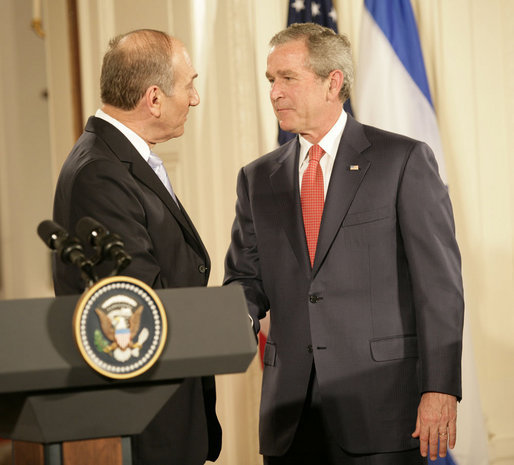
President George W. Bush and Prime Minister Ehud Olmert of Israel exchange handshakes Tuesday, May 23, 2006, at the end of a joint press availability in the East Room of the White House. White House photo by Eric Draper.President George W. Bush and Prime Minister Ehud Olmert of Israel exchange handshakes Tuesday, May 23, 2006, at the end of a joint press availability in the East Room of the White House.
White House photo by Eric Draper.

PRESIDENT BUSH: Thank you. Mr. Prime Minister, welcome. I'm particularly pleased to welcome Mrs. Olmert to the White House, as well. Thanks for coming.

The Prime Minister and I have known each other since 1998, when he was the mayor of Jerusalem, and I was the governor of Texas. And I remember you greeting me in your office there, and you probably thought you were going to be the Prime Minister -- I wasn't sure if I was going to be the President. (Laughter.)

We've just had a really productive meeting. We reaffirmed the deep and abiding ties between Israel and the United States. And those ties include our commitment to democracy and our strong belief that everybody has the right to worship freely. The ties include growing trade and economic relationships. The ties include important educational exchange programs that allow Israeli students to study in American colleges and universities, and American students to travel and study in Israel.

In our meeting, the Prime Minister and I recalled the great contributions to peace made by Ariel Sharon. I asked the Prime Minister to convey my very best wishes to Ariel Sharon's sons.

Prime Minister Olmert and I discussed peace and security in the Middle East, which the people of Israel seek and the American people support. In 2002, I outlined my vision of two democratic states, Israel and Palestine, living side-by-side in peace and security. Prime Minister Olmert told me that he and his government share this vision. The international community seeks to realize this goal to the road map, which calls for a comprehensive settlement that resolves all outstanding issues between Israelis and Palestinians. I believe, and Prime Minister Olmert agrees, that a negotiated final status agreement best serves both the Israelis and the Palestinians, and the cause of peace.

Palestinian Authority President Abbas favors and speaks out for peace and negotiations. Yet, the Hamas-led Palestinian government does not. Hamas needs to make a strategic choice for peace. The United States and the international community have made clear that Hamas must recognize Israel's right to exist, must abandon terror, and must accept all previous agreements between the Palestinian Authority and Israel. No country can be expected to make peace with those who deny its right to exist and who use terror to attack its population.

Today, Prime Minister Olmert shared with me some of his ideas -- I would call them bold ideas. These ideas could lead to a two-state solution if a pathway to progress on the road map is not open in the period ahead. His ideas include the removal of most Israeli settlements, except for the major Israeli population centers in the West Bank. This idea would follow Prime Minister Sharon's decision to remove all settlements in Gaza and several in the West Bank.

I look forward to learning more about the Prime Minister's ideas. While any final status agreement will be only achieved on the basis of mutually agreed changes, and no party should prejudice the outcome of negotiations on a final status agreement, the Prime Minister's ideas could be an important step toward the peace we both support. I'm encouraged by his constructive efforts to find ways to move the peace process forward.

And finally, the Prime Minister and I shared our concerns about the Iranian regime's nuclear weapons ambitions. The United States and the international community have made our common position clear: We're determined that the Iranian regime must not gain nuclear weapons.

I told the Prime Minister what I've stated publicly before: Israel is a close friend and ally of the United States, and in the event of any attack on Israel, the United States will come to Israel's aid. The United States is strongly committed, and I'm strongly committed, to the security of Israel as a vibrant, Jewish state.

I look forward to our continuing discussions after this press conference. I'm not sure the delegations realize this yet, but we're going to shed ourselves of our delegations and the Prime Minister and I are going to go up to the Residence and sit down and have a continued dialogue. And if we decide to brief our delegations on what we discuss, we will do so. But if not, they're going to have to guess. (Laughter.) And then I'm looking forward to dinner.

Welcome.

PRIME MINISTER OLMERT: Thank you, Mr. President. I thank you for your kind invitation to visit Washington, and for the opportunity to meet with you and discuss the many issues on our common agenda. Our meeting was enlightening, and I look forward to working closely with you in the coming years, to deepen the friendship, understanding and bilateral ties between the United States and Israel.

I also recall our meeting in the city hall when you and I were strolling around the beautiful building, at the terrace on the sixth floor, watching the walls of the city of Jerusalem. At that time you were the governor, I was the mayor, and I think none of us thought that the day would come that I will have the honor and the privilege of being hosted by you as President of the United States and Prime Minister of Israel.

I could sense then your deep connection to the Holy Land, and your friendship and commitment to the state of Israel. I must say, Mr. President, that my instincts did not fail me. I, and the entire people of Israel, appreciate your true friendship and unwavering commitment to Israel's security and its well-being as a vibrant Jewish state.

Your involvement in the Middle East and personal contribution to the efforts towards resolving the Israel-Palestinian conflict has been significant. The vision which you outlined in your historic speech of June 2002, of two democratic states living side-by-side in peace and security, is the basis of any progress towards a solution in this region. Your unreserved support of the disengagement plan in your letter of April 14, 2004, to Prime Minister Ariel Sharon -- and I join you in praying for his recovery -- were the basis for the success of its implementation. What you immediately recognized to be an historic state was later adopted by all those who were skeptical in the beginning.

I intend to exhaust every possibility to promote peace with the Palestinians, according to the road map, and I extend my hand in peace to Mahmoud Abbas, the elected President of the Palestinian Authority. I hope he will take the necessary steps which he committed to in order to move forward.

Unfortunately, the rise of Hamas, a terrorist organization which refuses to recognize Israel's right to exist, and regards terrorism as a legitimate tool, severely undermines the possibility of promoting a genuine peace process. As you stated, Mr. President, the Palestinian Authority headed by Hamas government must abandon the path of terrorism, dismantle the terror infrastructure, honor agreements and recognize Israel's right to exist. By doing so they will find us a willing partner in peace. However, we will not enter into any kind of partnership with a party which refuses to recognize our right to live in peace and security.

Despite our sincere desire for negotiations, we cannot wait indefinitely for the Palestinians to change. We cannot be held hostage by a terrorist entity which refuses to change or to promote dialogue. If we come to the conclusion that no progress is possible, we will be compelled to try a different route.

I presented to the President ideas which I believe could help advance his vision and prevent a political stalemate. According to these ideas, we will remove most of the settlements which are not part of the major Israeli population centers in Judea and Samaria. The settlements within the population centers would remain under Israeli control and become part of the state of Israel, as part of the final status agreement. This process of free alignment would reduce friction between Israelis and Palestinians, ensure territorial contiguity for the Palestinians, and guarantee Israel's security as a Jewish state with the borders it desires.

The implementation of these ideas would only be possible with the comprehensive support of the United States and the international community. I anticipate working with you to explore ways to advance this.

We discussed the Iranian issue. The Iranian regime, which calls for Israel's destruction, openly denies the Holocaust, and views the United States as its enemy, makes every effort to implement its fundamentalist religious ideology and blatantly disregards the demands of the international community. The Iranian threat is not only a threat to Israel, it is a threat to the stability of the Middle East and the entire world. And it could mark the beginning of a dangerous and irresponsible arms race in the Middle East.

Mr. President, we appreciate your efforts to curb Iran's nuclear ambitions, including through the U.N. Security Council. They are of crucial importance. The international community cannot tolerate a situation where a regime with a radical ideology and a long tradition of irresponsible conduct becomes a nuclear weapons state. This is a moment of truth. It is still not too late to prevent it from happening.

I thank you again for your gracious hospitality and for our discussions. I look forward to continue working with you, Mr. President. Thank you very much.

PRESIDENT BUSH: We'll take two questions a side, starting with Steve Holland.

Q You mentioned that the West Bank plan could be an important step. Doesn't this sweep away the U.S. principle of a negotiated two-state solution? And should the Palestinian side approve any plan that would establish Israel's final borders?

PRESIDENT BUSH: You just heard the Prime Minister say that he's going to exhaust all options to negotiate, that he wants to reach out a hand to President Abbas. And I agree. I said in my opening statement that the best solution is one in which there's a negotiated final status. And we discussed -- we spent ways -- we spent some time discussing about how it's important to get a Palestinian President to the table. And the Prime Minister says he looks forward to discussing the issue.

And so our preferred option, of course, is there to be a negotiated settlement. On the other hand, as the Prime Minister said, that if he's unable to find a partner in peace, if nothing can go forward, he is willing to think about ways to advance the process forward.

And in order to solve this problem, there needs to be willingness to take the lead, and creativity, and the desire to follow through on the vision. The most important aspect about peace is to have a vision for peace. And I appreciate the Prime Minister's vision of two states, side-by-side -- two democratic states side-by-side in peace. That's possible.

And so what I come away from the meeting with is that the Prime Minister, one, has a vision; two, willing to reach out to determine whether or not that vision exists with the Palestinian President, which I think it does; three, is willing to work to see whether or not it is possible for two sides to come together, and if not, is still willing to consider other ways to move the process forward. That's, to me, a very positive statement.

Q You said you wanted to hear more. Is there anything that worries you about this plan?

PRESIDENT BUSH: No, the only thing that worries me about the plan is that Hamas has said they want to destroy Israel. And the reason that worries me is, how can you have two states, side-by-side in peace, if one of the partners does not recognize the other state's right to exist? It's illogical for somebody to say, I'm for a state, side-by-side with another state, and yet I don't want the state to exist. And so we spent time talking about Hamas, and I assured the Prime Minister that our position is steady and strong; that Hamas must change.

Now, we care about the Palestinian people -- and I say, we, both of us -- he can speak for himself on this issue -- but we are trying to set up a mechanism that supports the Palestinian people. Our beef is not with the Palestinian people. Our beef is with the government that -- a group in the government that says they don't recognize Israel. And so the United States, we're working with the Europeans -- Condi's people in the State Department are working with the Europeans to come up with a mechanism to get food and medicine and aid to the Palestinians.

You may want to comment on it yourself, Mr. Prime Minister.

PRIME MINISTER OLMERT: Thank you, Mr. President. Indeed, the government, Sunday, decided to spend 50 million shekels buying medical equipment -- 50 million shekels, about $11 million -- for the time being, to buy medical equipment and drugs needed for the hospitals in Gaza. And as I said during the Cabinet meeting, we will spend any amount of money needed in order to save lives of innocent Palestinians suffering from the indifference of their government. We will not hesitate to do it. We will use the revenues that we have collected, and more if necessary. We will make arrangements, together with our friends, so that the supplies will arrive directly to those who need them.

This is a humanitarian commitment. We are absolutely committed to help innocent people that suffer from the brutality and the intransigence of their own government, and we will continue to do it at all times.

Thank you, Mr. President.

Q Mr. Prime Minister, are you satisfied from what you have learned out of your meeting with the President with regard of the Iranian issue? And what's your message to the Israeli public about this issue?

And, Mr. President, with your permission, there is a military option, from your point of view, to solve the threat of the Iranian problem, their work on -- to getting a nuclear weapon?

PRIME MINISTER OLMERT: The Iranian issue was discussed, indeed, between the President and myself. And we'll continue to talk about it later. Obviously, there is a major threat posed, as I've said already, and the President said, by the Iranians and their attempts to have non-conventional capabilities and also to build up delivery systems and the ballistic missiles that can hit major centers all across Europe, not just in the Middle East.

This is something that needs to be stopped. We discussed this issue at length, and there is a total agreement and understanding between the President and myself that there is a need to stop it. And we reviewed the different ways how to do it, and I am very satisfied with what I heard from the President and on what we agreed that we would continue to do in order to achieve this goal.

PRESIDENT BUSH: Our primary objective is to solve this problem diplomatically. I've told the American people that I will, on all issues, we'll try diplomacy first and exhaust diplomacy. And I explained to the Prime Minister that -- about our diplomatic efforts -- the most important thing in diplomacy is that there be a shared goal and -- in other words, you have to have a common objective, a common goal in order to get people to come together around it. And now we have got a common goal throughout most of the world, and that is, Iran should not have a nuclear weapon. And that's important, and we are now working the diplomatic front around that goal.

We have a variety of options, one of which, of course, is the United Nations Security Council, if the Iranians aren't willing to show progress toward that goal. We're working very closely with what's called the EU3. That's Germany, England and France. And I've been pleased, and Secretary of State Rice has been pleased about their willingness to stay tough on the goal, of achieving the goal. Sometimes when you've got a variety of negotiating parties, it's easier for one -- a non-transparent negotiator to pick off a weak link. And yet, they've been firm, and that's important for Israel to know. It's important for me to praise our partners for that strength of purpose.

Obviously, there's other parties we have to work with, including Russia and China. In other words, you can't get anything out of the U.N. Security Council unless there's an agreement that the Iranians are not negotiating in good faith and aren't willing to go forward. And so we're spending a lot of time working with our Russian friends, in particular, to make it clear to them that Iran is showing no good faith.

And one of the interesting issues that the Iranians have tossed out in this debate is that they believe they have the sovereign right for civilian nuclear power. And my position has been, fine, it's just you don't get to enrich the fuel necessary for the plant. And so we provided a -- I thought a very interesting opportunity for them to say, if you want civilian nuclear power, you can have your plant and the international consortium will provide the fuel for the plant. And we'll pick up the spent fuel from the plant. And this was a very realistic and reasonable approach, and it's been rejected by the Iranians.

And so I say to our friends in our consortium, I'm not so sure these people really do want a solution and, therefore, let us make sure that we're willing to be working together in the U.N. Security Council. That's where we are. We're headed -- we're on the cusp of going to the Security Council. And I repeat to your question, obviously, we'd like to solve this issue peacefully and diplomatically. And the more the Iranians refuse to negotiate in good faith, the more countries are beginning to realize that we must continue to work together.

Martha. Yes, yes.

Q If we can switch to Iraq, sir.

THE PRESIDENT: Iraq. Okay.

Q I know that this is something you're leaving up to your commanders, but from what you've heard from your commanders, how confident are you that you can start drawing down troops by the end of the year?

THE PRESIDENT: First of all, we are making progress in achieving our objective of training the Iraqis to take the fight to the enemy. And the reason I know that is because I talk to our commanders quite frequently. And we're making good political progress, as the world saw in the formation of a unity government. The government has yet to get their full cabinet in place, although we think that will happen relatively quickly. And then this sovereign government is going to assess their security situation and their security forces and their needs, and work with our commanders. We haven't gotten to the point yet where the new government is sitting down with our commanders to come up with a joint way forward.

However, having said that, this is a new chapter in our relationship. In other words, we're now able to take a new assessment about the needs necessary for the Iraqis. And when I get that report from our commanders, I'll share it with others and you.

Q Sir, can I just add --

THE PRESIDENT: Please --

Q The U.S. has the most powerful military in the world, and they have been unable to bring down the violence in any substantial way in several of the provinces. So how can you expect the Iraqis to do that?

PRESIDENT BUSH: If one were to measure progress on the number of suiciders, if that's your definition of success, I think it gives -- I think it will -- I think it obscures the steady, incremental march toward democracy we're seeing. In other words, it's very difficult -- you can have the most powerful army of the world -- ask the Israelis what it's like to try to stop suiciders -- it is a difficult task to stop suicide bombers. That's the -- but that's one of the main -- that's the main weapon of the enemy, the capacity to destroy innocent life with a suicider.

And so I view progress as, is there a political process going forward that's convincing disaffected Sunnis, for example, to participate? Is there a unity government that says it's best for all of us to work together to achieve a common objective which is democracy? Are we able to meet the needs of the 12 million people that defied the car bombers? To me, that's success. Trying to stop suiciders -- which we're doing a pretty good job of on occasion -- is difficult to do. And what the Iraqis are going to have to eventually do is convince those who are conducting suiciders who are not inspired by al Qaeda, for example, to realize there's a peaceful tomorrow. And those who are being inspired by al Qaeda, we're just going to have to stay on the hunt and bring al Qaeda to justice. And our Army can do that, and is doing that right now.

Q Mr. President, the Prime Minister just said that the settlement blocks in the major population centers will be part of Israel, annexed to Israel in the future. Do you support that? Would the United States sanction that?

And, Mr. Prime Minister, can you give us some assessment of the time that you are willing to wait for the emergence of a Palestinian partner?

PRESIDENT BUSH: My answer to your question is, refer to my April 14th, 2004 letter. I believed it when I wrote it, and I still believe it. (Laughter.)

Q -- (inaudible) --

PRESIDENT BUSH: -- rare that I wrote the letter, or rare that I believed what I wrote? (Laughter.)

PRIME MINISTER OLMERT: First of all, I want to emphasize again what I said before and what I said before the elections and immediately after the elections in Israel, and when my government was inaugurated in the Knesset just a couple of weeks ago. I said that we will make a genuine effort to negotiate with the Palestinian side on the basis of the road map, which is the framework for future negotiations towards, hopefully, a peace agreement between us and the Palestinians.

I meant precisely what I said. I'll make every possible effort. And in order to examine it carefully and seriously, I will certainly meet with the elected President of the Palestinian Authority, Mahmoud Abbas. We haven't yet decided about the timing. It will be in the near future. And I will do everything that I can in order to help create the necessary circumstances for such negotiations to take place, providing, of course, that the Palestinian partner will have to not just to make a public commitment, but to be able to deliver on the basic requirements of the road map and the Quartet decisions, namely to recognize the state of Israel and its right to exist as a Jewish state, to unarm the terrorist organizations, and to implement all the obligations of the agreement signed between the state of Israel and the Palestinian Authority.

So we will make an effort. And I say time and again that we accept the sincerity of Mahmoud Abbas as the elected President of the Palestinian Authority. He is genuine, he is sincere, and we hope that he will have the power to be able to meet the requirements necessary for negotiations between us and the Palestinians. How soon it will be? The sooner the better. I don't want to prejudge it at this point. I think it's too early. And I didn't come with a timetable to meet with the President of the United States.

We shared our observations. I entirely agree with the vision of the President as it was outlined so brilliantly in the famous speech in June of 2002, which really set the course for all the developments that took place in the Middle East since then and created the possibility for ultimately the disengagement, which was a turning point in the history of the Middle East. And we are grateful to the President for the courage that he manifested then in presenting this outline and in being the first to support the disengagement, and carry on in spite of the difficulties and the skepticism and the question marks posed by different countries at the beginning. Most of them joined in later.

So we are anxious to have negotiations. And we will look and find every possible avenue to help establish a process of negotiations on the basis of these conditions. However, as I said, we will not wait indefinitely. If we will reach the conclusion that in spite of all these efforts, it is impossible to implement the principles of the road map through a negotiating process, we'll look for other ways to implement these principles, and to ultimately create a situation where there are secured borders for the state of Israel, with the population centers in the territories as part of a state of Israel, and with a contiguous territory that will allow the Palestinians to establish their own Palestinian state alongside the state of Israel. And hopefully, this is something that will happen within the next three to four years.

Again, I am grateful to the President for the efforts that he was making and for his willingness to examine together with me these new ideas, -- as he called them, bold ideas -- in the event that all other options will not be possible.

Thank you.

PRESIDENT BUSH: Good job.

END 5:36 P.M. EDT, For Immediate Release, Office of the Press Secretary, May 23, 2006

RELATED: Keywords, President to Welcome, Monday, May 15, 2006 President Bush will welcome Prime Minister Ehud Olmert of Israel Saturday, May 06, 2006 President Bush Welcomes President VƔzquez of Uruguay (VIDEO), Monday, April 24, 2006 President Bush to Host Danish Prime Minister Anders Fogh Rasmussen, Wednesday, April 12, 2006 President Bush to Welcome German Chancellor Merkel, Wednesday, April 12, 2006 President Bush welcomes Ghana President John A. Kufuor, Wednesday, March 29, 2006 President Bush Welcomes President Obasanjo of Nigeria, Thursday, March 23, 2006 President Welcomes President Sirleaf of Liberia (VIDEO), Friday, March 17, 2006 President Welcomes Irish Prime Minister Ahern (VIDEO), Saturday, February 11, 2006 President Bush Welcomes President of Poland (VIDEO), Friday, February 10, 2006 President Bush Welcomes King Abdullah (VIDEO),

Tuesday, May 23, 2006

Department of Veterans Affairs (VA) electronic data stolen

Technorati Tags: and or and or and or and or or or

The Department of Veterans Affairs (VA) has recently learned that an employee, a data analyst, took home electronic data from the VA, which he was not authorized to do. This behavior was in violation of our policies. This data contained identifying information including names, social security numbers, and dates of birth for up to 26.5 million veterans and some spouses, as well as some disability ratings. Importantly, the affected data did not include any of VA's electronic health records nor any financial information. The employee's home was burglarized and this data was stolen. The employee has been placed on administrative leave pending the outcome of an investigation.

Appropriate law enforcement agencies, including the FBI and the VA Inspector General's office, have launched full-scale investigations into this matter. Authorities believe it is unlikely the perpetrators targeted the items because of any knowledge of the data contents. It is possible that they remain unaware of the information which they posses or of how to make use of it. However, out of an abundance of caution, the VA is taking all possible steps to protect and inform our veterans.

The VA is working with members of Congress, the news media, veterans service organizations, and other government agencies to help ensure that those veterans and their families are aware of the situation and of the steps they may take to protect themselves from misuse of their personal information. The VA will send out individual notification letters to veterans to every extent possible. Veterans can also go to http://www.firstgov.gov/ as well as http://www.va.gov/opa/ to get more information on this matter. The firstgov web site is being set to handle increased web traffic. Additionally, working with other government agencies, the VA has set up a manned call center that veterans may call to get information about this situation and learn more about consumer identity protections. That toll-free number is 1-800-FED INFO (333-4636). The call center will be open beginning today, and will operate from 8 am to 9 pm (EDT), Monday-Saturday as long as it is needed. The call center will be able to handle up to 20,000 calls per hour (260,000 calls per day).

The Secretary of Veterans Affairs R. James Nicholson has briefed the Attorney General and the Chairman of the Federal Trade Commission, co-chairs of the President's Identity Theft Task Force. Task Force members have already taken actions to protect the affected veterans, including working with the credit bureaus to help ensure that veterans receive the free credit report they are entitled to under the law. Additionally, the Task Force will meet today, 22 May 2006, to coordinate the comprehensive Federal response, recommend further ways to protect affected veterans, and increase safeguards to prevent the reoccurrence of such incidents.

The VA's mission to serve and honor our nation's veterans is one we take very seriously and the 235,000 VA employees are deeply saddened by any concern or anxiety this incident may cause our veterans and their families. We appreciate the service our veterans have given their country and we are working diligently to protect them from any harm as a result of this incident.

RELATED: Friday, July 15, 2005 budget amendment for the Department of Veterans Affairs, Tuesday, June 07, 2005 VA, Army Sign Walter Reed Training Pact, Sunday, June 05, 2005 VA Gives $10 Million Grant for Texas Veterans Home, Saturday, May 28, 2005 Honor Our Fallen Heroes, R. James Nicholson, Veterans Affairs, Tuesday, May 03, 2005 VA Awards Grant to Louisiana Veterans Home,

Sunday, May 21, 2006

Genome doesn't start with 'G'

Technorati Tags: or and or and or and or and or

Genome doesn't start with 'G', Study of the largest and last chromosome of the human genome published.

If it were typed out, chromosome 1's huge repository of genetic information would cover 60,000 pages.False-colour image of human chromosomes with chromosome 1 pair identified in blue. Credit: Indigo Instruments.
The Wellcome Trust Sanger Institute and colleagues in the UK and USA today publish the longest and final chapter in what has been called The Book of Life - the text and study of our human genetic material. Published in Nature, the report of the sequence of human chromosome 1 is the final chromosome analysis from the Human Genome Project.

The sequence has been used to identify more than 1000 new genes and is expected to help researchers find novel diagnostics and treatments for many diseases. In the past year alone, genes involved in a dozen diseases, including cancer and neurological disease, have been identified using the freely available chromosome 1 sequence and DNA resources.

If it were typed out, chromosome 1's huge repository of genetic information would cover 60,000 pages. It is home to more than 3000 genes and more than 350 known diseases, including conditions as varied as cancer development, Parkinson's and Alzheimer's disease, high cholesterol and porphyria (thought to affect King George III of England).

"The sequence we have generated, like that produced by our collaborators throughout the Human Genome Project, has driven biomedical discovery," said Dr Simon Gregory, Assistant Professor from Duke University, who led the project while at the Sanger Institute. "This moment, the publication of the sequence from the last and largest human chromosome, completes the story of the HGP and marks the growing wave of biological and medical research founded on the human genome sequence".

"Chromosome 1 contains fascinating stories of chromosome biology, of our evolution, and our health, and it's inspiring to have played a part in a programme that will have so much power to understand the essence of human biology."

Human chromosomes are numbered from the largest (chromosome 1) to the smallest (chromosomes 22 and 21). Each is composed of many millions of genetic letters or bases, called A, C, T and G. The first genetic letter of chromosome 1 sequence, and hence the beginning of our genome, is "C".

The sequence of human chromosome 1 is 223,569,564 bases of genetic code - around 8% of our genome - and contains about twice as many genes as the average chromosome. "The size of chromosome 1 means its landscape spans extremes in gene content, with stretches of millions of bases of gene-rich oases and gene-poor deserts", continued Dr Gregory, "as well as regions of the chromosome that are copied during early and late phases of cell division.".

But the sequence must be mined to be of benefit: for example, differences in the sequence between individuals will help develop an understanding of diseases associated with this chromosome. Almost 4500 single-letter changes in the genetic code (called SNPs) were identified that could lead to changes in protein activity. In addition, 90 SNPs were found that would result in a shortened - and possibly inactive - protein. Although some 15 SNPs are associated with already known protection from malaria and predisposition to porphyria, the function of these newly located SNPs is yet to be discovered.

"A catalyst for our gene discoveries", is how Dr Brian Schutte, Associate Professor of Pediatrics at the University of Iowa, describes the sequence of chromosome 1. "Prior to the sequencing efforts, we managed to localize the gene for a rare human orofacial clefting disease to a region on chromosome 1. But, we had no clue which genes lay in the region".

"Our collaboration with the Sanger led to much more rapid discovery of the gene involved and now we, and others, have found that normal genetic variation in the same gene contributes 12% risk for the common form of cleft lip and palate. Our experience demonstrates two important issues. Firstly, gene discoveries in rare diseases can contribute directly to the understanding of common diseases. Secondly, sequencing efforts accelerate gene discovery of not only rare genetic disorders, but also common diseases that place the greatest burden on our healthcare system."

The finished sequence of chromosome 1 enabled the team to bring together chromosome-wide information associated with genetic variation from projects such as the HapMap - a leading international study of human genetic variation. Our chromosome pairs 'recombine' with each other, so that regions inherited from our two parents are shuffled when passed on to our children.

Shuffling the deck tends not to disrupt genes. Most of the recombination found on chromosome 1 occurs at a few hotspots and more than 80% of hotspots are in only 15% of the sequence. Fine scale analyses have shown that recombination tends to be near to genes but outside the actual gene structures themselves.

Dr David Bentley, Chief Scientist at Solexa and former Head of Human Genetics at the Wellcome Trust Sanger Institute, said "The sequence of chromosome 1, published today, is part of an exciting and near-complete reference volume of our genome. Freely available in the public domain, researchers all over the world are already adding new information to it, enriching the picture of what it is to be human, for the benefit of others in the future.".

Careful analysis also showed how our genome has undergone recent evolutionary selection. The team looked at correlations between the HapMap data and the annotated chromosome 1 sequence to investigate the variation between three human population groups with ancestry in Europe, Africa or Asia.

Genome sequence varies from person to person. New insights are being gained all the time. We now find that genetic differences may be prevalent in one population but rare in, or absent from, another. Some of these like the gain or loss of large regions, have been recognized only in the past few years as a result of the Human Genome Project.

For example, as well as the fine-grain variation represented by SNPs, the team localized genes to a number of larger 'chunks' of DNA that differed between individuals. These chunks are as large as 1 million bases. Some of the regions have been previously implicated in how we vary in our interaction with the environment around us. For example, variations in the region around the GSTM1 gene can alter our susceptibility to cancer-causing chemicals or toxins and influence the toxicity or efficacy of certain drugs.

Chromosome 1 is particularly susceptible to rearrangement and it is thought that disruption to genes within these rearrangements play a role in several cancers and in mental retardation. The high-quality sequence has already helped researchers around the world to home in on genes that affect a range of cancers.

Rearrangements, deletions and duplications can tell us about our evolution and our diseases. More than 5% of the chromosome is duplicated and can provide material for the evolution of new functions. In one example, the partial duplication of a gene called NOTCH2 has resulted in a novel protein that is known to be functional in humans and has been implicated in disease. Meanwhile, deletion of regions of chromosome 1p is found in 1/5000 to 1/10,000 live births and may contribute to mental retardation syndromes.

"The Human Genome Project has provided us with a wealth of information about our genes and their many variations," said Dr Mark Walport, Director of the Wellcome Trust. "It is a vital resource for answering important questions about health and disease. We have been a committed partner in the project since 1992 both in supporting the research and ensuring the results are freely accessible to all".

"The completion of the project, with the publication of the Chromosome 1 sequence, is a monumental achievement that will benefit the research community for years to come and is a credit to all involved.".

The human genome is essential in understanding disease and the sequence of chromosome 1, together with the sequences produced and analysed throughout the Human Genome Project, will continue to be a foundation to help improve human health.

When seeking funding from the Wellcome Trust for their efforts to sequence the human genome in 1995, the Sanger Institute management wrote: "Sequencing is not an end in itself: it is not the solution of the genome, but merely the baseline information that allows the real aim - the biology - to proceed faster". The chromosome 1 project stands as a reflection of that view. Genome sequence powers research to help us understand the biology of our genome and the medical consequences of sequence variation.

Notes to Editors,

1. Chromosome 1, The finished sequence comprises 223.6 million base-pairs (Mbp), determined to an accuracy of >99.99%. The sequence of chromosome 1 published today includes 99.4% of the gene coding (euchromatin) regions of the chromosome amenable to sequencing with current technologies. Gaps within the sequence (most are due to repetitive sequence) comprise about 1.3 Mbp. The total size of chromosome 1 is estimated to be 237.6 Mbp, which includes the centromere and a large non-coding region (heterochromatin) in the centre of the chromosome.

Sequencing was carried out at the Wellcome Trust Sanger Institute and the University of Washington Genome Center contributed 13% of the sequence finishing. Analysis of the chromosome content was carried out by Wellcome Trust Sanger Institute.

2. The Human Genome Project, Throughout the Human Genome Project, sequence data have been released freely to speed biological and biomedical research. For each of our 24 human chromosomes, a peer-reviewed report has been published: the publications describe the attributes of the finished sequence and analysis of the gene content, variation in sequence and other features. The sequence of chromosome 1 is the final report in this series.

3. Publication details, The DNA sequence and biological annotation of human chromosome 1.Gregory SG, Barlow KF, McLay KE, Kaul R, Swarbreck D, Dunham A, Scott CE, Howe KL, Woodfine K, Spencer CC, Jones MC, Gillson C, Searle S, Zhou Y, Kokocinski F, McDonald L, Evans R, Phillips K, Atkinson A, Cooper R, Jones C, Hall RE, Andrews TD, Lloyd C, Ainscough R, Almeida JP, Ambrose KD, Anderson F, Andrew RW, Ashwell RI, Aubin K, Babbage AK, Bagguley CL, Bailey J, Beasley H, Bethel G, Bird CP, Bray-Allen S, Brown JY, Brown AJ, Buckley D, Burton J, Bye J, Carder C, Chapman JC, Clark SY, Clarke G, Clee C, Cobley V, Collier RE, Corby N, Coville GJ, Davies J, Deadman R, Dunn M, Earthrowl M, Ellington AG, Errington H, Frankish A, Frankland J, French L, Garner P, Garnett J, Gay L, Ghori MR, Gibson R, Gilby LM, Gillett W, Glithero RJ, Grafham DV, Griffiths C, Griffiths-Jones S, Grocock R, Hammond S, Harrison ES, Hart E, Haugen E, Heath PD, Holmes S, Holt K, Howden PJ, Hunt AR, Hunt SE, Hunter G, Isherwood J, James R, Johnson C, Johnson D, Joy A, Kay M, Kershaw JK, Kibukawa M, Kimberley AM, King A, Knights AJ, Lad H, Laird G, Lawlor S, Leongamornlert DA, Lloyd DM, Loveland J, Lovell J, Lush MJ, Lyne R, Martin S, Mashreghi-Mohammadi M, Matthews L, Matthews NS, McLaren S, Milne S, Mistry S, M Oore MJ, Nickerson T, O'dell CN, Oliver K, Palmeiri A, Palmer SA, Parker A, Patel D, Pearce AV, Peck AI, Pelan S, Phelps K, Phillimore BJ, Plumb R, Rajan J, Raymond C, Rouse G, Saenphimmachak C, Sehra HK, Sheridan E, Shownkeen R, Sims S, Skuce CD, Smith M, Steward C, Subramanian S, Sycamore N, Tracey A, Tromans A, Van Helmond Z, Wall M, Wallis JM, White S, Whitehead SL, Wilkinson JE, Willey DL, Williams H, Wilming L, Wray PW, Wu Z, Coulson A, Vaudin M, Sulston JE, Durbin R, Hubbard T, Wooster R, Dunham I, Carter NP, McVean G, Ross MT, Harrow J, Olson MV, Beck S, Rogers J, Bentley DRNature. 2006;441;315-321. PMID: 16710414

4. Participating Centres
>Wellcome Trust Sanger Institute, Genome Campus, Hinxton, Cambridge CB10 1SA, UK
>Division of Medical Genetics, Department of Medicine, University of Washington Genome Center, Seattle, WA, USA
>Department of Statistics, University of Oxford, Oxford OX1 3TG, UK
King's College London, Dept of Medical and Molecular Genetics, Guy's Tower, London SE1 9RT, UK
>HUGO Gene Nomenclature Committee, The Galton Laboratory, Department of Biology, University College NW1 2HE, UK
>The Duke University Center for Human Genetics, Durham, North Carolina NC27708, USA
>Solexa Ltd, Chesterford Research Park, Little Chesterford, Essex CB10 1XL, UK

5. Websites
Publication (doi: 10.1038/nature04727)
Sanger Institute, Chromosome 1 - sanger.ac.uk/HGP/Chr1/
Sanger Institute, HGP - sanger.ac.uk/HGP/
University of Washington Genome Center - genome.washington.edu/UWGC/
HUGO Gene Nomenclature Committee - gene.ucl.ac.uk/nomenclature/
Oxford University Department of Statistics - stats.ox.ac.uk/
Solexa Ltd - solexa.com/
Dept of Medical and Molecular Genetics - kcl.ac.uk/schools/medicine/depts/memoge

Sequencing Information, The Wellcome Trust Sanger Institute, which receives the majority of its funding from the Wellcome Trust, was founded in 1992 as the focus for UK sequencing efforts. The Institute is responsible for the completion of the sequence of approximately one-third of the human genome as well as genomes of model organisms such as mouse and zebrafish, and more than 90 pathogen genomes. In October 2001, new funding was awarded by the Wellcome Trust to support a new range of post-genomic programmes designed to understand the biological function of genes and their relevance to our health. These programmes are built around a Faculty of more than 30 senior researchers.

The Wellcome Trust and Its Founder, The Wellcome Trust is an independent research-funding charity, established under the will of Sir Henry Wellcome in 1936. It is funded from a private endowment which is managed with long-term stability and growth in mind. The Trust's mission is to foster and promote research with the aim of improving human and animal health.

Websites, wellcome.ac.uk and Henry Wellcome

Sanger Institute Contact Information, Don Powell, Press Officer. Address, Wellcome Trust Sanger Institute Hinxton, Cambs, CB10 1SA, UK. Tel.+44 (0)1223 494 956, Mobile.+44 (0)7753 7753 97, Fax.+44 (0)1223 494 919, Email press.officer@sanger.ac.uk. WWW Website - Press and PR Office

Related: Keyword biology, Sunday, May 07, 2006 Lying Is Exposed By Micro-Expressions We Can't Control, Sunday, April 30, 2006 Mothers often have inaccurate perceptions of their children's body weight, Sunday, April 16, 2006 Other people influence us and we don't even know it!, Tuesday, January 04, 2005 The Cassini-Huygens mission to Saturn, Sunday, March 20, 2005 Agriculture Secretary Mike Johanns, bovine spongiform encephalopathy (BSE), Thursday, March 24, 2005 Fish Oil Holds Promise in Alzheimer's Fight, Sunday, April 10, 2005 National Human Genome Research Institute (NHGRI), Friday, April 15, 2005 Study uncovers bacteria's worst enemy , Sunday, May 01, 2005 Yes, it is an exoplanet 2M1207 system, Friday, May 20, 2005 a polysaccharide called hyaluronan, Tuesday, May 24, 2005 pseudoneglect phenomenon, Friday, June 03, 2005 DOE JGI sequences DNA from extinct cave bear, Monday, June 06, 2005 From a Few Wild Ancestors, a Citrus Cornucopia, Tuesday, June 07, 2005 NHGRI Selects 13 More Organisms for Genome Sequencing, Sunday, July 24, 2005 Prehistoric Native Americans maize cultivation ,

Bush Welcomes 2006 U.S. Winter Olympic and Paralympic Teams (VIDEO)

Technorati Tags: and or and or and or and or

President Bush Welcomes 2006 U.S. Winter Olympic and Paralympic Teams, FULL STREAMING VIDEO, The South Lawn 10:16 A.M. EDT.

President George W. Bush poses for a photo after delivering congratulatory remarks to the 2006 U.S. Winter Olympic and Paralympic teams during a ceremony held on the South Lawn of the White House Wednesday, May 17, 2006. White House photo by Eric Draper.President George W. Bush poses for a photo after delivering congratulatory remarks to the 2006 U.S. Winter Olympic and Paralympic teams during a ceremony held on the South Lawn of the White House
Wednesday, May 17, 2006. White House photo by Eric Draper.

THE PRESIDENT: Thank you all very much. Please be seated. Laura and I are so honored to welcome the 2006 Winter Olympic and Paralympic teams to the White House. It is such a joy to have you all here, and congratulations for being champs. (Applause.)

I appreciate the members of the Congress who are here: Senator Thomas and Congressmen Shays, Buyer, Hastings and Ryun. Thank you all for coming, thanks for honoring these great Olympians. Congressman Ted Poe from Texas, as well.

I want to thank all the athletes who've taken time to come. We really appreciate your giving us a chance to pay respects to your athleticism and your character. I want to thank the coaches and the team leaders and the U.S. Olympic staff. I particularly want to thank the members of the Texas A&M Singing Cadets for joining us today; thanks for coming to provide the -- (applause.)

I wish I could have been at the games there in Turin, but fortunately we do have TVs here in the White House. (Laughter.) It was such a thrill to watch you all compete. Laura represented our country and really enjoyed getting to know you all. She came back and talked about the kindness and the integrity of our athletes. I appreciate the fact that you treated her with such respect. More importantly, I appreciate the fact that you represented our country with such nobility and dignity.

I thank you for the example you set. I don't know if you know this or not, but there's all kinds of people watching our Olympic and Paralympic athletes wondering whether or not it's possible for them to be able to achieve the same level of accomplishments that you all achieved. The fact that you compete hard and train hard and set high goals and succeed is a really important part of encouraging others to follow in your footsteps. Being a champ means that you've got enormous responsibilities and I thank you for upholding those responsibilities with the class that you've showed as athletes in Turin.

Thanks for creating so many lasting memories for the American people. We love our athletes. We follow your successes. We love it when the "Star Spangled Banner" is played. We also understand that not everybody is going to win the Gold, but we appreciate so much the fact that you competed so hard and in such a way that brought honor to our country.

The memories are such that we remember the -- America's first medal in ice dancing in 30 years with Tanith and Ben. Congratulations to you both. We appreciate the courage of Lindsey Kildow, who overcame a terrible crash in the training run and then decided to continue to compete. That kind of courage stirs our hearts. It's such a great example for people.

We appreciate Joey Cheek, who won the Gold and then turned around and donated $40,000 to help the refugee children of Sudan. What a wonderful example for all of us here in America to know that with our personal victories comes the responsibility of helping those who suffer and those who need help.

We're honored that the "Flying Tomato" represented our country, and we want to thank all the dudes and dudesses of the snowboarders who are here. (Laughter and applause.)

America's Paralympians overcame incredible odds to earn 12 medals for our nation. Laurie Stephens was born with spina bifida. She won two Golds and the Silver Medal in alpine skiing. What a strong example for people to look at Laurie and realize that I can achieve dreams, too.

Steve Cook, he lost part of his right leg in a tractor accident. But that didn't stop him. He's gone on to earn seven medals in cross-country skiing, including two Golds and a Bronze in this year's Paralympics. Steve, I appreciate your courage and I appreciate the example you have shown for others.

Lonnie Hannah is with us. She had breast cancer last year and came back to help the U.S. sled hockey team win the Bronze in a really thrilling game against Germany.

All of our successes in the Olympics and Paralympics require unbelievable skill and determination. And they also required the support of a lot of people in your lives. The honors you've won are a tribute to, of course, your coaches and trainers, but also to your parents and to your brothers and sisters and your friends and supporters who continue to cheer you. I know all of you join me in thanking those who supported you.

At the Games you showed the best values of our country. You were humble in victory and gracious in defeat. You made us proud. And so here on the White House South Lawn, I want to thank you for being such great ambassadors to our country. Welcome, and may God bless you all. (Applause.)

END 10:24 A.M. EDT, For Immediate Release, Office of the Press Secretary, May 17, 2006

Related: Keywords baseball, Sports, Friday, April 07, 2006 2005-06 NCAA Sports Champions (VIDEO), Tuesday, April 04, 2006 President Bush, Baseball Opening Day 2006, Wednesday, March 08, 2006 Play Ball! Inaugural World Baseball Classic, Tuesday, November 08, 2005 President Bush delivers a pitch, Monday, August 15, 2005 Little League Regional Championship, Wednesday, July 20, 2005 NCAA Women's Basketball Champions, Tuesday, July 12, 2005 President Congratulates 2004 and 2005 NCAA Sports Champions, Wednesday, July 06, 2005 Washington Nationals Join America Supports You, Monday, June 27, 2005 White House South Lawn Tee Ball

Saturday, May 20, 2006

Presidential Podcast 05/20/06

Technorati Tags: and or and or and or and or

Presidential Podcast 05/13/06 en EspaƱol

Subscribe to My Odeo Channel Subscribe to Our Odeo Podcast Channel and receive the Presidential Radio Address each week. Featuring real audio and full text transcript

Related: Keywords radio address, podcast, Saturday, May 13, 2006 Presidential Podcast 05/13/06, Saturday, April 22, 2006 Presidential Podcast 04/22/06, Saturday, April 15, 2006 Presidential Podcast 04/15/06, Saturday, April 08, 2006 Presidential Podcast 04/08/06, Saturday, Saturday, April 01, 2006 Presidential Podcast 04/01/06, March 18, 2006 Presidential Podcast 03/18/06, Saturday, March 11, 2006 bush radio address 03/11/06 full audio, text transcript, Saturday, March 04, 2006 bush radio address 03/04/06 full audio, text transcript, Saturday, February 25, 2006 bush radio address 02/25/06 full audio, text transcript, Saturday, February 18, 2006 bush radio address 02/18/06 full audio, text transcript, Saturday, February 04, 2006 bush radio address 02/04/06 full audio, text transcript, Saturday, January 28, 2006, bush radio address 01/28/06 full audio, text transcript, Saturday, January 21, 2006 bush radio address 01/21/06 full audio, text transcript, Saturday, January 14, 2006 bush radio address 01/14/06 full audio, text transcript, Saturday, January 07, 2006 bush radio address 01/07/06 full audio, text transcript,

Freedom Calendar 05/20/06 - 05/27/06

May 20, 1868 Republican National Convention marks debut of African-American politicians on national stage; two – Pinckney Pinchback and James Harris – attend as delegates, and several serve as presidential electors.

May 21, 1919, Republican House passes constitutional amendment granting women the vote with 85% of Republicans in favor, but only 54% of Democrats; in Senate, 80% of Republicans would vote yes, but almost half of Democrats no.

May 22, 1856, For denouncing Democrats’ pro-slavery policy, Republican U.S. Senator Charles Sumner (R-MA) is beaten nearly to death on floor of Senate by U.S. Rep. Preston Brooks (D-SC).

May 23, 2003, U.S. Senator Sam Brownback (R-KS) introduces bill to establish National Museum of African American History and Culture.

May 24, 1900, Republicans vote no in referendum for constitutional convention in Virginia, designed to create a new state constitution disenfranchising African-Americans.

May 25, 1928, Republican Genevieve Cline becomes first woman in nation to serve as federal judge; appointed to U.S. Customs Court by President Calvin Coolidge.

May 26, 2001, African-American Claude Allen, nominated by President George W. Bush, is confirmed as U.S. Deputy Secretary of Health and Human Services.

May 27, 1987, Vietnamese-American cadet Hoang Nhu Tran, former boat person, graduates as valedictorian from U.S. Air Force Academy; nominated by U.S. Senator Bill Armstrong (R-CO).

“Every one who shoots down negroes in the streets, burns negro school-houses and meeting-houses, and murders women and children by the light of their own flaming dwellings, calls himself a Democrat. Every New York rioter in 1863 who burned up little children in colored asylums, who robbed, ravished, and murdered indiscriminately in the midst of a blazing city for three days and nights, calls himself a Democrat.”

Governor Oliver Morton (R-IN), whose statue is in Statuary Hall in the U.S. Capitol and also at the entrance to the Indiana State Capitol Building, 1866

SOURCE: Republican Freedom Calendar

Technorati Tags: and or and or and or and or and or or and or

Related: Keywords Freedom Calendar, Saturday, May 13, 2006 Freedom Calendar 05/13/06 - 05/20/06, Saturday, May 06, 2006 Freedom Calendar 05/06/06 - 05/13/06, Saturday, April 29, 2006 Saturday, April 22, 2006 Freedom Calendar 04/22/06 - 04/29/06, Saturday, April 15, 2006 Freedom Calendar 04/15/06 - 04/22/06, Saturday, April 08, 2006 Freedom Calendar 04/08/06 - 04/15/06, Saturday, April 01, 2006 Freedom Calendar 04/01/06 - 04/08/06, Saturday, March 25, 2006 Freedom Calendar 03/25/06 - 04/01/06, Saturday, March 18, 2006 Freedom Calendar 03/18/06 - 03/25/06, Saturday, March 11, 2006 Freedom Calendar 03/11/06 - 03/18/06, Saturday, March 04, 2006 Freedom Calendar 03/04/06 - 03/11/06, Saturday, February 25, 2006 Freedom Calendar 02/18/06 - 03/04/06, Saturday, February 18, 2006 Freedom Calendar 02/18/06 - 02/25/06, Saturday, February 11, 2006 Freedom Calendar 02/11/06 - 02/18/06, Saturday, February 04, 2006 Freedom Calendar 02/04/06 - 02/11/06, Saturday, January 28, 2006 Freedom Calendar 01/28/06 - 02/04/06, Saturday, January 21, 2006 Freedom Calendar 01/21/06 - 01/28/06,