


June 10, 1964 Senate Minority Leader Everett Dirksen (R-IL) criticizes Democrat filibuster against 1964 Civil Rights Act, calls on Democrats to stop opposing racial equality.
June 11, 1924, African-American Henry Lincoln Johnson leads Georgia delegation to Republican National Convention, a first for a major U.S. political party.
June 12, 1929, First Lady Lou Hoover invites wife of U.S. Rep. Oscar De Priest (R-IL), an African-American, to tea at the White House, sparking protests by Democrats across the country.
June 13, 1928, U.S. Senate Majority Leader Charles Curtis (R-KS), descendant of American Indians who was raised on a reservation, becomes Republican nominee for Vice President.
June 14, 1877, Nominated by U.S. Rep. James Freeman (R-GA), Henry O. Flipper becomes first African-American to graduate from West Point.
June 15, 1864 Republican Congress votes equal pay for African-American troops serving in U.S. Army during Civil War.
June 16, 1854, Newspaper editor Horace Greeley calls on opponents of slavery to unite in the Republican Party.
June 17, 1856, Republican National Convention makes John C. Fremont its first Republican presidential nominee, with slogan 'Free soil, free labor, free speech, and Fremont'.
“This government will meet its responsibility to help those in need. But policies that increase dependency, break up families, and destroy self-respect are not progressive; they're reactionary. Despite our strides in civil rights, blacks, Hispanics, and all minorities will not have full and equal power until they have full economic power.”
Ronald Reagan 40th President of the United States
SOURCE: Republican Freedom Calendar
Technorati Tags: President Bush and Freedom Calendar or Dwight Eisenhower and Republicans or African-Americans and Ronald Reagan or John C. Fremont and Civil Rights or Abraham Lincoln and Frederick Douglass or 40 acres and a mule or Brown v. Board of Education and Everett Dirksen or Dred Scott
Related: Keywords Freedom Calendar, Sunday, June 04, 2006 Freedom Calendar 06/03/06 - 06/10/06, Saturday, May 27, 2006 Freedom Calendar 05/27/06 - 06/03/06, Saturday, May 20, 2006 Freedom Calendar 05/20/06 - 05/27/06, Saturday, May 13, 2006 Freedom Calendar 05/13/06 - 05/20/06, Saturday, May 06, 2006 Freedom Calendar 05/06/06 - 05/13/06, Saturday, April 29, 2006 Saturday, April 22, 2006 Freedom Calendar 04/22/06 - 04/29/06, Saturday, April 15, 2006 Freedom Calendar 04/15/06 - 04/22/06, Saturday, April 08, 2006 Freedom Calendar 04/08/06 - 04/15/06, Saturday, April 01, 2006 Freedom Calendar 04/01/06 - 04/08/06, Saturday, March 25, 2006 Freedom Calendar 03/25/06 - 04/01/06, Saturday, March 18, 2006 Freedom Calendar 03/18/06 - 03/25/06, Saturday, March 11, 2006 Freedom Calendar 03/11/06 - 03/18/06, Saturday, March 04, 2006 Freedom Calendar 03/04/06 - 03/11/06, Saturday, February 25, 2006 Freedom Calendar 02/18/06 - 03/04/06, Saturday, February 18, 2006 Freedom Calendar 02/18/06 - 02/25/06, Saturday, February 11, 2006 Freedom Calendar 02/11/06 - 02/18/06,
Saturday, June 10, 2006
Freedom Calendar 06/10/06 - 06/17/06
1 comments
||
||

Presidential Podcast 06/10/06
Technorati Tags: President Bush and White House or terrorist Zarqawi and Jordanian or Coalition forces and Osama bin Laden or Prince of al Qaida and beheaded American hostages or Iraq and PODCAST
Presidential Podcast 06/10/06 
 Subscribe to Our Odeo or
  podnova Podcast Channel and receive the weekly Presidential Radio Address in English and Spanish with select State Department Briefings. Featuring real audio and full text transcripts, More content Sources added often so stay tuned.
Related: Keywords radio address, podcast, Saturday, June 03, 2006 Presidential Podcast 06/03/06, Saturday, May 27, 2006 Presidential Podcast 05/27/06, Saturday, May 20, 2006, Presidential Podcast 05/20/06, Saturday, May 13, 2006 Presidential Podcast 05/13/06, Saturday, April 22, 2006 Presidential Podcast 04/22/06, Saturday, April 15, 2006 Presidential Podcast 04/15/06, Saturday, April 08, 2006 Presidential Podcast 04/08/06, Saturday, Saturday, April 01, 2006 Presidential Podcast 04/01/06, March 18, 2006 Presidential Podcast 03/18/06, Saturday, March 11, 2006 bush radio address 03/11/06 full audio, text transcript, Saturday, March 04, 2006 bush radio address 03/04/06 full audio, text transcript, Saturday, February 25, 2006 bush radio address 02/25/06 full audio, text transcript, Saturday, February 18, 2006 bush radio address 02/18/06 full audio, text transcript, Saturday, February 04, 2006 bush radio address 02/04/06 full audio, text transcript, Saturday, January 28, 2006, bush radio address 01/28/06 full audio, text transcript,
0
comments
||
||
bush radio address 06/10/06 full audio, text transcript
Technorati Tags: President Bush and White House or terrorist Zarqawi and Jordanian or Coalition forces and Osama bin Laden or Prince of al Qaida and beheaded American hostages or Iraq and PODCAST
 | bush radio address 06/10/06 full audio, text transcript. PODCAST President's Radio Address |
Subscribe to Our Odeo or podnova Podcast Channel and receive the weekly Presidential Radio Address in English and Spanish with select State Department Briefings. Featuring real audio and full text transcripts, More content Sources added often so stay tuned.THE PRESIDENT: Good morning. This was a good week for the cause of freedom. On Wednesday night in Iraq, U.S. military forces killed the terrorist Zarqawi.
The killing of Zarqawi is an important victory in the global war on terror. This Jordanian-born terrorist was the operational commander of al Qaida in Iraq. He led a campaign of car bombings, and kidnappings, and suicide attacks that has taken the lives of many American forces, international aid workers, and thousands of innocent Iraqis. Zarqawi had a long history of murder and bloodshed. Before September the 11th, 2001, he ran a camp in Afghanistan that trained terrorists -- until Coalition forces destroyed that camp. He fled to Iraq, where he received medical care and set up operations with terrorist associates.
After the fall of Saddam, Zarqawi went underground and declared his allegiance to Osama bin Laden, who called him the "Prince of al Qaida in Iraq" and instructed terrorists around the world to "listen to him and obey him." Zarqawi personally beheaded American hostages and other civilians in Iraq; he masterminded the destruction of the United Nations headquarters in Baghdad; and he was responsible for the assassination of an American diplomat in Jordan and the bombing of hotels in Amman. His goals in Iraq were clear: He wanted to stop the rise of democracy, drive coalition forces out, incite a civil war, and turn that country into a safe haven from which al Qaida could launch new attacks on America and other free nations. Instead, Zarqawi died in the free and democratic Iraq that he fought so hard to prevent, and the world is better off because this violent man will never kill again.
Iraqis can be justly proud of their new government and its early steps to improve their security. And Americans can be enormously proud of the men and women of our Armed Forces, and the intelligence officers who support them. In the past three years, our troops have overthrown a cruel dictator, fought the terrorists and insurgents house to house, and trained Iraqi forces to defend their new democracy. All the while, they stayed on the trail of this brutal terrorist, persevering through years of near misses and false leads and never giving up hope. This week they got their man. And all Americans are grateful for their remarkable achievement.
Zarqawi is dead, but the difficult and necessary mission in Iraq continues. In the weeks ahead, violence in Iraq may escalate. The terrorists and insurgents will seek to prove that they can carry on without Zarqawi. And Coalition and Iraqi forces are seizing this moment to strike the enemies of freedom in Iraq at this time of uncertainty for their cause. The work ahead will require more sacrifice and the continued patience of the American people.
I'm encouraged by Prime Minister Maliki's determination to defeat our common enemies and bring security and rule of law to all Iraqis. This week he took another major step toward this objective when he completed the formation of his cabinet -- naming a new Minister of Defense, a new Minister of the Interior, and a new Minister of State for National Security. These new leaders will help the government address its top priorities: reconciliation, reconstruction, and putting an end to the kidnappings, beheadings, and suicide bombings.
As they pursue these goals, they will have America's full support. On Monday, I will convene my national security team and other key members of my Cabinet at Camp David to discuss the way ahead in Iraq. On Tuesday, Iraq's new Ambassador to the United States will join us, and we will have a teleconference discussion with Prime Minister Maliki and members of his cabinet. Together we will determine how to best deploy America's resources in Iraq and achieve our shared goal of an Iraq that can govern itself, sustain itself, and defend itself.
There's still difficult work ahead in Iraq. Yet this week, the ideology of terror has suffered a severe blow. Al Qaida has lost its leader in Iraq, the Iraqi people have completed a democratic government that is determined to defend them, and freedom has achieved a great victory in the heart of the Middle East.
Thank you for listening.
END For Immediate Release, Office of the Press Secretary, June 10, 2006
Related: Keywords radio address, podcast, Monday, June 05, 2006 bush radio address 06/03/06 full audio, text transcript, Wednesday, May 31, 2006 bush radio address 05/27/06 full audio, text transcript, Saturday, May 20, 2006 bush radio address 05/20/06 full audio, text transcript, Saturday, May 13, 2006 bush radio address 05/13/06 full audio, text transcript, Saturday, May 06, 2006 bush radio address 05/06/06 full audio, text transcript, Saturday, April 29, 2006 bush radio address 04/29/06 full audio, text transcript, Saturday, April 22, 2006 bush radio address 04/22/06 full audio, text transcript, Saturday, April 15, 2006 bush radio address 04/15/06 full audio, text transcript, Saturday, April 08, 2006 bush radio address 04/08/06 full audio, text transcript, Saturday, April 01, 2006 bush radio address 04/01/06 full audio, text transcript, Saturday, March 25, 2006 bush radio address 03/25/06 full audio, text transcript, Saturday, March 18, 2006 bush radio address 03/18/06 full audio, text transcript, Saturday, March 11, 2006 bush radio address 03/11/06 full audio, text transcript,
0
comments
||
||
Discurso Radial del Presidente a la Nación 06/10/06
Etiquetas De Technorati: Discurso Radial del Presidente a la Nación, y Presidente Bush, o terrorista Zarqawi y al Qaida en Iraq, o rehenes americanos decapitados, o Primer ministro Maliki y Medio Oriente
| forre el audio de la dirección de radio 06/10/06 por completo, transcripción del texto. PODCAST Discurso Radial del Presidente.  |
EL PRESIDENTE: Buenos Días. Esta fue una buena semana para la causa de la libertad. El miércoles de noche en Irak, fuerzas militares de Estados Unidos mataron al terrorista Zarqawi.
La muerte de Zarqawi es una victoria importante en la guerra global contra el terror. Este terrorista, nacido en Jordania, fue el comandante operacional de al-Qaida en Irak. Libró una campaña de bombas en automóviles, secuestros y ataques suicidas que han costado las vidas de muchas fuerzas estadounidenses, trabajadores de asistencia internacionales, y miles de iraquíes inocentes. Zarqawi tuvo un largo historial de asesinatos y derramamiento de sangre. Antes del 11 de septiembre, 2001, operaba un campo en Afganistán que entrenaba a terroristas - hasta que las fuerzas de Coalición destruyeron ese campo. Se fugó a Irak donde recibió atención médica y estableció operaciones con terroristas asociados.
Después de la caída de Saddam, Zarqawi se escondió y declaró su lealtad a Osama bin Laden - quien lo llamó el "Príncipe de al-Qaida en Irak" y dio instrucciones a terroristas alrededor del mundo de "escucharlo y obedecerlo". Zarqawi personalmente decapitó a rehenes estadounidenses y otros civiles en Irak; fue el cerebro detrás de la destrucción de la sede de las Naciones Unidas en Bagdad; y fue responsable del asesinato de un diplomático estadounidense en Jordania y de hacer detonar bombas en hoteles en Amman. Sus metas para Irak fueron claras: quería frenar la emergencia de la democracia, expulsar a las fuerzas de Coalición, incitar a una guerra civil y convertir ese país en un refugio seguro del cual al-Qaida pudiera lanzar nuevos ataques contra los Estados Unidos y otras naciones libres. Pero al contrario, Zarqawi murió en el Irak libre y democrático que luchó tanto por evitar, y el mundo está mejor porque este hombre violento no volverá a matar.
Los iraquíes pueden estar orgullosos con razón de su nuevo gobierno y de sus primeros pasos para mejorar su seguridad. Y los estadounidenses pueden sentir enorme orgullo en los hombres y las mujeres de nuestras Fuerzas Armadas, y de los oficiales de inteligencia que les dan apoyo. En los últimos tres años nuestras tropas han derrocado a un cruel dictador, han luchado casa a casa contra los terroristas y los insurgents y han entrenado a las fuerzas iraquíes a defender su nueva democracia. Todo el tiempo se mantuvieron sobre la pista de este brutal terrorista, perseverando durante años de yerros por poco y falsas pistas sin nunca perder las esperanzas. Esta semana capturaron a su hombre. Y todos los estadounidenses les agradecemos por este logro extraordinario.
Zarqawi ha muerto, pero la misión difícil y necesaria en Irak continúa. En las semanas por venir, la violencia en Irak podrá intensificarse. Los terroristas y los insurgentes querrán probar que pueden seguir adelante sin Zarqawi. Y las fuerzas de Coalición e iraquíes están aprovechando este momento para atacar a los enemigos de la libertad en Irak en este tiempo de incertidumbre para su causa. La labor por delante exigirá más sacrificio y la paciencia continua del pueblo estadounidense.
Me siento alentado por la determinación del Primer Ministro Maliki de derrotar a nuestros enemigos comunes, y traer seguridad y el imperio de la ley a todos los iraquíes. Esta semana tomó otro paso importante hacia este objetivo al completar la formación de su Gabinete - nombrando un nuevo Ministro de Defensa, un nuevo Ministro del Interior, y un nuevo Ministro de Estado para la Seguridad Nacional. Estos nuevos líderes ayudarán al Gobierno a enfocar sus principales prioridades: reconciliación, reconstrucción y poner fin a los secuestros, las decapitaciones y las bombas suicidas.
Al perseguir estas metas, tendrán el apoyo pleno de los Estados Unidos. El lunes reuniré a mi equipo de seguridad nacional y otros miembros claves de mi gabinete en Camp David para discutir el camino por delante en Irak. El martes, el nuevo Embajador de Irak a los Estados Unidos se unirá a nosotros y tendremos una discusión por tele-conferencia con el Primer Ministro Maliki y miembros de su gabinete. Juntos determinaremos cómo mejor aprovechar los recursos estadounidenses en Irak y lograr nuestra meta compartida de un Irak que por sí solo se pueda gobernar, se pueda sustentar, y se pueda defender.
Aún hay una labor difícil por delante en Irak. Sin embargo, esta semana la ideología del terror ha sufrido un golpe severo. Al-Qaida ha perdido su líder en Irak, el pueblo iraquí ha completado un gobierno democrático que está determinado a defenderlo y la libertad ha logrado una gran victoria en el corazón del Medio Oriente.
Gracias por escuchar.
# # # Para su publicación inmediata, Oficina del Secretario de Prensa, 10 de junio de 2006.
Relacionado: Dirección de radio de las palabras claves, podcast, Lunes 5 de junio de 2006 Discurso Radial del Presidente a la Nación 06/03/06, Miércoles 31 de mayo de 2006 Discurso Radial del Presidente a la Nación 05/27/06, Sábado 20 de mayo de 2006 Discurso Radial del Presidente a la Nación 05/20/06, Sábado 13 de mayo de 2006 Discurso Radial del Presidente a la Nación 05/13/06, Sábado 6 de mayo de 2006 Discurso Radial del Presidente a la Nación 05/06/06 , Sábado 29 de abril de 2006 Discurso Radial del Presidente a la Nación 04/29/06, Sábado, De Abril El 22 De 2006 Discurso Radial del Presidente a la Nación 04/22/06, Sábado, De Abril El 15 De 2006 Discurso Radial del Presidente a la Nación 04/15/06, Sábado, De Abril El 08 De 2006 Discurso Radial del Presidente a la Nación 04/08/06, Monday, April 03, 2006 Rice urge progreso en cuanto a gobierno en Iraq, Saturday, April 01, 2006 Discurso Radial del Presidente a la Nación 04/01/06, Lunes, De Marcha La 27 De 2006 Declaraciones Del Presidente Después De Reunión Sobre La Reforma Inmigratoria, sábado, de marcha la 25 de 2006 Discurso Radial del Presidente a la Nación 03/18/06,
0
comments
||
||
Bush and Prime Minister Rasmussen of Denmark (VIDEO)
Technorati Tags: President Bush and White House or Danish Prime Minister and Anders Fogh Rasmussen, or Camp David and United Nations Security Council, or Denmark,
President Bush and Prime Minister Rasmussen of Denmark Participate in Joint Press Availability, FULL STREAMING VIDEO, Source: C-SPAN, Copyright (C), 2006 National Cable Satellite Corporation, Camp David, 10:43 A.M. EDT In Focus: Global Diplomacy
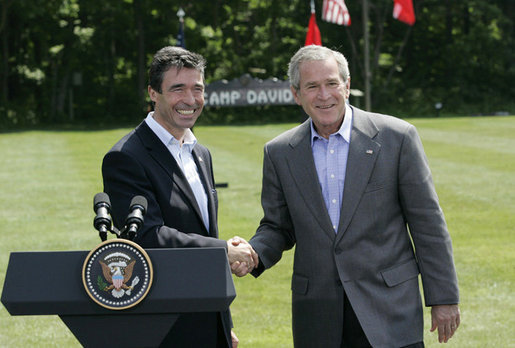 | President George W. Bush and Prime Minister Anders Fogh Rasmussen of Denmark meet at Camp David Friday, June 9, 2006. White House photo by Eric Draper. |
The invitation to come to Camp David is an expression of my high regard for Prime Minister Rasmussen and our friendship between our two countries. You know, I think -- I was checking back, I think it's been over two years since we've had a foreign leader come and visit us here. And thanks for bringing such good weather. It was important to have good weather today, because the Prime Minister is going to give me a mountain biking lesson after this news conference.
A couple of thoughts, then he's going to speak, and then we'd be glad to answer some questions.
First, I appreciate the Prime Minister's belief that freedom can help change the world, and that freedom is universal. We had a really important discussion about our desire to help others realize the great blessings of liberty, particularly in Iraq and Afghanistan. Prime Minister Rasmussen has been a strong believer in supporting the Iraqi government's desire to live in democracy. I thank you for your courage, I thank you for your country's commitment of troops that are helping make a difference.
We talked about the new government in Iraq. The Prime Minister has met Prime Minister Maliki -- I have not, and so it was very useful for me to hear from him first hand about the Prime Minister's determination to succeed. I appreciate his understanding of the Prime Minister's desire to set priorities, starting with electricity in Baghdad, security in Baghdad, and dismantling militia groups that are creating havoc.
We discussed our common strategies in Iraq. One of the most important strategies is to make sure that the police force in Iraq is capable of inspiring the population who they're supposed to be protecting. And I believe we took a long -- we took a big step toward that when the Prime Minister selected a new Minister of the Interior, and as well as a new Defense Minister.
And so we spent time on that, and we spent time on Afghanistan, as well. Prime Minister Rasmussen shared his thoughts with me about President Karzai. We both agree that he's a patriot, that he's the kind of person that we can back and that we will back as this new democracy begins to develop.
We spent time on Iran. We shared thoughts about how to diplomatically solve the problem, and the problem is the Iranians want to have a nuclear weapon and they shouldn't have one.
We spent time talking about Darfur, our desire to help the AU forces achieve stability in Darfur. I've spoken out on this subject a lot. I believe there's genocide taking place, and I believe we have a responsibility to work together to bring some security to the poor folks that are being harassed and raped and murdered in the far reaches of Darfur.
The Prime Minister and I share values, and he spent time making sure that I understood his strong belief that when we fight the war on terror and we help new democracies, that we've got to uphold the values that we believe in, and he brought up the Guantanamo issue. And I appreciate the fact that the Prime Minister is concerned about the decisions that I made on -- toward Guantanamo. I assured him that we would like to end the Guantanamo. We'd like it to be empty. And we're now in the process of working with countries to repatriate people.
But there are some that, if put out on the streets, would create grave harm to American citizens and other citizens of the world. And, therefore, I believe they ought to be tried in courts here in the United States. We will file such court claims once the Supreme Court makes its decision as to whether or not -- as to the proper venue for these trials. And we're waiting on our Supreme Court to act.
We talked about bilateral relations. I am impressed by the fact that the Prime Minister is off to the West Coast with a message of new technologies and the desire for Denmark to work with some of our venture capitalists and businesses to promote energy independence, for example, and to come up with technologies that will enable a country like ours to become less reliant upon foreign sources of energy.
All in all, we had a very constructive visit, which will be continued over lunch after the bike ride -- presuming he doesn't ride me into the ground. (Laughter.)
Mr. Prime Minister, welcome. Glad you're here.
PRIME MINISTER RASMUSSEN: Thank you very much, Mr. President. Let me first of all express my gratitude for inviting me to Camp David. I'm very honored to be here. And one could hardly imagine a better venue to spend time for work and pleasure with close friends. So thank you very much.
We have had a very productive meeting this morning at this wonderful setting. First we talked about Iraq. A few weeks ago, I met with the new Iraqi government, as the President pointed out. It was with a particular sense of respect I heard the views of the first permanent democratically-elected government in Iraq. I would say that our efforts have not been in vain.
Democracy is what it is all about. We agree on the very reason for being engaged in Iraq: to put an end to oppression and to promote freedom, democracy and human rights. These are the very values we want to defend. That also gives us strong obligation to live up to those values in every step we take. When unacceptable events happen in Abu Ghraib, and when allegations are made about horrific events in Haditha, it is not only a tragedy for the victims, it is damaging to our own efforts and an offense to our very own values. The President has assured me that all allegations will be investigated and if there has been wrongdoing, then the responsible will be prosecuted.
We are committed to remain in Iraq as long as the Iraqi government and the U.N. request our assistance, and as long as we can make a positive difference.
As the President mentioned, we had also a discussion on Iran. I am pleased that the United States, under the President's leadership, has joined the European allies in presenting a package to the Iranians. It's now up to the Iranians to take advantage of this window of opportunity.
Secondly, we touched upon energy. I strongly share the President's view that energy is a major strategic challenge. I think that transatlantic cooperation can contribute to ensuring energy security and sustainable development. It could, for instance, be instrumental in developing new energy technologies.
In Denmark, this issue has been a high priority for 30 years. We have focused on renewable energy and energy efficiency, and we are among the leading countries when it comes to developing technologies in that field. It is part of the reason for our strong economy and competitiveness. And in Denmark, we have managed to combine economic growth with energy efficiency. Over the last 25 years, the Danish economy has grown by 50 percent without increasing the use of energy.
I think it's fair to say that Danish companies are at the edge in developing new technologies, and they are already engaged in the United States. Some of them are traveling with me to the West Coast on Monday.
Which brings me to my final point on our bilateral economic relations. Trade and investment between the United States and Denmark is flourishing at impressive growth rates. The United States is now the biggest foreign investor in Denmark. Likewise, Danish companies have turned their attention towards the United States. Our top five companies have created more than 20,000 jobs in the United States, and they have engaged in a vast number of subcontractors. I think that the broad range of subjects demonstrates the vitality and closeness of our relations.
Mr. President, the health experts tell us that we need daily exercise. So before we even start thinking about lunch, I'm looking forward to exploring Camp David in even greater detail on bike. It's going to be hard work; I know that. But I will do my very best to keep up with you, Mr. President. (Laughter.)
So, once again, thank you very much for your hospitality. Meeting with you at Camp David has indeed been a great symbol of the close and very warm relations between our two countries. Thank you.
PRESIDENT BUSH: I'll take a couple of questions. Deb.
Q Mr. President, after meeting with the Danish Prime Minister last month, Maliki said he thought he could stand up the Iraqi security forces in about a year-and-a-half. And with Zarqawi's death, do you think this is realistic?
PRESIDENT BUSH: I think it is -- we'll get a realistic appraisal about the capacity for standing up Iraqi troops as this new government begins to function as a government. It wasn't until just a couple of days ago that they had a Defense Minister. Now they've got a Defense Minister, which will give us time to assess their command and control, their capacity to be able to send an order from the top to the bottom of their organization, a Defense Ministry that will be independent from politics, hopefully.
Once we make those assessments, then I think I'll be able to give the American people a better feel for what "stand up/stand down" means. And one of the reasons we're coming here -- I'm coming here Monday, by the way, Mr. Prime Minister, with a lot of my Cabinet members to discuss the way forward in Iraq, to analyze the new government, to look carefully at what their blueprint for the future looks like, and to figure out how we can help. And of course, I will share our thoughts with the Prime Minister, because he's a very important part of our coalition.
Zarqawi's death helps a lot. Zarqawi was bin Laden's main advocate outside of some remote parts of the world. He was the operator. He was the person that had made the declaration that it's just a matter of time for America and other democracies to leave, so that we could then -- so that they could then develop safe haven from which to launch further attacks. He beheaded people, he was a cold-blooded killer, he masterminded the bombing of the hotel in Jordan. He masterminded the bombing of the U.N. headquarters early on in the liberation of Iraq.
Removing Zarqawi is a major blow to al Qaeda. It's not going to end the war, and it's certainly not going to end the violence. But it's going to help a lot.
One of the goals of al Qaeda was to encourage sectarian violence inside the country; it was to pit Sunni against Shia and Shia against Sunni in order to be able to stop democracy. His whole ambition was to stop the advance of democracy in Iraq. And our troops -- who performed brilliantly, by the way, in bringing this man to justice -- did the Iraqis and the Americans and anybody else who loves freedom a great service by bringing him to justice.
Q Can I ask you a follow up?
PRESIDENT BUSH: Probably not.
Q How long will --
PRESIDENT BUSH: This is Mr. Accommodator -- (laughter) -- Mr. Reaching Out. Yes.
Q You said you'd have to reassess with the new government these various things. How long do you think that that assessment is going to take?
PRESIDENT BUSH: See, part of the issue I deal with is people want to know with certainty when certain things are going to happen --
Q Just about --
PRESIDENT BUSH: -- and I understand that; it's a legitimate question. It's like, when are you going to withdraw troops? And the answer is, when conditions on the ground --
Q I didn't ask that.
PRESIDENT BUSH: No, I know, but I -- you asked the question, I answer them. The answer is, as to when we'll be able to stand up Iraqis and stand down, when we'll be able to analyze the situation, depends upon how these people react, how they react to pressure, how they react to forming their government. This is a brand-new democracy. And the problem with the war we have is it requires a certain degree of patience in order to succeed. And we have to be patient here as this new democracy begins to flourish, and has to deal with people like Zarqawi, who is trying to stop their advance.
And so, as soon as possible. I've told the American people I'd like to get our troops out as soon as possible. But the definition of "as soon as possible" is depending upon victory in Iraq. And victory in Iraq is a country that can sustain itself, govern itself and defend itself. That's the definition of victory, and we're making progress toward that goal.
Q Mr. President, Mr. Prime Minister, last week we saw a major change in the policy towards Iran. And although you don't want to talk about timetables, the Prime Minister talked about a window of opportunity for the Iranians. How do you see that window of opportunity, what is the timetable, and what will be the next step in the procedure when we talk about Iran?
PRESIDENT BUSH: Thank you. Actually, you saw a shift in tactics, but not a shift in strategy. I've always felt like we needed to solve this problem diplomatically. And I always felt it was essential that when the Iranians looked out at the world, they see a common, united group of nations saying, no nuclear weapon.
Part of the change in tactics was to do two things: One, say to the Iranians, the choice is yours to make, see. You have said you're going to verifiably suspend your program. Now we're going to see whether or not you really mean it. And if you do, by the way, the United States will come to the table. And I said to our friends and partners, if they choose not to come back -- to suspend verifiably, there must be a consequence. There must be a sense of urgency on our part to send a common message to them. And I applaud my Secretary of State for effectively delivering that message.
And so to answer your question, we've given the Iranians a limited period of time -- weeks, not months -- to digest a proposal to move forward. And if they choose not to verifiably suspend their program, then there will be action taken in the U.N. Security Council.
Caren.
Q Thank you, Mr. President. Your initial public comments on the death of Zarqawi have been described as more cautious than other developments, such as the capture of Saddam Hussein. Are you more cautious now? And, if so, why?
PRESIDENT BUSH: Well, let me make sure everybody understands, I'm thrilled that Zarqawi was brought to justice. And I am so proud of our troops and intelligence officers who brought him to justice. This man had a lot of blood on his hands. He killed a lot of people. And it's a big deal to have brought him to justice. Having said that, I don't want the American people to think that a war is won with the death of one person, that we have still more work to do.
I am confident that al Qaeda will try to regroup and kill other people in order to say, well, we haven't lost our -- we haven't lost our way. I believe that. I also know that there are criminal elements and irritated people inside of Iraq who will try to stop the progress of the government; they will continue to bomb.
The problem we have in this war is that all they've got to do is kill some innocent people by a car bomb, and it looks like they're winning, see. It takes a major event like an election or the death of Zarqawi to understand that we're making progress. And so one of the things I'm trying to be is realistic with the American people, and say there's still going to be tough days ahead, because the enemy has got the capacity to get on our TV with death and destruction. That's what they've got the capacity to do.
In the meantime, however, the political process -- remember, a government that can sustain itself and govern itself and defend itself. The governance aspect, as the Prime Minister will attest, is making progress under Prime Minister Maliki. It's a new type of government. It's a unity government that represents the Iraqi people under a constitution which they ratified, which is a remarkable feat, by the way, in the Middle East -- a government that can defend itself. And that is a government with an army that's well-trained, with a chain of command, that's responsive to civilian leadership.
And, finally, a government that can sustain itself is one that not only has an economic -- a bright economic future for its people, but one in which the internal security is such that people have confidence in their government. And, frankly, that's the area where we need a lot of work, which is in the police forces. The Interior Minister was dominated by politicians that wanted to seek revenge, as opposed to provide blanket security, and as General Casey has said, training our troops -- training the police is the mission of our troops for 2006. And I want to thank the Prime Minister for his great contribution through NATO and the police training academies that we're helping to run.
But we're making progress. But I don't want -- I want the people to understand that our progress will be viewed as incremental progress. If I didn't think we would succeed, I wouldn't stay. And if I didn't think it was necessary for peace, I wouldn't have put our troops there in the first place. And I told that to the Prime Minister. I said you can count on America for standing by this new government, because we're doing the right thing. And people are going to look back at this moment in history and say a democracy in Iraq helped change the world for the better and helped provide security. It certainly helped address the simmering resentment that exists in a part of a region that for too long has been ignored.
And some say, I understand, that liberty isn't universal, therefore we shouldn't worry about freeing people of Iraq. I strongly disagree with that. Liberty is universal. And not only in our attempts to defend ourselves, we also have got to understand that to help win hearts and minds, freedom is an avenue that will help do that. We've got to be confident in our belief in freedom and confident in our knowledge that freedom has the capacity to yield the peace we want.
Q Mr. President and Mr. Prime Minister, in previous meetings you have discussed Guantanamo, Abu Ghraib, and now Haditha, and possibly other crimes have been added to that list.
Mr. President, how did you try to convince the Prime Minister today that that kind of violations of human rights will stop and guilty will be prosecuted? And Mr. Prime Minister, are you today convinced that violations of human rights will stop so that these violations are not undermining the war for democracy in Iraq? Thank you.
PRESIDENT BUSH: You know, last time -- I think it was in Denmark we talked about Abu Ghraib, if I'm not mistaken. I told the people in Denmark on your soil that it was a disgusting event. It soiled our soul. It's not what America stands for. I also -- I'm not sure I put it this way, but I understand humans make mistakes, but there needs to be accountability. And since then, those involved with the Abu Ghraib have been brought to justice. And that's what happens in transparent societies -- which, by the way, stood in stark contrast to the society that Saddam Hussein ran, where there was no justice, where there was no transparency, where people weren't given a chance to take their case in front of an impartial court. But that's what's happened here in America.
I'm like the Prime Minister, I understand that these incidents run contrary to what we believe; I know that. But I also want to assure -- I assured the Prime Minister -- that they'll be dealt with. That's what societies like ours do. I can't guarantee success all across the front, but I can guarantee there will be justice.
PRIME MINISTER RASMUSSEN: I'm very much in line with that. What we have seen in Abu Ghraib is not, was not what we are standing for. If the allegations concerning Haditha show up to be true, it is definitely not what the coalition, what America, what Denmark stands for. On the contrary, we are in Iraq to promote freedom, democracy, respect for human rights. And of course we should comply with these basic principles in all our behavior.
I can give no guarantee, but just like the Prime Minister, I can give the guarantee that in free and open societies, the whole process will be transparent. And if there are wrongdoings, the responsible will be prosecuted. That's a guarantee you can give in a free and open society, based on the rule of law.
Q Thank you, Mr. President.
PRESIDENT BUSH: Fine looking shoes you've got on there.
Q Thank you, sir. Mr. President, what are your top commanders telling you in the last 48 hours about the possible impact of Zarqawi's death, and how does that affect what you are trying to accomplish in these strategy meetings, here at Camp David, Monday and Tuesday?
PRESIDENT BUSH: First, we had the strategy meetings scheduled before Zarqawi's death, interestingly enough. I haven't spoken to our commanders yet, except to call General Casey and McChrystal and congratulate them, but more importantly, for them to congratulate the troops and the intel groups that were working on finding Zarqawi.
I suspect they will tell you what I just said, answered to Caren, and that is that it's a big deal, but it's certainly not the end of conflict. We had some -- we believed that al Qaeda was stirring up violence inside of Baghdad. And one of the things the Prime Minister told the Prime Minister and me by phone, that the security of Baghdad is a central part of having a strategy that shows the Iraqi people that the government is capable of governing and achieving objectives.
And, therefore, if al Qaeda was a part of -- not the sole source, but part of the violence inside of Baghdad, it helps to get rid of their commander.
It's also a -- General Abizaid, whose job it is to think beyond just Iraq -- he's the CENTCOM, he's the theater commander -- will tell you that the upper management of al Qaeda was counting on Zarqawi to help implement their vision beyond Iraq.
See, it's really important for the American people to understand that al Qaeda has got an ideology and a strategy to impose that ideology. And part of the strategy is to create turmoil in moderate Muslim nations. And they want to overthrow moderate Muslim nations. They want to have their view of the world. I call it totalitarian, Islamo-fascism. Whatever you want to call it, it is extreme and it's real. And Zarqawi was the implementer of that strategy. And he can no longer implement. And that is helpful in winning the war on terror.
Iraq is a theater in the war on terror. It's not the war on terror. It's a part of the war on terror. And Zarqawi was a general inside of Iraq, and he was a part of their strategy outside of Iraq. And I suspect General Abizaid -- I don't mean to be putting words into one of our top commanders, but I would suspect he would say this was a major blow to al Qaeda.
The death of Zarqawi was very important for the people of Iraq. He was sowing incredible violence inside of Iraq. He promoted spectacular death. And by the way, he talked about human rights abuses, and we -- definitely need to be held to account. But the world needs to hold to account terrorists for civil rights abuses, too. The killing of innocent people to achieve a military objective is the cornerstone of al Qaeda's military strategy. And this world of ours -- it's no question we ought to be concerned about what the United States does. But I expect the free world, as well, to unite in condemnation of terrorist activities around the world. See, it ought to be a universal condemnation. We ought not to excuse that kind of behavior.
And yesterday's action -- or a couple of days ago action, expressed our disdain for that kind of killing of innocent life. And bringing him to justice is a positive thing.
It's important for the Iraqi people to see progress in the death of Zarqawi, there's no question progress toward more stable -- it's not going to solve all problems. And I'm sure, as I mentioned to you, there's going to be some who step up and say we will teach you a lesson and we will continue to send suiciders into neighborhoods just to show that we've still got power. But they've lost their general. They've lost the person that the top management of al Qaeda was counting on. And it's a positive development.
Q Is there specific goals for Monday and Tuesday?
PRESIDENT BUSH: Specific goals for Monday and Tuesday is to review the Iraqi strategy, the Iraq way forward. In other words, the Prime Minister has put forward a strategy as to how to achieve his objectives, which coincide with our objectives -- a nation that can sustain itself, govern itself and defend itself. And we want to review all aspects of that strategy. I felt that Camp David is a good place to do it because it can be distracting down in Washington -- with phone calls, and all those kinds of -- we can make sure the people involved in senior levels of government stay focused on the task at hand.
I will be talking to Zal and our commanders, just to get assessment. One question I'll ask is precisely the question you asked. I want to get a feel for their view of the Iraqi government's plans and how we can help Iraq achieve the objectives they want. And then the next day, we're going to have the Ambassador from Iraq to the United States up to talk with him, as well as have a Cabinet meeting between my government and the Maliki government via secure video. And I think that will be a very interesting moment for the Iraqi government, to see that we're concerned and interested about their plans for success. And I think it will be interesting for us to be able to get a sense for the type of people that the Prime Minister has attracted.
Ask Anders a question, will you? He's feeling a little defensive. (Laughter.)
Q I'm sorry, I have one for you, Mr. President. This week, a report from the European Council talked about some CIA flights, illegal CIA flights with the prisoners in Europe, and illegal CIA presence also in some European countries. Have these flights taken place, and did you discuss this in your meeting today?
PRESIDENT BUSH: We haven't discussed it yet. I suspect we will now that you brought it up. I would just -- I can tell you what I'll tell the Prime Minister, is that in cases where we're not able to extradite somebody who's dangerous, sometimes renditions take place. It's been a part of our government for quite a period of time -- not just my government, but previous administrations have done so in order to protect people. And as we do so, we protect the sovereign rights of nations that we're involved with.
Okay, thanks for the press conference. Enjoy yourselves. Get out of here. (Laughter.) Welcome, glad you all are here.
Q Are you guys going to race?
PRESIDENT BUSH: No, we're old -- one of us is old. (Laughter.) I'm taking a lesson.
END 11:15 A.M. EDT
RELATED: Keywords, President to Welcome, Monday, June 05, 2006 President Bush Welcomes President Sassou Nguesso of the Congo , Monday, May 29, 2006 President Bush to Welcome Prime Minister Harper of Canada, Monday, May 29, 2006 President Bush to Welcome President Paul Kagame of Rwanda, Monday, May 29, 2006 President Bush to Welcome Prime Minister Junichiro Koizumi of Japan, Monday, May 29, 2006 President Bush to Welcome President Zelaya of Honduras, Saturday, May 27, 2006 President Bush and Prime Minister Tony Blair (VIDEO), Friday, May 26, 2006 President Bush and Prime Minister Ehud Olmert (VIDEO), Monday, May 15, 2006 President Bush will welcome Prime Minister Ehud Olmert of Israel Saturday, May 06, 2006 President Bush Welcomes President Vázquez of Uruguay (VIDEO), Monday, April 24, 2006 President Bush to Host Danish Prime Minister Anders Fogh Rasmussen, Wednesday, April 12, 2006 President Bush to Welcome German Chancellor Merkel, Wednesday, April 12, 2006 President Bush welcomes Ghana President John A. Kufuor, Wednesday, March 29, 2006 President Bush Welcomes President Obasanjo of Nigeria, Thursday, March 23, 2006 President Welcomes President Sirleaf of Liberia (VIDEO), Friday, March 17, 2006 President Welcomes Irish Prime Minister Ahern (VIDEO), Saturday, February 11, 2006 President Bush Welcomes President of Poland (VIDEO), Friday, February 10, 2006 President Bush Welcomes King Abdullah (VIDEO),
0
comments
||
||
Maj. Gen. Caldwell, neutralization of terrorist Musab Al Zarqarwi (VIDEO)
Maj. Gen. Caldwell, neutralization of terrorist Musab Al Zarqarwi, Briefs the media in Baghdad on the neutralization of terrorist Musab Al Zarqarwi. He then answers questions from the media.
Video Location: Baghdad, Iraq, Interviewee(s): Maj. Gen. Bill Caldwell, Force(s) Involved: Army, Component(s) Involved: Active, Submitting Unit: American Forces Network Iraq, Date Taken: 06-08-2006, FEED COURTESY PENTAGON CHANNEL, pentagonchannel.mil
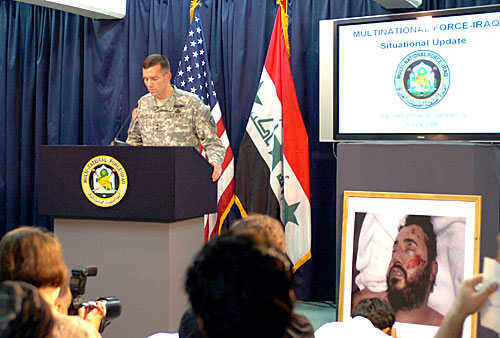 | Army Maj. Gen. William B. Caldwell briefs reporters in Baghdad, June 8, 2006, on the June 7 air strike that killed terrorist Abu Musab al Zarqawi. U.S. military officials released the photo to Caldwell's right of the deceased Zarqawi . U.S. Army photo. |
The Digital Video and Imagery Distribution System (DVIDS) is provided as a public service operated by Headquarters, U.S. Third Army/Army Forces Central Command (ARCENT) on behalf of the Department of the Army in support of all branches of the U.S. military (Navy, Air Force, Marines) and its Coalition partners serving in the U.S. Forces Central Command (CENTCOM) area of responsibility.
Technorati Tags: President Bush and White House or September the 11th and VIDEO and Abu Musab al-Zarqawi or War on Terror and Iraq or al Qaeda and terrorists or Osama bin Laden and Gun Camera Footage or special operation forces
Related: Keyword Iraq, Friday, June 09, 2006 Gun Camera Footage of Zarqawi Elimination (VIDEO), Friday, June 09, 2006 the President on Death Zarqawi (VIDEO), Thursday, May 11, 2006 President Discusses NSA Surveillance Program (VIDEO, Monday, March 20, 2006 Third Anniversary of Beginning of Iraq Liberation (VIDEO), Tuesday, March 14, 2006 President Discusses Freedom and Democracy in Iraq, 03/13/05 VIDEO, Thursday, March 09, 2006 President Signs USA PATRIOT Act (VIDEO), Saturday, February 25, 2006 President Addresses American Legion, Discusses Global War on Terror (VIDEO), Wednesday, January 25, 2006 President Discusses War on Terror at K-State (VIDEO), Wednesday, January 04, 2006 President Discusses War on Terror Following Pentagon Briefing (VIDEO), Monday, December 19, 2005 President's Address to the Nation (VIDEO) 12/18/05, Thursday, December 15, 2005 President, McCain, Warner, Discusses Interrogation, Wednesday, December 14, 2005 Iraqi Elections, Victory in the War on Terror (VIDEO), Monday, December 12, 2005 President Discusses War on Terror and Upcoming Iraqi Elections (VIDEO), Sunday, July 17, 2005 Soldiers charged with assault on suspected insurgents, Sunday, July 24, 2005 Iraqi, American Women Discuss Constitution, Women's Rights,
0
comments
||
||
Friday, June 09, 2006
Gun Camera Footage of Zarqawi Elimination (VIDEO)
 | Gun Camera Footage of Zarqawi Elimination, B-Roll of aerial gun camera footage of the elimination of terrorist Musab Al-Zarqarwi. Scenes include an aerial view of the safe house being hit by a guided missle. FULL VERSION |
The Digital Video and Imagery Distribution System (DVIDS) is provided as a public service operated by Headquarters, U.S. Third Army/Army Forces Central Command (ARCENT) on behalf of the Department of the Army in support of all branches of the U.S. military (Navy, Air Force, Marines) and its Coalition partners serving in the U.S. Forces Central Command (CENTCOM) area of responsibility
Technorati Tags: President Bush and White House or September the 11th and VIDEO and Abu Musab al-Zarqawi or War on Terror and Iraq or al Qaeda and terrorists or Osama bin Laden and Gun Camera Footage or special operation forces
Related: Keyword Iraq, Friday, June 09, 2006 the President on Death Zarqawi (VIDEO), Thursday, May 11, 2006 President Discusses NSA Surveillance Program (VIDEO, Monday, March 20, 2006 Third Anniversary of Beginning of Iraq Liberation (VIDEO), Tuesday, March 14, 2006 President Discusses Freedom and Democracy in Iraq, 03/13/05 VIDEO, Thursday, March 09, 2006 President Signs USA PATRIOT Act (VIDEO), Saturday, February 25, 2006 President Addresses American Legion, Discusses Global War on Terror (VIDEO), Wednesday, January 25, 2006 President Discusses War on Terror at K-State (VIDEO), Wednesday, January 04, 2006 President Discusses War on Terror Following Pentagon Briefing (VIDEO), Monday, December 19, 2005 President's Address to the Nation (VIDEO) 12/18/05, Thursday, December 15, 2005 President, McCain, Warner, Discusses Interrogation, Wednesday, December 14, 2005 Iraqi Elections, Victory in the War on Terror (VIDEO), Monday, December 12, 2005 President Discusses War on Terror and Upcoming Iraqi Elections (VIDEO), Sunday, July 17, 2005 Soldiers charged with assault on suspected insurgents, Sunday, July 24, 2005 Iraqi, American Women Discuss Constitution, Women's Rights,
0
comments
||
||
the President on Death Zarqawi (VIDEO)
Technorati Tags: President Bush and White House or September the 11th and VIDEO and Abu Musab al-Zarqawi or War on Terror and Iraq or al Qaeda and terrorists or Osama bin Laden and Prime Minister Maliki or special operation forces
Statement by the President on Death of Abu Musab al-Zarqawi, FULL STREAMING VIDEO, Rose Garden, Washington, D.C. 7:31 A.M. EDT
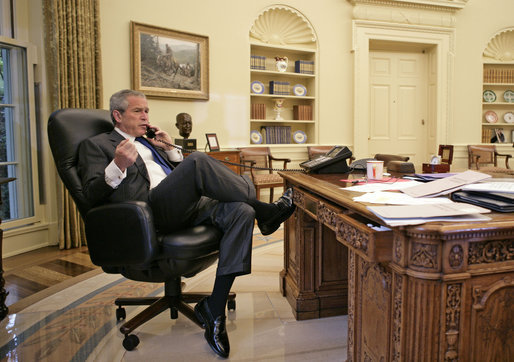 | President George W. Bush talks with Prime Minister Nouri al-Maliki of Iraq regarding the death of terrorist al Zarqawi from the Oval Office Thursday morning, June 8, 2006. White House photo by Eric Draper. |
Zarqawi was the operational commander of the terrorist movement in Iraq. He led a campaign of car bombings, assassinations and suicide attacks that has taken the lives of many American forces and thousands of innocent Iraqis. Osama bin Laden called this Jordanian terrorist "the prince of al Qaeda in Iraq." He called on the terrorists around the world to listen to him and obey him. Zarqawi personally beheaded American hostages and other civilians in Iraq. He masterminded the destruction of the United Nations headquarters in Baghdad. He was responsible for the assassination of an American diplomat in Jordan, and the bombing of a hotel in Amman.
Through his every action, he sought to defeat America and our coalition partners, and turn Iraq into a safe haven from which al Qaeda could wage its war on free nations. To achieve these ends, he worked to divide Iraqis and incite civil war. And only last week he released an audio tape attacking Iraq's elected leaders, and denouncing those advocating the end of sectarianism.
Now Zarqawi has met his end, and this violent man will never murder again. Iraqis can be justly proud of their new government and its early steps to improve their security. And Americans can be enormously proud of the men and women of our armed forces, who worked tirelessly with their Iraqi counterparts to track down this brutal terrorist and put him out of business.
The operation against Zarqawi was conducted with courage and professionalism by the finest military in the world. Coalition and Iraqi forces persevered through years of near misses and false leads, and they never gave up. Last night their persistence and determination were rewarded. On behalf of all Americans, I congratulate our troops on this remarkable achievement.
Zarqawi is dead, but the difficult and necessary mission in Iraq continues. We can expect the terrorists and insurgents to carry on without him. We can expect the sectarian violence to continue. Yet the ideology of terror has lost one of its most visible and aggressive leaders.
Zarqawi's death is a severe blow to al Qaeda. It's a victory in the global war on terror, and it is an opportunity for Iraq's new government to turn the tide of this struggle. A few minutes ago I spoke to Prime Minister Maliki. I congratulated him on close collaboration between coalition and Iraqi forces that helped make this day possible. Iraq's freely elected Prime Minister is determined to defeat our common enemies and bring security and the rule of law to all its people.
Earlier this morning he announced the completion of his cabinet appointments, with the naming of a new Minister of Defense, a new Minister of the Interior, and a new Minister of State for National Security. These new ministers are part of a democratic government that represents all Iraqis. They will play a vital role as the Iraqi government addresses its top priorities -- reconciliation and reconstruction and putting an end to the kidnappings and beheadings and suicide bombings that plague the Iraqi people. I assured Prime Minister Maliki that he will have the full support of the United States of America.
On Monday I will meet with my national security team and other key members of my Cabinet at Camp David to discuss the way forward in Iraq. Our top diplomats and military commanders in Iraq will give me an assessment of recent changes in the political and economic and security situation on the ground. On Tuesday, Iraq's new Ambassador to the United States will join us, and we will have a teleconference discussion with the Prime Minister and members of his cabinet. Together we will discuss how to best deploy America's resources in Iraq and achieve our shared goal of an Iraq that can govern itself, defend itself and sustain itself.
We have tough days ahead of us in Iraq that will require the continued patience of the American people. Yet the developments of the last 24 hours give us renewed confidence in the final outcome of this struggle: the defeat of terrorism threats, and a more peaceful world for our children and grandchildren.
May God bless the Iraqi people and may God continue to bless America.
END 7:37 A.M. EDT, For Immediate Release, Office of the Press Secretary, June 8, 2006
Related: Keyword Iraq, Thursday, May 11, 2006 President Discusses NSA Surveillance Program (VIDEO, Monday, March 20, 2006 Third Anniversary of Beginning of Iraq Liberation (VIDEO), Tuesday, March 14, 2006 President Discusses Freedom and Democracy in Iraq, 03/13/05 VIDEO, Thursday, March 09, 2006 President Signs USA PATRIOT Act (VIDEO), Saturday, February 25, 2006 President Addresses American Legion, Discusses Global War on Terror (VIDEO), Wednesday, January 25, 2006 President Discusses War on Terror at K-State (VIDEO), Wednesday, January 04, 2006 President Discusses War on Terror Following Pentagon Briefing (VIDEO), Monday, December 19, 2005 President's Address to the Nation (VIDEO) 12/18/05, Thursday, December 15, 2005 President, McCain, Warner, Discusses Interrogation, Wednesday, December 14, 2005 Iraqi Elections, Victory in the War on Terror (VIDEO), Monday, December 12, 2005 President Discusses War on Terror and Upcoming Iraqi Elections (VIDEO), Sunday, July 17, 2005 Soldiers charged with assault on suspected insurgents, Sunday, July 24, 2005 Iraqi, American Women Discuss Constitution, Women's Rights, Thursday, July 28, 2005 Killing of Algerian Diplomats to Iraq, Saturday, August 06, 2005 Operation Quick Strike,
0
comments
||
||
Wednesday, June 07, 2006
Secretary Condoleezza Rice African Growth and Opportunity Forum (PODCAST)
Technorati Tags: Secretary Condoleezza Rice and African Union Peace and Security Council or State Department and Foreign Minister Gadio of Senegal, or African and African Global Competitiveness Initiative, or African Growth and Opportunity Act, and Africa, or Millennium Challenge Corporation, and Emergency Plan for AIDS relief,
Remarks at the African Growth and Opportunity Forum 2006, MP3 file format for PODCAST, running time is 11:22, Secretary Condoleezza Rice, Loy Henderson Conference Room, Washington, DC, June 6, 2006 (9:05 a.m. EDT), UPDATE VIDEO In Windows Media Format, running time is 11:22.
![Secretary Rice addresses the opening plenary session of the African Growth and Opportunity Act [AGOA] Forum. State Department photo by Michael Gross. Loy Henderson Conference Room, Washington, DC, June 6, 2006.](http://d21c.com/sookietex/rice_agao.jpg) | Secretary Rice addresses the opening plenary session of the African Growth and Opportunity Act [AGOA] Forum. State Department photo by Michael Gross. Loy Henderson Conference Room, Washington, DC, June 6, 2006. |
Unless you think that this connection ends with Jendayi, I want to just recognize Dr. Cindy Courville, who is the NSC Special Assistant and there's a connection there, too, because Cindy and I were classmates at the University of Denver. So you see I've had very, very strong training about Africa all my life.
Well, welcome everyone to the State Department. It's a great pleasure to have you here in Washington for this year's Forum for the African Growth and Opportunity Act. I'd like to welcome the many African ministers, who are joining us today, especially Foreign Minister Gadio of Senegal. I know I speak for everyone here, Mr. Minister, when I say how much we enjoyed last year's Dakar forum and how much we appreciated the hospitality and the generosity of the people of Senegal.
On behalf of President Bush and all of the American people, let me express my deep gratitude to all who have made the long journey from Africa to join us here today. You carry with you the hopes and dreams of millions of men and women and children from every corner of the African Continent. People who simply want to better their own lives build their own prosperity and take ownership of their own development. America shares and supports your aspirations and we are committed to helping you realize them. Our policy toward Africa is rooted in partnership not in paternalism, in doing things with the peoples of Africa not for the peoples of Africa. A keystone of our approach is this African Growth and Opportunity Act, or AGOA, which represents America's strong bipartisan support for Africa's development and prosperity.
AGOA is founded on irrefutable facts about how to fight poverty effectively. It is a fact that real development is only possible when economies are expanding and creating jobs. It is a fact that economic growth is driven by hardworking entrepreneurial citizens who are free to compete and trade in open markets. And of course, though the state cannot create economic growth, it is a fact that the government can and must ensure the political conditions of prosperity: transparent and accountable governance, the rule of law, property rights and investment in people.
These are the requirements for membership in AGOA, requirements that have been met by the 37 sub-Saharan African countries who are gathered here today. As a result of AGOA, the United States and Africa are prospering together. The United States remains Africa's great partner in trade and in assistance. While oil remains a source of our expanding trade relationship, last year we also saw impressive growth in sectors like agriculture and machinery and electronics. These gains were driven in part by our African Global Competitiveness Initiative, a $200 million program which President Bush announced last year to help African companies reach their full potential through free trade.
One such company from Kenya is called Kenana Knitters. Because of AGOA and our African Global Competitiveness Initiative, Kenana Knitters has won deals to export its wool and apparel to several high-end American clothing companies. In just two years the business has more than doubled its workforce, all of whom are women. Now to expand the opportunities and benefits of trade even further, we both have important obligations. For our part, President Bush made bold commitments last September to eliminate all U.S. barriers that prohibit the free flow of goods and services as long as others' nations do the same. This is a promise that we aim to keep.
In the current Doha round, being negotiated as we speak, the United States is at the forefront of a worldwide effort to increase market access for developing country products, including agricultural goods. We in Washington must also do more to help African farmers expand their exports by increasing their capacity to meet U.S. agricultural standards. We've made good progress on this front frequently -- recently and we are determined to expand our efforts even further.
African Governments also have important obligations in order to fully liberate the entrepreneurial spirit of their people. In most African countries, ambitious citizens still pay too many fees and wait too many days and negotiate too much red tape to start a business. African governments must also do more to enable their countries to trade with their neighbors. Seventy percent of all trade in the developing world is between developing countries. So helping Africans trade more freely together represents a powerful source of development.
Finally, it is vital for African nations to continue diversifying their economies. The AGOA Diversification Fund which we launched last year is beginning to help our African partners make steady gains toward the important development in this goal. Increasing free trade is a great challenge indeed. But it is not our only challenge. As a matter of justice of morality and of strategic interest, we must help all citizens, especially the most disadvantaged, to gain an equal opportunity to participate in growing economies. This is the job of foreign assistance. And under President Bush's leadership America has launched a development agenda with Africa that is the worthy heir of the Marshall Plan for Europe.
In the past five years with strong support from our Congress, President Bush has tripled foreign assistance to the countries of Africa and we are on pace to double it again by the year 2010.
I imagine that most of you knew Randall Tobias as our Global AIDS Coordinator. Now he is our new administrator of the U.S. Agency for International Development, as well as our new director of foreign assistance here at the State Department. And I'm pleased that he could join us here this morning. (Applause.)
The United States has also taken historic steps to free many developing countries, most of which are in Africa from the crushing burden of foreign debt. Under the Multilateral Debt Relief Initiative, which the United States worked tirelessly to secure, 14 African countries are now receiving over $30 billion of debt relief. Our ultimate goal is to extend this initiative to 19 other African countries in Africa, forgiving more than $10 billion of additional debt.
At the same time, our Millennium Challenge Corporation is now signing development compacts with countries that govern justly, advance economic freedom, fight corruption and invest in their people. Right now 12 African countries are eligible to apply for MCC grants and four African countries, Madagascar, Benin, Cape Verde and Mali have signed compacts with the MCC worth a total of nearly $537 million.
Finally, the United States is rightfully standing with the people of African in their fight against diseases like Malaria and HIV/AIDS. Now in its third year, President Bush's Emergency Plan for AIDS relief is on pace to meet our five-year, $5 billion commitment for prevention, treatment and care. The path to defeat AIDS will be long, but each step along the way represents one more person who understands the threat, one more orphan who finds a home and one more individual who can live with the disease.
Ladies and gentlemen, the United States does not view Africa as the sum of its problems nor as an object of international pity. No. We view the men and women of Africa as authors of their own destiny, as individuals of agency and dignity who have the right to flourish in freedom and who bear responsibility for their own successes. We believe that this success rests in the strength and the spirit of African citizens and we reject what President Bush has called the "soft bigotry of low expectations."
Africa has given so much to America -- more than anyone. It was the stolen sons and daughters of Africa who lifted up the body of America, brick by brick, field by field, city by city. More than anyone, it was the quiet righteousness of African Americans, men and women like my parents and my grandparents, sons and daughters of the American South who helped to redeem America at last from its original sin of slavery. (Applause.)
America will never, America cannot forget the deep historical ties that bind us to the peoples of Africa. And we are committed to building a shared future of hope and opportunity and freedom for all.
Thank you for making the trip here to Washington. Thank you for participating in this important forum. And I look forward to seeing you all again next year.
Thank you. 2006/593, Released on June 6, 2006
White House: Africa Policy State Department: Sudan
Related: Keywords: Africa, Tuesday, May 16, 2006 Implementation of Darfur Peace Agreement, Monday, May 01, 2006 Status of Darfur Peace Negotiations in Abuja, Saturday, April 29, 2006 President Meets with Darfur Advocates (VIDEO), Thursday, April 06, 2006 Inauguration Thomas Yay Boni of Benin, Wednesday, March 29, 2006 President Bush Welcomes President Obasanjo of Nigeria, Monday, March 27, 2006 President Bush to Welcome Nigerian President, Thursday, March 23, 2006 President Welcomes President Sirleaf of Liberia (VIDEO), Thursday, March 16, 2006 President to Welcome President of the Republic of Liberia, Wednesday, January 18, 2006 First Lady After Liberia Inauguration,
0
comments
||
||
Tuesday, June 06, 2006
OIC Secretary General official visit to Moscow
Technorati Tags: Ekmeleddin Ihsanoglu and Organization of the Islamic Conference or Sergey Lavrov and Russian Federation, or Muslims and Putin, or Russia, and diplomatic staff of Russia in Iraq, or G8 summit and Chechnya or Jerusalem
The OIC Secretary General starts 4 days official visit to Moscow
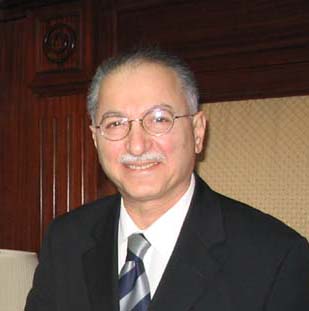 | Prof. Dr., Dr.h.c. mult. EKMELEDDIN IHSANOGLU, THE SECRETARY GENERAL, OF THE ORGANIZATION OF THE ISLAMIC CONFERENCE. |
During the meeting the Foreign Minister expressed his gratitude for the acceptance of Russia as an Observer to the OIC and confirmed his participation in the upcoming Islamic Conference of Foreign Ministers to be held in Baku from 19-21 June, 2006, which would be first of its kind since Russia became an Observer.
The Minister also thanked the Secretary General for his personal involvement in according Russia the observer status on an exceptional basis. Both the Secretary General and the Foreign Minister agreed that the association of Russia, a traditional supporter of the just causes of the Muslims, as an Observer with the OIC, would pave the way towards more support, cooperation and coordination in matters and issues of mutual concern and interests to Russian Federation and the Muslim world.
Current issues like the question of Palestine, situation in Iraq, and Iran’s nuclear file were raised during the meeting. Both the parties found themselves in line with each other regarding resolution of these issues. They both emphasized the importance of achieving peaceful solutions through negotiation and cooperation.
In this connection, the Secretary General briefed the Minister about his recent visit to Iran and his discussions with the Iranian high officials. The Minister, in his turn, briefed the Secretary General about the recent Western initiative on the Iranian nuclear file crisis.
The Secretary General expressed his sadness over the killing and kidnapping incident that targeted the members of the diplomatic staff of Russia in Iraq. He condemned all forms of terrorism and terrorist activities.
Evoking the issue of Chechnya, the Secretary General reiterated the OIC’s explicit stand which respects the territorial integrity and sovereignty of the Russian Federation. The Secretary General expressed OIC’s willingness, stemming from a peaceful and humanitarian point of view, to provide help in different aspects of the problem. The Foreign Minister welcomed the proposal. He mentioned that many constructive steps are taken in Chechnya and also encouraged the OIC to send fact finding missions to see the current situation on the ground.
During his official visit to the Russian Federation, the Secretary General met also His Holiness Alexy II, the Patriarch of Moscow and all Russia, at the latter’s residence on 5th of June.
The Secretary General thanked His Holiness the Patriarch for his audience and the warm welcome. He also mentioned the long history of peaceful co-existence between Islam and the Orthodox Church in Russia which has never witnessed any conflict. The Patriarch thanked the Secretary General for his insight of the history.
The Patriarch announced that a summit of religious leaders of different faiths from all over the world would be held in St. Petersburg on the eve of G-8 Summit. The main objective of the summit would be to attract the attention of the governments of the world to the necessity of ensuring the peaceful coexistence of different faiths. The Patriarch extended an invitation to the Secretary General to participate in the said Summit. The Secretary General thanked the Patriarch for the invitation and assured him of highest possible level participation of the OIC in the summit.
The question of the status of the holy city of Jerusalem was raised among other issues of mutual concern during the discussion and the Secretary General urged the Orthodox Church of Russia as well as the Patriarch himself to play more active role in preserving the historic status of the holy city of Jerusalem where Christianity, Judaism and Islam could coexist and flourish as ever before.
Jeddah: 6 June 2006.
Related: Keyword Muslims, Wednesday, January 11, 2006 Presidential Message: Eid Al-Adha, Friday, November 04, 2005 Eid Al-Fitr Presidential Message, Tuesday, October 18, 2005 President Hosts Iftaar Dinner (VIDEO), Tuesday, October 04, 2005 Presidential Message: Ramadan, Sunday, May 15, 2005 On Respect for the Holy Koran Secretary Condoleezza Rice, Saturday, January 22, 2005 Presidential Message: Eid Al-Adha,
0
comments
||
||


