Thursday, June 22, 2006

President's Remarks to the People of Hungary

Technorati Tags: and or and or and or and or and or and or

President George W. Bush and Mrs. Laura Bush stand in silence after laying flowers at the eternal flame of the 1956 Memorial Monument outside the Hungarian Parliament in Budapest, Hungary, Thursday, June 22, 2006. The monument honors victims of the failed 1956 Hungarian uprising against Soviet rule. White House photo by Eric Draper.President George W. Bush and Mrs. Laura Bush stand in silence after laying flowers at the eternal flame of the 1956 Memorial Monument outside the Hungarian Parliament in Budapest, Hungary, Thursday, June 22, 2006.
The monument honors victims of the failed 1956 Hungarian uprising against Soviet rule. White House photo by Eric Draper.

President's Remarks to the People of Hungary, Gellert Hill, Budapest, Hungary, 4:38 P.M. (Local), FULL STREAMING VIDEO, Source C-SPAN, Copyright (C) 2006 National Cable Satellite Corporation.

THE PRESIDENT: Thank you very much. Yo napote kivanok. (Applause.) Thank you for your warm welcome. I first want to thank the President for his gracious hospitality and the chance to visit Sandor Palace. It's a beautiful site, and I know you're proud of it. I also want to thank your Prime Minister for his hospitality and the chance to go to the Parliament Building. Laura and I particularly liked to see the Holy Crown of St. Stephen. It was beautiful. It's a grand reminder of the great history of Hungary.

I thank the Hungarian people for their gracious reception. Laura and I are honored to visit your great nation. Hungary sits at the heart of Europe. Hungary represents the triumph of liberty over tyranny, and America is proud to call Hungary a friend.

I appreciate the opportunity to stand here on Gellert Hill, which offers a striking view of your beautiful city. Fifty years ago, you could watch history being written from this hill. In 1956, the Hungarian people suffered under a communist dictatorship and domination by a foreign power. That fall, the Hungarian people had decided they had had enough and demanded change. From this spot you could see tens of thousands of students and workers and other Hungarians marching through the streets. They called for an end to dictatorship, to censorship, and to the secret police. They called for free elections, a free press, and the release of political prisoners. These Hungarian patriots tore down the statue of Josef Stalin, and defied an empire to proclaim their liberty.

Twelve days after the Hungarian people stood up for their liberty, the communists in Moscow responded with great brutality. Soon the streets of Budapest were filled with Soviet tanks. The Red Army killed many who resisted, including women and children. The Soviets threw many more into prison. They crushed the Hungarian uprising, but not the Hungarian people's thirst for freedom.

Some 200,000 Hungarians fled into exile in search of liberty. Many found refuge in the United States. These immigrants have contributed to my country in countless ways, and America will always be glad that we opened our doors to Hungarians that were seeking freedom. Fifty years later, the sacrifice of the Hungarian people inspires all who love liberty. Some of those who faced those tanks are here today. I had the honor of meeting three such gentlemen at lunch. I was proud to be in their presence. America honors your courage. We've learned from your example, and we resolve that when people stand up for their freedom, America will stand with them.

In 1989, a new generation of Hungarians returned to the streets to demand their liberty, and boldly helped others secure their freedom, as well. By giving shelter to those fleeing tyranny and opening your border to the West, you helped bring down the Iron Curtain, and gave the hope of freedom to millions in Central and Eastern Europe. Because you had the courage to lead, Hungary became the first communist nation in Europe to make the transition to democracy.

Hungary has continued to move forward. You regained your independence, held free elections, and established a free economy. Hungary is now a valued member of NATO and the European Union. You know that the democratic journey is not easy, but you continue to make the tough decisions that are necessary to succeed. America admires your perseverance, we welcome your progress, and America values our alliance with the free people of Hungary.

You believe that free nations have an obligation to help others realize the benefits of freedom. So last year, you launched the International Center for Democratic Transition here in Budapest. You set that center up to help others learn from your country's experiences. Hungary was also an early contributor to the United Nations Democracy Fund, which supports emerging democracies with legal and technical and financial assistance. And together, America and Hungary helped launch the Foundation for the Future, which supports democratic reformers, independent journalists, women's groups, and human rights advocates throughout the Middle East. Hungary is making a difference in our world, and I thank you for your leadership in freedom's cause.

Hungary is also showing courage in freedom's cause. In Kosovo, Hungarian soldiers are helping to secure the peace. Your work is aiding the rise of democracy in a region that has endured violence and tyranny for many decades. By your efforts, you're helping the people of the Balkans establish free and democratic societies, and you're paving the way for their membership in the institutions of a united Europe.

Hungarian troops are also defending freedom's cause in the war on terror. In Afghanistan, your soldiers have rebuilt schools and a medical center. They've helped train Afghan police to enforce the rule of law, and to protect the Afghan people. In Iraq, Hungarian troops played a vital role in Operation Iraqi Freedom by providing security and delivering food and medical supplies to coalition forces. Today, Hungarian soldiers are helping to train Iraqi security forces. This is important work. By supporting these two young democracies, you are strengthening two new allies in the war on terror, and you're bringing hope to millions of people in a vital region of the world.

Last week, I traveled to Baghdad. I was impressed by what I saw. Americans and Hungarians, and other coalition partners can be proud of what we have achieved in partnership with the Iraqi people. I met with Iraq's new Prime Minister, and was able to see firsthand his strong character, his commitment to freedom, and his determination to succeed. Hungarians will recognize this spirit: Prime Minister Maliki is committed to the democratic ideals that also inspired Hungarian patriots in 1956 and 1989. He has a sound plan to improve security, to unify his people, and to deliver a better life for the citizens of Iraq. The success of the new Iraqi government is vital to the security of all nations, and so it deserves the support of the international community. We will continue to help the Iraqi government establish free institutions, to achieve its goals, and we will continue to help Iraq take its rightful place alongside America and Hungary as beacons of liberty in our world.

Iraq's young democracy still faces determined enemies, people who will use violence and brutality to stop the march of freedom. Defeating these enemies will require sacrifice and continued patience -- the kind of patience the good people of Hungary displayed after 1956. We will help them rebuild a country destroyed by a tyrant. We'll help the Iraqis defeat the enemies of freedom. Our commitment is certain, our objective is clear. The new Iraqi government will show the world the promise of a thriving democracy in the heart of the Middle East.

The Hungarian people know well the promise of freedom. Many of you lived through the nightmare of fascism, or communism, or both. Yet you never lost hope. You kept faith in freedom. And 50 years after you watched Soviet tanks invade your beloved city, you now watch your grandchildren play in the streets of a free Hungary.

The lesson of the Hungarian experience is clear: Liberty can be delayed, but it cannot be denied. The desire for liberty is universal, because it is written by our Creator into the hearts of every man, woman, and child on this Earth. And as people across the world step forward to claim their own freedom, they will take inspiration from your example, and draw hope from your success.

Earlier today Laura and I laid a bouquet of flowers at the 1956 Memorial Monument across the river. It was our privilege to do so. It was a moving moment for us. Hokok Square is named for the father of Hungarian democracy, and honors more than a century-and-a-half of Hungarian sacrifice in freedom's cause.

A bust of this great leader stands in the U.S. Capitol. It affirms that those who fight for liberty are heroes not only in their own land, but of all free nations. All who love liberty are linked together across the generations, and across the world.

Your great poet Peteofi said this:

"Here is the time, now or never! Shall we be slaves or free? This is the question, answer! By the God of the Hungarians we swear, We swear to be slaves no more!"

These words were addressed to the Hungarian people, yet they speak to all people, in all times. This is the spirit that we honor today. I appreciate the opportunity to come to this great country and to celebrate the Hungarian example -- the courage, the sacrifice, the perseverance that has led to this democracy.

On behalf of all Americans: Köszönöm. May God bless you all. Thank you very much. (Applause.)

END 4:50 P.M. (Local), For Immediate Release, Office of the Press Secretary, June 22, 2006

RELATED: Keyword, Hungary, Wednesday, June 14, 2006 President Bush to Visit Budapest, Hungary, Thursday, March 16, 2006 President Attends Celebration of Hungarian Contributions to Democracy, Friday, October 07, 2005 President Meets with Prime Minister Gyurcsány of Hungary (VIDEO), Saturday, September 24, 2005 President Presents Medal of Honor to Corporal Tibor "Ted" Rubin (VIDEO, Sunday, July 17, 2005 President to Welcome Hungarian Prime Minister

Chemical Weapons Discovered in Iraq

Technorati Tags: and or and and or and or and or and or and

Rose Ann Gaetano greets Senator Santorum at the Professional Women's Conference on Capitol Hill.Senator Santorum Makes Major Announcement Regarding Newly Declassified Information Concerning Chemical Weapons Discovered in Iraq SENADOR SANTORUM ABOGA POR LEGISLACION BIPARTIDISTA TRAYENDO MIL MILLONES DE DOLARES A PENSILVANIA PARA ESFUERZOS DE LIMPIEZA DEL MEDIO AMBIENTE
“This is critically important information that the world community needs to know” – Senator Santorum" June 21, 2006

Washington, D.C. – U.S. Senator Rick Santorum (R-PA), Chairman of the Senate Republican Conference, joined Congressman Peter Hoekstra, (R-MI-2), Chairman of the House Permanent Select Committee on Intelligence, today to make a major announcement regarding the release of newly declassified information that proves the existence of chemical munitions in Iraq since 2003. The information was released by the Director of National Intelligence, John Negroponte, and contained an unclassified summary of analysis conducted by the National Ground Intelligence Center. In March, Senator Santorum began advocating for the release of these documents to the American public.

“The information released today proves that weapons of mass destruction are, in fact, in Iraq,” said Senator Santorum. “It is essential for the American people to understand that these weapons are in Iraq. I will continue to advocate for the complete declassification of this report so we can more fully understand the complete WMD picture inside Iraq.”

The following are the six key points contained in the unclassified overview:

• Since 2003 Coalition forces have recovered approximately 500 weapons munitions which contain degraded mustard or sarin nerve agent.

• Despite many efforts to locate and destroy Iraq’s pre-Gulf War chemical munitions, filled and unfilled pre-Gulf War chemical munitions are assessed to still exist.

• Pre-Gulf War Iraqi chemical weapons could be sold on the black market. Use of these weapons by terrorists or insurgent groups would have implications for Coalition forces in Iraq. The possibility of use outside Iraq cannot be ruled out.

• The most likely munitions remaining are sarin and mustard-filled projectiles.

• The purity of the agent inside the munitions depends on many factors, including the manufacturing process, potential additives, and environmental storage conditions. While agents degrade over time, chemical warfare agents remain hazardous and potentially lethal.

• It has been reported in open press that insurgents and Iraqi groups desire to acquire and use chemical weapons. ###

Related: Keyword Iraq, Wednesday, June 21, 2006 Military Working Dog's Best Friend (VIDEO), Monday, June 19, 2006 Female Sailors first to be deployed forward (PODCAST, Saturday, June 17, 2006 Maj. Gen. Caldwell missing soldiers 06/17/06 (VIDEO), Saturday, June 10, 2006 Maj. Gen. Caldwell, neutralization of terrorist Musab Al Zarqarwi (VIDEO), Friday, June 09, 2006 Gun Camera Footage of Zarqawi Elimination (VIDEO), Friday, June 09, 2006 the President on Death Zarqawi (VIDEO), Thursday, May 11, 2006 President Discusses NSA Surveillance Program (VIDEO, Monday, March 20, 2006 Third Anniversary of Beginning of Iraq Liberation (VIDEO), Tuesday, March 14, 2006 President Discusses Freedom and Democracy in Iraq, 03/13/05 VIDEO, Thursday, March 09, 2006 President Signs USA PATRIOT Act (VIDEO), Saturday, February 25, 2006 President Addresses American Legion, Discusses Global War on Terror (VIDEO), Wednesday, January 25, 2006 President Discusses War on Terror at K-State (VIDEO), Wednesday, January 04, 2006 President Discusses War on Terror Following Pentagon Briefing (VIDEO), Monday, December 19, 2005 President's Address to the Nation (VIDEO) 12/18/05, Thursday, December 15, 2005 President, McCain, Warner, Discusses Interrogation, Wednesday, December 14, 2005 Iraqi Elections, Victory in the War on Terror (VIDEO), Monday, December 12, 2005 President Discusses War on Terror and Upcoming Iraqi Elections (VIDEO),

Wednesday, June 21, 2006

Military Working Dog's Best Friend (VIDEO)

Technorati Tags: and or and and or and or and or

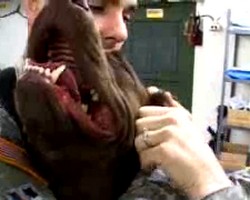
Military Working Dog's Best FriendPackage made from "Military Working Dog's Best Friend." B-roll in this section about Army veterinarians caring for military working dogs. Produced by Sgt. Thomas Wheeler.
Video Location: Mosul, Unit(s) Involved: 72nd Medical Detachment, Unit Hometown(s): Giebelstadt, Unit State(s): Germany, Interviewee(s): CPT Michelle Goodnight;SPC Joseph Gonzalez, Force(s) Involved: Army, Component(s) Involved: Active, Submitting Unit: 138th Mobile Public Affairs Detachment.

Filename: 0606/DOD_N06062005.wmv, Size (bytes): 2637034 (2.51 MB), Length: 1:42, Date Taken: 06-12-2006

The Digital Video and Imagery Distribution System (DVIDS) is provided as a public service operated by Headquarters, U.S. Third Army/Army Forces Central Command (ARCENT) on behalf of the Department of the Army in support of all branches of the U.S. military (Navy, Air Force, Marines) and its Coalition partners serving in the U.S. Forces Central Command (CENTCOM) area of responsibility

Related: Keyword Iraq, Monday, June 19, 2006 Female Sailors first to be deployed forward (PODCAST, Saturday, June 17, 2006 Maj. Gen. Caldwell missing soldiers 06/17/06 (VIDEO), Saturday, June 10, 2006 Maj. Gen. Caldwell, neutralization of terrorist Musab Al Zarqarwi (VIDEO), Friday, June 09, 2006 Gun Camera Footage of Zarqawi Elimination (VIDEO), Friday, June 09, 2006 the President on Death Zarqawi (VIDEO), Thursday, May 11, 2006 President Discusses NSA Surveillance Program (VIDEO, Monday, March 20, 2006 Third Anniversary of Beginning of Iraq Liberation (VIDEO), Tuesday, March 14, 2006 President Discusses Freedom and Democracy in Iraq, 03/13/05 VIDEO, Thursday, March 09, 2006 President Signs USA PATRIOT Act (VIDEO), Saturday, February 25, 2006 President Addresses American Legion, Discusses Global War on Terror (VIDEO), Wednesday, January 25, 2006 President Discusses War on Terror at K-State (VIDEO), Wednesday, January 04, 2006 President Discusses War on Terror Following Pentagon Briefing (VIDEO), Monday, December 19, 2005 President's Address to the Nation (VIDEO) 12/18/05, Thursday, December 15, 2005 President, McCain, Warner, Discusses Interrogation, Wednesday, December 14, 2005 Iraqi Elections, Victory in the War on Terror (VIDEO), Monday, December 12, 2005 President Discusses War on Terror and Upcoming Iraqi Elections (VIDEO),

EU-U.S. Summit in Vienna (VIDEO)

Technorati Tags: and or and , or and , or , and , or , and , or , and ,

President Bush Participates in Press Availabilty at 2006 U.S.-EU Summit, FULL STREAMING VIDEO, Source C-SPAN, Copyright (C) 2006 National Cable Satellite Corporation. Zeremoniensaal HallHofburg PalaceVienna, Austria, 2:50 P.M. (Local). U.S.-EU Summit

Pres. Bush, Sec. of State Condoleeza Rice, European Council Pres. Wolfgang Schuessel and European Commission Pres. Jose Manuel Barroso - press conference at the EU-U.S. Summit in Vienna.
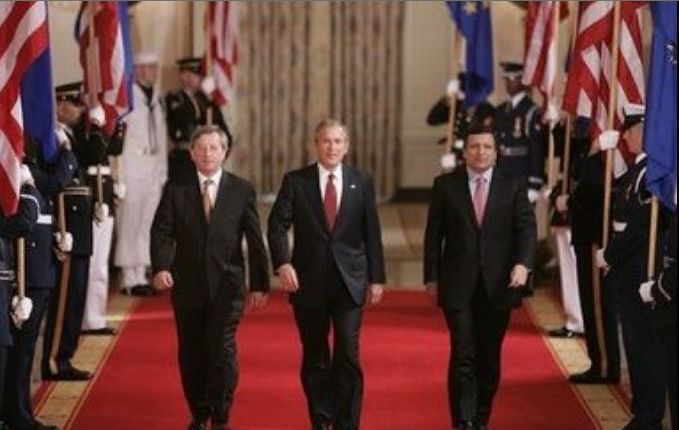
EU President Jean-Claude Juncker, President Bush, and European Commission Pres. Jose Manuel Barroso. East Room June 20, 2006, White House Photo by Paul Morse.EU President Jean-Claude Juncker, President Bush, and European Commission Pres. Jose Manuel Barroso. East Room June 20, 2006,
White House Photo by Paul Morse. MORE GALLERY in FLASH Format.

CHANCELLOR SCHÜSSEL: So, ladies and gentlemen, let me first start by saying that this was -- is the 15th journey of the President of the United States, George Bush, to Europe. And I'm really happy that this journey leads -- as a kind of an Austria-Hungarian journey, leads George Bush and his team to Vienna.

We had a summit, a very fruitful and a positive summit touching a broad range of subjects, from the economy -- quite obvious -- America and Europe, we are the E2, the economic big two powers of the world, and we spoke about common trade, foreign investment in both directions. Of course, we touched some problems, but don't forget that 99 percent of our trade volume is done without any problems. It's, per date, a sum of around $2 billion traded above the Atlantic Ocean.

And we touched foreign policy issues; we touched Iran; we touched Iraq; Bulkan issues; global issues like global warming, climate change, et cetera.

Although we might have different approaches in some aspects, this should never overshadow the depth and quality of our cooperation. We covered, as I said it, a wide range of issues during our talks, from foreign policy and economic cooperation. Energy security was high on our agenda; the protection of intellectual property rights, the cooperation in the fight against terror, and the protection of human rights around the world.

In our common responsibility to promote stability and security for our citizens and the world, European Union and the United States successfully work together. There are recent examples for our good cooperation. As I mentioned, just Iran, Middle East and Iraq.

In one of the topics we intensively discussed today, our efforts to keep Iran from producing nuclear weapons. We have come to a crossroad on the Iranian nuclear issue. Iran has to make the right choice. And we welcome a U.S. involvement, in particularly recent historic signal the U.S. is ready to join negotiations talks if conditions for resuming negotiations are met. And this signal greatly contributed to the credibility of a united position between the key players. And I told President George Bush how much we appreciate his constructive role in this particularly sensitive situation.

The situation in the Middle East is still complex. There's no doubt the Palestinian government has to accept the basic principles of the peace process -- non-violence, recognition of Israel, acceptance of existing agreements, the so-called road map. On the other hand, both America and Europe consequently argue against any unilateral steps by Israel. The escalation of armed confrontation during the recent days and weeks show the lack of a political perspective. The solution to this conflict can only be a political one, based on negotiations and the principles of the road map.

In Iraq, we welcome the formation of the new Iraqi national unity government on the 20th of May. We strongly condemn terrorist acts, the continuing campaign of violence against the Iraqi people and their constitutionally elected government. At the European Council last week, we stressed our encouragement for enhanced institutional and international engagement and underlined our willingness for continued supporting U.N. role in Iraq.

On Balkans, we informed President Bush of the European strategy. We have opened negotiations last week with Croatia. Macedonia is a candidate. We signed an agreement for stabilization association with Albania. We have now Montenegro independent. Bosnia is integrated, and we are, all the time, involved in positive talks with Serbia. Of course, there are open questions, and we discussed them in detail. In Kosovo, negotiations under the Chairmanship of Martti Ahtisaari are taking place here in Vienna. The Office of Ahtisaari is here and we do our utmost to help and to ease.

Strong bilateral ties between Europe and USA are absolutely important. We are the most important economic partners for each other. The summit highlights only some topics. Progress made in many other areas should not be overlooked.

Today, we signed an agreement on higher education and vocational training that will last for a longer period of time than the previous one, engage us in a larger quantity of programs and funds, and will reach more students and teachers -- three-times more students than before.

Given the worldwide increase in energy demands, and at the same time, limited resources, security of supply is of strategic importance. And therefore, we welcome the establishment of a strategic cooperation between America and Europe. And we are committed to develop a coherent energy strategy that not only emphasizes security of supply, but efficiency, sustainability, and climate protection.

This is my first statement. I now invite the President of the United States, George Bush, to take the floor, and then the President of the Commission.

PRESIDENT BUSH: Mr. Chancellor -- I call him, Wolfgang; he calls me, George W. -- Jose, it's good to see you. Thank you very much for your hospitality. I also want to thank President Fischer for his hospitality, as well. I've really been looking forward to this trip. I have never been to your beautiful country. I need to come back. It is -- and your hospitality has been grand. I really appreciate it a lot.

We did have a very engaged and fruitful conversation, as we should. We're close partners in peace and prosperity. I've always believed that when America and the EU work together, we can accomplish big deeds. And this world needs us to work together, because there's a lot of challenges.

We talked about democracy and new democracies, and I want to thank the European Union for its strong support of Afghanistan and Iraq. Look, I fully understand we've had our differences on Iraq, and I can understand the differences. People have strong opinions on the subject. But what's past is past, and what's ahead is a hopeful democracy in the Middle East. And I want to thank your leadership, both of your leaderships, on this important issue. I believe the Maliki government is going to succeed. I know the government needs our help, and the European Union has stood up to help, and I can't thank you enough for that.

We talked about Lebanon and the need for Lebanon to be free from Syrian influence. We worked very closely together at the United Nations to send that clear message to the Syrians: Leave Lebanon alone, let them be, let them be a free democracy, which is a necessary part of laying the foundation for peace in the Middle East.

We talked about Israel and Palestine. I assured the leaders here that my position is firm, and that is I envision two states living side-by-side in peace. And we want to help. On the other hand, we're not going to deal with a government that has made the destruction of Israel one of its key policy platforms. How can you be side-by-side in peace if part of your platform is the destruction of one of the countries you're supposed to be at peace with? And I appreciate Europe being strong on that issue, as well.

We talked about the Balkans, and I assured the Chancellor that Austria's role in the Balkans and the European Union's role in the Balkans is essential and we look forward to supporting your role. In essence, the EU, particularly under the Chancellor's guidance, is in the lead on the Balkans. And we want to help. We want to be a participant in helping bring peace to that region.

I think the European Union is a vital part of helping solve the issue of the Balkans. After all, aspirations to the EU causes people to adopt the habits necessary for there to be a democracy and peace. And so we're very strongly supportive of the EU's role in the Balkans, and applaud your strong role as well, Mr. Chancellor.

We talked about development and prosperity. Listen, we're trading partners and we've got to make sure that commerce and trade and capital continues to flow freely between the EU and America. And we talked about some of the impediments to capital flows, and we discussed our desire to make sure that we continue to trade as freely as possible.

Obviously, the Doha Round and the WTO was a big subject. And it's a tough subject because we're -- we're trying to make difficult adjustments to our own internal policy in order to satisfy a -- in order to reach an agreement that's fair for all of us. But the good news is, is that we were very frank in our discussion with each other. I mean, the Europeans have problems with the U.S. position; we have problems with the European position; we both have problems with the G20 position. But the point is, we're committed to a successful round. And it's going to take hard work. There's a ministers meeting here at the end of this month, and my pledge to our European counterparts is, we'll do the very best we can to reach an agreement that is -- that satisfies all parties' desires.

But make no mistake about it, it's hard work. My view is, is that we can't let this round fail. A failed WTO round would be missed opportunity, particularly to help people in the impoverished -- who are impoverished. The best way to help lift people out of poverty is trade. You can give all the money you want -- and my government has been very generous on the continent of Africa. We're joining with the Europeans to fight HIV/AIDS and to deal with hunger. But if you're really interested in development, the best way to do it is to have a successful round at the WTO. And I understand that, and we're committed to working for success in that round.

We talked about energy. I kind of startled my country when, in my State of the Union, I said we're hooked on oil and we need to get off oil. That seemed counterintuitive for some people to hear a Texan say. But the truth of the matter is, we got to diversify away from oil. And the best way to do it is through new technologies. And we agreed we would share technologies between our nations and between the EU and the United States. The EU needs to get diversified, as well. And so this is going to be a very interesting period for us as new technologies develop and we're willing to share those technologies.

We talked about our efforts to continue to defeat the terrorists. I reminded my fellow leaders here that the terrorists still want to strike and they want to do harm, and we have an obligation to work very closely together.

And, obviously, they brought up the concern about Guantanamo. And I understand their concerns. But let me explain my position. First, I'd like to end Guantanamo. I'd like it to be over with. One of the things we will do is we'll send people back to their home countries. We've got about 400 people there left -- 200 have been sent back -- 400 are there, mainly from Saudi Arabia, Afghanistan and Yemen. And I explained to the two leaders here our desires to send them back. Of course, there's international pressure not to send them back. But, hopefully, we'll be able to resolve that when they go back to their own country.

There are some who need to be tried in U.S. courts. They're cold-blooded killers. They will murder somebody if they're let out on the street. And yet, we believe there's a -- there ought to be a way forward in a court of law, and I'm waiting for the Supreme Court of the United States to determine the proper venue in which these people can be tried.

So I understand the concerns of the leaders. They expressed the concerns of the European leaders and the European people about what Guantanamo says. I also shared with them my deep desire to end this program, but also I assured them that we will -- I'm not going to let people out on the street that will do you harm. And so we're working through the issue. And I appreciate your interest and appreciate your questions.

Finally, we talked about Iran. It's very important for the leadership in Iran to look at the world and say, Europe and the United States and Russia and China are united in our common desire to make sure that Iranians do not develop a nuclear weapon. And step one of achieving a diplomatic success is to share a goal. And there's no question we share the goal of Iran not having the capacity and/or a nuclear weapon. It would be -- it would be a terrible situation if they developed a weapon.

And so the second phase of a diplomatic strategy is to have a common front, a common diplomatic front that says clearly to the Iranians, here is a way forward for it, but you get to choose. And so I said to the -- I said to our -- my counterparts here that we'll come to the table to negotiate, so long as the Iranians verifiably end any enrichment activities. The Iranians have said that they will end Iranian enrichment activities before. That's what they told the EU3. We're just asking them to do what they already said they would do.

But it's their choice to make. And I'm convinced that when they look and see that we're working very closely together, that they will see the seriousness of our intent to resolve this in a diplomatic and peaceful way.

And so the discussions were wide-ranging, which is a positive sign of a healthy relationship. We shared tactics and strategies, which is a sign of a healthy relationship. We disagreed in an agreeable way on certain issues. But we're bound to work together for the good of our respective peoples. And this meeting has been a great success, Mr. Chancellor, and I appreciate you running it. And again, I want to thank you for your hospitality.

PRESIDENT BARROSO: Thank you. Thank you very much. I think there is a very good spirit in European Union and the United States positions and we're building on that today. As President Bush just said, it was not just a working meeting for very concrete results, but also working we were thinking aloud, we were discussing together some possible strategies for the future. And this is precisely that spirit that relations between partners like United States and European Union should be established.

But let me just concentrate on concrete results of this summit that were already presented by Chancellor Schüssel, so I will highlight some of them. First, we are entering into strategic cooperation on energy to promote energy security for producers, consumers, and transit countries alike. I think this is important, strategic cooperation on energy between the United States and Europe. Second, we have agreed to establish a European Union and United States high-level dialogue on climate change, clean energy, sustainable development, to address ways to get cost-effective emission cuts, development and employment of new technologies, efficiency and conservation, renewable fuels and other environmental issues such as biodiversity.

We have also discussed how to deliver an ambitious and balanced conclusion to the Doha development agenda. These negotiations are at a crucial phase. European Union and the United States have a joint responsibility to help deliver an agreement which promotes growth, opportunity, especially for the poor, to look for -- (inaudible) -- determination from other WTO members. And after the good exchange of views we had today during this summit, I'm convinced, I'm really convinced that it is possible to have a successful outcome -- and it's crucially important from a trade point of view, from a growth and economic point of view, and also from a development point of view.

Third, we have endorsed today a strategy for the enforcement of intellectual property rights in third countries. For the first time we have named countries and regions which cause most concern. They will be the focus of concrete actions to reduce global piracy and counterfeiting. Proper protection of intellectual property is vital for our industry and for our consumers.

Fourth, we also agreed on the need for open investment regimes, fighting all protectionist tendencies that can happen in some of our circles. We need to -- (inaudible) -- jobs and get best control of our very dynamic transatlantic economy. Two-way investment benefits our economies. In this context, I hope we will seek finalization of European Union-United States air transport agreement to be possible by the end of the year.

We also addressed the issue that is very important in European Union of establishment of reciprocal visa-free travel for all European Union citizens to the United States. I also believe this is good for our citizens, this is good for our economies.

Finally, the point I want to highlight, I want to emphasize our shared commitment to promoting democracy, freedom all over the world. The very enlargement of European Union has been one of the greatest achievements in terms of promotion of democracy from Southern Europe, West Europe, to Eastern Europe, North Europe, from the Iberian Peninsula to the Baltic countries, now most recently, European Union is a great success story in terms of promoting democracy. And we want to do it also globally, and we are doing it globally. And that's one of the fields where I see that the United States and European Union can do, and should do, even more together.

One thing is sure; the world now is very complex. Even together we are not sure that we will solve all issues. But if we don't work together it will be much more difficult to face global challenges. I believe this summit was very helpful for having this closer relationship between the United States and Europe so that, together, we can do our best to make the world a better place.

Thank you.

PRESIDENT BUSH: Jen.

Q -- (inaudible) -- long-range missile? And what sort of penalties do you think are in order if they do so?

And to the Chancellor, if I might, where does the EU stand on possible penalties for such a test?

PRESIDENT BUSH: The North Koreans have made agreements with us in the past, and we expect them to keep their agreements. For example, agreements on test launches. We think it would be in the world's interest to know what they're testing, what they intend to do on their test. It should make people nervous when non-transparent regimes that have announced that they've got nuclear warheads fire missiles.

And so we've been working with our partners, particularly in that part of the world, to say to the North Koreans that this is not the way you conduct business in the world, this is not the way that peaceful nations conduct their affairs.

I was pleased to see that the Chinese spoke out to the North Korean government and suggested they not fire whatever it is on their missile. And we'll see whether or not the North Koreans listen. One of our strategies in North Korea is to make sure we include other countries as a part of our consortium to deal with this non-transparent regime. And China is an integral part of what we've called the six-party talks, and I am pleased that they're taking responsibility in dealing with the leader of North Korea. It's a very positive sign.

I've talked to President Putin about this subject. I know that we're reaching out to the Japanese, all aimed at saying to the North Koreans, this is not a -- in order to be an accepted nation, a non-isolated nation, there are certain international norms that you must live by. And we expect them to live by those norms.

CHANCELLOR SCHÜSSEL: I couldn't agree more with the question of North Korea, and the compliance with the international rules and the international standards are always a matter of great concern, always high on the priority list of foreign policy matters within European Union. And if this happens, there will be a strong statement and a strong answer from the international community. And Europe will be part of it. So there's no doubt. We discussed, by the way, in our debate, what to do when and if, and there will be a strong response on that.

Q A question to President Barroso and President Bush. Do you actually share the view that Russia is using its energy resources to oppress other countries? And in what respect does your cooperation help you now to position yourselves against that?

And if I may, to President Bush, you've got Iran's nuclear program, you've got North Korea, yet, most Europeans consider the United States the biggest threat to global stability. Do you have any regrets about that?

PRESIDENT BUSH: That's absurd. The United States is -- we'll defend ourselves, but at the same time, we're actively working with our partners to spread peace and democracy. So whoever says that is -- it's an absurd statement.

PRESIDENT BARROSO: On energy, as you know that energy is a geostrategic question. That's why in January, President Bush called for an end to American oil addiction. That's why, in February, in Washington, I asked for a partnership between United States and European Union in matters of energy. That's why today we are agreeing on key principles to guarantee energy security. I also welcome the high level -- the agreement on a high-level dialogue between European Union and United States on climate change and sustainable development.

These are central challenges to all of us globally. So our agreement is not against anyone -- by the way, we expect the G8 summit to be a very important summit, to be a success. And we wish the President continued success at that G8 summit. We believe it should be an occasion to reinforce our message for an open, stable, non-discriminatory, transparent market on energy. So energy is a global issue and it should be tackled globally.

Q If Iran says it will respond to the offer in late August, is that a suitable time frame? And I would ask all of you, Iran's Foreign Minister says some kind of negotiations can start before a final answer is given; are you willing to do that?

PRESIDENT BUSH: Well, our position, Steve, is that we'll come to the table when they verifiably suspend. Period. And we expect them to verifiably suspend. This is what they said they will do to the EU3.

Secondly, the August 22nd date -- is that part of your question? Yes. It seems like an awful long time for a reasonable answer -- for a reasonable proposal, a long time for an answer. And we look forward to working with our partners. We just got word of this statement as we walked in here, but it shouldn't take the Iranians that long to analyze what is a reasonable deal.

Q -- (inaudible) --

PRESIDENT BUSH: Well, I said, weeks, not months. And I believe that's the view of our partners -- weeks, not months.

CHANCELLOR SCHÜSSEL: We agree. We spoke about Iran at length and it is really one of the fruits of a well-balanced partnership and cooperation that we were able to offer a bold package of incentives to Iran, to the Iranian government and to the Iranian people. And as President Bush said, it's better to agree as soon as possible; the time is limited and I think we should not play with time.

This is -- we discussed it for months and months, and I think time -- in Greek language -- that I learned, Ancient Greek -- there is a fantastic word, "kyros." Kyros means "the right moment." The right moment -- and I think now is the right moment for Iran to take this offer, to grab it and to negotiate. This is a well-balanced -- we got advice from everybody from the international scene -- United Nations, ElBaradei here, International Atomic Energy organization, a lot of experts of scientists that convinced us -- of course, the EU3 and America, Russia and China are on board. So this is their kyros. Take it. This is my advice.

Q Chancellor Schüssel, the European public is deeply worried by these secret prisoners that the CIA has been transporting, is transporting through Europe. Did you get assurance today from the President that this is not going to happen anymore, that there won't be anymore in the kidnapping of terror suspects in Europe, that this is a thing of the past?

And to the President, Mr. President, you said this is "absurd," but you might be aware that in Europe the image of America is still falling, and dramatically in some areas. Let me give you some numbers. In Austria, in this country only 14 percent of the people believe that the United States, what they are doing is good for peace; 64 percent think that it is bad. In the United Kingdom, your ally, there are more citizens who believe that the United States policy under your leadership is helping to destabilize the world than Iran. So my question to you is, why do you think that you've failed so badly to convince Europeans, to win their heads and hearts and minds? Thank you.

PRESIDENT BUSH: Well, yes, I thought it was absurd for people to think that we're more dangerous than Iran. It's a -- we're a transparent democracy. People know exactly what's on our mind. We debate things in the open. We've got a legislative process that's active. Look, people didn't agree with my decision on Iraq, and I understand that. For Europe, September the 11th was a moment; for us, it was a change of thinking. I vowed to the American people I would do everything to defend our people, and will. I fully understood that the longer we got away from September the 11th, more people would forget the lessons of September the 11th. But I'm not going to forget them. And, therefore, I will be steadfast and diligent and strong in defending our country.

I don't govern by polls, you know. I just do what I think is right. And I understand some of the decisions I made are controversial. But I made them in the best interest of our country, and I think in the best interest of the world. I believe when you look back at this moment, people will say, it was right to encourage democracy in the Middle East. I understand some people think that it can't work. I believe in the universality of freedom; some don't. I'm going to act on my beliefs so long as I'm the President of the United States. Some people say, it's okay to condemn people for -- to tyranny. I don't believe it's okay to condemn people to tyranny, particularly those of us who live in the free societies.

And so I understand, and I'll try to do my best to explain to the Europeans that, on the one hand, we're tough when it comes to the war on terror; on the other hand, we're providing more money than every before in the world's history for HIV/AIDS on the continent of Africa. I'll say, on the one hand, we're going to be tough when it comes to terrorist regimes who harbor weapons. On the other hand, we'll help feed the hungry. I declared Darfur to be a genocide because I care deeply about those who have been afflicted by these renegade bands of people who are raping and murdering.

And so I will do my best to explain our foreign policy. On the one hand, it's tough when it needs to be; on the other hand, it's compassionate. And we'll let the polls figure out -- people can say what they want to say. But leadership requires making hard choices based upon principle and standing -- (President's mike goes out) -- and that's how I'm going to continue to lead my country.

Thank you for your question.

CHANCELLOR SCHÜSSEL: Let me add -- let me add something. I think Austria is really a good example to show that America has something to do with freedom, democracy, prosperity, development. Don't forget I was born in '45. At that time, Vienna and half of Austria laid in ruins. And without the participation of America, what fate would have Europe? Where would be Europe today? Not the peaceful, prosperous Europe like we love it and where we live.

Nothing -- I will never forget that America fed us with food, with economic support. The Marshall Plan was an immense aid and incentive to develop industry, agriculture, tourism. And by the way, I said it to the President, the Marshall Fund is still working in Austria. It's now transformed into a kind -- in a fund for research and development -- still working.

The American people, at that time, the American government invested billions of dollars in Europe to develop the former enemy. And now we are a partner. So I think it's grotesque to say that America is a threat to the peace in the world compared with North Korea, Iran, other countries.

Of course, we -- and I thank you very much for the question on human rights and the over-flights and the secret prisons and Guantanamo. And it was quite interesting to see how the debate was going on in -- this morning. The President started, himself. He didn't wait that we raise the question. He came up and said, look, this is my problem, this is where we are. And I think we should be fair from the other side of the Atlantic. We should understand that what September 11th meant to the American people. It was a shock. For the first time, a real shock. A society values were attacked -- American values, international values, European values were attacked in the home country of the President and all Americans. And we should not be naive. We Europeans are also attacked. We had bomb attacks in Madrid. Hundreds of people were killed. We had bomb attacks in London subway, buses were blown up. We had detected some terrorists who tried to shoot down an Israeli plane. So we should not be naive.

And since September 11th -- and I think this is important to underline that -- since September 11th, we are now able to define our targets, to fight against terror and terrorists, to cut off their financial supplies, to share information, to secure our citizens, our people. This is the ultimate goal. Not creating enemies, virtual enemies, but to secure our people and to secure peace in the world and to stabilize our societies.

The problem is -- and I will be very frank on that, and I said it the same way like we did it here, and we say it now -- we are only -- we can only have a victory in the fight against terror if we don't undermine our common values. It can never be a victory, a credible victory over terrorists if we give up our values: democracy, rule of law, individual rights.

This is important to know. And our discussion with all the European parliament, the European governments, I personally -- we are calling for the closure of Guantanamo. But our discussion today went far beyond the closing of Guantanamo, because we have -- we have a legal problem, we have gray areas. And there should be no legal void, not in the fight against terrorists, but also not in -- for individuals to be guaranteed in their individual rights, in their freedom.

And it's quite interesting to see how the President reacted -- I welcome, of course, your statement saying that you're looking forward to close Guantanamo and it depends on the Supreme Court's decision. And we got clear, clear signals and a commitment from the American side -- no torture, no extraordinary or extra-territorial positions to deal with the terrorists -- the McCain amendment, for instance. All the legal rights must be preserved.

But we have to help if we're to find a way-out strategy, to help countries to take back the prisoners, either to charge them or to release them. And there are international organizations which could help and could assist. And we discussed this in detail. And I think it's important to know that although there are differences in the legal perception, it was possible to have such a statement.

And I really want to add, after my visit to you in December '05, last December, we established a very good cooperation between John Bellinger, the leading advisor of the State Department and the Austrian Bureau, the Department for international law. And this is working. We are really working in a precise, professional way on that. So thank you very much.

Let me say, Mr. President, I'm really happy that you are here, that you were here in Vienna. Come back, if possible. You will find a little bit more from our town and from the possibilities of our city. And don't let us wait for another nearly 30 years for the next visit. All the best. Thank you.

PRESIDENT BUSH: Thank you, sir.

END 3:27 P.M. (Local), For Immediate Release, Office of the Press Secretary, June 21, 2006

Related: Keywords State Department, Monday, June 19, 2006 Secretary Condoleezza Rice, Foreign Minister Miguel Angel Moratinos, VIDEO, PODCAST, TEXT, Monday, June 19, 2006 Robert Zoellick Announces Departure VIDEO, PODCAST, TEXT, Friday, June 02, 2006 R. Nicholas Burns, Remarks in Vienna, Austria, Wednesday, May 31, 2006 Iran Statement by Condoleezza Rice (VIDEO), Thursday, May 18, 2006 Secretary Rice With Prime Minister John Howard (PODCAST), Wednesday, May 10, 2006 Secretary Rice, EU Secretary General Javier Solana on Iran, VIDEO, PODCAST, TEXT, Wednesday, May 03, 2006 Secretary Rice, James Wolfensohn, Gaza Disengagement (PODCAST), Thursday, April 27, 2006 Remarks at Stakeout Secretary Condoleezza Rice, Friday, April 21, 2006 Secretary Rice to Travel to Europe, Friday, April 21, 2006 The Face of the State Department (VIDEO), Thursday, April 13, 2006 Secretary Rice Holds Talks with Equatorial Guinean President, Tuesday, April 11, 2006 State Department Podcast, VIDEO and Text 04/10/06, Wednesday, April 05, 2006 State Department Podcast, VIDEO and Text 04/03/06, Thursday, March 30, 2006 State Department Podcast, VIDEO and Text 03/29/06, Monday, April 03, 2006 Secretary Rice With Foreign Secretary Straw, Baghdad, Friday, March 31, 2006 Rice in Berlin To Discuss Iran with P-5 plus 1, Friday, March 31, 2006 UNHCR Worker’s Death in Sudan Attack,

President Bush to Welcome President Mikheil Saakashvili

Technorati Tags: and or and , or and ,

President George W. Bush and Georgian President Mikhail Saakashvili leave a press availability Tuesday, May 10, 2005, at the Georgian Parliament in Tbilisi. White House photo by Eric Draper.President Bush to Welcome President Mikheil Saakashvili of Georgia to the White House.

President George W. Bush and Georgian President Mikhail Saakashvili leave a press availability Tuesday, May 10, 2005, at the Georgian Parliament in Tbilisi. White House photo by Eric Draper.
President Bush will welcome Georgian President Mikheil Saakashvili for a meeting at the White House on July 5, 2006. Georgia's Rose Revolution was a powerful moment in modern history that has inspired others to seek freedom. Georgia is a key ally in an important region, and a valued partner in the war on terror, making important contributions in Iraq. The President and President Saakashvili will discuss developments in consolidating Georgia's democratic transition since the President's May 9-10, 2005 visit to Georgia, efforts to promote a peaceful resolution to the separatist conflicts in South Ossetia and Abkhazia within a unified Georgia, cooperation in Energy Security and Georgia's Euro-Atlantic aspirations and our common commitment to working together to advance freedom and security around the world.

# # # For Immediate Release, Office of the Press Secretary, June 19, 2006

RELATED: KEYWORD, Georgia - Thursday, May 26, 2005 Caspian Basin Pipeline, Tuesday, May 10, 2005 President Addresses and Thanks Citizens in Tbilisi, Georgia, Tuesday, May 10, 2005 President and President Saakashvili Discuss NATO, Democracy, Tuesday, May 10, 2005 President and Saakashvili Participate in Roundtable with Society Leaders, Monday, May 09, 2005 Interview of the President by Rustavi 2, Georgia TV

Tuesday, June 20, 2006

Aung San Suu Kyi

Technorati Tags: and or and , or and ,

Aung San Suu Kyi Birthday

Today is the 61st birthday of Nobel Prize winner and detained democracy leader Daw Aung San Suu Kyi. She spends her birthday, again, in detention in Burma. Aung San Suu Kyi's courage and fortitude are an inspiration to those who seek freedom and justice in all parts of the world. The United States urges the international community and the United Nations to take up its responsibility to address the plight of the Burmese people and the need for an inclusive, genuine political dialogue in Burma.

# # # Immediate Release, Office of the Press Secretary, June 19, 2006

RELATED, KEYWORDS, Daw Aung San Suu Kyi - Sunday, June 19, 2005 Birthday Wishes to Daw Aung San Suu Kyi of Burma, Thursday, May 26, 2005 Second Anniversary of Attack on Aung San Suu Kyi, Tuesday, February 15, 2005 Burma - Reconvening of the National Convention, Saturday, February 12, 2005 Hkun Htun Oo (UNA) arrested in Burma

Persons Undermining Democratic Processes or Institutions in Belarus

Technorati Tags: and or and , or and , or , and , or and or and

Executive Order: Blocking Property of Certain Persons Undermining Democratic Processes or Institutions in Belarus

By the authority vested in me as President by the Constitution and the laws of the United States of America, including the International Emergency Economic Powers Act (50 U.S.C. 1701 et seq.)(IEEPA), the National Emergencies Act (50 U.S.C. 1601 et seq.)(NEA), and section 301 of title 3, United States Code,

I, GEORGE W. BUSH, President of the United States of America, determine that the actions and policies of certain members of the Government of Belarus and other persons to undermine Belarus' democratic processes or institutions, manifested most recently in the fundamentally undemocratic March 2006 elections, to commit human rights abuses related to political repression, including detentions and disappearances, and to engage in public corruption, including by diverting or misusing Belarusian public assets or by misusing public authority, constitute an unusual and extraordinary threat to the national security and foreign policy of the United States, hereby declare a national emergency to deal with that threat, and hereby order:

Section 1. (a) Except to the extent provided in section 203(b)(1), (3), and (4) of IEEPA (50 U.S.C. 1702(b)(1), (3), and (4)), or in regulations, orders, directives, or licenses that may be issued pursuant to this order, and notwithstanding any contract entered into or any license or permit granted prior to the effective date of this order, all property and interests in property that are in the United States, that hereafter come within the United States, or that are or hereafter come within the possession or control of any United States person, including any overseas branch, of the following persons are blocked and may not be transferred, paid, exported, withdrawn, or otherwise dealt in:

(i) the persons listed in the Annex to this order; and

(ii) any person determined by the Secretary of the Treasury, after consultation with the Secretary of State:

(A) to be responsible for, or to have participated in, actions or policies that undermine democratic processes or institutions in Belarus;

(B) to be responsible for, or to have participated in, human rights abuses related to political repression in Belarus;

(C) to be a senior-level official, a family member of such an official, or a person closely linked to such an official who is responsible for or has engaged in public corruption related to Belarus;

(D) to have materially assisted, sponsored, or provided financial, material, or technological support for, or goods or services in support of, the activities described in paragraphs (a)(ii)(A) through (C) of this section or any person listed in or designated pursuant to this order; or

(E) to be owned or controlled by, or acting or purporting to act for or on behalf of, directly or indirectly, any person listed in or designated pursuant to this order.

(b) I hereby determine that the making of donations of the type of articles specified in section 203(b)(2) of IEEPA (50 U.S.C. 1702(b)(2)) by, to, or for the benefit of any person listed in or designated pursuant to this order would seriously impair my ability to deal with the national emergency declared in this order, and I hereby prohibit such donations as provided by paragraph (a) of this section.

(c) The prohibitions in paragraph (a) of this section include, but are not limited to, (i) the making of any contribution or provision of funds, goods, or services by, to, or for the benefit of any person listed in or designated pursuant to this order, and (ii) the receipt of any contribution or provision of funds, goods, or services from any such person.

Sec. 2. (a) Any transaction by a United States person or within the United States that evades or avoids, has the purpose of evading or avoiding, or attempts to violate any of the prohibitions set forth in this order is prohibited.

(b) Any conspiracy formed to violate any of the prohibitions set forth in this order is prohibited.

Sec. 3. For purposes of this order:

(a) the term "person" means an individual or entity;

(b) the term "entity" means a partnership, association, trust, joint venture, corporation, group, subgroup, or other organization;

(c) the term "United States person" means any United States citizen, permanent resident alien, entity organized under the laws of the United States or any jurisdiction within the United States (including foreign branches), or any person in the United States.

Sec. 4. For those persons listed in or designated pursuant to this order who might have a constitutional presence in the United States, I find that because of the ability to transfer funds or other assets instantaneously, prior notice to such persons of measures to be taken pursuant to this order would render these measures ineffectual. I therefore determine that for these measures to be effective in addressing the national emergency declared in this order, there need be no prior notice of a listing or determination made pursuant to section 1 of this order.

Sec. 5. The Secretary of the Treasury, after consultation with the Secretary of State, is hereby authorized to take such actions, including the promulgation of rules and regulations, and to employ all powers granted to the President by IEEPA, as may be necessary to carry out the purposes of this order. The Secretary of the Treasury may redelegate any of these functions to other officers and agencies of the United States Government, consistent with applicable law. All executive agencies of the United States Government are hereby directed to take all appropriate measures within their authority to carry out the provisions of this order and, where appropriate, to advise the Secretary of the Treasury in a timely manner of the measures taken. The Secretary of the Treasury shall ensure compliance with those provisions of section 401 of the NEA (50 U.S.C. 1641) applicable to the Department of the Treasury in relation to this order.

Sec. 6. The Secretary of the Treasury, after consultation with the Secretary of State, is hereby authorized to submit the recurring and final reports to the Congress on the national emergency declared in this order, consistent with section 401(c) of the NEA (50 U.S.C. 1641(c)) and section 204(c) of IEEPA (50 U.S.C. 1703(c)).

Sec. 7. The Secretary of the Treasury, after consultation with the Secretary of State, is hereby authorized to determine, subsequent to the issuance of this order, that circumstances no longer warrant the inclusion of a person in the Annex to this order and that the property and interests in property of that person are therefore no longer blocked pursuant to section 1 of this order.

Sec. 8. This order is not intended to, and does not, create any right, benefit, or privilege, substantive or procedural, enforceable at law or in equity by any party against the United States, its departments, agencies, instrumentalities, or entities, its officers or employees, or any other person.

Sec. 9. This order is effective at 12:01 a.m. eastern daylight time on June 19, 2006.

GEORGE W. BUSH

THE WHITE HOUSE,
June 16, 2006.

ANNEX

Individuals

1. Alyaksandr Hyrhoryavich Lukashenka [President, born August 30, 1954]

2. Natallia Uladzimirauna Piatkevich [Deputy Head of the Presidential Administration, born October 24, 1972]

3. Viktar Hryhoryavich Halavanau [Minister of Justice, born 1952]

4. Aliaksandr Leanidavich Zimousky [Head of the Belarusian State Television and Radio Company (BSTRC) and Member of the Upper House of Parliament, born January 10, 1961]

5. Stiapan Mikalayevich Sukharenka [Chairman of the Belarusian KGB, born January 27, 1957]

6. Viktar Uladzimiravich Sheiman [State Secretary of the Security Council, born May 26, 1958]

7. Dzmitry Valeryevich Paulichenka [Commander of the Special Response Group of the Ministry of the Interior (SOBR), born 1966]

8. Uladzimir Uladzimiravich Naumau [Minister of Internal Affairs, born 1956]

9. Lidziya Mihaulauna Yarmoshina [Head of the Central Commission for Elections and National Referendums (CEC), born January 29, 1953]

10. Viktar Aliaksandravich Lukashenka [President's National Security Advisor, born 1976]

# # #

Thursday, August 25, 2005 Belarus Incident with U.S. Diplomat, Thursday, August 04, 2005 Belarus: Actions Taken Against Union of Belarusian Poles, Friday, June 03, 2005 Belarusian: Mikhail Marinich, Valeriy Levonevsky, Aleksandr Vasilyev, Sergey Skrebets, and Andrey Klimov, Thursday, May 19, 2005 Belarus Expulsion of Polish Diplomat, Thursday, December 30, 2004 Boucher Belarus Mikhail Marinich,

Presidential Determination, Kingdom of Swaziland

Technorati Tags: and or and , or and , or , and , or , and ,

Memorandum for the Secretary of State, Presidential Determination, No. 2006-16

SUBJECT: Eligibility of the Kingdom of Swaziland to Receive Defense Articles and Defense Services under the Foreign Assistance Act and the Arms Export Control Act

Pursuant to section 503(a) of the Foreign Assistance Act of 1961, as amended (22 U.S.C. 2311), and section 3(a)(1) of the Arms Export Control Act, as amended (22 U.S.C. 2753), I hereby find that the furnishing of defense articles and defense services to the Kingdom of Swaziland will strengthen the security of the United States and promote world peace.

You are authorized and directed to transmit this determination, including the justification, to the Congress and to arrange for the publication of this determination in the Federal Register.

GEORGE W. BUSH # # #

White House: Africa Policy State Department: Sudan

Related: Keywords: Africa, Wednesday, June 07, 2006 Secretary Condoleezza Rice African Growth and Opportunity Forum (PODCAST), Tuesday, May 16, 2006 Implementation of Darfur Peace Agreement, Monday, May 01, 2006 Status of Darfur Peace Negotiations in Abuja, Saturday, April 29, 2006 President Meets with Darfur Advocates (VIDEO), Thursday, April 06, 2006 Inauguration Thomas Yay Boni of Benin, Wednesday, March 29, 2006 President Bush Welcomes President Obasanjo of Nigeria, Monday, March 27, 2006 President Bush to Welcome Nigerian President, Thursday, March 23, 2006 President Welcomes President Sirleaf of Liberia (VIDEO), Thursday, March 16, 2006 President to Welcome President of the Republic of Liberia, Wednesday, January 18, 2006 First Lady After Liberia Inauguration,

Missile Defense Agency Capability Successfully Completed

Technorati Tags: and or and , or and , or , and , or , and ,

First at-Sea Demonstration of Sea-Based Terminal Capability Successfully Completed.

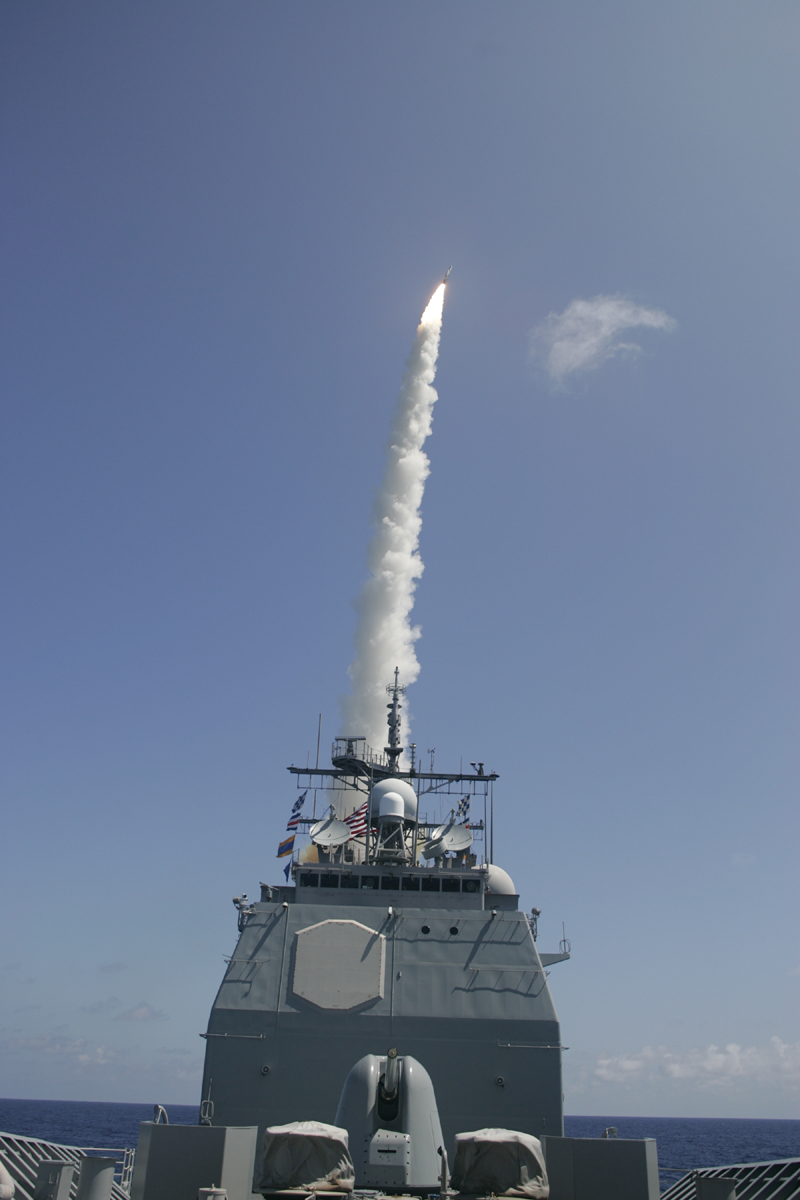
The Pearl Harbor-based Aegis cruiser USS Lake Erie (CG 70)The U.S. Navy, in cooperation with the Missile Defense Agency, today successfully conducted a ballistic missile defense demonstration involving the intercept of a target missile in the terminal phase (the last few seconds) of flight. The test involved an Aegis cruiser modified to detect, control and engage a ballistic missile target with a modified Standard Missile - 2 (SM-2) Block IV.
The Pearl Harbor-based Aegis cruiser USS Lake Erie (CG 70) conducted the mission against a short-range target missile launched from the Pacific Missile Range Facility, Barking Sands, Kauai, Hawaii. It was the first sea-based intercept of a ballistic missile in its terminal phase.

The modified Aegis Weapon System and the modified SM-2 Block IV provided the firing ship the capability to guide the missile to achieve either; 1) a direct body to body hit between the interceptor and the threat or, 2) a near-direct hit where the high pressure, heat and fragments are placed on the threat by a blast fragmentation warhead. This warhead is similar in concept to that used in the deployed Israeli Arrow system. In today's test, the threat missile was completely destroyed by the combined effects of these two mechanisms.

"This is another example of the ongoing cooperative spirit between the Navy and the Missile Defense Agency," said Rear Admiral Barry McCullough, Director, Surface Warfare, on the staff of the Chief of Naval Operations.

"We believe it is an important step towards the desired end-state of a robust sea-based terminal ballistic missile defense capability," McCullough added, “and it begins to meet an immediate near-term concern of our Combatant Commanders.” "The only terminal phase program we currently have that is operational is the Patriot Advanced Capability 3 (PAC-3)," he added, "and considerations to put those aboard ships are still under review."

There is currently no sea-based terminal ballistic missile defense capability. The Navy Area Theater Ballistic Missile Defense (TBMD) Program, had been under development, but was terminated in December 2001. In ballistic missile defense, the modified Aegis Weapon System, with a modified SM-2 Block IV missile provides a near term, limited emergency capability against a very specific segment of the ballistic missile threat. The Navy and MDA consider it vital to develop a more robust capability for terminal ballistic missile defense of the joint sea base and friendly force embarkation points ashore.

"There is a significant number of SM-2 Block IV missiles available, which may be modified and deployed on Navy ships modified to perform a BMD mission,” said Air Force Lieutenant General Henry "Trey" Obering, Missile Defense Agency director. "While talking with the Navy and the Combatant Commanders, on how and when, we might be able to make that happen," Lieutenant General Obering added, "MDA will continue to improve its development of the midcourse Aegis sea-based ballistic missile defense capability, which utilizes the Standard Missile – 3 (SM-3), and has successfully achieved 6 intercepts in 7 flight tests."

Both the SM-2 Block IV and the SM-3 were developed by the Raytheon Missile Systems of Tucson, Arizona. The Aegis Weapon System, the basis of the weapon system used today and in Aegis BMD ships, was developed by Lockheed Martin of Moorestown, New Jersey.

Queries on this test should be directed to Ms. Pat Dolan, Naval Sea Systems Command Public Affairs at (202) 781-2975. Photos and video will be available later from PMRF Public Affairs. Contact is Tom Clements at (808) 335-4740.

RELATED: KEYWORD - KOREA, Friday, August 19, 2005 Human Rights in North Korea, Friday, July 08, 2005 Korea – Meetings with ROK Official, Thursday, June 23, 2005 North Korea -- U.S. Humanitarian Assistance, Wednesday, June 22, 2005 North Korea – Six-Party Talks, Thursday, June 09, 2005 Korea – Six-Party Talks, Wednesday, June 01, 2005 North Korea – New York Channel

Monday, June 19, 2006

Secretary Condoleezza Rice, Foreign Minister Miguel Angel Moratinos, VIDEO, PODCAST, TEXT

Technorati Tags: and or and , or and , or , and , or , and , or , and ,

Remarks With Foreign Minister Miguel Angel Moratinos of Spain After Their Meeting, FULL STREAMING VIDEO, PODCAST, file is MP3 format, running time is 11:08 Secretary Condoleezza Rice, Benjamin Franklin Room, Washington, DC, June 19, 2006

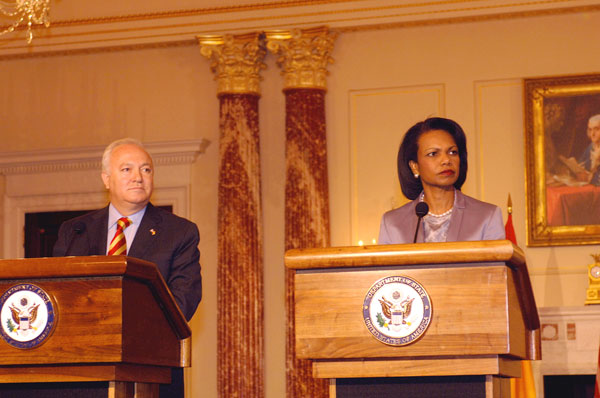
Secretary Rice with His Excellency Miguel Angel Moratinos, Minister of Foreign Affairs of Spain speak to the press after their bilateral and working lunch. State Department photo by Michael Gross.Secretary Rice with His Excellency Miguel Angel Moratinos, Minister of Foreign Affairs of Spain speak to the press after their bilateral and working lunch. State Department photo by Michael Gross.
SECRETARY RICE: Good afternoon. I'm delighted to welcome my colleague Miguel Moratinos, the Foreign Minister of Spain, to Washington and here to the State Department. Miguel and I have, of course, met on a number of occasions, including at our NATO meetings and when we've had an opportunity to meet at various international meetings as well. I am delighted that we've had this opportunity because we have talked about the entire world because Spain and the United States, as allies, NATO allies, are, in fact, engaged in many activities around the world.

We have talked about the prospects for peace in the Middle East. We have talked about Afghanistan, where Spain is playing an extremely important role. We have talked about how to support the new Government of Iraq. And we have talked a great deal about Latin America, where Spain and the United States share both interest and heritage.

Miguel, it is terrific to have you here. I should also note that Miguel has been here before. He has invited me to come to Spain and I look forward to doing so, Miguel, at the earliest possible convenience. Thank you very much.

FOREIGN MINISTER MORATINOS: Thank you. I'm extremely delighted to be back in the State Department in my third visit to Washington, D.C., and I had with Dr. Rice an extremely positive and fruitful exchange of view: on bilaterals, on regional issues that both Spain and United States are working together, fight against terrorism, our presence in Afghanistan, our support to the new Iraqi Government, on the Middle East Israeli-Palestinian issue, on Iran, on North Africa and of course on Latin America, where both United States and Spain wants to have a complementary role because we want progress and democracy to be absolutely established and consolidated in this important part of the world.

I think we have expressed our extremely satisfactory exchange of view. We are going to work together. I invite Secretary of State Condoleezza Rice to visit Spain. She agreed to come to Madrid in this year and I have the sense that both United States and Spain are working together in the main challenges that are confronted in this, today's world.

So again, I'm extremely happy. We have a tremendous agenda both on North Africa with Morocco and Algeria, Western Sahara, on the Middle East, on the Latin America, and I think working together the best answer to anyone who thought that U.S.-Spanish relation are going extremely well.

MR. MCCORMACK: The first question to Anne Gearan from the Associated Press.

QUESTION: Hello. Madame Secretary, how imminent do you think a North Korea test launch would be? Do you regard it as a test and not as some sort of hostile act? And what would the consequences be? What would the United States do if, in fact, they do go ahead with the test?

SECRETARY RICE: Well, Anne, we are working very closely with our allies. I, over the weekend in the last few days, have had several conversations with regional allies. Indeed, Foreign Minister Moratinos and I talked about the North Korean situation.

We regard it as abrogation of obligations that North Korea undertook in the moratorium that they signed onto in 1999, that they reiterated in 2002 that is clearly a part of the framework agreement that was signed in September of this past year between the six parties. And so it would be a very serious matter and indeed a provocative act should North Korea decide to launch that missile.

We will obviously consult on next steps, but I can assure everyone that it would be taken with utmost seriousness. I think it is already taken with utmost seriousness by regional states and by the world because it would once again show North Korea determined to deepen its isolation, determined not to take a path that is a path of compromise and a path of peace, but rather instead to once again saber-rattle. And so from our point of view it would be a very serious matter indeed.

QUESTION: Hello. Madame Secretary, this is a question actually for both of you, but starting with Secretary Rice. Since this government in Spain was selected on the withdrawing of troops on Iraq, the relationship between our two countries have been more tense than they were before. And in Spain we see, like, proof of that, the fact that our president has never been invited to the United States to meet with President Bush. Since the relationship seem to be much more smooth now, I wonder if that was a topic in your discussion today, or do you have any plans for that in the future?

SECRETARY RICE: Well, we obviously are here working together. We're determined to look forward. There's no secret we had our disagreements in the past. But I am impressed with the degree to which the Foreign Minister came prepared to talk about the future agenda, including how to support the democratically elected Government of Iraq. After all, this is now a government that has been elected by more than 12 million Iraqis. It's a national unity government. It's a government that the entire international community ought to be prepared and ready to get behind and push to success and that's the attitude that I saw expressed by the Foreign Minister. And as I said, I expect to be visiting Madrid fairly soon, so let's take it from there.

FOREIGN MINISTER MORATINOS: (Via interpreter) No, we have not discussed anything regarding that specific issue but I would like to reiterate, as I have said before, the excellent level of our relationship, the intensity of the agenda that we have discussed today, the level of our commitment. We have discussed issues like the new Government of Iraq. We are firmly committed to supporting them. I have, in fact, promised the new Iraqi Foreign Minister to visit his country in September and we're going to be working on issues such as support for them in communications, health issues, education and others.

QUESTION: Madame Secretary, what efforts are being made to find the two soldiers that have been kidnapped in Iraq? And also, you met with your Italian counterparts last Friday, but now we're hearing that the Italians would like to prosecute those responsible for the killing of Nicola Calipari last year and do you have any response to that?

SECRETARY RICE: I am not going to respond on a legal matter, but we are in discussion with the Italians. We have consistently respected our partners and, of course, discussed matters when they arise. But I'm not going to get into that -- that issue.

I will, on the matter of our missing soldiers. This is obviously a matter of great -- great concern to all of us and the American military has made very clear that they are going to do everything possible -- I think they've said, air, land and sea -- to try and find them. And obviously their safe return is something that everyone will work for and their safe return is something that everyone will pray for.

QUESTION: Madame Secretary, have you talked with Mr. Moratinos about the future of the military base in Guantanamo, the prison in the military base?

SECRETARY RICE: We actually did not talk about this. I can, however, answer your question if you would like. And -- look, the United States doesn't have any desire to be the world's jailer. We've said that many times. But we are in a different kind of war where we have picked up very dangerous people, either plotting terrorist plots or fighting in Afghanistan, engaged with terrorism and you'll have to have a place to put people like this. I don't think anyone wants to see Guantanamo open one day longer than it is needed. But I also expect suspect nobody wants to see a number of dangerous people simply released out onto the streets. A lot of people have been released from Guantanamo to -- in several cases, to their home countries when adequate provisions could be made for them. We continue to discussthe release of others to their home countries with adequate security provisions. And in cases -- some cases, we have relocated some people when we thought that their release to their home countries was not the appropriate course. So we're working through this population.

We also, of course, very much want to have trials for people. We understand the concerns about what's called indefinite detention. But we are currently awaiting a decision by our own Supreme Court on the constitutionality of military tribunals, which would be one way to try these people. And I can assure you that we want to bring people to justice, we want to bring them to a process in which their cases can be heard and we'll do that as soon as possible.

Thank you very much.

FOREIGN MINISTER MORATINOS: Thank you. Thank you.

2006/626, Released on June 19, 2006

Related: Keywords State Department, Monday, June 19, 2006 Robert Zoellick Announces Departure VIDEO, PODCAST, TEXT, Friday, June 02, 2006 R. Nicholas Burns, Remarks in Vienna, Austria, Wednesday, May 31, 2006 Iran Statement by Condoleezza Rice (VIDEO), Thursday, May 18, 2006 Secretary Rice With Prime Minister John Howard (PODCAST), Wednesday, May 10, 2006 Secretary Rice, EU Secretary General Javier Solana on Iran, VIDEO, PODCAST, TEXT, Wednesday, May 03, 2006 Secretary Rice, James Wolfensohn, Gaza Disengagement (PODCAST), Thursday, April 27, 2006 Remarks at Stakeout Secretary Condoleezza Rice, Friday, April 21, 2006 Secretary Rice to Travel to Europe, Friday, April 21, 2006 The Face of the State Department (VIDEO), Thursday, April 13, 2006 Secretary Rice Holds Talks with Equatorial Guinean President, Tuesday, April 11, 2006 State Department Podcast, VIDEO and Text 04/10/06, Wednesday, April 05, 2006 State Department Podcast, VIDEO and Text 04/03/06, Thursday, March 30, 2006 State Department Podcast, VIDEO and Text 03/29/06, Monday, April 03, 2006 Secretary Rice With Foreign Secretary Straw, Baghdad, Friday, March 31, 2006 Rice in Berlin To Discuss Iran with P-5 plus 1, Friday, March 31, 2006 UNHCR Worker’s Death in Sudan Attack,