Monday, August 07, 2006

President Bush Secretary Rice Middle East Crisis VIDEO, AUDIO, TEXT

Technorati Tags: and or and , or and or , or and ,, or , and , or , and , or , and , ,

President Bush and Secretary of State Rice Discuss the Middle East Crisis, FULL STREAMING VIDEO, Prairie Chapel Ranch, Crawford, Texas, 8:59 A.M. CDT, Audio, STREAMING AUDIO, and In Focus: The Road Map to Peace

President George W. Bush meets with Secretary of State Condoleezza Rice and National Security Advisor Stephen Hadley at the Bush Ranch to discuss the Middle East, Saturday, Aug. 5, 2006. White House photo by Eric Draper.President George W. Bush meets with Secretary of State Condoleezza Rice and National Security Advisor Stephen Hadley at the Bush Ranch to discuss the Middle East, Saturday, Aug. 5, 2006. White House photo by Eric Draper.
THE PRESIDENT: Good morning. Since the crisis in Lebanon began more than three weeks ago, the United States and other key nations have been working for a comprehensive solution that would return control of Lebanon to its government, and to provide a sustainable peace that protects the lives of both the Lebanese and the Israeli people.

Secretary Rice and diplomats from other countries are developing United Nations resolutions to bring about a cessation of hostilities and establish a foundation for lasting peace.

The first resolution, which the Security Council is now considering, calls for a stop of all hostilities. Under its terms, Hezbollah will be required to immediately stop all attacks. Israel will be required to immediately stop all offensive military operations. In addition, the resolution calls for an embargo on the shipment of any arms into Lebanon, except as authorized by the Lebanese government.

A second resolution, which the Security Council will begin working on as soon as possible, will help establish a sustainable and enduring cease-fire and provide a mandate for a robust international force that will help the legitimate government of Lebanon extend it's authority over all of Lebanon's territory.

Under this second resolution, the Lebanese armed forces, supported by the international force, will deploy to southern Lebanon. This international force will help Lebanon patrol its border with Syria and prevent illegal arm shipments to Hezbollah. As these Lebanese and international forces deploy, the Israeli defense forces will withdraw. And both Israel and Lebanon will respect the blue line that divides them.

These two resolutions are designed to bring an immediate end to the fighting, to help restore sovereignty over Lebanese soil to Lebanese democratic government -- to Lebanon's democratic government, excuse me -- to strike a blow against the terrorists and their supporters, and to help bring lasting peace to the region. By taking these steps, it will prevent armed militias like Hezbollah and its Iranian and Syrian sponsors from sparking another crisis. And it will protect innocent Lebanese and Israelis. And it will help the international community deliver humanitarian relief and support Lebanon's revival and reconstruction.

The loss of life on both sides of the Lebanese-Israeli border has been a great tragedy. Millions of Lebanese civilians have been caught in the crossfire of military operations because of the unprovoked attack and kidnappings by Hezbollah. The humanitarian crisis in Lebanon is of deep concern to all Americans, and alleviating it will remain a priority of my government.

I also believe that innocent civilians in Israel should not have to live in bunkers in fear of missile attacks. To establish a lasting peace that protects innocent civilians on both sides of the border, we must address the underlying conditions that are the root cause of this crisis.

I believe that the two resolutions I have discussed and that Secretary Rice is working on will put us on that path.

And now I'll be glad to answer some questions. Nedra.

Q Thank you, Mr. President. Lebanon has rejected the draft proposal, and Israel is not speaking out in support of it. How do you get a resolution that both sides will support?

THE PRESIDENT: Everyone wants the violence to stop. People understand that there needs to be a cessation of hostilities in order for us to address the root causes of the problem. That was the spirit that came out of the G8 conference. It came out of the Rome conference that Secretary Rice attended. We all recognize that the violence must stop. And so that's what Secretary Rice is working toward with our friends and allies.

Look, everybody is -- I understand both parties aren't going to agree with all aspects of the resolution. But the intent of the resolutions is to strengthen the Lebanese government so Israel has got a partner in peace. The intent of the resolution is to make sure that we address the root cause -- the resolution is to address the root cause, which was a state operating within the state. Hezbollah was -- or is an armed movement that provoked the crisis.

And so whatever comes out of the resolutions must address that root cause. And so the task today for the Secretary and her counterparts is to develop a resolution that can get passed. It is essential that we create the conditions for the Lebanese government to move their own forces, with international help, into the south of Lebanon to prevent Hezbollah and its sponsors from creating this -- creating another crisis. And so that's where we're headed.

Steve.

Q The Lebanese Prime Minister is demanding a quick and decisive cease-fire. An Israeli air raid today killed 40 people. When will we see this resolution? And if it's approved, when will we see a cessation of violence?

THE PRESIDENT: I'll let Condi talk about the details of what she's going to do today, if you care to hear from her. But we will work with our partners to get the resolution laid down as quickly as possible. And the resolution will call for a cessation of violence. And the concern, by the way, from the parties in the region is whether or not the resolution will create a vacuum into which Hezbollah and its sponsors will be able to promote more instability.

We all agree that we ought to strengthen this government, the Lebanese government -- that's the purpose of the resolutions, as well as to stop the violence.

I don't know if you want to comment upon --

SECRETARY RICE: First of all, we are working from what we believe to be a strong basis for a cessation of hostilities, that is the U.S.-French draft, a strong basis for the cessation of hostilities, and then as the President said, to have a process then that can address the root causes. And we also believe that it's going to be very important that this first resolution lay a very quick foundation for passage of a second resolution. So these have to be worked, in a sense, together.

I spoke last night and yesterday with Prime Minister Olmert, with Prime Minister Siniora, with Secretary General Kofi Annan, with a number of others, and I think we believe that there is a way forward.

Now, we understand that this has been a very emotional and, indeed, devastating and tragic set of circumstances for Lebanon and for Israel. And obviously, the parties have views on how to stop this. Their views are not going to necessarily be consonant about how to stop it. The international community has a view. But, of course, we're going to take a little time and listen to the concerns of the parties and see how they can be addressed.

But I want to just note, we believe that the extant draft resolution is a firm foundation, is the right basis, but, of course, we're going to listen to the concerns of the parties and see how they might be addressed. And that's really what's going to be going on today, particularly after the Arab League meets and Prime Minister Siniora emerges from that.

THE PRESIDENT: Yes, Peter.

Q Thanks. Mr. President, officials have been quoted saying that the international force would not include U.S. troops. And I wonder if you can explain why that is? Is it because the military is already over-tasked? Is it because you're afraid that the U.S. doesn't have credibility in the region?

THE PRESIDENT: No, I think -- first of all, there has been a history in Lebanon with U.S. troops. Secondly, I have said that if the international force would like some help with logistics and command and control, we'd be willing to offer logistics and command and control. There are some places where -- it's like Darfur, people say to me, why don't you commit U.S. troops to Darfur as part of an international peacekeeping. And the answer there is that those troops would be -- would create a sensation around the world that may not enable us to achieve our objective. And so when we commit troops, we commit troops for a specific reason, with the intent of achieving an objective. And I think command and control and logistical support is probably the best -- is the best use of U.S. forces.

Mike Fletcher.

Q Many strategists say that we'll never get to the bottom of this crisis unless the U.S. engages directly with Syria and Iran. Why not talk to them directly about this, and have a back-and-forth conversation?

THE PRESIDENT: Yes, that's an interesting question. I've been reading about that, that people have been posing that question. We have been in touch with Syria. Colin Powell sent a message to Syria in person. Dick Armitage traveled to Syria. Bill Burns traveled to Syria. We've got a consulate office in Syria. Syria knows what we think. The problem isn't us telling Syria what's on our mind, which is to stop harboring terror and to help the Iraqi democracy evolve. They know exactly what our position is. The problem is, is that their response hasn't been very positive. As a matter of fact, it hasn't been positive at all.

And in terms of Iran, we made it clear to the Iranians that if they would honor previous obligations and verifiably stop enrichment of nuclear materials, we would sit at a table. And so there's a way forward for both countries. The choice is theirs. Now, I appreciate people focusing on Syria and Iran, and we should, because Syria and Iran sponsor and promote Hezbollah activities -- all aimed at creating chaos, all aimed at using terror to stop the advance of democracies.

Our objective, our policy is to give voice to people through democratic reform. And that's why we strongly support the Siniora government. That's why I've articulated a two state solution between Israel and the Palestinians, two democracies living side-by-side in peace. That's why Condi went to see President Abbas, the President of the Palestinian Territories, to assure him that we're committed to a democracy. That's why we're making sacrifices in Iraq -- to build democracy.

In other words, we believe democracy yields peace. And the actions of Hezbollah through its sponsors of Iran and Syria are trying to stop that advance of democracy. Hezbollah launched this attack. Hezbollah is trying to create the chaos necessary to stop the advance of peace. And the world community must come together to address this problem.

Let's see here. Jim.

Q Mr. President, in the last couple of weeks, every time the question was asked why not get an immediate cessation and then build a sustainable -- terms for a sustainable cease-fire after you get the hostilities stopped, it was categorically rejected. Yet, a few weeks later, here we are. Can you explain why this wasn't done a couple weeks ago?

THE PRESIDENT: Sure. Because, first of all, the international community hadn't come together on a concept of how to address the root cause of the problem, Jim.

Part of the problem in the past in the Middle East is people would paper over the root cause of the problem, and therefore the situation would seemingly be quiet, and then lo and behold, there'd be another crisis. And innocent people would suffer. And so our strategy all along has been, of course we want to have a cessation of hostilities, but what we want to do in the same time is to make sure that there is a way forward for the Lebanese government to secure its own country so that there's peace in the region.

And that deals with an international peacekeeping force to complement a Lebanese army moving into the south to make sure that Resolution 1559, passed two years ago by the U.N., was fully upheld. Had the parties involved fully implemented 1559, which called for the disarmament of Hezbollah, we would not be in the situation we're in today.

Let's see here. Yes, Richard.

Q Mr. President, what are the specific stumbling blocks that are preventing this first resolution from being passed quickly? What are the people -- what are the parties objecting to in the language that needs to be altered?

SECRETARY RICE: I think that first of all, I don't -- I'm not going to get into specifics about the views of the parties. I think that we have to do that privately and talk with the parties privately. But obviously, this particular resolution is important because it sets an agenda for the basis for a sustainable peace. And so it will not surprise you that the Lebanese have views of what should be on that agenda. The Israelis have views of what should be on that agenda. They aren't always the same views, and so working together to get to what that agenda should be is part of what's going on here.

But I will say something that's very interesting. There is more agreement than you might think about how to prevent, again, a situation in which you have a state within a state able to launch an attack across the blue line.

For instance, there is agreement that the Lebanese government needs to extend its authority throughout the country, that it needs to have the Lebanese armed forces move to take care of this vacuum that has been existing in the south, that there should not be any armed groups able just to operate in the south in the way that Hezbollah has been able to operate in the south, that there ought to be respect for the blue line. These are all agreements between the two parties.

And so there is going to be some pressure from both sides to get things onto the agenda because they want to get them onto the agenda. But I think we have a reasonable basis here that both sides can accept. I think there are some issues of timing and sequence that need to be worked out. There are some concerns about when an international force would actually be available. And so we're going to continue to work to address those concerns of the two parties.

But as the President said, this last three weeks has been extremely important. Had we done this three weeks ago, we were talking about what people -- an unconditional cease-fire that I can guarantee you would not have addressed any of these items that both sides know are going to have to be addressed if we're going to have a sustainable cease-fire in the future. So this has been time that's been well spent over the last couple of weeks, that everybody agrees it's time to have a cessation. We're going to work a little bit more with the parties, and I think this resolution will be the right basis -- both to cease the hostilities and to move forward.

THE PRESIDENT: Cheryl.

Q Mr. President, you've spoken with Prime Minister Blair and Chancellor Merkel about this. Have you spoken directly with Prime Ministers Olmert and Siniora? And if not, why not?

THE PRESIDENT: Because Condi is handling those conversations, and she's doing a fine job of doing so.

Yes.

Q Mr. President, you've been quite specific in Hezbollah's role as the creator of this conflict. But what is the magnet, what is the pressure point, what is the hook to get this group to accept a cease-fire, to stop shooting and to stop kidnapping soldiers from across the border of another country?

THE PRESIDENT: Yes, I would hope it would be international pressure on not only Hezbollah, the group of Hezbollah within Lebanon, but also its sponsors. And that's the whole purpose of the United States working with allies and friends, is to send a clear message that sponsoring terror is unacceptable. It's the great challenge of the 21st century, really.

Q Do you --

THE PRESIDENT: Let me finish for a minute.

Q I'm sorry..

THE PRESIDENT: It is the great challenge of this century and it's this: As young democracies flourish, terrorists try to stop their progress. And it's the great challenge of the United States and others who are blessed with living in free countries. Not only do terrorists try to stop the advance of democracy through killing innocent people within those countries, they also try to shape the will of the western world by killing innocent westerners. They try to spread their jihadist message -- a message I call, it's totalitarian in nature -- Islamic radicalism, Islamic fascism, they try to spread it as well by taking the attack to those of us who love freedom.

And as far as this administration is concerned, we clearly see the problem and we're going to continue to work to advance stable, free countries. We don't expect every country to look like the United States, but we do want countries to accept some basic conditions for a vibrant society -- human rights, human decency, the power of the people to determine the fate of their governments. And, admittedly, this is hard work because it flies in the face of previous policy, which basically says stability is more important than form of government. And as a result of that policy, anger and resentment bubbled forth with an attack, with a series of attacks, the most dramatic of which was on September the 11th.

You know, your question is can we get people to -- a terrorist group to change their attitude. What we can do is we can get state sponsors of terror to understand this behavior is unacceptable, and that we can convince some people in terrorist groups that there is a better way forward for them and their families.

Remember, Hezbollah is a political party within Lebanon. They actually ran people for office. The problem is, is that they're a political party with a militia that is armed by foreign nations and, obviously, this political party with militia was willing to try to influence the Middle East through unprovoked attacks.

And what Condi is working on and I work on is to remind people about the stakes in the Middle East. And those stakes include not only helping the Lebanese government firm up its democracy -- remember, we worked with the French two years ago to boot out Syria. Syria was inside Lebanon and we felt that in order for a democracy to flourish, Syria needed to remove not only her troops, but her agents, her intelligence agents, for example.

And, obviously, there are some in the region that don't want the Lebanese government to succeed. I also happen to believe that as Prime Minister Olmert was making progress in reaching out to President Abbas and others in the region to develop a Palestinian state, that that caused a terrorist reaction. Remember, this all started with the kidnapping of an Israeli soldier by militant Hamas, followed shortly thereafter by the kidnapping of two Israeli soldiers by Hezbollah.

And, finally, the third most notable battleground in the advance of liberty is Iraq. It's interesting, if you go back to the work of Mr. Zarqawi, he talked about fomenting sectarian violence in order to stop the advance of democracy. The challenge of the 21st century is for free nations to help those who aspire to liberty. And, you know, the first question is, do people aspire to liberty? And the answer is, absolutely -- look at the 12 million people who voted in Iraq. Or look at the people who went to the polls in Lebanon. It's just clear to me that there will be terrorist activities that will try to stop people from living a decent, hopeful life.

And what you're watching now is the diplomatic efforts to address the problem. I know there's -- I sense a certain impatience in your voice about diplomacy coming to a conclusion. What Secretary Rice is doing, as well as me, is we are dealing with a lot of different interests. Remember, each nation at the Security Council has got its own domestic issues to deal with, as well, and so it is -- I wish things happened quicker in the diplomatic realm -- sometimes it takes a while to get things done. But what the American people need to know is we've got a strategy -- a strategy for freedom in the Middle East which protects the American people in the long run. And we've got a strategy to deal with the situations that arise in the Middle East -- first Lebanon; of course, the Iranian nuclear weapon issue.

And as you remember, right before the G8, the question on your mind was would we ever get a resolution out of the U.N. on the Iranians' desire to have a nuclear weapon, as well as whether or not we'd ever get a resolution out of the U.N. to deal with North Korea. As a matter of fact, there was great skepticism, I felt, in some circles, as to whether or not we'd be able to put a diplomacy in place that would deal with these two very difficult problems.

And, in fact, during the G8, two resolutions were passed -- by the way, those resolutions overshadowed by the situation in Lebanon. And I'm confident that working with our friends, if we stay on principle and remind people of the stakes, that we'll be able to accomplish the diplomatic objectives that we have set out -- which is dealing with this problem and addressing the long-term issues.

A couple more questions, and we'll get out -- Suzanne.

Q If I could follow Nedra's question. She had asked, Lebanon --

THE PRESIDENT: I can't remember that far back. (Laughter.)

Q Lebanon's parliament speaker, Nabih Berri, who has been negotiating for Hezbollah, has rejected the first resolution, saying it's unacceptable, they want the Israeli troops to pull out immediately. Is that a negotiable point? And, also, Secretary Rice, will you be reaching out to Berri, as you had spoken with him before?

THE PRESIDENT: Whatever happens in the U.N., we must not create a vacuum into which Hezbollah and its sponsors are able to move more weapons. Sometimes the world likes to take the easy route in order to solve a problem. Our view is, it's time to address root causes of problems. And to create a vacuum, Suzanne, is unacceptable. It would mean that we haven't addressed the root cause.

The idea is to have the Lebanese government move into the south so that the government of Lebanon can protect its own territory, and that there be an international force to provide the help necessary for the Lebanese government to secure its country. Remember, in Germany, the first thing I said was -- or one of the first things I said, I think I said this -- help me out here, if I didn't --

SECRETARY RICE: I think you did.

THE PRESIDENT: -- was we want the Siniora government to survive and to be strengthened. The linchpin of the policy is to support democracies. And so the strategy at the U.N., the diplomatic strategy is to support that notion, because a democracy in Lebanon will not only help that nation address its long-term issues -- such as rebuilding, providing a hopeful life -- but a democracy on Israeli's northern border will stabilize -- help stabilize the region. We are committed to a democracy in the Palestinian territory.

President Abbas, in his conversations with Condi, talked about moving forward with democracy. There are people who can't stand the thought of a society based upon universal liberty from emerging. And that, in itself, ought to be a warning signal to those of us who care deeply for peace, that people would be willing to kill innocent citizens in order to stop the advance of liberty.

Now, I've talked a lot about the universal appeal of liberty, and I readily concede some people aren't willing to -- some say, well, you know, liberty may not be universal in this sense -- America imposes its will. We don't impose liberty; liberty is universal.

It's one of the interesting debates of the 21st century, I think, that some would be willing to say it's okay for people not to live in a free society. It's not okay for us. If you love peace, in order to achieve peace you much help people realize that which is universal -- and that is freedom.

She asked you a question.

SECRETARY RICE: Our point of contact for the Lebanese government is obviously Prime Minister Siniora. As you know, I've also spoken to Speaker Berri on a couple of occasions.

I understand how emotional this is for the Lebanese. They've been through a very difficult war. It's emotional for Israel, as well. They're in the midst of a difficult war.

Let me just say that in terms of what the end state will look like here, I don't think there is any disagreement that the right solution is the one that the President referred to. It's the Lebanese, and the Lebanese armed forces able to secure their territory. And the international help is so that Lebanon can secure its territory. And I don't believe anybody anticipates that there should be foreign forces on Lebanese soil as a result of what has happened here.

And so I think there is room on this issue to work on this issue, because everybody has the same vision -- that it's the Lebanese army, with support from an international force, that can actually prevent that vacuum from obtaining again in the south, so that we're not right back here three or four or five months from now, in the same situation.

Q Mr. President, I don't think we've heard from you since Fidel Castro has fallen ill. Can you give us what you know of his current condition, what your administration's contingency plans are for his death, and how they address the desire of Cuban exiles in this country to eventually go home and reclaim their property?

THE PRESIDENT: First of all, Cuba is not a very transparent society, so the only thing I know is what has been speculated. And that is that, on the one hand, he's very ill, and on the other hand, he's going to be coming out of a hospital. I don't know. I really don't know.

And, secondly, that our desire is for the Cuban people to be able to choose their own form of government, and we would hope that -- and we'll make this very clear -- that as Cuba has the possibility of transforming itself from a tyrannical situation to a different type of society, the Cuban people ought to decide. The people on the island of Cuba ought to decide. And once the people of Cuba decide their form of government, then Cuban Americans can take an interest in that country and redress the issues of property confiscation. But first things first, and that is the Cuban people need to decide the future of their country.

Q Mr. President, if I could turn to Iraq for a moment.

THE PRESIDENT: Sure.

Q When you and Prime Minister Blair met at the White House a few months ago, you were asked about mistakes and missteps. And he said the one mistake he made was miscalculating in thinking that a young democracy, as you put it, would be born very quickly after the fall of Saddam. Are you prepared today to agree with him and acknowledge that you've had the same expectations, which were wrong?

THE PRESIDENT: Actually, I think -- I can't remember his answer; I'm sure you've characterized it perfectly. My attitude is that a young democracy has been born quite quickly. And I think the Iraqi government has shown remarkable progress on the political front, and that is, is that they developed a modern constitution that was ratified by the people, and then 12 million people voted for a government -- which gives me confidence about the future in Iraq, by the way.

You know, I hear people say, well, civil war this, civil war that. The Iraqi people decided against civil war when they went to the ballot box. And a unity government is working to respond to the will of the people. And frankly, it's quite a remarkable achievement on the political front, and the security front is where there have been troubles. And it's going to be up to the Maliki government, with U.S. help, to use the trained forces, and eventually a trained police force, to take care of those who are trying to foment sectarian violence.

We've made some progress against some of those folks, particularly when Mr. Zarqawi met his demise. Remember, al Qaeda is in the country, all attempting to stop the advance of democracy. And the blowing up of the mosque created an opportunity for those who were trying to foment sectarian violence to achieve their objective. But the Iraqi people rejected that kind of sectarian violence, the army stood strong.

No question it's still difficult. On the other hand, the political process is part of helping to achieve our objective, which is a free country, an ally in the war on terror that can sustain itself and govern itself and defend itself.

Okay, who else? I don't want to hurt any feelings. Yes, sir.

Q Thank you very much.

THE PRESIDENT: Identify yourself.

Q Kevin Corke, NBC News, sir.

THE PRESIDENT: Right. I knew that.

Q Yes, sir.

THE PRESIDENT: Just wanted to make sure you did.

Q Yes, indeed. In reading the 1559 resolution and the draft, as it's currently constructed, there are a lot of similarities, quite frankly. And I'm wondering if you could speak to maybe the frustration some Americans might be feeling that you've said we want sustainable peace, we don't want to come back here in a few months or a few years -- and, yet, it seems like there will be another resolution, maybe another resolution, maybe another this, that and the other. People get frustrated. Can you understand that and respond to that, sir?

THE PRESIDENT: Well, the people who should get really frustrated are the Israelis and the Lebanese. They ought to be the ones who are frustrated, because 1559 clearly laid a way forward for there to be a strong democracy in Lebanon, which will more likely yield the peace. And there is a level of frustration around the world with organizations that will take innocent life to achieve political objectives. And our job is to remind people that this isn't a moment, this is a movement, and that we must deal with this movement. We must deal with this movement with strong security measures, we must bring justice to those who would attack us, and at the same time, defeat their ideology by the spread of liberty.

And it takes a lot of work. This is the beginning of a long struggle against an ideology that is real and profound. It's Islamo-fascism. It comes in different forms. They share the same tactics, which is to destroy people and things in order to create chaos in the hopes that their vision of the world become predominant in the Middle East.

And Condi and I will work hard -- by the way, the United States can't win this war alone. We can do damage to the enemy. We can take the philosophical high ground and remind people of the importance of how freedom can change societies. But we will work with allies and friends to achieve this objective. And part of the challenge in the 21st century is to remind people about the stakes, and remind people that in moments of quiet, there's still an Islamic fascist group plotting, planning and trying to spread their ideology. And one of the things that -- one of the things that came out of this unfortunate incident in the Middle East is it is a stark reminder that there are those who want to stop the advance of liberty and destabilize young democracies. And they're willing to kill people to do so.

I repeat, this whole incident started because Hezbollah kidnapped two soldiers and launched rocket attacks. And it's been unfortunate that people on both sides of the border have lost life. And we're committed to helping the Lebanese government rebuild.

On the other hand, what we won't do is allow for a false hope. We believe that it's important to challenge the root cause now. We thought we had done so with 1559, but 1559 wasn't implemented. In other words, there was a way forward to deal with the problem. And now there's another chance to deal with the problem, and that's the role of the United States, working with others, to not only remind people about the problem, but to come up with solutions in dealing with the problem. And the solutions that we are working with our friends are, in our judgment, is the best hope for achieving stability and peace.

But it takes a lot of work. And it takes commitment and focus. And that's what this administration will continue to do. We'll stay focused on the problem and stay focused on coming up with solutions that, when implemented, will leave behind a better world.

Thank you all very much for your interest.

END 9:36 A.M. CDT, For Immediate Release, Office of the Press Secretary, August 7, 2006

Related: Keywords State Department, Monday, August 07, 2006 Press Briefing National Security Advisor Steve Hadley (VIDEO), Monday, August 07, 2006 Condoleezza Rice on Mid East Cease-Fire (VIDEO), Friday, August 04, 2006 Condoleezza Rice to the People of Cuba VIDEO, PODCAST, TEXT, Wednesday, July 26, 2006 State Department Daily Press Briefing, VIDEO, PODCAST, TEXT, 07/26/06, Tuesday, July 25, 2006 Condoleezza Rice With Israeli Foreign Minister Livni in Jerusalem, Saturday, July 22, 2006 Condoleezza Rice, Middle East and Europe VIDEO, PODCAST, TEXT, Friday, July 21, 2006 State Department Daily Press Briefing, VIDEO, PODCAST, TEXT, 07/20/06, Thursday, July 20, 2006 Secretary Rice, Patriarch Nasrallah Sfeir, VIDEO, PODCAST, TEXT, Tuesday, July 18, 2006, Evacuation of U.S. Citizens from Lebanon VIDEO, PODCAST, TEXT, Monday, July 17, 2006 For U.S. Citizens Seeking Assistance in Lebanon, VIDEO, PODCAST, TEXT, Saturday, July 15, 2006 U.S. Embassy Information for American Citizens in Lebanon, Thursday, July 13, 2006, U.S.-India Civil Nuclear Cooperation Initiative, VIDEO, PODCAST, TEXT, Thursday, July 13, 2006 Condoleezza Rice, Carlos Gutierrez, Free Cuba, VIDEO, PODCAST, TEXT, Thursday, July 13, 2006 Condoleezza Rice, Pakistani Minister of Foreign Affairs Khurshid Mahmood, VIDEO, PODCAST, TEXT, Thursday, July 13, 2006 Condoleezza Rice, British Foreign Secretary, Margaret Beckett VIDEO, PODCAST, TEXT, Wednesday, July 05, 2006 Condeleeza Rice, Turkish Foreign Minister VIDEO, PODCAST, TEXT,

Press Briefing National Security Advisor Steve Hadley (VIDEO)

Technorati Tags: and or and , or and or , or and ,, or , and , or , and , or , and , ,

Press Briefing by National Security Advisor Steve Hadley, FULL STREAMING VIDEO, Crawford Middle School, Crawford, Texas, 9:00 A.M. CDT.

President George W. Bush and National Security Advisor Stephen Hadley participate in a teleconference with Prime Minister Tony Blair of the United Kingdom, Sunday morning, Aug. 6, 2006 at the Bush Ranch in Crawford, Texas. White House photo by Eric Draper.President George W. Bush and National Security Advisor Stephen Hadley participate in a teleconference with Prime Minister Tony Blair of the United Kingdom,
Sunday morning, Aug. 6, 2006 at the Bush Ranch in Crawford, Texas. White House photo by Eric Draper.

MR. HADLEY: Good morning. I'd be glad to answer any questions you folks have.

Q Steve, how are you going to get Hezbollah to sign on to this cessation of hostilities?

MR. HADLEY: The resolution will call for the Lebanese government and the Israeli government to accept the framework of a political arrangement that will be set out in this first resolution. And also, of course, to accept this call for a cessation, a full cessation of hostilities, which means Hezbollah attacks to stop and Israeli offensive operations to stop.

It's really going to be the Lebanese government that is going to have to set out and accept the arrangement on behalf of the Lebanese people. As you know, Hezbollah is a part of that government. They will have to take on that responsibility. In addition, of course, we are asking those countries with influence on Hezbollah to send a clear message, and that would be particularly Iran and Syria, to send a clear message to Hezbollah that it needs to accept the will of the international community and support the decision made by the Lebanese government.

I think it's interesting if you have a situation where the international community is calling for a full cessation of hostilities supported by the Lebanese government -- it was supported by the Israeli government, and Hezbollah says no, that will tell you something about who wants peace and who does not, and that will be a clarifying moment.

I think it's important to say that if, when this first resolution is adopted -- which we hope will be tomorrow afternoon or Tuesday morning -- I don't think you'll see an instantaneous end to the violence. As you know, historically, these cease-fires take some time to go into effect, particularly if, unfortunately, Hezbollah were to reject it.

But we would want, in any event, to move towards a second resolution, because everybody, I think, understands how this needs to end up -- which is that the Lebanese government needs to be able to exert it's authority throughout the country; the Lebanese army needs to be able to move south and take control of that territory, which it has not done and has not had for the last several years; and that it is going to need help to do so. And that's what the UNIFIL force, the United Nations force that is now there can do -- but also, the multinational force is so important to strengthen the hand of the Lebanese army when it moves into southern Lebanon, and to give Israel some assurance that if Israel then pulls out, Hezbollah will not come back in.

So everybody knows that's where that needs to end up. We need a second resolution to get there, and that's why once the first resolution is adopted, we will try and move very quickly towards a second resolution.

Q Steve, is the administration now going to talk to Iran and Syria to make this point, and try to have some back-and-forth with them? As you know, many of your critics say you haven't been talking to your enemies, who actually hold the key to this.

MR. HADLEY: Well, in some sense, you know, every time someone like me gets up and talks and says what they've just said, we've sent a message to Syria and Iran. I mean, it's not as if they don't hear what has been said.

Secondly, in terms of both of these countries, there are a number of countries that are sending the same message. That's really been an approach we have had both with respect to Syria and Iran, to try and get the international community and as many countries as we can sending the same message to Syria and Iran.

In terms of Iran, as you know, we are very anxious to enter into a discussion with Iran on their nuclear program. And we have proposed to do so if they will simply do what the international community, what the Europeans, who have been handling the diplomacy with them have called for, what the IAEA Board of Governors have called for, which is to suspend their nuclear enrichment programs.

So we would like very much to be entering into a discussion with Iran on that issue and potentially other issues. But they've got to take a step to show that they are willing to come into compliance with the international community.

Q On this particular issue, though, I know Syria says they don't want to be just sent messages, they want to have a conversation about that. Is the administration open to that?

MR. HADLEY: Throughout the firs term of this administration and into the second, we have had ongoing, very high-level discussions with Syria. They involved Secretary of State Powell, they involved Deputy Secretary Armitage, they involved Bill Burns, who was then Assistant Secretary of State. Those were a bit interrupted after the murder of Rafik Hariri, and evidence that the Syrian government may have been responsible for that. And at that point, we withdrew our ambassador. But we continue to have an embassy there, we continue to have a charg who does have -- attempt to have conversations with the Syrian government.

So the problem really is not that we haven't had conversations; the problem is we have not had action out of the Syrian government. It has been very clear what the international community has asked it to do. For example, with respect to Lebanon, there are three Security Council resolutions -- 1559, 1595*, 1680 -- all make clear what the parties need to do, including Syria. The problem isn't that Syria doesn't know what the international community is requiring of it -- the problem is Syria isn't doing it, that Syria is not acting.

Syria has a choice to do what the international community has asked -- to come into increasing relations in the international community, or to defy the international community and to continue to isolate itself and to become a handmaiden of Iran, which is really what they've become. And so the problem is not that Syria doesn't know what's being asked of it, it's not that a lot of people aren't talking to them, it's not that we haven't been talking to them over the years -- the problem is they're making choices, they're making bad choices. They need to make different choices.

Q Mr. Hadley, you say the first resolution won't bring about an instantaneous end to the violence, it's going to take a second resolution that will bring in this international force. Given that, when do you anticipate that we'll get a vote on the second resolution? And how soon do you expect a force to be able to get in there to back up the Lebanese army?

MR. HADLEY: We would hope -- let me just be clear: We would hope that the first resolution would, over time, result in the cessation of violence. It will call on the parties to do what I said: Hezbollah to stop its attacks, Israel to stop its offensive military operations. But I'm just saying as a practical matter, as you sort of look forward and try and anticipate what might happen, we know, historically, that even if all parties agree to the cease-fire, it takes time for it to come into place. And we want to move very quickly, in any event, towards the second resolution. Our hope is that it would be days, not weeks. The long pole in the tent, as they say, of course, is the formation of this multinational force that takes some time.

And, quite frankly, that's why we had to divide it into two resolutions, so that we could get the violence down, while we took the time that's going to be required to put together this multinational force. We hope we're going to do it as quickly as we can, but these things are difficult. We also hope, let me just say, that the adoption of the first resolution will free up the international community and a number of folks who may contribute to that force to be able to focus on that effort and put together the force as quickly as we can.

Q And just so we understand, the U.S. still has no intention of contributing forces to that force?

MR. HADLEY: We have talked about supporting that force, and there are things that we may be able to do with those kinds of unique capabilities the United States has -- you know, we've done this before with other forces -- lift, intelligence, command and control, logistics and those things. But, you know, given the history, we think that the idea of putting U.S. ground combat forces on the ground, this probably doesn't make sense; it isn't going to be something that will be designed to advance the objectives that the international community and that the President has set for us. So we think that wouldn't really advance the cause.

Q The resolution calls for Israel to stop its offensive military operations. But Israeli officials have always said these are defensive maneuvers against Hezbollah's attacks. So how do you reassure the Lebanese that, short of having Israeli forces withdraw from Lebanese territory, that Israel would stop its attacks and stop the violence?

MR. HADLEY: It will be called on to stop its offensive activities. And I think the choice of that word is to recognize, of course, that if Hezbollah does not cease all attacks, as the resolution will call for it to do, and does attack Israeli forces in southern Lebanon, they're going to have to have the right to defend themselves. That's what that's trying to do.

Q Has Israel had any offensive attacks yet?

MR. HADLEY: I'm sorry?

Q -- described anything so far as being offensive that they've been doing? Or this has all been defensive, right?

MR. HADLEY: Well, when people talk about offensive military actions they would be thinking about the air strikes that have occurred out of the southern area, and they would be thinking about the military operations that the ground forces have been undertaking. Those, I think, would be, in common parlance, viewed as offensive military operation.

Q Can you talk to us a little bit about the time you spent with the President yesterday? How much time did you spend briefing him? And, also, are there any plans for the President to call any of the other foreign leaders involved to, perhaps, move things along?

MR. HADLEY: Yes. The Secretary of State and I flew down on an airplane yesterday, spent most of the time on the phone with Israeli leaders, with those folks on the ground talking to the Lebanese leaders, because, obviously, we want to come up with a resolution that is acceptable to the Security Council and will work, in terms of Lebanon and Israel.

When we got down, we sat down with the President and reported on those conversations, so he knew exactly where we were. We also reviewed with him the situation, and, quite frankly, got some pretty clear guidance from him on the way forward as to how he wanted to proceed in not only the second resolution, but beyond. He's in the process, obviously, of developing an overall strategy for the Middle East as to sort of what comes next -- which is something that the President is good at and encourages us to do: How does this fit into an overall strategy? We had an opportunity to talk about that at lunch.

We then went off and did a number of things, in part carrying out what the President had directed us to do and then to get some additional information. Before dinner that evening we had another discussion and, in some sense, had a sort of strategic discussion of: Okay, let's assume we get through the first and second resolution, where do we head, in terms of the Middle East, more generally? This kind of a brainstorming session.

He has been in touch with world leaders on this issue, where it is appropriate and where it will advance the diplomacy. A lot of what's happening in New York right now is now into the details of draft language, which is not appropriate for heads of government to be negotiating Security Council text over the phone.

He did have a good discussion with Prime Minister Blair of the United Kingdom today. It was comparing notes on where we are, in terms of this first and second resolution; again, beginning to talk a little bit about the strategy for the Middle East more generally, after we get through this current crisis. It was a good conversation; it's a conversation they've had from time to time, for some time.

Q But no calls on the horizon, either to the Lebanese or Israeli Prime Minister?

MR. HADLEY: If it will advance diplomacy, the President will do it.

Q Mr. Hadley, given the ultimate goal of Iran, Syria and Hezbollah -- which is the destruction of Israel -- what's in it for them to go along with this resolution at this point in time?

MR. HADLEY: Well, they're going to have to make a decision about how far they're prepared to go in defying the international community. I think what's interesting is that the attack by Hezbollah came on the 12th of July, and by the 16th of July, four days later, you had a G8 statement by the leaders, the G8 leaders -- these are major industrialized countries -- that were meeting in St. Petersburg.

And, it's interesting, if you go back and look at that document, it sets out the framework that we have really been pursuing since then. One of the things that's very interesting is that it made clear -- unanimously adopted by France, the U.K., Germany, Italy, Japan, Canada, the United States and Russia -- it made clear that Hezbollah was the offending party. It was an unprovoked attack on Israel. It was in a position -- it did it in defiance of the Lebanese government, without informing the Lebanese government, and it had been able to do so because the Security Council resolutions that I referred to have not been carried out. And it also made clear that they were supported by Syria and Iran.

So the international community has made very clear who the offending party here is. It will now make clear in the Security Council resolutions what needs to happen to get out of this crisis. It will be calling on all states to facilitate that process. And Syria and Iran are going to have a choice to make as to whether they are prepared to try and confront and defy the international community.

Q Again, what is the incentive for them? Despite all of the language that came out of the G8, the weapons have continued to flow into Lebanon from Iran, probably elsewhere. So what's, you know, the carrot out there?

MR. HADLEY: Well, part of it is do they want to be increasingly isolated by the international community; do they want to be in a situation where there are financial measures and, ultimately, international sanctions imposed against them. There are sanctions that are available for violations of arms embargo, for example. There are penalties -- and we've made it clear, particularly, for example, in the nuclear discussions, that there are two paths, and if they defy the international community there will be consequences and sanctions, increasing isolation and increasing difficulty in doing business and being part of the international community. And the question is whether they want to walk down that road.

Q But what changes that now? I mean, Iran has been dealing with sanctions and isolation since --

MR. HADLEY: No, they haven't. On the contrary. Iran is very much integrated into the international community. We have had sanctions on Iran, but the international community has not, the Europeans have not. It's interesting, Iran is a different case than North Korea, which has already isolated itself. Iran has not. Iran has commercial relations, it has diplomatic relations, it sees itself as a regional power and a global power. And the question is whether it wants to go in a situation where the international community basically turns its back on Iran. That would be a situation we've never had before.

And, indeed, one of the things that has been, I believe, this President's achievement has been if you look at where we were with the Europeans in the 1990s about our views on Iran, it was not a shared conception. The Europeans, the Russians did not view Iran as a threat, let alone the strategic threat that it has become. And one of the things this President has done is get to the point where we have now the whole international community saying Iran is making a strategic challenge to us all by its support for terror, by its supporting Hezbollah, for the kinds of things we see in Lebanon, by the way it treats its own people, by its pursuit of nuclear weapons. Think about how difficult this crisis would be now if Iran had a nuclear weapon.

And what we're heartened by is the international community is beginning to understand what is at stake in the broader context of this current struggle. That's why the G8 report and statement was so important. That's why it's been interesting that Russia has gone from supporting Iran's nuclear program to, in recent years, cooperating with the rest of us in trying to rein that program in.

So there has been a sea change, and Iran needs to take that into account. It is really confronting the international community. And the international community is wakening to the challenge.

Q Steve, two quick ones for you. One is, have you had explicit conversations with Japan and Germany about ultimately imposing international sanctions on Iran? And the other is, do you need this second resolution -- you said in days, not weeks, do you need this second resolution to start talking with the logistics of an international force, or has that already begun?

MR. HADLEY: There have been some conversations, but there's been a reluctance to do it until we could get and be sure that the international framework is in place. And so we hope that this first resolution will hasten that.

Secondly, in terms of sanctions on Iran, as you know, there was an agreement in the nuclear context that if Iran did not suspend its enrichment activities and reprocessing activities and come back to the negotiating table, that there would be action in the U.N. Security Council. There was a resolution, as you know, adopted a week ago, that says that if Iran does not comply with what the international community has asked of it by August 31, it will return to the Security Council under Chapter 7 and under a provision of Chapter 7 that envisions economic sanctions. So that is already on the table, with respect to Iran.

Q So you think this consensus will hold, moving out of a nuclear context and into the Lebanon/Israel context?

MR. HADLEY: We would hope that it would. And we think it's interesting that in the middle of this Lebanese crisis we did have, I think, the United Nations Security Council did adopt, by a vote of 14-1 ,the resolution on Iran's nuclear program. And I think it was, in a way, fortuitous, that it was a signal to Iran, even in the Lebanese crisis, that the international community is united on the broader issue of Iran.

Q Mr. Hadley, is there any sense that Hezbollah's military capability has been weakened as a result of all this fighting?

MR. HADLEY: It's hard to know. I think the answer is that it has been weakened. That's certainly, I think, what the Israelis think. I think what is important is that the diplomacy now makes clear that we're not going back to the status quo ante; that a situation where Hezbollah controls the south, continues to be armed, basically has a kingdom within a kingdom -- that is not acceptable anymore to the Lebanese government or to the international community.

And that's what, of course, getting the Lebanese army into the south, getting the multinational force to support it is all about, to send that message to Hezbollah that the rules of the game have changed. And we think that will be a great setback to Hezbollah and a great thing that will strengthen the Lebanese government, and to become really a sovereign, democratic government in charge of all of its territory. That's where we want to go.

Q Can you talk about your plans and Secretary Rice's plans -- how long are you guys planning to stay here? And she had mentioned that she may not go to New York.

MR. HADLEY: I'm not aware that she said she may not go to New York.

Q She would go if and when it was necessary. Do you know --

MR. HADLEY: Well, I think what we hope is that we've had a good opportunity to speak with the President yesterday; we will today. We've also been on the phone pretty constantly working the diplomacy. Our hope would be that in New York there is agreement on this resolution. And then, of course, the issue will be whether the foreign ministers will come and sit in the Council to vote on it or not. I think that's still an issue that's' being worked. But we would like to get to the point where the resolution could be voted on, on Monday or Tuesday.

Steve Holland, last question.

Q You've said that the international force is the long pole in the tent. What are the complications in setting that up?

MR. HADLEY: It's the normal stuff: Who's going to contribute forces, when will they be ready to move, who's going to lift them to get them into the theater; once they're in the theater, where do they go. I mean, it's all the nuts and bolts of moving people and heavy equipment; getting a command and control, taking disparate pieces and integrating them into a single force with a unified command and control.

You know, these things are things militaries do -- they just take time, because they're big movements.

Thanks very much.

Q What is the timeframe for the force? When do you think the force might come in?

MR. HADLEY: We'd like to do it in days, not weeks, but it's going to take some time. We're going to try and move it as soon as we can, but I can't give you a timeframe.

Q So by the end of the week?

MR. HADLEY: I can't give you a time.

Q Wait, Steve. Days, not weeks -- that's for the deployment of the force, or the second resolution?

MR. HADLEY: We would like to have days not weeks for the second resolution, which would authorize the force. And, obviously, as soon after that as the force can move, the better, because it's what we all want -- it's what the international community is going to want, what the Lebanese and the Israelis -- how many days that is, how long that will take, I can't tell you. That's what the force planners are going to have to come up with, in putting this force together.

Q That's what my question was --

MR. HADLEY: I'm sorry.

Q -- the logistics of getting that force together.

MR. HADLEY: I got you. I didn't give you a good answer, I'm sorry.

Thank you.

END 9:23 A.M. CDT, * The correct resolution is 1559.

Related: Keywords State Department, Monday, August 07, 2006 Condoleezza Rice on Mid East Cease-Fire (VIDEO), Friday, August 04, 2006 Condoleezza Rice to the People of Cuba VIDEO, PODCAST, TEXT, Wednesday, July 26, 2006 State Department Daily Press Briefing, VIDEO, PODCAST, TEXT, 07/26/06, Tuesday, July 25, 2006 Condoleezza Rice With Israeli Foreign Minister Livni in Jerusalem, Saturday, July 22, 2006 Condoleezza Rice, Middle East and Europe VIDEO, PODCAST, TEXT, Friday, July 21, 2006 State Department Daily Press Briefing, VIDEO, PODCAST, TEXT, 07/20/06, Thursday, July 20, 2006 Secretary Rice, Patriarch Nasrallah Sfeir, VIDEO, PODCAST, TEXT, Tuesday, July 18, 2006, Evacuation of U.S. Citizens from Lebanon VIDEO, PODCAST, TEXT, Monday, July 17, 2006 For U.S. Citizens Seeking Assistance in Lebanon, VIDEO, PODCAST, TEXT, Saturday, July 15, 2006 U.S. Embassy Information for American Citizens in Lebanon, Thursday, July 13, 2006, U.S.-India Civil Nuclear Cooperation Initiative, VIDEO, PODCAST, TEXT, Thursday, July 13, 2006 Condoleezza Rice, Carlos Gutierrez, Free Cuba, VIDEO, PODCAST, TEXT, Thursday, July 13, 2006 Condoleezza Rice, Pakistani Minister of Foreign Affairs Khurshid Mahmood, VIDEO, PODCAST, TEXT, Thursday, July 13, 2006 Condoleezza Rice, British Foreign Secretary, Margaret Beckett VIDEO, PODCAST, TEXT, Wednesday, July 05, 2006 Condeleeza Rice, Turkish Foreign Minister VIDEO, PODCAST, TEXT,

Condoleezza Rice on Mid East Cease-Fire (VIDEO)

Technorati Tags: and or and , or and or , or and ,, or , and , or , and , or , and ,

Secretary of State Condoleezza Rice on Mid East Cease-Fire Resolution FULL STREAMING VIDEO

President George W. Bush meets with U.S. Secretary of State Condoleezza Rice at the White House Monday evening, July 31, 2006, to discuss her recent trip to the Middle East. White House photo by Eric Draper.President George W. Bush meets with U.S. Secretary of State Condoleezza Rice at the White House Monday evening, July 31, 2006, to discuss her recent trip to the Middle East.
White House photo by Eric Draper.

Secretary Condoleezza Rice, Crawford Middle School, Crawford, Texas, August 6, 2006,Released by the White House Office of the Press Secretary, 8:00 A.M. CDT

SECRETARY RICE: Good morning. I'll take a few questions.

QUESTION: Secretary Rice, who or what are you counting on to bring Hezbollah on board, to get them to agree with this resolution?

SECRETARY RICE: Well, first of all, let me say that it's important that we vote the resolution in the Security Council, and we expect that to happen in the next day or two. And at that point, the international community will have put forward its views of how this war can abate, and then we'll see who is for peace and who isn't. The world is really watching now to see. Everyone has been talking about a cease-fire, an immediate cease-fire. I think even Hezbollah has from time to time talked about an immediate cease-fire.

This is a basis on which a cease-fire will take place, cessation of hostilities will take place so that there can't be a return to the status quo ante, which is extremely important to all the parties, because we don't want to create a situation in which we get out of this, and then you create the conditions in which Hezbollah, a state-within-a-state, goes across the line again, abducts soldiers, and we get another war.

And so we will ask everyone who has any influence with all the parties to talk to them about the importance of taking this opportunity. I just want to note that these things take a while to wind down. It is certainly not the case that probably all violence is going to stop, but the kind of large-scale violence that is really so hard on the Lebanese and Israeli people, the rocketing into Israel, the major offensive military operations, it's important to get those stopped, but it's a first step. We've then got to get to the second resolution, and the formation of an international force that can help the Lebanese government extend its authority throughout the country. So this is a first step.

QUESTION: Can I just follow up, something you said on the morning talk shows. How could it possibly be that the Lebanese government didn't know that thousands and thousands of rockets came into their territory? You gave the indication that they were oblivious to this.

SECRETARY RICE: No, I said that they did not know about the attack across the Blue Line for the abduction of Israeli soldiers. They have said that, and I believe them on that. The military wing of Hezbollah did this apparently without any authorization of the Lebanese government, which had an obligation to respect the Blue Line.

The real situation in Lebanon is that the south has had a vacuum in which Hezbollah has been operating. And the solution to this over the next several months is going to be to flow the authority of the Lebanese government and Lebanese forces with the help of international forces into the south, so that you don't have that vacuum.

Steve.

QUESTION: (Inaudible.)

SECRETARY RICE: Well, I would hope that you would see, very early on, an end to the kind of large-scale violence, large-scale military operations, firing of rockets, that we've been seeing. That needs to stop so that the situation can clear for the next phase, and the bringing in of international forces to help.

But I can't say that you should rule out that there could be skirmishes of some kind for some time to come. This isn't meant to be a permanent condition, it's meant to create conditions on which a more permanent, enduring cease-fire can be built.

QUESTION: Prime Minister Siniora says that the U.N. resolution, as in the draft, is inadequate, that they're looking for Israeli troops to withdraw from Lebanese territory immediately. Have you spoken with him, and what is the administration willing to offer in the first resolution? Are you willing to make some changes in that to include that in that resolution?

SECRETARY RICE: Well, again, we need to keep this in face. Yes, I've spoken to Prime Minister Siniora a couple of times, as a matter of fact, yesterday. I'm also speaking with the Israelis, as are others. The United States has been very much, with France, in the lead on this, but there are a number of countries that are talking to all the parties.

The way to think about this is that you need to have, in effect, forces stop in place, so that you don't have the large-scale military operations that really are so devastating to the country and so devastating to the people. There will have to be a phase of the flowing of Lebanese security forces into the south. Everybody wants to have that happen as quickly as possible, but they need international assistance to do it. No one wants to see Israel permanently in Lebanon, nobody wants that. The Israelis don't want it, the Lebanese don't want it.

And so I think there's a basis here for moving forward. We are not in a position to stop after the first resolution, people are absolutely right about that. That would not be a stable equilibrium. So we need to get the first resolution, get the large-scale violence stopped, get the Lebanese forces ready to flow in, get security -- international forces to help them, and do that really rather quickly. So I want to emphasize this is a first step, not the only step.

QUESTION: Can you tell us about what the President has had to say about this, and what interactions you've had with him since you've been here?

SECRETARY RICE: Well, I've been, obviously -- and before we left Washington -- in constant contact with the President; came back from the meetings that I'd had in the Middle East and came directly to talk to him. Obviously, yesterday we've been in fairly intensive conversation about this, as we've been moving forward toward the resolution.

But his view is very strong on this, and it's not unlike what he stated at the very beginning of this crisis, when we were in, I think, Germany, when this really started, which is that this is really now an opportunity to extend the authority of the Lebanese government throughout its own territory. That really has to be the goal. Everybody is focused on the international forces, but the international forces are there to assist in the important work of getting the Lebanese to fill the vacuum that has developed in the south. That's, in large part, why you have a kind of state-within-a-state operating there. The Lebanese have also been very clear -- Prime Minister Siniora, for instance, when he was in Rome, that the Lebanese understand their responsibilities under the Taif Accords, which were signed in 1989, and under resolution 1559, which says that there should be no armed groups outside the authority of the Lebanese government.

The very fact that that Taif Accord was signed in 1989 lets you know how longstanding this problem is in Lebanon, and it goes well back before that. It took some almost 10 years to get to the Taif Accords. So you have to understand that we're trying to deal with a problem that has been festering and brewing in Lebanon now for years and years and years.

And so it's not going to be solved by one resolution in the Security Council. This is one step to stop the large-scale violence so that we can begin to then address these underlying problems. But what this resolution has in it that would not have been there if we had done this a couple weeks ago is a kind of political basis for creating those conditions in which the parties -- in which Lebanon can flow its authority south.

QUESTION: Are you expecting a unanimous vote in the U.N., and what can you tell us about any work that's being done on the second resolution?

SECRETARY RICE: I would, obviously, always hope for a unanimous vote.

QUESTION: (Inaudible.)

SECRETARY RICE: All that I know is that both the French permanent representative, Jean-Marc de La Sabliere and John Bolton, our permanent representative, represented the conversations in the Security Council yesterday as positive. We will see -- there will be further discussions today. I would urge, and I think we are urging all states of the Security Council now to back this resolution as a first step toward not just an end to the crisis, but as a first step to moving to a more stable set of solutions. So that's -- the mood in the Council has been very good, and I think you will see support for the resolution.

Yes.

QUESTION: What about the second resolution?

SECRETARY RICE: Oh, the second resolution. This resolution anticipates a second resolution. I think work will begin on that very, very quickly. People have, obviously, ideas, and have been talking about it. There's been some work done, but it's not been done in a setting with the United States and other parties.

QUESTION: Madam Secretary, Hezbollah has indicated that it will not cease its attacks until every last Israeli soldier is out of Lebanon, not to be prepared -- but out of Lebanon. Is that a necessary, in your mind, first step at ending the immediate violence, is for a complete Israeli withdrawal?

SECRETARY RICE: The resolution does not anticipate and does not expect a complete Israeli withdrawal in the first phase, no, because this is a resolution that ceases hostilities with forces in place, but requires that the major military operations, offensive military operations, the firing of rockets -- the kind of violence that really is so hard on civilian populations -- that that's got to stop.

Now I know Hezbollah has said all kinds of things. I've heard, "we should have an immediate cease-fire," I've heard, "we'll keep fighting," I've heard all of those things. What we need to focus on, when this Security Council resolution is passed, we're going too know who really did want to stop violence and who didn't. We've had an awful lot of calls over the last couple of weeks for an immediate cessation of hostilities, an immediate cessation of hostilities. The United States has been very clear that we did have to have some political basis to make clear that that cessation of hostilities was not going to countenance a return to the status quo ante. This resolution does that. And now we're going to see who is for peace and who isn't.

QUESTION: Who should rebuild Lebanon after the violence has ceased? Is it the U.S. role?

SECRETARY RICE: Well, the U.S. will certainly play a role in the rebuilding of Lebanon. We have committed to that. The Rome declaration commits to an international effort to rebuild Lebanon -- not just a U.S. effort, not just a French effort, a complete international effort. And let's remember, too, that the Saudis have already made known that they're going to make a very large donation to the rebuilding of Lebanon. So I think the rebuilding of Lebanon will be well underway when the violence stops and when the political constituents are there.

QUESTION: Madam Secretary, two questions. The first, a couple of weeks ago, when there were calls for an immediate cessation of violence, you said you wanted to provide a permanent solution. Why shouldn't we see this two-state solution as precisely what you were arguing against then? And second, how is that you came up with agreement that didn't have fundamentals that the Lebanese wanted, like an immediate cessation of violence, a withdrawal of the Israeli troops and a return of displaced civilians?

SECRETARY RICE: Well, there's a very simple answer to the second: there are things the Israelis wanted and things the Lebanese wanted, and everybody wasn't going to get everything that they wanted. This is the international community's effort to bring about an equitable, reasonable basis for a cessation of hostilities of the kind that are so devastating to civilian populations. And so I would expect that there is going to be a lot of discussion on how to move forward. But I would hope that the parties are all going to take the opportunity before them to stop the kind of terrible violence that we've been seeing against Israeli populations, against Lebanese populations.

On the first point, we do insist that there is -- that when there is a cease-fire, that it's going to have to be on an enduring basis, which is why bringing forces in to support Lebanon's flow of its own forces to the south and to support conditions where there can't be a return to the status quo ante is so important.

But what we wanted to do was to not have an unconditional cease-fire with no political principles, no view of what the south is going to look like when this is finally resolved. It took some time -- the G8 statement was the first step. It then took some time going out to the region, talking to the Lebanese, talking to the Israelis. Let me remind that at the Rome conference, Prime Minister Siniora did a lot of work in his council of ministers to get backing, including of the two Hezbollah ministers in his cabinet, of a set of a principles that could move this forward. Now, Lebanon isn't going to have all of the principles there, or the full principles there that they would like; Israel, I'm sure, is not going to have all of them there that they would like.

But this is a first step. It's a good basis for ending large-scale violence, it's a good basis for creating conditions in which there can't be a return to the status quo ante, and it's a good basis for beginning to flow the authority of the Lebanese government into the south so that this can't happen again.

Last question.

QUESTION: Madam Secretary, what role have China and Russia played in this latest negotiations. Did we (inaudible.)

SECRETARY RICE: Well, yes. I know that there have been conversations with the Russians, including conversations with the Russian leadership about this. And we have talked with the Russians, as well as have others, and so far we've gotten positive soundings from Russia, but I don't want to speak for them. This is an important meeting today, to take account. Yesterday the meeting was simply to have Jean-Marc de La Sabliere and John Bolton go through the resolution with the other permanent representatives, let them know what was in it, the thinking behind each of those steps. I'm sure that overnight instructions were then passed to delegations. They then will have discussion today.

We will see where we are at the end of the day, but the urgency now is on this basis, which we and the French think is a very good basis, and which we heard very favorable remarks about yesterday, to try to vote this resolution in the next day or two days, and then to allow a stop to the large-scale violence, so that we can move to the next step, which is starting to flow the authority of the Lebanese government and the Lebanese forces into its own territory.

I'm sorry, last question. Yes.

QUESTION: Same region, different problem. Israel has arrested the speaker of the Palestinian parliament overnight. Was that a helpful step?

SECRETARY RICE: You mean, in the Palestinian Territories. We've expressed concerns about what may be going on in the Palestinian Territories, too, as you know. I went there and saw Abu Mazen. It would be a very good step if, as they have been told to do by everybody in the region, if the military wing of Hamas would release that abducted Israeli soldier. That needs to be done.

It's probably not surprising that this took place by the military wing of Hamas at the time that Abu Mazen was moving towards some understandings with the political -- the people who were elected from Hamas about how they might move toward Quartet principles. It's also, perhaps, not surprising that it took place at a time when there was anticipation that there might be a meeting between Prime Minister Olmert and President Abbas.

There is a method to what these terrorists and extremist groups are doing -- they are trying to destroy the foundation for democratic and moderate states in Lebanon, in Iraq, in the Palestinian Territories. That's what they're trying to do. And so it's not surprising that people who have no future in a moderate and democratic Middle East would try to destroy it. So that's really the way forward. We're continuing to work with both the Israelis and the Palestinians, as well, even as the situation in Lebanon unfolds.

QUESTION: Are you -- go to New York?

SECRETARY RICE: I will go to New York when and if necessary. My understanding is that we really believe that we can, as I said last week, we really now -- were within days. I think we said that when I came back from the Middle East. I think we're still within a couple of days. And I would expect that there will be a meeting in New York very shortly, probably within the next couple of days.

All right. Thanks. Thank you very much.

END 8:18 A.M. CDT, Released on August 6, 2006

Related: Keywords State Department, Friday, August 04, 2006 Condoleezza Rice to the People of Cuba VIDEO, PODCAST, TEXT, Wednesday, July 26, 2006 State Department Daily Press Briefing, VIDEO, PODCAST, TEXT, 07/26/06, Tuesday, July 25, 2006 Condoleezza Rice With Israeli Foreign Minister Livni in Jerusalem, Saturday, July 22, 2006 Condoleezza Rice, Middle East and Europe VIDEO, PODCAST, TEXT, Friday, July 21, 2006 State Department Daily Press Briefing, VIDEO, PODCAST, TEXT, 07/20/06, Thursday, July 20, 2006 Secretary Rice, Patriarch Nasrallah Sfeir, VIDEO, PODCAST, TEXT, Tuesday, July 18, 2006, Evacuation of U.S. Citizens from Lebanon VIDEO, PODCAST, TEXT, Monday, July 17, 2006 For U.S. Citizens Seeking Assistance in Lebanon, VIDEO, PODCAST, TEXT, Saturday, July 15, 2006 U.S. Embassy Information for American Citizens in Lebanon, Thursday, July 13, 2006, U.S.-India Civil Nuclear Cooperation Initiative, VIDEO, PODCAST, TEXT, Thursday, July 13, 2006 Condoleezza Rice, Carlos Gutierrez, Free Cuba, VIDEO, PODCAST, TEXT, Thursday, July 13, 2006 Condoleezza Rice, Pakistani Minister of Foreign Affairs Khurshid Mahmood, VIDEO, PODCAST, TEXT, Thursday, July 13, 2006 Condoleezza Rice, British Foreign Secretary, Margaret Beckett VIDEO, PODCAST, TEXT, Wednesday, July 05, 2006 Condeleeza Rice, Turkish Foreign Minister VIDEO, PODCAST, TEXT,
Sunday, August 06, 2006

Scientists develop artwork that changes to suit your mood

Technorati Tags: or and or and or and or and or , and ,

Computer scientists from Bath and Boston have developed electronic artwork that changes to match the mood of the person who is looking at it.

Using images collected through a web cam, special software recognises eight key facial features that characterise the emotional state of the person viewing the artwork.

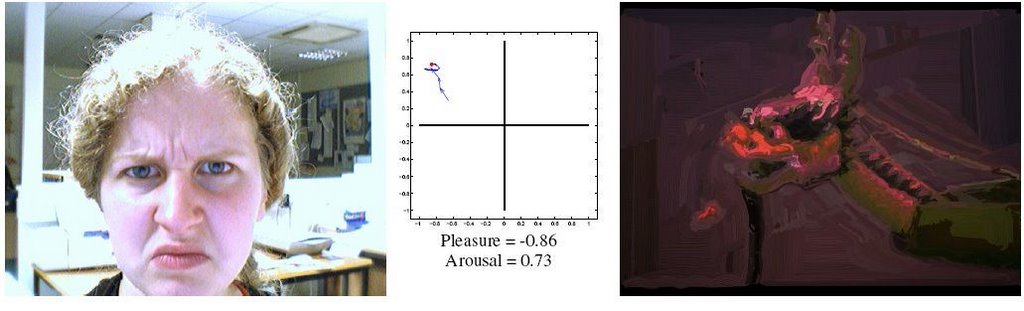
These snapshots indicate angry emotional states
It then adapts the colours and brush strokes of the digital artwork to suit the changing mood of the viewer.

For example, when the viewer is angry the colours are dark and appear to have been applied to the canvas with more violent brush strokes.
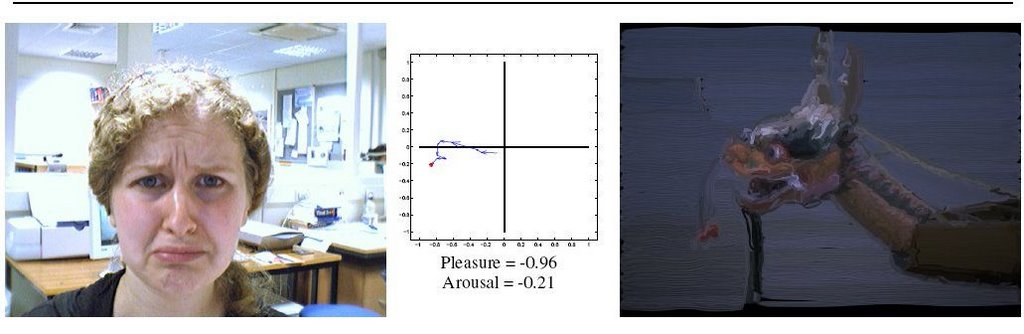
These snapshots indicate despairing emotional states
If their expression changes to happy, the artwork adapts so that the colours are vibrant and more subtly applied.

The project forms part of on-going research looking to develop a range of advanced artwork tools for use in the computer graphics industry.
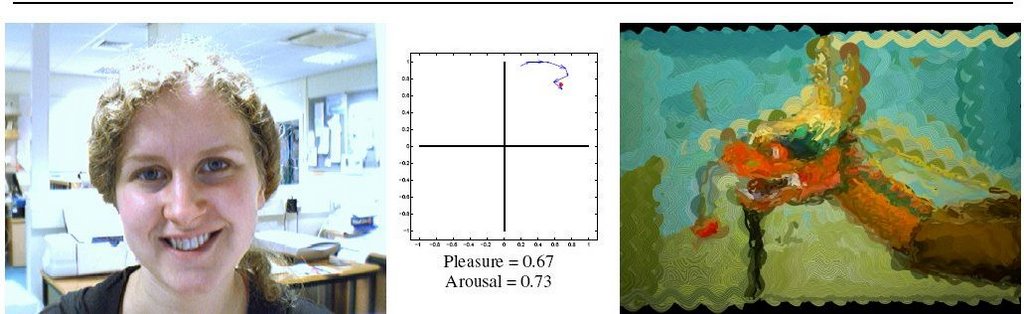
These snapshots indicate cheerful emotional states
This has already resulted in software which produces highly-detailed artistic versions of photographs, and allows designers to create animations directly from digital footage.

"The programme analyses the image for eight facial expressions, such as the position and shape of the mouth, the openness of the eyes, and the angle of the brows, to work out the emotional state of the viewer," said Dr John Collomosse from the Department of Computer Science at the University of Bath.

"It does all of this in real time, meaning that as the viewer's emotions change the artwork responds accordingly.

"This results in a digital canvas that smoothly varies its colours and style, and provides a novel interactive artistic experience.

"This kind of empathic painting only needs a desk top computer and a webcam to work, so once you have the programme and have calibrated it for the individual viewer, you are ready to start creating personalised art based on your mood.

"The empathic painting is really an experiment into the feasibility of using high level control parameters, such as emotional state, to replace the many low-level tools that users currently have at their disposal to affect the output of artistic rendering."

The empathic painting project was carried out with Maria Shugrina and Margrit Betke from the University of Boston.

The images used in the project were created by the researchers using advanced artistic rendering techniques which give the computer-generated artwork the appearance of having been painted onto canvas. ###

More information on the empathic painting project, including a video demonstration, is available at: cs.bath.ac.uk/~vision/empaint/

The research was recently presented at the fourth International Symposium on Non-Photorealistic Animation and Rendering conference in Annecy as part of the International Animation Festival. npar.org/2006/

For further information please contact Andrew McLaughlin in the University of Bath Press Office on +44 (0)1225 386 883 or +44 (0)7966 341 357

Notes, The University of Bath is one of the UK's leading universities, with an international reputation for quality research and teaching. In 19 subject areas the University of Bath is rated in the top ten in the country. View a full list of the University's press releases: bath.ac.uk/news/releases/

Useful links: John Collomosse's research page cs.bath.ac.uk/~jpc/, Department of Computer Science bath.ac.uk/comp-sci

Contact: Andrew McLaughlin a.mclaughlin@bath.ac.uk 44-012-253-86883 University of Bath

RELATED: Keyword biology, Sunday, August 06, 2006 Washington, DC getting a summertime air quality exam, Sunday, July 30, 2006 The World Map of Happiness, Sunday, July 23, 2006 The Occult Life of Things, Sunday, July 23, 2006 Why we could all do with a siesta, Sunday, July 16, 2006 Hope I die before I get old?, Sunday, July 09, 2006 People more likely to help others they think are 'like them!, Sunday, July 09, 2006 Jefferson Team Designs Program that Helps Elderly Live Longer, Sunday, July 02, 2006 Gabapentin cools hot flashes as well as estrogen, Sunday, June 25, 2006 Estrogen plays different role during stress in black and white teens, Sunday, June 25, 2006 Our grip on reality is slim, Sunday, May 21, 2006 Genome doesn't start with 'G', Sunday, May 07, 2006 Lying Is Exposed By Micro-Expressions We Can't Control, Sunday, April 30, 2006 Mothers often have inaccurate perceptions of their children's body weight, Sunday, April 16, 2006 Other people influence us and we don't even know it!, Tuesday, January 04, 2005 The Cassini-Huygens mission to Saturn, Sunday, March 20, 2005 Agriculture Secretary Mike Johanns, bovine spongiform encephalopathy (BSE), Thursday, March 24, 2005 Fish Oil Holds Promise in Alzheimer's Fight, Sunday, April 10, 2005 National Human Genome Research Institute (NHGRI), Friday, April 15, 2005 Study uncovers bacteria's worst enemy ,

Washington, DC getting a summertime air quality exam

Technorati Tags: or and or and or and or and or , and ,

 NASA's Aura satellite can see several different forms of air pollution worldwide. This image shows high levels of nitrogen dioxide on the U.S. East Coast in 2005, Credit: NASA, Usage Restrictions: None.Summer in the city can often mean sweltering "bad air days" that threaten the health of the elderly, children and those with respiratory problems. This summer the nation's capitol has been no stranger to such severe air-quality alerts.
But since early July Washington area skies have been put under a unique microscope as scientists from NASA and around the country assembled a powerful array of scientific instruments -- in space and on the ground -- to dissect the region's atmosphere. The result will be not only a better understanding of intense urban air pollution episodes but also a better toolkit to track and probe air pollution worldwide from space.

Two years ago NASA launched the third of its major Earth Observing System satellites -- Aura -- carrying a group of instruments designed to take global measurements of air pollution on a daily basis. Aura sensors can detect five of the six air pollutants regulated by the U.S. Environmental Protection Agency. But to make these 400-mile-high readings as accurate as possible, data from the sophisticated Aura instruments need to be compared to data from tried-and-true sensors on Earth.

NASA is sponsoring just such a "ground-truth" experiment this summer. Howard University Research Campus, Beltsville, Md., is hosting visiting scientists, graduate students and instruments for a six-week-long series of intensive observations. The experiment is also evaluating the next generation of instruments used in daily weather forecasting, as well as tracking one of the strongest greenhouse gases involved in climate change: water vapor, which at increased levels we feel as humidity.

The Beltsville research facility grew out of collaborations between NASA, the National Oceanic and Atmospheric Administration (NOAA), and Howard University in Washington.

The site is dotted with instruments from the National Weather Service, the Maryland Department of the Environment, and a local television station. For this summer's experiment, additional sensors have been brought in from NASA's Goddard Space Flight Center, Greenbelt, Md.; NASA's Wallops Flight Facility, Wallops Island, Va.; Pennsylvania State University, University Park; University of Colorado, Boulder; and Trinity University, Washington. Students from many of these institutions, as well as the University of Wisconsin, Madison, and Smith College, Northampton, Mass., are involved in the day-to-day operations.

"With a large collaboration like this you can really investigate a lot of interesting aspects of air quality," says David Whiteman, who is leading Goddard's research team from the nearby NASA center. "You can look straight down through the atmosphere to the ground from the satellite and at the same time you see in great detail the whole chemical soup of pollutants near the surface from the state's air quality monitoring site located here. Multi-instrument observations like this make the Howard site a real gem."

The experiment is also focusing on a key measurement for both global climate change and local weather forecasting: water vapor. "Measuring water vapor is a tricky business, because it varies greatly in quantity around the globe," says Whiteman. But if our Earth is indeed warming, we need to understand how water vapor responds to that. Water vapor is a stronger greenhouse gas than carbon dioxide and could have a major impact on future climate."

Water vapor measurements from NASA's Aura satellite and its companion Aqua, launched in 2002, are being compared with readings at the site from several laser-based instruments called lidars that can continuously observe water vapor levels in great detail directly overhead. In addition, balloon-borne instruments called radiosondes, a standard instrument used daily around the world, are being flown to compare their accuracy with the more sophisticated research tools.

"The moisture information we get every day from radiosondes is becoming more important in numerical weather prediction and climate monitoring," says Joe Facundo, chief of the National Weather Service's Observing Systems Branch, who is participating in the Beltsville experiment. "This type of instrument comparison project lets us test improved moisture sensors." Better water vapor data from radiosondes flown around the world can lead to more accurate weather forecasts and long-term climate predictions.

New knowledge is also emerging from the experiment about the daily rise and fall of ozone pollution, which involves a complex interplay between the "chemical soup" of pollutants, sunlight, and meteorology. "We have already observed examples of the influence of a narrow stream of strong winds during the night on surface-level ozone formation," says Howard's Everette Joseph, who leads the university's team of scientists and students. "Better understanding of this process could lead to better air quality forecast methods and aid local governments in developing strategies to combat ozone pollution."

### Contact: Rob Gutro robert.J.gutro@nasa.gov 301-286-4044 NASA/Goddard Space Flight Center

RELATED: Keyword biology, Sunday, July 30, 2006 The World Map of Happiness, Sunday, July 23, 2006 The Occult Life of Things, Sunday, July 23, 2006 Why we could all do with a siesta, Sunday, July 16, 2006 Hope I die before I get old?, Sunday, July 09, 2006 People more likely to help others they think are 'like them!, Sunday, July 09, 2006 Jefferson Team Designs Program that Helps Elderly Live Longer, Sunday, July 02, 2006 Gabapentin cools hot flashes as well as estrogen, Sunday, June 25, 2006 Estrogen plays different role during stress in black and white teens, Sunday, June 25, 2006 Our grip on reality is slim, Sunday, May 21, 2006 Genome doesn't start with 'G', Sunday, May 07, 2006 Lying Is Exposed By Micro-Expressions We Can't Control, Sunday, April 30, 2006 Mothers often have inaccurate perceptions of their children's body weight, Sunday, April 16, 2006 Other people influence us and we don't even know it!, Tuesday, January 04, 2005 The Cassini-Huygens mission to Saturn, Sunday, March 20, 2005 Agriculture Secretary Mike Johanns, bovine spongiform encephalopathy (BSE), Thursday, March 24, 2005 Fish Oil Holds Promise in Alzheimer's Fight, Sunday, April 10, 2005 National Human Genome Research Institute (NHGRI), Friday, April 15, 2005 Study uncovers bacteria's worst enemy ,

Saturday, August 05, 2006

Freedom Calendar 08/05/06 - 08/12/06

August 5, 1964, Hispanic-American Republican Lt. Everett Alvarez, USN, is shot down in Vietnam; becomes first U.S. prisoner of North Vietnamese and longest-serving POW in U.S. history.

August 6, 1965, Voting Rights Act of 1965, abolishing literacy tests and other measures devised by Democrats to prevent African-Americans from voting, signed into law; higher percentage of Republicans than Democrats vote in favor.

August 7, 1917, Birth of African-American Republican Melvin Evans, first elected Governor of Virgin Islands; also served as Delegate to Congress, Republican National Committeeman, and U.S. Ambassador to Trinidad and Tobago.

August 8, 1878, African-American Republican James Rapier becomes Collector of Internal Revenue; previously served as U.S. Rep. (R-AL).

August 9, 1988, Lauro Cavazos, first Hispanic to serve in Cabinet, nominated by President Ronald Reagan to be Secretary of Education.

August 10, 1988, President Ronald Reagan signs Civil Liberties Act of 1988, compensating Japanese-Americans for deprivation of civil rights and property during World War II internment ordered by FDR.

August 11, 1868, Death of U.S. Rep. Thaddeus Stevens (R-PA), who introduced 14th Amendment; requested burial in a racially-integrated cemetery, with epitaph 'Equality of Man before his Creator'.

August 12, 1982,Hispanic Republican Faith Evans, first woman in nation to serve as U.S. Marshal, sworn in following appointment by President Ronald Reagan.

The United States respects your aspirations as sovereign citizens. And we will stand with you to secure your rights -- to speak as you choose, to think as you please, to worship as you wish, and to choose your leaders, freely and fairly, in democratic elections.

Secretary of State Condoleezza Rice Washington, DC August 4, 2006.

SOURCE: Republican Freedom Calendar

Technorati Tags: and or and or and or and or and or or and or

Related: Keywords Freedom Calendar, Saturday, July 29, 2006 Freedom Calendar 07/29/06 - 08/05/06, Saturday, July 22, 2006 Freedom Calendar 07/22/06 - 07/29/06, Saturday, July 15, 2006 Freedom Calendar 07/15/06 - 07/22/06, Saturday, July 08, 2006 Freedom Calendar 07/08/06 - 07/15/06, Saturday, July 01, 2006 Freedom Calendar 07/01/06 - 07/08/06, Saturday, June 24, 2006 Freedom Calendar 06/24/06 - 07/01/06, Saturday, June 17, 2006 Freedom Calendar 06/17/06 - 06/24/06, Saturday, June 10, 2006 Freedom Calendar 06/10/06 - 06/17/06, Sunday, June 04, 2006 Freedom Calendar 06/03/06 - 06/10/06, Saturday, May 27, 2006 Freedom Calendar 05/27/06 - 06/03/06, Saturday, May 20, 2006 Freedom Calendar 05/20/06 - 05/27/06, Saturday, May 13, 2006 Freedom Calendar 05/13/06 - 05/20/06, Saturday, May 06, 2006 Freedom Calendar 05/06/06 - 05/13/06, Saturday, April 29, 2006 Saturday, April 22, 2006 Freedom Calendar 04/22/06 - 04/29/06, Saturday, April 15, 2006 Freedom Calendar 04/15/06 - 04/22/06, Saturday, April 08, 2006 Freedom Calendar 04/08/06 - 04/15/06, Saturday,