Press Conference by the President, FULL STREAMING VIDEO, White House Conference Center Briefing Room In Focus: Peace in the Middle East 10:02 A.M. EDT
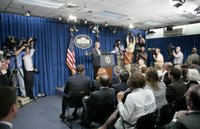 | President George W. Bush gestures as he thanks the White House media for its hospitality Monday, Aug. 21, 2006, at the start of a news conference in the temporary press briefing room at the White House Conference Center. |
"Fancy digs you got here," the President told the gathering. "It's good to visit with you." White House photo by Paul Morse.
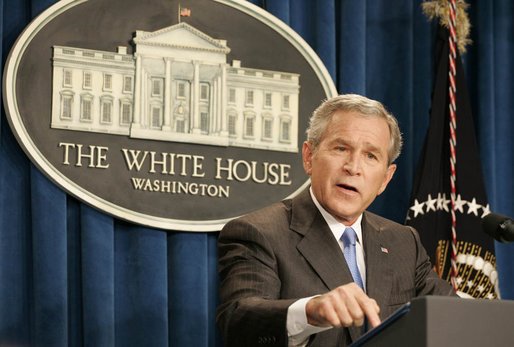
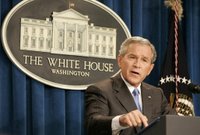 | President George W. Bush emphasizes a point as he responds to a question Monday, Aug. 21, 2006, during a news conference at the White House Conference Center Briefing Room. |
He told the gathered media "America is making a long-term commitment to help the people of Lebanon because we believe every person deserves to live in a free, open society that respects the rights of all." White House photo by Paul Morse.
THE PRESIDENT: Thank you all. Please be seated. Fancy digs you got here. Thanks for your hospitality. It's good to visit with you. I look forward to taking some of your questions. I do want to talk to you about the latest developments in Lebanon, and what we're doing to ensure U.N. Security Council 1701 is implemented and its words are quickly put into action.
Resolution 1701 authorizes an effective international force to deploy to Lebanon, which is essential to peace in the region and it's essential to the freedom of Lebanon. An effective international force will help ensure the cessation of hostilities hold in Lebanon once the Israeli troops withdraw. An effective international force will help the Lebanese army meet its responsibility to secure Lebanon's borders and stop them from acting as -- and stop Hezbollah from acting as a state within a state. An effective international force will help give displaced people in both Lebanon and Israel the confidence to return to their homes and begin rebuilding their lives without fear of renewed violence and terror.
An international force requires international commitment. Previous resolutions have failed in Lebanon because they were not implemented by the international community, and in this case, did not prevent Hezbollah and their sponsors from instigating violence. The new resolution authorizes a force of up to 15,000 troops. It gives this force an expanded mandate. The need is urgent. The international community must now designate the leadership of this new international force, give it robust rules of engagement, and deploy it as quickly as possible to secure the peace.
America will do our part. We will assist a new international force with logistic support, command and control, communications and intelligence. Lebanon, Israel and our allies agreed that this would be the most effective contribution we can make at this time. We will also work with the leadership in the international force, once it's identified, to ensure that the United States is doing all we can to make this mission a success.
Deployment of this new international force will also help speed delivery of humanitarian assistance. Our nation is wasting no time in helping the people of Lebanon. In other words, we're acting before the force gets in there. We've been on the ground in Beirut for weeks, and I've already distributed more than half of our $50 million pledge of disaster relief to the Lebanese people who have lost their homes in the current conflict. Secretary Rice has led the diplomatic efforts to establish humanitarian corridors so that relief convoys can get through, to reopen the Beirut airport to passenger and humanitarian aid flights, and to ensure a steady fuel supply for Lebanese power plants and automobiles. I directed 25,000 tons of wheat be delivered in Lebanon in the coming weeks.
But we'll do even more. Today, I'm announcing that America will send more aid to support humanitarian and reconstruction work in Lebanon, for a total of more than $230 million. These funds will help the Lebanese people rebuild their homes and return to their towns and communities. The funds will help the Lebanese people restore key bridges and roads. The funds will help the Lebanese people rehabilitate schools so the children can start their school year on time this fall.
I directed that an oil spill response team be sent to assist the Lebanese government in cleaning up an oil slick that is endangering coastal communities; proposing a $42 million package to help train and equip Lebanon's armed forces. I will soon be sending a presidential delegation of private sector leaders to Lebanon to identify ways that we can tap into the generosity of American businesses and non-profits to continue to help the people of Lebanon.
We take these steps -- and I'll also work closely with Congress to extend the availability of loan guarantees to help rebuild infrastructure in Israel, infrastructure damaged by Hezbollah's rockets.
America is making a long-term commitment to help the people of Lebanon because we believe every person deserves to live in a free, open society that respects the rights of all. We reject the killing of innocents to achieve a radical and violent agenda.
The terrorists and their state sponsors, Iran and Syria, have a much darker vision. They're working to thwart the efforts of the Lebanese people to break free from foreign domination and build their own democratic future. The terrorists and their sponsors are not going to succeed. The Lebanese people have made it clear they want to live in freedom. And now it's up to their friends and allies to help them do so.
I'll be glad to answer some questions, starting with you, Terry.
Q Thank you, Mr. President. More than 3,500 Iraqis were killed last month, the highest civilian monthly toll since the war began. Are you disappointed with the lack of progress by Iraq's unity government in bringing together the sectarian and ethnic groups?
THE PRESIDENT: No, I am aware that extremists and terrorists are doing everything they can to prevent Iraq's democracy from growing stronger. That's what I'm aware of. And, therefore, we have a plan to help them -- "them," the Iraqis -- achieve their objectives. Part of the plan is political; that is the help the Maliki government work on reconciliation and to work on rehabilitating the community. The other part is, of course, security. And I have given our commanders all the flexibility they need to adjust tactics to be able to help the Iraqi government defeat those who want to thwart the ambitions of the people. And that includes a very robust security plan for Baghdad.
We've, as you may or may not know, Terry, moved troops from Mosul, the Stryker Brigade, into Baghdad, all aiming to help the Iraqi government succeed.
You know, I hear a lot of talk about civil war. I'm concerned about that, of course, and I've talked to a lot of people about it. And what I've found from my talks are that the Iraqis want a unified country, and that the Iraqi leadership is determined to thwart the efforts of the extremists and the radicals and al Qaeda, and that the security forces remain united behind the government. And one thing is clear: The Iraqi people are showing incredible courage.
The United States of America must understand it's in our interests that we help this democracy succeed. As a matter of fact, it's in our interests that we help reformers across the Middle East achieve their objectives. This is the fundamental challenge of the 21st century. A failed Iraq would make America less secure. A failed Iraq in the heart of the Middle East will provide safe haven for terrorists and extremists. It will embolden those who are trying to thwart the ambitions of reformers. In this case, it would give the terrorists and extremists an additional tool besides safe haven, and that is revenues from oil sales.
You know, it's an interesting debate we're having in America about how we ought to handle Iraq. There's a lot of people -- good, decent people, saying, withdraw now. They're absolutely wrong. It would be a huge mistake for this country. If you think problems are tough now, imagine what it would be like if the United States leaves before this government has a chance to defend herself, govern herself, and listen to the -- and answer to the will of the people.
Patsy. We're working our way here.
Q Thank you, Mr. President. Iran has indicated that it will defy the U.N. on nuclear enrichment. It's been holding military exercises, sending weapons and money to Hezbollah. Is Tehran's influence in the region growing, despite your efforts to curb it?
THE PRESIDENT: The final history in the region has yet to be written. And what's very interesting about the violence in Lebanon and the violence in Iraq and the violence in Gaza is this: These are all groups of terrorists who are trying to stop the advance of democracy. They're trying to thwart the will of millions who simply want a normal, hopeful life. That's what we're seeing. And it's up to the international community to understand the threat.
I remember right after Hezbollah launched its rocket attacks on Israel, I said, this is a clarifying moment. It's a chance for the world to see the threats of the 21st century, the challenge we face.
And so, to answer your question on Iran, Iran is obviously part of the -- part of the problem. They sponsor Hezbollah. They encourage a radical brand of Islam. Imagine how difficult this issue would be if Iran had a nuclear weapon. And so, therefore, it's up to the international community, including the United States, to work in concert to -- for effective diplomacy. And that begins at the United Nations Security Council.
We have passed one Security Council resolution, demanding that Iran cease its enrichment activities. We will see what the response is. We're beginning to get some indication, but we'll wait until they have a formal response. The U.N. resolution calls for us to come back together on the 31st of August. The dates -- dates are fine, but what really matters is will. And one of the things I will continue to remind our friends and allies is the danger of a nuclear-armed Iran.
But, no, you're right, this is a -- they're a central part of creating instability, trying to stop reformers from realizing dreams. And the question facing this country is, will -- do we, one, understand the threat to America? In other words, do we understand that a failed -- failed states in the Middle East are a direct threat to our country's security? And secondly, will we continue to stay engaged in helping reformers, in working to advance liberty, to defeat an ideology that doesn't believe in freedom?
And my answer is, so long as I'm the President, we will. I clearly see the challenge. I see the challenge to what these threats pose to our homeland, and I see the challenge -- what these threats pose to the world.
Helen. (Laughter.) What's so funny about me saying "Helen"? (Laughter.) It's the anticipation of your question, I guess.
Q Israel broke its word twice on a truce. And you mentioned Hezbollah rockets, but it's -- Israeli bombs have destroyed Lebanon. Why do you always give them a pass? And what's your view on breaking of your oath for a truce?
THE PRESIDENT: Yes, thank you. I like to remind people about how this started, how this whole -- how the damage to innocent life, which bothers me -- but, again, what caused this.
Q Why drop bombs on --
THE PRESIDENT: Let me finish -- let -- ma'am. Ma'am, please let me finish the question. It's a great question to begin with. The follow-up was a little difficult, but anyway. (Laughter.) I know you're waiting for my answer, aren't you, with bated breath.
This never would have occurred had a terrorist organization, a state within a state, not launched attacks on a sovereign nation. From the beginning, Helen, I said that Israel, one, has a right to defend herself, but Israel ought to be cautious about how she defends herself. Israel is a democratically elected government. They make decisions on their own sovereignty. It's their decision-making that is -- what leads to the tactics they chose.
But the world must understand that now is the time to come together to address the root cause of the problem. And the problem was you have a state within a state. You have people launch attacks on a sovereign nation without the consent of the government in the country in which they are lodged.
And that's why it's very important for all of us, those of us who are involved in this process, to get an international force into Lebanon to help the Lebanese government achieve some objectives. One is their ability to exert control over the entire country; secondly is to make sure that the Hezbollah forces don't rearm, don't get arms from Syria or Iran through Syria, to be able to continue to wreak havoc in the region.
Let's see -- we'll finish the first line here. Everybody can be patient.
Q Thank you.
THE PRESIDENT: Yes. (Laughter.) It's kind of like dancing together, isn't it? (Laughter.)
Q Yes, kind of. (Laughter.)
Q Very close quarters.
THE PRESIDENT: If I ask for any comments from the peanut gallery I'll call on you. (Laughter.) By the way, seersucker is coming back. I hope everybody -- (laughter.) Never mind.
Q Kind of the Texas county commissioner look. (Laughter.)
THE PRESIDENT: Yes, Martha. Sorry.
Q That's quite all right. Mr. President, I'd like to go back to Iraq. You've continually cited the elections, the new government, its progress in Iraq, and yet the violence has gotten worse in certain areas. You've had to go to Baghdad again. Is it not time for a new strategy? And if not, why not?
THE PRESIDENT: You know, Martha, you've covered the Pentagon, you know that the Pentagon is constantly adjusting tactics because they have the flexibility from the White House to do so.
Q I'm talking about strategy --
THE PRESIDENT: The strategy is to help the Iraqi people achieve their objectives and their dreams, which is a democratic society. That's the strategy. The tactics -- now, either you say, yes, its important we stay there and get it done, or we leave. We're not leaving, so long as I'm the President. That would be a huge mistake. It would send an unbelievably terrible signal to reformers across the region. It would say we've abandoned our desire to change the conditions that create terror. It would give the terrorists a safe haven from which to launch attacks. It would embolden Iran. It would embolden extremists.
No, we're not leaving. The strategic objective is to help this government succeed. That's the strategic -- and not only to help the government -- the reformers in Iraq succeed, but to help the reformers across the region succeed to fight off the elements of extremism. The tactics are which change. Now, if you say, are you going to change your strategic objective, it means you're leaving before the mission is complete. And we're not going to leave before the mission is complete. I agree with General Abizaid: We leave before the mission is done, the terrorists will follow us here.
And so we have changed tactics. Our commanders have got the flexibility necessary to change tactics on the ground, starting with Plan Baghdad. And that's when we moved troops from Mosul into Baghdad and replaced them with the Stryker Brigade, so we increased troops during this time of instability.
Suzanne.
Q Sir, that's not really the question. The strategy --
THE PRESIDENT: Sounded like the question to me.
Q You keep -- you keep saying that you don't want to leave. But is your strategy to win working? Even if you don't want to leave? You've gone into Baghdad before, these things have happened before.
THE PRESIDENT: If I didn't think it would work, I would change -- our commanders would recommend changing the strategy. They believe it will work. It takes time to defeat these people. The Maliki government has been in power for less than six months. And, yes, the people spoke. I've cited that as a part of -- the reason I cite it is because it's what the Iraqi people want. And the fundamental question facing this government is whether or not we will stand with reformers across the region. It's really the task. And we're going to stand with this government.
Obviously, I wish the violence would go down, but not as much as the Iraqi citizens would wish the violence would go down. But, incredibly enough, they show great courage, and they want our help. And any sign that says we're going to leave before the job is done simply emboldens terrorists and creates a certain amount of doubt for people so they won't take the risk necessary to help a civil society evolve in the country.
This is a campaign -- I'm sure they're watching the campaign carefully. There are a lot of good, decent people saying, get out now; vote for me, I will do everything I can to, I guess, cut off money is what they'll try to do to get our troops out. It's a big mistake. It would be wrong, in my judgment, for us to leave before the mission is complete in Iraq.
Suzanne.
Q Thank you, Mr. President. Back to Lebanon. The Lebanese Prime Minister, over the weekend, said that Israel flagrantly violated the cease-fire with its raid into Lebanon, and so far the European allies who have committed forces, the U.N. security peacekeeping forces, have expressed reservations; those Muslim nations who have offered troops have been shunned by Israeli officials. Why shouldn't we see the cease-fire as one that essentially is falling apart? And what makes this more than a piece of paper if you don't have the will of the international community to back it up?
THE PRESIDENT: Yes, no, listen, all the more reason why we need to help our friends and allies get the forces necessary to help the Lebanese forces keep the cessation of hostilities in place, intact. And that's why we're working with friends, with allies, with Security Council members, to make sure the force that is committed is robust and the rules of engagement are clear. And so it's an ongoing series of conversations and discussions, and hopefully this will happen quite quickly.
Q Will you pressure the French to contribute more troops?
THE PRESIDENT: Well, we're pressing on all. I was asked about the French the other day at Camp David, and I
-- listen, France has had a very close relationship with Lebanon, there's historical ties with Lebanon; I would hope they would put more troops in. They understand the region as well as anybody. And so we're working with a lot of folks, trying to get this force up and running.
Look, like you -- I mean, you sound somewhat frustrated by diplomacy. Diplomacy can be a frustrating thing. I think the strategy can work, so long as the force is robust and the rules of engagement are clear.
Q Mr. President, as you mentioned, we're just 10 days from the U.N. Security Council deadline on Iran. Judging by the public comments from the Iranians, it appears at least highly unlikely that they're going to stop or suspend their enrichment program. Are you confident that the U.N. Security Council will move quickly on sanctions if Iran thumbs its nose at the world again?
THE PRESIDENT: I certainly hope so. In order for the U.N. to be effective, there must be consequences if people thumb their nose at the United Nations Security Council. And we will work with people in the Security Council to achieve that objective, and the objective is that there's got to be a consequence for them basically ignoring what the Security Council has suggested through resolution.
Q Understanding that diplomacy takes time, do you think that this could drag out for a while?
THE PRESIDENT: You know, I don't know. I certainly want to solve this problem diplomatically, and I believe the best chance to do so is for there to be more than one voice speaking clearly to the Iranians. And I was pleased that we got a resolution, that there was a group of nations willing to come together to send a message to the Iranians -- nations as diverse as China and Russia, plus the EU3 and the United States.
Kelly.
Q Good morning, Mr. President. When you talked today about the violence in Baghdad, first you mentioned extremists, radicals, and then al Qaeda. It seems that al Qaeda and foreign fighters are much less of a problem there, and that it really is Iraqi versus Iraqi. And when we heard about your meeting the other day with experts and so forth, some of the reporting out of that said you were frustrated, you were surprised. And your spokesman said, no, you're determined. But frustration seems like a very real emotion. Why wouldn't you be frustrated, sir, about what's happening?
THE PRESIDENT: I'm not -- I do remember the meeting; I don't remember being surprised. I'm not sure what they meant by that.
Q About the lack of gratitude among the Iraqi people.
THE PRESIDENT: Oh. No, I think -- first of all, to the first part of your question, if you look back at the words of Zarqawi before he was brought to justice, he made it clear that the intent of their tactics in Iraq was to create civil strife. In other words, look at what he said. He said, let's kill Shia to get Shia to seek revenge, and therefore, to create this kind of -- hopefully, a cycle of violence.
Secondly, it's pretty clear that at least the evidence indicates that the bombing of the shrine was an al Qaeda plot, all intending to create sectarian violence. No, al Qaeda is still very active in Iraq. As a matter of fact some of the more -- I would guess, I would surmise that some of the more spectacular bombings are done by al Qaeda suiciders.
No question there's sectarian violence, as well. And the challenge is to provide a security plan such that a political process can go forward. And I know -- I'm sure you all are tired of hearing me say 12 million Iraqis voted, but it's an indication about the desire for people to live in a free society. That's what that means.
And the only way to defeat this ideology in the long-term is to defeat it through another ideology, a competing ideology, one where government responds to the will of the people. And that's really -- really the fundamental question we face here in the beginning of this 21st century is whether or not we believe as a nation, and others believe, it is possible to defeat this ideology.
Now, I recognize some say that these folks are not ideologically bound. I strongly disagree. I think not only do they have an ideology, they have tactics necessary to spread their ideology. And it would be a huge mistake for the United States to leave the region, to concede territory to the terrorists, to not confront them. And the best way to confront them is to help those who want to live in free society.
Look, eventually Iraq will succeed because the Iraqis will see to it that they succeed. And our job is to help them succeed. That's our job. Our job is to help their forces be better equipped, to help their police be able to deal with these extremists, and to help their government succeed.
Q But are you frustrated, sir?
THE PRESIDENT: Frustrated? Sometimes I'm frustrated. Rarely surprised. Sometimes I'm happy. This is -- but war is not a time of joy. These aren't joyous times. These are challenging times, and they're difficult times, and they're straining the psyche of our country. I understand that. You know, nobody likes to see innocent people die. Nobody wants to turn on their TV on a daily basis and see havoc wrought by terrorists. And our question is, do we have the capacity and the desire to spread peace by confronting these terrorists, and supporting those who want to live in liberty? That's the question. And my answer to that question is, we must. We owe it to future generations to do so.
Bill.
Q Mr. President, as you have reminded us a number of times, it was Hezbollah that started the confrontation between Israel and Lebanon. But you were supportive of the holding off of any kind of cease-fire until Israel had a chance to clear out the Hezbollah weapons. By all accounts, they did not exactly succeed in doing that. And by all accounts, the Lebanese army, as it moved into southern Lebanon, had a wink-and-a-nod arrangement with Hezbollah not to disturb anything, to just leave things as they are, a situation not unknown in the Middle East. Do you demand that the peacekeeping force, if and when it gets up and running, disarm Hezbollah?
THE PRESIDENT: The truth of the matter is, if 1559, that's the United Nations Security Council resolution number, had been fully implemented, we wouldn't be in the situation we were in to begin with. There will be another resolution coming out of the United Nations giving further instructions to the international force. First things first; is to get the rules of engagement clear, so that the force will be robust to help the Lebanese.
One thing is for certain -- is that when this force goes into help Lebanon, Hezbollah won't have that safe haven, or that kind of freedom to run in Lebanon's southern border. In other words, there's an opportunity to create a cushion, a security cushion. Hopefully, over time, Hezbollah will disarm. You can't have a democracy with an armed political party willing to bomb its neighbor without the consent of its government, or deciding, well, let's create enough chaos and discord by lobbing rockets.
And so the reality is, in order for Lebanon to succeed -- and we want Lebanon's democracy to succeed -- the process is going to -- the Lebanese government is eventually going to have to deal with Hezbollah.
Q But it's the status quo if there's no disarming.
THE PRESIDENT: Not really. I mean, yes, eventually, you're right. But in the meantime, there will be a -- there's a security zone, something to -- where the Lebanese army and the UNIFIL force are more robust, UNIFIL force can create a security zone between Lebanon and Israel. That would be helpful.
But, ultimately, you're right. Your question is, shouldn't Hezbollah disarm, and ultimately, they should. And it's necessary, for the Lebanese government to succeed.
The cornerstone of our policy in that part of the world is to help democracies. Lebanon is a democracy; we want the Siniora government to succeed. Part of our aid package is going to be help strengthen the army of Lebanon so when the government speaks, when the government commits its troops, they do so in an effective way.
Knoller.
Q Yes, sir.
THE PRESIDENT: How are you feeling?
Q I'm good, sir. It's good to be back.
THE PRESIDENT: Good to see you. Yes, it's good to see you. Sorry we didn't spend more time in Crawford. I knew you were anxious to do so.
Q Always am.
THE PRESIDENT: That's good. (Laughter.) That's why we love seeing you.
Q Thanks. Let me ask you about presidential pardons. Last week, you issued 17 of them. That brought the number of pardons you've issued in your presidency to 97, and that's far fewer than most of your recent predecessors, except your dad. And I want to ask you, do you consider yourself to be stingy when it comes to pardons? What is your philosophy on granting presidential pardons?
THE PRESIDENT: You know, I don't have the criterion in front of me, Mark, but we have a strict criterion that we utilize -- we being the Justice Department and the White House Counsel. And I, frankly, haven't compared the number of pardons I've given to any other President. Perhaps I should. But I don't think a scorecard should, necessarily, be the guidepost for pardoning people.
McKinnon. I'm going to go to you, Jackson, and kind of work around.
Q Thanks. Mr. President, what do you say to people who are losing patience with gas prices at $3 a gallon? And how much of a political price do you think you're paying for that right now?
THE PRESIDENT: I've been talking about gas prices ever since they got high, starting with this -- look, I understand gas prices are like a hidden tax. Not a hidden tax, it's a tax -- it's taking money out of people's pockets. I know that. All the more reason for us to diversify away from crude oil. That's not going to happen overnight. We passed law that encouraged consumption through different purchasing habits, like hybrid vehicles
-- you buy a hybrid, you get a tax credit. We've encouraged the spread of ethanol as an alternative to crude oil. We have asked for Congress to pass regulatory relief so we can build more refineries to increase the supply of gasoline, hopefully taking the pressure off of price.
And so the strategy is to recognize that dependency upon crude oil is -- in a global market affects us economically here at home, and therefore, we need to diversify away as quickly as possible.
Jackson.
Q Thank you, Mr. President. As you know, the one-year anniversary of Katrina is coming up. And there are a lot of retrospectives about what went wrong down there last year. Specifically, what has your administration done in the past year to help the folks down there, and what remains to be done?
THE PRESIDENT: Thanks. You know, I went to New Orleans, in Jackson Square, and made a commitment that we would help the people there recover. I also want the people down there to understand that it's going to take a while to recover. This was a huge storm.
First things -- the first thing that's necessary to help the recovery is money. And our government has committed over $110 billion to help. Of that, a lot of money went to -- went out the door to help people adjust from having to be moved because of the storm. And then there's rental assistance, infrastructure repair, debris removal. Mississippi removed about 97 percent, 98 percent of its -- what they call dry debris. We're now in the process of getting debris from the water removed. Louisiana is slower in terms of getting debris removed. The money is available to help remove that debris. People can get after it, and I would hope they would.
Q What --
THE PRESIDENT: Let me finish. Thank you.
We provided about $1.8 billion for education. That money has gone out the door. We want those schools up and running. As I understand, the schools are running now in New Orleans, a lot of schools are. Flood insurance, we're spending money on flood insurance. There is more work to be done, particularly when it comes to housing. We've spent about -- appropriated about $16 billion, $17 billion for direct housing grants to people in the Gulf Coast and in Louisiana.
I made the decision, along with the local authorities, that each state ought to develop a housing recovery plan. That's what they call the LRA in Louisiana. They're responsible for taking the federal money and getting it to the people. Same in -- Mississippi has developed its own plan.
I thought it would be best that there be a local plan developed and implemented by local folks. And so there's now, as I mentioned, $16 billion of direct housing grants. Each state has developed its own plan, how much money goes to each homeowner to help these people rebuild their lives. And so I think the area where people will see the most effect in their lives is when they start getting this individualized CDBG grant money.
Q Has anything disappointed you about the recovery, the federal response?
THE PRESIDENT: I was concerned at first about how much Congress and the taxpayers would be willing to appropriate and spend. I think $110 billion is a strong commitment, and I'm pleased with that. Any time -- I named a man named Don Powell to go down there, and the thing that's most important is for the government to eliminate any bureaucratic obstacles when we find something that's not moving quick enough.
I think, for example, about the debris removal. There was the issue of whether or not the government would pay for debris removal on private property, or not. So we worked out a plan with the local mayors and local county commissioners, local parish presidents to be able to designate certain property as a health hazard. And when they did so, then government money could pay for it. In other words, we're trying to be flexible with the rules and regulations we have to deal with.
But the place where people, I'm sure, are going to be most frustrated is whether or not they're going to get the money to rebuild their homes. And my attitude is we've appropriated the money, and now we'll work with states to get the money.
April, I suspect you have a follow-up on this.
Q Yes, I do, sir.
THE PRESIDENT: Why don't you let her go?
Q And another question, sir. The follow-up: Some have a concern that you've given all of this money, but the federal government has moved away to let the local government, particularly in New Orleans, handle everything, and things are not moving like they expected. And that's one of the concerns. And another question, if you --
THE PRESIDENT: Well, let me address that, and I promise you can ask that other one.
As I mentioned to you, the strategy from the get-go was to work with the local folks in Mississippi and Louisiana, and they would then submit their plans to the federal government, particularly for housing, and that upon approval, we would then disburse the appropriated monies -- in this case, about $17 billion for housing grants. And so each state came up with a grant formula, and I can't give you all the details. But it's -- the whole purpose is intended to get money into people's pockets to help them rebuild. And once the strategy is developed at the state and local level, it makes sense for the monies to be appropriated at the state and local level. And if there's a -- if there's a level of frustration there, we will work with the LRA in this case.
Second question.
Q Well, I have one follow-up on that. Do you think --
THE PRESIDENT: Well, how many -- are you trying to dominate this thing? (Laughter.)
Q No, sir, but I don't get a chance to talk to you as much as the others.
THE PRESIDENT: That's not -- wait a minute. (Laughter.)
Q But a follow-up real quick. Do you think that more needs to be done? Does the federal government need to put its hands on what's going on? Because New Orleans is not moving --
THE PRESIDENT: I think the best way to do this is for the federal government's representative, Don Powell, to continue to work with Mayor Nagin and Governor Blanco to get the money into the hands of the people. The money has been appropriated, the formula is in place, and now it's time to move forward.
Now, you have another question, I presume.
Q Yes, sir. Chinese officials are saying that you need to get involved in the six-party talks, and that ultimately you have to be a part of the six-party talks in dealing with North Korea. And also they're saying that you need to stop dealing with the issue of money laundering and deal with the real issue of ballistic missiles. What are your thoughts?
THE PRESIDENT: Well, counterfeiting U.S. dollars is an issue that every President ought to be concerned about. And when you catch people counterfeiting your money, you need to do something about it.
We are very much involved in the six-party talks. As a matter of fact, I talked to Hu Jintao this morning about the six-party talks, and about the need for us to continue to work together to send a clear message to the North Korean leader that there is a better choice for him than to continue to develop a nuclear weapon. The six-party talks are -- is an important part of our -- the six-party talks are an important part of our strategy of dealing with Kim Jong-il. And the North Korean -- the Chinese President recognized that in the phone call. And so we talked about how we'll continue to collaborate and work together.
Jim.
Q Thank you, Mr. President. You mentioned the campaign earlier. Do you agree with those in your party, including the Vice President, who have said or implied that Democratic voters emboldened al Qaeda types by choosing Ned Lamont over Joe Lieberman, and then as a message that how Americans vote will send messages to terrorists abroad? Thank you.
THE PRESIDENT: You're welcome. What all of us in this administration have been saying is that leaving Iraq before the mission is complete will send the wrong message to the enemy and will create a more dangerous world. That's what we're saying. It's an honest debate and it's an important debate for Americans to listen to and to be engaged in. In our judgment, the consequences for defeat in Iraq are unacceptable.
I fully understand that some didn't think we ought to go in there in the first place. But defeat -- if you think it's bad now, imagine what Iraq would look like if the United States leaves before this government can defend itself and sustain itself. Chaos in Iraq would be very unsettling in the region. Leaving before the job would be done would send a message that America really is no longer engaged, nor cares about the form of governments in the Middle East. Leaving before the job was done would send a signal to our troops that the sacrifices they made were not worth it. Leaving before the job is done would be a disaster, and that's what we're saying.
I will never question the patriotism of somebody who disagrees with me. This has nothing to do with patriotism; it has everything to do with understanding the world in which we live. It's like the other day I was critical of those who heralded the federal judge's opinion about the terrorist surveillance program. I thought it was a terrible opinion, and that's why we're appealing it. And I have no -- look, I understand how democracy works: quite a little bit of criticism in it, which is fine; that's fine, it's part of the process. But I have every right, as do my administration, to make it clear what the consequences would be of policy, and if we think somebody is wrong or doesn't see the world the way it is, we'll continue to point that out to people.
And, therefore, those who heralded the decision not to give law enforcement the tools necessary to protect the American people simply don't see the world the way we do. They see, maybe these are kind of isolated incidents. These aren't isolated incidents, they're tied together. There is a global war going on. And somebody said, well, this is law enforcement. No, this isn't law enforcement, in my judgment. Law enforcement means kind of a simple, singular response to the problem. This is a global war on terror. We're facing extremists that believe something, and they want to achieve objectives. And therefore, the United States must use all our assets, and we must work with others to defeat this enemy. That's the call. And we -- in the short run, we've got to stop them from attacking us. That's why I give the Tony Blair government great credit, and their intelligence officers, and our own government credit for working with the Brits to stop this attack.
But you know something -- it's an amazing town, isn't it, where they say, on the one hand, you can't have the tools necessary -- we herald the fact that you won't have the tools necessary to defend the people, and sure enough, an attack would occur, and they say, how come you don't have the tools necessary to defend the people? That's the way -- that's the way we think around this town.
And so we'll -- Jim, we'll continue to speak out, in a respectful way, never challenging somebody's love for America when you criticize their strategies or their point of view. And, you know, for those who say that, well, all they're trying to say is, we're not patriotic, simply don't listen to our words very carefully, do they?
What matters is that in this campaign that we clarify the different point of view. And there are a lot of people in the Democrat Party who believe that the best course of action is to leave Iraq before the job is done, period. And they're wrong. And the American people have got to understand the consequence of leaving Iraq before the job is done. We're not going to leave Iraq before the job is done, and we'll complete the mission in Iraq. I can't tell you exactly when it's going to be done, but I do know that it's important for us to support the Iraqi people, who have shown incredible courage in their desire to live in a free society. And if we ever give up the desire to help people who live in freedom, we will have lost our soul as a nation, as far as I'm concerned.
Ann.
Q Is that a make-or-break issue for you in terms of domestic politics? There's a Republican in Pennsylvania who says he doesn't think the troops should -- would you campaign for Mike Fitzpatrick?
THE PRESIDENT: I already have.
Q And would you campaign against Senator Joe Lieberman, whose Republican candidate may support you, but he supports you, too, on Iraq?
THE PRESIDENT: I'm going to stay out of Connecticut. (Laughter.)
Q You were born there.
THE PRESIDENT: Shhh. (Laughter.) I may be the only person -- the only presidential candidate who never carried the state in which he was born. Do you think that's right, Herman? Of course, you would have researched that and dropped it out for everybody to see -- particularly since I dissed that just ridiculous looking outfit. (Laughter.)
Q Your mother raised you better than that, Mr. President.
THE PRESIDENT: That is -- so I'm not going to say it --
Q There is Al Gore.
THE PRESIDENT: I don't want anybody to know that I think it's ridiculous. Look, I'm not through yet.
Q -- make-or-break issue for you?
THE PRESIDENT: And by the way, I'm staying out of Connecticut because that's what the party suggested, the Republican Party of Connecticut. And plus, there's a better place to spend our money, time, and resources --
Q But you're the head --
THE PRESIDENT: Right, I've listened to them very carefully. I'm a thoughtful guy, I listen to people. (Laughter.) I'm open-minded. I'm all the things that you know I am.
The other part of your question? Look, issues are won based upon whether or not you can keep this economy strong -- elections are won based upon economic issues and national security issues. And there's a fundamental difference between many of the Democrats and my party, and that is, they want to leave before the job is completed in Iraq. And again, I repeat, these are decent people. They're just as American as I am. I just happen to strongly disagree with them. And it's very important for the American people to understand the consequences of leaving Iraq before the job is done.
This is a global war on terror. I repeat what our major general said -- or leading general said in the region. He said, "If we withdraw before the job is done, the enemy will follow us here." I strongly agree with that. And if you believe that the job of the federal government is to secure this country, it's really important for you to understand that success in Iraq is part of securing the country.
We're talking about a long-term issue here, as well, Ann. In the short-term, we've got to have the tools necessary to stop terrorist attack. That means good intel, good intelligence-sharing, the capacity to know whether al Qaeda is calling into this country and why. We've got to have all those tools -- the Patriot Act, tearing down those walls between intel and law enforcement are a necessary part of protecting the country. But in the long-term, the only way to defeat this terrorist bunch is through the spread of liberty and freedom.
And that's a big challenge. I understand it's a challenge. It requires commitment and patience and persistence. I believe it's a challenge of this -- the challenge for this generation. I believe we owe it to our children and grandchildren to stay engaged and to help spread liberty, and to help reformers.
Now, ultimately, success is going to be up to the reformers. Just like in Iraq, it's going to require Iraqis -- the will of Iraqis to succeed. I understand that. And that's why our strategy is to give them to tools necessary to defend themselves and help them defend themselves, in this case, right now, mainly in Baghdad, but, as well, around the country.
At home, if I were a candidate, if I were running, I'd say, look at what the economy has done. It's strong. We created a lot of jobs -- let me finish my question, please. These hands going up. I'm not -- I'm kind of getting old, and just getting into my peroration. (Laughter.) Look it up. (Laughter.)
I'd be telling people that the Democrats will raise your taxes. That's what they said. I'd be reminding people that tax cuts have worked in terms of stimulating the economy. I'd be reminding people there's a philosophical difference between those who want to raise taxes and have the government spend the money, and those of us who say, you get to spend the money the way you see fit, it's your money. I'd remind people that pro-growth economic policies have helped us cut that deficit faster than we thought.
I'd also remind people if I were running that the long-term problem facing the budget is Social Security and Medicare. And they look -- Republican or Democrat ought to say, I look forward to working with the President to solve the problem. People expect us to come here to solve problems, and thus far, the attitude has been, let's just kind of ignore what the President has said and just hope somebody else comes and solves it for us. That's what I'd be running on. I'd be running on the economy, and I'd be running on national security. But since I'm not running, I can only serve as an advisor to those who are.
Yes, Herman.
Q Thank you, sir. Go ahead. (Laughter.)
THE PRESIDENT: I don't need to, now that you've stood up and everybody can clearly see for themselves. (Laughter.)
Q Mr. President, polls continue to show sagging support for the war in Iraq. I'm curious as to how you see this developing. Is it your belief that long-term results will vindicate your strategy and people will change their mind about it, or is this the kind of thing you're doing because you think it's right and you don't care if you ever gain public support for it? Thank you.
THE PRESIDENT: Thank you. Look, Presidents care about whether people support their policies. I don't mean to say, I don't care. Of course, I care. But I understand why people are discouraged about Iraq, I can understand that. We live in a world in which people hope things happen quickly, and this is a situation where things don't happen quickly, because there's a very tough group of people using tactics, mainly the killing of innocent people, to achieve their objective. And they're skillful about how they do this, and they also know the impact of what it means on the consciousness of those of us who live in the free world. They know that.
And so, yes, I care, I really do. I wish -- and so, therefore, I'm going to spend a lot of time trying to explain as best I can why it's important for us to succeed in Iraq.
Q Can I follow --
THE PRESIDENT: Let me finish. On the other hand, Ken, I don't think you've ever heard me say -- and you've now been covering me for quite a while, 12 years -- I don't think I've -- 12 years? Yes. I don't think you've ever heard me say, gosh, I'd better change positions because the polls say this or that. I've been here long enough to understand you cannot make good decisions if you're trying to chase a poll. And so the second part of your question is, look, I'm going to do what I think is right, and if people don't like me for it, that's just the way it is.
Q Quick follow-up. A lot of the consequences you mentioned for pulling out seem like maybe they never would have been there if we hadn't gone in. How do you square all of that?
THE PRESIDENT: I square it because, imagine a world in which you had Saddam Hussein who had the capacity to make a weapon of mass destruction, who was paying suiciders to kill innocent life, who would -- who had relations with Zarqawi. Imagine what the world would be like with him in power. The idea is to try to help change the Middle East.
Now, look, part of the reason we went into Iraq was -- the main reason we went into Iraq at the time was we thought he had weapons of mass destruction. It turns out he didn't, but he had the capacity to make weapons of mass destruction. But I also talked about the human suffering in Iraq, and I also talked the need to advance a freedom agenda. And so my question -- my answer to your question is, is that, imagine a world in which Saddam Hussein was there, stirring up even more trouble in a part of the world that had so much resentment and so much hatred that people came and killed 3,000 of our citizens.
You know, I've heard this theory about everything was just fine until we arrived, and kind of "we're going to stir up the hornet's nest" theory. It just doesn't hold water, as far as I'm concerned. The terrorists attacked us and killed 3,000 of our citizens before we started the freedom agenda in the Middle East.
Q What did Iraq have to do with that?
THE PRESIDENT: What did Iraq have to do with what?
Q The attack on the World Trade Center?
THE PRESIDENT: Nothing, except for it's part of -- and nobody has ever suggested in this administration that Saddam Hussein ordered the attack. Iraq was a -- the lesson of September the 11th is, take threats before they fully materialize, Ken. Nobody has ever suggested that the attacks of September the 11th were ordered by Iraq. I have suggested, however, that resentment and the lack of hope create the breeding grounds for terrorists who are willing to use suiciders to kill to achieve an objective. I have made that case.
And one way to defeat that -- defeat resentment is with hope. And the best way to do hope is through a form of government. Now, I said going into Iraq that we've got to take these threats seriously before they fully materialize. I saw a threat. I fully believe it was the right decision to remove Saddam Hussein, and I fully believe the world is better off without him. Now, the question is how do we succeed in Iraq? And you don't succeed by leaving before the mission is complete, like some in this political process are suggesting.
Last question. Stretch. Who are you working for, Stretch?
Q Washington Examiner.
THE PRESIDENT: Oh, good. Glad you found work. (Laughter.)
Q Thank you very much. Mr. President, some pro-life groups are worried that your choice of FDA Commissioner will approve over the counter sales of Plan B, a pill that, they say, essentially can cause early-term abortions. Do you stand by this choice, and how do you feel about Plan B in general?
THE PRESIDENT: I believe that Plan B ought to be -- ought to require a prescription for minors, is what I believe. And I support Andy's decision.
Thanks for letting me come by the new digs here. They may be a little too fancy for you.
Q We'd be happy to go back.
Q Are we coming back?
THE PRESIDENT: Absolutely, you're coming back.
Q Can we hold you to that?
THE PRESIDENT: Coming back to the bosom of the White House. (Laughter.) I'm looking forward to hugging you when you come back, everybody. When are you coming back?
Q You tell us.
Q May.
THE PRESIDENT: May, is that when it is scheduled?
Q They've sealed off of our -- they sealed off the door. We're wondering if we're really coming back or not.
Q The decision will be made by commanders on the ground. (Laughter.)
Q There's no timetable.
THE PRESIDENT: What do you think this is, a correspondents dinner or something? (Laughter.)
Thank you all.
Q Thank you.
Q Are you going to come visit our workspace?
THE PRESIDENT: No. (Laughter.)
END 10:58 A.M. EDT
For Immediate Release, Office of the Press Secretary, August 21, 2006
Technorati Tags:
President Bush and
White House radio address or
national security and
counterterrorism or
Department of Homeland Security and
Lebanon or
new energy technologies and
U.N. Security Council or
Hezbollah and
PODCASTRelated: Keywords radio address, podcast, Saturday, August 19, 2006
bush radio address 08/19/06 full audio, text transcript, Saturday, August 12, 2006
bush radio address 08/12/06 full audio, text transcript, Saturday, August 05, 2006
bush radio address 08/05/06 full audio, text transcript, Saturday, July 29, 2006
bush radio address 07/29/06 full audio, text transcript, Saturday, July 22, 2006
bush radio address 07/22/06 full audio, text transcript, Saturday, July 15, 2006
bush radio address 07/15/06 full audio, text transcript, Saturday, July 08, 2006
bush radio address 07/08/06 full audio, text transcript, Saturday, July 01, 2006
bush radio address 07/01/06 full audio, text transcript, Saturday, June 24, 2006
bush radio address 06/24/06 full audio, text transcript, Saturday, June 17, 2006
bush radio address 06/17/06 full audio, text transcript, Saturday, June 10, 2006
bush radio address 06/10/06 full audio, text transcript, Monday, June 05, 2006
bush radio address 06/03/06 full audio, text transcript, Wednesday, May 31, 2006
bush radio address 05/27/06 full audio, text transcript, Saturday, May 20, 2006
bush radio address 05/20/06 full audio, text transcript, Saturday, May 13, 2006
bush radio address 05/13/06 full audio, text transcript,


 , 10:15 A.M. EDT.