


Presidential Message: 90th Anniversary of the National Park Service
I send greetings to those celebrating the 90th anniversary of the National Park Service.
Americans take great pride in our country's natural and historic treasures, and the National Park Service plays an important role in ensuring that our rich heritage is preserved and enjoyed for generations to come. Since its establishment in 1916, the National Park Service has grown to include almost 400 sites, with parks in nearly every state. These parks protect beautiful landscapes, tell important stories about our country's past, and encourage our citizens to conserve our natural environment and celebrate our national history.
Over the past five years, the National Park Service has made significant progress in conserving our natural resources and improving the condition of park facilities. I call on all Americans to help in these efforts and to enhance our parks as we get ready for the National Park Services' centennial celebration. Through continued cooperation and partnership, our national parks can endure for the next 100 years and beyond.
I appreciate the volunteers and employees of the National Park Service who dedicate their time and talents to maintaining and enhancing our national parks. Your efforts help advance environmental stewardship, promote outdoor recreation, and preserve our national memory.
Laura and I send our best wishes on this special occasion.
GEORGE W. BUSH
# # # For Immediate Release, Office of the Press Secretary, August 25, 2006
Technorati Tags: President Bush or National Park Service and natural environment or national history and natural resources or environmental stewardship and Laura Bush or outdoor recreation
Related: Keywords A Proclamation by the President, Tuesday, February 08, 2005 National African American History Month, 2005, Tuesday, March 01, 2005 American Red Cross Month 2005, Friday, April 01, 2005 National Child Abuse Prevention Month, 2005, Friday, April 01, 2005 National Donate Life Month, 2005, Thursday, April 21, 2005 National Physical Fitness and Sports Month, 2005, Tuesday, May 03, 2005 Asian/Pacific American Heritage Month, 2005, Tuesday, May 03, 2005 Older Americans Month, 2005, Thursday, May 26, 2005 National Homeownership Month, 2005, Thursday, June 02, 2005 Great Outdoors Month, 2005 , Thursday, June 02, 2005 Black Music Month, 2005, Tuesday, August 30, 2005 National Prostate Cancer Awareness Month, 2005, Tuesday, August 30, 2005 National Ovarian Cancer Awareness Month, 2005, Friday, September 16, 2005 National Hispanic Heritage Month, 2005, Saturday, October 01, 2005 National Breast Cancer Awareness Month, 2005, Saturday, October 01, 2005 National Disability Employment Awareness Month, 2005, Saturday, October 01, 2005 National Domestic Violence Awareness Month, 2005, Thursday, November 03, 2005 National Adoption Month, 2005, Friday, November 25, 2005 National Drunk and Drugged Driving Prevention Month, 2005, Monday, November 28, 2005 National Pearl Harbor Remembrance Day, 2005, Monday, January 30, 2006 African American History Month, 2006, Wednesday, March 08, 2006 Mrs. Bush Celebrate Women's History Month (VIDEO), Monday, August 28, 2006 National Day of Remembrance of Hurricane Katrina, 2006, Wednesday, August 30, 2006 National Alcohol and Drug Addiction Recovery Month, 2006,
Wednesday, August 30, 2006
90th Anniversary of the National Park Service
0
comments
||
||

National Alcohol and Drug Addiction Recovery Month, 2006
National Alcohol and Drug Addiction Recovery Month, 2006, A Proclamation by the President of the United States of America
Alcohol and drug abuse disrupts families, threatens the safety of our neighborhoods, and ruins the lives of countless men, women, and youth. During National Alcohol and Drug Addiction Recovery Month, we recognize the damaging effects of substance abuse and renew our support for individuals battling to overcome addiction. The theme for 2006, "Join the Voices for Recovery: Build a Stronger, Healthier Community," urges all Americans to help prevent alcohol and drug abuse and to promote treatment and recovery options.
While drug use among youth is down since 2001, we must continue our efforts to help our next generation avoid substance abuse. This work begins with understanding that youth are less likely to engage in risky behaviors when they are connected to strong families and communities. To assist our children in learning to make healthy choices, the Helping America's Youth initiative, led by First Lady Laura Bush, is encouraging local partnerships that empower families, schools, and communities to help our young people reach their full potential.
In order to effectively battle alcohol and drug addiction, we must ensure that Americans in need can readily access services and programs. Over the past 3 years, my Administration has provided nearly $300 million for the Access to Recovery program so that individuals who desire treatment have the ability to seek the form of treatment most suitable for their needs, including assistance from faith-based and community providers. My fiscal year 2007 budget proposes to build upon the success of this initiative by providing $98 million to further expand individual choice.
My Administration is also committed to protecting our citizens and our young people from the scourge of methamphetamine. This substance is highly addictive and is a continuing and devastating threat in too many communities across our Nation. While the number of teens who have ever tried this deadly drug has decreased since 2001, we remain focused on keeping methamphetamine from reaching more Americans. Through the Access to Recovery program, $25 million will be targeted in fiscal year 2007 to help individuals recover from methamphetamine abuse. Additionally, earlier this year I signed into law the USA PATRIOT Improvement and Reauthorization Act of 2005, which increases penalties for smuggling and selling methamphetamine and introduces commonsense safeguards to make many of the ingredients used in manufacturing it harder to obtain and easier to track.
These efforts are helping in the fight against substance abuse in America, yet government action is not the only answer. We are making progress because there are millions of our fellow citizens answering the universal call to love a neighbor. To find out how to join the armies of compassion and be a part of building a stronger, healthier community, interested volunteers should visit recoverymonth.gov and usafreedomcorps.gov. By working together, we can make a difference in the life of someone in need and help fulfill the promise of a more hopeful tomorrow for generations to come.
NOW, THEREFORE, I, GEORGE W. BUSH, President of the United States of America, by virtue of the authority vested in me by the Constitution and laws of the United States, do hereby proclaim September 2006 as National Alcohol and Drug Addiction Recovery Month. I call upon the people of the United States to observe this month with appropriate programs and activities.
IN WITNESS WHEREOF, I have hereunto set my hand this twenty-fifth day of August, in the year of our Lord two thousand six, and of the Independence of the United States of America the two hundred and thirty-first.
GEORGE W. BUSH
# # # For Immediate Release, Office of the Press Secretary, August 25, 2006
Technorati Tags: President Bush or Drug Addiction Recovery and substance abuse or methamphetamine and Alcohol or Access to Recovery and Laura Bush or Join the Voices for Recovery and addictive
Related: Keywords A Proclamation by the President, Tuesday, February 08, 2005 National African American History Month, 2005, Tuesday, March 01, 2005 American Red Cross Month 2005, Friday, April 01, 2005 National Child Abuse Prevention Month, 2005, Friday, April 01, 2005 National Donate Life Month, 2005, Thursday, April 21, 2005 National Physical Fitness and Sports Month, 2005, Tuesday, May 03, 2005 Asian/Pacific American Heritage Month, 2005, Tuesday, May 03, 2005 Older Americans Month, 2005, Thursday, May 26, 2005 National Homeownership Month, 2005, Thursday, June 02, 2005 Great Outdoors Month, 2005 , Thursday, June 02, 2005 Black Music Month, 2005, Tuesday, August 30, 2005 National Prostate Cancer Awareness Month, 2005, Tuesday, August 30, 2005 National Ovarian Cancer Awareness Month, 2005, Friday, September 16, 2005 National Hispanic Heritage Month, 2005, Saturday, October 01, 2005 National Breast Cancer Awareness Month, 2005, Saturday, October 01, 2005 National Disability Employment Awareness Month, 2005, Saturday, October 01, 2005 National Domestic Violence Awareness Month, 2005, Thursday, November 03, 2005 National Adoption Month, 2005, Friday, November 25, 2005 National Drunk and Drugged Driving Prevention Month, 2005, Monday, November 28, 2005 National Pearl Harbor Remembrance Day, 2005, Monday, January 30, 2006 African American History Month, 2006, Wednesday, March 08, 2006 Mrs. Bush Celebrate Women's History Month (VIDEO), Monday, August 28, 2006 National Day of Remembrance of Hurricane Katrina, 2006,
3
comments
||
||
Tuesday, August 29, 2006
Vice President Veterans of Foreign Wars National Convention (VIDEO)
Vice President's Remarks at the Veterans of Foreign Wars National Convention, FULL STREAMING VIDEO, Reno-Sparks Convention and Visitors Center, Reno, Nevada, 10:56 A.M. PDT.
 | Vice President Dick Cheney is welcomed by members of the Veterans of Foreign Wars of the U.S., Monday, August 28, 2006, at the VFW's annual convention in Reno, Nevada. White House photo by David Bohrer. |
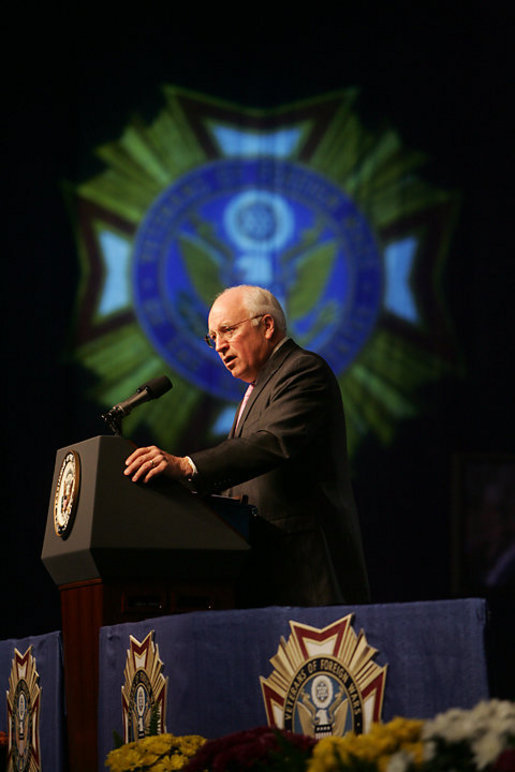 | Vice President Dick Cheney addresses the 107th National Convention of the Veterans of Foreign Wars of the U.S., Monday, August 28, 2006, in Reno, Nevada. "Whatever it is about America that has produced such brave citizens in every generation, it is the best quality we have," said the Vice President. "Freedom is not free, and all of us are deep in the debt of the men and women who go out and pay the price for our liberty." White House photo by David Bohrer. |
Let me thank Jim Mueller for his kind words this morning, as well as for the invitation to join all of you today. I also want to thank Sandy Germany and the Ladies Auxiliary for the fine work they do every day on behalf of our veterans and military families. Bob Wallace, of course, the executive director of your national office, is here. And we appreciate his devoted service to America's veterans in our Nation's Capital.
Let me also be among the first to congratulate VFW's incoming commander in chief, Gary Kurpius of Anchorage, Alaska; and the next president of the -- (applause) -- good to hear from Alaska -- and the next president of the Ladies Auxiliary, Linda Meader of Concord, New Hampshire. I know Gary and Linda will do a fine job in the years ahead. (Applause.)
It's been my good fortune to attend a number of VFW conventions over the years, and I've been looking forward to joining all of you today. By its very name, this organization commands the respect of our entire nation. As members of the VFW, you know what it means to hear the call to duty, to carry responsibility, to set aside all notions of comfort, convenience, and safety in order to defend the United States. Last month I participated in an Armistice Day Ceremony at the Korean War Veterans Memorial in Washington. I was struck by the simple words of one of our men who served in what's been called the Forgotten War. In spite of it all, he said, quote, "I was glad to have served my country, and I've never heard Korean War veterans complain. In fact, if we had to do it all over again, we would." End quote. (Applause.)
There could be no more eloquent testimony to the character of our country than those words from a war veteran. Whatever it is about America that has produced such brave citizens in every generation, it is the best quality we have. Freedom is not free, and all of us are deep in the debt of the men and women who go out and pay the price for our liberty.
Military service forms habits and commitments that last for a lifetime -- and that's why we always see veterans doing more than their full share on behalf of the country. Each year VFW members give more than 13 million hours in volunteer time -- educating and inspiring young people; helping military families; enhancing the civic life of communities all across the nation. One year ago Hurricane Katrina hit shore -- and soon afterward members of the VFW were involved in the relief effort and contributing hundreds of thousands of dollars to fellow citizens in need.
We would not be the nation we are today were it not for the ethic of teamwork, generosity, active citizenship, and patriotism that define the VFW. So I count it a privilege to be in your company, and I bring personal greetings from the President of the United States, George W. Bush.
Something tells me we've got more than a few veterans here today from the President's home state of Texas. (Applause.) And maybe a small contingent from my home state of Wyoming. (Applause.) I'll remind you of what I used to tell colleagues when I was in Congress, and I served as the lone Congressman from Wyoming. I said it was a small delegation, but it's all quality. (Laughter.)
Both the President and I have many friends in the room this morning, and we're proud to have strong ties with the rank and file and the leadership of the VFW. We came to office five-and-a-half years ago, we were determined to enhance the respect shown by our government to veterans -- and to demonstrate that respect not just in words but in resources.
By respecting and caring for our veterans, we show our values as a nation. More than that, we honor solemn commitments that have been made to those who wore the uniform. A veteran who deals with the federal government should be treated as one who has paid into the system the hard way -- and should never be made to feel that someone is doing him or her a favor
I am happy to report that under the administration of George Bush, we have increased funding for all VA-administered programs by 75 percent. (Applause.) In fact, President Bush presided over a greater increase for the VA in the first four years of his administration than was seen in the entire eight years of the prior administration. In addition, the President's budget for the next fiscal year calls for $34.3 billion for veterans health care -- an amount almost 70 percent greater than the budget when we took office. (Applause.)
As part of our commitment to good and timely care for our veterans, we're modernizing and expanding many VA facilities, including brand-new veterans' hospitals in Orlando, Denver and Las Vegas.
Our administration has also worked with veterans' groups to meet the special needs of veterans, and this President was the first in more than 100 years to sign concurrent receipt legislation. (Applause.)
As a nation born in revolution -- and defended for two centuries by the courage of unselfish men and women -- America looks with reverence to our fallen and missing heroes, and to the flag under which they served. Millions of Americans recall the face and the name of someone who never lived to be called a veteran. Departed service members have a special place in our national memory and are taken to their rest with national honors. Recent appearances of protestors at military funerals, mocking the dead and insulting their families in their hour of grief, are an outrage. (Applause.) In response, and with your active support, Congress passed the Respect for America's Fallen Heroes Act, and President Bush was pleased to sign it into law.
The VFW remains in the forefront of the effort to learn the full truth about our fellow Americans whose fate is yet undetermined. We have seen some progress in this area, but nothing close to enough. This nation will not give up until we have reached a full accounting for every last American prisoner of war and soldier missing in action. (Applause.)
I also want to thank the VFW for your unremitting dedication to protection of the American flag, and the right of our children and grandchildren to speak every word of the pledge of allegiance. (Applause.)
Your annual convention comes, yet again, in a time of war. At this very hour, American soldiers, Marines, sailors, airmen, and Coast Guardsmen are on vital missions to defend the innocent, confront the violent, and honor the commitments of the United States. They reflect enormous credit on this nation, and I know they appreciate the unwavering concern, and support, and prayers of the VFW.
In just two weeks the calendar will read again September 11th, and our minds will go back to that day five years ago, when enemies struck our country with acts of stealth and murder. The men and women on duty in the War on Terror are serving the highest ideals of the nation -- our belief in freedom and justice, equality, and the dignity of the individual. And they are serving the vital security interests of America and the civilized world. There is no denying that the work is difficult and that there is a great deal to be done. Yet we can harbor no illusions about the nature of the enemy we're fighting, or the ambitions they seek to achieve.
This enemy wears no uniform, has no regard for the rules of warfare, and is unconstrained by any standard of decency or morality. They plot and plan in secret, target the defenseless, and rejoice at the death of innocent, unsuspecting human beings.
This enemy has a set of beliefs -- and we saw the expression of those beliefs in the rule of the Taliban. They seek to impose a dictatorship of fear, under which every man, woman, and child lives in total obedience to a narrow and hateful ideology. This ideology rejects tolerance, denies freedom of conscience, and demands that women be pushed to the margins of our society. Such beliefs can be imposed only through force and intimidation, so those who refuse to bow to the tyrants will be brutalized or killed -- and no person or group is exempt.
This enemy also has a set of clear objectives. The terrorists want to end all American and Western influence in the Middle East. Their goal in that region is to seize control of a country so they have a base from which to launch attacks and to wage war against governments that do not meet their demands. The terrorists believe that by controlling one country, they will be able to target and overthrow other governments in the region, and ultimately to establish a totalitarian empire that encompasses a region from Spain, across North Africa, through the Middle East and South Asia, all the way around to Indonesia.
They have made clear, as well, their ultimate ambitions: to arm themselves with chemical, biological and even nuclear weapons, to destroy Israel, to intimidate all western countries, and to cause mass death in the United States. Some might look at these ambitions and wave them off as extreme and mad. Well, these ambitions are extreme and they are mad. They are also real, and we must not wave them off. We must take them seriously. We must oppose them. And we must defeat them. (Applause.)
Over the last several decades, Americans have seen how the terrorists pursue their objectives. Something of a pattern developed, and it was plain to see. To put it in blunt terms, the terrorists would hit us, but we did not hit back hard enough. For many years prior to 9/11, we treated terror attacks against Americans as isolated incidents, and answered -- if at all -- on an ad hoc basis, and never in a systematic way. Even after a strike inside our own country -- the 1993 bombing at the World Trade Center -- there was a tendency to treat terrorist attacks as individual criminal acts, to be handled primarily through law enforcement.
The man who perpetrated that first attack in New York was tracked down, arrested, convicted, and sent off to prison. Yet behind that one man was a growing network with operatives inside and outside the United States, waging war against our country.
For us, that war started on 9/11. For them, it started years before. They killed 241 servicemen in Beirut in 1983. Then there was the first World Trade Center attack in 1993; and after that, the murders at the Saudi Arabian National Guard Training Center in Riyadh in 1995; the simultaneous bombings of American embassies in Kenya and Tanzania in 1998; and the attack on the USS Cole 2000. With each attack, the terrorists grew more confident in believing they could strike America without paying a price. So they continued to wage those attacks -- making the world less safe and eventually striking here in the homeland on September 11th.
Against this kind of determined, organized, ruthless enemy, America required a new strategy -- not merely to prosecute a series of crimes, but to fight and win a global campaign against the terror network. If I may quote Franklin Roosevelt, the President under who many of you served and fought, in words he used to describe fighting the Nazis: "Modern warfare against treacherous enemies," he said, "is a dirty business. We don't like it -- we didn't want to get in it -- but we are in it and we're going to fight it with everything we've got." (Applause.)
First, we're absolutely determined to prevent attacks before they occur, so we're on the offensive against the terrorists. At home and with coalition partners abroad, we've broken up terror cells, tracked down terrorist operatives, and put heavy pressure on their ability to organize and plan attacks. The work is hard, perilous, and ongoing. But we have made tremendous progress against an enemy that dwells in the shadows.
Second, we are determined to deny safe haven to the terrorists. Since the day our country was attacked, we've applied the Bush Doctrine: Any person or government that supports, protects, or harbors terrorists is complicit in the murder of the innocent, and will be held to account.
Third, we are working to halt the proliferation of weapons of mass destruction, and to keep those weapons out of the hands of killers. In the post-9/11 world, we have to confront such dangers before they fully materialize. President Bush has put it very well: Terrorists and terror states do not reveal these threats with fair notice, in formal declarations -- and responding to such enemies only after an attack is not self-defense, it is suicide.
Fourth, we are determined to deny the terrorists control of any nation, which they would use as a home base and staging ground for terrorist attacks on others. That's why we continue to fight Taliban remnants and al Qaeda forces in Afghanistan. That's why we're working with President Musharraf to oppose and isolate the terrorist element in Pakistan. And that's why we are fighting with the remnants of Saddam Hussein's regime and terrorists in Iraq.
I know some have suggested that by liberating Iraq from Saddam Hussein, we simply stirred up a hornet's nest. They overlook a fundamental fact: We were not in Iraq on September 11th, 2001, and the terrorists hit us anyway. As President Bush has said, the hatred of the radicals existed before Iraq was an issue, and it will exist after Iraq is no longer an excuse.
The terrorists regard the entire world as their battlefield. That is why al Qaeda has operatives in Iraq today. And they believe they can frighten and intimidate America into a policy of retreat.
I realize, as well, that some in our own country claim retreat from Iraq would satisfy the appetite of the terrorists and get them to leave us alone. But the exact opposite is true. Time and again over the last generation, the terrorists have targeted nations whose behavior they believe they can change through violence. In fact such a retreat would convince the terrorists, once again, that free nations will change our policies, forsake our friends, and abandon our interests whenever we are confronted with violence and blackmail. They would simply draw up another set of demands, and instruct Americans to act as they direct or to face other murders. A precipitous withdrawal from Iraq would be a victory for the terrorists, an invitation to further violence against free nations, and a ruinous blow to the future security of the United States.
In our own country, we take democratic values seriously -- and so we always have a vigorous debate on the issues. That's part of the greatness of America, and we wouldn't have it any other way. But there is a difference between healthy debate and self-defeating pessimism. We have only two options in Iraq -- victory or defeat. And this nation will not pursue a policy of retreat. We will complete the mission, we will get it done right, and then we will return with honor. (Applause.)
Before we took down Saddam Hussein's regime, President Bush said the United States would not permit another dictatorship to rise on the ruins of the old one. And today, Iraq has the most progressive constitution and the strongest democratic mandate in the entire Arab world. Iraq's political leaders are steady and courageous, and the citizens, police, and soldiers have stepped forward as active participants and guardians of the new democracy -- running for office, speaking out, voting by the millions, and sacrificing for the future of their country.
Iraqi citizens are doing all of this despite threats from terrorists who offer no political agenda for Iraq's future and wage a campaign of mass slaughter against the Iraqi people themselves -- the vast majority of whom are fellow Arabs and fellow Muslims.
As Prime Minister Maliki said on his recent visit to Washington, his country has gone "from a one-party state, ruled by a small elite, to a multi-party system where politics is the domain of every citizen and parties compete at all levels." And Iraqis have firmly chosen "hope over fear; liberty over oppression; dignity over submission; democracy over dictatorship."
America is helping Iraq on this journey, because we are a nation that keeps its word. And we know that when men and women are given the power to determine their own destiny, the ideologies of violence and resentment will lose their appeal, and nations will turn their energies to the pursuit of peace. By standing with our friends, we are making a better day possible in the broader Middle East. By supporting democracy, we serve both the ideals and the security of our nation. And the brave Americans on duty in this war can be proud of their service for the rest of their lives. (Applause.)
Our forces remain absolutely relentless in their duties, and they are carrying out their missions with the skill and honor we expect of them. I think of the ones who put on heavy gear and work 12 or 14-hour shifts in the desert heat. Every day they are striking the enemy -- conducting raids, training Iraqi forces, countering attacks, seizing weapons, capturing killers. We'll continue to train the Iraqi forces so they can defend their own country and make it a source of stability in a troubled part of the region.
When it comes to our own troop levels, the President will listen to the recommendations of commanders on the ground. And he'll make the call based on what is needed for victory, not according to the polls, and not by artificial timelines set by set by politicians in Washington, D.C. (Applause.)
Recently one of our great allies, Prime Minister Tony Blair, said, we are never going to succeed unless we understand the terrorists are going to fight hard.
And we are learning, as previous generations learned, that wartime conditions are a fierce test of military skill and of national will. This is especially true in the war on terror.
Five years ago, President Bush told Congress and the country that the path ahead would be difficult; that we were heading into a long struggle, unlike any we have known. All this has come to pass.
At the same time, we must realize that this is a multi-front war, requiring every element of our national power. And those of us in positions of responsibility must do all we can to figure out the intentions of an enemy that likely has combatants inside the United States. We live in a free and open society, and the terrorists want to use those very advantages against us. And so we have an urgent duty to learn who they are and what they are doing, and to stop them before they can act.
To this end, in the days following 9/11, the President authorized the National Security Agency to intercept a certain category of terrorist-linked international communications. On occasion you will hear this called a domestic surveillance program. That's more than a misnomer; it is a flat-out falsehood. We are talking about international communications, one end of which we believe -- or have reason to believe is related to al Qaeda or to terrorist networks. It's hard to think of any category of information that would be more important to the safety of the United States.
The authorization the President made after September 11th helped address that problem in a manner that is fully consistent under the Constitution and consistent legal authority of the President and with the civil liberties of the American people. The activities conducted under this authorization have helped to detect and prevent possible terrorist attacks against the American people. The recent ruling by a federal judge ordering an end to this program is just dead wrong. We are confident it will be reversed on appeal.
If you'll recall, the 9/11 Commission -- (applause) -- if you'll recall, the 9/11 Commission focused criticism on the nation's inability to uncover links between terrorists at home and terrorists overseas. The term that's used is "connecting the dots" -- and the fact is that one small piece of data might very well make it possible to save thousands of lives. And the very important question today is whether, on five years' reflection, we have learned all the lessons of September 11th.
In the decade prior to those attacks, our country spent more than two trillion dollars on national security. Yet on 9/11, we lost nearly 3,000 Americans at the hands of 19 men armed with box cutters and airline tickets. In the case of al Qaeda we are not dealing with large armies we can track, or uniforms we can see, or men with territory of their own to defend. Their preferred tactic, which they boldly proclaim, is to slip into the country, blend in among the innocent, and to kill without mercy and without restraint. They have intelligence and counterintelligence operations of their own. They take their orders from overseas. They are using the most sophisticated communications technology they can get their hands on. Since 9/11 they have successfully carried out attacks in Casablanca, Jakarta, Mombassa, Bali, Riyadh, Baghdad, Istanbul, Madrid, London, Sharm al-Sheikh, Bombay, and elsewhere. Here in the U.S., we have not had another 9/11. No one can guarantee that we won't be struck again. But to have come this far without another attack is no accident. We have been protected by sound policy decisions by the President, by decisive action at home and abroad, and by round-the-clock efforts on the part of our people in the armed services, law enforcement, intelligence, and homeland security.
The President of the United States regularly makes decisions based on the intelligence briefings he receives. The information in those briefings is critical to assessing risks, and to allocating security assets inside the homeland, as well as overseas. Throughout our military, intelligence has a daily, indeed hourly, influence on the movement of ships, fighter and bomber missions, and orders given to those whose commands control the tip of the spear. Gathering the best information, and getting it into the hands of the war fighter, makes all the difference for the safety of our forces and the security of the nation. Members of the VFW: I want each one of you to know that the President will not relent in the effort to track the enemies of the United States with every legitimate tool at his command. (Applause.)
The enemy that struck on 9/11 is weakened and fractured, yet still lethal and still desperately trying to hit us again. They hate us, they hate our country, and they hate the liberties for which we stand. This is not a war we can win on the defensive. Either we are serious about this fight or we are not. And the enemies of America need to know: We are serious, and we will not let down our guard. (Applause.)
Ladies and gentlemen, on a Tuesday morning five years ago, the nation we all love experienced one of the cruelest acts the modern world has seen. In our sorrow we also felt inspiration, as we learned of airline passengers who rose up against hijackers to prevent greater loss, and rescuers who charged into burning towers and died by the hundreds, and the many examples of kindness and brotherhood that Americans showed to each other on one of the worst days in our history.
From that hour of destruction to this very moment, the people and the government of the United States have answered violence with justice, honor, and moral courage. America is a good, a decent, and generous country. The ideals that gave life to this nation are the same ideals we uphold at home and that we serve abroad. We fight not only to protect ourselves and to overcome the dangers to civilization, but to liberate the oppressed, and to give others the chance to decide their own destiny, so that all of us can one day live in peace on the foundation of human freedom.
Liberty and equality; justice and humanity; self-government, tolerance, respect, and the rule of law -- these are the principles by which we fight, the principles by which we live, and the principles by which we will prevail.
Thank you. (Applause.)
END 11:28 A.M. PDT, For Immediate Release, Office of the Vice President, August 28, 2006
Technorati Tags: Lynne Cheney and Liz Cheney or Phil Perry and Vice President ot grandchild and Richard Jonathan Perry or Dick Cheney and VICE PRESIDENT CHENEY or Sibley Memorial Hospital
Relared: Keywords Vice President Cheney, Wednesday, July 12, 2006 Cheneys welcomed fifth grandchild, Monday, July 03, 2006 Vice President Cheney NASCAR America Supports You., Sunday, July 02, 2006 Interview of the Vice President Fox Sports Daytona, Tuesday, May 09, 2006 Vice President's Remarks with Prime Minister Ivo Sanader of Croatia, Tuesday, May 09, 2006 Vice President's Remarks with President Nursultan Nazarbayev of Kazakhstan, Tuesday, May 09, 2006 Vice President's Remarks with Ukrainian President Viktor, Yushchenko, Tuesday, May 09, 2006 Vice President Cheney and Lithuanian President Valdus Adamkus, Monday, April 17, 2006 Vice President Cheney and Mrs. Cheney Release 2005 Income Tax Return, Thursday, February 16, 2006 Interview of the Vice President by Brit Hume (VIDEO), Wednesday, February 15, 2006 Update by the Office of the Vice President, Saturday, January 21, 2006 Vice President, Neil Cavuto, FOX News (VIDEO), Friday, January 13, 2006 Vice President to Travel to Egypt and Saudi Arabia, Friday, January 06, 2006 Vice President's Remarks on Iraq and the War on Terror (VIDEO), Thursday, November 17, 2005 Vice President's Remarks 11/16/05, Monday, October 31, 2005 Vice President appointed David S. Addington chief of staff, Saturday, October 29, 2005 Vice President's Statement on Libby Resignation, Friday, October 28, 2005 Resignation of Scooter Libby (VIDEO, Tuesday, October 04, 2005 Remarks by the Vice President to Second Marine Expeditionary Force,
0
comments
||
||
Monday, August 28, 2006
Media Stakeout Ambassador John Bolton 08/28/06 (VIDEO)
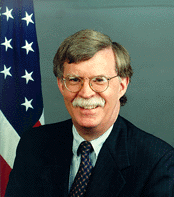 | Media Stakeout: Informal comments to the Media by the Permanent Representative of the United States of America, Ambassador John Bolton, on the situation in Sudan. 28 August 06, [Webcast: Archived Video - file is real media format, running time is 15:31] FULL STREAMING VIDEO. |
Technorati Tags: State Department and Secretary of State or Ambassador John Bolton and VIDEO, or Media Stakeout and United Nations or Condoleezza Rice, or Sudan and UN Security Council,
Related: Keywords State Department, Wednesday, August 23, 2006 Iranian Response to the P5+1 Package, Tuesday, August 22, 2006 Media Stakeout Ambassador John Bolton 08/22/06 (VIDEO), Tuesday, August 22, 2006 Media Stakeout Ambassador John Bolton 08/15/06 (VIDEO), Friday, August 18, 2006 State Department Daily Press Briefing, VIDEO, PODCAST, TEXT, 08/17/06, Thursday, August 17, 2006 Media Stakeout Ambassador Anne Woods Patterson Sudan VIDEO, Wednesday, August 16, 2006 Middle East Update 08/16/06 VIDEO, PODCAST, TEXT, Tuesday, August 15, 2006 Media Stakeout Ambassador John Bolton 08/15/06 (VIDEO), Tuesday, August 15, 2006 State Department Daily Press Briefing, VIDEO, PODCAST, TEXT, 08/14/06, Thursday, August 10, 2006 State Department Daily Press Briefing, VIDEO, PODCAST, TEXT, 08/10/06, Saturday, August 12, 2006 UN Adopts Resolution on Lebanon (VIDEO), Friday, August 11, 2006 International Initiative to Combat Kleptocracy VIDEO, PODCAST, TEXT, Thursday, August 10, 2006 State Department Daily Press Briefing, VIDEO, PODCAST, TEXT, 08/10/06, Wednesday, August 09, 2006 Media Stakeout Minister Tarek Mitri Lebanon (VIDEO), Wednesday, August 09, 2006 Media Stakeout Ambassador Dan Gillerman Israel (VIDEO), Wednesday, August 09, 2006 Media Stakeout Ambassador John Bolton (VIDEO), Tuesday, August 08, 2006 Lebanon - Stakeout by Ambassador de La Sablière VIDEO, PODCAST, TEXT, Monday, August 07, 2006 Condoleezza Rice on Mid East Cease-Fire (VIDEO), Friday, August 04, 2006 Condoleezza Rice to the People of Cuba VIDEO, PODCAST, TEXT, Wednesday, July 26, 2006 State Department Daily Press Briefing, VIDEO, PODCAST, TEXT, 07/26/06,
0
comments
||
||
National Day of Remembrance of Hurricane Katrina, 2006
National Day of Remembrance of Hurricane Katrina, 2006, A Proclamation by the President of the United States of America. In Focus: Hurricane Katrina
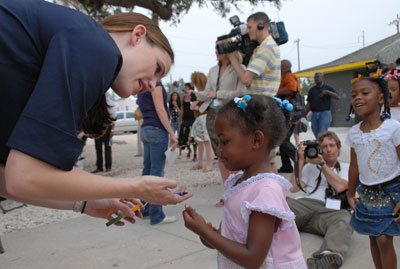 | New Orleans, La., May 8, 2006 - Actress Jennifer Garner offers FEMA Trailer Park resident Tyle Conner a crayon during her visit of the "Katrina Child Watch" |
One year ago, a vast coastline of towns and communities was virtually destroyed; one of America's great cities was submerged; and many lives were lost in one of the worst natural disasters in our Nation's history. On this National Day of Remembrance of Hurricane Katrina, we honor those who did not survive the fury of the storm and those who continue to put their lives back together in its aftermath. We also remember the heroism of ordinary citizens who touched our hearts with their bravery and compassion and moved our whole Nation to action.
Hurricane Katrina brought many days of struggle and sorrow; yet, we also witnessed extraordinary acts of courage and kindness. Rescue workers, other first responders, and concerned citizens from around the country risked their lives to save others and performed heroically under the most difficult of circumstances. Many were victims themselves, acting on a sense of duty greater than their own suffering. Men, women, and children across America rallied to help their neighbors in desperate need, providing food, water, shelter, and hope to the victims of Hurricane Katrina. Those days tested our Nation, and they revealed a resilience more powerful than any storm.
Millions of lives were changed in a day by that cruel and destructive storm. America accepted the challenge to restore broken communities and disrupted lives not as a burden, but as our responsibility to help our fellow citizens. Victims and volunteers continue to demonstrate a spirit that cannot be broken -- a core of strength that survives all hurt, a faith in God that no storm can take away, and an unyielding determination to clear the wreckage and build anew.
In the past year, Federal, State, and local governments have worked to enhance our Nation's ability to prepare for and respond to natural disasters. The Federal Government has conducted an extensive review of preparedness and response efforts, and actions are being taken at every level to improve communications and coordination and strengthen emergency response capabilities. The American people can know that our government is working hard to be prepared to protect life and property should we face another such challenge.
In the life of our Nation, we have often been reminded that nature is an awesome force, and that all life is fragile. However, Americans have always summoned the will and compassion to persevere and rebuild. Guided by our enduring American spirit, we know that a bright new dawn will rise over the great city of New Orleans, and the entire Gulf Coast region will reemerge stronger and more vibrant than ever.
NOW, THEREFORE, I, GEORGE W. BUSH, President of the United States of America, by virtue of the authority vested in me by the Constitution and laws of the United States, do hereby proclaim August 29, 2006, as a National Day of Remembrance of Hurricane Katrina. I call upon State and local governments, places of worship, and all Americans to mark this day with services and appropriate observances. I also encourage all Americans to remember and support the continued effort to rebuild our Nation's great Gulf Coast.
IN WITNESS WHEREOF, I have hereunto set my hand this twenty-fifth day of August, in the year of our Lord two thousand six, and of the Independence of the United States of America the two hundred and thirty-first.
GEORGE W. BUSH
# # # For Immediate Release, Office of the Press Secretary, August 25, 2006
Technorati Tags: President Bush or Hurricane Katrina and Katrina or hurricane and Katrina relief or Gulf Opportunity Zone Act and Gulf Coast or H.R. 4440 and National Day of Remembrance of Hurricane Katrina
Related: Keyword Katrina, Wednesday, December 21, 2005 President Signs Gulf Opportunity Zone Act (VIDEO), Monday, August 29, 2005 President, Hurricane Katrina, Iraqis Draft Constitution, Monday, August 29, 2005 Hurricane Katrina Update (real time loop), Monday, August 29, 2005 Hurricane Katrina Homeland Security Media Advisory, Tuesday, August 30, 2005 FEMA Responding to Hurricane Katrina (real time loop), Tuesday, August 30, 2005 Disaster Medical Deployed For Hurricane Katrina (real time loop), Tuesday, August 30, 2005 KATRINA Advisory (NOAA RSS FEED) (real time loop), Wednesday, August 31, 2005 Ask the White House Michael Chertoff Hurricane Katrina, Wednesday, August 31, 2005 Samuel W. Bodman, Hurricane Katrina, Strategic Petroleum Reserve, Thursday, September 01, 2005 President Outlines Hurricane Katrina Relief (VIDEO), Thursday, September 01, 2005 W Asks Poppi and Bubba for Hurricane Relief (VIDEO), Thursday, September 01, 2005 well isn't that special, Friday, September 02, 2005 President Heads to Katrina Affected Areas (VIDEO), Friday, September 02, 2005 FEMA News Release Number: HQ-05-193, Saturday, September 03, 2005 Navy Personnel, Family Helpline, Pentagon Briefing (VIDEO), Saturday, September 03, 2005 President Addresses Nation, Katrina Relief (VIDEO)
0
comments
||
||
Decision to Send Troops to Lebanon
President Bush Welcomes France's Decision to Send Troops to Lebanon
I welcome President Chirac's decision to send a total of 2000 troops to Lebanon and to continue to exercise leadership on the ground in enforcing United Nations Security Council Resolution 1701. This is an important step towards finalizing preparations to deploy the United Nations Interim Force of Lebanon. I applaud the decision of France, as well as the significant pledges from Italy and our other important allies. I encourage other nations to make contributions as well. We are working with the United Nations and our partners to ensure the rapid deployment of this force to help Lebanon's legitimate armed forces restore the sovereignty of its democratic government throughout the country and stop Hezbollah from acting as a state within a state.
# # # For Immediate Release, Office of the Press Secretary, August 24, 2006
Technorati Tags: State Department and Security Council Resolution 1701 or United Nations Interim Force of Lebanon and LEBANON, or Israel and Resolution 1559 or Condoleezza Rice, or Middle East and UN Security Council,, or Iran, and Hezbollah, or France, and Jean-Marc de La Sabliere, or Mid East Cease-Fire, and Chirac, or United States Mission to the United Nations,
Related: Keywords State Department, Wednesday, August 23, 2006 Iranian Response to the P5+1 Package, Tuesday, August 22, 2006 Media Stakeout Ambassador John Bolton 08/22/06 (VIDEO), Tuesday, August 22, 2006 Media Stakeout Ambassador John Bolton 08/15/06 (VIDEO), Friday, August 18, 2006 State Department Daily Press Briefing, VIDEO, PODCAST, TEXT, 08/17/06, Thursday, August 17, 2006 Media Stakeout Ambassador Anne Woods Patterson Sudan VIDEO, Wednesday, August 16, 2006 Middle East Update 08/16/06 VIDEO, PODCAST, TEXT, Tuesday, August 15, 2006 Media Stakeout Ambassador John Bolton 08/15/06 (VIDEO), Tuesday, August 15, 2006 State Department Daily Press Briefing, VIDEO, PODCAST, TEXT, 08/14/06, Thursday, August 10, 2006 State Department Daily Press Briefing, VIDEO, PODCAST, TEXT, 08/10/06, Saturday, August 12, 2006 UN Adopts Resolution on Lebanon (VIDEO), Friday, August 11, 2006 International Initiative to Combat Kleptocracy VIDEO, PODCAST, TEXT, Thursday, August 10, 2006 State Department Daily Press Briefing, VIDEO, PODCAST, TEXT, 08/10/06, Wednesday, August 09, 2006 Media Stakeout Minister Tarek Mitri Lebanon (VIDEO), Wednesday, August 09, 2006 Media Stakeout Ambassador Dan Gillerman Israel (VIDEO), Wednesday, August 09, 2006 Media Stakeout Ambassador John Bolton (VIDEO), Tuesday, August 08, 2006 Lebanon - Stakeout by Ambassador de La Sablière VIDEO, PODCAST, TEXT, Monday, August 07, 2006 Condoleezza Rice on Mid East Cease-Fire (VIDEO), Friday, August 04, 2006 Condoleezza Rice to the People of Cuba VIDEO, PODCAST, TEXT, Wednesday, July 26, 2006 State Department Daily Press Briefing, VIDEO, PODCAST, TEXT, 07/26/06,
0
comments
||
||
Sunday, August 27, 2006
Population Growth, Environmental Degradation
Remote island provides clues on population growth, environmental degradation, University of Oregon researcher traces Polynesian arrival, expansion on Rapa
 | Caption: The cave, according to radiocarbon dating, has been shown to be the oldest site of habitation, beginning in about AD 1200. Inside, researchers found remnants of sleeping mats and other evidence indicating 400 years of usage of the cave. Credit: Photos courtesy of Douglas Kennett, Usage Restrictions: Media use only. |
 | Caption: Rising high on the island is the Tevaitau Fortification. The mountaintop was flattened, with evenly spaced layers carved along the way to the top. Researchers suspect that fortifications resulted as division grew among the island's growing population. Credit: Photos courtesy of Douglas Kennett, Usage Restrictions: Media use only |
Until only recently, little was known about the French Polynesian Island, where the current population is less than 500. Archaeological, linguistic and genetic data suggest that the island, like much of East Polynesia, was inhabited in a final pulse of colonization by seafaring travelers who originated from Island Southeast Asia. New research, led by the University of Oregon's Douglas Kennett, has shed fresh new light on Rapa, especially on what life may have been like for as many as 1,500 to 2,000 people who lived there before the arrival of European explorers.
Kennett's team, which included researchers from three institutions, reported in the June issue of the journal Antiquity that Polynesians arrived on the island around A.D. 1200, much later than long assumed. The settlers spread across the island, splintering from a shoreline-based society into competing groups that built and likely defended a growing number of spectacular fortifications carved from mountaintops in the years before English explorer George Vancouver sailed by in 1791, ushering in European contact.
The conclusions of Kennett's team are based on 48 radiocarbon dates drawn from samples taken from a variety of sites, including archaeological excavations at five of 16 known coastal rock shelters and four of 15 upland fortifications, each with a central tower surrounded by a series of large domestic terraces.
The settlement date for Rapa matches nicely with new data from Easter Island (Rapa Nui) suggesting that colonization there also occurred about A.D. 1200, a conclusion published March 17 by Terry Hunt of the University of Hawaii and Carl Lipo of California State University, Long Beach, in the journal Science.
"Our research confirms that approximate settlement date and supports the idea of a late pulse of colonization into East Polynesia," Kennett said. "However, we believe that the archaeological record of Rapa's later history is more compelling than Easter Island's in terms of what it teaches us about the social and political mechanisms for population dispersal."
Kennett argues that Polynesians moved to Rapa and several other parts of the remote Pacific after a 1,500-year lull in their major migrations. Around 3,000 years ago, he said, Polynesians had moved into West Polynesia (Fiji, Tonga and Samoa), far to the northwest of Rapa, where they lived until population densities and dwindling food resources spawned fragmentation and aggression. This idea is detailed in a chapter of "Behavioral Ecology and the Transition to Agriculture," a book Kennett co-edited and which was published earlier this year by the University of California Press.
Archeological evidence, described in the Antiquity paper, showed that Rapa's earliest occupants lived in coastal rock shelters. One such cave, Tangarutu, is being mined for sand to construct roads. However, Kennett's team delineated some 400 years of occupation in the cave. Among items found were fragments of sleeping mats, cordage and fish hooks made from shell.
Radiocarbon dating indicated that people relocated their residences to fortified interior locations 300 years after the island was colonized. "These were all related people who arrived in Rapa," Kennett said. "They generally get along and collaborate when they arrive, but with time and growing populations there was division, then competition between different family lineages, resulting in significant amounts of aggression. This division led to the establishment of fortifications in not very desirable locations, such as mountaintop ridges, where it's cold, windy, inhospitable for crops, and far away from water."
In the course of expansion, the islanders developed pond agriculture, similar to rice paddies, for growing taro, a root-crop much like potatoes. The expansion of pond-field agriculture on the island parallels evidence from sediment cores for deforestation and erosion. Taro remains the island's food staple. Extending into the sea from the various drainage systems flowing from the upland fortifications are linear walls that likely served as tidal fish traps.
"The archaeological landscape is phenomenal," Kennett said. "There are domestic and agricultural terraces all around the island. Many of the ridge tops are flattened and there are staircases carved into the mountainsides. Arable land and access to fishing grounds were limited, and the farming areas and fish traps would have been well defended."
The findings and satellite maps taken by Kennett's team are being shared with the people of Rapa, with whom the team is continuing to work as part of Kennett's Rapa Heritage Project.
"Rapa is a compelling story," Kennett said. "To me, this is an example of what's happening on the planet today in terms of expanding populations, environmental degradation and increasing warfare. Rapa is a little microcosm of our planet. There are lessons about the consequences of population growth to be learned there."
###
Co-authors with Kennett on the Antiquity paper were Atholl Anderson and Matthew Prebble, both of the Australian National University, Eric Conte of the University of French Polynesia and John Southon of the University of California, Irvine.
Sarah McClure, an archaeologist in the University of Oregon department of anthropology and assistant director of public programs at the Museum of Natural and Cultural History, served on the Rapa field team. Three other field-team members were: Yann Doignon, who in 2003 received his master's in arts administration from University of Oregon; Nathan Wilson, who received his bachelor's degree in 2004 in anthropology from the University of Oregon and who is now pursuing a doctorate at Arizona State University; and Rosine Oitokaia, a native resident of Rapa.
The National Geographic Society, Australian National University and the University of Oregon funded the research.
Source: Douglas Kennett, professor of anthropology, 541-346-5237, dkennett@uoregon.edu
Links: uoregon.edu/~dkennett/
Images: waddle.uoregon.edu/gallery/Rapa
Contact: Jim Barlow jebarlow@uoregon.edu 541-346-3481 University of Oregon
Technorati Tags: environmental or Radiocarbon dating and Polynesian or Archaeological and sociology or Sociological and linguistic or genetic and colonization or Rapa, and archaeological excavations,
RELATED: Keyword biology, Sunday, August 13, 2006 religious garment defines a new generation of women, Sunday, August 13, 2006 Multiracial congregations offer different social ties, Sunday, August 06, 2006 Scientists develop artwork that changes to suit your mood, Sunday, August 06, 2006 Washington, DC getting a summertime air quality exam, Sunday, July 30, 2006 The World Map of Happiness, Sunday, July 23, 2006 The Occult Life of Things, Sunday, July 23, 2006 Why we could all do with a siesta, Sunday, July 16, 2006 Hope I die before I get old?, Sunday, July 09, 2006 People more likely to help others they think are 'like them!, Sunday, July 09, 2006 Jefferson Team Designs Program that Helps Elderly Live Longer, Sunday, July 02, 2006 Gabapentin cools hot flashes as well as estrogen, Sunday, June 25, 2006 Estrogen plays different role during stress in black and white teens, Sunday, June 25, 2006 Our grip on reality is slim, Sunday, May 21, 2006 Genome doesn't start with 'G', Sunday, May 07, 2006 Lying Is Exposed By Micro-Expressions We Can't Control, Sunday, April 30, 2006 Mothers often have inaccurate perceptions of their children's body weight, Sunday, April 16, 2006 Other people influence us and we don't even know it!, Tuesday, January 04, 2005 The Cassini-Huygens mission to Saturn, Sunday, March 20, 2005 Agriculture Secretary Mike Johanns, bovine spongiform encephalopathy (BSE), Thursday, March 24, 2005 Fish Oil Holds Promise in Alzheimer's Fight, Sunday, April 10, 2005 National Human Genome Research Institute (NHGRI), Friday, April 15, 2005 Study uncovers bacteria's worst enemy ,
0
comments
||
||
Saturday, August 26, 2006
Freedom Calendar 08/26/06 - 09/02/06
August 26, 1820, Birth of Republican anti-slavery activist James Harlan, U.S. Senator from Iowa, whose statue is in U.S. Capitol.
August 27, 1809, Birth of Hannibal Hamlin (R-ME), first Republican elected Vice President of the United States; instrumental in passage of anti-slavery Wilmot Proviso.
August 28, 1963, Martin Luther King delivers “I Have a Dream” speech in front of memorial dedicated to Republican President Abraham Lincoln.
August 29, 1989, U.S. Rep. Ileana Ros-Lehtinen (R-FL) becomes first Hispanic woman and first Cuban-American in Congress.
August 30, 1890, Republican President Benjamin Harrison signs legislation by U.S. Senator Justin Morrill (R-VT) making African-Americans eligible for land-grant colleges in the South.
August 31, 1823, Birth of Speaker of the House Galusha Grow (R-PA); secured passage of Homestead Act, providing free land to settlers and ending plans of Democrats to open western lands to slave plantations.
September 1, 1975, Gen. Daniel James receives fourth star from Republican President Gerald Ford; first African-American to hold that rank in U.S. Air Force.
September 2, 1910, Administration of Republican George Alexander, Mayor of Los Angeles, makes Alice Wells first woman police officer in America.
"For 150 years, Republicans have worked to secure the civil rights of African-Americans, Hispanics, Asian-Americans, and every individual from every background and walk of life. We believe that every person contributes to America's rich cultural heritage. Americans of all races and creeds share the Republican commitment to creating job opportunities for all, giving children equal access to a quality education, and strengthening families and faith. This is the Republican agenda; this is the American agenda"
U.S. Rep. Dennis Hastert (R-IL) Speaker of the House
SOURCE: Republican Freedom Calendar
Technorati Tags: President Bush and Freedom Calendar or Dwight Eisenhower and Republicans or African-Americans and Ronald Reagan or Ronald Reagan and Civil Rights or Abraham Lincoln and Frederick Douglass or 40 acres and a mule or Martin Luther King and Voting Rights Act of 1965 or Dred Scott
Related: Keywords Freedom Calendar, Saturday, August 19, 2006 Freedom Calendar 08/19/06 - 08/26/06, Saturday, August 12, 2006 Freedom Calendar 08/12/06 - 08/19/06, Saturday, August 05, 2006 Freedom Calendar 08/05/06 - 08/12/06, Saturday, July 29, 2006 Freedom Calendar 07/29/06 - 08/05/06, Saturday, July 22, 2006 Freedom Calendar 07/22/06 - 07/29/06, Saturday, July 15, 2006 Freedom Calendar 07/15/06 - 07/22/06, Saturday, July 08, 2006 Freedom Calendar 07/08/06 - 07/15/06, Saturday, July 01, 2006 Freedom Calendar 07/01/06 - 07/08/06, Saturday, June 24, 2006 Freedom Calendar 06/24/06 - 07/01/06, Saturday, June 17, 2006 Freedom Calendar 06/17/06 - 06/24/06, Saturday, June 10, 2006 Freedom Calendar 06/10/06 - 06/17/06, Sunday, June 04, 2006 Freedom Calendar 06/03/06 - 06/10/06, Saturday, May 27, 2006 Freedom Calendar 05/27/06 - 06/03/06, Saturday, May 20, 2006 Freedom Calendar 05/20/06 - 05/27/06, Saturday, May 13, 2006 Freedom Calendar 05/13/06 - 05/20/06, Saturday, May 06, 2006 Freedom Calendar 05/06/06 - 05/13/06, Saturday, April 29, 2006 Saturday, April 22, 2006 Freedom Calendar 04/22/06 - 04/29/06, Saturday, April 15, 2006 Freedom Calendar 04/15/06 - 04/22/06,
0
comments
||
||
Presidential Podcast 08/26/06
Presidential Podcast 08/26/06 
 Subscribe to Our Odeo or
  podnova Podcast Channel and receive the weekly Presidential Radio Address in English and Spanish with select State Department Briefings. Featuring real audio and full text transcripts, More content Sources added often so stay tuned.
Technorati Tags: President Bush and White House radio address or Gulf Coast and Saint Bernard Parish or Katrina and Louisiana or New Orleans and natural disasters or Mississippi and PODCAST
RELATED: Keywords radio address, podcast, Saturday, August 19, 2006 bush radio address 08/26/06 full audio, text transcript, Saturday, August 12, 2006 Presidential Podcast 08/12/06, Saturday, August 05, 2006 Presidential Podcast 08/05/06, Saturday, July 29, 2006 Presidential Podcast 07/29/06, Saturday, July 15, 2006 Presidential Podcast 07/15/06, Monday, July 10, 2006 Presidential Podcast 07/08/06, Saturday, July 01, 2006 Presidential Podcast 07/01/06, Saturday, June 24, 2006 Presidential Podcast 06/24/06, Saturday, June 17, 2006 Presidential Podcast 06/17/06, Saturday, June 10, 2006 Presidential Podcast 06/10/06, Saturday, June 03, 2006 Presidential Podcast 06/03/06, Saturday, May 27, 2006 Presidential Podcast 05/27/06, Saturday, May 20, 2006, Presidential Podcast 05/20/06, Saturday, May 13, 2006 Presidential Podcast 05/13/06, Saturday, April 22, 2006 Presidential Podcast 04/22/06, Saturday, April 15, 2006 Presidential Podcast 04/15/06, Saturday, April 08, 2006 Presidential Podcast 04/08/06, Saturday, Saturday, April 01, 2006 Presidential Podcast 04/01/06, March 18, 2006 Presidential Podcast 03/18/06, Saturday, March 11, 2006 bush radio address 03/11/06 full audio, text transcript, Saturday, March 04, 2006 bush radio address 03/04/06 full audio, text transcript,
0
comments
||
||
bush radio address 08/26/06 full audio, text transcript
 | bush radio address 08/26/06 full audio, text transcript. PODCAST and In Focus: Hurricane Katrina President's Radio Address |
Subscribe to Our Odeo or podnova Podcast Channel and receive the weekly Presidential Radio Address in English and Spanish with select State Department Briefings. Featuring real audio and full text transcripts, More content Sources added often so stay tuned.THE PRESIDENT: Good morning.
Earlier this week, I had coffee with Rockey Vaccarella in the White House. Rockey is from Saint Bernard Parish in Louisiana, and he and his family lost everything they owned to Hurricane Katrina. Rockey drove to Washington to thank the federal government for its efforts to help people like him. And he brought a trailer along to help remind us that many good people along our Gulf Coast are still living in difficult conditions, and that the hard work of rebuilding has only just begun.
This Tuesday marks the first anniversary of Katrina -- one of the deadliest and most costly natural disasters in American history. In Mississippi, the storm wiped out virtually everything along an 80-mile stretch of the coast, flattening homes and destroying entire communities. In Louisiana, flooding left 80 percent of the city of New Orleans underwater. The human costs were even more terrible. More than a thousand people died, countless families lost their homes and livelihoods, and tens of thousands of men, women, and children were forced to flee the region and leave behind everything they knew.
During the storm and in the days that followed, Americans responded with heroism and compassion. Coast Guard and other personnel rescued people stranded in flooded neighborhoods and brought them to high ground. Doctors and nurses stayed behind to care for their patients, and some even went without food so their patients could eat. Many of the first-responders risking their lives to help others were victims themselves -- wounded healers, with a sense of duty greater than their own suffering. And across our great land, the armies of compassion rallied to bring food and water and hope to fellow citizens who had lost everything. In these and countless other selfless acts, we saw the spirit of America at its best.
Unfortunately, Katrina also revealed that federal, state, and local governments were unprepared to respond to such an extraordinary disaster. And the floodwaters exposed a deep-seated poverty that has cut people off from the opportunities of our country. So last year I made a simple pledge: The federal government would learn the lessons of Katrina, we would do what it takes, and we would stay as long as it takes, to help our brothers and sisters build a new Gulf Coast where every citizen feels part of the great promise of America.
That was the same pledge I repeated to Rockey during his visit to the White House. This pledge meant stronger levees and rebuilt homes and new infrastructure. It also means safe streets and neighborhoods filled with locally owned businesses, and more opportunities for everyone.
Next week, Laura and I will return to Mississippi and New Orleans to meet with local citizens and officials, and review the progress we have made. The federal government has conducted a thorough review of its response to natural disasters, and we're making reforms that will improve our response to future emergencies. With help from Congress, we have committed $110 billion to the recovery effort, and we are playing a vital role in helping people clear debris, repair and rebuild their homes, reopen their businesses and schools, and put their lives back together.
The federal government will continue to do its part -- yet a re-born Gulf Coast must reflect the needs, the vision, and the aspirations of the people of Mississippi and Louisiana. And their state and local officials have a responsibility to help set priorities and make tough decisions, so people can plan their futures with confidence.
One year after the storms, the Gulf Coast continues down the long road to recovery. In Mississippi and Louisiana, we can see many encouraging signs of recovery and renewal, and many reminders that hard work still lies ahead. This work will require the sustained commitment of our government, the generosity and compassion of the American people, and the talent and vision of people determined to restore their homes, neighborhoods, and cities. We will stay until the job is done, and by working together, we will help our fellow citizens along the Gulf Coast write a new future of hope, justice, and opportunity for all.
Thank you for listening.
END, For Immediate Release, Office of the Press Secretary, August 26, 2006
Technorati Tags: President Bush and White House radio address or Gulf Coast and Saint Bernard Parish or Katrina and Louisiana or New Orleans and natural disasters or Mississippi and PODCAST
Related: Keywords radio address, podcast, Saturday, August 19, 2006 bush radio address 08/19/06 full audio, text transcript, Saturday, August 12, 2006 bush radio address 08/12/06 full audio, text transcript, Saturday, August 05, 2006 bush radio address 08/05/06 full audio, text transcript, Saturday, July 29, 2006 bush radio address 07/29/06 full audio, text transcript, Saturday, July 22, 2006 bush radio address 07/22/06 full audio, text transcript, Saturday, July 15, 2006 bush radio address 07/15/06 full audio, text transcript, Saturday, July 08, 2006 bush radio address 07/08/06 full audio, text transcript, Saturday, July 01, 2006 bush radio address 07/01/06 full audio, text transcript, Saturday, June 24, 2006 bush radio address 06/24/06 full audio, text transcript, Saturday, June 17, 2006 bush radio address 06/17/06 full audio, text transcript, Saturday, June 10, 2006 bush radio address 06/10/06 full audio, text transcript, Monday, June 05, 2006 bush radio address 06/03/06 full audio, text transcript, Wednesday, May 31, 2006 bush radio address 05/27/06 full audio, text transcript, Saturday, May 20, 2006 bush radio address 05/20/06 full audio, text transcript, Saturday, May 13, 2006 bush radio address 05/13/06 full audio, text transcript,
0
comments
||
||


