Wednesday, September 06, 2006

President Discusses Global War on Terror 09/05/06 (VIDEO)

President Discusses Global War on Terror, FULL STREAMING VIDEO, Capital Hilton Hotel, Washington, D.C. 1:15 P.M. EDT, National Strategy for Combating Terrorism, and Fact Sheet: The President's National Strategy for Combating Terrorism, or In Focus: National Security

President George W. Bush is greeted by military personnel following his address on the global war on terror at the Military Officers Association of America meeting Tuesday, Sept. 5, 2006, at the Capital Hilton Hotel in Washington. President Bush spoke about the U.S. and allies strategy for combating terrorism saying 'we're confronting them before they gain the capacity to inflict unspeakable damage on the world, and we're confronting their hateful ideology before it fully takes root.' White House photo by Kimberlee HewittPresident George W. Bush is greeted by military personnel following his address on the global war on terror at the Military Officers Association of America meeting Tuesday, Sept. 5, 2006, at the Capital Hilton Hotel in Washington.
President Bush spoke about the U.S. and allies strategy for combating terrorism saying "we're confronting them before they gain the capacity to inflict unspeakable damage on the world, and we're confronting their hateful ideology before it fully takes root." White House photo by Kimberlee Hewitt.

THE PRESIDENT: Thank you all very much. (Applause.) Thank you all. Please be seated. General Hendrix, thank you for the invitation to be here. Thanks for the kind introduction. I'm honored to stand with the men and women of the Military Officers Association of America. I appreciate the Board of Directors who are here, and the leaders who have given me this platform from which to speak. I'm proud to be here with active members of the United States military. Thank you for your service. I'm proud to be your Commander-in-Chief. (Applause.)

I am pleased also to stand with members of the diplomatic corps, including many representing nations that have been attacked by al Qaeda and its terrorist allies since September the 11th, 2001. (Applause.) Your presence here reminds us that we're engaged in a global war against an enemy that threatens all civilized nations. And today the civilized world stands together to defend our freedom; we stand together to defeat the terrorists; and were working to secure the peace for generations to come.

I appreciate my Attorney General joining us today, Al Gonzales. Thank you for being here. (Applause.) The Secretary of Homeland Security, Michael Chertoff, is with us. (Applause.) Three members of the United States Senate -- I might say, three important members of the United States Senate -- Senate President Pro Tem Ted Stevens of Alaska. Thank you for joining us, Senator. (Applause.) Chairman of the Appropriations Committee, Senator Thad Cochran of Mississippi. (Applause.) The Chairman of the Armed Services Committee, John Warner of Virginia. (Applause.)

I thank Norb Ryan, as well, for his leadership. I do appreciate all the folks that are at Walter Reed who have joined us today. I'm going to tell the parents of our troops, we provide great health care to those who wear the uniform. I'm proud of those folks at Bethesda and Walter Reed -- are providing you the best possible care to help you recover from your injuries. Thank you for your courage. Thank you for joining us here today. May God bless you in your recovery. (Applause.)

Next week, America will mark the fifth anniversary of September the 11th, 2001 terrorist attacks. As this day approaches, it brings with it a flood of painful memories. We remember the horror of watching planes fly into the World Trade Center, and seeing the towers collapse before our eyes. We remember the sight of the Pentagon, broken and in flames. We remember the rescue workers who rushed into burning buildings to save lives, knowing they might never emerge again. We remember the brave passengers who charged the cockpit of their hijacked plane, and stopped the terrorists from reaching their target and killing more innocent civilians. We remember the cold brutality of the enemy who inflicted this harm on our country -- an enemy whose leader, Osama bin Laden, declared the massacre of nearly 3,000 people that day -- I quote -- "an unparalleled and magnificent feat of valor, unmatched by any in humankind before them."

In five years since our nation was attacked, al Qaeda and terrorists it has inspired have continued to attack across the world. They've killed the innocent in Europe and Africa and the Middle East, in Central Asia and the Far East, and beyond. Most recently, they attempted to strike again in the most ambitious plot since the attacks of September the 11th -- a plan to blow up passenger planes headed for America over the Atlantic Ocean.

Five years after our nation was attacked, the terrorist danger remains. We're a nation at war -- and America and her allies are fighting this war with relentless determination across the world. Together with our coalition partners, we've removed terrorist sanctuaries, disrupted their finances, killed and captured key operatives, broken up terrorist cells in America and other nations, and stopped new attacks before they're carried out. We're on the offense against the terrorists on every battlefront -- and we'll accept nothing less than complete victory. (Applause.)

In the five years since our nation was attacked, we've also learned a great deal about the enemy we face in this war. We've learned about them through videos and audio recordings, and letters and statements they've posted on websites. We've learned about them from captured enemy documents that the terrorists have never meant for us to see. Together, these documents and statements have given us clear insight into the mind of our enemies -- their ideology, their ambitions, and their strategy to defeat us.

We know what the terrorists intend to do because they've told us -- and we need to take their words seriously. So today I'm going to describe -- in the terrorists' own words, what they believe… what they hope to accomplish, and how they intend to accomplish it. I'll discuss how the enemy has adapted in the wake of our sustained offensive against them, and the threat posed by different strains of violent Islamic radicalism. I'll explain the strategy we're pursuing to protect America, by defeating the terrorists on the battlefield, and defeating their hateful ideology in the battle of ideas.

The terrorists who attacked us on September the 11th, 2001, are men without conscience -- but they're not madmen. They kill in the name of a clear and focused ideology, a set of beliefs that are evil, but not insane. These al Qaeda terrorists and those who share their ideology are violent Sunni extremists. They're driven by a radical and perverted vision of Islam that rejects tolerance, crushes all dissent, and justifies the murder of innocent men, women and children in the pursuit of political power. They hope to establish a violent political utopia across the Middle East, which they call a "Caliphate" -- where all would be ruled according to their hateful ideology. Osama bin Laden has called the 9/11 attacks -- in his words -- "a great step towards the unity of Muslims and establishing the Righteous… [Caliphate]."

This caliphate would be a totalitarian Islamic empire encompassing all current and former Muslim lands, stretching from Europe to North Africa, the Middle East, and Southeast Asia. We know this because al Qaeda has told us. About two months ago, the terrorist Zawahiri -- he's al Qaeda's second in command -- declared that al Qaeda intends to impose its rule in "every land that was a home for Islam, from [Spain] to Iraq. He went on to say, "The whole world is an open field for us."

We know what this radical empire would look like in practice, because we saw how the radicals imposed their ideology on the people of Afghanistan. Under the rule of the Taliban and al Qaeda, Afghanistan was a totalitarian nightmare -- a land where women were imprisoned in their homes, men were beaten for missing prayer meetings, girls could not go to school, and children were forbidden the smallest pleasures like flying kites. Religious police roamed the streets, beating and detaining civilians for perceived offenses. Women were publicly whipped. Summary executions were held in Kabul's soccer stadium in front of cheering mobs. And Afghanistan was turned into a launching pad for horrific attacks against America and other parts of the civilized world -- including many Muslim nations.

The goal of these Sunni extremists is to remake the entire Muslim world in their radical image. In pursuit of their imperial aims, these extremists say there can be no compromise or dialogue with those they call "infidels" -- a category that includes America, the world's free nations, Jews, and all Muslims who reject their extreme vision of Islam. They reject the possibility of peaceful coexistence with the free world. Again, hear the words of Osama bin Laden earlier this year: "Death is better than living on this Earth with the unbelievers among us."

These radicals have declared their uncompromising hostility to freedom. It is foolish to think that you can negotiate with them. (Applause.) We see the uncompromising nature of the enemy in many captured terrorist documents. Here are just two examples: After the liberation of Afghanistan, coalition forces searching through a terrorist safe house in that country found a copy of the al Qaeda charter. This charter states that "there will be continuing enmity until everyone believes in Allah. We will not meet [the enemy] halfway. There will be no room for dialogue with them." Another document was found in 2000 by British police during an anti-terrorist raid in London -- a grisly al Qaeda manual that includes chapters with titles such as "Guidelines for Beating and Killing Hostages." This manual declares that their vision of Islam "does not… make a truce with unbelief, but rather confronts it." The confrontation… calls for… the dialogue of bullets, the ideals of assassination, bombing, and destruction, and the diplomacy of the cannon and machine gun."

Still other captured documents show al Qaeda's strategy for infiltrating Muslim nations, establishing terrorist enclaves, overthrowing governments, and building their totalitarian empire. We see this strategy laid out in a captured al Qaeda document found during a recent raid in Iraq, which describes their plans to infiltrate and take over Iraq's western Anbar Province. The document lays out an elaborate al Qaeda governing structure for the region that includes an Education Department, a Social Services Department, a Justice Department, and an "Execution Unit" responsible for "Sorting out, Arrest, Murder, and Destruction."

According to their public statements, countries that have -- they have targeted stretch from the Middle East to Africa, to Southeast Asia. Through this strategy, al Qaeda and its allies intend to create numerous, decentralized operating bases across the world, from which they can plan new attacks, and advance their vision of a unified, totalitarian Islamic state that can confront and eventually destroy the free world.

These violent extremists know that to realize this vision, they must first drive out the main obstacle that stands in their way -- the United States of America. According to al Qaeda, their strategy to defeat America has two parts: First, they're waging a campaign of terror across the world. They're targeting our forces abroad, hoping that the American people will grow tired of casualties and give up the fight. And they're targeting America's financial centers and economic infrastructure at home, hoping to terrorize us and cause our economy to collapse.

Bin Laden calls this his "bleed-until-bankruptcy plan." And he cited the attacks of 9/11 as evidence that such a plan can succeed. With the 9/11 attacks, Osama bin Laden says, "al Qaeda spent $500,000 on the event, while America… lost -- according to the lowest estimate -- $500 billion… Meaning that every dollar of al Qaeda defeated a million dollars” of America. Bin Laden concludes from this experience that "America is definitely a great power, with… unbelievable military strength and a vibrant economy, but all of these have been built on a very weak and hollow foundation." He went on to say, "Therefore, it is very easy to target the flimsy base and concentrate on their weak points, and even if we're able to target one-tenth of these weak points, we will be able [to] crush and destroy them."

Secondly, along with this campaign of terror, the enemy has a propaganda strategy. Osama bin Laden laid out this strategy in a letter to the Taliban leader, Mullah Omar, that coalition forces uncovered in Afghanistan in 2002. In it, bin Laden says that al Qaeda intends to "[launch]," in his words, "a media campaign… to create a wedge between the American people and their government." This media campaign, bin Laden says, will send the American people a number of messages, including "that their government [will] bring them more losses, in finances and casualties." And he goes on to say that "they are being sacrificed… to serve… the big investors, especially the Jews." Bin Laden says that by delivering these messages, al Qaeda "aims at creating pressure from the American people on the American government to stop their campaign against Afghanistan."

Bin Laden and his allies are absolutely convinced they can succeed in forcing America to retreat and causing our economic collapse. They believe our nation is weak and decadent, and lacking in patience and resolve. And they're wrong. (Applause.) Osama bin Laden has written that the "defeat of... American forces in Beirut" in 1983 is proof America does not have the stomach to stay in the fight. He's declared that "in Somalia… the United States [pulled] out, trailing disappointment, defeat, and failure behind it." And last year, the terrorist Zawahiri declared that Americans "know better than others that there is no hope in victory. The Vietnam specter is closing every outlet."

These terrorists hope to drive America and our coalition out of Afghanistan, so they can restore the safe haven they lost when coalition forces drove them out five years ago. But they've made clear that the most important front in their struggle against America is Iraq -- the nation bin Laden has declared the "capital of the Caliphate." Hear the words of bin Laden: "I now address… the whole… Islamic nation: Listen and understand… The most… serious issue today for the whole world is this Third World War… [that] is raging in [Iraq]." He calls it "a war of destiny between infidelity and Islam." He says, "The whole world is watching this war," and that it will end in "victory and glory or misery and humiliation." For al Qaeda, Iraq is not a distraction from their war on America -- it is the central battlefield where the outcome of this struggle will be decided.

Here is what al Qaeda says they will do if they succeed in driving us out of Iraq: The terrorist Zawahiri has said that al Qaeda will proceed with "several incremental goals. The first stage: Expel the Americans from Iraq. The second stage: Establish an Islamic authority or amirate, then develop it and support it until it achieves the level of Caliphate… The third stage: Extend the jihad wave to the secular countries neighboring Iraq. And the fourth stage: …the clash with Israel."

These evil men know that a fundamental threat to their aspirations is a democratic Iraq that can govern itself, sustain itself, and defend itself. They know that given a choice, the Iraqi people will never choose to live in the totalitarian state the extremists hope to establish. And that is why we must not, and we will not, give the enemy victory in Iraq by deserting the Iraqi people. (Applause.)

Last year, the terrorist Zarqawi declared in a message posted on the Internet that democracy "is the essence of infidelity and deviation from the right path." The Iraqi people disagree. Last December, nearly 12 million Iraqis from every ethnic and religious community turned out to vote in their country's third free election in less than a year. Iraq now has a unity government that represents Iraq's diverse population -- and al Qaeda's top commander in Iraq breathed his last breath. (Applause.)

Despite these strategic setbacks, the enemy will continue to fight freedom's advance in Iraq, because they understand the stakes in this war. Again, hear the words of bin Laden, in a message to the American people earlier this year. He says: "The war is for you or for us to win. If we win it, it means your defeat and disgrace forever."

Now, I know some of our country hear the terrorists' words, and hope that they will not, or cannot, do what they say. History teaches that underestimating the words of evil and ambitious men is a terrible mistake. In the early 1900s, an exiled lawyer in Europe published a pamphlet called "What Is To Be Done?" -- in which he laid out his plan to launch a communist revolution in Russia. The world did not heed Lenin's words, and paid a terrible price. The Soviet Empire he established killed tens of millions, and brought the world to the brink of thermonuclear war. In the 1920s, a failed Austrian painter published a book in which he explained his intention to build an Aryan super-state in Germany and take revenge on Europe and eradicate the Jews. The world ignored Hitler's words, and paid a terrible price. His Nazi regime killed millions in the gas chambers, and set the world aflame in war, before it was finally defeated at a terrible cost in lives.

Bin Laden and his terrorist allies have made their intentions as clear as Lenin and Hitler before them. The question is: Will we listen? Will we pay attention to what these evil men say? America and our coalition partners have made our choice. We're taking the words of the enemy seriously. We're on the offensive, and we will not rest, we will not retreat, and we will not withdraw from the fight, until this threat to civilization has been removed. (Applause.)

Five years into this struggle, it's important to take stock of what's been accomplished -- and the difficult work that remains. Al Qaeda has been weakened by our sustained offensive against them, and today it is harder for al Qaeda's leaders to operate freely, to move money, or to communicate with their operatives and facilitators. Yet al Qaeda remains dangerous and determined. Bin Laden and Zawahiri remain in hiding in remote regions of this world. Al Qaeda continues to adapt in the face of our global campaign against them. Increasingly, al Qaeda is taking advantage of the Internet to disseminate propaganda, and to conduct "virtual recruitment" and "virtual training" of new terrorists. Al Qaeda's leaders no longer need to meet face-to-face with their operatives. They can find new suicide bombers, and facilitate new terrorist attacks, without ever laying eyes on those they're training, financing, or sending to strike us.

As al Qaeda changes, the broader terrorist movement is also changing, becoming more dispersed and self-directed. More and more, we're facing threats from locally established terrorist cells that are inspired by al Qaeda's ideology and goals, but do not necessarily have direct links to al Qaeda, such as training and funding. Some of these groups are made up of "homegrown" terrorists, militant extremists who were born and educated in Western nations, were indoctrinated by radical Islamists or attracted to their ideology, and joined the violent extremist cause. These locally established cells appear to be responsible for a number of attacks and plots, including those in Madrid, and Canada, and other countries across the world.

As we continue to fight al Qaeda and these Sunni extremists inspired by their radical ideology, we also face the threat posed by Shia extremists, who are learning from al Qaeda, increasing their assertiveness, and stepping up their threats. Like the vast majority of Sunnis, the vast majority of Shia across the world reject the vision of extremists -- and in Iraq, millions of Shia have defied terrorist threats to vote in free elections, and have shown their desire to live in freedom. The Shia extremists want to deny them this right. This Shia strain of Islamic radicalism is just as dangerous, and just as hostile to America, and just as determined to establish its brand of hegemony across the broader Middle East. And the Shia extremists have achieved something that al Qaeda has so far failed to do: In 1979, they took control of a major power, the nation of Iran, subjugating its proud people to a regime of tyranny, and using that nation's resources to fund the spread of terror and pursue their radical agenda.

Like al Qaeda and the Sunni extremists, the Iranian regime has clear aims: They want to drive America out of the region, to destroy Israel, and to dominate the broader Middle East. To achieve these aims, they are funding and arming terrorist groups like Hezbollah, which allow them to attack Israel and America by proxy. Hezbollah, the source of the current instability in Lebanon, has killed more Americans than any terrorist organization except al Qaeda. Unlike al Qaeda, they've not yet attacked the American homeland. Yet they're directly responsible for the murder of hundreds of Americans abroad. It was Hezbollah that was behind the 1983 bombing of the U.S. Marine barracks in Beirut that killed 241 Americans. And Saudi Hezbollah was behind the 1996 bombing of Khobar Towers in Saudi Arabia that killed 19 Americans, an attack conducted by terrorists who we believe were working with Iranian officials.

Just as we must take the words of the Sunni extremists seriously, we must take the words of the Shia extremists seriously. Listen to the words of Hezbollah's leader, the terrorist Nasrallah, who has declared his hatred of America. He says, "Let the entire world hear me. Our hostility to the Great Satan [America] is absolute… Regardless of how the world has changed after 11 September, Death to America will remain our reverberating and powerful slogan: Death to America."

Iran's leaders, who back Hezbollah, have also declared their absolute hostility to America. Last October, Iran's President declared in a speech that some people ask -- in his words -- "whether a world without the United States and Zionism can be achieved… I say that this… goal is achievable." Less than three months ago, Iran's President declared to America and other Western powers: "open your eyes and see the fate of pharaoh… if you do not abandon the path of falsehood… your doomed destiny will be annihilation." Less than two months ago, he warned: "The anger of Muslims may reach an explosion point soon. If such a day comes… [America and the West] should know that the waves of the blast will not remain within the boundaries of our region." He also delivered this message to the American people: "If you would like to have good relations with the Iranian nation in the future… bow down before the greatness of the Iranian nation and surrender. If you don't accept [to do this], the Iranian nation will… force you to surrender and bow down."

America will not bow down to tyrants. (Applause.)

The Iranian regime and its terrorist proxies have demonstrated their willingness to kill Americans -- and now the Iranian regime is pursuing nuclear weapons. The world is working together to prevent Iran's regime from acquiring the tools of mass murder. The international community has made a reasonable proposal to Iran's leaders, and given them the opportunity to set their nation on a better course. So far, Iran's leaders have rejected this offer. Their choice is increasingly isolating the great Iranian nation from the international community, and denying the Iranian people an opportunity for greater economic prosperity. It's time for Iran's leader to make a different choice. And we've made our choice. We'll continue to work closely with our allies to find a diplomatic solution. The world's free nations will not allow Iran to develop a nuclear weapon. (Applause.)

The Shia and Sunni extremists represent different faces of the same threat. They draw inspiration from different sources, but both seek to impose a dark vision of violent Islamic radicalism across the Middle East. They oppose the advance of freedom, and they want to gain control of weapons of mass destruction. If they succeed in undermining fragile democracies, like Iraq, and drive the forces of freedom out of the region, they will have an open field to pursue their dangerous goals. Each strain of violent Islamic radicalism would be emboldened in their efforts to topple moderate governments and establish terrorist safe havens.

Imagine a world in which they were able to control governments, a world awash with oil and they would use oil resources to punish industrialized nations. And they would use those resources to fuel their radical agenda, and pursue and purchase weapons of mass murder. And armed with nuclear weapons, they would blackmail the free world, and spread their ideologies of hate, and raise a mortal threat to the American people. If we allow them to do this, if we retreat from Iraq, if we don't uphold our duty to support those who are desirous to live in liberty, 50 years from now history will look back on our time with unforgiving clarity, and demand to know why we did not act.

I'm not going to allow this to happen -- and no future American President can allow it either. America did not seek this global struggle, but we're answering history's call with confidence and a clear strategy. Today we're releasing a document called the "National Strategy for Combating Terrorism." This is an unclassified version of the strategy we've been pursuing since September the 11th, 2001. This strategy was first released in February 2003; it's been updated to take into account the changing nature of this enemy. This strategy document is posted on the White House website -- whitehouse.gov. And I urge all Americans to read it.

Our strategy for combating terrorism has five basic elements:

First, we're determined to prevent terrorist attacks before they occur. So we're taking the fight to the enemy. The best way to protect America is to stay on the offense. Since 9/11, our coalition has captured or killed al Qaeda managers and operatives, and scores of other terrorists across the world. The enemy is living under constant pressure, and we intend to keep it that way -- and this adds to our security. When terrorists spend their days working to avoid death or capture, it's harder for them to plan and execute new attacks.

We're also fighting the enemy here at home. We've given our law enforcement and intelligence professionals the tools they need to stop the terrorists in our midst. We passed the Patriot Act to break down the wall that prevented law enforcement and intelligence from sharing vital information. We created the Terrorist Surveillance Program to monitor the communications between al Qaeda commanders abroad and terrorist operatives within our borders. If al Qaeda is calling somebody in America, we need to know why, in order to stop attacks. (Applause.)

I want to thank these three Senators for working with us to give our law enforcement and intelligence officers the tools necessary to do their jobs. (Applause.) And over the last five years, federal, state, and local law enforcement have used those tools to break up terrorist cells, and to prosecute terrorist operatives and supporters in New York, and Oregon, and Virginia, and Texas, and New Jersey, and Illinois, Ohio, and other states. By taking the battle to the terrorists and their supporters on our own soil and across the world, we've stopped a number of al Qaeda plots.

Second, we're determined to deny weapons of mass destruction to outlaw regimes and terrorists who would use them without hesitation. Working with Great Britain and Pakistan and other nations, the United States shut down the world's most dangerous nuclear trading cartel, the AQ Khan network. This network had supplied Iran and Libya and North Korea with equipment and know-how that advanced their efforts to obtain nuclear weapons. And we launched the Proliferation Security Initiative, a coalition of more than 70 nations that is working together to stop shipments related to weapons of mass destruction on land, at sea, and in the air. The greatest threat this world faces is the danger of extremists and terrorists armed with weapons of mass destruction -- and this is a threat America cannot defeat on her own. We applaud the determined efforts of many nations around the world to stop the spread of these dangerous weapons. Together, we pledge we'll continue to work together to stop the world's most dangerous men from getting their hands on the world's most dangerous weapons. (Applause.)

Third, we're determined to deny terrorists the support of outlaw regimes. After September the 11th, I laid out a clear doctrine: America makes no distinction between those who commit acts of terror, and those that harbor and support them, because they're equally guilty of murder. Thanks to our efforts, there are now three fewer state sponsors of terror in the world than there were on September the 11th, 2001. Afghanistan and Iraq have been transformed from terrorist states into allies in the war on terror. And the nation of Libya has renounced terrorism, and given up its weapons of mass destruction programs, and its nuclear materials and equipment. Over the past five years, we've acted to disrupt the flow of weapons and support from terrorist states to terrorist networks. And we have made clear that any government that chooses to be an ally of terror has also chosen to be an enemy of civilization. (Applause.)

Fourth, we're determined to deny terrorist networks control of any nation, or territory within a nation. So, along with our coalition and the Iraqi government, we'll stop the terrorists from taking control of Iraq, and establishing a new safe haven from which to attack America and the free world. And we're working with friends and allies to deny the terrorists the enclaves they seek to establish in ungoverned areas across the world. By helping governments reclaim full sovereign control over their territory, we make ourselves more secure.

Fifth, we're working to deny terrorists new recruits, by defeating their hateful ideology and spreading the hope of freedom -- by spreading the hope of freedom across the Middle East. For decades, American policy sought to achieve peace in the Middle East by pursuing stability at the expense of liberty. The lack of freedom in that region helped create conditions where anger and resentment grew, and radicalism thrived, and terrorists found willing recruits. And we saw the consequences on September the 11th, when the terrorists brought death and destruction to our country. The policy wasn't working.

The experience of September the 11th made clear, in the long run, the only way to secure our nation is to change the course of the Middle East. So America has committed its influence in the world to advancing freedom and liberty and democracy as the great alternatives to repression and radicalism. (Applause.) We're taking the side of democratic leaders and moderates and reformers across the Middle East. We strongly support the voices of tolerance and moderation in the Muslim world. We're standing with Afghanistan's elected government against al Qaeda and the Taliban remnants that are trying to restore tyranny in that country. We're standing with Lebanon's young democracy against the foreign forces that are seeking to undermine the country's sovereignty and independence. And we're standing with the leaders of Iraq's unity government as they work to defeat the enemies of freedom, and chart a more hopeful course for their people. This is why victory is so important in Iraq. By helping freedom succeed in Iraq, we will help America, and the Middle East, and the world become more secure.

During the last five years we've learned a lot about this enemy. We've learned that they're cunning and sophisticated. We've witnessed their ability to change their methods and their tactics with deadly speed -- even as their murderous obsessions remain unchanging. We've seen that it's the terrorists who have declared war on Muslims, slaughtering huge numbers of innocent Muslim men and women around the world.

We know what the terrorists believe, we know what they have done, and we know what they intend to do. And now the world's free nations must summon the will to meet this great challenge. The road ahead is going to be difficult, and it will require more sacrifice. Yet we can have confidence in the outcome, because we've seen freedom conquer tyranny and terror before. In the 20th century, free nations confronted and defeated Nazi Germany. During the Cold War, we confronted Soviet communism, and today Europe is whole, free and at peace.

And now, freedom is once again contending with the forces of darkness and tyranny. This time, the battle is unfolding in a new region -- the broader Middle East. This time, we're not waiting for our enemies to gather in strength. This time, we're confronting them before they gain the capacity to inflict unspeakable damage on the world, and we're confronting their hateful ideology before it fully takes root.

We see a day when people across the Middle East have governments that honor their dignity, and unleash their creativity, and count their votes. We see a day when across this region citizens are allowed to express themselves freely, women have full rights, and children are educated and given the tools necessary to succeed in life. And we see a day when all the nations of the Middle East are allies in the cause of peace.

We fight for this day, because the security of our own citizens depends on it. This is the great ideological struggle of the 21st century -- and it is the calling of our generation. All civilized nations are bound together in this struggle between moderation and extremism. By coming together, we will roll back this grave threat to our way of life. We will help the people of the Middle East claim their freedom, and we will leave a safer and more hopeful world for our children and grandchildren.

God bless. (Applause.)

END 1:59 P.M. EDT, For Immediate Release, Office of the Press Secretary, September 5, 2006

Technorati Tags: and or and and or and or and or and or , and , or

Related: Keyword Iraq, Thursday, August 31, 2006 President Addresses American Legion National Convention (VIDEO), Wednesday, June 14, 2006 Press Conference of the President 06/14/06 (VIDEO), Friday, June 09, 2006 the President on Death Zarqawi (VIDEO), Thursday, May 11, 2006 President Discusses NSA Surveillance Program (VIDEO, Monday, March 20, 2006 Third Anniversary of Beginning of Iraq Liberation (VIDEO), Tuesday, March 14, 2006 President Discusses Freedom and Democracy in Iraq, 03/13/05 VIDEO, Thursday, March 09, 2006 President Signs USA PATRIOT Act (VIDEO), Saturday, February 25, 2006 President Addresses American Legion, Discusses Global War on Terror (VIDEO), Wednesday, January 25, 2006 President Discusses War on Terror at K-State (VIDEO), Wednesday, January 04, 2006 President Discusses War on Terror Following Pentagon Briefing (VIDEO), Monday, December 19, 2005 President's Address to the Nation (VIDEO) 12/18/05, Thursday, December 15, 2005 President, McCain, Warner, Discusses Interrogation, Wednesday, December 14, 2005 Iraqi Elections, Victory in the War on Terror (VIDEO), Monday, December 12, 2005 President Discusses War on Terror and Upcoming Iraqi Elections (VIDEO), Sunday, July 17, 2005 Soldiers charged with assault on suspected insurgents, Sunday, July 24, 2005 Iraqi, American Women Discuss Constitution, Women's Rights, Thursday, July 28, 2005 Killing of Algerian Diplomats to Iraq, Saturday, August 06, 2005 Operation Quick Strike,

President Welcomes the Amir of Kuwait

President Bush Welcomes the Amir of Kuwait to the White House FULL STREAMING VIDEO, The Oval Office, 11:54 A.M. EDT, In Focus: Global Diplomacy

President George W. Bush and His Highness Sheikh Sabah Al-Ahmed Al-Jaber Al-Sabah of Kuwait meet with the press in the Oval Office Tuesday, Sept. 5, 2006. White House photo by Eric Draper.President George W. Bush and His Highness Sheikh Sabah Al-Ahmed Al-Jaber Al-Sabah of Kuwait meet with the press in the Oval Office Tuesday, Sept. 5, 2006. White House photo by Eric Draper.
PRESIDENT BUSH: Your Highness, thank you for coming. It's been my honor to welcome you and your delegation here to the Oval Office. I congratulate you for taking on the very important responsibilities of our close friend and ally, Kuwait.

We've had a important strategic dialogue about how to work together to promote peace and stability in the Middle East. I thank you for your leadership. I congratulate you for your steady reforms in your country. They have served as a notable example for others in the region. I thank you very much for your steadfast support of our United States military. It means a lot, Your Highness, to know that we can count on your friendship.

I appreciated your advice on a variety of matters. His Highness has got a clear vision about how we can work together, strategically, as well as commercially. And I want to thank you for that vision. I assured His Highness that I fully understand that the United States has an obligation to work to promote the peace. And we will work to promote the peace with our friends.

And so I welcome you here, sir. It's great to see you again. And I'm honored that you would take time to visit me.

AMIR SABAH: (As translated.) Thank you very much, Mr. President. I would like really to express my gratitude on my own behalf and the behalf of the delegation that accompanying me for this kind invitation. We have conducted a very fruitful talk. We have covered several issues, bilateral issues, economic issues related to strengthening the bilateral relation between our two countries. And also we have discussed some regional matters related with the aim of both of us to achieve stability in the region.

Yes, I do agree that there are differences between points of view from the United States and some of our region. But, nevertheless, I would like also to say that there are differences between ourselves, the region. But the goal is to achieve peace and security, and we have seen in a lot of our positions that we are seeing our -- the positions eye to eye. Therefore, I am very grateful for the outcome of this visit.

PRESIDENT BUSH: Thank you, sir. Thank you.

END 11:58 A.M. EDT, For Immediate Release, Office of the Press Secretary, September 5, 2006

Technorati Tags: and or and or

RELATED: Keywords, President to Welcome, Tuesday, August 22, 2006 President Bush to Welcome President Roh Moo-hyun of the Republic of Korea, Tuesday, August 22, 2006 President Bush to Welcome President Alan Garcia of PeruFriday, July 28, 2006 President Bush and Prime Minister Blair 07/28/06 VIDEO, Wednesday, July 19, 2006 President Bush Meets with Indian Prime Minister Singh , Wednesday, July 19, 2006, President Bush Meets with President Hu of China at the G-8 Summit (VIDEO), Wednesday, July 05, 2006 President Bush Welcomes President Saakashvili, Thursday, June 29, 2006 President Welcomes Prime Minister Koizumi (VIDEO), Wednesday, June 21, 2006 President Bush to Welcome President Mikheil Saakashvili, Wednesday, June 14, 2006 President Bush Welcomes President Bachelet of Chile (VIDEO), Saturday, June 10, 2006 Bush and Prime Minister Rasmussen of Denmark (VIDEO), Monday, June 05, 2006 President Bush Welcomes President Sassou Nguesso of the Congo , Monday, May 29, 2006 President Bush to Welcome Prime Minister Harper of Canada, Monday, May 29, 2006 President Bush to Welcome President Paul Kagame of Rwanda, Monday, May 29, 2006 President Bush to Welcome Prime Minister Junichiro Koizumi of Japan, Monday, May 29, 2006 President Bush to Welcome President Zelaya of Honduras, Saturday, May 27, 2006 President Bush and Prime Minister Tony Blair (VIDEO), Friday, May 26, 2006 President Bush and Prime Minister Ehud Olmert (VIDEO), Monday, May 15, 2006 President Bush will welcome Prime Minister Ehud Olmert of Israel Saturday, May 06, 2006 President Bush Welcomes President Vázquez of Uruguay (VIDEO), Monday, April 24, 2006 President Bush to Host Danish Prime Minister Anders Fogh Rasmussen, Wednesday, April 12, 2006 President Bush to Welcome German Chancellor Merkel,

Tuesday, September 05, 2006

President Nominates Mary Peters as Transportation Secretary (VIDEO)

President Nominates Mary Peters as Transportation Secretary, FULL STREAMING VIDEO, Fact Sheet: Mary Peters: The Right Person for Secretary of Transportation, and President's Cabinet, 2:36 P.M. EDT

President George W. Bush's nominee for Secretary of Transportation Mary Peters addresses the media during the announcement in the Roosevelt Room Tuesday, Sept. 5, 2006. White House photo by Shealah Craighead.President George W. Bush's nominee for Secretary of Transportation Mary Peters addresses the media during the announcement in the Roosevelt Room
Tuesday, Sept. 5, 2006. White House photo by Shealah Craighead.

THE PRESIDENT: Good afternoon and welcome to the White House. I'm pleased to announce that I intend to nominate Mary Peters to be the next Secretary of Transportation.

Our nation's transportation infrastructure is vital to our prosperity and competitiveness; it's critical to the everyday lives of our citizens. The Secretary of Transportation is responsible for maintaining a safe, reliable and efficient transportation system. In addition, the Secretary of Transportation plays an important role in our nation's coordinated efforts to guard against terrorist threats to our aircraft, our seaports and our infrastructure. It is a job that requires vision and strong leadership.

Mary Peters is the right person for this job. She brings a lifetime of experience on transportation issues, from both the private and public sectors. She now serves as a senior executive for transportation policy at a major engineering firm. Before that, Mary served in my administration as the head of the Federal Highway Administration. As administrator, Mary led efforts to improve safety and security, reduce traffic congestion and modernize America's roads and bridges.

And before coming to Washington, Mary served in the Arizona Department of Transportation for more than 15 years, rising through the ranks to become the director in 1998. Mary has a reputation for character and common sense. She's an innovative thinker. She knows how to set priorities and to solve problems. And as a member of my Cabinet, Mary will work closely with state and local leaders to ensure that America has a state of the art transportation system that meets the needs of our growing economy.

When confirmed by the Senate, Mary will succeed one of our nation's finest Secretaries of Transportation in Norm Mineta. When I came to Washington, I asked Norm to continue his service by joining my Cabinet. And he shows that when we put politics aside, people from different political parties can work together to achieve results for the American people.

He was the Secretary of Transportation on September the 11th, 2001. And he led the unprecedented effort to bring tens of thousands of passengers aboard commercial aircraft to safe landings. And since then, he's worked to strengthen the security at America's airports and seaports. He's played a critical role in keeping America safe from terrorist attacks. Norm also worked hard to modernize the aviation market. And after Hurricane Katrina, Norm and his team swung into action to repair and reopen major highways and seaports and airports and pipelines along America's Gulf Coast.

Norm Mineta has served America with integrity and dedication and distinction. He leaves office as the longest-serving Secretary of Transportation in our nation's history. I appreciate Norm's lifetime of service to our country. I wish him and Deni and all his family all the best. I also want to thank Maria Cino for her outstanding leadership of the Department since Norm stepped down in July.

Mary Peters knows the legacy she has to live up to at the Department of Transportation. She will take this new post during a time of historic challenges for our economy and our transportation system. I want to thank Mary for her willingness to serve yet again. She's going to make an outstanding Secretary of Transportation, and I call upon the United States Senate to confirm her promptly. Congratulations.

MS. PETERS: Mr. President, thank you so much. I feel a little bit like Ginger Rogers must have felt with Fred Astaire following Secretary Mineta. I think I'm going to be dancing backward in high heels a little bit.

Mr. President, thank you so much for the honor to serve you and to serve the American people as your nominee to be the next Secretary of Transportation.

As the President has so clearly recognized, our nation's transportation systems are essential to America's continued economic vitality and our ability as a nation to compete in a global economy, and, most importantly, to the quality of life of all Americans. Those systems have served our nation very well, but must rise to an even greater challenge in the future.

Today, our vital transportation infrastructure is showing signs of aging. We are experiencing increasing congestion on our nation's highways, railways, airports and seaports. And we're robbing our nation of productivity and our citizens of quality time with their families.

In some cases, this is the result of systems and structures that are more suited to a bygone era than to the 21st century. Should I be confirmed by the United States Senate, I look forward to working with you, Mr. President, with Congress, and with our public and private sector partners to address these issues and to provide our nation with a transportation system that is unparalleled in its security, in its safety, its efficiency, and its effectiveness.

Mr. President, I want to take this opportunity to thank my life's partner, my very best friend and my husband of 40 years, Terry, as well as my children, my family and friends for their continued love and support. Without them, I would not have this incredible opportunity to be standing here with you today, sir.

I also want to thank my parents and grandparents who are now gone, but who taught me that anything is possible. And most importantly, thank God, for without Him, nothing is possible.

Thank you, sir.

THE PRESIDENT: Good job. Thank you, all.

END 2:42 P.M. EDT, For Immediate Release, Office of the Press Secretary, September 5, 2006

Technorati Tags: or or and or and or and or

RELATED: Keywords announced his intention to nominate, Thursday, August 24, 2006 President to nominate three appoint four and designate three, Thursday, August 24, 2006 President Bush to nominate six, Thursday, August 24, 2006 President to appoint Juan Carlos Zarate, Thursday, August 24, 2006 President to appoint Rhonda Keenum, Thursday, August 24, 2006 President to nominate six, Tuesday, August 01, 2006 President to nominate three, Tuesday, August 01, 2006 President to appoint one and designate one, Tuesday, August 01, 2006 President to appoint one and designate one, Tuesday, August 01, 2006 President to nominate two appoint eighteen and designate one, Thursday, July 27, 2006 President to nominate four and appoint one, Thursday, July 27, 2006 President to nominate four and appoint sixteen, Thursday, July 27, 2006 President to nominate eight, appoint one and designate one, Thursday, July 27, 2006 President to nominate seven and designate one, Thursday, July 27, 2006 President to nominate five and appoint four, Friday, May 12, 2006 President to nominate six and appoint two, Thursday, April 20, 2006 President to nominate four and appoint three, Thursday, Thursday, April 20, 2006 President to nominate four and appoint four, April 20, 2006 President to name four, Thursday, April 20, 2006 President to nominate Daniel L. Cooper, Thursday, April 20, 2006 President to nominate four, appoint sixteen and designate one, Friday, April 07, 2006 President to nominate one appoint five and designate one, Friday, April 07, 2006 President to nominate three and designate one,

Iran: Arrest of Student Activists

Iran: Arrest of Student Activists, The United States is deeply concerned about the detention of a number of Iranian student activists, including the re-arrest of well-known student leader Ahmed Batebi.

Mr. Batebi was re-arrested while on parole from a 15-year sentence at Evin prison handed out as part of the July 1999 government crackdown on Iranian university students. Student activists Abofazl Jahandar, Kheirollah Derakhshandi and Jamal Zaher-Poor were among others detained in the past few days. Many of those arrested are being denied communication with their families and otherwise being held in violation of accepted international norms.

We call on the Iranian government to respect the rights of its citizens and to free Ahmed Batebi and all those imprisoned as a consequence of defending universally accepted human rights. The Iranian regime’s continued efforts to suppress freedom of speech and assembly make clear the hollowness of its professed openness to peaceful dialogue and debate.

2006/780, Released on September 1, 2006, Press Statement, Sean McCormack, Spokesman, Washington, DC, September 1, 2006

Technorati Tags: and or and , or and or , or and , or ,

Related: Keywords State Department, Monday, September 04, 2006 Media Stakeout Ambassador John Bolton 09/01/06 (VIDEO), Monday, September 04, 2006 Condoleezza Rice American Legion Convention VIDEO, PODCAST, TEXT, Thursday, August 31, 2006 United Nations Daily Press Briefing 08/31/06 (VIDEO), Monday, August 28, 2006Media Stakeout Ambassador John Bolton 08/28/06 (VIDEO), Wednesday, August 23, 2006 Iranian Response to the P5+1 Package, Tuesday, August 22, 2006 Media Stakeout Ambassador John Bolton 08/22/06 (VIDEO), Tuesday, August 22, 2006 Media Stakeout Ambassador John Bolton 08/15/06 (VIDEO), Friday, August 18, 2006 State Department Daily Press Briefing, VIDEO, PODCAST, TEXT, 08/17/06, Thursday, August 17, 2006 Media Stakeout Ambassador Anne Woods Patterson Sudan VIDEO, Wednesday, August 16, 2006 Middle East Update 08/16/06 VIDEO, PODCAST, TEXT, Tuesday, August 15, 2006 Media Stakeout Ambassador John Bolton 08/15/06 (VIDEO), Tuesday, August 15, 2006 State Department Daily Press Briefing, VIDEO, PODCAST, TEXT, 08/14/06, Thursday, August 10, 2006 State Department Daily Press Briefing, VIDEO, PODCAST, TEXT, 08/10/06, Saturday, August 12, 2006 UN Adopts Resolution on Lebanon (VIDEO), Friday, August 11, 2006 International Initiative to Combat Kleptocracy VIDEO, PODCAST, TEXT, Thursday, August 10, 2006 State Department Daily Press Briefing, VIDEO, PODCAST, TEXT, 08/10/06, Wednesday, August 09, 2006 Media Stakeout Minister Tarek Mitri Lebanon (VIDEO), Wednesday, August 09, 2006 Media Stakeout Ambassador Dan Gillerman Israel (VIDEO),

Monday, September 04, 2006

Media Stakeout Ambassador John Bolton 09/01/06 (VIDEO)

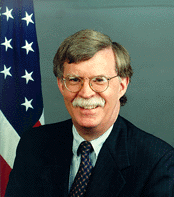
John R. Bolton Ambassador Permanent U.S. Representative to the United NationsMedia Stakeout: Informal comments to the Media by the Permanent Representative of the United States of America, Ambassador John Bolton, on non-proliferation and other matters. 01 September 06, [Webcast: Archived Video - file is real media format, running time is 16:31] FULL STREAMING VIDEO.
Biography, John R. Bolton Ambassador Permanent U.S. Representative to the United Nations

Technorati Tags: and or and , or and or , or and , or ,

Related: Keywords State Department, Monday, September 04, 2006 Condoleezza Rice American Legion Convention VIDEO, PODCAST, TEXT, Thursday, August 31, 2006 United Nations Daily Press Briefing 08/31/06 (VIDEO), Monday, August 28, 2006Media Stakeout Ambassador John Bolton 08/28/06 (VIDEO), Wednesday, August 23, 2006 Iranian Response to the P5+1 Package, Tuesday, August 22, 2006 Media Stakeout Ambassador John Bolton 08/22/06 (VIDEO), Tuesday, August 22, 2006 Media Stakeout Ambassador John Bolton 08/15/06 (VIDEO), Friday, August 18, 2006 State Department Daily Press Briefing, VIDEO, PODCAST, TEXT, 08/17/06, Thursday, August 17, 2006 Media Stakeout Ambassador Anne Woods Patterson Sudan VIDEO, Wednesday, August 16, 2006 Middle East Update 08/16/06 VIDEO, PODCAST, TEXT, Tuesday, August 15, 2006 Media Stakeout Ambassador John Bolton 08/15/06 (VIDEO), Tuesday, August 15, 2006 State Department Daily Press Briefing, VIDEO, PODCAST, TEXT, 08/14/06, Thursday, August 10, 2006 State Department Daily Press Briefing, VIDEO, PODCAST, TEXT, 08/10/06, Saturday, August 12, 2006 UN Adopts Resolution on Lebanon (VIDEO), Friday, August 11, 2006 International Initiative to Combat Kleptocracy VIDEO, PODCAST, TEXT, Thursday, August 10, 2006 State Department Daily Press Briefing, VIDEO, PODCAST, TEXT, 08/10/06, Wednesday, August 09, 2006 Media Stakeout Minister Tarek Mitri Lebanon (VIDEO), Wednesday, August 09, 2006 Media Stakeout Ambassador Dan Gillerman Israel (VIDEO), Wednesday, August 09, 2006 Media Stakeout Ambassador John Bolton (VIDEO), Tuesday, August 08, 2006 Lebanon - Stakeout by Ambassador de La Sablière VIDEO, PODCAST, TEXT, Monday, August 07, 2006 Condoleezza Rice on Mid East Cease-Fire (VIDEO),

Condoleezza Rice American Legion Convention VIDEO, PODCAST, TEXT

Secretary Condoleezza Rice, Remarks at the 88th Annual American Legion Convention, The Salt Palace Convention Center, Salt Lake City, Utah, August 29, 2006Secretary Condoleezza Rice, Remarks at the 88th Annual American Legion Convention, FULL STREAMING VIDEO, file is windows media format PODCAST, file is mp3 in m3u format for streaming playback, DOWNLOAD, file is mp3 format for PODCAST, The Salt Palace Convention Center, Salt Lake City, Utah, August 29, 2006.
SECRETARY RICE: Well, thank you for that warm and generous welcome and thank you, Commander Bock, for the generous introduction. And I want to thank Commander Bock for his leadership of this great organization.

The Commander is serving the American Legion so well. And you, the people of this great organization, are serving our country so well. Perhaps Commander Bock's story is a common one to some of you. I just had the great pleasure of meeting his son, Adam, who served in Operation Iraqi Freedom and he's soon leaving for Afghanistan. And it just shows that America's families are contributing and giving to our nation. Thank you, Commander Bock, for your family's service to our nation.

(Applause.)

I would also like to recognize National Adjutant Robert Spanogle, all of the nations – all of the national officers of the American Legion who are here today, and other distinguished guests.

Ladies and gentlemen, I am so honored to be with you here in Salt Lake City today. As our nation’s largest veterans’ service organization, the American Legion plays a very special role in America’s history and in America's life. The men and women in this hall and others like you have made the greatest of sacrifices: leaving your families, and your friends, and your loved ones to protect America's freedoms, America's democracy, and especially American lives.

It was you, our veterans, who stopped Nazi aggression in Europe and Japanese militarism in Asia during World War II. It was you, our veterans, who fought heroically to contain the spread of communism in Korea and in Vietnam. And it was you, our youngest veterans, whose valiant service has removed old threats and brought new hope to Afghanistan and to Iraq. America owes an immeasurable debt of gratitude to the brave veterans of our nation.

So today, on behalf of President Bush, and all of the American people, I want to thank the members of the American Legion for your service to our country, and I want to join with all of you today in sending this message to our fighting men and women overseas: Your service is bringing hope to others, honor to yourselves, and you are making every American very, very proud.

(Applause.)

Earlier today, I had the opportunity to spend some time with the women of the American Legion Auxiliary, and I want to salute them for their volunteerism, for their patriotism, and for their commitment to the veterans of our country. There are few better examples of the American spirit than the members of the American Legion and of the Auxiliary.

Through your two signature programs, Boys State and Girls State, you’re introducing a new generation of Americans to the principles of the American republic. You’re setting them on a course to become the new leaders of our country. And you’re teaching our youngest citizens to be proud that we Americans are and will always be, "One Nation, under God, indivisible, with liberty and justice for all."

(Applause.)

The service of America’s Legionnaires was especially inspiring one year ago to this day, when our nation suffered the worst natural disaster in our history: Hurricane Katrina. On that day and in those that followed, American Legion Posts all across this country sprang into action to help the residents of our Gulf Coast. In DeRidder, Louisiana, for example, Post 27 turned its bingo hall into an emergency shelter for 41 kidney dialysis patients. And right here in Salt Lake City, Post 71 sent truckloads of clothing to displaced hurricane victims living in Houston.

In times like those, in times of unbearable loss and heartache, the compassion of the American people shines through in groups like the American Legion. And it serves as a beacon to the world and it tells the world that America is proud, America is resilient, and when tragedy brings us to our knees, we will help one another to rise to our feet, united every time.

(Applause.)

I’m especially reminded of America’s resolve in times of adversity, as we come upon the fifth anniversary of September the 11th. That day, America encountered the darker nature of our world, and our nation’s course was profoundly altered. Since September 11th, we have taken the fight to the enemy, and we are making America safer.

Consider the progress we have made: Five years ago, the members of al-Qaida were largely free to operate, to organize, to travel, to move money, to communicate with each other, and to plan attacks to murder innocent people. Today, however, five years later, America is leading a great coalition of countries in the fight against terrorists. Together, we are seizing their money. We’re closing their sanctuaries. We’re hunting their cells. We’re killing and capturing their leaders. Ladies and gentlemen: We are waging a global war on terrorism, and we are breaking the back of the al-Qaida network.

(Applause.)

Because we've gone on the offense, America is safer, but we are not yet safe, as we’ve seen just recently with the foiled terror plot in London. We know that every day, each and every day, violent extremists are plotting new ways to do us harm. And we know that now and for many years to come, America and our allies will be engaged in a long war, a war that we can and must win.

Today, five years after the attack on our nation, people still differ about what September 11th called us to do. On the one hand, if you focus only on the attacks themselves and believe that they were caused by 19 hijackers supported by a network called al-Qaida, operating from a failed state, Afghanistan, then the response can be limited.

But if you believe, as I do, and as President Bush does, that the root cause of September 11th was the violent expression of a global extremist ideology, an ideology that thrives on the oppression and despair of the Middle East, then we must seek to remove this source of terror by helping the people of that troubled region to transform their countries and to transform their lives.

We must be very clear about this broader struggle: Yes, it is a war, but a war of completely new and different dimensions. It is a struggle between the vast majority of moderate Muslims, who desire peace and freedom from oppression, and a small minority of violent extremists that will do whatever it takes to further their ideology of hatred and injustice.

The dream of some, that we could avoid this conflict, that we did not have to take sides in this battle in the Middle East, that dream was demolished on September the 11th. For as we learned on that fateful day, America’s stake in this struggle is very clear: The security of our citizens is inextricably linked to the success of freedom and moderation and, yes, democracy in the Middle East.

(Applause.)

Under President Bush’s leadership, the United States is now standing shoulder to shoulder with moderate men and women all across the Middle East. Together, we are summoning a vision of hope to combat the ideology of extremism that we face. And in the past few years, we have witnessed some unprecedented events.

Five years ago, who could have imagined that a vibrant debate about democratic reform and economic reform and social reform would be raging in every country of the Broader Middle East, a debate not about whether to proceed with reform, but how to proceed? Who could have imagined the positive changes we have already witnessed in places as different as Egypt and Saudi Arabia, and Kuwait and Morocco, and Jordan? Sure, there have been many setbacks and step backs in each of these cases, but the steps forward are also taking place.

And who could have imagined that the people of Lebanon would stand up by the hundreds of thousands and call for the Syrian occupation of their country to end and for a new democratic future to begin? And of course, who could have imagined that the people of Iraq and Afghanistan, after years of tyranny and misery, would turn out by the millions to make their voices heard and to vote for a better life?

These events were remarkable. And they were setbacks for the forces of extremism in the Middle East. But the elections of the previous years only marked the beginnings of a journey to democracy, not its completion.

Advancing the work of democracy, the daily effort to build effective institutions through which all of a country’s citizens can experience justice and exercise power equally, this is a longer and far harder process. And it is made even more difficult because the moderate citizens of the Middle East face violent enemies who are determined to reverse the gains of democracy.

In Afghanistan, the Taliban is terrorizing the Afghan people and trying to stop their democratic progress. But we and our NATO allies are helping the Afghan people, their government, and their army fight them and beat them back. In Lebanon, the radical leaders of Hezbollah launched a war against Israel to undermine the moderate Lebanese Government and to put at risk the lives of the Lebanese people. But now, we and the international community are helping this young democracy to strengthen and to expand its sovereign authority.

In the Palestinian territories, radical elements of Hamas are holding an Israeli soldier hostage, as well as the aspirations of the Palestinian people and their leaders. And of course, in Iraq, we see the same struggle being played out daily, as terrorists and sectarian militias seek to strangle the promise of peace and unity and democracy.

I know that many of you here today have friends and family members who are serving in Iraq. Some of you have served there yourselves. We've all seen stories about Iraq, some positive and inspiring; others, indeed many, that are disheartening and frustrating to hear. I know that Americans are concerned about the course and the future of Iraq. On the one hand, Americans want desperately to succeed in Iraq. They want to do whatever it takes to achieve victory.

But on the other hand, there are unsettling questions. Is success possible? Is it really worth the effort? Do the Iraqi people really want to live together in peace and freedom, the peace and freedom for which our troops have sacrificed so much. Or do they desire a darker path, somehow, of violence?

Ladies and Gentlemen: I am here today to tell you that I am confident that Iraq, Iraqis, and America will succeed.

(Applause.)

When you speak with our fellow citizens who are serving in Iraq and when you ask them why they fight, why they are optimistic and inspired to conduct their mission, I am sure that most of them give you the same answer that I hear from troops when I speak to them, and from members of our diplomatic corps, and other civilians who are there risking their lives in Iraq. Most of these men and women say that what motivates them to do their job every day is the overwhelming hope that they witness in the Iraqi people and the tremendous sacrifices that Iraqis themselves are bearing to realize that hope.

Most Iraqis want what all people want. They want freedom from coercion and oppression, safety from violence and injustice, opportunities for a better life for themselves and for their children. They what a future of peace and moderation for their country, as do the leaders they freely elected in December, who are now serving at great personal risk in Iraq’s national unity government.

To a small number of extremists in Iraq, however, this vision of a moderate, democratic future is an existential threat, because it is one in which their ideology of sectarian hatred will find no support. So these terrorists and these militias resort to unthinkable acts of brutality to drag the country into civil strife and to destroy the hopes of their fellow Iraqis. They target innocent civilians making a religious pilgrimage. They murder people with a certain first name, because it signifies a sectarian difference. And they lay bombs on soccer fields to murder young children, because games like soccer are deemed "idolatrous."

Though the risks to their lives are clear and present, though, Iraqis of every sect and every ethnicity, carried forward in their hope -- and they are pulling together to make a new Iraq succeed. Despite rocket attacks and campaigns of terror, they are building water treatment facilities and laying new roads, and preparing to open classrooms for the start of a new school year. And of course, despite intimidation and assassination and the murder of their friends and loved ones, Iraqis volunteer by the tens of thousands for the new Iraqi Army. And when they find themselves in a fight against terrorists and militias, I am told by our military people that they do not cower and run; they join the battle and they fight until that battle is won.

One American soldier in Iraq, -- Army Major Michael Jason, tells the story of one Iraqi who would wake up at 2 o’clock in the morning, each morning. for months, just to begin the long, dangerous walk to Baghdad to stand in line for an application to the new Iraqi Army. And when he was finally cleared to serve, when he was asked one day why he would risk his life and that of his family to join up, his response was, "I am a soldier and my country needs me." All of you understand that statement and that desire because you have felt it yourselves.

Ladies and Gentlemen, it is that desire for freedom; it is that belief in country and in family that unites us with people in Iraq and Afghanistan and other parts of the Middle East who simply want a better future.

Now in Iraq, we are helping them with a strategy of "clear, hold, and build." It means that with Iraqi forces in the lead and with our strong support, areas are cleared from terrorists and militia control. And this difficult, yet promising work that you are witnessing in Baghdad right now is a part of that effort.

Second, we are helping the Iraqi government to hold the areas we have cleared together; most importantly, by supporting Prime Minister Al-Maliki’s plan for national reconciliation. That plan got a significant boost over the weekend when 100 of Iraq’s tribal leaders signed a "pact of honor," declaring that they would do what they could to stop the sectarian killings that have plagued Iraq.

Finally, we are helping the government and the people of Iraq to rebuild their country. The keystone of this effort is a compact which will rally new international support for Iraqi reconstruction as the Iraqi government proceeds with democratic and political reform.

Ladies and gentlemen, this strategy can succeed and it will succeed, but if we quit before the job is done, the cost of failure will be severe; indeed, immeasurable. If we abandon the Iraqi people, before their government is strong enough to secure the country, then we will show reformers across the region that America cannot be trusted to keep its word. We will embolden extremist enemies of moderation and of democratic reform. We will leave the makings of a failed state in Iraq, like that one in Afghanistan in the 1990s, which became the base for al-Qaida and the launching pad for the September 11th hijackers. And we should not assume for one minute that those terrorists will not continue to come after the American homeland. That is why President Bush calls Iraq a central front in the war on terror.

I know that the struggle before us sometimes seems daunting. I know. I feel it. I see it in the challenged eyes of Americans across this great country. But I know too that America has a proud tradition of struggling with others and helping them to secure their freedom. This tradition is embodied in the members of the American Legion and I know many of you, like me, can also remember extraordinary times in history when American leadership and American perseverance and American resolve were required. We stood strong and we must stand strong now.

All of us know, as we look back on history, that there were things that seemed impossible at the time that, in retrospect, seemed quite inevitable. Last summer, I spent some time reading the biographies of our founding fathers. By all rights, the United States of America, facing the greatest imperial power of the time, simply should never have come into being. This past summer, I read a wonderful book about Abraham Lincoln and the civil war. By all rights, this country should never have survived our violent division to come back united and free.

The last time I was in government, I was fortunate enough to serve at the end of the Cold War and I was there for the unification of Germany and the liberation of Eastern Europe and for the peaceful breakup of the Soviet Union, events to which many of you contributed in the steadfastness that you exhibited during the Cold War.

But you know, again, in looking back, I know that that victory was assured not in 1989 and in 1990 and 1991, but in 1946 and 1947, and 1948 and 1949, when in the aftermath of World War II, Europe was devastated and prostrate and the Soviet Union seemed on the march; when in 1947, there was civil war in Greece and civil conflict in Turkey; when Germany was permanently divided in 1948 by the Berlin crisis, Czechoslovakia fell to communist coup; and in 1949, the Soviet Union exploded a nuclear weapon five years ahead of schedule, and the Chinese communists won and a year later, the Korean War broke out.

Who would have thought in 1946 or 1947, or 1948 or 1949, or 1950 that by 1991, we would be celebrating the victory of free men and women over communism? But indeed, we were and it was because of the steadfastness and the commitment of America, of our men and women in uniform, of our leaders, and indeed of the American people to a cause greater than ourselves. Because we knew that only when the world was freer would America be so secure. Now, no one can imagine war again in Europe, and no one imagines war against Japan or in Asia, but in 1949, it didn't seem that way.

I submit to you that if we stay strong, if we stay committed, if we remain true to our values, that one day, people will look back and they will say, "Who could ever have doubted that of course, the universal values of democracy and freedom would take hold in the Middle East?" And they will say, "Who could have ever doubted that the people of Iraq and Afghanistan would be free?" And they will look back and they will say, "Thank God that America stayed the course."

Thank you.

(Applause.)

2006/T21-2, Released on August 29, 2006,

Technorati Tags: and or and , or and or , or and ,

Related: Keywords State Department, Thursday, August 31, 2006 United Nations Daily Press Briefing 08/31/06 (VIDEO), Monday, August 28, 2006Media Stakeout Ambassador John Bolton 08/28/06 (VIDEO), Wednesday, August 23, 2006 Iranian Response to the P5+1 Package, Tuesday, August 22, 2006 Media Stakeout Ambassador John Bolton 08/22/06 (VIDEO), Tuesday, August 22, 2006 Media Stakeout Ambassador John Bolton 08/15/06 (VIDEO), Friday, August 18, 2006 State Department Daily Press Briefing, VIDEO, PODCAST, TEXT, 08/17/06, Thursday, August 17, 2006 Media Stakeout Ambassador Anne Woods Patterson Sudan VIDEO, Wednesday, August 16, 2006 Middle East Update 08/16/06 VIDEO, PODCAST, TEXT, Tuesday, August 15, 2006 Media Stakeout Ambassador John Bolton 08/15/06 (VIDEO), Tuesday, August 15, 2006 State Department Daily Press Briefing, VIDEO, PODCAST, TEXT, 08/14/06, Thursday, August 10, 2006 State Department Daily Press Briefing, VIDEO, PODCAST, TEXT, 08/10/06, Saturday, August 12, 2006 UN Adopts Resolution on Lebanon (VIDEO), Friday, August 11, 2006 International Initiative to Combat Kleptocracy VIDEO, PODCAST, TEXT, Thursday, August 10, 2006 State Department Daily Press Briefing, VIDEO, PODCAST, TEXT, 08/10/06, Wednesday, August 09, 2006 Media Stakeout Minister Tarek Mitri Lebanon (VIDEO), Wednesday, August 09, 2006 Media Stakeout Ambassador Dan Gillerman Israel (VIDEO), Wednesday, August 09, 2006 Media Stakeout Ambassador John Bolton (VIDEO), Tuesday, August 08, 2006 Lebanon - Stakeout by Ambassador de La Sablière VIDEO, PODCAST, TEXT, Monday, August 07, 2006 Condoleezza Rice on Mid East Cease-Fire (VIDEO), Friday, August 04, 2006 Condoleezza Rice to the People of Cuba VIDEO, PODCAST, TEXT, Wednesday, July 26, 2006 State Department Daily Press Briefing, VIDEO, PODCAST, TEXT, 07/26/06,

Sunday, September 03, 2006

Atmospheric Ozone Shows Signs of Recovery

Sun Shield: Report Shows Signs of Recovery in Atmospheric Ozone that Protects Earth from Ultraviolet Radiation

Concentrations of atmospheric ozone -- which protects Earth from the sun’s ultraviolet radiation -- are showing signs of recovery in the most important regions of the stratosphere above the mid-latitudes in both the Northern and Southern hemispheres, a new study shows. Image Courtesy of NASA.Concentrations of atmospheric ozone -- which protects Earth from the sun’s ultraviolet radiation -- are showing signs of recovery in the most important regions of the stratosphere
above the mid-latitudes in both the Northern and Southern hemispheres, a new study shows.
This chart represents the accumulation of total organic chlorine (number per billion atmospheric molecules) in the lower atmosphere. It plots the changing contributions from human-made chlorofluorocarbons (CFCs), chlorinated solvents and the replacements for these compounds (called the HCFCs)This chart represents the accumulation of total organic chlorine (number per billion atmospheric molecules) in the lower atmosphere. It plots the changing contributions from human-made chlorofluorocarbons (CFCs), chlorinated solvents and the replacements for these compounds (called the HCFCs).
Also shown is the almost-constant contribution from chloromethanes, which are mostly produced by natural processes. The data is derived from continuous sampling of Earth’s atmosphere since 1978 at five remote locations around the world by the Advanced Global Atmospheric Gases Experiment (AGAGE), which is sponsored by NASA. Chart Courtesy Derek Cunnold Download 300 dpi version.
Authors of the paper, Eun-Su Yang and Derek Cunnold, pose outside their research building on the Georgia Institute of Technology campus in Atlanta.Researchers attribute the improvement to both a reduction in ozone-depleting chemicals phased out by the global Montreal Protocol treaty and its amendments and to changes in atmospheric transport dynamics.
The study, funded by NASA, is the first to document a difference among stratospheric regions in ozone-level improvement and to establish a cause-and-effect relationship based on direct measurements by multiple satellite and ground-based, ozone-monitoring systems.
NASA’s Upper Atmosphere Research Satellite carried the Halogen Occultation Experiment (HALOE) instrument, which measures simultaneous vertical profiles of ozone, hydrogen chloride, hydrogen fluoride, methane, water vapor, nitric oxide, nitrogen dioxide, temperature and aerosols. Researchers led by the Georgia Institute of Technology used HALOE data to assess stratospheric ozone changes.Image Courtesy of NASA.NASA’s Upper Atmosphere Research Satellite carried the Halogen Occultation Experiment (HALOE) instrument, which measures simultaneous vertical profiles of ozone, hydrogen chloride, hydrogen fluoride, methane, water vapor, nitric oxide, nitrogen dioxide, temperature and aerosols. Researchers led by the Georgia Institute of Technology used HALOE data to assess stratospheric ozone changes. Image Courtesy of NASA.
“We do think we’re on the road to recovery of stratospheric ozone, but what we don’t know is exactly how that recovery will happen,” said Derek Cunnold, a professor of earth and atmospheric sciences at the Georgia Institute of Technology. “Many in the scientific community think it will be at least 50 years before ozone levels return to the pre-1980 levels when ozone began to decline.”

The research results will be published Sept. 9, 2006 in the American Geophysical Union’s Journal of Geophysical Research—Atmospheres. Georgia Tech research scientist Eun-Su Yang led the study in close collaboration with Cunnold, Ross Salawitch of NASA's Jet Propulsion Laboratory at the California Institute of Technology, M. Patrick McCormick and James Russell III of Hampton University, Joseph Zawodny of NASA Langley Research Center, Samuel Oltmans of the NOAA Earth System Research Laboratory and Professor Mike Newchurch at the University of Alabama in Huntsville.

NASA's News Release and Ozone Resources Page , The study’s data indicate that atmospheric ozone has stopped decreasing in one region and is actually increasing in the other of the two most important lower regions of the stratosphere

Scientists attribute the stabilization of ozone levels in the past decade in the 11- to 15-mile (18- to 25-kilometer) altitude region to the Montreal Protocol, enacted in 1987, and its amendments. The treaty phased out the use of ozone-depleting chemicals, including chlorofluorocarbons (CFCs) emitted from such sources as spray-can propellants, refrigerator coolants and foam insulation.

In the 7- to 11-mile (11- to 18-kilometer) region, the researchers link a slight increase in ozone to changes in atmospheric transport – perhaps caused by natural variability or human-induced climate warming – rather than atmospheric chemistry. The changes in this altitude range – below the region where ozone-depleting gases derived from human activity are thought to cause ozone depletion – contribute about half of the overall-measured improvement, researchers said.

“There is now widespread agreement in the scientific community that ozone is leveling off in the 18- to 25-kilometer region of the stratosphere because of the Montreal Protocol,” Cunnold said. “And we believe there is some tendency toward an increase in ozone in this region, though further study is needed to be certain.

“In the 11- to 18-kilometer region, ozone is definitely increasing because of changes in atmospheric dynamics and transport not related to the Montreal Protocol,” he added. “But we don’t know the long-term effect this change will have in this region.”

Other recent studies complement these new findings. Among them are a study published in 2003 in the Journal of Geophysical Research, which reported a slowdown in the ozone depletion rate in the upper stratosphere at about 22 to 28 miles altitude (35 to 45 kilometers). Newchurch at the University of Alabama in Huntsville led this study in collaboration with: Cunnold, his former Ph.D. advisor; Yang, his former Ph.D. student; and other prominent scientists. Newchurch is also an author on the current paper.

More recently, a study published in the journal Nature on May 3, 2006 indicated a stabilization and slight increase in the total-column stratospheric ozone in the past decade. This work, led by Betsy Weatherhead at the University of Colorado at Boulder, relied on satellite and ground-based ozone data used in 14 modeling studies done by researchers around the world. She and her colleagues also attributed the changes to the Montreal Protocol, but could not separate treaty-related changes from transport-related changes because of limited information available on ozone variations by height.

In the current study, Yang, Cunnold and their co-authors reached their conclusions based on satellite and ground-based atmospheric ozone measurements. They analyzed a tremendous amount of data from three extremely accurate NASA satellite’s instruments (SAGE I and II and HALOE) that began collecting data in 1979 and continued until 2005, with the exception of a three-year period in the early 1980s. Ground-based ozone measurements taken by NASA and NOAA from 1979 to 2005 and balloons provided essential complementary data for the study, Yang said. The satellites and the balloons measured ozone levels by atmospheric region. The ground-based data recorded measurements for the total ozone column.

“The ground-based measurements were especially important for the lower atmosphere because satellites can have difficulty in sensing the lowest regions,” Yang said.

Salawitch, a senior research scientist at NASA’s Jet Propulsion Laboratory, noted: “Our study provides a quantitative measure of a key fingerprint that is lacking in earlier studies -- the response of the ozone layer as function of height. We reconcile the height-dependent response with observations from other instruments that record variations in total-column ozone."

To accurately attribute the ozone level changes to the Montreal Protocol, researchers had to account for long- and short-term natural fluctuations in ozone concentration, Cunnold noted. One such fluctuation is an 11-year solar cycle, and another is a two-year oscillation that occurs in the tropics, but affects ozone in other latitudes because of atmospheric transport. Despite the natural fluctuations, Yang, Cunnold and their co-authors are very confident in the conclusions they reached from the data they analyzed.

“We know from the study we’ve just published that the Montreal Protocol -- the first major global agreement related to atmospheric change -- is working,” Cunnold said.

A new NASA satellite called Aura is continuing to measure ozone in various regions of the stratosphere, and these same researchers are involved in the ongoing study of the ozone layer using the satellite’s data.

RESEARCH NEWS & PUBLICATIONS OFFICE Georgia Institute of Technology 75 Fifth Street, N.W., Suite 100 Atlanta, Georgia 30308 USA

MEDIA RELATIONS CONTACTS: 1) Jane Sanders (404-894-2214); E-mail: (jane.sanders@innovate.gatech.edu); Fax (404-894-4545);2) John Toon (404-894-6986); E-mail: (jtoon@gatech.edu); 3) Philip Gentry, UA-Huntsville (256-824-6420); E-mail: (gentryp@uah.edu); 4) Alan Buis, JPL (818-354-0474); E-mail: (alan.buis@jpl.nasa.gov); 5) Harvey Leifert, American Geophysical Union (202-777-7507); E-mail: (hleifert@agu.org)

TECHNICAL CONTACTS:1) Derek Cunnold (404-894-3814); E-mail: cunnold@eas.gatech.edu 2) Eun-Su Yang (404-894-3886); E-mail: eun-su.yang@eas.gatech.edu 3) Mike Newchurch, UAH (256-961-7825); E-mail: mike@nsstc.uah.edu 4) Ross Salawitch, JPL (818-354-0442); E-mail: rjs@caesar.jpl.nasa.gov

WRITER: Jane Sanders, A copy of the paper to be published Sept. 9, 2006 in the Journal of Geophysical Research--Atmospheres is available from Jonathan Lifland atmailto:jlifland@agu.edu or 202-777-7535. Color photos of Cunnold and Yang are available from the Georgia Tech media relations contacts listed above.

For Immediate Release, August 30, 2006

Technorati Tags: or and or and or and or

RELATED: Keyword biology, Sunday, August 27, 2006 Population Growth, Environmental Degradation, Sunday, August 13, 2006 religious garment defines a new generation of women, Sunday, August 13, 2006 Multiracial congregations offer different social ties, Sunday, August 06, 2006 Scientists develop artwork that changes to suit your mood, Sunday, August 06, 2006 Washington, DC getting a summertime air quality exam, Sunday, July 30, 2006 The World Map of Happiness, Sunday, July 23, 2006 The Occult Life of Things, Sunday, July 23, 2006 Why we could all do with a siesta, Sunday, July 16, 2006 Hope I die before I get old?, Sunday, July 09, 2006 People more likely to help others they think are 'like them!, Sunday, July 09, 2006 Jefferson Team Designs Program that Helps Elderly Live Longer, Sunday, July 02, 2006 Gabapentin cools hot flashes as well as estrogen, Sunday, June 25, 2006 Estrogen plays different role during stress in black and white teens, Sunday, June 25, 2006 Our grip on reality is slim, Sunday, May 21, 2006 Genome doesn't start with 'G', Sunday, May 07, 2006 Lying Is Exposed By Micro-Expressions We Can't Control, Sunday, April 30, 2006 Mothers often have inaccurate perceptions of their children's body weight, Sunday, April 16, 2006 Other people influence us and we don't even know it!, Tuesday, January 04, 2005 The Cassini-Huygens mission to Saturn, Sunday, March 20, 2005 Agriculture Secretary Mike Johanns, bovine spongiform encephalopathy (BSE), Thursday, March 24, 2005 Fish Oil Holds Promise in Alzheimer's Fight, Sunday, April 10, 2005 National Human Genome Research Institute (NHGRI), Friday, April 15, 2005 Study uncovers bacteria's worst enemy ,

Saturday, September 02, 2006

Freedom Calendar 09/02/06 - 09/09/06

September 2, 1910, Administration of Republican George Alexander, Mayor of Los Angeles, makes Alice Wells first woman police officer in America.

September 3, 1868, 25 African-Americans in Georgia legislature, all Republicans, expelled by Democrat majority; later reinstated by Republican Congress.

September 4, 2001, Republican U.S. Senate selects Alfonso Lenhardt as first African-American Sergeant at Arms.

September 5, 1883, After reforms implemented by Republican President Chester Arthur, Mary Hoyt becomes first woman federal civil service appointee.

September 6, 1870, Women vote in Wyoming, in first election after women’s suffrage signed into law by Republican Gov. John Campbell.

September 7, 1969, Death of Senate Republican Leader Everett Dirksen (R-IL), who authored 1960 Civil Rights Act and led passage of 1964 Civil Rights Act.

September 8, 2003 ,Speaking five decades after Brown v. Board of Education, President George W. Bush challenges teachers’ unions to embrace standards in inner-city education: “This society of ours must challenge the soft bigotry of low expectations”.

September 9, 1957, President Dwight Eisenhower signs Republican Party’s 1957 Civil Rights Act

"We should reach each and every one in the State, so they would all register and vote for the Republican candidates.”

Mary Terrell, African-American Republican and co-founder of the NAACP

SOURCE: Republican Freedom Calendar

Technorati Tags: and or and or and or and or and or or and or

Related: Keywords Freedom Calendar, Saturday, August 26, 2006 Freedom Calendar 08/26/06 - 09/02/06, Saturday, August 19, 2006 Freedom Calendar 08/19/06 - 08/26/06, Saturday, August 12, 2006 Freedom Calendar 08/12/06 - 08/19/06, Saturday, August 05, 2006 Freedom Calendar 08/05/06 - 08/12/06, Saturday, July 29, 2006 Freedom Calendar 07/29/06 - 08/05/06, Saturday, July 22, 2006 Freedom Calendar 07/22/06 - 07/29/06, Saturday, July 15, 2006 Freedom Calendar 07/15/06 - 07/22/06, Saturday, July 08, 2006 Freedom Calendar 07/08/06 - 07/15/06, Saturday, July 01, 2006 Freedom Calendar 07/01/06 - 07/08/06, Saturday, June 24, 2006 Freedom Calendar 06/24/06 - 07/01/06, Saturday, June 17, 2006 Freedom Calendar 06/17/06 - 06/24/06, Saturday, June 10, 2006 Freedom Calendar 06/10/06 - 06/17/06, Sunday, June 04, 2006 Freedom Calendar 06/03/06 - 06/10/06, Saturday, May 27, 2006 Freedom Calendar 05/27/06 - 06/03/06, Saturday, May 20, 2006 Freedom Calendar 05/20/06 - 05/27/06, Saturday, May 13, 2006 Freedom Calendar 05/13/06 - 05/20/06, Saturday, May 06, 2006 Freedom Calendar 05/06/06 - 05/13/06, Saturday, April 29, 2006 Saturday, April 22, 2006 Freedom Calendar 04/22/06 - 04/29/06, Saturday, April 15, 2006 Freedom Calendar 04/15/06 - 04/22/06,

Presidential Podcast 09/02/06

Presidential Podcast 09/02/06 en Español

Click here to Subscribe to Our Republican National Convention Blog Podcast Channel with Odeo Subscribe to Our Odeo or Click here to Subscribe to Our Republican National Convention Blog Podcast Channel with Podnova podnova Podcast Channel and receive the weekly Presidential Radio Address in English and Spanish with select State Department Briefings. Featuring real audio and full text transcripts, More content Sources added often so stay tuned.

Technorati Tags: and or and or and or and or and

RELATED: Keywords radio address, podcast, Saturday, August 26, 2006 Presidential Podcast 08/26/06, Saturday, August 19, 2006 bush radio address 08/26/06 full audio, text transcript, Saturday, August 12, 2006 Presidential Podcast 08/12/06, Saturday, August 05, 2006 Presidential Podcast 08/05/06, Saturday, July 29, 2006 Presidential Podcast 07/29/06, Saturday, July 15, 2006 Presidential Podcast 07/15/06, Monday, July 10, 2006 Presidential Podcast 07/08/06, Saturday, July 01, 2006 Presidential Podcast 07/01/06, Saturday, June 24, 2006 Presidential Podcast 06/24/06, Saturday, June 17, 2006 Presidential Podcast 06/17/06, Saturday, June 10, 2006 Presidential Podcast 06/10/06, Saturday, June 03, 2006 Presidential Podcast 06/03/06, Saturday, May 27, 2006 Presidential Podcast 05/27/06, Saturday, May 20, 2006, Presidential Podcast 05/20/06, Saturday, May 13, 2006 Presidential Podcast 05/13/06, Saturday, April 22, 2006 Presidential Podcast 04/22/06, Saturday, April 15, 2006 Presidential Podcast 04/15/06, Saturday, April 08, 2006 Presidential Podcast 04/08/06, Saturday, Saturday, April 01, 2006 Presidential Podcast 04/01/06, March 18, 2006 Presidential Podcast 03/18/06, Saturday, March 11, 2006 bush radio address 03/11/06 full audio, text transcript, Saturday, March 04, 2006 bush radio address 03/04/06 full audio, text transcript,