Saturday, September 09, 2006

Discurso Radial del Presidente a la Nación 09/09/06

Presidente George W. Bush llama a tropas de su rancho en Crawford, Tejas, día de Thanksgiving, jueves, de noviembre el 24 de 2005.  Foto blanca de la casa de Eric Draper.forre el audio de la dirección de radio 09/09/06 por completo, transcripción del texto. PODCAST

Discurso Radial del Presidente. en Español
Chascar aquí para suscribir a nuestro canal republicano de Blog Podcast de la convención nacional con Odeo Suscribir a nuestro canal de Podcast de Odeo o del podnova Chascar aquí para suscribir a nuestro canal republicano de Blog Podcast de la convención nacional con Podnova y recibir la dirección de radio presidencial semanal en inglés y español con informes selectos del departamento del estado. Ofreciendo transcripciones audio y con texto completo verdaderas, más fuentes contentas agregaron a menudo así que la estancia templó.

Buenos Días. Este lunes nuestra Nación marcará el quinto aniversario de los ataques del 11 de Septiembre, 2001. En esta ocasión solemne, los estadounidenses observarán un día de oración y recuerdo - y Laura y yo viajaremos a la Ciudad de Nueva York, a Pensilvania y al Pentágono, para tomar parte en ceremonias conmemorativas. Nuestra Nación honra la memoria de cada persona que perdimos en ese día de terror. Y le rogamos al Todopoderoso que siga consolando a las familias a quienes tanto se les quitó.

En este aniversario, también recordamos la brutalidad del enemigo que atacó a nuestro país - y renovamos nuestra determinación de derrotar a este enemigo y asegurar un futuro de paz y de libertad. Por lo tanto, esta semana yo he dado una serie de discursos sobre la naturaleza de nuestro enemigo, los intereses que están en juego en esta lucha y el progreso que hemos logrado durante los últimos cinco años.

El martes en Washington describí lo que los terroristas creen en sus propias palabras, lo que desean lograr y cómo piensan lograrlo. Sabemos las intenciones de los terroristas, pues ellos nos las han dicho. Quieren establecer un imperio islámico totalitario a través del Medio Oriente - que ellos llaman un "Califato" - donde todos serían gobernados según su ideología odiosa. Osama bin Laden ha llamado a los ataques del 11 de Septiembre, y cito, "un gran paso hacia la unidad de los musulmanes y hacia establecer el (Califato) Justo". Al Qaeda y sus aliados rechazan toda posibilidad de co-existencia con los que ellos llaman "infieles". Escuchen las palabras de Osama bin Laden: "La muerte es mejor que vivir en esta tierra con los no-creyentes entre nosotros."

Tenemos que tomar en serio las palabras de estos extremistas - y debemos actuar decisivamente para evitar que logren sus propósitos nefastos. El miércoles en la Casa Blanca, describí por primera vez un programa de la CIA que establecimos después del 11 de septiembre para detener e interrogar a líderes y operativos terroristas claves - a fin de poder evitar nuevos ataques terroristas. Este programa ha sido inestimable para la seguridad de Estados Unidos y sus aliados, y nos ayudó a identificar y capturar a hombres que nuestra comunidad de inteligencia considera haber sido arquitectos claves en los ataques del 11 de Septiembre. Información obtenida de terroristas en manos de la CIA también nos ayudó a descubrir los esfuerzos de una celda al Qaeda para obtener armas biológicas, identificar a personas enviadas por al Qaeda para buscar objetivos para ser atacados en los Estados Unidos, detener un ataque planeado contra un campo de la Infantería de Marina de Estados Unidos en Djibouti, evitar un ataque contra el consulado de Estados Unidos en Karachi y ayudar a desbaratar un complot para secuestrar aviones de pasajeros y hacerlos estrellar en el aeropuerto de Heathrow o en el sector Canary Wharf de Londres.

Información obtenida de terroristas bajo la custodia del la CIA también jugó un papel en la captura o interrogación de casi todos los miembros o asociados superiores de al Qaeda detenidos por los Estados Unidos y sus aliados desde que este programa comenzó. De no ser por este programa, nuestra comunidad de inteligencia considera que al Qaeda y sus aliados habrían logrado lanzar otro ataque contra el territorio estadounidense.

En gran medida hemos terminado nuestra interrogación de estos hombres - y ahora es tiempo de que sean juzgados por sus crímenes. Por lo tanto esta semana anuncié que los hombres que creemos haber sido los responsables de los ataques del 11 de Septiembre habían sido transferidos a la Bahía de Guantánamo - y le pedí al Congreso que aprobara legislación para crear comisiones militares para juzgar a los terroristas sospechados de crímenes de guerra. En seguida que el Congreso autorice estas comisiones militares, enjuiciaremos a estos hombres y enviaremos un mensaje muy claro a aquellos que matan a estadounidenses: no importa cuanto tiempo tome, los encontraremos y los enjuiciaremos.

A medida que traemos a los terroristas ante la justicia, estamos actuando para asegurar el territorio nacional. El jueves en Atlanta presenté un informe de progreso sobre los pasos que hemos tomado desde el 11 de Septiembre para proteger al pueblo estadounidense y ganar la guerra contra el terror. Estamos más seguros hoy porque hemos actuado para remediar las brechas de seguridad, de inteligencia y en el compartir información, de las cuales se aprovecharon los terroristas en sus ataques del 11 de Septiembre. Nadie puede decir con certeza que hubiéramos podido evitar los ataques de haber estado en vigor estas reformas en el 2001. Sin embargo, sí podemos decir que para los terroristas hubiera sido más difícil planificar y financiar sus operaciones, más difícil entrar a nuestro país sin ser detectados y más difícil abordar los aviones, tomar control de las cabinas y poder dar con sus objetivos.

Estados Unidos todavía enfrenta a enemigos decididos - y a largo plazo, derrotar a estos enemigos exige más que una mejor seguridad en casa y acción militar en el extranjero. También debemos ofrecer una alternativa prometedora a la ideología de odio de los terroristas. Por lo tanto Estados Unidos se está poniendo del lado de líderes democráticos y de reformadores, y apoyando las voces de la tolerancia y moderación a lo largo del Medio Oriente. Proponiendo la libertad y la democracia como las grandes alternativas a la represión y al radicalismo, y apoyando jóvenes democracias como Irak, estamos ayudando a traer un futuro más prometedor a esta región - y eso hará más seguro a Estados Unidos y al mundo.

La guerra contra el terror será larga y difícil - y quedan por delante más días duros. Sin embargo podemos confiar en el desenlace final - porque sabemos lo que Estados Unidos puede lograr cuando nuestra Nación actúa con determinación y claridad de propósito. Con vigilancia, determinación y valentía, derrotaremos a los enemigos de la libertad, y dejaremos atrás un mundo más pacífico para nuestros hijos y nuestros nietos.

Gracias por escuchar.

###, Para su publicación inmediata, Oficina del Secretario de Prensa, 9 de septiembre de 2006

Etiquetas De Technorati: , y , o y , o , o y o y o

Relacionado: Dirección de radio de las palabras claves, podcast, Sábado 2 de septiembre de 2006 Discurso Radial del Presidente a la Nación 09/02/06, Sábado 26 de agosto de 2006 Discurso Radial del Presidente a la Nación 08/26/06, Sábado 12 de agosto de 2006 Discurso Radial del Presidente a la Nación 08/19/06, Sábado 12 de agosto de 2006 Discurso Radial del Presidente a la Nación 08/12/06, Sábado 5 de agosto de 2006 Discurso Radial del Presidente a la Nación 08/05/06, Sábado 29 de julio de 2006 Discurso Radial del Presidente a la Nación 07/29/06, Sábado 22 de julio de 2006 , Sábado 15 de julio de 2006 Discurso Radial del Presidente a la Nación 07/15/06 Lunes 10 de julio de 2006 Discurso Radial del Presidente a la Nación 07/08/06, Sábado 1 de julio de 2006 Discurso Radial del Presidente a la Nación 07/01/06, Sábado 24 de junio de 2006 Discurso Radial del Presidente a la Nación 06/24/06, Sábado 17 de junio de 2006 Discurso Radial del Presidente a la Nación 06/17/06, Sábado 10 de junio de 2006 Discurso Radial del Presidente a la Nación 06/10/06, Lunes 5 de junio de 2006 Discurso Radial del Presidente a la Nación 06/03/06, Miércoles 31 de mayo de 2006 Discurso Radial del Presidente a la Nación 05/27/06, Sábado 20 de mayo de 2006 Discurso Radial del Presidente a la Nación 05/20/06, Sábado 13 de mayo de 2006 Discurso Radial del Presidente a la Nación 05/13/06, Sábado 6 de mayo de 2006 Discurso Radial del Presidente a la Nación 05/06/06 , Sábado 29 de abril de 2006 Discurso Radial del Presidente a la Nación 04/29/06,

Friday, September 08, 2006

Update on Detainee Issues and Military Commissions Legislation (AUDIO)

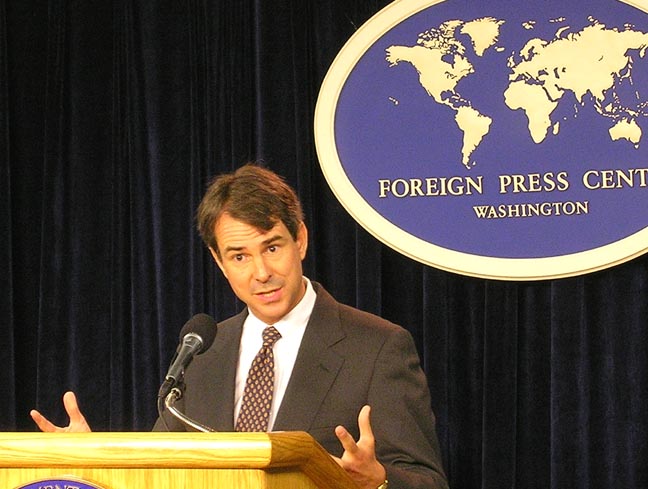
John Bellinger III, State Department Legal Advisor at Washington Foreign Press Center Briefing on Update on Detainee Issues and Military Commissions Legislation John Bellinger III, State Department Legal Advisor.
Foreign Press Center Briefing Washington, DC September 7, 2006, 10:00 A.M. EDT Real Audio of Briefing

MR. BAILY: Good morning and welcome to the Foreign Press Center. This morning the State Department's Legal Advisor John Bellinger will be discussing the issues of detainees and the legislation that the administration has proposed to the Congress regarding military commissions. He will make a brief opening statement and then be happy to take your questions.

MR. BELLINGER: Nice to be with you. Sorry I am late. Actually, I'll speak a little bit more broadly than just on the Military Commission legislation and really on the President's entire set of remarks yesterday.

I think some DOD briefers will be available this afternoon to talk in more detail about the Defense Department directive, the Army Field Manual and the Military Commission legislation. So they will get into some more detail. But I'm happy to answer as many questions as I can about the President's statement yesterday.

The President's statement was a comprehensive statement on all aspects of detainee policy. It was intended to be as such to address as many of the issues relating to detainee policy as we could in a major Presidential address and to -- particularly to speak to the international community as well on these issues, and I'll say something about that in a moment.

There were many parts to the President's address. The -- of course, the headline is that he announced that all of the individuals who had been held in classified locations by the CIA around the world had been, by the time of the President's speech moved to Guantanamo Bay, Cuba, fourteen individuals, high-level al-Qaida planners and operatives including those directly responsible for planning 9/11, the attacks on the Cole, the attacks on our embassy people who committed acts of terrorism themselves, all moved to Guantanamo. And the President announced that he wants them to be brought to justice before the Military Commissions.

He said that at this point there are no individuals left in CIA custody anywhere in the world. These 14 were the remaining individuals now all in Guantanamo Bay where the ICRC will have access to them. They will have their full panoply of legal rights and will be treated just like anybody else in Guantanamo Bay.

Shortly before the President's remarks, Secretary Rice called President Kellenberger of ICRC to tell him that, that the ICRC would be able to have access to the individuals there. We are working out the modalities of that.

In addition, the President reiterated again his desire that Guantanamo be closed and that he wanted to rapidly move towards that day. He again reminded the audience that closing Guantanamo is difficult, that other countries have not agreed to take back their nationals or to provide sufficient either human rights assurances or security assurances, that the people would not pose a threat or would be treated humanely. But the President will work on those efforts and wants to reach the day that Guantanamo can be closed.

The President also emphasized legal changes that have been being made, that our processes and laws have evolved. He reiterated that he supported the McCain amendment, will abide by the McCain amendment. He mentioned that the Defense Department had, as of yesterday, issued a new Army Field Manual on interrogation techniques that will cover anyone in Defense Department custody anywhere in the world and that those would address any of these questions about what the interrogation techniques are, their uniformity or consistency. Those are now out there. A new Defense Department directive on the treatment of detainees, making clear that we will comply with Common Article 3 for those individuals who are not prisoners of war are protected persons. So that's the standard for anyone in Defense Department custody anywhere in the world.

He also said that he was submitting yesterday legislation to the Congress to authorize military commission legislations consistent with the Supreme Court's ruling in the Hamdan case and that he wanted to work with Congress to finish the legislation as quickly as possible so that, in particular, the 14 new individuals brought to Guantanamo could be tried for their crimes. He also described in significant detail previously classified information about the CIA's special program to gather intelligence from a very small number of high-level al-Qaida individuals. He laid out the specialized training for those CIA personnel who engage in this program and the very narrow set of individuals against whom it was directed.

He said that he believes that that program will need to continue in the future to collect information from al-Qaida members if we capture them in the future and said, though, that he would consult with Congress on the parameters of that program and that it, of course, would have to be consistent with existing law -- the McCain amendment and Common Article 3.

He then laid out the details of information that we had obtained from the individuals who had been in CIA custody, including those moved to Guantanamo, and in significant detail in his speech talked about how the information that they had provided had led to the unraveling of terrorist plots both in the United States and around the world. He made clear that information obtained through this program was shared with our allies around the world and had averted plots in various places, including in Europe; that thousands of lives had been saved as a result of information that had been obtained from these individuals. The CIA, I will say, has separately released a fact sheet that I think you've seen that lays out the details of the different plots that were uncovered.

And then finally, the President spoke directly to the international community. The penultimate paragraph of the President's speech emphasizes that he has spoken to world leaders about issues in the war on terrorism, particularly concern, and he has listened to the concerns raised by other countries about some of our policies, including in Guantanamo, and detention policies that he says specifically we are a nation of laws and that as we work to strengthen and clarify our laws at home to address these difficult problems of dealing with terrorists, that he will also work with other countries around the world. And that he wants to work together with the international community to build a common foundation that will allow us to attack these problems together.

So it was a comprehensive statement on all aspects of detainee policy, recognizing that five years after September 11th that our policies, our laws, our procedures, have evolved; that now is the time to bring to justice those individuals who are in our custody and who have committed crimes so that they can be tried before military commissions. And he tried to address as many of the different issues that are out there.

So with that, I am happy to take you questions.

MR. BAILY: Yes, ma'am.

QUESTION: I am Katja Gloger with Stern Magazine from Germany. Good morning. I am wondering about the military commissions. Is it true that the information obtained through coercive interrogation methods could be used during those trials? And if so, how could you guarantee a fair trial for those persons?

MR. BELLINGER: Information that's derived from torture is specifically prohibited, may not be used in the trials. The information that is derived from coercion could be used but only if the judge who is presiding over the trial determines that use of that information would not deny the individual a fair trial.

We looked specifically at this question of whether information derived from "coercion" should simply be prohibited. The problem is that being in custody and being questioned is inherently coercive and so if that would immediately set up someone saying because I was incarcerated and being questioned, that was coercive so you can't admit anything. So we have got a balancing test that says that if information that the accused believes is coercive is admitted that the judge will then determine whether that information may be admitted, and if the judge determines that it would deny the individual a right to a fair trial it would not be admitted.

QUESTION: Can I follow that up?

MR. BELLINGER: Yeah.

MR. BAILY: But wait for the mike, please.

QUESTION: Barry Schweid, Associated Press. On your last point, what is -- is this a sua sponte decision, legal decision, by the Administration? Is there some legal basis for leaving leeway for coercively obtained information to be used? You put the emphasis on a fair trial. Wouldn't the emphasis be as a defendant or a defendant been mistreated and that pro forma, that on its face, requires acquittal? In other words, where you do you get the -- where does the U.S. Government get this formula, this typically is a lot of words like "balancing?" Where do you get this balancing act? Where does it derive from?

Frankly, in the whole darn thing, if you could address this for a little bit, the whole system of jails and all, is this something that simply evolved under exigent, unprecedented circumstances, or do you have any legal historical basis for the actions that were taken to counter terrorism? Is it just a new threat and you've got to make it up as you go along?

MR. BELLINGER: Let me try to take your specific question and your general question. I'll take your general question first, which is a good one and it's one that we have tried to speak to our international partners about. On September 11th, clearly the United States was not prepared for those attacks or they would not have happened. We were not prepared as a matter of intelligence, law enforcement, nor were we prepared legally.

And so yes, after September 11th, while there were numerous rules on the books that were available to treat past wars and people in past wars, we quickly determined that they don't fit these new people very well. For example, after much discussion, as everyone knows, about the Geneva Conventions and the need for the U.S. to comply with the Geneva Conventions, but anyone who actually looks closely at the terms of the Geneva Convention will actually probably agree that the individuals captured are not prisoners of war under the Geneva Conventions because al-Qaida is not a party to the Geneva Conventions in the first place and they don't fit the terms in the treaty.

So what rules does one use to apply to these sorts of individuals? And so our policies have had to evolve as we have gone along and we have tried to develop rules that adopt appropriate balancing tests. So for example, the Defense Department -- in any normal war, one holds individuals until the end of the conflict. We are of course aware that this conflict could go on for a very long time. It's also not entirely clear who one is picking up because they don't wear uniforms and carry their arms openly. So the Defense Department has put in place, as you know, different types of review procedures: the combatant status review tribunals, the administrative review boards that do different reviews.

And so we have been trying to adapt our policies. I would not say we are making them up as we go along, but there are not clearly existing rules either domestically or internationally that apply to individuals like this.

And this gets to the point in the President's speech where he says that he has listened to our international partners and wants to work with them. And this recognizes that in fact we are all of us facing a new kind of threat from not just a small domestic terrorist group that all of our countries have been able to deal with before, but a massive international terrorist group that is able to inflict attacks really on par with the way countries used to do that.

And what I have seen in the last six months as we have engaged in more intense dialogue with our foreign partners is frankly a recognition that the law which perhaps critics thought was clear is maybe not quite so clear as people thought. So I think one is seeing even an evolution in international thinking on these issues and we're trying hard to work together with our foreign partners.

QUESTION: Guy Dinmore of the Financial Times. Going back to the first question, you know there have been reports and memos of the water boarding, dogs, sexual abuse, extremes of temperature and all the rest, and some of these are, you know, official FBI memos that have been released under the official Freedom of Information Act.

Can you elaborate more on how you distinguish between what is torture and what is coercion and what will be permitted?

MR. BELLINGER: With respect to anybody who is in Defense Department control and, of course, many of the allegations of abuse, Abu Ghraib in particular, involved Defense Department personnel. And as you know, there were different procedures that were approved in different places. There is now a single set of procedures in the Army Field Manual laid out. It is all unclassified. There's a long list of things that are prohibited like water boarding, nudity, other things. You will have to ask the Defense Department on the details just because I can't remember them all. But it's all a single standard applicable to Defense Department anywhere with a long list of prohibited activities. Common Article 3 would apply. And despite earlier reports that there might be some portions that might be classified, it's all unclassified and all there for anyone to see going forward.

With respect to the CIA the President made clear that he believes there will need to continue to be a specialized program if we capture al-Qaida -- senior al-Qaida leaders in the future. Any procedures that the CIA would use in the future, of course, would be classified. The idea here is not to telegraph to terrorists who we know do train against our procedures in their field manuals, not to telegraph to them specifically what to expect or they will train against it. But the President also said that he will consult with Congress on any of those aspects of that program going forward so that Congress would be comfortable with that program and, of course, it would have to comply with existing law, the McCain Amendment and the Supreme Court's decision in Hamdan.

QUESTION: Guy Dinsmore. (Inaudible) that wasn't quite what I meant. Well, that's partly what I meant. But some of these people have been held for several years in these secret prisons subjected to what most people would say was -- could well have been torture, you know, reports of water boarding. If these people now come to trail under a military tribunal, how will a judge determine what treatment they received while they were in these secret prisons, what is torture, the evidence that was obtained by the CIA under these prisons, will it be accepted as fair evidence?

MR. BELLINGER: Absolutely fair question. And those will be things that would have to -- if these individuals are tried and there are issues about their treatment or the terms of their interrogation or the length of their confinement, those are all issues that I am certain a vigorous defense attorney would raise at trial. I think you have seen in the cases that we have tried to bring forward so far, there has been no lack of vigor in the Defense's arguments so far. And so I would expect that those issues would be raised.

There is, as I say, a ban on use of information derived from torture. It would be up to the judge to determine based on an argument by the accused whether he believed that something were torture and needed to be prohibited, if it were coercive, if it would need still not to be introduced because it would deny a fair trial. So if there are questions that come up about confinement or treatment, and I expect that they would be -- those would be things that would come out at trial just as they do in our ordinary criminal system.

QUESTION: Giampiero Grammaglia, ANSA, Italy. Mr. Bellinger, last fall you were personally and deeply involved in a massive U.S. effort to calm down European concerns on secret prisons, tortures, renditions, et cetera. How do you think that the disclosures made yesterday by the President will announce the confidence of the allies to the United States. And how do you consider the first reaction to the speech of the President?

MR. BELLINGER: The -- my hope would be that our allies will welcome the statements that were made by the President. The President, as I say, spoke specifically to the international community by saying that he had listened to their concerns and wanted to work together with them. My hope is that we have addressed in this statement and through policies that we have been adopting many of the concerns that have been raised with respect to Guantanamo, with respect to those individuals who have been held in classified locations.

So at this point, for example, the President has made clear that he would like to close Guantanamo. I believe that in the run-up to the U.S.-EU summit in June and at the summit that European leaders accept that and now recognize, in fact, because we have been explaining it in more detail, the difficulties actually involved in trying to close Guantanamo.

With respect to the individuals in secret sites, we have addressed that by moving them all so they're now in Guantanamo for all -- for the ICRC to have access to and where they will have lawyers and there are no longer any individuals to whom the ICRC is being denied access. So we hope that we have addressed those concerns. The desire is to move forward on these issues, to turn a page with respect to many of them and to be able to move forward.

QUESTION: Yes, Toshiya Umehara from Asahi Shimbun. I have two sets of questions. One is, yesterday in his remarks President Bush said these detainees are not common criminals. And who are those detainees? Are they alleged terrorists or they are already defined as terrorists and then is the principle of presumed innocence applied to them? That's one, and another thing is you mentioned the vigorous defense in the current military commission system. And then both civilian and military defense lawyers have already asked -- has been asking why not using the traditional court martial. And by introducing as new legislation, in fact you would easily expect another set of challenges via federal court system. And that way, you know, in result, you are delaying the closure and how do you respond to those concern?

MR. BELLINGER: With respect to the court martial versus military commissions, in order to move forward on military commissions after the Supreme Court's decision, we have to submit legislation to Congress so that Congress would authorize the military commissions. We have put together a package that we are confident addresses all of the Supreme Court's concerns so that it would, if passed by Congress, address all of the concerns raised by the Supreme Court. That was the purpose -- to abide fully by the Supreme Court's ruling. And we need Congress to pass that legislation so that we can move forward and begin to bring people to justice.

With respect to the difference between the court martial and the military commissions, I think most people do understand that the court martial system really does not -- certainly was not intended to and does not fit very well trials of international terrorists. It was largely intended to try our own soldiers if they commit common crimes, so it has a whole array of different procedural protections that just simply don't make sense if you have captured someone on a battlefield several thousand miles away who you can't immediately read their rights to, bring a speedy trial to and other issues.

So what we have tried to do in the legislation we put forward is to both combine aspects of the court martial system of which there are many, many, many parts of the court martial system in our legislative package, while adapting that to the need to try individuals like these. And yes, they will absolutely have the presumption of innocence.

The President was, in fact, very careful in his remarks yesterday to lay out the information that the intelligence community has collected about them, while not making statements about whether they were guilty or even could be prosecuted. It will be up to the prosecutors to determine whether they actually can be prosecuted.

MR. BAILY: Let's go to Barry.

QUESTION: Can I please try a -- the coercion thing a little bit more --

MR. BELLINGER: Yeah, sure.

QUESTION: -- because when you addressed it a second time you said it a bit differently. Leaving aside how you make a -- how one makes a distinction between torture and coercion is beyond me. I'm not a lawyer, but it's beyond me. But is it that it will be up to the judge to decide whether a specific segment of information obtained through coercion can be used at the trial or will it be up to the judge to decide if coercion by itself means that they can be no trial of this guy? Are you talking about excluding certain material or losing the case?

MR. BELLINGER: The rules say that the use of torture, the introduction of torture -- evidence derived from torture is absolutely banned. It's clear -- torture is a defined term both in international treaties and in our domestic law. It may still be up to a judge to determine whether it fits those definitions, but it is -- it should be pretty clear because those terms are defined.

With respect to what is coercion, though, that is not a term that really is used in law, certainly not in treaties or in domestic law, and that's one reason why we didn't want to prohibit it because if you simply said anything that's coercive is prohibited, it may be --

QUESTION: Incarceration is prohibited.

MR. BELLINGER: Exactly, incarceration is prohibited. I don't want to be interviewed, interrogated between 8:00 and 10:00 in the morning please, and if you do, that's coercive. I mean I use some colloquial examples but, again, if you -- coercion is not a defined term, and that's why we could not prohibit it. But we do leave it up to the judge to determine if he thinks that something is so coercive and obviously we are talking about serious mistreatment, if he thinks that that's so coercive that it would deny the individual a fair trial, then it would not be introduced.

QUESTION: Kirit Radia from ABC News. If you could just explain something to me on these CIA prisons themselves. I understand that the remaining 14 prisoners have been removed from these facilities. But could you tell me if those facilities still exist. And to ask it a different way, could future arrests be sent to these facilities?

MR. BELLINGER: The President made clear that we are not going to talk about where the facilities were and who may have been involved. So we're not going to talk about those aspects of where the facilities are.

In the future, if we are able to capture al-Qaida leaders in the future, while they may be held by the Defense Department and questioned by the Defense Department, at the same time the President has said he also believes he needs to have a CIA program and will consult with Congress on that. So we reserve the right to still have people questioned by the CIA pursuant to a program with which we would consult with Congress about.

QUESTION: Christoph von Marschall, Der Tagesspiegel, Berlin. I want to come back to the reaction of the Europeans. I'm certainly sure that my country is happy about the clarification on torture, but they are still demanding that they want to know where the detainees have been kept before, which the Administration doesn't want to clarify. And second, they are unhappy about the military tribunals, and they think that military tribunals are not the courts which are mentioned in the Geneva Convention as these are courts by the Armed Forces who are the same institution who was holding the detainees. So it's not an independent court in their view. Could you comment on that? And are you personally happy that the President is still wanting to have this military tribunals and not independent court?

MR. BELLINGER: Well, on the military tribunals, they are -- we think they are sufficiently independent. There is an appeals system from the military commissions into our federal system. So that at the conclusion of a trial, it would be -- the accused, if convicted, could appeal his case directly into our criminal justice system. If the suggestion is that military trials should not be permitted at all, then even the court-martials would not be able to be used and there really would not be a system to be able to try these people at all. So I think the -- if there really is the suggestion is that the military should not be used to try them at all, then there really would not be a system to try these individuals. And I think -- everybody would like to see those who have committed crimes be tried. And the best system to try them, particularly those who have committed, we think, violations of war crimes against this would be in a military system. And we have come forward with a package that we think suits all of the concerns of our Supreme Court and that would provide them full and fair trials.

With respect to the secret sites, you know, at this point we are looking forward to the future with European countries want to continue to try to find out where the sites were, that's, you know, whether they were somewhere in their territory and that is something that will be left up to Europeans. We are not going to talk about that. We have appreciated those countries, wherever they are in the world, who have helped us. What we -- President did make clear is that information derived from questioning these individuals was shared with European countries and shared in a way that saved European lives. So I think European governments will have to decide whether, you know, they think that that intelligence cooperation is something that they would rather not have.

QUESTION: Could you explain why you think that civil criminal courts and not a court that's where they could be tried? Why only military? Why do you say if not military courts, there is no way at all to bring them to trial. Why?

MR. BELLINGER: Well, there are different categories of individuals here. For the -- before these 14 were moved, many of the people in Guantanamo had never set foot in the United States, had trained in al-Qaida training camps in Afghanistan and were captured there. And while they were training in acts of terrorism, there may have been an Egyptian or a Pakistani who would come to train. They had not committed crimes that were in violation of our U.S. criminal laws because those were not crimes that were on our books at the time in September 11, 2001.

On the other hand, if the were in fact training in acts of terrorism, planning to conduct attacks against the United States, does that mean that they should simply be let go? I think not. The answer is that a system needs to be designed in which those who had been conspiring to commit attacks on the United States or elsewhere around the world can be tried in a fair system for their crimes.

MR. BAILEY: Let's go to Ron over there.

QUESTION: Ron Baygents with Kuwait News Agency. Would you be able to give us a little bit of highlight on what might be the top concerns in the proposed Bush legislation that was submitted yesterday versus the McCain, Warner, Graham -- Lindsey Graham package that's being developed since these are members of the President's own party and so forth. Could you just say, well, you know, we're in agreement largely but there's a few salient areas that we are not sure that they're addressing at this point, that they're willing to make sure gets in there with perhaps the CIA factor and so forth? And then, the second question is, is there any scenario in which the presiding judge could say: clearly, I believe these people have been tortured; I'm sorry, this case is thrown out; these people need to be freed and released?

MR. BELLINGER: Let metake a stab at your first question because I -- it would be hard for me to speak for Senators McCain and Graham to know exactly what their views are. I will say from our perspective, we have tried very hard to come up with a legislative package that not only addresses all of the concerns of the Supreme Court. We don't want there to be additional legal challenges. I mean, we know in any vigorous defense, people will bring legal challenges, but we have wanted to stay well inside the concerns raised by the court. In addition, we have tried to come up with a package that we think will be broadly supported by Congress and we'll have enough votes so that it can be passed quickly and that's why the President said in this short term before Congress goes out, potentially for a number of months, they need to act with urgency. So we have tried to craft a package that we think will have a broad consensus in Congress, including from Senators McCain and Graham.

I know one issue that they have been concerned about in particular and that we have again tried to strike a appropriate balance is whether the accused must always be present during the trial. The legislation that we have put forward states that the trials are expected to be open at all times and that is the expectation, but they do allow in certain limited circumstances for the accused to be excluded on the following conditions. One, if intelligence information is produced and a cabinet official of the United States Government certifies that it is essential for our or that the -- providing that information to the accused would prejudice our national security and that the evidence cannot be redacted or presented in any other way just to introduce the evidence, a cabinet official would have to make those certifications. Then the judge would look at the information and determine, one, does he agree that it would -- that it cannot be presented in any other way. There is no other substitute and if it were introduced, that it would not interfere with the accused rights to a full and fair trial. And in any case, his lawyer would be there present and able to examine the information. So I know that had been one area of concern and so we have tried to strike a balance here that we think would be acceptable to all.

QUESTION: There was a second part.

MR. BELLINGER: Oh, what was part two?

QUESTION: Well, it was just a question of whether there was any scenario in which a judge could hear all this facts and decide, I believe this person has been tortured and then therefore I'm throwing this case out and these people should be released?

MR. BELLINGER: Well, the judge will have broad discretion. I would have to look back at the rules. That's a good question for those -- the experts who you will have this afternoon.

MR. BAILEY: We'll go here and then in the back.

QUESTION: Hi. Brian Knowlton with the International Herald Tribune. Since the new Army manual applies to DOD personnel and not CIA, can you clarify if al-Qaida people are taken to secret CIA locations in the future how treatment will be constrained from here on out or changed and are any of the legal changes that you're seeking going to that question? Also, if you could just say -- could you give us your best estimate on when the first tribunals in Guantanamo of some of these 14 might take place? Thank you.

MR. BELLINGER: Five years later, I'm going to stop estimating because the purpose when we created the Military Commissions in November of 2001 was that we would be able to try people promptly and of course that has gotten caught up in a whole variety of legal challenges for five years. We are very anxious to try those individuals who we think have committed crimes. We are convinced particularly with this new legislation that we have a military commissions that are full, that are fair and we really think that once the world sees people beginning to be tried, that the world will be convinced that we're doing that we need to just be able to move forward and start trying people, instead of constantly squabbling about the rules before anyone has begun to be tried. So my hope is and this -- the President's purpose in emphasizing to Congress is that we need to move forward, he needs the legislation so that we can begin the military commissions. So he does not want Congress to leave without having passed legislation. If they were to leave town and potentially not come back until January, he would have lost four months. If it's passed at the end of September, we hope that we could move forward relatively quickly. With respect -- as you know, there are a number of cases that are ready to move forward now with respect to the 14, those cases need to continue to be developed. And just remind me of your first question.

QUESTION: Yeah. What's the differences -- what new constraints there might be at the CIA camps --

MR. BELLINGER: Oh yes. Right, right. Absolutely.

QUESTION: -- and whether you have any legal changes, you know?

MR. BELLINGER: The Defense Department part really is a big part of this, as you know, because there are many concerns that have been raised about U.S. detention policies and the objective was to address all of them. As you know, from Abu Ghraib and Afghanistan and Iraq and Guantanamo there were questions raised about Defense Department techniques. So that part should put all of the issues with respect to the interrogation and treatment of individuals in Defense Department custody, which accounts for the vast, vast majority of anyone captured by the United States under one single, clear set of rules that are out there for all to see and that are consistent with the Geneva Conventions.

With respect to the CIA, which would be responsible for only holding a very small number of people -- holding none right now -- those procedures would have to be consistent with the new laws that have come into effect since some of these issues had been raised. So in fact, the McCain Amendment would have to be compliant with the McCain Amendment's prohibition on cruel, inhuman or degrading treatment and would have to be consistent with the Supreme Court's decision that Common Article 3 applies. The procedures themselves will -- before going forward we would consult with Congress to determine that Congress is in fact also comfortable. We have a robust and vigorous intelligence oversight process by our congressional committees and the CIA's intention is to work with those committees who represent our Congress to make sure that they're comfortable with this program.

At the same time, I think the American people do expect that if we capture senior members of al-Qaida in the future, who we think have got information about plots in the United States or around the world, the American people expect -- and I think the world community would expect -- that these individuals are going to be questioned and questioned vigorously to know what information that they have and that there needs to be a way to do that. What the President said -- he wants to be able to have a program going forward, but he wants it to comply with the law and we want to work with the Congress to do it.

QUESTION: Suzanne Goldeberg from The Guardian. It has to do with the Army Field Manual again. Is it the desire of the Administration, or can we be assured that the information obtained from the methods that are now specifically barred in the Army Field Manual, such as waterboarding and sexual stuff -- that will not be admissible at trials, even if that information was obtained, you know, prior to the issuance of the Army manual as a broad matter of policy? Or will that be left to the issuance of the Army manual as a broad matter of policy, or will that be left to the discretion of the individual judge?

MR. BELLINGER: That's a question that you're just going to have to put to the experts this afternoon on the tie-in between the procedures in the Army Field Manual. It's a good question; I just don't know the answer to how that specifically ties in. Again, the legislation would state that information derived from coercion could not be introduced if the judge thinks it would deny a fair trial. I'm assuming that a judge would look at the information that the Army Field Manual said is prohibited and consider whether that was coercive or not, but you'll have to ask that to this afternoon's experts.

MR. BAILY: We have time for one last one.

QUESTION: Giampiero Grammaglia, Italian News Agency ANSA. Those are international terrorists responsible for act of terrorism worldwide. And there is an international expectation to said that they are judged by tribunal. Why don't try, because it's so difficult feat in those judgment in the U.S. laws, why don't try with the international tribunal not insist with the U.S. tribunals?

MR. BELLINGER: Well, I think the crimes committed by these individuals on September 11th or afterwards are not things that are tryable by any of our international tribunals right now. Remember that the ICC, for example, the Rome Statute did not come into effect until 2003, and I'm not sure at all that it would cover these sorts of crimes. So as a public policy question I think it is a fair question. And in part what the President was getting at when he said we need to work with our international community to determine what the foundation ought to be going forward for dealing with international terrorists. So it is a good question as to how do our societies generally deal with bringing people like this to justice. But right now I do not think that there is any international tribunal that would have jurisdiction over these crimes.

MR. BAILY: Thank you very much. We'll have a briefing again this afternoon at 1:30 on the Military Commissions and the Field Manuals, so you can follow up with some of your questions. That's here as well.

(10:58 A.M.)

Released on September 7, 2006

Technorati Tags: and or and and or and or and or and or , and , or

Related: Keyword Iraq, Thursday, September 07, 2006 Military Commissions to Try Suspected Terrorists (VIDEO), Wednesday, September 06, 2006 President Discusses Global War on Terror 09/05/06 (VIDEO), Thursday, August 31, 2006 President Addresses American Legion National Convention (VIDEO), Wednesday, June 14, 2006 Press Conference of the President 06/14/06 (VIDEO), Friday, June 09, 2006 the President on Death Zarqawi (VIDEO), Thursday, May 11, 2006 President Discusses NSA Surveillance Program (VIDEO, Monday, March 20, 2006 Third Anniversary of Beginning of Iraq Liberation (VIDEO), Tuesday, March 14, 2006 President Discusses Freedom and Democracy in Iraq, 03/13/05 VIDEO, Thursday, March 09, 2006 President Signs USA PATRIOT Act (VIDEO), Saturday, February 25, 2006 President Addresses American Legion, Discusses Global War on Terror (VIDEO), Wednesday, January 25, 2006 President Discusses War on Terror at K-State (VIDEO), Wednesday, January 04, 2006 President Discusses War on Terror Following Pentagon Briefing (VIDEO), Monday, December 19, 2005 President's Address to the Nation (VIDEO) 12/18/05, Thursday, December 15, 2005 President, McCain, Warner, Discusses Interrogation, Wednesday, December 14, 2005 Iraqi Elections, Victory in the War on Terror (VIDEO), Monday, December 12, 2005 President Discusses War on Terror and Upcoming Iraqi Elections (VIDEO), Sunday, July 17, 2005 Soldiers charged with assault on suspected insurgents, Sunday, July 24, 2005 Iraqi, American Women Discuss Constitution, Women's Rights, Thursday, July 28, 2005 Killing of Algerian Diplomats to Iraq, Saturday, August 06, 2005 Operation Quick Strike,

President to Visit Estonia, NATO Summit in Latvia

President Bush to Visit Estonia and to Participate in the NATO Summit in Latvia

President Bush will travel to Estonia and Latvia in November 2006 to support the advance of freedom and to strengthen the NATO Alliance. The President will have a bilateral program in Tallinn, Estonia on November 28, 2006, including meetings with the President and Prime Minister of Estonia. The President will then travel to Riga, Latvia to participate in the NATO Summit on November 28 and 29, 2006. In addition to the Summit events, President Bush will have bilateral meetings with the President of Latvia and the NATO Secretary General.

The President's visit to Estonia and Latvia will underscore the importance of the Alliance in fostering a Europe whole and free by highlighting new Allies that have successfully transitioned to free-market democracies, contribute to the War on Terror, and offer lessons learned and expertise to others pursuing liberty. In Riga, Latvia, the President will discuss with NATO leaders how to improve Alliance capabilities to ensure it can meet the challenges of the 21st century. This trip, the President's first visit to Estonia and his second visit to Latvia, is part of a series of Presidential trips to Europe which underscore the common commitment of the United States and our European allies to work together to advance democracy, security, and prosperity in Europe, its neighborhood, and beyond.

# # # For Immediate Release, Office of the Press Secretary, September 7, 2006

Technorati Tags: and or and , or and , or , and , or , and , or ,

RELATED: Keywords Gleneagles, Scotland, G-8, Tuesday, July 05, 2005 Bush Proposes New African Anti-Poverty Initiatives for G8,,
Tuesday, July 05, 2005 U.S. LIVE 8 Attendees Show Support for Africa, Tuesday, July 05, 2005 U2's Bono Praises President and Calls for Action!, Sunday, July 03, 2005 Geldof, Bono praise Bush before Group of Eight Summit in Scotland, Sunday, July 03, 2005 LIVE 8 Performers in Philadelphia Speak Out for Africa, Saturday, July 02, 2005 G8 Summit in Scotland, Saturday, July 02, 2005 Pre-G8 Finance Ministers Meetings, Thursday, June 30, 2005 President Discusses G8 Summit, Progress in Africa,

Thursday, September 07, 2006

Military Commissions to Try Suspected Terrorists (VIDEO)

President Discusses Creation of Military Commissions to Try Suspected Terrorists, FULL STREAMING VIDEO, The East Room, 1:45 P.M. EDT. Fact Sheet: The Administration's Legislation to Create Military Commissions, and Myth/Fact: The Administration's Legislation to Create Military Commissions, and Fact Sheet: Bringing Terrorists to Justice, and In Focus: National Security

President George W. Bush emphasizes a point Wednesday Sept. 6, 2006 in the East Room of the White House, as he discusses the administration's draft legislation to create a strong and effective military commission to try suspected terrorists. The bill being sent to Congress, said President Bush, 'reflects the reality that we are a nation at war, and that it is essential for us to use all reliable evidence to bring these people to justice.' White House photo by Kimberlee HewittPresident George W. Bush emphasizes a point Wednesday Sept. 6, 2006 in the East Room of the White House, as he discusses the administration's draft legislation to create a strong and effective military commission to try suspected terrorists.
The bill being sent to Congress, said President Bush, "reflects the reality that we are a nation at war, and that it is essential for us to use all reliable evidence to bring these people to justice." White House photo by Kimberlee Hewitt.

THE PRESIDENT: Thank you. Thanks for the warm welcome. Welcome to the White House. Mr. Vice President, Secretary Rice, Attorney General Gonzales, Ambassador Negroponte, General Hayden, members of the United States Congress, families who lost loved ones in the terrorist attacks on our nation, and my fellow citizens: Thanks for coming.

On the morning of September the 11th, 2001, our nation awoke to a nightmare attack. Nineteen men, armed with box cutters, took control of airplanes and turned them into missiles. They used them to kill nearly 3,000 innocent people. We watched the Twin Towers collapse before our eyes -- and it became instantly clear that we'd entered a new world, and a dangerous new war.

The attacks of September the 11th horrified our nation. And amid the grief came new fears and urgent questions: Who had attacked us? What did they want? And what else were they planning? Americans saw the destruction the terrorists had caused in New York, and Washington, and Pennsylvania, and they wondered if there were other terrorist cells in our midst poised to strike; they wondered if there was a second wave of attacks still to come.

With the Twin Towers and the Pentagon still smoldering, our country on edge, and a stream of intelligence coming in about potential new attacks, my administration faced immediate challenges: We had to respond to the attack on our country. We had to wage an unprecedented war against an enemy unlike any we had fought before. We had to find the terrorists hiding in America and across the world, before they were able to strike our country again. So in the early days and weeks after 9/11, I directed our government's senior national security officials to do everything in their power, within our laws, to prevent another attack.

Nearly five years have passed since these -- those initial days of shock and sadness -- and we are thankful that the terrorists have not succeeded in launching another attack on our soil. This is not for the lack of desire or determination on the part of the enemy. As the recently foiled plot in London shows, the terrorists are still active, and they're still trying to strike America, and they're still trying to kill our people. One reason the terrorists have not succeeded is because of the hard work of thousands of dedicated men and women in our government, who have toiled day and night, along with our allies, to stop the enemy from carrying out their plans. And we are grateful for these hardworking citizens of ours.

Another reason the terrorists have not succeeded is because our government has changed its policies -- and given our military, intelligence, and law enforcement personnel the tools they need to fight this enemy and protect our people and preserve our freedoms.

The terrorists who declared war on America represent no nation, they defend no territory, and they wear no uniform. They do not mass armies on borders, or flotillas of warships on the high seas. They operate in the shadows of society; they send small teams of operatives to infiltrate free nations; they live quietly among their victims; they conspire in secret, and then they strike without warning. In this new war, the most important source of information on where the terrorists are hiding and what they are planning is the terrorists, themselves. Captured terrorists have unique knowledge about how terrorist networks operate. They have knowledge of where their operatives are deployed, and knowledge about what plots are underway. This intelligence -- this is intelligence that cannot be found any other place. And our security depends on getting this kind of information. To win the war on terror, we must be able to detain, question, and, when appropriate, prosecute terrorists captured here in America, and on the battlefields around the world.

After the 9/11 attacks, our coalition launched operations across the world to remove terrorist safe havens, and capture or kill terrorist operatives and leaders. Working with our allies, we've captured and detained thousands of terrorists and enemy fighters in Afghanistan, in Iraq, and other fronts of this war on terror. These enemy -- these are enemy combatants, who were waging war on our nation. We have a right under the laws of war, and we have an obligation to the American people, to detain these enemies and stop them from rejoining the battle.

Most of the enemy combatants we capture are held in Afghanistan or in Iraq, where they're questioned by our military personnel. Many are released after questioning, or turned over to local authorities -- if we determine that they do not pose a continuing threat and no longer have significant intelligence value. Others remain in American custody near the battlefield, to ensure that they don't return to the fight.

In some cases, we determine that individuals we have captured pose a significant threat, or may have intelligence that we and our allies need to have to prevent new attacks. Many are al Qaeda operatives or Taliban fighters trying to conceal their identities, and they withhold information that could save American lives. In these cases, it has been necessary to move these individuals to an environment where they can be held secretly [sic], questioned by experts, and -- when appropriate -- prosecuted for terrorist acts.

Some of these individuals are taken to the United States Naval Base at Guantanamo Bay, Cuba. It's important for Americans and others across the world to understand the kind of people held at Guantanamo. These aren't common criminals, or bystanders accidentally swept up on the battlefield -- we have in place a rigorous process to ensure those held at Guantanamo Bay belong at Guantanamo. Those held at Guantanamo include suspected bomb makers, terrorist trainers, recruiters and facilitators, and potential suicide bombers. They are in our custody so they cannot murder our people. One detainee held at Guantanamo told a questioner questioning him -- he said this: "I'll never forget your face. I will kill you, your brothers, your mother, and sisters."

In addition to the terrorists held at Guantanamo, a small number of suspected terrorist leaders and operatives captured during the war have been held and questioned outside the United States, in a separate program operated by the Central Intelligence Agency. This group includes individuals believed to be the key architects of the September the 11th attacks, and attacks on the USS Cole, an operative involved in the bombings of our embassies in Kenya and Tanzania, and individuals involved in other attacks that have taken the lives of innocent civilians across the world. These are dangerous men with unparalleled knowledge about terrorist networks and their plans for new attacks. The security of our nation and the lives of our citizens depend on our ability to learn what these terrorists know.

Many specifics of this program, including where these detainees have been held and the details of their confinement, cannot be divulged. Doing so would provide our enemies with information they could use to take retribution against our allies and harm our country. I can say that questioning the detainees in this program has given us information that has saved innocent lives by helping us stop new attacks -- here in the United States and across the world. Today, I'm going to share with you some of the examples provided by our intelligence community of how this program has saved lives; why it remains vital to the security of the United States, and our friends and allies; and why it deserves the support of the United States Congress and the American people.

Within months of September the 11th, 2001, we captured a man known as Abu Zubaydah. We believe that Zubaydah was a senior terrorist leader and a trusted associate of Osama bin Laden. Our intelligence community believes he had run a terrorist camp in Afghanistan where some of the 9/11 hijackers trained, and that he helped smuggle al Qaeda leaders out of Afghanistan after coalition forces arrived to liberate that country. Zubaydah was severely wounded during the firefight that brought him into custody -- and he survived only because of the medical care arranged by the CIA.

After he recovered, Zubaydah was defiant and evasive. He declared his hatred of America. During questioning, he at first disclosed what he thought was nominal information -- and then stopped all cooperation. Well, in fact, the "nominal" information he gave us turned out to be quite important. For example, Zubaydah disclosed Khalid Sheikh Mohammed -- or KSM -- was the mastermind behind the 9/11 attacks, and used the alias "Muktar." This was a vital piece of the puzzle that helped our intelligence community pursue KSM. Abu Zubaydah also provided information that helped stop a terrorist attack being planned for inside the United States -- an attack about which we had no previous information. Zubaydah told us that al Qaeda operatives were planning to launch an attack in the U.S., and provided physical descriptions of the operatives and information on their general location. Based on the information he provided, the operatives were detained -- one while traveling to the United States.

We knew that Zubaydah had more information that could save innocent lives, but he stopped talking. As his questioning proceeded, it became clear that he had received training on how to resist interrogation. And so the CIA used an alternative set of procedures. These procedures were designed to be safe, to comply with our laws, our Constitution, and our treaty obligations. The Department of Justice reviewed the authorized methods extensively and determined them to be lawful. I cannot describe the specific methods used -- I think you understand why -- if I did, it would help the terrorists learn how to resist questioning, and to keep information from us that we need to prevent new attacks on our country. But I can say the procedures were tough, and they were safe, and lawful, and necessary.

Zubaydah was questioned using these procedures, and soon he began to provide information on key al Qaeda operatives, including information that helped us find and capture more of those responsible for the attacks on September the 11th. For example, Zubaydah identified one of KSM's accomplices in the 9/11 attacks -- a terrorist named Ramzi bin al Shibh. The information Zubaydah provided helped lead to the capture of bin al Shibh. And together these two terrorists provided information that helped in the planning and execution of the operation that captured Khalid Sheikh Mohammed.

Once in our custody, KSM was questioned by the CIA using these procedures, and he soon provided information that helped us stop another planned attack on the United States. During questioning, KSM told us about another al Qaeda operative he knew was in CIA custody -- a terrorist named Majid Khan. KSM revealed that Khan had been told to deliver $50,000 to individuals working for a suspected terrorist leader named Hambali, the leader of al Qaeda's Southeast Asian affiliate known as "J-I". CIA officers confronted Khan with this information. Khan confirmed that the money had been delivered to an operative named Zubair, and provided both a physical description and contact number for this operative.

Based on that information, Zubair was captured in June of 2003, and he soon provided information that helped lead to the capture of Hambali. After Hambali's arrest, KSM was questioned again. He identified Hambali's brother as the leader of a "J-I" cell, and Hambali's conduit for communications with al Qaeda. Hambali's brother was soon captured in Pakistan, and, in turn, led us to a cell of 17 Southeast Asian "J-I" operatives. When confronted with the news that his terror cell had been broken up, Hambali admitted that the operatives were being groomed at KSM's request for attacks inside the United States -- probably [sic] using airplanes.

During questioning, KSM also provided many details of other plots to kill innocent Americans. For example, he described the design of planned attacks on buildings inside the United States, and how operatives were directed to carry them out. He told us the operatives had been instructed to ensure that the explosives went off at a point that was high enough to prevent the people trapped above from escaping out the windows.

KSM also provided vital information on al Qaeda's efforts to obtain biological weapons. During questioning, KSM admitted that he had met three individuals involved in al Qaeda's efforts to produce anthrax, a deadly biological agent -- and he identified one of the individuals as a terrorist named Yazid. KSM apparently believed we already had this information, because Yazid had been captured and taken into foreign custody before KSM's arrest. In fact, we did not know about Yazid's role in al Qaeda's anthrax program. Information from Yazid then helped lead to the capture of his two principal assistants in the anthrax program. Without the information provided by KSM and Yazid, we might not have uncovered this al Qaeda biological weapons program, or stopped this al Qaeda cell from developing anthrax for attacks against the United States.

These are some of the plots that have been stopped because of the information of this vital program. Terrorists held in CIA custody have also provided information that helped stop a planned strike on U.S. Marines at Camp Lemonier in Djibouti -- they were going to use an explosive laden water tanker. They helped stop a planned attack on the U.S. consulate in Karachi using car bombs and motorcycle bombs, and they helped stop a plot to hijack passenger planes and fly them into Heathrow or the Canary Wharf in London.

We're getting vital information necessary to do our jobs, and that's to protect the American people and our allies.

Information from the terrorists in this program has helped us to identify individuals that al Qaeda deemed suitable for Western operations, many of whom we had never heard about before. They include terrorists who were set to case targets inside the United States, including financial buildings in major cities on the East Coast. Information from terrorists in CIA custody has played a role in the capture or questioning of nearly every senior al Qaeda member or associate detained by the U.S. and its allies since this program began. By providing everything from initial leads to photo identifications, to precise locations of where terrorists were hiding, this program has helped us to take potential mass murderers off the streets before they were able to kill.

This program has also played a critical role in helping us understand the enemy we face in this war. Terrorists in this program have painted a picture of al Qaeda's structure and financing, and communications and logistics. They identified al Qaeda's travel routes and safe havens, and explained how al Qaeda's senior leadership communicates with its operatives in places like Iraq. They provided information that allows us -- that has allowed us to make sense of documents and computer records that we have seized in terrorist raids. They've identified voices in recordings of intercepted calls, and helped us understand the meaning of potentially critical terrorist communications.

The information we get from these detainees is corroborated by intelligence, and we've received -- that we've received from other sources -- and together this intelligence has helped us connect the dots and stop attacks before they occur. Information from the terrorists questioned in this program helped unravel plots and terrorist cells in Europe and in other places. It's helped our allies protect their people from deadly enemies. This program has been, and remains, one of the most vital tools in our war against the terrorists. It is invaluable to America and to our allies. Were it not for this program, our intelligence community believes that al Qaeda and its allies would have succeeded in launching another attack against the American homeland. By giving us information about terrorist plans we could not get anywhere else, this program has saved innocent lives.

This program has been subject to multiple legal reviews by the Department of Justice and CIA lawyers; they've determined it complied with our laws. This program has received strict oversight by the CIA's Inspector General. A small number of key leaders from both political parties on Capitol Hill were briefed about this program. All those involved in the questioning of the terrorists are carefully chosen and they're screened from a pool of experienced CIA officers. Those selected to conduct the most sensitive questioning had to complete more than 250 additional hours of specialized training before they are allowed to have contact with a captured terrorist.

I want to be absolutely clear with our people, and the world: The United States does not torture. It's against our laws, and it's against our values. I have not authorized it -- and I will not authorize it. Last year, my administration worked with Senator John McCain, and I signed into law the Detainee Treatment Act, which established the legal standard for treatment of detainees wherever they are held. I support this act. And as we implement this law, our government will continue to use every lawful method to obtain intelligence that can protect innocent people, and stop another attack like the one we experienced on September the 11th, 2001.

The CIA program has detained only a limited number of terrorists at any given time -- and once we've determined that the terrorists held by the CIA have little or no additional intelligence value, many of them have been returned to their home countries for prosecution or detention by their governments. Others have been accused of terrible crimes against the American people, and we have a duty to bring those responsible for these crimes to justice. So we intend to prosecute these men, as appropriate, for their crimes.

Soon after the war on terror began, I authorized a system of military commissions to try foreign terrorists accused of war crimes. Military commissions have been used by Presidents from George Washington to Franklin Roosevelt to prosecute war criminals, because the rules for trying enemy combatants in a time of conflict must be different from those for trying common criminals or members of our own military. One of the first suspected terrorists to be put on trial by military commission was one of Osama bin Laden's bodyguards -- a man named Hamdan. His lawyers challenged the legality of the military commission system. It took more than two years for this case to make its way through the courts. The Court of Appeals for the District of Columbia Circuit upheld the military commissions we had designed, but this past June, the Supreme Court overturned that decision. The Supreme Court determined that military commissions are an appropriate venue for trying terrorists, but ruled that military commissions needed to be explicitly authorized by the United States Congress.

So today, I'm sending Congress legislation to specifically authorize the creation of military commissions to try terrorists for war crimes. My administration has been working with members of both parties in the House and Senate on this legislation. We put forward a bill that ensures these commissions are established in a way that protects our national security, and ensures a full and fair trial for those accused. The procedures in the bill I am sending to Congress today reflect the reality that we are a nation at war, and that it's essential for us to use all reliable evidence to bring these people to justice.

We're now approaching the five-year anniversary of the 9/11 attacks -- and the families of those murdered that day have waited patiently for justice. Some of the families are with us today -- they should have to wait no longer. So I'm announcing today that Khalid Sheikh Mohammed, Abu Zubaydah, Ramzi bin al-Shibh, and 11 other terrorists in CIA custody have been transferred to the United States Naval Base at Guantanamo Bay. (Applause.) They are being held in the custody of the Department of Defense. As soon as Congress acts to authorize the military commissions I have proposed, the men our intelligence officials believe orchestrated the deaths of nearly 3,000 Americans on September the 11th, 2001, can face justice. (Applause.)

We'll also seek to prosecute those believed to be responsible for the attack on the USS Cole, and an operative believed to be involved in the bombings of the American embassies in Kenya and Tanzania. With these prosecutions, we will send a clear message to those who kill Americans: No longer -- how long it takes, we will find you and we will bring you to justice. (Applause.)

These men will be held in a high-security facility at Guantanamo. The International Committee of the Red Cross is being advised of their detention, and will have the opportunity to meet with them. Those charged with crimes will be given access to attorneys who will help them prepare their defense -- and they will be presumed innocent. While at Guantanamo, they will have access to the same food, clothing, medical care, and opportunities for worship as other detainees. They will be questioned subject to the new U.S. Army Field Manual, which the Department of Defense is issuing today. And they will continue to be treated with the humanity that they denied others.

As we move forward with the prosecutions, we will continue to urge nations across the world to take back their nationals at Guantanamo who will not be prosecuted by our military commissions. America has no interest in being the world's jailer. But one of the reasons we have not been able to close Guantanamo is that many countries have refused to take back their nationals held at the facility. Other countries have not provided adequate assurances that their nationals will not be mistreated -- or they will not return to the battlefield, as more than a dozen people released from Guantanamo already have. We will continue working to transfer individuals held at Guantanamo, and ask other countries to work with us in this process. And we will move toward the day when we can eventually close the detention facility at Guantanamo Bay.

I know Americans have heard conflicting information about Guantanamo. Let me give you some facts. Of the thousands of terrorists captured across the world, only about 770 have ever been sent to Guantanamo. Of these, about 315 have been returned to other countries so far -- and about 455 remain in our custody. They are provided the same quality of medical care as the American service members who guard them. The International Committee of the Red Cross has the opportunity to meet privately with all who are held there. The facility has been visited by government officials from more than 30 countries, and delegations from international organizations, as well. After the Organization for Security and Cooperation in Europe came to visit, one of its delegation members called Guantanamo "a model prison" where people are treated better than in prisons in his own country. Our troops can take great pride in the work they do at Guantanamo Bay -- and so can the American people.

As we prosecute suspected terrorist leaders and operatives who have now been transferred to Guantanamo, we'll continue searching for those who have stepped forward to take their places. This nation is going to stay on the offense to protect the American people. We will continue to bring the world's most dangerous terrorists to justice -- and we will continue working to collect the vital intelligence we need to protect our country. The current transfers mean that there are now no terrorists in the CIA program. But as more high-ranking terrorists are captured, the need to obtain intelligence from them will remain critical -- and having a CIA program for questioning terrorists will continue to be crucial to getting life-saving information.

Some may ask: Why are you acknowledging this program now? There are two reasons why I'm making these limited disclosures today. First, we have largely completed our questioning of the men -- and to start the process for bringing them to trial, we must bring them into the open. Second, the Supreme Court's recent decision has impaired our ability to prosecute terrorists through military commissions, and has put in question the future of the CIA program. In its ruling on military commissions, the Court determined that a provision of the Geneva Conventions known as "Common Article Three" applies to our war with al Qaeda. This article includes provisions that prohibit "outrages upon personal dignity" and "humiliating and degrading treatment." The problem is that these and other provisions of Common Article Three are vague and undefined, and each could be interpreted in different ways by American or foreign judges. And some believe our military and intelligence personnel involved in capturing and questioning terrorists could now be at risk of prosecution under the War Crimes Act -- simply for doing their jobs in a thorough and professional way.

This is unacceptable. Our military and intelligence personnel go face to face with the world's most dangerous men every day. They have risked their lives to capture some of the most brutal terrorists on Earth. And they have worked day and night to find out what the terrorists know so we can stop new attacks. America owes our brave men and women some things in return. We owe them their thanks for saving lives and keeping America safe. And we owe them clear rules, so they can continue to do their jobs and protect our people.

So today, I'm asking Congress to pass legislation that will clarify the rules for our personnel fighting the war on terror. First, I'm asking Congress to list the specific, recognizable offenses that would be considered crimes under the War Crimes Act -- so our personnel can know clearly what is prohibited in the handling of terrorist enemies. Second, I'm asking that Congress make explicit that by following the standards of the Detainee Treatment Act our personnel are fulfilling America's obligations under Common Article Three of the Geneva Conventions. Third, I'm asking that Congress make it clear that captured terrorists cannot use the Geneva Conventions as a basis to sue our personnel in courts -- in U.S. courts. The men and women who protect us should not have to fear lawsuits filed by terrorists because they're doing their jobs.

The need for this legislation is urgent. We need to ensure that those questioning terrorists can continue to do everything within the limits of the law to get information that can save American lives. My administration will continue to work with the Congress to get this legislation enacted -- but time is of the essence. Congress is in session just for a few more weeks, and passing this legislation ought to be the top priority. (Applause.)

As we work with Congress to pass a good bill, we will also consult with congressional leaders on how to ensure that the CIA program goes forward in a way that follows the law, that meets the national security needs of our country, and protects the brave men and women we ask to obtain information that will save innocent lives. For the sake of our security, Congress needs to act, and update our laws to meet the threats of this new era. And I know they will.

We're engaged in a global struggle -- and the entire civilized world has a stake in its outcome. America is a nation of law. And as I work with Congress to strengthen and clarify our laws here at home, I will continue to work with members of the international community who have been our partners in this struggle. I've spoken with leaders of foreign governments, and worked with them to address their concerns about Guantanamo and our detention policies. I'll continue to work with the international community to construct a common foundation to defend our nations and protect our freedoms.

Free nations have faced new enemies and adjusted to new threats before -- and we have prevailed. Like the struggles of the last century, today's war on terror is, above all, a struggle for freedom and liberty. The adversaries are different, but the stakes in this war are the same: We're fighting for our way of life, and our ability to live in freedom. We're fighting for the cause of humanity, against those who seek to impose the darkness of tyranny and terror upon the entire world. And we're fighting for a peaceful future for our children and our grandchildren.

May God bless you all. (Applause.)

END 2:22 P.M. EDT, For Immediate Release, Office of the Press Secretary, September 6, 2006

Technorati Tags: and or and and or and or and or and or , and , or

Related: Keyword Iraq, Wednesday, September 06, 2006 President Discusses Global War on Terror 09/05/06 (VIDEO), Thursday, August 31, 2006 President Addresses American Legion National Convention (VIDEO), Wednesday, June 14, 2006 Press Conference of the President 06/14/06 (VIDEO), Friday, June 09, 2006 the President on Death Zarqawi (VIDEO), Thursday, May 11, 2006 President Discusses NSA Surveillance Program (VIDEO, Monday, March 20, 2006 Third Anniversary of Beginning of Iraq Liberation (VIDEO), Tuesday, March 14, 2006 President Discusses Freedom and Democracy in Iraq, 03/13/05 VIDEO, Thursday, March 09, 2006 President Signs USA PATRIOT Act (VIDEO), Saturday, February 25, 2006 President Addresses American Legion, Discusses Global War on Terror (VIDEO), Wednesday, January 25, 2006 President Discusses War on Terror at K-State (VIDEO), Wednesday, January 04, 2006 President Discusses War on Terror Following Pentagon Briefing (VIDEO), Monday, December 19, 2005 President's Address to the Nation (VIDEO) 12/18/05, Thursday, December 15, 2005 President, McCain, Warner, Discusses Interrogation, Wednesday, December 14, 2005 Iraqi Elections, Victory in the War on Terror (VIDEO), Monday, December 12, 2005 President Discusses War on Terror and Upcoming Iraqi Elections (VIDEO), Sunday, July 17, 2005 Soldiers charged with assault on suspected insurgents, Sunday, July 24, 2005 Iraqi, American Women Discuss Constitution, Women's Rights, Thursday, July 28, 2005 Killing of Algerian Diplomats to Iraq, Saturday, August 06, 2005 Operation Quick Strike,

Wednesday, September 06, 2006

President Bush Meets with Cabinet (VIDEO)

President Bush Meets with Cabinet, The Cabinet Room, 10:17 A.M. EDT President's Cabinet

THE PRESIDENT: I want to thank my Cabinet for what has been a very fruitful discussion. I thank you for your continued service to our country. Congress is coming back into town, and we welcome them back and we look forward to working with them on a variety of matters.

One of the most important tasks is for Congress to recognize that we need the tools necessary to win this war on terror, and we'll continue to discuss with Congress ways to make sure that this nation is capable of defending herself.

Secondly, I recognize this is a political season, there's elections coming down the road, but I made sure the Cabinet understands that we'll continue to address the concerns of the American people. See, that's what the people expect us to do. And those concerns include being fiscally wise with the people's money. So when Congress starts appropriating money, we will continue to urge them to be wise with the people's money.

We talked about the economy, we talked about energy, we talked about health care and a variety of other matters. I'm looking forward to working with Congress, members of both political parties, to do the job that the American people expect us to do.

Thank you.

END 10:18 A.M. EDT, For Immediate Release, Office of the Press Secretary, September 6, 2006

Technorati Tags: and or and or and or

RELATED: Keywords radio address, podcast, Saturday, September 02, 2006 Presidential Podcast 09/02/06, Saturday, August 26, 2006 Presidential Podcast 08/26/06, Saturday, August 19, 2006 bush radio address 08/26/06 full audio, text transcript, Saturday, August 12, 2006 Presidential Podcast 08/12/06, Saturday, August 05, 2006 Presidential Podcast 08/05/06, Saturday, July 29, 2006 Presidential Podcast 07/29/06, Saturday, July 15, 2006 Presidential Podcast 07/15/06, Monday, July 10, 2006 Presidential Podcast 07/08/06, Saturday, July 01, 2006 Presidential Podcast 07/01/06, Saturday, June 24, 2006 Presidential Podcast 06/24/06, Saturday, June 17, 2006 Presidential Podcast 06/17/06, Saturday, June 10, 2006 Presidential Podcast 06/10/06, Saturday, June 03, 2006 Presidential Podcast 06/03/06, Saturday, May 27, 2006 Presidential Podcast 05/27/06, Saturday, May 20, 2006, Presidential Podcast 05/20/06, Saturday, May 13, 2006 Presidential Podcast 05/13/06, Saturday, April 22, 2006 Presidential Podcast 04/22/06, Saturday, April 15, 2006 Presidential Podcast 04/15/06, Saturday, April 08, 2006 Presidential Podcast 04/08/06, Saturday, Saturday, April 01, 2006 Presidential Podcast 04/01/06, March 18, 2006 Presidential Podcast 03/18/06, Saturday, March 11, 2006 bush radio address 03/11/06 full audio, text transcript, Saturday, March 04, 2006 bush radio address 03/04/06 full audio, text transcript,