Friday, September 22, 2006

Bush, Chirac, (VIDEO)

President Bush Meets with French President Chirac, FULL STREAMING VIDEO, Waldorf-Astoria Hotel, New York, New York 10:10 A.M. EDT.

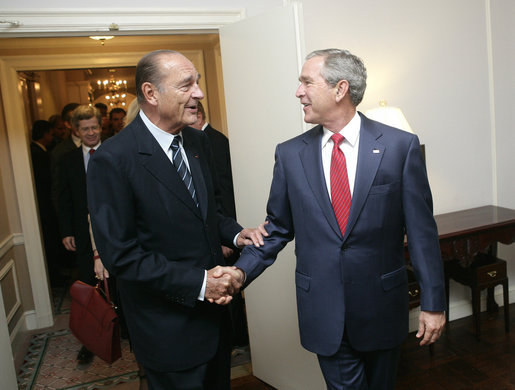
President George W. Bush meets with President Jacques Chirac of France Tuesday, Sept. 19, 2006, during the President's visit to New York City for the United Nations General Assembly. White House photo by Eric Draper.President George W. Bush meets with President Jacques Chirac of France Tuesday, Sept. 19, 2006, during the President's visit to New York City for the United Nations General Assembly.
White House photo by Eric Draper.

PRESIDENT BUSH: It's been a pleasure to have a meaningful, strategic dialogue with Jacques Chirac. We talked about a lot of subjects. It's important that France and the United States work closely to keep the peace. We talked about Iran, we talked about Syria, we talked about the Palestinian-Israeli issue, we talked about Darfur; we talked about common problems and how to solve those problems. It was a very constructive and important dialogue.

Mr. President, welcome back to America and thank you for your time.

PRESIDENT CHIRAC: (As translated.) We're always welcome in the United States. Relations between the United States and France are long-standing and deeply rooted.

Well, indeed, today we have discussed and evidenced the fact that we have common approaches and a common sense of the main issues that we discussed, relating as they do to peace and to development throughout the world -- in fact, this coincides with the 61st U.N. General Assembly, which is going to meet today.

So we discussed peace and development. And particularly on the subject of peace-related issues, we addressed the issue of Iran, of the Israeli-Palestinian conflict, we addressed Lebanon and, of course, Africa, in particular, in Africa. And with respect to Africa we addressed the issue of what's going on in Darfur.

And we, as a result of this, have once again confirmed that we are entirely on the same wave length -- we have the same approach to the different issues, which are of deep and grave concern to us, as they challenge and jeopardize peace in different parts of the world.

I repeat what I've already said, namely that we concur, our views concur on these matters, particularly on the issue of a possible agreement with the Iranians. And, therefore, France, I'm convinced, the United States, the American administration and the French government see eye-to-eye on these matters and on how to address them.

PRESIDENT BUSH: One question a side. Nedra.

Q Yes, thank you, Mr. President. President Chirac has proposed suspending the threat of sanctions against Iran as an incentive to get them to the negotiating table. What do you think of that idea?

PRESIDENT BUSH: First of all, France and the United States share the same goal, and that is for the Iranians not to have a nuclear weapon.

Secondly, we share the same goal; we'd like to solve this problem diplomatically. And we understand working together is important. And the Iranians have got to understand we share the same objective, and we're going to continue to strategize together.

The EU3 will continue to dialogue with the Iranians to get them to the table so that they will suspend, verifiably suspend their enrichment activities, in which case, the United States will come to the table. And we believe time is of the essence. Should they continue to stall, we will then discuss the consequences of their stalling. And one of those consequences, of course, would be some kind of sanction program.

But now is the time for the Iranians to come to the table. And that's what we discussed.

PRESIDENT CHIRAC: For the past two days I've had the opportunity to speak very clearly on the subject -- at least I hope I've been very clear -- and let me take this opportunity once again to say that the present views of the United States and I again see eye to eye on this one. I totally agree with President Bush. We are both determined to push forward on this one, to move ahead in a constructive manner. And the first thing we need to do is to find a solution so that, indeed, and end be put to the uranium enrichment activity being engaged in, and then we can move on to finding solutions to the other problems that arise and stem from this issue

PRESIDENT BUSH: Final question. Do you want to call on somebody?

Q (Asked in French.)

PRESIDENT CHIRAC: There never has been any ambiguity as to the positions adopted respectively by the Europeans, by the six, by the United States, and in particular by France. We have always said very clearly that any negotiations -- and let's face it, this is the normal course of events, this negotiation is the normal way in which one expects to address and, indeed, settle, solve such a thorny issue as this one -- that negotiations are the way we are heading.

Nonetheless, we have equally said that we cannot have negotiations if we do not have prior suspension, on the one hand, of uranium enrichment activity on the part of Iran, and on the other, on the part of the six, the agreement not to approach the Security Council on this matter, in particular, this will include the possibility of examining a sanction program.

I think this has been said abundantly clearly time and again, and I do not really understand what kind of controversy has arisen or misunderstanding could have crept in, insofar as this, as I said, has been repeatedly said. Maybe it's due to a lack of understanding of the situation, but there's no ambiguity on our side.

PRESIDENT BUSH: Thank you, Jacques.

END 10:19 A.M. EDT, For Immediate Release, September 19, 2006

Technorati Tags: and or and or

RELATED: Keywords, President to Welcome, Friday, September 22, 2006 President Bush and President Musharraf (VIDEO), Wednesday, September 20, 2006 President Bush Meets with President Abbas Tuesday, September 12, 2006 President to Welcome Prime Minister Erdogan of Turkey, Tuesday, September 12, 2006 President to Welcome President Nursultan Nazarbayev of Kazakhstan, Wednesday, September 06, 2006 President Welcomes the Amir of Kuwait, Tuesday, August 22, 2006 President Bush to Welcome President Roh Moo-hyun of the Republic of Korea, Tuesday, August 22, 2006 President Bush to Welcome President Alan Garcia of PeruFriday, July 28, 2006 President Bush and Prime Minister Blair 07/28/06 VIDEO, Wednesday, July 19, 2006 President Bush Meets with Indian Prime Minister Singh , Wednesday, July 19, 2006, President Bush Meets with President Hu of China at the G-8 Summit (VIDEO), Wednesday, July 05, 2006 President Bush Welcomes President Saakashvili, Thursday, June 29, 2006 President Welcomes Prime Minister Koizumi (VIDEO), Wednesday, June 21, 2006 President Bush to Welcome President Mikheil Saakashvili, Wednesday, June 14, 2006 President Bush Welcomes President Bachelet of Chile (VIDEO), Saturday, June 10, 2006 Bush and Prime Minister Rasmussen of Denmark (VIDEO), Monday, June 05, 2006 President Bush Welcomes President Sassou Nguesso of the Congo ,

President Bush and President Musharraf (VIDEO)

President Bush and President Musharraf of Pakistan Participate in Press Availability FULL STREAMING VIDEO, The East Room, 10:21 A.M. EDT General Pervez Musharraf Official Biography

President George W. Bush and Pakistan President Pervez Musharraf walk together to their joint news conference at Aiwan-e-Sadr in Islamabad, Pakistan, Saturday, March 4, 2006.President George W. Bush and Pakistan President Pervez Musharraf walk together to their joint news conference at Aiwan-e-Sadr in Islamabad, Pakistan, Saturday, March 4, 2006.
PRESIDENT BUSH: Thank you very much, please be seated. Laura and I appreciate the opportunity to welcome President and Mrs. Musharraf here to Washington. We remember fondly, Mr. President, your great hospitality in Pakistan and we remember the importance of that visit -- it reconfirmed our friendship, gave you and me a chance to discuss important issues. And there's no more important issue than defending our peoples.

This President is a strong defender of freedom and the people of Pakistan, and I appreciate your leadership.

PRESIDENT MUSHARRAF: Thank you very much.

PRESIDENT BUSH: He understands that we are in a struggle against extremists who will use terror as a weapon. He understands it just about as good as anybody in the world -- after all, they've tried to take his life. These extremists who can't stand the thought of a moderate leader leading an important country like Pakistan want to kill the President. That should say things to the people of Pakistan and the people of America, that because he has been a strong, forceful leader, he has become a target of those who can't stand the thought of moderation prevailing.

I admire your leadership. I admire your courage. And I thank you very much for working on common strategies to protect our respective peoples.

We had a good discussion here today. We talked about how our intelligence cooperation can continue. I want to remind the people of Pakistan and the people of America that because of the good work of our intelligence forces and Pakistani intelligence forces, as we helped people in the United Kingdom, we prevented the loss of innocent life. That kind of cooperation is necessary in a world in which extremists and radicals are willing to kill to try to achieve political objectives.

We talked about the earthquake recovery, and our nation was proud to support you, Mr. President, because we care when we see people suffering. And I was briefed by you and your administration when I was there and I was impressed by the great organization and compassion shown for the Pakistani people by your government. I hope all is going well, particularly for those who suffered mightily.

We talked about economic development and the need to move forward on a reconstruction opportunity zones, as well as a bilateral investment treaty. In other words, our relationship is more than just helping to secure our respective homelands. Ours is a relationship that recognizes that through economic prosperity, people can embetter themselves.

We had a very interesting briefing on the federally administered tribal areas. The governor of the areas are with us here, and he briefed me and members of my national security team on the strategy to strengthen governance and to promote economic development.

We talked about education. The first time I ever met President Musharraf, he talked about the need to make sure that school systems in Pakistan worked well. I was impressed then, and I'm impressed now, by your commitment to an education system that prepares students for the -- and gives students the skills necessary to compete in a global economy.

We talked about democracy. The last time I was with the President, he assured me, and assured the people that were listening to the news conference, that there would be free and fair elections in Pakistan in 2007. He renewed that commitment, because he understands that the best way to defeat radicalism and extremism is to give people a chance to participate in the political process of a nation.

We talked about -- we talked about India in relations -- and the President's relations with India. I was pleased to see that in Havana Prime Minister Singh and President Musharraf had another discussion. I think it's very important that the -- that the issue of Kashmir move forward and be resolved peacefully. And I appreciate your efforts, Mr. President.

We talked, of course, about Afghanistan. And President Musharraf and President Karzai and I will have dinner right here in the White House next week. And it's going to be an important discussion. It's going to be an important discussion because one of the most important avenues for peace is for Afghanistan to succeed. And it's in our mutual interests that we work together to help that country that's been devastated by war succeed. And so I look forward to our trilateral discussion, Mr. President. It's going to be a good one and it's going to be an interesting one. And it's an important discussion.

All in all, we've had yet another good meeting between people who are able to speak frankly with each other and people who share the common desire for our people to live in security and peace.

Welcome.

PRESIDENT MUSHARRAF: Thank you very much. I would like to, first of all, express my gratitude and also on behalf of my entire delegation for the warmth and hospitality that we have received, and many courtesies that are being extended to us since our arrival in the United States.

I had an excellent meeting with President Bush. We, first of all, reinforced our trust and confidence in each other. I trust President Bush, and I have total confidence in him that he desires well for Pakistan and for our region. And I trust him also that he's trying to do his best for bringing peace to the world. And I trust him also that he's trying to resolve the core issue of the Palestinian dispute.

We discussed the entire gambit of relations bilaterally between the United States and Pakistan, and also in our region and on international issues. Bilaterally, we reinforced our desire to have this relationship on a long-term basis, broad-based, and a strategic relationship. When we are talking of broad-based, whatever the President has said, it involves all aspects which we discussed. It has its political and diplomatic aspects, which we reinforced, and then our desire to fight terrorism and succeed against terrorism.

Other than that issue in the social sector, on the economy, how whatever assistance is being given to us, whatever assistance we require, our requests on that -- especially in the field of trade and investment, which are the main areas which we require assistance in -- otherwise, on a broad-based level, assistance in the education and health sector, on the defense side, the F-16 deals. All this was discussed.

On the regional issues, on the international plain, we did discuss the core issue of the Palestinian dispute, which needs to be resolved, and being at the core. And I am extremely glad that the President has a desire and a will to resolve this Palestinian dispute. I wish him very well because that lies at the heart of all problems, even at the heart of terrorism and extremism.

On the regional side, in our region, we also discussed the rapprochement going on between Pakistan and India. And I proudly told the President that we had -- I had an excellent meeting with Prime Minister Manmohan Singh in Havana. And it was a step forward towards resolution of disputes between India and Pakistan. I did tell him on the way forward that we are moving on the Kashmir dispute especially.

Coming on the other side, we had an in-depth discussion on what is happening in Afghanistan and our tribal agency. They are -- I explained to him whatever we are doing in the form of the peace treaty that we have just signed through a grand jirga, which is an assembly of elders.

This treaty is not to deal with the Taliban. It is actually to fight the Taliban. The misperception in the media, I did clarify to the President. And may I very briefly say -- and what I explained to the President -- that this is a holistic approach that we are taking to fighting terrorism in Pakistan, in the tribal agencies of Pakistan. This is a political site of the holistic strategy -- the holistic strategy being the military arm being used, a political element, an administrative element, and a reconstruction element.

We want to move on all these aspects forward, confining myself to this deal. This deal is not at all with the Taliban, as I said, this is against the Taliban, actually. This deal is with the tribal elders of north Waziristan agency. And the deal has three bottom lines, which we fixed for ourselves. And this is very important, which I explained to the President.

Number one, there will be no al Qaeda activity in our tribal agency or across the border in Afghanistan. There will be no Taliban activity in our tribal agency or across in Afghanistan. There will be no Talibanization, which is an obscuritas thoughts or way of life -- no Talibanization. All these three have been agreed by the tribal elders who signed that deal. And when they signed the deal, they are honor-bound, and they have already strict honor code to not only abide by it, but also that whoever violates it, they'll move against them.

So this is, in brief, the deal which I explained to the President. And I know that he's satisfied with that deal. And maybe this shows the light or the way forward for bringing peace to the region.

So this is what we discussed holistically. I would like to conclude by saying we had a total understanding of views between President Bush and myself. And as I said, we reinforced our trust and confidence in each other. Thank you very much.

PRESIDENT BUSH: Good job.

Two questions apiece. Deb.

Q Mr. President, after 9/11, would the United States have actually attacked Pakistan if President Musharraf had not agreed to cooperate with the war on terrorism? He says that the United States was threatening to bomb his country back into the stone age.

And, President Musharraf, would Pakistan have given up its backing of the Taliban if this threat had not come from Armitage?

PRESIDENT BUSH: First, let me -- she's asking about the Armitage thing. The first I heard of this was when I read it in the newspaper today. You know, I was -- I guess I was taken aback by the harshness of the words.

All I can tell you is, is that shortly after 9/11, Secretary Colin Powell came in and said, President Musharraf understands the stakes and he wants to join and help route out an enemy that has come and killed 3,000 of our citizens. As a matter of fact, my recollection was that one of the first leaders to step up and say that the stakes have changed, that attack on America that killed 3,000 of the citizens needs to be dealt with firmly, was the President. And if I'm not mistaken, Colin told us that, if not the night of September the 11th, shortly thereafter. I need to make sure I get my facts straight, but it was soon.

I don't know of any conversation that was reported in the newspaper like that. I just don't know about it.

PRESIDENT MUSHARRAF: I would like to -- I am launching my book on the 25th, and I am honor-bound to Simon and Schuster not to comment on the book before that day. (Laughter.)

PRESIDENT BUSH: In other words, buy the book, is what he's saying. (Laughter.)

Q My question is for the U.S. President. Your Excellency, President Musharraf has issued a call for building bridges and promoting interfaith harmony between the West and the Islamic world, which is in upheaval and in complete turmoil. So your comments of Islamic fascists, and then the comments of the Pope, have inflamed the Islamic world. And my question is that would you take the leading role, along with President Musharraf, to build these bridges and promote interfaith harmony to avert any wrong notion of class of civilizations, sir?

PRESIDENT BUSH: I appreciate the President's leadership in promoting harmony. There is unbelievable propaganda in the Middle East these days that try to inflame passion. The propagandists are attempting to create conditions where terror is justified. And so at my speech at the United Nations, I stood up and said loud and clear, America respects Islam. And we do. We don't respect people who kill in the name of Islam to achieve political objectives, like the terrorists do.

As a matter of fact, these extremists exploit propaganda in order to justify their behavior. All of us need to step up and talk about a world in which we respect each other's religions. As a matter of fact, it's very important for Muslims around the world to know there's a lot of Muslims living at peace here in the United States. They are proud Americans and they're equal to me as a citizen. We respect their religions.

I repeat to you, however, that the free world and the moderate world must stand up to these extremists and not let them spread their hateful propaganda, not let them try to incite people to acts of violence, because these extremists are not only against Western people, they're also against moderate people. And the President is reaching out to help understand -- the world to understand the Muslim religion is a peaceful religion is very important. And we can help, and we will help.

One way we can help is to work with the Palestinians and the Israelis to achieve peace. I'm the first President ever to have articulated a two-state solution. I believe a Palestinian state, as a democracy living side-by-side with Israel, will yield the peace. What's important is for people to understand that in order to have that peace and that Palestinian state, people have got to recognize Israel's right to exist in order for this to happen. You can't ask people to negotiate with people who say you shouldn't exist.

We will continue to give aid to people who suffer. We didn't ask the question whether -- you know, what was the nature of the religion of the people who suffered in Pakistan when we spent a half a billion dollars to help this President. We said, they're suffering and we want to help. And so we will continue to outreach.

It's important, however, for people in the Middle East to reject the extremist propaganda that is spreading, in many cases, absolute lies about the intentions of the United States. They love to say this is a war against Islam. I can't think of anything more false. These are moderate, reasonable people who reject extremism in order for there to be peace. And so I'll work hard to do my part. Thank you for that question.

Steve.

Q Thank you, sir. There's been a back-and-forth this week over whether the U.S. needs permission to strike inside Pakistan if Osama bin Laden is located. Could each of you give your position on that? And did you -- are you satisfied with his assurances on the tribal deal?

THE PRESIDENT: Well, first of all, I appreciate the briefing on the tribal deal. When the President looks me in the eye and says, the tribal deal is intended to reject the Talibanization of the people, and that there won't be a Taliban and won't be al Qaeda, I believe him, you know? This is a person with whom I've now had close working relationships for five-and-a-half years. And when he says, if we find -- when we find Osama bin Laden, he will be brought to justice, I believe him. And we'll let the tactics speak for themselves after it happens.

We're on the hunt together. It's in the President's interest that al Qaeda be brought to justice. And it's in our interest. And we collaborate and we strategize and we talk a lot about how best to do this.

Q So you do have permission to go inside Pakistan?

PRESIDENT BUSH: All I can tell you is, is that when Osama bin Laden is found, he will be brought to justice. And that's what we've continually discussed.

PRESIDENT MUSHARRAF: May I add?

PRESIDENT BUSH: Yes, please.

PRESIDENT MUSHARRAF: I think, as the President said, we are on the hunt together against these people. Now why are we bothering or how to -- the semantics of the tactics of how to deal with the situation? We will deal with it. We are on the hunt together. You want the person -- if at all we confront him, if at all we find out his location, we are quite clear what to do.

But let's not get involved in how it ought to be done, by whom it ought to be done. There's total coordination at the intelligence level between the two forces, there's coordination at the operational level, at the strategic level, even at the tactical level. So, therefore, we are working together, and when the situation arises, we need to pick the right decision to strike. That's how I --

PRESIDENT BUSH: You probably don't want to let them know what we're thinking about anyway, do we?

PRESIDENT MUSHARRAF: And may I also say that we need to have -- ladies and gentlemen here, we have the pieces of -- a relationship is trust and confidence. Now, if we don't have that trust and confidence in each other, and we think that we are bluffing each other -- I don't think that's a good way of moving forward, anyway.

Q Mr. President, I have two-part question. And, first, I must (inaudible) the remarks which you gave at the outset about President Musharraf. And second is, Mr. President, in Pakistan, we cherish the idea of having strategic and long partnership with United States of America. But we found that there is a discriminate (inaudible) is being followed by your great country pertaining to the (inaudible) of the nuclear technology for the peaceful purpose. Pakistan needs energy, and we have been denied of that. Could you ensure us that this discrimination will come to an end after this great meeting with President Musharraf?

And the second part of my question, Mr. President, is that President Musharraf has been asking resolution of the problem of Palestine and Kashmir for the sustainable peace in the world, especially in this part of the world. Aren't you going to contemplate -- are you contemplating some step to take some initiative to resolve these two problems? And question for Mr. President is, is how far --

PRESIDENT MUSHARRAF: Three in one. (Laughter.)

PRESIDENT BUSH: If I ask him -- then I'll remember yours.

Q -- talk about these discussions with President Bush and the agenda, the item for which you are going to take up with the President of the United States -- (inaudible). Thank you, sirs.

PRESIDENT BUSH: Man, you represented the entire press corps there, that's good. (Laughter.) We talked about energy, and we talked about our need to work through the recent history that we've had together on dealing with proliferation matters.

Secondly, in terms of Kashmir and Palestine: Kashmir issue will be solved when two leaders decide to solve it. And we want to help. The United States can't force nations to reach an agreement just because we want there to be an agreement. Lasting agreements occur when leaders of nations say, let's get the past behind us and let's move forward.

I am encouraged by the meetings that the President and the Prime Minister of India have had. It is an indication that there is desire at the leadership level to solve this longstanding problem.

Leadership is also going to be required between Israel and Palestine. We, of course, can help and will help. But it's important for you to understand that we cannot impose peace. We can help create the conditions for peace to occur. We can lay out vision. We can talk to world leaders, and we do. We can provide aid to help institutional building, so that a democracy can flourish.

But, ultimately, peace, longstanding peace depends upon the will of leaders. I'm impressed by this President's will to get something done in Kashmir. He and I have talked about this issue in the past. He has said he was going to reach out to the Prime Minister of India, and he has. And our hope is that this process continues move forward.

I asked the President, just like I would ask the Prime Minister of India, what can we do to help; what would you like the United States to do to facilitate an agreement? Would you like us to get out of the way? Would you like us not to show up? Would you like us to be actively involved? How can we help you, if you so desire, achieve peace? And that's the role of the United States, as far as I'm concerned.

PRESIDENT MUSHARRAF: Thank you. I think I've already answered. We had far-reaching discussion, encompassing bilateral issues, regional and international. I think we have general consensus on all issues.

PRESIDENT BUSH: Thank you, Mr. President. Good job.

PRESIDENT MUSHARRAF: Thank you.

PRESIDENT BUSH: Buy the book. (Laughter.)

END 10:46 A.M. EDT, For Immediate Release, Office of the Press Secretary, September 22, 2006

Technorati Tags: and or and or

RELATED: Keywords, President to Welcome, Wednesday, September 20, 2006 President Bush Meets with President Abbas Tuesday, September 12, 2006 President to Welcome Prime Minister Erdogan of Turkey, Tuesday, September 12, 2006 President to Welcome President Nursultan Nazarbayev of Kazakhstan, Wednesday, September 06, 2006 President Welcomes the Amir of Kuwait, Tuesday, August 22, 2006 President Bush to Welcome President Roh Moo-hyun of the Republic of Korea, Tuesday, August 22, 2006 President Bush to Welcome President Alan Garcia of PeruFriday, July 28, 2006 President Bush and Prime Minister Blair 07/28/06 VIDEO, Wednesday, July 19, 2006 President Bush Meets with Indian Prime Minister Singh , Wednesday, July 19, 2006, President Bush Meets with President Hu of China at the G-8 Summit (VIDEO), Wednesday, July 05, 2006 President Bush Welcomes President Saakashvili, Thursday, June 29, 2006 President Welcomes Prime Minister Koizumi (VIDEO), Wednesday, June 21, 2006 President Bush to Welcome President Mikheil Saakashvili, Wednesday, June 14, 2006 President Bush Welcomes President Bachelet of Chile (VIDEO), Saturday, June 10, 2006 Bush and Prime Minister Rasmussen of Denmark (VIDEO), Monday, June 05, 2006 President Bush Welcomes President Sassou Nguesso of the Congo , Monday, May 29, 2006 President Bush to Welcome Prime Minister Harper of Canada,

President, Senate Detaineee Treatment Legislation (VIDEO)

President Thanks Senate for Agreement on Pending War on Terror Legislation, Ritz-Carlton Orlando, Orlando, Florida, 5:04 P.M. EDT
Declaración del Presidente

Congressional Republicans News Conference on Detainees FULL STREAMING VIDEO, Congressional Republicans hold a press conference on the detaineee treatment agreement made with Pres. Bush. 9/21/2006: WASHINGTON, DC

President George W. Bush remarks on an agreement reached with Senate Republicans regarding interrogation legislation during a visit to Orlando, Fla., Thursday, Sept. 21, 2006. White House photo by Paul Morse.President George W. Bush remarks on an agreement reached with Senate Republicans regarding interrogation legislation during a visit to Orlando, Fla., Thursday, Sept. 21, 2006. White House photo by Paul Morse.
THE PRESIDENT: I want to thank the members of the United States Senate for working with my administration to meet our top legislative priority, and that is a law that will help us crack the terror network and to save American lives.

I had a single test for the pending legislation, and that's this: Would the CIA operators tell me whether they could go forward with the program, that is a program to question detainees to be able to get information to protect the American people. I'm pleased to say that this agreement preserves the most single -- most potent tool we have in protecting America and foiling terrorist attacks, and that is the CIA program to question the world's most dangerous terrorists and to get their secrets.

The measure also creates military commissions that will bring these ruthless killers to justice. In short, the agreement clears the way to do what the American people expect us to do, to capture terrorists, to detain terrorists, to question terrorists, and then to try them. I hope the Congress will send me legislation before it wraps up their business next week.

Thank you.

END 5:06 P.M. EDT For Immediate Release, Office of the Press Secretary, September 21, 2006

Technorati Tags: and or and or and or and or and

RELATED: Keywords radio address, podcast, Tuesday, September 19, 2006 President Bush Addresses United Nations (VIDEO), Saturday, September 16, 2006 Presidential Podcast 09/16/06, Saturday, September 09, 2006 Presidential Podcast 09/09/06, Saturday, September 02, 2006 Presidential Podcast 09/02/06, Saturday, August 26, 2006 Presidential Podcast 08/26/06, Saturday, August 19, 2006 bush radio address 08/26/06 full audio, text transcript, Saturday, August 12, 2006 Presidential Podcast 08/12/06, Saturday, August 05, 2006 Presidential Podcast 08/05/06, Saturday, July 29, 2006 Presidential Podcast 07/29/06, Saturday, July 15, 2006 Presidential Podcast 07/15/06, Monday, July 10, 2006 Presidential Podcast 07/08/06, Saturday, July 01, 2006 Presidential Podcast 07/01/06, Saturday, June 24, 2006 Presidential Podcast 06/24/06, Saturday, June 17, 2006 Presidential Podcast 06/17/06, Saturday, June 10, 2006 Presidential Podcast 06/10/06, Saturday, June 03, 2006 Presidential Podcast 06/03/06, Saturday, May 27, 2006 Presidential Podcast 05/27/06, Saturday, May 20, 2006, Presidential Podcast 05/20/06, Saturday, May 13, 2006 Presidential Podcast 05/13/06, Saturday, April 22, 2006 Presidential Podcast 04/22/06, Saturday, April 15, 2006 Presidential Podcast 04/15/06, Saturday, April 08, 2006 Presidential Podcast 04/08/06,

Thursday, September 21, 2006

Presidential Message: Rosh Hashanah, 5767

Presidential Message: Rosh Hashanah, 5767

I send greetings to those around the world celebrating Rosh Hashanah.

Rosh Hashanah American Forces Information ServiceDuring these holy days, Jewish people begin the new year by answering the call of the Shofar and gathering in synagogues.
It is a time to reflect on the past, celebrate the beginning of life, and welcome the promise of the future with a spirit of renewal and hope.

On this sacred holiday, I appreciate the Jewish people for your efforts to ensure that your values and traditions are passed on to future generations. As you begin the Days of Awe, your faith in the Almighty reminds us of the gift of religious freedom in our country and helps make the world a more hopeful place.

Laura and I send our best wishes for a peaceful Rosh Hashanah.

GEORGE W. BUSH

# # # For Immediate Release, September 21, 2006

Technorati Tags: and or and or and

Related: Keyword Jews, Tuesday, December 20, 2005 Presidential Message: Hanukkah 2005, Friday, December 10, 2004 President Bush Menorah Lighting, Tuesday, April 19, 2005 Passover Message, 5765, Friday, June 24, 2005 NAZI GUARD JOHN DEMJANJUK IS RULED REMOVABLE, Thursday, September 15, 2005 President's Remarks Jewish Life in America, Tuesday, September 20, 2005 Simon Wiesenthal: 'The Conscience of the Holocaust', Dies in Vienna at 96, Tuesday, September 20, 2005 Simon Wiesenthal - A Short Biography, Saturday, September 24, 2005 President Jewish Coalition 20th Anniversary (VIDEO), Saturday, October 01, 2005 Rosh Hashanah, 5766, Wednesday, October 12, 2005 Presidential Message: Yom Kippur, 5766, Thursday, December 08, 2005 President and Mrs. Bush Menorah Lighting (VIDEO,

State Department Daily Press Briefing, VIDEO, PODCAST, TEXT, 09/21/06

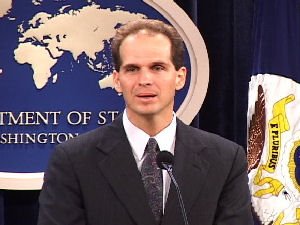
Tom Casey, Director, Office of Press Relations, Bureau of Public AffairsState Dept. Briefing with Tom Casey U.S. State Department spokesman Tom Casey briefs the press and answers questions.9/21/2006: WASHINGTON, DC: 29:57 min. FULL STREAMING VIDEO, M3U for streaming audio,
running time is 29:57, MP3 for PODCAST Download, running time is 29:57

TRANSCRIPT: 12:50 p.m. EDT

MR. CASEY: Good afternoon, everybody. Don't have any opening statements for you, so Barry, why don't we go right into questions.

QUESTION: All right. Thailand, absent from the two statements the State Department put out yesterday, any comments on whether you approve of a coup or, for instance, whether you think the overthrown government was corrupt? There's no value -- there are no value judgments -- just, you know, hope things are sorted out in a democratic way. Were they justified in overthrowing the government and do you think the rule -- the military rule will be as temporary as they say it will be?

MR. CASEY: Well, Barry, first of all, there is no justification for a military coup in Thailand or in any place else. And we certainly are extremely disappointed by this action. It is a step backward for democracy in Thailand. And I think it is important that that step backward now be resolved in accordance with the rule of law and democracy. We very much urge that democratic elections be held as soon as possible, which is a commitment military officials have made. That commitment needs to be met and it needs to be respected. And in that process, we need to make sure that there is full respect for freedom of speech and assembly and that violence be avoided.

There are also consequences when these kinds of actions take place and obviously in light of what's happened, in light of this coup, there are aspects of our relationship that we are going to have to review. There are certain legal and other requirements out there. I certainly don’t want to get ahead of any evaluations that are currently being made. But again it is something we're going to have to look at. But certainly, I would characterize this as a coup and certainly under no circumstances should a military coup ever be deemed acceptable.

QUESTION: Could you at least give us the categories of the relationship that would be under review?

MR. CASEY: Well, I think first and foremost, there are sections of the Foreign Operations Act concerning assistance that are considered. I think the specific citation for you, Barry, would be Section 508 of the Foreign Operations Act of '06. I believe there are some other ones potentially out there. That's the one that usually comes into play when a situation like this happens. But again, I think the most important thing is that we want to see a resolution of this situation in accordance with the rule of law, in accordance with democratic procedures and that certainly means a restoration of civilian rule in Thailand as quickly as possible.

QUESTION: You described it as a step backwards. Wouldn't the appropriate step be not the restoration of civilian rule, but the restoration of the Thaksin government?

MR. CASEY: Well, again, I'm not going -- I'm trying to make sure that we lay out the basic positions here. There is still a lot that's happening on the ground in Thailand, but the main thing is that there needs to be democratic rule there. The military individuals who are now running the country have stated that their objective is to have elections, is to have a return to civilian democratic rule, and to do so in very quick order, and that's what we want to see happen.

QUESTION: Do you have any figure for assistance?

QUESTION: Can I follow up on this and then we get to the assistance?

MR. CASEY: Why don't we -- Arshad, why don't you follow up and then we'll go on to the assistance.

QUESTION: The thing that perplexes me is that if no military coup is justified and if, you know, ousting elected governments is something the United States Government does not approve, why you would simply lay out your desire for a restoration of civilian rule rather than Thaksin, who was -- who won an election, should be restored. Why isn't that your preferred outcome?

MR. CASEY: Look, at this point I'm not offering any specific prescriptions on this. These are issues for the Thai people to determine. What is important is that the coup leaders live up to their public commitment to restore democracy rapidly.

QUESTION: Can I follow up on --

MR. CASEY: Well, let's go to Barry first.

QUESTION: I just wondered if you had any assistance figure.

MR. CASEY: You know I don't have specific figures on foreign assistance.

QUESTION: Do you have -- if you don't have specific figures, do you have categories, what kind of aid do we give the Thais?

MR. CASEY: No, I honestly don't, Charlie. I haven't done a review of what's out there. Certainly there are a number of different categories. I'm sure we can come up with a listing for you of the amounts of aid involved and wherever. Thailand is, of course, a country that has made a great deal of progress in building and strengthening democracy over the past decades. It's had, though -- it certainly has had its ups and downs. It is a growing economy and it is an important economy. So I don't believe it is a major recipient of U.S. assistance, but certainly we can look for you at the various categories of aid that are out there.

QUESTION: And just to go back a step, I am perplexed as well, similarly to Arshad. I don’t understand why the government that's been overthrown shouldn't be restored or why you're reluctant to call for that. And it seems -- it doesn't seem to add up that you, you know, promote democracy and rule of law and then a government is overthrown and not to take the step to call for the restoration of that government.

MR. CASEY: Well, look again, Charlie, I think the facts on the ground are that a coup has happened. Certainly we wish that that had not occurred in the first place. But the important thing now is that we move forward to make sure that those who have engaged in this activity live up to their public commitments. And again, those public commitments are to restore democracy as quickly as possible. The determinations and the specifics of that are things that we need to let the Thai people work out and resolve, and I am simply not in a position to do that for them. This is an issue that they are going to need to work out.

Mr. Lambros, same issue?

QUESTION: Yes. Any communication with the King, who in this day is acting as (inaudible) cooperating with a military (inaudible) democracy in Thailand?

MR. CASEY: Well, I don’t have any information on the King's role specifically. Certainly, what we are doing is talking to all different political actors in Thailand. Again, what we're doing is encouraging everyone to have, first, the coup leaders act out on their commitments and restore democratic rule as quickly as possible. And again, with everyone in the political process, we are also encouraging everyone to do so in a way that is respective of the rule of law, that carries out things in a manner that is nonviolent, and that leads to a quick and peaceful resolution of this issue.

QUESTION: A follow-up. What is the status of the Prime Minister of Thailand who is in New York on American soil?

MR. CASEY: I am not sure where he is right now. I have seen press reports indicating that he is in or perhaps is en route to London, but I don't have any information about where he is right now.

QUESTION: Can you tell us about any contacts the U.S. may have had with either the Thai Government or the Prime Minister's government or the coup leaders?

MR. CASEY: Well, again, I understand we're talking to a broad variety of individuals. I don't have anything for you on specific contacts that have been made. Again, I think our message, though, is the same to everyone and it is one that we are disseminating broadly both with officials here in Washington as well as those in Thailand.

QUESTION: Broadly have they been in touch with the government and then with the coup leaders --

MR. CASEY: My understanding is we are talking to all actors involved, and I would assume that includes military officials as well.

Mr. Lambros.

QUESTION: Yes, on the Pope. The head of (inaudible) says, Mr. Casey, requests yesterday that the Department of Justice in Turkey that the Pope Benedict, head of the Catholic Church, must be arrested upon his arrival in Turkey during the upcoming visit in November and should be tried and punished because the Pope, with his illicit remarks about Islam violated several statutes of the Turkish law, encouraging discrimination based on religion, including Islam and Prophet Mohammed. Any comment?

MR. CASEY: I haven't seen those remarks, Mr. Lambros. Obviously, we've spoken to this issue before. What we believe is important and appropriate is for representatives of all religions to work together to help promote tolerance and to promote a culture of freedom of religion. That is what is important to us.

QUESTION: One more. U.S. House of Representatives' resolution (inaudible) -- the U.S. Congress yesterday is urging Turkey to respect the rights and the religious freedom of the Ecumenical Patriarch, head of Constantinople in Istanbul, Turkey, under the auspices of the Ecumenical Patriarch Bartholomew to recognize its international status and allow the re-opening of the theological school at Halki. May we have your comments since (inaudible) from the Congress now?

MR. CASEY: I'm not familiar with that particular piece of legislation. I don't believe there is a statement of Administration position on it. Again, I'd simply refer you back to what I've said previously and what you heard from John Hanford here. We do have concerns about promoting religious freedom including in Turkey. There are issues that you can look at within that Religious Freedom Report that talk about issues related to the Ecumenical Patriarch, but I don't have anything new to add on that for you.

Kirit.

QUESTION: President Bush yesterday had said that he was directing Secretary Rice to approach a new diplomatic effort, I guess to read it here, to engage moderate leaders across the region to help the Palestinians reform their security services, support the Israeli and Palestinian leaders in their efforts to come together and resolve their differences. Do you have anything as far as how she'll be taking -- undertaking that?

MR. CASEY: Well, I think in some ways she's doing it already. She's met up in New York with President Abbas, with Foreign Minister Livni. She's met with KingAbdullah. She's speaking with other leaders around the region. The President, of course, met with President Abbas today, and the Secretary was there for that. You've heard from both of them on it.

I think mostly what we are trying to do here is have her look for opportunities to be able to move the process forward. You've heard from us on these issues before. Certainly among the other things, as you heard the President mention, is a focus on the security service. That means continuing with the work that had been done by General Dayton, among others, to try and help reform and improve the security services, to help bring about stability in Gaza and in other places in the territories. That's something that ultimately is in the interest of the Palestinian people and is ultimately in the interest of the security of Israel. Certainly she's going to be continuing to meet with officials from the region up in New York.

While I certainly don't have anything to announce for you, I would expect that at some point in the future after the events of the General Assembly are over that she will have an opportunity to travel to the region as well. But again, I think what the President's remarks highlight is his commitment to making progress on the roadmap and to ultimately achieving his vision of a two state solution. That really is -- been the goal of this Administration, and it's something that he really wishes to see move forward.

QUESTION: Is General Dayton still on the payroll?

MR. CASEY: My understanding is that he is, in fact, still on the payroll, Charlie.

QUESTION: Doing his work in -- with the Palestinian security --

MR. CASEY: I do not know exactly where he is today, but yes, my understanding is he's still on the payroll.

QUESTION: I don't mean that -- he's still in his job of trying to reform Palestinian security?

MR. CASEY: Yes, I believe there's a transition that's coming up in that, but I don't believe it's happened as of yet.

Arshad, welcome back.

QUESTION: Thank you. Good to be back. I've got a couple of things, if I may. The Iraqi Government has replaced the judge presiding over Saddam Hussein's genocide trial. That action has led some human rights groups to suggest it is unwarranted meddling in the judicial affairs of Iraq by the Iraqi Government and does not speak well of the separation of powers there. What is your reaction to the government's decision to replace the judge?

MR. CASEY: Well, first of all, this is an Iraqi process and it is governed by the Iraqi High Tribunal statute. I think really the best place to have the specifics of this decision explained are with Prime Minister Maliki's government and his officials. That said, our understanding is that the statute does give the Iraqi Council of Ministers the legal authority to replace judges in this case. So in that sense, our understanding is this is a decision that was taken in conformity with the relevant legal statutes.

I think, though, what is more important than the issue of who is presiding over the trial is whether the defendants in it are receiving a fair one. And we certainly support the efforts that are underway by the Iraqi High Tribunal to investigate in a thorough, transparent and appropriate manner. Those cases that are being prepared against Saddam Hussein as well as against others in the regime, to try them in accordance with the rule of law, for actions that they took while the previous regime was in power. And that is something that is important not only for the international community but for the Iraqi people to have accountability for those who committed crimes during the previous regime.

QUESTION: There were suggestions, I think, by Saddam Hussein's defense lawyers that he's not getting a fair trial and I'm -- according to our story at least the new judge said, well, if you want to leave you can, and the defense lawyers then stood up and left. Doesn't the replacement of a judge in what is, if not the, one of the most high-profile cases in postwar or post-invasion Iraq -- doesn't it undermine the credibility of the judiciary and of the process and of whether it will or -- you know, to summarily replace the judge, even if that is, you know, acceptable and provided for under a statute? Wouldn't you prefer that they just left the trial to unfold as it would?

MR. CASEY: Well, Arshad, I think our goal here again is seeing that there is a transparent, open trial process that meets international standards, that conforms with the relevant Iraqi laws. And again, I think what is important most of all is that this be a process that has that kind of credibility for the Iraqi people. Again, this is a decision that the Iraqi Government has made. And I think at this point, what I would do is just allow them to describe it. But again, our view of it is that this was done in accordance with the law and we do want to see this process move forward.

QUESTION: And just one last one on this. Do you regard it as a transparent and open process?

MR. CASEY: Well, we believe that the Tribunal has been set up in accordance with not only Iraqi law but international laws. We believe that the procedures that have gone forward while certainly not always have gone forward smoothly, have been done in a way that meets that international standards.

Let's go over here.

QUESTION: What is your reaction to President Chavez today speaking for the UN, calling President Bush the devil and referring to him as an imperialist seeking to dominate the world?

MR. CASEY: Well, I don't think you'll find it surprising that we disagree with the views that were expressed in President Chavez's remarks. Certainly I think it is disappointing that you see personal attacks issued by any head of state. The UN is an important world stage and an important forum and leaders come there representing their people and their country and I'll leave it to the Venezuelan people to determine whether President Chavez represented them and presented them in a way they would have liked to have seen.

Kirit.

QUESTION: The AU today extended the AMIS forces mandate through the end of the year. I was wondering if you had any reaction to that? And then also how this is going to change or if it will change the U.S. plans to put a UN force into Darfur?

MR. CASEY: I understand that they were going to extend the mandate. I haven't actually seen confirmation that it has. Either way, though, we have said before that we expect there to continue to be peacekeeping forces in Darfur. We think it is important that those forces transition as quickly as possible to a UN-led mission as has been called for. We also expect as well that during that transition period the international community will do everything it can to help support the AMIS force and to help expand it and make it stronger and more capable of carrying out the requirements under the Darfur Peace Agreement.

I know that there are a number of donors out there who have expressed interest in providing funding to help AMIS continue its mission during the transition period. We, of course, have contributed substantial funds to that effort as well. We have allocated or requested funds – excuse me -- for the budget for the upcoming year to help support an UN force as well as to help support the transition. So it is definitely positive to have that force continue. It is definitely important, though, that while that force continues that we do move with it and working together with it to expand it, enhance it and to have it then become the UN force that has been envisioned by the Security Council because that's ultimately the way to help achieve a lasting solution in Darfur.

I also do want to note, too -- since we didn't have an opportunity to brief yesterday – and that, of course, is one of the other things the President did in his address at the United Nations was announce the appointment of a special envoy for Sudan. That person is in the form of Mr. Andrew Natsios who I think many of you know from his time as Administrator at the U.S. Agency for International Development here. Andrew is in fact in New York today. He is actually there most immediately to honor a previous commitment to participate in a private event there. But he will be participating in the Secretary's meeting on Sudan on Friday and we certainly look forward to him being able to meet with various officials and those involved in this issue, and also can travel to the region in the not-too-distant future.

Arshad.

QUESTION: Since you didn't brief yesterday, I wanted to raise something that I would have raised, had there been a briefing.

MR. CASEY: Oh, I opened the door, didn't it?

QUESTION: Yeah.

MR. CASEY: Okay.

QUESTION: Hungary. As you're well aware, there had been what are described as the worst protests in Hungary since 1956, sparked by the Prime Minister's -- by the revelation the that Prime Minister had lied about the budget. Do you have any comment on this, either on the protest, but also on the Hungarian Prime Minister lying to his public ahead of an election about the budget?

MR. CASEY: Well, look, certainly this is a major issue in Hungary. And it's one that has a lot of ramifications for politics in that country. For that reason, Arshad, I think we are just going to leave it to the folks in Hungary, certainly it political leadership, but also its citizens to determine what to make of this and how best to proceed. I understand in terms of the situation on the ground that the Hungarian police have established security controls in a number of different locations around Budapest. Protests, as I understand it, have caused some injuries and some damage. Certainly, as any one moves through a politically difficult period, we want to see things proceed in accordance with the laws of the country and we certainly hope that people will act in a peaceful manner. But we do understand obviously that this is a major issue for the Hungarian Government and the Hungarian people. But we do think it's one that's best left to their own judgments.

QUESTION: Is it acceptable to lie about budgetary matters?

MR. CASEY: Well, I know it's never acceptable to lie from the podium under any circumstances. Again, I'm not going to try and make a value judgment on it.

QUESTION: Thank you.

MR. CASEY: Oh, let's go over to here, back there. And then, Mr. Lambros, we'll see if we got time for an extra shot.

Let's go to her first, though.

QUESTION: Can you tell us anything about the U.S. will hold three-party talks soon -- Japan, South Korea, United States?

MR. CASEY: In terms of six-party talks?

QUESTION: Yes.

MR. CASEY: Well, we continue to as we have in the past, called for North Korea to return to the talks as quickly as possible. We believe it's long overdue that they do so. But I'm not aware that there's been any movement in that direction. Again, the other five parties are willing to meet at any time. We are simply waiting for North Korea to make the right decision and come to the talks.

QUESTION: Does the United States have any inducement plan to get North Korea come back to the six-party talks?

MR. CASEY: Well, I think the plan that's on the table is the September 19th agreement, which is one that does offer benefits to North Korea if, in fact, they choose to come to the table and negotiate an end to their nuclear program as they agreed to do in that date.

Let's go back over here.

QUESTION: On Japan, Mr. Shinzo Abe was elected the new leader of the Liberal Democratic Party of Japan. Does the State Department have any comments on that?

MR. CASEY: Well, I understand that's happened. Obviously that's an internal matter for the Liberal Democratic Party to decide. We also understand that Diet will be meeting, I believe, on September 26th to select a new government. The important thing to us is regardless of who ultimately is in that new government, we look forward to continuing our warm, friendly relationship and our great alliance with Japan. Japan is a tremendous partner for the United States on a wide variety of issues. And we expect that we will have as good and warm relations with a future government as we have with the current one.

Mr. Lambros, last shot.

QUESTION: On Cyprus. Anything to say, Mr. Casey, about yesterday's one-hour meeting between -- in New York City between the Greek Cypriot Foreign Minister Yiorgos Lillikas and Assistant Secretary Daniel Fried?

MR. CASEY: Since I wasn't aware that the meeting took place, Mr. Lambros, no, I don't have anything specific for you on the meeting. Again, our ongoing efforts with respect to Cyprus are in accordance with our longstanding policy. We do want to see a resolution of this dispute. We believe that it is possible to do so. And we certainly, though, want that resolution to be something that is agreeable to all communities on the island.

QUESTION: But yesterday's meeting between the Cypriot President Tassos Papadopoulos and the UN Secretary General Kofi Annan produced no results, Mr. Casey, absolutely nothing. Therefore, I'm wondering how do you assess now the Annan plan since Mr. Annan is departing from the UN by the end of this year and his era is over.

MR. CASEY: Well, look, I'd refer you either to the Cypriot President or the UN Secretary General for details on their meeting. As I've stated, we have a pretty clear policy out there. We want to see a resolution of this. We want to see that done in accordance with the wishes of both communities in a manner that's acceptable to both of them. But I don't have anything really to offer you on that.

QUESTION: And the last one --

MR. CASEY: Let's go over to Barry first, and then we'll --

QUESTION: That's all right. Have you said anything about the Sudanese President's UN speech?

MR. CASEY: No, and I haven't seen it, but --

QUESTION: Well, he says that human rights groups have exaggerated the crisis in Darfur to help their fundraising and charged that demands for UN peacekeepers are meant to protect Israel. Do you have anything to say about that?

MR. CASEY: Well, I don't have anything to say specifically on his speech because, again, I haven't seen it.

QUESTION: Okay.

MR. CASEY: In terms of the situation in Darfur, I think we have been quite clear. It's a grave humanitarian crisis. We have made a formal legal finding, which is not only legal but proper and appropriate that the actions that have gone on in Darfur are genocide. The President has called it that, and we certainly don't have any change in our views.

Thanks everyone.

QUESTION: Oh, there was something else. It's --

MR. CASEY: All right, Barry, one last one. Hang on everybody.

QUESTION: You know it's been a hectic few minutes here. Iran is increasing its restrictions on American media. Officials are saying that the move is justified because the U.S. denied Iranian journalists visas to attend the UN General Assembly.

MR. CASEY: Well, okay. Well, let me just clarify what the situation is there. First of all, we received 150 applications for individuals to participate as part of the Iranian delegation to the UN General Assembly.

QUESTION: Right.

MR. CASEY: One hundred and twenty-five of those to date have been granted. What our records show is that on Friday, meaning September 15th, 15 journalists applied for visas to travel on the following Monday, on September 18th, as part of the or with the Iranian delegation. Certainly as you know, and as the Iranian Government certainly well knows, there are a number of procedures that we have to do to conform with U.S. law to be able to grant Iranian citizens visas to come to the U.S., and they generally are not something that can be done when one hands in applications on the close of business Friday and expects visas on a Monday morning. So we were in the process of evaluating those visas, of adjudicating them, and on Tuesday, yesterday the 19th, the Iranian mission withdrew a number of pending applications, including those for all those journalists. So certainly --

QUESTION: Fifteen plus?

MR. CASEY: Yes. So certainly there were no visas denied to journalists nor did we signal to the Iranians that we intended to do so. We were simply trying to comply with U.S. law and the necessary processes involved in that. Obviously, again, that is something that -- for Iranian citizens because of our concerns, because we don't have diplomatic relations, because they are the leading state sponsor of terror, do in fact take time. But it's certainly wrong to suggest that we either denied visas or had signaled to the Iranians that we had done so.

Thank you.

(The briefing was concluded at 1:20 p.m.)

DPB # 151 Released on September 20, 2006

Technorati Tags: and or and , or and or , or and , or ,

Related: Keywords State Department, Wednesday, September 20, 2006 Mahmoud Ahmadinejad Iran UN (VIDEO), Tuesday, September 19, 2006 Media Stakeout Ambassador John Bolton 09/18/06 (VIDEO), Tuesday, September 19, 2006 Kristen Silverberg On-the-Record Briefing (VIDEO), Monday, September 18, 2006 Annual Report on International Religious Freedom (VIDEO), Wednesday, September 13, 2006State Department Daily Press Briefing, VIDEO, PODCAST, TEXT, 09/12/06, Monday, September 04, 2006 Media Stakeout Ambassador John Bolton 09/01/06 (VIDEO), Monday, September 04, 2006 Condoleezza Rice American Legion Convention VIDEO, PODCAST, TEXT, Thursday, August 31, 2006 United Nations Daily Press Briefing 08/31/06 (VIDEO), Monday, August 28, 2006Media Stakeout Ambassador John Bolton 08/28/06 (VIDEO), Wednesday, August 23, 2006 Iranian Response to the P5+1 Package, Tuesday, August 22, 2006 Media Stakeout Ambassador John Bolton 08/22/06 (VIDEO), Tuesday, August 22, 2006 Media Stakeout Ambassador John Bolton 08/15/06 (VIDEO), Friday, August 18, 2006 State Department Daily Press Briefing, VIDEO, PODCAST, TEXT, 08/17/06, Thursday, August 17, 2006 Media Stakeout Ambassador Anne Woods Patterson Sudan VIDEO, Wednesday, August 16, 2006 Middle East Update 08/16/06 VIDEO, PODCAST, TEXT, Tuesday, August 15, 2006 Media Stakeout Ambassador John Bolton 08/15/06 (VIDEO), Tuesday, August 15, 2006 State Department Daily Press Briefing, VIDEO, PODCAST, TEXT, 08/14/06,

Wednesday, September 20, 2006

President Welcomes President Roh of Korea (VIDEO)

President Bush Welcomes President Roh of Republic of Korea to the White House, FULL STREAMING VIDEO, The Oval Office, 11:53 A.M. EDT In Focus: Global Diplomacy,

President George W. Bush welcomes President Roh Moo-hyun of South Korea to the Oval Office Thursday, Sept. 14, 2006. White House photo by Eric Draper.President George W. Bush welcomes President Roh Moo-hyun of South Korea to the Oval Office Thursday, Sept. 14, 2006. White House photo by Eric Draper.
PRESIDENT BUSH: Welcome to the White House. I will give an opening statement, the President will give an opening statement, we will answer two questions a side.

Mr. President, thank you for coming. The relationship between the United States and South Korea is a strong and vital relationship. Today we talked about how to strengthen our commitment to peace and security on the Korean Peninsula. All our discussions began with the notion that our alliance is important to security and peace in the Far East. I thank the President, the South Korean government and the people of South Korea for sending troops into Iraq to help that young democracy realize the benefits of liberty.

We reaffirmed our commitment to the six-party talks, so that we can peacefully deal with the North Korean issue. We talked about our economic relations and the importance of a free trade agreement to benefit our respective peoples.

And finally, the President talked to me about a visa waiver policy. He strongly advocated the need for there to be a visa waiver for the people of South Korea. I assured him we will work together to see if we can't get this issue resolved as quickly as possible.

We've had a very friendly and very meaningful dialogue, and I'm glad you came, Mr. President. Please.

PRESIDENT ROH: (As translated.) First of all, I would like to offer my sincere condolences and sympathies, and those of the Korean people, for the tragedy of 9/11, which struck five years ago.

PRESIDENT BUSH: Thank you, sir.

PRESIDENT ROH: (As translated.) I would like to also reiterate our support for the war against terror, and President Bush, the people of the United States. And we stand with you, President Bush, and the people of America, in your fight against terror. Prior to our summit meeting we have closely coordinated the agenda and issues of interest. And on this basis we had very sufficient and very satisfactory talks.

And President Bush spoke about the three issues that we discussed. If I may add to one of them, the wartime operational control, I was very happy that the President reassured me of the continued commitment of the United States for the defense of the Korean Peninsula.

As for the remaining issue of timing of the transfer of OPCON, we agreed that this is not a political issue; this is an issue that will be discussed through the working level talks and we will continue to work together on this issue.

And also the President and I agreed to work together for the re-start of the six-party talks. As for specific steps that we can take before the resumption of the six-party process, our ministers and staff will be consulting closely.

And, Mr. President, I would like to thank you again for the open and understanding that you have shown in these difficult issues.

PRESIDENT BUSH: Thank you, sir. Caren -- I mean, Nedra.

Q Thank you, sir. Your former Secretary of State endorsed the plan to block the terror suspect interrogation legislation that you have proposed. He says it would raise doubts about the moral basis for the U.S. fight against terrorists and would put U.S. troops at risk. Does this hurt your efforts?

PRESIDENT BUSH: We have proposed legislation that will enable the Central Intelligence Agency to be able to conduct a program to get information from high-value detainees in a lawful way. And that idea was approved yesterday by a House committee in an overwhelmingly bipartisan fashion. It is very important for the American people to understand that in order to protect this country, we must be able to interrogate people who have information about future attacks.

So the question I ask about any piece of legislation is, will the program provide legal clarity so that our professionals will feel comfortable about going forward with the program? That's what I'm going to ask. And I will resist any bill that does not enable this program to go forward with legal clarity. And there's all kinds of letters coming out -- and today, by the way, active duty personnel in the Pentagon, the JAG, supported the concept that I have just outlined to you. This is an important program for the security of this country. And we want to work with Congress to make sure that the program can go forward. If there's not clarity, if there's ambiguity, if there's any doubt in our professionals' minds that they can conduct their operations in a legal way, with support of the Congress, the program won't go forward and the American people will be in danger.

Q (Asked in Korean.)

PRESIDENT BUSH: See, I'll interpret the question for him. (Laughter.) "How come you look so beautiful in your blue tie, Mr. President?" (Laughter.)

No, he asked about operational control, and the date -- the appropriate date of operational control. My message to the Korean people is that the United States is committed to the security of the Korean Peninsula. Decisions about the placement of our troops and the size of our troops will be made in consultation with the South Korean government. We will work in a consultative way at the appropriate level of government to come up with an appropriate date.

I agree with the President that the issue should not become a political issue. I have talked to our Secretary of Defense about making sure that the issue is done in a consultative way and at the appropriate level of government, and that's how we will end up deciding the appropriate transfer of operational authority.

Did he ask you a question?

PRESIDENT ROH: (As translated.) Yes, that was a very good answer. Thank you, Mr. President. (Laughter.)

PRESIDENT BUSH: Hope everybody else agrees with it.

PRESIDENT ROH: (As translated.) As for the question about the common and broad approach being talked about between our two countries for the re-start of the six-party talks, I must tell you that we are at the working level of consulting very closely on this issue, but we have not yet reached a conclusion and this issue is very complex, so I would be hesitant and it would be difficult for me to answer the question at the moment.

The important thing to remember, that South Korea now faces the issue of North Korean nuclear issue. And this, I would say, is the one important issue that we're facing. On the other hand, the United States has a host of other issues to deal with: the Iran, Lebanon crisis, the war in Iraq. So what is important to remember is that the fact that we are consulting closely on the North Korean nuclear issue and we are consulting on ways to re-start the six-party process, and I believe this is the important point.

That this is, in fact, very meaningful that the United States is devoting much of its efforts to resolving the North Korean issue. This is very significant for the Korean government.

PRESIDENT BUSH: Thank you. Caren.

Q Mr. President, North Korea has refused to engage in the six-party talks for nearly a year. What's the incentive to get them back to the table?

PRESIDENT BUSH: First and foremost, the incentive is for Kim Jong-il to understand there is a better way to improve the lives of his people than being isolated; that stability in the region is in his interests, the ultimate interests for the people of North Korea to be able to benefit and for families to be able to have food on the table.

His refusal to come back to the six-party talks has really strengthened an alliance of five nations that are determined to solve this issue peacefully, but recognize a threat posed by a country in the region armed with a nuclear weapon. If he were to verifiably get rid of his weapons programs, there is clearly a better way forward. And that is the message we've been sending to the North Korean government through the six-party talks.

Final question. Do you want to call on somebody?

Q (Asked in Korean.)

PRESIDENT ROH: (As translated.) As for your question, that there is a concern in Korea that the United States will take further sanctions against North Korea and whether this will jeopardize the chance of a successful six-party process, my answer is that we are working very hard on restarting the six-party talks. That is what the President and I have discussed this morning, and this is not the appropriate time to think about the possibility of a failure of the six-party process. So this is my answer.

And my government has taken certain measures, and although -- because we do not want to hurt the inter-Korean relations, we do not label this -- these measures as sanctions, we are, in fact, taking measures tantamount to sanctions after the North Korean missile launches. This is -- we have suspended rice and fertilizer aid to North Korea, and this is, in fact, similar to sanctions in its effect.

And we are, in fact -- this measure of suspension of aid to North Korea, I believe, is in line with the implementation of the U.N. security resolution on North Korea. And as for other sanctions you have mentioned by the United States, these are being done in line with the U.S. law enforcement. And so we would be -- we would not delve into this at this time.

PRESIDENT BUSH: Thank you, sir. Thank you.

END 12:12 P.M. EDT, For Immediate Release, Office of the Press Secretary, September 14, 2006

Technorati Tags: and or and or

RELATED: Keywords, President to Welcome, Wednesday, September 20, 2006 President Bush Meets with President Abbas Tuesday, September 12, 2006 President to Welcome Prime Minister Erdogan of Turkey, Tuesday, September 12, 2006 President to Welcome President Nursultan Nazarbayev of Kazakhstan, Wednesday, September 06, 2006 President Welcomes the Amir of Kuwait, Tuesday, August 22, 2006 President Bush to Welcome President Roh Moo-hyun of the Republic of Korea, Tuesday, August 22, 2006 President Bush to Welcome President Alan Garcia of PeruFriday, July 28, 2006 President Bush and Prime Minister Blair 07/28/06 VIDEO, Wednesday, July 19, 2006 President Bush Meets with Indian Prime Minister Singh , Wednesday, July 19, 2006, President Bush Meets with President Hu of China at the G-8 Summit (VIDEO), Wednesday, July 05, 2006 President Bush Welcomes President Saakashvili, Thursday, June 29, 2006 President Welcomes Prime Minister Koizumi (VIDEO), Wednesday, June 21, 2006 President Bush to Welcome President Mikheil Saakashvili, Wednesday, June 14, 2006 President Bush Welcomes President Bachelet of Chile (VIDEO), Saturday, June 10, 2006 Bush and Prime Minister Rasmussen of Denmark (VIDEO), Monday, June 05, 2006 President Bush Welcomes President Sassou Nguesso of the Congo , Monday, May 29, 2006 President Bush to Welcome Prime Minister Harper of Canada, Monday, May 29, 2006 President Bush to Welcome President Paul Kagame of Rwanda, Monday, May 29, 2006 President Bush to Welcome Prime Minister Junichiro Koizumi of Japan,

President Bush Meets with President Abbas

New York City, September 18, 2006, During her trip to the 61st UN General Assembly, Secretary Rice met with Palestinian Authority President Abbas. State Department photo by Michael Gross.New York City, September 18, 2006, During her trip to the 61st UN General Assembly, Secretary Rice met with Palestinian Authority President Abbas. State Department photo by Michael Gross.
President Bush Meets with President Abbas of the Palestinian Authority, Waldorf Astoria, New York, New York, 10:33 A.M. EDT.

PRESIDENT BUSH: Mr. President, thank you for coming. Yesterday, in my speech to the United Nations, I said that you're a man of peace who believes in a two-state solution. And after our conversation today, once again you confirmed that.

I, too, believe that the best way to bring peace to the Holy Land is for two democratic states living side-by-side in peace. I said in my speech yesterday that the Palestinian state must have territorial integrity. I firmly believe that. I also said in my speech that the -- one of the great objectives of my administration is to achieve this vision. I fully understand that in order to achieve this vision, there must be leaders willing to speak out and act on behalf of people who yearn for peace, and you are such a leader, Mr. President.

I can't thank you enough for the courage you have shown. I assure you that our government wants to work with you in order -- so that you're able -- capable of delivering the vision that so many Palestinians long for, and that is a society in which they can raise their children in peace and hope. And I know that society is possible. And I appreciate your vision along those lines.

So, welcome to Washington, D.C. [sic] I think this is our fifth visit. Every time, I've left our visits inspired by your vision.

PRESIDENT ABBAS: (As translated.) Mr. President, thank you very much. I'm honored to meet with you, as you said, for the fifth time during these past years.

First of all, I would like to thank you greatly for the wonderful speech that you have delivered yesterday before the United Nations, and talk about the Palestinian issues and your vision of two states, and you adopt this vision. Mr. President, you are the first American President to adopt the vision of two states living side-by-side.

Of course, I've talked with the President about the situation in the Palestinian Territories, and the difficulties that the Palestinian people are facing, as well as the possible solution that can get us out of these difficulties. And I mentioned to the President that more than 70 percent of the Palestinian population, they believe in the two-state solution, a state of Palestine and a state of Israel, living in peace and security next to each other. That means that the Palestinian people desire peace, and there is no power on Earth that can prevent the Palestinian people from moving toward the peaceful solution, and living and coexisting in peace.

Of course, we look forward to activate the various plans and various resolutions and the road map in order to be in a position to reach with our neighbors the desired objectives.

We always, Mr. President -- we look forward to your support and your help and your aid, because we are in dire need for your help and support. Mr. President, we will always be faithful and truthful to peace, and we will not disappoint you.

PRESIDENT BUSH: Thank you, sir. Thank you very much.

END 10:39 A.M. EDT For Immediate Release, Office of the Press Secretary, September 20, 2006 Press Briefing by Elliot Abrams on the President's Bilateral Meeting With President Abbas

Technorati Tags: and or and or

RELATED: Keywords, President to Welcome, Tuesday, September 12, 2006 President to Welcome Prime Minister Erdogan of Turkey, Tuesday, September 12, 2006 President to Welcome President Nursultan Nazarbayev of Kazakhstan, Wednesday, September 06, 2006 President Welcomes the Amir of Kuwait, Tuesday, August 22, 2006 President Bush to Welcome President Roh Moo-hyun of the Republic of Korea, Tuesday, August 22, 2006 President Bush to Welcome President Alan Garcia of PeruFriday, July 28, 2006 President Bush and Prime Minister Blair 07/28/06 VIDEO, Wednesday, July 19, 2006 President Bush Meets with Indian Prime Minister Singh , Wednesday, July 19, 2006, President Bush Meets with President Hu of China at the G-8 Summit (VIDEO), Wednesday, July 05, 2006 President Bush Welcomes President Saakashvili, Thursday, June 29, 2006 President Welcomes Prime Minister Koizumi (VIDEO), Wednesday, June 21, 2006 President Bush to Welcome President Mikheil Saakashvili, Wednesday, June 14, 2006 President Bush Welcomes President Bachelet of Chile (VIDEO), Saturday, June 10, 2006 Bush and Prime Minister Rasmussen of Denmark (VIDEO), Monday, June 05, 2006 President Bush Welcomes President Sassou Nguesso of the Congo , Monday, May 29, 2006 President Bush to Welcome Prime Minister Harper of Canada, Monday, May 29, 2006 President Bush to Welcome President Paul Kagame of Rwanda, Monday, May 29, 2006 President Bush to Welcome Prime Minister Junichiro Koizumi of Japan,