Friday, October 06, 2006

White House Press Briefing by Dana Perino 10/06/06 VIDEO

Press Briefing by Dana Perino, White House Conference Center Briefing Room, FULL STREAMONG VIDEO, 12:35 P.M. EDT

MS. PERINO: Good afternoon. I have two foreign leader calls to readout, and an announcement, and then we'll get started.
The President this morning, at 9:35 a.m., spoke to Senegalese President Wade. He thanked President Wade for his support on Darfur, emphasized an urgent need to stop the offensive of the government of Sudan; he stressed the need to facilitate access for delivery of humanitarian assistance; he called for the African Union to transition to a United Nations peacekeeping force; and he stated that friends and allies need to work together to solve the genocide and stop the suffering of the people of Darfur.

And 10 minutes later, at 9:45 a.m., he spoke to Canadian Prime Minister Harper. The President spoke with Canadian Prime Minister Harper about a number of international issues, including the situation in Afghanistan and Sudan. Prime Minister Harper also expressed Canadian concerns about the case of Maher Arar, in light of the recently concluded commission of inquiry into this case. The President noted his appreciation for Harper calling him directly on this.

And a quick announcement, just to reiterate that on Tuesday, October 10th, the President is going to be participating in a Conference on School Safety. In recent days we have all witnessed with sad and shocking violence, and it just has broken America's collective heart that so many children have been victimized by violence in our schools.

The President, in the wake of these events, asked Attorney General Gonzales and Secretary Spellings to bring together teachers and parents, administrators and law enforcement officials and other experts to discuss best practices and learn lessons about school safety. There will be four panels on that day. The first one is "Preventing Violence in Schools," and "Prepared Schools and Communities are Safer," "Helping Communities Heal and Recover," and "Working Together to Make Our Schools Safe."

Mrs. Bush will speak around 12:30 p.m., just with brief remarks. And then the President will participate in the closing discussion regarding the lessons learned from the conference, and you'll hear from him briefly then. And as we have more details over the weekend about specific participants and logistics -- I know that it is open press, but in terms of the logistics, they're still being worked out, so we'll get those to you over the weekend.

With that, I'll take any questions. Jim.

Q Has the President spoken with Senator Warner, since the Senator's return?

MS. PERINO: Not that I know of, today. I believe -- you know, they speak often, but I don't think that they've spoken since Senator Warner returned from his trip.

Q What's the reaction to this notion if Iraq does not become a, sort of, safer place in the next 60 to 90 days, that perhaps the government should consider a change in course?

MS. PERINO: I don't know what Senator Warner meant by that. And I would point you back a little bit to the President's speech on August 31st. That was a first in a series of speeches that he gave -- that was in Salt Lake City to the American Legion -- in which he said, this is a crucial moment. And he said that the American people are very patient, as long as the Iraqi government continues to make hard decisions and continues to make progress.

Secretary Rice was in Baghdad yesterday and she was reiterating the same message. She said political solutions are critical at this time; we realized that there would be a spike of violence during Ramadan -- that has been traditionally the case; violence that is being perpetrated by the terrorists and the Saddamists and the rejectionists is one that continues to kill our own soldiers, as well as Iraqi soldiers, and especially heartbreaking are the innocent men, women and children who are being targeted by these folks.

One of the hard decisions that the Iraqis had to make this week was after concluding an investigation about a police unit possibly being complicit in the violence and some of the torture that was going on in the city, that they shut that unit down.

In addition to that, they continue to make progress by thinking about political solutions. And just this week it was Prime Minister Maliki who announced a four-point plan, the purpose of which is to bring together representatives of each party and the different religious and tribal leaders, in order to reach a political consensus so that they can move forward with a new government.

Q But I don't think looking at Iraq this week and saying that there's progress being made -- certainly Senator Warner isn't indicating that at all. Am what I'm hearing from Secretary Rice and perhaps some of your comments are the beginnings of a warning to the Iraqi government, and perhaps getting the American people -- signaling to the American people that perhaps a change might be coming in the next 60 to 90 days?

MS. PERINO: I wouldn't look at it that way. Secretary Rice -- the purpose of her trip was to reiterate the support of the American people and to remind and help this young government to start making the tough decisions that they need to make and to help stand themselves up. The government is a little bit more than -- just about five months old. And, yes, the American people are very patient; we are committed as a country to winning. We understand the stakes of victory and the consequences of defeat. But in terms of it being a warning, no, I would not consider it a warning.

Q You're saying you don't quite understand what Senator Warner meant by that? It seems pretty clear --

MS. PERINO: No, I don't know -- I think your question was, what did he mean in terms of how would we be switching gears in 60 to 90 days. I don't know what his suggestions were in terms of that, and if we get anything more on that, or if he makes any further public comments, we'll take a look at them.

Q But you're not considering any switch in gears?

MS. PERINO: We are continually looking at ways to adapt to the enemy and to stay ahead of them and to help this young government, continually trying to work how to be flexible. We have a pretty nimble strategy, and I think Caldwell talked about that this week. And things can change within 60 to 90 days, in terms of needs, in terms of different areas. For example, in some places we've been able to turn over security to the Iraqi forces, and in other places we had to beef up with some more American support.

Jessica.

Q When the Secretary was there yesterday, she said that the security situation in Baghdad is not being helped by political inaction. Does the President agree that there's a problem with political inaction in Baghdad, in Iraq?

MS. PERINO: I think that we want to make sure that they understand that even though it's hard -- we're a democracy that's had about 200 years of experience, and we can figure out ways to work well with one another. This young democracy is coming to the table with a lot of anger and distrust, and they have to find ways politically in order to help find those solutions. I do think that Prime Minister Maliki, who has asked us for our patience and reassurance that we are going to stick with them, has shown some innovation, in terms of his ideas of pulling together this four-point plan. And as I understand it, it includes some of the parties that had been most recalcitrant and not interested in participating.

So that is encouraging. But no doubt about it, this is very tough, it's very troubling, and it's very heartbreaking when innocent men and women and children die at the hands of the terrorists.

Helen.

Q A lot of the innocent men, women and children have been harmed by the tons of cluster bombs that we sent to Israel the last days of the war. Is the President doing anything to compensate or to help these people now, make amends in southern Lebanon?

MS. PERINO: Yes, and I think there are -- our financial contribution at this point is $230 million, and in addition to that, I don't know if you are aware, I think it was just last weekend, the President sent a team of five top CEOs of the United States to go over and work with the Lebanese government in order to find ways that we, in America, can help. It's similar to the efforts with the Iranian earthquake earlier in the year, where Americans are very generous of spirit and generous when they open up their pocketbooks. So on all fronts, we will be helping in terms of the reconstruction.

I don't have any specifics in regards to the bombs that you mention in the story that was in The New York Times today. If I can get some more, I'll certainly reply to you. But the reconstruction and rebuilding, we'd have to consider that problem, as well, as we move forward.

Toby.

Q The Japanese apparently believe that North Korea is going to test a nuclear weapon this weekend. Would you concur with that assessment, or disagree with it?

MS. PERINO: I'm not going to comment on any of our intelligence, but we have -- the North Koreans, themselves, put out a statement saying that they were planning to test a device. And what we have done is, the international community has joined us in sending a clear signal to the North Koreans that any such test of a nuclear device would be unacceptable. It is not in the best interest of the North Koreans. And this hostile act would be most incendiary and threatening to North Korea's immediate neighbors. It would be destabilizing to the region and could lead to further escalation of tensions. And a test by its very nature could advance the North Koreans capabilities.

Q What would be the repercussions from the United States if they were to test? And how soon would the repercussions be felt?

MS. PERINO: I would refer you back to what Under Secretary Nick Burns has said about possible next steps. But one thing is for sure is that we will be continuing to work with our partners in the region using our influence to the greatest extent possible, as well as those of our partners -- the five of the six-party talks.

Mark.

Q If I could go back to the war for a second. His two-word summary of the situation in Iraq was "drifting sideways." Would you agree with that assessment?

MS. PERINO: I haven't spoken to the President about Senator Warner's comments or his visit, and I know that the President would be anxious to hear from Senator Warner, and perhaps we'll have something for you later if they are able to connect either by phone or in the coming days.

I think that the commanders on the ground continue to tell us that while it is very tough and it is hard, that if we continue to be nimble and flexible, that if we keep our commitment there, that we'll be able to help this young democracy succeed. So until we have a little bit more, in terms of a conversation between the President and Senator Warner, I don't know.

Q But you're not rejecting that? I mean, that's --

MS. PERINO: I'm not going to question what Senator Warner said that he saw or that he felt, no.

Q Obviously, he's been a supporter of the war, he's a very well-respected thinker. He's been to Iraq many times. He goes to Iraq and he literally can't get around the country. And his reaction (inaudible) -- remarks is that things are drifting sideways and they're not encouraging here. And it strikes me as the President ought to take a look and want to talk to the Senator. Has anyone from the White House been in contact with him to get a fuller explanation of what he's talking about?

MS. PERINO: I don't have an update in terms of the past few hours this morning, if someone had been in touch with him directly after his visit. I know that we have regular contact with Senator Warner. I don't believe that in his comments that he lessened his commitment to his support of the war in Iraq, but he has said --

Q No, but he provided a pretty stark assessment of where he thinks things are going --

MS. PERINO: He did?

Q -- and things that aren't going well.

MS. PERINO: That's right. And as soon as -- if we have more to say, in terms of a conversation that we have with him, I'll certainly provide that. I think we would -- I was pointing back to you the things that I have mentioned that, it is very tough. Secretary Rice said yesterday, we need to have political solutions along with the military solutions so that we can help this young democracy fully stabilize and get the security situation under control.

Peter.

Q Thanks, Dana. Going back to the school safety forum next week, to what extent should the availability of guns be on the agenda for that?

MS. PERINO: Well, there is going to be -- the President wanted the Attorney General and Secretary Spellings to work jointly on this. So they will be talking about both the law enforcement side of things and how to prevent violence, how to recognize it when it comes -- or recognize it before it starts.

And the debate over gun control is one that Americans are keenly aware of; it's a politically charged debate. And as you know, the President has been supportive of the Second Amendment in general, believes that people who are law-abiding citizens and pass background checks should be allowed to own guns. However, even going back to when he was governor, he supported weapons-free school zones and instant background checks, and other things of that nature. So it's certainly possible that on these panel discussions, which aren't scripted, that people could talk about gun control and availability of guns.

Q Are advocacy groups on either side going to be involved in this, invited to --

MS. PERINO: I have not seen a final list. In fact, they're trying to right now try to pull together a list of invitees, which I hope that we'll be able to get to you over the weekend as that finalizes.

I do know that the Secret Service is going to be a participant. One of the things that the Secret Service has is a partnership with the Secretary of Education and the Department of Education, in which they work to -- they've done a lot of research, in terms of how schools can keep themselves safe. And so you'll not only have Department of Justice representatives and local law enforcement folks, but the Secret Service will add another element to the security side of things.

Q Of course, the use --or some would say, abuse -- of guns, is the one common thread in all of these recent incidents. So you're indicating that -- has the President's thinking at all on gun control changed because of what's happened in these incidents over the past few weeks?

MS. PERINO: Not that I've heard. I think that the purpose of this conference is to bring together the collective thinking of America, in terms of not only how we can help recognize violence and stop it before it happens, but to look at how we can make schools safer places to be, and also a good focus on how we can help communities heal, especially children heal. And, thankfully, there's been a lot of research and good information coming out of these communities since the Columbine incident. And that type of work has been able to be used in other instances, as well, in terms of helping children recover from the trauma of the 9/11 attacks or other such tragedies.

And so we'll bring the best thinking together. I wouldn't expect a lot of policy outcomes and recommendations to come out of this conference. This is a gathering where people will be sharing thoughts, best practices, and hopefully coming up with some ideas that can help school districts.

Q Dana, you mentioned the President's calls about the Darfur situation today. The group Save Darfur Coalition has a recent pretty big ad buy in newspapers and TV. They show graphic images of children and women, and at the end of these ads, it says, "President Bush, stop the genocide now." Could I get you to react to the charge that the U.S. should and could do more, that this last line, the President somehow has the ability to stop the genocide in Darfur?

MS. PERINO: I believe it's -- you've heard the President. He is one of -- I believe he was the first to call this violence in Darfur genocide. And he has called upon the international community and the United Nations, as recently as two weeks ago when we were at the U.N. General Assembly annual meeting, for the United Nations to create a blue helmeted force in the region. He does not think that they have moved fast enough. We know that we have to work with the international community in order to get this done.

One of the things the President did when he was in New York was to appoint special envoy Andrew Natsios to the -- to be a special envoy for Darfur. I expect he'll be going to the region soon, and perhaps from there we can get some movement on behalf of the government there.

Q If the Sudanese government continues to resist a strong U.N. force, what are the options?

MS. PERINO: I think what I would do is let Andrew Natsios get down there and survey the situation, and then come back and work with the United Nations in order to figure out how to get there. What the President wants to see is a blue helmeted force in the region.

Q Is a U.S. military force there off the table?

MS. PERINO: I don't think anyone is talking about that right now. I think what the President would like to see is a blue helmeted force in the area.

April.

Q Back on Darfur. I understand that sanctions are still an option. What sanctions are in play, or are thought about as it relates to Darfur --

MS. PERINO: I checked into this after you asked me this morning. I understand that we currently have a pretty full and extensive list of sanctions -- economic sanctions imposed upon the government of Sudan. I will give you a few of these, that they relate to prohibition of foreign assistance, a ban of defense exports and sales, controls over U.S. export to Sudan of dual-use items, directed voting at the international financial institutions, and other miscellaneous financial restrictions.

And is your question, are there more on the table?

Q Right --

MS. PERINO: Those are in place right now.

Q What more, what other sanctions are they talking about? I understand more sanctions are in play. What sanctions are up in the air to put more pressure on the Sudanese government to allow --

MS. PERINO: I think before we detail any of those discussions out, it's a good idea not to tie Andrew Natsios' hands behind his back, let him go the region, survey the situation, make the President's case, and explain why he believes -- or the President believes so strongly that a United Nations blue-helmeted force is the best way to help bring stability to the region and stop the genocide and the killing of these innocent women and children.

Q And also, another question to ask, as a follow up, does this administration believe guns are playing a central part, more so than just a healing of the community in this conference? And this recent wave of shootings across the country --

MS. PERINO: Well, no doubt that American citizens who have a gun should abide by the laws and should understand the difference between right and wrong.

The purpose of this conference really is to bring together the best practices of everyone's thinking on those range of issues that I talked about, not only the security side of things, in terms of prevention of the violence before it happens, but also looking at how to make sure that the schools are safe buildings, and that's one of the things the Secret Service can really help shed some light on, on Tuesday. And then moving on into the other pieces in terms of the healing.

Q Will one of the panels specifically deal with the issue of guns, because many are concerned that this administration, with the President's view of Second Amendment rights, that this administration will kind of gloss over the gun use issue, or gun issue and just move into --

MS. PERINO: There will be no glossing over of any issues at this conference. It is an open-ended discussion. Let me give you a little bit more description of that first panel. I think that's the one that you're most interested in. This is the one that is headed by Attorney General Gonzales called, "Preventing Violence in Schools."

The panel will examine the scope of the school violence problem and focus on lessons learned from prior experiences. The goal of this best practices session is to offer common sense ideas and solutions from law enforcement and security experts. They can help the schools effectively from both outside and inside, prevent these attackers. That doesn't -- that means that we're not ruling anything in or out in terms of the discussion.

Lester.

Q Yes, I have two questions. Since The New York Times reports this morning that radio station WHO in Des Moines has been running a commercial of Tony Snow promoting Nu-Vu, I'm wondering if you know of any recordings of Tony as a radio talk show host having difficulty getting non-evasive answers to his questions of White House Press Secretary?

MS. PERINO: I don't even know if I understand the question, but I don't -- I think the answer is, no. (Laughter.)

Q Okay. All right. Has the President -- has the President expressed any gratitude that talk radio host Mike Gallagher was able to persuade that church group in Kansas not to disrupt the funeral services for those five Amish girl murder victims in Pennsylvania?

MS. PERINO: I'm not sure that the President is aware of that particular incident, but certainly he believes that no funeral should be protested. Those are private family affairs.

Victoria.

Q Is the President disappointed with what former Attorney General John Ashcroft has said about the 9/11 Commission hearing, that they degenerated into show trials and that they were not so much about discovering the truth as they were about assessing blame and grandstanding?

MS. PERINO: I don't know if the President has had a chance to look at Ashcroft's book. I certainly haven't spoken to him about it, and I think we're going to decline comment on his book.

Q Could you find out for us?

MS. PERINO: I'll see if I can.

Q Dana, how does the bookkeeping work on days when Tony is out doing politics? Is he taking a vacation day today?

MS. PERINO: There are rules that govern that, that are handled by the ethics office. All of those rules are being followed. I don't -- since I am not in demand on the fundraising circuit, I don't know really what they are. (Laughter.)

Q Would you like to be in demand on the fundraising circuit? (Laughter.)

MS. PERINO: I'd much rather be here with you. (Laughter.)

Q Japan made a decision today to reduce their stakes in the Iranian Azadegan oil fields from 75 percent to 10 percent. The Bush administration has repeatedly encouraged the Japanese to be cautious in investing in a terrorist-supported nation. Would it be safe to say that the Bush administration sees this new action by Japan as positive? And more generally, how does the administration view countries investing in the Iranian energy sector?

MS. PERINO: I think it would be safest to say that the government of Japan has made its position on Iran's nuclear activities well known. We hold the same position. Iran should suspend all enrichment and reprocessing activities. There's a meeting going on today in London talking just about that.

And as to whether or not this divestiture, as I think you called it is linked to that position, I would have to refer you over to the sovereign government of Japan.

Ann.

Q To clarify two things that you've already addressed, does the President think John Warner is wrong on the phrase "sideways drift" in Iraq?

MS. PERINO: What I said was that I don't believe that the President has spoken to Senator Warner --

Q That wasn't my question. Senator Warner says that Iraq is in a "sideways drift."

MS. PERINO: I don't believe that the President thinks that way. I think that he believes that while it is tough going in Iraq, that slow progress is being made. We would like to see more progress; Secretary Rice was there yesterday prodding the new Iraqi government to make more political answers to some of the problems that they're facing.

The President has not spoken to John Warner that I'm aware. I'm sure he would be interested in doing so. And if there's more on that I can get back to you.

Q And on the Second Amendment, I didn't hear whether you were actually asked, a member of Congress would like to provide for arming some teachers in schools. Does the President think that sounds like a promising path forward?

MS. PERINO: That is also something I have not asked the President. It's not something I've heard come up, in terms of conversations. So I would let the congressman -- whoever it was that said that -- to sort of explain his reasoning on that.

Sheryl.

Q Dana, on the detainee legislation, it's been I think about a week since that bill passed Congress. Why have we not yet seen a bill signing --

MS. PERINO: I think it's underway, in terms of getting scheduled. It's not going to be next week, but probably the week after -- I think on the 17th. And as soon as we have that finalized I'll let you know.

Q Will the bill signing coincide with the issuance of an executive order?

MS. PERINO: Not necessarily. I think that that would be a little bit premature.

Q Is there work being done on the executive order?

MS. PERINO: Let me check for you. I don't know. I know that DOD and DOJ are working to move forward on the military commission side of things. In terms of an executive order, I would need to check on that.

Yes, Paula.

Q Dana, on global warming, there's mounting scientific evidence that climate change is occurring much faster than earlier predicted, as well as the human factor being a much greater contributing factor to climate change. Is the White House thinking, or rethinking its current climate change policy, as well as its definition of what constitutes sound science?

MS. PERINO: The definition of sound science is "sound." And that doesn't change. What the President said in 2001 is that he established a goal for the United States to reduce the growth of greenhouse gas emissions by 12 percent -- I'm sorry, by 18 percent by 2012. And we are on track to meet that goal. And what he said is that while the research is ongoing, that we will take stock of it and that if we aren't making that goal, if research indicates otherwise, that we might have to take additional aggressive action. That has been his policy since 2001.

Q But there is research indicating that you are not meeting and you are not on track --

MS. PERINO: No, we are on track. And I would refer you to the Energy Information Administration, which is the independent arm, statistical arm of the Department of Energy, which just released that report in the spring. And we are on track. We've been on track every year.

Thank you.

END 1:01 P.M. EDT, For Immediate Release, Office of the Press Secretary, October 6, 2006

Technorati Tags: and or and , or and , or , and , or and or and or and or and or , or , or ,

Related: Keywords Press Briefing Scott McClellan, Tony Snow, Dana Perino. Tuesday, October 03, 2006 Press Briefing Tony Snow 10/02/06 (VIDEO), Wednesday, August 23, 2006 White House Press Briefing by Dana Perino 08/23/06 VIDEO, Monday, August 14, 2006 Press Briefing Tony Snow 08/14/06 (VIDEO), Wednesday, July 26, 2006 Press Briefing Tony Snow 07/26/06 (VIDEO), Monday, July 24, 2006 Press Briefing Tony Snow 07/24/06 (VIDEO), Tuesday, July 18, 2006 Press Briefing Tony Snow 07/18/06 (VIDEO), Thursday, July 06, 2006 Press Briefing Tony Snow 07/06/06 (VIDEO), Thursday, June 29, 2006 Press Briefing Tony Snow 06/29/06 (VIDEO), Tuesday, June 06, 2006 Press Briefing Tony Snow 06/06/06 (VIDEO), Wednesday, May 31, 2006 Press Briefing Tony Snow 05/31/06 (VIDEO), Wednesday, May 17, 2006 Press Briefing Tony Snow 05/16/06 (VIDEO), Tuesday, May 02, 2006 Press Briefing Scott McClellan 05/02/06 (VIDEO), Tuesday, April 25, 2006 Press Briefing Scott McClellan 04/25/06 (VIDEO), Tuesday, April 11, 2006 Press Briefing Scott McClellan 04/10/06 (VIDEO), Wednesday, April 05, 2006 Press Briefing Scott McClellan 04/04/06 (VIDEO), Wednesday, March 29, 2006 Press Briefing Scott McClellan 03/28/06 (VIDEO), Friday, March 24, 2006 Press Briefing Scott McClellan 03/23/06 (VIDEO),

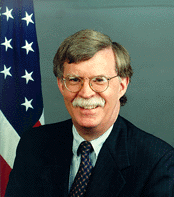
Media Stakeout Ambassador John Bolton 10/06/06 (VIDEO)

John R. Bolton Ambassador Permanent U.S. Representative to the United NationsMedia Stakeout: Informal comments to the Media by the Permanent Representative of the United States of America, Ambassador John Bolton, on the Democratic People's Republic of Korea and other matters. 06 October 06, [Webcast: Archived Video - file is real media format, running time is 11:42] FULL STREAMING VIDEO.
Biography, John R. Bolton Ambassador Permanent U.S. Representative to the United Nations

Technorati Tags: and or and , or and or , or and , or , and ,

Related: Keywords State Department, Thursday, October 05, 2006 Secretary Condoleezza Rice, President Mahmoud Abbas (VIDEO), Tuesday, October 03, 2006 State Department Daily Press Briefing, VIDEO, TEXT, 10/02/06, Thursday, September 21, 2006State Department Daily Press Briefing, VIDEO, PODCAST, TEXT, 09/21/06 Wednesday, September 20, 2006 Mahmoud Ahmadinejad Iran UN (VIDEO), Tuesday, September 19, 2006 Media Stakeout Ambassador John Bolton 09/18/06 (VIDEO), Tuesday, September 19, 2006 Kristen Silverberg On-the-Record Briefing (VIDEO), Monday, September 18, 2006 Annual Report on International Religious Freedom (VIDEO), Wednesday, September 13, 2006State Department Daily Press Briefing, VIDEO, PODCAST, TEXT, 09/12/06, Monday, September 04, 2006 Media Stakeout Ambassador John Bolton 09/01/06 (VIDEO), Monday, September 04, 2006 Condoleezza Rice American Legion Convention VIDEO, PODCAST, TEXT, Thursday, August 31, 2006 United Nations Daily Press Briefing 08/31/06 (VIDEO), Monday, August 28, 2006Media Stakeout Ambassador John Bolton 08/28/06 (VIDEO), Wednesday, August 23, 2006 Iranian Response to the P5+1 Package, Tuesday, August 22, 2006 Media Stakeout Ambassador John Bolton 08/22/06 (VIDEO), Tuesday, August 22, 2006 Media Stakeout Ambassador John Bolton 08/15/06 (VIDEO),

President Bush Discusses No Child Left Behind (VIDEO)

President Bush Discusses No Child Left Behind, FULL STREAMING VIDEO, Woodridge Elementary and Middle Campus, Washington, D.C. 11:02 A.M. EDT, Fact Sheet: The No Child Left Behind Act: Challenging Students Through High Expectations, and In Focus: Education, Declaraciones Del Presidente acerca de No Child Left Behind

President George W. Bush and U.S. Secretary of Education Margaret Spellings pose for a photo with students during their visit Thursday, Oct. 5, 2006, to the Woodridge Elementary and Middle Campus in Washington, D.C. White House photo by Paul Morse.THE PRESIDENT: Thank you all. Thank you for the warm welcome. Thank you for inviting Madam Secretary and me to your school. It's nice to be introduced by somebody with a Texas accent.
(Laughter.) She's a good buddy, and she is doing a fine job as the Secretary of Education. So, Margaret, thank you very much for your service.
President George W. Bush talks with students during his visit Thursday, Oct. 5, 2006, in the SmartLab of the Woodridge Elementary and Middle Campus in Washington, D.C., where students demonstrated various math, science and technology projects. White House photo by Paul Morse.I'm glad to be at Woodridge, as well. I'm here because this is one of America's fine public charter schools. I'm here to remind people that charter schools work,
and they can make a difference in the lives of our children. So I want to thank you for letting me come. I want to thank the teachers and the administrators and the principals -- and the principal, for setting high expectations. I know that sounds simple, but you know what happens when you set low expectations? You get low results. And so a center of excellence is always a place of learning where people believe the best. And I want to thank the folks here for setting high expectations. I want to thank you for achieving results.

I applaud the parents of the students who are here for being -- and I applaud you for being involved in the life of your children, particularly when it comes to one of the most important aspects of their development, and that is school. And I want to thank the students for letting me come, too.

I want to thank Mary, the principal. You know, one of the things I have found, and I've spent a lot of time in schoolhouses as a result of being the governor and the President is that a good school always has a good principal. (Applause.) And Mary Dunnock must be a good principal, because this is a good school. And I applaud you for being an educational entrepreneur. An educational entrepreneur is somebody who is willing to challenge failure and mediocrity if she finds it, because failure and mediocrity are unacceptable in any classroom anywhere in the United States. (Applause.)

I thank Donald Hense for joining us, Founder and Chairman of the Board of Trustees of the Friendship Public Charter School. (Applause.) Mr. Hense told me he had the opportunity of meeting my mother one time, and I said to him, well, you met the A-team then -- (laughter) -- now you met the B-team. (Laughter.) But thank you for your leadership. I welcome the members of the Friendship Public Charter School Board. Thank you for coming.

Being on a school board is difficult work, I know. Being on a school board that challenges the status quo is important work, and I thank you for that. It means a difference -- I was in Lyle Brown's class. Lyle is not here. He's still teaching. But one of the things I saw was a teacher who loves being a teacher. (Applause.) And I applaud the teachers in this school and teachers all around the country who are -- who are adding to the great future of our country.

I was in Max Brooks' class. He's not here either, but he is the facilitator in what's called a SmartLab. They didn't have SmartLabs when I was going to elementary or junior high school. They've got one here. And it's an innovative program that teaches people practical skills. You know, one of the interesting questions I like to ask to students when I go into the classroom is, how many of you are going to go to college? You'll be pleased -- there you go -- you'll be pleased to hear that hands went up. (Applause.)

See, that's a good sign when the principal and students and parents have encouraged our children to set a goal. Going to college is an important goal for the future of the United States of America, and I'm please to report that when I asked that question in both classrooms I was invited to go to, there was unanimity.

The students have set a goal to go to college, and I reminded them that now is the time to work hard so you get to go, like take advantage of the SmartLab, read more than you watch TV, practice your math and science. I want to applaud you, Madam Principal, for encouraging our students to aim high, and I thank the teachers for helping them achieve those dreams.

In recent days, we have seen some sad and shocking violence in our schools across America. Yesterday, I was in Colorado, which is one of the states that had received this sad and shocking news firsthand.

Next week, Secretary Spellings and Attorney General Al Gonzales are going to host a conference here in Washington, D.C., and it's an important conference. We're going to bring together teachers, and parents, and administrators and law-enforcement officials, and other experts to discuss ways to help our schools protect the children. See, it is paramount that the federal government work with the state government and local governments to make it clear that our schools are places of learning, not places where there will be violence. And so, Margaret, I want to thank you for that initiative, and I'm looking forward to hearing the results of the important discussions.

I'm here today to talk about the No Child Left Behind Act. It's a -- this act is an important way to make sure America remains competitive in the 21st century. We're living in a global world. See, the education system in America must compete with education systems in China and India. If we fail to give our students the skills necessary to compete in the world of the 21st century, the jobs will go elsewhere. That's just a fact of life. It's the reality of the world in which we live. And therefore, now is the time for the United States of America to give our children the skills so that the jobs will stay here.

Oh, there will be jobs -- don't get me wrong. But I'm talking about the high-paying jobs, the quality jobs, the jobs that will be helping to lead the world in the 21st century. And there's no doubt in my mind we can achieve that objective. And the No Child Left Behind Act was all part of making sure that we get it right in the schools. So when I came here to Washington I made a focused effort to work with Democrats and Republicans to pass this important law. And the theory behind the law is straightforward: We'll spend more money on education, but in return, we want to see results.

Oh, I know that may be too much to ask for some. It's not too much for this school. As a matter of fact, I get a little nervous when I hear people say, well, I don't want to be measured. My attitude is, what are you trying to hide? How can you solve a problem until you measure the problem? How can you make sure a child is achieving what we all want if you don't measure early to determine whether or not the skills are being imparted?

And so the No Child Left Behind says, look, we trust the local folks. I don't want Washington, D.C. running the schools. That's up to the people in the states and the local community. I've been a strong believer in local control of schools. But I also believe it makes sense to ask the question, whether or not a child can read, write, and add and subtract. I don't think it's too much to ask. I know it's an important question if we expect our children to have the schools [sic] necessary to compete in the 21st century. I know the kids don't like tests, and I didn't like it either, to be honest with you. You hear people say, well, we're testing too much. No, we're just trying to figure out whether or not people have got the skills necessary to succeed.

You know, I remember the debates when I was the governor of Texas and Margaret and I were working on accountability systems. I remember somebody standing up and saying, it is racist to test. I said, uh-uh, it is racist not to test, because there are too many children being shuffled through our schools without understanding whether or not they can read and write and add and subtract. I think it's important to hold people to account now to make sure the education system functions for all. And that's the spirit of No Child Left Behind.

By measuring, it helps us determine whether or not a curricula works. Is the reading curriculum you're using working? That's a fundamental question a parent ought to ask, or a principal ought to ask, or a teacher ought to ask. The best way to find out is to measure to determine whether or not a child can read at grade level. And that helps you determine whether or not your curriculum are working.

One of the things that I think is most important about the No Child Left Behind Act is that when you measure, particularly in the early grades, it enables you to address an individual's problem today, rather than try to wait until tomorrow. My attitude is, is that measuring early enables a school to correct problems early.

See, let's be frank about it. We had a system that just shuffled kids through grade after grade. I know some say that wasn't the case, but it was -- let me just say, my state, the place I was familiar with. It's so much easier, when you think about it, just to say, okay, if you're such and such a grade, you're supposed -- age, you're supposed to be in this grade, and just shuffle them through. And guess who got shuffled through? Inner-city kids, the hard to educate. It made it easy just to say, oh, gosh, let's just -- you know, let's don't worry about whether or not you've got the skills. Let's just put you here because that's where you belong. That's unfair to parents. That's unfair to the children. And the No Child Left Behind Act demands result for every child, for the good of the United States of America. (Applause.)

There's an achievement gap in America that's not good for the future of this country. Some kids can read at grade level and some can't. And that's unsatisfactory. I know it's unsatisfactory for the educators who are here. It's unsatisfactory if you're a parent, and it's unsatisfactory for the President.

You can't have a hopeful America if certain kids can read at grade level and others can't, and we don't address the problem. I'm proud to report the achievement gap between white kids and minority students is closing, for the good of the United States.

How do I know? Because we measure. In reading, nine-year-olds have made larger gains in the past five years than at any point in the previous 28 years. That's positive news. In math, nine-year-olds and 13-year-olds earned the highest scores in the history of the test. In reading and math, African American and Hispanic students are scoring higher, and the achievement gap is closing.

Oh, I know people say we test too much, but how can you solve a problem until you measure? And how can you hold people to account when there's an achievement gap that is not right for America, unless you measure? Measuring is the gateway to success.

Woodridge Elementary School gets measured. The accountability system helped your school identify struggling students and enabled them to get the help they need early. I appreciate the fact that you have intervention sessions with teacher assistance. In other words, we identify a particular child's problems, and then this school intervenes. You have specialized learning projects, extra tutoring.

Each child matters. Every child has potential. All hands went up and said, I want to go to college. And this school recognizes that some students need a little extra help early to make sure they can realize those dreams. That's what measuring helps you to do.

Woodridge has met the standards for three years in a row. You've put in a lot of hard work and you have the results to show for it, and I thank you for your contribution to the future of this country. (Applause.)

If you don't make progress, you get extra help. One of the most important initiatives is the Supplemental Service Initiative. This initiative says that when we find a child that needs help, that child gets extra help. In other words, if a child is falling behind. Remember, I keep talking about individual children. It used to be when they measured, they just measured everybody, you know. And now we're forcing them to disaggregate results. That's a fancy word for saying, just split individuals out so we know.

And when we find a child that needs extra help, there's money to do so. And there are options for parents, which is an important part of making sure there's parental involvement, and making sure -- an important part of making sure the strategy works.

A parent can enroll their child in a free intensive tutoring program. There's money for that. If your child is not up to grade level early on, there's extra help available for each family to do so. Parents can transfer their child to a better public school if that school refuses to change. In other words, at some point in time, there's got to be some accountability. It's one thing to be talking the talk about educational excellence, but pretty soon, if nothing happens, a parent ought to be allowed to walk. And that means to another public school, just like Woodridge, see.

If you're in a neighborhood and one school won't teach and change, and another school will, I think it makes sense for a parent to have the option, with space available, to be able to say, I've had it. I'm tired of my child being trapped in a failed school; I'm owed better as a parent and a property taxpayer than failure, therefore, I'd like to move my child to another school.

And that's what's happened to some of the students right here. Asia Goode -- where's Asia? Oh, thank you for coming, Asia. Can I quote you? Thank you. I was going to quote you anyway. (Laughter.) Asia first came to Woodridge; she was reading well below grade level. How do we know? Because she measured. Her teachers stayed after school to tutor her, and she caught up. Somebody said, it is my job to make sure this individual is not left behind, and not just shuffled through. And I thank that teacher for doing that.

Even after Asia reached grade level -- in other words, we measure to determine whether a child can read at grade level -- the teacher said, wait a minute, grade level is not good enough for you, Asia. I started off my speech by saying we're setting high standards. That's how you help somebody achieve educational excellence. Asia is now an honors student. She loves reading and she sings in the school choir. And I congratulate her parent and the teachers and Asia for setting high standards and working hard to achieve those standards. (Applause.)

Washington, D.C. has a really innovative and interesting program that I strongly support, as did your Mayor, Mayor Williams. Oh, I know it's controversial for some, but it rests on the premise that a parent ought to have different options if a child is trapped in a school that won't teach and won't change. I happen to think that is a good, solid principle on which to operate -- that the parent is the primary teacher of a child, and the parent ought to have different options for his or her child.

And so the D.C. Opportunity Scholarship Program was enacted. And it wasn't easy to enact it. There are some who are willing to defend the status quo at all costs. That's okay, that's generally what happens sometimes in the political arena. But this is a program that enables a parent to transfer his or her child to a private or religious school if the parent feels like the current school isn't working. This program is aimed particularly at low-income students.

Let's be frank about it; upper-income families have got school choice. They can afford it. Low-income families don't. This program enables low-income families to say, I'm sick and tired of my child not receiving a quality education. Eighteen hundred low-income students have used these scholarships. One of them is Carlos Battle. Carlos isn't here, but I thought his quote might interest -- he was in a school and he transferred to Assumption Catholic School two years ago. In other words, his parents -- family qualified, received a scholarship, and off he went.

After transferring, he made the honor roll. He became the class president. He led the basketball team to its first championship. He said this, "There is no limit to what I can do. And that not only makes me happier, but my mom can't seem to stop smiling." It is really important that as we think about how to make sure every child gets a good education, that we not only measure, but we say that if things don't change, parents ought to have different options.

The No Child Left Behind Act is good progress, but we've got a lot of work to do, and it starts with making sure that here in Washington we don't soften our desire to hold schools accountable. I'll tell you, look, there's a lot of pressure, and I'm sure the congressmen and senators feel that pressure. They feel the pressure because people say, look, we're tired of measuring. They feel the pressure because, you know, we're just teaching the test. I mean, there's every excuse in the book.

But as we come time to reauthorize the No Child Left Behind Act, my attitude is, instead of softening No Child Left Behind, we need to strengthen it. The law is working. It makes sense. We must hold schools account -- to account if we expect our children to be able to realize dreams. And if we want America to remain competitive, we must have high standards.

You know, there's a -- kind of a mind-set at times, a culture that says, well, you know, maybe certain kids can't learn, and therefore, let's don't have high standards. I reject that notion. I strongly believe every child has got the capacity. And all of us must demand that the high standards be set and met. And so one of the top priorities next year for me will be the reauthorization and the strengthening of the No Child Left Behind Act. (Applause.)

Here are some ways to improve the law: In order for every child to get up to grade level, there must be a quality teacher in every classroom. And one way to help the law is to help our teachers in an innovative way. We created what's called the Teacher Incentive Fund. It allows states and local districts to reward teachers who demonstrate strong results for their students. It's an interesting concept, isn't it? In other words, if your measurement system shows that you're providing excellence for your children, it seems to make sense that there ought to be a little extra incentive to do so through the bonus program, not run by the federal government -- funded by the federal government, administered by states and local governments.

I think it's very important to encourage our good teachers to teach in some of the toughest school districts. You know, when you find a good teacher, a good high-quality teacher in a -- for example, an inner-city district needs help, or a rural district needs help, there ought to be a bonus system available, an incentive program to say to a teacher, thanks; thanks for heading into some of the -- you know, an area that is -- that needs help, and here's a little incentive to do so. So there's some ideas that Congress can work on in order to provide incentives for our teachers.

I believe we ought to encourage math and science professionals to bring their expertise into the classrooms. I remember going to a school here in Maryland recently. Margaret and I went over there, and I met a guy who worked at NASA. And do you know what he was doing? He was in the classrooms basically saying to the 7th and 8th graders, science is cool; take it seriously.

You know, it's important that you learn the skills necessarily to be good scientists because it's important for the United States of America that we've got young scientists. And by the way, every neighborhood in America can produce young scientists. And therefore encouraging these professionals in the classroom as adjunct teachers makes a lot of sense, and Congress ought to fund that program.

We've got to improve options. One of the problems we have in the Public School Choice program is parents aren't getting information on a timely basis. So in other words, you got your kid going to a school, the school's accountability system says, wait a minute, you're not doing as well as you should. And the parent gets notified after the next school year begins. That doesn't help.

It kind of looks like people are afraid to put out results for some reason. And so we'll work with Congress to clarify the law and to strengthen the law to make sure our parents get timely information and useful information so that they can take advantage of the No Child Left Behind Act's law that provides flexibility and transferability.

We're going to work with school districts to help more students take advantage of free, intensive tutoring. You'd be amazed at the number of districts that don't use this extra tutoring. They don't take advantage of the extra money to help an individual child. Oh, they'll figure out ways to spend it, don't get me wrong. But the money is aimed for helping an individual succeed, and it's the cumulative effect of bringing these students up to grade level that will enable us all to say we're more competitive for the future.

I believe in opportunity scholarships. I believe that the program here in Washington, D.C. ought to be replicated around the country. I call on Congress to create such a program for 28,000 low-income children as a beginning step to help parents challenge failure.

We've got to do something about our high schools, by the way. I think there needs to be strong accountability in America's high schools. There's strong accountability right here at Woodridge. It seems like it makes sense, if it's working, to extend that concept to our high schools.

One out of every four 9th graders in America does not graduate from high school on time. That's unacceptable. If we want to be competitive, we better make sure that the skills that are now being imparted at elementary school and junior high carry on through high school. We don't want the good work here at Woodridge to be lost because there's -- because some say, well, I don't need to get out of high school, or the accountability systems in high school don't measure up. And so what I want to do is I want to have the same sense of accountability in our high schools that we have in our junior high and elementary schools -- not to increase the testing burden, but to help us understand whether or not we are achieving our national objective, which is giving our kids the skills necessary to be competitive.

And so I think we need to fund testing early in the high-school systems, and to help students fix problems like we're doing in elementary school and high schools [sic]. I proposed a billion-and-a-half dollar initiative; Congress needs to fund it.

I've also proposed a program to train 70,000 teachers over five years to lead Advanced Placement classes in our high schools. Advanced Placement works. It is a -- it is an excellent program that helps our high schools set high standards. And it calls -- it challenges our students to achieve great things by raising the standards.

Many of you know about AP. It needs to be spread all throughout America. And step one is to make sure our teachers have the skills necessary to teach it. And step two is to help states develop programs that will help parents pay for the AP test. What we don't want is a child taking an AP class and having mom or dad say, it's too expensive to take the test. You pass an AP test, you're on your way. If you've got the skills necessary to pass an AP test, it means the education system has done its job, and our country is better off.

And so here are some ideas for the Congress and the administration to work on as we think about how to reauthorize the No Child Left Behind Act. I strongly believe this piece of legislation is working. I know it is necessary to have this kind of rigor in our school systems to say, we have done our job and given our kids the skills necessary to succeed. And I want to thank you all for serving as a great example. Thank you for inviting me. Again, I thank the teachers for teaching, and the parents for loving, and the students for reading.

God bless. (Applause.)

END 11:32 A.M. EDT, For Immediate Release, Office of the Press Secretary, October 5, 2006

Technorati Tags: and or and , or and , or , and , or , and ,

RELATED: Wednesday, January 11, 2006 No Child Left Behind fourth anniversary (VIDEO), Sunday, May 08, 2005 No Child Left Behind Act, Quiet Revolution, Wednesday, January 12, 2005 No Child Left Behind High School Initiatives

Thursday, October 05, 2006

Secretary Condoleezza Rice, President Mahmoud Abbas (VIDEO)

Remarks With Palestinian Authority President Mahmoud Abbas After Their Meeting, FULL STREAMING VIDEO, Secretary Condoleezza Rice, Ramallah, West Bank, October 4, 2006, (11:00 a.m. EDT)

Ramallah, West Bank, October 4, 2006, Secretary Rice and Palestinian President Mahmoud Abbas held a joint press conference today in Ramallah following their meetings. Secretary Rice is traveling to Saudi Arabia, Egypt, Israel and the Palestinian Territories, October 1-5, 2006. State Department photo by Josie Duckett.Ramallah, West Bank, October 4, 2006, Secretary Rice and Palestinian President Mahmoud Abbas held a joint press conference today in Ramallah following their meetings.
Secretary Rice is traveling to Saudi Arabia, Egypt, Israel and the Palestinian Territories, October 1-5, 2006. State Department photo by Josie Duckett.


PRESIDENT ABBAS: (Via interpreter) …including our relations with various countries in the world searching a peace process that will end the Arab-Israeli conflict. And so the Palestinian question by means of setting up an independent Palestinian state that would live peacefully alongside the state of Israel.

We discussed the issue of forming a national unity government, and we addressed the issue of how talks on the national unity government have been disrupted, and today we say that any government to be formed has to be fully committed to all the commitments of the Palestinian Authority towards the Arab world and to the international community and has to honor all kinds of agreements that were signed in the past between the PA and the Arab parties. Up to this moment, there are no indications that these conditions are going to be met.

We also spoke about the prisoners. And we said that Egypt is making a big effort to release the Israeli soldier and in return it is a must to release Palestinian prisoners incarcerated in Israel.

And finally we spoke about the crossing points and we raised the issue of the need for keeping (inaudible). In addition to this, we spoke of the security condition, the deteriorating security conditions especially the events of the last two days, the reasons of which are very well known and I don't want to go into details of what happened in those days.

SECRETARY RICE: Thank you very much, Mr. President, and thank you for a warm reception. May I begin by wishing Ramadan Karim to everyone. This is, of course, a time when Muslims around the world are celebrating this holy time of Ramadan, a time of family and a time of faith. I might note that many Americans of Muslim faith are these very days also observing Ramadan, and it is in part why the United States has such great respect for the great religion of Islam. It is a part of us as Americans as well.

I want to thank you, Mr. President, for your leadership. I had a chance to brief the President on the fact that we met last night in the GCC+2 and that much of the conversation was about how to support the Palestinian people in this time of considerable difficulty, how to support President Abbas and the Palestinian Authority, and how to create the conditions in which the Palestinian people can be served by the kind of government that the President talked about in his United Nations speech, a government that is able to deliver for the needs of the Palestinian people, that observes the Quartet principles and that can form the basis then for movement forward on what we all desire, especially President Bush, and that is a two-state solution, a solution in which a democratic Palestine and a democratic Israel can live side by side in peace.

We discussed a number of specific issues. I told the President that we are very concerned, of course, about the humanitarian conditions in the Palestinian territories, about the economic situation. It is a great sadness during this time, of course, of Ramadan that Palestinians, many of them are deprived of basic needs. And I said to him that we would double our -- redouble our efforts to improve the conditions of the Palestinian people. The Quartet talked about this. We talked about this last night. And we want very much to work toward better conditions for the Palestinian people.

We talked also about the security situation, the need to improve the security forces, the President's -- of the Palestinian Authority. And of course, as the President said, we understand that some of the economic hardships are of course caused by the lack of mobility, the lack of movement and access, and I will of course see what I can do to make sure that some of those crossings are indeed open longer and more frequently so that economic activity can return.

Mr. President, I think that you know that we have great admiration for you and for your leadership, that President Bush when he met with you restated again his strong commitment to a process by which Palestinians and Israelis can move forward to the day when there are two states. We know we have a lot of work to do in between, but you have the strong commitment of the United States to that cause and the personal commitment of me and the personal commitment of the President.

Thank you very much.

PRESIDENT ABBAS: (In Arabic.)

QUESTION: (In Arabic.)

SECRETARY RICE: First of all, let me say that I think President Abbas has enormous respect from the international community and in the United States. And it is indeed because of that respect for the President that the United States, even after the election of the Hamas government, which we fully recognize the Palestinian people’s elections as legitimate -- but after the refusal of that government to accept the international norms, the agreements that the Palestinians have accepted, the United States found a way to get humanitarian assistance to the Palestinian people by reprogramming some of our assistance for the Palestinians. That’s, in large part, because of our respect for President Abbas and what he’s trying to do. There is an international mechanism for support to the Palestinian people and again, I think in recognition of what the President is trying to do.

But obviously, we would like to be able to do more. And I’ve been discussing with the President ways that we might be able to better address some of the great needs that are there with the Palestinian people, but more than that, how we can facilitate a dialogue, how we can facilitate discussions between Israel and the Palestinians about the key issues that really do relate to economic development, to the ability of the Palestinian people to move within their territory, ways to end the violence, ways to make possible a life for the Palestinian people that is not subject to the kind of daily humiliations that we know have been associated with the occupation.

That is my program here with the President and because he is a leader that people respect, he is going to continue to have not just the attention of the international community, but its very intensive efforts to try to break through some of the deadlocks that have been there. And I think we will make progress.

QUESTION: President Abbas, do you think it's possible that the next step will include elections and what specifically are you doing to prevent a civil war?

And to Secretary Rice, first of all on Iran.

MODERATOR: (Off-mike.)

QUESTION: Sorry. President Abbas, do you think it's possible that the next step will include elections? And secondly, what are you doing to prevent a civil war between Hamas and Fatah?

And to Secretary Rice on Iran, how dead do you think negotiations are? Are they finished with Iran? And do you anticipate holding a meeting this week with your P-5+1 counterparts to discuss what specific sanctions to impose on Iran? And secondly, what specifically, tangibly, concretely do you expect to get out of this trip and are there ways that you anticipate restarting the peace process?

SECRETARY RICE: How many questions, Robin? (Laughter.)

PRESIDENT ABBAS: (In Arabic.)

SECRETARY RICE: Let me take the second question first since it relates actually to the Palestinians. The first is that I do hope that we can come to some understanding about how to make the agreement on movement and access more functional. Clearly a lot has happened since that agreement was signed, but it's still important that Carni be able to operate. It's still important that there be at least some openings at Rafah. I'm glad to know that it was opened a couple of times during Ramadan, but I think we need to work on those issues. Those are the kinds of on-the-ground things that make it easier for the Palestinian people.

I think we will also discuss ways that we might make more resources available at least for some of the needs that have been identified by the international community for the Palestinian people. And finally, I am here to hear from the President what we can do to support him. I think that General Dayton is here. We are working very closely on some security plans. I think that we want to make sure those security plans are now really implemented and that we can move them forward. Because obviously security, the movement and access, economic development, well-being are all interlinked.

And sometimes, Robin, what is necessary is to go step-by-step and try on the ground to really improve conditions. And so I'm trying to facilitate that. I know there have been some good meetings between the Israelis and the Palestinians at the official level, and we hope that those will continue. General Dayton is working on some of those security issues, but it's my hope that it will not be very long before there can be a meeting between the President and Prime Minister Olmert. I know that they will choose the time, but we hope that it will take place in the near future.

As to Iran, I have read very briefly the statement that Javier Solana made to the European parliamentarians. I would share his assessment. Iran has not decided to suspend its enrichment and reprocessing activities. There have been months of negotiations. There has been patience beyond the August 31st deadline that was set by the UN Security Council resolution. There has been a lot of patience when you go all the way back to the fact that the Paris agreement is now more than two and a half years ago.

So I think we have come to a time when the Iranians have to make their choice and the international system has to act accordingly. And it seems to me that acting accordingly is very much spelled out in Resolution 1696 that means action under Article 41 of Chapter 7. I will tell you whether or not we're actually going to have a meeting on Friday. I think we have left open that possibility. But when we do, I have to say that I think the logic of the -- of bringing to a close the open-ended negotiations with the Iranians that that's become -- that it's become quite evident that that's what we're going to have to do.

Thank you.

2006/T23-7, Released on October 4, 2006

Technorati Tags: and or and , or and or , or and , or ,

Related: Keywords State Department, Tuesday, October 03, 2006 State Department Daily Press Briefing, VIDEO, TEXT, 10/02/06, Thursday, September 21, 2006State Department Daily Press Briefing, VIDEO, PODCAST, TEXT, 09/21/06 Wednesday, September 20, 2006 Mahmoud Ahmadinejad Iran UN (VIDEO), Tuesday, September 19, 2006 Media Stakeout Ambassador John Bolton 09/18/06 (VIDEO), Tuesday, September 19, 2006 Kristen Silverberg On-the-Record Briefing (VIDEO), Monday, September 18, 2006 Annual Report on International Religious Freedom (VIDEO), Wednesday, September 13, 2006State Department Daily Press Briefing, VIDEO, PODCAST, TEXT, 09/12/06, Monday, September 04, 2006 Media Stakeout Ambassador John Bolton 09/01/06 (VIDEO), Monday, September 04, 2006 Condoleezza Rice American Legion Convention VIDEO, PODCAST, TEXT, Thursday, August 31, 2006 United Nations Daily Press Briefing 08/31/06 (VIDEO), Monday, August 28, 2006Media Stakeout Ambassador John Bolton 08/28/06 (VIDEO), Wednesday, August 23, 2006 Iranian Response to the P5+1 Package, Tuesday, August 22, 2006 Media Stakeout Ambassador John Bolton 08/22/06 (VIDEO), Tuesday, August 22, 2006 Media Stakeout Ambassador John Bolton 08/15/06 (VIDEO), Friday, August 18, 2006 State Department Daily Press Briefing, VIDEO, PODCAST, TEXT, 08/17/06, Thursday, August 17, 2006 Media Stakeout Ambassador Anne Woods Patterson Sudan VIDEO,

Wednesday, October 04, 2006

Spinach E. coli O157:H7 Outbreak Warrants

OFFICE OF THE UNITED STATES ATTORNEYSOUTHERN DISTRICT OF CALIFORNIA, San Diego, California, United States Attorney Carol C. Lam, October 4, 2006

Statement on Search Warrants Related to September 2006 Outbreak of E. coli

Escherichia coli in FA stained section of intestine from an 8-month old child suffering from chronic diarrhea. In a small number of individuals (mostly children under 5 and the elderly), E. coli can cause hemolytic uremic syndrome, in which the red blood cells are destroyed and the kidneys fail.* The U.S. Attorney's Office for the Northern District of California announced that agents of the FBI and FDA Office of Criminal Investigations executed two search warrants today
on Growers Express in Salinas, CA, and Natural Selection Foods in San Juan Batista, CA, in connection with the September 2006 outbreak of E. coli 0157:H7 that the FDA has traced to spinach grown in the Salinas area.

"FDA continues to work with the U.S. Attorney's Office and the FBI to determine the facts behind this outbreak," said Dr. Robert Brackett, Director of the FDA Center for Food Safety and Applied Nutrition.

United States Attorney Kevin V. Ryan stated that "I want to reassure the public that there is no indication in this investigation that leaf spinach was deliberately or intentionally contaminated. We are investigating allegations that certain spinach growers and distributors may not have taken all necessary or appropriate steps to ensure that their spinach was safe before they were placed into interstate commerce. Moreover, the investigation has not revealed any evidence of a new or continuing threat to public health in connection with the matters under investigation."

FDA Announces Findings From Investigation of Foodborne E. coli O157:H7 Outbreak in Spinach

FDA is announcing today that all spinach implicated in the current outbreak has traced back to Natural Selection Foods LLC of San Juan Bautista, California. This determination is based on epidemiological and laboratory evidence obtained by multiple states and coordinated by the Centers for Disease Control and Prevention. Natural Selection Foods issued a recall of all implicated products on September 15, 2006. Four other companies have issued secondary recalls because they received the recalled product from Natural Selections. See below for a complete list of brand names that are subject of the recalls. Spinach processed by other manufacturers has not been implicated in the outbreak.

FDA, the State of California, the Centers for Disease Control and Prevention and the United States Department of Agriculture continue to investigate the cause of the outbreak. This includes continued inspections and sample collection in facilities, the environment and water, as well as studies of animal management, water use and the environment.

Next Steps

Although the current outbreak may ultimately trace back to a specific field(s), there has been a long history of E. coli O157:H7 outbreaks involving leafy greens from the central California region. Spinach processed by other manufacturers has not been implicated in this outbreak, however, based on discussions with industry, and given the past E. coli O157:H7 outbreaks, FDA and the State of California expect the industry to develop a comprehensive plan which is designed to minimize the risk of another outbreak due to E. coliO157:H7 in spinach grown in central California. While this plan is under development, FDA and the State of California reiterate our previous concerns and advise firms to review their current operations in light of the agency's guidance for minimizing microbial food safety hazards.

FDA and the State of California have previously expressed serious concern with the continuing outbreaks of foodborne illness associated with the consumption of fresh and fresh-cut lettuce and other leafy greens. After discussions with industry, FDA and the State of California, as part of a longer term strategy, now expect industry to develop a plan to minimize the risk of another outbreak due to E. coli O157:H7 in all leafy greens, including lettuce.

The Grower Shipper Association of Central California, the Produce Marketing Association, the United Fresh Produce Association, and the Western Growers Association, said today, "We are committed to working together as one industry to learn everything we can from this tragedy, and will redouble our efforts to do everything in our power to reduce the potential risk of foodborne illness. As we have in the past, we will work aggressively with the Food and Drug Administration and state regulatory authorities to ensure the industry's growing and processing practices continue to be based on the very best scientific information available, and that we are doing everything possible to provide the nation with safe and healthy produce."

Implementation of these plans will be voluntary, but FDA and the State of California are not excluding the possibility of regulatory requirements in the future.

FDA will be holding a public meeting to address the larger issue of food borne illness linked to leafy greens later in the year once the current investigation is complete.

Advice to Retailers, Restaurateurs and the Public

FDA is still reminding the public that Natural Selection Foods has recalled all spinach products under multiple brand names with a date code of October 1 or earlier. There have been four other recalls from different companies because they received Natural Selection Foods spinach. See below for a complete list of brand names that are subject of the recalls.

In order to protect consumers, retailers and restaurateurs should not sell raw spinach or blends that may contain spinach that was processed by Natural Selection Foods and all other brands subject to the recalls.

Consumers are advised that proper storage of fresh produce can affect both quality and safety. To maintain quality of fresh produce, certain perishable fresh fruits and vegetables (like strawberries, lettuce, herbs, and mushrooms) can be best maintained by storing in a clean refrigerator at a temperature of 40° F or below. All produce that is purchased pre-cut or peeled should be refrigerated to maintain both quality and safety.

Many precut, bagged produce items like lettuce are pre-washed. If so, it will be stated on the packaging. This pre-washed, bagged produce can be used without further washing.

Processed spinach (e.g., frozen and canned spinach) is not implicated in this outbreak.

Number of Cases of Infection, Hospitalization and Death

To date, 187 cases of illness due to E. coli O157:H7 infection have been reported to the Centers for Disease Control and Prevention (CDC), including 29 cases of Hemolytic Uremic Syndrome (HUS), 97 hospitalizations and one death.

States Involved and Number of Cases

The 26 affected states are: Arizona (7), California (2), Colorado (1), Connecticut (3) Idaho (4), Illinois (1), Indiana (9), Kentucky (8), Maine (3), Maryland (3), Michigan (4), Minnesota (2), Nebraska (9), Nevada (1), New Mexico (5), New York (11), Ohio (25), Oregon (6), Pennsylvania (9), Tennessee (1), Utah (17), Virginia (2), Washington (3), West Virginia (1), Wisconsin (49), and Wyoming (1). In addition, Canada has one confirmed case.

Laboratory Findings

There are now a total of 10 confirmed product samples that contain the E. coli O157:H7 outbreak strain.
  • The Colorado Department of Public Health and Environment has confirmed the presence of the outbreak strain of E. coli O157:H7 in a sample of Dole spinach with a lot code of P227A02, and a "best if used by" date of August 30, 2006.
  • The Ohio Department of Health confirmed the isolation of E. coli O157:H7, matching the outbreak strain, from a package of bagged spinach.
  • The Wisconsin Department of Health and Family Services has confirmed that E. coli O157:H7, the same strain as that associated with the outbreak, has been found in 2 bags of Dole Baby Spinach with lot codes of P227A.
  • The Nevada Department of Health and Human Services has reported a confirmed finding of E. coli O157:H7 in bagged spinach, matching the outbreak strain. The Nevada sample was analyzed by FDA Pacific Regional Lab NW.
  • The Pennsylvania Department of Health has confirmed that E. coli O157:H7, the same strain as that associated with the outbreak, has been found in 2 individual bags of Dole spinach purchased in Pennsylvania with a "best if used by" date of August 30, 2006, and a lot code of P227A01.
  • The Utah Department of Health (UDOH) and the Salt Lake Valley Health Department (SLVHD) have confirmed that E. coli O157:H7, the same strain as that associated with the outbreak, has been found in a bag of Dole Baby Spinach purchased in Utah, with a lot code of P227A01. Laboratory tests were conducted by the Utah Public Health Laboratory (UPHL).
  • The New Mexico Department of Health announced on September 20, 2006, that it had linked a sample from a package of spinach with the outbreak strain of E. coli O157:H7. DNA fingerprinting tests determined that the strain from the spinach matches the strain from patients in the outbreak. The package of spinach that tested positive was Dole Baby Spinach, with a lot code of P227A03.
  • The Illinois Department of Public Health has confirmed that E. coli O157:H7, matching the outbreak strain, has been found in a package of Dole Fresh Spinach with a lot code of P227A02, and a "best if used by" date of August 30.
Product Recalls (5)

To date, 5 firms have initiated recalls:

1) On September 22, 2006, Pacific Coast Fruit Company of Portland, Oregon initiated a voluntary recall of products that may include spinach supplied by Natural Selections Foods. Pacific Coast Fruit Company stopped making all products with spinach supplied from California on September 14, 2006. The recalled products are:

Baby Spring Mix Salad Kit (4.6 lbs), Chef on the Run- Bacon Spinach Salad (9 oz. plus 2 fl. oz. dressing), Chef on the Run - Spring Greens Salad (5 oz. plus 2 fl. oz. dressing), Chef on the Run - Willamette Valley Salad (10 oz. plus 2 fl. oz. dressing),Trader Joe's - Baby Spinach and Greens with Bleu Cheese, Candied Pecans and Cranberries with Raspberry Vinaigrette Dressing (10 oz.), Trader Joe's - Baby Greens and Spinach Salad with Wild Maine Blueberry Dressing (10 oz.), Mediterranean Veggie Blend Kit - 15 lbs, and My Brothers Pizza Spinach and Garlic - 15 oz. and 36 oz.

Most of the salad products can be identified by the labels Trader Joe's, My Brothers Pizza or Chef on the Run and are in clam shell containers. Pizza products are in round cardboard bottoms with a plastic over wrap. All salad products will have a "USE BY DATE" on or before Sept 20, 2006. Pizza products will have a "USE BY DATE" on or before September 23, 2006. The products were distributed through various retail outlets in Alaska, Oregon, Washington and Idaho. There is no international distribution.

2) On September 22, 2006,Triple B Corporation, doing business as S.T. Produce, of Seattle, Washington, initiated a voluntary recall of its fresh spinach salad products with a "Use By" date of 8/22/2006 thru 9/20/2006. Spinach used in these products may have been supplied from Natural Selections Foods of California. The recalled products were distributed in Washington, Oregon, Idaho and Montana to retail stores and delis and sold in a hard plastic clamshell container.

The products recalled by S.T. Produce are: NWG Spinach Salad (5 oz.),Spinach Salad, QFC (5 oz.), Charlie's Spinach Salad (5 oz.), Charlie's Tabouli & Goat Cheese Salad (10 oz.), NWG Tabouli & Goat Cheese Salad (10 oz.),Tabouli & Goat Cheese Salad, QFC (10 oz.), T/H Spring Mix Salad (5.5 oz.), T/H Mozzarella Spring Mix Salad (5.5 oz.), T/H Baby Spinach Salad (5.5 oz.), Walnut and Blue Cheese Salad w/ Grilled Chicken Breast (6.5 oz.), Larry's Market Tabouli & Goat Cheese Salad (10 oz.), Charlie's Seasonal Greens Salad (2.5 oz.), Charlie's Seasonal Greens Salad (4 oz.), Charlie's Baby Spinach Salad (6 oz.), Charlie's Baby Spinach Salad (5 oz.) and Caesar Bowtie Noodle Salad Kit with Grilled Chicken Breast (6.9 lbs).

3) On September 19, 2006, RLB Food Distributors, L.P., West Caldwell, NJ, initiated a voluntary recall of certain salad products that may contain spinach with an 'Enjoy Thru' date of 9/20/06.

The products recalled by RLB are: Balducci's Mesclun Mix 5 oz., Balducci's Organic Baby Spinach 5 oz., Balducci's Mixed Greens 5 oz., FreshPro Mesclun Mix 5 oz., FreshPro Organic Baby Spinach 5 oz., FreshPro Mixed Greens 5 oz., FreshPro Salad Mix with Italian Dressing 4.75 oz., and FreshPro Salad Mix with Ranch Dressing 5.25 oz.

4) On September 17, 2006, River Ranch, of Salinas, California, announced a voluntary recall of packages of spring mix containing spinach. River Ranch obtained bulk spring mix containing spinach from Natural Selections. The following brands are involved: Fresh N' Easy Spring Mix and Hy-Vee Spring mix containing baby spinach, distributed to retailers in Texas, Iowa, New Mexico, Georgia and Ohio. Product was packed in 5 oz. bags and 5 oz. plastic trays. Products that do not contain spinach are not part of this recall.

5) On September 15, 2006, Natural Selection Foods, LLC, of San Juan Bautista, California, announced a voluntary recall of all products containing spinach in all brands they pack with "Best if Used by Dates" of August 17, 2006 through October 1, 2006. These products include spinach and any salad with spinach in a blend, both retail and food service products. Products that do not contain spinach are not part of this recall.

Natural Selection Foods, LLC brands include: Natural Selection Foods, Pride of San Juan, Earthbound Farm, Bellissima, Dole, Rave Spinach, Emeril, Sysco, O Organic, Fresh Point, River Ranch, Superior, Nature's Basket, Pro-Mark, Compliments, Trader Joe's, Ready Pac, Jansal Valley, Cheney Brothers, D'Arrigo Brothers Co. of New York, Green Harvest, Mann, Mills Family Farm, Premium Fresh, Snoboy, The Farmer's Market, Tanimura & Antle, President's Choice, Cross Valley, and Riverside Farms. The affected products were also distributed to Canada, Mexico, Taiwan, Hong Kong and Iceland. FDA continues to investigate whether other companies and brands are involved.

Symptoms of E. coli O157:H7 Illness

E. coli O157:H7 causes diarrhea, often with bloody stools. Although most healthy adults can recover completely within a week, some people can develop a form of kidney failure called HUS. HUS is most likely to occur in young children and the elderly. The condition can lead to serious kidney damage and even death.

Lettuce Safety Initiative

The FDA developed the Lettuce Safety Initiative cfsan.fda.gov/~dms/lettsafe in response to recurring outbreaks of E. coli O157:H7 in lettuce. As a result of this outbreak, the initiative has been expanded to cover spinach. The primary goals of the initiative are to reduce public health risks by focusing on the product, agents and areas of greatest concern and to alert consumers early and respond rapidly in the event of an outbreak. This initiative is based on the 2004 Produce Safety Action Plan, intended to minimize the incidence of food borne illness associated with the consumption of fresh produce.

Additional Information, FDA continues to work closely with the CDC and state and local agencies to determine the cause and scope of the E. coli O157:H7 outbreak in spinach. Please check fda.gov for updates.

Additional information regarding safe handling of raw produce and fresh-squeezed fruit and vegetable juices can be found at cfsan.fda.gov/~dms/prodsafe. For additional general food safety tips, go to fightbac.org. ####

#### More Information and Nationwide E. coli O157:H7 Outbreak: Questions and Answers Media Inquiries: Julie Zawisza, 301-827-6242 julie.zawisza@fda.hhs.gov Susan Bro susan.bro@fda.hhs.gov Consumer Inquiries: 888-INFO-FDA

*This image is in the public domain and thus free of any copyright restrictions. As a matter of courtesy we request that the content provider be credited and notified in any public or private usage of this image.

Technorati Tags: or and or and or and or and or and or and

Related: Keyword biology, Thursday, August 24, 2006 FDA Approves Over-the-Counter Access for Plan B (morning after pill), Sunday, July 02, 2006 Gabapentin cools hot flashes as well as estrogen, Sunday, June 25, 2006 Estrogen plays different role during stress in black and white teens, Sunday, June 25, 2006 Our grip on reality is slim, Sunday, May 21, 2006 Genome doesn't start with 'G', Sunday, May 07, 2006 Lying Is Exposed By Micro-Expressions We Can't Control, Sunday, April 30, 2006 Mothers often have inaccurate perceptions of their children's body weight, Sunday, April 16, 2006 Other people influence us and we don't even know it!, Tuesday, January 04, 2005 The Cassini-Huygens mission to Saturn, Sunday, March 20, 2005 Agriculture Secretary Mike Johanns, bovine spongiform encephalopathy (BSE), Thursday, March 24, 2005 Fish Oil Holds Promise in Alzheimer's Fight, Sunday, April 10, 2005 National Human Genome Research Institute (NHGRI), Friday, April 15, 2005 Study uncovers bacteria's worst enemy , Sunday, May 01, 2005 Yes, it is an exoplanet 2M1207 system, Friday, May 20, 2005 a polysaccharide called hyaluronan, Tuesday, May 24, 2005 pseudoneglect phenomenon, Friday, June 03, 2005 DOE JGI sequences DNA from extinct cave bear, Monday, June 06, 2005 From a Few Wild Ancestors, a Citrus Cornucopia, Tuesday, June 07, 2005 NHGRI Selects 13 More Organisms for Genome Sequencing, Sunday, July 24, 2005 Prehistoric Native Americans maize cultivation ,