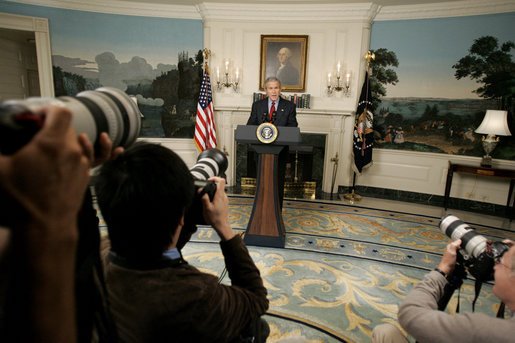
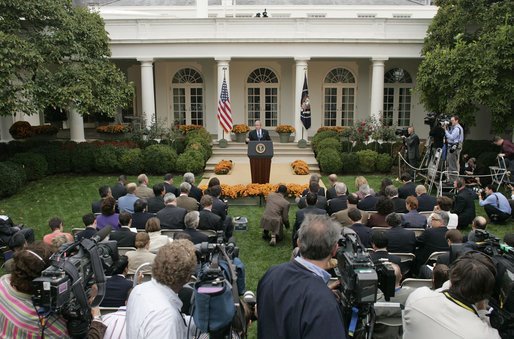
 | Press Conference by the President, FULL STREAMING VIDEO, The Rose Garden, 11:01 A.M. EDT. |
I'm going to talk about the pro-growth economic policies that helped bring about the dramatic reduction in the deficit this afternoon, and I'm going to remind our fellow citizens that good tax policy has a lot to do with keeping the economy strong, and therefore, we'll continue to urge the Congress to make the tax cuts permanent.
I also want to talk about the unfolding situation in North Korea. Earlier this week, the government of North Korea proclaimed to the world that it had conducted a successful nuclear test. The United States is working to confirm North Korea's claim, but this claim, itself, constitutes a threat to international peace and stability.
In response to North Korea's actions, we're working with our partners in the region and the United Nations Security Council to ensure there are serious repercussions for the regime in Pyongyang. I've spoken with other world leaders, including Japan, China, South Korea, and Russia. We all agree that there must be a strong Security Council resolution that will require North Korea to abide by its international commitments to dismantle its nuclear programs. This resolution should also specify a series of measures to prevent North Korea from exporting nuclear or missile technologies, and prevent financial transactions or asset transfers that would help North Korea develop its nuclear and missile capabilities.
Last year, North Korea agreed to a path to a better future for its people in the six-party talks -- September of last year. We had an agreement with North Korea. It came about in the form of what we call the six-party joint statement. It offered the prospect for normalized relations with both Japan and the United States. It talked about economic cooperation in energy, trade and investment. In that joint statement, North Korea committed to abandoning all nuclear weapons and existing nuclear programs, and to adhering to the Treaty on Non-proliferation of Nuclear Weapons and to IAEA safeguards. They agreed.
The United States affirmed that we have no nuclear weapons on the Korean Peninsula. We affirmed that we have no intention of attacking North Korea. With its actions this week, North Korea has once again chosen to reject the prospect for a better future offered by the six-party joint statement. Instead, it has opted to raise tensions in the region.
I'm pleased that the nations in the region are making clear to North Korea what is at stake. I thank China, South Korea, Japan, and Russia for their strong statements of condemnation of North Korea's actions. Peace on the Korean Peninsula requires that these nations send a clear message to Pyongyang that its actions will not be tolerated, and I appreciate their leadership.
The United States remains committed to diplomacy. The United States also reserves all options to defend our friends and our interests in the region against the threats from North Korea. So, in response to North Korea's provocation, we'll increase defense cooperation with our allies, including cooperation on ballistic missile defense to protect against North Korean aggression, and cooperation to prevent North Korea from exporting nuclear and missile technologies.
Our goals remain clear: peace and security in Northeast Asia and a nuclear-free Korean Peninsula. We will take the necessary actions to achieve these goals. We will work with the United Nations. We'll support our allies in the region. And together, we will ensure that North Korea understands the consequences if it continues down its current path.
I'd like to discuss the latest developments in Iraq. This morning I just had a meeting with Secretary Rumsfeld and General George Casey, who is in town today. General Casey, as you know, is the top commander on the ground in Iraq. The brutality of Iraq's enemies has been on full display in recent days. Earlier this week, Deputy President Tariq al-Hashimi lost his brother, Major General Hashimi, when gunmen dressed in police uniforms broke into his house and shot him in the head. Only a few months ago, his sister and other brother were assassinated. On behalf of the United States, I express my heartfelt condolences to the al-Hashimi family. And we express our condolences to all those who've suffered at the hands of these brutal killers.
The situation is difficult in Iraq, no question about it. The violence is being caused by a combination of terrorists, elements of former regime criminals and sectarian militias. Attacks and casualties have risen during the Ramadan period. A rise in violence has occurred every Ramadan period in the last three years.
Attacks and casualties have also increased recently because our forces are confronting the enemy in Baghdad and in other parts of Iraq. The past weekend, U.S. and Iraqi forces engaged militias -- or members of an illegal militia -- during a mission to capture a high-value target. The reason I bring this up is that we're on the move. We're taking action. We're helping this young democracy succeed. The reasons we went after the illegal militia was to capture a man responsible for killing many innocent Iraqis, and we accomplished that mission. Our troops have increased their presence on the streets of Baghdad, and together with Iraqi forces, they're working to ensure that terrorists and death squads cannot intimidate the local population and operate murder rings.
Amid the violence, important political developments are also taking place. The Iraqi legislature reached a compromise and set up a process for addressing the difficult issues of federalism and constitutional reform. In addition, the government of Prime Minister Maliki has taken three important steps to build confidence in his government and in the Iraqi security forces. First, Prime Minister Maliki announced a plan to bring together Sunni and Shia parties and stop sectarian violence. The Prime Minister's plan has received support from every major political group in Iraq, including some hard-line Sunni elements that chose not to join the unity government. Among the steps the Prime Minister announced is a new system of local and neighborhood committees, made up of both Sunni and Shia members, that will work directly with Iraqi security forces to resolve tensions and stop sectarian strife.
Second, this past weekend Prime Minister Maliki met with tribal leaders from the Anbar Province. These tribal leaders told him they've had enough of the terrorists seeking to control the Sunni heartland, and they're ready to stand up and fight al Qaeda. The Prime Minister told them that he welcomed their support and would help them.
Third, Prime Minister Maliki's government suspended the Eighth Brigade, Second Division of the national police after learning that this unit was not intervening to stop sectarian violence in and around Baghdad. This police brigade has been decertified by the Iraqi Ministry of Interior; it's been removed from service; it's now being reviewed and retrained. With this action, the Iraqi government has made clear it's not going to tolerate the infiltration of the Iraqi security forces by militias and sectarian interests.
The reason I bring this up, these examples up, is that there's a political process that's going forward, and it's the combination of security and a political process that will enable the United States to achieve our objective, which is an Iraq that can govern itself, sustain itself, defend itself, and be an ally in this war on terror.
Iraq's government -- Iraq's democratic government is just four months old. Yet, in the face of terrorist threats and sectarian violence, Iraq's new leaders are beginning to make tough choices. And as they make these tough decisions, we'll stand with them, we'll help them. It's in our interests that Iraq succeed.
I fully understand the American people are seeing unspeakable violence on their TV screens. These are tough times in Iraq. The enemy is doing everything within its power to destroy the government and to drive us out of the Middle East, starting with driving us out of Iraq before the mission is done. The stakes are high. As a matter of fact, they couldn't be higher. If we were to abandon that country before the Iraqis can defend their young democracy the terrorists would take control of Iraq and establish a new safe haven from which to launch new attacks on America. How do I know that would happen? Because that's what the enemy has told us would happen. That's what they have said. And as Commander-in-Chief of the United States military, and as a person working to secure this country, I take the words of the enemy very seriously, and so should the American people.
We can't tolerate a new terrorist state in the heart of the Middle East, with large oil reserves that could be used to fund its radical ambitions, or used to inflict economic damage on the West. By helping the Iraqis build a democracy -- an Iraqi-style democracy -- we will deal a major blow to terrorists and extremists, we'll bring hope to a troubled region, and we'll make this country more secure.
With that, I'll take some questions, starting with Terry Hunt.
Q Thank you, Mr. President. Democrats say that North Korea's reported test shows that your policy has been a failure, that you got bogged down in Iraq where there were no weapons of mass destruction while North Korea was moving ahead with a bomb. Is your administration to blame for letting North Korea get this far?
THE PRESIDENT: North Korea has been trying to acquire bombs and weapons for a long period of time, long before I came into office. And it's a threat that we've got to take seriously, and we do, of course.
In 1994, the government -- our government -- entered into a bilateral arrangement with the North Koreans that worked to make sure that they don't have the capacity to develop a bomb, and North Korea agreed that there would be no program whatsoever toward the development of a weapon. And yet, we came into office and discovered that they were developing a program, unbeknownst to the folks with whom they signed the agreement, the United States government. And we confronted them with that evidence and they admitted it was true, and then left the agreement that they had signed with the U.S. government.
And my point -- and then I -- as I mentioned in my opening statement, we, once again, had North Korea at the table -- this time with other parties at the table -- and they agreed once again, through this statement as a result of the six-party talks, to verifiably show that they weren't advancing a nuclear weapons program. And they chose again to leave. And my point to you is that it's the intransigence of the North Korean leader that speaks volumes about the process. It is his unwillingness to choose a way forward for his country -- a better way forward for his country. It is his decisions. And what's changed since then is that we now have other parties at the table who have made it clear to North Korea that they share the same goals of the United States, which is a nuclear weapons-free peninsula.
Obviously, I'm listening very carefully to this debate. I can remember the time when it was said that the Bush administration goes it alone too often in the world, which I always thought was a bogus claim to begin with. And now all of a sudden people are saying, the Bush administration ought to be going alone with North Korea. But it didn't work in the past is my point. The strategy did not work. I learned a lesson from that and decided that the best way to convince Kim Jong-Il to change his mind on a nuclear weapons program is to have others send the same message.
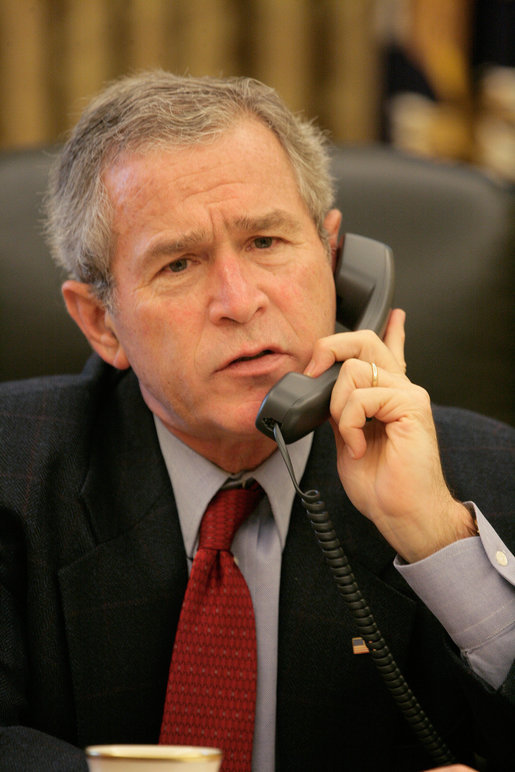
And so, in my phone calls that I recently made right after the test, I lamented the fact that he had tested to Hu Jintao, and also lamented the fact that Hu Jintao had publically asked him not to test. I talked to the South Korean President, and I said, it ought to be clear to us now that we must continue to work together to make it abundantly clear to the leader in North Korea that there's a better way forward. When he walks away from agreement, he's not just walking away from a table with the United States as the only participant; he's walking away from a table that others are sitting at.
And my point to you is, in order to solve this diplomatically, the United States and our partners must have a strong diplomatic hand, and you have a better diplomatic hand with others sending the message than you do when you're alone. And so, obviously, I made the decision that the bilateral negotiations wouldn't work, and the reason I made that decision is because they didn't. And we'll continue to work to come up with a diplomatic solution in North Korea.
This is a serious issue. But I want to remind our fellow citizens that the North Korea issue was serious for years. And I also remind our citizens that we want to make sure that we solve this problem diplomatically. We've got to give every effort to do so. But in my discussions with our partners, I reassured them that the security agreements we have with them will be enforced if need be, and that's in particular to South Korea and Japan.
Terry. I mean -- you're not Terry. You're Steve.
Q Thank you very much, sir.
THE PRESIDENT: -- insult, I know.
Q Senator Warner says Iraq appears to be drifting sideways, and James Baker says a change in strategy may be needed. Are you willing to acknowledge that a change may be needed?
THE PRESIDENT: Steve, we're constantly changing tactics to achieve a strategic goal. Our strategic goal is a country which can defend itself, sustain itself, and govern itself. The strategic goal is to help this young democracy succeed in a world in which extremists are trying to intimidate rational people in order to topple moderate governments and to extend a caliphate.
The stakes couldn't be any higher, as I said earlier, in the world in which we live. There are extreme elements that use religion to achieve objectives. And they want us to leave, and they want us to -- and they want to topple government. They want to extend an ideological caliphate that is -- has no concept of liberty inherent in their beliefs. They want to control oil resources, and they want to plot and plan and attack us again. That's their objectives. And so -- and our strategic objective is to prevent them from doing that. And we're constantly changing tactics to achieve that objective.
And I appreciate Senator Warner going over there and taking a look. I want you to notice what he did say is, if the plan is now not working -- the plan that's in place isn't working, America needs to adjust. I completely agree. That's what I talk to General Casey about. I said, General, the Baghdad security plan is in its early implementation. I support you strongly, but if you come into this office and say we need to do something differently, I support you. If you need more troops, I support you. If you're going to devise a new strategy, we're with you, because I trust General Casey to make the judgments necessary to put the tactics in place to help us achieve an objective.
And I appreciate Jimmy Baker willingness to -- he and Lee Hamilton are putting this -- have got a group they put together that I think was Congressman Wolf's suggestion -- or passing the law. We supported the idea. I think it's good to have some of our elder statesmen -- I hate to call Baker an elder statesmen -- but to go over there and take a look, and to come back and make recommendations. Somebody said he said, well, you know, cut-and-run isn't working. That's not our policy. Our policy is to help this country succeed, because I understand the stakes. I'm going to repeat them one more time. As a matter of fact, I'm going to spend a lot of time repeating the stakes about what life is like in the Middle East.
It is conceivable that there will be a world in which radical forms, extreme forms of religion fight each other for influence in the Middle East, in which they've got the capacity to use oil as an economic weapon. And when you throw in the mix a nuclear weapon in the hands of a sworn enemy of the United States, you begin to see an environment that would cause some later on in history to look back and say, how come they couldn't see the problem? What happened to them in the year 2006? Why weren't they able to see the problems now and deal with them before it came too late, Steve?
And so Iraq is an important part of dealing with this problem. And my vow to the American people is I understand the stakes, and I understand what it would mean for us to leave before the job is done. And I look forward to listening how -- what Jimmy Baker and Lee Hamilton say about how to get the job -- I appreciate them working on this issue because I think they understand what I know, and the stakes are high.
And the stakes are high when it comes to developing a Palestinian state so that Israel can live at peace. And the stakes are high when it comes to making sure the young democracy of Lebanon is able to fend off the extremists and radicals that want to crater that democracy.
This is the real challenge of the 21st century. I like to tell people we're in an ideological struggle. And it's a struggle between extremists and radicals and people of moderation who want to simply live a peaceful life. And the calling of this country and in this century is whether or not we will help the forces of moderation prevail. That's the fundamental question facing the United States of America -- beyond my presidency. And you can tell I made my choice. And I made my choice because the most solemn duty of the American President and government is to protect this country from harm.
Martha. I'm sure it was a profound follow-up. Okay.
Q Can we go back to North Korea, Mr. President?
THE PRESIDENT: Please.
Q You talk about failures of the past administration with the policy towards North Korea. Again, how can you say your policy is more successful, given that North Korea has apparently tested a nuclear weapon? And also if you wouldn't mind, what is the red line for North Korea, given what has happened over the past few months?
THE PRESIDENT: My point was bilateral negotiations didn't work. I appreciate the efforts of previous administrations. It just didn't work. And therefore, I thought it was important to change how we approached the problem so that we could solve it diplomatically. And I firmly believe that with North Korea and with Iran that it is best to deal with these regimes with more than one voice. Because I understand how it works. What ends up happening is, is that we say to a country such as North Korea, here's a reasonable way forward; they try to extract more at the negotiating table, or they've got a different objective, and then they go and say, wait a minute, the United States is being unreasonable. They make a threat. They could -- they say the world is about to fall apart because of the United States' problem. And all of a sudden, we become the issue.
But the United States' message to North Korea and Iran and the people in both countries is that we have -- we want to solve issues peacefully. We said there's a better way forward for you. Here's a chance, for example, to help your country economically. And all you got to do is verifiably show that you -- in Iran's case, that you suspended your weapons program; and in North Korea's case, that you've got international safeguards on your program -- which they agreed to, by the way.
And so my point is, is that -- to the American people -- I say, look, we want to solve this diplomatically. It's important for the President to say to the American people, diplomacy is what -- is our first choice, and that I've now outlined a strategy. And I think it is a hopeful sign that China is now a integral partner in helping North Korea understand that it's just not the United States speaking to them.
And it's an important sign to North Korea that South Korea, a country which obviously is deeply concerned about North Korean activities -- South Korea is a partner, and that if North Korea decides that they don't like what's being said, they're not just stiffing the United States -- I don't know if that's a diplomatic word, or not -- but they're sending a message to countries in the neighborhood that they really don't care what other countries think, which leads to further isolation. And when we get a U.N. Security Council resolution, it will help us deal with issues like proliferation and his ability -- 'he' being Kim Jong-Il's -- ability to attract money to continue to develop his programs.
Q What about the red line, sir?
THE PRESIDENT: Well, the world has made it clear that these tests caused us to come together and work in the United Nations to send a clear message to the North Korean regime. We're bound up together with a common strategy to solve this issue peacefully through diplomatic means.
Kevin.
Q Thank you, Mr. President --
THE PRESIDENT: If I might say, that is a beautiful suit.
Q Thank you, sir. My tailor appreciates that.
THE PRESIDENT: And I can't see anybody else that even comes close. (Laughter.)
Q Thank you very much. I'll be happy to pass along my tailor's number if you'd like that, sir.
THE PRESIDENT: I'll take that back. I will recognize that -- please.
Q On May 23, 2003, sir, you said -- you effectively drew a line in the sand. You said, "We will not tolerate a nuclear North Korea." And yet now it appears that they have crossed that line. And I'm wondering what now, sir, do you say to both the American people and the international community vis-B-vis what has happened over the last 48 hours?
THE PRESIDENT: No, I appreciate that, and I think it's very important for the American people and North Korea to understand that that statement still stands, and that one way to make sure that we're able to achieve our objective is to have other people join us in making it clear to North Korea that they share that objective. And that's what's changed. That's what's changed over a relatively quick period of time. It used to be that the United States would say that, and that would be kind of a stand-alone statement. Now, when that statement is said, there are other nations in the neighborhood saying it.
And so we'll give diplomacy a chance to work. It is very important for us to solve these problems diplomatically. And I thank the leaders of -- listen, when I call them on the phone, we're strategizing. This isn't, oh, please stand up and say something; this is, how can we continue to work together to solve this problem. And that is a substantial change, Kevin, from the previous times.
Suzanne. First best dressed person here. Sorry.
Q Kevin and I coordinated.
THE PRESIDENT: Yes. He actually looks --
Q Thank you, Mr. President. Back on Iraq. A group of American and Iraqi health officials today released a report saying that 655,000 Iraqis have died since the Iraq war. That figure is 20 times the figure that you cited in December, at 30,000. Do you care to amend or update your figure, and do you consider this a credible report?
THE PRESIDENT: No, I don't consider it a credible report. Neither does General Casey and neither do Iraqi officials. I do know that a lot of innocent people have died, and that troubles me and it grieves me. And I applaud the Iraqis for their courage in the face of violence. I am amazed that this is a society which so wants to be free that they're willing to -- that there's a level of violence that they tolerate. And it's now time for the Iraqi government to work hard to bring security in neighborhoods so people can feel at peace.
No question, it's violent, but this report is one -- they put it out before, it was pretty well -- the methodology was pretty well discredited. But I talk to people like General Casey and, of course, the Iraqi government put out a statement talking about the report.
Q -- the 30,000, Mr. President? Do you stand by your figure, 30,000?
THE PRESIDENT: You know, I stand by the figure. A lot of innocent people have lost their life -- 600,000, or whatever they guessed at, is just -- it's not credible. Thank you.
Q Thank you, Mr. President. Since you last held a news conference here in the Rose Garden, about a month ago, Republicans across the country have seen races that were once safe tighten, with the tide turning, according to several polls, towards the Democrats. Understanding that you don't lead by looking at polls --
THE PRESIDENT: Thank you, sir, thank you. Finally.
Q -- as you've said many times, are you still confident Republicans will hold the House and the Senate?
THE PRESIDENT: Yes, I am.
Q If so, why? And do you believe that the biggest drag on the Republican Party is the situation in Iraq?
THE PRESIDENT: I believe that the situation in Iraq is, no question, tough on the American psyche, like I said I think at this very spot last time I faced the press corps. And it's serious business. Look, the American people want to know, can we win -- that's what they want to know -- and do we have a plan to win. There are some who say, get out, it's not worth it. And those are some of the voices, by the way, in the Democrat Party. Certainly not all Democrats, but some of the loud voices in the party say, get out.
And so, no question this is an issue, but so is the economy. And I believe there'll be -- I still stand by my prediction, we'll have a Republican Speaker and a Republican leader of the Senate. And the reason I say that is because I believe the two biggest issues in this campaign are, one, the economy. And the economy is growing. The national unemployment rate is 4.6 percent. We've just discovered, as the result of analyzing new data, that we added 6.6 million new jobs since August of 2003. Gas prices are down. Tax cuts are working.
And there's a difference of opinion in the campaign about taxes, and we will keep them low. Matter of fact, I would like to keep the -- make the tax cuts we pass permanent. And the Democrats will raise taxes. Now, I know they say only on rich people, but that's -- in my judgment, having been around here long enough to know, it's just code word. They're going to raise them on whoever they can raise them on.
And then, on security, the American people know that our biggest job is to protect this country from further attack, and -- because they know there's an enemy that still plots and plans. And there is. There is. Recently we learned that when British intelligence and U.S. intelligence -- with our help -- broke up a plot to get on airplanes and blow them up, the planes that were going to fly from Great Britain to here. And they want to know -- 'they' the people -- want to know what are we doing to protect them.
There have been some votes on the floor of the Senate and the House that make it abundantly clear we just have a different view of the world. The vast majority of Democrats voted against a program that would enable us to interrogate high-value detainees. That was the vote. It's wide open for everybody to see: Should a CIA program go forward, or not go forward. The vast majority of Democrats in the House voted against a program that would have institutionalized the capacity of this government to listen to al Qaeda phone calls or al Qaeda affiliate phone calls coming from outside the country to inside the country.
It's very important for our fellow citizens to recognize that I don't question anybody's patriotism, but I do question a strategy that says we can't give those on the front line of fighting terror the tools necessary to fight terror. I believe that in order to defend America we must take a threat seriously and defeat an enemy overseas so we don't have to face them here. I don't believe we can wait to respond after attack has occurred.
And so I think these are the two biggest issues, Brett. And Iraq is a part of the war on terror. Now, I recognize Democrats say that's not the case, and what I say to the American people when I am out there is, all you got to do is listen to what Osama bin Laden says. Don't believe me that it's a part of the war on terror; listen to the enemy, or listen to Mr. Zawahiri, the number two of al Qaeda, both of whom made it clear that Iraq is central in their plans. And I firmly believe that the American people understand that this is different from other war because in this war if we were to leave early before the job is done, the enemy will follow us here.
And so I believe, Brett, that we'll maintain control because we're on the right side of the economic issue and the security issue.
Let's see. Yes, sir, Mr. NPR. Welcome to the front row. Yes, it's good.
Q Thank you. It's good to be here. Appreciate it. Following up on that answer, one of the things Democrats complain about is the way you portray their position --
THE PRESIDENT: Oh, really?
Q -- in wanting to fight the war on terror. They would say you portray it as either they support exactly what you want to do, or they want to do nothing. We hear it in some of your speeches. Is it fair to portray it to the American people that way?
THE PRESIDENT: Well, I think it's fair to use the words of the people in Congress or their votes. The vote was on the Hamdan legislation: Do you want to continue a program that enabled us to interrogate folks, or not? And all I was doing was reciting the votes. I would cite my opponent in the 2004 campaign when he said there needs to be a date certain from which to withdraw from Iraq. I characterize that as cut and run because I believe it is cut and run. In other words, I've been using either their votes or their words to characterize their positions.
Q But they don't say cut and run.
THE PRESIDENT: Well, they may not use cut and run, but they say date certain is when to get out, before the job is done. That is cut and run. Nobody has accused me of having a real sophisticated vocabulary, I understand that. And maybe their -- their words are more sophisticated than mine. But when you pull out before the job is done, that's cut and run as far as I'm concerned. And that's cut and run as far as most Americans are concerned. And so, yes, I'm going to continue reminding them of their words and their votes.
Jim.
Q Thank you, Mr. President. My best suit is in the cleaners.
THE PRESIDENT: That's not even a suit.
Q I know. (Laughter.) You got to give me more time in the morning with a news conference.
THE PRESIDENT: I know you like to wake up about 8:30 a.m. (Laughter.)
Q I want to ask you --
THE PRESIDENT: High-priced news guys.
Q Yes, sure.
THE PRESIDENT: Yes. (Laughter.)
Q I want to ask you a little bit about -- I want to follow on the criticism that you've received for the suggestions from Senator Warner and from James Baker, now Olympia Snowe. This is not exactly the board of directors for MoveOn.org. Do you --
THE PRESIDENT: That's true.
Q Do you feel in some way that there is some shift going on in terms of the general support for the war in Iraq, and your strategy specifically? And do you ever feel like the walls are closing in on you in terms of support for this?
THE PRESIDENT: (Laughter.) Jim, I understand how hard it is. And I also understand the stakes. And let me go back to Senator Warner. Senator Warner said, if the plan isn't working, adjust. I agree completely. I haven't seen Baker's report yet, but one of the things I remind you of is that I don't hear those people saying get out before the job is done. They're saying, be flexible. And we are.
I believe that you -- you empower your generals to make the decisions -- the recommendations on what we do to win. You can't fight a war from Washington. In other words, you can't make the tactical decisions necessary to win. It just won't work. And I trust General Casey. I find him to be one of the really competent, decent guys.
Q But --
THE PRESIDENT: Let me finish please for a second. Plus, I couldn't hear you, but I saw you talking. Anyway, I think it's -- I value his judgment. I value his -- I know he wants to succeed and I value his objectivity. And he -- what's important for the President is when I open up that door in there and General Casey walks in, he feels confident to tell me what's on his mind, Jim -- here's what's going right, and here's what's going wrong, and here's what we're doing about it.
And so, for those folks saying, make sure there's flexibility, I couldn't agree more with you. And I think the characterization of "let's stay the course" is about a quarter right. Stay the course means keep doing what you're doing. My attitude is, don't do what you're doing if it's not working; change. Stay the course also means don't leave before the job is done. And that's -- we're going to get the job done in Iraq. And it's important that we do get the job done in Iraq.
Defeat in Iraq will embolden an enemy. And I want to repeat to you the reality of the world in which we live. If we were to leave before the job is done, the enemy is coming after us. And most Americans -- back to your question, Brett -- understand we've got to defeat them there so we don't face them here. It's a different kind of war, but, nevertheless, it is a war.
Go ahead.
Q I'm just wondering, two months ago Prime Minister Maliki was here, and you talked about how we had to be nimble and facile in our approach. And my question is, are we being nimble and facile in the right way? Is what General Casey telling you the most effective advice? Because it would seem in the two months since Prime Minister Maliki was here, things have only gotten more bloody in Iraq.
THE PRESIDENT: No question, Ramadan is here; no question we're engaging the enemy more than we were before. And by the way, when you engage the enemy, it causes there to be more action and more kinetic action. And the fundamental question is, do I get good advice from Casey, and the answer is, I believe I do, I believe I do.
THE PRESIDENT: Please. Sanger.
Q Thank you, Mr. President. You spoke very passionately before about acting before it was too late on major issues. You faced one of those moments in early 2003. This was when the North Koreans had thrown out the international inspectors, said they were going to go ahead and turn their fuel into weapons. And you had a moment to tell them that they would face serious consequences if they were going to do that. You also had what may have been the last moment for any American President to destroy their fuel supplies while they were all in one place.
THE PRESIDENT: You mean, bombing them?
Q Whatever action you might have needed to take, including military action, against the site -- the one site at the time where they were getting ready --
THE PRESIDENT: I just wanted to clarify. Sorry to interrupt you.
Q Yes. And you chose not to. And I was wondering whether, in retrospect, you regret that decision at all; whether or not you think that, because of the long history of deception that you pointed out before, you should have acted differently?
THE PRESIDENT: I used the moment to continue my desire to convince others to become equity partners in the Korean issue, North Korean issue, because, David, I, obviously, look at all options all the time, and I felt like the best way to solve this problem would be through a diplomacy effort that was renewed and reinvigorated by having China and South Korea and Japan and Russia joining us in convincing Kim Jong-il there's a better way forward.
And, frankly, I was quite optimistic that we had succeeded last September when we had this joint statement, which you adequately covered. And yet he walked away from it. He decided, well, maybe his word doesn't mean anything.
And so we will continue to work diplomatically to solve the problem. That's what I owe the American people, to come up with a diplomatic solution. I also made it clear, and I will repeat, that we have security obligations in the region that I reconfirmed to our partners.
Sir. Washington Post man.
Q Good morning, Mr. President.
THE PRESIDENT: That would be Mike.
Q Right. I'd like to follow up on an earlier question about your rhetoric on Iran and North Korea.
THE PRESIDENT: Okay.
Q You said yesterday in your statement that the North Korean nuclear test was unacceptable. Your chief negotiator for the six-party talks said last week that North Korea has a choice of either having weapons or having a future. When you spoke a month or so ago to the American Legion, you talked about Iran and said, there must be consequences for Iran's defiance, and we must not allow Iran to develop a nuclear weapon. I am wondering, sir, your administration has issued these kinds of warnings pretty regularly over the last five years, and yet these countries have pursued their nuclear programs. I'm wondering if you -- what is different about the current set of warnings, and do you think the administration and our government runs a risk of looking feckless to the world by issuing these kinds of warnings regularly without response from the countries?
THE PRESIDENT: That's a fair question. First of all, I am making it clear our policy hasn't changed. It's important for the folks to understand that we don't continually shift our goals based upon polls or -- whatever. See, I think clarity of purpose is very important to rally a diplomatic effort to solve the problem. And so I try to speak as clearly as I can and make sure there's no ambiguity in our position. I also found that's a pretty good way to help rally a diplomatic effort that I believe will more likely work.
I know this sounds -- I'm just saying it over and over again, but it's -- rhetoric and actions are all aimed at convincing others that they have an equal stake in whether or not these nations have a nuclear weapon, because I firmly believe, Mike, that that is the best strategy to solve the problem. One has a stronger hand when there's more people playing your same cards. It is must easier for a nation to hear what I believe are legitimate demands if there's more than one voice speaking. And that's why we're doing what we're doing.
And to answer your question as to whether or not the words will be empty, I would suggest that, quite the contrary, that we not only have spoken about the goals, but as a result of working together with our friends, Iran and North Korea are looking at a different -- a different diplomatic scenario.
I thought you were going to ask the question, following up on Sanger, how come you don't use military action now. You kind of hinted it, you didn't say it. And some wonder that. As a matter of fact, I'm asked questions around the country, just go ahead and use the military. And my answer is that I believe the Commander-in-Chief must try all diplomatic measures before we commit our military. And I believe the diplomacy is -- we're making progress when we've got others at the table.
I'll ask myself a follow-up. If that's the case, why did you use military action in Iraq? And the reason why is because we tried the diplomacy. Matter of fact, we tried resolution after resolution after resolution. All these situations are -- each of them different and require a different response, a different effort to try to solve this peacefully. And we'll continue to do so.
The inability to convince people to move forward speaks volumes about them. It ought to say to all the world that we're dealing with people that maybe don't want peace -- which in my judgment, in order for there to be peace requires an international response. It says volumes about a person who signs an agreement with one administration and signs an agreement or speaks about an agreement with another administration and doesn't honor the agreement. It points up the fact that these are dangerous regimes and requires an international effort to work in concert.
Roger.
Q Thank you. I'd like to turn back to North Korea for a bit. You've said that bilateral talks didn't work. Secretary Baker has said that maybe they should be considered, maybe at some point under certain conditions. Are you prepared now to just take the possibility of one-one-one talks with North Korea off the table?
THE PRESIDENT: I'm saying as loud and I can and as clear as I can that there is a better way forward for North Korea and that we will work within the context of the six-party talks.
People say, you don't talk to North Korea. We had a representative, a United States representative at the table in the six-party talks. The North Korean leader knows our position. It's easy to understand our position: There is a better way forward for his government. And people need to review the September '05 document, the joint statement that talked about economics, and we won't attack North Korea. We agreed that we shouldn't have nuclear weapons on the peninsula. I mean, there is a way forward for the leader in North Korea to choose. We've made our choice, and so has China, South Korea, Japan, and Russia. And that's what's changed.
I also am deeply concerned about the lives of the citizens in that country. I mean there's -- and that's why I named a envoy, Jay Lefkowitz, to talk about the human condition inside of North Korea. And the reason we did that is we care about how people live. We care about people starving. We care about the fact that there are large concentration camps.
You know, one of the most meaningful moments of my presidency came when a Japanese mother came to the Oval Office to talk about what it was like to have her daughter kidnapped by North Korea. You can imagine what that was like. It broke my heart. And it should break everybody's heart. But it speaks to the nature of the regime. And, therefore, we -- I am convinced that to solve this diplomatically requires more than just America's voice.
Let's see here. Mark.
Q Thank you, Mr. President.
THE PRESIDENT: Yes.
Q Mr. President, with growing numbers of House members and staffers saying that they knew of and told others about a problem with Mark Foley some years ago, has House Speaker Hastert lost touch within his own ranks, and has the scandal damaged Hastert's credibility and effectiveness in maintaining party control in the midterm elections?
THE PRESIDENT: No, I think the Speaker's strong statements have made it clear to not only the party members, but to the country, that he wants to find out the facts. All of us want to find out the facts. I mean, this is disgusting behavior when a member of Congress betrays the trust of the Congress and a family that sent a young page up to serve in the Congress. And I appreciated Speaker Hastert's strong declaration of his desire to get to the bottom of it. And we want to make sure we understand what Republicans knew and what Democrats knew, in order to find the facts. And I hope that happens sooner rather than later.
Q And his credibility, sir --
THE PRESIDENT: Oh, Denny is very credible, as far as I'm concerned. And he's done a fine job as Speaker, and when he stands up and says, I want to know the truth -- I believe yesterday he said that if somebody on his staff didn't tell him the truth, they're gone -- I respect that, and appreciate that, and believe him. And -- no, I think the elections will be decided by security and the economy. I really do, Mark. I know this is -- this Foley issue bothers a lot of people, including me. But I think when they get in that booth, they're going to be thinking about how best to secure the country from attack, and how best to keep the economy growing.
I think the last time I was out here with you I reminded you that I understand that the economy is always a salient issue in campaigns. We've had some experience with that in my family, I think I said. I still believe the economy is an important issue, and I believe on this issue there is a huge difference of opinion.
The other day, by the way, Don, I did bring up the words of the leader of the House when she said, "I love tax cuts." And I then reminded everybody that if she loved them so much, how come she voted against a lot of tax cuts? In other words, again, back to your question about whether it's fair to use people's words -- I think to say I love tax cuts and then vote against tax cuts it's just -- it's worthy, it's just worthy of people's consideration in the political process -- I believe taxes are a big issue in the campaign, Mark.
And I know how -- I know that -- how best to protect the country is a big issue, a really big issue. And there's a kind of law enforcement mentality that says, well, we'll respond after attack. It's not going to work. It's just not going to work. We've got to deal with these problems before they come to -- before they come to our territory.
I understand that some are saying, well, he's just trying to scare us. My job is to look at the intelligence and to -- and I'm going to tell you there's an enemy out there that would like to do harm again to the United States, because we're in a war. And they have objectives. They want to -- they want to drive us out of parts of the world to establish a caliphate. It's what they have told us. And it's essential that we listen to the words of the enemy if we want to protect the American people.
And in this debate about which party can handle it better, I will -- it's very important that no one question the patriotism or the loyalty to the country. There is a different mind-set, however, that is worth discussing in the course of a campaign. And I'm going to continue to do it. And I believe those two issues will be the issues that drive the election.
April.
Q Thank you, sir. Mr. President, some in the national security community are wondering if, indeed, you're ready to live with a nuclear North Korea?
THE PRESIDENT: No.
Q Well, they're saying that that is a possibility.
THE PRESIDENT: Well, they're wrong.
Q Well, can I give you --
THE PRESIDENT: Well, it was a short question and a short answer. (Laughter.)
Q One, China is not ready to put teeth behind sanctions -- enough teeth to really threaten the regime. And also, economic sanctions have limited effect on North Korea.
THE PRESIDENT: We got to try it diplomatically first, April. And this is back to old Michael's question about, am I serious about saying what I mean. It's why I say what I say, because some people are beginning to wonder whether or not it's the goal. The goal is no nuclear weapon. And again, I think I've shared with you my views of diplomacy. Diplomacy is -- it's a difficult process because everybody's interests aren't exactly the same. We share the same goal, but sometimes the internal issues are different from ours. And, therefore, it takes a while to get people on the same page, and it takes a while for people to get used to consequences.
And so I wouldn't necessarily characterize these countries' positions as locked-in positions. We're constantly dialoguing with them to make sure that there is a common effort to send a clear message.
And the other part of your question was?
Q And the follow-up, yes. Military options -- there are a menu of options the White House is saying. Once diplomacy has run its course and you've run through your timetable, what about military options against North Korea?
THE PRESIDENT: Well, diplomacy hasn't run its course. That's what I'm trying to explain to you a la the Sanger question. And we'll continue working to make sure that we give diplomacy a full opportunity to succeed.
Yes, David.
Q Thank you, Mr. President. You spoke of the troubles in Iraq. And as you know, we have Woodward and we have a shelf full of books about Iraq, and many of them claim that administration policies contributed to the difficulties there. So I'm wondering, is there anything you wish you would have done differently with regard to Iraq?
THE PRESIDENT: Speaking about books, somebody ought to add up the number of pages that have been written about my administration. There's a lot of books out there -- a lot. I don't know if I've set the record, or not, but I guess it means that I've made some hard decisions and will continue to make hard decisions.
And, David, this is the -- this is about the fifth time I've been asked this type of question. And as you know, there are some things that I wish had happened differently -- Abu Ghraib. I believe that really hurt us. It hurt us internationally. It kind of eased us off the moral high ground. In other words, we weren't a country that was capable of, on the one hand, promoting democracy, and then treating people decently. Now the world has seen that we've held those to account who are -- who did this.
You know, there's just a lot of look-backs. Presidents don't get to look back, but I will tell you, the decision to remove Saddam was the right decision. And I would look forward to the debate where people debate whether or not Saddam should still be in power.
As you know, a leader in the Senate Intel Committee on -- I think it was CBS News, Axelrod, I'm not sure -- you follow your news closely, you can verify this -- said that the world would be better if Saddam were in power. I strongly disagree. So when it comes to that decision, which is a decision to cause a lot of people to write books, it's the right decision.
And now the fundamental question is, will this country help this young democracy succeed? And the answer is, we will. We'll change tactics when we need to change tactics to help this young democracy succeed. But the stakes are high if we were to leave. It means that we would hand over a part of the region to extremists and radicals who would glorify a victory over the United States, and use it to become -- use it to recruit. It would give these people a chance to plot and plan and attack. It would give them resources from which to continue their efforts to spread their caliphate. The stakes are really high.
Joe.
Q Thank you. On a different topic. You've said you will sign the border fence bill to build 700 miles of fence along the U.S. border, but DHS has said it prefers a virtual fence of sensors and cameras rather than an actual wall. Are you committed to building the 700 miles of fence, actual fencing?
THE PRESIDENT: Yes, we're going to do both, Joe. We're just going to make sure that we build it in a spot where it works. I don't -- DHS said they want a virtual wall. I don't believe that's the only thing they've said. I think you might have truncated their statement, because we're actually building fence, and we're building double fence in particular -- in areas where there is a high vulnerability for people being able to sneak in.
You can't fence the entire border, but what you can do is you can use a combination of fencing and technology to make it easier for the Border Patrol to enforce our border. I happen to believe, however, that in order to make sure the border is fully secure, we need a guest worker program, so people aren't sneaking in in the first place.
And so I look forward to not only implementing that which Congress has funded, in a way that says to folks, the American people, we'll enforce our border, but I'm going to continue to campaign and work for a comprehensive bill so that whatever we do in terms of equipment and manpower works better. If somebody is not trying to sneak in to work, in other words, coming through in a way where they're showing a temporary worker pass, where they're not using coyotes to smuggle across, where they're not going through tunnels, it's going to make it much easier for us to do our job, Joe, and that's enforce the border.
And so my judgment is, if the people want this country secure, we've got to do -- have a smart border, which we're in the process of developing now. It's a combination of fencing and technologies -- UAVs, sensors. I don't know if you've ever been down there, but it's a pretty vast part of country down there. It's hard to enforce that border. You've got some rugged country; you've got stretches of territory where you don't even know where the border is. You've got urban areas, like El Paso, or Southern California, where people have been able to sneak in by use of urban corridors. And so, therefore, fencing makes sense there.
I went down to Arizona, the Arizona sector, and saw a place where there's literally neighborhoods abutting the border, and people come -- a hundred of them would rush across the border into a little subdivision, and the Border Patrol would catch two or three, and 97 would get in. And they're asking, what are you going to provide to help us do our job? And in this case, those who are in charge of coming up with the proper strategy to enforce the border said, we need double fencing with space, so that the Border Patrol can use that fencing as leverage against people rushing into the country.
And my only point to you is that the strategy to develop this border requires different assets based on the conditions -- based upon what the terrain looks like. And that's what we're doing.
But I repeat to you, when you've got a situation where people are sneaking in to do jobs Americans aren't doing, it's also going to keep a strain on the border. And so, therefore, a temporary worker plan, to me, makes sense, and it's a much more humane program -- approach, by the way. It will certainly help stamp out all these illegal characters that are exploiting human beings. You know, these coyotes that stuff people in the back of 18-wheelers for money is just -- that's not in character with how this nation works. And I think we ought to -- I think a good program that helps us enforce our border also will see to it that people are treated more humanely.
Thank you for your interest.
END 12:04 P.M. EDT, For Immediate Release, Office of the Press Secretary, October 11, 2006.
Technorati Tags: President Bush and White House or federal budget deficit and North Korea and nuclear test or United Nations Security Council and Pyongyang or missile technologies and Treaty on Non-proliferation of Nuclear Weapons or IAEA
RELATED: Keyword, Korea - UN Media Stakeout DPRK 10/09/06 (VIDEO), Monday, October 09, 2006 South Korea Ban Ki-Moon UN Secretary-General, Monday, October 09, 2006 President on North Korea Nuclear Test (VIDEO)
RELATED: Keyword Iraq, Tuesday, October 10, 2006 Average Joe’s’ Rock Band Gives Final Performances, Tuesday, October 10, 2006 COLUMBUS DAY PARADE - Fifth Avenue in New York City, Wednesday, September 27, 2006 National Intelligence Estimate Key Judgments, Thursday, September 14, 2006 Key Terror Leader Captured in Iraq (VIDEO), Saturday, June 10, 2006 Maj. Gen. Caldwell, neutralization of terrorist Musab Al Zarqarwi (VIDEO), Friday, June 09, 2006 Gun Camera Footage of Zarqawi Elimination (VIDEO), Friday, June 09, 2006 the President on Death Zarqawi (VIDEO), Thursday, May 11, 2006 President Discusses NSA Surveillance Program (VIDEO, Monday, March 20, 2006 Third Anniversary of Beginning of Iraq Liberation (VIDEO), Tuesday, March 14, 2006 President Discusses Freedom and Democracy in Iraq, 03/13/05 VIDEO, Thursday, March 09, 2006 President Signs USA PATRIOT Act (VIDEO), Saturday, February 25, 2006 President Addresses American Legion, Discusses Global War on Terror (VIDEO), Wednesday, January 25, 2006 President Discusses War on Terror at K-State (VIDEO), Wednesday, January 04, 2006 President Discusses War on Terror Following Pentagon Briefing (VIDEO), Monday, December 19, 2005 President's Address to the Nation (VIDEO) 12/18/05, Thursday, December 15, 2005 President, McCain, Warner, Discusses Interrogation, Wednesday, December 14, 2005 Iraqi Elections, Victory in the War on Terror (VIDEO),


![The Secretary of State's Outer Office, Washington, DC, February 14, 2005, Secretary Rice with South Korean Foreign Minister Ban Ki-Moon before their meeting. State Department photo. [Remarks by Secretary Rice and Foreign Minister Ban]](http://photos1.blogger.com/blogger2/6340/873/1600/rice_moon.jpg)