Friday, October 13, 2006

State Department Daily Press Briefing, VIDEO, TEXT, 10/12/06

Daily Press Briefing, Spokesman Sean McCormack, FULL STREAMING VIDEO, file is windows media format, running time is 28:10 Washington, DC, October 12, 2006
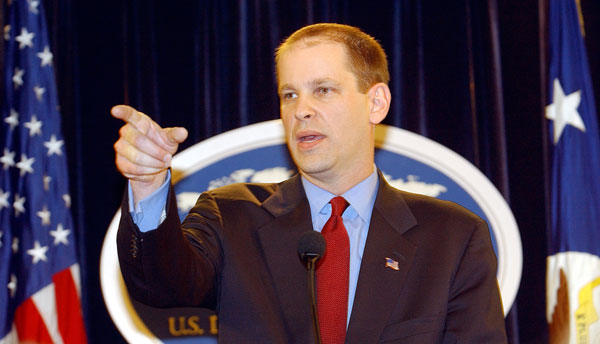
Department Spokesman Sean McCormack (shown during the  Daily Press Briefing) was sworn in as Assistant Secretary for Public Affairs and Department Spokesman on June 2, 2005. Immediately prior to returning to the State Department, Mr. McCormack served as Special Assistant to the President, Spokesman for the National Security Council, and Deputy White House Press Secretary for Foreign Policy. State Department Photo by Michael Gross.Department Spokesman Sean McCormack (shown during the Daily Press Briefing) was sworn in as Assistant Secretary for Public Affairs and Department Spokesman on June 2, 2005.
Immediately prior to returning to the State Department, Mr. McCormack served as Special Assistant to the President, Spokesman for the National Security Council, and Deputy White House Press Secretary for Foreign Policy. State Department Photo by Michael Gross. TRANSCRIPT:, 12:35 p.m. EDT.

QUESTION: Sean, (inaudible) I have to read the 15 questions today? (Laughter.)

MR. MCCORMACK: Good afternoon, everybody. Well, that is not welcome news Lambros. (Laughter.) Don't have any statements, so let's get right into your questions. Who wants to start?

QUESTION: It turns out the Secretary and Steve Hadley met with the Chinese envoy at the White House --

MR. MCCORMACK: They did.

QUESTION: -- without announcement --

MR. MCCORMACK: They did.

QUESTION: -- at 9:45 this morning and I wonder if you could tell us what they talked about, what may have been accomplished by the meeting. And also stories from Beijing say that the envoy would be talking to her about a trip to China. Could you get into any of these things, please?

MR. MCCORMACK: A couple things. Secretary Rice did participate in a meeting over at the White House -- Mr. Hadley's office -- the National Security Advisor with State Councilor Tang. I understand reading the press reports from my colleague Fred Jones from the NSC also mentioned that they stopped by the Oval Office so they had a meeting with the President as well.

I don't have any readout of the meeting for you, Barry. I think the White House is probably better positioned to do that than I. The intent of the meeting was to talk about the way forward in the wake of North Korea's announcement that it had conducted a nuclear test and that specifically in the immediate term focuses on what's going to be in this resolution. We're working hard on the resolution right now. We have a draft that's been circulated up in New York. We're working to see -- to try to put that into final form in the coming hours or days. That will depend upon the positions of others on the Security Council and get their input to that draft to see if it's acceptable to them. And that's pretty much where we stand at the moment.

QUESTION: Speaking of the positions of others, the Chinese today said that any sanctions against North Korea should be aimed -- not be punitive but rather designed to get to a peaceful resolution of the crisis. It seems as if there's no sort of softening in their position. That they -- while they are open to talking about some measures, they do not want to see very harsh ones. Do you get any sense that they are shifting position on that and that they're --

MR. MCCORMACK: No, no. I think that ultimately we're going to get a strong resolution from the Security Council in short order. You know, look, is the final product going to look like a wish list of the United States or other states? No, of course not; that's the give and take of multilateral diplomacy. But we believe that what we will get is a good strong resolution that sends a clear strong message to the North Korean regime that they have to change their behavior, that this behavior will not be tolerated. And furthermore, in a very practical sense, a resolution that will further everybody's objective of not allowing North Korea to in any way benefit from outside help that would further development of its nuclear program, WMD programs or missile technology programs. And also not allow them to ship out of North Korea the technology know-how and other items associated with the WMD or missile technology program as best you can ensure that there is a good solid seal so those things aren't able to be exported from North Korea.

QUESTION: Speaking of wish lists, are you open to narrowing the range of measures that you might like to see taken against North Korea in this first resolution and possibly coming back to it a second or a third time with additional measures rather than pushing for something with a lot in the first one?

MR. MCCORMACK: I think what we're looking at is one resolution here. Subsequent resolutions would, of course, be dependent upon North Korea's behavior. But we think it's important to have a good strong resolution, we think we're going to get one and we think that everybody in the room -- that Security Council chamber agrees on that. We'll see exactly what the final product is. Right now it's a pretty robust draft that has been circulated. So we'll see. We'll see how it comes out.

It's multilateral diplomacy. It may not come out looking exactly like the draft we have now. We certainly think that that would be -- it would be appropriate to have everybody support that draft, but we'll see. You know, we'll see how it plays out in the next day or so here.

QUESTION: Can I ask you about the food issue briefly?

MR. MCCORMACK: Which food issue?

QUESTION: She repeated again in one of her many interviews just recently that we don't use it as a weapon.

MR. MCCORMACK: Right.

QUESTION: The Chinese are feeding the North Koreans, and there's no question there's terrible need. The rationale for no longer doing it or suspending it is that you want to make sure it gets to the people who need it. How long is it going to take the U.S. to find that out? Would you -- can you go beyond the constant refrain, "Food is not a political weapon"? I mean there's starving people.

MR. MCCORMACK: Right.

QUESTION: And you want to make sure it doesn't get to the Korean army; it gets to people who need the food.

MR. MCCORMACK: Right.

QUESTION: So how -- what's the prospect of coming to some judgment about this that you can sort of rely on and resuming this humanitarian gesture?

MR. MCCORMACK: Well, we ourselves have come to a judgment that's unchanged and that that is we couldn't participate in the World Food Program -- humanitarian -- could not. We've talked about that before, for the very issues that you raised, Barry. We couldn't assure ourselves that the food that we would donate and that would be delivered via the World Food Program would actually get to those who really need it, the Korean people, and not be diverted to regime elites or the army or whomsoever else. It would -- the intent was to try to help out starving North Koreans.

The World Food Program has restarted on a limited basis its program. It has -- you can talk to them directly, but my sense was, at least as of a couple of months ago, even though they did have some trepidation about starting the program again, that they were able to get some assurances that they would be able to check to make sure the food actually got delivered.

You can check with the WFP to find out exactly the state of their program. Individual states are going to make individual decisions about bilateral assistance. The Chinese will do so, the South Koreans will do so, the Japanese will do so, as will we and other countries around the world.

QUESTION: So the U.S. judgment is that -- keep it suspended, what, indefinitely because you're not sure it gets to the --

MR. MCCORMACK: Until -- until the --

QUESTION: -- gets to hungry people?

MR. MCCORMACK: Well, until you -- again, see a qualitative change in the situation whereby we can assure ourselves that our humanitarian assistance, paid for by U.S. tax dollars will actually get to those in need, you're not going to have a change in the status quo.

QUESTION: Are you constantly reviewing that or are you just -- or not? I mean, is that an exception?

MR. MCCORMACK: No, of course, people look at those things. As of right now, I don't detect any change in that policy. It's not a policy -- that change in our particular position at this point, our policy is not to use food as a weapon. We have a very deep concern for the plight of the North Korean people. I think President Bush spoke about that yesterday. We have a very deep concern about not only their humanitarian plight, but the human rights condition there in North Korea. So while people do constantly look at that, there's no change that I'm aware of at this point.

QUESTION: And just to be clear, you said there was no change in your position, that you don't use food as a weapon.

MR. MCCORMACK: Right.

QUESTION: My question was more to whether you were constantly assessing the question of the judgment of whether food aid to North Korea would actually go to the needy rather than to the military.

MR. MCCORMACK: Sure. Yeah, we do look at that. We would -- the United States would like to be in the position to reconsider whether or not it would be possible. Now, of course, that becomes a policy judgment based upon the facts as we know them. The facts as we know them right now haven't really changed qualitatively so that you have a different kind of situation.

Yeah, Charlie.

QUESTION: Sean, you mentioned the meeting this morning was to talk about the way forward. My question is might that include Secretary Rice traveling to the region and more to the point, would she travel the region -- would she not travel the region until a UN resolution has been adopted?

MR. MCCORMACK: We'll keep you updated on her travel. Nothing to announce at this point.

QUESTION: I'm not asking for an announcement on travel. I'm asking whether if she goes, would she go -- would she not go until a UN resolution has been passed?

MR. MCCORMACK: Well, Charlie, we're focused on getting a resolution passed. We'll let you know when she's ready to hit the road again.

QUESTION: But in my original question, I said reports from Beijing say one topic for discussion with the envoy is a trip by her to China.

MR. MCCORMACK: Same answer, Barry.

QUESTION: Did they discuss it?

MR. MCCORMACK: Same answer.

QUESTION: What's the answer? I'm sorry, I'm not --

MR. MCCORMACK: Well, the original answer, if you remember when I first answered the question, was I don't have a readout of the meeting. So in order to have that information, I would have to have a readout of the meeting, which I previously said I didn't have. But you asked again, so I'm telling you again now that I don't have a readout of the meeting.

QUESTION: Okay.

MR. MCCORMACK: There you go. All right. Anybody -- yes.

QUESTION: Yeah, one of the points they mentioned apparently in the discussions in New York is whether this -- the resolution would include interdiction of shipping and air and other kinds of transport in and out of North Korea. If that isn't included in -- if that cannot be included in a resolution, is that something the United States using the PSI would -- could so?

MR. MCCORMACK: Well, PSI goes forward regardless of this particular resolution. We'll see what's ultimately included in it. John Bolton probably wouldn't look kindly upon my giving away negotiating positions at this point, whether what he's ready to give, what he's not ready to give. We think it is important to do everything that we possibly can as an international community to see that dangerous exports from North Korea, i.e., WMD technology or materials, don't reach hands that might do harm to us or others.

So that certainly is a primary cause of -- you know, a primary objective in our mind. And also to make sure that the regime isn't able to further benefit from development of these technologies. They have essentially an open arms bazaar and they've been known to sell pretty much everything that they have at their disposal. So you certainly don't want to see that fall into the wrong hands and you don't want to see the regime benefit from that kind of trade, never mind the other kinds of illicit trade that it's engaged in.

Nicholas.

QUESTION: Sean, Ban Ki-Moon has said that he will be happy to go to North Korea and serve as an envoy or whatever it is to -- actually, he said that even before the test on Monday. Would you welcome a role for him? And can you also talk about your decision to support him on Monday and when that decision was made and why did you wait until late in the process to do it?

MR. MCCORMACK: Well, he talked about traveling potentially to North Korea in the context of his being Secretary General. He's still the Foreign Minister of South Korea at the moment. I think everybody's focus right now is on getting a resolution passed, implementing that resolution, and implementing it effectively, hopefully to bring about a change in North Korea's behavior.

As for his candidacy for Secretary General of the United Nations, there's going to be a vote Monday and we'll have a chance to raise our hand at that point. We think that certainly he is a fine candidate, think that he certainly exceeds all the requirements that one might look for in a Secretary General. And should he be elected Secretary General by the General Assembly, we look forward to working with him.

QUESTION: But yeah, and there was no particular reason that you held out until pretty much the last moment to support him, at least publicly because I don't know what you voted for in these --

MR. MCCORMACK: Well, the nature of the process is that these are secret ballots. It moves from a process where all the ballots are the same color and you have no idea who voted for whom or who voted to encourage whom and who voted to discourage whom. It then moves forward to a process where the permanent members of the Security Council have a different kind of ballot, and he won -- all five security members voting to encourage him. Clearly we did. So I think you can safely assume that we have -- since we did in that process vote to encourage him and vote for his nomination that we did so previously.

QUESTION: I was asking because ten years ago the Clinton Administration made its public support for Kofi Annan to replace Boutros Boutros-Ghali very early on in --

MR. MCCORMACK: I think those are two totally different circumstances.

QUESTION: Right. But of course this is the same position and the same process. But just one last thing --

MR. MCCORMACK: But the circumstances --

QUESTION: Right.

MR. MCCORMACK: The circumstances I believe are quite different.

QUESTION: Right. Yes, they had another objective of actually getting rid of someone else. But just one last point on any possible travel to Pyongyang by Mr. Ban. You don't -- even though he was talking about once he assumes the position, you don't think that the events this week warrant a possible trip by him as a South Korean Foreign Minister to Pyongyang?

MR. MCCORMACK: Again, Nicholas, I don't think anybody's talking about that at the moment. What people are talking about is working to get a strong resolution.

QUESTION: Can I just pick up on that?

MR. MCCORMACK: Mm-hmm.

QUESTION: You have said that the purpose of this resolution is to make Pyongyang see the cost of this nuclear program and the nuclear attacks in an effort to get them back to the talks. So do you see the resolution as standing on its own and then hopefully they'll feel the pinch, or are you intending to accompany that with some kind of diplomacy to continue to show Pyongyang that if they were to change their mind that they can still come back to the table? I mean is it just the sanctions or do you see countries still continuing to talk to Pyongyang to get them back to the table?

MR. MCCORMACK: Well, you take the steps that the international community is now poised to take in order to achieve an objective. The objective here is to get them to change their behavior.

Certainly our objective on the issue of North Korea's nuclear weapons program is to see a denuclearized Korean Peninsula. That's everybody's shared objective. Certainly in the six-party talks that's what the North Korean regime signed up to. So you want to get them to change their behavior.

If at some point they choose to avail themselves of the mechanism of the six-party talks to achieve some of the things that they say they want to achieve, that's certainly positive. We would encourage it. The six-party mechanism remains. It is there. But given North Korea's actions right now, although I don't have insight to their decision-making processes, I'm not sure that now is the moment that they are going to choose to come back to the six-party talks and make an announcement that they are ready to go. I might be wrong. And certainly one would hope that they would see the light and choose the path of the potential for some greater integration into the rest of the world as opposed to just the opposite, further isolation, which is where they're going now.

QUESTION: But what I was trying to get at is when you say that this furthers their isolation, do you see these measures themselves as the isolation, or are you advocating or have you spoken to your allies about continuing to reach out to North Korea diplomatically to try and talk to them, or is this -- are these measures supposed to stand on themselves until -- they know that the door is open and they can knock on it when they want?

MR. MCCORMACK: I think it's -- you know, they read the press clippings. You know, they watch the TV. They listen to the radio. They understand that that pathway is available to them. But right now, the world is focused on getting a resolution that puts in place certain restrictions on their ability to do what they have been doing in the past.

Yes.

QUESTION: A North Korean ambassador today is quoted as threatening Japan with "strong countermeasures" --

MR. MCCORMACK: Right.

QUESTION: -- if Japan imposes tougher bilateral sanctions. Do you have any comment on that?

MR. MCCORMACK: I don't. You know, I don't know what that means. I don't know what they mean by that. Japan has taken the steps that it believes is prudent in reaction to what North Korea -- North Korea's announcement. Individual states will make individual decisions. We put out a statement saying that we supported Japan in taking those steps, although those decisions are solely theirs to make. Prior to that, in the wake of the -- and in the wake of the missile launch Japan and Australia decided to take some additional measures. So I think you will see individual states doing -- taking steps that they deem appropriate. They'll probably be a little bit different for each particular state. Each state has a different kind of relationship with North Korea. And then all states will be -- depending on the form of the Security Council resolution -- will be subject to its restrictions and its requirements.

QUESTION: Do you think North Korea ought to be making threats like that?

MR. MCCORMACK: Well, you know, it certainly doesn't further the cause of trying to reach out to the international community and get back to some pathway where they can realize through a negotiated solution some of the things that they want to achieve. It's sort of more bombastic rhetoric from them that has the practical effect of isolating them from the rest of the community.

Yes, Libby.

QUESTION: On the test itself, I may have missed this, but have you guys come any closer to determining --

MR. MCCORMACK: You haven't missed anything, no.

QUESTION: (Laughter.) I came in just a little late. Have you come any closer to determining what actually happened there?

MR. MCCORMACK: Don't have any news for you. But as -- you know, as --

QUESTION: Is the time running out to determine that? I know it was a couple days of a window that we'd be able to --

MR. MCCORMACK: No. You know, I can't tell you. The experts who -- that analyze all these things in minute detail -- I couldn't tell you what their window is. But regardless of the -- whether or not this was a nuclear test, the North Korean regime intended the world to believe that it was and make a political statement that it was. You know, we believe that that in and of itself, coupled with the fact that something happened in North Korea, is reason enough alone to move forward with the Security Council resolution.

QUESTION: Do you have any reason to believe more tests are coming?

MR. MCCORMACK: Don't have any information on that.

QUESTION: Okay.

MR. MCCORMACK: Yeah. Anything else on North Korea?

QUESTION: Yes.

MR. MCCORMACK: Yes. Who has a North Korean, you? Okay, yeah.

QUESTION: Sean, if economical sanctions are to be implemented on North Korea, what's the benefit of these sanctions, especially that North Korea have developed its capabilities in nuclear weapons on its own without the use of the outside world and what's the benefit of these sanctions if North Korea is an isolated country anyways?

MR. MCCORMACK: Well, they certainly are isolated and that is in large part self-imposed isolation. As for the extent to which they did this themselves, I can't tell you. I think that if you look back at the historical record, there may have been some outside assistance. They've been at this a long time, you know, decades --

QUESTION: But 90 percent --

MR. MCCORMACK: -- working on the nuclear program. I can't tell you the extent to which this was an indigenous effort and the extent to which there was outside assistance. Our view, however, is that regardless of the state of their nuclear program and how they got there, that this is a reversible step. This can be reversed. There are other examples of countries that have sworn off their nuclear weapons programs and nuclear weapons. You can point to South Africa, Kazakhstan, Ukraine. Libya is the most recent example. So there is precedent for this and our encouragement to North Korea, as well as the encouragement of the rest of the world, is to follow those examples.

I think if you look at each of those countries, each of those countries have benefited from the decision that they took to either give up their nuclear weapons or to give up both their nuclear weapons program and their nuclear weapons. So we would encourage them to do so.

Is there another part to your --

QUESTION: Yes. And what are the measures that the United States would take with its allies so that the situation in Asia would not turn to be a nuclear race? I mean here like Japan and --

MR. MCCORMACK: Right.

QUESTION: -- South Korea.

MR. MCCORMACK: Well, the Japanese Government itself has come out and said that they don't intend to have any changes to their nuclear status. And we, of course, are treaty allies with South Korea and Japan. We have certain obligations and President Bush made very clear that we will fulfill all of our treaty obligations. Our view is that it would not be a positive step that there -- as a result of these actions that there be a change in the nuclear balance within the region. And I think that the indications are -- that are coming out of the region right now are -- track exactly with that, witness the Japanese statement.

Yes.

QUESTION: North Korea.

MR. MCCORMACK: North Korea, yes. Yes, ma'am.

QUESTION: Today North Korea has mentioned that if the United States imposed the sanctions against North Korea it would be equal to the declaration of war against North Korea. What is your comment on that?

MR. MCCORMACK: My comment is that they have much greater issues than just the United States. You know, this is a global problem that they have. They are completely isolated on this score. So they want to make it a U.S.-North Korea issue, it's not. This is -- has to do with the world's condemnation of North Korea's behavior not just the United States.

Yes, ma'am.

QUESTION: The Secretary met with Chinese President's Envoy State Councilor Tang Jiaxuan this morning.

MR. MCCORMACK: Correct.

QUESTION: Do you know if they talked directly about how far the UN sanctions will go?

MR. MCCORMACK: I don't have a readout of the meeting. It was over at the White House. Yeah. They did not have a separate meeting here at the State Department.

QUESTION: Korea?

MR. MCCORMACK: Korea?

QUESTION: Yeah.

MR. MCCORMACK: Okay.

QUESTION: President Bush yesterday ruled out the use of force against North Korea. So why are all options on the table on Iran?

MR. MCCORMACK: Well, a couple of things. One, what he said, if you go back and look at the transcript, he said we have no intention to invade or attack North Korea. He’s said that before, he said that in South Korea. We have tried to reassure the North Korean regime of that fact many different times even in the context of the six-party talks. All that said, no President in the United States ever takes options off the table. You don't want the President of the United States to do that. That is just -- that is the nature of that office as well as the United States. We are, however, seeking a diplomatic solution both to the situation with Iran as well as with North Korea. That is the focus of our energies right now.

Anything else on North Korea?

QUESTION: Yeah, one quickly.

MR. MCCORMACK: Sure.

QUESTION: It's still the U.S. Government's position that it has no hostile intent towards North Korea?

MR. MCCORMACK: There is no change from our previous statements on that.

QUESTION: Including hostile intent?

MR. MCCORMACK: Off the top of my head I can't tell you that that's the exact phrase that was used. If in fact that's verified by the transcripts from the President and Secretary Rice, yes. But I'm -- what I do know is that the President has said, as recently as yesterday, that we have no intention to invade or attack. So I can't confirm that particular phrase for you.

Yeah.

QUESTION: Sean, I think the question was: he, the President, said no, and Secretary, too, no plan or intention to attack North Korea, but you would not say that about Iran. And so the question is why. What's the difference?

MR. MCCORMACK: We -- you know -- well, it is a specific issue that came up with respect to North Korea. They were seeking this very specific security statement. As for Iran, the same situation holds. We are seeking a diplomatic solution. We are seeking a diplomatic solution to what is a problem created by Iran. But it is not just an issue with the United States. This is an issue that Iran has with the rest of the world. So in both cases we are seeking a diplomatic solution. And in each case, you will treat it differently according to the specific facts of that case.

QUESTION: Can I ask you about another subject if we're ready for it?

MR. MCCORMACK: I don't know if we're ready for it yet. Anything else on North Korea?

Your question, Barry.

QUESTION: Okay, the British Foreign Secretary again, now more critical than ever, says the detention of terrorist suspects in Guantanamo is unacceptable. And I wondered if you had any reaction to that.

MR. MCCORMACK: I saw the news story, Barry. I believe it was with regard to an annual report that they have issued. Look, we don't want Guantanamo open forever. We don't want to be the world's jailers. We certainly would look forward to the day when Guantanamo is closed. At the moment, it's housing some very dangerous people including those who are responsible for the attack on this country which killed 3,000 people. We do now have a process, or in the near future will have a process, guided by U.S. law to deal with the people who are in Guantanamo Bay and we will deal with those people according to the law and according to our international treaty obligations and as were outlined by the Supreme Court. So we all look forward to the day when Guantanamo Bay is closed down.

Yeah. Okay. Sylvie, do you have one?

QUESTION: Yes.

MR. MCCORMACK: Okay, we'll come back to you, Lambros, and your 15 questions.

QUESTION: Yeah, I have a question on Turkey, actually.

MR. MCCORMACK: She beat you at your own game, Lambros. (Laughter.)

QUESTION: The French parliament voted about the Armenian genocide and I wanted to know if you have any question of that. The law makes the Armenian genocide the same -- put it at the same level as the Holocaust and it's forbidden to deny it.

MR. MCCORMACK: Right. We have our views on this. We've talked about them before. We issue usually an annual statement on the topic. I don't have anything to add to that other statement.

QUESTION: Do you think it's something positive --

MR. MCCORMACK: I would just refer you back to what we've said on the matter.

QUESTION: -- for relations with Turkey?

MR. MCCORMACK: I'd just refer you back to what we've said on the matter.

QUESTION: A follow-up?

MR. MCCORMACK: Mm-hmm.

QUESTION: Are you concerned that this could hurt Turkish-French relations and Turkey's relationship with the European Union?

MR. MCCORMACK: That will be up to Turkey and France, and Turkey and the EU. We certainly hope that they are able to work through the issues that are quite clearly on the table in terms of Turkey's accession discussions with the EU. It's quite clear there's been a formal process where the issues are before everybody and it's up to the two sides to work through them all.

QUESTION: Should the recognition of the Armenian genocide be a precondition for Turkey's acceptance?

MR. MCCORMACK: Look, Turkey and the EU have a process. They have a very clear roadmap for the issues that they have to work through. That is between the EU and Turkey. As for this question that's come up, we have our views on it. It is very clearly stated in the public record and I don't have anything to add to it.

QUESTION: A follow-up?

MR. MCCORMACK: Mm-hmm, yes.

QUESTION: Two interesting developments took place today, Mr. McCormack. Number one: the Nobel Prize was awarded today to Orhan Pamuk, a Turkish intellectual, an excellent writer, who has called on his nation to recognize the Armenian genocide.

MR. MCCORMACK: Right.

QUESTION: Number two, the French parliament adopted the law, much like similar law dealing with the Holocaust, that imposes penalties for the denial of Armenian genocide. Why, despite courageous voice in Turkey and growing pressure from Europe, the U.S. Government continues to reverse (inaudible) effort in blocking a single up-or-down vote on the Armenian genocide resolution before Congress? In light of these developments, will the U.S. Government think twice today its stance on the Armenian genocide?

MR. MCCORMACK: Do you have another question?

QUESTION: But what is the answer? Then I will know.

MR. MCCORMACK: Look at our statement. I don't have anything to add to it.

QUESTION: Okay. The next question is -- (laughter). It's on Turkey and I will stop.

According to reports, the Turkish Free Party leader Yasar Okuyan called the Government of Recep Erdogan to declare the U.S. Ambassador to Turkey Ross Wilson "persona non grata." In a recent statement he charges the U.S. Ambassador that "is interfering in Turkey's internal affairs," explaining that the American Ambassador actually insulted the President of the Republic of Turkey, the Turkish armed forces under the chairmanship of General Yasar Buyukanit and the opposition party who (inaudible), when the Ambassador said that "There is no threat of religious fundamentalism in Turkey. It is only noise." Any comment, Mr. McCormack, since his statement against your government and the government of Recep Erdogan who is trying very hard to preserve and protect democracy in Turkey for which everyone is very concerned?

MR. MCCORMACK: Ross Wilson is doing a good job as Ambassador to Turkey.

QUESTION: Well --

QUESTION: Excuse me?

MR. MCCORMACK: Right. Well --

QUESTION: Well, if I can just follow up on that, I mean, the comments of the Ambassador did cause a lot of concern in Turkey. I mean, do you stand by those comments that --

MR. MCCORMACK: I haven't seen this specific report and I haven't talked to Ross about it, but I do know that he is doing a good job there.

QUESTION: Okay, I have -- I have one on Darfur.

MR. MCCORMACK: Mm-hmm.

QUESTION: Could you tell us about Mr. Natsios's trip?

MR. MCCORMACK: He is going to be leaving, I think, today.

QUESTION: Today?

MR. MCCORMACK: He is going to be leaving today. He is going to be traveling to Sudan. He does expect to travel to Khartoum, Darfur and Juba on this trip. He's going to be meeting with government officials, civil society leaders, NGOs, our embassy staff and our USAID staff.

QUESTION: Are there any restrictions that you know of on going where he'd like to go?

MR. MCCORMACK: He's been assured -- we have been assured by the Sudanese Government that he will be able to travel outside of Khartoum to these places.

QUESTION: To the extent that he --

MR. MCCORMACK: Well, he intends to go to Khartoum, to Darfur and Juba, and we've been assured -- we have been assured that he will be able to do so.

QUESTION: I get that. What I'm wondering is if he wants to be able to go, for example, to particular camps in Darfur, I'm wondering if they've placed any restrictions on his movements.

MR. MCCORMACK: Not that I'm -- not that I'm aware of.

QUESTION: Is he expected to meet with President Bashir? Did he ask for a meeting, do you know?

MR. MCCORMACK: I don't -- you know, I don't have list of with whom he's going to meet -- be meeting. Just government officials from -- see if we can get you some more on that.

QUESTION: (Inaudible.) Let me ask you if he'll be renewing the President's appeal for Sudan to clear the way for UN peacekeepers.

MR. MCCORMACK: Sure, you bet. Yeah.

QUESTION: Okay. So that's what he's hoping to get out of this trip concretely?

MR. MCCORMACK: What's that?

QUESTION: That's what he's trying to get out of the trip concretely?

MR. MCCORMACK: Well, he's going to assess the situation and then try to push our policy position as well as the policy position of the Security Council, and that is to, as a first step, allow UN peacekeepers into Sudan. He's probably going to be talking about implementation of the Darfur Peace Agreement as well as the Comprehensive Peace Agreement.

QUESTION: He's pushing for that -- is that something he's expecting to get accomplished during the trip?

MR. MCCORMACK: Well, he's going to -- you know, we'll see what -- we'll see what comes out of the trip.

QUESTION: Could you take Arshad's question about whether there are any restrictions on Mr. Natsios visiting refugee camps?

MR. MCCORMACK: If -- I'll check to see if he -- what camps he intends to visit and we'll let you know if he has any problems visiting those places.

QUESTION: But at least at this point -- I don't mean to belabor it -- but, you know, there are restrictions on visas sometimes, only 25 miles from the (inaudible). Are there any stated restrictions?

MR. MCCORMACK: Regardless of that, regardless of those kinds of questions, we've been assured that he will be able to travel to those places where he wants to go. If he's not, you're sure to hear about it from us.

QUESTION: Okay.

MR. MCCORMACK: David.

QUESTION: There's an African Union delegation that's planning on going following the meeting that was held this week and the Nigerian President suggesting that it -- he did agree that it was genocide in Darfur. Do you know if those two visits may overlap at all with Natsios?

MR. MCCORMACK: I don't. We can check for you.

QUESTION: Okay.

MR. MCCORMACK: Elise.

QUESTION: This happened a little while ago. I'm not sure if you had the chance to see the remarks by the Deputy Secretary General Mark Malloch Brown gave a -- well, he gave an address to the Brookings Institution about the United Nations and the use of force and he criticized the United States in terms of the fact that it said that the United States has kind of limited the circle of peacemaking to a small group and that the body isn't really representative of all members. And in that sense a lot of times the kind of pronouncements of the United Nations don't have all that much legitimacy and effectiveness because the circle isn't widened enough to have a representative body.

MR. MCCORMACK: I would have to take a look at his remarks. I'm not quite sure I understand what the criticism is there. The fact of the matter is the United Nations comprises member-states. Member-states are the core of the United Nations. And just a simple fact, there is a limited amount of competent combat capability in the world among military forces and competent professional military forces. That group, that subset is much smaller than the actual existing numbers of military forces all around the world. So that is important to keep in mind when you're thinking about peacekeeping operations. Sure, you can deploy all sorts of forces around the world. But the question is are they effective, are they professional, are they competent? Being able to answer those three questions as well as other questions is important. It's important to not only accomplishing the mission but also the credibility of the UN peacekeeping operation as a whole.

Yeah.

QUESTION: Do you have something else?

QUESTION: No.

QUESTION: Are you on Darfur?

QUESTION: In the same speech, Mark Malloch Brown said the U.S. and Britain are doing a good job in highlighting the suffering in Darfur, but neither country is doing enough in terms of selling the idea of a UN peacekeeping force.

MR. MCCORMACK: You know --

QUESTION: I know that the Secretary has been focusing on this issue perhaps more in the last two weeks than she did previously.

MR. MCCORMACK: Right.

QUESTION: She gave a speech. She raised it with the Egyptian Foreign Minister.

MR. MCCORMACK: Right.

QUESTION: Andrew Natsios has said there's increasing contact with Arab countries on this. But perhaps you should -- maybe I should use your words instead of mine as to what the U.S. has been doing to highlight this issue.

MR. MCCORMACK: Well, I think it's quite clear what we have been doing. This was a -- it was a primary topic of conversation during the Secretary's trip -- recent trip to the Middle East most especially in Cairo, when you got the Gulf Cooperation Council+2, Jordan and Egypt together, to talk about this very issue. She talked about it bilaterally with Saudi leadership as well as the Egyptian leadership. She has been out in front in putting the public spotlight on this issue.

So look, I don't know exactly what he said. I have seen comments from him before criticizing member-states for various things, singling out the United States, singling out Great Britain, singling out other states. And frankly, it is not the place of that position to do so. It sounds like another in a series of speeches this guy is giving being critical of others. He might take a little -- allocate a little bit more of his time to doing the job at hand than going out and giving speeches criticizing, criticizing member-states. So, you know, at a certain point it's hard to take those kinds of criticisms seriously, especially when you look at exactly what this President and this Secretary of State and the previous Secretary of State have been doing to try to resolve this issue and to bring public attention to it. If not for this Administration you would not have the level of international attention on this issue, and you probably would not have a Comprehensive Peace Agreement being implemented, and you certainly wouldn't have had a Darfur Peace Agreement.

Now is that a perfect agreement? No, it's not. But it is something that can be worked from and that can be implemented. So in terms of this sort of rhetoric, I think we're going to focus on doing the job.

QUESTION: Wait. In his defense -- this is not a question -- in his defense, I took one little snippet of a speech in which he had kind things to say about the U.S. and this was not an anti-American speech. I just -- I think I should point that out in fairness.

MR. MCCORMACK: But I can only react to what -- you know, the quotes that you're giving me. Certainly if there's praise for the United States and the efforts of other member countries, great.

QUESTION: There have been some ads in the media in the last couple of days by a group of former Assistant Secretaries, Congressmen, Senators, including Lee Hamilton, Anthony Lake, Sandy Berger, Warren Rudman, all recommending -- and they say that they've written the Secretary of State -- in addition to trying to get the UN force in that there needs to be tough sanctions against the government including a no fly zone, embargo of oil imports. Has the Secretary been speaking to this group of former policy heavyweights about the issue?

MR. MCCORMACK: I'm not aware of any particular conversations on it. But I would point out that the United States has been at the forefront of pushing for tough resolutions. There have been others who have stood in the way of that.

QUESTION: So you do favor tougher sanctions on the government?

MR. MCCORMACK: No, I'm saying that we have been in the forefront of pushing for tough resolutions, witness the latest resolution that was passed. Would we have hoped for something tougher to have come out of the Security Council? Yes, we would have. We made that clear. But it is something to work with. It is a resolution that can be implemented and should be implemented.

QUESTION: Can I --

MR. MCCORMACK: Yeah.

QUESTION: Just a quick one on Iraq. Gunmen stormed into the office of a news satellite channel in Baghdad and killed -- there are varying reports but ours says that 11 employees were killed. The channel was owned by what is described as a secular political party, and its staff was a mix of Sunnis, Shias and Kurds. And the head of the party, who was also -- had some kind of a role in running the news station was killed. Do you have any comment on this, sort of the latest attack on media in Iraq? And do you have any reason to believe that the channel's owner's secular outlook is one of the reasons for this attack?

MR. MCCORMACK: I would have to look into the facts of this. I don't have the facts surrounding it. Very clearly we have supported development of the free and vigorous media in Iraq, and it is. I've been there. I've watched Secretary Rice, the Foreign Secretary Straw at the time, take questions from them. She's taking questions in roundtables from them. It's pretty vigorous questioning. I think it would certainly stand up to the kind of incisive tough questioning that you would get from Western media as well. So there is a vibrant free media in Iraq. We certainly support the development of that. And it is -- and again, I can't comment on the specifics of this report. I haven't looked into it. I don't have it for myself. It is a sad fact around the world that journalists seeking to report to their populations and to the world are sometimes subject to -- oftentimes subject to threat, intimidation, violence and sometimes even murder. And it is a tribute to people in this profession, good journalists around the world, that they keep doing it even in the most difficult circumstances.

QUESTION: And how do you think your plan to secure Baghdad is going more generally?

MR. MCCORMACK: Talk to the military about that.

QUESTION: Sean, on another thing, we're running long here --

MR. MCCORMACK: I've got time, Barry.

QUESTION: I have time, too, if this is really worthwhile. The UN agency is reporting --

MR. MCCORMACK: First, let the record note he -- that was not a sarcastic remark.

QUESTION: No, no, it's not sarcasm, because the U.S. response to these allegations would be very interesting. The Secretary last night, and I guess it isn't the first time she did it, spoke to a Palestinian-American group and spoke of the humiliation of an occupation. I guess she means Israel is humiliating the Palestinians by occupation. Now there's a UN report that says there's a sharp increase in restrictions on travel, very large, very difficult, in effect there are whole areas becoming compartmentalized. I don't know if you've seen the report. But keeping her remarks in mind at all and what you've been trying to do, do you have anything to say about this report or about the situation?

MR. MCCORMACK: To my mind we haven't done an analysis of the report. I saw the news report and I did ask about the increased number of checkpoints, and it gave I think a 40 percent increase.

QUESTION: Yes.

MR. MCCORMACK: That, I've asked folks to look into to see if we can verify it. I can't at this point, Barry.

QUESTION: Fine.

MR. MCCORMACK: You heard from the Secretary last night about the general issue. I don’t really have anything to add to what she said.

QUESTION: One other thing, then. She made some reference to travel by Palestinian Americans having difficulty I suppose getting to either Israel or the territories. Can you elaborate on that at all?

MR. MCCORMACK: Yeah. There have been some cases, more than a handful, where there have been some difficulties of people that previously have been able to freely cross between Israeli areas and Palestinian areas aren't able to do so.

QUESTION: U.S. citizens?

MR. MCCORMACK: Yes. Well, they may be --

QUESTION: Or whatever.

MR. MCCORMACK: Yeah, maybe dual citizens. Regardless, they hold U.S. passports as American citizens, so it doesn't make a difference.

QUESTION: Right.

MR. MCCORMACK: And this was brought to the attention of the Secretary, and it's something that she's looking into and she's going to raise with Israeli officials.

QUESTION: Has she reached any temporary conclusions? Is it some discrimination or is it based on thin suspicions of terrorism? Is it --

MR. MCCORMACK: You know, I think --

QUESTION: Is it generic bigotry? What is it?

MR. MCCORMACK: I'm not going to try to, you know, characterize and broad-brush, Barry. I think that each -- obviously, each individual case will be different. But the fact is there's more than a handful of these cases, and it is something that has got her attention. We're talking about American citizens here.

QUESTION: Passport holders?

MR. MCCORMACK: Yeah.

QUESTION: Thank you.

(The briefing was concluded at 1:25 p.m.), DPB # 165, Released on October 12, 2006

Technorati Tags: and or and , or and or , or and ,

Related: Keywords State Department, Tuesday, October 10, 2006 Secretary Rice With Foreign Minister Saud al-Faisal, Monday, October 09, 2006 UN Media Stakeout DPRK 10/09/06 (VIDEO), Monday, October 09, 2006 South Korea Ban Ki-Moon UN Secretary-General, Monday, October 09, 2006Russia: Murder of Journalist Anna Politkovskaya, Friday, October 06, 2006 Media Stakeout Ambassador John Bolton 10/06/06 (VIDEO), Thursday, October 05, 2006 Secretary Condoleezza Rice, President Mahmoud Abbas (VIDEO), Tuesday, October 03, 2006 State Department Daily Press Briefing, VIDEO, TEXT, 10/02/06, Thursday, September 21, 2006State Department Daily Press Briefing, VIDEO, PODCAST, TEXT, 09/21/06 Wednesday, September 20, 2006 Mahmoud Ahmadinejad Iran UN (VIDEO), Tuesday, September 19, 2006 Media Stakeout Ambassador John Bolton 09/18/06 (VIDEO), Tuesday, September 19, 2006 Kristen Silverberg On-the-Record Briefing (VIDEO), Monday, September 18, 2006 Annual Report on International Religious Freedom (VIDEO), Wednesday, September 13, 2006State Department Daily Press Briefing, VIDEO, PODCAST, TEXT, 09/12/06, Monday, September 04, 2006 Media Stakeout Ambassador John Bolton 09/01/06 (VIDEO), Monday, September 04, 2006 Condoleezza Rice American Legion Convention VIDEO, PODCAST, TEXT,

President Bush Renewable Energy Conference (VIDEO)

President Bush Discusses Energy at Renewable Energy Conference, FULL STREAMING VIDEO, St. Louis Convention Center, St. Louis, Missouri, 12:29 P.M. CDT, In Focus: Energy

President George W. Bush waves as he leaves the stage following his keynote address at the 2006 Advancing Renewable Energy: An American Rural Renaissance Conference, Thursday, Oct. 12, 2006, at the St. Louis Convention Center in St. Louis, Mo. President Bush discussed the development of new energy sources that reduce America's consumption of oil, such as hydrogen, ethanol and biodiesel. White House photo by Eric Draper.THE PRESIDENT: Thanks for the warm welcome. I appreciate the chance to come and speak to the Renewable Energy Conference. I hope you're excited about being here, because I sure am.
This is -- it's exciting to be with -- (applause.) I view this as kind of a meeting of pioneers, people who are on the leading edge of change, and people whose research, thought, and production will all help this country become stronger and better. And so I appreciate you giving me a chance to come by and visit with you.

This is a -- energy is a subject dear to my heart -- as it should be for any President -- because you can't grow your economy without energy. And yet, it is apparent, and should be for most Americans, we got to change our habits if we want to remain the economic leader of the world.

Before I share some of my thoughts with you, I do want to recognize members of my Cabinet who have joined you: The Secretary of Agriculture, Mike Johanns; the Secretary of Energy, Sam Bodman; and the Administrator of the EPA, Steve Johnson.

I think it is interesting that when we -- we got an energy conference going on here, that we have the Secretary of Energy, which makes sense -- (laughter) -- but the Secretary of Agriculture, as well. And the man who runs the EPA, whose job it is to make sure our environment is clean, is with us. And the reason I find that interesting is because we've got an interesting confluence of national security concerns and environmental concerns that come together, probably unlike any other time in our history. And I want to share some thoughts with you about that in a minute.

I do want to thank the United States Senators from the state of Missouri -- both men believe strongly in the future of renewable energy -- and that would be Kit Bond and Jim Talent. Thank you for coming. (Applause.) I appreciate Congressman Todd Akin being here, and his wife, Lulli.

You know, I -- gasoline prices are down, and that's good news. (Applause.) Yes. I think everybody in America ought to be applauding. (Laughter.) It's like -- if you're driving a truck for a living, it helps you. If you're trying to put food on the table and you got to drive to work, it helps you. If you're a small business owner, it means you've got more capital to invest when the price of gasoline goes down.

My worry is, however, that a low price of gasoline will make it complacent -- make us complacent about our future when it comes to energy, because I fully understand that energy is going to help determine whether or not this nation remains the economic leader in the world. We're doing fine now. We've got a really strong economy, and in order to make sure it's strong tomorrow we need to make sure we work on how we use energy.

Energy is -- look, let me just put it bluntly: We're too dependent on oil. We are a -- (applause.) And see, low gasoline prices may mask that concern. So, first, I want to tell you that I welcome the low gasoline prices, however it's not going to dim my enthusiasm for making sure we diversify away from oil.

We need to diversify away from oil for economic reasons. We live in a global world. When the demand for oil goes up in China or in India, it causes the price of crude oil to rise and, since we import about 60 percent of the crude oil we use, it causes our price to go up, as well, which means the economy becomes less competitive.

And then, of course, there's the national security concern for oil. Why? Well, we get oil from some countries who don't particularly care for us. They don't like what we stand for. They don't like it when we say, for the sake of peace, let us work in a way that we don't develop nuclear weapons, for example.

I spend a lot of time on national security issues, which you expect your President to do. And a lot of times those national security issues are involved with countries that have oil. They have something we want, and so there's a national security issue when it comes to the status quo. And then, of course, we have a great debate about the environment in America, and that's good. It's an important debate. We all want to be good stewards of our environment. We want to be good conservationists. And reliance upon oil and hydrocarbons has created some challenges when it comes to the environment.

And so this is one of the reasons why I believe so strongly that this country has got to use its talent and its wealth to get us off oil. And I believe we will do so, and I believe -- I know the best way to do so is through technological breakthroughs.

And the government has got a role to play. First, I understand there are some entrepreneurs here, some people that are investors, venture capitalists, and I welcome you here. I think it's a good sign for those of us who understand the need to diversify away from oil that private money is beginning to make investments into some of the technologies I'm going to be describing.

And we can help you in Washington, and one way we can help you is to reward people for investing in research and development. There's a research and development tax credit that's on the books. The problem is, it expires every year, on a year-by-year basis, which means you've got to come back to Congress on a year-to-year basis; which also means there's unpredictability in the tax code, and that's not wise, if you're trying to encourage people to invest dollars in the long-term. And so in order to encourage private initiative and private investment in new energies, we ought to make the research and development tax credit a permanent part of the tax code. (Applause.)

And we need to continue what we're doing at the federal level, which is spend your money on research. I think it's a legitimate use of taxpayers' money, to spend on grants, to find new ways to power our economy, new ways to conserve, new ways to protect the environment through new technologies.

Since I've been President, we've spent about $10 billion on research. A lot of goes through Sam's shop. He's the Energy man. (Laughter.) We will vigorously pursue new ways to power our automobiles. If you want to get off oil, the surest and quickest way to do so is to change how we power our automobiles. We consume a lot of oil, through gasoline. And the more inefficient our cars are, the more we drive old clunkers, the more gasoline we use, which means we're more dependent on oil.

And so we've got some interesting initiatives at the federal level to help change habits. One of them is, and it's probably the fastest way we can begin to change the consumer habits, is to promote hybrid vehicles. You all know what hybrids are, it's a combination of gas and -- gasoline and electric battery that gets the driver a lot more miles per gallon.

And so one way to do this -- one way to encourage people to buy hybrids, one way to stimulate demand so that the production will follow -- is to provide tax credits. You can get up to, now, $3,400 tax credit when you buy your hybrid automobile. In other words, the government is using the tax code to stimulate demand, which then should stimulate more automobile -- more production on the auto lines of hybrids. And the more hybrids we get on the road, the less oil we're going to be using.

Secondly, we're spending money on new battery technologies. See, we envision a day in which light and powerful batteries will become available in the marketplace so that you can drive the first 40 miles on electricity, on batteries, and your car won't have to look like a golf cart. (Laughter.) In other words, it will be a technology that will meet consumer demand and at the same time meet a national need, which is less consumption of gasoline. These are called plug-in hybrid vehicles.

And the battery technology is coming. In order to expedite it, Sam's shop, the Department of Energy, is putting out grants. In other words, we're using your money to expedite the arrival of a new technology that will enable folks to drive the first 40 miles on electricity.

That's not going to help rural Missouri or rural Texas, but it's certainly going to help those who live in the cities. Most folks in the cities don't drive more than 40 miles, so you can envision consumer habits beginning to change: You drive to work; you go home; you plug in your automobile. And you go -- ride to work and go home the next -- and you're still on electricity. It's going to change the consumption patterns. This new technology will change the consumption patterns on gasoline, which in turn will make us less dependent on crude oil, which meets a national security concern, an economic security concern, and helps us deal with an environmental concern.

Now, there's another technology that will enable us to help change our driving habits, and that's ethanol. See, I like the idea of promoting a fuel that relies upon our farmers. I happen to believe a good farm economy is important to a good national economy, and I also know it makes sense to have our -- (applause.) Sounds like we might have some farmers here. (Laughter.)

But I also know it makes sense to have our farmers growing the feedstock for new energy. The way I like to tell our citizens is Johanns is going to come in someday and say, "Mr. President, corn is up, which means we're less dependent on oil." And that's good news for the country and good news for our economy.

People are using ethanol. For those of you who are in the ethanol business, you're on the leading edge of change. It's coming, and government can help. That's why we enhanced and extended the 10-cent-per-gallon tax credit. We did that to stimulate production. We've extended a 51-cent-per-gallon tax credit for ethanol blenders. We provided a 30-percent tax credit for the installation of alternative fuel stations, up to $30,000 a year.

In other words, I believe and Congress agrees that the proper use of tax credits will help stimulate a new industry that will help our economy and help us when it comes to national security. You know, we're up to now 5 billion gallons of ethanol sold this year. That's up from 1.6 billion gallons in 2000. Ethanol -- there are now 100 ethanol refineries which are operating. There -- it's anticipated there are going to be 40 more next year. In other words, we're just at the beginning stages of a new industry that is evolving. It's one of the reasons I'm excited to be here. For those of you on the cutting edge, I want to thank you, and just let you know we want you to succeed. It's in our interests that you do succeed.

Today there are 900 stations selling E85. For those of you who don't know what that means, that's 85 percent ethanol. Look, a lot of Americans wonder whether or not this is feasible, what I'm talking about. A lot of folks aren't exposed to ethanol yet. In the Midwest you are, you've got a lot of corn. And it makes a lot of sense to have these plants where the feedstocks are. But ethanol is coming, and it doesn't require much money to convert a regular gasoline-driven car to a flex-fuel automobile. See, the technology is available. It takes about $100-something to change a gasoline-only automobile to one that can use E85. And it works.

And in my judgment, the thing that's preventing ethanol from becoming more widespread across the country is the lack of other types of feedstocks that are required to make ethanol -- sugar works, corn works, and it seems like it makes sense to spend money, your money, on researching cellulosic ethanol, so that we could use wood chips, or switch grass, or other natural materials. (Applause.)

And we've got an aggressive effort to research new raw materials to be used in ethanol. I was down in Alabama -- I'm going to tell you an interesting story when I was down there the other day. But I talked to a fellow from Auburn, he's a Ph.D. -- just reminded me the difference between a Ph.D. and a C student; the C student is the President, and the Ph.D. is the advisor. (Laughter and applause.)

But he's telling me how optimistic he is that someday we're going to be able to take wood chips from those southern pine forests, and convert that raw material into ethanol. He said it's right around the corner, as far as he's concerned. It makes a lot of sense for the federal government to continue to invest taxpayers' money, because the more different raw materials that are practical in use, the more ethanol production facilities will spread around the country. And the more spread around -- the more production there is, the more likely it is that the entire industry will evolve quicker.

So you've got a lot of plants here in the Midwest. The vision has got to be for these plants to be able to spread throughout the entire country. And when it does, ethanol will become a primary source for the fuel people use, which will help us meet our national security and economic concerns and objectives.

The Department of Energy announced $250 million in funding to establish and operate two new bioenergy research center, all aimed at accelerating basic research into cellulosic ethanol and other biofuels. I suspect we've got some soybean growers here. I know you've got some in Missouri. (Applause.) I have been to a biodiesel plant in Virginia. And it doesn't take much capital investment to refine biodiesel from soy, soybeans; it just doesn't. Biodiesel is coming. It makes a lot of sense for us to continue to invest in biodiesel technologies to make the production process even more efficient. I have seen biodiesel poured into a new truck, and watched that truck crank right up, and realize it emitted no emissions. I know, because I put a handkerchief over the stack. (Laughter.)

These are exciting times, and people are beginning to take advantage of them. I told you I was down in Alabama. I went to the Hoover Police Department. They're using E85. Their people on the beat are filling up their cars with E85. I asked a guy, one of the policemen -- I said, "Why do you use it?" He said, "First of all, I like the fact that it keeps the environment clean" -- that's a good reason. He said, "By the way, when you fill it up with the 85 it gives you better get-up-and-go." (Laughter.) In other words, it works. That's a good sign when police departments begin to use E85.

I was over at a FedEx place, and they've got what they call the OptiFleet E700 -- it's a new vehicle, all aimed at reducing emissions by 96 percent. In other words, people are thinking differently now. There's a whole new industry beginning to evolve. Users are beginning to understand the benefits of using ethanol or biodiesel. And these are exciting times.

And the federal government's job is to continue to research so that we provide our consumers, the American people, with more options. And one of the great options that's coming down the road is hydrogen. That's a longer-term project. If you notice, I kind of talk about hybrids that are on the road today and how we stimulate demand, hybrids that are coming with new batteries, ethanol which is now evolving into a significant industry. Ultimately, in my judgment, one of the ways to make sure that we become fully less dependent on oil is through hydrogen. And we're spending $1.2 billion to encourage hydrogen fuel cells. It's coming, it's coming. It's an interesting industry evolution, to think about your automobiles being powered by hydrogen, and the only emission is water vapor.

Oh, I'm sure there are some people out there saying, well, you know, he's just dreaming. Well, I'm just listening to the dreamers who happen to be good, smart, capable people who know what they're talking about --

AUDIENCE MEMBER: Out of Iraq now! Out of Iraq now! Soldiers are not renewables!

THE PRESIDENT: Since 2003, my administration has made hydrogen and fuel-cell technology a priority -- (audience interruption) -- and we will continue to research to make sure America is less dependent on foreign sources of oil. (Applause.)

As you can tell, I'm excited about new technologies. But I think we've got to be realistic about the timing. And in order to become less dependent on foreign sources of oil, we've got to explore for oil and gas in our own hemisphere in environmentally friendly ways. And one of the interesting technological developments is the capacity to find oil in unique places. I don't know if you followed recently the exploration in the Gulf of Mexico, where there was a well that was drilled five miles in depth in thousands of feet of water.

In other words, these new technologies enable us to go to new places, and they enable us to be wise stewards of the environment. I understand there's a big debate about whether or not you can explore for oil and gas and protect the environment. I believe you can. And I understand that as we transition to the ethanol era we must also -- or the hydrogen area, we must also find oil and gas in our own hemisphere if the objective is to become less dependent on foreign oil. (Applause.)

They estimate that the new discovery in the deep Gulf of Mexico could increase our reserves from 10 to 50 percent. In other words, this is a big deal. And Congress is debating an energy bill. They passed a good energy bill, by the way, in the past, that encourages conservation and encourages a lot of the research that I was talking about, understands we've got to diversify away from our current structure. But there's another bill out there, and they need to get the work done. They need to come together between the House and the Senate version to encourage exploration in the Gulf of Mexico in new areas to make sure that we transition to a new day when it comes to energy. (Applause.)

And I believe that states ought to share in the royalties because I know, in the state of Louisiana, for example, they have committed their share of new royalties in this new exploration to help protect their coastline. And I believe Congress needs to get the bill to my desk as quick as possible. So when you finish the elections, get back and let me sign this bill so the American people know that we're serious about getting off foreign oil.

And that's going to be important because we can find a lot of natural gas offshore, for example, and we need natural gas in order to make sure we meet our second objective, and that's how we protect the environment and power our society.

I don't know if you know this or not, but electricity is generated from natural gas, about 18 percent; coal, 50 percent; nuclear power, 20 percent; and then -- solar and wind. And the fundamental question is, can the federal government help make sure that we have energy so we can power our economy, protect the environment, and grow. And the answer is, we can, and we can spend money to help you.

One thing we don't need to spend money on but need to do is permit more liquefied natural gas terminals. LNG is a new technology that is -- it's not that new, but it's evolving technology. It means you can get -- buy natural gas from overseas in liquefied form and de-liquefy it. There's a lot of natural gas in the world, and it makes sense for us to be in a position to receive that natural gas in order to make sure you've got energy in your home.

A shortage of natural gas causes your electricity bills to go up. Supply of natural gas, increased supply, makes it more likely that you're going to have rational bills, more likely the economy will continue to grow. And natural gas protects the environment.

Secondly, on coal, we got a lot of coal. We got 250 years of coal. That's a lot, and yet coal presents us with an environmental challenge. And so we're spending quite a bit of money here at the federal level to come up with clean-coal technologies. If you want to be less dependent on foreign sources of energy, it seems like it makes sense to me that we use the energies we have here at home and do so in environmentally friendly ways.

We're spending $2 billion to promote technologies that will enable our coal-fired plants to protect the environment. As a matter of fact, we got what's called a future-gen initiative. By the year 2012, we'll build the first clean-coal power plant that will remove virtually all pollutants and greenhouse gases from burning coal. In other words, there's a way coming that's going to enable us to use this plentiful resource. (Applause.)

A controversial subject is nuclear power. You might remember, we've had a time in our country where people liked nuclear power, thought it was a strong solution to energy independence, and then we just shut her down because of engineering concerns. I strongly believe that if we want to keep this country competitive, if we want to make sure we can compete globally, we must promote civilian nuclear power. We must have more energy coming from nuclear power. (Applause.)

Nuclear power is renewable, and there are no greenhouse gases associated with nuclear power. One of the problems we've had is that nobody wants to build any plants. They're afraid of the costs of regulation and the litigious nature that surrounds the construction of nuclear power plants -- litigious problems surrounding the construction of the nuclear power plants.

And so, in the energy bill that I signed, the Congress wisely provided incentives and risk insurance for nuclear power plant construction. Last year only three companies were seeking to build power plants -- nuclear power plants. Today 14 have expressed new interest in construction. In other words, there's a new industry beginning to come back.

I think it's very important for us to spend dollars on how to best deal with the waste, in other words, research new ways to be able to assure the American people that we'll be able to deal with the nuclear waste in a smart way. And that's why we're teaming up with France, and Japan, and Russia to spend money -- $250 million from the United States' perspective, and they're matching it -- on what's called the Global Nuclear Energy Partnership, all designed to research reprocessing and fast-burner reactors.

The idea is to take the nuclear industry, take the spent fuel, reprocess it, put it into a fast-burner reactor, which will yield about 90 percent less of the waste than under the current system. What I'm telling you is, is that the engineering is much safer today than it has been in the past, and we're spending money to make sure that we can deal with the waste in a sane way, so that we can with confidence say to the American people, now is the time to accelerate the expansion of nuclear power for the sake of national and economic security. (Applause.)

I believe that with the proper amount of research, whether it be public or private, we will have solar roofs that will enable the American family to be able to generate their own electricity. And it's coming. (Applause.)

I believe wind power has got the opportunity to help. All we need is to put a couple of windmills right there in Washington, D.C., and we'll be -- (laughter) -- less dependent on foreign sources of energy. (Applause.)

What I'm talking about is a comprehensive approach to solving a national issue, which is dependence on oil, and how best to protect this environment. You know, it's time to get rid of the old, stale debates on the environment and recognize new technologies are going to enable us to achieve a lot of objectives at the same time. (Applause.)

Technology will enable us to be able to say we can grow our economy and protect our environment at the same time. It's not a zero-sum game anymore. (Applause.) These technological breakthroughs are going to say to our farmers, you're energy producers. And that's good for America. It's going to say to those entrepreneurs that are risk-takers, this is a good place to try to make a good return on capital.

There's a lot of smart money in the United States going into energy diversification and to research. And for those of you here, thanks. I hope you make a good return. I think you will. There is no question in my mind that we're on the verge of significant breakthroughs, and so what I wanted to come and tell you is, one, thanks for your interest, thanks for showing up at a conference like this. You're the beginning of what's going to be a new environmental debate, an economy based upon new technologies, a new way to power our automobiles, and a way that says by making good decisions now and researching now, we'll leave behind a better world for our children.

Some day, some -- the 56th President will be standing up here saying, I appreciate the fact that there was some pioneers back in America in those days; I can't spent too much time because I've got to go get my limousine filled up by hydrogen -- (laughter) -- but I appreciate the fact that the solar panels are working so you can see me. (Laughter.) In other words, it's coming, and I'm excited to be a part of it. And I hope you're excited, as well.

Thanks for letting me come by. God bless. (Applause.)

END 1:01 P.M. CDT, For Immediate Release, Office of the Press Secretary, October 12, 2006

Technorati Tags: or and or and or and or and or

RELATED: Keyword biology, Sunday, September 10, 2006 chemicals produced from ethanol feedstocks could boost biorefinery, Sunday, September 03, 2006 Atmospheric Ozone Shows Signs of Recovery, Sunday, August 27, 2006 Population Growth, Environmental Degradation, Sunday, August 13, 2006 religious garment defines a new generation of women, Sunday, August 13, 2006 Multiracial congregations offer different social ties, Sunday, August 06, 2006 Scientists develop artwork that changes to suit your mood, Sunday, August 06, 2006 Washington, DC getting a summertime air quality exam, Sunday, July 30, 2006 The World Map of Happiness, Sunday, July 23, 2006 The Occult Life of Things, Sunday, July 23, 2006 Why we could all do with a siesta, Sunday, July 16, 2006 Hope I die before I get old?, Sunday, July 09, 2006 People more likely to help others they think are 'like them!, Sunday, July 09, 2006 Jefferson Team Designs Program that Helps Elderly Live Longer, Sunday, July 02, 2006 Gabapentin cools hot flashes as well as estrogen, Sunday, June 25, 2006 Estrogen plays different role during stress in black and white teens, Sunday, June 25, 2006 Our grip on reality is slim, Sunday, May 21, 2006 Genome doesn't start with 'G', Sunday, May 07, 2006 Lying Is Exposed By Micro-Expressions We Can't Control, Sunday, April 30, 2006 Mothers often have inaccurate perceptions of their children's body weight, Sunday, April 16, 2006 Other people influence us and we don't even know it!,

Thursday, October 12, 2006

Adam Yahiye Gadahn (VIDEO)

Adam Gadahn FBI Most wanted
Rewards for Justice Announces Reward for Adam Yahiye Gadahn. Interview With 'Azzam The American' (2004) Video Clip MPG format

Secretary of State Condoleezza Rice has authorized the Rewards for Justice (RFJ) program to pay up to $1 million for information leading to the arrest or conviction of Adam Yahiye Gadahn, a California-born American believed to be a prominent member of the al-Qaeda organization.
a self-proclaimed American jihadist using the alias 'Azzam the American, aka 'Azzam Al-Amriki.Gadahn is suspected of being an integral figure in al-Qaeda media production, producing videos for external and internal propaganda that advocate the killing of U.S. citizens and catastrophic destruction of U.S. property.
Gadahn was part of a 48-minute video aired September 2, on an Islamic insurgent web site. He appeared with Ayman al-Zawahiri urging U.S. soldiers to switch sides in the Iraq and Afghan wars. He appeared unmasked July 7, 2006, on an al-Qaeda tape made public on the Internet denouncing the United States military presence in Iraq and calling for the killing of U.S. civilians. Gadahn is believed to have been a masked speaker on two additional al-Qaeda videos from October 2004 and September 2005.

Rewards for Justice encourages anyone with specific information that may lead to Gadahn’s arrest and/or conviction to contact the RFJ staff via e-mail: RFJ@state.gov or telephone (1-800-877-3927). Additional contact information is at: rewardsforjustice.net/.

Since its inception, RFJ has paid more than $62 million to over 40 individuals whose information led to the prevention, frustration, or favorable resolution of international terrorist attacks against United States persons or property worldwide, as well as the arrest or conviction of terrorists attempting, committing, conspiring to commit, or aiding and abetting in the commission of such acts. RFJ assures strict confidentiality. Those providing information may also be eligible for relocation with their families.

RFJ played a significant role in the arrest of international terrorist Ramzi Yousef, who was convicted in the 1993 bombing of the World Trade Center. RFJ informants provided key information that led the U.S. to Uday and Qusay Hussein. Through RFJ, the Secretary of State has authorized rewards up to $25 million that lead to the arrest or conviction of Usama bin Laden or Ayman al-Zawahiri.

RFJ is one of the most valuable U.S. government assets in the fight against international terrorism. Established by the 1984 Act to Combat International Terrorism, Public Law 98-533, the Program is administered by the U.S. Department of State's Bureau of Diplomatic Security.

LINKS:
  • Copy of the Indictment - Al-Qaeda is, and at all times relevant hereto was, a foreign terrorist organization designated by the Secretary of
    State, pursuant to Section 219 of the Immigration and Nationality
    Act.
  • Transcript of Press Conference Announcing Indictment of U.S. Citizen for Treason - Material Support Charges for Providing Aid and Comfort to al Qaeda.
  • Gadahn 'Most Wanted' Poster - Adam Yahiye Gadahn was indicted in the Central District of California for treason and material support to Al Qaeda.
  • - "You are an American who has joined a movement for waging war on America and killing large numbers of Americans. Don't you in any way feel you are betraying your people and country?"
  • DOJ Press Release - .S. CITIZEN INDICTED ON TREASON, MATERIAL SUPPORT CHARGES FOR PROVIDING AID AND COMFORT TO AL QAEDA
2006/917, Released on October 11, 2006, Press Statement, Sean McCormack, Spokesman, Washington, DC, October 11, 2006

If you have any information that might lead to identifying and/or locating this person--or his interviewer-- please contact the FBI immediately.
  • Use our Submit a Tip form located on this website.
  • In the U.S., contact the Joint Terrorism Task Force at your nearest FBI office or contact your closest law enforcement agency.
  • Overseas, you may contact your closest U.S. Embassy.
Technorati Tags: and or and , or and or , or and ,

Related: Keywords State Department, Tuesday, October 10, 2006 Secretary Rice With Foreign Minister Saud al-Faisal, Monday, October 09, 2006 UN Media Stakeout DPRK 10/09/06 (VIDEO), Monday, October 09, 2006 South Korea Ban Ki-Moon UN Secretary-General, Monday, October 09, 2006Russia: Murder of Journalist Anna Politkovskaya, Friday, October 06, 2006 Media Stakeout Ambassador John Bolton 10/06/06 (VIDEO), Thursday, October 05, 2006 Secretary Condoleezza Rice, President Mahmoud Abbas (VIDEO), Tuesday, October 03, 2006 State Department Daily Press Briefing, VIDEO, TEXT, 10/02/06, Thursday, September 21, 2006State Department Daily Press Briefing, VIDEO, PODCAST, TEXT, 09/21/06 Wednesday, September 20, 2006 Mahmoud Ahmadinejad Iran UN (VIDEO), Tuesday, September 19, 2006 Media Stakeout Ambassador John Bolton 09/18/06 (VIDEO), Tuesday, September 19, 2006 Kristen Silverberg On-the-Record Briefing (VIDEO), Monday, September 18, 2006 Annual Report on International Religious Freedom (VIDEO), Wednesday, September 13, 2006State Department Daily Press Briefing, VIDEO, PODCAST, TEXT, 09/12/06, Monday, September 04, 2006 Media Stakeout Ambassador John Bolton 09/01/06 (VIDEO), Monday, September 04, 2006 Condoleezza Rice American Legion Convention VIDEO, PODCAST, TEXT,

President Signs H.R. 318, H.R. 326, H.R. 1728, H.R. 2720, H.R. 3443, H.R. 5539, H.R. 6106, S. 213, S. 2146, and S. 2430

President Signs H.R. 318, H.R. 326, H.R. 1728, H.R. 2720, H.R. 3443, H.R. 5539, H.R. 6106, S. 213, S. 2146, and S. 2430

On Wednesday, October 11, 2006, the President signed into law:

H.R. 318, which requires the Department of the Interior to conduct a study regarding the suitability and feasibility of designating Castle Nugent Farms, St. Croix, Virgin Islands, as a unit of the National Park System.

H.R. 326, which amends the Yuma Crossing National Heritage Area Act of 2000 to adjust the boundaries of the heritage area.

H.R. 1728, the "Ste. Genevieve County National Historic Site Study Act of 2005," which authorizes the Department of the Interior to study the suitability and feasibility of designating portions of Ste. Genevieve County in the State of Missouri as a unit of the National Park System.

H.R. 2720, the "Salt Cedar and Russian Olive Control Demonstration Act," which directs the Department of the Interior to carry out an assessment and demonstration program to control the spread of salt cedar and Russian olive trees in the western United States.

H.R. 3443, which requires the Department of the Interior to convey certain water distribution facilities to the Northern Colorado Water Conservancy District.

H.R. 5539, the "North American Wetlands Conservation Reauthorization Act of 2006," which reauthorizes the North American Wetlands Conservation Act through FY 2012.

H.R. 6106, which extends for one year authority for the Secretary of Education to waive certain statutory fiscal requirements for States and school districts affected by Hurricanes Katrina or Rita.

S. 213, the "Rio Arriba County Land Conveyance Act," which conveys approximately 171 acres of Federal land to Rio Arriba County, New Mexico.

S. 2146, which extends, for an additional four years, the authority for Federal agencies to conduct relocation expenses test programs.

S. 2430, the "Great Lakes Fish and Wildlife Restoration Act of 2006," which reauthorizes the Great Lakes Fish and Wildlife Restoration Act of 1990 through FY 2012 and makes additional modifications to the Act.

# # # For Immediate Release, Office of the Press Secretary, October 12, 2006

Technorati Tags: and or and or and or and or and

Related: Keywords H.R. Thursday, September 14, 2006 Passage of S. 2590, Monday, July 03, 2006 H.R. 5403 Foster Children Act, Friday, June 16, 2006 VOTE RESULTS FOR ROLL CALL 288 on H.R. 861, Thursday, May 18, 2006 President Signs Tax Relief Extension Reconciliation Act of 2005, Friday, March 24, 2006 President Signs Bill to Strengthen Trade with Ukraine (VIDEO), Friday, February 10, 2006 President Signs S.1932, Deficit Reduction Act (VIDEO), Tuesday, January 03, 2006 President Signs 14 House and Senate Resolutions, Tuesday, October 19, 2004 Provisional Ballots, Early Voting, and 10,000 Lawyers, Monday, December 06, 2004 Bill # H.R.10 intelligence community, Sunday, December 12, 2004 House and Senate Resolutions, Thursday, December 23, 2004 Statement on House and Senate Resolutions, Saturday, January 08, 2005 H.R.241 tax charitable contributions relief tsunami, Tuesday, January 11, 2005 bush H.R. 241 tax deduction tsunami relief, Friday, February 11, 2005 H.R.418 REAL ID Act of 2005, Monday, February 21, 2005 .256 Bankruptcy Reform Bill, Wednesday, March 09, 2005 S.148 United States Boxing Commission, Sunday, March 13, 2005 H.R. 1220 Veterans’ Compensation Cost-of-living Adjustment Act of 2005, Wednesday, March 16, 2005 H.R.1268 Emergency Supplemental Appropriations Act, Friday, March 18, 2005 Protection of Incapacitated Persons Act of 2005 H. R. 1332 Friday, March 25, 2005 H.R. 1160, S. 384, Friday, April 01, 2005 Foreign Operations, Export Financing, and Related Programs Appropriations Act, Friday, April 01, 2005 H.R. 1270,

Wednesday, October 11, 2006

President Discusses the Economy and Budget (VIDEO)

President George W. Bush holds a press conference in the Rose Garden Wednesday, Oct. 11, 2006. 'In response to North Korea's actions, we're working with our partners in the region and the United Nations Security Council to ensure there are serious repercussions for the regime in Pyongyang,' said President Bush. White House photo by Paul MorsePresident Bush Discusses the Economy and Budget, FULL STREAMING VIDEO, Eisenhower Executive Office Building, Room 450, 2:10 P.M. EDT. Fact Sheet: Economic Strength and Spending Restraint Drive Down Budget Deficit and In Focus: Budget Management or In Focus: Jobs & Economy
THE PRESIDENT: Thank you all. Please be seated. Good afternoon. Thanks for coming to the White House.

In 2004, I made a promise to the American people, we would cut the federal budget deficit in half over five years. Today I'm pleased to report that we have achieved this goal, and we've done it three years ahead of schedule. (Applause.)

This morning my administration released the budget numbers for fiscal 2006. These budget numbers are not just estimates; these are the actual results for the fiscal year that ended February the 30th.* [sic] These numbers show that the budget deficit has been reduced to $248 billion and is down to just 1.9 percent of the economy. As a percentage of the economy, the deficit is now lower than it has been for 18 out of the last 25 years. These budget numbers are proof that pro-growth economic policies work. By restraining spending in Washington, and allowing Americans to keep more of what they earn, we're creating jobs, reducing the deficit, and making this nation prosperous for all our citizens.

Today I'm going to talk about the pro-growth economic policies that helped bring a dramatic reduction in the federal deficit. I'm going to remind the American people that we cannot afford to be complacent. I'll discuss some of the issues that I intend to address over the next two years to help ensure that our dynamic economy continues to grow and provide jobs.

Before I do so, I do want to recognize members of my Cabinet who have joined us. I want to thank the Secretary of the Treasury, Hank Paulson, for being here today. Mr. Secretary, thank you for your service. (Applause.) And the Director of the Office of Management and Budget, affectionately known as OMB -- Rob Portman. Thanks for coming, Rob. (Applause.) I thank Steve Preston, who is the Administrator of the Small Business Administration. Thanks for being here, Steve.

I see members of my staff who are here who probably should be working -- (laughter) -- instead of taking time off. But I thank you for coming.

The reduction of the deficit I've announced today is no accident. It is the result of the hard work of the American people, and because of sound fiscal policies here in Washington. When I first came to office, I thought taxes were too high -- and they were -- and this economy of ours was headed into a recession. Some people said the answer was to centralize power in Washington and to let politicians decide what to do with the people's money. I had a different approach. I have a different view. And therefore, we chose a different course of action.

See, I believe that our economy prospers when we trust the people to make the decisions on how to save, spend, or invest. And so, starting in 2001, we worked with members of the United States Congress to pass the largest tax relief ever passed since Ronald Reagan was the President. We cut taxes on everybody who pays income taxes. I was concerned about this kind of selective tax cutting. I didn't think that was fair. Our attitude was if you pay income taxes, you ought to get relief.

We reduced the marriage penalty, we doubled the child tax credit, and we put the death tax on the road to extinction. We cut the tax rate paid by most small businesses. Most small businesses are a sub-chapter S corporation, for example, or a limited partnership and, therefore, pay tax at the individual income tax rate, and therefore, when you cut the rates on people who pay income taxes, you're cutting tax on small businesses.

And by the way, it was really the cornerstone in many ways of our economic recovery policy, because we understand that 70 percent of new jobs in America are created by small businesses, and therefore, when small businesses have more capital to spend, it is more likely they'll create jobs.

We increased the amount small businesses can expense, on the knowledge that providing incentive for people to buy plant and equipment will cause somebody to have to make the plant and equipment that the person purchases. We encouraged economic expansion by cutting taxes on dividends and capital gains, understanding that by cutting those types of taxes, we're reducing the cost of capital, which makes it easier for people to borrow so we can expand our economy. In other words, we had a comprehensive plan that when enacted has left nearly $1.1 trillion in the hands of American workers, families, investors and small business owners.

And they have used this money to help fuel economic expansion that's now in its 37th straight month of growth. The theory was, was that if we can encourage entrepreneurship and investment and consumption by reducing taxes, it will cause the economy to recover from a recession, and a terrorist attack, corporate scandals, war, hurricanes -- and it has. The pro-growth policies have worked. Since August of 2003, this economy of ours has added more than 6.6 million new jobs. And the national unemployment rate is down to 4.6 percent. People are working. And that's good for our country.

Behind these numbers are millions of individual workers who start each day with hope because they have a job that will enable them to do their duties to support their families, or to put food on the table. Behind these numbers are small business owners that are being rewarded for taking risk. Government can't make anybody successful; we can make the environment such that people are willing to take risk. And when small businesses take risk, the economy flourishes and grows.

You know, last week I went to a FedEx facility here in D.C. The Secretary and I went, and we met with a group of entrepreneurs who are helping to drive this economic growth. It was a fascinating meeting. It was really exciting, wasn't it, Hank? I mean, it was so wonderful to sit with dreamers and doers. We met a guy -- I think he said he was an engineering graduate from Perdue -- who on his way from upstate New York to Purdue to go to college, he and his brother would stop and dive for golf balls -- (laughter) -- and then they'd sell the golf balls to help pay for college. He has since -- he and his brother have since started an Internet company that sells golf clubs. And he's successful, and he's employing people, and he's excited, and he appreciates the tax cuts. (Laughter.)

We talked to the Under Armour man. I don't know if you ever heard of that product. I know I'm not supposed to advertise -- (laughter) -- so I won't. (Laughter.) But here's a dreamer. The man had an idea. He didn't like the way the cotton shirts that he wore absorbed his bodily fluids when he exercised, so he came up with a better product. And it worked. And now he's built a huge business. And he's talking about how to continue to expand, and he's worried about our trade policy. Here's a small business guy who came out of a garage, and he's talking to the Secretary of the Treasury and the President of the United States about making sure we have intellectual property rights protection in China.

My point to you is, is that America must remain entrepreneurial heaven if we want to be the leading economy in the world, and we will do so through good policy. And that's by keeping taxes low. As a matter of fact, the best policy would be for Congress to have certainty in the tax code by making the tax cuts we passed permanent. (Applause.)

Back to the budget. When we announced -- when I announced the plan to cut the deficit in half by 2009, a lot of folks said it's just simply not going to be done. They said that we had to choose between cutting the deficit and keeping taxes low -- or another way to put it, that in order to solve the deficit we had to raise taxes. I strongly disagree with those choices. Those are false choices. Tax relief fuels economic growth, and growth -- when the economy grows, more tax revenues come to Washington. And that's what's happened. It makes sense, doesn't it? As businesses expand people pay more taxes, and when you pay more taxes, there's more revenues that come to our treasury.

Tax revenues grew by $253 billion in 2006. That's an increase of 11.8 percent. Over the last two years, we've seen the largest back-to-back increases in tax revenues ever, and the largest percentage increase in 25 years. In other words, when you put policies in place that cause the economy to grow, tax revenues increase.

I know that sounds counterintuitive for some here in Washington. People say, well, they're cutting taxes; that means less revenue. But that's not what happened over the past two years. As a matter of fact, I'm convinced that if we had raised taxes it would cause there to be an economic decline, which would make it harder to balance the budget over the years.

In February this year we projected the federal budget deficit for 2006 would be $423 billion. That was the best guess. Today's report, as I mentioned to you, shows that the deficit came out at $248 billion -- so, $175 billion less than anticipated. The difference is because we have a growing economy, and the difference is because we've been wise about spending your money.

Congress votes every year on day-to-day spending, and it's called discretionary spending. There's two types of spending in Washington: discretionary spending, over which Congress has got discretion -- and we're involved; we submit a budget and we've got the capacity to veto to help bring some discipline to the process -- or mandatory spending. Mandatory spending helped -- just happens. It's formula driven. It's -- the Congress doesn't allocate money for it, it just comes to be, based upon the circumstances involved.

Every year since I took office, we have reduced the growth of discretionary spending that is not related to the military and the homeland. And the reason that's the case is I believe it's important for the President to lead and to set budget priorities, and so long as we've got kids in combat, they're going to have what it takes to do their job. (Applause.) And so long as there's an enemy that wants to strike us, we'll spend money to protect the homeland. Those are the most important jobs we have. (Applause.)

The last two budgets have actually cut non-defense, non-homeland discretionary spending. And I want to applaud the Congress for making hard choices. Every program sounds fantastic in Washington, until you actually determine whether or not they're working. And a lot of times, the nice-sounding programs are not delivering the results that the people expect. And so we worked with Congress to focus on those programs that work and do away with those that don't work. It's not easy, by the way, to get rid of somebody's pet project that's not working. But you've just got to know that Rob and his office are working hard to do just that.

I believe Congress can make the President's job more effective in dealing with bad spending habits if they gave me the line-item veto, and let me tell you why. The President is presented with a dilemma: On the one hand, we sit down and we negotiate the budget with the Congress. We say, here's the top line we can live with, and they'll pass appropriations that meet our top line. But the problem is within the appropriations are oftentimes programs that may not have been properly debated, in other words, stuck in, earmarked. They may not be meeting national priorities. And therefore, the President is confronted with either vetoing a good budget bill because he doesn't like parts of the bill, or accepting the overall bill and the bad parts exist in it.

And so one way to remedy that is to give the President the capacity to analyze the appropriations process, to remove -- approve spending that is necessary, red-line spending that is not, and send back the wasteful and unnecessary spending to Congress for an up or down vote. That's how we define line-item veto.

It makes sure that the President is directly involved with the process in deciding the size of the slices of the pie once the size of the pie has been delivered. But it also makes sure that Congress is involved with the process of approving up or down whether or not the spending is needed or not needed.

Governors have got this power; 43 governors have got the authority, and they use it effectively. One of the advantages is this, that they know -- if the chief executive has got the line-item veto, then legislators will understand that a program they may try to sneak into a bill will see the light of day, and therefore, make it less likely somebody will try to sneak something into the bill. It's kind of preventative maintenance.

The House has passed the bill. The Senate really needs to get the line-item veto to my desk. If senators from both political parties are truly interested in helping maintain fiscal discipline in Washington, D.C., and they want to see budgetary reform, one way to do so is to work in concert with the executive branch and pass the line-item veto.

And for those of you who are here, who are helping us get that legislation out of the Senate, I want to thank you for your work. The reason I brought it up is I am absolutely convinced it is necessary to make sure that we continue to maintain budget discipline here in Washington, D.C.

We've made good progress, as I mentioned to you, in getting the fiscal house in order, but there's another problem with our budget, and that has to do with mandatory spending, particularly with Social Security, Medicare and Medicaid. These are really important programs. They're called entitlement programs because when each of us retire we're entitled to a benefit, in Social Security for example.

And yet the health of these programs -- the health is in serious jeopardy. Why? Because there's a lot of people like me and Paulson who are fixing to retire. (Laughter.) As a matter of fact, both of us reach retirement age at the same time, which is in 2008. That's quite convenient in my case. (Laughter.)

But unlike the previous generation, there's a lot more of us, and we've been promised greater benefits than the previous generation. In other words, the government has made promises with a future generation's money that we can't keep. And so the fundamental question facing the government in Washington, D.C. is: Will we have the will necessary to deal with these entitlement programs to leave behind a better budget picture to deal with the unfunded liabilities and the mandatory programs for future generations?

One reason Secretary Paulson came to work in this administration is because he wanted to understand whether or not we were committed to continue trying to bring Social Security reform, to modernize the system. Look, you don't have to cut benefits. You've just got to slow the rate at which benefits are growing in order to make sure a future generation is not strapped with a budgetary system that is unaffordable.

And I assured -- I assured Hank that I was deeply committed to working to solve Social Security, because I believe the call for those of us who are blessed to be in public service is to confront problems now. It's so much easier to quit and just say, let's let another Congress deal with it. The problem is, is that the longer we wait, the more costly it becomes for future Congresses. And so now is the time. Now is the time. And Hank and I are going to -- after these elections come and go, we're going to work with the leaders, and to say, we're all responsible for getting something done. My hope is, in the last two years of this administration, we can set aside needless politics and focus on what's right for the United States of America and solve these entitlement programs once and for all. (Applause.)

I hope you're optimistic about this country's future, because I sure am. I am -- I am optimistic because I have great faith in American ingenuity and I know how hard our people work. I am optimistic because we're an innovative society, and there's a lot of really capable, smart people continuing to make sure we remain innovative. I'm optimistic because the public sector and private sector encourages important research and development to make sure America is on the leading edge of change. I'm optimistic that we have put good policy in place that will encourage the entrepreneurial spirit. And I firmly believe, so long as this is an entrepreneurial-oriented country, America will remain the economic leader we want her to be.

I want to thank you all for coming to hear this proclamation of good news. (Laughter.) God bless. (Applause.)

END 2:29 P.M. EDT

* September 30th

For Immediate Release, Office of the Press Secretary, October 11, 2006

Technorati Tags: and or and or and or and or and

RELATED: Tuesday, August 08, 2006, Federal Open Market Committee Statement 08/08/06, Friday, June 30, 2006 Federal Open Market Committee Statement 06/29/06, Wednesday, May 10, 2006 Federal Open Market Committee Statement 05/10/06, Tuesday, March 28, 2006 Federal Open Market Committee Statement 03/28/06, Wednesday, February 15, 2006 Chairman Ben S. Bernanke, Semiannual Monetary Policy Report, Monday, February 06, 2006 President Attends Swearing-In Ceremony for Federal Reserve Chairman Ben Bernanke VIDEO, Monday, October 24, 2005 Appointment Ben Bernanke Federal Reserve (VIDEO), Monday, October 24, 2005 Biography of Dr. Ben S. Bernanke, Tuesday, June 21, 2005 President Congratulates CEA Chairman Ben Bernanke (VIDEO)