Sunday, March 12, 2006

magnetic phenomenon may improve RAM memories

A new magnetic phenomenon may improve RAM memories and the storage capacity of hard drives
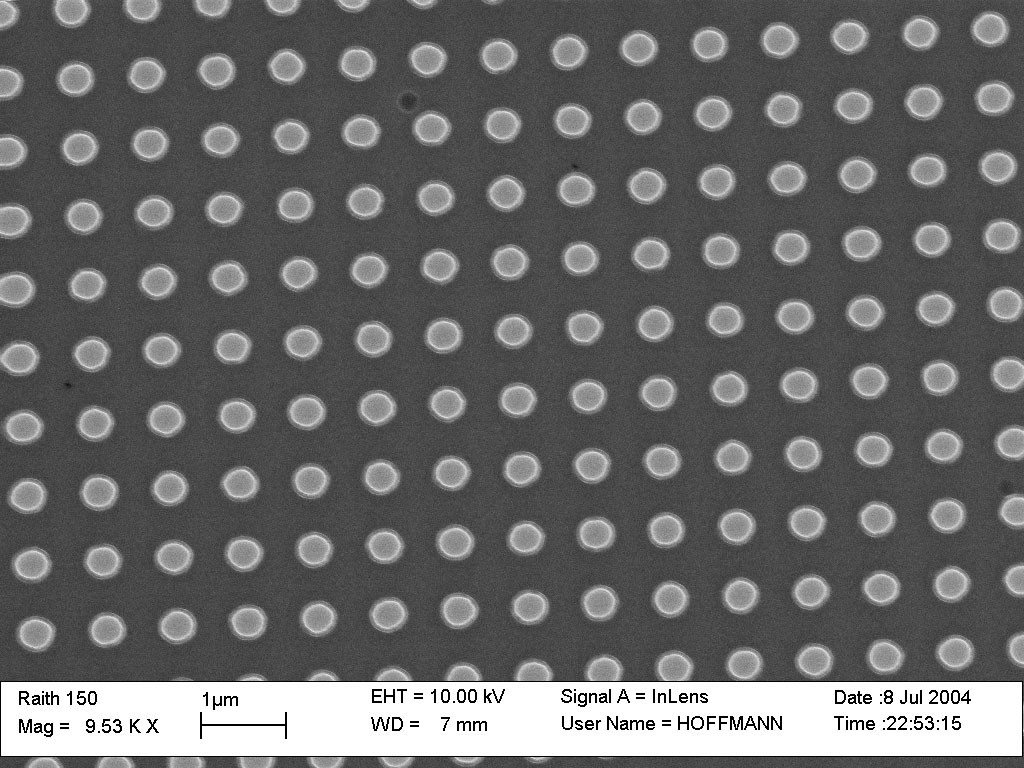
The application of 'displaced vortex states' - small magnetic circular movements of just a few thousandths of a millimetre - may accelerate the arrival of a new type of magnetic memory (MRAM) that does not disappear when a computer is switched offThe application of 'displaced vortex states' - small magnetic circular movements of just a few thousandths of a millimetre - may accelerate the arrival of a new type of magnetic memory (MRAM) that does not disappear when a computer is switched off.
A team of scientists from the Universitat Autònoma de Barcelona, in collaboration with colleagues from the Argonne National Laboratory (USA) and the Spintec laboratory (Grenoble, France), has for the first time produced microscopic magnetic states, known as "displaced vortex states", that will allow an increase in the size of MRAMs (which are not deleted when the computer is switched off). The research has been published in Physical Review Letters and Applied Physics Letters.

In the near future we will turn our computers on and they will be ready to work almost instantaneously; no longer will we have to wait a while for the operating system and certain programs to load into the RAM. At the moment, SRAM and DRAM do not allow this, as they are quick, but they are deleted when the computer is switched off (that is, they are "volatile"); Flash memories, which we use for digital cameras, are not deleted, but they are slow; MRAM, which is still being developed, is fast and non-volatile, but has a relatively low storage capacity. A team of scientists from the UAB Department of Physics, in collaboration with colleagues from the Argonne National Laboratory (USA) and the Spintec laboratory (Grenoble, France), have discovered a magnetic phenomenon that could be useful in the quest for the ideal type of memory: an MRAM with large storage capacity.

The "displaced vortex states", first observed by UAB researchers, are small circular movements of just a few thousandths of a millimetre that form in the tiny zones where the data is stored. The information on hard drives has normally been saved by orientating these zones in specific directions. The zones pointing upwards, for example, codify a 1, and those pointing downwards a 0. The smaller and more compact these zones are, the greater the capacity of the hard drive. But if they are too close together, the magnetic field created by one can affect the neighbouring zone and wipe the data. However, if the field is saved in a whirlpool form, in "vortex state", it does not leave the tiny zone to which it is confined and does not affect the neighbouring data, thus making it possible for a much larger hard drive capacity.

The scientists have achieved these "vortex states" on small, circular structures that are smaller than a micrometre (a thousandth of a millimetre) and combine layers of material with opposing magnetic properties: a layer of ferromagnetic material and a layer of antiferromagnetic material. What makes the configuration of the magnets observed by the UAB scientists new is that the vortex states are "displaced", that is, once the magnetic field is no longer applied, the eye of the whirpool moves off-centre with regard to the circular structure on which it formed. This seemingly insignificant detail is the key to applying the technique to increasing the capacity not only of hard drives but also Magnetic Random Access Memories (MRAMs) that are fast, non-volatile, but until now with small storage capacity.

"The phenomenon observed could also be applied to other fields, such as improving the read heads of hard drives", according to Jordi Sort, a UAB-ICREA physicist and the coordinator of the research. "But the reason that motivated us is even more fundamental: this is a very peculiar physical state that can be observed only in extremely small magnetic structures." ###

Josep Nogués (ICREA researcher) and Maria Dolors Baró, of the UAB Department of Physics, also took part in the research, which was recently published in Physical Review Letters and Applied Physics Letters.

Contact: Octavi Lopez
octavi.lopez@uab.es34-93-581-3301 Universitat Autonoma de Barcelona

more at
or and or and or and or and or and or and or

Related: Keyword Nanotech Sunday, February 26, 2006
Nanoscience study shows that quantum dots 'talk', Sunday, February 26, 2006 Nano-bots to undertake major tasks?, Sunday, February 19, 2006 Nanotech to improve health care delivery, Sunday, February 19, 2006 nano-canary in the nanotoxicology coalmine, Sunday, December 04, 2005 Nano-cages 'fill up' with hydrogen, Sunday, November 13, 2005 Testing toxicity of nanomaterials, Sunday, October 23, 2005 single-molecule car, 'Nanocar', Sunday, August 28, 2005 Writing at the nanoscale, Thursday, May 26, 2005 discontinuous palladium, siloxane self-assembled monolayer, Sunday, May 08, 2005 Center for Nanoscale Materials, Monday, April 25, 2005 Nanomagnets, Nanocomposite, Monday, March 21, 2005 porphyrin tubes may lead to new nanodevices, inexpensive hydrogen fuel

'John Henryism' Health Outcomes in African Americans

'John Henryism' Key to Understanding Coping, Health Outcomes in African Americans

DURHAM, N.C. – John Henry, the figure from American folklore who worked himself to death to beat a steam engine, is a key to understanding the medical reality of African Americans in the 21st century, according to researchers from Duke University Medical Center and their colleagues. African Americans continue to have poorer health than other groups, even though their economic situation has improved significantly, said the researchers.

'John Henryism,' is a coping style that has a clear genetic basis in African Americans and reflects clear personality traits, they reported. The effects of John Henryism (JH) are apparent in clinical and non-clinical settings, can influence emotional reactions and may impact how African Americans function in their everyday lives, the researchers said.

The findings from four studies that examine JH and health outcomes among African Americans were presented on Friday, March 3, 2006, as part of a symposium organized by Duke researchers at the
American Psychosomatic Society's annual meeting in Denver. The studies were funded by the National Institute on Aging.

Psychologists have formally recognized John Henryism as a style of strong coping behaviors used by many African Americans to deal with psychosocial and environmental stressors such as career issues, health problems and even racism. The classic traits of JH are seen among those African Americans who are extremely preoccupied with success, particularly in new environments with which they have little experience. Most commonly, people with JH are extremely goal-oriented but often lack the resources they need for success, such as financial or emotional support, the researchers said.

People with high levels of JH and inadequate resources have a much higher prevalence of health disorders, the researchers added, because they drive themselves toward reaching specific goals at the expense of their health, often without realizing they are doing so.

For example, when coping with a medical crisis like sickle cell anemia, African Americans may display a strong drive toward a successful health outcome but lack the support they need in their job in order to take time off from work, leading them to work during a severe pain episode even though they know their work will suffer or their pain will last longer, said the researchers.

Without adequate resources such as income, social support or psychological and medical care, a person with sickle cell disease would risk increased levels of dysfunction and pain. They also have increased tendencies toward worrying; an increased sensitivity to the comments and reactions of others; increased anxiety and depression; and difficulty trusting other people.

"John Henryism provides one of the more significant and promising models of explaining coping behavior and health outcomes in African Americans for the twenty-first century," said Christopher L. Edwards, Ph.D., a psychiatrist at Duke and lead researcher for one of the studies presented at APS. He is also the medical director of the biofeedback laboratory and director of the Chronic Pain Management Program at Duke.

He further indicated that, "We believe that by better understanding how John Henryism can give rise to health-endangering behaviors by African Americans, we can find new approaches to reducing the health disparities that have led to poorer health among African Americans."

The researchers quantify John Henryism using a questionnaire that reveals a 'single-minded' drive to succeed, even beyond a person's overall self-interest, which is the hallmark of JH, Edwards said.

"People who are so intensely success-oriented and goal-directed, even beyond their resources such as income, education or family support, might seem to succeed at first," said Edwards. "But, long term they are likely to fail because their lack of resources will catch up to them. Add to that the African American situation, which, for many, includes an expectation that failure is inevitable, you find yourself in a most destructive situation.

"They end up compromising their health, with higher rates of cardiovascular disease and death as compared to any other population in the world. We also see evidence of this self-destructive behavior in African Americans with breast cancer, osteoarthritis, and of course, sickle cell disease."
One study, conducted at Pennsylvania State University and Johns Hopkins University, found that as much as 30 percent of active coping behavior in African Americans may be genetically-based, said the researchers. In their study, they examined 180 same-sex twins to glean a better framework for understanding the mechanics of coping behavior. They did this by comparing environmental factors, such as learning and socialization, to genetics factors. The 70 percent of coping that is not accountable to genetics gives hope that modifying the environment and learning how to better apply coping skills may yield solutions to the challenge of reducing the health burden of disease as a function of race, said the researchers.

A Duke-based study found that personality can be linked to measures of JH. In a sample of 233 participants, half of whom were African American and half white, researchers found traits such as 'extroversion' and 'conscientiousness' to be associated with the coping style characterized by JH, as were traits such as dutifulness, achievement-striving, self-discipline and assertiveness.

In a study conducted by researchers at Cleveland State University, Harvard and Duke, researchers found that JH influences how people react emotionally within their environment. The team tested the emotional reactions of 58 healthy black males between the ages of 23 and 47 to various activities. These included public speaking about a racially charged issue, a reading assignment and an anger recall task. They found that the men with lower educational levels who displayed more traits of JH were happier than those who scored high for JH who had higher educational levels.

To test their understanding of John Henryism in a clinical setting, researchers at Duke, North Carolina Central University and Harvard identified the influence of JH on patterns of pain and emotionally-related illness stemming from pain in 50 adult patients with sickle cell disease, an African American population that has not been well-studied. They administered the standard JH questionnaire to those patients, and asked them to report their pain level due to the disease.

That team found that patients with sickle cell disease who exhibited higher levels of JH reported higher incidence of pain and pain-related problems than those with lower levels of JH, they said.

According to Edwards, use of the JH model in research studies has added significantly to the overall understanding of coping in African Americans and will provide even better understanding of the health challenges they face.

"We hope that better understanding coping in African Americans using the John Henryism model will help us develop a better concept of how JH contributes to health problems and how we can reduce their stress and thus enhance their health," Edwards said.

keywords :
African Americans and John Henryism or mental health date : 3/3/2006, media contact : Tracey Koepke , (919) 684-4148 or (919) 660-1301 koepk002@mc.duke.edu

Technorati Tags:
or and or and or or and or and or and or

RELATED: Keyword biology. Sunday, December 18, 2005
Conditions for slavery, Sunday, December 25, 2005 Why Christmas trees are not extinct, Sunday, January 01, 2006 prostaglandins choreograph perturbations, Sunday, January 01, 2006 Cultural differences may explain variations in home remedy use, Sunday, January 08, 2006 Risky Sexual Behaviors in Miami, and Racial Influences on Children’s Care, Sunday, January 22, 2006 Twenty-seven previously unknown species discovered, Sunday, February 12, 2006 Hormone linked to good hearing as we age, Sunday, February 12, 2006 Anti-HIV drug has potential to prevent transmission in women, Sunday, February 12, 2006 Parental Conflict Produces More Than Fleeting Distress for Children, Sunday, February 12, 2006 Facial characteristics indicative of personality traits, say experts, Sunday, February 19, 2006 There's something fishy about human brain evolution, Sunday, February 19, 2006 Marine mammals are on the frontline of failing ocean health, Sunday, February 26, 2006 Study shows that soda consumption increases among adolescent girls as they get older, Sunday, February 26, 2006 Gold's power against autoimmune diseases defined, Sunday, March 05, 2006 People Use Separate Brain Mechanisms to Make Risky Choices,