


President Discusses Freedom and Democracy in Iraq, 03/13/05, FULL STREAMING VIDEO Dorothy Betts Marvin Theatre, The George Washington University, Washington, D.C. 1:16 P.M. EST
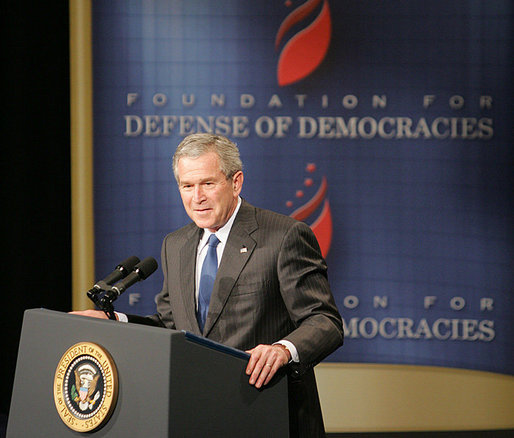 | President George W. Bush addresses his remarks on the global war on terror, Monday, March 13, 2006 , before members and guests of the Foundation for the Defense of Democracies at the Dorothy Betts Marvin Theatre at George Washington University in Washington. White House photo by Paul Morse. |
In Focus: Renewal in Iraq
In Focus: National Security

THE PRESIDENT: Thanks for the warm welcome. Cliff, thanks for the introduction. It's a pleasure to be with the Foundation for the Defense of Democracies. This organization was formed in the wake of the September the 11th attacks to fight the ideologies that drive terrorism. You recognized immediately that the war on terror is a struggle between freedom and tyranny -- and that the path to lasting security is to defeat the hateful vision the terrorists are spreading with the hope of freedom and democracy.
The Foundation is making a difference across the world, and I appreciate the difference you're making. You have trained Iraqi women and Iranian students in the principles and practice of democracy, you've translated "democracy readers" into Arabic for distribution across the broader Middle East, you've helped activists across the region organize effective political movements -- so they can help bring about democratic change and ensure the survival of liberty in new democracies. By promoting democratic ideals, and training a new generation of democratic leaders in the Middle East, you are helping us to bring victory in the war on terror -- and I thank you for your hard work in freedom's cause.
I also want to thank the members of the board of the Foundation for the Defense of the Democracies. I want to thank Steve Trachtenberg, the President of George Washington University, and his wife, Fran, for joining us today. Thanks for letting me come to your campus. I'm honored to be here. He informed me that my dad will be giving the graduation speech this year. (Laughter.) And Mother is getting an honorary degree. (Laughter.) Smart man. (Laughter and applause.) Mr. Secretary, thanks for joining us. I'm proud that Secretary Rumsfeld is with us.
I want to thank Senator Dick Lugar for being with us today. Mr. Chairman, proud you're here. Thanks for coming. I want to thank the members of the United States Congress who have joined us. Congressman Lungren, Adam Schiff, Joe Wilson, Tom Cole and Dan Boren. I appreciate you all taking time to be here today, it means a lot. I want to thank the ambassadors who have joined us. I see two for certain, one from Jordan and one from Israel. Proud you both are here. If there's any ambassadors here, I apologize for not introducing you, and you don't have as good a seat as these two guys. (Laughter.)
The mission of this Foundation is to defeat terror by promoting democracy -- and that is the mission of my administration. Our strategy to protect America is based on a clear premise: the security of our nation depends on the advance of liberty in other nations. On September the 11th, 2001, we saw that problems originating in a failed and oppressive state 7,000 miles away could bring murder and destruction to our country. We saw that dictatorships shelter terrorists, feed resentment and radicalism, and threaten the security of free nations. Democracies replace resentment with hope, democracies respect the rights of their citizens and their neighbors, democracies join the fight against terror. And so America is committed to an historic, long-term goal: To secure the peace of the world, we seek the end of tyranny in our world.
We are making progress in the march of freedom -- and some of the most important progress has taken place in a region that has not known the blessings of liberty: the broader Middle East. Two weeks ago, I got a chance to visit Afghanistan and to see firsthand the transformation that has taken place in that country. Before September the 11th, 2001, Afghanistan was ruled by a cruel regime that oppressed its people, brutalized women, and gave safe haven to the terrorists who attacked America.
Today, the terror camps have been shut down, women are working, boys and girls are going to school, Afghans have voted in free elections -- 25 million people have had the taste of freedom. Taliban and al Qaeda remnants continue to fight Afghanistan's democratic progress. In recent weeks, they have launched new attacks that have killed Afghan civilians and coalition forces. The United States and our allies will stay in the fight against the terrorists, and we'll train Afghan soldiers and police so they can defend their country. The Afghan people are building a vibrant young democracy that is an ally in the war on terror -- and America is proud to have such a determined partner in the cause of freedom. (Applause.)
Next week, we will mark the three-year anniversary of the start of Operation Iraqi Freedom. In less than three years, the Iraqi people have gone from living under the boot of a brutal tyrant, to liberation, to sovereignty, to free elections, to a constitutional referendum, and last December, to elections for a fully constitutional government. In those December elections, over 11 million Iraqis -- more than 75 percent of the Iraqi voting age population -- defied the terrorists to cast their ballots.
Americans were inspired by the images of Iraqis bringing elderly relatives to the polls, holding up purple ink-stained fingers, dancing in the streets and celebrating their freedom. By their courage, the Iraqi people have spoken and made their intentions clear: they want to live in democracy -- and they are determined to shape their own destiny.
The past few weeks, the world has seen very different images from Iraq -- images of violence, and anger, and despair. We have seen a great house of worship -- the Golden Mosque of Samarra -- in ruins after a brutal terrorist attack. We've seen mass protests in response to provocation. We've seen reprisal attacks by armed militias on Sunni mosques -- and random violence that has taken the lives of hundreds of Iraqi citizens.
The terrorists attacked the Golden Mosque for a reason: They know that they lack the military strength to challenge Iraqi and coalition forces directly -- so their only hope is to try and provoke a civil war. So they attacked one of Shia Islam's holiest sites, hoping to incite violence that would drive Iraqis apart and stop their progress on the path to a free society.
Immediately after the attack, I said that Iraq faced a moment of choosing -- and in the days that followed, the Iraqi people made their choice. They looked into the abyss and did not like what they saw. After the bombing, most Iraqis saw what the perpetuators [sic] of this attack were trying to do: The enemy had failed to stop the January 2005 elections, they failed to stop the constitutional referendum, they failed to stop the December elections, and now they're trying to stop the formation of a unity government. By their response over the past two weeks, Iraqis have shown the world they want a future of freedom and peace -- and they will oppose a violent minority that seeks to take that future away from them by tearing their country apart.
The situation in Iraq is still tense and we're still seeing acts of sectarian violence and reprisal. Yet out of this crisis, we've also seen signs of a hopeful future. We saw the restraint of the Iraqi people in the face of massive provocation. Most Iraqis did not turn to violence, and many chose to show their solidarity by coming together in joint Sunni and Shia prayer services. We saw the leadership of Sunni and Shia clerics who joined together to denounce the bombing and call for restraint. Ayatollah Sistani issued a strong statement denouncing what he called "sectarian sedition," and he urged all Iraqis -- in his words -- "not to be dragged into committing acts that would only please the enemies." We saw the capability of the Iraqi security forces, who deployed to protect religious sites, enforce a curfew, and restore civil order. We saw the determination of many of Iraq's leaders, who rose to the moment, came together, and acted decisively to diffuse the crisis.
Iraq's leaders know that this is not the last time they will be called to stand together in the face of an outrageous terrorist attack. Iraq's leaders know that they must put aside their differences, reach out across political, religious, and sectarian lines, and form a unity government that will earn the trust and the confidence of all Iraqis. Iraqis now have a chance to show the world that they have learned the lesson of Samarra: A country that divides into factions and dwells on old grievances risks sliding back into tyranny. The only path to a future of peace is the path of unity.
Soon the new parliament will be seated in Baghdad, and this will begin the process of forming a government. Forming a new government will demand negotiation and compromise by the Iraqis; it will require patience by America and our coalition allies.
In the weeks ahead, Americans will likely see a good deal of political maneuvering in Iraq -- as different factions and leaders advance competing agendas and seek their share of political power. Out of this process, a free government will emerge that represents the will of the Iraqi people -- instead of the will of one cruel dictator.
The work ahead in Iraq is hard -- and there will be more difficult moments. The Samarra attack was a clear attempt to ignite a civil war. And we can expect the enemy will try again -- and they will continue to sow violence and destruction designed to stop the emergence of a free and democratic Iraq.
The enemies of a free Iraq are determined -- yet so are the Iraqi people. And so are America and coalition partners. We will not lose our nerve. We will help the Iraqi people succeed. Our goal in Iraq is victory -- and victory will be achieved when the terrorists and Saddamists can no longer threaten Iraq's democracy, when the Iraqi security forces can provide for the safety of their own citizens, and when Iraq is not a safe haven for terrorists to plot new attacks against our nation.
We have a comprehensive strategy for victory in Iraq -- a strategy I laid out in a series of speeches last year. Our strategy has three elements: On the political side, we are helping Iraqis build a strong democracy, so that old resentments will be eased, and the insurgency marginalized. On the economic side, we are continuing reconstruction efforts and helping Iraqis build a modern economy that will give all its citizens a stake in a free and peaceful Iraq. And on the security side, we are striking terrorist targets and training the Iraqi security forces -- which are taking responsibility for more Iraqi territory and becoming increasingly capable of defeating the enemy.
In the coming weeks, I will update the American people on our strategy -- the progress we are making, the lessons we have learned from our experiences, and how we are fixing what hasn't worked. Today, I will discuss the third element of our strategy -- the progress of our efforts to defeat the terrorists and train the Iraqi security forces so they can take the lead in defending their own democracy.
At the end of last year, I described in detail many of the changes we have made to improve the training of Iraqi security forces -- and we saw the fruits of those changes in recent days in Iraq. After the Samarra bombings, it was the Iraqi security forces -- not coalition forces -- that restored order. In the hours after the attack, Iraqi leaders put the Iraqi security forces on alert -- canceling all leaves, and heightening security around mosques and critical sites. Using security plans developed for the December elections, they deployed Iraqi forces in Baghdad and other trouble spots.
Iraqi police manned checkpoints, increased patrols, and ensured that peaceful demonstrators were protected -- while those who turned to violence were arrested. Public order brigades deployed as rapid reaction forces to areas where violence was reported. The 9th Mechanized Division of the Iraqi Army, which was in the midst of a major training event, regrouped and entered the Baghdad City Gates -- taking up assigned positions throughout the city with T-72 tanks and armored infantry vehicles. During the past two weeks, Iraqi security forces conducted more than 200 independent operations -- each of them Iraqi-planned, Iraqi-conducted, and Iraqi-led.
Having Iraqi forces in the lead has been critical to preventing violence from spinning out of control. For example, on the day of the Samarra bombing, the Iraqi national police responded to an armed demonstration in an area immediately adjacent to Sadr City -- where an angry Shia crowd had surrounded the Sunni Al Quds Mosque. The Iraqi Brigade Commander placed his troops -- who were largely Shia -- between the crowd and the mosque, and talked to the crowd using megaphones, and calling for calm and urging them to disperse. After a two-hour standoff, the crowd eventually left without incident -- and the national police remained in position overnight to guard the Mosque until the threat was over. The fact that Iraqis were in the lead and negotiating with their own countrymen helped diffuse a potential confrontation -- and prevented an escalation of violence.
In another Baghdad neighborhood, a similar situation unfolded: a group of armed militia members had gone in and occupied the Al Nida Mosque. An Iraqi Army brigade quickly arrived on the scene -- and the Brigade Commander negotiated with the group and secured their peaceful departure. Once again, because Iraqi forces spoke their language and understood the culture, they were able to convince the Iraqi militia to leave peacefully.
Not all Iraqi units performed as well as others -- and there were some reports of Iraqi units in Eastern Baghdad allowing militia members to pass through checkpoints. But American commanders are closely watching the situation, and they report these incidents appear to be the exception, not the rule. In the weeks since the bombing, the Iraqi security forces turned in a strong performance. From the outset, Iraqi forces understood that if they failed to stand for national unity, the country would slip into anarchy. And so they have stood their ground, and defended their democracy, and brought their nation through one of its most difficult moments since liberation.
General Marty Dempsey, our top commander responsible for training the Iraqis' security forces, says this about their performance: "They were deliberate, poised, even-handed, and professional. They engaged local tribal, political, and religious leaders. They patiently, but deliberately confronted armed groups to let them know that they had control of the situation." He went on to say, "I'm sure we will find instances where they could have performed better, but in the face of immense pressure, they performed very, very well." As a result of their performance, the Iraqi security forces are gaining the confidence of the Iraqi people. And as the Iraqi security forces make progress against the enemy, their morale continues to increase.
When I reported on the progress of the Iraqi security forces last year, I said that there were over 120 Iraqi and police combat battalions [sic] in the fight against the enemy -- and 40 of those were taking the lead in the fight. Today the number of battalions in the fight has increased to more than 130 -- with more than 60 taking the lead. As more Iraqi battalions come on line, these Iraqi forces are assuming responsibility for more territory. Today, Iraqi units have primary responsibility for more than 30,000 square miles of Iraq -- an increase of roughly 20,000 square miles since the beginning of the year. And Iraqi forces are now conducting more independent operations throughout the country than do coalition forces.
This is real progress, but there is more work to be done this year. Our commanders tell me that the Iraqi police still lag behind the Army in training and capabilities -- so one of our major goals in 2006 is to accelerate the training of the Iraqi police. One problem is that some National Police units have been disproportionately Shia -- and there have been some reports of infiltration of the national police by Shia militias. And so we're taking a number of steps to correct this problem:
First, we have begun implementing a program that has been effective with the Iraqi Army -- partnering U.S. battalions with the Iraqi national police battalions. These U.S. forces are working with their Iraqi counterparts -- giving them tactical training so they can defeat the enemy. And they are also teaching them about the role of a professional police force in a democratic system, so they can serve all Iraqis without discrimination.
Second, we are working with the Iraqi leaders to find and remove any leaders in the national police who show evidence of loyalties to militia. For example, last year there were reports that the Second Public Order Brigade contained members of an illegal militia, who were committing abuses. So last December, the Interior Ministry leadership removed the Second Brigade Commander, and replaced him with a new commander -- who then dismissed more than a hundred men with suspected militia ties. Today, this Iraqi police brigade has been transformed into a capable, professional unit -- and during the recent crisis after the Samarra bombing, they performed with courage and distinction.
Finally, we are working with Iraqis to diversify the ranks of the national police, by recruiting more Sunni Arabs. For example, the basic training class for the National Police Public Order forces that graduated last October was less than one percent Sunni. The class graduating in April will include many, many more Sunnis. By ensuring the Public Order forces reflect the general population, Iraqis are making the National Police a truly national institution -- one that is able to serve, protect, and defend all the Iraqi people.
As more capable Iraqi police and soldiers come on line, they will assume responsibility for more territory -- with the goal of having the Iraqis control more territory than the coalition by the end of 2006. And as Iraqis take over more territory, this frees American and Coalition forces to concentrate on training and on hunting down high-value targets like the terrorist Zarqawi and his associates. As Iraqis stand up, America and our coalition will stand down. And my decisions on troop levels will be made based upon the conditions on the ground, and the recommendations of our military commanders -- not artificial timetables set by politicians here in Washington, D.C.
These terrorists know they cannot defeat us militarily -- so they have turned to the weapon of fear. And one of the most brutal weapons at their disposal are improvised explosive devices, or IEDs.
IEDs are bombs made from artillery shells, explosives, and other munitions that can be hidden and detonated remotely. After the terrorists were defeated in battles in Fallujah and Tall Afar, they saw that they could not confront Iraqi or American forces in pitched battles and survive. And so they turned to IEDs -- a weapon that allows them to attack us from a safe distance, without having to face our forces in battle.
The principal victims of IED attacks are innocent Iraqis. The terrorists and insurgents have used IEDs to kill Iraqi children playing in the streets, shoppers at Iraqi malls, and Iraqis lining up at police and army recruiting stations. They use IEDs to strike terror in the hearts of Iraqis, in an attempt to break their confidence in the free future of their country.
The enemy is also using IEDs in their campaign against U.S. and coalition forces in Iraq -- and we are harnessing every available resource to deal with this threat. My administration has established a new high-level organization at the Department of Defense, led by retired four-star General Montgomery Meigs. On Saturday, General Meigs, along with the Secretary of Defense, briefed me at the White House on our plan to defeat the threat of IEDs. Our plan has three elements: targeting, training, and technology.
The first part of our plan is targeting and eliminating the terrorists and bomb makers. Across Iraq, we are on the hunt for the enemy -- capturing and killing the terrorists before they strike, uncovering and disarming their weapons before they go off, and rooting out and destroying bomb making cells so they can't produce more weapons.
Because the Iraqi people are the targets, primarily the targets of the bombers, Iraqis are increasingly providing critical intelligence to help us find the bomb-makers and stop new attacks. The number of tips from Iraqis has grown from 400 last March to over 4,000 in December. For example, just three weeks ago, acting on tips provided by local citizens, coalition forces uncovered a massive IED arsenal hidden in a location northwest of Baghdad. They found and confiscated more than 3,000 pieces of munitions -- in one of the largest weapons caches discovered in that region to date. Just two weeks ago, acting on intelligence from Iraqis, coalition forces uncovered a bomb-making facility northeast of Fallujah. They captured 61 terrorists at the facility and confiscated large numbers of weapons.
In all, during the past six months, Iraqi and coalition forces have found and cleared nearly 4,000 IEDs, uncovered more than 1,800 weapons caches and bomb-making plants, and killed or detained hundreds of terrorists and bomb-makers. We're on the hunt for the enemy -- and we're not going to rest until they've been defeated.
The second part of our plan is to give our forces specialized training to identify and clear IEDs before they explode. Before arriving in Iraq and Afghanistan, our combat units get training on how to counter the threat of IEDs. And to improve our training, last month we established a new IED Joint Center of Excellence headquartered at Fort Irwin, California -- where we're taking lessons learned from the IED fight in Iraq, and sharing them with our troops in the field and those preparing to deploy. This new initiative will ensure that every Army and Marine combat unit headed to Afghanistan and Iraq is prepared for the challenges that IEDs bring to the battlefield.
Before deploying, our troops will train with the equipment they will use in the IED fight, they'll study enemy tactics, and experience live fire training that closely mirrors what they will see when they arrive in the zone of combat. Our goal with this training is to ensure that when our forces encounter the enemy, that they're ready.
The third part of our plan is to develop new technologies to defend against IEDs. We are putting the best minds in America to work on this effort. The Department of Defense recently gathered some -- gathered 600 leaders from industry and academia, the national laboratories, the National Academy of Sciences, all branches of the military, and every relevant government agency to discuss technology solutions to the IED threat. We now have nearly a hundred projects underway. For security reasons, I'm not going to share the details of the technologies we're developing. The simple reason is, the enemy can use even the smallest details to overcome our defenses.
Earlier this year, a newspaper published details of a new anti-IED technology that was being developed. Within five days of the publication -- using details from that article -- the enemy had posted instructions for defeating this new technology on the Internet. We cannot let the enemy know how we're working to defeat him. But I can assure the American people that my administration is working to put the best technology in the hands of our men and women on the front lines -- and we are mobilizing resources against the IED threat.
I assured General Meigs that he will have the funding and personnel he needs to succeed. In 2004, the administration spent $150 million to fight the IED threat. This year, we're providing $3.3 billion to support our efforts to defeat IEDs. These investments are making a difference. Today, nearly half of the IEDs in Iraq are found and disabled before they can be detonated. In the past 18 months, we've cut the casualty rate per IED attack in half. More work needs to be done. Yet by targeting the bomb-makers, and training our forces, and deploying new technologies, we will stay ahead of the enemy, and that will save Iraqi and American lives.
Some of the most powerful IEDs we're seeing in Iraq today includes components that came from Iran. Our Director of National Intelligence, John Negroponte, told the Congress, "Tehran has been responsible for at least some of the increasing lethality of anti-coalition attacks by providing Shia militia with the capability to build improvised explosive devises" in Iraq. Coalition forces have seized IEDs and components that were clearly produced in Iran. Such actions -- along with Iran's support for terrorism and its pursuit of nuclear weapons -- are increasingly isolating Iran, and America will continue to rally the world to confront these threats. (Applause.)
We still have difficult work ahead in Iraq. I wish I could tell you that the violence is waning and that the road ahead will be smooth. It will not. There will be more tough fighting and more days of struggle -- and we will see more images of chaos and carnage in the days and months to come. The terrorists are losing on the field of battle, so they are fighting this war through the pictures we see on television and in the newspapers every day. They're hoping to shake our resolve and force us to retreat. They are not going to succeed. (Applause.)
The battle lines in Iraq are clearly drawn for the world to see, and there is no middle ground. The enemy will emerge from Iraq one of two ways: emboldened or defeated. The stakes in Iraq are high. By helping Iraqis build a democracy, we will deny the terrorists a safe haven to plan attacks against America. By helping Iraqis build a democracy, we will gain an ally in the war on terror. By helping Iraqis build a democracy, we will inspire reformers across the Middle East. And by helping Iraqis build a democracy, we'll bring hope to a troubled region, and this will make America more secure in the long-term.
Since the morning of September the 11th, we have known that the war on terror would require great sacrifice -- and in this war we have said farewell to some very good men and women. One of those courageous Americans was Sergeant William Scott Kinzer, Jr., who was killed last year by the terrorists while securing polling sites for the Iraqi elections. His mom, Debbie, wrote me a letter. She said: "These words are straight from a shattered but healing mother's heart. ... My son made the decision to join the Army. He believed that what he was involved in would eventually change Iraq and that those changes would be recorded in history books for years to come. ... On his last visit home... I asked him what I would ever do if something happened to him in Iraq. He smiled at me with -- his blue eyes sparkled, as he said, 'Mom, I love my job...If I should die I would die happy, does life get any better than this?'" His mom went on: "Please do not let the voices we hear the loudest change what you and Scott started in Iraq. Please do not... let his dying be in vain. ... Don't let my son have given his all for an unfinished job. ... Please...complete the mission."
I make this promise to Debbie, and all the families of the fallen heroes: We will not let your loved ones dying be in vain. We will finish what we started in Iraq. We will complete the mission. We will leave behind a democracy that can govern itself, sustain itself, and defend itself. (Applause.) And a free Iraq, in the heart of the Middle East, will make the American people more secure for generations to come.
May God bless the families of the fallen. May God bless our troops in the fight. And may God continue to bless the United States of America. (Applause.)
END 1:49 P.M. EST, For Immediate Release, Office of the Press Secretary, March 13, 2006
Technorati Tags: President Bush and White House or September the 11th and Foundation for the Defense of Democraciesor VIDEO and Middle East or War on Terror and Iraq or al Qaeda and terrorists or Afghanistan and Operation Iraqi Freedom or Golden Mosque
Related: Keyword Iraq, Thursday, March 09, 2006 President Signs USA PATRIOT Act (VIDEO), Saturday, February 25, 2006 President Addresses American Legion, Discusses Global War on Terror (VIDEO), Wednesday, January 25, 2006 President Discusses War on Terror at K-State (VIDEO), Wednesday, January 04, 2006 President Discusses War on Terror Following Pentagon Briefing (VIDEO), Monday, December 19, 2005 President's Address to the Nation (VIDEO) 12/18/05, Thursday, December 15, 2005 President, McCain, Warner, Discusses Interrogation, Wednesday, December 14, 2005 Iraqi Elections, Victory in the War on Terror (VIDEO), Monday, December 12, 2005 President Discusses War on Terror and Upcoming Iraqi Elections (VIDEO), Sunday, July 17, 2005 Soldiers charged with assault on suspected insurgents, Sunday, July 24, 2005 Iraqi, American Women Discuss Constitution, Women's Rights, Thursday, July 28, 2005 Killing of Algerian Diplomats to Iraq, Saturday, August 06, 2005 Operation Quick Strike, Monday, August 08, 2005 The Independent Inquiry Committee into the Iraq Oil-for-Food Programme, Thursday, August 11, 2005 President Meets with Defense and Foreign Policy Teams,


