Monday, March 20, 2006

Third Anniversary of Beginning of Iraq Liberation (VIDEO)

President Remarks on Third Anniversary of Beginning of Iraq Liberation, FULL STREAMING VIDEO, The South Lawn. 12:56 P.M. EST Fact Sheet: Operation Iraqi Freedom: Three Years Later and In Focus: Renewal in Iraq
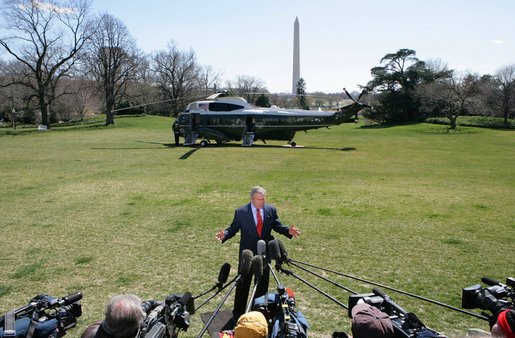
President George W. Bush delivers a statement after his arrival on the South Lawn, Sunday, March 19, 2006. White House photo by Kimberlee Hewitt.President George W. Bush delivers a statement after his arrival on the South Lawn, Sunday, March 19, 2006. White House photo by Kimberlee Hewitt.
THE PRESIDENT: This morning I had a phone call with our ambassador to Iraq. And the ambassador informed me of the progress that the Iraqis are making in forming a unity government. I encouraged the Iraqi leaders to continue to work hard to get this government up and running. The Iraqi people voted for democracy last December; 75 percent of the eligible citizens went to the polls to vote. Now the Iraqi leaders are working together to enact a government that reflects the will of the people. I'm encouraged by the progress. The ambassador was encouraged by it.

Today, as well, marks the third anniversary of the beginning of the liberation of Iraq. And it's a time to reflect. And this morning, our reflections were upon the sacrifices of the men and women who wear our uniform. Ours is an amazing nation where thousands have volunteered to serve our country. They volunteered to -- many volunteered after 9/11, knowing full well that their time in the military could put them in harm's way. So, on this third anniversary, the beginning of the liberation of Iraq, I think all Americans should offer thanks to the men and women who wear the uniform, and their families who support them. We are implementing a strategy that will lead to victory in Iraq. And a victory in Iraq will make this country more secure, and will help lay the foundation of peace for generations to come.

My God continue to bless our troops in harm's way. Thank you.

END 12:58 P.M. EST, For Immediate Release, Office of the Press Secretary, March 19, 2006

Technorati Tags:
and or and and or and or and or and or

Related: Keyword Iraq, Tuesday, March 14, 2006
President Discusses Freedom and Democracy in Iraq, 03/13/05 VIDEO, Thursday, March 09, 2006 President Signs USA PATRIOT Act (VIDEO), Saturday, February 25, 2006 President Addresses American Legion, Discusses Global War on Terror (VIDEO), Wednesday, January 25, 2006 President Discusses War on Terror at K-State (VIDEO), Wednesday, January 04, 2006 President Discusses War on Terror Following Pentagon Briefing (VIDEO), Monday, December 19, 2005 President's Address to the Nation (VIDEO) 12/18/05, Thursday, December 15, 2005 President, McCain, Warner, Discusses Interrogation, Wednesday, December 14, 2005 Iraqi Elections, Victory in the War on Terror (VIDEO), Monday, December 12, 2005 President Discusses War on Terror and Upcoming Iraqi Elections (VIDEO), Sunday, July 17, 2005 Soldiers charged with assault on suspected insurgents, Sunday, July 24, 2005 Iraqi, American Women Discuss Constitution, Women's Rights, Thursday, July 28, 2005 Killing of Algerian Diplomats to Iraq, Saturday, August 06, 2005 Operation Quick Strike, Monday, August 08, 2005 The Independent Inquiry Committee into the Iraq Oil-for-Food Programme, Thursday, August 11, 2005 President Meets with Defense and Foreign Policy Teams,

Sunday, March 19, 2006

Brain-scanning technology reveals how we process brands and products

Brain-scanning technology reveals how we process brands and products

In a groundbreaking new study, researchers from the University of Michigan and Harvard University use cutting-edge brain-scanning technology to explore how different regions of the brain are activated when we think about certain qualities of brands and products. The study, forthcoming in the Journal of Consumer Research, is the first to use fMRI to assess consumer perceptions and has important implications for the use of metaphorical human-like traits in branding.

"[fMRI] allows one to gauge, for the first time, the degree to which the underlying thought processes are similar," write the researchers.

Subjects were given 450 adjectives such as "reliable," "sophisticated," and "cheerful," and scanned while indicating whether each word was applicable to themselves and someone else. The sample group was also scanned while making similar judgments about brands they know and use. The researchers discovered that even when the consumers were judging products on unmistakably human terms, they still used the part of the brain associated with inanimate objects.

"Although we may use similar vocabularies to describe people and products, we can't say that the same concepts are involved," explain the researchers. "Companies building brand images and icons should be wary of taking the legitimately useful metaphor of brand personality too literally, since it's now apparent that consumers themselves do not." ###

Carolyn Yoon, Angela H. Gutchess, Fred Feinberg, and Thad A. Polk. "A Functional Magnetic Resonance Imaging Study of Neural Dissociations between Brand and Person Judgments" Journal of Consumer Research. June 2006.

Not all products are created equal: Study explores how consumers evaluate newly released products
In a forthcoming study from the Journal of Consumer Research, researchers from Indiana University explore the process by which consumers evaluate new products, be it a new razor with an unprecedented number of blades or an even mintier chewing gum. The researchers argue that when a multi-product brand – such as Nike, which recently added electronic gadgets to its core of athletic apparel – releases a new product, the consumer's evaluative process is significantly different than when a brand strongly associated with one product – such as Gillette – releases a new product.
"[The] attitude transfer process may be more complex than suggested by current models," write Huifang Mao and H. Shanker Krishnan. "For a multi-product brand, multiple referent points exist to judge a brand extension, resulting in more complex evaluative processes."

For multi-product brands, the researchers distinguish between the two measures consumers use to decide what they think of a newly released product: brand fit and product fit. "Brand fit" is the degree to which a new product is consistent with the overall brand image, and knee pads would fit well with the athletic Nike persona. However, certain new products that do not mesh with the Nike brand might still garner a positive consumer reaction if they demonstrate "product fit." A Nike car audio system, for example, would have high product fit with Nike's existing line of audio equipment for joggers. Surprisingly, this second type of association is often easier for consumers to make, the researchers found. "Consumers tend to transfer attitudes from varying sources to a brand extension," explain the authors. "[But] consumers may transfer their liking for an existing product to an extension in a spontaneous fashion." ###

Huifang Mao and H. Shanker Krishnan. "Effects of Prototype and Exemplar Fit on Brand Extension Evaluations: A Two-Process Contingency Model" Journal of Consumer Research. June 2006.

Contact: Suzanne Wu
swu@press.uchicago.edu 773-834-0386 University of Chicago Press Journals

Technorati Tags:
or and or and or or and or and or and or

RELATED: Keyword biology. Sunday, March 12, 2006
'John Henryism' Health Outcomes in African Americans, Sunday, December 18, 2005 Conditions for slavery, Sunday, December 25, 2005 Why Christmas trees are not extinct, Sunday, January 01, 2006 prostaglandins choreograph perturbations, Sunday, January 01, 2006 Cultural differences may explain variations in home remedy use, Sunday, January 08, 2006 Risky Sexual Behaviors in Miami, and Racial Influences on Children’s Care, Sunday, January 22, 2006 Twenty-seven previously unknown species discovered, Sunday, February 12, 2006 Hormone linked to good hearing as we age, Sunday, February 12, 2006 Anti-HIV drug has potential to prevent transmission in women, Sunday, February 12, 2006 Parental Conflict Produces More Than Fleeting Distress for Children, Sunday, February 12, 2006 Facial characteristics indicative of personality traits, say experts, Sunday, February 19, 2006 There's something fishy about human brain evolution, Sunday, February 19, 2006 Marine mammals are on the frontline of failing ocean health, Sunday, February 26, 2006 Study shows that soda consumption increases among adolescent girls as they get older, Sunday, February 26, 2006 Gold's power against autoimmune diseases defined, Sunday, March 05, 2006 People Use Separate Brain Mechanisms to Make Risky Choices,