


Technorati Tags: Special Relativity theory or atomic binding energy equation and supernovae or Space dust and red giants or galaxies and universe or Spitzer Space Telescope and spiral galaxy Messier 74 or Hubble and unified force theory or space-time and physics or Quantum Mechanics and astronomy or Jet Propulsion Laboratory
Massive-star supernovae found to be major space dust factories
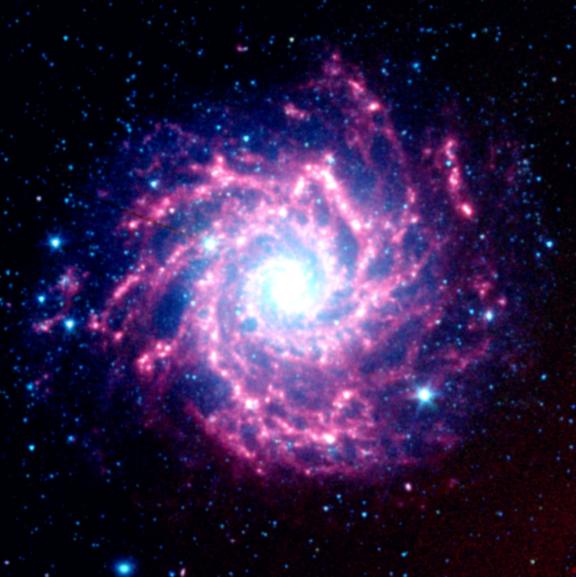 | PIA08533: Supernova Dust Factory in M74, Mission: Spitzer Space Telescope (SST), Spacecraft: Spitzer Space Telescope (SST), Instrument: Infrared Array Camera (IRAC), Product Size: 2325 samples x 2329 lines, Produced By: California Institute of Technology. |
Space dust is composed of small particles, made of elements such as carbon, silicon, magnesium, iron and oxygen, which are the building blocks from which the earth was made. Until recently, it was thought that this dust was mainly formed by old sun-like stars known as red giants. But the amount of dust found in young galaxies in the early universe seems unlikely to be due to old stars.
Supernovae produced by short-lived massive stars have long been suspected as the dust factories but they are fairly rare events that only happen approximately once every hundred years in a galaxy, making it harder for researchers to find and analyse whether dust is formed in their aftermath.
NASA’s Spitzer Space Telescope allowed the researchers to peer further into the universe, allowing them to observe a supernova whose explosion was discovered in 2003 in the spiral galaxy Messier 74, which is approximately 30 million light-years away. Their results suggest for the first time that dust can form efficiently in supernovae, using up about five per cent of the heavy elements available.
Professor Mike Barlow, of the UCL Department of Physics & Astronomy and one of the authors of the study, says: “Dust particles in space are the building blocks of comets, planets and life, yet our knowledge of where this dust was made is still incomplete. These new observations show that supernovae can make a major contribution to enriching the dust content of the universe.”
The researchers used the space-based Spitzer and Hubble telescopes and the ground-based Gemini North Telescope atop Mauna Kea in Hawaii. The study was led by Dr Ben Sugerman of the Space Telescope Science Institute in Baltimore, and members of the Survey for the Evolution of Emission from Dust in Supernovae (SEEDS) collaboration, which is led by Professor Barlow.
Although researchers have detected many supernovae in the past at visible wavelengths, supernova 2003gd is only one of three in the universe that have been seen at infrared wavelengths producing dust. Supernovae dim and expand into space fairly quickly, so scientists require extremely sensitive telescopes to study them even a few months after the initial explosion. While astronomers have suspected that most supernovae do produce dust, their ability to study this dust production in the past has been limited by technology.
As dust condenses in supernova ejections it produces three observable phenomena: (1) emission at infrared wavelengths; (2) an increase in obscuration of the supernova’s light at visible wavelengths; (3) greater obscuration by the newly formed dust of emission from gas that is expanding away from us, on the far side of the supernova, than from gas expanding towards us, at the front of the supernova.
“One of the difficulties in trying to detect infrared emissions from distant galaxies is the extreme sensitivity of the detectors to heat from other sources,” explains Professor Barlow.
“Infrared is primarily heat radiation, so the Spitzer Space Telescope must be cooled to near absolute zero (-273 degrees Celsius) so that it can observe infrared signals from space without interference from the telescope’s own heat.”
Infrared measurements of supernova 2003gd made 500-700 days after the outburst revealed emission consistent with newly formed cooling dust. Sophisticated modelling of the observed infrared emission and of the measured obscuration at visible wavelengths implied that solid dust particles equivalent to up to seven thousand earth masses had formed.
Dr Ben Sugerman, of the Space Telescope Science Institute in Baltimore who led the study, says: “People have suspected for 40 years that supernovae could be producers of dust, but the technology to confirm this has only recently become available. The advantage of using Spitzer is that we can actually see the warm dust as it forms.”
Professor Robert Kennicutt, of the University of Cambridge’s Institute of Astronomy and a co-author of the study, added: “These results provide an impressive demonstration of how Spitzer observations of supernovae can provide unique new insights into the processes that produce dust in the universe.”
Notes to editors
The paper, ‘Massive-Star Supernovae as Major Dust Factories’ was published in the June 8 Science Express edition of the journal Science.
NASA’s Jet Propulsion Laboratory, Pasadena, California, manages the Spitzer Space Telescope mission for NASA’s Science Mission Directorate, Washington. Science operations are conducted at the Spitzer Science Center at the California Institute of Technology. JPL is a division of Caltech.
For further information, please contact:
Judith H Moore,UCL Media Relations, Tel: +44 (0) 20 7679 7678, Mobile: +44 (0)77333 075 96, Out-of-hours: +44 (0)7917 271 364, Email: judith.moore@ucl.ac.uk
Professor Mike Barlow, UCL Department of Physics & Astronomy, Tel: +44 (0) 20 7679 7160, Email: mjb@star.ucl.ac.uk,
Dr Ben Sugerman, The Space Telescope Science Institute in Baltimore, Email: sugerman@stsci.edu
Related: Keywords Nanotech, science - Sunday, June 04, 2006 New unified force theory predicts measured values of physics, Sunday, Sunday, May 28, 2006 Growing glowing nanowires to light up the nanoworld , Sunday, May 14, 2006 Scientists Create the First Synthetic Nanoscale Fractal Molecule, Sunday, May 14, 2006 World’s tiniest test tubes get teensiest corks, Sunday, May 07, 2006 Blood-Compatible Nanoscale Materials Possible Using Heparin, Sunday, April 30, 2006 Micro-pump is cool idea for future computer chips, Sunday, April 16, 2006 Self-Powered Nanoscale Devices, Sunday, April 09, 2006 Nanopore Method Genome Sequencing, Sunday, April 02, 2006 Quantum dot method rapidly identifies bacteria, March 26, 2006 'Custom' nanoparticles, cancer diagnosis and treatment, Sunday, March 26, 2006, Green nanochemistry, American Chemical Society symposium, Sunday, March 19, 2006 nanotechnologists demonstrate artificial muscles powered by highly energetic fuels, Sunday, Sunday, March 12, 2006 magnetic phenomenon may improve RAM memories, February 26, 2006 Nanoscience study shows that quantum dots 'talk', Sunday, February 26, 2006 Nano-bots to undertake major tasks?, Sunday, February 19, 2006 Nanotech to improve health care delivery, Sunday, February 19, 2006 nano-canary in the nanotoxicology coalmine, Sunday, December 04, 2005 Nano-cages 'fill up' with hydrogen, Sunday, November 13, 2005 Testing toxicity of nanomaterials, Sunday, October 23, 2005 single-molecule car, 'Nanocar', Sunday, August 28, 2005 Writing at the nanoscale, Thursday, May 26, 2005 discontinuous palladium, siloxane self-assembled monolayer, Sunday, May 08, 2005 Center for Nanoscale Materials, Monday, April 25, 2005 Nanomagnets, Nanocomposite, Monday, March 21, 2005 porphyrin tubes may lead to new nanodevices, inexpensive hydrogen fuel.


