Wednesday, July 05, 2006

Statement by the President on Immigration

Technorati Tags: and or and or and or and or and or

Statement by the President on Immigration, FULL STREAMING VIDEO, Dunkin' Donuts/Baskin Robbins, Alexandria, Virginia Declaraciones del Presidente acerca de la Inmigración

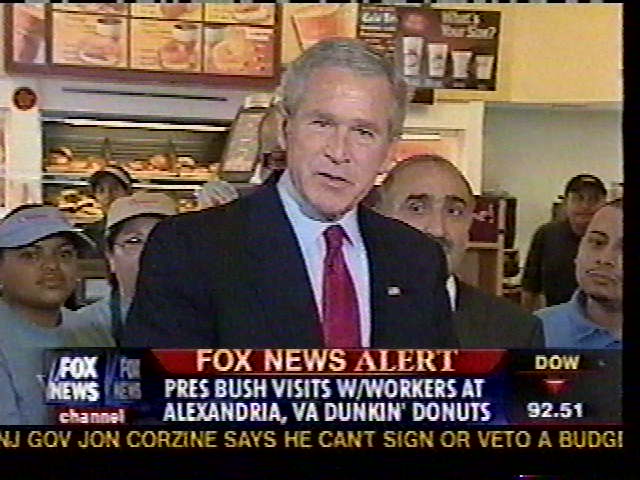
Statement by the President on Immigration, Vidcap COPYRIGHT FOX NEWS.Statement by the President on Immigration, Vidcap COPYRIGHT FOX NEWS.
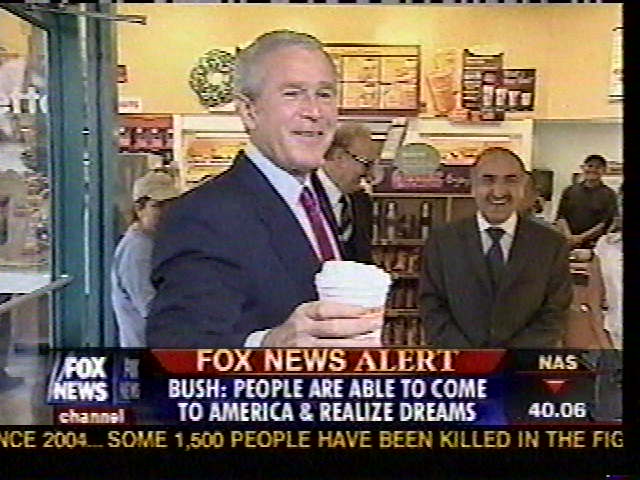
Vidcaps FOX NEWS, From their live coverage of this event.

THE PRESIDENT: I just had a really interesting conversation. First of all, this business is owned by two Iranian American brothers. They are small business owners, they are entrepreneurs, they are employing people. And then I met with the district manager, who works with the two Iranian American brothers, happens to be a Guatemalan American citizen. She is learning business. She is taking on additional responsibility. Then I talked to the store manager, who was a Salvadoran American.

These people remind me that one of the great features of our country is that people are able to come here and realize dreams. One of the problems we have because our economy is strong is that small business owners have trouble finding workers. People come here to work.

And one of the things we've got to do is to make sure that they have a verification plan that will enable them to determine, as they hire new workers, whether or not the workers are here illegally. See, it's against the law to hire somebody who is here illegally. And we intend to enforce that law. Part of a comprehensive immigration plan is to give employers the tools necessary to determine whether or not the workers they're looking for are here legally in America. And we've got such a plan -- Basic Pilot, it's called. It's working.

One of the reasons I came is I asked the owner of the business, was the plan working. He said, yes, it is -- it makes it easier for us to verify whether the documents a person gives us are true. I also want -- so therefore I want this plan to be expanded. When I first became President, it was only in six states. Now it's across the nation, but it's a voluntary plan. It ought to be a mandatory plan.

I'm strongly for a comprehensive immigration policy, one that enforces the border. And we're doing that by expanding agents and putting new technologies on our border. But part of a comprehensive immigration plan is to make sure we have interior enforcement, that we uphold our laws, and say to employers, it's against the law for you to hire somebody here illegally; we intend to fine you when we catch you doing it. But we've got to get the employers the tools to make sure that the people who are here are here legally.

Thirdly, I think there needs to be -- I know there needs to be a worker program that says you can come here on a temporary basis and work here legally for jobs Americans aren't doing. If you talk to employers such as these folks, they'll tell you they need workers. And people are willing to do the work that others aren't willing to do, but we want to make sure there's a legal way to do it.

So I look forward to working with Congress for a temporary worker plan that will have background checks to make sure that people that are coming aren't criminals, that say you can come here for a temporary basis, that you can do work others aren't doing, and that's one way to make sure that employers know they're hiring people who are here legally.

We need to make sure we help people assimilate. I met four people here who assimilated into our country. They speak English; they understand the history of our country; they love the American flag as much as I love the American flag. That's one of the great things about America, we help newcomers assimilate. Here's four folks that are living the American Dream, and I think it helps renew our soul and our spirit to help people assimilate.

And finally, we cannot kick people out who have been here for a while. And so I look forward to working with Congress on a rational plan as to how to make sure people who have been here, the 11 million or so people who have been here for a while are treated with respect and dignity. I'm absolutely opposed to amnesty. Amnesty says you're automatically a citizen. That would be a mistake to grant amnesty. Amnesty would say to somebody, all I've got to do is wait it out; all I've got to do is get here illegally myself and I'll become a citizen. That would be bad policy.

But I'm also realistic to tell you that we're not going to be able to deport people who have been here, working hard and raising their families. So I want to work with Congress to come up with a rational way forward.

Again, I want to thank you all for having me. I love being -- I cannot tell you how I love being with entrepreneurs and dreamers and doers and people who are running things, and managers, and to be with my fellow citizens as we talk about a very important public policy, and that's rational, comprehensive immigration reform.

Thank you all very much. See you back at the White House.

Q Mr. President, North Korea -- do you believe there should be --

THE PRESIDENT: April, would you like me to buy you a cup of coffee?

MS. RYAN: I would love you to.

THE PRESIDENT: What would you want in it?

MS. RYAN: Anything you want to give me.

THE PRESIDENT: What would you like in it, cream and sugar?

MS. RYAN: Sure, sir. (Laughter.)

THE PRESIDENT: It's coming your way. It's in the spirit of --

MS. RYAN: Spirit of what?

THE PRESIDENT: Spirit of reaching out.

MS. RYAN: All right. And you got money in your pocket. Do you typically keep money in your pocket?

THE PRESIDENT: No, this is -- Jared let me have this. (Laughter.) I'll repay him. The man offered to give me the coffee for free. You can't run a business if you give your coffee away. I understand how commerce works. He offers a product I want, I then pay for that product -- I'll handle that, sir, thank you -- (laughter.)

MS. RYAN: Mr. President, thank you so much.

THE PRESIDENT: Anything for you.

MS. RYAN: Thank you. Presidential coffee, mmm.

END 11:08 A.M. EDT

For Immediate Release, Office of the Press Secretary, July 5, 2006

Related: Keywords radio address, podcast, Saturday, July 01, 2006 bush radio address 07/01/06 full audio, text transcript, Saturday, June 24, 2006 bush radio address 06/24/06 full audio, text transcript, Saturday, June 17, 2006 bush radio address 06/17/06 full audio, text transcript, Saturday, June 10, 2006 bush radio address 06/10/06 full audio, text transcript, Monday, June 05, 2006 bush radio address 06/03/06 full audio, text transcript, Wednesday, May 31, 2006 bush radio address 05/27/06 full audio, text transcript, Saturday, May 20, 2006 bush radio address 05/20/06 full audio, text transcript, Saturday, May 13, 2006 bush radio address 05/13/06 full audio, text transcript, Saturday, May 06, 2006 bush radio address 05/06/06 full audio, text transcript, Saturday, April 29, 2006 bush radio address 04/29/06 full audio, text transcript, Saturday, April 22, 2006 bush radio address 04/22/06 full audio, text transcript, Saturday, April 15, 2006 bush radio address 04/15/06 full audio, text transcript, Saturday, April 08, 2006 bush radio address 04/08/06 full audio, text transcript, Saturday, April 01, 2006 bush radio address 04/01/06 full audio, text transcript, Saturday, March 25, 2006 bush radio address 03/25/06 full audio, text transcript, Saturday, March 18, 2006 bush radio address 03/18/06 full audio, text transcript, Saturday, March 11, 2006 bush radio address 03/11/06 full audio, text transcript,

Condeleeza Rice, Turkish Foreign Minister VIDEO, PODCAST, TEXT

Technorati Tags: and or and , or and , or , and , or , and , or , and ,

Secretary of State Condeleeza Rice meets with Foreign Minister of Turkey. FULL STREAMING VIDEO, PODCAST, MP3.

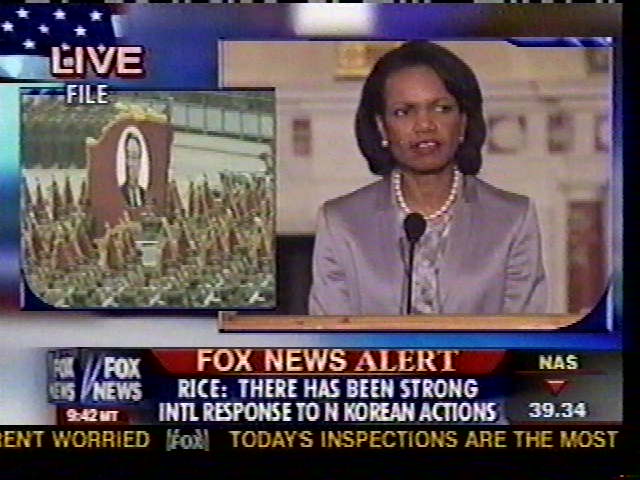
Remarks With Deputy Prime Minister Abdullah Gul After Their Meeting, Secretary Condoleezza Rice, Copyright FOX NEWSRemarks With Deputy Prime Minister Abdullah Gul After Their Meeting, Secretary Condoleezza Rice, Copyright FOX NEWS
Vidcaps FOX NEWS, From their live coverage of this event.

Remarks With Deputy Prime Minister Abdullah Gul After Their Meeting, Secretary Condoleezza Rice, Benjamin Franklin Room, Washington, DC, July 5, 2006

SECRETARY RICE: Good morning. I am very pleased to welcome my colleague, the Foreign Minister of Turkey Abdullah Gul, to Washington to the State Department. It was not very long ago that I was in Turkey and he received me there and we continue our discussions based on our tremendously strong friendship, our strategic relationship, our commitment to common values. I especially want to note for you that we will issue shortly a statement of the strategic vision for U.S.-Turkish relations. It is indeed a relationship that has a great deal to contribute to regional stability and indeed to global stability.

The Foreign Minister and I have had a brief discussion of some issues of interest, the situation in the Middle East. I have had a briefing on some of the work that the Foreign Minister has undertaken to convince Iran that this is a time to accept the international community's offer to solve this by diplomatic means. I want to say too that the Foreign Minister has been stalwart in his support for young democracies like Afghanistan and Iraq, and I thank him very much for that. So we will have further discussions over lunch and I look forward to many more opportunities, Abdullah, to be with you as Turkey is such an important and strong partner of the United States. Thank you.

DEPUTY PRIME MINISTER GUL: Good morning. I'm really pleased to meet once again my friend Secretary of State Dr. Rice shortly after her visit to Turkey. Since our last meeting, we had several talks over the phone and exchanged views. We will continue our discussions over lunch, as she just said, and we will have the opportunity to talk further about bilateral, regional and international matters of common concern, including Iraq, Iran, combating the PKK, recent developments in the Middle East, Cyprus and energy issues. The result of our joint efforts on Baku-Tblisi-Ceyhan will be integrated on 13 July in Ceyhan and we hope to see a representative from the United States over there. During our talks, I expressed our gratitude for the support given by the U.S. to matters that are important for Turkey. I also emphasized my strong belief and hope that this support will continue to strengthen.

Our discussions have reaffirmed that our deep-rooted alliances is well grounded. It's based on strategic partnership, cooperation and mutual trust. We have once more confirmed our common desire to advance this relationship, which is based on universal values such as democracy, respect for human rights, the rule of law and principle of market economy.

I am very happy to announce here today with Dr. Rice that we have finalized a shared vision document, which we had agreed to work on during her last visit to Turkey. This shared vision document will enable our countries to conduct closer intensive consultations on many levels. It will provide for a structured dialogue that will enable us to address more effectively the issues of bilateral, regional and international concern.

This document is not an action plan; therefore, it does not contain details on various issues. The shared vision document sets a broad agenda between the two countries and launches a process of intensive dialogue on different levels.

To summarize our contacts, I've said that we have seen once again that our relations are indeed based on mutual trust, hence moving on within a constructive agenda. Thank you.

MR. MCCORMACK: The first question for Anne Gearan from AP.

QUESTION: Madame Secretary, what do you think is the motivation for North Korea to launch the missiles it launched yesterday? Are they trying to get the U.S.'s attention? Does this mean the six-party talks are dead? And going forward, what can you really do to punish or coerce a regime that is as impoverished and isolated as North Korea already is?

SECRETARY RICE: Thank you. First of all, I can't really judge the motivations of the North Korean regime. I wouldn't begin to try. But I will note the effect that their actions are having and the effect is that they are being throughout the world, of course in the region, but also at NATO, we've had expressions from countries all over the world of concern about this provocation that the North Koreans have engaged in. Concern that I think is being expressed now in the Security Council. I believe a meeting is going on as we speak. And it simply demonstrates that the North Koreans, if they may have -- perhaps have miscalculated that the international community would remain united. But in fact there has been a very strong response to their actions. So whatever their motivations, whatever they thought they were doing, they've gotten a very strong reaction from the international community.

As to the six-party talks, what the six-party talks provide is now a diplomatic infrastructure that can be used to resolve problems of this kind and it would still be incumbent on the North Koreans to use that kind of infrastructure to address these issues. I might note that Chris Hill will soon be talking with his counterparts from the six-party talks in the region. And that simply demonstrates that the wisdom of the six-party framework is that it is now not a matter of the United States and North Korea; it is really a matter of the region saying to North Korea that it has to change its behavior.

As to what steps will be taken to reverse North Korean behavior, to address the nuclear issue and the missile issue, that's what we're going to be talking about over the next couple of days. But of course, the international community does have at its disposal a number of tools to make it more difficult for North Korea to engage in this kind of brinksmanship and to engage in the continued pursuit of its nuclear weapons programs and of its missile programs.

QUESTION: Why do the United States and Turkey need a strategic region document? Why now and what's the importance of this document for both countries? And Turkey has expressed its concerns about the PKK terror in northern Iraq. Will the United States do more on this matter?

DEPUTY PRIME MINISTER GUL: Turkish-American relations have a long history and also we have common grounds, common visions and democratic developments and market economy and we are both interested in about events in the region and international, so we wanted to put all of our visions, all our shared values, our alliance into a paper and share with others.

SECRETARY RICE: And I would just add that sometimes it's very important to step back from the day-to-day issues and to look at the broad relationship and to remind ourselves and to remind our populations that this is a relationship that is broad and deep, and based on values and based on strategic interests, and that's really what this document allows us to do.

As to the PKK, which the United States does declare as a terrorist organization, we will work very actively with Turkey and also with the new Iraqi Government to deal with this problem because, as I have said before and as I said when I was in Turkey, no one wants the PKK to be able to operate, to carry out terrorist attacks against Turkey anywhere, but most especially from northern Iraq.

MR. MCCORMACK: The next question, Elise Labott from CNN.

QUESTION: Thank you. Madame Secretary, you and your partners in the P-5+1 process gave Iran today as a deadline to answer your offer of an incentives or disincentives package, and that deadline has passed. Is Iran stringing the international community along here? What makes you think that they might answer by your July 12th meeting of the foreign ministers? And if they don't, will next steps be considered at that point? Thank you.

SECRETARY RICE: Well, Elise, we gave -- what was to happen today was there was to be a meeting of the Iranians with the -- with High Representative Solana. We will see what takes place over the next couple of days. But if indeed Iran is trying to stall, it's not going to work. The international community has said that we need to get an answer, an indication of where Iran is going with this. We need to know if the path of negotiation is open or not. It is really incumbent on Iran now to take what is a very good and respond to it.

And so I will, in fact, be talking to my colleagues a little bit later today, but I can assure you that we still intend to have a substantive response from Iran before the middle of July when the heads of state will meet in St. Petersburg. It simply makes sense for the world to have some kind of indication of whether Iran intends to pursue the negotiated track or not.

QUESTION: Secretary Rice, Turkey has sent a message to Syrian leader Assad concerning the rising conflict, rising tension in between Israel and Palestine. Within this context, have you received a response or message from Assad through Turkey, through Minister Gul? And how do you evaluate Turkey's role in order to calm down the tension of Iran and Middle East? Thank you.

SECRETARY RICE: Thank you. Well, I want to thank -- did thank -- the Turkish Foreign Minister for responsively -- responsive to the desires of the governments in the region, the United States, to say to the Syrians as directly as possible that there are many countries that believe that Syria has a lot of leverage that it could use to get the release of this Israeli soldier, that they really ought to do it and they ought to do it now, because this is how this conflict started. Let's remember that this began with a tunneling into Israeli territory, the abduction of an Israeli soldier. That release needs to take place and we need to get back on ground where we can pursue a more hopeful future for the Palestinian people and for the Israeli people. But really, what Turkey did that was very helpful is to go to Damascus and to say to the Syrians that they need to use all of their leverage to help this take place.

Now, the situation in Gaza is indeed a tense one. We are continuing to exercise -- are continuing to call upon the Israelis to exercise restraint. I would note that there were enormous numbers of Qassam rockets that were falling on Israeli territory yesterday, and so it would also be incumbent and helpful if there is pressure on Hamas to stop those attacks.

We are also calling on the international community to help Prime Minister -- President Abbas, and I think that is helping -- is happening, but most especially to help the Palestinian people. We are trying to keep the crossings open so that the humanitarian assistance can get into the Palestinian people. We are trying to do what we can to help to get their electricity back on and the like because we don't want to see the Palestinian people suffer.

But their government, Hamas government, needs to respond to root cause of this problem, and the root cause of this problem was the attack that took place and the Israeli soldier that was abducted. It is high time for Hamas to return that soldier. It is high time then for everybody who has any influence on Hamas to make sure that that happens, and then we can get back on track.

Thank you.

DEPUTY PRIME MINISTER GUL: Thank you.

2006/651, Released on July 5, 2006

Related: Keywords State Department,Monday, June 26, 2006 Secretary Rice With Foreign Affairs Minister of Poland, VIDEO, PODCAST, TEXT, Monday, June 19, 2006 Secretary Condoleezza Rice, Foreign Minister Miguel Angel Moratinos, VIDEO, PODCAST, TEXT, Monday, June 19, 2006 Robert Zoellick Announces Departure VIDEO, PODCAST, TEXT, Friday, June 02, 2006 R. Nicholas Burns, Remarks in Vienna, Austria, Wednesday, May 31, 2006 Iran Statement by Condoleezza Rice (VIDEO), Thursday, May 18, 2006 Secretary Rice With Prime Minister John Howard (PODCAST), Wednesday, May 10, 2006 Secretary Rice, EU Secretary General Javier Solana on Iran, VIDEO, PODCAST, TEXT, Wednesday, May 03, 2006 Secretary Rice, James Wolfensohn, Gaza Disengagement (PODCAST), Thursday, April 27, 2006 Remarks at Stakeout Secretary Condoleezza Rice, Friday, April 21, 2006 Secretary Rice to Travel to Europe, Friday, April 21, 2006 The Face of the State Department (VIDEO), Thursday, April 13, 2006 Secretary Rice Holds Talks with Equatorial Guinean President, Tuesday, April 11, 2006 State Department Podcast, VIDEO and Text 04/10/06, Wednesday, April 05, 2006 State Department Podcast, VIDEO and Text 04/03/06, Thursday, March 30, 2006 State Department Podcast, VIDEO and Text 03/29/06, Monday, April 03, 2006 Secretary Rice With Foreign Secretary Straw, Baghdad, Friday, March 31, 2006 Rice in Berlin To Discuss Iran with P-5 plus 1, Friday, March 31, 2006 UNHCR Worker’s Death in Sudan Attack,