Technorati Tags: President Bush and Transportation Security Administration or Alberto R. Gonzales and Attorney General, or Homeland Security Secretary Michael Chertoff and FBI Director Robert Mueller, or FBI Building, and liquid explosives, or TSA Kip Hawley, and MI-5 or terror plot in Britain
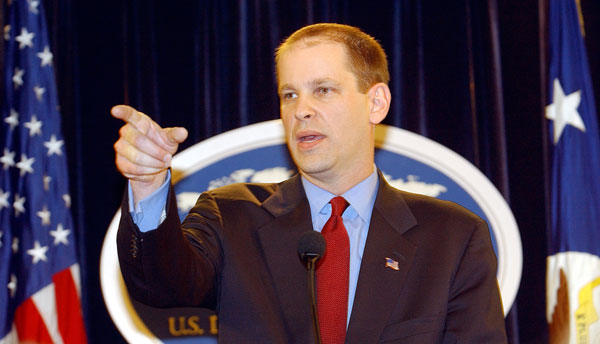
 | Remarks by Homeland Security Secretary Michael Chertoff, United States Attorney, General Alberto Gonzales, FBI Director Robert Mueller and Assistant Secretary for TSA Kip Hawley, FULL STREAMING VIDEO Secretary Chertoff and Attorney General Alberto Gonzales (DHS Photo/Bahler), |
Secretary Chertoff: Good morning. We'd like to provide you with the latest information that we have on recent events in the United Kingdom, and an update on the actions that we are taking to protect our citizens and to keep air travel safe and secure. We want to be as open as possible with the public about the facts; at the same time, it's important, I'm sure you'll understand, that we preserve confidentiality of matters that are necessary in order to complete this investigation. And we also have to respect the demands of the British legal process, which puts certain restrictions on what can be said about ongoing cases.
As I think you're all aware, British authorities have arrested 21 individuals who are now in custody who are alleged to have engaged in a plot to detonate liquid explosives on board multiple commercial aircraft departing from the United Kingdom and bound for the United States. This plot appears to have been well planned and well advanced, with a significant number of operatives. The terrorists planned to carry the components of the bombs, including liquid explosive ingredients and detonating devices disguised as beverages, electronic devices, or other common objects.
While this operation was centered in Great Britain, it was sophisticated, it had a lot of members, and it was international in scope. This operation is, in some respects, suggestive of an al Qaeda plot, but because the investigation is still underway, we cannot yet form a definitive conclusion. We're going to wait until all the facts are in.
We believe that the arrests in Britain have significantly disrupted this major threat. But we cannot assume that the threat has been completely thwarted, or that we have fully identified and neutralized every member of this terrorist network.
There is currently no indication of any plotting within the United States; nevertheless, as a precaution, the federal government is taking immediate steps to increase security measures, with respect to aviation.
First of all, the United States government has raised the nation's threat level to our highest level of alert -- Severe, or Red -- for commercial flights originating in the United Kingdom and bound for the United States. We've made this adjustment to coordinate our alert level with that currently enforced in Britain. In Britain, as you've heard, they are now operating as their highest level, which is called Critical.
Second, as a precaution against any members of the plot who may still be at large, and recognizing the fact that we still have yet to take the investigation to its conclusion, we want to make sure that there are no remaining threats out there, and we also want to take steps to prevent any would-be copycats who may be inspired to similar conduct. Accordingly we are raising the threat level, or we have raised the threat level, with respect to aviation in general, to High, or Orange. That will cover all in-bound international flights, other than flights from Great Britain, and it will cover all flights within the United States itself.
We're taking some additional specific steps. In light of the nature of the liquid explosive devices which were designed by the plotters, we are temporarily banning all liquids in carry-ons in aircraft cabins. That means no liquids or gels will be allowed in carry-on baggage. Any liquids or gels have to be checked have to be checked as part of baggage to go into the hold. There will be exceptions for baby formula and medicines, but travelers must be prepared to present these items for inspection at the checkpoint, and that will allow us to take a look at them and make sure that they're safe to fly.
We are taking this step of preventing liquids from getting into the cabin to give us time to make adjustments in our current screening tactics, based upon what we learn from this investigation concerning the nature of the devices that these individuals were constructing.
We might also add that in order to expedite and ease the process of going through this new screening regime, travelers would be wise to pack as lightly as possible for their carry-on, and to minimize clutter so that we can make the process go more quickly.
Additionally, the Transportation Security Administration will be implementing a series of additional security measures, some of them visible and some of them not visible, to ensure the security of the traveling public and the nation's transportation system.
TSA is immediately implementing these changes to airport screening, including the prohibition against liquids and gels of any kind in carry-on baggage. And apart from these other measures, federal air marshals are being sent to the United Kingdom to provide expanded mission coverage for flights between the United Kingdom and the United States.
United States Customs and Border Protection will be increasing enforcement efforts in the international arrival areas, including the use of advanced targeting tools; special response teams, including baggage and aircraft search teams; baggage x-ray equipment; specially trained canine units; and explosive detection technology. These measures, again, will be constantly evaluated and updated as circumstances warrant.
Now, we recognize these measures are going to be inconvenient. But they are proportionate to the very real threat to the lives of innocent people that was posed by this plot. And what is important here is that we are taking every prudent step to thwart new tactics of terror. Today, air traffic is safe. And air traffic will remain safe precisely because of the measures we are adopting today. People should be patient, but they need not cancel their travel plans. They simply need to be aware there may be some delays and they may want to check with their carriers to see whether they ought to adjust their arrival times at airports.
As always, we ask the American public to remain aware and vigilant, and report any activity that they think is suspicious to local authorities or other appropriate law enforcement agencies.
The work in this investigation has been a remarkable example of interagency coordination in the federal government. We've had numerous intelligence components and law enforcement components working together seamlessly in a coordinated fashion to address this emerging threat and to take the steps necessary to protect the American public from it. I also have to give special thanks to our partners, the British government. They have been terrific, in terms of close information sharing and close coordination, recognizing that both countries, which are bound together with great common feelings of culture, are also, unfortunately, bound together by being targeted through terror. But because of the close working relationship between the British government and the U.S. government, we have managed to make sure that the people of both countries and the people of the world are safer.
The American public can be assured that the United States government will continue to do everything in its power, under the leadership of President Bush, and in cooperation with our British and other allies, to defend our nations and our world. We will continue to provide updates throughout the day and the next few days, as appropriate.
And now I'd like to turn to Attorney General Gonzales.
Attorney General Gonzales: Thank you, Michael. Let me begin by repeating and emphasizing something that Secretary Chertoff said, and that is, we have a very serious investigation that is proceeding in the United Kingdom. And we want to be very, very careful, as we try to inform and educate the American public, about saying too much that might, in any way, jeopardize that investigation or subsequent prosecution. And so we ask for your patience in asking and receiving information. We'll try to be as forthcoming as we can, as quickly as we can. But again, we don't want to do anything that may, in any way, jeopardize or adversely affect an investigation or prosecution in the United Kingdom, or perhaps even in this country.
Now, since 9/11, the threat reporting has consistently shown that there is a vicious and determined enemy that is intent on harming American lives. And every day is September 12th for those of us tasked with protecting America. And we know that our counterparts abroad feel the same way.
Today's announcement is a true testament to the hundreds of hours of patient work by British authorities. Their vigilance has led to the unraveling of this deadly plot by terror cells based in the U.K. -- a plot, as Mike indicated, designed to detonate bombs aboard commercial airliners en route to the United States, potentially killing hundreds of innocent people. On behalf of the American people, I want to thank the British authorities for their tremendous efforts to disrupt this deadly scheme.
Although the law enforcement investigation is ongoing, I want to update you on the preliminary information that we have available at this time. We will, as Secretary Chertoff indicated, continue to provide additional information as it becomes available. The perpetrators who were arrested overnight were extremists who had gone beyond just stating a desire to kill Americans. Their plotting turned to action as they took several steps to carry out their deadly plan. Their focus appears to have been on the use of liquid explosives.
We are still assessing the links to al Qaeda. However, a plot of this sophistication is suggested of al Qaeda tactics, as Secretary Chertoff mentioned.
From the beginning of the investigation, we have been in constant contact with our counterparts in the U.K. We share the same philosophy of prevention, a sense of urgency to dismantle these terrorist cells before an attack occurs. The FBI and other law enforcement intelligence agencies have worked closely with our colleagues at MI-5 on all aspects of this case, and they have aggressively pursued every domestic lead that has arisen from the intelligence that led to these arrests.
As Secretary Chertoff said, while there is currently no indication of any plotting within the United States, the federal government is taking immediate steps to increase security measures in the aviation sector. The FBI, the Department of Homeland Security and the entire intelligence community will continue to aggressively pursue every lead and shred of intelligence that arises from this or any other terrorism case. This has been our practice since 9/11. And today is no different from any other day, in that sense.
The American people should know that everything that can be done to protect them is being done by law enforcement and intelligence professionals around the country and abroad. We ask that people continue on with their normal lives, but with some extra patience as the professionals do their jobs, especially at the airports around the country.
As we have stated many times before, we are a nation at war. Today's actions are a stark reminder that the threat is real and that we have a deadly enemy who still wakes every morning thinking of new ways to kill innocent men, women and children, and dreams every night about wreaking the destruction on freedom-loving countries.
Our enemies should know that we are just as equally intent on stopping them. We will continue to work around the clock with our colleagues around the world to dismantle their operations one person at a time.
Assistant Secretary Hawley: First, I'd like to thank the traveling public and our partners at the airports and airlines, law enforcement and our own transportation security officers and all the people involved in this change-over. It normally takes us about four weeks to roll out a change at a security checkpoint, and this one came about in a little bit more than four hours in the middle of last night. And so this was a surprise to many of us, and as such is difficult to implement. And I think we are going to see over the next day or two as the public becomes aware and we all get used to the process that it is going to get better, but in the next couple of days, we ask for your patience, and we thank you for your understanding.
This was strong and immediate action, and it was cooperative with -- among airlines, airports, law enforcement to do much more than you can see at the checkpoint. These changes sound complicated, but it is very, very simple. The major change is that passengers are no longer allowed to bring liquids through the checkpoint and onto the plane. That is the big change. Other than that, it is getting used to the new process. And we're very confident that as time goes one, that will occur.
A couple of pointers: de-clutter your bag. If you let the TSOs have a clear view of what's in the bag with their x-ray, you'll move right on through. That is something very easy to do as you pack your bag -- leave the liquids at home, drink them, de-clutter your bag.
And last, I'd say enjoy your trip. I think this is what TSA was created for -- to be flexible, to work with others in the community, to scale up security where needed in certain areas and be flexible and adjustable. And we look forward to delivering on that commitment.
Secretary Chertoff: Let me just echo that. It does seem a little odd maybe to hear somebody say enjoy your trip, but the whole point of this exercise is to continue to maintain the level of safety and security in air travel in this country that we have had since September 11th. Now, sometimes to do that, we have to be taking steps that do cause a little bit of inconvenience. But with patience and with cooperation -- and so far I think we've seen that from the traveling public -- what we will deliver to the public is the thing which is most important, which is the ability get on the plane, get about your business or enjoy your holiday and do so with confidence that we are searching out people who want to do harm to innocent travelers.
Let me just introduce everybody else up here, and then we'll take some questions in various people's area of expertise. We have Marian Blakey, who is the head of the Federal Aviation Administration; you know Bob Mueller, the Director of the FBI; and Scott Redd, who is the head of the NCTC. So with that, if you'll raise your hands, and I'll direct questions.
Yes, Pete.
Question: Mr. Secretary, you talked about the design of the devices by the plotters. Can you say whether they went beyond the design stage and had actually built their devices? And can you say whether they had made reservations, bought tickets? How far along were they?
Secretary Chertoff: I would say that this plot was well advanced. In other words, they had accumulated and assembled the capabilities that they needed, and they were in the final stages of planning before execution. I don't want to get very specific for investigative reasons about each individual step. But this is not a case where this was just in the initial thought stage. There were very concrete steps underway to execute all elements of this plan.
Question: So they had built the bombs?
Secretary Chertoff: I'm not going to get that specific because I'm going to honor that original observation I made about not compromising the British case or the investigation, but they had accumulated the capabilities necessary and they were well on the way. This was a well advanced plan.
Yes.
Question: Secretary Chertoff, you praised British authorities. What do you know about when they learned about this plot? And when did they inform the United States?
Secretary Chertoff: Let me -- again, I'm going to be a little bit circumspect and say that some of the threads which led to this investigation have been pursued by British authorities for a considerable period of time. However, it is only recently -- certainly within the last two weeks, maybe less -- that the investigation revealed that this planning was taking the direction of targeting the United States. And so in that much more recent period of time, we've obviously become much more involved from the United States' standpoint and been working much more closely with the British to follow what appeared to be an accelerating plan to carry out a very, very serious terrorist act.
Yes.
Question: I wonder if we could talk about the upcoming anniversary of 9/11, and whether this was in any way related to that? Was that a possible target date? And if not, can you say anything about when this plot would have come to fruition? And speaking of 9/11, can you compare this plot with that one in terms of scope -- the number of airlines, the number of planes, the number of potential victims and so forth?
Secretary Chertoff: That's about five questions. We're all obviously mindful about September 11th. I can't tell you that that was a particular date that was in the mind of the people involved in this plot, nor can I tell you that they would have waited that long. I think we were really getting quite close to the execution phase. I can tell you our general experience, certainly when you deal with al Qaeda -- and again I want to caution that we've not yet concluded this is al Qaeda -- but our general experience is that they're not necessarily motivated by anniversaries the way sometimes people project.
In terms of seriousness, it's obviously hard to compare a plot that was frustrated, thank God, with a plot that was unfortunately executed. It is reminiscent -- but again, I don't want to overdraw the comparison -- with a plot that was hatched by Khalid Shaykh Muhammad in the 1990s, in which he envisioned detonating bombs on I think it was 11 airliners, many of them traveling over the Pacific. And that's been well publicized, so that's obviously a known historical fact.
Yes.
Question: Mr. Secretary, maybe you -- Mr. Mueller or Mr. Redd might answer this -- if this isn't an al Qaeda footprint, is there any evidence that leads you to believe that there is -- there are other organizations with the capability to do something like this?
Director Mueller: Well, this had the earmarks of an al Qaeda plot. As the Attorney General and Secretary Chertoff have said, we have no indication at this point in time of plotting within the United States aligned at all, or at all intersecting the plotters in the U.K. But that does not mean that there are not others around the world that have the same aspirations and would undertake the same type of plotting.
Question: You mentioned the 11 planes in that -- in the KSM plot -- do you know how many planes were actually targeted in this plot? And can you give us the airlines that were targeted, as well?
Secretary Chertoff: Again, the investigation is still at a relatively early phase. The British are conducting the investigation. I don't feel that we can confidently give you a number. Clearly what was envisioned were multiple explosions in multiple aircraft. But I think it would be speculative for us to come up with a number -- to fix a number onto that.
Question: Can you name the airlines, at all?
Secretary Chertoff: What I prefer to say is this: It's clear that they were searching to look at possible options, in terms of scheduled passenger airline flights. It does appear that towards the end, shortly before we brought this down, they had focused on a number of airlines involved, which have specific routes between Britain and the United States, and which are U.S.-flagged carriers. We have talked to the airlines in question. In fact, we've talked to all the airlines that operate internationally and domestically because we want to make sure that everyone is fully aware of what the dimensions of this planning was. And I can tell you the airlines have been very, very deeply committed to working with us to elevate the level of security to protect their passengers.
Beverly.
Question: Mr. Secretary, there is so much emphasis here on liquids. Was the fear that they were planning actually to assemble a bomb on board the aircraft by mixing liquids?
Secretary Chertoff: I would say certainly one of the considerations or one of the concerns we had is the possibility of bringing on board a number of different components of a bomb, each one of which would be benign, but when mixed together would create a bomb. And as we assess exactly what the design of these devices was or the plan design was, I think it will give us a better ability to tailor our countermeasures in order to pick up what appears to be a quite sophisticated conception of how to execute a terrorist bombing plot.
Yes.
Question: Regardless of whether this does turn out to be al Qaeda or not, could you talk about the suspects in Britain, and whether those people were homegrown folks who -- are British citizens or from Britain, as opposed to people who came from elsewhere and moved there?
Secretary Chertoff: Yes, I think we're going to let -- this is really a sensitive area for the British legal system. I think we're going to let them discuss the nature of the defendants. But I do think a point that's very important is this: This was a very sophisticated plan and operation. This is not a circumstance where you had a handful of people sitting around coming up with dreamy ideas about terrorist plots. The conception, the large number of people involved, the sophisticated design of the devices that were being considered, and the sophisticated nature of the plan all suggests that this group that came together to conspire was very determined and very skilled and very capable.
And the reason I emphasize that is become we are taking some very serious and inconvenient measures, and I think the public is entitled to understand we're doing this because we recognize this was a plot that is certainly about as sophisticated as any we've seen in recent years, as far as terrorism is concerned.
Question: When the threat alert system was created, the Red level was supposed to indicate an imminent threat. Do you believe that there's an imminent threat against the United States at this point? If not, why didn't we just go to code Orange like we did a year ago? And from your viewpoint, what's the difference in operational levels between Red level and Orange level?
Also, a quick follow-up. Are there any concerns about threats against any other modes of transportation in the United States?
Secretary Chertoff: What we tried to do this year, as we did last year with July 7th was to be as precise and sculpted as we could reasonably be, in terms of the alert level. We did go to Orange in the aviation system domestically and every place outside of flights from Britain to the U.S. precisely because we have no specific indication of a threat in those channels of air travel. But given what we don't know, and given the possibility of copycats, we thought it prudent to raise the alert level generally in aviation. We don't believe that logic extends to raising it generally in the country.
Now, as far as Red, the British made a determination -- and obviously they are in the best position, given their knowledge of what's going on in their investigation -- that even with the 21 arrests, it is still prudent to consider the likelihood of attack at being at the highest possible level for travel from Britain to the United States. And I think that, based in significant part, certainly, on that judgment, and with our own assessment, that seemed a prudent step to take with respect to this fairly defined subset of air travel, which was, after all, the objective of a sophisticated plot.
Question: So, in other words, there's no evidence right now to indicate that there's going to be an imminent attack on the United States?
Secretary Chertoff: I would say that with respect to travel from the U.K. to the United States, given the fact that the arrest activities in Britain are still underway, prudence suggests that we treat that particular route of travel -- U.K. to the U.S. -- as being at the highest level of being under threat.
Apart from that, we're certainly at a heightened alert-level elsewhere, but we don't have any specific reason to believe that there is a threat to other routes of air travel. But, again, we always have to be careful that -- we don't necessarily know everything. We're going to learn a lot more in the course of the investigation, and I would rather have more protection and then scale it back as we become more reassured than underestimate the problem and find out, God forbid, that we have made a tragic mistake.
Yes.
Question: Mr. Secretary, because you said the substances were benign, is there any type of detection device that we have or could be created to detect these liquid explosives?
Secretary Chertoff: Well, here's where I'm going to resist the temptation to give a recipe to terrorists about how to try to maximize their ability to succeed. Obviously, we're always assessing and examining the challenge posed by different kinds of improvised explosive devices. We do use various kinds of techniques for different kinds of bomb-making, but when we do see a sophisticated design, we want to make sure that we have properly engineered our countermeasures to be able to detect it.
And so while we're in the process of assessing that -- and, you know, honestly, some of these are pretty difficult -- we want to, frankly, take the most protective stance, and that's why we have, for the time being, excluded liquids from the cabin.
Yes, in the back.
Question: Yes, are the air marshals just going to Britain for flights coming this way, or are they going to other European cities, as well?
Secretary Chertoff: Well, we have air marshals all over the world. We're going to continue to have air marshals operate in the system, but we will be focusing, at least in the short term, on putting extra air marshal resources in this particular route because we know this was the focal point of the conspiracy that is in the process of being disrupted.
Question: Mr. Secretary, just back to the Red versus Orange -- the Red would seem to indicate that you or the British authorities believe that some of the people involved are still at large. Is that the case? Or is this just precautionary?
Secretary Chertoff: I think it's a recognition of the fact that, particularly at this stage of the arrest and the takedown, there is sufficient uncertainty about whether the British have scooped up everybody -- that we do think it's prudent to regard this particular target, this particular route, as still being at the highest level of risk. It doesn't mean that we know for a fact there are people out there who are still active, but as anybody who's been involved in these investigations knows, we're going to learn more things, and the British are going to learn more things in the next hours and days.
And given the amount of planning and effort that was put into this plot, I think it would be a little bit risky to assume that everything is shut down and the threat has gone away. So, you know, we spent a lot of time thinking about this. We certainly put a great deal of weight on the views taken by the British because it is, after all, their investigation. Principally it is their -- the folks who are on the ground, and certainly when they express a concern that prudence requires the highest level of protection and the highest level of concern for this particular route, I think we're well advised to give a lot of weight to that. ###
Related Information: Statement by Homeland Security Secretary Michael Chertoff Announcing a Change to the Nation’s Threat Level for the Aviation Sector, August 10, 2006, Fact Sheet: Guidance For Airline Passengers, August 10, 2006
RELATED: Keywords, Alberto R. Gonzales, Friday, June 23, 2006 Seven Florida Men Charged with Conspiring to Support al Qaeda (VIDEO), Thursday, April 27, 2006 Operation Falcon II (VIDEO), Thursday, January 26, 2006 Gonzales to Lead U.S. Delegation to Honduras Inauguration, Wednesday, January 04, 2006 Jack Abramoff Press Release and VIDEO, Wednesday, November 23, 2005 Attorney General Gonzales on Jose Padilla (VIDEO), Wednesday, July 06, 2005 ATTORNEY GENERAL GONZALES TRAVELS TO BAGHDAD, Sunday, April 24, 2005 DRAM CONSPIRACY, Monday, April 18, 2005 Operation FALCON, Friday, March 11, 2005 ALBERTO R. GONZALES ON THE AL-MOAYAD AND ZAYED CONVICTIONS, Friday, February 25, 2005 Alberto R. Gonzales priorities of Justice, Friday, February 04, 2005 Confirmation Alberto R. Gonzales Attorney General, Wednesday, January 05, 2005 Judiciary Committee Alberto R. Gonzales, Wednesday, November 10, 2004 The Honorable Alberto R. Gonzales,