


President Honors and Congratulates EPA Administrator Steve Johnson, Environmental Protection Agency Washington, D.C. 1:48 P.M. EDT
THE PRESIDENT: Good afternoon. I'm proud to visit the headquarters of the Environmental Protection Agency. (Applause.) I am honored to be here to congratulate Steve Johnson on becoming America's 11th EPA Administrator. Congratulations. (Applause.) It is good to be up here with Debbie, your wonderful family, as well as your dad, Bill.
I'm sorry that Laura couldn't join us, but today she's been touring the Egyptian desert. (Laughter.) She tells me that if you take away the pyramids, it just looks like West Texas. (Laughter.)
I want to thank Secretary of Transportation Norm Mineta for joining us. I want to thank the former EPA Administrator, the former governor of New Jersey, Christie Todd Whitman, for coming today. (Applause.) I thank Congressman Charlie Taylor of North Carolina for joining us today. Congressman, I'm proud you're here. He happens to be the Chairman of the Appropriations Subcommittee on the Interior, Environment, and Related Agencies. Welcome. (Applause.)
My administration is fulfilling our responsibility to be good stewards of the Earth. Today, America's air, land and water are cleaner than they were in 2001. We've reduced air pollution by more than 10 percent. We put in place clean diesel rules that will cut emissions from heavy-duty vehicles by more than 90 percent over 10 years. We've restored nearly 1,200 abandoned industrial sites to productive use. We've worked to pass the Healthy Forest Restoration Act, to protect forests and wildlife and homeowners against catastrophic fires. We've substantially increased funding to improve water quality in the Great Lakes.
Our policies are protecting the environment while also promoting growth. And I want to thank each employee of this agency for helping make this progress possible. (Applause.)
Steve Johnson is the right man to build on this progress. He has 24 years of experience here at the EPA. He is the first career EPA employee to hold the office of Administrator. (Applause.) Steve is also the first professional scientist to lead the agency. With this background, Steve will help us continue to place sound scientific analysis at the heart of all major environmental decisions.
The EPA recently finalized a rule that places the first-ever national cap on mercury emissions from power plants, which will result in a nearly 70-percent decrease in these emissions. And we issued the Clean Air Interstate rule to reduce air pollution from power plants by 70 percent. These rules are a good start, but they are not a substitute for effective legislation. So one of Steve's first tasks -- and I look forward to joining you on this task -- to further reduce air pollution is to work with Congress to pass the Clear Skies legislation. (Applause.) Clear Skies is a common-sense, pro-environment, pro-jobs initiative. And Congress needs to pass the bill this year. (Applause.)
Steve will also build on EPA's work to improve the quality and security of our drinking water. We're enforcing strict standards to bring cleaner water to communities across our country. The budget I submitted this year to Congress includes a $44-million pilot program to develop tools to better monitor urban water systems so we can detect contamination as quickly as possible. The budget also increases support for EPA homeland security programs by more than 70 percent next year. Under Steve's leadership, we will work to ensure that every American community continues to have a water supply that is clean and is safe.
We must build on our progress and the conservation and protection of our wetlands, soil, and wildlife habitats. On Earth Day last year, I announced a new goal to restore, improve and protect at least 3 million acres of wetlands by 2009. After one year, we've already enhanced over 800,000 acres of wetlands. And that puts us on a pace to meet our goal.
And finally, we will continue our enforcement strategy which focuses on achieving real environmental improvements that benefit everyone. Since 2001, the EPA has increased compliance inspections by 19 percent, and civil investigations by 24 percent. And last year, the agency provided compliance assistance to over 730,000 individuals and businesses.
Our strategy is working. Last year we obtained commitments to reduce future pollution by an estimated 1 billion pounds, an increase of 50 percent over the 2001 level. And I want to thank all the EPA employees who work in the field to work on this collaborative effort.
Steve leads -- as Steve leads the EPA, he will maintain our common-sense approach of collaborating with leaders and volunteers at the local level to find the best solutions to meet our national goals. We'll continue to vigorously enforce our environmental laws. We'll encourage good stewardship of natural resources, and we will focus on results. We'll continue to protect the health of our citizens, and help guarantee the quality of our air, water and land for generations to come.
I'm looking forward to working with this good man as he leads this important agency. Steve, congratulations. God bless.
MR. JOHNSON: Thank you, sir. Thank you very much. (Applause.)
Mr. President, members of the Cabinet, Chairman Taylor, my family, friends and distinguished colleagues: I welcome you to EPA Headquarters. Mr. President, you are the first President to visit EPA Headquarters here at Ariel Rios. Your visit today highlights to the nation and to the world the importance of protecting our environment.
As a career scientist, I spent the majority of my adult life working side-by-side with the world's experts in the field of environmental protection. Today, I am proud and honored to stand side-by-side with you, Mr. President, together, reaffirming our nation's commitment to protecting public health and the environment.
As I prepared for today, I thought about how I felt when the President asked me to lead the EPA. Even after years of Latin, German, scientific training, the only word that I could think of was, "wow" -- (laughter) -- wow. (Laughter.) That's exactly how I felt then, and it's exactly how I feel today -- wow. (Laughter.)
Mr. President, I approach the task of leading the Environmental Protection Agency with great enthusiasm and profound optimism. Your selection of a career scientist to serve as Administrator has clearly demonstrated your dedication to science on which agency decisions are based.
Over the past 35 years, EPA has been a significant part of our nation's many environmental accomplishments. These experiences have taught us that sound science is the basis of our achievements and the genesis for our future successes. And that is why we're here, to accelerate environmental progress and to deliver better, more efficient results while maintaining our economic competitiveness.
When my daughters call, they ask if my grandchildren's playgrounds are safe, if their water is healthy to drink, if their houses are built on safe ground. They look to EPA to provide them with a peace of mind which comes from knowing that their children's natural environment is being watched over.
Mr. President, under your leadership, our country has made great strides in cleaning our air, water and land in a way that allows our nation to continue to grow and prosper. Today the air across our country is the cleanest it has been in three decades; our food and drinking water supplies are safer; our land is better protected.
These past successes are the solid foundation for future advancements in environmental stewardship. Just as we live in a global marketplace, we now understand that many of our environmental challenges are not confined to political or physical boundaries. By expanding the roles of technology, collaborative partnerships and flexible policies, we will be able to engage broad interests and deliver results quicker and more effectively than ever before.
None of these objectives can be achieved without the commitment of our professional staff. The success of EPA and the health of our nation's environment cannot be separated from the productivity and creativity of my colleagues. I would like to thank them for their continued hard work and devotion to our mission.
Mr. President, thank you again for this opportunity. I am humbled by the trust you have placed in me, and look forward to working together to provide the next generation a cleaner, safer environment in which to live, work and play.
Thank you very much, Mr. President.
THE PRESIDENT: Congratulations.
END 1:59 P.M. EDT For Immediate Release Office of the Press Secretary May 23, 2005
Monday, May 23, 2005
EPA Administrator Steve Johnson
0
comments
||
||

President Bush Welcomes Afghan President Karzai
President Welcomes Afghan President Karzai FULL STREAMING VIDEO to the White House The East Room President's Remarks 11:03 A.M. EDT
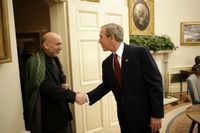 | PRESIDENT BUSH: Thank you. Welcome. Mr. President, welcome back to the White House. I am honored to stand by the first democratically-elected leader in the five-thousand year history of Afghanistan. Congratulations. |
PRESIDENT BUSH: I want to thank you for your friendship and your commitment to freedom. I especially want to thank you for being such a wonderful host to my wife, Laura. She came back overwhelmed by the experience, touched by the people she met, and optimistic about the future for your country. So thanks for being a good host and thanks for being such a fine inspiration to not only the people of your country, but showing the countries in your neighborhood what's possible.
Your leadership has been strong, and it's in our interests that Afghanistan be free. Afghanistan is no longer a safe haven for terrorists. Afghanistan is a key partner in the global war on terror. Our troops have fought and will continue to fight side-by-side to defeat the few who want to stop the ambitions of the many.
PRESIDENT KARZAI: Exactly.
PRESIDENT BUSH: Increasing numbers of low-level Taliban are getting the message that Afghanistan society is peaceful and optimistic, and I appreciate your efforts to reach out to the low-level members of the Taliban. I am impressed by the progress that you're making toward a market economy and a full-fledged democracy. One of the things that's very important, that is, a shift of opinion is taking place where now women are equal partners in society; over 40 percent of the voters in that October day were women voters; girls are now going to school; women entrepreneurs are opening businesses. The President was telling me that there's quite a number of candidates who filed for the upcoming legislative elections who are women. The model, the example being set by Afghanistan in that part of the world is an important -- important message, because you can't have a free and hopeful society unless women are full participants in the society.
And so Mr. President, thank you for your leadership. We're looking forward to watching and helping make sure these elections go forward in a peaceful -- peaceful manner. It's a -- the number of candidates that -- who have filed are -- is quite impressive. I think you maybe told me over 5,000?
PRESIDENT KARZAI: Over 5,000.
PRESIDENT BUSH: Yes, 5,000 people have filed for office. It's a -- it's a -- democracy is -- democracy is flourishing.
We spent a lot of time talking about the challenges we continue to face. Our objective is to continue to train the Afghan army so that they're capable of defeating the terrorists. However, today, it's important for the Afghan people to understand that we have a strategic vision about our relationship with Afghanistan.
I've signed a strategic partnership with the President. It's a partnership that we've been working on for quite awhile. It's a partnership that establishes regular high-level exchanges on political security and economic interests of -- economic issues of mutual interests. We will consult with Afghanistan if it perceives its territorial integrity, independence or security is at risk. We will help the Afghan people build strong, lasting government and civic institutions. We'll continue to support reconstruction, economic development and investments that will help educate and build the skills of the Afghan people.
I've got great faith in the future in Afghanistan. First, I've got great faith in the ability of democracy to provide hope. And I've got faith in this man as a leader. He has shown tremendous courage in the face of difficult odds. He's been a strong leader, he's a good friend to our country, and, Mr. President, it's my honor to welcome you back here. Congratulations.
PRESIDENT KARZAI: Thank you very much. My turn?
PRESIDENT BUSH: Your turn. (Laughter.)
PRESIDENT KARZAI: Mr. President --
PRESIDENT BUSH: Don't give these an opening, they'll jump in there at a moment's notice. (Laughter.)
PRESIDENT KARZAI: Mr. President, it's a great pleasure and privilege to be visiting the United States again, to be visiting you in the White House with the usual warmth and hospitality. I was in Boston yesterday, meeting with all the students on their commencement day. I was given an honorary degree, which was a great honor for me, and received tremendous warmth there, as well.
The United States has been the country with whose help we have rebuilt our country, are in the process of rebuilding our country. And you have been at the forefront of that effort with us in Afghanistan and in the rest of the world. I'm here today to thank you, Mr. President, once again for your leadership in providing Afghanistan the security, the reconstruction, and the freedoms that the Afghan people have today.
You cannot imagine, Mr. President, and I cannot tell you that in a few words -- there are so many words, it has to take a much longer time for me to describe to you what Afghanistan was going through three years ago. So it's difficult to say, and I'm sometimes -- rather often -- neither our press, nor your press, nor the press in the rest of the world will pick up the miseries of the Afghans three years ago and what has been achieved since then, until today. We have a constitution; we had a presidential election -- and I'm glad it turned out to be good for me. (Laughter.)
PRESIDENT BUSH: I know how you feel. (Laughter.)
PRESIDENT KARZAI: Yes, well -- (laughter.) I believe we share that feeling, yes. And we are going to have a parliamentary election in three months' time. And I just informed the President that we have, as of yesterday -- as of the day before yesterday, over 5,000 candidates for the national assembly and for the provincial assemblies. There are women from all the provinces of the country will be coming to the parliament. So the country is moving forward.
We have been talking with your officials in Afghanistan and have conveyed to you through your embassy and government the desire of the Afghan people to have a strategic partnership with America, because after the completion of the parliamentary elections, the Bonn process will come to an end. From that point onward, we would like the world to recognize that with the completion of the Bonn process and the arrival of the Afghan parliament, Afghanistan will not suddenly stand on its own feet. Politically, we will have done the process -- politically, we will have completed the process, but in terms of the institutional strength, Afghanistan will continue to need a lot of support.
And I'm glad that you signed with me today a memorandum of understanding on the long-term partnership between Afghanistan and the United States of America, which will make sure that Afghanistan continues to receive reconstruction assistance, which will make sure that Afghanistan continues to receive training from the U.S. for its military and the police, and which will enable Afghanistan to stand on its own feet eventually and be a good, active member of the region, contributing to peace and stability in the region, and be a bridge between various parts of that part of the world for trade and values.
Mr. President, I'm here today to thank you for all that you have done for Afghanistan. And we are very, very happy. We are grateful. You sent the Vice President of the United States to come and attend the inauguration in Afghanistan. It was a tremendous honor for us to receive him there, to have him there. It was the manifestation of the commitment of the United States and yourself to the Afghan people to have that day attended by the Vice President. And we are very, very happy more importantly to have had the First Lady to visit us in Afghanistan. We were thrilled. The Afghan women were thrilled. The Afghan site were thrilled. And now you guess whose turn it is now to come to Afghanistan. (Laughter.) So we'll be hoping to receive you there very soon.
PRESIDENT BUSH: Thank you for the invitation. (Laughter.)
PRESIDENT KARZAI: The country is much greener than it was in the past few years. I thank you once again for receiving us here and for the support you've given to us all along, and will continue to do so. Thank you.
PRESIDENT BUSH: Thank you, Mr. President. Of course, I don't want to correct my friend, but I must. In thanking me, you're really thanking the American people.
PRESIDENT KARZAI: Of course.
PRESIDENT BUSH: And the American people are most impressed by the progress you've made, Mr. President, and it's progress that we look forward to working with you so that you can continue to make progress. And in the spirit of free press, we'll answer a couple of questions.
PRESIDENT KARZAI: Yes, we all know that, yes. (Laughter.)
PRESIDENT BUSH: Hunt.
Q Thank you, Mr. President. Mr. President, will you give the Karzai government custody of Afghan citizens detained by the United States? And are you willing to give Afghanistan more say in U.S. military matters in their country?
And to President Karzai, did you discuss the prisoner abuse at Bagram issue with the President?
PRESIDENT BUSH: First, in terms of more say over our military, our relationship is one of cooperate and consult. Of course our troops will respond to U.S. commanders, but our U.S. commanders and our diplomatic mission there is in a consultative relationship with the government. It's a free society. There is a democratically-elected government. They've invited us in, and we'll consult with them in terms of how to achieve mutual goals, and that is to rout out the remnants of al Qaeda, to deal with those folks who would come and like to create harm to U.S. citizens and/or Afghan citizens.
I must say, the Afghan military is making great progress. It hadn't been all that long ago that we started a training mission. Now there's over 25,000 troops who are trained and ready to fight, and they take the fight to these thugs that are coming across the border to create havoc. And we've got another, I think, 22,000 to train to get this army fully stood up. Our mission in Afghanistan and Iraq is the same. I mean, we want these new democracies to be able to defend themselves. And so we will continue to work with the Afghans to train them and to cooperate and consult with the government.
The other aspect of the question?
Q The prisoners who --
PRESIDENT BUSH: Oh, the prisoners, yes. Our policy, as you know, has been to work our way through those who are being held in Guantanamo and send them back to the host countries, and we will do so over time, with the Afghan government. Part of the issue is to make sure there is a place where the prisoners can be held. As I explained to the President, that our policy is one where we want the people to be sent home, but, two, we've got to make sure the facilities are there -- facilities where these people can be housed and fed and guarded.
Now, you asked about the prison -- yes, he did bring up the prison abuse.
PRESIDENT KARZAI: On the question of the prisoner abuse, we are, of course, sad about that. But let me make sure that you all know that that does not reflect on the American people.
Right now in Afghanistan there is an Italian lady that has been kidnapped by an Afghan man -- while there are hundreds of Afghan women demonstrating outside in the streets of Kabul demanding the release of that woman, the Italian lady. So the prisoner abuse thing is not at all a thing that we attribute to anybody else but those individuals. The Afghan people are grateful, very, very much to the American people. They recognize that individual acts do not reflect either on governments or on societies. These things happen everywhere. As we are sad, we recognize that the American people, kind as they are to Afghanistan, have nothing to do with that.
And I'm glad to tell you that I was reading today somewhere that one of those persons has been given a sentence of prison for three months and removed from his job, and that's a good thing. We -- I must repeat strongly -- are fully aware of the tremendously good values of the American people and of their kind attitude toward us and others in this world.
Thank you.
PRESIDENT BUSH: Somebody from the Afghan press?
PRESIDENT KARZAI: Anybody from the Afghan press? Do we have an Afghan press? Oh, here he is. (Laughter.)
Q (As translated.) This question is for President Bush, question was: Besides security and military assistance, Afghanistan needs more economic assistance. How can the U.S. assist more in building the economic infrastructure of Afghanistan?
PRESIDENT BUSH: Right. As you know, we cooperated early with Japan and Saudi Arabia in helping them build a very important highway. I can remember when then-Secretary of State Powell came in and asked whether or not I thought this made sense, and I did. And I talked -- I think I talked to you about it in our first visit.
PRESIDENT KARZAI: Yes, yes.
PRESIDENT BUSH: I hope that highway is complete -- if not, being completed.
PRESIDENT KARZAI: It is --
PRESIDENT BUSH: We talked today about electricity. Interestingly enough, Afghanistan has got natural gas resources, and that those gas resources can be used to fire electricity plants which will be helpful for the infrastructure. And as a matter of fact, thanks to the United States Congress, there is reconstruction money in the supplemental and the budget. And that's good. And so those are ways we can help.
The truth of the matter -- another way we can help is to diversify the agricultural sector, which leads to a subject that we spent some time on, and that is opium and poppies. As you know, there are -- there's too much poppy cultivation in Afghanistan. And I made it very clear to the President that this is -- that we have got to work together to eradicate poppy crop. And the President, not only in this meeting but in other meetings, has been very forthcoming about the desire to eradicate poppy. And as a matter of fact, according to a United Nations' report, there is less poppy today than the previous year.
PRESIDENT KARZAI: Exactly.
PRESIDENT BUSH: The President can give you some statistics on that if you're interested. One of the interesting issues, however, besides poppy crop eradication, and frankly, bringing people to justice who are running drugs is to -- is for crop substitution. And the -- President Karzai was talking about how the quality of the pomegranate that used to be grown in Afghanistan, evidently it's quite famous for -- the country is quite famous for growing pomegranates.
PRESIDENT KARZAI: Yes, yes.
PRESIDENT BUSH: Or honeydew melons. In other words, there are some specialty crops, along with wheat and corn, that can and should be grown in Afghanistan. We look forward to working -- the President brought his Agricultural Minister with him, and we look forward to working on this aspect of economic development. After all, Afghanistan has had a long history of farming. And we can do -- we can do a lot to help the farmers get back on their feet and diversify away from poppies.
And so there are some areas where we discussed help. The truth of the matter is, though, that it's very important for your government to make -- continue to make -- and I'm confident the President will -- but continue to make the right decisions about rule of law and transparency and decisions that will encourage an open marketplace so that people will feel comfortable investing in your country.
I don't know if you want to comment on that -- on the poppy issue.
PRESIDENT KARZAI: On the drugs issue, yes, yes. Mr. President, indeed, Afghanistan is suffering from the cultivation of poppies, which is undermining our economy. It's giving us a bad name, worst of all. Just after the inauguration, a day after
the Vice President and Secretary Rumsfeld left Afghanistan for the U.S., we called a meeting of the Afghan elders and representatives and spoke to them about the curse of poppies in Afghanistan. Their response to that was very positive. A lot of provinces that were the biggest producers of poppy refrained from producing poppies. Three years ago I saw a report in the press that the province of Nangarhar, which used to produce poppies, has now reduced poppies by 80 percent. The same as in Helmand, the same as in Badakhshan, the same as in other areas where poppies were grown.
So we are hoping that Afghanistan this year will have something between 20 to 30 percent reduction in poppies all over the country, and that is a lot. When I was addressing the Afghan people a few months ago, I was not expecting the response to be so positive, or that we will have poppy reduction by so many percentages in a year. Now if this trend continues, we'll have no poppies, hopefully, in Afghanistan in another five or six years.
But equally important is the provision of alternative livelihoods to the Afghan people. The President mentioned pomegranates, honeydew melon, lots of other things in Afghanistan that people destroyed in order to replace with poppies have to be now brought back to the lives of the Afghan farmers' alternative livelihood. And our adjudication to the arrest of drug dealers, mafia, the producers of the labs, is going on. But this trend -- and with proper alternative livelihood, hopefully in five to six years, Afghanistan should be free of poppies. That's a promise we have given to the world and to the Afghan people, and that's a promise that we will deliver on. Hold us accountable on that.
PRESIDENT BUSH: Thank you, sir.
Steve.
Q Mr. President, on judicial nominees, are you willing to risk a stalling of your domestic agenda in order to get votes on judicial nominees? And what do you say to critics who said Republicans did basically the same thing to some of President Clinton's nominees?
PRESIDENT BUSH: Steve, I have made my position very clear, and that is my job is to pick people who will interpret the Constitution, not use the bench from which to write law. That's what I campaigned on. I said, if I'm the President, I will pick people who do that. I said, I'll pick people who are -- will bring great credit to the bench. And that's exactly what I've done, consistent with judicial philosophy in my picks, as well as the character of the people I pick. And I expect them to get an up or down vote. That's what I expect. And I think the American people expect that, as well. People ought to have a fair hearing and they ought to get an up or down vote on the floor.
Why don't you go with one final question. We've got this lady reporter here. Yes.
PRESIDENT KARZAI: All right. Lady.
Q Just to follow up on the treatment of the prisoners. Mr. President, you know, anti-American feeling is running high in the Muslim world. We've seen it in Afghanistan after the alleged disintegration of the Koran in Guantanamo. After meeting with the President, how do you assure the Muslim world and Afghan people that have seen death as a result of the article, that this incident in Bagram and other treatment of prisoners is isolated incident, and it's not systemic?
And if I may ask you, Mr. President, as you know, the casualties of Iraq is again high today -- 50 more people dying. Do you think that insurgence is getting harder now to defeat militarily? Thank you.
PRESIDENT BUSH: No, I don't think so. I think they're being defeated. And that's why they continue to fight. The worst thing for them is to see democracy. The President can speak to that firsthand. The worst problem that an ideologue that uses terror to try to get their way is to see a free society emerge. And I'm confident we're making great progress in Iraq.
And clearly, it's dangerous and we mourn the loss of life. On the other hand, the eight-and-a-half million Iraqis who went to the polls sent a very clear message to the world, that they want to be free.
PRESIDENT KARZAI: Ma'am, yes, we discussed those questions on the -- on the demonstrations, or the so-called demonstrations in part of the -- parts of Afghanistan. You saw that government buildings were burned and private property was damaged, broken. Those demonstrations were, in reality, not related to the Newsweek story. They were more against the elections in Afghanistan; they were more against the progress in Afghanistan; they were more against the strategic partnership with the United States.
We know who did it. We know the guys. We know the people behind those demonstrations. And if -- unfortunately, you don't hear -- follow the Afghan press, but if you listen to the Voice of America, the Radio Liberty, and the BBC, the Afghan population condemned that -- those acts of arson in Afghanistan.
Of course, we are as Muslims very much unhappy with Newsweek bringing a matter so serious in the gossip column. It's really something that one shouldn't do, that responsible journalism shouldn't do at all. But Newsweek story is not America's story. That's what -- that's what we understand in Afghanistan. America has over a thousand mosques. I have gone and prayed in mosques here in America; I've prayed in Virginia; I've gone and prayed in Maryland; I've been to a mosque in Washington. And thousands of Afghans have been to mosques here in town, and as a matter of fact, tens of thousands of Muslims are going on a daily basis to mosques in America and praying.
So -- and this is what was also reflected in Afghanistan. People spoke in the mosques -- the clergy, and said, what the hell are you doing? There is -- there is a respect, there is this freedom in America for religion, and there are Muslims, on a daily basis praying in mosques in America. And there are Korans, Holy Korans all over America in homes and mosques. So it was a political act -- a political act against Afghanistan's stability, which we have condemned, which the Afghan people have condemned.
On the issue of prisoners, I spoke earlier, it does not reflect at all on American people. On the contrary, it's an individual act just like that bad Afghan kidnapped an Italian lady. And it's not the work of the Afghan people -- in the same way, we treat this case.
PRESIDENT BUSH: Thank you, Mr. President. Thank you.
PRESIDENT KARZAI: All right, okay, thanks very much. Bye-bye.
END 11:28 A.M. EDT For Immediate Release Office of the Press Secretary May 23, 2005
0
comments
||
||
Sunday, May 22, 2005
trospium chloride, overactive bladder
Common incontinence drug could have an additional topical effect on the bladder itself
SAN ANTONIO, May 22 – A commonly prescribed incontinence drug may help patients in more than one way, according to research completed by the University of Pittsburgh. When taken orally, trospium chloride not only helps control symptoms of overactive bladder systemically, but according to this study, it also may help control symptoms in the bladder itself when it comes into contact with the bladder walls. Results of this study are being presented today at the annual meeting of the American Urological Association (AUA) in San Antonio, and are published in abstract 542 in the AUA proceedings.
"When taken orally, certain classes of drugs can control the muscle contractions that cause conditions like overactive bladder. In this study, we have found one drug, trospium, reacts with the bladder muscle as urine is stored in the bladder," said Michael Chancellor, M.D., professor, department of urology, University of Pittsburgh School of Medicine. "It is exciting to see that this drug could be helping the same patients in more ways than we had previously thought."
In the study, urine samples from human subjects taking the anti-muscarinic drugs trospium, tolterodine LA and oxybutynin XL and from control subjects were instilled into the bladders of animal models.
Researchers induced bladder overactivity using carbachol. The trospium bladder did not react to the carbachol, indicating that the trospium had a topical effect on controlling the muscle contractions. In the control, tolterodine- and oxybutynin-treated bladders, the length of time between bladder contractions and the bladder's capacity were decreased – representing overactive bladder-type conditions and indicating no topical effect.
Anti-muscarinic drugs block receptors in the bladder responsible for smooth muscle contractions; by easing the muscle contractions, the number of incontinence episodes are reduced and bladder capacity is increased. Common urologic conditions like overactive bladder are caused by involuntary contractions of the detrusor muscle, which controls the bladder.
More than 17 million Americans suffer from overactive bladder, a condition that significantly affects the patient's quality of life. An estimated 80 percent of these patients do not seek help or treatment for this condition. Overactive bladder is characterized by the following conditions: frequency – urinating more than eight times in a 24 hour period; urgency – the immediate and strong urge to urinate; and urge incontinence – the inability to suppress urgency, resulting in the leaking or loss of urine. ###
In addition to Dr. Chancellor, Yong Tae Kim, Hitoshi Masuda, Fernando de Miguel, all from the University of Pittsburgh School of Medicine, contributed to this study.
Public release date: 22-May-2005 Contact: Jocelyn Uhl UhlJH@upmc.eduphone: 412-647-3555 fax: 412-624-3184 Lisa Rossi RossiL@upmc.edu phone: 412-647-3555 fax: 412-624-3184 SOURCE: University of Pittsburgh Medical Center
0
comments
||
||
Laura Bush, Middle East, World Economic Forum
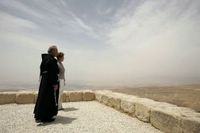 | Laura Bush and Father Michele Piccirillo, head of the Franciscan Archeology Society, look out from the Judeo-Christian holy site of Mount Nebo in Jordan Saturday, May 21, 2005. White House photo by Krisanne Johnson. |
May 22, 2005 Mrs. Bush Delivers Remarks at the World Economic Forum
May 21, 2005 Mrs. Bush Delivers Remarks at the World Economic Forum
0
comments
||
||
consideration of the nomination of Priscilla Owen
Senate Floor Schedule Friday, May 20, 2005, The Senate convened at 9:30 a.m. and adjourned at 2:23 p.m. No record votes were taken.
Next meeting: Monday, May 23, 2005, 11:30 a.m.: Proceed to Executive Session and resume consideration of the nomination of Priscilla Owen to be U.S. Circuit Judge for the Fifth Circuit.
NOMINATION: PN194-109
DATE RECEIVED: February 14, 2005
Priscilla Richman Owen, of Texas, to be United States Circuit Judge for the Fifth Circuit, vice William L. Garwood, retired.
REFERRED TO: Senate Judiciary
REPORTED BY: Senate Judiciary
LEGISLATIVE ACTIONS
Floor Action: February 14, 2005 - Received in the Senate and referred to the Committee on the Judiciary.
Committee Action: April 21, 2005 - Committee on the Judiciary. Ordered to be reported favorably.
Floor Action: April 21, 2005 - Reported by Senator Specter, Committee on the Judiciary, without printed report.
Floor Action: April 21, 2005 - Placed on Senate Executive Calendar. Calendar No. 71.
Floor Action: May 18, 2005 - Considered by Senate. By Unanimous Consent.
Floor Action: May 18, 2005 - By unanimous consent agreement, debate set for May 19, 2005.
Floor Action: May 19, 2005 - Considered by Senate. By Unanimous Consent.
Floor Action: May 19, 2005 - By unanimous consent agreement, debate set for May 20, 2005.
Floor Action: May 20, 2005 - Considered by Senate. By Unanimous Consent.
Floor Action: May 20, 2005 - Cloture motion presented in Senate.
ORGANIZATION: The Judiciary
CONTROL NUMBER: 109PN0019400
SOURCE: senate.gov
0
comments
||
||
Arms Sales to Nepal
Arms Sales to Nepal
Question: Do we sell arms to Nepal? What level of military cooperation do we have with Nepal?
Answer: In the past we have provided equipment and training to the Royal Nepalese Army. This fiscal year, $3 million was appropriated for military assistance to Nepal, including Foreign Military Financing and training. Our assistance to Nepal is overwhelmingly economic assistance, out of a total U.S. assistance level this fiscal year of roughly $42 million. Disbursement of our military assistance remains under review.
2005/537 Released on May 20, 2005 Taken Question Office of the Spokesman Washington, DC May 20, 2005 Question Taken at May 19, 2005 Daily Press Briefing
0
comments
||
||
Condoleezza Rice to Address The American Israel Public Affairs Committee
Secretary of State Condoleezza Rice to Address The American Israel Public Affairs Committee’s Annual Policy Conference May 23, 2005
Secretary of State Condoleezza Rice will deliver remarks at the American Israel Public Affairs Committee’s (AIPAC) Annual Policy Conference on Monday, May 23, 2005 at 11:15 a.m. at the Washington Convention Center, 801 Mt. Vernon Place, Washington, D.C.
The remarks will be open for press coverage; press who wish to cover the remarks must pre-register by calling Josh Block at AIPAC. Only limited parking will be available. Secretary Rice will not be taking questions at this event.
Set-up time for cameras: 8:00 a.m.
Final access time for press: 9:30 a.m.
SOURCE: state.gov Press Contacts: Josh Block AIPAC (202) 997-4614 Office of Press Relations U.S. Department of State (202) 647-2492 2005/539
0
comments
||
||
National Management Case Study Competition
U.S. Department of State’s First National Management Case Study Competition Presentation and Award Ceremony
As part of its first real-world management case study competition, the U.S. Department of State is hosting a special ceremony to recognize and reward the efforts of the top three finalists: Georgetown University; University of Texas-San Antonio; and Ohio State University. The ceremony will take place Tuesday, May 24, 2005 at 11:45 a.m. in Room 1912. During the ceremony the first, second, and third place winners will receive certificates of achievement and a monetary award.
The Department of State’s Office of Recruitment, Examination and Employment of the Bureau of Human Resources (HR/REE) is engaged in an educational venture designed to increase the awareness of, and interest in, the State Department and careers in the Foreign Service. In alliance with EdVenture Partners, the Department invited target universities to participate in a real-world management case study competition. The Bureau of Administration and Dr. Bridgette Braig, President of Lighthouse, a consumer research and consulting firm, designed a realistic scenario that management officers working overseas could potentially face.
As a result of the six-month program, the top three winning teams will present their solutions in Washington, D.C. The judging panel includes Acting Assistant Secretary for Administration Frank Coulter and Ambassador to Nigeria John Campbell.
The award ceremony is open for press coverage. Media representatives may attend this briefing upon presentation of one of the following: 1) a U.S. Government-issued identification card (Department of State, Foreign Press Center, White House, Congress, or Department of Defense), (2) a media-issued photo identification card, or (3) a letter from their employer on letterhead verifying their employment as a journalist, accompanied by an official photo identification (driver’s license or passport).
Members of the press who do not have a State Department building pass should arrive at the 23rd Street entrance by 11:15 a.m. for clearance through security. Those who are interested in covering the award ceremony should contact either Brenda Greenberg (202-647-4282) or Jennifer Wicks (202-647-3196).
SOURCE: state.gov 2005/536 Released on May 20, 2005 Media Note Office of the Spokesman Washington, DC May 20, 2005
0
comments
||
||
Saturday, May 21, 2005
Joint Service Open House
| Defense Secretary Donald H. Rumsfeld and Joint Chiefs of Staff Chairman Air Force Gen. Richard B. Myers participate in opening ceremonies May 20 for the Joint Service Open House at Andrews Air Force Base, Md. |  |
0
comments
||
||
Prayer for Peace, Memorial Day, 2005
Prayer for Peace, Memorial Day, 2005 by the President of the United States of America a Proclamation
On Memorial Day, we honor the men and women in uniform who have given their lives in service to our Nation. When the stakes were highest, our Soldiers, Sailors, Airmen, Marines, and Coast Guardsmen answered the call of duty and made the ultimate sacrifice for the security of our country and the peace of the world.
Throughout our Nation's history, members of the Armed Forces have taken great risks to keep America strong and free. These proud patriots have defended the innocent, freed the oppressed, and helped spread the promise of liberty to all corners of the earth. In serving our Nation, they have been unrelenting in battle, unwavering in loyalty, and unmatched in decency. Because of their selfless courage, millions of people who once lived under tyranny now are free, and America is more secure.
On Memorial Day, we remember that this history of great achievement has been accompanied by great sacrifice. To secure our freedom, many heroic service members have given their lives. This year we mark the 60th anniversary of the end of World War II, and we remember the Americans who died on distant shores defending our Nation in that war. On Memorial Day and all year long, we pray for the families of the fallen and show our respect for the contributions these men and women have made to the story of freedom. Our grateful Nation honors their selfless service, and we acknowledge a debt that is beyond our power to repay.
In respect for their devotion to America, the Congress, by a joint resolution approved on May 11, 1950, as amended (64 Stat. 158), has requested the President to issue a proclamation calling on the people of the United States to observe each Memorial Day as a day of
prayer for permanent peace and designating a period on that day when
the people of the United States might unite in prayer. The Congress, by Public Law 106 579, has also designated the minute beginning at 3:00 p.m. local time on that day as a time for all Americans to observe the National Moment of Remembrance.
NOW, THEREFORE, I, GEORGE W. BUSH, President of the United States of America, do hereby proclaim Memorial Day, May 30, 2005, as a day of prayer for permanent peace, and I designate the hour beginning in each locality at 11:00 a.m. of that day as a time to unite in prayer. I also ask all Americans to observe the National
Moment of Remembrance beginning at 3:00 p.m. local time on Memorial Day. I urge the media to participate in these observances.
I also request the Governors of the United States and the Commonwealth of Puerto Rico, and the appropriate officials of all units of government, to direct that the flag be flown at half staff
until noon on this Memorial Day on all buildings, grounds, and naval vessels throughout the United States, and in all areas under its jurisdiction and control. I also request the people of the United States to display the flag at half-staff from their homes for the customary forenoon period.
IN WITNESS WHEREOF, I have hereunto set my hand this twentieth day of May, in the year of our Lord two thousand five, and of the Independence of the United States of America the two hundred and twenty ninth.
GEORGE W. BUSH
# # # For Immediate Release Office of the Press Secretary May 20, 2005
0
comments
||
||
War Powers Resolution (Public Law 93-148)
Text of a Letter from the President to the Speaker of the House of Representatives and the President Pro Tempore of the Senate May 20, 2005
Dear Mr. Speaker: (Dear Mr. President:)
I am providing this supplemental consolidated report, prepared by my Administration and consistent with the War Powers Resolution (Public Law 93-148), as part of my efforts to keep the Congress informed about deployments of U.S. combat-equipped armed forces around the world. This supplemental report covers operations in support of the global war on terrorism, Kosovo, and Bosnia and Herzegovina.
THE GLOBAL WAR ON TERRORISM
Since September 24, 2001, I have reported, consistent with Public Law 107-40 and the War Powers Resolution, on the combat operations in Afghanistan against al-Qaida terrorists and their Taliban supporters, which began on October 7, 2001, and the deploy ment of various combat-equipped and combat-support forces to a number of locations in the Central, Pacific, and Southern Command areas of operation in support of those operations and of other operations in our global war on terrorism.
I will direct additional measures as necessary in the exercise of the U.S. right to self-defense and to protect U.S. citizens and interests. Such measures may include short-notice deployments of special operations and other forces for sensitive operations in various locations throughout the world. It is not possible to know at this time either the precise scope or duration of the deployment of U.S. Armed Forces necessary to counter the terrorist threat to the United States.
United States Armed Forces, with the assistance of numerous coalition partners, continue to conduct the U.S. campaign to pursue al-Qaida terrorists and to eliminate support to al-Qaida.
These operations have been successful in seriously degrading al Qaida's training capabilities. United States Armed Forces, with the assistance of numerous coalition partners, ended the Taliban regime in Afghanistan and are actively pursuing and engaging remnant al-Qaida and Taliban fighters. Approximately 90 U.S. personnel are also assigned to the International Security Assistance Force (ISAF)
in Afghanistan. The U.N. Security Council authorized the ISAF in U.N. Security Council Resolution 1386 of December 20, 2001, and has reaffirmed its authorization since that time, most recently, for a 12-month period from October 13, 2004, in U.N. Security Council Resolution 1563 of September 13, 2004. The mission of the ISAF under
NATO command is to assist the Government of Afghanistan in creating a safe and secure environment that allows reconstruction and the reestablishment of Afghan authorities. Currently, all 26 NATO nations contribute to the ISAF. Ten non-NATO contributing countries also participate by providing military and other support personnel to the ISAF.
The United States continues to detain several hundred al-Qaida and Taliban fighters who are believed to pose a continuing threat to the United States and its interests. The combat equipped and combat-support forces deployed to Naval Base, Guantanamo Bay, Cuba, in the U.S. Southern Command area of operations since January 2002 continue to conduct secure detention operations for the approxi mately 520 enemy combatants at Guantanamo Bay.
The U.N. Security Council authorized a Multinational Force (MNF) in Iraq under unified command in U.N. Security Council Resolution 1511 of October 16, 2003, and reaffirmed its authori-zation in U.N. Security Council Resolution 1546 of June 8, 2004, noting the Iraqi Interim Government's request to retain the presence of the MNF. Under U.N. Security Council Resolution 1546, the mission of the MNF is to contribute to the security and stability in Iraq, as reconstruction continues, until the completion of Iraq's political transformation. These contributions include assisting in building the capability of the Iraqi security forces and institutions, as the Iraqi people, represented by the Transitional National Assembly, draft a constitu tion and establish a constitutionally elected government. The U.S. contribution to the MNF is approximately 139,000 military personnel.
In furtherance of our efforts against terrorists who pose a continuing and imminent threat to the United States, our friends and allies, and our forces abroad, the United States continues to work with friends and allies in areas around the globe. United States combat-equipped and combat-support forces are located in the Horn of Africa region, and the U.S. forces headquarters element in Djibouti provides command and control support as necessary for military operations against al-Qaida and other international terrorists in the Horn of Africa region, including Yemen. These forces also assist in enhancing counter terrorism capabilities in Kenya, Ethiopia, Yemen, Eritrea, and Djibouti. In addition, the United States continues to conduct maritime interception operations on the high seas in the areas of responsibility of all of the geographic combatant comman ders. These maritime operations have the responsibility to stop the movement, arming, or financing of international terrorists.
NATO-LED KOSOVO FORCE (KFOR)
As noted in previous reports regarding U.S. contributions in support of peacekeeping efforts in Kosovo, the U.N. Security Council authorized Member States to establish KFOR in U.N. Security Council Resolution 1244 of June 10, 1999. The mission of KFOR is to provide an international security presence in order to deter renewed hostilities; verify and, if necessary, enforce the terms of the Military Technical Agreement between NATO and the Federal Republic of Yugoslavia (which is now Serbia and Montenegro); enforce the terms of the Undertaking on Demilitari zation and Trans formation of the former Kosovo Liberation Army; provide day-to-day operational direction to the Kosovo Protection Corps; and maintain a safe and secure environment to facilitate the work of the U.N. Interim Administration Mission in Kosovo (UNMIK).
Currently, there are 23 NATO nations contributing to KFOR. Eleven non-NATO contributing countries also participate by providing military personnel and other support personnel to KFOR. The
U.S. contribution to KFOR in Kosovo is about 1,700 U.S. military personnel, or approximately 10 percent of KFOR's total strength of approximately 17,000 personnel. Additionally, U.S. military personnel occasionally operate from Macedonia, Albania, and Greece in support of KFOR operations.
The U.S. forces have been assigned to a sector principally centered around Gnjilane in the eastern region of Kosovo. For U.S. KFOR forces, as for KFOR generally, maintaining a safe and secure environment remains the primary military task. The KFOR operates under NATO command and control and rules of engagement. The KFOR coordinates with and supports UNMIK at most levels; provides a security presence in towns, villages, and the country side; and organizes checkpoints and patrols in key areas to provide security, protect minorities, resolve disputes, and help instill in the community a feeling of confidence.
In accordance with U.N. Security Council Resolution 1244, UNMIK continues to transfer additional competencies to the Kosovar Provisional Institutions of Self-Government, which includes the President, Prime Minister, multiple ministries, and the Kosovo Assembly. The UNMIK retains ultimate authority in some sensitive areas such as police, justice, and ethnic minority affairs.
NATO continues formally to review KFOR's mission at 6-month intervals. These reviews provide a basis for assessing current force levels, future requirements, force structure, force reduc tions, and the eventual withdrawal of KFOR. NATO has adopted the Joint Operations Area plan to regionalize and rationalize its force
structure in the Balkans. The UNMIK international police and the Kosovo Police Service (KPS) have full responsibility for public safety and policing throughout Kosovo except in the area of South Mitrovica, where KFOR and UNMIK share this responsibility due to security concerns. The UNMIK international police and KPS also have begun to assume responsibility for guarding patrimonial sites and established border-crossing checkpoints. The KFOR augments security in particularly sensitive areas or in response to particular threats as needed.
NATO HEADQUARTERS-SARAJEVO IN BOSNIA AND HERZEGOVINA
Pursuant to the June 2004 decision made by NATO Heads of State and Government, and in accordance with U.N. Security Council Resolution 1575 of November 22, 2004, NATO concluded its Stabilization Force (SFOR) operations in Bosnia and Herzegovina and established NATO Headquarters-Sarajevo to continue to assist in implementing the Peace Agreement in conjunction with a newly established European Force (EUFOR). NATO Headquarters-Sarajevo, to which approximately 235 U.S. personnel are assigned, is, with EUFOR, the legal successor to SFOR. The principal tasks of NATO Headquarters-Sarajevo are providing advice on defense reform and performing operational supporting tasks, such as counter terrorism and supporting the International Criminal Tribunal for the Former Yugoslavia.
I have directed the participation of U.S. Armed Forces in all of these operations pursuant to my constitutional authority to conduct U.S. foreign relations and as Commander in Chief and Chief Executive. Officials of my Administration and I communicate regularly with the leadership and other Members of Congress with regard to these deployments, and we will continue to do so.
Sincerely,
GEORGE W. BUSH
# # # For Immediate Release Office of the Press Secretary May 20, 2005
0
comments
||
||
Tom Luce, Arlene Holen, Irma B. Elder, Charles Patrick Garcia, Nancy R. Kudla
Personnel Announcement
President George W. Bush today announced his intention to nominate two individuals and appoint three individuals to serve in his Administration:
The President intends to nominate Tom Luce, of Texas, to be Assistant Secretary of Education (Planning, Evaluation and Policy Development). Mr. Luce currently serves as Chairman of the National Center for Educational Accountability and Just for the Kids. He was a founding partner and managing partner of Hughes & Luce, LLP in Dallas, Texas. Mr. Luce received his bachelor's degree and master's degree from Southern Methodist University.
The President intends to nominate Arlene Holen, of the District of Columbia, to be a Member of the Federal Mine Safety and Health Review Commission, for the remainder of a six-year term expiring August 30, 2010. Mrs. Holen currently serves as Associate Director for Research and Reports for the Congressional Budget Office. Earlier in her career, Mrs. Holen served as a Member and Chairman of the Federal Mine Safety and Health Review Commission. She received her bachelor's degree from Smith College and her master's degree from Columbia University.
The President intends to appoint Irma B. Elder, of Michigan, to be a Member of the President's Commission on White House Fellowships.
The President intends to appoint the following individuals to be Members of the Board of Visitors to the United States Air Force Academy for the remainder of a three-year term expiring December 30, 2007:
Charles Patrick Garcia of Florida
Nancy R. Kudla of Texas
# # # For Immediate Release Office of the Press Secretary May 20, 2005
0
comments
||
||
bush radio address 05/21/05 full audio, text transcript
bush radio address 05/21/05 full audio, text transcript
President's Radio Address
THE PRESIDENT: Good morning. Today, I can report to you that we are making good progress in advancing the cause of freedom, defeating the forces of terror, and transforming our military so we can meet the emerging threats of the 21st century. As I speak, Laura is in the Middle East to help advance the freedom agenda; and her message is a powerful one -- that by working together for liberty, we will create a future of peace and opportunity for women and men worldwide.
On Monday, I will meet Afghan President Hamid Karzai at the White House to discuss freedom's remarkable progress in his nation. Afghanistan now has a constitution, an elected President, and its citizens will return to the polls this September to elect provincial councils in the lower house of the National Assembly. We're helping Afghanistan's elected government solidify these democratic gains and deliver real change. A nation that once knew only the terror of the Taliban is now seeing a rebirth of freedom, and we will help them succeed.
Terrorists know that there is no room for them as freedom takes root in the broader Middle East, so they are fighting to stop its progress. But in recent weeks, we have dealt them a series of devastating blows. In Afghanistan, we have brought to justice dozens of terrorists and insurgents. In Pakistan, one of Osama bin Laden's senior terrorist leaders, a man named Al-Libbi, was brought to justice. In Iraq, we captured two deputies of the terrorist Zarqawi, and our forces have killed or captured hundreds of terrorists and insurgents near the Syrian border.
Our strategy is clear: We will fight the terrorists abroad so we do not have to face them here at home. While some difficult days still lie ahead, these recent victories are making America safer and the world more secure.
As we make progress against today's enemies, we are also transforming our military to defeat the enemies we might face in the decades ahead. On Friday, I will speak to future leaders of our military who are graduating from the U.S. Naval Academy about how we are making our Armed Forces faster, more agile, and more lethal.
To deal with the emerging threats of the 21st century, we are building a military that can deploy rapidly and deliver more fire power with fewer forward deployed forces. However, much of our military is still deployed in ways that reflect the threats of the Cold War. So last summer, I announced a plan to reposition our forces over the next decade. This shift will bring home 60,000 to 70,000 uniformed personnel, while still maintaining a significant overseas presence. It will also allow us to reduce the stress on our military families and make the best overall use of our resources. In the months and years ahead, we will continue to do what is necessary to prepare our Armed Forces to protect the American people in this new century.
The war on terror continues, and we are making solid progress, but we must not become complacent. We will continue to pursue terrorists abroad. We will continue to support democratic change throughout the world, including in Afghanistan, Iraq, and the broader Middle East. And we will do whatever it takes to support our men and women in uniform and give them the tools they need to prevail.
Thank you for listening.
END For Immediate Release May 21, 2005
0
comments
||
||
Freedom Calendar 05/21/05 - 05/28/05
May 21, 1919, Republican House passes constitutional amendment granting women the vote with 85% of Republicans in favor, but only 54% of Democrats; in Senate, 80% of Republicans would vote yes, but almost half of Democrats no.
May 22, 1856, For denouncing Democrats’ pro-slavery policy, Republican U.S. Senator Charles Sumner (R-MA) is beaten nearly to death on floor of Senate by U.S. Rep. Preston Brooks (D-SC).
May 23, 2003, U.S. Senator Sam Brownback (R-KS) introduces bill to establish National Museum of African American History and Culture.
May 24, 1900, Republicans vote no in referendum for constitutional convention in Virginia, designed to create a new state constitution disenfranchising African-Americans.
May 25, 1928, Republican Genevieve Cline becomes first woman in nation to serve as federal judge; appointed to U.S. Customs Court by President Calvin Coolidge.
May 26, 2001, African-American Claude Allen, nominated by President George W. Bush, is confirmed as U.S. Deputy Secretary of Health and Human Services.
May 27, 1987, Vietnamese-American cadet Hoang Nhu Tran, former boat person, graduates as valedictorian from U.S. Air Force Academy; nominated by U.S. Senator Bill Armstrong (R-CO).
May 28, 1930 Birth of U.S. Rep. Patricia Saiki (R-HI), first Asian-American to lead a federal agency; appointed head of U.S. Small Business Administration by President George H. W. Bush.
"A healthy republican government must rest upon individuals, not upon classes or sections. As soon as it becomes government by a class or by a section, it departs from the old American ideal.”
Theodore Roosevelt26th President of the United States
SOURCE: 2005 Republican Freedom Calendar
0
comments
||
||
Friday, May 20, 2005
fate of the Neandertals
Oldest cranial, dental and postcranial fossils of early modern European humans confirmed
The human fossil evidence from the Mladec Caves in Moravia, Czech Republic, excavated more than 100 years ago, has been proven for the first time, through modern radiocarbon dating, to be the oldest cranial, dental and postcranial assemblage of early modern humans in Europe.
A team of researchers from the Natural History Museum in Vienna, from the University of Vienna in Austria and from the Washington University in St. Louis, USA recently conducted the first successful direct dating of the material. Several previous attempts to radiocarbon date the Mladec specimens directly have failed, but in the present attempt by using teeth as dating material reliable results were obtained.
The findings are documented in the May 19 issue of Nature.
"The dating results document that these samples are as old as we thought they should be," agree Maria Teschler-Nicola from the Natural History Museum in Vienna and Erik Trinkaus, professor of anthropology at Washington University in St. Louis, the two anthropologists involved in this study. "The Mladec samples date to around 31,000 years ago," reports Eva Maria Wild from the VERA (Vienna Environmental Research Accelerator) Laboratory at University of Vienna, where the radiocarbon dating has been performed. This is the oldest assemblage of modern humans in Europe which retains many portions of the skeleton plus archaeological objects from the Aurignacian period. Only two modern human specimens from a site in Romania, dated to ~35,000 years ago, are older. At Mladec there are multiple individuals - at least 5 or 6 represented. The dating shows that the Mladec assemblage is central to discussions of modern human emergence in Europe and the fate of the Neandertals.
The Mladc remains are universally accepted as those of early modern humans. However, there has been an ongoing debate as to whether they also exhibit distinctive archaic features, indicative of some degree of Neandertal ancestry, or are morphologically aligned solely with recent humans and therefore document only a dispersal of modern humans into Europe.
The radiocarbon dating of the Mladec assemblage confirms that they derived from the time period of the middle to late Aurignacian of Central Europe. Given the presence of multiple individuals, males and females, adult and immature with cranial, dental and postcranial elements, the Mladec assemblage becomes the oldest directly dated substantial assemblage of modern human remains in Europe. ###
Contact information:
Univ. Prof. Dr. Eva Maria WildInstitut für Isotopenforschung und Kernphysik der Universität WienVERA-LaboratoriumWaehringer Strasse 17A-1090 Wien, AustriaTel.: +43-1-4277-51704Fax: +43-1-4277-9517E-mail: eva.maria.wild@univie.ac.at
Univ. Prof. Dr. Maria Teschler-NicolaAnthropologische AbteilungNaturhistorisches Museum WienBurgring 7, Postfach 417A-1014 Wien, AustriaTel.: 0043 1 52177-572 od. 239Fax: 0043 1 52177-230E-mail: maria.teschler@nhm-wien.ac.at
Prof. Erik TrinkausDepartment of AnthropologyWashington UniversitySt. Louis, MO 63130, USATel: 1-314-935-5207Fax: 1-314-935-5207E-mail: trinkaus@artsci.wustl.edu
Contact: Neil Schoenherr nschoenherr@wustl.edu 314-935-5235 Washington University in St. Louis
0
comments
||
||
President Bush Meets with Danish Prime Minister Rasmussen
President Bush Meets with Danish Prime Minister Rasmussen The Oval Office 10:48 A.M. EDT
PRESIDENT BUSH: The Prime Minister and I will be glad to answer two questions per side.
First, Mr. Prime Minister, welcome back. It is so wonderful to see you. He's a good friend of mine. Denmark is a good friend of America. I appreciate your contributions to transatlantic ties. The Prime Minister has made very constructive and helpful comments to make sure that the transatlantic ties between the United States and Europe are strong. And I want to thank you for your leadership role.
I also appreciate your clear understanding about the historic times in which we live, times in which more and more people are becoming free. I appreciate your strong support for those who desire to live in a democracy in Iraq. I thank you for your contributions to a new democracy called Afghanistan. I thank you for your very constructive work in helping the Palestinians develop a democratic state that can live side-by-side with Israel in peace.
So welcome back. It's good to see you, sir.
PRIME MINISTER RASMUSSEN: Thank you very much, Mr. President. I'm delighted to be back in Washington. It's my fourth visit as Prime Minister, which underlines that the United States and Denmark are close friends and allies. We share the same fundamental values. We are allied in our efforts to promote freedom and democracy worldwide.
And I'm happy to say, in addition to this, that I appreciate very much your straightforward style. I consider you a friend and I know that with you, I'll always have a very frank discussion and exchange of views. So I'm happy to be back.
PRESIDENT BUSH: Fortunately, he's not that good a friend that I would go running with him. (Laughter.) He's one of the best runners in the world, amongst the world leaders. He's a good one.
Deb.
Q Mr. President, on stem cells, specifically, would you veto legislation that loosened the requirement on federal funding for stem cell research? And secondly --
PRESIDENT BUSH: Deb --
Q -- what is your reaction to the news about the South Koreans on embryonic --
PRESIDENT BUSH: I'm -- first, I'm very concerned about cloning. I worry about a world in which cloning becomes acceptable. Secondly, I made my position very clear on embryonic stem cells. I'm a strong supporter of adult stem cell research, of course. But I made it very clear to the Congress that the use of federal money, taxpayers' money to promote science which destroys life in order to save life is -- I'm against that. And therefore, if the bill does that, I will veto it.
Q Mr. President, how do you react to the continuing reports about mistreatment of prisoners held by American military around the world, and also the perception abroad that the ones that are paying for it are low-ranking soldiers, but that nobody higher up is taking any responsibility?
PRESIDENT BUSH: I think the world ought to be -- pay attention to the contrast between a society which was run by a brutal tyrant in which there was no transparency and a society in which the whole world watches a government find the facts, lay the facts out for the citizens to see, and that punishment, when appropriate, be delivered.
If I'm not mistaken, I think about over 20 percent of the people thus far that have been held to account as a result of the Abu Ghraib issue have been officers. There have been over, I think, nine investigations, eight or nine investigations by independent investigators that have made the reports very public. I'm comfortable that we're getting to the bottom of the situation and I know we're doing so in a transparent way. Obviously, ours is a country that respects human rights and human dignity, and if those rights and dignity have been denied, we will hold people to account.
Steve.
Q Sir, are you worried that the publication of the Saddam photo, along with the Newsweek story, will further inflame tensions and inspire the Iraq insurgency and anti-Americanism in the Middle East?
PRESIDENT BUSH: I think the Iraq insurgency is inspired by their desire to stop the march of freedom. Remember, these are ideologues of -- that murder innocent people in order to spread their dark vision of hate. And, therefore, when light begins to show up in the form of democracy, it frightens them. There is no future for these haters in a free world. And so they're inspired by the fact that they see democracy emerging in Iraq. That's what causes them to want to kill. They're frightened by the fact -- and inspired the wrong way, by the way -- by the fact that Afghanistan is free. They're seeing the people in Lebanon demand free and fair elections. And their ideology cannot survive in a democratic society. See, the only way they can survive is to -- is to try to shake our will by killing innocent life.
And that's why our strategy in Iraq is to train the Iraqis so that they, themselves, can fight off these terrorists. Listen, eight-and-a-half million people went to the polls, in spite of the fact that the -- people had been killed and there was incredible intimidation. And they defied the bombers. These people want to be free, and the killers don't want them to be free. And so our strategy is to help the Iraqis realize the dream of a free society. And when the Iraqi troops are properly trained -- and we're headed in that direction -- of course, it will take less of a coalition effort to help this new democracy get started.
Yes, Steve.
Q What about the Saddam photo? Does that have any --
THE PRESIDENT: Well, you asked me whether or not that would inspire people. You know, I don't think a photo inspires murderers. I think they're inspired by an ideology that is so barbaric and backwards that it's hard for many in the Western world to comprehend how they think. But I would just remind people, if you want to know how ideologically grim their vision of the world is, just remember the Taliban. They said, if you don't agree with our religious views you'll be prosecuted; if you're a woman who seeks freedom, you'll be beaten. So these people are motivated by a vision of the world that is backward and barbaric.
Q Mr. President, while the Danish people might support the war and appreciate the progress in Iraq, they're also curious when our soldiers will come back home. Can you elaborate on that?
THE PRESIDENT: Well, I appreciate that question a lot and, of course, I get asked that in our own country a lot. And my answer is, it makes no sense to set a timetable. And the reason why is, is because it will allow an enemy to adjust.
On the other hand, as I tell our folks, is that we would like to get our troops out as quickly as possible. And the definition of that will be how soon our commanders on the ground think that the Iraqis are able to take the fight to the enemy.
I just got off of a video -- which I'm looking to briefing the Prime Minister on -- with General Casey, who is our general on the ground, he's the commander of the coalition forces. And he was describing to us the Iraqi training and the quality of training. And some units are in really good shape and other units need additional work. But one of the things that's important to understand is the Iraqi government understands that as civilian governments change, there needs to be stability in the military and a chain of command that links top to bottom. And General Casey knows we're making progress toward establishing that chain of command.
My answer to the Danish people is, as soon as we can possibly get it done. We've got to complete the mission. A free Iraq in the midst of the Middle East is going to be a powerful -- a powerful agent for peace.
Listen, thank you all for coming.
Q One more?
PRESIDENT BUSH: We don't want to break precedent. Was that you, Mark, who asked that?
Q It was.
PRESIDENT BUSH: No. (Laughter.) You know better than that.
END 10:56 A.M. EDT For Immediate Release Office of the Press Secretary May 20, 2005
0
comments
||
||
President to Welcome German Chancellor Schroeder
President to Welcome German Chancellor Schroeder
The President will welcome German Chancellor Gerhard Schroeder to the White House for a meeting and working lunch on June 27, 2005. Germany is a strong ally and partner of the United States, working with us to advance freedom and reform, promote prosperity and development, and counter terrorism and proliferation around the world. Germany has played a leading role in the international effort to assist the Afghan people with security, developing the police, and reconstructing their nation. Building on their February 2005 meeting in Mainz, Germany, the two leaders intend to continue their discussion about how the United States and Europe can work together on a broad agenda of global issues.
# # # For Immediate Release Office of the Press Secretary May 20, 2005
0
comments
||
||
President Bush Meets with Greek Prime Minister Karamanlis
President Bush Meets with Greek Prime Minister Karamanlis The Oval Office 1:14 P.M. EDT
PRESIDENT BUSH: Thank you all for coming. It's my pleasure to welcome the Prime Minister back. It's good to see you, sir.
America and Greece have got a strategic partnership. That's important. It's important for our respective peoples, and it's important we work together to spread freedom and peace.
I want to welcome you here. Last time you were here, we were talking about the Olympics. I told the Prime Minister I was confident that the government would make sure the Olympics were secure. I was so confident I sent my family. And not only did you keep your word, my parents and my -- some of my relatives had a fabulous time in a spectacular country.
I look forward to visiting with you on a variety of subjects -- the freedom agenda, freedom in the greater Middle East, the Balkans. I look forward to talking to you about how best we can work together to continue to spread liberty. So I'm proud you're here, and welcome to the United States.
PRIME MINISTER KARAMANLIS: Well, it's my second visit with President Bush within almost a year. And I'm happy to say that this reflects the excellent bilateral relations we have, and, of course, our determination to further our partnership to promote the areas of mutual interest, the common goals we have. And I think that it's going to be the outcome of this meeting, as well, to keep working closely in matters which are very important to both of us in both countries.
PRESIDENT BUSH: Good man. Thank you all.
END 1:16 P.M. EDT For Immediate Release Office of the Press Secretary May 20, 2005
0
comments
||
||
a polysaccharide called hyaluronan
New polysaccharide may help combat multidrug resistance in cancer
Bethesda, MD – In a recent study published in the Journal of Biological Chemistry, scientists report that a molecule previously thought to play a purely structural and inert role in cells is actually involved in multidrug resistance in cancer. Using antagonists for this molecule, the researchers were able to sensitize drug resistant breast cancer cells to chemotherapeutic drug treatment.
The research appears as the "Paper of the Week" in the May 27 issue of the Journal of Biological Chemistry, an American Society for Biochemistry and Molecular Biology journal.
Multidrug resistance is very common in most types of cancers, making it one of the leading problems in cancer therapy. It is often caused by an increase in the cell's production of proteins that transport drugs out of the cell, preventing the drugs from combating cancer.
Previously, Dr. Bryan P. Toole and his coworkers, Drs. Suniti Misra and Shibnath Ghatak, of the Medical University of South Carolina noticed that small pieces, or oligomers, of a polysaccharide called hyaluronan were able to sensitize drug-resistant breast cancer cells to several different chemotherapeutic drugs. He believed that the polysaccharide oligomers were binding to a receptor for hyaluronan (called CD44) and preventing it from initiating a signaling cascade that would result in drug resistance.
"It is very surprising that hyaluronan is involved in drug resistance," admits Dr. Toole. "Most scientists think of hyaluronan as a structural and inert molecule. In adult tissues it plays two roles. First, it assists in tissue hydration and in biophysical properties such as resilience. Second, it forms a template to which matrix proteins attach and form important extracellular structural complexes."
Hyaluronan also accumulates around the outside of cells during disease processes such as early atherogenesis, persistent inflammation, and cancer. In recent years, however, hyaluronan has also been shown to induce signaling pathways in inflammatory, embryonic and cancer cells.
In their current Journal of Biological Chemistry paper, Dr. Toole and his colleagues report on further studies which indicate that hyaluronan increases the cellular production of a multidrug transporter protein by binding to CD44. They discovered that antagonist molecules that bind to hyaluronan and prevent it from interacting with CD44 were able to sensitize multidrug resistant breast cancer cells to chemotherapeutic drugs. The researchers also found that increasing hyaluronan synthesis in cells increased resistance to drug treatment.
"Our work indicates that hyaluronan antagonists, for example small hyaluronan oligomers, reverse the malignant properties of cancer cells, including proliferation, invasiveness, and drug resistance," explains Dr. Toole. "Hyaluronan oligomers are non-toxic, non-immunogenic, and readily applicable to several proliferative disease processes, especially cancer. We are hoping that hyaluronan antagonists can be used in conjunction with chemotherapy such that much lower and less toxic doses of chemotherapeutic agents can be used."
###
The Journal of Biological Chemistry's Papers of the Week is an online feature which highlights the top one percent of papers received by the journal. Brief summaries of the papers and explanations of why they were selected for this honor can be accessed directly from the home page of the Journal of Biological Chemistry online at www.jbc.org.
The American Society for Biochemistry and Molecular Biology (ASBMB) is a nonprofit scientific and educational organization with over 11,000 members in the United States and internationally. Most members teach and conduct research at colleges and universities. Others conduct research in various government laboratories, nonprofit research institutions, and industry.
Founded in 1906, the Society is based in Bethesda, Maryland, on the campus of the Federation of American Societies for Experimental Biology. The Society's primary purpose is to advance the sciences of biochemistry and molecular biology through its publications, the Journal of Biological Chemistry, The Journal of Lipid Research, Molecular and Cellular Proteomics, and Biochemistry and Molecular Biology Education, and the holding of scientific meetings.
For more information about ASBMB, see the Society's website at asbmb.org.
Contact: Nicole Kresge nkresge@asbmb.org 301-634-7415 American Society for Biochemistry and Molecular Biology
0
comments
||
||
Cuban Independence Day, 2005
Presidential Message: Cuban Independence Day, 2005
I send greetings to those celebrating the 103rd anniversary of Cuban Independence.
Freedom is the birthright of all mankind. Leaders across the Americas understand that the hope for peace in our world depends on the unity of free nations. America's continued support of democratic institutions, constitutional processes, and basic liberties gives hope and strength to those struggling in our hemisphere to reclaim the rule of law and their God-given rights. As we observe Cuba's independence today, we look forward to the day when Cuba is free, and my Administration supports efforts to hasten that day's coming. The tide of freedom is spreading across the globe, and it will reach Cuban shores. No tyrant can stand forever against the power of liberty because the hope of freedom is found in every heart.
This milestone is an opportunity to celebrate the Cuban culture and the many contributions Cuban Americans have made to the United States. By sharing your proud history with all Americans, you enrich our society and contribute to the diversity that makes our Nation great.
May God bless the Cuban people.
GEORGE W. BUSH ### For Immediate Release Office of the Press Secretary May 20, 2005
0
comments
||
||
Honduras, Millennium Challenge Corporation (MCC)
Today, the President congratulated Honduras on the approval of its Millennium Challenge Account (MCA) Compact by the Millennium Challenge Corporation (MCC) Board. The $208 million Compact will link rural farmers to the local, regional, and global economies through a comprehensive rural development program and an upgraded transportation network, raising rural incomes and strengthening the region as a whole. It is an example of the innovative and results-oriented approach to development the President launched through the MCA, a groundbreaking initiative that rewards countries that govern justly, invest in their people, and promote economic freedom.
# # # For Immediate Release Office of the Press Secretary May 20, 2005 Statement by the Deputy Press Secretary
0
comments
||
||
U.S. Trade and Investment Policy Toward Sub-Saharan Africa
Statement by the Deputy Press Secretary on African Growth and Opportunity Act
2005 Comprehensive Report on U.S. Trade and Investment Policy Toward Sub-Saharan Africa and Implementation of the African Growth and Opportunity Act
Today, the President submitted to Congress the 2005 Comprehensive Report on U.S. Trade and Investment Policy for Sub-Saharan Africa and Implementation of the African Growth and Opportunity Act. The African Growth and Opportunity Act (AGOA), Title I of the Trade and Development Act of 2000, states that the President shall submit such reports annually through 2008. The report is on the progress of AGOA implementation and general trade and investment developments between the United States and Africa.
Highlights from the 2005 report:
AGOA has been a measurable success, increasing our two-way trade with sub-Saharan Africa and diversifying the range of products being traded. In 2004, U.S. exports to sub-Saharan Africa increased 25 percent from 2003, to $8.6 billion. AGOA imports were $26.6 billion in 2004, an increase of 88 percent over 2003. Non-oil AGOA imports totaled $3.5 billion, an increase of 22 percent from 2003.
In July 2004, President Bush signed into law the AGOA Acceleration Act of 2004. This legislation extends AGOA's authorization until 2015, including its special third-country fabric provision until 2007, mandates increased AGOA-related technical assistance, and amends some technical provisions of the Act.
The United States devoted $181 million to trade capacity- building activities in sub-Saharan Africa in FY04, up 36 percent from FY03.
Thirty-seven of the 48 sub-Saharan African countries are eligible for AGOA. In December 2004, Burkina Faso was added to the list of eligible countries, and C te d'Ivoire was removed from the list. Three countries -- Benin, Nigeria, and Sierra Leone -- became eligible for AGOA's apparel benefits in 2004. As of April 2005, 24 sub-Saharan African countries are eligible to receive AGOA's apparel benefits.
The fourth U.S.-Sub-Saharan Africa Trade and Economic Cooperation Forum will be held in Dakar, Senegal, in July 2005. Senior Administration officials from the United States are expected to join government ministers from the 37 AGOA-eligible countries at this event. Hundreds of U.S. and African businesses and organizations will participate in the private sector and civil society dialogues to be held at the AGOA Forum.
# # # For Immediate Release Office of the Press Secretary May 19, 2005
RELATED:
- African Growth and Opportunity Act - Message to the Congress of the United States
0
comments
||
||
Emergency Economic Powers Act (50 U.S.C. 1701-1706) (IEEPA)
Notice: Continuation of the National Emergency Protecting the Development Fund for Iraq and Certain Other Property in Which Iraq Has An Interest
On May 22, 2003, by Executive Order 13303, I declared a national emergency protecting the Development Fund for Iraq and certain other property in which Iraq has an interest, pursuant to the International Emergency Economic Powers Act (50 U.S.C. 1701-1706) (IEEPA). I took this action to deal with the unusual and extraordinary threat to the national security and foreign policy of the United States posed by the obstacles to the orderly reconstruction of Iraq, the restoration and maintenance of peace and security in the country, and the development of political, administrative, and economic institutions in Iraq constituted by the threat of attachment or other judicial process against the Development Fund for Iraq, Iraqi petroleum and petroleum products, and interests therein, and proceeds, obligations, or any financial instruments of any nature whatsoever arising from or related to the sale or marketing thereof.
On August 28, 2003, in Executive Order 13315, I expanded the scope of this national emergency to block the property of the former Iraqi regime, its senior officials and their family members as the removal of Iraqi property from that country by certain senior officials of the former Iraqi regime and their immediate family members constitutes an obstacle to the orderly reconstruction of Iraq, the restoration and maintenance of peace and security in the country, and the development of political, administrative, and economic institutions in Iraq.
On July 29, 2004, in Executive Order 13350, I amended the Annex to Executive Order 13315 to include certain persons determined to have been subject to economic sanctions pursuant to Executive Orders 12722 and 12724. Because of their association with the prior Iraqi regime, I determined that these persons present an obstacle to the orderly reconstruction of Iraq, the restoration and maintenance of peace and security in that country, and the development of political, administrative, and economic institutions in Iraq and, therefore, such persons should be subject to sanctions under Executive Order 13315.
Executive Order 13350 also amended Executive Order 13290 of March 20, 2003, in which, consistent with section 203(a)(1)(C) of IEEPA, 50 U.S.C. 1702(a)(1)(C), I ordered that certain blocked funds held in the United States in accounts in the name of the Government of Iraq, the Central Bank of Iraq, Rafidain Bank, Rasheed Bank, or the State Organization for Marketing Oil be
confiscated and vested in the Department of the Treasury. I originally exercised these authorities pursuant to Executive Order 12722. In light of the changed circumstances in Iraq and my decision to terminate the national emergency declared in Executive Order 12722, I determined that the exercise of authorities in Executive Order 13290 should continue in order to address the national emergency declared in Executive Order 13303 of May 22, 2003, as expanded in scope in Executive Order 13315 of August 28, 2003, regarding the obstacles posed to the orderly reconstruction of Iraq. Executive Order 13350 amends Executive Order 13290 to that effect.
On November 29, 2004, in Executive Order 13364, I modified the scope of this national emergency to address the unusual and extraordinary threat to the national security and foreign policy of the United States posed by the threat of attachment or other judicial process against the Central Bank of Iraq. I also determined that, consistent with United Nations Security Council Resolutions 1483 and 1546, the steps taken in Executive Order 13303 to deal with this national emergency need to be limited so that such steps do not apply with respect to any final judgment arising out of a contractual obligation entered into by the Government of Iraq, including any agency or instrumentality thereof, after June 30, 2004, and so that, with respect to Iraqi petroleum and petroleum products and interests therein, such steps shall apply only until title passes to the initial purchaser.
Because the obstacles to the orderly reconstruction of Iraq, the restoration and maintenance of peace and security in the country, and the development of political, administrative, and economic institutions in Iraq continue to pose an unusual and extraordinary threat to the national security and foreign policy of the United States, the national emergency declared on May 22, 2003, and the measures adopted on that date, August 28, 2003, July 29, 2004, and November 29, 2004, to deal with that emergency must continue in effect beyond May 22, 2005. Therefore, in accordance with section 202(d) of the National Emergencies Act (50 U.S.C. 1622(d)), I am continuing for 1 year the national emergency protecting the Development Fund for Iraq and certain other property in which Iraq has an interest.
This notice shall be published in the Federal Register and transmitted to the Congress.
GEORGE W. BUSH THE WHITE HOUSE, May 19, 2005. For Immediate Release Office of the Press Secretary May 19, 2005
RELATED:
0
comments
||
||


