Tuesday, August 09, 2005

Discovery Crew Home Safe (Image Gallery)

Discovery Crew Home Safe (Image Gallery)

The crew of mission STS-114 gathered in front of Discovery following landing at Edwards Air Force Base. From left to right: Mission Specialist Stephen Robinson, Commander Eileen Collins, Mission Specialists Andrew Thomas, Wendy Lawrence, Soichi Noguchi and Charles Camarda, and Pilot James Kelly. (Image Credit: Jim Ross/NASA)The crew of mission STS-114 gathered in front of Discovery following landing at Edwards Air Force Base. From left to right: Mission Specialist Stephen Robinson, Commander Eileen Collins, Mission Specialists Andrew Thomas, Wendy Lawrence, Soichi Noguchi and Charles Camarda, and Pilot James Kelly. (Image Credit: Jim Ross/NASA)
+ Large Image (3000 x 2406, 300 ppi) --- + Medium Image (700 x 558, 72 ppi) --- + Small Image (360 x 263, 72 ppi)
NASA's Crew Transport Vehicle, or CTV, pulls up to the Space Shuttle Discovery to offload the crew after a successful landing August 9, 2005 at Edwards Air Force Base, California. The landing marked the end of the STS-114 mission. (Image Credit: Carla Thomas/NASA)NASA's Crew Transport Vehicle, or CTV, pulls up to the Space Shuttle Discovery to offload the crew after a successful landing August 9, 2005 at Edwards Air Force Base, California. The landing marked the end of the STS-114 mission. (Image Credit: Carla Thomas/NASA)
+ Large Image (3008 x 2000, 300 ppi) --- + Medium Image (722 x 480, 72 ppi) --- + Small Image (360 x 240, 72 ppi)
The sun rises on the Space Shuttle Discovery as it rests on the runway at Edwards Air Force Base, California, after a safe landing August 9, 2005 to complete the STS-114 mission. (Image Credit: Carla Thomas/NASA)The sun rises on the Space Shuttle Discovery as it rests on the runway at Edwards Air Force Base, California, after a safe landing August 9, 2005 to complete the STS-114 mission. (Image Credit: Carla Thomas/NASA)
+ Large Image (3008 x 2000, 300 ppi) --- + Medium Image (530 x 422, 72 ppi) --- + Small Image (361 x 240, 72 ppi)
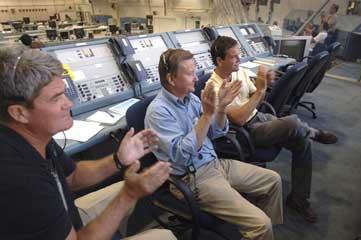
Mission managers applaud the successful landing of Space Shuttle Discovery at Edwards Air Force Base in California. (Image Credit: Bill Ingalls/NASA)Mission managers applaud the successful landing of Space Shuttle Discovery at Edwards Air Force Base in California. (Image Credit: Bill Ingalls/NASA)
+ Large Image (3008 x 2000, 300 ppi) --- + Medium Image (722 x 480, 72 ppi) --- + Small Image (361 x 240, 72 ppi)
Touchdown! Discovery makes a picture-perfect landing at Edwards Air Force Base in California at 8:11 a.m. EDT. (Image Credit: Carla Thomas/NASA)Touchdown! Discovery makes a picture-perfect landing at Edwards Air Force Base in California at 8:11 a.m. EDT. (Image Credit: Carla Thomas/NASA)
+ Large Image (3008 x 2000, 300 ppi) --- + Medium Image (722 x 480, 72 ppi) --- + Small Image (361 x 240, 72 ppi)

Source:
NASA more at or and or

President George W. Bush signs H.R. 6

President George W. Bush signs H.R. 6 FULL STREAMING VIDEO

President George W. Bush signs H.R. 6, The Energy Policy Act of 2005 at Sandia National Laboratory in Albuquerque, New Mexico, Monday, Aug. 8, 2005. White House photo by Eric Draper President George W. Bush signs H.R. 6, The Energy Policy Act of 2005 at Sandia National Laboratory in Albuquerque, New Mexico, Monday, Aug. 8, 2005. White House photo by Eric Draper. President Signs Energy Policy Act Sandia National Laboratory Albuquerque, New Mexico.
11:26 A.M. MDT Fact Sheet and In Focus: Energy or Gallery

THE PRESIDENT: Thank you all. Please be seated. Thanks very much for the warm welcome. I appreciate you treating a neighbor from Texas so kindly. (Laughter.) I'm really proud to be here with the men and women of the Sandia National Laboratory. We just had a fascinating tour of the facility. It was a little quick, but I learned a lot, and I want to thank Tom Hunter for his hospitality and his enthusiasm for the projects that go on here, and his praise for the people who work here.

I thank you for coming, and it's such an honor to be here. I know full well that the work you do here keeps our military strong, it keeps our nation competitive, and our country is really grateful for your dedication and for the fact that you lend your expertise into helping Americans.

It is such an honor to be in New Mexico, the home state of Pete Domenici, as well as Jeff Bingaman, to sign this bill. This bill will strengthen our economy and it will improve our environment, and it's going to make this country more secure. The Energy Policy Act of 2005 is going to help every American who drives to work, every family that pays a power bill, and every small business owner hoping to expand.

The bill is the result of years of effort. It is the result of good folks coming together, people who have made a commitment to deliver results for the American people. This bill launches an energy strategy for the 21st century, and I've really been looking forward to signing it. (Applause.)

I appreciate Pete Domenici's leadership on this bill. You know, he's the kind of fellow, when he makes up his mind to do something it's hard to stop him. And as Pete said, he's worked on a lot of energy bills in the past; some of them were signed by Presidents and some of them never made it to the desk. But he's been dogged in his determination to get a bill done, and he found a really find partner in Joe Barton.

Joe Barton did an outstanding job as the Chairman of the House Energy and Commerce Committee, and he did a really good job as the conference chairman. This bill is here in New Mexico because of the fine work of Joe Barton and Pete Domenici. (Applause.) And as Pete mentioned, Senator Jeff Bingaman gets a lot of credit, as well. (Applause.) He knows the subject matter in the bill, and he's a proven leader on issues such as conservation and efficiency and renewable fuels and research and development. And, Jeff, I, like Pete, I want to congratulate you for a job well done, and thank you for being here -- (applause.)

A member of the House Energy and Commerce Committee came on over -- Ralph Hall, a great Congressman from the state of Texas. Ralph is a good friend. I think he came just to grab a cup of coffee on Air Force One, but -- (laughter) -- I'm proud to have him alongside. Thanks for coming, Ralph, and thanks for your vote. (Applause.)

I appreciate Congressman Steve Pearce, from eastern New Mexico, joining us. He and his wife, Cynthia, are with us. Thanks for coming, Steve. Appreciate your support on this bill. Good work. Thank you. (Applause.) I put a good fellow to run the Energy Department in Sam Bodman. He's smart, he's capable, he's got a lot of experience, he knows what he's doing. He's going to be the right person to help implement this bill. (Applause.) And I want to thank Sam and his wife, Diane, for being here. Thank you all for coming.

I want to remind you about the fact that this economy of ours has been through a lot. And that's why it was important to get this energy bill done, to help us continue to grow. We've been through a stock market decline; we went through a recession; we went through corporate scandals; we had an attack on our homeland; and we had the demands on an ongoing war on terror. And to grow this economy, we worked together to put together an economic growth policy, an economic growth package, the cornerstone of which was to cut the taxes on the American people. And that tax relief plan is working. This economy is strong, and it's growing stronger. And what this energy bill is going to do, it's just going to help keep momentum in the right direction so people can realize their dreams.

Last week we had some good news that America added just over 200,000 jobs -- new jobs -- in the month of July. Since May of 2003, we've added nearly 4 million new jobs. More Americans are working today than ever before in our nation's history. (Applause.) Workers are taking more of what they earn -- taking home more of what they earn. Inflation is low, mortgage rates are low. Home ownership in America is at an all-time high. In other words, this economy is moving. And what this energy bill does is it recognizes that we need more affordable and reliable sources of energy in order to make sure the economy continues to grow.

It's an economic bill, but, as Pete mentioned, it's also a national security bill. For more than a decade, America has gone without a national energy policy. It's hard to believe, isn't it? We haven't had a strategy in place. We've had some ideas, but we have not had a national energy policy. And as a result, our consumers are paying more for the price of their gasoline, electricity bills are going up. We had a massive blackout two summers ago that cost this country billions of dollars and disrupted millions of lives. And because we didn't have a national energy strategy over time, with each passing year we are more dependent on foreign sources of oil.

Now, solving these problems required a balanced approach. And that's the spirit that Pete and Jeff and Joe took into the -- on to the floors of their respective bodies. They recognized that we need a comprehensive approach to deal with the situation we're in. In other words, we need to conserve more energy; we need to produce more energy. We need to diversify our energy supply, and we need to modernize our energy delivery. And so they worked hard and listened to a lot of good ideas, and they've taken really important steps.

Now, one of the things that I appreciate about the people on the stage here is that they were able to set aside kind of the partisan bickering that oftentimes -- too many times -- deadlocks Washington, D.C. In other words, they said, let's get something done for the good of the country. And that's an important spirit. That's what the American people expect. I know the people in New Mexico expect people to go up to Washington, D.C. and work together for the common good. And that's exactly what this bill has done.

These members, when they say they're going to strengthen our economy and protect our environment and help our national security, are telling it like it is. And let me tell you why. First, the bill makes an unprecedented commitment to energy conservation and efficiency -- an unprecedented commitment. The bill sets higher efficiency standards for federal buildings and for household products. It directs the Department of Transportation to study the potential for sensible improvements in fuel-efficiency standards for cars and trucks and SUVs. It authorizes new funding for research into cutting-edge technologies that will help us do more with less energy.

The bill recognizes that America is the world's leader in technology, and that we've got to use technology to be the world's leader in energy conservation. The bill includes incentives for consumers to be better conservers of energy. If you own a home, you can receive new tax credits to install energy-efficient windows and appliances. If you're in the market for a car, this bill will help you save up to $3,500 on a fuel-efficient hybrid or clean-diesel vehicle. And the way the tax credit works is that the more efficient the vehicle is, the more money you will save. Energy conservation is more than a private virtue; it's a public virtue. And with this bill I sign today, America is taking the side of consumers who make the choice to conserve.

Second, this bill will allow America to make cleaner and more productive use of our domestic energy resources, including coal, and nuclear power, and oil and natural gas. By using these reliable sources to supply more of our energy, we'll reduce our reliance on energy from foreign countries, and that will help this economy grow so people can work.

Coal is America's most abundant energy resource. It accounts for more than one-half of our electricity production. The challenge is to develop ways to take advantage of our coal resources while keeping our air clean.

When I ran for President in 2000, I promised to invest -- or asked the Congress to invest $2 billion over 10 years to promote clean coal technology. So far, working with the United States Congress, we've provided more than $1.3 billion for research in the innovative ways to improve today's coal plants and to help us build even cleaner coal plants in the future. And the bill I sign today authorizes new funding for clean coal technology so we can move closer to our goal of building the world's first zero emission coal-fired power plant. (Applause.)

Nuclear power is another of America's most important sources of electricity. Of all our nation's energy sources, only nuclear power plants can generate massive amounts of electricity without emitting an ounce of air pollution or greenhouse gases. And thanks to the advances in science and technology, nuclear plants are far safer than ever before. Yet America has not ordered a nuclear plant since the 1970s. To coordinate the ordering of new plants, the bill I sign today continues the Nuclear Power 2010 Partnership between government and industry. It also offers a new form of federal risk insurance for the first six builders of new nuclear power plants. With the practical steps in this bill, America is moving closer to a vital national goal. We will start building nuclear power plants again by the end of this decade. (Applause.)

Meeting the needs of our growing economy also means expanding our domestic production of oil and natural gas, which are vital fuels for transportation and electricity and manufacturing. The energy bill makes practical reforms to the oil and gas permitting process to encourage new exploration in environmentally sensitive ways.

The bill authorizes research into the prospects of unlocking vast amounts of now -- energy now trapped in shale and tar sands. It provides incentives for oil refineries to expand their capacity, and that's consumer-friendly. The more supply, the more reliable your gasoline will be and the more -- less pressure on price.

The bill includes tax incentives to encourage new construction of natural gas pipelines. It clarifies federal authority to site new receiving terminals for liquified natural gas, so that consumers across this nation can benefit from more affordable, clean-burning natural gas.

Thirdly, the bill I sign today will help diversify our energy supply by promoting alternative and renewable energy sources. The bill extends tax credits for wind, biomass, landfill gas and other renewable electricity sources. The bill offers new incentives to promote clean, renewable geothermal energy. It creates a new tax credit for residential solar power systems. And by developing these innovative technologies, we can keep the lights running while protecting the environment and using energy produced right here at home. When you hear us talking about less dependence on foreign sources of energy, one of the ways to become less dependent is to enhance the use of renewable sources of energy. (Applause.)

The bill also will lead to a greater diversity of fuels for cars and trucks. The bill includes tax incentives for producers of ethanol and biodiesel. The bill includes a flexible, cost-effective renewable fuel standard that will double the amount of ethanol and biodiesel in our fuel supply over the next seven years. Using ethanol and biodiesel will leave our air cleaner. And every time we use a home-grown fuel, particularly these, we're going to be helping our farmers, and at the same time, be less dependent on foreign sources of energy. (Applause.)

I used to like to kid, but I really wasn't kidding when I said, some day a President is going to pick up the crop report -- (laughter) -- and they're going to say we're growing a lot of corn, and -- or soybeans -- and the first thing that's going to pop in the President's mind is, we're less dependent on foreign sources of energy. It makes sense to promote ethanol and biodiesel. (Applause.)

The bill I sign today also includes strong support for hydrogen fuel technology. When hydrogen is used in a fuel cell, it can power consumer products from computers to cell phones to cars that emit pure water instead of exhaust fumes. I laid out a hydrogen fuel initiative, and I want to thank the members of Congress for adding to the momentum of this initiative through this energy bill.

The goal -- the goal of the research and development for hydrogen-powered automobiles is to make it possible for today's children to take their driver's test in a pollution-free car. (Applause.)

Fourth, the energy bill will help ensure that consumers receive electricity over dependable modern infrastructure. The bill removes outdated obstacles to investment in electricity transmission lines in generating facilities. The bill corrects the provision of the law that made electric reliability standards optional instead of mandatory. Most of you probably consider it mandatory that the lights come on when you flip a switch. (Laughter.) Now the utility companies will have to consider it mandatory, as well. (Laughter.)

To keep local disputes from causing national problems, the bill gives federal officials the authority to select sites for new power lines. We have a modern interstate grid for our phone line and our highways. With this bill, America can start building a modern 21st century electricity grid, as well.

The bill I sign today -- (applause) -- the bill I sign today is a critical first step. It's a first step toward a more affordable and reliable energy future for the American citizens. This bill is not going to solve our energy challenges overnight. Most of the serious problems, such as high gasoline costs, or the rising dependence on foreign oil, have developed over decades. It's going to take years of focused effort to alleviate those problems. But in about two minutes, we're going to have a strategy that will help us do that. (Applause.)

And as we work to solve our energy dependence -- dependency, we've got to remember that the market for energy is global and America is not the only large consumer of hydrocarbons. As the economies of nations like India and China grow rapidly, their demand for energy is growing rapidly, as well. It's in our interest to help these expanding energy users become more efficient, less dependent on hydrocarbons. You see, by helping them achieve these goals, it will take pressure off the global supply and it will help take pressure off price for American consumers.

And so, last month, I joined with the leaders of India and China and Australia and Japan and South Korea to create a new Asia Pacific Partnership on Clean Development. This is an innovative program which is authorized by this energy bill. And through it, our goal is to spread the use of clean, efficient energy technologies throughout the Pacific Rim. (Applause.)

After years of debate and division, Congress passed a good bill. It's my honor to have come to the great state of New Mexico to sign it. I'm confident that one day Americans will look back on this bill as a vital step toward a more secure and more prosperous nation that is less dependent on foreign sources of energy.

Thank you for coming. (Applause.)

(The bill is signed.) END 11:47 A.M. MDT

For Immediate Release Office of the Press Secretary August 8, 2005

more at
or and or and

Bird Flu Cases Increase

A bird flu patient receives care in Bac Mai hospital in Hanoi, Vietnam, July 11, 2005. (©AP/WWP) Bird Flu Cases Increase, Adding Credence to Warnings, Computer models aid in containment strategies if human pandemic erupts, By Charlene Porter, Washington File Staff Writer. Washington – The steady creep of a deadly form of avian influenza, or bird flu, lends further credence to warnings issued by international health officials for months that the H5N1 virus could trigger a worldwide flu pandemic.
Vietnam remains the nation most seriously affected with the appearance of bird flu in humans; officials there report, and the World Health Organization (WHO) confirms, three additional cases of human infection with the virus that has caused the deaths of hundreds of millions of poultry across Asia.

Vietnam has detected a total of 90 human cases of H5N1 since the disease first began to appear in the region in late 2003. Of those, 40 have died.

WHO’s official accounting of human cases issued August 5 tallies 112 in four nations – Vietnam, Thailand, Cambodia and Indonesia. After Vietnam, Thailand has confirmed the most avian influenza cases – 17 – while Indonesia is the most recent government to report a human death. A man who died July 12 had two young daughters who also became ill and subsequently died. Tests are still ongoing to determine whether H5N1 was the cause of the girls’ deaths.

As the human toll of the disease increases, so does the spread of the virus among bird populations. Russian animal health officials have reported to the World Organisation for Animal Health the appearance of H5N1 in three villages in Novosibirsk province.

This Russian region borders on Kazakhstan, where a strain of bird flu is also reported, according to news reports, but not yet confirmed as the highly dangerous H5N1 strain.

This strain infected humans for the first time in only 1997, health officials say, so immunity to it is virtually nonexistent in people. The pattern of human infection so far proves that the virus is not easily transmitted between humans. Most cases have been traced to close contact with infected birds.

Health authorities fear though that H5N1 will mutate to become more transmissible between humans. If that happens, in a world of rapid transit and globalized travel, experts say a flu pandemic could sweep from nation to nation with the potential death toll in the tens of millions, and economic and trade disruption of immense proportions.

Pandemic Research

A timely response with a targeted distribution of antiviral drugs could contain an epidemic and prevent a global spread, according to research published by international research teams. Using computer models, the research shows that pandemic could be prevented with a combination of carefully implemented public health measures introduced soon after the first cases appear.

Scientists in the United States, Hong Kong, Thailand and France produced the work as participants in a research network funded by the National Institute of General Medical Sciences (NIGMS), a component of the National Institutes of Health.

Two different computer models tested different outbreak scenarios, according to an August 3 NIGMS press release. One focused on 85 million people in Thailand and bordering regions of neighboring countries. Published in the magazine Nature, this study found that 3 million courses of antiviral drugs targeted for treatment of infected individuals and all their contacts – family, friends, schoolmates, coworkers, and shopkeepers – could have more than a 90 percent chance of stopping the virus.

A second computer model developed a scenario involving 500,000 people in rural Southeast Asia. Described in the magazine Science, this model applied similar treatment and response strategies to those of the first study, but also called for the pre-pandemic inoculation of the population with a flu vaccine, even though the vaccine would be considered low-efficacy. That is, it would be a vaccine of limited value because it would not have been specifically developed to target a rapidly emerging, previously unknown viral strain.

An inoculation campaign would help bolster the effectiveness of the other containment strategies such as quarantine and antiviral treatment according to the study. Under that scenario, the spread of the pandemic might be contained to less than one case per 1,000 people.

Further information on both
studies is available at the MIDAS (Models of Infectious Disease Agent Study) Web site.

more at
or and or and or

United States Transports Rwandan Civilian Police to Darfur

An 86th Airlift Wing C-130 Hercules transport on its way to Kigali, Rwanda, last July for a month-long airlift mission to the Darfur region of western Sudan. (U.S. Air Force photo)An 86th Airlift Wing C-130 Hercules transport on its way to Kigali, Rwanda, last July for a month-long airlift mission to the Darfur region of western Sudan. (U.S. Air Force photo)
U.S. Moves Rwandan Civilian Police to War-Torn Darfur, Action is part of larger NATO effort requested by African Union

Stuttgart-Vaihingen, Germany, Aug. 8, 2005 – A U.S.-contracted commercial aircraft moved 49 Rwandan civilian police officers from Kigali, Rwanda, to El Fashir airfield in the war-torn Darfur region of Sudan Aug. 7.

The move was in response to a request by the African Union to NATO. The movement of civilian police and AU peace monitors is part of an effort that began July 14, when 150 U.S. Air Force personnel from Germany and England deployed to provide logistical and airlift support of Rwandan forces as part of the African Union's expanded mission in Sudan, or AMIS II. The AU plans to increase its presence in the region to more than 7,700 personnel by September.

NATO officials notified the U.S. of the AU's desire to move the civilian officers on Aug. 5, Air Force Brig. Gen. Richard Mills, deputy director of the U.S. European Command Plans and Operations Center here, said.

"The AU wanted to move the civilian police into theater as quickly as possible," Mills said. "Once we were notified, a plan went into action to rapidly transport them, space available, in conjunction with the ongoing deployment of the second Rwandan military battalion."

As part of a larger NATO effort, the U.S. is airlifting three battalions of Rwandan troops to Darfur by mid September. Movement of the first battalion's 680 troops and 14,500 pounds of cargo began July 17 and was completed July 27 by U.S. Air Force C-17 and C-130 aircraft. The C-130s also returned 190 previously deployed Rwandan troops from El Fashir back to Kigali. Those U.S. aircraft and personnel have returned to home station.

Two additional Rwandan battalions of approximately 540 soldiers each are being flown via U.S.-contracted commercial airlift. Movement of the second battalion commenced on Aug 2 and finished Aug. 7. Planners at EUCOM anticipate the third Rwandan battalion will be flown to El Fashir around Sept. 10-19. A small number of U.S. military remain in Kigali to support the contracted movements.

President Bush on July 15 authorized an additional $6 million in emergency spending for the Defense Department to support the transportation of African Union forces to Darfur to help improve security and enable humanitarian assistance to relieve suffering to those displaced by conflict in the region.

(From a U.S. European Command news release.) United States Department of Defense, August 8, 2005], American Forces Press Service

Source
usinfo.state.gov/ more at or and or and

Iran: Crackdown on Ethnic Kurds

Question: What is our reaction to Iranian government crackdown on ethnic minority Kurds in northern party of country?

Answer: The United States is concerned by reports of an Iranian government crackdown on ethnic Kurds in northern Iran, and in Iran's southwestern province of Khuzestan. These reports indicate that several people have been killed and that many more, perhaps hundreds, may have been arrested.

Denial of the rights of minority groups is one aspect of the regime's appalling human rights and democracy record that has been well documented by non-governmental organizations and in our annual Country Report on Human Rights. We call on the Iranian authorities to exercise restraint and to respect the peaceful exercise by the Iranian people of their democratic rights.

2005/770 Released on August 8, 2005

Source:
state.gov Taken Question Office of the Spokesman Washington, DC August 8, 2005 Question Taken at the August 8, 2005 Daily Press Briefing

more at or and or and and

Monday, August 08, 2005

Judge John Roberts Replies to Senate Panel Questionnaire

Supreme Court nominee John Roberts completed questionnaire from the Senate Judiciary Committee. Roberts says if confirmed he'd respect settled law. The document will be reviewed by the Senate Judiciary Committee, which will be considering Roberts' nomination in September.

UNITED STATES SENATE COMMITTEE ON THE JUDICIARY GENERAL (PUBLIC)

1. Name: Fu1l name (include any former names used). John Glover Roberts, Jr.

2. Position: State the position for which you have been nominated. Associate Justice, Supreme Court of the United States

3. Address: List current office address. If state of residence differs from your place of employment, please list the state where you currently reside.

Office: E. Barrett Prettyman Courthouse, 333 Constitution Avenue, N.W. Washington, D.C. 20001

Residence: Maryland

4. Birthplace.: State date and place of birth. January 27,1955 Buffalo, New York

5. Marital Status: (include.maiden name of wife, or husband's name). list spouse's
occupation, employer's name and business address(es).Please also indicate the number
of dependent children. Married to Jane Sullivan Roberts, July 27, 1996.
Spouse's maiden name:. Jane Marie Sullivan
Spouse's occupation: Attorney
Spouse's employer: Pillsbury Winthrop Shaw Pittman L.L.P.
2300 N Street~N.W. Washington,D.C. 20037

Two dependent children.

Full Questionnaire in PDF format
John Roberts questionnaire from the Senate Judiciary Committee

more at
or and or

The Independent Inquiry Committee into the Iraq Oil-for-Food Programme

The Independent Inquiry Committee into the Iraq Oil-for-Food Programme (IIC) is ‎collecting and examining information relating to the administration and management of ‎the Oil-for-Food Programme, including allegations of fraud and corruption on the part of ‎United Nations officials, personnel and agents, as well as contractors, including entities ‎that have entered into contracts with the United Nations or with Iraq under the ‎Programme.‎

The IIC, which is chaired by Mr. Paul Volcker, can be contacted at:‎ Phone: + 1 877 442 3500
Fax: + 1 212 963 0956 Email:
info@iic-offp.org or iic-offp.org/

Alternatively, you can get in touch with the IIC through the Office of Internal Oversight Services (OIOS), which is the contact point at the United Nations for the IIC. OIOS can be contacted at:
dixonb@un.org

Third Interim Report In PDF format of The Independent Inquiry Committee into the Iraq Oil-for-Food Programme (IIC) The Conduct of Benon Sevan who headed up the $64 billion Iraq Oil-for-Food Program and Alexander Yakovlev, a former procurement officer for the UN

Sevan, a Cypriot, is accused of acting "in concert" to gain payments with Middle East Petroleum principals Fred Nadler. Yakovlev, a Russian, is named for acting with Yves Pintore, a French businessman, with soliciting and accepting illegal payments.

Paul Volcker, is a former head of the U.S. Federal Reserve Board, promises reports due in two months, on activities of others including UN head Kofi Annan and his son Kojo Annan.

more at
or and or and or

Seventh Anniversary of the 1998 Bombings in East Africa

Seventh Anniversary of the 1998 Bombings in East Africa

August 7th 2005 marks the seventh anniversary of the terrorist bombings of the U.S. embassies in Nairobi, Kenya and Dar es Salaam, Tanzania. More than 200 Americans, Kenyans, and Tanzanians died in these heinous attacks, and approximately 5,000 people were injured.

On this solemn occasion, we are reminded of the dangers faced by our diplomats and foreign service nationals abroad and their courage in confronting terrorists who target the innocent. We remember, too, the citizens of Tanzania and Kenya who suffered with us in this devastating tragedy. We honor the memory of our fallen colleagues and express our deepest sympathies to their families, the surviving victims, and the people of Kenya and Tanzania.

2005/767 Released on August 7, 2005 Press Statement, Adam Ereli, Deputy Spokesman, Washington, DC, August 7, 2005

more at
and or and

Secretary Condoleezza Rice The Death of Peter Jennings

The Death of Peter Jennings, Secretary Condoleezza Rice, Washington, DC, August 8, 2005

I am saddened by the death of my close, personal friend Peter Jennings. To Peter's wife and family, we offer our deepest sympathies and heartfelt condolences. He will be deeply missed.

Peter Jennings represented all that was best in journalism and public service. A man of conscience and integrity, his reporting was a guide to all of us who aspire to better the world around us. I learned from him and was inspired by him.

2005/768, Released on August 8, 2005

more at
and

Statement by the President on Death of Peter Jennings

Statement by the President on Death of Peter Jennings
Texas State Technical College, Waco, Texas, 9:52 A.M. CDT

THE PRESIDENT: Laura and I were saddened to learn about the death of Peter Jennings. Peter Jennings had a long and distinguished career as a news journalist. He covered many important events, events that helped define the world as we know it today. A lot of Americans relied upon Peter Jennings for their news. He became a part of the lives of a lot of our fellow citizens, and he will be missed. May God bless his soul.

Thank you.

END 9:53 A.M. CDT For Immediate Release, Office of the Press Secretary, August 8, 2005

more at
and

Sunday, August 07, 2005

extinction of giant ground sloths

Study shows big game hunters, not climate change, killed off sloths

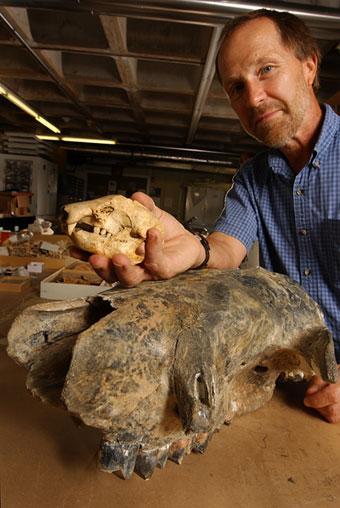
GAINESVILLE, Fla. --- On Tuesday, Aug. 2, 2005, University of Florida ornithologist David Steadman holds the skull of an extinct ground sloth that was uncovered from a cave in Haiti. In the foreground is a much larger sloth skull that was found in Ormond Beach, Fla. The giant skull belonged to an animal that weighed at least three tons and lived about 15,000 years ago, while the smaller sloth, which may have lived in trees as well as on the ground, weighed between 10 and 15 pounds and dates from 5,000 to 6,000 years ago. Steadman’s finding that prehistoric big game hunters and not the last ice age are the likely culprits in the extinction of giant ground sloths and other North American great mammals is the subject of a paper published in the Proceedings of the National Academy of Sciences this week. Both skulls are now housed in the Florida Museum of Natural History on the UF campusGAINESVILLE, Fla. --- On Tuesday, Aug. 2, 2005, University of Florida ornithologist David Steadman holds the skull of an extinct ground sloth that was uncovered from a cave in Haiti. In the foreground is a much larger sloth skull that was found in Ormond Beach, Fla.
The giant skull belonged to an animal that weighed at least three tons and lived about 15,000 years ago, while the smaller sloth, which may have lived in trees as well as on the ground, weighed between 10 and 15 pounds and dates from 5,000 to 6,000 years ago. Steadman’s finding that prehistoric big game hunters and not the last ice age are the likely culprits in the extinction of giant ground sloths and other North American great mammals is the subject of a paper published in the Proceedings of the National Academy of Sciences this week. Both skulls are now housed in the Florida Museum of Natural History on the UF campus.

GAINESVILLE, Fla. — Prehistoric big game hunters and not the last ice age are the likely culprits in the extinction of giant ground sloths and other North American great mammals such as mammoths, mastodons and saber-toothed tigers, says a
University of Florida researcher.

Determining whether the first arrival of humans or the warm-up of the American continent at the end of the last Ice Age was responsible for the demise of prehistoric sloths has puzzled scientists because both events occurred at the same time, about 11,000 years ago. But by using radiocarbon to date fossils from Cuba and Hispaniola, where humans appeared later than on the North American continent, long after the last Ice Age occurred, UF ornithologist
David Steadman was able to separate the two events.

He and his colleagues found the last record of West Indian ground sloths coincided with the arrival of humans 4,400 years ago. The results are published in a
Proceedings of the National Academy of Sciences paper this week.

“If climate were the major factor driving the extinction of ground sloths, you would expect the extinctions to occur at about the same time on both the islands and the continent since climate change is a global event,” Steadman said.

Gary Haynes, anthropology professor at the University of Nevada, Reno, said Steadman’s study “clearly shows that ground sloth extinctions in the New World didn’t happen after serious changes in climate or vegetation – and that the first appearance of humans must have been the decisive factor.”

The fossil record shows the people who arrived in North America were making sophisticated tools out of stone, bone and ivory, Steadman said. These “big-game hunters” had a traumatic effect on the animals living there, he said.

More than three-fourths of the large species of mammals that roamed the North American landscape became extinct within a few thousand years, which, besides ground sloths, included mammoths, mastodons, saber-toothed tigers and giant bears, Steadman said.

“It was as dramatic as the extinction of the dinosaurs 65 million years ago,” he said.

By understanding when, and to some extent how, ground sloths became extinct, scientists may be able to determine the biological potential of an area for restoration if human contact could be eliminated, such as in a national forest, a national park or an island, Steadman said.

“I’m not a Steven Spielberg type in that I don’t believe that DNA would bring these things back,” he said. “But in lieu of Jurassic Park, I think we can come up with sound ideas using the nearest living relatives. For example, we might want to consider taking living tree sloths and introducing them to protected forested areas on Cuba or Hispaniola.”

While the largest of the prehistoric ground sloths grew to the size of a modern elephant and fed on bushes and the leaves of lower branches of trees, today’s only surviving descendants are several small tree sloths whose range extends from southern Mexico to southern Brazil, he said.

Such an experiment might be similar to the one that involved restoring bison, once native to Florida, to
Paynes Prairie Preserve State Park near Gainesville, Steadman said. “With the work we’re doing, especially on islands, to reconstruct which kinds of plants and animals — particularly birds and mammals — used to live there, we can open up possibilities for restoring parts of these islands to something near their original condition,” he said.

The only reason the living species of sloths survive is that they live high up in trees, where their green-algae-colored fur camouflages them, Steadman said. “God save the sloth that comes down to the ground because usually somebody is there to kill it,” he said.

For the study, Steadman sent samples from the large collection of ground sloth skeletons at the
Florida Museum of Natural History on the UF campus, to Paul Martin, a professor emeritus of geosciences at the University of Arizona, for radiocarbon dating.

Steadman said he was not surprised to find that humans were more significant than changes in climate because most species of plants and animals can adjust to changes in temperature. However, the transition between the glacial and inter-glacial period, which resulted in shifts in habitat and the ranges of plants, may have made animal species more vulnerable than they otherwise would have been, he said.

“This is the first time it’s been demonstrated for West Indian ground sloths, and West Indian ground sloths are sort of the poster child of big extinct West Indian mammals,” he said. “I think this will go a long way to finally put to rest this whole idea that large extinct animals from the West Indies died out in the Ice Age during the Pleistocene Epoch.”-30-

Credits, Writer: Cathy Keen,
ckeen@ufl.edu, (352) 392-0186 Source: David Steadman, dws@flmnh.ufl.edu, (352) 392-1721 Contact the UF News Desk staff. Resources for reporters

more at
or and or and or

placental tissue, embryonic stem cells

Discarded placentas deliver researchers promising cells similar to embryonic stem cells

PITTSBURGH, Aug. 5 – Routinely discarded as medical waste, placental tissue could feasibly provide an abundant source of cells with the same potential to treat diseases and regenerate tissues as their more controversial counterparts, embryonic stem cells, suggests a University of Pittsburgh study to be published in the journal Stem Cells and available now as an early online publication in Stem Cells Express.
A part of the placenta called the amnion, or the outer membrane of the amniotic sac, is comprised of cells that have strikingly similar characteristics to embryonic stem cells, including the ability to express two key genes that give embryonic stem cells their unique capability for developing into any kind of specialized cell, the researchers report. And according to the results of their studies, these so-called amniotic epithelial cells could in fact be directed to form liver, pancreas, heart and nerve cells under the right laboratory conditions.

"If we could develop efficient methods that would allow amnion-derived cells to differentiate into specific cell types, then placentas would no longer be relegated to the trashcan. Instead, we'd have a useful source of cells for transplantation and regenerative medicine," said senior author Stephen C. Strom, Ph.D., associate professor of pathology at the University of Pittsburgh School of Medicine and a researcher at the university's McGowan Institute for Regenerative Medicine.

According to U.S. census figures, there are more than 4 million live births each year. For each discarded placenta, the researchers calculate there are about 300 million amniotic epithelial cells that potentially could be expanded to between 10 and 60 billion cells relatively easily.

"Provided that research advances to the point that we can demonstrate these cells' true therapeutic benefit, parents could conceivably choose to bank their child's amniotic epithelial cells in the event they may someday be needed, as is sometimes done now with umbilical cord blood," commented Dr. Strom.

The amnion is derived from the embryo and forms as early as eight days after fertilization, when the fate of cells has yet to be determined, and serves to protect the developing fetus. According to the researchers' studies using placentas from full-term pregnancies, amniotic epithelial cells have many of the telltale surface markers that define embryonic stem cells, and also express the Oct-4 and nanog genes that are known to be required for self-renewal and pluripotency – the ability to develop into any type of cell.
Yet the authors are careful to point out that despite their remarkable similarities to embryonic stem cells, amniotic epithelial cells are not stem cells per se, because they can't grow indefinitely. This may be due to the fact that these amnion-derived cells do not express a certain enzyme, called telomerase, that is important for normal DNA and chromosome replication, and by extension, ultimately, cell division.

"Perhaps it's to their advantage that the amnion epithelial cells lack telomerase expression, because telomerase is associated with many cancers and one of the main concerns about stem cell therapies is that transplanted stem cells would replicate in the recipient to form tumors," noted Toshio Miki, M.D., Ph.D., first author of the paper and an instructor in the department of pathology at the School of Medicine.

To help determine if amnion-derived cells that are delivered directly to tissues would cause tumors, the researchers conducted studies in immune system-deficient mice and found no evidence that tumors had developed seven months after the cells were injected into multiple sites.

While amniotic epithelial cells do not share the same capacity for unlimited replication as do embryonic stem cells, they still can double in population size about 20 times over without needing another cell type serving as a feeder cell layer. This is significant, because to replicate, the currently available embryonic stem cell lines require a bed of mouse cells, traces of which can end up in each new generation of stem cells. Amniotic epithelial cells, on the other hand, create their own feeder layer, with some cells choosing to spread out at the bottom of the culture dish thereby giving those cells just above them the best environment for replicating and for retaining their stem cell characteristics.
With the addition of various growth factors, the authors report the amnion-derived cells could differentiate to become liver cells, heart cells, the glial and neuronal cells that make up the nervous system, and pancreatic cells with genetic markers for insulin and glycogen production.

"In this first paper we sought to determine if amniotic epithelial cells have the potential to differentiate into many different cell types rather than focusing on ways for optimizing this potential for a specific cell type. Further studies will be required to better understand if and how they may be useful in a clinical setting," Dr. Strom added.

The researchers say their original motivation was, and still is, to identify cells with the same therapeutic promise as embryonic stem cells. To this end, they began looking at the viability of amnion as a cell source in late 2001, obtaining discarded placentas from full-term births under an Institutional Review Board-approved protocol. In 2002, the University of Pittsburgh licensed the technology to a company now called Stemnion, LLC, and as part of the agreement, and in keeping with university patent policy, Drs. Strom and Miki will receive license proceeds. Both have served as paid consultants and hold equity in Stemnion.

The research was supported by the Alpha-1 Foundation and the National Institute of Diabetes and Digestive and Kidney Diseases, a part of the National Institutes of Health. In addition to Drs. Miki and Strom, other authors are Thomas Lehmann, Ph.D., and Hongbo Cai, M.D., Ph.D., both from the department of pathology, and Donna Stolz, Ph.D., of the department of cell biology and physiology. ###

Contact: Lisa Rossi
RossiL@upmc.edu Phone: 412-647-3555 Fax: 412-624-3184 Jocelyn Uhl UhlJH@upmc.edu Phone: 412-647-3555F ax: 412-624-3184 University of Pittsburgh Medical Center

more at
or and or and

Smoking gun for Alzheimer's disease

Smoking gun for Alzheimer's disease

In a world first, Australian researchers have found a toxin that plays an important role in the progression of Alzheimer's disease (AD), the most common cause of dementia.

The research is significant because drugs that are in the advanced developmental phase for other conditions might be able to be used on Alzheimer's patients, to halt the disease progressing. At present, there are only minimally effective treatments for the condition, which is increasing with the ageing population.

"We found that all of the brains of dementia patients showed quinolinic acid neurotoxicity," said Professor Bruce Brew, Director of Neurology at St Vincent's Hospital and Professor of Medicine at the University of New South Wales (UNSW). "This acid kills nerve cells in the brain, leading to brain dysfunction and ultimately death."

There are currently more than 200, 000 people with Alzheimer's disease in Australia. The number will exceed 730, 000 by 2050.

"Quinolinic acid is part of a biochemical pathway called the kynurenine pathway," said the lead author of the research, UNSW's Dr Gilles Guillemin, who is based at the Centre for Immunology at St Vincent's Hospital. "The activation of that pathway is also found in other major brain diseases including Huntington's disease, stroke, dementia and schizophrenia."

The paper Indoleamine 2, 3 dioxygenase and quinolinic acid Immunoreactivity in Alzheimer's disease hippocampus has been published this week in the leading international journal Neuropathology and Applied Neurobiology. It is the result of collaboration between researchers from St Vincent's Hospital, UNSW, the University of Sydney and Hokkaido University, Japan.

"There are several drugs which can block this pathway, which are already under investigation by our laboratory and others," said Dr Guillemin.

The drugs, which would need to be tested for efficacy, could be used to complement other treatments.

"Quinolinic acid may not be the cause of Alzheimer's disease, but it plays a key role in its progression," said Alzheimer's researcher, Dr Karen Cullen from the University of Sydney. "It's the smoking gun, if you like.

"While we won't be able to prevent people from getting Alzheimer's disease, we may eventually, with the use of drugs, be able to slow down the progression."

The other researchers are Claire Noonan from Sydney University and Osamu Takikawa from Hokkaido University, Japan. ###

Contact: Susi Hamilton, UNSW media unit, tel. +61 2 9385 1583 or +61 (0) 422 934 024; David Faktor, Public Affairs SV&MHS on +61 2 8382 2866 or +61 (0) 405 497 510 Contact: Susi Hamilton
susi.hamilton@unsw.edu.au 61-2-9385-1583 Research Australia

more at
or and or and

black holes

Voracious black holes hide their appetite in dusty galaxies

Image of an obscured data from combined data sources. The object has been named AMS08. Credit:NASA/JPL-Caltech/A. Martinez-Sansigre (University of Oxford)/NRAOA UK-led team of astronomers reports today (August 4th) in Nature that they have tracked down an elusive population of black holes growing rapidly hidden behind clouds of dust. Download Full High Resolution Image
Their results suggest that most black hole growth takes place in dusty galaxies, solving astronomer's headaches, as until now, the cosmic x-ray background suggested the existence of more growing black holes than they could find.

Growing black holes, known as quasars, are some of the brightest objects in the Universe and are seen by the light emitted as gas and dust spiral into the black hole. Quasars are situated in the inner-most regions of galaxies and can consume the equivalent mass of between ten and a thousand stars in one year! Astronomers believe that all quasars are surrounded by a dusty ring which hides them from sight on Earth in about half of cases.

However, examining the cosmic x-ray background, which is made up primarily of the emissions from quasars, astronomers realised that there should be many more obscured quasars than currently known. Objects surrounded by dust are hard to see with visible light, so the astronomers looked at infrared wavelengths, which are less likely to be reflected away. Using NASA's Spitzer Space Telescope's First Look Data, they were able to find a new population of obscured quasars. The new quasars have no spectra that can be seen and are thought to be hidden behind the dust of the galaxy itself rather than just a dust ring. The presence of lots of dust in a galaxy indicates that stars are still forming there. The researchers found 21 examples of these lost quasars in a relatively small patch of sky. All of the objects were confirmed as quasars by the National Radio Astronomy Observatory's Very Large Array radio telescope, New Mexico, and the Particle Physics and Astronomy Research Council's William Hershel Telescope on La Palma.

Alejo Martinez-Sansigre from the University of Oxford explains "We were missing a large population of obscured quasars, which had been inferred from studies at X-ray frequencies. This newly discovered population is large enough to account for the X-ray background, and now we wish to find out why there are more obscured quasars than unobscured ones".

From their study, the team believes that there are more quasars hidden by dust than not and that most black holes grow in short, efficient bursts at the heart of growing galaxies.

Professor Richard Wade, Chief Executive of the Particle Physics and Astronomy Research Council which supports the University of Oxford Astrophysics group said "The new population of Quasars suggest that throughout cosmic history most black holes grow in the heart of dusty active galaxies with stars still forming."

Notes for Editors

1. NASA's Jet Propulsion Laboratory (JPL) manages the Spitzer Space Telescope mission for NASA's Science Mission Directorate, Washington. Science operations are conducted at the Spitzer Science Center at the California Institute of Technology (Caltech) in Pasadena, Calif. JPL is a division of Caltech. Additional information about the Spitzer Space Telescope is available on the
website.

2. The Isaac Newton Group of Telescopes (ING) is an establishment of the Particle Physics and Astronomy Research Council (PPARC) of the United Kingdom, the Nederlandse Organisatie voor Wetenschappelijk Onderzoek (NWO) of the Netherlands and the Instituto de Astrofísica de Canarias (IAC) in Spain. The ING operates the 4.2-metre William Herschel Telescope, the 2.5-metre Isaac Newton Telescope, and the 1.0-metre Jacobus Kapteyn Telescope. The telescopes are located in the Spanish Roque de Los Muchachos Observatory on La Palma, Canary Islands, which is operated by the Instituto de Astrofísica de Canarias (IAC).

3. The paper can be viewed online
here.

Contacts
Julia Maddock PPARC Press Office Tel +44 1793 442094
Alejo Martinez-Sansigre University of Oxford Tel +44 1865 273 337
NASA Contact
Whitney Clavin Jet Propulsion Laboratory, Pasadena, California Tel +1 818-354-4673 Chris Willott National Research Council Canada Tel +1 250 363 8103 About PPARC

more at
or and or and

universal flu vaccine

VIB signs cooperation agreement for the development of a new, universal flu vaccine

Ghent, Belgium – This week the Flanders Interuniversity Institute for Biotechnology (VIB) has entered into an agreement with the British company Acambis for the development of a new flu vaccine. Together VIB and Acambis want to develop a universal flu vaccine that offers protection from all flu variants. Furthermore this vaccine will not need to be renewed annually. VIB researchers linked to the Ghent University - led by Walter Fiers, professor Molecular Biology and former director of one of the Ghent VIB departments - carried out the research on which this new flu vaccine is based.

Flu, not an innocent illness...

Flu is an acute infection of the bronchial tubes and is caused by the flu virus. Flu is extremely contagious and makes you feel really ill. In addition, flu can have extremely serious consequences: on average 1,500 people die of flu in Belgium annually. There were even as many as 4,500 flu victims during the winter period of 1989 and 1990. According to the World Health Organization, on average 10 to 20% of the world's population is infected by flu every year. This leads to 3 to 5 million hospitalizations and 250 000 to 500 000 deaths a year.

What makes the influenza virus so special?

The outer coating of the influenza virus changes gradually, making the virus invisible to the antibodies that were built up during an earlier infection or vaccination; after all, these antibodies are aimed at the changeable proteins of the outer coating. Since no one as yet has antibodies, the slightly altered virus can easily set off a new epidemic. Thus far no vaccine has been developed against influenza that lasts for a lifetime, in contrast to diseases as polio, hepatitis B or measles.

Flu, prevention is better...

Vaccination offers the most efficient protection to flu. The present flu vaccines are a mixture of three vaccines, each offering protection to a certain virus strain. Vaccination reduces death and the amount of hospitalizations as a result of flu considerably. The government strongly advises flu vaccination for those over 60 years old, diabetes patients, people with diminished resistance or chronic kidney, heart and lung disorders. However, everyone can consider vaccination: it will give you 80% less chance of getting the flu next winter.

No more annual renewal thanks to new research?

VIB and the British company Acambis are collaborating on the development of a universal flu vaccine that offers protection to all flu variants. Moreover, the vaccine would not require annual adaptations to the virus changes. This is because the candidate vaccine uses the M2e-domain. This domain is strongly conserved, and nearly identical in all human virus strains, also those that caused the pandemics in the previous century. As a consequence, people can be vaccinated long before a new pandemic breaks out.

This innovative vaccine is currently in a preclinical phase. It is not longer produced by the growth of viruses, but the active component is produced in bacteria. Therefore the production process will be more effective, safer and cheaper.

Walter Fiers, co-inventor (UGent and VIB):

'The structure of M2e is almost identical in all known flu viruses that can be transmitted between people. We indicated that the M2e vaccine offers full protection to flu without side effects in mice. This way vaccination against all human flu viruses is possible, not only against viruses returning yearly, but even against future epidemics. Through our cooperation with Acambis we can continue the development of this promising vaccine.'

Cooperation between VIB and Acambis

Professor Walter Fiers and his team carried out the research on which the collaboration between VIB and Acambis is based. Acambis recently acquired an influenza A vaccine candidate from Apovia, a US company. Apovia had originally obtained the necessary technology for the development of the vaccine from VIB. Through the research collaboration with VIB, together with internal research, Acambis enters the flu vaccine market, one of the most significant vaccine markets.

Gordon Cameron, CEO (Acambis):

'This programme gives Acambis the opportunity to enter one of the most significant vaccine markets - influenza. The recent influenza vaccine shortages have highlighted the inadequacies of current influenza vaccines and their manufacturing methods. Through the collaboration with VIB we get the chance to develop the ultimate vaccine that will offer protection against all flu virus variants and reduce the annual redesign of the vaccine.' ###

Background information

How do influenza vaccines work?

Each year the World Health Organization determines which three influenza viruses are the most likely to cause an influenza epidemic during the next winter period. These candidates are used for the production of a vaccine. These days influenza vaccines are prepared by growing viruses on chicken embryos or in cultures of animal cells. Then proteins originating from the outer coating of the virus are purified from the harvested viruses and used as vaccine. After inoculation, the human immune system creates antibodies. After a few weeks, sufficient antibodies have been produced and will neutralize the viruses in case of an infection. Since new species of viruses that have slightly altered proteins on their outer coatings appear nearly every year, injection must be repeated every year.

Pandemics, a tremendous threat

A new human influenza virus in which the outer coating is drastically altered appears a few times every century. This new virus spreads lightning-fast around the entire world, since no one has yet been able to build up antibodies against it. Such a worldwide epidemic or pandemic can contaminate up to 50% or more of the world population. In the last century there was the Asian flu, the Hong Kong flu and above all the Spanish flu. During the period between 1917 and 1920 the latter was responsible for over 50 million victims.

Pandemic viruses occur when the genetic material originating from a fowl plague virus is mixed with that of a human influenza virus. This is why the World Health Organization has followed the recent epidemics caused by the fowl plague virus of the type H5N1 in the Far East with an extremely watchful eye.

The virus species that will cause the next pandemic is not known, so no vaccine can be produced against it in advance. Only after a pandemic has burst into action, the responsible virus can be identified and a suitable vaccine can be developed. It will take some 6 to 9 months before the vaccine is ready for use. 'Optimistic' predictions speak of two million deaths worldwide and 20,000 deaths in Belgium.

Contact: Karine Clauwaert
karine.clauwaert@vib.be 32-9-244-6611 VIB, Flanders Interuniversity Institute of Biotechnology

more at
or and or and or

Saturday, August 06, 2005

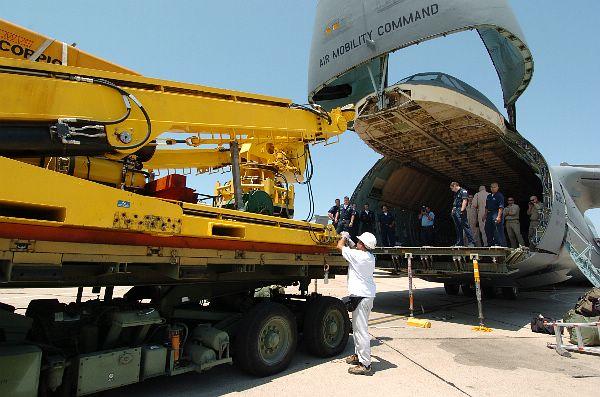
ROV Super Scorpio is loaded aboard an Air Force C-5.

050805-N-8629M-106 Naval Air Station North Island, San Diego, Calif.(Aug. 5, 2005) – Sailors assigned to the U.S. Navy's Deep Submergence Unit, Naval Base Coronado, make preparations to load 'Super Scorpio,' a robotic rescue vehicle aboard an Air Force C-5 Galaxy aircraft. The Navy is transporting two of the remotely operated vehicles in an effort to assist the rescue of seven Russian Sailors trapped on the ocean floor in a mini-submarine off the Kamchatka Peninsula. The Super Scorpios and a team of U.S. Navy technicians are to be flown from San Diego to Petropavolvsk, and then transported by truck to be embarked on a Russian ship before making a descent to the stranded submarine. U.S. Navy photo by Photographer's Mate 3rd Class Rebecca J. Moat (RELEASED)050805-N-8629M-106 Naval Air Station North Island, San Diego, Calif.(Aug. 5, 2005) – Sailors assigned to the U.S. Navy's Deep Submergence Unit, Naval Base Coronado, make preparations to load 'Super Scorpio,' a robotic rescue vehicle aboard an Air Force C-5 Galaxy aircraft.
The Navy is transporting two of the remotely operated vehicles in an effort to assist the rescue of seven Russian Sailors trapped on the ocean floor in a mini-submarine off the Kamchatka Peninsula. The Super Scorpios and a team of U.S. Navy technicians are to be flown from San Diego to Petropavolvsk, and then transported by truck to be embarked on a Russian ship before making a descent to the stranded submarine. U.S. Navy photo by Photographer's Mate 3rd Class Rebecca J. Moat (RELEASED) Download Full High Resolution Image

more at
or and or and and

Belize Proliferation Security Initiative Ship Boarding Agreement

The United States and Belize Proliferation Security Initiative Ship Boarding Agreement

On Thursday, August 4, 2005, the United States and Belize signed a reciprocal Ship Boarding Agreement in support of the Proliferation Security Initiative (PSI). Belizean Ambassador to the U.S. Lisa Shoman signed the agreement on behalf of Belize and Assistant Secretary Stephen Rademaker signed on behalf of the United States.

The Proliferation Security Initiative was announced by President Bush on May 31, 2003, and is aimed at establishing cooperative partnerships worldwide to prevent the flow of weapons of mass destruction, their delivery systems, and related materials to and from states and non-state actors of proliferation concern. Proliferation Security Initiative partners marked the recent second anniversary of the Initiative through a series of activities, including exercises in the Czech Republic and Spain and an event hosted by Secretary Rice on May 31 for the Washington diplomatic corps.

The ship boarding agreement signed by the U.S. and Belize will facilitate cooperation between the two countries to prevent the maritime trafficking of proliferation-related shipments by establishing points of contact and procedures to expedite requests to board and search suspect vessels in international waters. If a U.S.- or Belizean-flagged vessel is suspected of trafficking proliferation-related cargo, either Party to this agreement can request authorization to board, search, and possible detain the other’s vessel and its cargo. The agreement does not apply to the vessels of third states.

Belize is the first CARICOM (Caribbean Community and Common Market) member state and the sixth country in total to sign a Ship Boarding Agreement with the U.S in support of the Proliferation Security Initiative; we have concluded similar agreements with Liberia, Panama, the Marshall Islands, Croatia and Cyprus. The combination of states with which we have signed bilateral ship boarding agreements, plus the commitments made by other Proliferation Security Initiative partners under the Statement of Interdiction Principles, translates into more than 60 percent of the global commercial shipping fleet dead weight tonnage now being subject to rapid action consent procedures for boarding, search, and seizure.

Signing the ship boarding agreement demonstrates the commitment of Belize and the United States to ensuring the highest standards of security for their flag registries. This reciprocal agreement also sends a clear message to proliferators that neither the U.S. nor Belize will tolerate the involvement of their vessels in the trade of proliferation-related cargoes. We believe that ship boarding agreements in support of the Proliferation Security Initiative simultaneously deter proliferators and attract legitimate commercial shipping interests that want to ensure their goods are transported under a reputable and responsible flag, which is not "misused" to transport illicit proliferation-related shipments.

For additional information on the Proliferation Security Initiative, please see
state.gov/. 2005/761 Media Note
Office of the Spokesman, Washington, DC, August 4, 2005

more at
and or and and or

Coastal Zone Management Act of 1972

Memorandum for the Secretary of Commerce ,SUBJECT: Assignment of Reporting Function

By virtue of the authority vested in me as President by the Constitution and the laws of the United States, including section 301 of title 3, United States Code, I hereby assign to you the functions of the President under section 316 of the
Coastal Zone Management Act of 1972, as amended (16 U.S.C. 1451, et seq.).

You are authorized and directed to publish this memorandum in the Federal Register.

GEORGE W. BUSH

# # # For Immediate Release, Office of the Press Secretary, August 5, 2005

more at
or and