


Belarus Incident with U.S. Diplomat
Question: Regarding the detention of the U.S. diplomat in Gomel on August 23, 2005, did the Belarusians give any reasons for detaining the U.S. diplomat in the city of Gomel? If so, what reasons? What was the U.S. response?
Answer: Police entered a routine meeting this U.S. diplomat was having with representatives of non-governmental organizations. They refused to permit the diplomat to leave for forty minutes, without offering any clear explanation, except for an alleged need to check his identification.
We have made our concerns about this incident known to Belarusian officials both in Minsk and in Washington. Belarusian officials indicated they will look into the matter and provide us more information, but they have not yet given a full explanation.
We continue to press the Government of Belarus to respect civil society and to uphold its international commitments to human rights.
2005/808, Released on August 25, 2005
Taken Question Office of the Spokesman Washington, DC August 24, 2005 Question Taken at the August 24, 2005 Daily Press Briefing
more at Belarus or Gomel and Eastern Europe or Department of State and State Department
Thursday, August 25, 2005
Belarus Incident with U.S. Diplomat
0
comments
||
||

President to nominate three 08/25/05
President George W. Bush today announced his intention to nominate three individuals to serve in his Administration:
The President intends to nominate James M. Andrew, of Georgia, to be Administrator, Rural Utilities Service at the Department of Agriculture. Mr. Andrew currently serves as a consultant for BAS, Inc., in Waynesboro, Georgia. From 1978 until 1999, he owned and operated the company, which designs and services agricultural irrigation systems. Earlier in his career, he was a Regional Marketing Manager for the Federal Pacific Electric Co. Mr. Andrew received his bachelor's degree from the University of Alabama.
The President intends to nominate David B. Dunn, of California, to be Ambassador Extraordinary and Plenipotentiary of the United States of America to the Togolese Republic. A career member of the Senior Foreign Service, Mr. Dunn currently serves as the U.S. Consul General in Johannesburg, South Africa. Prior to that assignment, he served as Ambassador to the Republic of Zambia. Earlier in his career, Mr. Dunn was Director of the Office of East African Affairs at the Department of State. He received his bachelor's degree from Occidental College, his first master's degree from American University, and his second master's degree from the National War College.
The President intends to nominate Dale W. Meyerrose, of Indiana, to be Chief Information Officer at the Office of the Director of National Intelligence. Major General Meyerrose is Director of Command Control Systems and Chief Information Officer for Headquarters North American Aerospace Defense Command. He also assumes the positions of Director of Architectures and Integration as well as Chief Information Officer for Headquarters United States Northern Command. General Meyerrose first entered the United States Air Force in 1975 after receiving his bachelor's degree from the United States Air Force Academy. He has served in a number of information related positions at Air Force Bases across the United States and overseas, including Director of Communications for Operation Southern Watch in Riyadh, Saudi Arabia. General Meyerrose graduated from the National War College and received his master's degree from the University of Utah.
# # # For Immediate Release, Office of the Press Secretary,August 25, 2005, Personnel Announcement
more at President Bush or Department of Agriculture and Togo or Africa and National Intelligence
0
comments
||
||
25th Anniversary of the Solidarity Movement
Presidential Delegation to Gdansk, Poland for 25th Anniversary of the Solidarity Movement
President George W. Bush today announced the designation of a Presidential Delegation to Gdansk, Poland to attend the 25th Anniversary of the Solidarity Movement on August 31, 2005.
The Honorable James A. Baker III, former Secretary of State, will lead the delegation.
Members of the Presidential Delegation are:
The Honorable Victor Ashe, U. S. Ambassador to Poland The Honorable Daniel Fried, Assistant Secretary of State for European and Eurasian Affairs The Honorable Hank Brown, President of the University of Colorado System and former U.S. Senator Mrs. Irena Kirkland, widow of former AFL-CIO President Lane Kirkland
### For Immediate Release, Office of the Press Secretary, August 24, 2005
more at Solidarity and Poland and Gdansk or President Bush
0
comments
||
||
Wednesday, August 24, 2005
Macedonia and Official Language
Macedonia and Official Language
Question: U.S. reaction to Macedonia Prime Minister’s rejection of request from Albanian community to designate Albanaian as the official second language for Macedonia? Is this a violation of the Ohrid Agreement?
Not aware of any such statement by the Prime Minister of Macedonia regarding official national languages. Press reports that the Prime Minister has stated that he is opposed to the use of Albanian as an official language in the military
The Government of Macedonia is in the process of preparing a language law that addresses Ohrid Framework Agreement provisions for the use of languages other than the Macedonian language.
This is an issue to be worked out by the government and parliament of Macedonia.
The Framework Agreement has no specific provisions with regard to language usage in the police and military. This too is an issue for the government and parliament of Macedonia to decide, in the spirit of the Framework Agreement.
2005/806
Released on August 23, 2005
Taken Question Office of the Spokesman Washington, DC August 24, 2005 Question Taken at the August 23, 2005 Daily Press Briefing
more at Macedonia or Albanian and Ohrid Agreement or Department of State and State Department
0
comments
||
||
Turkey’s Handling of its Kurds
Turkey’s Handling of its Kurds
Question: Turkey Prime Minister Erdogan "admitted that Turkey had mishandled its rebellious Kurds", saying democracy, not oppression, is what is needed. Any comment on this remarks in the context of Turkey's human rights practices/policies?
Answer: The United States has long supported Turkey’s democratization efforts as it continues on its path toward the European Union.
Turkey has made impressive strides in recent years on democratization and human rights issues, as reflected by the European Union decision to grant Turkey a date to open European Union accession talks.
This progress has also been noted in the Department’s annual human rights reports.
We commend the Turkish authorities and the Turkish people on their determined effort and will continue to support Turkey as it moves this process forward.
2005/807, Released on August 23, 2005
Taken Question Office of the Spokesman Washington, DC August 24, 2005 Question Taken at the August 23, 2005 Daily Press Briefing
more at Turkey or Kurds and Turkish or Erdogan or Department of State and State Department
0
comments
||
||
Venezuela: Visa Application for Asia Villegas Poljak
Venezuela: Visa Application for Asia Villegas Poljak
Question: Do we have any information on reports of a Venezuelan official in Caracas having her visa refused?
The U.S. Embassy in Caracas has not denied a diplomatic visa to Asia Villegas Poljak.
Those wishing to apply for official or diplomatic visas are asked to make their visa application through the proper channels, and to utilize the proper procedures for obtaining a diplomatic visa, as outlined by the Embassy.
In order for a diplomatic or official visa application to be considered for issuance, an applicant must provide proper documentation to support that request.
Ms. Poljak may wish to apply for the appropriate visa through the Consular section's established procedures.
2005/805
Released on August 23, 2005
Source: state.gov Taken Question Office of the Spokesman Washington, DC August 24, 2005 Question Taken at the August 23, 2005 Daily Press Briefing
more at Venezuela and Asia Villegas Poljak or Caracas and Department of State and State Department
1 comments
||
||
Secretary Rice, South Korean Minister Ban Ki-moon
Secretary of State Rice’s Meeting with Minister of Foreign Affairs and Trade of the Republic of Korea Ban Ki-moon
Question: Please provide a readout of Secretary Rice’s meeting with South Korean Minister Ban Ki-moon this afternoon.
Answer: Secretary Rice had a good meeting this afternoon with South Korean Foreign Minister Ban Ki-Moon. The Secretary will host the Foreign Minister for dinner following their meeting.
The Secretary and the Foreign Minister discussed preparation for the upcoming APEC Summit, which South Korea will host in November. The Secretary said that she looks forward to attending the Ministers' meeting immediately prior to the beginning of the Summit.
They discussed regional issues, including the six-party talks. Both agreed that progress had been made during this round of talks, that they had seen a businesslike approach to the talks from the North Korean delegation, and that they looked forward to resumption of the talks. They also discussed the diplomatic way forward prior to and after the resumption of talks.
Foreign Minister Ban also updated the Secretary on the status of issues related to the inter-Korean dialogue.
2005/804, Released on August 23, 2005, Taken Question, Office of the Spokesman, Washington, DC, August 23, 2005
more at Condoleezza Rice or Korea and Ban Ki-moon or South Korea and Department of State and State Department
0
comments
||
||
President Addresses Military Families
President Addresses Military Families, Discusses War on Terror, Idaho Center, Nampa, Idaho, 11:00 A.M. MDT
THE PRESIDENT: Thank you all. (Applause.) Thank you all very much. (Applause.) Thanks for the warm welcome. Glad I finally got here. (Applause.) You got a beautiful state. (Applause.) Full of really decent people. And Laura and I are thrilled to be here. I'm particularly thrilled to be with the courageous men and women who wear our nation's uniform. (Applause.) I'm honored to stand with the brave men and women of the Idaho National Guard. (Applause.)
I don't know if you know this or not, but 19 individuals have served both as Guardsmen and as President of the United States. And I'm proud to have been one. (Applause.) In times of crisis, our nation depends on the courage and determination of the Guard. You know that the call to active duty can come at any time. You stand ready to put your lives on hold and answer that call. And you do so because you love your state and your country. America appreciates your courageous decision to serve. And we appreciate your families and employers who support you in your vital work. Together with your comrades in the Army, Navy, Air Force and Marine Reserves, you're showing that patriotism and public service are alive and well in Idaho and throughout the United States of America. (Applause.)
I'm also proud to be here with the Gunfighters of Mountain Home Air Force Base. (Applause.) After our nation was attacked on September the 11th, 2001, air crews from the 366th Wing flew more than a thousand combat missions over the skies of Afghanistan. In the war on terror, you're bringing justice to our enemies and honor to the uniform, and our country is grateful to your service. (Applause.)
You can see coming in here I'm keeping pretty good company. (Laughter.) I'm proud to be traveling today with a great wife, wonderful mother, Laura Bush. (Applause.) She said, when you get in there keep your speech short. (Laughter.) I said, I hadn't been to Idaho yet as President, how can I keep my speech short? (Applause.) Anyway, I'm listening to her. (Laughter.)
I'm proud to be here with your Governor, Dirk Kempthorne, and his wife Patricia. He's a really fine man and a great Governor for Idaho. (Applause.)
Last night we spent the night in Tamarack. I want to thank the good folks of Tamarack for their wonderful hospitality and thanks for putting up with us, and the entourage. (Laughter.) But we invited the congressional delegation from your great state to join us for dinner, and so we were honored to have the likes of Senator Larry Craig and Suzanne join us for dinner. (Applause.) Senator Mike Crapo -- (applause) -- Congressman Butch Otter -- (applause) and Congressman Mike Simpson and his wife Kathy are with us today. (Applause.)
I found it particularly interesting that Larry Craig's mom, Dorothy, is with us, and Butch Otter's mom, Regina, is with us. I guess it's "mothers bring their boys to work day." (Laughter and applause.)
I want to thank all the members of the Statehouse who are here. I appreciate you being here. Thanks for serving your state. I want to thank Mayor Tom Dale of Nampa. I appreciate you, Mr. Mayor. (Applause.) Mr. Mayor -- he didn't ask for any advice, but I'll give you some anyway -- fill the potholes. (Laughter.) I want to thank Mayor David Bieter of the city of Boise, for joining us. Mr. Mayor, thank you. Thanks for your hospitality. (Applause.) Appreciate you being here.
I want to thank Generals Blum, Lafrenz, Sayler for their service to our country. Thanks for greeting me when I came in today. I'm proud of your service. (Applause.) Colonel Charlie Shugg, Commander of the 366th, is with us. Colonel, thank you for being here. (Applause.)
But most of all, thank you all for coming. I appreciate you taking time out of your Wednesday morning to say hello. (Applause.)
Our nation is engaged in a global war on terror that affects the safety and security of every American. In Iraq, Afghanistan and across the world, we face dangerous enemies who want to harm our people, folks who want to destroy our way of life. Throughout our nation's history, whenever freedom has been threatened, America has turned to the National Guard. From the War of Independence to today's war on terror, the Guard has defended this country with courage and determination. I'm proud to be the Commander-in-Chief, and I respect and honor all those who serve in the United States Armed Forces Active Guard and Reserve. (Applause.)
The role of the Guard in our military is unique. You're the only part of the Armed Forces that serve both your state and your country. Here in Idaho there's 4,300 soldiers and airmen of the Guard who are meeting their state and federal responsibilities with distinction and with courage. The Idaho Guard has been called up to provide disaster relief eight times in the past decade. You've helped your fellow citizens through fires and floods and snow emergencies. The people of this state take comfort knowing you're on call. When tragedy strikes, they know they can count on the men and women of the Guard. And as you protect your neighbors from national disasters -- natural disasters, you're also helping to protect all Americans from terrorist threats.
A special WMD response team in the Idaho Guard is based in Gowen Field. These good folks are ready to mobilize within hours in the case of a terrorist attack. You're not only protecting the American homeland, you're also taking the fight to the enemy.
Since September the 11th, 2001, more than 243,000 members of the National Guard have been mobilized for various missions in the war on terror. Idaho now has a higher percentage of its Guard forces mobilized than any other state. (Applause.) At this moment, more than 1,700 soldiers of the Idaho Guard are serving in Iraq. It's the largest Guard mobilization in the history of Idaho. Laura and I are here to thank you for your service and your courage in defending the United States of America. (Applause.)
A time of war is a time of sacrifice, and a heavy burden falls on our military families. They miss you and they worry about you. By standing behind you, you're standing up for America -- the families are standing for America. And America appreciates the service and the sacrifice of the military families. (Applause.)
There are few things in life more difficult than seeing a loved one go off to war. And here in Idaho, a mom named Tammy Pruett -- (applause) -- I think she's here -- (laughter) -- knows that feeling six times over. (Applause.) Tammy has four sons serving in Iraq right now with the Idaho National Guard -- Eric, Evan, Greg and Jeff. Last year, her husband Leon and another son, Eren, returned from Iraq, where they helped train Iraqi firefighters in Mosul. Tammy says this -- and I want you to hear this -- "I know that if something happens to one of the boys, they would leave this world doing what they believe, what they think is right for our country. And I guess you couldn't ask for a better way of life than giving it for something that you believe in." America lives in freedom because of families like the Pruetts. (Applause.)
Our nation depends on our Guard families, and we depend on the understanding and support of the employers of our Guardsmen and women. Your service would not be possible without the employers, without the help of the employers. In offices and schools and factories across Idaho, your colleagues do without your talents so that you can serve our nation. Businesses are putting patriotism ahead of profit, because they know that our prosperity and way of life depend on the freedom you defend. Guard employers are serving this nation, and they have the gratitude of all Americans. (Applause.)
In this time of call-ups and alerts and mobilizations and deployments, your employers are standing behind you, and so is your government. (Applause.) The country owes you something in return for your sacrifice. We've taken a number of steps to improve the call-up process so it's more respectful of you and your families. In most cases, we're now giving you at least 30 days notification before you mobilize so that you and your families have time to make arrangements.
We're working to give you as much certainty as possible about the length of your mobilization, so you can know when you're able to resume civilian life. We're working to minimize the number of extensions and repeat mobilizations. We're working to ensure that you and your families are treated with the dignity you deserve. (Applause.)
We're also taking steps to improve the quality of life. We've expanded health care benefits for Guard and Reserve forces and their families, giving you access to the military's TRICARE system for up to 90 days before you report, and 180 days after deactivation.
We're also expanding access to education for those who serve as citizen soldiers. Last year I was proud to sign legislation providing our Guard and Reserve forces between 40 to 80 percent of the education benefit available to active duty forces, depending on the length of their mobilization in the war on terror.
We've also tripled the amount that can be paid for re-enlisting in the Guard and Reserve. I've asked Congress to authorize a new retention bonus for Guardsmen and Reservists with critical skills. What I'm tell you is this: We understand that as the Guardsmen and Reservists stand up for America, this administration and the government of the United States will stand with the Guard and Reserves people. (Applause.)
Your service is needed in these dangerous times. We remain a nation at war. The war reached our shores on September the 11th, 2001, when terrorists murdered nearly 3,000 of our citizens. And since then, they've continued to kill -- in Madrid, in Istanbul, in Jakarta, Casablanca, Riyadh, Bali, Baghdad, London, Sharm el-Sheikh and elsewhere. Our enemies murder because they despise our freedom and our way of life. We believe in human rights, and the human dignity of every man, woman and child on this Earth. The terrorists believe that all human life is expendable. They share a hateful ideology that rejects tolerance and crushes all dissent. They envision a world where women are beaten, children are indoctrinated, and all who reject our ideology of violence and extremism are murdered.
During the last few decades, the terrorists grew to believe that if they hit America hard, as in Lebanon and Somalia, America would retreat and back down. Before September the 11th, Osama bin Laden said that an attack could make America run in less than 24 hours. So now they're trying to break our will with acts of violence. They'll kill women and children, knowing that the images of their brutality will horrify civilized people. Their goal is to force us to retreat. See, they have a strategy. They want us to retreat so they can topple governments in the Middle East and turn that region into a safe haven for terrorism.
We saw the terrible harm the terrorists did when they took effective control of the failed state of Afghanistan. After all, it was there that they trained and plotted and planned the attack that killed thousands of our citizens. We will not allow the terrorists to establish new places of refuge in failed states from which they can recruit and train and plan new attacks on our citizens. (Applause.)
On September the 11th, 2001, we saw the future that the terrorists intend for our country and the lengths they're willing to go to achieve their aims. We faced a clear choice. We could hunker down, retreating behind a false sense of security, or we could bring the war to the terrorists, striking them before they could kill more of our people. (Applause.)
I made a decision -- America will not wait to be attacked again. Our doctrine is clear: We will confront emerging threats before they full materialize. And if you harbor a terrorist, you're just as guilty as the terrorist. (Applause.)
We will stay on the offense. We'll complete our work in Afghanistan and Iraq. An immediate withdrawal of our troops in Iraq, or the broader Middle East, as some have called for, would only embolden the terrorists and create a staging ground to launch more attacks against America and free nations. So long as I'm the President, we will stay, we will fight, and we will win the war on terror. (Applause.)
Since September the 11th, we've followed a clear strategy to defeat the terrorists and protect our people. First, we are defending the homeland. We've strengthened our intelligence capabilities; we've trained more than 800,000 first responders; we have taken critical steps to protect or cities and borders and infrastructure. We have taken the fight to the enemy in our midst. We've disrupted terrorist cells and financing networks in California and Oregon and Illinois and New Jersey and Virginia, and other states. (Applause.)
This is a different kind of war. Today's enemies do not mass armies on borders, or navies on high seas. They blend in with the civilian population. They emerge to strike, and then they retreat back into the shadows. And that's why there are thousands of our fellow citizens running down every single piece of intelligence we can find, doing everything we can to disrupt folks that might be here in America trying to hurt you.
The second part of our strategy is this -- and it's based upon this fact: In an open society like ours -- and we will keep it open and we will keep it free -- it is impossible to protect against every threat. That's a fact we have to deal with. In a free society it is impossible to protect against every possible threat. And so the only way to defend our citizens where we live is to go after the terrorists where they live. (Applause.)
When the terrorists spend their days and nights struggling to avoid death or capture, they are less capable of arming and training and plotting new attacks on America and the rest of the civilized world. So we're after the enemy across the globe. And we're determined, and we're relentless, and we will stay on the hunt until the terrorists have nowhere to run and nowhere to hide. (Applause.)
And the third part of our strategy is this: We're spreading the hope of freedom across the broader Middle East. In the long run, the only way to defeat the terrorists is by offering an alternative to their ideology of hatred and fear. So a key component of our strategy is to spread freedom. History has proven that free nations are peaceful nations, that democracies do not fight their neighbors. (Applause.) And so, by advancing the cause of liberty and freedom in the Middle East, we're bringing hope to millions, and security to our own citizens. By bringing freedom and hope to parts of the world that have lived in despair, we're laying the foundation of peace for our children and grandchildren. (Applause.)
We're using all elements of our national power to achieve our objectives -- military power, diplomatic power, financial, intelligence and law enforcement. We're fighting the enemy on many fronts -- from the streets of the Western capitals to the mountains of Afghanistan, to the tribal regions of Pakistan, to the islands of Southeast Asia and the Horn of Africa. You see, this new kind of war, the first war of the 21st century, is a war on a global scale. And to protect our people, we've got to prevail in every theater. And that's why it's important for us to call upon allies and friends to join with us -- and they are.
One of the most important battlefronts in this war on terror is Iraq. Terrorists have converged on Iraq. See, they're coming into Iraq because they fear the march of freedom. Their most prominent leader is a Jordanian named Zarqawi, who has declared his allegiance with Osama bin Laden. The ranks of these folks are filled with foreign fighters who come from places like Saudi Arabia and Syria and Iran and Egypt and Sudan and Yemen and Libya. They lack popular support so they're targeting innocent Iraqis with car bombs and suicide attacks. They know the only way they can prevail is to break our will and the will of the Iraqi people before democracy takes hold. They are going to fail. (Applause.)
The stakes in Iraq could not be higher. The brutal violence in Iraq today is a clear sign of the terrorists' determination to stop democracy from taking root in the Middle East. They know that the success of a free Iraq, who can be a key ally in the war on terror and a symbol of success for others, will be a crushing blow to their strategy to dominate the region, and threaten America and the free world. They know that when their hateful ideology is defeated in Iraq, the Middle East will have a clear example of freedom and prosperity and hope. And the terrorists will begin to lose their sponsors and lose their recruits and lose the sanctuaries they need to plan new attacks.
And so they're fighting these efforts in Iraq with all the brutality they can muster. Yet, despite the violence we see every day, we're achieving our strategic objectives in Iraq. The Iraqi people are determined to build a free nation, and we have a plan to help them succeed. America and Iraqi forces are on the hunt, side-by-side, to defeat the terrorists. And as we hunt down our common enemies, we will continue to train more Iraqi security forces.
Like free people everywhere, Iraqis desire to defend their own country. That's what they want to do. They want to be in a position to defend their own freedom and their own democracy. And we're helping to achieve that goal. Our approach can be summed up this way: As Iraqis stand up, we will stand down. And when the Iraqi forces can defend their freedom by taking more and more of the fight to the enemy, our troops will come home with the honor they have earned. (Applause.)
At the same time, we're helping the Iraqi people establish a secure democracy. The people of Iraq have made a choice. In spite of the threats and assassinations, eight and a half million Iraqis went to the polls in January. (Applause.) By casting their ballots in defiance of the terrorists, they sent a clear and unmistakable message to the world: It doesn't matter where you're born; it doesn't matter what faith you follow, embedded in every soul is the deep desire to live in freedom. (Applause.) I understand freedom is not America's gift to the world; freedom is an Almighty God's gift to each man and woman in this world. (Applause.)
The Iraqi people want to live in freedom. Part of securing America for our children and grandchildren is to help then secure their freedom. Members of the Idaho Guard know the Iraqi people's desire for liberty because they've seen it up close. Specialist Matt Salisbury is with us today. (Applause.) He helped provide security for the election. He described seeing an Iraqi family helping an elderly man to the polls vote that day.
Is it all right if I quote you? (Laughter.) "The pride radiating from his face was unmistakable," Matt said. "With one act, he recovered his dignity which had been stolen by a tyrant. How can I possibly describe the return of hope and dignity that I saw in these people's eyes? It is worth the sacrifice of leaving families, jobs and a safe life. I am proud to be a citizen soldier in the 116th Brigade Combat Team serving in Iraq. And I'm proud to stand on my watch." (Applause.)
You see, the Iraqi election that Matt witnessed was more than a momentary victory for the Iraqi people. It was part of a series of defeats for the terrorists. The terrorists have sworn havoc and destruction across -- sown havoc and destruction across Iraq. Yet the violence has not stopped the Iraqi people from building a free Iraq. The terrorists failed to stop the transfer of sovereignty. They failed to stop Iraqis from running for office and going to the polls. They have failed to stop a democratic government from taking power in Iraq. The terrorists can kill the innocent, but they cannot stop the political process which ultimately will lead to freedom.
And right now, the Iraqi people are achieving another important victory over the terrorists. Despite threats, intimidation and the assassination of some of its members, Iraq's Constitutional Drafting Committee has submitted a constitution to Iraq's Transitional National Assembly. Iraqi negotiators are now further debating and revising the text. The establishment of a democratic constitution will be a landmark event in the history of Iraq and the history of the history of the Middle East. It will bring us closer to a day when Iraq is a nation that can govern itself, sustain itself, and defend itself. (Applause.)
It will send a clear signal to the people across the Middle East who are desperate for freedom that the future belongs to freedom. See, producing a constitution is a difficult process. It involves a lot of debate and compromise. We know that from our own history. Our Constitutional Convention was the home to political rivalries and regional disagreements. And the document that our founders produced in Philadelphia was not the final word. After all, it has been amended many times over the century.
Iraqis are now at the beginning of a long process, and like our founders, they're grappling with difficult issues, such as the role of the federal government. Idaho people have a pretty good view of the role of the federal government. (Laughter and applause.) Like, limit it. (Applause.) They're arguing about the proper place of religion in the life of their nation. And like our founders, they will come up with a system that respects the traditions of their country and guarantees the rights of all their citizens.
They understand that in order to have a free democracy, you must have minority rights. The will of the majority, coupled with minority rights and human dignity and rights for women is important for a free society. They understand that. (Applause.) But what's important is that the Iraqis are resolving these issues through debate and discussion, not at the barrel of a gun. (Applause.) And we admire their thoughtful deliberations, and we salute the determination of the Iraqi leaders to lay the foundation of a lasting democracy amid the ruins of a brutal dictatorship. (Applause.)
The battle lines in Iraq are now clearly drawn for the world to see, and there is no middle ground. Transforming a country that was ruled by an oppressive dictator who sponsored terror into a free nation that is an ally in the war on terror will take more time, more sacrifice, and continued resolve. Terrorists will emerge from Iraq one of two ways: emboldened or defeated. Every nation -- every free nation -- has a stake in the success of the Iraqi people. If the terrorists were to win in Iraq, the free world would be more vulnerable to attacks on innocent civilians. And that is why, for the sake of our children and our grandchildren, the terrorists will be defeated. (Applause.)
There will be more difficult moments on the path to victory, yet we can have confidence in the future. We have seen freedom conquer evil and secure the peace before. In World War II, free nations came together to fight the ideology of fascism. Freedom prevailed. And today, the enemies of World War II are allies in the cause of peace. (Applause.) In the Cold War, freedom defeated the ideology of communism and led to a Europe that is whole, free and at peace. Now, once again, freedom is confronting the followers of a murderous ideology, and like the hate-filled ideologies that came before it, the darkness of terror will be defeated, and the forces of freedom and moderation will prevail throughout the Muslim world. (Applause.)
In the end, the terrorists will fail because they have nothing positive to offer. The terrorist Zarqawi sums up their appeal this way: Anyone who stands in the way of our struggle is our enemy and target of the swords. That's the sum of his grim vision. They're brutal, but nothing more. They seek to exploit a great religion, but in truth, they are animated by nothing but their own lust for power and their desire for dominion over others. And while they may sow death and destruction for a time, the history of the last half-century is clear -- the will to power cannot withstand the will to live in freedom. (Applause.)
We will prevail in this struggle because freedom is the permanent hope of mankind, and because we have on our side the greatest force for freedom in the history of the world -- the brave men and women of the United States Armed Forces. (Applause.)
Since the founding of our republic, every generation has produced patriots willing to sacrifice for our freedom. Since the morning of September the 11th, we have known that the war on terror required great sacrifice, as well. In this war, we have said farewell to some very good men and women, including 491 heroes of the National Guard and Reserves. We mourn the loss of every life. We pray for their loved ones. These brave men and women gave their lives for a cause that is just and necessary for the security of our country, and now we will honor their sacrifice by completing their mission. (Applause.)
The men and women of the Idaho Guard are serving freedom's cause with courage and distinction, and your courage is changing the world. Specialist Charles Glenn of Boise has been on the front lines in Iraq. He has seen the progress firsthand, and he says, "I know Idaho has made a big difference here. We have been a part of history." The citizen soldiers of Idaho are making history. You're fighting to ensure that our freedom, like the state of Idaho, may endure forever. Americans are grateful for your devotion to duty and your courage under fire. We live in freedom and peace because of your determination to prevail.
I want to thank you for your service. May God bless the people of this great state. May God bless our troops. And may God continue to bless the United States of America. (Applause.)
END 11:43 A.M. MDT more at President Bush and Military or War on Terror and National Guard or Armed Forces and terrorists or Iraq
0
comments
||
||
President to nominate four appoint one
President George W. Bush today announced his intention to nominate four individuals and appoint one individual to serve in his Administration:
The President intends to nominate Thomas O. Barnett, of Virginia, to be Assistant Attorney General (Antitrust Division). Mr. Barnett currently serves as Acting Assistant Attorney General for the Antitrust Division where he has been Deputy Assistant Attorney General for Civil Enforcement since 2004. Prior to that, he was a partner in the Washington D.C. office of Covington & Burling, where he served as Vice Chair of the firm's Antitrust and Consumer Protection Practice Group. Earlier in his career, he clerked for Judge Harrison Winter of the U.S. Court of Appeals for the Fourth Circuit. Mr. Barnett received his bachelor's degree from Yale University and his master's degree from the London School of Economics while a Fulbright Scholar to the United Kingdom. He received his JD from Harvard Law School.
The President intends to nominate Clay Lowery, of Virginia, to be Deputy Under Secretary of the Treasury (International Affairs). Upon confirmation, the President intends to designate him Assistant Secretary of the Treasury (International Affairs). Mr. Lowery currently serves as Vice President for Markets and Sector Assessments at Millennium Challenge Corporation. He previously served as Deputy Assistant Secretary for Debt and Development Finance at the Department of Treasury. Prior to that, he was Director for International Finance for the National Security Council. Mr. Lowery received his bachelor's degree from the University of Virginia and his master's degree from the London School of Economics.
The President intends to nominate John M. Molino, of Virginia, to be Assistant Secretary of Veterans Affairs (Policy and Planning). Mr. Molino currently serves as Deputy Under Secretary of Defense for Military Community and Family Policy. In addition, he serves as acting Deputy Under Secretary of Defense for Equal Opportunity. Prior to joining the Department of Defense, Mr. Molino was Director of Government Affairs for the Association of the United States Army. After serving nearly 20 years in the U.S. Army, he retired in 1995 as Lieutenant Colonel. Mr. Molino received his bachelor's degree from St. Peter's College and his master's degree from Webster University.
The President intends to nominate Lisette M. Mondello, of Texas, to be Assistant Secretary of Veterans Affairs (Public and Intergovernmental Affairs). Ms. Mondello currently serves as Senior Advisor to the Secretary of Education. Prior to that, she served as Director of Communications for United States Senators Kay Bailey Hutchison and Alfonse D'Amato. She received her bachelor's degree from Trinity University.
The President intends to appoint Charles E. Allen, of North Carolina, to be Assistant Secretary for Information Analysis at the Department of Homeland Security. Mr. Allen currently serves as Special Assistant to the Director of the Central Intelligence Agency. He has served with the CIA since 1958. Prior to his appointment as Special Assistant, Mr. Allen served as Assistant Director of Intelligence for Collection. He also served as Chief of Intelligence in the CIA's Counterterrorist Center. Earlier in his career, Mr. Allen was assigned overseas in an intelligence liaison capacity. He received his bachelor's degree from the University of North Carolina at Chapel Hill.
# # # For Immediate Release, Office of the Press Secretary, August 23, 2005, Personnel Announcement
more at President Bush or Justice Department and Department of Justice or Treasury and Veterans Affairs or veterans-affairs and Homeland Security
0
comments
||
||
Tuesday, August 23, 2005
County GOP Chairmen Announce Support for Ed Cox
County GOP Chairmen Announce Support for Ed Cox, GOP Chairmen Announce Support for Ed Cox
Stating that he is the most qualified candidate to challenge Sen. Hillary Clinton next year, the Republican Chairmen from two western New York counties have proudly announced their support for Ed Cox.
“I care about this state. Ed Cox cares about this state. In my judgment Ed has the ideas, values and ability to mount the most aggressive challenge to Sen. Clinton,” stated Lowell Conrad, Chairman of the Livingston County GOP.
“We are part of a political party that has a strong ideology. I have come to learn that Ed Cox firmly believes in that ideology. They are values that are good for Wayne County,” stated Dan Olson, Republican Chairman of Wayne County. Both Conrad
and Olson urged their fellow GOP chairmen to join together in support of Cox.
Cox just wrapped up a twelve county tour of central and western New York with visits to Livingston and Ontario counties on Saturday.
“I am honored to have the backing of these chairmen and many other leaders across the state. Over the past several months, I’ve taken the time to travel the state, discuss the issues and begin energizing our base,” stated Cox. “We are going to capture the Republican and Conservative nominations county by county,” he added.
Source: edcoxforny more at Ed Cox or Jeanine Pirro or HILLARY CLINTON and New York Senate or republican and republicans
0
comments
||
||
President to Welcome Chinese President Hu Jintao
President to Welcome Chinese President Hu Jintao to the White House, Statement by the Press Secretary
President Bush will welcome Chinese President Hu Jintao to the White House on September 7. The President looks forward to holding discussions with President Hu on the full range of issues on the U.S.-China agenda and continuing to build a candid, constructive, and cooperative bilateral relationship.
# # # For Immediate Release, Office of the Press Secretary, August 23, 2005
more at President Bush or China and Chinese or Hu Jintao
0
comments
||
||
Secretary Condoleezza Rice Iraqi Draft Constitution
Iraqi Draft Constitution, Secretary Condoleezza Rice, Washington, DC, August 22, 2005
I congratulate the Iraqi people and their leaders on the submission of a draft Constitution to Iraq’s Transitional National Assembly. In a statesmanlike decision, the men and women of the Assembly have decided to use the next three days to continue reaching out to build the broadest national consensus for Iraq’s new Constitution. Step by step, the Iraqi people are charting their own path toward a shared future of freedom.
Through extensive discussion among Iraqis -- including town meetings across the country, televised debates, and thousands of individual submissions -- Iraq’s Constitutional Committee has assembled this draft in accordance with Iraqi law. The process by which Iraqis have reached this point is historic and in the best tradition of democracy.
From Iraq’s first free elections in January, to the creation of an inclusive transitional government in the spring, to today’s draft Constitution, free Iraqis have shown determination and resolve in the face of extremism and violence. America admires the bravery of all Iraqis who are working peacefully for a democratic, secure, and prosperous Iraq, and we remain committed to assisting them.
2005/803 Released on August 22, 2005 more at more at Iraqi Constitution or Iraq and Iraq Draft Constitution or Iraq National Assembly and Middle East or Condoleezza Rice
0
comments
||
||
President Discusses Iraqi Constitution
President Discusses Iraqi Constitution with Press Pool, Tamarack Resort, Donnelly, Idaho, 8:50 A.M. MDT
THE PRESIDENT: I want to thank the Governor for the invitation to come to Idaho. He's been asking me to come here for five years, and I finally made it. I'm going to tell the people tomorrow in Boise that I made a mistake not coming here earlier. It's a beautiful state. We're out spending a little time hiking the trails here. This is a spectacular part of the world. I want to thank the people of Idaho for a warm welcome.
I'm looking forward to my speech tomorrow, to thank the Idaho National Guard and those who are on active duty for their selfless dedication to working to make this world a more secure place for those of us who love freedom. I'll remind the people that we're making progress on two fronts -- a political front. The Iraqi people are working hard to reach a consensus on their constitution. It's an amazing process to work. First of all, the fact that they're even writing a constitution is vastly different from living under the iron hand of a dictator.
As Americans watch the constitutional process unfold, as we watch people work to achieve compromise and unity, we've got to remember our own history. We had trouble at our own conventions writing a constitution. It took a lot of work and a lot of interest, and willingness of people to work for the common good. That's what we're seeing in Iraq, and that's a positive development. The fact that Iraq will have a democratic constitution that honors women's rights, the rights of minorities, is going to be an important change in the broader Middle East.
And on the security front, we'll remain on the hunt. We have an obligation and a duty to protect this country. And one way to do so is to not only firm up the homeland, but to stay on the offense against the terrorists, and we'll do so. We'll defeat the terrorists; we'll train Iraqi forces to defeat the terrorists. In the long run, we'll defeat the terrorists through the spread of freedom and democracy.
Anyway, thanks for the invitation. The Idaho National Guard has done good strong work, and I look forward to thanking them in person. I'll take a couple of questions -- AP.
Q Mr. President, we know you met with Cindy Sheehan a year ago, but she says a lot has changed since then; she has more to say to you. And even some Republicans have said that you should meet with her. Why not do that when you get back to the ranch?
THE PRESIDENT: Well, I did meet with Cindy Sheehan. I strongly support her right to protest. There's a lot of people protesting, and there's a lot of points of view about the Iraq war. As you know, in Crawford last weekend there were people from both sides of the issue, or from all sides of the issue there to express their opinions.
I sent Deputy Chief of Staff Hagin and National Security Advisor Hadley to meet with Ms. Sheehan early on. She expressed her opinion. I disagree with it. I think immediate withdrawal from Iraq would be a mistake. I think those who advocate immediate withdrawal from not only Iraq but the Middle East would be -- are advocating a policy that would weaken the United States. So I appreciate her right to protest. I understand her anguish. I met with a lot of families. She doesn't represent the view of a lot of the families I have met with. And I'll continue to meet with families.
Toby.
Q Hi, how are you doing?
THE PRESIDENT: I got you this time.
Q Mr. President, Israel has withdrawn from the final settlement. What does the Palestinian leader Abbas need to do next? And are there any specific plans for restarting negotiations based on the road map?
THE PRESIDENT: First of all, I want to congratulate Prime Minister Sharon for having made a very tough decision. As I said in my remarks yesterday in Salt Lake City, the Prime Minister made a courageous decision to withdraw from the Gaza. We have got Jim Wolfensohn, the former head of the World Bank, on the ground, helping President Abbas develop a government that responds to the will of the folks in Gaza. In other words, this is step one in the development of a democracy.
And so to answer your question, what must take place next is the establishment of a working government in Gaza, a government that responds to the people. President Abbas has made a commitment to fight off the violence, because he understands a democracy can't exist with terrorist groups trying to take the law into their own hands.
Along these lines, we've also got General Ward on the ground, helping the Palestinians consolidate their security forces. It turns out that the post-Arafat regime is one of different factions and different security forces that were really in place to kind of maintain his power, but not necessarily to protect the overall security of the Palestinian people. It's in the interest to consolidate the security forces, so that there is a -- the government has got a vehicle and a group of folks by which to help enforce order.
You asked about the road map. Of course you want to get back to the road map. But I understand that in order for this process to go forward there must be confidence -- confidence that the Palestinian people will have in their own government to perform, confidence with the Israelis that they'll see a peaceful state emerging. And therefore it's very important for the world to stay focused on Gaza, and helping Gaza -- helping the Gaza economy get going, helping rebuild the settlements for Gaza -- for the people of Gaza.
This is a very hopeful period. Again, I applaud Prime Minister Sharon for making a decision that has really changed the dynamics on the ground, and has really provided hope for the Palestinian people. My vision, my hope is that one day we'll see two states -- two democratic states living side by side in peace.
Who else we got? Bloomberg.
Q Mr. President, the Sunni negotiator yesterday for the constitution said that if they do pass the constitution tomorrow, that it would cause an insurgency amongst the Sunnis. What would America do if the Sunnis did rise up and have an insurgency?
THE PRESIDENT: Well, I think -- you know, you're speaking about one voice. There is more than one Sunni involved in the process. Reaching an accord on a constitution, after years of dictatorship, is not easy. And so you're seeing people express their opinion. I don't know if this is a negotiating position by the fellow or not. I'm not on the ground, I didn't hear him.
But I will tell you I spoke with Secretary Rice twice this morning, who has been in touch with our ambassador on the ground. And she is hopeful that more and more Sunnis will accept the constitution. Again, I repeat to you that we're watching an amazing event unfold, and that is the writing of a constitution which guarantees minority rights, women's rights, freedom to worship, in a part of the world that had only -- in a country that had only known dictatorship. And so you're seeing people express their opinions and talking about a political process.
And the way forward in Iraq is for there to be a two-track strategy. One, on the one hand, there's politics. It wasn't all that long ago, but it seems like a long time ago, I guess, for some, that the Iraqi people expressed their interest in democracy. Eight million people voted. They said, we want to be free. They went to the polls, said, give us a chance to vote, and we will, and they did. In other words, they have made their intentions known that they want to have a free society. And now they're writing a constitution.
The next step after the constitution will be the ratification of the constitution, and then the election of a permanent government. In other words, democracy is unfolding. And the reason why that's important is, is that we've had a -- we had a policy that just said, let the dictator stay there, don't worry about it. And as a result of dictatorship, and as a result of tyranny, resentment, hopelessness began to develop in that part of the world, which became the -- gave the terrorists capacity to recruit. We just cannot tolerate the status quo. We're at war. And so this is a hopeful moment.
And you talk about Sunnis rising up. I mean, the Sunnis have got to make a choice -- do they want to live in a society that's free, or do they want to live in violence. And I suspect most mothers, no matter what their religion may be, will choose a free society, so that their children can grow up in a peaceful world.
Anyway, I'm optimistic about what's taking place. I'm also optimistic about the fact that more and more Iraqis are able to take the fight to the enemy. And as I'll remind the good folks of Idaho, our strategy can be summed up this way: As the Iraqis stand up, Americans will stand down. And what that means is, as more and more Iraqis take the fight to the few who want to disrupt the dreams of the many, that the American troops will be able to pull back. We're still going to be training Iraqis; we'll still be working with Iraqis. But more and more Iraqis will be in the fight.
We've got somebody from Fox here, somebody told me?
Q Yes, Mr. President, thank you.
THE PRESIDENT: There you are, kind of blending in.
Q Sorry about that. Does the administration's goal -- I'll ask you about the Iraqi constitution. You said you're confident that it will honor the rights of women.
THE PRESIDENT: Yes.
Q If it's rooted in Islam, as it seems it will be, is that still -- is there still the possibility of honoring the rights of women?
THE PRESIDENT: I talked to Condi, and there is not -- as I understand it, the way the constitution is written is that women have got rights, inherent rights recognized in the constitution, and that the constitution talks about not "the religion," but "a religion." Twenty-five percent of the assembly is going to be women, which is a -- is embedded in the constitution.
Okay. It's been a pleasure.
Q What else are you going to do? Are you going to be bike today?
THE PRESIDENT: I may bike today. I've been on the phone all morning. I spent a little time with the CIA man this morning, catching up on the events of the world. And as I said, I talked to Condi a couple of times. Tonight I'm going to be dining with the Governor and the delegation from Idaho, spend a little quality time with the First Lady here in this beautiful part of the world. I may go for a bike ride.
Q Any fishing?
THE PRESIDENT: I don't know yet. I haven't made up my mind yet. I'm kind of hanging loose, as they say. (Laughter.)
All right, I've got to go. Thank you.
END 9:02 A.M. MDT For Immediate Release, Office of the Press Secretary, August 23, 2005
more at more at Iraqi Constitution or Iraq and Iraq Draft Constitution or Iraq National Assembly and Middle East or President Bush
1 comments
||
||
Israel: Assistant Secretary Welch's Meetings in Israel
Israel: Assistant Secretary Welch's Meetings in Israel
Question: With whom did Assistant Secretary Welch meet in Israel during his visit?
Answer: During his visit to Israel, the Palestinian Territories, and Egypt from August 19-22, Assistant Secretary David Welch met with a number of Israeli officials, including Foreign Minister Shalom, Defense Minister Mofaz, and Senior Advisor to the Prime Minister Weissglas.
2005/802, Released on August 22, 2005
Taken Question Office of the Spokesman Washington, DC August 22, 2005 Question Taken at the August 22, 2005 Daily Press Briefing
more at Israel or Palestinian Territories or Department of State and State Department
0
comments
||
||
Monday, August 22, 2005
Iraq's National Assembly pass draft constitution
Today, Iraqi leaders submitted a draft constitution to Iraq's National Assembly, thereby meeting the requirements of the Transitional Administrative Law. The leadership of the National Assembly has announced it will deliberate for an additional three days before voting to approve a final draft constitution. The Iraqis will use this three-day period to consolidate consensus with all groups and finalize agreement on the few outstanding issues.
We welcome today's development as another step forward in Iraq's constitutional process. The progress made over the past week has been impressive, with consensus reached on most provisions through debate, dialogue, and compromise. This is the essence of democracy, which is difficult and often slow, but leads to durable agreements, brokered by representatives that reflect the interests and values of free people. The American people commend the spirit of cooperation that has marked these deliberations, and look forward to seeing the constitutional draft finalized on Thursday. The United States pledges its full support as the Iraqis work to complete their democratic transition.
# # # For Immediate Release, Office of the Press Secretary, August 22, 2005 Statement by the Press Secretary
more at more at Iraqi Constitution or Iraq and Iraq Draft Constitution or Iraq National Assembly and Middle East
0
comments
||
||
Veterans of Foreign Wars at National Convention
President Honors Veterans of Foreign Wars at National Convention, FULL STREAMING VIDEO Salt Palace Convention Center, Salt Lake City, Utah, 11:17 A.M. MDT
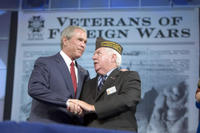 | President George W. Bush talks with Veterans of Foreign Wars Commander-in-chief John Furgess during his visit to the VFW national convention in Salt Lake City, Utah, August 22, 2005. White House photo by Paul Morse |
I really enjoy coming to these conventions. Members here come from all walks of life and you do vital work across our country. I know firsthand the spirit of the VFW. I was raised by one of your members -- (applause) -- a proud veteran of Post 4344 in Houston, Texas, former President George Bush. (Applause.) Where is that mighty Texas delegation? (Applause.) Behaves yourselves. (Laughter.)
I'm honored to serve as the Commander-in-Chief of the United States Armed Forces. The men and women who wear the uniform today are protecting our nation and our way of life. And they are upholding a tradition of honor and bravery and integrity set by America's veterans. All of you defended this country with unselfish courage. You've earned the respect of our citizens. And so, on behalf of a grateful nation, thank you for your service for the cause of freedom and peace. (Applause.)
I appreciate John Furgess. I appreciated working with him for the past year. He's a good, honorable man, and he's represented the VFW with distinction and class. It takes judgment to be the President of an organization. And so when I first saw John this morning, I realized he was a man of good judgment. He said, "You've got to understand, Mr. President, most of the people are really excited to see Laura." (Laughter and applause.) I'm proud she's traveling with me. I'm proud to call her wife. And a lot of folks in this United States of America are proud to call her First Lady. (Applause.)
And I'm pleased the Secretary of Veterans Affairs is with us today, Ranger vet, a man who is doing a fine job on behalf of the veterans across the United States, Secretary Jim Nicholson. (Applause.)
When I landed out there at the airport, I was greeted at the base of the stairs by the Governor of this great state, Governor Jon Huntsman. And I appreciate you being here, Governor. And I want to thank your wife, Mary Kaye, for joining, as well. There she is. Hi, Mary Kaye. I know the Lieutenant Governor, Gary Herbert is with us, and Jeanette. Appreciate you being here, Lieutenant Governor.
I got on Air Force One down there in Waco, and they told me that we had a special guest on our plane. I said, well, who is it? They said, well, it's Orrin Hatch. I said, fantastic, glad to give the fellow a ride. (Laughter.) And the reason why I'm glad to give him a ride, he's a strong ally, and I appreciate a strong ally in Orrin Hatch. He does a great job for Utah, and he does a great job for the United States of America. (Applause.)
I appreciate Congressman Chris Cannon joining us today. Thank you for being here, Congressman -- and Congressman Jim Matheson -- I'm proud you both are here. Thanks for taking time to be here today. (Applause.)
They must have changed the immigration laws here in Utah, because they allowed the Idaho Governor to come across the border. (Laughter.) I'm proud to be here with my friend, Dirk Kempthorne. Thank you for coming, Dirk. (Applause.) I want to thank the Senior Vice Commander, Jim Miller, for his hospitality. I'm looking forward to working with him. I want to thank JoAnne Ott, the outgoing National VFW Ladies Auxiliary president. And I want to thank Sandy Germany, who will be the incoming president. (Applause.)
Most of all, thank you all. As veterans of foreign wars, you stepped forward when America needed you. You took an oath to defend the nation, and you kept that oath, overseas and under fire. You triumphed over brutal enemies, liberated continents, and answered the prayers of millions across the Earth. All of us who have grown up in freedom must never forget your service and your sacrifice.
We also remember the troops who left America's shores, but did not live to make the journey home. We think of the families who lost a loved one, and who carry a burden of grief that remains for a lifetime. We remember the men and women in uniform whose fate is still undetermined, our prisoners of war and those missing in action. America must never forget them. We will not stop searching until we have accounted for every soldier, sailor airmen and Marine missing in the line of duty. (Applause.)
VFW's mission is to honor the dead by helping the living, and VFW members are making good on that promise every day. Together with your superb Ladies Auxiliary, VFW members have -- (applause) -- VFW members have adopted military units, mentored youth groups, assisted in blood drives, and provided countless services to fellow veterans and their families. When you hear the name VFW, you know a certain type of work is being done -- honorable, decent, and faithful to the nation's highest ideals.
In war and in peace, America's veterans set an example of citizenship, and we honor your devotion to duty and to our country. All of America's veterans have placed the nation's security before their own lives. Your sacrifice creates a debt that America can never really fully -- fully repay.
Yet there are certain things the government can do. My administration remains firmly committed to serving America's veterans. Since I took office my administration, in working with the United States Congress, has increased spending for veterans by $24 billion, an increase of 53 percent. In my first four years as President -- (applause) -- in my first four years as President, we increased spending for veterans more than twice as much as the previous administration did in eight years. (Applause.)
Health care is a top priority for our veterans and it's a top priority for my administration. The past four years, we've increased the VA medical care budget by 51 percent, and we're using those resources to make real improvements for our veterans. Over the past four years, we've increased total outpatient visits from 44 million to 55 million. We've increased the number of prescriptions filled from 98 million to 116 million. Since January 2002, we've reduced the backlog of disability claims by 20 percent. Claims are now being processed 68 days faster. By the end of this year, we plan to cut another 15 days on the average turnaround time. (Applause.)
We place a special focus on treating men and women returning from combat, and veterans with service disabilities and lower incomes and special needs. In the last two years, we've committed more than $1.5 billion to modernizing and expanding VA facilities, so more veterans can get care closer to their homes. My administration is helping the veterans who fought and sacrificed for America to get the quality care they deserve.
We're also getting results for veterans beyond the health care system. For more than a century, federal law prohibited disabled veterans from receiving both their retired pay and their VA disability compensation. Combat-injured and severely disabled veterans deserve better, and I was honored to be the first President in more than 100 years to sign concurrent receipt legislation. (Applause.)
We've also expanded grants to help homeless veterans in all 50 states and the District of Columbia. No veteran who served in the blazing heat or bitter cold of foreign lands should have to live without shelter in the very country whose freedom they fought for. (Applause.) You defended our flag in uniform; you continue to defend the flag today.
I share the VFW's strong support for a constitutional amendment to protect the American flag. (Applause.) In June, the House of Representatives voted to ban flag desecration, and I urge the United States Senate to pass this important amendment this year. (Applause.)
At this hour, a new generation of Americans is defending our flag and our freedom in the first war of the 21st century. The war came to our shores on the morning of September the 11th, 2001. Since then the terrorists have continued to strike -- in Bali, in Riyadh, in Istanbul, and Madrid, and Baghdad, and London, and Sharm el-Sheikh and elsewhere. The enemy, the terrorists, are ruthless and brutal. They're fighting on behalf of a hateful ideology that despises everything America stands for.
Our enemies have no regard for human life. They're trying to hijack a great religion to justify a dark vision that rejects freedom and tolerance and dissent. They have a strategy, and part of that strategy is they're trying to shake our will. They kill the innocent. They kill women and children, knowing that the images of their brutality will horrify civilized peoples. Their goal is to drive nations into retreat so they can topple governments across the Middle East, establish Taliban-like regimes, and turn that region into a launching pad for more attacks against our people. In all their objectives, our enemies are trying to intimidate America and the free world. And in all their objectives, they will fail. (Applause.)
Like the great struggles of the 20th century, the war on terror demands every element of our national power. Yet this is a different kind of war. Our enemies are not organized into battalions, or commanded by governments. They hide in shadowy networks and retreat after they strike. After September the 11th, 2001, I made a pledge, America will not be -- will not wait to be attacked again. We will go on the offense and we will defend our freedom. (Applause.)
We have a comprehensive strategy to win this war on terror. It includes three parts -- protecting this homeland, taking the fight to the enemy, and advancing freedom. The first part of our strategy is to protect America. We're reforming our intelligence services to stay ahead of our enemies and to rout out terror cells before they strike. We're using our diplomatic and financial tools to cut off the terrorists' financing and to drain them of their support. We've more than tripled funding for homeland security since September the 11th, 2001. We've provided more than $14 billion to train and equip state and local first responders. Many of our police officers and firefighters and first responders are veterans, and America is grateful for their dedication to keeping this country safe. (Applause.)
One of the most important tools we have to protect America is called the USA Patriot Act. This good law permits our intelligence and law enforcement communities to share information. It gives our law enforcement officers many of the same tools to fight terror that they already use to fight drugs and street crime. The Patriot Act is fully consistent with the United States Constitution, and as a result of that act, we're getting results. Our law enforcement intelligence officers have used the Patriot Act to help break up terror cells and support networks in California and New York and Ohio and Illinois and Virginia and Florida and other states.
Key provisions of the Patriot Act are scheduled to expire at the end of this year. Yet the terrorist threat to our country will not expire at the end of this year. When the House and Senate return from their recess, they need to send me a bill to renew the Patriot Act. (Applause.)
All these steps to protect the homeland have made it safer, but we're not yet safe. Terrorists in foreign lands still hope to attack our country. They still hope to kill our citizens. The lesson of September the 11th, 2001, is that we must confront threats before they fully materialize. (Applause.)
Vast oceans and friendly neighbors are not enough to protect us. A policy of retreat and isolation will not bring us safety. The only way to defend our citizens where we live is to go after the terrorists where they live. (Applause.)
So the second part of our strategy is to take the fight to the terrorists abroad before they can attack us here at home. This is the most difficult and dangerous mission in the war on terror. And like generations before them, our soldiers and sailors and airmen and Marines have stepped forward to accept the mission. They've damaged the al Qaeda network across the world and we're going to keep the terrorists on the run. From Afghanistan to Iraq, to the Horn of Africa, our men and women in uniform are bringing our enemies to justice and bringing justice to our enemies.
Our goal is clear: to secure a more peaceful world for our children and grandchildren. We will accept nothing less than total victory over the terrorists and their hateful ideology. (Applause.)
Iraq is a central front in the war on terror. It is a vital part of our mission. Terrorists like bin Laden and his ally, Zarqawi, are trying to turn Iraq into what Afghanistan was under the Taliban, a place where women are beaten, religious and ethnic minorities are executed, and terrorists have sanctuary to plot attacks against free people. Terrorists are trying to block the rise of democracy in Iraq, because they know a free Iraq will deal a decisive blow to their strategy to achieve absolute power. The Iraqi people lived for three decades under an absolute dictatorship, and they will not allow a new set of would-be tyrants to take control of their future.
The response -- (applause) -- the people of Iraq have made a clear choice for all to see. In spite of threats and assassinations, more than eight million citizens defied the car bombers and killers and voted in free elections. (Applause.) In spite of violence, the Iraqi people are building a nation that secures freedom for its citizens and contributes to peace and stability in that region.
Now Iraq's leaders are once again defying the terrorists and pessimists by completing work on a democratic constitution. The establishment of a democratic constitution will be a landmark event in the history of Iraq and the history of the Middle East. All of Iraq's main ethnic and religious groups are working together on this vital project. All made the courageous choice to join the political process, and together they will produce a constitution that reflects the values and traditions of the Iraqi people.
Producing a constitution is a difficult process that involves debate and compromise. We know this from our own history. Our Constitutional Convention was home to political rivalries and regional disagreements. The Constitution our founders produced has been amended many times over. So Americans understand the challenges facing the framers of Iraq's new constitution. We admire their thoughtful deliberations; we salute their determination to lay the foundation for lasting democracy amid the ruins of a brutal dictatorship.
As Iraqis continue to take control of their own future, we will help them take responsibility for their own security. The enemies of a free Iraq are determined. They are adapting their tactics so they can take more innocent life. American and Iraqi forces are adapting our tactics, too. We're on the hunt, side-by-side with Iraqi troops. We're working to defeat the terrorists together. As we hunt down our common enemies, we will continue to train more Iraqi security forces so they can take on more responsibilities in fighting the terrorists. After all, it's their own country.
Our military is strategy is straightforward: As Iraqis stand up, Americans will stand down. And when Iraqi forces can defend their freedom by taking on more and more of the fight to the enemy, our troops will come home with the honor they have earned. (Applause.)
In the long run, victory in the war on terror requires changing the conditions that give rise to violence and extremism. So the third part of our strategy in the war on terror is to spread the hope of freedom across the broader Middle East. Free societies are peaceful societies. By standing with those who stand for their liberty, we will lay the foundation of peace for our children and our grandchildren.
As we work to spread freedom in the Middle East we have cause for optimism. The rise of liberty in Iraq is part of a wider movement in the region. The tide of freedom ebbs and flows, but it is moving in a clear direction, and freedom's tide is rising in the broader Middle East.
In Afghanistan, men and women have formed a free government after suffering one of the most brutal tyrannies on Earth. America is proud to call Afghanistan an ally in the war on terror. In Lebanon, people took to the streets to demand their sovereignty. They have now gone to the polls and voted in free elections. As freedom takes root in these countries it is inspiring democratic reformers in places like Egypt and Saudi Arabia. Across the region, a new generation desires to be free, and they will have it. And the world will be more peaceful because of it. (Applause.)
In the heart of the Middle East a hopeful story is unfolding. After decades of shattered promises and stolen lives, peace is within reach in the Holy Land. The Palestinian people have expressed their desire for sovereignty and peace in free and fair elections. President Abbas has rejected violence and taken steps toward democratic reform. This past week, Prime Minister Sharon and the Israeli people took a courageous and painful step by beginning to remove settlements in Gaza and parts of the northern West Bank. The Israeli disengagement is an historic step that reflects the bold leadership of Prime Minister Sharon.
Both Israelis and Palestinians have elected governments committed to peace and progress, and the way forward is clear. We're working for a return to the road map. We're helping the Palestinians to prepare for self-government and to defeat terrorists who attack Israel, and terrorists who oppose the establishment of a peaceful Palestinian state. We're providing $50 million in direct assistance to the Palestinians for new housing and infrastructure projects in Gaza. We remain fully committed to defending the security and well-being of our friend and ally, Israel, and we demand an end to terrorism and violence in every form, because we know that progress toward peace depends on an end to terror.
We'll continue working for the day when the map of the Middle East shows two democratic states, Israel and Palestine, living side-by-side in peace and security. (Applause.)
As more nations replace tyranny with liberty and replace hatred with hope, America will be more secure. Our nation has accepted a mission, and we're moving forward with resolve. Spreading freedom is the work of generations, and no one knows it better than you. Freedom has contended with hateful ideologies before. We defeated fascism; we defeated communism; and we will defeat the hateful ideology of the terrorists who attacked America. (Applause.)
Each of these struggles for freedom required great sacrifice. From the beaches of Normandy to the snows of Korea, courageous Americans gave their lives so others could live in freedom. Since the morning of September the 11th, we have known that the war on terror would require great sacrifice, as well. We have lost 1,864 members of our Armed Forces in Operation Iraqi Freedom, and 223 in Operation Enduring Freedom. Each of these men and women left grieving families and loved ones back home. Each of these heroes left a legacy that will allow generations of their fellow Americans to enjoy the blessings of liberty. And each of these Americans have brought the hope of freedom to millions who have not known it. We owe them something. We will finish the task that they gave their lives for. We will honor their sacrifice by staying on the offensive against the terrorists, and building strong allies in Afghanistan and Iraq that will help us win and fight -- fight and win the war on terror. (Applause.)
As veterans of foreign wars, you know that the rise of liberty is critical to our national security. You understand the power of freedom because you've witnessed it with your own eyes. In a single lifetime, many of you have seen liberty spread from Germany and Japan to Eastern Europe, to Latin America, to Southeast Asia and Africa and beyond. You've seen that democracies do not fight each other, and that liberation leads to peace. With your courage and commitment to freedom, you have lifted lives of millions around the globe, and you made this country and our world more secure.
The generation of men and women who defend our freedom today is taking its rightful place among the heroes of our nation's history. Once again, America has found patriots who are selfless and tireless and unrelenting in the face of danger. Once again, the American people have been steadfast and determined not to lose our nerve. And once again, we have confidence in our cause, because we know that freedom is the future of every nation, and that the side of freedom is the side of victory.
I want to thank you for the example you have set for all who wear our nation's uniform. I want to thank you for your bravery and your decency. May God bless this nation's veterans, and may God continue to bless the United States of America. (Applause.)
END 11:47 A.M. MDT
For Immediate Release, Office of the Press Secretary, August 22, 2005
more at President Bush and Veterans of Foreign Wars or VFW and veterans-affairs or terrorists and Iraq or Middle East
0
comments
||
||


