Friday, October 14, 2005

President Addresses U.S. Troops in Iraq (VIDEO)

President Addresses U.S. Troops in Iraq in Video Teleconference 9:54 A.M. EDT

THE PRESIDENT: Captain Kennedy?

CAPTAIN KENNEDY: Yes, Mr. President.
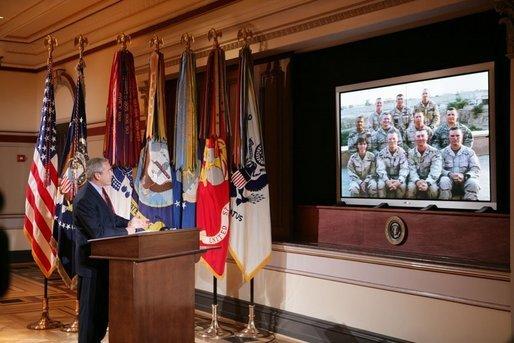
President George W. Bush gestures as he speaks with troops, from the U.S. Army's 42nd Infantry Division serving in Iraq, via video teleconference from the Eisenhower Executive Office Building in Washington, Thursday, Oct. 13, 2005. White House photo by Paul Morse THE PRESIDENT: Well, it's good to see you. Thanks. Thanks for taking time out of your busy schedule to allow me to visit with you a little bit. I've got some questions for you here in a minute, but I do want to share some thoughts with you.
First, I want to thank the members of the 42nd Infantry Division and Task Force Liberty for serving our country with such distinction and honor. I want you to know that the mission you are on is vital to achieving peace and to protecting America. One of my most solemn duties, a duty that you have joined me on, is to protect the American people.

And we're facing an enemy that is ruthless and cold-blooded, an enemy that actually has a philosophy, and the philosophy is so opposite of ours, it is the exact opposite of what America stands for. We stand for religious freedom, and freedom to speak, and women's rights, and capacity for people to realize their dreams. They stand for a vision that is -- doesn't believe in freedom, that if you don't agree with their narrow point of view, that you're subject to reprisal.

And so I want to thank you for being a part of this global war. And Iraq is a part of the war, because the enemy understands that a free Iraq will be a blow to their vision and their strategy of spreading dominance throughout the broader Middle East. And so I want to thank you. When you email your families, you tell them how proud the Commander-in-Chief is of their patience and their support, as well.

One of the tactics of the enemy is to shake our will. Part of their strategy is to use the killing of innocent people to get the American government to pull you out of there before the mission is complete. I'm going to assure you of this, that so long as I'm the President, we're never going to back down, we're never going to give in, we'll never accept anything less than total victory. It's important for you to know that; it's important for the enemy to know that, as well.

We got a strategy, and it's a clear strategy. On the one hand, we will hunt down these killers and terrorists and bring them to justice, and train the Iraqi forces to join us in that effort.

The second part of the strategy is a political strategy, based upon the knowledge that you defeat a backward, dark philosophy with one that's hopeful. And that hopeful philosophy is one based upon universal freedom. I'm very impressed that the Iraqi government has continued to work to have a constitution that attracts Sunnis and Shias and Kurds. They've worked hard to get a constitution, and now the people of Iraq are going to get to vote once again, on a constitution, in this case.

And I want to thank you for providing the security necessary for people to exercise their free will. You're part of an historic mission that is laying the foundation for peace. I am convinced that when we look back at this time in history, those who follow us -- whether it be in the armed services or in the political process -- will say, thank goodness the United States of America didn't lose our nerve or will; that we've put in motion something that can't be stopped, and that is the march of freedom.

So I want to thank you for giving me a chance to visit with you. You just got to know the American people are proud of you. You've got tremendous support here at home. And there's nobody more proud of you than I am.

Let me ask you some questions, Captain, if you don't mind. One of the, you know, questions I have is about the pre-election operations, about what you've been doing, and what are the -- what's your strategy, and how do you think it's going for -- to make sure the people have a chance to vote.

By the way, you're in Tikrit, as I understand it, as well. It's kind of an interesting place to be. It's Saddam's old stomping grounds.

CAPTAIN KENNEDY: Good morning, Mr. President, from Tikrit. I'm Captain Brent Kennedy. To my right is Sergeant Major Akeel from the 5th Iraqi Army Division. We're working together here with the Iraqis in Task Force Liberty for the upcoming referendum. We're surging an operation, called Operation Saratoga, that includes the securing of over 1,250 polling sites. We're working right alongside with the Iraqis as they lead the way in securing these sites.

THE PRESIDENT: That's good. And so, like -- I mean, and so the vote is in less than 48 hours -- or about 48 hours, I guess. And so how do you -- how would -- are you confident? I mean, how do you feel the operations are going?

CAPTAIN KENNEDY: Mr. President, I'm going to field that question to Captain Smith.

THE PRESIDENT: I didn't want to give you -- I didn't want to throw you a hardball there, Captain.

CAPTAIN SMITH: Morning, Mr. President. I'm Captain Dave Smith from Grand Rapids , Michigan. I'm representing the 3rd Brigade Combat Team here in -- headquartered in Baqubah.

THE PRESIDENT: Right.

CAPTAIN SMITH: I work directly with the Iraqi army. I am responsible for coordinating all their security responses in our area of operations.

Sir, our Iraqi partners have been conducting battalion and Brigade-size operations since April. They have been planning and coordinating with other Iraqi security forces, such as the Iraqi police and local government agencies, preparing for this referendum. Sir, we as coalition forces, we have taken a supporting role only as they prepare to execute this referendum.

THE PRESIDENT: How are they doing? Give us an assessment. One of the things, Captain, that people in America want to know is, one, do the Iraqis want to fight, and are they capable of fighting. And maybe somebody can give us an appraisal.

CAPTAIN KENNEDY: Mr. President, I'm going to field that question to Captain Pratt.

CAPTAIN PRATT: Good morning, Mr. President. My name is Captain Steven Pratt from Pocatello, Idaho, serving with the 116th Brigade Combat Team as the Iraqi army coordinator. The Iraqi army and police services, along with coalition support, have conducted many and multiple exercises and rehearsals. Recently we've conducted a command post exercise in which we brought together these Iraqi security forces with emergency service units, and the joint coordination center, in which we all sat around a model and discussed what each one would do at their specific location and what they would do at the referendum.

It was impressive to me to see the cooperation and the communication that took place among the Iraqi forces. Along with the coalition's backing them, we'll have a very successful and effective referendum vote.

THE PRESIDENT: Captain, thank you very much. Let me ask you something. As you move around, I presume you have a chance to interface with the civilians there in that part of the world. And a lot of Americans are wondering whether or not people appreciate your presence or whether or not the people are anxious to be part of the democratic process. Can you give us a sense for the reception of the people there in Tikrit toward coalition forces, as well as the Iraqi units that they encounter?

CAPTAIN KENNEDY: Mr. President, I'm going to field this question to Captain Williams.

CAPTAIN WILLIAMS: Mr. President, I'm Captain David Williams. I'm from Los Angeles, California. I'm currently with the 1st Brigade Combat Team, attached to the Military Transition Team. Sir, in North-Central Iraq, voter registration is up 17 percent. That's 400,000 new voters in North-Central Iraq, and 100,000 new voters in the al-Salahuddin province. Sir, I was with my Iraqi counterpart in Tikrit, the city Tikrit last week, and he was going around, talking to the locals. And from what he told me that the locals told him, the Iraqi people are ready and eager to vote in this referendum.

THE PRESIDENT: That's good. It's pretty interesting. That's a pretty interesting concept for the people of Tikirt, when you really think about the fact that that was Saddam Hussein's hometown. They didn't get to vote too often when he was the leader there. Let me ask you about the progress. Most of you have been there for nearly a year, as I understand it.

And is it possible to give us a sense, kind of a calibration of what life was like when you first got there, and what it's like today?

CAPTAIN KENNEDY: Mr. President, Master Sergeant Lombardo will answer this question.

SERGEANT LOMBARDO: Good morning, Mr. President. I'm Master Sergeant Corine Lombardo, with the Headquarters 42nd Infantry Division and Task Force Liberty, from Scotia, New York. First, I'd like to say that this is a pleasure to speak with you again. We had the honor of your visit in New York City on November 11th, in 2001, when you recognized our Rainbow Soldiers for their recovery and rescue efforts at Ground Zero.

THE PRESIDENT: Were you there?

SERGEANT LOMBARDO: We began our fight against terrorism in the wake of 9/11, and we're proud to continue it here in North-Central New York -- North-Central Iraq.

THE PRESIDENT: Let me ask you something. Were you there when I came to New York?

SERGEANT LOMBARDO: Yes, I was, Mr. President.

THE PRESIDENT: I thought you looked familiar.

SERGEANT LOMBARDO: Well, thank you.

THE PRESIDENT: I probably look familiar to you, too.

SERGEANT LOMBARDO: Yes, you do, Mr. President. I can tell you over the past 10 months we've seen a tremendous increase in the capabilities and the confidences of our Iraqi security force partners. We've been working side-by-side, training and equipping 18 Iraqi army battalions. Since we began our partnership, they have improved greatly, and they continue to develop and grow into sustainable forces. Over the next month, we anticipate seeing at least one-third of those Iraqi forces conducting independent operations.

THE PRESIDENT: That's important. The American people have got to know -- and I appreciate you bringing that up, Sergeant Major, about how -- what the progress is like. In other words, we've got a measurement system --

SERGEANT LOMBARDO: Well, together --

THE PRESIDENT: I'm sorry, go ahead.

SERGEANT LOMBARDO: I'm sorry, just, together with our coalition forces, we've captured over 50 terrorists, as well as detained thousands of others that have ties to the insurgency. And I believe it is these accomplishments and the numerous accomplishments from our task force that will provide a safe and secure environment for the referendum vote.

THE PRESIDENT: Well, I appreciate that. There's no question that we need to stay on the offense, and we need to stay on the offense with well-trained Iraqi forces, side-by-side the finest military ever -- ever to exist, and that's the United States military.

SERGEANT LOMBARDO: That it is, Mr. President. Thank you.

THE PRESIDENT: Yes. Sergeant Akeel, thanks for joining us. I appreciate -- appreciate your service. You've got something to say, Akeel?

SERGEANT AKEEL: Good morning, Mr. President. Thank you for everything. Thank very much for everything.

THE PRESIDENT: Yes, you're welcome.

SERGEANT AKEEL: I like you. (Laughter.)

THE PRESIDENT: Well, I appreciate that.

LIEUTENANT MURPHY: Good morning, Mr. President.

THE PRESIDENT: Go ahead.

LIEUTENANT MURPHY: I'm First Lieutenant Gregg Murphy from the 278th Regimental Combat Team, from the Volunteer State of Tennessee. I want to tell you, sir, that we appreciate you coming with us today for this interview, and hearing us express our confidence in the Iraqi security forces' role in the upcoming referendum. Sir, we are prepared to do whatever it takes to make this thing a success. But the important thing here is that the Iraqi army and the Iraqi security forces, they're ready, and they're committed. They're going to make this thing happen.

Back in January, when we were preparing for that election, we had to lead the way. We set up the coordination, we made the plan. We're really happy to see, during the preparation for this one, sir, they're doing everything. They're making the plans, they're calling each other, they've got it laid out. So on Saturday, sir, we're going to be beside them, we're going to be there to support them through anything. But we can't wait to share in their success with them on Sunday.

Sir, from all of us here at Task Force Liberty here in Tikrit, we want to express our gratitude to you for spending a little time with us this morning, and thank you, sir, for hearing our assessment of the current situation here in Tikrit, Iraq.

THE PRESIDENT: Well, Lieutenant, thanks. It's been my honor. And, you know, I wish I could be there to see you face-to-face, to thank you personally. It's probably a little early for me to go to Tikrit, but one of these days perhaps the situation will be such that I'll be able to get back to Iraq to not only thank our troops, but to thank those brave Iraqis who are standing strong in the face of these foreign fighters and these radicals that are trying to stop the march of freedom.

Again, I want to thank you all for being so courageous and for stepping up when the United States of America needed you. I repeat what I said earlier: Please give your loved ones my deepest respect. And you've got to know, the American people are standing strong with you. We're proud of you. May God bless you all in your work and when you get back to the states, you know, if I'm hanging around, come by and say hello.

Thank you all.

END 10:09 A.M. EDT, For Immediate Release, Office of the Press Secretary, October 13, 2005

more at
or and or and or and or and or

Thursday, October 13, 2005

President Welcomes Polish President Kwasniewski (VIDEO)

President Welcomes Polish President Kwasniewski to the White House, FULL STREAMING VIDEO, The Oval Office, 11:54 A.M. EDT

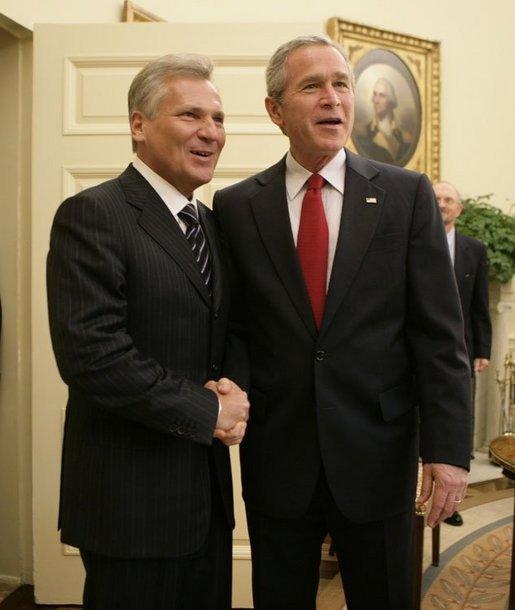
President George W. Bush welcomes Poland's President Aleksander Kwasniewski to the Oval Office at the White House, Wednesday, Oct. 12, 2005 in Washington. White House photo by Eric DraperPRESIDENT BUSH: Thank you all for coming. I'll have a statement; Aleksander will have a statement. We'll be glad to answer two questions per side.

Welcome back. This is a happy moment, because I get to see my friend again. It's a sad moment because he is leaving office. He has done an extraordinary job. We have built a strong personal relationship, but more importantly,
we have a strong strategic relationship with Poland, thanks to your leadership. Aleksander has helped advance the cause of peace by advancing the cause of freedom. He has served as a mentor for new democracies in the neighborhood. He has proven that you can be a friend to the United States and a loyal member of the EU at the same time. We have worked hard together to improve the lots of both our peoples.

And, Mr. President, you can leave with your -- your office with your head held high, because of the fine job you have done. I am glad you came back, and it's an honor to be able to praise you to the people of your country for a job -- a fine job.

PRESIDENT KWASNIEWSKI: Thank you, sir.

PRESIDENT BUSH: Hold on, we're going to a little --

PRESIDENT KWASNIEWSKI: Yes. Thank you for --

PRESIDENT BUSH: Do want to do an interpretation?

PRESIDENT KWASNIEWSKI: Yes, I think interpretation is better.

PRESIDENT BUSH: Especially after what I just said. (Laughter.)

PRESIDENT KWASNIEWSKI: (As translated.) I want to thank you very much, Mr. President. I want to thank you very much for those nice words. It is true that this visit -- (inaudible) -- compilation of 10 years of my presidency, and 10 years of Polish-American relations between our two countries.

I started my presidency in a different world. And now I'm leaving the office when the world is different and the world now is better. We are together in NATO. We are in NATO together with other Central and Eastern European countries. We are in NATO, together with the Baltic states, and we are also together in a group, in fact, family. Together we are building peace and stability in different parts of the world. We are fighting together against terrorism. We are fulfilling our task with joy and satisfaction, and we do it effectively. And together we are bringing more peace and more democracy to the world.

We are also creating more values with humanity. We are fighting for human rights and for the dignity of human beings.

We have been cooperating together with President Bush and we have made together very hard and very difficult and very important decisions. Today we talked about what we have done together and we have also talked about the fact that we will be continuing the policy of cooperation between the two countries, and that the new Polish government and my successor in the presidential office will continue this policy in the years to come.

I want to say that I'm very happy that we are enjoying and following the values between Polish and American cooperation, and that we are developing -- (inaudible) -- contacts. We have summed up our bilateral cooperation. There is still very much ahead of us, and here, as you can see here on the table next to President Bush, there is a document that I have presented to him, and this document is the -- (inaudible) -- of our achievements, and it is also information about our future cooperation. It's also the encouragement to cooperate in the future.

THE PRESIDENT: Thank you.

We'll take a couple of questions. Deirdre.

Q Thank you, Mr. President. Why do people in this White House feel it's necessary to tell your supporters that Harriet Miers attends a very conservative Christian church? Is that your strategy to repair the divide that has developed among conservatives over her nominee?

PRESIDENT BUSH: People ask me why I picked Harriet Miers. They want to know Harriet Miers' background; they want to know as much as they possibly can before they form opinions. And part of Harriet Miers' life is her religion. Part of it has to do with the fact that she was a pioneer woman and a trailblazer in the law in Texas. I remind people that Harriet Miers is one of the -- has been rated consistently one of the top 50 women lawyers in the United States. She's eminently qualified for the job. And she has got a judicial philosophy that I appreciate; otherwise I wouldn't have named her to the bench, which is -- or nominated her to the bench -- which is that she will not legislate from the bench, but strictly interpret the Constitution.

So our outreach program has been just to explain the facts to people. But, more importantly, Harriet is going to be able to explain the facts to the people when she testifies. And people are going to see why I named her -- nominated her to the bench, and she's going to make a great Supreme Court judge.

Q Mr. President, President Bush, there is a significant change of power underway in Poland right now. Some have already said that they would ask for more from the United States in return for Polish support and continued engagement in Iraq. Are you aware of these positions and do you expect any changes in Polish-American relations, any tougher talk, maybe?

PRESIDENT BUSH: Well, we had a talk about who might succeed Aleksander, and their opinions. My advice would be for whoever succeeds the President to come and visit, and to exchange visits with foreign ministers, such as our foreign minister as well as our minister of defense, and to strategize. That's what friends do. They share concerns and share goals, and then work together to satisfy concerns and achieve goals. And I'm confident that's going to happen.

PRESIDENT KWASNIEWSKI: (As translated.) May I add a few words for the Polish media here? We have talked about this and I think that this is information important for the Polish media. Poland wants the stabilization mission in Iraq to be a success and to complete the success. We want to be a serious partner and we want to be a steadfast and loyal partner in the coalition. Our troops are in Iraq and they will stay in Iraq until the end of January, and the decision has been made and nothing changes here. But we have to think about the future and we have to respect the right of the new government and the right of the new president to make their decisions about it.

It was the right suggestion of President George W. Bush, and the decision will be forwarded by me to our authorities and people in power when I come back, that after the new government is established, the new power's defense minister and the foreign minister should come here to Washington to talk about the future, because the future goes far beyond January next year. And we have to talk about what we shall do together to continue this cause.

THE PRESIDENT: Caren.

Q Thank you. The Syrian Interior Minister committed suicide. What are the consequences for Syria if they are implicated in the murder of the former Lebanese Prime Minister?

THE PRESIDENT: I don't want to prejudge the report that's coming out, the Mehlis report. I think it's very important for Syria to understand that the free world respects Lebanese democracy and expects Syria to honor that democracy. It's one thing to have been asked to remove troops and all intelligence services. Now the world wants for -- expects Syria to honor the democracy in the country of Lebanon.

Secondly, we expect Syria to do everything in her power to shut down the trans-shipment of suiciders and killers into Iraq. We expect Syria to be a good neighbor to Iraq. We expect Syria not to agitate killers in the Palestinian Territories. We're making good progress toward peace in the Holy Land, but one of the areas of concern is that foreign countries, such as Syria, might try to disrupt the peace process through encouraging terrorist activities.

So we have a lot of expectations for Syria beyond just the Mehlis report. But let's see how the Mehlis report -- what it says. In the meantime, we'll continue to work with friends and allies to send a clear message to the Assad government there are expectations involved for countries that want to be accepted in the international community.

Go ahead.

Q It's a question for President Bush. Mr. President, we thought that your last summit between America and Russian leaders, American diplomacy was stepping up the pressure on Moscow in reference to causes of democratic reforms in that country and the situation in Chechnya. And right now we have a long list of problems between Poland and Russia. So what's your point of view and what would be your advice for a new Polish government how we should handle that situation?

THE PRESIDENT: We've got -- I've got good relations with President Putin; America has got a working relationship with Russia. And always, as a part of our discussions with Russia is my personal -- when I have personal discussions with him, I remind him of my deep faith in democracy, and the people that interrelate with Russia from my government remind their Russian counterparts about democracy and its importance.

The reason I believe in democracy so strongly is because I believe in freedom, and democracy is a manifestation of free societies. I believe there's a desire for everybody to be free. I also know that free societies are peaceful societies. One of the goals of this administration is to promote peace, and the more democracy and the more freedom there is, the more likely it is the world will be peaceful.

So we've got a consistent message to Russia, and that is that one should not fear democracy, one should embrace democracy. Now, having said that, I recognize that Russian democracy will be different from the United States. We don't expect every country to look like us; we just expect people to embrace some universal truths -- the right of people to worship freely, the right of women to be able to equally participate in society -- which is the case in Russia, of course -- the rule of law, the respect for private property. These are fundamental, basic principles that we believe should be inherent in all societies. People need to make those choices themselves, but one of the roles of the United States is to remind people about how beneficial a democratic society can be to its people. And so we're consistent in our message.

Thank you all very much.

PRESIDENT KWASNIEWSKI: Thank you. You see, this is the difference between the President in power -- you have many questions, and the President will finish -- "no questions, thank you."

END 12:11 P.M. EDT, For Immediate Release, Office of the Press Secretary, October 12, 2005

more at
or and and or

President and Mrs. Bush Visit Elementary School in Mississippi (VIDEO)

President and Mrs. Bush Visit Elementary School in Mississippi, FULL STREAMING VIDEO, Delisle Elementary School, Pass Christian, Mississippi, 10:54 A.M. CDT

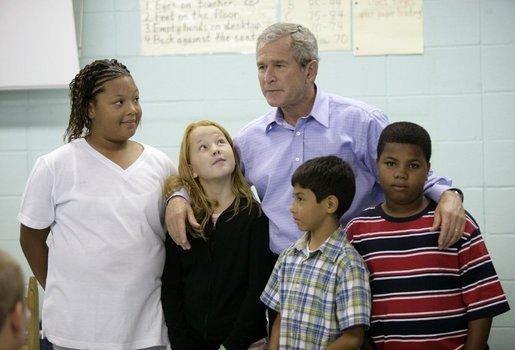
President George W. Bush spends a moment Tuesday, Oct. 11, 2005, with students at Delisle Elementary School in Pass Christian, Miss. The school reopened Tuesday for the first time since Hurricane Katrina devastated the Gulf Coast region. White House photo by Eric DraperLaura Bush gives a hug to a student at Delisle Elementary School in Pass Christian, Miss., Tuesday, Oct. 11, 2005, as the school reopened for the first time since the area was struck by Hurricane Katrina. White House photo by Eric Draper
THE PRESIDENT: Listen, first I want to thank the Superintendent. We're delighted to see that the schools of Pass Christian are Blue Ribbon schools. They have been Blue Ribbon schools before and they'll be Blue Ribbon schools in the future. Part of the health of a community is to have a school system that's vibrant and alive. And in spite of the fact that a lot of equipment was damaged and homes destroyed and teachers without places to live and -- this school district is strong, and it's coming back. And it's a sign that out of the rubble here on the Gulf Coast of Mississippi is a rebuilding, is a spirit of rebuilding.

And thank you all for having us. I want to thank the principals and teachers for understanding the quality of education -- the quality of the education in a community helps define the nature of the community. And one of the things that's interesting is the high school principal told Laura and me that the -- and Madam Secretary -- that the high school was deemed to be a Blue Ribbon high school after Katrina hit. And yet a lot of the students don't know that yet. And so when the high school comes back next Monday, the first thing the principal is going to tell them is that the school that they go to, even though the building is different -- the buildings are different -- is a Blue Ribbon high school.

And the Superintendent says, Blue Ribbon high school last year, this year, and next year. And I appreciate your spirit. Thanks for letting us come by.

Thank you all. Bye-bye.

END 10:56 A.M. EDT, For Immediate Release, Office of the Press Secretary, October 11, 2005

more at
and or and or and or

President Thanks Troops for Hurricane Relief Efforts (VIDEO)

President Thanks Troops for Hurricane Relief Efforts in Louisiana, FULL STREAMING VIDEO, Joint Reserve Base U.S. Naval Air Station, New Orleans, Louisiana 12:29 P.M. CDT

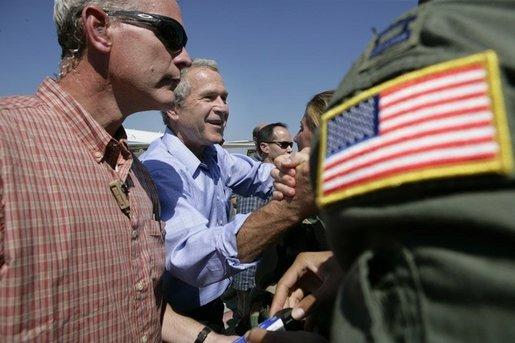
President George W. Bush greets staff personnel at the U.S. Naval Air Station, Joint Reserve Base, Tuesday, Oct. 11, 2005 in New Orleans. White House photo by Eric DraperTHE PRESIDENT: Generals, thanks -- General Landreneau and General Downer, thank you all for greeting me here. I'm proud to be traveling with members of the United States Congress who are with us today.
Listen, I'm here to thank you all for what has been an incredible outpouring of talent and skill and compassion to help the good folks of this part of the world that have suffered mightily. I'm incredibly proud of those who wear our nation's uniform, and I'm incredibly proud of the job you have done. You have brought great credit to your units, credit to your family, and credit to our nation.

We got a lot of work to do, and I'll be telling the people that I've had an honor to meet, opportunity to meet, that out of this rubble is going to come some good; out of the devastation is going to come new cities and new hope. And I hope you take great inspiration in being a part of the renewal of this important part of the world.

I want you to, when you talk to your families, to tell them the Commander-in-Chief is proud of them as -- I'm equally as proud of them as I am proud of you. May God bless you all and your work. May God bless your families. And may God continue to bless our great country.

Thank you very much. (Applause.)

END 12:30 P.M. CDT, For Immediate Release, Office of the Press Secretary, October 11, 2005

more at
or and or and

President Expresses Condolences to Pakistan (VIDEO)

President Expresses Condolences to Pakistan, Offers Assistance After Earthquake, FULL STREAMING VIDEO My Odeo Channel (odeo/94bb8338a53a2e41)

President George W. Bush meets with Pakistan's Deputy Chief of Mission, Mohammad Sadiq, Sunday, Oct. 9, 2005 in the Oval Office at the White House, to express condolences on the tragedy of the earthquake which struck Pakistan and other areas of Asia, and to pledge the support of United States aid in the recovery of the region. White House photo by Paul MorseTHE PRESIDENT: I would like to thank the Pakistan Embassy for coming by to brief me on the tragedy that has taken place in that country. I was just told that this is going to be the worst natural disaster in the nation's history;
thousands of people have died; thousands are wounded, and the United States of America wants to help.

I spoke to President Musharraf. I expressed our nation's deepest condolences. And I told him that we want to help in any way we can. To that end, we've already started to send cash money and other equipment and goods that is going to be needed to help the people in Pakistan. Moving eight choppers over; the Chargé told me that one of the biggest concerns for the government of Pakistan is not enough airlift capacity to get to some of these rural areas where people are suffering. So we're moving choppers.

Secretary Rumsfeld is surveying the assets that he may be able to move in the area. We're working with Pakistan at all levels of government. Pakistan is a friend of the United States government and the people of the United States will help as best as we possibly can. So I appreciate you coming by.

Finally, as I told the President -- President Musharraf -- I said there are a lot of Americans who will be asking for the Almighty God's blessings on the people of Pakistan.

Thank you all.

END 12:55 P.M. EDT, For Immediate Release, Office of the Press Secretary, October 9, 2005

more at
and or and or and

Wednesday, October 12, 2005

Advisory Committee on International Economic Policy

Meeting of the Advisory Committee on International Economic Policy

The Advisory Committee on International Economic Policy (ACIEP) will meet on Tuesday, November 1, 2005, from 1:30 p.m. to 4:30 p.m. in Room 1205 of the Harry S. Truman Building. Assistant Secretary of State for Economic and Business Affairs E. Anthony Wayne and Committee Chairman R. Michael Gadbaw will host the meeting.

The Committee serves the U.S. Government in a solely advisory capacity concerning current issues and problems in international economic policy. Topics for the meeting include a discussion of U.S. Priorities in the Doha Development Agenda, sustainable energy development, and subcommittee updates.

The public may attend this meeting as seating capacity allows. Admittance to the State Department building will be by means of a pre-arranged clearance list. In order to be placed on this list, please provide your name, title, company or other affiliation if appropriate, social security number (or other identification number, such as driver's license number), date of birth, and citizenship to the Office of Economic Policy Analysis and Public Diplomacy by fax (202) 647-5936 (Attention: Gwendolyn Jackson), email (
jacksongl@state.gov), or telephone (202) 647-0847 by October 26.

For further information about the meeting, please contact David Freudenwald, Office of Economic Policy and Public Diplomacy, Bureau of Economic and Business Affairs, at (202) 647-2231 or
freudenwalddj@state.gov.

2005/942, Released on October 12, 2005, Media Note, Office of the Spokesman, Washington, DC, October 12, 2005

more at
and or and or and

Moroccan Islamic Combatant Group

Designation of Moroccan Islamic Combatant Group as a Foreign Terrorist Organization

As part of ongoing U.S. efforts against terrorism, the Department of State has designated the Moroccan Islamic Combatant Group (GICM) as a Foreign Terrorist Organization under the Immigration and Nationality Act. This designation makes it illegal under U.S. law for persons in the United States or subject to U.S. jurisdiction knowingly to provide material support to the group; it blocks all funds in U.S. financial institutions in which the organization or its agent has an interest; and it provides a basis for the United States to deny visas to representatives and members of the organization.

The U.S. list of designated
Foreign Terrorist Organizations now numbers 42.

The United States calls on governments across the world to take action, as have we, to isolate these terrorist organizations, to choke off their sources of financial support, and to prevent their members’ movement across international borders.

2005/935, Released on October 11, 2005, Press Statement, Adam Ereli, Deputy Spokesman, Washington, DC, October 11, 2005

more at
and or and or

America and the Kyrgyz Republic

Joint Statement of the United States of America and the Kyrgyz Republic on the Presence of the U.S. Military in the Region

Following is the text of a joint statement issued by the United States of America and the
Kyrgyz Republic on the Presence of the U.S. Military in the Region.

Kyrgyzstan understands the need to resolve urgently the military and political situation in
Afghanistan, to contain the sources of terrorism and to create peaceful conditions for the social, economic and democratic development of the country.

In this regard, the Government of the Kyrgyz Republic recognizes the important contribution of the international anti-terrorist Coalition, located at the Ganci Airbase, in strengthening regional stability. The Kyrgyz side will continue to take part in these and other joint efforts of the international community to contend with modern-day challenges and threats to security.
We support the presence of Coalition Forces in the Kyrgyz Republic until the mission of fighting terrorism in Afghanistan is completed, a mission supported by the United Nations.

The governments of the United States and the Kyrgyz Republic express their readiness to review the transparency of investments made for the use of the Manas Airport and at the same time to discuss other organizational and technical questions.

Regarding its domestic policy, Kyrgyzstan intends to continue its orientation toward strengthening democratic principles and carrying out a decisive battle against corruption in order to create the necessary conditions for sustainable development.

2005/934, Released on October 11, 2005, Press Statement, Adam Ereli, Deputy Spokesman, Washington, DC, October 11, 2005

more at
and or and or and

Nicaragua’s Passage of CAFTA-DR

Nicaragua’s Passage of CAFTA-DR and Recent Political Developments

The United States is encouraged by the Nicaraguan General Assembly’s decision to join with the United States, the
Dominican Republic, and three other Central American countries in ratifying the Central America Free Trade Agreement (CAFTA-DR). CAFTA-DR is Nicaragua’s best opportunity to derive the benefits of trade and investment that will increase employment and bring prosperity to the Nicaraguan people.

Political developments which have transpired since Deputy Secretary of State Robert B. Zoellick visited
Nicaragua last week are steps in the right direction. We welcome the October 10 announcement by President Enrique Bolaños of an agreement, facilitated by the Organization of American States (OAS), that supports completion of his constitutionally mandated term and suspends January’s constitutional amendments which erode the Presidency and threaten the balance of power.

The United States has worked with the OAS and the broader international community to encourage a resolution of the political crisis that would ensure democratic governance. While we are encouraged by the steps taken this past weekend, we will continue to monitor developments carefully.

During his October 4-5 visit to Managua, Deputy Secretary Zoellick described the corrupt pact between Arnoldo Aleman and Daniel Ortega as a "creeping coup" undermining Nicaraguan democracy. U.S. assistance will continue to be predicated on maintaining democratic order and good governance. Any subsequent post-agreement steps to further weaken or remove the constitutionally elected president will result in loss of opportunities for Nicaragua, including Millennium Challenge Account funding and participation in CAFTA-DR.

2005/937, Released on October 11, 2005, Press Statement, Adam Ereli, Deputy Spokesman, Washington, DC, October 11, 2005

more at
or and or and or

Sudan: Darfur Violence

Sudan: Darfur Violence

The United States strongly condemns the attack on African Union mission personnel on October 8 near Menawashi, South Darfur. Our sympathies are with the families of the Nigerian peacekeepers and local Sudanese drivers killed in the incident. The United States equally condemns the detainment of African Union Mission in Sudan (AMIS) personnel, including a U.S. citizen, near Tine, North Darfur on October 9.

Initial indications point to two Darfur rebel groups, the Sudan Liberation Movement and a faction of the Justice and Equality Movement, respectively, as responsible for these attacks. These attacks run counter to the rebels’ professed interest in negotiating a political settlement in Darfur. Violence will not bolster the negotiating position of any party in the Abuja peace talks, will not earn any group enhanced contacts with the United States, and will not gain any faction a seat at the negotiating table.

The United States reiterates its unequivocal support for the African Union with respect to its mission in Darfur and its mediation of the Abuja talks. We are in contact with leaders of the Sudanese government and Darfur rebel groups to urge them to stop the violence and return to the peace talks in Abuja. The United States is also in contact with the African Union, the United Nations, the European Union, and other governments in the region to coordinate our efforts to end the violence in Darfur.

Assistant Secretary of State for African Affairs Jendayi Frazer and Special Representative for Sudan Roger Winter will both travel to Sudan in the next two weeks to support the implementation of the Comprehensive Peace Agreement and to push for resolution of the crisis in Darfur in order to help build a stable and unified Sudan.

2005/931 Released on October 10, 2005 Press Statement, Adam Ereli, Deputy Spokesman
Washington, DC, October 10, 2005

more at
or and or and or and or

Presidential Message: Yom Kippur, 5766

Presidential Message: Yom Kippur, 5766

Seek the Lord while He may be found, call unto Him while He is near. Isaiah 55:6

Yom Kippur is the Sabbath of Sabbaths, the most solemn day of the Jewish calendar. On this day, Jews around the world reflect on their lives and give thanks to God for their many blessings. The Rabbis teach that on Yom Kippur, God holds open the gates of Heaven and listens to every word of every prayer. As those final prayers are shared and the Shofar is sounded, God remembers every name -- those living and those departed. In this moment, we draw near to God, sharing in the wonders of all creation and the miracle of all life.

Yom Kippur teaches us that we merit forgiveness and mercy through repentance, prayer, and acts of charity. May we have the strength to achieve all these things, so that we continue to build a more hopeful Nation and a more peaceful and free world.

Laura and I send our best wishes for a blessed day.

GEORGE W. BUSH

# # # For Immediate Release, Office of the Press Secretary, October 11, 2005

more at
or and or and or

Tuesday, October 11, 2005

2 Withdrawals Sent to the Senate

Withdrawals Sent to the Senate

Timothy Elliott Flanigan, of Virginia, to be Deputy Attorney General, Vice James B. Comey, Resigned, Which Was Sent to the Senate on June 20, 2005.

Philip D. Morrison, of the District of Columbia, to be an Assistant Secretary of the Treasury, vice Pamela F. Olson, resigned, which was sent to the Senate on May 26, 2005.

# # # For Immediate Release, Office of the Press Secretary, October 7, 2005

more at
and or and or

President announced the nomination of five to serve in his Administration

President George W. Bush announced the nomination of five individuals to serve in his Administration: David Steele Bohigian, Antonio Fratto, Susan C. Schwab, Ron Silver and Judy Van Rest.

The President nominated David Steele Bohigian, of Missouri, to be Assistant Secretary of Commerce for Market Access and Compliance. Mr. Bohigian currently serves as Assistant to the Secretary and Director of Policy and Strategic Planning at the Department of Commerce. Prior to this, Mr. Bohigian was Deputy Director. Earlier in his career, he held a variety of positions in the private sector including Managing Director for Idealab, Founder and Managing Director for VenCatalyst and Director for Jefferson Partners, LLC. Mr. Bohigian received his bachelor's degree from Washington & Lee University and his JD from Washington University School of Law.

The President nominated Antonio Fratto, of Pennsylvania, to be Assistant Secretary of the Treasury for Public Affairs. Mr. Fratto currently serves as Acting Assistant Secretary of the Treasury for Public Affairs, where he previously served as Deputy. He has also served as the Director of Public Affairs and a Public Affairs Specialist for the Department. Earlier in his career, Mr. Fratto was the Vice President of Governmental Affairs for the Pittsburgh Regional Alliance. Mr. Fratto received his bachelor's degree from the University of Pittsburgh.

The President nominated Susan C. Schwab, of Maryland, to be Deputy United States Trade Representative, with the Rank of Ambassador. Dr. Schwab is the President and CEO of the University of Maryland Foundation, Inc. and USM Vice Chancellor for Advancement. Prior to this, Dr. Schwab served as Dean of the University of Maryland School of Public Policy. Earlier in her career, she served as Director of Corporate Business Development for Motorola, Inc. Dr. Schwab also served as Assistant Secretary of Commerce and Director General for the U.S. & Foreign Commercial Service. Dr. Schwab received her bachelor's degree from Williams College, her master's degree from Stanford University and her PhD from George Washi ngton University.

The President nominated the following individuals to be Members of the United States Institute of Peace for the remainder of four-year terms expiring January 19, 2009:

Ron Silver, of New York
Judy Van Rest, of Virginia

### For Immediate Release, Office of the Press Secretary, October 7, 2005, Personnel Announcement

more at
and or and or and

Eric Nicholas Vitaliano Nomination Sent to Senate

Nomination Sent to the Senate

Eric Nicholas Vitaliano, of New York, to be United States District Judge for the Eastern District of New York, vice Arthur D. Spatt, retired.

# # # For Immediate Release, Office of the Press Secretary, October 7, 2005

more at
and or and or

Harriet Ellan Miers Nomination Sent to Senate

Nomination Sent to the Senate

Harriet Ellan Miers, of Texas, to be An Associate Justice of The Supreme Court of the United States, Vice Sandra Day O'Connor, retiring.

# # # For Immediate Release, Office of the Press Secretary, October 7, 2005

more at
or and or and

10 Nominations Sent to the Senate

Nominations Sent to the Senate

Jeffrey Thomas Bergner, of Virginia, to be An Assistant Secretary of State , Vice Paul Vincent Kelly, resigned.

David Steele Bohigian, of Missouri, to be an Assistant Secretary of Commerce, vice William Henry Lash, III, resigned.

Terrence L. Bracy, of Virginia, to be a Member of the Board of Trustees of the Morris K. Udall Scholarship and Excellence in National Environmental Policy Foundation for a term expiring October 6, 2010. (Reappointment)

Antonio Fratto, of Pennsylvania, to be an Assistant Secretary of the Treasury, vice Robert Stanley Nichols.

Susan Rasinski McCaw, of Washington, to be Ambassador Extraordinary and Plenipotentiary of the United States of America to the Republic of Austria.

Susan C. Schwab, of Maryland, to be a Deputy United States Trade Representative, with the rank of Ambassador, vice Peter F. Allgeier.

Ron Silver, of New York, to be a Member of the Board of Directors of the United States Institute of Peace for a term expiring January 19, 2009, vice Stephen D. Krasner, term expired.

Sarah M. Singleton, of New Mexico, to be a Member of the Board of Directors of the Legal Services Corporation for a term expiring July 13, 2008, vice Ernestine P. Watlington, term expired.

Nicholas F. Taubman, of Virginia, to be Ambassador Extraordinary and Plenipotentiary of the United States of America to Romania.

Judy Van Rest, of Virginia, to be a Member of the Board of Directors of the United States Institute of Peace for a term expiring January 19, 2009, vice Daniel Pipes.

# # # For Immediate Release, Office of the Press Secretary, October 7, 2005

more at
and or and or and or

Monday, October 10, 2005

FIRST U.S. HUMANITARIAN AIRLIFT REACHES ISLAMABAD

Statement from the Secretary of Defense on the South Asian Earthquake

“On behalf of the men and women of the Department of Defense, I express my condolences to those affected by the earthquake in South Asia.

“The Department of Defense is working closely with the State Department, and affected governments, to provide assistance to ease the suffering and assist in search and rescue operations.

“General John Abizaid, the Commander of the United States Central Command, and others have been in touch with military officials in Pakistan, and is moving five CH-47 and three UH-60 helicopters into Pakistan immediately.

“Additional capabilities for airborne reconnaissance, heavy lift ground equipment, and medical support are being identified and dispatched from within the Central Command region.

“Today, I will designate a dedicated Task Force commander in the region to work with the affected governments, to help assess their needs, and to draw on U.S. military capabilities from inside or outside the affected region as may be available and required.

“Our prayers go with those who have lost loved ones in the terrible situation.”

U.S. Department of Defense Office of the Assistant Secretary of Defense (Public Affairs) News Release, On the Web:
defenselink.mil/releases/2005/ Media contact: +1 (703) 697-5131
Public contact:
dod.mil/faq/comment or +1 (703) 428-0711 No. 1024-05, IMMEDIATE RELEASE October 9, 2005

Source:
United States Central Command (USCENTCOM), SPC Claude Flowers, CENTCOM Public Affairs

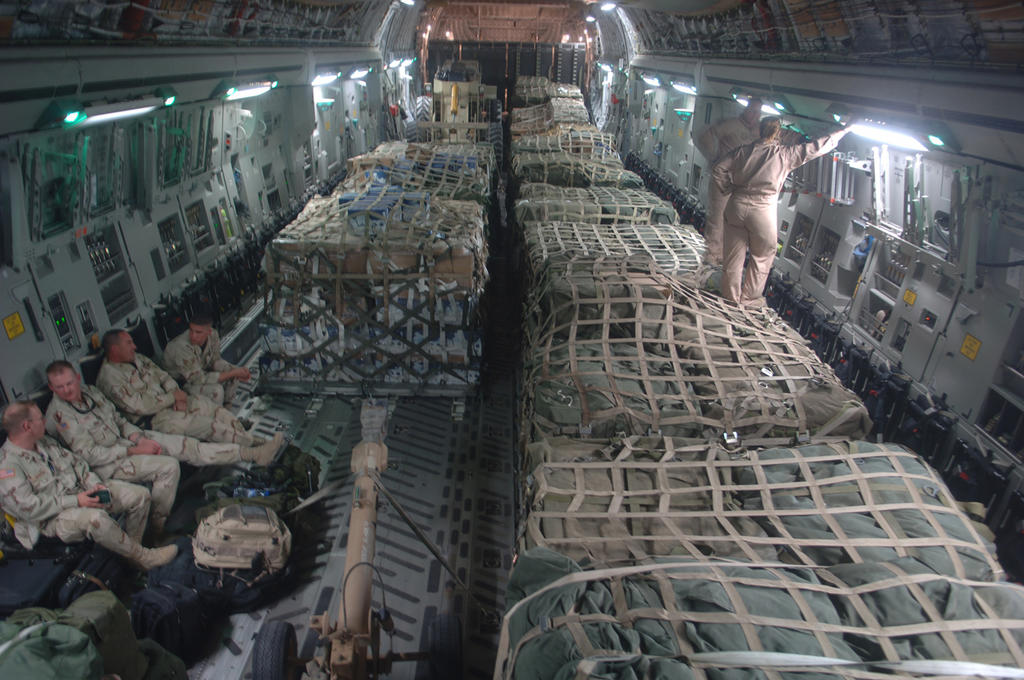
(HUMANITARIAN AIRLIFT 1, U.S. Air Force photo by Capt. James H. Cunningham) BAGRAM AIR FIELD, Afghanistan – The first relief supplies from the United States ready for departure aboard here on a U.S. Air Force C-17 less than 48 hours after the devastating earthquake that left thousands dead and thousands more injured.
The C-17 and its crew from the 7th Airlift Squadron, McChord Air Force Base, Wash., delivered 12 pallets -- weighing almost 90,000 pounds -- of food, water, medicine and blankets from Bagram Air Field, Afghanistan. Two aerial port specialists from Bagram's 455th Expeditionary Logistics Readiness Squadron were also on the flight to coordinate and manage cargo at Islamabad. Airmen and soldiers at Bagram, with only a few hours notice, worked feverishly to palletize the supplies and prepare them for the flight. (U.S. Air Force photo by Capt. James H. Cunningham)
(HUMANITARIAN AIRLIFT 2, U.S. Air Force photo by Capt. James H. Cunningham)(HUMANITARIAN AIRLIFT 3, U.S. Air Force photo by Capt. James H. Cunningham)(HUMANITARIAN AIRLIFT 4, U.S. Air Force photo by Capt. James H. Cunningham)(HUMANITARIAN AIRLIFT 5, U.S. Air Force photo by Capt. James H. Cunningham)
IMAGE 2, ISLAMABAD, Pakistan – The first relief supplies from the United States are unloaded in Islamabad, Pakistan from a U.S. Air Force C-17 less than 48 hours after the devastating earthquake that left thousands dead and thousands more injured. The C-17 and its crew from the 7th Airlift Squadron, McChord Air Force Base, Wash., delivered 12 pallets -- weighing almost 90,000 pounds -- of food, water, medicine and blankets from Bagram Air Field, Afghanistan. Two aerial port specialists from Bagram's 455th Expeditionary Logistics Readiness Squadron were also on the flight to coordinate and manage cargo at Islamabad. Airmen and soldiers at Bagram, with only a few hours notice, worked feverishly to palletize the supplies and prepare them for the flight. (U.S. Air Force photo by Capt. James H. Cunningham)

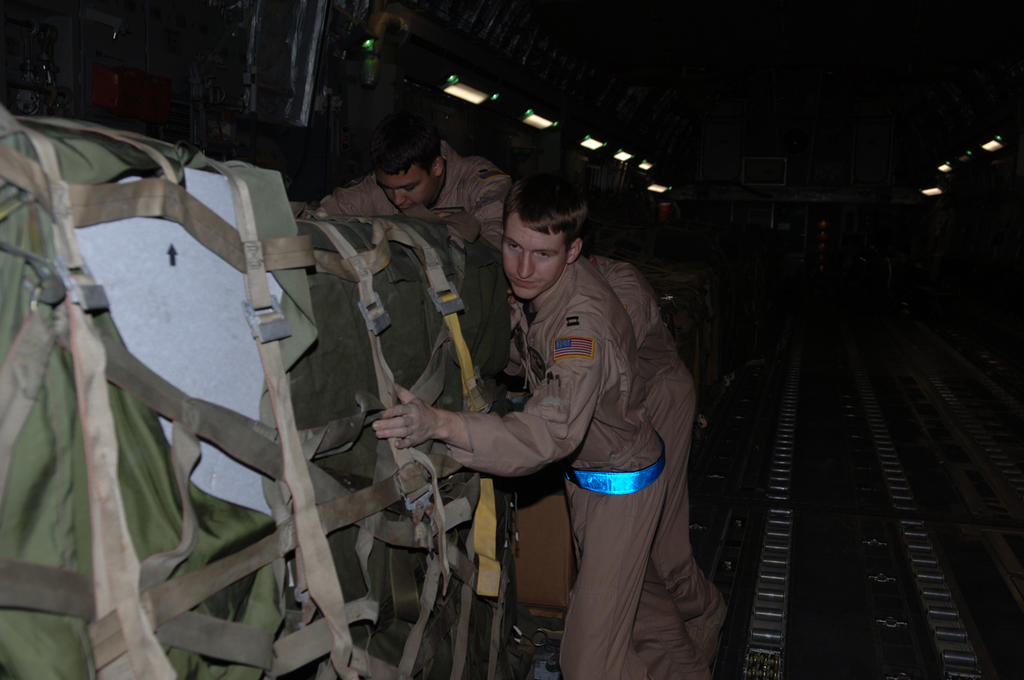
IMAGE 3, ISLAMABAD, Pakistan – Capt. Todd Stinchfield, C-17 aircraft commander, helps unload a pallet of the first relief supplies from the United States here less than 48 hours after the devastating earthquake that left thousands dead and thousands more injured. The C-17 and its crew from the 7th Airlift Squadron, McChord Air Force Base, Wash., delivered 12 pallets -- weighing almost 90,000 pounds -- of food, water, medicine and blankets from Bagram Air Field, Afghanistan. Two aerial port specialists from Bagram's 455th Expeditionary Logistics Readiness Squadron were also on the flight to coordinate and manage cargo at Islamabad. Airmen and soldiers at Bagram, with only a few hours notice, worked feverishly to palletize the supplies and prepare them for the flight. (U.S. Air Force photo by Capt. James H. Cunningham)

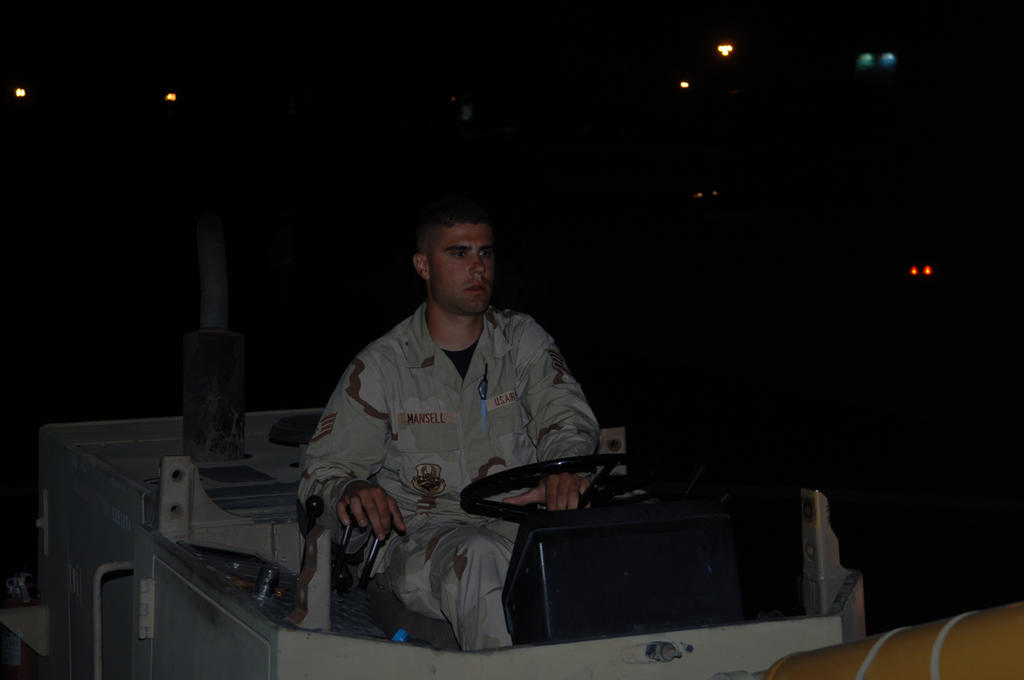
IMAGE 4, ISLAMABAD, Pakistan – Staff Sgt. Larry Mansell, aerial port specialist with the 455th Expeditionary Logistics Readiness Squadron at Bagram Air Field, Afghanistan, unloads a pallet of the first relief supplies from the United States here less than 48 hours after the devastating earthquake that left thousands dead and thousands more injured. The C-17 and its crew from the 7th Airlift Squadron, McChord Air Force Base, Wash., delivered 12 pallets -- weighing almost 90,000 pounds -- of food, water, medicine and blankets from Bagram Air Field, Afghanistan. Two aerial port specialists from Bagram's 455th Expeditionary Logistics Readiness Squadron were also on the flight to coordinate and manage cargo at Islamabad. Airmen and soldiers at Bagram, with only a few hours notice, worked feverishly to palletize the supplies and prepare them for the flight. Sergeant Mansell is deployed here from the 137th Aerial Port Squadron in Oklahoma City. (U.S. Air Force photo by Capt. James H. Cunningham)

iMAGE 5, BAGRAM AIR FIELD, Afghanistan – Airman 1st Class, Marie Gamachie, C-17 loadmaster, unloads a pallet of the first relief supplies from the United States here less than 48 hours after the devastating earthquake that left thousands dead and thousands more injured. The C-17 and its crew from the 7th Airlift Squadron, McChord Air Force Base, Wash., delivered 12 pallets -- weighing almost 90,000 pounds -- of food, water, medicine and blankets from Bagram Air Field, Afghanistan. Two aerial port specialists from Bagram's 455th Expeditionary Logistics Readiness Squadron were also on the flight to coordinate and manage cargo at Islamabad. Airmen and soldiers at Bagram, with only a few hours notice, worked feverishly to palletize the supplies and prepare them for the flight. (U.S. Air Force photo by Capt. James H. Cunningham)

Statement on Earthquake in Pakistan and India

Secretary Condoleezza Rice, Washington, DC, October 8, 2005

I send my deepest condolences to all those affected by today’s earthquake centered in northern Pakistan. The devastation in northern Pakistan and on both sides of the line of control in Kashmir is a terrible tragedy for the people of the region.

I spoke with the foreign ministers of both Pakistan and India this morning to convey our sympathy and offer whatever assistance may be needed.

At this difficult time, the United States stands with its friends in Pakistan and India, just as they stood with us and offered assistance after Hurricane Katrina.

Source:
state.gov, 2005/930

more at and or and or

Sunday, October 09, 2005

Earthquake Report Magnitude 7.6 - PAKISTAN

U.S. Geological Survey, National Earthquake Information Center World Data Center for Seismology, DenverA major earthquake occurred at 03:50:38 (UTC) on Saturday, October 8, 2005. The magnitude 7.6 event has been located in PAKISTAN. (This event has been reviewed by a seismologist.)
Magnitude 7.6 Date-Time Saturday, October 8, 2005 at 03:50:38 (UTC)= Coordinated Universal Time Saturday, October 8, 2005 at 8:50:38 AM = local time at epicenter
Time of Earthquake in other Time Zones , Location 34.402°N, 73.560°E, Depth 10 km (6.2 miles) set by location program, Region PAKISTAN, Distances 90 km (55 miles) NNE of ISLAMABAD, Pakistan115 km (75 miles) ESE of Mingaora, Pakistan120 km (75 miles) WNW of Srinagar, Kashmir165 km (100 miles) N of Jhelum, Pakistan, Location Uncertainty horizontal +/- 5.9 km (3.7 miles); depth fixed by location program, Parameters Nst=199, Nph=199, Dmin=918 km, Rmss=0.98 sec, Gp= 22°,M-type=moment magnitude (Mw), Version=Q, Source USGS NEIC (WDCS-D), Event ID usdyae

Earthquakes and active faults in northern Pakistan and adjacent parts of India and Afghanistan are the direct result of the Indian subcontinent moving northward at a rate of about 40 mm/yr (1.6 inches/yr) and colliding with the Eurasian continent.

This collision is causing uplift that produces the highest mountain peaks in the world including the Himalayan, the Karakoram, the Pamir and the Hindu Kush ranges. As the Indian plate moves northward, it is being subducted or pushed beneath the Eurasian plate. Much of the compressional motion between these two colliding plates has been and continues to be accommodated by slip on a suite of major thrust faults that are at the Earth’s surface in the foothills of the mountains and dip northward beneath the ranges.

These include the Main Frontal thrust, the Main Central thrust, the Main boundary thrust, and the Main Mantle thrust. These thrust faults have a sinuous trace as they arc across the foothills in northern India and into northern Pakistan.

In detail, the modern active faults are actually a system of faults comprised of a number of individual fault traces. In the rugged mountainous terrain, it is difficult to identify and map all of the individual thrust faults, but the overall tectonic style of the modern deformation is clear in the area of the earthquake; north- and northeast-directed compression is producing thrust faulting.

Near the town of Muzaffarabad, about 10 km southwest of the earthquake epicenter, active thrust faults that strike northwest-southeast have deformed and warped Pleistocene alluvial-fan surfaces into anticlinal ridges. The strike and dip direction of these thrust faults is compatible with the style of faulting indicated by the focal mechanism from the nearby M 7.6 earthquake.

Source:
USGS

more at
and or and or

Researchers Reconstruct 1918 Pandemic Influenza Virus

Researchers Reconstruct 1918 Pandemic Influenza Virus; Effort Designed to Advance Preparedness

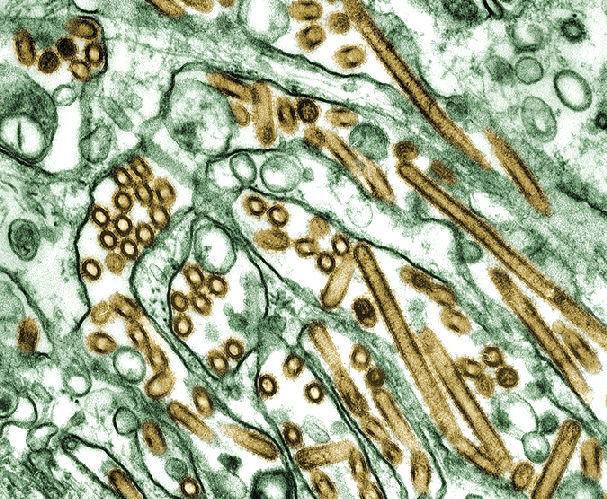
Colorized transmission electron micrograph of Avian influenza A H5N1 viruses (seen in gold) grown in MDCK cells (seen in green).Scientists at the Centers for Disease Control and Prevention have successfully reconstructed the influenza virus strain responsible for the 1918 pandemic, a project that greatly advances preparedness efforts for the next pandemic.
“This groundbreaking research helps unlock the mystery of the 1918 flu pandemic and is critically important in our efforts to prepare for pandemic influenza,” said CDC Director Dr. Julie Gerberding. “We need to know much more about pandemic influenza viruses. Research such as this helps us understand what makes some influenza viruses more harmful than others. It also provides us information that may help us identify, early on, influenza viruses that could cause a pandemic.”

The work, done in collaboration with Mount Sinai School of Medicine, the Armed Forces Institute of Pathology and Southeast Poultry Research Laboratory, determined the set of genes in the 1918 virus that made it so harmful. Prior to this study, which is published in the Oct. 7 issue of Science, flu experts had little knowledge of what made the 1918 pandemic so much more deadly than the 1957 and 1968 pandemics. This week’s issue of Nature also includes a related article entitled “Characterization of the 1918 influenza virus polymerase genes” which describes the final three gene sequences of the 1918 influenza virus. The work reported in the Nature article was done by scientists at the Armed Forces Institute of Pathology.

The 1918 pandemic killed an estimated 20-50 million people worldwide, including 675,000 in the United States. The pandemic’s most striking feature was its unusually high death rate among otherwise healthy people aged 15-34. During normal seasonal flu outbreaks, severe complications and death are most common among the elderly and young children.

Influenza pandemics occur when a new strain emerges to which people have little or no immunity. Most experts believe another pandemic will occur, but it is impossible to predict which strain will emerge as the next pandemic strain, when it will occur or how severe it will be.

“By identifying the characteristics that made the 1918 influenza virus so harmful, we have information that will help us develop new vaccines and treatments,” said Dr. Terrence Tumpey, the CDC senior microbiologist who recreated the virus. “Influenza viruses are constantly evolving, and that means our science needs to evolve if we want to protect as many people as possible from pandemic influenza.”

In reconstructing the 1918 influenza virus, researchers learned which genes were responsible for making the virus so harmful. This is an important advance for preparedness efforts because knowing which genes are responsible for causing severe illness helps scientists develop new drugs and vaccines (e.g., they can focus their research on those genes).

CDC employed stringent biosafety and biosecurity precautions during research on the 1918 influenza virus. The work was done in a high containment Biosafety Level 3 lab with enhancements that include special provisions to protect both laboratory workers and the public from exposure to the virus. Currently available antiviral drugs have been shown to be effective against influenza viruses similar to the 1918 influenza virus.

All laboratory work was conducted at CDC. The work was supported in part with funding from the U.S. Department of Agriculture and the National Institutes of Health.

To evaluate the benefits of publishing the information contained in these manuscripts and any potential threat from its possible deliberate misuse, both manuscripts were reviewed by the National Science Advisory Board on Biosecurity (NSABB). The NSABB advises the federal government on strategies for the conduct and communication of research that might yield information or technologies that could be misused to threaten public health or national security. The Board was unanimous in its determination that it was critically important to make these findings available to the scientific community at large to not only validate their significance, but also permit further research on the development of diagnostic tests, treatments, and preventative measures.

Source:
CDCFor Immediate Release, October 5, 2005 Contact: CDC Media Relations, 404-639-3286

more at
and or and and or and

President Offers Assistance Pakistan, India Earthquake

President Offers Sympathy and Assistance After Pakistan-India Border Earthquake

The people of the United States offer our deepest sympathies for the loss of life and destruction caused by the earthquake that struck outside of Islamabad. Our initial deployments of assistance are underway, and we stand ready to provide additional assistance as needed. My thoughts and prayers are with those affected by this horrible tragedy.

# # # For Immediate Release, Office of the Press Secretary, October 8, 2005

more at
and or and or

Saturday, October 08, 2005

Freedom Calendar 10/08/05 - 10/015/05

October 8, 1898, Republican Joseph Simon (R-OR) elected as first Jewish U.S. Senator outside the former Confederacy.

October 9, 1886, Death of Rep. Benjamin Arnett (R-OH), first African-American to represent a majority white constituency in a state legislature.

October 10, 1871, Following warnings by Philadelphia Democrats against black voting, African-American Republican civil rights activist Octavius Catto murdered by Democratic Party operative; his military funeral was attended by thousands.

October 11, 1972, Horacio Rivero, first Hispanic four-star Admiral, appointed by President Richard Nixon as U.S. Ambassador to Spain.

October 12, 1813, Birth of Senator Lyman Trumbull, (R-IL), author of Republican Party’s 13th Amendment banning slavery, and of Civil Rights Act of 1866 granting full citizenship to African-Americans.

October 13, 1858, During Lincoln-Douglas debates, U.S. Senator Stephen Douglas (D-IL) states: “I do not regard the Negro as my equal, and positively deny that he is my brother, or any kin to me whatever”; Douglas became Democratic Party’s 1860 presidential nominee.

October 14, 1890, Birth of Dwight Eisenhower, who as President spearheaded Republican civil rights initiatives including 1957 and 1960 Civil Rights Acts; used federal troops, marshals, and Justice Dept. officials to force Democrat governors to desegregate public schools.

October 15, 1914, African-American Republican James Weldon Johnson, celebrated poet of Harlem Renaissance movement, becomes editor of leading black journal, New York Age; served as Theodore Roosevelt’s Consul in Venezuela and Nicaragua

“Every right that has been bestowed upon blacks was initiated by the Republican Party.”

Mary Terrell, African-American Republican and co-founder of the NAACP

SOURCE:
2005 Republican Freedom Calendar more at or and or and or