


U.S. Looks Into Videotaped Desecration of Taliban Corpses by Army Unit, By Richard A. Serrano, Times Staff Writer
WASHINGTON — The Army is investigating a group of U.S. soldiers in Afghanistan who were caught on videotape desecrating the bodies of two dead Taliban fighters and using the burning corpses in a propaganda effort to dare other militants to "come and fight like men."
The tape, shot this month by an Australian photojournalist traveling with a U.S. Army unit, was aired on Australian television Wednesday and immediately drew concern from Pentagon officials. FULL TEXT
U.S. investigates desecration report, By DANIEL COONEY, Thursday, October 20, 2005 Posted at 11:10 AM EDT, Associated Press
Australia's SBS television network broadcast video that purportedly showed U.S. soldiers burning the bodies of the suspected Taliban fighters in the hills outside the southern village of Gonbaz, near the former Taliban stronghold of Kandahar.
The network said the video was taken by a freelance journalist, Stephen Dupont, who told the Associated Press he was embedded with the Army's 173rd Airborne Brigade earlier this month. Mr. Dupont said the burnings happened Oct. 1.
In the video, which was seen by the AP, two soldiers who spoke with American accents later broadcast taunting messages that the SBS said targeted the village, which was believed to be harbouring Taliban soldiers.
Mr. Dupont said the soldiers responsible for the loudspeaker broadcasts were part of a U.S. Army psychological operations unit FULL TEXT
SOURCE SBS Dateline's John Martinkus and freelance photojournalist Stephen Dupont. And earlier this evening Stephen and George Negus looked at that Taliban burning footage and then talked about it here in the studio.Psych War in Afghanistan transcript, and Stephen Dupont Interview FULL STREAMING VIDEO
U.S. INVESTIGATES ALLEGATION OF LAW OF WAR VIOLATION
SOURCE: HEADQUARTERS UNITED STATES CENTRAL COMMAND, 7115 South Boundary Boulevard, MacDill AFB, Fla. 33621-5101, Phone: (813) 827-5894; FAX: (813) 827-2211; DSN 651-5894 October 19, 2005 Release Number: 05-10-72, FOR IMMEDIATE RELEASE centcom.mil/CENTCOMNews/NewsRelease=20051072 Public RElations, Flowers, SPC Claude W. (USA) flowercw@centcom.mil
COMBINED FORCES COMMAND – AFGHANISTAN, COALITION PRESS INFORMATION CENTER, KABUL, AFGHANISTAN, APO AE 09356 Kabul-Presscenter@cfc-a.centcom.mil Mobile : 070-276-545 cfc-a.centcom.mil FOR IMMEDIATE RELEASE, Oct. 20, 2005, Release # 051020-02 Allegation of Law of War Violation
BAGRAM AIRFIELD, Afghanistan - The Army Criminal Investigation Division has initiated an investigation into alleged misconduct by U.S. service members, including the burning of dead enemy combatant bodies under inappropriate circumstances.
"This command takes all allegations of misconduct or inappropriate behavior seriously and has directed an investigation into circumstances surrounding this allegation," said Maj. Gen. Jason Kamiya, Combined Joint Task Force-76 Commander. "If the allegation is substantiated, the appropriate course of action under the Uniform Code of Military Justice and corrective action will be taken."
Service members are expected to abide by the highest standards of behavior and the law, he said.
"This command does not condone the mistreatment of enemy combatants or the desecration of their religious and cultural beliefs," Kamiya said.
"This alleged action is repugnant to our common values, is contrary to our commands approved tactical operating procedures, and is not sanctioned by this command. Our efforts to thoroughly investigate this allegation are a reflection of our commitment to the Government of Afghanistan and the Afghan people."
UPDATE: ALLEGED MISCONDUCT BY U.S. FORCES
more at Taliban and Afghanistan or SBS and Stephen Dupont or 173rd Airborne Brigade and CENTCOM or BAGRAM and Taliban Corpses or VIDEO
Thursday, October 20, 2005
.S. INVESTIGATES ALLEGATION OF LAW OF WAR VIOLATION (VIDEO)
0
comments
||
||

Wednesday, October 19, 2005
President Signs Homeland Security Appropriations Act (VIDEO)
President Signs Homeland Security Appropriations Act for 2006, The East Room 1:33 P.M. EDT
 | THE PRESIDENT: Thank you all. Please be seated. Thanks for coming. Welcome to the White House. The most solemn duty of the President and the Congress is to protect the American people. To help meet this responsibility we created the Department of Homeland Security. This department united 22 federal agencies under a single command with a clear mission, to protect the American homeland. |
The bill I sign today supports our ongoing efforts to protect our homeland with $30.8 billion in discretionary funding for fiscal year 2006, an increase of $1.8 billion over the 2005 levels. This bill will help us identify terrorists seeking to enter our country, safeguard our cities against weapons of mass destruction, and better prepare the federal government to respond to catastrophic attack.
The bill also includes $7.5 billion in vital funding to address the serious problem of illegal immigration. We're going to get control of our borders. We'll make this country safer for all our citizens. (Applause.)
I want to thank Secretary Mike Chertoff for the job he's doing. I want to welcome Josh Bolten, Director of OMB. He's the money man. (Laughter.) I appreciate Ambassador John Negroponte for joining us, the Director of National Intelligence; Director Porter Goss of the CIA; Vice Admiral Scott Redd, Director of the National Counterterrorism Center. I want to thank the members of Congress who are up here with me -- Thad Cochran of Mississippi, Chairman of the Appropriations Committee; Senator Judd Gregg, Chairman of the Appropriations Subcommittee on Homeland Security; Senator John Kyl, Chairman of the Senate Republican Policy Committee.
I want to thank the members of the House who've joined me up here: Congressman Hal Rogers, Chairman of the Appropriations Subcommittee on Homeland Security; Congressman Pete King; Congressman John Shadegg; Congressman Chet Edwards, who happens to be my Congressman; Congressman Sanford Bishop; Congressman Sheila Jackson-Lee. Thank you all for joining us. I appreciate so many members of the House and Senate who have joined us here today. Thank you for working hard on this good bill.
I appreciate Assistant Chief Patrol Agent Rebekah Salazar, who's joined us on stage. Thank you. Assistant Chief Patrol Agent Elizabeth Briones, as well as Patrol Agent in Charge Felix Chavez. They all work for the U.S. Customs and Border Protection. Thanks for representing the good folks -- (applause.) I appreciate those first responders who've joined us today. Thanks for bringing honor to -- (applause.)
To defend this country, we've got to enforce our borders. When our borders are not secure, terrorists and drug dealers and criminals find it easier to come to America. This administration is going to work with Congress to make sure we do our job, and that starts with having a clear strategy. And here's how the strategy has got to be: We've got to strengthen security along our borders to stop people from entering illegally. In other words, we've got to stop people from coming here in the first place. Secondly -- (applause) -- secondly, we must improve our ability to find and apprehend illegal immigrants who have made it across the border. If somebody is here illegally, we've got to do everything we can to find them. And thirdly, we've got to work to ensure that those who are caught are returned to their home countries as soon as possible. The bill I sign today will provide critical resources for all these efforts.
For the past four years, we've worked with Congress to implement the strategy. To stop illegal immigrants from coming into the country, we've increased manpower, we've upgraded technology, and we've improved the physical barriers along our border. In other words, we've worked together to implement the strategy.
Since I've been in office, we've increased funding for border security by 60 percent, and we've hired more than 1,900 new Border Patrol agents. We've employed new technology to help our agents do their job -- from unmanned aircraft, to ground censors, to infrared cameras. We've made better use of physical structures to help our agents do their job. We've taken steps to complete a 14-mile fence running along the San Diego border with Mexico.
Stopping people from crossing our borders illegally is only part of the strategy. The other part of our strategy is enforcing our immigration laws. Since 2001, we've increased funding for immigration enforcement by 35 percent. We've added nearly 1,000 new agents and criminal investigators to help us find and return illegal immigrants. We've targeted violent criminal gangs, whose members are here illegally.
Under a new program launched in February, our Immigration and Customs Enforcement agents have arrested nearly 1,400 illegal immigrant gang members. And this country owes them a debt of gratitude for working so hard to protect our citizens. We're going after criminal organizations and coyotes that traffic in human beings. These people are the worst of the worst. They prey on innocent life. They take advantage of people who want to embetter their own lives.
And we're working hard. In Arizona, we prosecuted more than 2,300 people for smuggling drugs, guns and illegal immigrants across our borders. And I want to thank the federal officers, as well as the folks from Arizona, both local and state, who have made this kind of work possible.
As part of our enforcement efforts, we're working to send the illegal immigrants we catch back to their home countries as soon as possible. It's one thing to catch them, it's the next thing to get them back home. To make progress -- to make our progress more effective, we're going to work with -- we'll continue to work with foreign governments to have their counsel officers review cases and issue travel documents more quickly -- in other words, to expedite the return.
These efforts are getting results. Since 2001, we've removed several million illegal immigrants from the United States, including nearly 300,000 with criminal records. Our Border Patrol and Immigration Enforcement officers are really doing good work. Yet today we capture many more illegal immigrants than we can send home, especially non-Mexicans. And one of the biggest reasons for that is we don't have enough bed space in our detention facilities. When there's no bed space available, non-Mexicans who are caught entering our country illegally are given a slip that tells them to come back for a court appearance. And guess what -- they don't come back.
And so this bill -- and by the way, as a result of that -- this process, the lack of beds, the lack of detention facility, we return home only 30,000 of the 160,000 non-Mexican illegal immigrants we caught coming through our Southwest border. And the system is not fair to those who are working the border. You got agents working hard to do their job, the job Americans expect; 160,000 non-Mexican illegal immigrants were caught, yet only 30,000 of them went home.
And so the bill I sign today -- and I appreciate Congress' work on this matter -- will help us expand our reach and effectiveness in two important ways. First, the bill provides more than $2.3 billion for the Border Patrol so we can keep more illegal immigrants from getting into this country. In other words, we're expanding the number of agents in a rational, planned way. This bill gives $139 million to improve our technology and intelligence capabilities, including portable imaging machines, and cameras and sensors and automated targeting systems that focus on high-risk travelers and goods. In other words, we've increased the number of people, but we've given them new technology so they can better do their job.
The bill also includes $82 million to improve and expand Border Patrol stations and $70 million to install and improve fencing, lighting, vehicle barriers and roads. What I'm saying is Congress did good work in helping us build a smarter system, so we can say to the American people, we're doing our job of securing our border.
Secondly, the bill provides $3.7 billion for immigration and customs enforcement, so we can find and return the illegal immigrants who are here. This bill will fund the hiring of 100 new immigration enforcement agents and 250 criminal investigators.
As a result of the bill I'm about to sign, we're going to add nearly 2,000 new beds to our detention facilities. That will bring the number of beds up to nearly 20,000. This will allow us to hold more non-Mexican illegal immigrants while we process them through a program we call "expedited removal." Putting more of these non-Mexican illegal immigrants through expedited removal is crucial to ending the problem of catch-and-release. As Secretary Chertoff told the Senate earlier this morning, our goal is clear: to return every single illegal entrant, with no exceptions. And this bill gets us on the way to do that.
For Mexicans who cross into America illegally, we have a different strategy. Now most of the 900,000 illegal immigrants from Mexico who are caught each year are immediately escorted back across the border. The problem is, these illegal immigrants are able to find another coyote, or human smuggler, and they come right back in. One part of the solution is a program called "interior repatriation," where we fly or bus Mexican illegal immigrants all the way back to their hometowns. See, many of these folks are coming from the interior of Mexico. And so the farther away from the border we send them, the more difficult it will be for them to turn around and cross right back into America. By returning Mexicans to their homes, far away from desert crossings, we're helping to save lives. These efforts are going to help us enforce our borders, and I want to thank you for your good work.
As we improve and expand our efforts to secure our borders, we must also recognize that enforcement work -- that enforcement cannot work unless it is part of a larger comprehensive immigration reform program. If an employer has a job that no American is willing to take, we need to find a way to fill that demand by matching willing employers with willing workers from foreign countries on a temporary and legal basis. The best way to do that is through a temporary worker program that gives those workers we need a legal, honest way to come into our country and to return home. I'm going to work with members of Congress to create a program that can provide for our economy's labor needs, without harming American workers, without providing amnesty, and that will improve our ability to control our borders.
You see, we got people sneaking into our country to work. They want to provide for their families. Family values do not stop at the Rio Grande River. People are coming to put food on the table. But because there is no legal way for them to do so, through a temporary worker program, they're putting pressure on our border. It makes sense to have a rational plan that says, you can come and work on a temporary basis if an employer can't find an American to do the job. It makes sense for the employer, it makes sense for the worker, and it makes sense for those good people trying to enforce our border. The fewer people trying to sneak in to work means it's more likely we're going to catch drug smugglers and terrorists and gun runners.
A critical part of any temporary worker program is work site enforcement. To deal with employers who violate our immigration law, this bill strengthens our enforcement capabilities by adding new agents and doubling their resources. We've got to crack down on employers who flout our laws. And we will give honest employers the tools they need to spot fake documents and ensure that their workers are respecting our laws. America is a country of laws, and we're going to uphold our laws for the good of the citizens of this country. (Applause.)
The bill I'm about to sign funds a lot of important programs. It helps people do the job they've been called on to do, which is to protect the American people. A key component of this bill is to make sure we enforce the borders of the United States of America. And I want to thank the authors of the bill, those who have worked hard to get this bill to my desk, for putting forth a rational plan, a way to do our job.
We've got a lot of work to do in this country. There are enemies still out there who want to hurt us. But this bill is a step toward all of us -- Republicans and Democrats -- being able to say to the American people, we're coming together to do the best job we can possibly do to protect this country.
Again, I want to thank the members for being here. Thanks for your good work. May God bless you, and may God continue to bless our country. (Applause.)
(The bill is signed.)
END 3:19 P.M. EDT, For Immediate Release, October 18, 2005
more at President Bush or Homeland Security and Border Patrol or Department of Homeland Security and Michael Chertoff or John Negroponte and Porter Goss
0
comments
||
||
Saddam Hussein Pleads Not Guilty (VIDEO)
Saddam Pleads Not Guilty, Trial Postponed in Baghdad, By Scott Bobb, Baghdad, 19 October 2005.
Iraq's long-time dictator Saddam Hussein went on trial Wednesday for mass murder along with seven subordinates. But the deposed strongman, immediately challenged the legitimacy of the court. The trial was subsequently postponed until the end of November.
Deposed President Saddam Hussein refused to give his name to the panel of five Iraqi judges. Instead he questioned the legitimacy of the court, saying he remains the true president of Iraq.
During the three-hour session held under tight security in a specially built courtroom in Baghdad, the court charged Saddam with ordering the mass murder of 140 villagers in Dujail, north of Baghdad, after a failed assassination attempt 23 years ago. He was also charged with the imprisonment, torture, and forced deportation of hundreds of other villagers.
If convicted, he and his seven subordinates could face the death penalty.
Saddam pleaded not guilty to charges and the court recessed for six weeks, granting his lawyers' request for more time to prepare the defense.
This is the first of what are expected to be several trials of senior Iraqi officials for atrocities during the Saddam regime in which tens of thousands of people died.
Legal experts say the former leader could also be tried for the gassing of 5,000 Kurds in 1988, the deaths of thousands of Shiites following an uprising in 1991, and hundreds of thousands of deaths during the Iran-Iraq war. They say the Dujail incident is well documented and therefore could help establish a model for subsequent trials.
Human-rights organizations have voiced concerns, saying some of the rules governing the trial do not meet international standards. They say the defense must not be restricted and guilt must be proven beyond any reasonable doubt. Iraqi officials and their international advisers say the trial will be fair.
Analysts in the region also fear the trial will aggravate tensions between the Sunni-Arab group, which dominated government under Saddam, and the Shiite-Arab and Kurdish groups that suffered under the regime, but gained power in elections following its overthrow.
SOURCE: VOA more at Saddam Hussein or Iraq and Middle East or Terrorism and Current Affairs or Politics and News
0
comments
||
||
Statement on Death of Penn Kemble
Statement on Death of Penn Kemble
President Bush expressed his deep regret over the death last weekend of Penn Kemble. Mr. Kemble dedicated his life to the struggle for democracy and human rights, both during the Cold War and after it. In his service as Deputy Director and Acting Director of the U.S. Information Agency and on the Board for International Broadcasting, in his work with Secretary of State Powell regarding Sudan, and in his years at Freedom House, he was a leading American voice for the advancement of freedom in the world. As a member of the Board of Directors of the National Democratic Institute for International Affairs and as a founder of the Coalition for a Democratic Majority, he promoted a strongly bipartisan approach to national security issues. The President sends his condolences to Mr. Kemble's widow and to his family.
# # # For Immediate Release, Office of the Press Secretary, October 19, 2005
more at President Bush or Penn Kemble and U.S. Information Agency or Board for International Broadcasting and Sudan or Freedom House and Coalition for a Democratic Majority
0
comments
||
||
Bush and Bono discuss global AIDS and Africa policy
 | President George W. Bush and Bono discuss global AIDS and Africa policy in the Oval Office Wednesday, Oct. 19, 2005, following lunch in the White House. White House photo by Eric Draper. RELATED: U2's Bono Praises President and Calls for Action! and Geldof, Bono praise Bush before Group of Eight Summit in Scotland more at President Bush or Bono and U2 or Africa and AIDS |
0
comments
||
||
Tuesday, October 18, 2005
President Hosts Iftaar Dinner (VIDEO)
President Hosts Iftaar Dinner, FULL STREAMING VIDEO, The East Room 7:01 P.M. EDT Presidential Message 2005 › English or › Persian and › Arabic
THE PRESIDENT: Please be seated. Thank you. Welcome to the White House. This is the fifth year in a row that it's been my honor to host an Iftaar ( see 'SEHRI' AND IFTAAR ) in the State Dining Room.
 | Our distinguished guests represent the millions of Muslims that we're proud to call Americans, and many Islamic nations are represented here that America is proud to call friend. We welcome the representatives from many countries with large Muslim populations. I want to thank you all for coming to celebrate an honored tradition of the Muslim faith, and wish you a, "Ramadan Mubarak." |
Ramadan is the holiest time of the Muslim year. According to Islamic teaching, this month commemorates the revelation of God's word to the Prophet Muhammad in the form of the Koran. For more than a billion Muslims, Ramadan is a time of heartfelt prayer and togetherness. It is a time of fasting and personal sacrifice. It's a time to give thanks for God's blessings through works of charity.
One Muslim leader said: "It's a national and Islamic obligation to assist one's neighbors when they are in need." The American people saw that spirit as we recovered from Hurricanes Katrina and Rita. The world sees that spirit, that compassion of Islam, through the countless acts of kindness following the recent earthquake in southeast -- in South Asia.
America is fortunate to count such good-hearted men and women among our fellow citizens. We have great respect for the commitment that all Muslims make to faith, family, and education. And Americans of many backgrounds seek to learn more about the rich tradition of Islam. To promote greater understanding between our cultures, I have encouraged American families to travel abroad, to visit with Muslim families. And I have encouraged American families to host exchange students from the Muslim world. I have asked young Americans to study the language and customs of the broader Middle East. And for the first time in our nation's history, we have added a Koran to the White House Library. (Applause.)
All of us gathered tonight share a conviction that America must remain a welcoming and tolerant land, in which our people are free to practice any faith they choose. We reject every form of ethnic and religious discrimination. As I said in my second Inaugural Address, we cannot carry the message of freedom and the baggage of bigotry at the same time.
We also share a common hope for the future -- that our children and grandchildren will grow up in a safer and more peaceful world. Delivering on that promise to future generations requires action from our generation. We must stand confidently in the cause of freedom -- including the freedom of people everywhere to practice their faith in peace. We must also firmly oppose all who commit evil in God's name. I am grateful to the Muslim nations that have joined our coalition in the war on terror -- including many nations that have been victims of terror themselves.
As we work together to defeat the terrorists, we must be very clear about the enemies we face. The killers who take the lives of innocent men, women, and children are followers of a violent ideology very different from the religion of Islam. These extremists distort the idea of jihad into a call for terrorist murder against anyone who does not share their radical vision, including Muslims from other traditions, who they regard as heretics.
Their strategy will fail. Many Muslim scholars have already publicly condemned terrorism, often citing chapter 5, verse 32 of the Koran, which states that killing an innocent human being is like killing all of humanity, and saving the life of one person is like saving all of humanity. I appreciate those of you here who have joined these scholars in rejecting violent extremists. And I believe the time has come for all responsible Islamic leaders to denounce an ideology that exploits Islam for political ends, and defiles your noble faith.
I have great confidence in the future of this nation, and in the future of the Muslim world. I have been inspired by the courage of people in Afghanistan and Iraq, where Muslims are celebrating Ramadan in two of the world's newest democracies. I believe that people of every religious and ethnic background have the right and the desire to be free. And I believe that the spread of freedom and justice and tolerance in the broader Middle East will lead to the peace that we all seek.
As we celebrate this special Iftaar, we renew the ties of friendship that bind all those who trace their faith back to God's call on Abraham. We recognize the many hopeful works we have achieved together. We look forward to learning more from each other in the years ahead.
I'm so grateful that you joined us today. I wish you a blessed Ramadan, and may God bless you all. (Applause.)
END 7:08 P.M. EDT, For Immediate Release, Office of the Press Secretary, October 17, 2005
more at President Bush and Ramadan or Muslims and Muhammed or Muslim and Ramadan mubarak or Iftaar
0
comments
||
||
Monday, October 17, 2005
President Discusses Harriet Miers Nomination with Former Texas Supreme Court Justices (VIDEO)
President Discusses Harriet Miers Nomination with Former Texas Supreme Court Justices, FULL STREAMING VIDEO, The Oval Office, 11:27 A.M. EDT
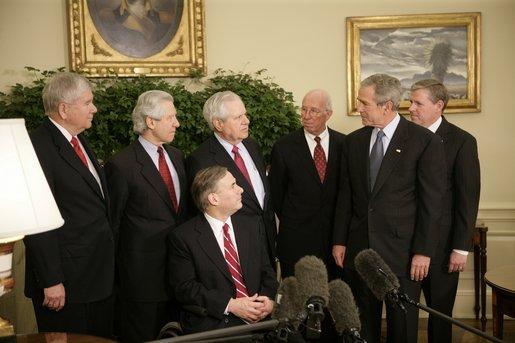 | President George W. Bush meets with former justices of the Texas Supreme Court Monday, Oct. 17, 2005, in the Oval Office of the White House. From left are: Former Associate Justice Eugene Cook; former Associate Justice Raul Gonzalez; |
Harriet Miers is a uniquely qualified person to serve on the bench. She is smart, she is capable, she is a pioneer. She's been consistently ranked as one of the top 50 women lawyers in the United States. She has been a leader in the legal profession. She's impressed these folks. They know her well. They know that she'll bring excellence to the bench.
So I want to thank you all for coming. Thank you for being part of a group of people who understand that Harriet Miers will be a superb Supreme Court judge.
Welcome. I'm glad you're here.
JUDGE HILL: Thank you. Mr. President, we just all want to thank you for this nomination. We're excited about it, and we're here to try to let the people of America know what we all know, that she is an absolutely fantastic person and a great lawyer, and will make a great judge.
THE PRESIDENT: Well, thank you, sir. Appreciate you coming. Thank you all.
END 11:29 A.M. EDT, For Immediate Release, Office of the Press Secretary, October 17, 2005
more at President Bush and Supreme Court or harriet miers and SCOTUS or Texas Supreme Court Justices
0
comments
||
||
President Meets with Bulgarian President Georgi Purvanov (VIDEO)
President Meets with Bulgarian President Georgi Purvanov, FULL STREAMING VIDEO, The Oval Office, 10:53 A.M. EDT
 | President George W. Bush shakes hands with Bulgarian President Georgi Purvanov prior to taking questions from reporters, Monday, Oct. 17, 2005, in the Oval Office at the White House in Washington. White House photo by Eric Draper |
Mr. President, your country is a strategic ally. It's been my honor to welcome you to the Oval Office and thank you for a wide-ranging discussion on a lot of important topics.
Bulgaria has been a valued partner in NATO. Your country has been a strong example for democracy. You understand, like I understand, that the march of democracy will lead to world peace. I want to thank you for being a part of a vast coalition that helped liberate 50 million people. We discussed important bilateral issues.
And I want to thank you again for coming, thank you for your leadership and thank you for your friendship.
PRESIDENT PURVANOV: (As translated.) Thank you, Mr. President. Ladies and gentlemen, I would like to say how pleased I am with the discussions we just had with Mr. President. I am delighted that we had a chance to reaffirm our specific partnership and to discuss, to go through the agenda of some specific issues related.
I do appreciate the support we have been receiving from the United States in becoming a reliable NATO member state, and also in joining the European Union in time, that is, as of January '07. I value the high appreciation of Bulgaria's role as a stabilizing factor in the Balkans that we receive.
I had the chance to reaffirm Bulgaria's commitment to remain an ally of the anti-terrorist coalition. Of course, the specifics of that are going to be discussed on an expert level. I appreciate the opportunity to raise some concrete, specific issues and put on the table Bulgaria's ambitions, particularly to get its military modernized and to be involved in some energy products in the Balkans.
And I'm sure that after these meetings and talks, our institutions and the people concerned, the experts will have a lot of work to do in order to guarantee an influx of investment. I'm particularly pleased with this very frank -- open and frank discussions we had.
PRESIDENT BUSH: Thank you. Answer a couple of questions -- hold a second, please. We'll go to the American side first. Deb.
Q Mr. President, would you expect a member of your administration to resign or take leave if they were indicted?
PRESIDENT BUSH: Mr. President, there's an investigation going on; I've made it very clear to the press that I'm not going to discuss the investigation. And so, therefore -- and so my position hasn't changed since the last time I've been asked this question. There's a serious investigation. We're not going to -- I'm not going to pre-judge the outcome of the investigation.
Yes.
Q Mr. President, first, we remember 9/11 and we thank you for your leadership, sir. The question is, in Bulgarian public opinion knows quite well that the most important thing for us is to get our nurses back from the jail in Libya, because they're facing a firing squad, sir, after few weeks if the verdict is confirmed. So we are partners. You're the leader of the most powerful nation on Earth. Why don't you help us, sir?
PRESIDENT BUSH: Do you want to interpret that?
We discussed this issue at length. Like the President, my heart breaks when young children get sick. The position of the United States government is the nurses ought to be freed. We have made our position known to the Libyan government. There's no confusion -- there should be no confusion in the Libyan government's mind. But those nurses ought to be not only spared their life, but out of prison. And we will continue to make that message perfectly clear.
Steve.
Q Sir, the vote on Saturday, does the Sunni vote against the Iraqi constitution damage the political process? Will it increase the likelihood of violence and American sacrifice?
PRESIDENT BUSH: My first reaction to the vote was that an increase in turnout was an indication that the Iraqi people are strongly in favor of settling disputes in a peaceful way; that they understand that working to find common ground on a constitution is much better for their future than relying upon killers and people who will kill innocent children and women for the sake of creating havoc.
Secondly, I was pleased to see that the Sunnis participated in the process. The idea of deciding to go into a ballot box is a positive development. The idea that people are willing to try to work out their political differences through a process, a peaceful process, stands in stark contrast to the al Qaeda types and the terrorists and the killers that are trying to drive the process through violence.
The way forward is clear. The political process will continue with a constitution, if finally ratified, and then an election, coupled with a security plan that continues to train Iraqis so they do the fight. The violence in this election was down from the previous election. And one of the reasons why is because the Iraqi forces took the fight to the enemy -- and provided security, which is really heartening to coalition forces and friends and allies.
So yesterday was a very hopeful day for peace. It's an exciting day for a country that only a few short years ago was ruled by a brutal tyrant. So I'm pleased with the progress being made.
Q What do you think of Bulgaria's role -- of your ally, Bulgaria, as a regional leader in the Balkans?
PRESIDENT BUSH: I think the -- I watched your election -- recent parliamentary elections very closely. The people voted. And then coalitions were formed for the good of the country. That's an example that many can learn from. There's nothing more wholesome than a young democracy, not only setting an example for others, but taking a lead in explaining to citizens that the best way to resolve differences is through a political process that is peaceful.
And so the President and I talked about Bulgaria's important role in taking the lead in helping young democracies grow in strength. We're laying the foundation for peace. Democracies are peaceful. They're at peace with their neighbors. And the Balkans needs peace, the Middle East needs peace. And working with friends like Bulgaria, we are laying that foundation for peace.
I'm proud to have your friendship. Thank you.
END 11:06 A.M. EDT, For Immediate Release, Office of the Press Secretary, October 17, 2005
more at President Bush and Bulgarian or Georgi Purvanov and Bulgaria or NATO or European Union and Balkans
0
comments
||
||
President to Welcome Italian Prime Minister Silvio Berlusconi
President to Welcome Italian Prime Minister Silvio Berlusconi to the White House
President Bush will host Italian Prime Minister Silvio Berlusconi at the White House for a meeting and lunch on October 31, 2005. Italy is one of America's strongest allies and closest partners in the global war on terror. Under Prime Minister Berlusconi's leadership, Italy is playing a leading role in international stabilization and reconstruction efforts in Iraq, Afghanistan, and the Balkans. The President and the Prime Minister will discuss a range of issues, including their shared commitment to advance freedom and democracy around the world.
# # # Immediate Release, Office of the Press Secretary, October 17, 2005
more at President Bush and Italian or Silvio Berlusconi and Berlusconi or Italy and Italia or White House
0
comments
||
||
President to Attend Asia-Pacific Economic Cooperation Meeting
President to Attend APEC Meeting in Korea, Additional Travel to Japan, China, and Mongolia
President Bush will travel to Busan, Republic of Korea to attend the 13th Asia-Pacific Economic Cooperation (APEC) Leaders' Meeting on November 18-19. At APEC, the President will continue his dialogue with APEC Leaders on ways to promote free trade and economic growth, and deepen regional security cooperation. The President will meet with President Roh Moo-Hyun in Gyeongju, Republic of Korea on November 17, and hold bilateral meetings with other leaders while at APEC.
On November 15, President Bush will visit Kyoto, Japan. He will meet with Prime Minister Junichiro Koizumi on November 16. Following the APEC meetings in the Republic of Korea, the President will travel to Beijing, China on November 19 at the invitation of President Hu Jintao and to Ulaanbaatar, Mongolia to meet with President Enkhbayar on November 21.
# # # For Immediate Release, Office of the Press Secretary, October 17, 2005
more at President Bush and Asia-Pacific Economic Cooperation or Korea and Japan or China and Mongolia
0
comments
||
||
Sunday, October 16, 2005
Iraqi Constitutional Referendum
President Congratulates Iraqis on Successful Elections, The South Grounds, 12:47 P.M. EDT
THE PRESIDENT: On behalf of the American people, I'd like to congratulate the people of Iraq for the successful completion of a vote on their draft constitution. By all indications, the turnout was greater than the turnout from the last January election, which is good news. By all indications, the Sunnis participated in greater numbers in this election than last time. And that's good news. After all, the purpose of a democracy is to make sure everybody is -- participates in the process.
I'm also pleased, from the initial indications, that the level of violence was considerably less than the last election. That's a tribute to the Iraqis -- forces who we've trained, as well as coalition forces that worked hard to make sure that democracy could move forward in Iraq.
This is a very positive day for the Iraqis and, as well, for world peace. Democracies are peaceful countries. The vote today in Iraq stands in stark contrast to the attitudes and philosophy and strategy of al Qaeda and its terrorist friends and killers. We believe, and the Iraqis believe, the best way forward is through the democratic process. Al Qaeda wants to use their violent ways to stop the march of democracy because democracy is the exact opposite of what they believe is right.
We're making progress toward peace. We're making progress toward an ally that will join us in the war on terror, that will prevent al Qaeda from establishing safe haven in Iraq, and a country that will serve as an example for others who aspire to live in freedom.
So, again, I congratulate the Iraqi people. I thank you for meeting this milestone. Thank you for doing what is right, to set the foundations for peace for future generations to come.
Appreciate it.
END 12:51 P.M. EDT, Immediate Release, Office of the Press Secretary, October 16, 2005
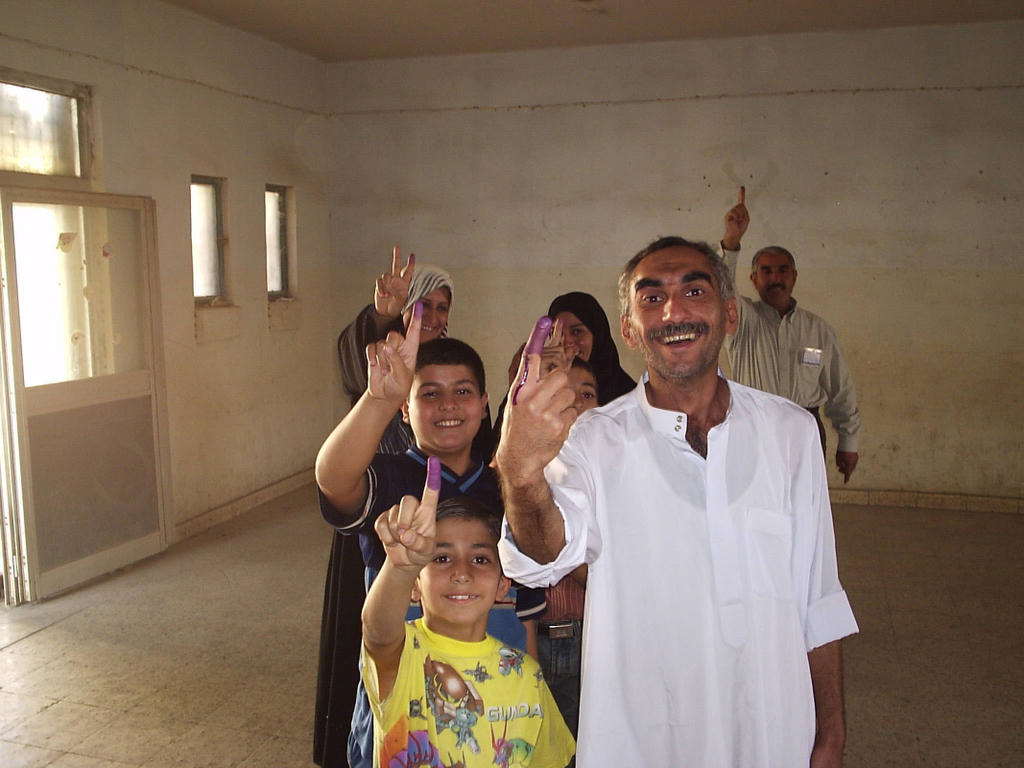 | BAGHDAD — Iraqi citizens young and old display their ink-dipped fingers after the adults cast their ballots during the Constitutional Referendum Oct. 15 near Khadamiyah. |
Caption: An election official checks the registrar for a man's name. Taken On: 10/15/2005, Photographer: Combat Camera
Caption: An Iraqi is handed his ballot by an election official. Taken On: 10/15/2005, Photographer: Combat Camera
Caption: An Iraqi folds his ballot before placing it in the ballot box. Taken On: 10/15/2005, Photographer: Combat Camera
Caption: An Iraqi places the finished ballot inside the ballot box. Taken On: 10/15/2005, Photographer: Combat Camera
Caption: An Iraqi proudly shows off his ink-stained finger. Taken On: 10/15/2005, Photographer: Combat Camera
Caption: An Iraqi man places his ballot into the ballot box. Taken On: 10/15/2005, Photographer: Combat Camera
Caption: An Iraqi proudly shows off her ink-stained finger. Taken On: 10/15/2005, Photographer: Combat Camera
Caption: An Iraqi woman places her ballot into the ballot box. Taken On: 10/15/2005 Photographer: Combat Camera
Caption: An Iraqi proudly shows off his ink-stained finger. Taken On: 10/15/2005 Photographer: Combat Camera
Caption: An Iraqi proudly shows off his ink-stained finger Taken On: 10/15/2005, Photographer: Combat Camera
Caption: An Iraqi proudly shows off his ink-stained finger. Taken On: 10/15/2005 Photographer: Combat Camera
more at President Bush and Iraqi Constitution or Iraq and Iraq Draft Constitution or Iraq National Assembly and Middle East ir iraqi referendum or Draft Constitution and Iraqi Constitutional Referendum
0
comments
||
||
FLU VIRUS REPORTED TO RESIST DRUG ENVISIONED FOR PANDEMIC
FLU VIRUS REPORTED TO RESIST DRUG ENVISIONED FOR PANDEMIC, RELATED: Researchers Reconstruct 1918 Pandemic Influenza Virus
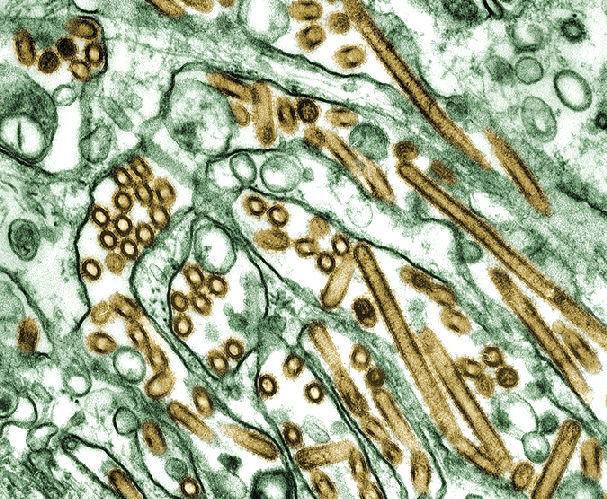 | MADISON - An avian influenza virus isolated from an infected Vietnamese girl has been determined to be resistant to the drug oseltamivir, the compound better known by its trade name Tamiflu, and the drug officials hope will serve as the front line of defense for a feared influenza pandemic. |
The finding suggests that health officials - now stockpiling millions of doses of the drug to forestall a global outbreak of influenza and buy time to develop and mass produce a vaccine - should also consider other options, according to Yoshihiro Kawaoka, an international authority on influenza and the senior author of the Nature paper.
Recent reports indicate the federal government may spend billions of dollars to stockpile as much as 81 million courses of Tamiflu to forestall a possible influenza pandemic. The government has already stockpiled an estimated 12 to 13 million courses.
"This is the first line of defense," says Kawaoka, a professor in the UW-Madison School of Veterinary Medicine who holds a joint appointment at the University of Tokyo. "It is the drug many countries are stockpiling, and the plan is to rely heavily on it."
The drug would be used to slow the spread of influenza until a vaccine is developed, which may take up to six months.
Tamiflu is delivered orally and works to impede the spread of the virus by binding to and inhibiting one of the surface enzymes the virus uses to exit infected cells of a host. Once inside a host cell, the virus commandeers the cell's reproductive machinery to make new infectious particles that go on to take over other cells. When the drug is at work, Kawaoka explains, "the virus is still able to replicate inside a cell, but is unable to get out and infect other cells."
Oseltamivir, which Kawaoka describes as an "amazing drug," is one of three compounds proven to be effective against influenza. One class, derivatives of the compound adamantine, would be less effective, as some flu viruses have already evolved resistance to it. The other drug, zanamivir, which was developed prior to oseltamivir, is effective, but is formulated as a powder and requires that a clinician provide instructions for use. Thus, it is more cumbersome to administer than the orally delivered Tamiflu.
These flu-fighting drugs, says Kawaoka, are by no means a replacement or alternative to a vaccine. Effective vaccines can confer immunity, preventing the virus from gaining a toehold in the body. But it is unlikely sufficient quantities of a vaccine can be produced and stockpiled prior to the emergence of a new virus in human populations.
If avian influenza does emerge and becomes infectious from human to human - and nearly all experts agree that will happen at some point in the future - an outbreak similar to the 1918 influenza pandemic could occur. That pandemic killed as many as 50 million people, more than died on all the battlefields of World War I. Scientists and vaccine manufacturers would be in a race against time to produce enough doses to forestall disaster. Drugs like Tamiflu, used in combination with quarantine, would be intended to slow the spread of the disease until a vaccine is produced.
Kawaoka says there may not be enough Tamiflu to go around even though countries are stockpiling it. The Wisconsin scientist says that will create a risk of patients sharing the drug and using smaller doses, which could accelerate the emergence of virus resistant to the drug and hamper efforts to contain the spread of the disease.
He says health officials should consider stockpiling zanamivir and recommending that only the therapeutic dosages of Tamiflu be administered to patients.
"We've been watching for this change (in the virus)," Kawaoka says. "This is the first, but we will see others. There's no question about it." ###
- Terry Devitt, (608) 262-8282, trdevitt@wisc.edu FOR IMMEDIATE RELEASE 10/14/05
CONTACT: Yoshihiro Kawaoka, (608) 265-4925, kawaokay@svm.vetmed.wisc.edu
more at 1918 Pandemic and Influenza Virus or CDC and Pandemic and Avian influenza or Bird Flu and H5N1 or Tamiflu and oseltamivir
0
comments
||
||
Study of Structural Damage from Gulf Hurricanes
Commerce’s NIST Coordinates Study of Structural Damage from Gulf Hurricanes
GAITHERSBURG, Md.—The Commerce Department’s National Institute of Standards and Technology (NIST) announced today that it has deployed the first of three teams of technical experts under a multiorganizational partnership to perform assessments of physical structures damaged by Hurricanes Katrina and Rita along the nation’s Gulf Coast. The partnership—coordinated by NIST and made up of 26 engineers from 16 separate private-sector, academic and federal organizations—will document data from the field on damage to major buildings, infrastructure facilities and residential structures due to wind, wind-borne debris, storm surge, surge-borne debris and flooding.
The damage assessment teams also will collect damage and environmental data from other sources, correlate damage data with environmental data, and identify building codes and practices used in the affected areas. Their efforts will result in a single report from the entire partnership documenting all findings, recommendations for any additional assessments needed of structural performance during the hurricanes, and any immediate implications for building practices, standards and codes.
The 16 organizations participating in the three damage assessment teams are NIST, the Applied Technology Council, the U.S. Army Corps of Engineers, the Federal Highway Administration, the International Code Council, the National Council of Structural Engineers Associations, the National Research Council of Canada, Texas Tech University, the University at Buffalo, the University of Puerto Rico, Amtech Roofing Consultants Inc., Applied Residential Engineering Services, ImageCat Inc., Scawthorn Porter Associates Inc., Shiner Moseley and Associates Inc., and Smith & Huston Inc.
The first damage assessment team began a four-day tour of duty on Oct. 10 in the East Texas/West Louisiana coastal areas affected by Hurricane Rita. The team is focusing its observation and data collection efforts on regions where wind speed measurements were obtained during the hurricane and where the data indicate wind strengths that may have approached levels used in building design.
The second and third damage assessment teams will be deployed on Oct. 17 to the regions affected by Hurricane Katrina. These teams will perform similar functions to the group currently assessing damage from Hurricane Rita. One team will concentrate on the New Orleans area while the other will focus on the Mississippi/Alabama coastal regions.
To support the planning and deployment of the three damage assessment teams, NIST had already sent experts on preliminary reconnaissance and data collection missions into the hurricane-affected areas of Louisiana and Mississippi. A NIST roofing expert was in the field from Sept. 6-9 to work with a roofing industry group, followed by a team of four NIST structural engineers that worked in the region from Sept. 26-Oct. 1. The latter group collaborated with an assessment team headed by the Department of Homeland Security’s Federal Emergency Management Agency. Additionally, two of the NIST engineers joined with the U.S. Army Corps of Engineers, at its invitation, to collect preliminary data on damage to the levees and other flood control systems around New Orleans.
As a non-regulatory agency of the U.S. Department of Commerce’s Technology Administration, NIST develops and promotes measurement, standards and technology to enhance productivity, facilitate trade and improve the quality of life.
FOR IMMEDIATE RELEASE: Oct. 13, 2005, CONTACT: Michael E. Newman( 301) 975-3025NIST
more at Hurricane or Katrina and Hurricane Katrina or Rita and Gulf Coast or Hurricane Rita and New Orleans or Louisiana and Mississippi
0
comments
||
||
Saturday, October 15, 2005
Presidential Podcast 10/15/05
Presidential Podcast 10/15/05 Subscribe to Our Odeo Podcast Channel and receive the Presidential Radio Address each week. Featuring real audio amd full text transcript
more at President Bush and Iraqi Constitution or Iraq and Iraq Draft Constitution or Iraq National Assembly and Middle East or iraqi referendum or Draft Constitution
0
comments
||
||
Freedom Calendar 10/15/05 - 10/022/05
October 15, 1914, African-American Republican James Weldon Johnson, celebrated poet of Harlem Renaissance movement, becomes editor of leading black journal, New York Age; served as Theodore Roosevelt’s Consul in Venezuela and Nicaragua.
October 16, 1901, President Theodore Roosevelt invites Booker T. Washington to dine at White House, sparking protests by Democrats across the country.
October 17, 1989, Appointed by President George H. W. Bush, Antonia Novello becomes first woman and first Hispanic to be U.S. Surgeon General.
October 18, 1871, After violence against Republicans in South Carolina, President Ulysses Grant deploys U.S. troops to combat Democrat terrorists who formed the Ku Klux Klan.
October 19, 1956, On campaign trail, Vice President Richard Nixon vows: “American boys and girls shall sit, side by side, at any school – public or private – with no regard paid to the color of their skin. Segregation, discrimination, and prejudice have no place in America”.
October 20, 1942, 60 prominent African-Americans issue Durham Manifesto, calling on southern Democrats to abolish their all-white primaries.
October 21, 1837, Birth of Sara Spencer, Secretary of National Woman Suffrage Association; her address to 1876 Republican National Convention was first by a woman before a major party.
October 22, 1868, While campaigning for re-election, Republican U.S. Rep. James Hinds (R-AR) is assassinated by Democrat terrorists who organized as the Ku Klux Klan.
“We should reach each and every one in the State, so they would all register and vote for the Republican candidates.”
Mary Terrell, African-American Republican and co-founder of the NAACP
SOURCE: 2005 Republican Freedom Calendar more at Freedom Calendar or Republican and Republicans or African-Americans and NAACP or Emancipation Proclamation and Harlem Renaissance
0
comments
||
||
bush radio address 10/15/05 full audio, text transcript
bush radio address 10/15/05 full audio, text transcript Podcast
President's Radio Address
THE PRESIDENT: Good morning. This weekend is a momentous time in the history of the Middle East. After choosing their leaders in free elections in January, the Iraqi people have gone to the polls to vote on a democratic constitution. This constitution is the result of months of debate and compromise by representatives of Iraq's diverse ethnic and religious communities. These leaders came together to produce a document that protects fundamental freedoms and lays the foundation for a lasting democracy. Earlier this week, the Iraqi people embraced changes to the text that have led to its endorsement by some Sunni leaders, as well as Kurdish and Shia leaders. Now the people of Iraq will have the final say.
By casting their ballots, the Iraqi people deal a severe blow to the terrorists and send a clear message to the world: Iraqis will decide the future of their country through peaceful elections, not violent insurgency.
This weekend's election is a critical step forward in Iraq's march toward democracy, and with each step the Iraqi people take, al Qaeda's vision for the region becomes more remote. As Iraqis prepared for this election, the world learned of a letter written by a leading terrorist explaining why Iraq is the central front in their war on civilization. Al Qaeda's number two leader, a man named Zawahiri, wrote to his chief deputy in Iraq, the terrorist Zarqawi. We intercepted this letter, and we have released it to the public. In it, Zawahiri lays out why al Qaeda views Iraq as "the place for the greatest battle" of our day.
He says that establishing al Qaeda's dominion over Iraq is the first step towards their larger goal of imposing Islamic radicalism across the broader Middle East. Zawahiri writes: "The jihad in Iraq requires several incremental goals. The first stage: Expel the Americans from Iraq. The second stage: Establish an Islamic authority over as much territory as you can to spread its power in Iraq. The third stage: Extend the jihad wave to the secular countries neighboring Iraq."
This letter shows that al Qaeda intends to make Iraq a terrorist haven and a staging ground for attacks against other nations, including the United States. The letter makes equally clear that the terrorists have a problem: Their campaign of murder and mayhem is turning the people against them. The letter warns Zarqawi that, "many of your Muslim admirers amongst the common folk are wondering about your attacks on the Shia." Even al Qaeda recognizes that with every random bombing and every funeral of a child, the Muslim world sees the terrorists for what they really are: murderers at war with the Iraqi people.
These terrorists are driven by an ideology that exploits Islam to serve a violent political vision: the establishment of a totalitarian empire that denies political and religious freedom. This is why the terrorists have fought to prevent and disrupt this weekend's elections. They understand that the act of voting is a rejection of them and their distorted vision of Islam. Simply by coming out to vote, the Iraqi people have shown that they want to live in freedom, and they will not accept a return to tyranny and terror.
The terrorists know their only chance for success is to break our will and force us to retreat. The al Qaeda letter points to Vietnam as a model. Zawahiri says: "The aftermath of the collapse of American power in Vietnam, and how they ran and left their agents, is noteworthy." Al Qaeda believes that America can be made to run again. They are gravely mistaken. America will not run, and we will not forget our responsibilities.
In Iraq, we have brought down a murderous regime. We have stood by the Iraqi people through two elections, and we will stand by them until they have established a free nation that can govern itself, sustain itself, and defend itself. When we do, Iraq will be an ally in the war on terror and a partner for peace and moderation in the Muslim world. And because America stood firm in this important fight, our children and grandchildren will be safer and more secure.
Thank you for listening.
END For Immediate Release October 15, 2005
more at President Bush and Iraqi Constitution or Iraq and Iraq Draft Constitution or Iraq National Assembly and Middle East or iraqi referendum or Draft Constitution
0
comments
||
||
Friday, October 14, 2005
TEXT OF THE DRAFT IRAQI CONSTITUTION
Preamble TEXT OF THE DRAFT IRAQI CONSTITUTION (from the Iraqi Transitonal Government Website)
We the sons of Mesopotamia, land of the prophets, resting place of the holy imams, the leaders of civilization and the creators of the alphabet, the cradle of arithmetic: on our land, the first law put in place by mankind was written; in our nation, the most noble era of justice in the politics of nations was laid down; on our soil, the followers of the prophet and the saints prayed, the philosophers and the scientists theorized and the writers and poets created.
Recognizing God's right upon us; obeying the call of our nation and our citizens; responding to the call of our religious and national leaders and the insistence of our great religious authorities and our leaders and our reformers, we went by the millions for the first time in our history to the ballot box, men and women, young and old, on January 30 2005, remembering the pains of the despotic band's sectarian oppression of the majority; inspired by the suffering of Iraq’s martyrs - Sunni and Shiite, Arab, Kurd and Turkomen, and the remaining brethren in all communities - inspired by the injustice against the holy cities in the popular uprising and against the marshes and other places; recalling the agonies of the national oppression in the massacres of Halabja, Barzan, Anfal and against the Faili Kurds; inspired by the tragedies of the Turkomen in Bashir and the suffering of the people of the western region, whom the terrorists and their allies sought to take hostage and prevent from participating in the elections and the establishment of a society of peace and brotherhood and cooperation so we can create a new Iraq, Iraq of the future, without sectarianism, racial strife, regionalism, discrimination or isolation.
Terrorism and “takfir” (declaring someone an infidel) did not divert us from moving forward to build a nation of law. Sectarianism and racism did not stop us from marching together to strengthen our national unity, set ways to peacefully transfer power, adopt a manner to fairly distribute wealth and give equal opportunity to all.
We the people of Iraq, newly arisen from our disasters and looking with confidence to the future through a democratic, federal, republican system, are determined - men and women, old and young - to respect the rule of law, reject the policy of aggression, pay attention to women and their rights, the elderly and their cares, the children and their affairs, spread the culture of diversity and defuse terrorism.
We are the people of Iraq, who in all our forms and groupings undertake to establish our union freely and by choice, to learn yesterday's lessons for tomorrow, and to write down this permanent constitution from the high values and ideals of the heavenly messages and the developments of science and human civilization, and to adhere to this constitution, which shall preserve for Iraq its free union of people, land and sovereignty.FULL TEXT: DRAFT IRAQI CONSTITUTION
more at Iraqi Constitution or Iraq and Iraq Draft Constitution or Iraq National Assembly and Middle East ir iraqi referendum or Draft Constitution
0
comments
||
||


