


bush radio address 01/21/06 full audio, text transcript PODCAST
President's Radio Address
THE PRESIDENT: Good morning. This past Thursday, I visited a thriving company in Loudoun County, Virginia, named JK Moving and Storage. I met with the owners and workers and with small businesspeople from the area, and I discussed my agenda to keep America's economy growing and to help our small businesses stay vibrant and strong.
Our agenda for growing the economy and helping small businesses starts with wise tax policy. Our economy grows when American workers and families can keep more of their hard-earned money to spend, save, and invest as they see fit. Small businesses create most of the new jobs in our country, and tax relief helps them as well, because most small businesses pay taxes at individual income tax rates.
So after I took office, we cut taxes on everyone who pays income taxes -- leaving more money in the hands of workers and families and giving small businesses more resources to expand and hire. We increased the tax incentives for small businesses to invest in new equipment, and we cut taxes on dividends and capital gains. We also put the death tax on the road to extinction because farmers and small business owners should not be taxed twice after a lifetime of work.
Thanks to tax relief, spending restraint, and the hard work of America's entrepreneurs and workers, our economy today is strong. We've added over 400,000 jobs in the last two months and over 4.6 million jobs since May 2003. Our unemployment rate is now 4.9 percent, lower than the average rate of the 1970s, 1980s, and 1990s. Our economy grew at 4.1 percent in the third quarter of 2005, and it has been growing at nearly that rate for two years. Real after-tax income has grown 7 percent per person since 2001. Productivity is high, inflation is contained, consumers are confident, and more Americans now own their homes than at any time in our Nation's history.
Unfortunately, just as we are seeing how our tax cuts have created jobs and opportunity, some in Washington want to repeal the tax relief. Others want to just let it expire in a few years. Either way, they want to raise your taxes. If that happens, families across America would see their taxes increase dramatically. Small businesses would also pay higher taxes -- which would mean less money to hire workers and buy new equipment. To keep our economy growing and our small business sector strong, we need to ensure that you keep more of what you earn -- so Congress needs to make the tax cuts permanent.
For the sake of America's small businesses, workers, and families, we must also make health care more affordable and accessible. A new product known as Health Savings Accounts helps control costs by allowing businesses or workers to buy low-cost insurance policies for catastrophic events and then save, tax-free, for routine medical expenses. This year, I will ask Congress to take steps to make these accounts more available, more affordable, and more portable. Congress also needs to pass Association Health Plans, which allow small businesses across the country to join together and pool risk so they can buy insurance at the same discounts big companies get.
Our small businesses are confronting other challenges that we must address. Too many entrepreneurs face the threats of costly junk lawsuits. Last year, we passed bipartisan class-action reform to ease this burden. Now Congress needs to curb abusive asbestos litigation, pass medical liability reform to reduce the costs of frivolous litigation on our doctors and patients, and penalize those who abuse the legal system by repeatedly filing junk lawsuits.
Rising energy costs are also a concern for small businesses, so we're going to continue to work to develop new technologies and alternative and renewable fuels that will make us less dependent on foreign sources of energy. And we will continue to open up new markets for small businesses so they can sell their products and services overseas. On a level playing field, I know our workers, farmers, and businesses can compete with anybody, anytime, anywhere.
America's economy is strong and growing stronger. Small businesses have been a driving force behind the tremendous growth and job creation of recent years. By adopting sound policies that help our small businesses continue to grow and expand, we will keep the economy moving forward and extend prosperity and hope in our country.
Thank you for listening.
For Immediate Release, January 21, 2006
more at President Bush and White House or economy and tax policy, or Small businesses and unemployment rate, or Health Savings Accounts, and junk lawsuits,
Related: Keywords radio address, podxast, Saturday, January 14, 2006 bush radio address 01/14/06 full audio, text transcript, Saturday, January 07, 2006 bush radio address 01/07/06 full audio, text transcript, Saturday, December 31, 2005 bush radio address 12/31/05 full audio, text transcript, Saturday, December 24, 2005 bush radio address 12/24/05 full audio, text transcript, Saturday, December 17, 2005 bush radio address 12/17/05 full VIDEO, text transcript, Sunday, December 04, 2005 Presidential Podcast 12/03/05, Saturday, December 03, 2005 bush radio address 12/03/05 full audio, text transcript, November 26, 2005 Presidential Podcast 11/26/05, Saturday, November 26, 2005 bush radio address 11/26/05 full audio, text transcript, Saturday, November 19, 2005 Presidential Podcast 11/19/05, Saturday, November 19, 2005 Freedom Calendar 11/19/05 - 11/26/05, Saturday, November 12, 2005 Presidential Podcast 11/12/05, Saturday, November 12, 2005 bush radio address 11/12/05 full audio, text transcript, Saturday, November 05, 2005 Presidential Podcast 11/05/05, Saturday, November 05, 2005 bush radio address 11/05/05 full audio, text transcript, Saturday, October 29, 2005 bush radio address 10/29/05 full audio, text transcript, Saturday, October 22, 2005 Presidential Podcast 10/22/05, Saturday, October 15, 2005 Presidential Podcast 10/15/05, Saturday, October 08, 2005 bush radio address 10/08/05 full audio, text transcript, Saturday, October 01, 2005 bush radio address 10/01/05 full audio, text transcript, Saturday, September 24, 2005 bush radio address 09/24/05 full audio, text transcript, Saturday, September 17, 2005 bush radio address 09/17/05 full audio, text transcript
Saturday, January 21, 2006
bush radio address 01/21/06 full audio, text transcript
0
comments
||
||

Friday, January 20, 2006
Press Briefing Scott McClellan 01/19/06 (VIDEO)
 | Press Briefing by Scott McClellan 01/18/06, FULL STREAMING VIDEO James S. Brady Briefing Room 12:43 P.M. EST. MR. MCCLELLAN: Good afternoon, everyone. I know there's a lot of interest in the purported bin Laden audiotape that aired on al-Jazeera earlier today. |
We continue to act on all fronts to win the war on terrorism, and we will. The President is fully committed to doing everything within his power to prevent attacks and defeat the terrorists. We are taking the fight to the enemy; we are working to advance freedom and democracy, to defeat their evil ideology. We are winning. Clearly, al Qaeda and the terrorists are on the run. And that is why it is important that we do not let up, and that we do not stop until the job is done. And that's what we will do.
Q He seemed to be offering a conditional truce under fair conditions, and seemed to be tying it to a U.S. pullout from Iraq.
MR. McCLELLAN: And as I indicated, clearly, the al Qaeda leaders and the terrorists are on the run. They're under a lot of pressure. We do not negotiate with terrorists. We put them out of business. The terrorists started this war, and the President made it clear that we will end it at a time and place of our choosing. We continue to pursue all those who are seeking to do harm to the American people, and to bring them to justice.
Q Scott, OBL seems to have been reading polling, particularly, on this issue of troop withdrawals, contrasting that with the President's position and trying to drive a wedge, it would seem, between the President and the American people.
MR. McCLELLAN: And?
Q What's your response to that?
MR. McCLELLAN: My response is what I just said. I think, clearly, the leaders of al Qaeda and others are on the run. We've already brought to justice some three-quarters of the al Qaeda leadership. And we are not going to let up. We are taking the fight to the enemy. We are continuing to pursue them, wherever they are. And we will bring them to justice, and we will win in this war on terrorism.
And I think, clearly, if you look at the last time we heard from bin Laden, you can see the kind of pressure he's under. Last time, remember, he was telling the Iraqi people not to show up and vote. Well, we saw how that turned out.
Q It is, to my knowledge, the first time that he has used polling to try to drive this wedge --
MR. McCLELLAN: I'll let the intelligence community do the analysis of the tape and look at his words. There has been ongoing analysis at this point.
Q Scott, what is the White House hearing from the intelligence community about the validity of the warning of attacks?
MR. McCLELLAN: I'm sorry?
Q What is the White House hearing initially from the intelligence community about the validity --
MR. McCLELLAN: There's nothing to report. This tape was just aired earlier this morning, and they're looking at it to determine, one, if it's authentic, and two, to see if there's any actionable intelligence on it. And there's nothing -- nothing more to report on that at this point.
Q The voice also says that the absence of an attack in the U.S. since 9/11 is not due to security measures, but that plans are, in fact, in place. Since the administration often says some security measures have, in fact, made the country safer, what's your response to that?
MR. McCLELLAN: I think, absolutely. Our intelligence community and law enforcement officials are doing a great job. Our men and women in uniform are doing an outstanding job. They're taking the fight to the enemy, and we keep them in our thoughts and prayers always, and we thank them for all that they're doing. We thank their families. They understand the stakes involved. And we are prevailing in this war. And we will continue to take the fight to the enemy, we will continue to support the advance of democracy in the broader Middle East.
We know the nature of the enemy. The President has talked about the nature of the enemy at length. We know that they want to drive us out of the Middle East because they view democracy and peace as a threat to their existence. And they know that the United States remaining involved in the Middle East is a threat to their ambitions. We know that they want to continue to try to create a safe haven to where they can plan and plot attacks. But we've got them on the run. We've got them under a lot of pressure. And we're going to continue taking the fight to them. That's the best way to prevail in the war on terrorism.
But we're acting on numerous fronts. We have taken a number of steps since the attacks of September 11th to harden our defenses at home. And I think that, in no small part, because of the great work of our military abroad and our men and women in law enforcement and intelligence here at home, and the tools that we have used, we have been fortunate not to have been attacked again. We know the enemy wants to attack us again and they want to inflict even greater harm than they have previously, and that's why we must continue taking the fight to them. That's why we must not stop until they are defeated. And that's what this President committed to doing to the American people.
Q Do you see a tactical link between the release of the tape now and the strikes that occurred --
MR. McCLELLAN: Again, this tape is being analyzed by the intelligence community. They'll look at these issues, and if there's more to report at a certain point, we'll talk about it further.
Q Scott, you said three-quarters of al Qaeda leadership who's been captured or killed -- I assume you meant known leadership.
MR. McCLELLAN: That's right. Well, and we know that they replace their leaders. We've talked about that at length. But we pursue those, as well, and we've brought some of those to justice, as well. But it's not the same organization that it was when it attacked us on September 11th, because of the actions that we have taken and because of what we have done to put their leaders out of business or bring them to justice.
Q But we've been unable to capture Osama bin Laden. He's still capable of sending out messages, he's still capable of threats, and I assume, still capable of attacks.
MR. McCLELLAN: I think, clearly, he is on the run. Clearly, he is under a lot of pressure, just as other al Qaeda leaders who are on the run are. And that's why we're going to continue pursuing them and continue going after them, to bring them to justice. We have made great progress, but this is a war that continues and this is a war that we will not let up on until we have prevailed.
Q Explain why it's so difficult to find him, just for the American public who may say, we're so technologically advanced, the greatest army in the world, but we can't find him --
MR. McCLELLAN: Well, I think you have to look at the nature of the enemy that we face, and the nature of the war that we're engaged in. This is a war on terrorism. It's broader than any one person. It's a struggle of ideologies. The President has talked about this at length with the American people, and will continue to talk about it. The Vice President, I think, is talking about some of that right now, as well. He's giving a speech in New York. And this is an ideological struggle. The President made it clear that it is a long struggle that we're engaged in, and that we must do everything within our power and act on all fronts to prevail in this war on terrorism. We are winning this war on terrorism, the terrorists are on the run and we're going to continue pursuing them and bringing them to justice, wherever they are.
Q Ideological war, or not, why is it so hard to find him?
MR. McCLELLAN: He is someone who is clearly on the run and has been hiding, and we will continue to pursue him and bring him to justice.
Q Would it make a huge difference if he was found at this point, or killed or captured?
MR. McCLELLAN: Well, again, that's why I made the point that it is much broader than any one person. And there's a loose network, the President has talked about, of terrorists who are committed to a shared ideology, and we must continue to take this threat seriously. And that's why we must continue to do everything within our power and use every tool at our disposal to defeat the terrorists.
Q Why do you keep linking Iraq and 9/11 and so forth? Iraq had nothing to do with 9/11, and you keep -- we started the war in Iraq. We brought the terrorists in, so-called.
MR. McCLELLAN: I think that's a misunderstanding of --
Q -- and 20 to 50 people are dying every day in Iraq.
MR. McCLELLAN: I think, one, that's a misunderstanding of the global war on terrorism that we are engaged in --
Q We invaded.
MR. McCLELLAN: Some people take a narrow view of the war on terrorism. The President recognizes --
Q Innocent Iraqis are paying the price.
MR. McCLELLAN: The President -- well, first of all, the Iraqi people, we have heard from many of them who have expressed their appreciation for the removal of a brutal and oppressive regime --
Q Many are dead. Thousands are dead.
MR. McCLELLAN: Second of all, Zawahiri, bin Laden's number two leader, has talked about how Iraq is the central front in the war on terrorism. We know that the terrorists want to create a safe haven from which they can plan and plot attacks. The stakes are high in Iraq. And that's why it's critical that we prevail in Iraq, because it will be a major blow to the ambitions of the terrorists. They don't want us in the Middle East. The Middle East is a dangerous region of the world. It has been a breeding ground for terrorism, a breeding ground where people are --
Q They don't want a foreigner in their country.
MR. McCLELLAN: -- planes into buildings and attacked innocent civilians across the world. And that's why it's so critical that we prevail in Iraq, as well. And we will. And the Iraqi people no longer live under a brutal, oppressive regime, a regime that was responsible for the systematic torture and killing of people who simply spoke out against that regime.
Q Scott, if I could follow --
MR. McCLELLAN: I'll try to come back if I can. I think -- go ahead.
Q On a related issue, there seemed to be a lot of contradictory evidence and statements about the recent raid on the village in Pakistan. Can you give us an accurate update based on intelligence -- the President know as to were there, in fact, four or five or more top al Qaeda people killed in this raid? Was al-Zawahiri one of those? Was he there, was he not there?
MR. McCLELLAN: Let me make a couple of comments. First of all, I indicated earlier this week that I don't tend to get into discussing operational matters or alleged operational matters in the war on terrorism from this podium, and I don't have any information to share with you on the reports that you're referring to. Pakistan is a valued ally in the global war on terrorism. We work very closely with Pakistan to pursue al Qaeda leaders and other terrorists and bring them to justice, and we will continue to do so.
Q Scott, during the appearance in Sterling, Virginia, the President didn't find out about the reported tape until after that was over --
MR. McCLELLAN: That's correct.
Q -- and you have a situation where millions of people are watching television, they're learning about the tape before the President does. Doesn't the White House see that as -- view that as kind of awkward, and was any thought given to perhaps giving him a note or somehow concluding that event --
MR. McCLELLAN: No, I don't think -- he was briefed immediately after the remarks, and I think that was an appropriate time to inform him of it.
Q How does the President feel about bin Laden personally? There have been famous quotes --
MR. McCLELLAN: Obviously, if there is something that is of an urgent nature, the President is informed.
Q -- famous quotes, "dead or alive," then in March of '02, "I'm not that concerned about him," then he said, "I never said I wasn't worried about him." You talked broadly about the leaders in general al Qaeda. How does he feel about bin Laden personally?
MR. McCLELLAN: I just indicated to you that we continue to pursue al Qaeda leaders and other terrorists who are seeking to do harm to the American people. We have made great progress over the last few years. We have kept them on the run, we have put a lot of pressure on them, because of the great work of our intelligence community, because of the great work of our military, because of the partnerships that we have with many nations around the world. And we will continue to pursue them wherever they are. The President has made that very clear. They can run, but we will continue to pursue them and they will be brought to justice.
Q Scott, two questions. As far as this tape is concerned, somebody somewhere is delivering these tapes to al-Jazeera. It sounds like al-Jazeera is acting as an agent of Osama bin Laden ever since 9/11 -- where each and every message from Osama bin Laden and al Qaeda they have aired -- so somebody should be knowing who is delivering these tapes to them, and where is Osama bin Laden on the run, and --
MR. McCLELLAN: I don't have anything for you on that.
Q The second question is, outside there are Iranians demonstrating for greater freedom. What message you think President Bush will have for them, for the Iranians --
MR. McCLELLAN: For the Iranian people? We continue to stand with the people of Iran. The people of Iran seek greater freedom. And our policy has long been to support the Iranian people in their desire for greater freedom. You have a regime that is in place that is out of step with the rest of the broader Middle East, and out of step with its own people. It is a regime that is more interested in serving its own self-interest and its own power than its people.
Q Is it a similar message to the Iraqi people?
MR. McCLELLAN: I'm sorry?
Q Is it a similar message to what the President had given to the Iraqi people?
MR. McCLELLAN: Well, this is another reason -- going back to something that Helen brought up about the comprehensive war that we're engaged in, it's important to understand a free Iraq will serve as an example to the rest of the Middle East and help inspire reformers in places like Iran. That's why it's so important that we succeed in Iraq. And that's why we have a clear strategy that's in place for doing so. And we're making real progress.
There's still difficulties and there will still be tough days ahead, but we stand with the Iraqi people, we stand with the people in Iran, we stand with people throughout the Middle East who want greater freedom. And we will continue to support people in the region in many different ways to advance freedom and democracy, because that is critical to our long-term security; that is critical to laying the foundations of peace for our children and grandchildren. And that's what I mean when I'm talking about the comprehensive war that we're engaged in, and making sure that we're doing everything we can to prevent attacks from happening and to defeat the enemy.
Q Scott, you mentioned Pakistan being a critical ally in the war on terror. The Pakistani government one thing. Does the President believe that without the Pakistani people's support, Osama bin Laden can be found?
MR. McCLELLAN: I think that, one -- a couple of things. I'm not going to get into talking about any intelligence matters, if that's what you're getting at, but, second, the Pakistani people are seeing the compassion and generosity of the American people in our response and support as they recover from the earthquake that hit. Our military, and many aid workers, have been in Pakistan helping people in need, people who were affected by those earthquakes and people that lost everything that they had. And we will continue to do our part to help them recover that. We've committed some $500 million in aid money. That's an extraordinary amount of resources committed to help them. We've also committed a large amount of military assets to help with getting people out of those dangerous areas. And we will continue to do so.
Q Can I ask you one more? On the threat level, are there considerations or discussion, obviously, right now depending on what the outcome of the authentication --
MR. McCLELLAN: I don't have any update. It's something that we always continue to look at, and we will continue to do so. I don't have any update. It's something that we're always looking at.
Q Scott, back on the struggle that you're talking about, and the narrow view. New York Congressman Ed Towns said, the administration's priorities are upside down; instead of concentrating on Osama bin Laden, we're concentrating on war in Iraq. And this goes back to the issue of why Osama bin Laden has not been found. And he was the impetus of this war on terror. He was the one who attacked -- well, his minions attacked the United States. Why not have Osama bin Laden captured or otherwise?
MR. McCLELLAN: Well, I think you're ignoring a lot of what the President has said, and a lot of what we are doing. And I think that some do have a misunderstanding of the nature of the enemy that we face and the war that we're engaged in. Some do view this as more of a law enforcement matter. But this is about an ideology. This is about an ideological struggle. This is an evil ideology that is based on hatred and oppression. This is an ideology that the terrorists want to spread throughout the broader Middle East. They want to create safe havens. This is a group of people that deny people their political and religious freedom. And that's why it's so important that we continue to do two things -- take the fight to the enemy, and spread freedom and democracy, because free nations are peaceful nations and that will lay the foundations of peace for generations to come.
Q But isn't it basic, step one, logically, for many people who are not trying to play political politics --
MR. McCLELLAN: Well, remember, there's al Qaeda, there are state sponsors of terror, there are other affiliated organizations that are out there, this loose network that the President has talked about that exists. And they all share this same ideology.
Q But wasn't step one that Osama bin Laden had his minions use planes as missiles?
MR. McCLELLAN: Well, I think you have to understand what September 11th taught us. What September 11th taught us was that we must confront threats before it's too late. And that's what this President is committed to doing and is doing. We must confront the threats before the attacks reach our shores.
Q And last question. Is Musharraf playing the fence? Some are questioning that he's playing the fence, trying to appease the United States and trying to appease those in his community. Do you think that Musharraf is straddling the fence?
MR. McCLELLAN: As I indicated, President Musharraf and Pakistan are a key ally in the global war on terrorism. And we are working with them --
Q -- doing enough to be a key ally?
MR. McCLELLAN: Well, all of us can do more in the war on terrorism.
Q Scott, if the tape is authentic, it shows that bin Laden is still alive. You say he's on the run right now. Would you go far as to say he has been marginalized -- I don't want to put words in your mouth, but is he marginalized?
MR. McCLELLAN: Well, as I indicated, he's clearly on the run and, clearly, al Qaeda is under a lot of pressure because of the actions that we are taking; because of the fact that we're on the offense; because of the fact that we're taking the fight to the enemy. That's what changed after September 11th. Before September 11th, the terrorists were taking the fight to the civilized world. They were attacking America, they were attacking other countries, and they thought they could do so with impunity. Now they know that they cannot. And that's why we will continue to pursue them wherever they are. We will continue to pursue this war until we win -- and we will win.
Q How do you know he's on the run?
MR. McCLELLAN: I think it's clear from all indications. And the last time we heard from him was a year ago in a tape, an audiotape, and as I indicated that was when he was urging the Iraqi people not to vote. And so anyone that thinks Iraq is not a central front in the war on terrorism, all they need to do is go and look at the words of bin Laden, look at the words of Zawahiri and other terrorists. They recognize the stakes involved. Look at the words of Zarqawi, too, someone who has pledged allegiance to bin Laden.
Q Is he still in control of al Qaeda, do you think?
MR. McCLELLAN: Well, I think we've talked about that in the past, some of our intelligence community and others have talked about that. Al Qaeda is not the same organization that it was when it attacked us on September 11th, but it is still a determined and lethal enemy. It is still an enemy that wants to inflict harm on the American people, that wants to inflict even greater damage than before. We've seen attacks carried out in places around the world since September 11th. And as I indicated, we're fortunate that there hasn't been another attack here. Remember what we've always said: We have to be right a hundred percent of the time; the terrorists only have to be right once. And that's why we must act on all fronts and use every tool at our disposal to defeat the terrorists and keep them from carrying out their attacks. And the best way to do that is stay after them and to bring them to justice before they can do us harm.
Q Scott, two questions, one on Israel, and one on the Iraqi prisoners. What does today's bombing in Israel mean for the Palestinian elections coming up? And would the United States accept a victory by Hamas?
MR. McCLELLAN: Well, a couple of things. One, we've indicated that we support the elections moving forward. The Palestinian people are moving forward on the elections.
Now, to the attack that took place in Tel Aviv earlier today. We condemn the vicious attack that took place against innocent civilians; tens of innocent civilians were wounded in that attack. I'm not aware of anyone that was killed, beside the suicide bomber at this point, but we know that some of those suffered serious injuries. They are in our thoughts and prayers at this time.
We continue to call on the Palestinian Authority to do everything it can to dismantle terrorist organizations and terrorist infrastructure. It is important that they act to do so. And that is an important part of moving forward on the peace process.
Q On the women prisoners in Iraq, would it be so terrible to release them at this point, especially if their cases are under review?
MR. McCLELLAN: Well, I think our policy is well-known, Connie, in terms of these issues. But there is a process that's in place regarding prisoners, a joint process that our military has with Iraqi authorities. And that process looks at individuals on a case-by-case basis. And I think the military has already commented on the individuals that you're bringing up.
Q Scott, I have a two-part question. Apparently, no one in the White House will challenge Al Gore with now public information that he led the Clinton administration's clipper chip project back in the 1990s to effectively tap every phone, fax machine and computer in the country. And my question: Isn't that worth pointing out to the American people, after he accused President Bush of breaking the law and violating the Constitution by --
MR. McCLELLAN: I think you just did. This is an administration that is forward-looking, Les. We're focused on the priorities of the American people.
Q Well, how about Gore? You mean you're going to say nothing about Gore and the clipper chip project?
MR. McCLELLAN: I think you already have. No, I'm not going to get into that.
Q Since there has been a wide coverage of what seems to be the First Lady's unprecedentedly outspoken statement that Senator Hilary Clinton's claim that Republicans run the White House like a plantation was, in Mrs. Bush's own words, "I think it's ridiculous. It is a ridiculous comment, that's what I think." So my question is will the President and First Lady be happy for her to speak to the next Republican Convention and in the next presidential campaign?
MR. McCLELLAN: Hilary Clinton? (Laughter.)
Q I think she'll be there --
MR. McCLELLAN: -- Mrs. Bush?
Q I think she'll be there, but I'm talking about Mrs. Bush -- they will be happy to have her active in the next --
MR. McCLELLAN: It's a long way to the next convention, but Mrs. Bush is a tremendous asset to this administration. I commented on those comments earlier this week and talked about how inappropriate they were and --
Q I remember, but you didn't say what she said.
MR. McCLELLAN: Mrs. Bush does a great job of focusing on some important priorities for the American people. She just returned from a trip to Africa.
Q Has she ever been as outspoken as this before, in your knowledge?
MR. McCLELLAN: She was asked a question, and she responded with her thoughts.
Q But had she ever been --
MR. McCLELLAN: I agree with what she said.
Q Has she ever been as outspoken, in your recollection, Scott?
MR. McCLELLAN: She is someone who speaks pretty straight, Les.
Q I have two; the first is on the bin Laden tape Some in the intelligence community do think that he's dead. Are you aware of anything on the tape that dates it in any way? It's audio, it's not video.
MR. McCLELLAN: As I indicated, the intelligence community is analyzing the tape, so that would indicate that, no, I don't have any additional information in terms of the timing of when it was made or if it's authentic.
Q And going back to the Abramoff investigation, do you have an update for us on any records of phone calls or emails between staff members and Mr. Abramoff, or photos of the President with him?
MR. McCLELLAN: No, as I indicated yesterday, we're not going to engage in some sort of fishing expedition. I know there are some that want to play partisan politics, and do so. This is a gentleman who is being held to account for the wrongdoing he was involved in. He is someone who, through himself and his clients, contributed to both Democrats and Republicans. And it was outrageous what he was involved in doing and he needs to be held to account, and he is being held to account by the Department of Justice.
Q Can you tell us of any phone calls, records or --
MR. McCLELLAN: I've already addressed this.
Q -- have been requested or subpoenaed by the investigation?
MR. McCLELLAN: I think I would have heard of that and I haven't heard anything like that.
Q I have a one-part question. This is slightly unrelated, but important to a certain segment of Americans. What is the President doing to recover Robert Kraft's Super Bowl ring from the Russians? (Laughter.)
MR. McCLELLAN: I saw a report about that. I don't know all the details behind it. So I think I'll leave it between the Russians and Mr. Kraft.
Q Do you see any link between the comments on this tape and the recent attack in Pakistan?
MR. McCLELLAN: Again, it's being analyzed, so I wouldn't want to get into trying to interpret anything at this point, beyond what I've already said.
Q Human Rights Watch said that it is an hypocrisy for the President of the United States to be speaking about immigration reform. I wonder if you have any reaction to that?
MR. McCLELLAN: Well, I think if that was said, it ignores the reality, because the President has been leading the way when it comes to making sure that we're enforcing our borders and that we're also continuing to be a welcoming society for people that want to come here for the right reasons. And that's why the President has outlined a comprehensive approach to immigration reform, an approach that is based on continuing to take steps to strengthen our borders, as well as moving forward on a temporary worker program to meet an important economic need. And that, in turn, will help address some of the humanitarian concerns related to undocumented workers in America and the way they are treated.
And that's why the President believes he has outlined an approach that will help fix our broken immigration system. It is an approach that is compassionate and humane and helps us meet an important economic need, while also keeping those who come here for the wrong reasons out of our country.
Q Do you see any contradiction in that the Republicans in Congress are trying to criminalize illegal immigration?
MR. McCLELLAN: Well, I'll let Congress speak about their views, but I can tell you what the President's views are, and he spelled them out very clearly over the course of -- well, going back to his days as governor.
Q Scott, does the administration believe that the President's wartime powers gives him the authority to authorize an extension of Patriot Act-style counter-terrorism techniques, whether or not Congress renews the act?
MR. McCLELLAN: The extension of the -- we want to see Congress reauthorize the Patriot Act. The Patriot Act is an important tool in helping us to prevent attacks. It has helped us to disrupt plots and prevent attacks from happening, and that's why it's so important that Congress move forward on renewing the Patriot Act.
Q If Congress doesn't do so, can he, as Commander-in-Chief, authorize --
MR. McCLELLAN: -- what ifs. The President wants to see it renewed. What the President will do is continue to use every lawful tool at his disposal to prevent attacks and to defeat the terrorists.
Q What difference does it make if Congress doesn't -- if it's a national security issue?
MR. McCLELLAN: Well, for the reasons that we have stated. This legislation helped us break down the wall that existed between law enforcement and intelligence. Now law enforcement and intelligence officials can share vital intelligence information to help us go after and disrupt plots and prevent attacks from happening. And that has happened in a number of incidents around the United States. We've been able to break up terrorist cells within the United States and prevent attacks from happening. And that's why it's so vital that Congress move forward on reauthorizing it.
Q But if Congress does not do that, the President does not have the authority to tell the FBI that they can keep using those surveillance techniques --
MR. McCLELLAN: Well, we always look at what authorities we have in order to move forward and prevent attacks from happening. And the President will use every lawful authority at his disposal to do so. He has an obligation to the American people. It's an obligation that he took when he took the oath of office in January of 2001. And he made it very clear to the American people since that time that it is an obligation that he takes very seriously. His most solemn responsibility is the safety and security of the American people. And the Constitution spells out very clearly that the role of the President is to protect Americans from all enemies, foreign and domestic. And the terrorist threat is the number one threat that we face, and that's why we are doing exactly what we're doing.
Q But that sounds like you're saying the Constitution would give him the authority --
MR. McCLELLAN: You seem to be saying that. I'm saying what we are doing and what we continue to urge Congress to do. It's important that Congress move forward and renew the Patriot Act. The Democrats have continued to use obstructionist tactics to prevent the Patriot Act from being renewed. They need to quit their obstructionist tactics, stop playing politics with it and get it renewed.
Q Where does the President see room for improvement when it comes to domestic security?
MR. McCLELLAN: Well, we're always looking at ways we can build upon the steps that we have taken. We have taken a number of steps to strengthen our borders, to improve the port security, to improve aviation security. And we're always looking at ways to continue to strengthen that. We've got a great Secretary of Homeland Security in Michael Chertoff and we appreciate the job he's doing. This is something that the President is focused on every single day. The very first thing he starts with is his intelligence report that lays out potential threats that we face.
Q Scott, you said a few minutes ago you weren't going to do a fishing expedition on any contacts Abramoff might have had with White House people. But some of his lobbying firm billing records and emails and other things that are emerging in this case suggest some specific meetings with White House officials, including an aid to the Vice President. Have you had any opportunity, or will you take the opportunity to sort of compare those records with anything --
MR. McCLELLAN: No, I mean, the gentleman you bring up, Mr. Abramoff, is someone that is being held to account by the Department of Justice. The Department of Justice has an ongoing investigation and they're the ones who are overseeing that investigation.
Q Scott, with bin Laden still out there taunting, threatening and commanding as much attention as he apparently still can, can you legitimately claim to be winning the war on terror?
MR. McCLELLAN: Absolutely, for the reasons that I spelled out earlier.
Thank you.
END 1:15 P.M. EST, For Immediate Release, Office of the Press Secretary, January 19, 2006
more at President Bush and White House or al-Jazeera and Patriot Act ot Syria and Musharraf or Pakistan and Iran or Osama bin Laden audiotape and VIDEO or Abramoff and Palestinian elections or Osama bin Laden
Related: Keywords Press Briefing Scott McClellan, Thursday, January 19, 2006 Press Briefing Scott McClellan 01/18/06 (VIDEO), Friday, December 16, 2005Press Briefing, Scott McClellan, Levee Reconstruction (VIDEO), Tuesday, December 06, 2005 Press Briefing Scott McClellan (VIDEO) 12/06/05, Thursday, November 10, 2005 Press Briefing by Scott McClellan 11/09/05 (VIDEO, Wednesday, November 09, 2005 Press Briefing by Scott McClellan 11/08/05 , Wednesday, October 26, 2005 Press Briefing Scott McClellan and Zal Khalilzad (VIDEO), Monday, September 19, 2005 09/19/05 Scott McClellan (VIDEO), Tuesday, September 06, 2005 Press Briefing Scott McClellan (VIDEO) 09/06/05, Wednesday, August 03, 2005 Press Briefing by Scott McClellan 08/01/05 VIDEO, Monday, February 28, 2005 whitehouse briefing, lebanon, syria, resignation of the Karami government, video, Monday, May 16, 2005 White House, Newsweek, Korans in the toilets?, Monday, May 16, 2005 Newsweek Report of Quran's Desecration Erroneous, Sunday, July 03, 2005 LIVE 8 Performers in Philadelphia Speak Out for Africa, Tuesday, July 12, 2005 Briefing by Scott McClellan, July 11, 2005, Wednesday, July 13, 2005 Briefing by Scott McClellan, July 12, 2005, Tuesday, July 19, 2005 07/18/05 White House Press Briefing, Thursday, July 21, 2005 White House Press Briefing by Scott McClellan 07/21/05, Sunday, July 24, 2005 US Coordinates with UK on Counterterrorism, Monday, August 01, 2005 Press Briefing by Scott McClellan 08/01/05,
0
comments
||
||
State Department Podcast and Text 01/19/06
Daily Press Briefing, Sean McCormack Spokesman, file is MP3 for PODCAST, running time is 33:16 , Washington, DC, January 19, 2006
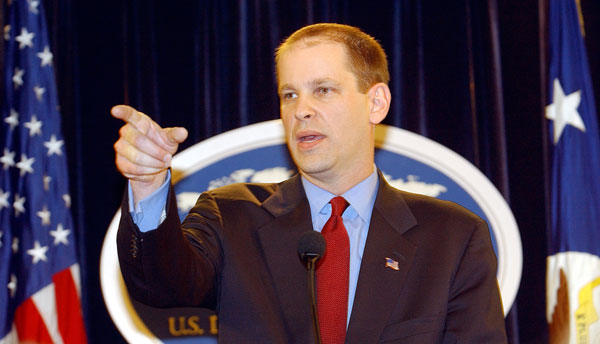 | Department Spokesman Sean McCormack (shown during the Daily Press Briefing) was sworn in as Assistant Secretary for Public Affairs and Department Spokesman on June 2, 2005. Immediately prior to returning to the State Department, |
TRANSCRIPT: 2:26 m. EST
MR. MCCORMACK: Good afternoon. I have one brief opening statement for you and then we can get right into questions. And this concerns the Secretary's travel. Secretary of State Condoleezza Rice will lead the U.S. Delegation to the London Conference on Afghanistan hosted by the United Kingdom January 31st through February 1st of this year. The conference will mark the beginning of a new phase in the international community's long-term partnership with Afghanistan. At the conference, the elected Government of Afghanistan will outline its goals for security, development, governance, human rights and counternarcotics. The international community will commit politically and financially to supporting these goals. With that, I'll be happy to take your questions.
QUESTION: Is this is a pledging conference?
MR. MCCORMACK: I believe that there are going to be various expressions of support for the Afghan Government, George. I expect that there will also be dollar figures attached to some of those pledges of support. And as for the specific figures, I don't have anything for you right now, but we encourage all the countries that are participating in the conference and that have an interest in a stable, prosperous and secure Afghanistan to support the Afghan people and the Afghan Government in the best way that they possibly can, whether that's professional expertise or financial assistance or other kinds of assistance.
QUESTION: What about additional stops?
MR. MCCORMACK: Any additional stops to this trip, we'll keep you informed. I have nothing to announce at this point.
QUESTION: She's doing intense diplomacy on the Iran issue, when she's in London. Will she carry that on?
MR. MCCORMACK: I expect that there will be meetings on that topic as well, Saul. And I wouldn't be surprised if there are more stops attached to this trip. At this point, we're not prepared to make any announcements about additional stops, but I would expect that as part of this trip, there's going to be a healthy portion of it devoted to discussion concerning Iran -- and diplomacy surrounding that -- the issue.
Yes.
QUESTION: The --
QUESTION: Still on this?
QUESTION: We go to Iran (inaudible.)
QUESTION: Oh, okay. A question on the trip. I just wanted to quickly ask, since the State of the Union is on the 31st, is she going to be in town for that?
MR. MCCORMACK: She will be back in time for that.
QUESTION: She will be back in town for that?
MR. MCCORMACK: Yes. Yes, she will.
QUESTION: So when does she leave again? Maybe I missed the times.
MR. MCCORMACK: This conference is on the 31st and the 1st of February. In terms of when she might be leaving for the trip, we'll keep you updated on what additional stops there might be. Charlie, but --
QUESTION: So she will only take part in the first day of the conference?
MR. MCCORMACK: Correct.
QUESTION: Okay. Thanks.
MR. MCCORMACK: Yes, ma'am.
QUESTION: The United States and Iran signed an agreement on January 19, 1981, exactly 25 years ago regarding the release of 52 hostages held in Iran at that time for more than 14 months. One of the general principles of that agreement was the pledge of non-intervention in Iranian affairs by the U.S. Government. My question: Is that pledge still valid and is there any contradiction between this pledge and supporting the aspiration of the Iranian people by the United States Government, as President and Secretary of State said many times that they're supporting the Iranian people?
MR. MCCORMACK: We continue to abide by our commitments by outlined by the Algiers Accord, but I don't see any contradiction between that commitment to abide by our treaty commitments and supporting the aspirations of the Iranian people. They have gotten a regime that they don't deserve.
Iran for centuries was at the crossroads of civilization. It is a great culture, it is a great people and it is a great country. And what they have now is a regime that has taken steps over the course of the years and accelerated those steps in recent months that have served to isolate Iran from the rest of the world. And that isolation is continuing to increase to the point where in the near future, I expect that Iran will find itself -- the Iranian regime will find itself before the Security Council for violations of its obligations under the Nonproliferation Treaty. So this Iranian regime is taking the Iranian people 180 degrees opposite where the rest of the region is headed. The rest of the region is headed towards a direction of greater political freedoms. Those include opening up political systems for greater participation. It's a greater investment by those populations. Freedom of speech, freedom of press and economic freedoms. These are all things -- these are all things that we believe all people desire, including the Iranian people.
So we have made statements in the past you can go back to, beginning with President Bush's statement on July 12th of 2002, saying that we stand with the Iranian people in their aspirations for a better way of life, for greater freedoms, greater economic prosperity. But that is for the Iranian people to determine what course their political system takes.
QUESTION: Are you going toward change in the political system in Iran, a change of regime, or just you want some -- I mean, you want radical change or --
MR. MCCORMACK: What we've called for is a change in the behavior of the Iranian regime. This is a regime that is, as I said, 180 degrees opposite where its neighbors are headed. It's a state sponsor of terror. It continues to oppress its own people. One recent example is the regime has forbidden the playing of classical music, Beethoven, in Iran. And it is also pursuing weapons of mass destruction, in this case nuclear weapons, in contravention of its treaty obligations.
So what we're looking for from the Iranian regime is a change in behavior. And you know, the Iranian regime points to the fact that it had an election. Well, this is an election where even before anybody was able to put a piece of paper in a ballot box, more than 1,000 candidates that said that they wanted to run in the presidential election were taken off or forbidden from running. They were forbidden from running by a small group of people who actually run Iran, who actually control the levers of power in Iran. That isn't a democratic -- that is not the democratic way of governing.
QUESTION: Then you're not calling for an overthrow of the regime?
MR. MCCORMACK: What we're calling for is a change in the behavior of the Iranian regime.
Yes.
QUESTION: Iranian President Ahmedi-Nejad is in Syria today and the two countries seem to close rounds. They said that they reject the pressure exerted on Iran about nuclear -- its nuclear program and they support the resistance against -- the Palestinian resistance against Israel. Do you have any comment on this?
MR. MCCORMACK: I think the general comment that I made about Iran finding itself -- the Iranian regime finding itself in complete -- going in completely the opposite direction from the rest of the region, there's actually one exception to that, and that's Syria. Syria is going right along with them, 180 degrees opposite from where the rest of the region is headed.
These are both oppressive, authoritarian regimes. They both support -- are state sponsors of terror. You mentioned the fact that they apparently -- I haven't seen the statement -- apparently take pride in the fact that they are continuing to support Palestinian rejectionist groups. Well, this is, again, in direct contradiction to where world opinion is headed. I would refer you back to recent statements from the Quartet, which includes the United States, the EU and the UN. These statements call upon Damascus to close down the offices of Palestinian rejectionist groups and to shut off support for those groups.
So instead, what we see -- what we see from these two -- the leaders of these two regimes is actually taking pride in that. You know who is actually suffering the most from the Syrian actions and the actions of the Iranian Government? It's the Palestinian people, the people that they supposedly say that they are fighting on behalf of. What they are doing, in effect, is thwarting the will of the Palestinian people for a better future, for a more peaceful future, for a democratic future.
So again, I think that all you can say about the fact that these two -- the leaders of these two regimes have gotten together is the fact that all it does is highlight the fact that they themselves are isolated from the rest of the world. Syria is currently under UN Security Council resolution and I expect in the not too distant future, Iran will find itself before the Security Council. So in essence, they do have a lot in common but it's a sad comment on the fact -- it's a sad comment that these two great peoples now find themselves increasingly isolated from the rest of the world because of the actions of their leaders.
QUESTION: But don't you think that Iran and Syria can influence what's going on in the area? I mean, they have many -- they have influence in Iraq, in Lebanon and, of course --
MR. MCCORMACK: I think, certainly over time, we have seen that the march of freedom is stronger than any oppressive authoritarian regime and that ultimately the fact that you have people around the region calling for greater freedoms, calling for more investment in their own political processes so they can elect leaders that reflect their will, will ultimately have much more influence over Syria and Iran than vice versa.
Yes.
QUESTION: Change of subject.
MR. MCCORMACK: Anything else on this?
QUESTION: Can we stay on Iran, please?
MR. MCCORMACK: Sure.
QUESTION: Secretary Robert Joseph discussed Iranian nuclear problems today with Russian officials in Moscow. Any details on that?
MR. MCCORMACK: I don't. I haven't talked to them, so I don't have any particular readout for you. Under Secretary Joseph is traveling to the -- he has been to Vienna. He's currently in Moscow, and I believe he's also going to Tokyo. There may be additional stops that he is making. Under Secretary Nick Burns traveled to London where he had discussions about the Iranian issue -- the Iranian nuclear issue. He's currently in India, where he is having -- the primary focus of his discussions is on US-India civil nuclear agreement and implementation of that agreement. But I expect he's also going to talk about Iran as well. That's on the agenda. And then he'll be continuing on to Sri Lanka.
That's a long way of saying that there's a lot of diplomatic activity concerning next diplomatic steps, regarding Iran. And what happens after the IAEA emergency Board of Governors meeting and what next steps would be taken in the UN Security Council. That's a big part of what he's talking about, but I don't have any particular readout of his discussions with the Russian Government.
QUESTION: Just for the record, isn't Nick Burns also going to Pakistan?
MR. MCCORMACK: Yes.
QUESTION: Okay. You didn’t say that option* (inaudible.)
MR. MCCORMACK: Left that out. Didn't mean to leave it out. Yes. Anything else on Iran? Okay, back to you.
QUESTION: Russia -- what's the U.S. position on the new Russian law on NGOs, recently signed into effect by President Putin? And what messages, if any, will be conveyed either by the State Department or by the Embassy in Moscow to the Russian officials on this issue?
MR. MCCORMACK: Well, we just put a statement out on the Russian NGO, but I'm happy to read it for you here, if you like.
QUESTION: If it's possible.
MR. MCCORMACK: "The United States urges the Russian Government to ensure that implementation of the Russian law on nongovernmental organizations, NGOs, which President Putin signed January 10th, not restrict the space for civil society in Russia. We have repeatedly conveyed our serious concerns about the legislation to the Russian Government and will continue to monitor implementation of the law and its impact on Russian civil society closely. In accordance with the Russian Government's international commitments concerning freedom of assembly and freedom of association, we urge it to enact regulations that eliminate the possibility for arbitrary implementation and facilitate rather than hinder the vital work of NGOs."
QUESTION: If I may follow up, Secretary Rice said in Georgetown yesterday that America can try and help those in Russia who want to return it to a more democratic path. How can the U.S. help and how will the U.S. help those groups and organizations in Russia? And does
MR. MCCORMACK: Now, on the latter, no. I have no expectation that that will happen. As a matter of fact, Secretary Rice talked about the responsibilities that come along with chairing such a meeting of democratic states.
In terms of what the United States does concerning promotion -- the greater promotion of democracy in Russia, we speak out about it. We also provide funds to NGOs that operate throughout Europe, as well as in Russia. But ultimately the course of democracy in Russia is going to be determined by the Russian people. We certainly encourage freedom -- and important to that is freedom of the press, expanding rather than contracting the political space so you have greater investment and greater dialogue and debate within the political space. So these are all things that we encourage the Russian Government to promote themselves, but ultimately these are going to be questions that the Russian people have to answer for themselves.
QUESTION: And what penalty is there, if the Russian Government doesn't respect those principles?
MR. MCCORMACK: Well, in terms of punitive measures, with respect to the slide, I'm not aware of anything that people have in mind. And the Secretary talked again -- has talked recently about the trajectory of relationships between the United States and various countries, between the United States and Russia. We have an excellent relationship with Russia.
Now, of course, there's always room for improvement in those relationships. But in order to realize the full potential of any relationship, including ours with Russia, it's going to depend upon the, you know, behaviors and intersections of interest between the United States and Russia. So the area of promotion of freedom of speech and increasing, rather than contracting, the democratic space is one of those areas which we would encourage improvement and certainly we'll continue to talk to the Russian Government about.
Yes, Teri.
QUESTION: Can we change subjects?
MR. MCCORMACK: Sure.
QUESTION: Just as a matter of course, do you have anything to say about the new bin Laden tape the CIA has within the last hour confirmed its authenticity?
MR. MCCORMACK: I understand that they have confirmed the authenticity. I know that Scott over at the White House in his briefing spoke at length about the tape, its contents and the questions surrounding its contents. I don't think I have anything particular to add to what he's said already.
QUESTION: Is the State Department doing its own analysis? I understand that CIA tests the voice, but there are other things that are also examined in these tapes. Is the State Department doing a separate analysis?
MR. MCCORMACK: Well, we do have the Bureau of Intelligence and Research here. I'm sure that they are involved, as is the rest of the intelligence community, in an analysis of the tape. And whenever you have these kind of tapes, the analysts look for any threat indicators that may be in there, any clues that might help us in our hunt for members of al-Qaida. Those things I expect are going on. I don't have particular information regarding those activities here in the Bureau of Intelligence and Research, but as a matter of course that is what happens when you do have these tapes.
Yes.
QUESTION: Pakistani officials have said that around four al-Qaida militants were killed in the U.S. air strike and they believe that one of them could be the son-in-law of Zawahiri, a bomb expert wanted by the U.S.?
MR. MCCORMACK: Yeah, I don't -- I can't confirm or deny those reports. I don't have anything to add beyond what I've said on the subject before.
Yes.
QUESTION: I have a French question to ask you today.
MR. MCCORMACK: How appropriate.
QUESTION: President Chirac announced a change in the French nuclear policy today. He said now that nuclear bomb could be used against any state with a large terrorist attack, so I wanted to know if you have any comment on that and what is the U.S. position on that? Is U.S. ready to launch a nuclear bomb on a terrorist state?
MR. MCCORMACK: Well, again, concerning questions of the United States right to defend itself, those are questions for the national command authority, which does not include the State Department. That includes the White House and the Department of Defense. And these are -- I would just say as a general issue, and I haven't seen President Chirac's comments or the statement, that decisions and actions that involve use of force and the military are the greatest decisions any leader can take in defense of a country and defense of a people. But those decisions are for that country to make and those leaders to make, but beyond that I don't think I have any specific comment.
Yes.
QUESTION: Can you give us a basic readout on today's rather lengthy meeting between Secretary Rice and Foreign Minister Ban Ki-moon?
MR. MCCORMACK: Well, they -- it was actually in two parts. They had a one-on-one meeting that lasted about 40 minutes. It did go on for some time and it was just Secretary Rice and Foreign Minister Ban Ki-moon. They talked about the six-party talks. They talked about a variety of other global issues, including Iran. You heard public comments from the Secretary and Foreign Minister on that issue. There was also a working lunch which served as the kickoff session, if you will, of the U.S.-South Korean Strategic Dialogue. They talked about a variety of issues, bilateral issues. They talked about the military-to-military relationship. They both commented that implementation of the agreement between the U.S. and South Korea concerning the expansion of military capabilities, conventional military capabilities, on the Korean Peninsula and the shifting of forces and shifting of military assets was proceeding very well, that there was very good contact between the two militaries and the two governments on the issue. There was a great deal of understanding on it. There are no problems there.
They also talked about issues in the region, South Korean-Japanese relations, South Korean-Chinese relations, how the Foreign Minister viewed those relationships. They also talked about human rights issues in the region. They touched upon the six-party talks as well. They talked about human rights issues in North Korea. So overall, all in all, it was a good discussion. I think if you total it up they spent more than an hour and a half together, and I expect -- I don't know when the next round of these Strategic Consultations take place, but I would expect they probably would take place in South Korea.
QUESTION: Can I follow up?
MR. MCCORMACK: Mm-hmm.
QUESTION: Any details on Mr. Hill's meetings, overnight meeting with his colleague -- North Korean and Chinese counterparts?
MR. MCCORMACK: He did -- there was a meeting on his return trip back to the United States that involved Assistant Secretary Hill, Mr. Wu from the Chinese Foreign Ministry and Kim Gye Gwan from North Korea. It was a meeting concerning the six-party talks. It was the idea of the Chinese Government. Assistant Secretary Hill thought it was a good idea. Secretary Rice endorsed the idea, as well as the White House.
Assistant Secretary Hill sent a strong, clear message that we are prepared to resume the six-party talks and start work on implementation of the Framework Agreement that was agreed to on September 19th and that we would hope the North Korean Government was ready to return to those talks without precondition as well at the earliest possible date. I think that all the other five parties are ready as soon as a date is set up to show up for talks, to engage in a serious manner, to get to the what will be tough work of coming up with a plan to implement the Framework Agreement that has been agreed upon already.
QUESTION: (Inaudible) basically the sanctions U.S. had imposed on North Korea over the alleged counterfeiting and money laundering activities in North Korea. And that was the issue that seems to be the stumbling block. Has there been anything done during this meeting to resolve this?
MR. MCCORMACK: Assistant Secretary Hill made clear again that these issues are separate and that the United States, as any country would, has and is going to continue to take steps to prevent illegal activities that may affect us or any other country, whether that's involvement in drug trafficking or money laundering or counterfeiting. These are issues that are separate from the six-party talks. These are issues, I think, that nobody should be surprised that the United States or any other country would take action to prevent. These are illicit activities. It's not as though these are legal activities that somehow the United States or others are unjustly cracking down on.
So we view these efforts as completely separate and that we remain ready to return to the six-party talks without precondition at the earliest possible date and we encourage the North Korean Government to do the same, to return without preconditions.
QUESTION: Can I follow up?
MR. MCCORMACK: Yes.
QUESTION: How did this meeting come about and who initiated it?
MR. MCCORMACK: It was the Chinese Government that suggested it. What happened is Chris was already on a trip to the region. He had already stopped in Tokyo, Seoul and Beijing and traveled on to Cambodia, Vietnam and Malaysia. He was on his way back to the United States for the meetings today with Foreign Minister Ban Ki-moon and along the way the Chinese Government, because he had to transit back through Beijing, the Chinese Government suggested this meeting. We took them up on that suggestion and we had the meeting with the three participants in it.
QUESTION: What was the North Korean response to Secretary Hill's suggestions?
MR. MCCORMACK: Well, we still don't have a date for the six-party talks although we continue to be hopeful that there will be one.
QUESTION: Were they positive? Were they -- I mean, was there any signal given?
MR. MCCORMACK: At this point, you know, I don't put too much stock in signals until you actually have the facts on the ground. A fact on the ground would be an agreement to a meeting date, so until we have a meeting date I don't think I'm going to speculate about whether there will be one. We continue to be hopeful.
Yes, you had a follow-up? Yes, sir.
QUESTION: Can you describe what was the recognition of both minister in the issue of South Korea and Japanese relation?
MR. MCCORMACK: I'm not sure -- in today's meeting with the Secretary?
QUESTION: Yes.
MR. MCCORMACK: Well, we have always encouraged the contacts between South Korea and North Korea. I know that they -- there's a great deal of interest among the people of South Korea and the South Korean Government on those contacts and we have never discouraged those contacts.
QUESTION: No issue of Yasukuni shrine, visiting the Yasukuni shrine by Prime Minister of Japan?
MR. MCCORMACK: Well, those are issues for the Korean -- South Korean Government and Japanese Government to resolve. As a general statement, our position is that there are historical differences, there are old wounds here, and that we would encourage all the parties in the region to move beyond their own particular histories with one another. We understand there are sensitivities and we would hope all the parties would be respectful of the actions of the others and to take steps to move beyond any of these historical differences or put any of these grievances behind them. But that's going to be up to the parties in the region to do.
Yes, ma'am.
QUESTION: Can I change the subject?
MR. MCCORMACK: I don't know. Anything else on -- we'll come back to you. Yes, ma'am.
QUESTION: Yes. Do you think will the North Korean nuclear issue be resolved within by the end of this year at the latest?
MR. MCCORMACK: I don't have a timeline for you. We are very hopeful that we can move through the various issues expeditiously, but I'm not going to undersell the fact that these are tough issues. And I think if this -- if these issues were easy, they would have been solved a long time ago. But we're committed to doing so through the mechanism of the six-party talks.
And I would just add one thing that we have said in the past. Through this mechanism, if we are able to resolve the issue of North Korea's nuclear program and arrive at a denuclearized Korean Peninsula, we have always said that this is a way for North Korea to realize a different kind of relationship with the rest of the world and we would hope that North Korea view this process in that way. There are real concerns on the part of the United States as well as, more importantly, North Korea's neighbors regarding their nuclear weapons program. So we would hope that North Korea would view these negotiations in that light and, as we have said before, and it's part of the Statement of Principles that we understand that there are issues that are of concern to North Korea. The immediate focus of the six-party talks is North Korea's nuclear program and arriving at a denuclearized Korean Peninsula. But we also understand that there are issues of importance to North Korea and this is the mechanism, this is the negotiating forum where they could realize a different kind of relationship with the rest of the world.
Yes. Anything else on North Korea? Yes, sir.
QUESTION: So did Ambassador Hill not have a bilateral meeting with Mr. Kim Gye Gwan?
MR. MCCORMACK: No. My understanding is that the --
QUESTION: Trilateral --
MR. MCCORMACK: -- the three of them in there.
QUESTION: And the issue of financial measures have never come up?
MR. MCCORMACK: Well, I think the North Korean Representative did raise it, but, again, Assistant Secretary Hill reiterated in private what we have said in public about this issue, that they're separate and that we would hope that the North Korean regime -- the North Korean Government would return, without preconditions, to the six-party talks.
QUESTION: Was there any indication that the North Koreans are coming to attend the briefing offered by the United States in New York?
MR. MCCORMACK: We offered an expert briefing on the issue and they did not take us up on the offer.
Yes, ma'am.
QUESTION: What's your reaction on Tel Aviv's bombing earlier this morning, especially that it comes right before the Palestinian elections?
MR. MCCORMACK: Well, we -- it's an act of terrorism that unfortunately has, I believe, wounded 16 people --
QUESTION: One killed and 16 (inaudible).
MR. MCCORMACK: Oh, one killed. I think it was the bomber who lost his life -- his or her life. I don't know which it was. It's an act of terrorism and it is a reminder, once again, that there are some who would act at the expense of the Palestinian people. These are acts that only have the potential to undermine the Palestinian people's hopes for a more peaceful, stable, secure future.
I understand from the news reports that there is a group, Palestinian Islamic Jihad, that has taken responsibility for this act. They have been responsible for, I think, two other recent bombings that have sadly claimed innocent life. So again, this is a group of people, the Palestinian Islamic Jihad, that has -- first of all, a terrorist group and far outside the mainstream of what the Palestinian people want. I think that you have -- they have reiterated over and over again, the Palestinian people want what everybody else wants. They want to be able to send their kids to school and not have to worry about their safety. They want to be able to have a better life for themselves. They want to realize a state where they can provide the services for their fellow countrymen that they see other places. Those are the kinds of things that the Palestinian people want.
And these kind of acts, perpetrated by terrorist groups, stand in stark relief to that vision. And I think it also underlines the fact that it is incumbent upon the Palestinian Authority and the Palestinian security services to act to prevent terrorist acts. And that it is important the Palestinian Authority and the leaders of the Palestinian Authority act in accordance with their roadmap obligations to dismantle terror groups. That is the way forward to achieving the two-state solution.
If you're going to achieve -- the only way to potentially achieve the two-state solution of two states living side by side in peace and security is through -- at the bargaining table. It's not going to come about at the point of a gun or because of suicide bombers.
We have one more. George.
QUESTION: Do you have any comment on Italy's decision to withdraw its troops from Iraq by the end of the year?
MR. MCCORMACK: Yes. So we're taking care of your question, too? Okay. George, we certainly appreciate and are very grateful for Italy's contribution to Iraq and the provision of these troops. Italy is one of the largest contingents in the coalition and they have previously indicated that they were going to take these steps to withdraw -- to draw down their security presence in Iraq, based on the security commissions that they see there and the functions that their troops were performing and the ability of Iraqi security services to take over those functions that the Italian troops were performing.
All coalition partners, including the United States, are interested in returning their troops home as soon as possible, again, consistent with the abilities of the Iraqis to take over the duties that those troops are performing. Italy expects to increase their civilian training and reconstruction support as combat force levels adjust. And Italy will also continue to contribute to training Iraqis through the NATO training mission, which reflects our shared priority of helping the Iraqis provide for their own security.
QUESTION: Sean, on Nepal, the Nepali Government has launched another crackdown on -- it arrested about 100 activists and cut off more land phone services. And it comes just a year after the crackdown in which the U.S. expressed much concern and, in fact, imposed military aid
MR. MCCORMACK: We'll see if we can get you something on that. Okay. Thank you.
(The briefing was concluded at 2:59 p.m.) DPB # 10
more at Department of State and State Department or Iran and SYRIA, or Russia and South Korea or North Korea, or ISRAEL and Italy,
Related: Keywords South Korea Wednesday, August 24, 2005 Secretary Rice, South Korean Minister Ban Ki-moon, Thursday, July 28, 2005 Asia-Pacific partnership, Friday, July 08, 2005 Korea – Meetings with ROK Official, Tuesday, May 24, 2005 President Bush to Welcome South Korean President, Friday, April 08, 2005 Korea/China – Japanese School Textbooks,
Related: Keywords State Department, Thursday, January 19, 2006 Secretary Rice, South Korean Foreign Minister PODCAST 01/19/06, Wednesday, January 18, 2006 State Department Podcast, Text 01/17/05,
0
comments
||
||
Thursday, January 19, 2006
President to nominate Vice Admiral Thad W. Allen
President George W. Bush today announced his intention to nominate Vice Admiral Thad W. Allen to be Commandant of the United States Coast Guard. Vice Admiral Allen currently serves as Chief of Staff for the United States Coast Guard. He also served as the Principal Federal Official overseeing Hurricane Katrina response and recovery efforts in the Gulf Coast region.
Vice Admiral Allen previously served as Commander of the United States Coast Guard Atlantic Area, Fifth United States Coast Guard District, and the United States Maritime Defense Zone, Atlantic Fleet. In addition, he led the Atlantic forces in the United States Coast Guard's response to the terrorist attacks on September 11, 2001. Prior to that position, Vice Admiral Allen commanded the Seventh United States Coast Guard District and was the Director of Resources for the United States Coast Guard. Earlier in his career, he served as Group Commander and Captain of the Port for Long Island Sound in Long Island, New York.
Vice Admiral Allen received his bachelor's degree from the United States Coast Guard Academy, his first master's degree from The George Washington University, and his second master's degree from the Massachusetts Institute of Technology.
# # # For Immediate Release, Office of the Press Secretary, January 19, 2006, Personnel Announcement
more at President Bush or White House or Nominations and Vice Admiral Thad W. Allen or Coast Guard and Hurricane Katrina or Gulf Coast
RELATED: Keywords announced his intention to nominate, Wednesday, January 18, 2006 President to nominate ten appoint four individuals and designate one, Wednesday, December 28, 2005 Presidentto nominate three, appoint seventeen 12/28/05, Wednesday, December 28, 2005 President to nominate three, appoint two, designate one, Thursday, December 15, 2005 President to nominate four, appoint four, Thursday, December 15, 2005 District Judge Nominations Sent to the Senate, Wednesday, November 16, 2005 President to nominate four and appoint one, Wednesday, November 02, 2005 President to nominate two appoint one 11/02/05, Thursday, October 06, 2005 President to nominate three to Administration, Thursday, September 08, 2005 President to nominate two appoint two 09/08/05 , Thursday, August 25, 2005 President to nominate three 08/25/05 , Wednesday, August 24, 2005 President to nominate four appoint one , Thursday, August 18, 2005 President to nominate one appoint three, Wednesday, August 17, 2005 President to nominate four, designate two, Thursday, August 11, 2005 The President to nominate two, designate one 08/11/05, Wednesday, August 10, 2005 President to nominate one, appoint five and recess appoint one, Wednesday, June 01, 2005 President to nominate three, designate one, appoint five 06/01/05 , Tuesday, May 17, 2005 President to nominate six individuals, appoint eleven 05/17/05, Sunday, May 15, 2005 President to nominate eight and designate one 05/15/05, Thursday, April 28, 2005 President to nominate eight, designate one, Wednesday, April 27, 2005 President, to nominate five, designate three, 04/27/05, Saturday, April 16, 2005 Bush nominates one, designates two, and appoints thirteen 04/16/05,
0
comments
||
||


