


President George W. Bush announced that he has nominated four individuals and designated one individual to serve in his Administration. He also intends to appoint one individual to serve in his Administration:
The President nominated John W. Cox, of Texas, to be Chief Financial Officer at the Department of Housing and Urban Development. Mr. Cox currently serves as a Private Consultant. He previously served as Vice President, Chief Financial Officer and Chief Accounting Officer for BMC Software, Inc. Prior to this, he served the company as Vice President for Investor Relations and Taxation and Manager of Taxation. Earlier in his career, he served as Tax Manager for Ernst & Young, LLP. Mr. Cox received his bachelor's degree from Texas A & M University.
The President nominated George McDade Staples, of Kentucky, to be Director General of the Foreign Service at the Department of State, and intends to appoint him Chairman of the Board of the Foreign Service. Ambassador Staples is a career member of the Senior Foreign Service, with the rank of Minister-Counselor. He currently serves as Political Advisor to the Supreme Allied Commander for Europe at the North Atlantic Treaty Organization. Prior to this, he served as the Ambassador to Cameroon and Equatorial Guinea. Ambassador Staples has also served as Ambassador to the Republic of Rwanda. Earlier in his career, he was a Senior Watch Officer at the Department of State's Secretariat and Senior Turkey Desk Officer in the Bureau of European Affairs. Ambassador Staples received his bachelor's degree from the University of Southern California and his master's degree from Central Michigan University.
The President nominated the following individuals to be Governors on the Board of Governors of the United States Postal Service:
Mickey D. Barnett, of New Mexico, for the remainder of a nine-year term expiring December 8, 2013.
Katherine C. Tobin, of New York, for the remainder of a nine-year term expiring December 8, 2012.
The President designated William Ludwig Wehrum, Jr., of Tennessee, to be Acting Assistant Administrator for Air and Radiation at the Environmental Protection Agency.
# # # For Immediate Release, Office of the Press Secretary, March 3, 2006, Personnel Announcement
more at President Bush or White House or Nominations and Department of Housing and Urban Development or Director General of the Foreign Service and United States Postal Service or Administrator for Air and Radiation
RELATED: Keywords announced his intention to nominate, Monday, March 06, 2006 President names three individuals to serve in his Administration, Monday, March 06, 2006 4 Nominations Sent to the Senate, Friday, March 03, 2006 4 Nominations Sent to the Senate, Friday, March 03, 2006 President to nominate one and appoint seven, Monday, February 20, 2006 President to nominate one and appoint three 02/16/06, Monday, February 20, 2006 Nominations Sent to the Senate 02/14/06, Monday, February 20, 2006 President to nominate four and appoint twelve, Monday, February 20, 2006 President to nominate one and appoint three 02/10/06, Friday, February 03, 2006 President to nominate five, appoint four, designate one, Wednesday, January 18, 2006 President to nominate ten appoint four individuals and designate one, Wednesday, December 28, 2005 Presidentto nominate three, appoint seventeen 12/28/05, Wednesday, December 28, 2005 President to nominate three, appoint two, designate one, Thursday, December 15, 2005 President to nominate four, appoint four, Thursday, December 15, 2005 District Judge Nominations Sent to the Senate, Wednesday, November 16, 2005 President to nominate four and appoint one,
Monday, March 06, 2006
President has nominated four and designated one
0
comments
||
||

President names three individuals to serve in his Administration:
President George W. Bush today announced that he has named three individuals to serve in his Administration:
The President has named Sean O'Hollaren to be Deputy Assistant to the President for Legislative Affairs. Mr. O'Hollaren recently served as Senior Director of Government Relations for Honeywell International. He previously served as a Special Assistant to the President in the Office of Legislative Affairs at the White House. Prior to that, he served as Assistant Secretary of Transportation for Government Affairs at the Department of Transportation. Earlier in his career, Mr. O'Hollaren was Director of Government Relations for Union Pacific Corp. and a Minority Clerk for the Senate Committee on Appropriations and a Legislative Assistant for Senator Mark O. Hatfield. He received his bachelor's degree from Williamette University.
The President has named Lisa E. Epifani to be Special Assistant to the President for Economic Policy. Ms. Epifani recently served as Counsel for the Senate Energy and Natural Resources Committee. She received her bachelor's degree from the University of Texas at Austin and her JD from Yale Law School.
The President has named Brian V. McCormack to be Special Assistant to the President and Deputy Director of Public Liaison. Mr. McCormack recently served as Special Assistant to the Under Secretary of Defense for Acquisition, Technology and Logistics at the Department of Defense. He received his bachelor's degree from Boise State University.
# # # For Immediate Release, Office of the Press Secretary, March 3, 2006, Personnel Announcement
more at President Bush or White House or Nominations and Legislative Affairs or Economic Policy and Brian+V.+McCormack or Senate
RELATED: Keywords announced his intention to nominate, Monday, March 06, 2006 4 Nominations Sent to the Senate, Friday, March 03, 2006 4 Nominations Sent to the Senate, Friday, March 03, 2006 President to nominate one and appoint seven, Monday, February 20, 2006 President to nominate one and appoint three 02/16/06, Monday, February 20, 2006 Nominations Sent to the Senate 02/14/06, Monday, February 20, 2006 President to nominate four and appoint twelve, Monday, February 20, 2006 President to nominate one and appoint three 02/10/06, Friday, February 03, 2006 President to nominate five, appoint four, designate one, Wednesday, January 18, 2006 President to nominate ten appoint four individuals and designate one, Wednesday, December 28, 2005 Presidentto nominate three, appoint seventeen 12/28/05, Wednesday, December 28, 2005 President to nominate three, appoint two, designate one, Thursday, December 15, 2005 President to nominate four, appoint four, Thursday, December 15, 2005 District Judge Nominations Sent to the Senate, Wednesday, November 16, 2005 President to nominate four and appoint one,
0
comments
||
||
4 Nominations Sent to the Senate
Mickey D. Barnett, of New Mexico, to be a Governor of the United States Postal Service for a Term Expiring December 8, 2013, Vice Robert F. Rider, term expired.
John W. Cox, of Texas, to be Chief Financial Officer, Department of Housing and Urban Development, vice Carin M. Barth, resigned.
George McDade Staples, of Kentucky, a Career Member of the Senior Foreign Service, Class of Minister-Counselor, to be Director General of the Foreign Service, vice W. Robert Pearson, resigned.
Katherine C. Tobin, of New York, to be a Governor of the United States Postal Service for a term expiring December 8, 2012, vice S. David Fineman, term expired.
# # # For Immediate Release, Office of the Press Secretary, March 2, 2006, Nominations Sent to the Senate
more at President Bush or White House or Nominations and United States Postal Service or Department of Housing and Urban Development and Foreign Service or Senate
RELATED: Keywords announced his intention to nominate, Friday, March 03, 2006 4 Nominations Sent to the Senate, Friday, March 03, 2006 President to nominate one and appoint seven, Monday, February 20, 2006 President to nominate one and appoint three 02/16/06, Monday, February 20, 2006 Nominations Sent to the Senate 02/14/06, Monday, February 20, 2006 President to nominate four and appoint twelve, Monday, February 20, 2006 President to nominate one and appoint three 02/10/06, Friday, February 03, 2006 President to nominate five, appoint four, designate one, Wednesday, January 18, 2006 President to nominate ten appoint four individuals and designate one, Wednesday, December 28, 2005 Presidentto nominate three, appoint seventeen 12/28/05, Wednesday, December 28, 2005 President to nominate three, appoint two, designate one, Thursday, December 15, 2005 President to nominate four, appoint four, Thursday, December 15, 2005 District Judge Nominations Sent to the Senate, Wednesday, November 16, 2005 President to nominate four and appoint one, Wednesday, November 02, 2005 President to nominate two appoint one 11/02/05,
0
comments
||
||
Sunday, March 05, 2006
People Use Separate Brain Mechanisms to Make Risky Choices
People Use Separate Brain Mechanisms to Make Ambiguous and Risky Choices
DURHAM, N.C. -- Distinct regions of the human brain are activated when people are faced with ambiguous choices versus choices involving only risk, Duke University Medical Center researchers have discovered.
The investigators found that they could predict activation of different brain areas, based on how averse study participants were toward either risk or ambiguity. The finding confirms what economists have long debated -- that different attitudes toward perceived risk and ambiguity in decision-making situations may reflect a basic distinction in brain function, the researchers said. Such fundamental knowledge of neural functioning will contribute to an understanding of why people make risky choices, and how such risk-taking can become pathological, as in addiction or compulsive gambling, they added.
Their study appears in the March 2, 2006 issue of Neuron. The research was supported by the National Institute of Mental Health, the National Institute of Neurological Disorders and Stroke and Duke.
"We were able to see individual differences in brain activation depending on the person's preferences or aversions to risk and ambiguity," said Scott Huettel, Ph.D., lead author and a neuroscientist with the Brain Imaging and Analysis Center at Duke University. "People who preferred ambiguity had increased activation in the prefrontal cortex, and people who preferred risk had increased activation in the parietal cortex. This opens up the possibility that there are specific neural mechanisms for different forms of economic decision making, which is a very exciting idea."
The team collected data from 13 adult participants who were asked to choose between pairs of monetary "gambles" that were predetermined to be 'certain', 'risky' or 'ambiguous'. For the risky choices, subjects were told the odds that they would win the gambles, but for the ambiguous choices, subjects were not given this information. The participants were rewarded with a cash payout based upon whether or not they won their gambles.
The team used functional magnetic resonance imaging (MRI) to determine which areas of the brain were activated while people were making risky or ambiguous choices. Functional MRI is a widely used brain imaging technique that uses harmless magnetic fields and radio waves to measure cerebral blood oxygenation, which reflects brain activity in a region. The researchers determined the subjects' preferences by examining how frequently they chose each type of gamble during the experiment.
They found that activation of specific brain regions depended on participants' preferences for risk or for ambiguity. They soon learned that the activation of an area in the lateral prefrontal cortex depended upon whether people tended to choose ambiguous gambles, while activation of an area in the posterior parietal cortex depended on whether people tended to choose risky gambles. Furthermore, whether or not a person is, by nature, impulsive appears to correlate with whether or not their brain preferred risky gambles to those that were ambiguous, the researchers said.
"Some people are impulsive, some people are not; some people think through their decisions while others don't, and sometimes this can become pathological," said Michael Platt, Ph.D., a neurobiologist and co-author of the study. "Impulsive behavior can be associated with all sorts of mental disorders like addiction or problem gambling. If it could be demonstrated that we could change the way people perceive risk and ambiguity by introducing a medication that could influence brain chemistry, someday we might be able to alleviate some types of pathological decision making."
The results provide important data for the emerging field of "neuroeconomics," Huettel added. Neuroeconomics is a relatively new area of research in which neuroscientists, economists, psychologists and psychiatrists collaborate to better understand how the brain works when people make decisions, evaluate risk, and receive rewards.
"By understanding these mechanisms, we may be able to make better predictions about how people will behave or interact in different circumstances," Huettel said.
Further, the team's results should yield new insights in economics, according to Jill Stowe, Ph.D., a decision scientist with Duke's Fuqua School of Business and co-author of the study.
"The results are exciting because they suggest that people evaluate risky and ambiguous options in different ways," she said. "That element is not currently embedded in current economic models of decision making under risk or ambiguity, so this may very well lead to better economic models in the future, as well as hold implications for future economic policy."
Huettel, Platt and Stowe are Co-Directors of the Center for Neuroeconomic Studies at Duke. Evan Gordon and Brent Warner of the Brain Imaging and Analysis Center at Duke are also authors on the study.
keywords : Neuroscience, neuroeconomics, Brain Imaging
date : 3/1/2006 media contact : Tracey Koepke , (919) 684-4148 or (919) 660-1301 koepk002@mc.duke.edu
more at human brain or biological and biology or pathological and Neurological Disorders or Mental Health or Science and prefrontal cortex or Health and parietal cortex or magnetic resonance imaging and neurobiologist or chemistry
RELATED: Keyword, biology. Sunday, December 11, 2005 40,000-year-old human footprints, Sunday, December 18, 2005 warfare in the Mesopotamian world, Sunday, December 18, 2005 Conditions for slavery, Sunday, December 25, 2005 Why Christmas trees are not extinct, Sunday, January 01, 2006 prostaglandins choreograph perturbations, Sunday, January 01, 2006 Cultural differences may explain variations in home remedy use, Sunday, January 08, 2006 Risky Sexual Behaviors in Miami, and Racial Influences on Children’s Care, Sunday, January 22, 2006 Twenty-seven previously unknown species discovered, Sunday, February 12, 2006 Hormone linked to good hearing as we age, Sunday, February 12, 2006 Anti-HIV drug has potential to prevent transmission in women, Sunday, February 12, 2006 Parental Conflict Produces More Than Fleeting Distress for Children, Sunday, February 12, 2006 Facial characteristics indicative of personality traits, say experts, Sunday, February 19, 2006 There's something fishy about human brain evolution, Sunday, February 19, 2006 Marine mammals are on the frontline of failing ocean health, Sunday, February 26, 2006 Study shows that soda consumption increases among adolescent girls as they get older, Sunday, February 26, 2006 Gold's power against autoimmune diseases defined,
0
comments
||
||
Saturday, March 04, 2006
Presidential Podcast 03/04/06
Presidential Podcast 03/04/06 Subscribe to Our Odeo Podcast Channel and receive the Presidential Radio Address each week. Featuring real audio and full text transcript
President's Visit to India and Pakistan March 1-5, 2006
more at President Bush and White House or Afghanistan and India, or Pakistan and President Karzai, or Prime Minister Singh, and President Musharraf,
Related: Keywords radio address, podcast, Saturday, February 25, 2006 Presidential Podcast 02/25/06, Saturday, February 18, 2006 Presidential Podcast 02/18/06, Saturday, February 11, 2006 Presidential Podcast 02/11/06, Saturday, February 04, 2006 Presidential Podcast 02/04/06, Saturday, January 28, 2006 Presidential Podcast 01/28/06, Saturday, January 14, 2006 Presidential Podcast 01/14/06, Saturday, January 07, 2006 Presidential Podcast 01/07/06, Saturday, December 31, 2005 Presidential Podcast 12/31/05, Saturday, December 17, 2005 bush radio address 12/17/05 full VIDEO, text transcript, Sunday, December 04, 2005 Presidential Podcast 12/03/05, Saturday, December 03, 2005 bush radio address 12/03/05 full audio, text transcript, November 26, 2005 Presidential Podcast 11/26/05, Saturday, November 26, 2005 bush radio address 11/26/05 full audio, text transcript, Saturday, November 19, 2005 Presidential Podcast 11/19/05, Saturday, November 19, 2005 Freedom Calendar 11/19/05 - 11/26/05, Saturday, November 12, 2005 Presidential Podcast 11/12/05, Saturday, November 12, 2005 bush radio address 11/12/05 full audio, text transcript,
0
comments
||
||
Freedom Calendar 03/04/06 - 03/11/06
March 4, 1954, President Dwight Eisenhower appoints J. Ernest Wilkins to serve as first African-American U.S. Asst. Secretary of Labor.
March 5, 1875, Blanche Bruce (R-MS) becomes first African-American to serve full term in U.S. Senate; in 1879 he was first African-American to preside over Senate.
March 6, 1857, Republican Supreme Court Justice John McLean issues strenuous dissent from decision by 7 Democrats in infamous Dred Scott case that African-Americans had no rights “which any white man was bound to respect”.
March 7, 1965, Police under the command of Democrat Governor George Wallace attack African-Americans demonstrating for voting rights in Selma, AL.
March 8, 1990, Republican Evan J. Kemp appointed by President George H. W. Bush as Chairman of U.S. Equal Employment Opportunity Commission; first person with a disability to serve on the Commission.
March 9, 1926, Republican Bertha K. Landes elected Mayor of Seattle; first woman to be mayor of a U.S. city.
March 10, 1975, President Gerald Ford appoints Republican Carla Hills as first woman to be U.S. Secretary of Housing and Urban Development; later first woman to be U.S. Trade Representative, appointed by President George H. W. Bush.
March 11, 1874, Death of Republican U.S. Senator Charles Sumner (R-MA), author of bill that would become Civil Rights Act of 1875; on his deathbed, said 'You must take care of the civil rights bill, my bill. Don’t let it fail'.
“Find out just what any people will quietly submit to and you have the exact measure of the injustice and wrong which will be imposed on them.”
Frederick Douglass, Republican Civil Rights Activist
SOURCE: Republican Freedom Calendar more at President Bush and Freedom Calendar or NAACP and Republicans or African-Americans and 15th Amendment or right to vote and Civil Rights or Abraham Lincoln and Frederick Douglass or 40 acres and a mule
or Gerald Ford and Senator Charles Sumner or Dred Scott
Related: Keywords Freedom Calendar, Saturday, February 25, 2006 Freedom Calendar 02/18/06 - 03/04/06, Saturday, February 18, 2006 Freedom Calendar 02/18/06 - 02/25/06, Saturday, February 11, 2006 Freedom Calendar 02/11/06 - 02/18/06, Saturday, February 04, 2006 Freedom Calendar 02/04/06 - 02/11/06, Saturday, January 28, 2006 Freedom Calendar 01/28/06 - 02/04/06, Saturday, January 21, 2006 Freedom Calendar 01/21/06 - 01/28/06, Saturday, January 14, 2006 Freedom Calendar 01/14/06 - 01/21/06, Saturday, January 07, 2006 Freedom Calendar 01/07/06 - 01/14/06, Saturday, December 31, 2005 Freedom Calendar 12/31/05 - 01/07/06, Saturday, December 24, 2005 Freedom Calendar 12/24/05 - 12/31/05, Saturday, December 17, 2005 Freedom Calendar 12/17/05 - 12/24/05, Saturday, December 10, 2005 Freedom Calendar 12/10/05 - 12/17/05, December 03, 2005 Freedom Calendar 12/03/05 - 12/10/05, Saturday, November 26, 2005 Freedom Calendar 11/26/05 - 12/03/05, Saturday, November 19, 2005 Freedom Calendar 11/19/05 - 11/26/05, Saturday, November 12, 2005 Freedom Calendar 11/12/05 - 11/19/05,
0
comments
||
||
bush radio address 03/04/06 full audio, text transcript
 | bush radio address 03/04/06 full audio, text transcript PODCAST President's Radio Address  |
My first stop was Afghanistan, and I was thrilled to see firsthand the incredible transformation that has taken place there. Before September the 11th, 2001, Afghanistan was ruled by a cruel regime that oppressed its people, brutalized women, and gave safe haven to the terrorists who attacked America.
Today, the terror camps have been shut down; women are working; boys and girls are back in school; and 25 million people have now tasted freedom. The Afghan people are building a vibrant young democracy that is an ally in the war on terror. And America is proud to have such a determined partner in the cause of freedom.
was pleased to visit with President Karzai and members of his cabinet and government. I told them America will stand with the Afghan people as they build a free society and fight our common enemies, and we will see the mission through without wavering.
I was honored to visit our troops at Bagram Air Base who are serving on the front lines of the war on terror. It was a privilege to thank them in person for their courage and for the sacrifice of their families back home. These fine Americans are standing watch for liberty halfway across the world, and I told them that all Americans were proud of them.
The next stop on my trip was India. Like America, India has endured terrorist attacks on its own soil. Like America, India is a democracy that understands the best way to ensure peace is to advance freedom. And like America, India is working to help nations like Afghanistan build the institutions of a free and democratic society.
Relations between the United States and India have never been better. One important aspect of this partnership is working together to meet the energy needs of our growing economies, especially through the use of clean and safe nuclear power. On my trip, the United States and India reached an historic agreement to share civilian nuclear technology as India brings its civilian nuclear programs under the safeguards of the International Atomic Energy Agency. This agreement is good for American security because it will bring India's civilian nuclear program into the international nonproliferation mainstream.
The agreement also is good for the American economy. The agreement will help meet India's surging energy needs, and that will lessen India's growing demand for other energy supplies and help restrain energy prices for American consumers.
Another important aspect of this partnership is the growing trade between our two countries. In the past 10 years, India has passed economic reforms that have opened its door to trade and helped raised the living standards for millions of its people. In my meetings with Prime Minister Singh, I made clear that trade between our countries must be free and fair. I know that America's workers can compete with anyone, any time, anywhere so long as the rules are fair.
Ultimately, the best way to create jobs for Americans is to expand markets for American products. Today, India is one of the fastest-growing export markets. India has now a growing middle class that is estimated at 300 million people -- more than the entire population of the United States. Middle class Indians are buying home appliances from American companies like Whirlpool. Younger Indians are enjoying McCurry meals from McDonald's. And Air India has recently ordered 68 planes from Boeing. Last year, exports to India grew by more than 30 percent. And all this trade is creating jobs and opportunity in America. So we will continue to work to level the playing field for our workers, farmers, and businesses -- and deliver a better life for all Americans.
The final stop on my trip was Pakistan, another important ally in the war on terror. After September the 11th, 2001, President Musharraf understood that he had to make a fundamental choice. He could turn a blind eye and leave his people hostage to the terrorists, or he could join the free world in fighting the terrorists.
President Musharraf made the right choice for his people, and America appreciates his leadership. Since he joined the fight against terror, President Musharraf has faced several attempts on his life, yet President Musharraf has not faltered. He understands that the terrorists are a threat to the peace and security of the Pakistani people and the world.
Our relations with Afghanistan, India, and Pakistan will enhance the security of our country. By working with these leaders and the people of these three nations, we're seizing the opportunities this new century offers and helping to lay the foundations of peace and prosperity for generations to come.
President's Visit to India and Pakistan March 1-5, 2006
more at President Bush and White House or Afghanistan and India, or Pakistan and President Karzai, or Prime Minister Singh, and President Musharraf,
Related: Keywords radio address, podcast, Saturday, February 25, 2006 bush radio address 02/25/06 full audio, text transcript, Saturday, February 18, 2006 bush radio address 02/18/06 full audio, text transcript, Saturday, February 04, 2006 bush radio address 02/04/06 full audio, text transcript, Saturday, January 28, 2006, bush radio address 01/28/06 full audio, text transcript, Saturday, January 21, 2006 bush radio address 01/21/06 full audio, text transcript, Saturday, January 14, 2006 bush radio address 01/14/06 full audio, text transcript, Saturday, January 07, 2006 bush radio address 01/07/06 full audio, text transcript, Saturday, December 31, 2005 bush radio address 12/31/05 full audio, text transcript, Saturday, December 24, 2005 bush radio address 12/24/05 full audio, text transcript, Saturday, December 17, 2005 bush radio address 12/17/05 full VIDEO, text transcript, Sunday, December 04, 2005 Presidential Podcast 12/03/05, Saturday, December 03, 2005 bush radio address 12/03/05 full audio, text transcript, November 26, 2005 Presidential Podcast 11/26/05, Saturday, November 26, 2005 bush radio address 11/26/05 full audio, text transcript,
0
comments
||
||
Friday, March 03, 2006
President's Visit to India and Pakistan March 1-5, 2006
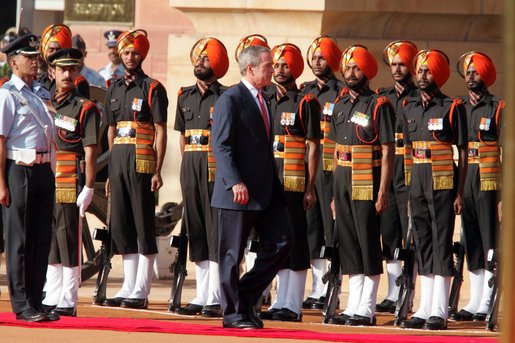 | President George W. Bush participates in the troop review Thursday, March 2, 2006, during the arrival ceremony at Rashtrapati Bhavan in New Delhi. White House photo by Paul Morse.INDIA VISIT GALLERY |
"India in the 21st century is a natural partner of the United States because we are brothers in the cause of human liberty. Yesterday, I visited a memorial to Mahatma Gandhi, and read the peaceful words of a fearless man. His words are familiar in my country because they helped move a generation of Americans to overcome the injustice of racial segregation. When Martin Luther King arrived in Delhi in 1959, he said to other countries, "I may go as a tourist, but to India, I come as a pilgrim." I come to India as a friend.
For many years, the United States and India were kept apart by the rivalries that divided the world. That's changed. Our two great democracies are now united by opportunities that can lift our people, and by threats that can bring down all our progress. The United States and India, separated by half the globe, are closer than ever before, and the partnership between our free nations has the power to transform the world."
--President George W. Bush, March 3, 2006
Speeches & News Releases:
Mar. 3, 2006
President Discusses Strong U.S.-India Partnership in New Delhi, India
President Meets with Young Entrepreneurs at Indian School of Business
Mar. 2, 2006
President Thanks Prime Minister and India at State Dinner in New Delhi
Fact Sheet: United States and India: Strategic Partnership
President and Prime Minister Singh Exchange Toasts in India
President Meets with Religious Leaders in New Delhi, India
President and Prime Minister of India Discuss Growing Strategic Partnership
President Meets with with American and Indian CEOs in New Delhi
U.S.-India Joint Statement on Trade
U.S.-India Joint Statement
| President George W. Bush greets a student in the middle of a field during his visit Friday, March 3, 2006, to the Acharya N.G. Ranga Agriculture University in Hyderabad, India. The President ended his visit to India Friday, | 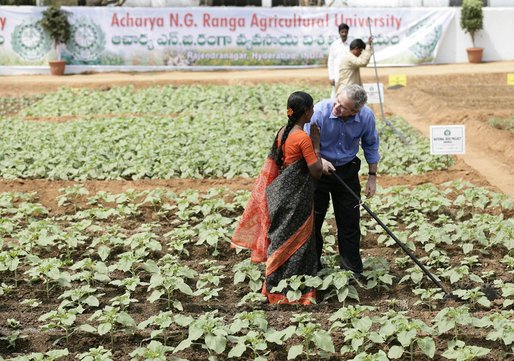 |
more at President Bush and White House or Laura Bush and India, or New Delhi and Rashtrapati Bhavan, or Prime Minister Manmohan Singh and Hyderabad House,
Related: Keywords State Department, Thursday, March 02, 2006 mounted escorts, of a limousine carrying the President, Wednesday, February 22, 2006 State Department Podcast and Text 02/21/06, Monday, February 13, 2006 State Department Podcast and Text 02/10/06, Thursday, February 09, 2006 State Department Podcast and Text 02/08/06, Friday, January 27, 2006 State Department Podcast and Text 01/25/06, Friday, January 27, 2006 Rice on Palestinian Elections (PODCAST), Tuesday, January 24, 2006 State Department Podcast and Text 01/23/06 , Friday, January 20, 2006 State Department Podcast and Text 01/19/06, Thursday, January 19, 2006 Secretary Rice, South Korean Foreign Minister PODCAST 01/19/06, Wednesday, January 18, 2006 State Department Podcast, Text 01/17/05,
0
comments
||
||
President to nominate one, appoint fourteen and designate two
President George W. Bush today announced his intention to nominate one individual, appoint fourteen individuals and designate two individuals to serve in his Administration:
The President intends to nominate William Ludwig Wehrum, Jr., of Tennessee, to be Assistant Administrator of the Environmental Protection Agency for Air and Radiation. Mr. Wehrum currently serves as Principal Deputy Assistant Administrator for the Office of Air and Radiation at the Environmental Protection Agency. Prior to this, he served as Counsel to the Assistant Administrator. Earlier in his career, he served as an environmental attorney at Latham & Watkins as well as at Swidler & Berlin. Mr. Wehrum received his bachelor's degree from Purdue University and his JD from Widener University.
The President intends to appoint the following individuals to be Members of the President's Council of Advisors on Science and Technology:
F. Duane Ackerman, of Georgia, Paul M. Anderson, of Washington, Robert A. Brown, of Massachusetts, Nance K. Dicciani, of Pennsylvania, Richard H. Herman, of Illinois, Martin C. Jischke, of Illinois, Fred Kavli, of California, Daniel A. Reed, of Illinois, Hector de Jesus Ruiz, of Texas, Stratton D. Sclavos, of California, John Brooks Slaughter, of Connecticut, Joseph M. Tucci, of New Hampshire, Robert E. Witt, of Alabama, Tadataka Yamada, of Pennsylvania
The President intends to designate Susan Schanlaber Barnes, of Illinois, to be Vice Chairman of the Advisory Council on Historic Preservation.
The President intends to designate Jeffrey William Runge, of North Carolina, to be Acting Under Secretary for Science and Technology at the Department of Homeland Security.
# # # For Immediate Release, Office of the Press Secretary, February 27, 2006, Personnel Announcement
more at President Bush or White House or Nominations and Science and Technology or Advisory Council on Historic Preservation and Environmental Protection Agency or Senate and Homeland Security
RELATED: Keywords announced his intention to nominate, Friday, March 03, 2006 4 Nominations Sent to the Senate, Friday, March 03, 2006 President to nominate one and appoint seven, Monday, February 20, 2006 President to nominate one and appoint three 02/16/06, Monday, February 20, 2006 Nominations Sent to the Senate 02/14/06, Monday, February 20, 2006 President to nominate four and appoint twelve, Monday, February 20, 2006 President to nominate one and appoint three 02/10/06, Friday, February 03, 2006 President to nominate five, appoint four, designate one, Wednesday, January 18, 2006 President to nominate ten appoint four individuals and designate one, Wednesday, December 28, 2005 Presidentto nominate three, appoint seventeen 12/28/05, Wednesday, December 28, 2005 President to nominate three, appoint two, designate one, Thursday, December 15, 2005 President to nominate four, appoint four, Thursday, December 15, 2005 District Judge Nominations Sent to the Senate, Wednesday, November 16, 2005 President to nominate four and appoint one, Wednesday, November 02, 2005 President to nominate two appoint one 11/02/05,
0
comments
||
||
4 Nominations Sent to the Senate
John G. Emling, of Pennsylvania, to be An Assistant Secretary of Commerce, vice Brett T. Palmer, resigned.
Timothy Anthony Junker, of Iowa, to be United States Marshal for the Northern District of Iowa for the term of four years, vice John Edward Quinn.
Patrick Carroll Smith, Sr., of Maryland, to be United States Marshal for the Western District of North Carolina for the term of four years, vice Gregory Allyn Forest, resigned.
William Ludwig Wehrum, Jr., of Tennessee, to be an Assistant Administrator of the Environmental Protection Agency, vice Jeffrey R. Holmstead, resigned.
# # # For Immediate Release, Office of the Press Secretary, February 27, 2006, Nominations Sent to the Senate
more at President Bush or White House or Nominations and Assistant Secretary of Commerce or United States Marshal and Environmental Protection Agency or Senate
RELATED: Keywords announced his intention to nominate, Friday, March 03, 2006 President to nominate one and appoint seven, Monday, February 20, 2006 President to nominate one and appoint three 02/16/06, Monday, February 20, 2006 Nominations Sent to the Senate 02/14/06, Monday, February 20, 2006 President to nominate four and appoint twelve, Monday, February 20, 2006 President to nominate one and appoint three 02/10/06, Friday, February 03, 2006 President to nominate five, appoint four, designate one, Wednesday, January 18, 2006 President to nominate ten appoint four individuals and designate one, Wednesday, December 28, 2005 Presidentto nominate three, appoint seventeen 12/28/05, Wednesday, December 28, 2005 President to nominate three, appoint two, designate one, Thursday, December 15, 2005 President to nominate four, appoint four, Thursday, December 15, 2005 District Judge Nominations Sent to the Senate, Wednesday, November 16, 2005 President to nominate four and appoint one, Wednesday, November 02, 2005 President to nominate two appoint one 11/02/05, Thursday, October 06, 2005 President to nominate three to Administration,
0
comments
||
||


