Friday, March 17, 2006

President Nominates Dirk Kempthorne Interior Secretary (VIDEO)

President Bush Nominates Dirk Kempthorne as Interior Secretary, FULL STREAMING VIDEO, The Oval Office, 5:29 P.M. EST
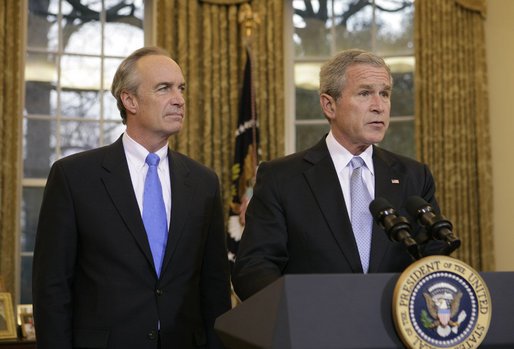
With Gov. Dirk Kempthorne at his side Thursday, March 16, 2006 in the Oval Office, President George W. Bush announces his intention to nominate the Governor to be Secretary of the Interior. White House photo by Paul Morse.With Gov. Dirk Kempthorne at his side Thursday, March 16, 2006 in the Oval Office, President George W. Bush announces his intention to nominate the Governor to be Secretary of the Interior. White House photo by Paul Morse.
THE PRESIDENT: Good afternoon. I'm pleased to announce my nomination of Governor Dirk Kempthorne to be the Secretary of the Interior. The Department of Interior is responsible for managing our national parks and public lands, conserving our natural resources, and pursuing environmentally responsible energy development on federal lands and waters.

I've nominated Dirk to succeed an outstanding public servant, Gale Norton. As the Secretary of the Interior for the past five years, she was instrumental in establishing the Healthy Forests Initiative, to protect communities from catastrophic wildfire, and to improve the habitat. When Hurricane Katrina devastated the Gulf Coast region, she helped lead the efforts to restore offshore energy production, so that Americans would not suffer further supply disruptions and price increases.

Future generations of Americans will be able to enjoy our great national parks and wildlife refugees because of Gale's untiring work. Gale was one of the original members of my Cabinet, and the first woman in American history to hold the post of Secretary of the Interior. I appreciate her dedicated service, and Laura and I wish Gale and John all the best.

Dirk Kempthorne is the right man to build on this progress. As Governor of Idaho, he worked closely with Gale on a variety of important initiatives. They worked together to resolve a longstanding water rights issue, to return responsibility to Idaho for managing the local wolf population, and to make the Healthy Forests Initiative a reality in Idaho.

As Governor, Dirk has been a responsible steward of Idaho's 30 state parks and recreational trail ways that serve millions of visitors each year. He has launched the statewide Experience Idaho initiative, which will fund needed improvements within Idaho's state parks, to preserve public spaces, and expand recreational opportunities for visitors. Last August, I had a chance to enjoy those recreational opportunities firsthand when Dirk and I biked some of Idaho's trails together.

As Secretary of the Interior, Dirk will continue my administration's efforts to conserve our land, water, and air resources, reduce the maintenance backlog of our national parks, support historic and cultural sites through our Preserve America Initiative, and develop the energy potential of federal lands and waters in environmentally sensitive ways.

Dirk brings wide experience to these important tasks. He has served at every level of government: as Mayor of Boise, as Governor of Idaho, and as a United States Senator. While in the Senate, he chaired the Subcommittee on Drinking Water, Fisheries, and Wildlife, and he chaired the Armed Services Personnel Subcommittee.

He built bipartisan support to enact comprehensive reforms to the Safe Drinking Water Act. Dirk understands that those who live closest to the land know how to manage it best, and he will work closely with state and local leaders to ensure wise stewardship of our resources.

Dirk has had a long and abiding love for nature. When he and his wife, Patricia, were married, they chose to hold the ceremony atop Idaho's Moscow Mountain at sunrise. Dirk said, "I don't think there's a more beautiful cathedral than the outdoors."

I appreciate his willingness to take on this important post, and I ask the Senate to confirm him promptly as the 49th Secretary of the Interior.

Thanks for agreeing to serve.

GOVERNOR KEMPTHORNE: Mr. President, thank you so very much for this honor. I appreciate the confidence that you have shown in me, and for this opportunity that I now have to serve you and to serve the people of the United States. I consider it a great honor and accept your charge to be a responsible steward of the land and the natural resources with which our nation has been blessed.

I also would like to thank and commend Secretary Norton, who has truly been a partner and a friend to Idaho over the past five years. By working together, there have been a number of historic accomplishments that have been achieved. She's been a partner and a friend to the states.

I'm grateful for the honor that I've had to serve the citizens of Idaho. For more than 20 years, in elected positions, I've had that privilege. I look forward to continuing my service now to this nation, if confirmed by the Senate, as Secretary of Interior.

My wife, Patricia, our children, Heather and Jeff, our new son-in-law, Drew, have been by my side throughout my public service. They've been a source of great encouragement and support and have allowed me to pursue my passion of helping people, finding solutions to problems, and making our communities and our state a better place to live, to work and to raise a family. I thank my family for that love.

I look forward to going to Capitol Hill and meeting with my former colleagues in the United States Senate, to talk with them about the heritage and the history of our great nation, the needs of those who live in Indian country, and the management of our natural resources.

Mr. President, one of the hallmarks of my public service has been my ability to bring people to the table and to work together to build consensus. I pledge to you and to the American people that I will continue in that role of reaching out and finding solutions.

I heard a clear direction from you, Mr. President, when we met earlier today. You stated that if confirmed, you want me to reach out to all constituent groups, to seek bipartisan support, to find common ground, and to build consensus. Whether on a hike or a bike ride, as you've referenced, in Idaho, or as recently as a conversation today, I truly appreciate and respect your genuine enthusiasm for this great land of ours in all of its grandeur and its essence.

Mr. President, once again, I thank you for this awesome honor and responsibility. I'm ready to serve the people of the United States. And God bless America, the beautiful. I would be honored to serve this land.

THE PRESIDENT: Thank you all.

END 5:36 P.M. EST, For Immediate Release, Office of the Press Secretary, March 16, 2006

Technorati Tags:
or or and or and or and or

RELATED: Keywords announced his intention to nominate, Monday, March 06, 2006
President has nominated four and designated one, Monday, March 06, 2006 President names three individuals to serve in his Administration, Monday, March 06, 2006 4 Nominations Sent to the Senate, Friday, March 03, 2006 4 Nominations Sent to the Senate, Friday, March 03, 2006 President to nominate one and appoint seven, Monday, February 20, 2006 President to nominate one and appoint three 02/16/06, Monday, February 20, 2006 Nominations Sent to the Senate 02/14/06, Monday, February 20, 2006 President to nominate four and appoint twelve, Monday, February 20, 2006 President to nominate one and appoint three 02/10/06, Friday, February 03, 2006 President to nominate five, appoint four, designate one, Wednesday, January 18, 2006 President to nominate ten appoint four individuals and designate one, Wednesday, December 28, 2005 Presidentto nominate three, appoint seventeen 12/28/05, Wednesday, December 28, 2005 President to nominate three, appoint two, designate one, Thursday, December 15, 2005 President to nominate four, appoint four, Thursday, December 15, 2005 District Judge Nominations Sent to the Senate, Wednesday, November 16, 2005 President to nominate four and appoint one,

President Welcomes Irish Prime Minister Ahern (VIDEO)

President Welcomes Irish Prime Minister Ahern for St. Patrick's Day, FULL STREAMING VIDEO, The Roosevelt Room, 10:31 A.M. EST In Focus: Global Diplomacy

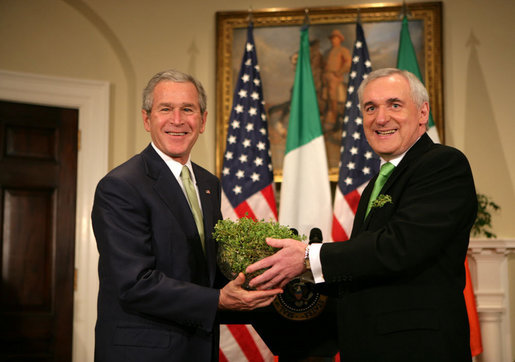
President George W. Bush is presented a bowl of shamrocks by Prime Minister Bertie Ahern of Ireland, during a ceremony Friday, St. Patrick's Day 2006, in the Roosevelt Room of the White House. White House photo by Kimberlee Hewitt.President George W. Bush is presented a bowl of shamrocks by Prime Minister Bertie Ahern of Ireland, during a ceremony Friday, St. Patrick's Day 2006, in the Roosevelt Room of the White House. White House photo by Kimberlee Hewitt.
PRIME MINISTER AHERN: Mr. President, Ambassadors, and friends; President, thank you for your warm welcome once again to the White House this morning to celebrate -- celebrate St. Patrick's Day, to me and all of the Irish delegation. And we're enormously honored to be here with you today. It means a great deal to us, and we deeply appreciate your time, both yesterday and again today.

Ireland and the United States are two countries of vastly different size and scale, but we enjoy an extraordinary and very special relationship. There's a profound bond between us that is historic and indelible. And it is fitting that we stand side-by-side in this great house to celebrate St. Patrick and Ireland together.

This Shamrock Ceremony is a cherished tradition. It symbolizes the profound kinship between Ireland and the United States. And the history of Irish immigration to this country is as old as America, itself. This week, across this great land, millions of Irish Americans are proudly celebrating their heritage. Remember on this day that the strength of today's relationship is made possible by the hard sacrifices of generations of Irish immigrants. From a sad and difficult past has emerged a successful and a proud people -- proud of Ireland, proud of the United States, and proud of being Irish American. We salute their many achievements, and we celebrate their many successes.

Mr. President, you have shown real leadership and understanding in the complex challenge of comprehensive immigration reform. On this St. Patrick's Day, mindful of the resonance that this great issue commands for people, and Irish people, I would like to express the hope that a path may be found to enable current Irish immigrants to legalize their status in the United States on a permanent basis. I hope that they can realize their dream of stable and secure lives for themselves and their families in this great country.

Mr. President, the greatest historic issue that has faced the Irish people from all traditions and creeds has been the challenge to live together in peace on our small island. Since we met last year, we've made further real progress. After decades of denying the will of the Irish people, the IRA announced the end of its armed campaign and the decommissioning of its weapons. These were long-awaited, landmark, historic developments.

Both Prime Minister Blair and I are determined that 2006 will be a decisive year in completing the journey of peace that we've embarked on. We're at one in our objective and in our strategy. We want to see the Good Friday Agreement implemented, and its full potential realized. We will not be deterred from this challenge. And when we look back on such a dark past, we're all the more determined to delivering the promise and hope of that indispensable agreement. The path to a permanent peace has not been easy. But I believe that, step by step, we are steadily building that peace and setting Northern Ireland on course for the future.

The United States has been a great friend in this quest, and as we seek to conclude the last elements in our peace process, your continuing support, Mr. President, will be of enormous importance and greatly appreciated. I welcome your invitation to the Northern Ireland political parties to be here today, and the fact that you've also extended an invitation to many others tragically affected by violence, or working for a better future for everyone in Ireland.

I warmly applaud the work of your Special Envoy, Ambassador Mitchell Reiss, as well as Ambassador James Kenny. They do a great job serving their country. And their tireless efforts and commitment in advancing the peace process in Ireland are widely recognized.

President John Quincy Adams once said that patience and perseverance have a magical effect before which difficulties disappear and obstacles vanish. We have found, Mr. President, the patience and perseverance that produce great results. With a little more on everybody's part, and with your help, and that of all our friends in the United States, we will complete our historic journey.

I'm very pleased, President, to present you once again on this St. Patrick's Day of 2006, the shamrock as a token of our esteem and the warmth of our friendship.

Thank you, Mr. President.

(The shamrock is presented.) (Applause.)

PRESIDENT BUSH: Taoiseach, thank you very much. Welcome back.

PRIME MINISTER AHERN: Thank you.

PRESIDENT BUSH: Laura and I are delighted to welcome you here to the White House. I'm proud to accept the bowl of shamrocks as a symbol of our friendship.

The friendship between Ireland and the United States has deep roots. Few people fought as hard for American independence as the sons of Erin. At the end of the Revolutionary War, Lord Mountjoy told the House of Commons that, "We've lost America through the Irish." The Irish played a key role in Washington's army. And in the two centuries since, the ties between Ireland and America have only strengthened.

The ties between Ireland and America are reflected in this great house. This house was designed by an Irish architect, and he used as his model the grandest building he knew, Leinster House in Ireland. The affinities between the two buildings are more than just architectural; the White House built by James Hoban has been home to every American President since John Q. Adams' father, John. The Dublin building that inspired him now serves as a free parliament in a free and independent Ireland.

The ties between Ireland and America are also reflected in our people. Ireland has one of the fastest growing economies in Europe, and its growth is attracting immigrants. For more than a century that was a different story. Millions of Irish came to our shores because of war and poverty and famine. Often they arrived with nothing but the faith of their fathers, and a willingness to work. These men and women who built our cities were also the soldiers who defended our freedom in every one of our wars. They're the priests and they're the nuns who built a system of parochial schools that provided a decent education for millions of poor immigrants. And they're now doing the same thing for a new generation of African Americans and Latino Americans in our inner cities.

Like St. Patrick, the Irish in America began their life in their new land as exiles, but came to love it as home. Finally, the ties between Ireland and America are reflected in our common commitment to bring the blessings of liberty to every man and woman and child on this Earth.

In the 20th century, Ireland won its independence and raised up a democracy that offered its people a just and better life. In the 21st century, Ireland is now helping other nations who share the same aspirations for peace and prosperity by fighting hunger, and the spread of HIV/AIDS in Africa, by supporting relief efforts for victims of the tsunami in Asia, and by helping the Afghan people rebuild their lives and their country. Ireland is independent when it comes to foreign policy. But Ireland is not neutral when it comes to the global challenges like hunger and disease and human rights.

Taoiseach, you're making a big contribution to our world, and we appreciate it. The United States appreciates all of Ireland's efforts for peace and freedom. Americans are grateful to our Irish friends, and we are proud of our Irish heritage.

The Census Bureau tells us there are more than 34 million Americans that claim Irish ancestry. On St. Patrick's Day, I suspect that number jumps a little bit. (Laughter.) On this special day, we honor the saint who brought the gospel of peace to the Green Isle, and we count ourselves blessed by the warm friendship between his adopted land and our own.

Thanks for coming. Appreciate it. (Applause.)

END 10:39 A.M. EST, For Immediate Release, Office of the Press Secretary, March 17, 2006

Technorati Tags:
and or and or and or

RELATED: Keywotd, Ireland Friday, March 10, 2006
President to Welcome Irish Prime Minister Ahern, Saturday, March 05, 2005 Taoiseach Bertie Ahern, Irish Prime Minister, Friday, March 18, 2005 Irish Prime Minister Ahern, St. Patrick's Day video, Tuesday, July 05, 2005 U2's Bono Praises President and Calls for Action!, Tuesday, September 27, 2005 U.S. Response to IRA Statement on Decommissioning,

Thursday, March 16, 2006

President to Welcome President of the Republic of Liberia

President to Welcome President of the Republic of Liberia to the White House

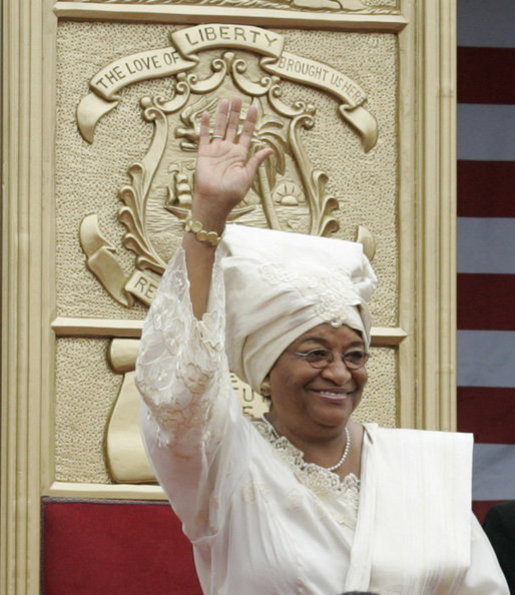
Liberian President Ellen Johnson Sirleaf waves to the audience at her inauguration in Monrovia, Liberia, Monday, Jan. 16, 2006. President Sirleaf is Africa's first female elected head of state. Mrs. Laura Bush and U.S. Secretary of State Condoleezza Rice attended the ceremony. White House photo by Shealah Craighead.Liberian President Ellen Johnson Sirleaf waves to the audience at her inauguration in Monrovia, Liberia, Monday, Jan. 16, 2006. President Sirleaf is Africa's first female elected head of state. Mrs. Laura Bush and U.S. Secretary of State Condoleezza Rice attended the ceremony. White House photo by Shealah Craighead.
President Bush will welcome President Ellen Johnson Sirleaf of the Republic of Liberia to the White House on March 21, 2006. The visit will be an opportunity for the President to congratulate President Sirleaf on becoming Africa's first woman to be elected Head of State. The two leaders will discuss continuing cooperation in the areas of reconstruction, education, HIV/AIDS, trade, asset recovery and security sector reform, and democratic reform, as well as the need to bring Charles Taylor to justice.

# # # For Immediate Release, Office of the Press Secretary, March 16, 2006

Technorati Tags:
and or and or and or and

Related: Keywords: Liberia
First Lady After Liberia Inauguration,

President Attends Celebration of Hungarian Contributions to Democracy,

President Attends Celebration of Hungarian Contributions to Democracy, FULL STREAMING VIDEO, Statutory Hall, United States Capitol, Washington, D.C. 5:45 P.M. EST

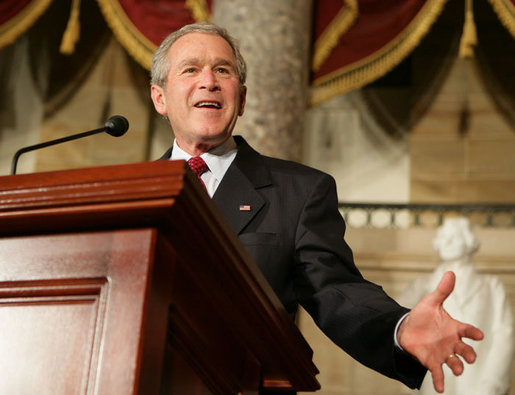
President George W. Bush speaks Wednesday evening, March 15, 2006 at the United State Capitol in Washington, in remembrance of the 50th Anniversary of the Hungarian revolution, during a celebration of Hungarian contributions to Democracy. White House photo by Kimberlee HewittPresident George W. Bush speaks Wednesday evening, March 15, 2006 at the United State Capitol in Washington, in remembrance of the 50th Anniversary of the Hungarian revolution, during a celebration of Hungarian contributions to Democracy.
White House photo by Kimberlee Hewitt.

THE PRESIDENT: Thank you all. Please be seated. Mr. Speaker, thank you for having me here in this beautiful Capitol to celebrate the 50th anniversary of the Hungarian Revolution.

I appreciate being here with the Mayor of our city, Mayor Williams. Good to see you, Mr. Mayor. I appreciate Chairman Hyde. Mr. Chairman, it's good to see you. I thank the members of the diplomatic corps, most particularly, Ambassador Walker. I've heard of him before. (Laughter.) Ambassador Simonyi -- thank you all. Members of Congress, most particularly a beacon for -- a steadfast beacon for liberty is how I'd like to define my friend, Tom Lantos.

I've come today not only to thank our strong ally, the government of Hungary and the people of Hungary, but I've come to thank my friend, Tom Lantos, and his wife, Annette, for never letting anybody forget that freedom is precious and necessary in our world.

The Hungarian example is an example of patience, and an example of the fact that freedom exists in everybody's soul. It's an example that tyranny can never stamp out the desire to be free. It's an example that -- of a country that, once becomes free, joins with other freedom-loving countries to keep the peace.

I've come to remind the people of Hungary they've got a great friend in America. I want to thank, by the way, the Hungarian Americans who are here with us today. You've made a significant contribution to our country.

You know, it's an interesting world in which we live. There's an argument about -- in some places -- about whether or not freedom is universal, whether or not freedom is okay for some parts of the world, but not others. I believe freedom is universal. I believe the example of Hungary proves that freedom is universal. I believe everybody desires to live in freedom. I believe there's an Almighty, and I believe the Almighty God's gift to each person in this world is liberty. And I believe the United States, and I believe Hungary, and I believe other free nations have the responsibility to help other people realize their freedom, as well.

You know, one of the interesting examples of Europe that I try to explain to our people is that for a hundred years there were war, where a lot of people lost their lives and a lot of Americans lost their life. But today Europe is at peace. Europe is whole, free, and at peace. And I believe the reason why is because democracy has taken hold on that continent. And one of the leading lights of democracy has been Hungary.

We thank the Hungarian people for their example. We thank them for their contribution in helping the newly free in Afghanistan and Iraq realize the blessings of liberty. We thank them for being allies in keeping the peace.

Mr. Speaker, thanks for letting me come by and pay my respects to a strong ally and a good friend, but also pay my respects to Congressman Tom Lantos, a person who understands the difference between freedom and tyranny, and a person who is willing to speak his mind all times, all places, everywhere.

God bless you all. (Applause.)

END 5:49 P.M. EST

Technorati Tags:
and or and or and

RELATED: Keyword, Hungary, Sunday, July 17, 2005
President to Welcome Hungarian Prime Minister, Saturday, September 24, 2005 President Presents Medal of Honor to Corporal Tibor "Ted" Rubin (VIDEO), Friday, October 07, 2005 President Meets with Prime Minister Gyurcsány of Hungary (VIDEO),

Iraqi Security Forces, Coalition Launch 'Operation Swarmer'

Iraqi Security Forces, Coalition Launch 'Operation Swarmer', American Forces Press Service

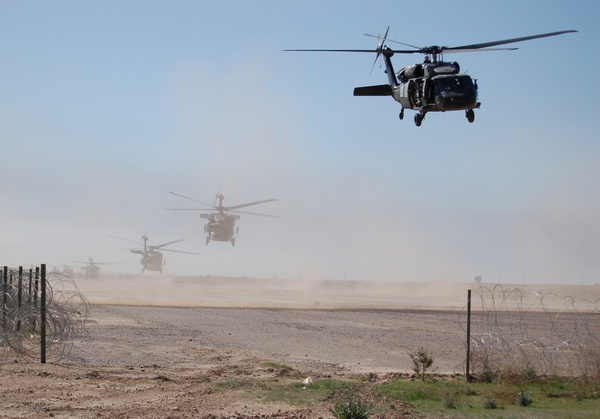
Operation Swarmer begins with the largest air assault operation since the beginning of Operation Iraqi Freedom. The operation, a combined effort by Iraqi security forces and coalition troops, will continue in the southern Salah Ad Din province for several days as the target area is thoroughly searched. Photo by Sgt. 1st Class Antony Joseph, USA.Operation Swarmer begins with the largest air assault operation since the beginning of Operation Iraqi Freedom. The operation, a combined effort by Iraqi security forces and coalition troops,
will continue in the southern Salah Ad Din province for several days as the target area is thoroughly searched. Photo by Sgt. 1st Class Antony Joseph, USA. Hi-Res Photo

WASHINGTON, March 16, 2006 – Iraqi and coalition forces today launched Operation Swarmer in the south of Iraq's Salah Ad Din province to clear a suspected insurgent operating area northeast of Samarra, military officials reported.

The operation began this morning with soldiers from the Iraqi army's 1st Brigade, 4th Division; the U.S. Army 101st Airborne Division's 3rd Brigade Combat Team; and the 101st Combat Aviation Brigade conducting a combined air and ground assault to isolate the objective area, officials said.

Attack and assault aircraft provided aerial weapons support for the operation and also delivered troops from the Iraqi army's 4th Division; the "Rakkasans" from 1st and 3rd Battalions, 187th Infantry Regiment, of the U.S. Army; and the "Hunters" from 2nd Squadron, 9th Cavalry Regiment, U.S. Army, to "multiple objectives" according to a Multinational Force Iraq statement. Forces from Iraq's 2nd Commando Brigade then completed a ground infiltration to secure numerous structures in the area, officials said.

More than 1,500 Iraqi and coalition troops, more than 200 tactical vehicles, and more than 50 aircraft participated in the operation, according to the MNF-I statement.

Initial reports from the objective area indicate that a number of enemy weapons caches -- containing artillery shells, explosives, materials for making homemade bombs, and military uniforms -- have been captured.

The operation is expected to continue for several days as a thorough search of the objective area is conducted, officials said.

Operation Swarmer follows closely the completion of a combined Iraqi and coalition operation west of Samarra in early March that yielded substantial enemy weapons and equipment caches.

The name Swarmer, the MNF-I statement explained, was derived from the name given to the largest peacetime airborne maneuvers ever conducted, in spring 1950 in North Carolina. Soon after this exercise, the 187th Infantry was selected to deploy to Korea as an airborne regimental combat team to provide Gen. Douglas MacArthur with an airborne capability.

(From a Multinational Force Iraq news release.)
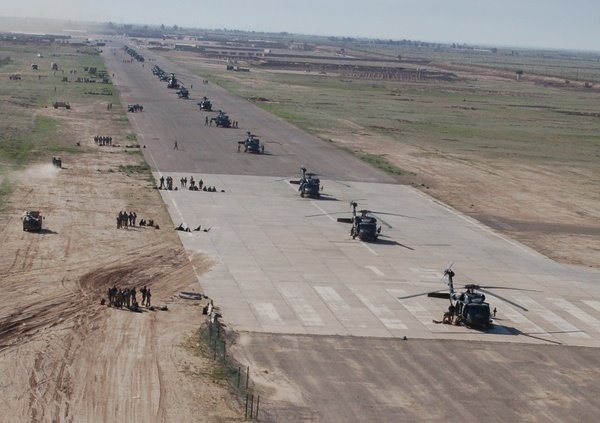
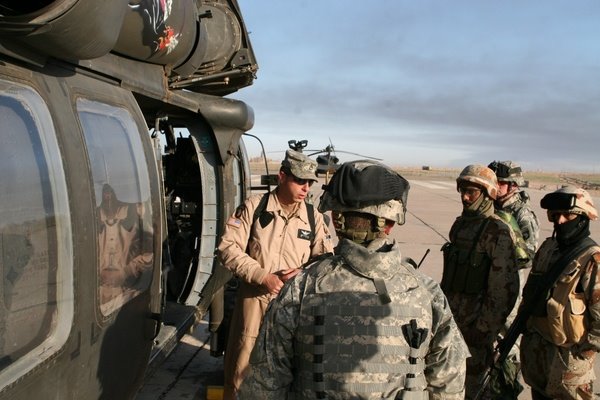
Soldiers and aircraft are positioned on the airstrip at Forward Operating Base Remagen in advance of Operation Swarmer, a combined Iraqi and coalition operation to clear a suspected insurgent operating area northeast of Samarra, Iraq. The soldiers are from the Iraqi army's 1st Brigade, 4th Division, the 101st Airborne Division's 3rd Brigade Combat Team, and the 101st Combat Aviation Brigade. Photo by Sgt. 1st Class Antony Joseph, USA.Soldiers from the Iraqi army's 1st Brigade, 4th Division, and the 101st Airborne Division's 3rd Brigade Combat Team receive a pre-flight briefing from a UH-60 Black Hawk crew chief prior to the start of Operation Swarmer, the combined air assault operation to clear a suspected insurgent operating area northeast of Samarra, Iraq. Photo by Staff Sgt. Lyle Grose, USA .
Technorati Tags: and or and , or and , or , and , or and or and

Related: Keywords CENTCOM, Tuesday, February 15, 2005
Recruitment drive for Iraqi Army draws thousands, Tuesday, March 01, 2005 Iraqi Soldiers kill, capture terrorist, Sunday, March 06, 2005 e-mail helps Iraqi citizens report insurgent activity, Monday, March 07, 2005 Iraqi troops flush Samarra of insurgents, Tuesday, March 08, 2005 Iraqi Army, Police Force’s Emergency Response Unit,

Wednesday, March 15, 2006

Press Briefing Scott McClellan 03/13/06 (VIDEO)

Press Secretary Scott McClellan responds to a question during his White House press briefing. White House photo by Tina HagerPress Briefing by Scott McClellan, FULL STREAMING VIDEO, James S. Brady Briefing Room, 12:19 P.M. EST, MR. MCCLELLAN: Good afternoon, everyone. Let me first begin with the President's remarks this afternoon.
As we approach the three-year anniversary of the liberation of Iraq, the President today will be giving the first in a series of speeches. Today he's going to be focusing on the security element of our strategy for victory in Iraq. He'll be talking about where we are in terms of our strategy to defeat the terrorists, and train Iraqi forces so that they can continue to take the lead in the fight, and they can continue to do more and more when it comes to defending the Iraqi people.

The President believes it's important as Commander-in-Chief to update the American people and to put our strategy for victory in the broader context of the war on terrorism and why this is important. And in these speeches he'll be talking in greater detail about how we are implementing the strategy; he'll talk about the progress that we're making; he'll talk about the lessons that we are learning from experience; and he'll talk about how we're adapting to fix what is not working.

In the last three years, the Iraqi people have gone from living under a brutal tyrant, to liberation, to sovereignty, to free elections, to a constitutional referendum, to elections for a constitutionally representative government. We saw more than 11 million Iraqis turn up at the polls last December in defiance of the terrorists. They have shown -- the Iraqi people have shown that they want to live in freedom.

This remains a difficult period in Iraq. There continues to be acts of violence and acts of sectarian violence. But the Iraqi people and Iraqi leaders are showing that they want to build a future of freedom and democracy. And Iraqi leaders have shown that they are committed to forming a unity government that represents all Iraqis.

Today in the speech the President will talk about how there is a lot of progress being made, but there's more work to do. And he'll talk about where we are in terms of the Iraqi security forces and how they're controlling more territory. There are more than 130 battalions now in the lead. There are more than 60 -- I'm sorry, more than 130 battalions, Iraqi battalions in place now, and more than 60 are in the lead. They're controlling more territory. They preformed well, by and large, during the recent up tick in violence in the aftermath of the attack on the Golden Mosque.

And the President will also be talking about the police forces, how we're focusing more of our efforts on training the police forces to address the problem with militias to make sure we're diversifying the ranks, and to make sure we're improving the professionalism of those police forces.

And finally he'll talk about the strategy when it comes to defeating the threat from improvised explosive devices. He had a good briefing with General Meigs on Friday, who is heading our task force to address the problem of improvised explosive devices. And he will talk about how we are training our forces to deal with the threat, how we're going after the terrorists and bomb makers and bringing them to justice before they can carry out their attacks, and how we are deploying new technologies to address this threat, as well.

And with that, I will be glad to go to your questions.

Q Scott, can I ask you about the speech? You say that there's a lot of progress being made, but there's more work to do. When you say that speaking for the President, it sounds like he's dangerously out of touch with public opinion in this country about the war. And these speeches, which are kind of a PR blitz for the second time, seem to be about communicating the policy, and not addressing what a lot of people think is a failing policy.

MR. McCLELLAN: No, I think it's convenient to try to simplify it and talk about it in those ways, but it misses the broader context of what we're working to achieve, and what our strategy is. And the American people want to hear from their Commander-in-Chief during a time of war. We remain at war. Iraq is central to winning the war on terrorism. And the President has been very up front talking about the challenges and the difficulties that we face. You heard him Friday.

I encourage you to listen very closely to his remarks, because he will talk about how this is a serious situation. The situation remains tense in Iraq, and there are difficulties that remain. There is continued sectarian violence that is going on. But the Iraqi people, by and large, are showing they want to live in freedom. The vast majority of the Iraqi people are saying, we want a free and democratic future. And it's important that we continue to stand with them. And he'll talk about why victory is important in Iraq. Victory is important in Iraq because it is a central front in the war on terrorism.

The enemy understands how high the stakes are in Iraq. We need to continue to work to make sure that we deny the terrorists a safe haven, to make sure that we gain an ally in the war on terrorism, and that we're bringing hope to a troubled region of the world. It goes directly to our own security. Remember, we've talked about how the broader Middle East has been a region that has been troubled for a long time.

Q Scott, this is the vision, but I'm asking you a question about reality on the ground. And part of that reality -- you talk about the strategy for war. There's a new book out by Bernard Trainor and by Mike Gordon of The New York Times, where they've looked at the actual combat phase of the war -- the President says that's been over for a long time now.

But, specifically, it makes the case -- through interviews and other classified materials -- that essentially commanders on the ground had a sense that the enemy was not what war planners thought it was, they could see the insurgency coming, and that Secretary of Defense Rumsfeld and even General Franks simply didn't listen, that there were missed signals, missed opportunities to get at this insurgency at the very start.

What's your response to that? Are they right?

MR. McCLELLAN: Well, let me correct you, first of all, because our troops remain engaged in fighting. They remain going after the terrorists and seeking to bring them to justice. What we're doing is training and equipping Iraqi security forces so that they can take the lead. They are taking the lead in the fight, and we're more and more in a supporting role, and more and more able to focus our efforts on going after the terrorists. Let me correct you in some comments that you threw into your question there, because I think that's wrong and it leaves the wrong impression for the American people.

Secondly, in terms of looking back and talking about what actions were taken during the lead-up to the war and after the war -- and we've talked repeatedly about that. I think we've expressed our views very clearly. And people can judge for themselves by looking at the facts and seeing what the situation was. But anytime you're engaged in a war you have to be able to adapt and adjust to circumstances on the ground. And that's one of the key points the President is talking about when he talks in greater detail about steps we have taken to fix what is not working. Flexibility is key to prevailing in the war on terrorism, and victory in Iraq is critical to our overall efforts.

Q So what's your response to the charges in this book?

MR. McCLELLAN: I just said that we've made our views very clear on those very issues --

Q Well, then, spell them out again. There are some specific points here. The President has said that he was surprised that Iraqi troops melted back, sort of fell back and melted to create an insurgency. He says that he always listens to commanders on the ground -- well, here are specific instances, a specific case being made that in fact this administration did not listen to commanders on the ground --

MR. McCLELLAN: No, that's not true.

Q -- and dropped the ball when it had an opportunity to kill this insurgency before it began. True or untrue?

MR. McCLELLAN: Our commanders on the ground are the ones who put the plan in place. And it's important that we not try to let the political leaders from Washington manage the war. It's important to let our military commanders, who are in the best position, to manage the war on terrorism and to carry out the war on terrorism. They're the ones who are in the best position to call the shots.

And we made it very clear in the aftermath of the liberation of Iraq that some things happened that weren't necessarily expected. There were other things that we had planned for that did happen. But some things, like the enemy leaving the battlefield, fleeing the battlefield quicker than we anticipated, only to come back and fight more at a later time. So you have to, again, be able to adapt and adjust to circumstances on the ground. But it's important to look to our commanders on the ground to make the determinations about what needs to be done.

Q Did or did not Rumsfeld make critical errors in judgment that led to the growth of this insurgency?

MR. McCLELLAN: David, I don't know how many times we've been over all these issues. If you want to do a book review, that's your business.

Q It's a pretty important question, it seems to me, instead of a flip answer. I think it's an important question.

MR. McCLELLAN: It's not a flip answer. We've been over it many times and --

Q I'm not doing a book review; I'd like to get the President's view on a pretty serious account.

MR. McCLELLAN: Well, you know, we've expressed that view very many times and if you want to continue to jump in here, that's your business. But he's expressed his views quite clearly, David, and you know that as well as anyone because you've heard it a number of times from leaders in this administration -- you've heard it from Secretary Rumsfeld, you've heard it from General Franks and you've heard it from others.

Q Today is a new day, new information. I'd like to hear it again. That's appropriate --

MR. McCLELLAN: I haven't read the book, so I can't speak to what's in the book.

Q Oh, okay, well, you didn't say that.

Q Scott, you talk about the strategy for victory. Secretary Rumsfeld has said that if civil war does break out the Iraqi security forces would take care of that, or try to take care of that. So do you consider victory in Iraq -- it to be a victory in Iraq even if civil war breaks out? Can the U.S. claim victory?

MR. McCLELLAN: Well, first of all, I think that our commanders on the ground say that they don't see it headed in that direction, because what you have seen in the aftermath of the attacks on the Golden Mosque is that the Iraqi people have exercised, by and large, restraint, that they've come together. The Iraqi religious leaders and political leaders have called for restraint and calm. The Iraqi political leaders have said they understand the importance of moving ahead as quickly as possible to form a government of national unity that represents all Iraqis. And that's what they're doing, and we're there to support them as they move forward on those efforts.

So I think you have to look at --

Q But we haven't seen that government being formed.

MR. McCLELLAN: -- you have to look at where things are. There's continued sectarian violence --

Q Right, there were six car bombs in Sadr City yesterday.

MR. McCLELLAN: That's what I'm just getting to. There's continued sectarian violence that we are seeing, but by and large, the Iraqi people are saying, we want to live in freedom, we want to live in democracy, and they're coming together to continue to move forward on the advance to that future.

Q But, Scott, go back to the victory in Iraq. And I know we've gone over this time and time again. But you've had Secretary Rumsfeld saying, if civil war broke out, the Iraqis would take care of --

MR. McCLELLAN: I think he was responding to a specific question.

Q So how can you say that would be victory, if civil war broke out?

MR. McCLELLAN: I think he said more than what you just said. And I think he expressed that they don't see it headed in that direction.

Q So you won't even address if civil war breaks out? I mean, you've seen sectarian violence. You said the President is going to talk about that --

MR. McCLELLAN: Our commanders spoke to what they would do. They were asked a specific question; they spoke to what would be done if you got into that situation. But at the same time, Martha, they said a lot more than that. So I don't think you should ignore what else they said, which is they don't see it headed in that direction.

Q Can I also just do one on the enemy? And will the President still define the enemy in the same way -- Saddamists, rejectionists, terrorists -- or is he looking more at sectarian violence, or do those fall into that?

MR. McCLELLAN: No, I think that the enemy clearly are the terrorists and the Saddam loyalists who want to derail the transition to democracy and freedom. That's what they're trying to do, by creating sectarian violence. That's why you saw the attack on the Golden Mosque. It was aimed at creating sectarian violence.

But the Iraqi people are responding with restraint and calm. There are still some that are engaging in sectarian violence. And those who are doing that, to a large extent, are ones that want to derail that transition to democracy. But the Iraqi people have shown the courage to stand up and defy the terrorists and defy those who want to return to the past. And it's important that we continue to stand with them and help them as they move forward.

Q What's the biggest threat?

MR. McCLELLAN: The terrorists who want to continue to carry out attacks on innocent civilians, carry out attacks on forces. Clearly, we're seeing images of violence and destruction, and that's going to have an effect on what people are seeing, how people feel.

The President talked about --

Q But what --

MR. McCLELLAN: No, hang on. The President talked about this in his radio address, and he talked about how he can understand why Americans are concerned about the situation in Iraq. Particularly when they're seeing these kind of images on their television screens. That's why it's important for the Commander-in-Chief to lay out for them what our strategy for victory is, how that fits into the broader context of our war on terrorism, and talk in greater detail about how we are implementing that strategy. The American people want to see our troops succeed in Iraq. And they are on the path to success in Iraq. We must continue to stand with them.

We have said repeatedly that there are going to be difficult days ahead. This is a period when they're transitioning to a permanent representative government under a constitution approved by the Iraqi people. And we made it very clear heading into this period that the terrorists and Saddam loyalists were going to do everything they could to try to derail that transition, that the violence wasn't going to stop. But what we have to do is continue to train and equip Iraqi security forces so that they can take the lead, so that they can control more territory and so that they can defend the Iraqi people. And that's what we are doing.

Q Can you just define "terrorists"? Because commanders on the ground a long time said that is --

MR. McCLELLAN: Zarqawi and others --

Q Right. But you said that's the biggest threat right now -- it's not sectarian violence, it's -- I mean, General Abizaid said the sectarian violence is a bigger threat than the insurgency --

MR. McCLELLAN: The sectarian violence is of concern. It is a concern right now. I'm not going to try to place myself in the position of being a commander on the ground -- they're the ones who are in the best position to tell you what the threats are. There is a threat from the improvised explosive devices to innocent Iraqis, to our troops. The President is talking about that in his remarks.

So if I wasn't clear, let me be clear. The terrorists -- I'm not going to try to draw a distinction. The terrorists and Zarqawi and his lieutenants remain a threat -- that's why we've continued to go after them and sought to bring them to justice and we have brought many of his lieutenants to justice. The Saddam loyalists who want to return to the past of tyranny are a threat and that's why we're working to address those issues. The sectarian strife is a concern, it's something that we have to take very seriously and we are taking very seriously. Everybody has to take it seriously.

Q What does the draw down in British forces mean for the security of Iraq?

MR. McCLELLAN: Well, a couple of things. First of all, I think that decisions are being based -- you should talk to the United Kingdom about the specific decisions that they're making. But, remember, back in December we announced our intentions to reduce our base force from 17 to 15 brigades, based on recommendations of our commanders on the ground. And we understand that the United Kingdom is adjusting its force, too. And this is done in close consultation with coalition forces.

When we made our announcement, back in December, we indicated that partners of ours would possibly be making adjustments as well. And so the capabilities of the Iraqi security forces are what you have to look at. The capabilities of the Iraqi security forces continue to improve and make progress, despite the violence, despite the tensions that exist in Iraq. And so I think that those decisions are being made based on those circumstances.

Q So these troops aren't needed any more?

MR. McCLELLAN: I'm sorry?

Q These troops aren't needed anymore?

MR. McCLELLAN: Well, what's needed is to keep training and equipping Iraqi security forces, so that they can take the lead. That's the solution to the situation in Iraq, and that's what we're doing.

Q Scott, on Claude Allen, was there any indication from Claude Allen to anyone in this building that there was financial trouble at any time, maybe months prior to his departure?

MR. McCLELLAN: Not that I'm aware of.

Q Well, according to a high-ranking Bush administration official, he allegedly was told by Claude Allen two months prior to Claude Allen's departure that he needed to find other means of employment for financial purposes. So no one in this building had heard anything, but some other people outside of this building heard that.

MR. McCLELLAN: I just said, not that I'm aware of. I don't know who you're specifically referring to. It's hard for me to address an anonymous source.

Q Can I follow up on that?

Q Had anyone seen anything different in Claude Allen, in the two months prior to his departure?

MR. McCLELLAN: Well, let me just lay out the facts for you, April. Maybe that's the best way to start here.

On January 2nd, there was an incident that took place. Claude Allen immediately reported that evening to Andy Card that an incident had taken place at a store. He spoke with Andy Card the very next morning. Andy Card then directed him to speak with Harriet Miers, the White House Counsel. And he assured both Andy and Harriet that this was a misunderstanding. The way he explained it to Harriet was that he was returning some merchandise, and there was some confusion with some credit cards because he had moved a number of times.

Now, within a few days of that time period -- and this would have been early January -- Claude came to Andy and Harriet and indicated that he had been thinking about leaving for some time. He said that he had been putting in long hours, he wanted to be able to spend more time with his family, and he thought the right thing to do would be to resign, so that he could spend more time with his family.

Now, he is someone who has gone through a number of background checks. His background has been investigated. And given his history and based on those background checks, I think he was given the benefit of the doubt. He assured them that he had done nothing wrong, and that he was working to get the matter cleared up.

Back in -- going back to what he said, in terms of leaving the White House, he was also working on a number of initiatives at the time that the President was finalizing for the State of the Union, particularly on the competitiveness agenda, the education side of that. So when he made the decision that he was going to leave the White House he indicated to Andy that he wanted to find a good time to transition. And he felt a good time to transition would be after the State of the Union. And so then we announced that he would be leaving, I believe it was on February 9th, and his last day at the White House was on February 17th.

And then we learned just Friday about the felony charges that had been brought in this matter. And as the President said Saturday, if it is true he would be deeply disappointed and he would feel a lot of sadness for the family. And he talked about how this would be very sad and something would have gone wrong in Claude Allen's life, if it is true. And I know that Harriet and Andy would be shocked, as well, as many of us on staff would be if it is true.

Q Well, I'm trying to put the pieces together on a couple of things. One, why was he visibly absent from the Coretta Scott King funeral? Also that was on February 7th, I believe. February 6th he was missing from the African American --

MR. McCLELLAN: I don't think that had anything to do with anything you're talking about. There was a very small number of staff that actually traveled on that day, and certainly when it came to the President, we had two Presidents traveling on that day on Air Force One --

Q -- African Americans from this administration were missing. Secretary Rice was missing from the African American event, because she had just gotten back from --

MR. McCLELLAN: I don't think that had anything to do with this.

Q -- and he was missing from the event.

MR. McCLELLAN: I don't think it has anything to do with this matter.

Q How much of a pay cut did he take when he left HHS to come to the White House?

MR. McCLELLAN: I don't know. I imagine that's public record.

Q Scott, if I can just follow this. Does the President feel duped by Claude Allen? You said before, they gave him the benefit of the doubt. Is that still the case?

MR. McCLELLAN: Well, if it's true, you heard what the President said the other day, that he told something to Andy and Harriet that simply is not true.

Q And could you just clarify what it was that he told Andy and Harriet? You said there was an incident that took place. How did he describe that incident? What did he say took place?

MR. McCLELLAN: Well, what we knew was that he had been apprehended by security personnel at the store, and that they had made a report to the police. And that's what we knew. I think I said what he specifically referred to, that it was a confusion over some credit cards when he was returning some merchandise.

Q Is there any cause for an investigation at the White House, whether or not there was any kind of theft that went on while he was here? Or is there anybody who --

MR. McCLELLAN: I'm not aware of anything.

Q Thank you, Scott. Two questions. First, recently an international group known as the Working Group, and known by the French acronym GTI, said that the parliamentary elections in C te D'Ivoire should be voided, and this led to a string of violence in that country. Now, last summer you told us that C te D'Ivoire was on the agenda of the working lunch between President Bush and President Mbeki at the White House. Does the President still support the continued democratic pattern in C te D'Ivoire, and is democracy in Africa --

MR. McCLELLAN: Of course we support the advance of democracy, wherever it is taking place. The President has spoken out very clearly about that. I don't know about specifics relating to the issue you bring up. It's not something that has been brought to my attention recently. I think the State Department has probably addressed it more recently.

Q Scott, one other question, if I might?

MR. McCLELLAN: Sure.

Q Thank you. Recently Fran Townsend, when she came up from that podium, and Michael Chertoff, when he testified before Congress, were highly critical of former FEMA Director Michael Brown, and specifically both said he went outside the established rules for a FEMA director during Katrina. Appearing on television last Sunday, Mr. Brown says that is absolutely not true, that both of them should know better; he followed the same procedure that every FEMA director does in an emergency. Does the White House have an opinion on this?

MR. McCLELLAN: Well, I think that our view is that we need to continue focusing our efforts where they should be, which is on helping the people of the Gulf Coast recover and rebuild their communities. That's what the President is doing. That's why he visited the region just last week, and that's where we're going to keep our focus. We're going to continue working to make sure the federal government is doing everything we can to support the people along the Gulf Coast as they rebuild their lives and rebuild their communities.

There is a lot of work to be done, and the President specifically focused on three key areas. He talked about where we are in terms of rebuilding and strengthening the levee system. He talked about where we are in terms of removing the debris, and he talked about where we are in terms of getting people back in their homes. And so that's where our focus is going to remain.

Our focus is also going to remain on applying the lessons learned from this catastrophic hurricane that hit the Gulf Coast region. And we're going to continue applying those lessons. We have already taken a number of steps. There are some 125 recommendations that Fran Townsend talked to you all about in this room. And we've got to continue acting to make sure we are better prepared in the future to respond to catastrophic events, whether they're natural disasters or terrorist attacks. And that's what this President is committed to doing, and that's why he directed Fran Townsend to undertake that very review.

Q So you stand by what Fran Townsend and Secretary Chertoff said?

MR. McCLELLAN: Our views have been expressed very clearly.

Go ahead, Wendell.

Q I have a question on the speech, but first, let me see if I understand. You said, based on the background checks that Claude Allen had been through, based on his history, he was given the benefit of the doubt by Andy Card and Harriet Miers?

MR. McCLELLAN: Yes, because he had gone through a number of background checks, that's right. His background had been investigated.

Q Given the Constitution that the Iraqis came up with fell a little short of what administration officials had hoped it would be, in terms of bringing the country together, why are you so confident that Iraqis are committed to a government of reconciliation?

MR. McCLELLAN: Because of the comments you're hearing not only from Iraqi political leaders, but from Iraqi religious leaders, who are urging calm and urging restraint. And the actions you're seeing by the Iraqi security forces. The security forces preformed very well, by and large, when it came to restoring calm in the different parts of the country where sectarian violence had spiked. There is still violence that's ongoing, that needs to be addressed, and there's still problems with the security forces, some areas where they didn't perform as well. I think you're going to hear a little bit more from the President in his remarks about that very issue.

But the Iraqi political leaders have now set a date -- they moved it up from where they originally set it -- to come together and discuss moving forward on forming a government of national unity, a government that represents all Iraqis. I think that they are showing that they understand the importance of current events on the ground and the importance of moving forward on forming that government of national unity.

Q And when would you expect it to be formed?

MR. McCLELLAN: Well, we're working to support them so that they can move forward as quickly as possible. This is something that, as our ambassador in Iraq has said, takes time. But we're urging them to move as quickly as possible. Obviously, there's a lot of politics that go on during a time like this, and I think the American people can expect to see more politics as that process moves forward. What we want to do is continue to support them as they move forward.

Q What's the President's reaction to the developments today in the Moussaoui trial, where a judge is considering throwing out the government's --

MR. McCLELLAN: And I think our reaction is that it's an ongoing legal matter at this point, and I'm not going to try to weigh into it while those issues are still being addressed.

Q Is he disappointed that the administration attorney may have jeopardized the case?

MR. McCLELLAN: Well, you're asking me to speculate about things at this point. Again, it's an ongoing legal matter, and we need to let that proceed forward.

Q Scott, at his news conference last week, Defense Secretary Rumsfeld said, just before closing, almost as an aside, that elements of the Iranian Republican Guard, the elite military unit, those elements are being sent into Iraq by the Iranian government. As the United States and the other nations take the question of the Iranian nuclear problem to the United Nations, do they also intend to address this problem, about interfering in --

MR. McCLELLAN: Well, the nuclear issue is not the only concern we have with the regime in Iran. We are concerned about their behavior in a number of ways. We've talked about that. We're concerned about their behavior when it comes to their support for terrorism. We're concerned about their behavior when it comes to the role that they're playing in the region. And we're concerned about their behavior when it comes to the Middle East peace process, as well, and their support for groups like Hezbollah.

So we have a number of concerns about the regime in Iran, and we've expressed those very clearly. This is a regime that is continuing to repress its people. We continue to stand with the Iranian people who want to live in freedom, and we will continue to do that.

But certainly, yes, there are a number of concerns we have. We are concerned about the role that they're playing -- the unhelpful role that they're playing in neighboring countries like Iraq. The Secretary touched on that last week. I think you'll hear the President touch a little bit in his remarks about when it comes to the improvised explosive devices, the role that Iran has played in some of that and our concerns there. So stay tuned to his speech.

Q As a follow-up, can you share with us, if any -- is the United States actively engaged -- as being reported by some of our brethren -- in a sense toppling the ayatollahs in Iran, which in a sense causing for a revolution from those within?

MR. McCLELLAN: I think the President spelled out our policy when it comes to the people of Iran. We will continue to stand with the people of Iran who want to chart their own future, who want greater freedom. And there are a number of ways that we are doing that.

Secretary Rice spelled those out at a hearing recently over at the Capitol, and talked about the additional resources that we're asking for to help support the efforts of non-governmental organizations and others to support the people of Iran.

Go ahead, Victoria.

Q Going with Iran, Senator Byrd last week was asking Secretary Rumsfeld and Peter Pace about the supplemental money, and asking whether any of this would be going to support a tax on Iran in any way, shape or form. He was eventually told no. Is that, in fact, the case?

MR. McCLELLAN: Well, I think you heard our testimony from our officials that are on the Hill, and I would stand by that testimony. I haven't looked at that specific testimony recently.

Q And one quick one on Gale Norton's resignation. When she was offering her resignation, was there any discussion at all of Jack Abramoff? Or was it just about wanting to spend more time with her family?

MR. McCLELLAN: It was for the reasons that she stated in her letter.

Q There was no discussion of Abramoff?

MR. McCLELLAN: No.

Q Is the White House planning to name a new head of the Food and Drug Administration soon? It's being reported that there are plans to name the acting director.

MR. McCLELLAN: I've seen some of those reports. I think we're going to have an announcement very soon on that position.

Q Scott, back to Iraq. Is there any sort of formal process of a handing off to Iraq, the security people, on a province-by-province basis?

MR. McCLELLAN: Well, we have been turning over territory to Iraqis.

Q How many provinces?

MR. McCLELLAN: I can get you that information, Roger. I didn't bring that out with me, but I'd be glad to try to get you that information. I think we can get you that.

Q Scott, can I ask about tomorrow's Medicare event, which I presume is about signing people up for prescription drug benefits. Is the President satisfied with the level of participation that he's seen so far? And, also, is he satisfied that the glitches that we've talked about before --

MR. McCLELLAN: I think there are some 26 million people that are already enrolled in the prescription drug benefit. There has been great progress made in terms of signing people up and enrolling them in the program. There's still a large number of people -- I expect he may touch on this tomorrow -- that are signing up on a weekly basis. The enrollment period just began in January. There are ongoing educational efforts for seniors so that they can pick the kind of health care that best fits their individual needs.

And tomorrow the President will be going up to New York and going to a senior center. And he will be visiting with seniors who are participating in an educational and enrollment session. And so there'll be about a dozen seniors that are sitting down and hearing about the different options that are available to them, and getting their questions answered. I know that Dr. McClellan, the administrator of the Center for Medicare and Medicaid Services, will be there, as well.

And then following that, the President is going to participate in a conversation to talk about how we are moving forward in implementing the prescription drug benefit, and implementing the other modernizations to the Medicare program. And on that panel, you'll have the administrator of CMS. You'll have a senior. I think there will be a pharmacist, and then a woman who has helped sign seniors up by educating them about the options that are available to them.

But the President believes that we are doing a good job in terms of moving forward. For the vast majority of seniors the program is working very well. Now, there have been some problems, because this is one of the biggest changes in the history of Medicare, and those problems are being addressed by Secretary Leavitt and by Administrator McClellan. They're working to address any glitches in the program as we move forward. And that's a challenge that you face anytime you have changes to a program like this. But they are working to address those issues.

But seniors are realizing substantial savings on their prescription drugs. For a typical senior, it's 50 percent or more that they are saving on their prescription drugs. So this is a very important program for our nation's seniors. And the President has made it very clear that when it comes to health care, government has a responsibility to make sure that we are providing for low-income Americans and for our nation's elderly, and that's what we are doing by making sure that they have up-to-date benefits and a modern Medicare program that provides them with the kind of drug coverage that they have waited on for far too long.

Q I was just asking whether he was satisfied with the level of participation at this point.

MR. McCLELLAN: Yes, I think that it's on track to meet the goals that have been outlined by Secretary Leavitt.

Q Scott, Senator Feingold is talking about censure relating to the NSA spying program, saying that the President was acting outside the law at a time when White House has said it's trying to codify the President's authority. What's your response to that?

MR. McCLELLAN: Well, the terrorist surveillance program is a program that has helped us to prevent attacks and save lives. It is vital to our nation's security. And it would be interesting to see how many Democrats actually agree with the view of Senator Feingold. Do Democrats support Senator Feingold's view, or do they support this vital program? The American people have made it very clear they support the President's efforts to defeat the terrorists and prevent attacks from happening.

The President has made it very clear he's not going to wait to be hit again. We are going to continue going after the terrorists wherever they are. And if you're talking to al Qaeda, or al Qaeda affiliated terrorists, we want to know. And it's important to keep in mind during a time of war that enemy surveillance is critical in those efforts. So what we ought to be doing is working together to defeat the terrorists, not engaging in partisan politics. So the question becomes, where do other Democrats stand? Do they agree with him in his view? I know Congressman Conyers has expressed a view about impeachment or something along those lines. Is this the view of the Democratic Party?

The enemy is the terrorists and al Qaeda members, not the President. And we ought to be focusing our efforts on going after the enemy and doing everything we can to prevent attacks from happening. And that's what this President has done and will continue to do.

Q Is it a legitimate technique for him to bring censure to the floor, in light of the fact that the legality is being questioned?

MR. McCLELLAN: Let's see how many Democrats agree with that view. It would be very interesting to see if they hold that view, or if they support this vital program and think that we should continue doing everything within our power to stop attacks from happening and to save lives. This program has been successful in helping us do that very thing.

Q Are you saying you'd welcome such a vote?

MR. McCLELLAN: I'm sorry?

Q Are you saying you'd welcome such a vote?

MR. McCLELLAN: You ought to ask Democrats where they stand, if they agree with that view.

Q Scott, you gave us a tick-tock on the Claude Allen situation, and the President even spoke about it on Saturday. Can you tell us why you've elected to talk about this situation, but have refused comment on the Moussaoui trial or Scooter Libby's case, as well?

MR. McCLELLAN: I was asked a question about this specific matter in terms of the facts and what related to it. And in terms of legal issues that are ongoing before the courts, I don't think we typically get into those matters.

Q Thank you.

END 12:54 P.M. EST

Technorati Tags:
and or and , or and , or , and , or and or and

Related: Keywords Press Briefing Scott McClellan, Friday, March 10, 2006
Press Briefing Scott McClellan 03/09/06 (VIDEO), Tuesday, March 07, 2006 Press Briefing Scott McClellan 03/07/06 (VIDEO), Tuesday, February 28, 2006 Press Briefing Scott McClellan 02/27/06 (VIDEO), Friday, February 17, 2006 Press Briefing Scott McClellan 02/16/06 (VIDEO), Friday, February 17, 2006 Press Briefing Scott McClellan 02/14/06 (VIDEO), Tuesday, February 14, 2006 Press Briefing Scott McClellan 02/13/06 (VIDEO), Thursday, January 19, 2006 Press Briefing Scott McClellan 01/18/06 (VIDEO), Friday, December 16, 2005Press Briefing, Scott McClellan, Levee Reconstruction (VIDEO), Tuesday, December 06, 2005 Press Briefing Scott McClellan (VIDEO) 12/06/05, Thursday, November 10, 2005 Press Briefing by Scott McClellan 11/09/05 (VIDEO, Wednesday, November 09, 2005 Press Briefing by Scott McClellan 11/08/05 , Wednesday, October 26, 2005 Press Briefing Scott McClellan and Zal Khalilzad (VIDEO), Monday, September 19, 2005 09/19/05 Scott McClellan (VIDEO), Tuesday, September 06, 2005 Press Briefing Scott McClellan (VIDEO) 09/06/05, Wednesday, August 03, 2005 Press Briefing by Scott McClellan 08/01/05 VIDEO,

Democrats: Find The Leader (VIDEO)

Democrats Find the LeaderDemocrats: Find The Leader - Paid for by the Republican National Committee Not Authorized By Any Candidate Or Candidate Committee www.GOP.com © 2006 Republican National Committee
Technorati Tags: or and or or and or and or

Related: Friday, December 09, 2005
Democrats’ Plan For Iraq, “Retreat and Defeat" (VIDEO), Monday, November 28, 2005 Sen. Biden Adopts Administration's Plan for Victory, Thursday, November 17, 2005 Democrats on Iraq (Video), Wednesday, November 16, 2005 New York Times on Pre-War Intelligence , Monday, November 14, 2005 Sen. Kennedy On Iraq, Monday, November 14, 2005 Senator Levin on Iraq, Monday, November 14, 2005 The Washington Post On Pre-War Intelligence, Thursday, July 14, 2005 Joe Wilson's Top Ten Worst Inaccuracies And Misstatements, Friday, July 15, 2005 Joe Wilson vs.Select Committee on Intelligence, Sunday, July 17, 2005 Captive Nations Week, 2005, Sunday, July 17, 2005 From The New York Times???