Tuesday, May 16, 2006

President Bush Addresses the Nation on Immigration Reform (VIDEO)

Technorati Tags: and or and or and or and or and

President Bush Addresses the Nation on Immigration Reform, FULL STREAMING VIDEO, The Oval Office, 8:01 P.M. EDT. Fact Sheet: Overview: Comprehensive Immigration Reform and In Focus: Immigration,Presidente Bush Addresses la nación en reforma de la inmigración

President George W. Bush delivers an Address to the Nation from the Oval Office, Monday night, May 15, 2006. White House photo by Eric Draper.President George W. Bush delivers an Address to the Nation from the Oval Office, Monday night, May 15, 2006. White House photo by Eric Draper.
THE PRESIDENT: Good evening. I've asked for a few minutes of your time to discuss a matter of national importance -- the reform of America's immigration system.

The issue of immigration stirs intense emotions, and in recent weeks, Americans have seen those emotions on display. On the streets of major cities, crowds have rallied in support of those in our country illegally. At our southern border, others have organized to stop illegal immigrants from coming in. Across the country, Americans are trying to reconcile these contrasting images. And in Washington, the debate over immigration reform has reached a time of decision. Tonight, I will make it clear where I stand, and where I want to lead our country on this vital issue.

We must begin by recognizing the problems with our immigration system. For decades, the United States has not been in complete control of its borders. As a result, many who want to work in our economy have been able to sneak across our border, and millions have stayed.

Once here, illegal immigrants live in the shadows of our society. Many use forged documents to get jobs, and that makes it difficult for employers to verify that the workers they hire are legal. Illegal immigration puts pressure on public schools and hospitals, it strains state and local budgets, and brings crime to our communities. These are real problems. Yet we must remember that the vast majority of illegal immigrants are decent people who work hard, support their families, practice their faith, and lead responsible lives. They are a part of American life, but they are beyond the reach and protection of American law.

We're a nation of laws, and we must enforce our laws. We're also a nation of immigrants, and we must uphold that tradition, which has strengthened our country in so many ways. These are not contradictory goals. America can be a lawful society and a welcoming society at the same time. We will fix the problems created by illegal immigration, and we will deliver a system that is secure, orderly, and fair. So I support comprehensive immigration reform that will accomplish five clear objectives.

First, the United States must secure its borders. This is a basic responsibility of a sovereign nation. It is also an urgent requirement of our national security. Our objective is straightforward: The border should be open to trade and lawful immigration, and shut to illegal immigrants, as well as criminals, drug dealers, and terrorists.

I was a governor of a state that has a 1,200-mile border with Mexico. So I know how difficult it is to enforce the border, and how important it is. Since I became President, we've increased funding for border security by 66 percent, and expanded the Border Patrol from about 9,000 to 12,000 agents. The men and women of our Border Patrol are doing a fine job in difficult circumstances, and over the past five years, they have apprehended and sent home about six million people entering America illegally.

Despite this progress, we do not yet have full control of the border, and I am determined to change that. Tonight I'm calling on Congress to provide funding for dramatic improvements in manpower and technology at the border. By the end of 2008, we'll increase the number of Border Patrol officers by an additional 6,000. When these new agents are deployed, we'll have more than doubled the size of the Border Patrol during my presidency.

At the same time, we're launching the most technologically advanced border security initiative in American history. We will construct high-tech fences in urban corridors, and build new patrol roads and barriers in rural areas. We'll employ motion sensors, infrared cameras, and unmanned aerial vehicles to prevent illegal crossings. America has the best technology in the world, and we will ensure that the Border Patrol has the technology they need to do their job and secure our border.

Training thousands of new Border Patrol agents and bringing the most advanced technology to the border will take time. Yet the need to secure our border is urgent. So I'm announcing several immediate steps to strengthen border enforcement during this period of transition:

One way to help during this transition is to use the National Guard. So, in coordination with governors, up to 6,000 Guard members will be deployed to our southern border. The Border Patrol will remain in the lead. The Guard will assist the Border Patrol by operating surveillance systems, analyzing intelligence, installing fences and vehicle barriers, building patrol roads, and providing training. Guard units will not be involved in direct law enforcement activities -- that duty will be done by the Border Patrol. This initial commitment of Guard members would last for a period of one year. After that, the number of Guard forces will be reduced as new Border Patrol agents and new technologies come online. It is important for Americans to know that we have enough Guard forces to win the war on terror, to respond to natural disasters, and to help secure our border.

The United States is not going to militarize the southern border. Mexico is our neighbor, and our friend. We will continue to work cooperatively to improve security on both sides of the border, to confront common problems like drug trafficking and crime, and to reduce illegal immigration.

Another way to help during this period of transition is through state and local law enforcement in our border communities. So we'll increase federal funding for state and local authorities assisting the Border Patrol on targeted enforcement missions. We will give state and local authorities the specialized training they need to help federal officers apprehend and detain illegal immigrants. State and local law enforcement officials are an important part of our border security and they need to be a part of our strategy to secure our borders.

The steps I've outlined will improve our ability to catch people entering our country illegally. At the same time, we must ensure that every illegal immigrant we catch crossing our southern border is returned home. More than 85 percent of the illegal immigrants we catch crossing the southern border are Mexicans, and most are sent back home within 24 hours. But when we catch illegal immigrants from other country [sic] it is not as easy to send them home. For many years, the government did not have enough space in our detention facilities to hold them while the legal process unfolded. So most were released back into our society and asked to return for a court date. When the date arrived, the vast majority did not show up. This practice, called "catch and release," is unacceptable, and we will end it.

We're taking several important steps to meet this goal. We've expanded the number of beds in our detention facilities, and we will continue to add more. We've expedited the legal process to cut the average deportation time. And we're making it clear to foreign governments that they must accept back their citizens who violate our immigration laws. As a result of these actions, we've ended "catch and release" for illegal immigrants from some countries. And I will ask Congress for additional funding and legal authority, so we can end "catch and release" at the southern border once and for all. When people know that they'll be caught and sent home if they enter our country illegally, they will be less likely to try to sneak in.

Second, to secure our border, we must create a temporary worker program. The reality is that there are many people on the other side of our border who will do anything to come to America to work and build a better life. They walk across miles of desert in the summer heat, or hide in the back of 18-wheelers to reach our country. This creates enormous pressure on our border that walls and patrols alone will not stop. To secure the border effectively, we must reduce the numbers of people trying to sneak across.

Therefore, I support a temporary worker program that would create a legal path for foreign workers to enter our country in an orderly way, for a limited period of time. This program would match willing foreign workers with willing American employers for jobs Americans are not doing. Every worker who applies for the program would be required to pass criminal background checks. And temporary workers must return to their home country at the conclusion of their stay.

A temporary worker program would meet the needs of our economy, and it would give honest immigrants a way to provide for their families while respecting the law. A temporary worker program would reduce the appeal of human smugglers, and make it less likely that people would risk their lives to cross the border. It would ease the financial burden on state and local governments, by replacing illegal workers with lawful taxpayers. And above all, a temporary worker program would add to our security by making certain we know who is in our country and why they are here.

Third, we need to hold employers to account for the workers they hire. It is against the law to hire someone who is in this country illegally. Yet businesses often cannot verify the legal status of their employees because of the widespread problem of document fraud. Therefore, comprehensive immigration reform must include a better system for verifying documents and work eligibility. A key part of that system should be a new identification card for every legal foreign worker. This card should use biometric technology, such as digital fingerprints, to make it tamper-proof. A tamper-proof card would help us enforce the law, and leave employers with no excuse for violating it. And by making it harder for illegal immigrants to find work in our country, we would discourage people from crossing the border illegally in the first place.

Fourth, we must face the reality that millions of illegal immigrants are here already. They should not be given an automatic path to citizenship. This is amnesty, and I oppose it. Amnesty would be unfair to those who are here lawfully, and it would invite further waves of illegal immigration.

Some in this country argue that the solution is to deport every illegal immigrant, and that any proposal short of this amounts to amnesty. I disagree. It is neither wise, nor realistic to round up millions of people, many with deep roots in the United States, and send them across the border. There is a rational middle ground between granting an automatic path to citizenship for every illegal immigrant, and a program of mass deportation. That middle ground recognizes there are differences between an illegal immigrant who crossed the border recently, and someone who has worked here for many years, and has a home, a family, and an otherwise clean record.

I believe that illegal immigrants who have roots in our country and want to stay should have to pay a meaningful penalty for breaking the law, to pay their taxes, to learn English, and to work in a job for a number of years. People who meet these conditions should be able to apply for citizenship, but approval would not be automatic, and they will have to wait in line behind those who played by the rules and followed the law. What I've just described is not amnesty, it is a way for those who have broken the law to pay their debt to society, and demonstrate the character that makes a good citizen.

Fifth, we must honor the great American tradition of the melting pot, which has made us one nation out of many peoples. The success of our country depends upon helping newcomers assimilate into our society, and embrace our common identity as Americans. Americans are bound together by our shared ideals, an appreciation of our history, respect for the flag we fly, and an ability to speak and write the English language. English is also the key to unlocking the opportunity of America. English allows newcomers to go from picking crops to opening a grocery, from cleaning offices to running offices, from a life of low-paying jobs to a diploma, a career, and a home of their own. When immigrants assimilate and advance in our society, they realize their dreams, they renew our spirit, and they add to the unity of America.

Tonight, I want to speak directly to members of the House and the Senate: An immigration reform bill needs to be comprehensive, because all elements of this problem must be addressed together, or none of them will be solved at all. The House has passed an immigration bill. The Senate should act by the end of this month so we can work out the differences between the two bills, and Congress can pass a comprehensive bill for me to sign into law.

America needs to conduct this debate on immigration in a reasoned and respectful tone. Feelings run deep on this issue, and as we work it out, all of us need to keep some things in mind. We cannot build a unified country by inciting people to anger, or playing on anyone's fears, or exploiting the issue of immigration for political gain. We must always remember that real lives will be affected by our debates and decisions, and that every human being has dignity and value no matter what their citizenship papers say.

I know many of you listening tonight have a parent or a grandparent who came here from another country with dreams of a better life. You know what freedom meant to them, and you know that America is a more hopeful country because of their hard work and sacrifice. As President, I've had the opportunity to meet people of many backgrounds, and hear what America means to them. On a visit to Bethesda Naval Hospital, Laura and I met a wounded Marine named Guadalupe Denogean. Master Gunnery Sergeant Denogean came to the United States from Mexico when he was a boy. He spent his summers picking crops with his family, and then he volunteered for the United States Marine Corps as soon as he was able. During the liberation of Iraq, Master Gunnery Sergeant Denogean was seriously injured. And when asked if he had any requests, he made two: a promotion for the corporal who helped rescue him, and the chance to become an American citizen. And when this brave Marine raised his right hand, and swore an oath to become a citizen of the country he had defended for more than 26 years, I was honored to stand at his side.

We will always be proud to welcome people like Guadalupe Denogean as fellow Americans. Our new immigrants are just what they've always been -- people willing to risk everything for the dream of freedom. And America remains what she has always been: the great hope on the horizon, an open door to the future, a blessed and promised land. We honor the heritage of all who come here, no matter where they come from, because we trust in our country's genius for making us all Americans -- one nation under God.

Thank you, and good night.

END 8:18 P.M. EDT, For Immediate Release, Office of the Press Secretary, May 15, 2006

Related: Keywords radio address, podcast, Saturday, May 13, 2006 bush radio address 05/13/06 full audio, text transcript, Saturday, May 06, 2006 bush radio address 05/06/06 full audio, text transcript, Saturday, April 29, 2006 bush radio address 04/29/06 full audio, text transcript, Saturday, April 22, 2006 bush radio address 04/22/06 full audio, text transcript, Saturday, April 15, 2006 bush radio address 04/15/06 full audio, text transcript, Saturday, April 08, 2006 bush radio address 04/08/06 full audio, text transcript, Saturday, April 01, 2006 bush radio address 04/01/06 full audio, text transcript, Saturday, March 25, 2006 bush radio address 03/25/06 full audio, text transcript, Saturday, March 18, 2006 bush radio address 03/18/06 full audio, text transcript, Saturday, March 11, 2006 bush radio address 03/11/06 full audio, text transcript, Saturday, March 04, 2006 bush radio address 03/04/06 full audio, text transcript, Saturday, February 25, 2006 bush radio address 02/25/06 full audio, text transcript, Saturday, February 18, 2006 bush radio address 02/18/06 full audio, text transcript, Saturday, February 04, 2006 bush radio address 02/04/06 full audio, text transcript,

Monday, May 15, 2006

President Bush will welcome Prime Minister Ehud Olmert of Israel

Technorati Tags: and or and , or

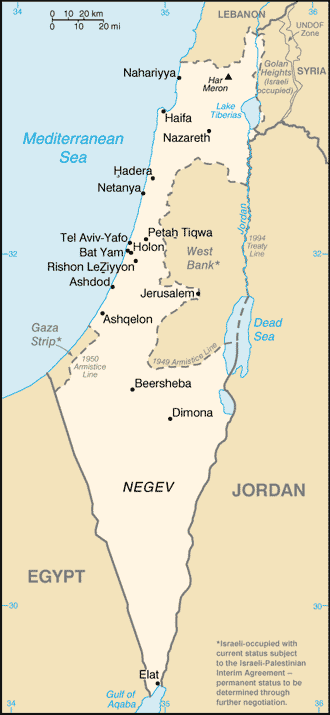
Map of IsraelVisit by Prime Minister Ehud Olmert of Israel

President Bush will welcome Prime Minister Ehud Olmert of Israel to the White House on May 23, 2006. The President looks forward to discussing with the Prime Minister the strong bilateral relationship between the United States and Israel, as well as a wide range of regional and international issues.

# # # For Immediate Release, Office of the Press Secretary, May 15, 2006, Statement by the Press Secretary.
BACKGROUND: Following World War II, the British withdrew from their mandate of Palestine, and the UN partitioned the area into Arab and Jewish states, an arrangement rejected by the Arabs. Subsequently, the Israelis defeated the Arabs in a series of wars without ending the deep tensions between the two sides. The territories occupied by Israel since the 1967 war are not included in the Israel country profile, unless otherwise noted. On 25 April 1982, Israel withdrew from the Sinai pursuant to the 1979 Israel-Egypt Peace Treaty.

Israel and Palestinian officials signed on 13 September 1993 a Declaration of Principles (also known as the "Oslo Accords") guiding an interim period of Palestinian self-rule. Outstanding territorial and other disputes with Jordan were resolved in the 26 October 1994 Israel-Jordan Treaty of Peace. In addition, on 25 May 2000, Israel withdrew unilaterally from southern Lebanon, which it had occupied since 1982. In keeping with the framework established at the Madrid Conference in October 1991, bilateral negotiations were conducted between Israel and Palestinian representatives and Syria to achieve a permanent settlement.

In April 2003, US President BUSH, working in conjunction with the EU, UN, and Russia - the "Quartet" - took the lead in laying out a roadmap to a final settlement of the conflict by 2005, based on reciprocal steps by the two parties leading to two states, Israel and a democratic Palestine. However, progress toward a permanent status agreement was undermined by Palestinian-Israeli violence between September 2000 and February 2005. An agreement reached at Sharm al-Sheikh in February 2005 significantly reduced the violence.

The election in January 2005 of Mahmud ABBAS as the new Palestinian leader following the November 2004 death of Yasir ARAFAT, the formation of a Likud-Labor-United Torah Judaism coalition government in January 2005, and the successful Israeli disengagement from the Gaza Strip (August-September 2005), presented an opportunity for a renewed peace effort. However, internal Israeli political events between October and December 2005 have destabilized the political situation and forced early elections, scheduled for March 2006. CIA Factbook,

RELATED: Keywords, President to Welcome, Saturday, May 06, 2006 President Bush Welcomes President Vázquez of Uruguay (VIDEO), Monday, April 24, 2006 President Bush to Host Danish Prime Minister Anders Fogh Rasmussen, Wednesday, April 12, 2006 President Bush to Welcome German Chancellor Merkel, Wednesday, April 12, 2006 President Bush welcomes Ghana President John A. Kufuor, Wednesday, March 29, 2006 President Bush Welcomes President Obasanjo of Nigeria, Thursday, March 23, 2006 President Welcomes President Sirleaf of Liberia (VIDEO), Friday, March 17, 2006 President Welcomes Irish Prime Minister Ahern (VIDEO), Saturday, February 11, 2006 President Bush Welcomes President of Poland (VIDEO), Friday, February 10, 2006 President Bush Welcomes King Abdullah (VIDEO),

U.S. Diplomatic Relations with Libya

Technorati Tags: and or and , or and or , or and ,, or ,

U.S. Diplomatic Relations with Libya, Secretary Condoleezza Rice, Washington, DC, May 15, 2006

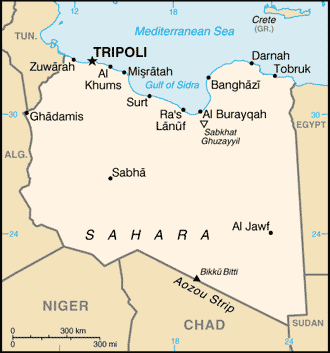
Map of LibyaI am pleased to announce that the United States is restoring full diplomatic relations with Libya. We will soon open an embassy in Tripoli.
In addition, the United States intends to remove Libya from the list of designated state sponsors of terrorism. Libya will also be omitted from the annual certification of countries not cooperating fully with United States' anti-terrorism efforts.

We are taking these actions in recognition of Libya's continued commitment to its renunciation of terrorism and the excellent cooperation Libya has provided to the United States and other members of the international community in response to common global threats faced by the civilized world since September 11, 2001.

Today's announcements are tangible results that flow from the historic decisions taken by Libya's leadership in 2003 to renounce terrorism and to abandon its weapons of mass destruction programs. As a direct result of those decisions we have witnessed the beginning of that country's re-emergence into the mainstream of the international community. Today marks the opening of a new era in U.S.-Libya relations that will benefit Americans and Libyans alike.

Just as 2003 marked a turning point for the Libyan people so too could 2006 mark turning points for the peoples of Iran and North Korea. Libya is an important model as nations around the world press for changes in behavior by the Iranian and North Korean regimes -- changes that could be vital to international peace and security. We urge the leadership of Iran and North Korea to make similar strategic decisions that would benefit their citizens.

For Libya, today's announcements open the door to a broader bilateral relationship with the United States that will allow us to better discuss other issues of importance. Those issues include protection of universal human rights, promotion of freedom of speech and expression, and expansion of economic and political reform consistent with President Bush's freedom agenda.
2006/493

Released on May 15, 2006

BACKGROUND: From the earliest days of his rule following the 1969 military coup, Col. Muammar Abu Minyar al-QADHAFI has espoused his own political system, the Third Universal Theory. The system is a combination of socialism and Islam derived in part from tribal practices and is supposed to be implemented by the Libyan people themselves in a unique form of "direct democracy." QADHAFI has always seen himself as a revolutionary and visionary leader.

He used oil funds during the 1970s and 1980s to promote his ideology outside Libya, supporting subversives and terrorists abroad to hasten the end of Marxism and capitalism. In addition, beginning in 1973, he engaged in military operations in northern Chad's Aozou Strip - to gain access to minerals and to use as a base of influence in Chadian politics - but was forced to retreat in 1987. UN sanctions in 1992 isolated QADHAFI politically following the downing of Pan AM Flight 103 over Lockerbie, Scotland.

Libyan support for terrorism appeared to have decreased after the imposition of sanctions. During the 1990s, QADHAFI also began to rebuild his relationships with Europe. UN sanctions were suspended in April 1999 and finally lifted in September 2003 after Libya resolved the Lockerbie case. In December 2003, Libya announced that it had agreed to reveal and end its programs to develop weapons of mass destruction, and QADHAFI has made significant strides in normalizing relations with western nations since then.

He has received various Western European leaders as well as many working-level and commercial delegations, and made his first trip to Western Europe in 15 years when he traveled to Brussels in April 2004. QADHAFI also finally resolved in 2004 several outstanding cases against his government for terrorist activities in the 1980s by compensating the families of victims of the UTA and La Belle disco bombings. CIA Factbook

Related: Keywords State Department, Thursday, May 11, 2006 State Department Podcast, VIDEO and Text 05/11/06, Wednesday, May 03, 2006 Secretary Rice, James Wolfensohn, Gaza Disengagement (PODCAST), Thursday, April 27, 2006 Remarks at Stakeout Secretary Condoleezza Rice, Friday, April 21, 2006 Secretary Rice to Travel to Europe, Friday, April 21, 2006 The Face of the State Department (VIDEO), Thursday, April 13, 2006 Secretary Rice Holds Talks with Equatorial Guinean President, Tuesday, April 11, 2006 State Department Podcast, VIDEO and Text 04/10/06, Wednesday, April 05, 2006 State Department Podcast, VIDEO and Text 04/03/06, Thursday, March 30, 2006 State Department Podcast, VIDEO and Text 03/29/06, Monday, April 03, 2006 Secretary Rice With Foreign Secretary Straw, Baghdad, Friday, March 31, 2006 Rice in Berlin To Discuss Iran with P-5 plus 1, Friday, March 31, 2006 UNHCR Worker’s Death in Sudan Attack, Friday, March 31, 2006 Statement on China's treatment of Kim Chun-Hee, Thursday, March 30, 2006 State Department Podcast, VIDEO and Text 03/29/06, Thursday, March 23, 2006 State Department Podcast, VIDEO and Text 03/22/06,

Sunday, May 14, 2006

Scientists Create the First Synthetic Nanoscale Fractal Molecule

Technorati Tags: or and or and or and or and or and or and or and or

Scientists Create the First Synthetic Nanoscale Fractal Molecule, Thursday May 11, 2006 by ANDREA GIBSON

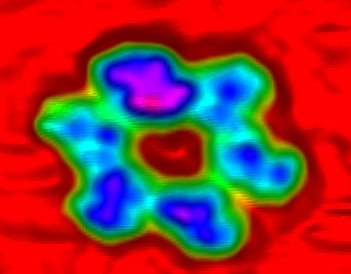
Scientists have created and captured an image of the largest man-made fractal molecule at the nanoscale, art by: Courtesy of Saw-Wai HlaScientists have created and captured an image of the largest man-made fractal molecule at the nanoscale, art by: Courtesy of Saw-Wai HlaChemical structure of the fractal molecule. art by: Courtesy Saw-Wai Hla
ATHENS, Ohio – From snowflakes to the leaves on a tree, objects in nature are made of irregular molecules called fractals. Scientists now have created and captured an image of the largest man-made fractal molecule at the nanoscale.

The molecule, developed by researchers at the University of Akron, Ohio University and Clemson University, eventually could lead to new types of photoelectric cells, molecular batteries and energy storage, according to the scientists, whose study was published online today by the journal Science.

A University of Akron research team led by Vice President for Research George Newkome used molecular self-assembly techniques to synthesize the molecule in the laboratory. The molecule, bound with ions of iron and ruthenium, forms a hexagonal gasket.

Ohio University physicists Saw-Wai Hla and Violeta Iancu, who specialize in imaging objects at the nanoscale, confirmed the creation of the man-made fractal. To capture the image, the physicists sprayed the molecules onto a piece of gold, chilled them to minus 449 degrees Fahrenheit to keep them stable, and then viewed them with a scanning tunneling microscope.

Though invisible to the naked eye – the molecules are about one million times smaller than the colorful hexagons shown in the Science image – the objects are 12 nanometers wide. “That’s big for a nanoscale molecule. It’s huge,” said Hla, an associate professor of physics and astronomy.

“This man-made structure is one of the first nanoscale, non-branched fractal molecules ever produced,” said Newkome, who is lead author on the Science paper and also serves as dean of the Graduate School and the James and Vanita Oelschlager Professor of Science and Technology at the University of Akron. “Blending mathematics, art and science, these nanoscopic hexagonal-shaped materials can be self-assembled and resemble a fine bead necklace. These precise polymers — the first example of a molecule possessing a ‘Star of David’ motif — may provide an entrée into novel new types of photoelectric cells, molecular batteries and energy storage.”

Fractals are irregular curves or shapes that retain the same pattern when reduced or magnified. The molecule in the study, for example, is composed of six rings, which are made up of six smaller rings, and so on, Hla explained. Snowflakes, broccoli florets or tree bark would be just a few examples from nature.

Hla and Iancu, a graduate student, also were able to measure the electronic structure of the molecule, which is useful to know for possible electronic applications. “(The molecules) are unique in their own way, so you have to find out what kind of properties they have so we can initiate possible applications,” he said.

The study authors were George R. Newkome, Pingshan Wang, Charles N. Moorefield, Tae Joon Cho, Prabhu Mohapatra, Sinan Li, Seok-Ho Hwang and Judith A. Palagallo, all from the University of Akron; Violeta Iancu and Saw-Wai Hla of Ohio University; and Olena Lukoyanova and Luis Echegoyen of Clemson University.

The research was supported by the National Science Foundation, Air Force Office of Scientific Research and the Ohio Board of Regents.

Hla is a member of Ohio University’s Nanoscale & Quantum Phenomena Institute, Condensed Matter and Surface Science group and Biomimetic Nanoscience and Nanotechnology group, which is part of Ohio University’s $8 million NanoBioTechnology Initiative, one of three major research priorities of the institution.

Read the article on Science Express or contact @Science for a copy. Contacts at Ohio University: Saw Wai-Hla, (740) 593-1727, hla@helios.phy.ohiou.edu; Andrea Gibson, (740) 597-2166, gibsona@ohio.edu Media Contact at University of Akron: Ken Torisky, (330) 972-7299.

Related: Keyword Nanotech Sunday, Sunday, May 14, 2006 World’s tiniest test tubes get teensiest corks, Sunday, May 07, 2006 Blood-Compatible Nanoscale Materials Possible Using Heparin, Sunday, April 30, 2006 Micro-pump is cool idea for future computer chips, Sunday, April 16, 2006 Self-Powered Nanoscale Devices, Sunday, April 09, 2006 Nanopore Method Genome Sequencing, Sunday, April 02, 2006 Quantum dot method rapidly identifies bacteria, March 26, 2006 'Custom' nanoparticles, cancer diagnosis and treatment, Sunday, March 26, 2006, Green nanochemistry, American Chemical Society symposium, Sunday, March 19, 2006 nanotechnologists demonstrate artificial muscles powered by highly energetic fuels, Sunday, Sunday, March 12, 2006 magnetic phenomenon may improve RAM memories, February 26, 2006 Nanoscience study shows that quantum dots 'talk', Sunday, February 26, 2006 Nano-bots to undertake major tasks?, Sunday, February 19, 2006 Nanotech to improve health care delivery, Sunday, February 19, 2006 nano-canary in the nanotoxicology coalmine, Sunday, December 04, 2005 Nano-cages 'fill up' with hydrogen, Sunday, November 13, 2005 Testing toxicity of nanomaterials, Sunday, October 23, 2005 single-molecule car, 'Nanocar', Sunday, August 28, 2005 Writing at the nanoscale, Thursday, May 26, 2005 discontinuous palladium, siloxane self-assembled monolayer, Sunday, May 08, 2005 Center for Nanoscale Materials, Monday, April 25, 2005 Nanomagnets, Nanocomposite, Monday, March 21, 2005 porphyrin tubes may lead to new nanodevices, inexpensive hydrogen fuel.

World’s tiniest test tubes get teensiest corks

Technorati Tags: or and or and or and or and or and or and or and or Posts that contain "Nanotechnology" per day for the last 30 days.
Technorati Chart

World’s tiniest test tubes get teensiest corks, Filed under Research, Health, Sciences on Wednesday, May 10, 2006.
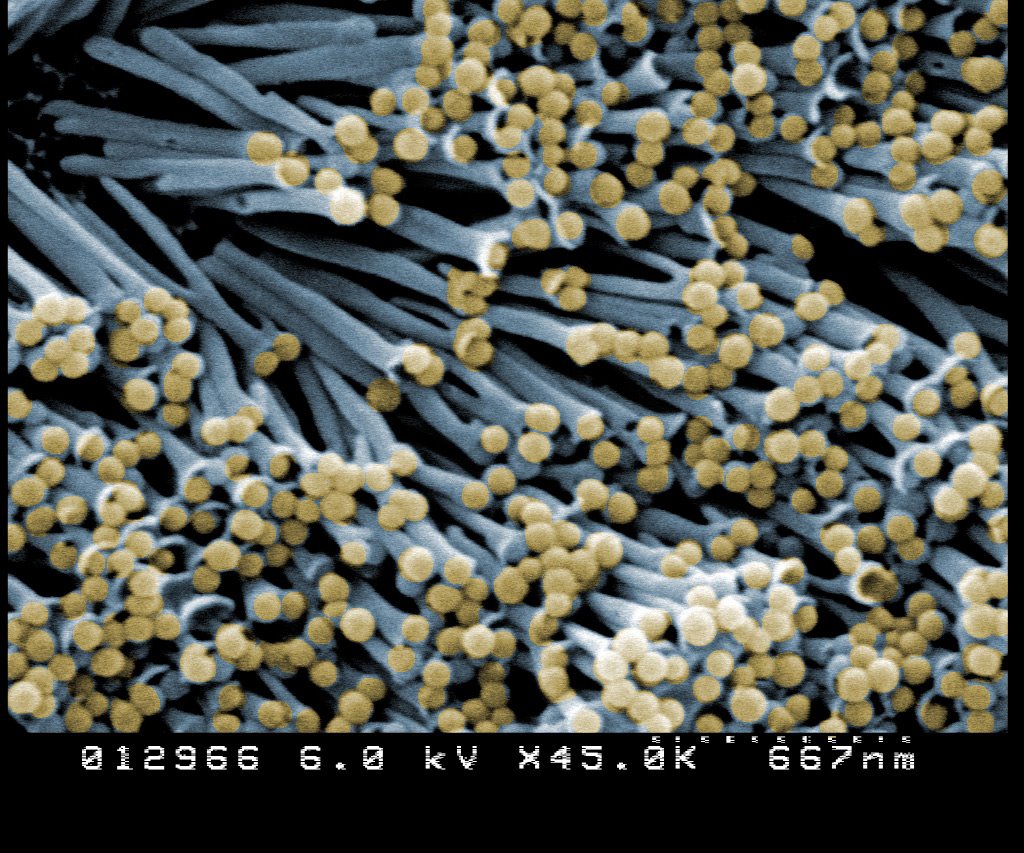
Rows of tiny nano test tubes rest on a mesh in this electron microscope photo, shot in October of last year and colorized for added clarity. Seeking to deliver drugs within the body, University of Florida scientists have found a way to 'cork' the tubes. The goal is to develop the ability to fill the teeny tubes with drugs and inject them into the body, where they will seek diseased or cancerous cells, uncork and spill their therapeutic contents in the right place.Rows of tiny nano test tubes rest on a mesh in this electron microscope photo, shot in October of last year and colorized for added clarity. Seeking to deliver drugs within the body,
University of Florida scientists have found a way to “cork” the tubes. The goal is to develop the ability to fill the teeny tubes with drugs and inject them into the body, where they will seek diseased or cancerous cells, uncork and spill their therapeutic contents in the right place. High Resolution Photo.

GAINESVILLE, Fla. — Now all they need is a really, really small corkscrew.

Like Lilliputian chemists, scientists have found a way to “cork” infinitesimally small nano test tubes. The goal is a better way to deliver drugs, for example, for cancer treatment. Scientists want to fill the teeny tubes with drugs and inject them into the body, where they will seek diseased or cancerous cells, uncork and spill their therapeutic contents in the right place.

“After making the nano test tubes, we saw the potential for them to be used for drug delivery vehicles, but because they are open at one end it would be like trying to ship wine in a bottle without a cork,” said University of Florida, chemistry professor Charles Martin. “You have to cork it, which is what we have accomplished.”

Martin is one of six University of Florida chemistry faculty members and graduate students who co-authored a paper about the research that appeared last month in the Journal of the American Chemical Society.

While chemotherapy works against many cancers, it can cause severe side effects such as nausea, temporary hair loss and blood disease. To make the chemo hit only the cancerous cells, Martin and scientists elsewhere have spent recent years experimenting with drug-carrying nanotubes or nanoparticles.

“Nano” stems from nanotechnology, the fast-growing science of making objects or devices that approach molecular dimensions. One nanometer equals one-billionth of a meter.

The approach makes sense for attacking diseased cells while bypassing healthy ones, but it also poses challenges. For one thing, the nanotubes must recognize their target, a problem scientists are attacking by tweaking their chemistry to make it respond to the unique chemistry of cancer cells. The tubes also must be biologically benign. Martin says a method for making nanotubes he pioneered, template synthesis, allows manufacturers to use biodegradable material, such as the polylactides that compose biodegradable sutures.

Additionally, the tubes also had to be closed at one end to form the classic test tube shape, a problem Martin and his group solved in research published in 2004.

To “cork” the test tubes in the latest research, the researchers applied an amino chemical group to the mouth of the tubes and an aldehyde chemical group to the corks. The two groups are complementary, so they bond with one another.

Billions of nanotubes could fit on a postage stamp. So, said Martin, “we don’t put individual caps in each nanotube the way corking machines do for bottles.”

Instead, the scientists immerse a small mesh that holds millions of amino-modified nanotubes, all precisely lined up in a grid pattern, into a solution imbued with millions of the corks. Brownian motion — what happens when minute particles immersed in a fluid move about randomly — takes care of the rest. The corks simply float around, then slip into the mouths of the tubes as they encounter them.

The diameter of the tubes is about 80 nanometers, or 80-billionths of a meter. Even though they are tiny, each tube can hold about 5 million drug molecules. “Each tube packs a real punch in terms of the number of drug molecules it can deliver,” Martin said.

Sang Bok Lee, an assistant professor of chemistry and biochemistry at the University of Maryland, works on similar research. He said scientists have proposed capping the tubes using chemical interactions between the drugs and the tubes. But that might not work because the tube could leak before it reaches its target.

“I strongly agree that Professor Martin’s proposed strategy will be one of the ideal solutions for the problem of controlling drug uptake and release,” he said in an e-mail.

The UF scientists aren’t there yet. There’s no easy way to unlock the amino chemical group from the aldehyde chemical group. So while Martin says there are some promising possibilities, he and his colleagues have their next job cut out for them: figuring out how to uncork the tubes. -30-

Credits: Writer, Aaron Hoover, ahoover@ufl.edu, (352) 392-0186, Source: Charles Martin, crmartin@chem.ufl.edu, (352) 392-8205

Related: Keyword Nanotech Sunday, Sunday, May 07, 2006 Blood-Compatible Nanoscale Materials Possible Using Heparin, Sunday, April 30, 2006 Micro-pump is cool idea for future computer chips, Sunday, April 16, 2006 Self-Powered Nanoscale Devices, Sunday, April 09, 2006 Nanopore Method Genome Sequencing, Sunday, April 02, 2006 Quantum dot method rapidly identifies bacteria, March 26, 2006 'Custom' nanoparticles, cancer diagnosis and treatment, Sunday, March 26, 2006, Green nanochemistry, American Chemical Society symposium, Sunday, March 19, 2006 nanotechnologists demonstrate artificial muscles powered by highly energetic fuels, Sunday, Sunday, March 12, 2006 magnetic phenomenon may improve RAM memories, February 26, 2006 Nanoscience study shows that quantum dots 'talk', Sunday, February 26, 2006 Nano-bots to undertake major tasks?, Sunday, February 19, 2006 Nanotech to improve health care delivery, Sunday, February 19, 2006 nano-canary in the nanotoxicology coalmine, Sunday, December 04, 2005 Nano-cages 'fill up' with hydrogen, Sunday, November 13, 2005 Testing toxicity of nanomaterials, Sunday, October 23, 2005 single-molecule car, 'Nanocar', Sunday, August 28, 2005 Writing at the nanoscale, Thursday, May 26, 2005 discontinuous palladium, siloxane self-assembled monolayer, Sunday, May 08, 2005 Center for Nanoscale Materials, Monday, April 25, 2005 Nanomagnets, Nanocomposite, Monday, March 21, 2005 porphyrin tubes may lead to new nanodevices, inexpensive hydrogen fuel.

Saturday, May 13, 2006

Discurso Radial del Presidente a la Nación 05/13/06

Etiquetas De Technorati: , y , o y , o

Presidente George W. Bush llama a tropas de su rancho en Crawford, Tejas, día de Thanksgiving, jueves, de noviembre el 24 de 2005.  Foto blanca de la casa de Eric Draper.forre el audio de la dirección de radio 05/13/06 por completo, transcripción del texto. PODCAST

Discurso Radial del Presidente. en Español
En foco: Seguridad nacional.
Suscriba a nuestro canal de Odeo Podcast y reciba la dirección de radio presidencial cada semana. Ofrecer la transcripción audio y llena verdadera del texto. Suscriba a nuestro canal de Odeo Podcast y reciba la dirección de radio presidencial cada semana.  Ofrecer la transcripción audio y llena verdadera del texto.

Buenos Días. Esta semana postulé al General Mike Hayden para ser el próximo Director de la Agencia Central de Inteligencia. El trabajo de la CIA es esencial para la seguridad del pueblo estadounidense. Los enemigos que atacaron a nuestra Nación el 11 de Septiembre, 2001 tienen la intención de atacarnos de nuevo - y para derrotarlos debemos tener la mejor inteligencia posible. En Mike Hayden, los hombres y mujeres de la CIA tendrán un líder fuerte que los apoyará mientras se esfuerzan para desbaratar los ataques terroristas... penetrar a sociedades cerradas... y obtener información que es fundamental para proteger a nuestra nación.

El General Hayden está altamente calificado para ser el líder de la CIA. Durante el último año, ha sido el primer Sub-Director de Inteligencia Nacional de nuestra Nación, y ha desempeñado un papel crítico en nuestros esfuerzos para reformar las capacidades de inteligencia de Estados Unidos a fin de enfrentar las amenazas de un nuevo siglo. Tiene más de 20 años de experiencia en el campo de la inteligencia. Durante seis años sirvió como Director de la Agencia Nacional de Seguridad y tiene un historial de éxito en liderar y transformar esa agencia de inteligencia tan grande. También ha desempeñado cargos importantes en el Pentágono y en el Consejo Nacional de Seguridad, y sirvió detrás de la Cortina de Hierro en nuestra embajada en Bulgaria durante la Guerra Fría.

Mike conoce nuestra comunidad de inteligencia de arriba abajo. Ha sido tanto productor como consumidor de inteligencia y ha supervisado actividades de inteligencia tanto humanas como técnicas, así como el análisis de todas las fuentes que se deriva de estas actividades. El año pasado Mike fue confirmado unánimemente por el Senado a su puesto actual - y esta semana miembros de ambos partidos han elogiado su candidatura. Le pido al Senado que lo confirme sin demora como el próximo Director de la CIA.

Durante el mando del General Hayden en la NSA, él ayudó a establecer y operar uno de nuestros esfuerzos de inteligencia más vitales en la guerra contra el terror - el Programa de Vigilancia de Terroristas. Como han notado la Comisión del 9/11 y otros, nuestro gobierno no "conectó los puntos" en los años antes de los ataques del 11 de Septiembre. Ahora sabemos que dos de los secuestradores en los Estados Unidos hicieron llamadas telefónicas a operativos de al-Qaida en el extranjero - pero no supimos de sus planes hasta que fue demasiado tarde. De modo que para evitar otro ataque, yo autoricé a la Agencia de Seguridad Nacional - en conformidad con la Constitución y las leyes - a interceptar comunicaciones internacionales en las cuales una parte tuviera lazos conocidos con al- Qaida y grupos de terroristas relacionados. Este programa de vigilancia de terroristas hace más probable que asesinos como los secuestradores del 9/11 serán identificados y encontrados a tiempo. Ha ayudado a evitar posibles ataques de terroristas en Estados Unidos y en el extranjero - y permanece esencial para la seguridad de Estados Unidos. Si hay personas dentro de nuestro país que están hablando con al-Qaida, queremos saberlo - no nos vamos a recostar y esperar a que nos vuelvan a atacar.

Esta semana se han hecho nuevos reclamos sobre las distintas maneras en que estamos rastreando al-Qaida para evitar ataques contra Estados Unidos. Es importante que los estadounidenses comprendan que nuestras actividades tienen como objetivo estrictamente a al-Qaida y sus afiliados conocidos. Al-Qaida es nuestro enemigo, y queremos conocer sus planes. Las actividades de inteligencia que he autorizado son legales y han sido informadas a miembros apropiados del Congreso, tanto Republicanos como Demócratas. La privacidad de todos los estadounidenses es fuertemente protegida en todas nuestras actividades. El gobierno no escucha a llamadas telefónicas domésticas sin aprobación de las cortes. No nos estamos inmiscuyendo en las vidas personales de millones de estadounidenses inocentes. Nuestros esfuerzos se concentran en lazos con terroristas al- Qaida y sus afiliados que quieren perjudicar al pueblo estadounidense.

Los estadounidenses esperan que su gobierno haga todo en su poder bajo nuestras leyes y Constitución para protegerlos a ellos y a sus libertades civiles. Eso es exactamente lo que estamos haciendo - y hasta la fecha hemos tenido éxito en evitar otro ataque en nuestro suelo. Los hombres y las mujeres de la CIA están trabajando las veinticuatro horas del día para hacer más segura a nuestra Nación. Confío que el General Hayden fortalecerá la CIA y que integrará su labor fundamental con la de nuestras otras agencias de inteligencia - para que podamos derrotar a los terroristas del siglo 21.

Gracias por escuchar.

# # #, Para su publicación inmediata, Oficina del Secretario de Prensa, 13 de mayo de 2006

Relacionado: Dirección de radio de las palabras claves, podcast, Sábado 6 de mayo de 2006 Discurso Radial del Presidente a la Nación 05/06/06 , Sábado 29 de abril de 2006 Discurso Radial del Presidente a la Nación 04/29/06, Sábado, De Abril El 22 De 2006 Discurso Radial del Presidente a la Nación 04/22/06, Sábado, De Abril El 15 De 2006 Discurso Radial del Presidente a la Nación 04/15/06, Sábado, De Abril El 08 De 2006 Discurso Radial del Presidente a la Nación 04/08/06, Monday, April 03, 2006 Rice urge progreso en cuanto a gobierno en Iraq, Saturday, April 01, 2006 Discurso Radial del Presidente a la Nación 04/01/06, Lunes, De Marcha La 27 De 2006 Declaraciones Del Presidente Después De Reunión Sobre La Reforma Inmigratoria, sábado, de marcha la 25 de 2006 Discurso Radial del Presidente a la Nación 03/18/06, sábado, de marcha la 18 de 2006 Discurso Radial del Presidente a la Nación 03/18/06,

bush radio address 05/13/06 full audio, text transcript

Technorati Tags: and or and or and

President George W. Bush calls troops from his ranch in Crawford, Texas, Thanksgiving Day, Thursday, Nov. 24, 2005. White House photo by Eric Draper.bush radio address 05/13/06 full audio, text transcript. PODCAST

President's Radio Address en Español In Focus: National Security
Subscribe to My Odeo Channel Subscribe to Our Odeo Podcast Channel and receive the Presidential Radio Address each week. Featuring real audio and full text transcript.

THE PRESIDENT: Good morning. This week I nominated General Mike Hayden to be the next Director of the Central Intelligence Agency. The work of the CIA is essential to the security of the American people. The enemies who struck our Nation on September the 11th, 2001, intend to attack us again, and to defeat them, we must have the best possible intelligence. In Mike Hayden, the men and women of the CIA will have a strong leader who will support them as they work to disrupt terrorist attacks, penetrate closed societies, and gain information that is vital to protecting our Nation.

General Hayden is supremely qualified to lead the CIA. For the last year, he's been our Nation's first Deputy Director of National Intelligence, and has played a critical role in our efforts to reform America's intelligence capabilities to meet the threats of a new century. He has more than 20 years of experience in the intelligence field. He served for six years as Director of the National Security Agency and has a track record of success in leading and transforming that large intelligence agency. He also has held senior positions at the Pentagon and the National Security Council, and he served behind the Iron Curtain in our embassy in Bulgaria during the Cold War.

Mike knows our intelligence community from the ground up. He's been both a producer and a consumer of intelligence and has overseen both human and technical intelligence activities, as well as the all-source analysis derived from those activities. Mike was unanimously confirmed by the Senate last year for his current post, and this week members of both parties have praised his nomination. I urge the Senate to confirm him promptly as the next Director of the CIA.

During General Hayden's tenure at the NSA, he helped establish and run one of our most vital intelligence efforts in the War on Terror -- the Terrorist Surveillance Program. As the 9/11 Commission and others have noted, our government failed to connect the dots in the years before the attacks of September the 11th. We now know that two of the hijackers in the United States made phone calls to al Qaeda operatives overseas, but we did not know about their plans until it was too late.

So to prevent another attack, I authorized the National Security Agency -- consistent with the Constitution and laws -- to intercept international communications in which one party has known links to al Qaeda and related terrorist groups. This terrorist surveillance program makes it more likely that killers like the 9/11 hijackers will be identified and located in time. It has helped prevent possible terrorist attacks in the United States and abroad, and it remains essential to the security of America. If there are people inside our country who are talking with al Qaeda, we want to know about it. We will not sit back and wait to be attacked again.

This week, new claims have been made about other ways we are tracking down al Qaeda to prevent attacks on America. It is important for Americans to understand that our activities strictly target al Qaeda and its known affiliates. Al Qaeda is our enemy, and we want to know their plans. The intelligence activities I have authorized are lawful and have been briefed to appropriate members of Congress, both Republican and Democrat. The privacy of all Americans is fiercely protected in all our activities. The government does not listen to domestic phone calls without court approval. We are not trolling through the personal lives of millions of innocent Americans. Our efforts are focused on links to al Qaeda terrorists and its affiliates who want to harm the American people.

Americans expect their government to do everything in its power under our laws and Constitution to protect them and their civil liberties. That is exactly what we are doing. And so far, we have been successful in preventing another attack on our soil. The men and women of the CIA are working around the clock to make our Nation more secure. I am confident that General Hayden will strengthen the CIA and integrate its vital work with our other intelligence agencies, so we can defeat the terrorists of the 21st century.

Thank you for listening.

END For Immediate Release, Office of the Press Secretary, May 13, 2006

Related: Keywords radio address, podcast, Saturday, May 06, 2006 bush radio address 05/06/06 full audio, text transcript, Saturday, April 29, 2006 bush radio address 04/29/06 full audio, text transcript, Saturday, April 22, 2006 bush radio address 04/22/06 full audio, text transcript, Saturday, April 15, 2006 bush radio address 04/15/06 full audio, text transcript, Saturday, April 08, 2006 bush radio address 04/08/06 full audio, text transcript, Saturday, April 01, 2006 bush radio address 04/01/06 full audio, text transcript, Saturday, March 25, 2006 bush radio address 03/25/06 full audio, text transcript, Saturday, March 18, 2006 bush radio address 03/18/06 full audio, text transcript, Saturday, March 11, 2006 bush radio address 03/11/06 full audio, text transcript, Saturday, March 04, 2006 bush radio address 03/04/06 full audio, text transcript, Saturday, February 25, 2006 bush radio address 02/25/06 full audio, text transcript, Saturday, February 18, 2006 bush radio address 02/18/06 full audio, text transcript, Saturday, February 04, 2006 bush radio address 02/04/06 full audio, text transcript, Saturday, January 28, 2006, bush radio address 01/28/06 full audio, text transcript, Saturday, January 21, 2006 bush radio address 01/21/06 full audio, text transcript,
Freedom Calendar 05/13/06 - 05/20/06

Technorati Tags: and or and or and or and or and or or and or

May 13, 1983, President Ronald Reagan designates first national observance of American Indian Day.

May 14, 1971, Republican Senators Jacob Javits (NY) and Charles Percy (IL) appoint the first female pages in U.S. Senate.

May 15, 1999, Death of Judge John Minor Wisdom of U.S. Court of Appeals, renowned author of landmark civil rights decisions; appointed by President Dwight Eisenhower to key Fifth Circuit covering Southern states.

May 16, 1860, U.S. Rep. David Wilmot (R-PA), anti-slavery leader and Republican Party co-founder, delivers keynote address at Republican National Convention nominating Abraham Lincoln.

May 17, 1954, Chief Justice Earl Warren, three-term Republican Governor (CA) and Republican vice presidential nominee in 1948, wins unanimous support of Supreme Court for school desegregation in Brown v. Board of Education.

May 18, 1896, Republican Justice John Marshall Harlan, dissenting from Supreme Court’s notorious Plessy v. Ferguson “separate but equal” decision, declares: “Our Constitution is color-blind, and neither knows nor tolerates classes among citizens”.

May 19, 1870, African-American John Langston, law professor and future Republican Congressman from Virginia, delivers influential speech supporting President Ulysses Grant’s civil rights policies.

May 20, 1868 Republican National Convention marks debut of African-American politicians on national stage; two – Pinckney Pinchback and James Harris – attend as delegates, and several serve as presidential electors.

“Believing that the spirit of our institutions as well as the Constitution of our country, guarantees liberty of conscience and equality of rights among citizens, we oppose all legislation impairing their security.”

1856 Republican Party national platform

SOURCE: Republican Freedom Calendar

Related: Keywords Freedom Calendar, Saturday, May 06, 2006 Freedom Calendar 05/06/06 - 05/13/06, Saturday, April 29, 2006 Saturday, April 22, 2006 Freedom Calendar 04/22/06 - 04/29/06, Saturday, April 15, 2006 Freedom Calendar 04/15/06 - 04/22/06, Saturday, April 08, 2006 Freedom Calendar 04/08/06 - 04/15/06, Saturday, April 01, 2006 Freedom Calendar 04/01/06 - 04/08/06, Saturday, March 25, 2006 Freedom Calendar 03/25/06 - 04/01/06, Saturday, March 18, 2006 Freedom Calendar 03/18/06 - 03/25/06, Saturday, March 11, 2006 Freedom Calendar 03/11/06 - 03/18/06, Saturday, March 04, 2006 Freedom Calendar 03/04/06 - 03/11/06, Saturday, February 25, 2006 Freedom Calendar 02/18/06 - 03/04/06, Saturday, February 18, 2006 Freedom Calendar 02/18/06 - 02/25/06, Saturday, February 11, 2006 Freedom Calendar 02/11/06 - 02/18/06, Saturday, February 04, 2006 Freedom Calendar 02/04/06 - 02/11/06, Saturday, January 28, 2006 Freedom Calendar 01/28/06 - 02/04/06, Saturday, January 21, 2006 Freedom Calendar 01/21/06 - 01/28/06, Saturday, January 14, 2006 Freedom Calendar 01/14/06 - 01/21/06, Saturday, January 07, 2006 Freedom Calendar 01/07/06 - 01/14/06, Saturday, December 31, 2005 Freedom Calendar 12/31/05 - 01/07/06,

Presidential Podcast 05/13/06

Technorati Tags: and or and or and

Presidential Podcast 05/13/06 en Español

Subscribe to My Odeo Channel Subscribe to Our Odeo Podcast Channel and receive the Presidential Radio Address each week. Featuring real audio and full text transcript

Related: Keywords radio address, podcast, Saturday, April 22, 2006 Presidential Podcast 04/22/06, Saturday, April 15, 2006 Presidential Podcast 04/15/06, Saturday, April 08, 2006 Presidential Podcast 04/08/06, Saturday, Saturday, April 01, 2006 Presidential Podcast 04/01/06, March 18, 2006 Presidential Podcast 03/18/06, Saturday, March 11, 2006 bush radio address 03/11/06 full audio, text transcript, Saturday, March 04, 2006 bush radio address 03/04/06 full audio, text transcript, Saturday, February 25, 2006 bush radio address 02/25/06 full audio, text transcript, Saturday, February 18, 2006 bush radio address 02/18/06 full audio, text transcript, Saturday, February 04, 2006 bush radio address 02/04/06 full audio, text transcript, Saturday, January 28, 2006, bush radio address 01/28/06 full audio, text transcript, Saturday, January 21, 2006 bush radio address 01/21/06 full audio, text transcript, Saturday, January 14, 2006 bush radio address 01/14/06 full audio, text transcript, Saturday, January 07, 2006 bush radio address 01/07/06 full audio, text transcript, Saturday, December 31, 2005 bush radio address 12/31/05 full audio, text transcript,
Friday, May 12, 2006

President to nominate six and appoint two

Technorati Tags: or or and or and or and or and or

President George W. Bush today announced his intention to nominate six individuals and appoint two individuals to serve in his Administration:

The President intends to nominate Anita K. Blair, of Virginia, to be Assistant Secretary of the Air Force for Manpower and Reserve Affairs. Ms. Blair currently serves as Deputy Assistant Secretary of the Navy for Military Personnel Policy and Total Force Transformation. Prior to this, she was President of the Independent Women's Forum. Earlier in her career, she served as Chairman of the Congressional Commission on Military Training and Gender-Related Issues. Ms. Blair received her bachelor's degree from the University of Michigan and her JD from the University of Virginia.

The President intends to nominate Anne E. Derse, of Maryland, to be Ambassador Extraordinary and Plenipotentiary of the United States of America to the Republic of Azerbaijan. Ms. Derse, a career member of the Senior Foreign Service, most recently served as a Director for Bio Defense Policy at the Homeland Security Council at the White House. Prior to this, she served as Minister Counselor for Economic Affairs at the United States Embassy in Baghdad, Iraq. Earlier in her career, she served as Minister Counselor for Economic Affairs at the United States Mission to the European Union in Brussels, Belgium. Ms. Derse received her bachelor's degree from Macalester College and her master's degree from the Johns Hopkins University.

The President intends to nominate Robert S. Ford, of Maryland, to be Ambassador Extraordinary and Plenipotentiary of the United States of America to the Democratic and Popular Republic of Algeria. Mr. Ford, a career member of the Senior Foreign Service, currently serves as Political Affairs Counselor in Baghdad, Iraq. Prior to this, he served as Deputy Chief of Mission in Manama, Bahrain. Earlier in his career, he served as Chief of the Political and Economic Section in Yaounde, Cameroon. Mr. Ford received his bachelor's degree and master's degree from the Johns Hopkins University.

The President intends to nominate Mark V. Rosenker, of Maryland, to be Chairman of the National Transportation Safety Board, for a two-year term. General Rosenker currently serves as Acting Chairman of the National Transportation Safety Board, and has served as a Member of the Board and Vice Chairman since 2003. Prior to that, he served as Deputy Assistant to the President and Director of the White House Military Office. A Major General in the U.S. Air Force Reserve, General Rosenker began his service in the U.S. Air Force in 1969. He is the recipient of the Air Force Distinguished Service Medal and previously served on the American Battle Monuments Commission. General Rosenker earned his bachelor's degree from the University of Maryland.

The President intends to nominate Leslie V. Rowe, of Washington, to be Ambassador Extraordinary and Plenipotentiary of the United States of America to Papua New Guinea, the Solomon Islands, and the Republic of Vanuatu. Ms. Rowe, a career member of the Senior Foreign Service, currently serves as Deputy Chief of Mission in Nairobi, Kenya. Prior to this, she served as Consul General in Bangkok, Thailand. Earlier in her career, she served as Counsul General in Lisbon, Portugal. Ms. Rowe received her bachelor's degree from Washington State University and a master's degree from Northeastern University. She later received a second master's degree from Tufts University.

The President intends to nominate Daniel S. Sullivan, of Alaska, to be Assistant Secretary of State for Economic and Business Affairs. Major Sullivan is currently on military leave from the National Security Council where he recently completed service as a Strategic Advisor and Special Assistant to the Commander US Central Command in Tampa, Florida. Prior to being recalled to active duty service, he served as a Director in the International Economics Directorate for the National Security Council and National Economic Council at the White House. Earlier in his career, he was a business attorney and served as a judicial law clerk on the US Court of Appeals for the Ninth Circuit and on the Supreme Court of the State of Alaska. Major Sullivan received his bachelor's degree from Harvard University. He also received his master's degree and JD from Georgetown University.

The President intends to appoint the following individuals to be Members of the Board of Visitors to the United States Naval Academy:

Craig J. Duchossois, of Illinois, for the remainder of a three-year term expiring December 30, 2008

Robert Pacheco, of California, for the remainder of a three-year term expiring December 30, 2007

# # # For Immediate Release, Office of the Press Secretary, April 13, 2006, Personnel Announcement

RELATED: Keywords announced his intention to nominate, Thursday, April 20, 2006 President to nominate four and appoint three, Thursday, Thursday, April 20, 2006 President to nominate four and appoint four, April 20, 2006 President to name four, Thursday, April 20, 2006 President to nominate Daniel L. Cooper, Thursday, April 20, 2006 President to nominate four, appoint sixteen and designate one, Friday, April 07, 2006 President to nominate one appoint five and designate one, Friday, April 07, 2006 President to nominate three and designate one, Friday, April 07, 2006 President to nominate three and appoint two, Friday, April 07, 2006 President to nominate one, Friday, April 07, 2006 President to nominate seven, appoint eight and designate one, Monday, March 06, 2006 President has nominated four and designated one, Monday, March 06, 2006 President names three individuals to serve in his Administration, Monday, March 06, 2006 4 Nominations Sent to the Senate, Friday, March 03, 2006 4 Nominations Sent to the Senate, Friday, March 03, 2006 President to nominate one and appoint seven, Monday, February 20, 2006 President to nominate one and appoint three 02/16/06, Monday, February 20, 2006 Nominations Sent to the Senate 02/14/06, Monday, February 20, 2006 President to nominate four and appoint twelve,

President has named Joel D. Kaplan

Technorati Tags: or or and or and or

President George W. Bush today announced that he has named Joel D. Kaplan to serve as Assistant to the President and Deputy Chief of Staff for Policy. In this role, Mr. Kaplan will be responsible for the policy development process in the White House. He will work closely with the four policy councils and the Cabinet agencies to provide the President with the best possible advice on all policy matters.

"Joel Kaplan is a man of great talent, intellect, and experience who possesses a deep knowledge of policy and budget processes. He is well-respected in the Cabinet and White House, and he will help me and Chief of Staff Josh Bolten develop policies that meet our Nation's priorities and needs. I appreciate his continued service to our country," President Bush stated.

Mr. Kaplan has served as Deputy Director of the Office of Management and Budget since he was nominated by the President and confirmed by the Senate to that position in 2003. He previously served as Special Assistant to the President in the Office of the Chief of Staff. Earlier in his career, Mr. Kaplan was a law clerk for Justice Antonin Scalia on the Supreme Court of the United States and for Judge Michael Luttig on the United States Court of Appeals for the Fourth Circuit. He served for four years in the United States Marine Corps. Mr. Kaplan is a graduate of Harvard College and Harvard Law School.

Mr. Kaplan will join Joe Hagin and Karl Rove as Deputy Chiefs of Staff to the President in the Office of Chief of Staff Josh Bolten. Joe Hagin has served as Assistant to the President and Deputy Chief of Staff since January 2001. Karl Rove has served as Assistant to the President, Deputy Chief of Staff, and Senior Advisor since 2005, and he served as Senior Advisor from 2001 through 2005.

# # # For Immediate Release, Office of the Press Secretary, April 19, 2006, Personnel Announcement

RELATED: Keywords announced his intention to nominate, Friday, May 12, 2006 President recess appointed four, Friday, May 12, 2006 President to nominate two, Friday, May 12, 2006 President to nominate one and appoint nine, Friday, May 12, 2006 President to nominate six and appoint two, Thursday, April 20, 2006 President to nominate four and appoint three, Thursday, Thursday, April 20, 2006 President to nominate four and appoint four, April 20, 2006 President to name four, Thursday, April 20, 2006 President to nominate Daniel L. Cooper, Thursday, April 20, 2006 President to nominate four, appoint sixteen and designate one, Friday, April 07, 2006 President to nominate one appoint five and designate one, Friday, April 07, 2006 President to nominate three and designate one, Friday, April 07, 2006 President to nominate three and appoint two, Friday, April 07, 2006 President to nominate one, Friday, April 07, 2006 President to nominate seven, appoint eight and designate one, Monday, March 06, 2006 President has nominated four and designated one, Monday, March 06, 2006 President names three individuals to serve in his Administration,

President recess appointed four

Technorati Tags: or or and or and or

President George W. Bush today recess appointed four individuals to serve in his Administration:

The President recess appointed the following individuals to be Members of the Board of Trustees of the Federal Old-Age and Survivors Insurance Trust Fund and the Federal Disability Insurance Trust Fund; and to be Members of the Board of Trustees of the Federal Hospital Insurance Trust Fund; and to be Members of the Board of Trustees of the Federal Supplementary Medical Insurance Trust Fund:

John L. Palmer of New York , Thomas R. Saving of Texas

The President recess appointed Bertha K. Madras, of Massachusetts, to be Deputy Director for Demand Reduction at the Office of National Drug Control Policy.

The President recess appointed James F. X. O'Gara of, Pennsylvania, to be Deputy Director for Supply Reduction at the Office of National Drug Control Policy.

# # # For Immediate Release, Office of the Press Secretary, April 19, 2006, Personnel Announcement

RELATED: Keywords announced his intention to nominate, Friday, May 12, 2006 President to nominate two, Friday, May 12, 2006 President to nominate one and appoint nine, Friday, May 12, 2006 President to nominate six and appoint two, Thursday, April 20, 2006 President to nominate four and appoint three, Thursday, Thursday, April 20, 2006 President to nominate four and appoint four, April 20, 2006 President to name four, Thursday, April 20, 2006 President to nominate Daniel L. Cooper, Thursday, April 20, 2006 President to nominate four, appoint sixteen and designate one, Friday, April 07, 2006 President to nominate one appoint five and designate one, Friday, April 07, 2006 President to nominate three and designate one, Friday, April 07, 2006 President to nominate three and appoint two, Friday, April 07, 2006 President to nominate one, Friday, April 07, 2006 President to nominate seven, appoint eight and designate one, Monday, March 06, 2006 President has nominated four and designated one, Monday, March 06, 2006 President names three individuals to serve in his Administration, Monday, March 06, 2006 4 Nominations Sent to the Senate, Friday, March 03, 2006 4 Nominations Sent to the Senate,