Tuesday, June 06, 2006

Press Briefing Tony Snow 06/06/06 (VIDEO)

Technorati Tags: and or and , or and , or , and , or and or and or and or and or ,

White House Press Secretary Tony Snow, Tuesday, May 16, 2006, fields questions during his first briefing after replacing Scott McClellan. White House photo by Paul Morse.Press Briefing by Tony Snow, FULL STREAMING VIDEO. James S. Brady Briefing Room 12:36 P.M. MR. SNOW: Hello, everybody; a couple of quick notes.
President Bush this morning had a 19-minute conversation with President Putin of Russia. The topics included Russian accession to the World Trade Organization. They talked about the upcoming G8 summit in St. Petersburg. Also the President expressed his concern about four Russian diplomats who were kidnapped over the weekend in Iraq.

Also in response to questions this morning, you were talking about the question of interpretations of the marriage amendment. Here is the amendment in full, that is, the article: "Marriage in the United States shall consist only of the union of a man and a woman. Neither this Constitution or the constitution of any state or federal law shall be construed to require that marital status or the legal incidence there will be conferred upon unmarried couples or groups." In other words, to answer your question, it does both things -- it defines marriage as a union between a man and a woman and also attempts to prevent the forced interstate recognition of same-sex marriage through judicial fiat in any place.

As to Victoria's question -- I don't see her here, but she had asked if there were any gay participants in the meeting with the President and the answer is, no.

Let's see, anything else? No, no question-and-answer after that event. Also -- oh, yes, I speculated about whether Condoleezza Rice or anybody here had spoken with Prime Minister Maliki, and the answer is, no, the people on the ground, Ambassador Khalilzad and General Casey, have spoken with him.

And with that we begin. Terry.

Q There is some criticism that the President's remarks today are merely intended to energize conservative supporters since there is little likelihood this is going to pass in the Senate. What's your response to that?

MR. SNOW: Well, the response is, the President -- again, and we went through this last week, this is driven in many ways by the legislative calendar. The President is making his views known. Whether it passes or not, as you know, Terry, there have been a number of cases where civil rights matters have arisen on a number of occasions and they've been brought up for repeated consideration by the United States Senate and other legislative bodies. So as far as a SOP, I mean, I've also had people say, well, wait a minute, you take a look at a constitutional amendments that's only a 45 percent to 50 percent proposition.

You can cut this both ways when you take a look at polls, but the fact is, A, the President is restating a long-held position, and, B, he's also made it clear that he wishes it didn't have to come to this -- this is in response to a number of states where either through their own constitutions or through laws or even initiatives or referenda, people have chosen to define marriage as being between a man and a woman and the courts have over-ridden them.

Q You present this as something that he's talking about because the occasion of the Senate vote. Once this week is over, do you expect him to be silent on this?

MR. SNOW: Don't know. I mean, I don't think -- look, in many ways, again, the debate is hot right -- the question is, will you be asking about it in five weeks? And the answer is, probably no. Quite often, a President will make statements -- and we went through this ripeness criterion the other day -- when it is, in fact, in the public eye, and there is action that may be imminent or pending, and that is the time one would expect a President to speak out on it.

Q You mentioned civil rights. Are you comparing this to various civil rights measures which have come to the Congress over the years? Is this a civil right?

MR. SNOW: Marriage? It actually -- what we're really talking about here is an attempt to try to maintain the traditional meaning of an institution that has maintained one meaning for a period of centuries, and for --

Q Do you equate that with civil rights?

MR. SNOW: No, I'm just saying, I think -- well, I don't know. How do you define civil rights?

Q It's not up to me; up to you.

MR. SNOW: Well, no, it's your question. So I need to get a more precise definition.

Q Can you stand there and say with a straight face that there is not a political dimension to this?

MR. SNOW: Of course there's a political dimension to it. There's going to be a Senate vote on it, for heaven's sake. There's naturally -- there are political dimensions on both sides. This is an issue -- and we talked about this, this morning -- that I think is of keen interest to a lot of people. And one of the interesting aspects is that there -- it's still -- the amendment still permits states to consider arrangements and institutions for same-sex couples that would not be called marriage. The President feels strongly that marriage is an institution, has a fixed meaning that ought to be honored in American law.

David.

Q In January, 2005, the President was asked about his support for this, and he said, well, there's a kind of a mind set in the Senate right now that it's unnecessary to push for this amendment because there is something -- a law that's been passed, the Defense of Marriage Act, and that's, frankly, good enough. So what's changed?

MR. SNOW: The Defense of Marriage Act now also is, itself, subject to legal challenge in a number of places. And that changes the dynamics a bit. And the question, also, ought to be asked of the Senate because the dynamics apparently have changed in the Senate in the sense that the leadership has seen fit to bring this up for a vote.

Q In an election year. And of course, the last time this came up for a vote was in 2004, another election year.

MR. SNOW: Again, I'm not sure that this is a big driver, to tell you the truth, of voters. This is an issue that is of concern, that the President is making his views known on. But I think we ought to be clear that the President is speaking out about a piece of legislation because he believes in it.

Q Isn't this why people hate politics, this kind of political posturing?

MR. SNOW: I don't think so. I don't think it's posturing. Many of us in this room are married, and we have strong feelings about the importance of marriage in our lives. And I think having the ability to define marriage is something that's important to a great many people in the United States of America. Whether the proper forum is a constitutional amendment or dealing with it state by state, that is something that the people are going to have to decide.

Q One follow up on DOMA. What has changed about the potential legal challenge since January of last year that makes this riper?

MR. SNOW: Again, David, you're going to have to ask --

Q Something has happened.

MR. SNOW: -- the people who brought it up for a vote in the Senate.

Q The Republican leadership works in concert with the White House, as you know.

MR. SNOW: But I'm not aware that the White House had any particular hand in scheduling this. But, you know what, I'll check it out, because I don't have the answer.

Q Tony, can I follow that up?

MR. SNOW: I'll get to you, Lester.

Q Okay.

MR. SNOW: Go ahead, Helen.

Q Just as the war in Iraq is escalating, and there are so many issues on the table, the President spent two days on this gay marriage. Isn't that a bit frivolous?

MR. SNOW: You're assuming, Helen, that he's spent each and every moment. Today he's met with two heads of state, he's had a half-hour phone conversation with another head of state, he's meeting with a delegation from China.

Q Well, there are real issues that affect every American, and that isn't one of them, but war is. And why isn't the President dealing with this at all? Who's problem is --

MR. SNOW: Are you assuming that the President is not dealing with -- again, the President, believe it or not, he can deal with more than one issue at a time, and I've tried to make it the point --

Q Is he concerned about the escalation of the war in Iraq?

MR. SNOW: The President is concerned about the successful conclusion of military action in Iraq, so that the people of Iraq, who are right now, as you know Helen, they're just now going back and unearthing a mass grave from the time of Saddam Hussein. They're concerned about building a democracy that is free and stable. So the President is committed to that task and seeing it through.

Q You don't do it was a barrel of a gun.

Q There are more than 8,000 same-sex couples that have been married in Massachusetts. What threat do they pose? And what is the President's message to them?

MR. SNOW: They don't -- this is not a response to a threat. This is merely a matter of trying to clarify what marriage ought to mean under the law. As you know, the people of Massachusetts also by referendum define marriage as being between a man and a woman. And the supreme judicial court decided to throw it out, and it remains a matter of contention.

I don't think people look at this as a threat. It is trying to clarify what is an important and contentious cultural and legal issue.

Q Would this -- let me just follow up. Would this to become a constitutional amendment, what legally then happens to those 8,000-plus same-sex couples? Are their marriages annulled?

MR. SNOW: That would have to require keener legal expertise than mine. I don't want to try to --

Q So the President doesn't know what would happen to them?

MR. SNOW: No, the press secretary doesn't know. (Laughter.)

Q You mentioned the President was actually concerned about other issues besides this one.

MR. SNOW: Yes.

Q Oil prices are continuing to go up on the statements by Ayatollah Khamenei about cutting off oil supplies if the U.S. made a wrong move. He wasn't talking about, as you said earlier, a theoretical U.S. intelligence -- any wrong move is what he's speaking of. What's the reaction to that?

MR. SNOW: The interpretation I saw -- well, let's -- okay, what would constitute a wrong move. It appears that the United States -- and what's interesting I think is, as I've said a number of times, and I think as diplomats recognize, there are going to be any number of statements coming out of Iran. I would caution against leaping to conclusions until the leadership in Iran has actually had an opportunity to look over the packages of incentives and disincentives offered by the EU3 with the support of the United States. It's easy to make comments into a vacuum. And my sense is that, again, the Iranians are going to realize that this is a serious offer. And it's an offer that offers great promise for them, and offers great promise for the region. But it's going to take some time.

There are also lots of different political undercurrents in Iraq -- in Iran. We know that any politician is going to have to deal with those, as well. But I would say what I said at this morning's gaggle, which is counsel patience, let people look at it. I understand why commodities markets may be unsettled by a comment like that, but over time if this succeeds, the commodities markets are going to be very happy, and so should we all be.

Q Tony, I just want -- on gay marriage again, you are almost portraying the President as being a passive participant in this, that the Senate is acting, so he's speaking out.

MR. SNOW: Right.

Q At the gaggle you suggested the media is over-hyping this issue. Conservatives like Tony Perkins are saying it was the President who brought this up a lot during the 2004 campaign. Wasn't he hyping it then? Why now is he so passive?

MR. SNOW: I'm not going to characterize -- I don't think it's passive. Again, the President has made clear what his views are. But this is one where -- I'm trying to figure out exactly how one decides when one is active and one is passive. Here what you're saying is, wait a minute -- Helen just hit me with, he gave a radio address, he's talking to these people, how can he spend so much time on it. You're saying, how can he spend so little energy on it.

Q That was her question, not --

MR. SNOW: I mean, the fact is that the President is making a position clear on an issue of concern.

Q All in a point of view. (Laughter.)

Q But you were saying before, as well, you know, it depends on the public interest. On Social Security reform he gave speech after speech; he decided, this is what I'm going to do, I'm using my political capital on this. In 2004 he let conservatives believe he would use political capital on this issue. Instead, it looks like he's going to do a radio address on Saturday, he's going to speak today, and move on.

MR. SNOW: Well, we'll let them draw their appropriate conclusions based on their interaction with the President.

Q But then why is he not -- bottom line question, why is he not using political capital on this, then?

MR. SNOW: Why is he not using political --

Q Yes. I mean, if he's made this a big issue in 2004, why is he not using political capital? Why is it not that important to him? Is he scared?

MR. SNOW: Again --

Q Why isn't he doing more on this?

MR. SNOW: Why is -- exactly. It's a damned-if-you-do, damned-if-you-don't situation, Ed. (Laughter.)

Q So what are you doing here? (Laughter.)

Q It's not up to us. As the President said over and over -- the President said over and over, on Social Security --

MR. SNOW: A schwing.

Q Over and over on Social Security, the President said it's not up to the Democrats, it's not up to the media -- it matters to me.

MR. SNOW: Right.

Q So at what point is -- that's what I'm trying to -- why on gay marriage is it not that important?

MR. SNOW: You mean, why on traditional marriage?

Q On the issue of gay marriage, yes.

MR. SNOW: It's the issue of traditional marriage. This is the Family Marriage Amendment. And the President has made clear what his views are. I think you look at the whip counts, we look at the whip counts. You've got to find out what you think is possible in this political environment.

Q Following that --

Q My turn.

MR. SNOW: I promise I'll get to you, Lester. I can't wait. But to get -- is this just going to be one part, or is this like two or three?

Q Tony, on Iraq. Does the President think this horrible factional violence would abate in Iraq if the U.S. and the foreign forces were asked to leave? And if so, would the country split into three, and if it does, can the President accept that?

MR. SNOW: Well, this is a bunch of "ifs." I think you've got the question turned around. The United States would not leave, one assumes, until the situation had been taken care of and the Iraqis are able to go ahead and assume full responsibility for their safety and security.

The President has also made it clear that he's not just going to pack up and leave.

Q But if the leadership of Iraq asks the foreign forces to leave?

MR. SNOW: Well, this is a big "if," and it's an "if" that's completely inconsistent with the readout I've gotten of the meeting with Prime Minister Maliki and Ambassador Khalilzad and General Casey the other day, where he said he wants them to stay.

Welcome.

Q Thank you. Are you saying that the President believes that marriage is under attack?

MR. SNOW: No, I think what the President is saying is that courts around the country have decided to overturn decisions made by voters in their states based on their viewer interpretation of the Constitution. And if it comes to the point where you have to figure out what the Constitution says on such an issue, where there are big and important divides in American culture, as this proceeds it may be necessary to clarify what the Constitution says by amending it.

Q Russia and the WTO. Russia is not an easy place to invest, they really have no rule of law. Some big American investment firms have closed their offices, and said, the hell with this place -- excuse me.

Q Damned if you do, damned if you don't.

MR. SNOW: That's all right, I'm already getting hammered. Go ahead.

Q What is the President telling --

MR. SNOW: I'm not going to engage in -- because the President and President Putin are talking about conditions under which it would be appropriate for the accession to the WTO. I'm not going to get into any further detail than that.

Q These conditions have -- it sounds like negotiations with Iran, are these carrots and sticks? Can you generalize it?

MR. SNOW: No, I can't.

Q It sounds pretty serious. Is this a change? Are we --

MR. SNOW: No, no, this is a continuation of prior discussions.

April.

Q Tony, you talked on the issue of civil rights as it relates to this marriage amendment. Will there be a civil rights violation for gays if the amendment does go through? Was that reflected --

MR. SNOW: A civil rights violation for gays? No, the President has made it clear, he wants people to be able to live their private lives as they see fit.

Q Wouldn't that --

MR. SNOW: What do you mean, a "civil rights violation"? Do you mean that it would be a violation of civil rights to be gay?

Q No, no, no, but it would -- would gays be able to file civil rights lawsuits because they are not allowed to marry? Civil rights issues -- you tried to get into the definition of civil rights, and wrongs against -- knowing wrongs against a group, okay, that group would be, indeed, wronged, they feel, if they are not allowed to marry in this country.

MR. SNOW: April, as you know, that's a very contentious legal issue which I cannot decide up here. Obviously, anything that would happen would be heavily litigated, and we would have to see how the courts came out on it.

Q And also, on immigration -- I tried to bring this up last week -- your first day, I asked you a question about people of color being pitted against black Americans in the President's temporary worker program. And you said something to affect that -- well, you said something to do with -- many of your critics are saying, how could you say that?

MR. SNOW: I'm glad you clarified it, because I didn't know what you were talking about the other day. A, I don't know who the critics are, but, B, let me give a response. The temporary worker program is designed in such a way that employers would have to certify that they were offering to immigrants jobs that were not being taken by Americans. I don't see how that pits anybody against anybody. If you have nobody lined up to take these jobs, it means that there is no necessary conflict between African Americans and immigrants, or any other group of Americans and immigrants. In fact, that is supposed to be one of the key points of the temporary worker program, precisely to avoid such conflicts.

Q But the major issue is also that it drives down wages. And many of the immigrants are not allowed to negotiate. Those are the standard issues the critics are throwing at this administration, when you say about the fact that it drives down wages --

MR. SNOW: I'm not sure it drives down -- you mean it drives down wages?

Q Yes, it drives down wages.

MR. SNOW: Look, there's wage competition throughout the economy. That typically happens. What you will always find, as a matter of fact, when people are embarked upon any form of economic enterprise, there are going to be attempts to hold down costs, to provide services to consumers for less money. And that's true whether you're talking about an immigrant population or Microsoft.

Q Tony, two questions.

MR. SNOW: I knew it couldn't just be one. Go ahead.

Q There's a news release on the Internet today from Exodus International, which is the organization of former homosexuals with 135 member groups. And they're reporting that they are guests of the President today at the White House. And my question: You said there are no homosexual groups here today. Were any invited?

MR. SNOW: Not that I'm aware of, Lester. I don't think so.

Q Second, The New York Times has just reported, "This White House, like all White Houses, is obsessed with the press." My question, will you admit to this alleged obsession, or is this just one more New York Times exaggeration?

MR. SNOW: It's more a love affair than an obsession, Lester. (Laughter.)

Q Very good, Tony. Good. (Laughter.)

Q I salute you. (Laughter.)

Q On the immigration trip tomorrow, has the President got any new tack to help bridge some differences between the House and the Senate?

MR. SNOW: I think one of the messages the President is going to want to convey is that when you take a look at sort of the priorities and interests of members of both parties and in the House and the Senate, you're going to find that there are quite a few issues on which they agree. And I've ticked them off before. But I think one of the points of emphasis may be to highlight some of those. Everybody agrees on the importance of border security. Everybody agrees on the importance of identifying people who are here illegally. There is widespread agreement that if you cannot move out all 11 million or 12 million or 15 million or whatever the number is, how do you make it so that they pay an appropriate debt to society? There is a question -- most people agree with a temporary worker program.

In other words, there are vast areas of agreement. And I think quite often what happens here is many people developed opinions about the President's program before the President announced his program. And I think this is an opportunity not only to remind people of what he has said, but also to remind them that there's a fair amount of common ground, not only between different factions in the Republican Party, but between both parties.

Q If I could follow up on that, what is the significance of his visit to the facility in Omaha on Wednesday?

MR. SNOW: It's a Catholic Charities event, and the theme there is going to be assimilation.

Q Tony, could you describe what he's going to see in Artesia?

MR. SNOW: I probably could, but I have actually not looked at the trip notes. I know that we're going to be swearing in a new head -- is it the new head of the Border Patrol -- he'll be swearing a head of the Border Patrol. And we're also going to be taking a look at Border Patrol activities in Artesia.

Q One more thing on the immigration trip, if I may. It sounds like you talk about these vast areas of shared priorities -- this is still a huge, heavy lift, isn't it, to try to get these two wildly different pieces of legislation --

MR. SNOW: It's going to be a considerable amount of work, yes.

Q On that topic, Tony?

MR. SNOW: Go ahead.

Q To that end, I'm interested that the President is, in essence, taking his show on the road, but the real work I think is back here in the Capitol, in bringing the House and the Senate together. Lawmakers have said the President will have to take a very active role. What is he planning on doing specifically to --

MR. SNOW: I'm not going to tell you specifically what he does. Quite often, a President is most effective when he is working behind the scenes and not broadcasting through you or me. But I guarantee you that the President is actively involved. And part of also going around the country, there are a couple of things, a lot of times immigration is discussed almost in a vacuum. People have perceptions about immigration. They don't know what border stations look like. They don't know what a lot of these different situations may look like. And it gives the President an opportunity to illustrate and dramatize what is going on. And also, as you know, members of Congress keep coming back saying, man, I'm getting an earful from the people back home. Well, this gives the President an opportunity also to converse with the people back home.

Q Is there a point where the President or the Representatives dealing with the House and Senate might ask the Speaker to suspend this one time, his doctrine, as it's called, of moving for a majority of the majority? Because that in essence now will be the ultimate road block in moving the President's --

MR. SNOW: I'm not going to prejudge at this point. There are no plans at this juncture to ask the Speaker to suspend the majority of majority. But I can't speak for what may happen. Just don't know.

Q Is that recognized as a significant hurdle to preparing this --

MR. SNOW: The Speaker feels very strongly about it. It doesn't seem he's going to change.

Q Thank you. In Hanoi today, Defense Secretary Rumsfeld is calling for expanded military exchanges between Vietnam and the U.S. Experts say the reasons are to establish a key location in the (inaudible) war against terror and to set up a buffer against China and its expanding military. Is that true?

MR. SNOW: I'm unfamiliar with the Secretary's comments, so I would refer you back to DOD, because they know what he said and I just haven't had time to track that today.

Q An immigration politics question. There's a special election, congressional election in California tomorrow. Immigration is playing a huge role. First of all, is the President going to make a -- is he doing a recorded call, or is he going to have any influence in that race? And also, the Democrat candidate, Francine Busby, had the statement, "You don't need papers for voting." Last week, she made that statement. Any reaction to that?

MR. SNOW: No, it obviously is a huge issue right now because she -- I guess it was in response to a question somebody was asking about voting, and she said, "You don't need papers for voting." She later said that what she really meant was, you don't need papers to help with the campaign. But in any event, it's obviously been a very hot topic out there in California.

Q Two things on marriage. First, logistical. The remarks are in 450. Where is the meeting taking place?

MR. SNOW: Roosevelt Room.

Q Second, the President is generally a state's rights kind of guy on issues. Why not on this issue?

MR. SNOW: He is. I mean, that's exactly what he is, and I'll tell you why. And I'm glad you asked, Ken, because state's rights -- here you have, in a number of states, including Massachusetts where the voters said, we want marriage to be defined as a man and a woman. The courts said, no. The people you ought to be asking about the sovereign rights of states may be state and federal courts which had been overturning what the states either legislatively -- or through ballot initiative -- have gone ahead and tried to inscribe into their own state laws. So I would argue that the President is trying to preserve the state's rights in this particular case.

Q But he was trying to prevent -- if there is a state out there where the people want this, he does want to allow that to happen?

MR. SNOW: Well, that is a hypothetical in this particular case, because I'm not aware of any state where that has achieved majority status.

Q But why not allow a state to do what it wants? What's different about this issue, than, say, death penalty? Why not have a federal amendment dictating how you do death penalty?

MR. SNOW: Because marriage is a unique institution in the history of American society --

Q The death penalty --

MR. SNOW: You can name a whole lot of issues that are important, but --

Q And he usually does, in supporting letting states make their decisions.

MR. SNOW: And again, I'm telling you that in this particular case -- we're talking past each other. What you're saying is that by coming up with a uniform definition of marriage you're getting in the way of states. It could be -- it is pretty obvious at this point that there are a number of judges around the country who are reading into the Constitution something the President does not believe is there. And furthermore, they are doing it despite the expressed opinions of people living in those states.

So what is he trying to do? He is acknowledging, more in sorrow than anything else, that this may in fact require a constitutional amendment, which is the point. As you know, the Court has been all over the place when it comes to the death penalty. The reason why is the Court has sort of had its say now on the death penalty, and it has said everybody can decide.

Q What is the U.S. reaction to the foiled Canada terror plot?

MR. SNOW: Relief. We're very happy that there has been successful cooperation. It's an international effort, and the Canadian government -- not only relief, but we congratulate Canadian authorities on intercepting such a plot.

Q Does the administration share in the concern of Republican Chairman Peter King of the House Homeland Security Committee? He said that there's a disproportionate number of al Qaeda members in Canada because of liberal immigration and refugee asylum policies. Do you share that concern?

MR. SNOW: I'm not going to get into characterizing al Qaeda penetration and alleged al Qaeda penetration in Canada. I think it's worth saying that U.S. and Canadian authorities have been pretty vigorous in working the intelligence on this. And as you know, this has become a hot political issue in Canada. But far be it for me to try to get involved in internal Canadian politics.

Q How much of a role did the FBI play in this foiled --

MR. SNOW: This was primarily a Royal Canadian Mounted Police operation, and they kept us in the loop.

Q Just a follow up to that, Tony. Was there any communication between Ottawa and Washington during this? Has the President spoken to the Canadian authorities at all?

MR. SNOW: I don't believe he has spoken directly to Canadian authorities. I think that's probably been done through Homeland Security and the Justice Department.

Q Canadians are also saying that they're going to send down emissaries in the next couple of weeks to dispel myths in this country about how bad Canada is. (Laughter.) As far as you know, is anything planned with the White House, any officials in the White House getting involved in that?

MR. SNOW: As you know, typically we don't get ahead on the schedule, but, furthermore, let me tell you I know nothing about it. I just don't know.

Yes, Lester.

Q In Michigan, the Lansing State Journal said that U.S. Senators Stabenow and Levin "voted in favor of illegality, in favor of border insecurity." And my question, does the President believe that the Lansing --

MR. SNOW: Lester, last time you asked a question like this, there was this big splashy thing on WorldNetDaily about what I did or did not believe. I'm not going to bite on an editorial in the Lansing state paper.

Q Thank you.

MR. SNOW: Thank you.

END 1:05 P.M. EDT For Immediate Release, Office of the Press Secretary, June 5, 2006

Related: Keywords Press Briefing Scott McClellan, Tony Snow. Wednesday, May 31, 2006 Press Briefing Tony Snow 05/31/06 (VIDEO), Wednesday, May 17, 2006 Press Briefing Tony Snow 05/16/06 (VIDEO), Tuesday, May 02, 2006 Press Briefing Scott McClellan 05/02/06 (VIDEO), Tuesday, April 25, 2006 Press Briefing Scott McClellan 04/25/06 (VIDEO), Tuesday, April 11, 2006 Press Briefing Scott McClellan 04/10/06 (VIDEO), Wednesday, April 05, 2006 Press Briefing Scott McClellan 04/04/06 (VIDEO), Wednesday, March 29, 2006 Press Briefing Scott McClellan 03/28/06 (VIDEO), Friday, March 24, 2006 Press Briefing Scott McClellan 03/23/06 (VIDEO), Sunday, March 19, 2006 Press Briefing Scott McClellan 03/17/06 (VIDEO), Friday, March 17, 2006 Press Briefing Scott McClellan 03/15/06 (VIDEO), Wednesday, March 15, 2006 Press Briefing Scott McClellan 03/13/06 (VIDEO), Friday, March 10, 2006 Press Briefing Scott McClellan 03/09/06 (VIDEO), Tuesday, March 07, 2006 Press Briefing Scott McClellan 03/07/06 (VIDEO), Tuesday, February 28, 2006 Press Briefing Scott McClellan 02/27/06 (VIDEO), Friday, February 17, 2006 Press Briefing Scott McClellan 02/16/06 (VIDEO), Friday, February 17, 2006 Press Briefing Scott McClellan 02/14/06 (VIDEO), Tuesday, February 14, 2006 Press Briefing Scott McClellan 02/13/06 (VIDEO), Thursday, January 19, 2006 Press Briefing Scott McClellan 01/18/06 (VIDEO), Friday, December 16, 2005Press Briefing, Scott McClellan, Levee Reconstruction (VIDEO), Tuesday, December 06, 2005 Press Briefing Scott McClellan (VIDEO) 12/06/05,

Monday, June 05, 2006

President Bush Welcomes President Sassou Nguesso of the Congo

Technorati Tags: and or and or and or and or

President Bush Welcomes President Sassou Nguesso of the Republic of Congo to the White House The Oval Office In Focus: Africa and In Focus: Global Diplomacy, 9:51 A.M. EDT

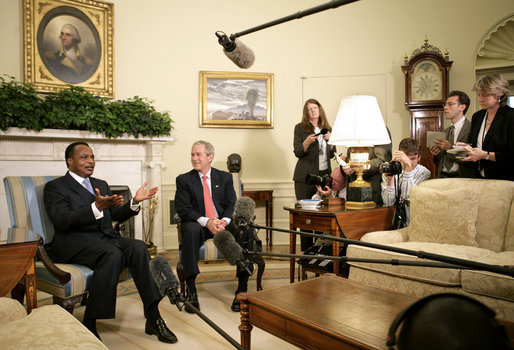
President George W. Bush and President Denis Sassou-Nguesso of the Republic of the Congo talk with the press during a meeting in the Oval Office Monday, June 5, 2006. 'We had a very constructive discussion about a variety of issues,' said President Bush. 'We talked about our common commitment to help end the genocide in Darfur. I appreciate the President's leadership in helping negotiate a peace agreement, and I appreciate his leadership in working with the United Nations so we can get the AU forces blue-helmeted as quickly as possible.' White House photo by Eric Draper.President George W. Bush and President Denis Sassou-Nguesso of the Republic of the Congo talk with the press during a meeting in the Oval Office Monday, June 5, 2006.
"We had a very constructive discussion about a variety of issues," said President Bush. "We talked about our common commitment to help end the genocide in Darfur. I appreciate the President's leadership in helping negotiate a peace agreement, and I appreciate his leadership in working with the United Nations so we can get the AU forces blue-helmeted as quickly as possible." White House photo by Eric Draper.

PRESIDENT BUSH: It's been my honor to welcome the President of the Congo here to the Oval Office. Mr. President, welcome. Thank you for coming. I welcome you not only as the President of your country, but as a leader of the African Union.

We had a very constructive discussion about a variety of issues. We talked about our common commitment to help end the genocide in Darfur. I appreciate the President's leadership in helping negotiate a peace agreement, and I appreciate his leadership in working with the United Nations so we can get the AU forces blue-helmeted as quickly as possible.

And one of my interests, of course, is to join with African nations in combating HIV/AIDS, and I want to congratulate the President for the low infection rate in Congo. Thank you for your leadership on that issue.

We've had a very good visit here, and I look forward to seeing you in St. Petersburg, Russia, where we can continue our discussions. So, welcome.

PRESIDENT NGUESSO: (As translated.) I, first of all, thank you, Mr. President, and I want to say to everyone that I'm very happy and honored to be here, actually for the second time, because in 1990, President Bush -- father of President Bush now-- welcomed me to this house on a state visit. So I'm very happy to be here, Mr. President.

Indeed, President Bush is absolutely right, we discussed a lot of issues that we're all interested in: peace, security, and not just in Africa, but beyond Africa, in the world. We talked about terrorism, we talked about the Iranian nuclear issue, we talked about the dialogue that's about to open up, I hope, and that will bring good results to that problem.

And on behalf of all of Africa, I thank President Bush for his commitment in fighting AIDS, the commitment of the United States in the fight against HIV/AIDS. As you know, we had a special meeting on AIDS at the United Nations General Assembly, and as you know also, Africa is the continent that suffers the most from this scourge.

And we also talked about African development issues. We talked about the situation in the Gulf of Guinea, and the Congo Basin, the NEPAD, Project for African Development in Africa. And I was happy to see President Bush give his entire support to the development of Africa.

And I'm, again, very happy with this very useful meeting that we had with President Bush here. And I'm very happy for the fact that we're going to see each other in St. Petersburg, because President Putin invited me to come to the G8 Summit as a representative for Africa.

I thank President Bush for his very friendly and warm welcome. And I'm very happy to be here, back in the White House.

END 9:58 A.M. EDT, For Immediate Release, Office of the Press Secretary, June 5, 2006

RELATED: Keywords, President to Welcome, Monday, May 29, 2006 President Bush to Welcome Prime Minister Harper of Canada, Monday, May 29, 2006 President Bush to Welcome President Paul Kagame of Rwanda, Monday, May 29, 2006 President Bush to Welcome Prime Minister Junichiro Koizumi of Japan, Monday, May 29, 2006 President Bush to Welcome President Zelaya of Honduras, Saturday, May 27, 2006 President Bush and Prime Minister Tony Blair (VIDEO), Friday, May 26, 2006 President Bush and Prime Minister Ehud Olmert (VIDEO), Monday, May 15, 2006 President Bush will welcome Prime Minister Ehud Olmert of Israel Saturday, May 06, 2006 President Bush Welcomes President VƔzquez of Uruguay (VIDEO), Monday, April 24, 2006 President Bush to Host Danish Prime Minister Anders Fogh Rasmussen, Wednesday, April 12, 2006 President Bush to Welcome German Chancellor Merkel, Wednesday, April 12, 2006 President Bush welcomes Ghana President John A. Kufuor, Wednesday, March 29, 2006 President Bush Welcomes President Obasanjo of Nigeria, Thursday, March 23, 2006 President Welcomes President Sirleaf of Liberia (VIDEO), Friday, March 17, 2006 President Welcomes Irish Prime Minister Ahern (VIDEO), Saturday, February 11, 2006 President Bush Welcomes President of Poland (VIDEO), Friday, February 10, 2006 President Bush Welcomes King Abdullah (VIDEO),

bush radio address 06/03/06 full audio, text transcript

Technorati Tags: and or and or and or and or

President George W. Bush calls troops from his ranch in Crawford, Texas, Thanksgiving Day, Thursday, Nov. 24, 2005. White House photo by Eric Draper.bush radio address 06/03/06 full audio, text transcript. PODCAST

President's Radio Address en EspaƱol
Subscribe to My Odeo Channel Subscribe to Our Odeo Podcast Channel and receive the Presidential Radio Address each week. Featuring real audio and full text transcript.

THE PRESIDENT: Good morning. Next week, the United States Senate will begin debate on a constitutional amendment that defines marriage in the United States as the union of a man and woman. On Monday, I will meet with a coalition of community leaders, constitutional scholars, family and civic organizations, and religious leaders. They're Republicans, Democrats, and independents who've come together to support this amendment. Today, I want to explain why I support the Marriage Protection Amendment, and why I'm urging Congress to pass it and send it to the states for ratification

Marriage is the most enduring and important human institution, honored and encouraged in all cultures and by every religious faith. Ages of experience have taught us that the commitment of a husband and a wife to love and to serve one another promotes the welfare of children and the stability of society. Marriage cannot be cut off from its cultural, religious, and natural roots without weakening this good influence on society. Government, by recognizing and protecting marriage, serves the interests of all.

In our free society, people have the right to choose how they live their lives. And in a free society, decisions about such a fundamental social institution as marriage should be made by the people -- not by the courts. The American people have spoken clearly on this issue, both through their representatives and at the ballot box. In 1996, Congress approved the Defense of Marriage Act by overwhelming bipartisan majorities in both the House and Senate, and President Clinton signed it into law. And since then, voters in 19 states have approved amendments to their state constitutions that protect the traditional definition of marriage. And today, 45 of the 50 states have either a state constitutional amendment or statute defining marriage as the union of a man and a woman. These amendments and laws express a broad consensus in our country for protecting the institution of marriage.

Unfortunately, activist judges and some local officials have made an aggressive attempt to redefine marriage in recent years. Since 2004, state courts in Washington, California, Maryland, and New York have overturned laws protecting marriage in those states. And in Nebraska, a federal judge overturned a state constitutional amendment banning same-sex marriage.

These court decisions could have an impact on our whole Nation. The Defense of Marriage Act declares that no state is required to accept another state's definition of marriage. If that act is overturned by activist courts, then marriages recognized in one city or state might have to be recognized as marriages everywhere else. That would mean that every state would have to recognize marriages redefined by judges in Massachusetts or local officials in San Francisco, no matter what their own laws or state constitutions say. This national question requires a national solution, and on an issue of such profound importance, that solution should come from the people, not the courts.

An amendment to the Constitution is necessary because activist courts have left our Nation with no other choice. The constitutional amendment that the Senate will consider next week would fully protect marriage from being redefined, while leaving state legislatures free to make their own choices in defining legal arrangements other than marriage. A constitutional amendment is the most democratic solution to this issue, because it must be approved by two-thirds of the House and Senate and then ratified by three-fourths of the 50 state legislatures.

As this debate goes forward, we must remember that every American deserves to be treated with tolerance, respect, and dignity. All of us have a duty to conduct this discussion with civility and decency toward one another, and all people deserve to have their voices heard. A constitutional amendment will put a decision that is critical to American families and American society in the hands of the American people, which is exactly where it belongs. Democracy, not court orders, should decide the future of marriage in America.

Thank you for listening.

END, For Immediate Release, Office of the Press Secretary, June 3, 2006

Editors Note: It is the position of The Republican National Convention Blog that all tax paying, law abiding, citizens of these United States are entitled to full and equal rights guaranteed by the consittution.

Further that these rights should not be abridged except for the most dire of reasons, quarantine for illness comes to mind.

The President states,

"In our free society, people have the right to choose how they live their lives. And in a free society, decisions about such a fundamental social institution as marriage should be made by the people -- not by the courts."

If one were to subsitute the word slavery for marrage it becomes readily apparent how unpersuasive this argument is.

"Marriage is the most enduring and important human institution, honored and encouraged in all cultures and by every religious faith"

As are many customs, a day of prayerful observence, but should the rights of those citizens who choose other wise be denied. We say no, and oppose any effort to do so.

Related: Keywords radio address, podcast, Wednesday, May 31, 2006 bush radio address 05/27/06 full audio, text transcript, Saturday, May 20, 2006 bush radio address 05/20/06 full audio, text transcript, Saturday, May 13, 2006 bush radio address 05/13/06 full audio, text transcript, Saturday, May 06, 2006 bush radio address 05/06/06 full audio, text transcript, Saturday, April 29, 2006 bush radio address 04/29/06 full audio, text transcript, Saturday, April 22, 2006 bush radio address 04/22/06 full audio, text transcript, Saturday, April 15, 2006 bush radio address 04/15/06 full audio, text transcript, Saturday, April 08, 2006 bush radio address 04/08/06 full audio, text transcript, Saturday, April 01, 2006 bush radio address 04/01/06 full audio, text transcript, Saturday, March 25, 2006 bush radio address 03/25/06 full audio, text transcript, Saturday, March 18, 2006 bush radio address 03/18/06 full audio, text transcript, Saturday, March 11, 2006 bush radio address 03/11/06 full audio, text transcript, Saturday, March 04, 2006 bush radio address 03/04/06 full audio, text transcript, Saturday, February 25, 2006 bush radio address 02/25/06 full audio, text transcript,

Discurso Radial del Presidente a la Nación 06/03/06

Etiquetas De Technorati: , y , o y , o , o y

Presidente George W. Bush llama a tropas de su rancho en Crawford, Tejas, dƃ­a de Thanksgiving, jueves, de noviembre el 24 de 2005.  Foto blanca de la casa de Eric Draper.forre el audio de la dirección de radio 06/03/06 por completo, transcripción del texto. PODCAST

Discurso Radial del Presidente. en EspaƱol
Suscriba a nuestro canal de Odeo Podcast y reciba la dirección de radio presidencial cada semana. Ofrecer la transcripción audio y llena verdadera del texto. Suscriba a nuestro canal de Odeo Podcast y reciba la dirección de radio presidencial cada semana.  Ofrecer la transcripción audio y llena verdadera del texto.

EL PRESIDENTE: Buenos Días. La semana entrante el Senado de los Estados Unidos comenzarÔ a debatir una enmienda constitucional que define el matrimonio en los Estados Unidos como la unión de un hombre y una mujer. El lunes me reuniré con una coalición de líderes comunitarios, autoridades constitucionales, organizaciones familiares y cívicas, y líderes religiosos. Son Republicanos, Demócratas e Independientes que se han juntado para apoyar esta enmienda. Hoy quiero explicar porqué yo apoyo la Enmienda de Protección del Matrimonio - y porqué estoy recomendando al Congreso que la apruebe y la envíe a los Estados para ser ratificada.

El matrimonio es la institución humana mÔs duradera e importante - honrada y alentada en todas las culturas y por todas las religiones. Años de experiencia nos han mostrado que el compromiso de un esposo y una esposa al amor y a servir el uno al otro promueve el bienestar de los hijos y la estabilidad de la sociedad. El matrimonio no puede aislarse de sus raíces culturales, religiosas y naturales sin debilitar esta buena influencia sobre la sociedad. El gobierno, al reconocer y proteger el matrimonio, sirve los intereses de todos.

En nuestra sociedad libre, las personas tienen el derecho de escoger cómo vivir sus vidas. Y en una sociedad libre, las decisiones sobre una institución social tan fundamental como lo es el matrimonio deben claramente ser tomadas por las personas -no por los tribunales. El pueblo estadounidense se ha pronunciado claramente sobre este punto, tanto a través de sus representantes cómo en las urnas electorales. En 1996, el Congreso aprobó la Ley de Defensa del Matrimonio por mayorías bipartitas abrumadoras tanto en la CÔmara de Representantes como en el Senado - y el Presidente Clinton la sancionó. Y desde entonces, votantes en 19 estados han aprobado enmiendas a sus constituciones estatales que protegen la definición tradicional del matrimonio. Y hoy en día, 45 de los 50 estados tienen ya sea una enmienda constitucional estatal o un estatuto que define el matrimonio como la unión de un hombre y una mujer. Estas enmiendas y leyes expresan un consenso amplio en nuestro país por proteger la institución del matrimonio.

Desafortunadamente, en años recientes, jueces activistas así como algunos oficiales locales han tratado en forma agresiva de redefinir el matrimonio. Desde 2004, tribunales estatales en Washington, California, Maryland y Nueva York han derrocado leyes que protegen al matrimonio en esos estados. Y en Nebraska un juez federal declaró nula una enmienda constitucional estatal que prohibía matrimonios entre personas del mismo sexo.

Estas decisiones en nuestros tribunales podrían tener un impacto sobre toda nuestra Nación. La Ley en Defensa del Matrimonio declara que ningún estado estÔ obligado a aceptar la definición del matrimonio de otro estado. Si esa ley es nulificada por tribunales activistas, entonces los matrimonios reconocidos en una ciudad o en un estado podrían tener que ser reconocidos como matrimonios en otras partes. Eso significaría que cada estado tendría que reconocer los matrimonios redefinidos por jueces en Massachussetts o por oficiales locales en San Francisco - no obstante lo que digan sus propias leyes o constituciones estatales. Esta pregunta nacional ahora requiere una solución nacional - y en un tema de importancia tan profunda, esa solución debe venir del pueblo y no de los tribunales.

Una enmienda a la Constitución es necesaria porque los tribunales activistas han dejado a nuestra Nación sin ninguna otra opción. La enmienda constitucional que el Senado considerarÔ la semana próxima protegería completamente al matrimonio contra ser redefinido - dejando al mismo tiempo que las legislaturas estatales estén en libertad de tomar sus propias decisiones para definir arreglos legales que no sean el matrimonio. Una enmienda constitucional es la solución mÔs democrÔtica para este tema, ya que debe ser aprobada por las dos terceras partes de la CÔmara de Representantes y del Senado... y luego ratificada por las tres cuartas partes de las 50 legislaturas estatales.

A medida que este debate se lleve a cabo, debemos recordar que todo estadounidense merece ser tratado con tolerancia, respeto y dignidad. Todos tenemos un deber de llevar adelante esta discusión con civilidad y decencia el uno hacia el otro - y todas las personas merecen que sus voces sean escuchadas. Una enmienda constitucional pondrÔ una decisión que es fundamental para las familias estadounidenses y la sociedad estadounidense en manos del pueblo estadounidense - exactamente donde debe estar. La democracia, y no las órdenes judiciales, deberÔ decidir el futuro del matrimonio en los Estados Unidos.

Gracias por escuchar.

Para su publicación inmediata, Oficina del Secretario de Prensa, 3 de junio de 2006

Nota de los redactores: Es la posición de la convención nacional republicana Blog que todo el pagar del impuesto, observante de la ley, ciudadanos de estos Estados Unidos se da derecho a las derechas completas e iguales garantizadas por el consittution.

Fomentar que las estas derechas no debe ser abreviado a excepción del mÔs calamitoso de razones, la cuarentena para la enfermedad viene importar.

Los estados del presidente,

“En nuestra sociedad libre, gente tener la derecha de elegir cómo ella vive sus vidas. Y en una sociedad libre, las decisiones sobre una institución social fundamental tal como la unión se deben tomar por la gente -- no por las cortes.”

Si uno era al subsitute la esclavitud de la palabra para el marrage llega a ser fÔcilmente evidente cómo es unpersuasive es esta discusión.

La “unión es el aguantar y la institución humana importante, honrados y alentadores en todas las culturas y por cada fe religiosa”

Al igual que muchos costumbres, un dĆ­a del observence prayerful, pero las derechas de esos ciudadanos que elijan el otro sabio se nieguen. Decimos no, y oponemos cualquier esfuerzo de hacer tan.

Relacionado: Dirección de radio de las palabras claves, podcast, Miércoles 31 de mayo de 2006 Discurso Radial del Presidente a la Nación 05/27/06, SÔbado 20 de mayo de 2006 Discurso Radial del Presidente a la Nación 05/20/06, SÔbado 13 de mayo de 2006 Discurso Radial del Presidente a la Nación 05/13/06, SÔbado 6 de mayo de 2006 Discurso Radial del Presidente a la Nación 05/06/06 , SÔbado 29 de abril de 2006 Discurso Radial del Presidente a la Nación 04/29/06, SÔbado, De Abril El 22 De 2006 Discurso Radial del Presidente a la Nación 04/22/06, SÔbado, De Abril El 15 De 2006 Discurso Radial del Presidente a la Nación 04/15/06, SÔbado, De Abril El 08 De 2006 Discurso Radial del Presidente a la Nación 04/08/06, Monday, April 03, 2006 Rice urge progreso en cuanto a gobierno en Iraq, Saturday, April 01, 2006 Discurso Radial del Presidente a la Nación 04/01/06, Lunes, De Marcha La 27 De 2006 Declaraciones Del Presidente Después De Reunión Sobre La Reforma Inmigratoria, sÔbado, de marcha la 25 de 2006 Discurso Radial del Presidente a la Nación 03/18/06, sÔbado, de marcha la 18 de 2006 Discurso Radial del Presidente a la Nación 03/18/06,

Sunday, June 04, 2006

New unified force theory predicts measured values of physics

Aether Unit illustrates the Aether's geometry and spin structureNew unified force theory predicts measured values of physics

Caption: The Aether Unit illustrates the Aether's geometry and spin structure. It shows how the length and time dimensions work together to produce curved space-resonance. Space-resonance is a five dimensional represntation involving three dimensions of length and two dimensions of frequency, as opposed to the four dimensional represntation of space-time common to Euclidian geometry.

Credit: Jon Lomberg, (c) 2000-2006, Quantum AetherDynamics Institute, Usage Restrictions: None.

Gilberts, Illinois- David Thomson and Jim Bourassa of the Quantum AetherDynamics Institute (QADI) released a new theory which mathematically predicts and explains the measured values of physics with striking precision. Their Aether Physics Model includes the "Holy Grail" of physics sought by Albert Einstein; the Unified Force Theory. "Our model shows the forces are unified by a simple set of general laws explainable as the fabric of space-time itself, which is a dynamic, quantum-scale Aether," said Bourassa.

In February 2002, Thomson was observing a peculiar setup of a Tesla coil and noticed what appeared to be two distinctly different manifestations of charges. Not finding an adequate explanation for why charge should take on two different forms, Thomson decided to re-examine the foundations of quantum physics. Within three weeks, he discovered the simple, empirically based equations, which produce the Unified Force Theory. "This new model of quantum existence does not change the laws of Quantum Mechanics, it merely changes our view of quantum structure," Thomson said.

"I placed an ad on my website for someone to develop the mathematics for a Unified Field Theory based upon the Aether," said Bourassa. "David said he not only could do it, but already had." Since then, they joined together to form QADI, a registered 501(c)3 non-profit research organization devoted to the development and dissemination of the Aether Physics Model, published Secrets of the Aether, a book about the theory, and released a new white paper that summarizes the theory, A New Foundation for Physics, which is available online in PDF Format at NewFoundationPhysics.pdf.

Infinite Energy Magazine will be publishing the white paper this fall. "We just received our first acknowledgement," said Thomson. "Because we are self-educated and this revolutionary discovery about the mathematics and geometry of the space-time fabric is not coming from a well-known scientific organization, it has been slow to gain acceptance, despite the stunning results the theory produces," he continued. The fabric of space-time Thomson refers to is the ubiquitous Aether, long discarded by modern science. According to Albert Einstein's Special Relativity theory, there cannot be a rigid Aether, as envisioned by Albert Michelson. However, Thomson and Bourassa's quantified Aether is fluid, as recently proposed in the December 2005 issue of Scientific American by Theodore Jacobson and Renaud Parentani.

Besides the Unified Force Theory, QADI has also developed the foundation for an atomic binding energy equation, an electron binding energy equation, a conductance constant, fine structure constants for the proton and neutron, and geometrical models for photons, subatomic particles, and quantum units of space-time. These are significant accomplishments, and should be receiving close attention from scientists and researchers. The theory is testable, coherent, mathematically derived, empirically based, and uses easy-to-understand Newtonian equations.

Along with providing more precise values for the Strong Nuclear Charge and Weak Nuclear Relationship, three other measurements where they predict a slightly different value than the Standard Model are in the Casimir equation, the neutron magnetic moment, and neutron g-factor. More accurate experiments should confirm which values are correct, which could verify the validity of the Aether Physics Model. ###
Caption: The 2-spin Aether unit is not only the quantum of the gravitational field; it is the quantum of all the fields. The Aether is both a container (quantified as rotating magnetic field) for subatomic particles (quantified as angular momentum) and imparts charge to particles. Shown here is the Aether fabric. Credit: Jon Lomberg (c) 2000-2006, Quantum AetherDynamics Institute, Usage Restrictions: None.Caption: The 2-spin Aether unit is not only the quantum of the gravitational field; it is the quantum of all the fields. The Aether is both a container (quantified as rotating magnetic field) for subatomic particles (quantified as angular momentum) and imparts charge to particles. Shown here is the Aether fabric. Credit: Jon Lomberg (c) 2000-2006, Quantum AetherDynamics Institute, Usage Restrictions: None.
For additional information about the Aether Physics Model, contact Jim Bourassa or visit quantumaetherdynamics.com. Science editors can use the white paper, A New Foundation for Physics, as a basis for an article. High-resolution graphics are available from QADI.

Contact: Jim D. Bourassa jim@quantumaetherdynamics.com 224-629-1180 Quantum AetherDynamics Institute

Related: Keyword Nanotech Sunday, Sunday, May 28, 2006 Growing glowing nanowires to light up the nanoworld , Sunday, May 14, 2006 Scientists Create the First Synthetic Nanoscale Fractal Molecule, Sunday, May 14, 2006 World’s tiniest test tubes get teensiest corks, Sunday, May 07, 2006 Blood-Compatible Nanoscale Materials Possible Using Heparin, Sunday, April 30, 2006 Micro-pump is cool idea for future computer chips, Sunday, April 16, 2006 Self-Powered Nanoscale Devices, Sunday, April 09, 2006 Nanopore Method Genome Sequencing, Sunday, April 02, 2006 Quantum dot method rapidly identifies bacteria, March 26, 2006 'Custom' nanoparticles, cancer diagnosis and treatment, Sunday, March 26, 2006, Green nanochemistry, American Chemical Society symposium, Sunday, March 19, 2006 nanotechnologists demonstrate artificial muscles powered by highly energetic fuels, Sunday, Sunday, March 12, 2006 magnetic phenomenon may improve RAM memories, February 26, 2006 Nanoscience study shows that quantum dots 'talk', Sunday, February 26, 2006 Nano-bots to undertake major tasks?, Sunday, February 19, 2006 Nanotech to improve health care delivery, Sunday, February 19, 2006 nano-canary in the nanotoxicology coalmine, Sunday, December 04, 2005 Nano-cages 'fill up' with hydrogen, Sunday, November 13, 2005 Testing toxicity of nanomaterials, Sunday, October 23, 2005 single-molecule car, 'Nanocar', Sunday, August 28, 2005 Writing at the nanoscale, Thursday, May 26, 2005 discontinuous palladium, siloxane self-assembled monolayer, Sunday, May 08, 2005 Center for Nanoscale Materials, Monday, April 25, 2005 Nanomagnets, Nanocomposite, Monday, March 21, 2005 porphyrin tubes may lead to new nanodevices, inexpensive hydrogen fuel.

Tags: Special Relativity theory or atomic binding energy equation and Nano or Nanotechnology and nanoparticles or Nanotech and Albert Einstein or Quantum AetherDynamics Institute and nanoscale or Strong Nuclear Charge and unified force theory or space-time and physics or Quantum Mechanics and Casimir equation or Nanoscience

Freedom Calendar 06/03/06 - 06/10/06

June 3, 1884, U.S. Rep. John Lynch (R-MS), a former slave, presides over Republican National Convention.

June 4, 1860, Republican U.S. Senator Charles Sumner (R-MA) delivers his classic address, The Barbarism of Slavery.

June 5, 1956, Republican federal judge Frank Johnson rules in favor of Rosa Parks in decision striking down “blacks in the back of the bus” law.

June 6, 2001, President George W. Bush issues Executive Order enhancing federal employment opportunities for Asian-Americans and Pacific Islanders.

June 7, 1892, In a first for a major U.S. political party, two women – Theresa Jenkins and Cora Carleton – attend Republican National Convention in an official capacity, as alternate delegates.

June 8, 1866, U.S. Senate passes Republicans’ 14th Amendment guaranteeing due process and equal protection of the law to all citizens; 94% of Republicans vote yes and 100% of Democrats vote no.

June 9, 1964, Republicans condemn 14-hour filibuster against 1964 Civil Rights Act by U.S. Senator and former Ku Klux Klansman Robert Byrd (D-WV), who still serves in the Senate.

June 10, 1964, Senate Minority Leader Everett Dirksen (R-IL) criticizes Democrat filibuster against 1964 Civil Rights Act, calls on Democrats to stop opposing racial equality.

“Believing that the spirit of our institutions as well as the Constitution of our country, guarantees liberty of conscience and equality of rights among citizens, we oppose all legislation impairing their security.”

1856 Republican Party national platform

SOURCE: Republican Freedom Calendar

Technorati Tags: and or and or and or and or and or or and or

Related: Keywords Freedom Calendar, Saturday, May 27, 2006 Freedom Calendar 05/27/06 - 06/03/06, Saturday, May 20, 2006 Freedom Calendar 05/20/06 - 05/27/06, Saturday, May 13, 2006 Freedom Calendar 05/13/06 - 05/20/06, Saturday, May 06, 2006 Freedom Calendar 05/06/06 - 05/13/06, Saturday, April 29, 2006 Saturday, April 22, 2006 Freedom Calendar 04/22/06 - 04/29/06, Saturday, April 15, 2006 Freedom Calendar 04/15/06 - 04/22/06, Saturday, April 08, 2006 Freedom Calendar 04/08/06 - 04/15/06, Saturday, April 01, 2006 Freedom Calendar 04/01/06 - 04/08/06, Saturday, March 25, 2006 Freedom Calendar 03/25/06 - 04/01/06, Saturday, March 18, 2006 Freedom Calendar 03/18/06 - 03/25/06, Saturday, March 11, 2006 Freedom Calendar 03/11/06 - 03/18/06, Saturday, March 04, 2006 Freedom Calendar 03/04/06 - 03/11/06, Saturday, February 25, 2006 Freedom Calendar 02/18/06 - 03/04/06, Saturday, February 18, 2006 Freedom Calendar 02/18/06 - 02/25/06, Saturday, February 11, 2006 Freedom Calendar 02/11/06 - 02/18/06, Saturday, February 04, 2006 Freedom Calendar 02/04/06 - 02/11/06,

Saturday, June 03, 2006

Presidential Podcast 06/03/06

Technorati Tags: and or and or and or and or

Presidential Podcast 06/03/06 en EspaƱol

Subscribe to My Odeo Channel Subscribe to Our Odeo Podcast Channel and receive the weekly Presidential Radio Address in English and Spanish with select State Department Briefings. Featuring real audio and full text transcripts, More content Sources added often so stay tuned

Editors Note: It is the position of The Republican National Convention Blog that all tax paying, law abiding, citizens of these United States are entitled to full and equal rights guaranteed by the consittution.

Further that these rights should not be abridged except for the most dire of reasons, quarantine for illness comes to mind.

The President states,

"In our free society, people have the right to choose how they live their lives. And in a free society, decisions about such a fundamental social institution as marriage should be made by the people -- not by the courts."

If one were to subsitute the word slavery for marrage it becomes readily apparent how unpersuasive this argument is.

"Marriage is the most enduring and important human institution, honored and encouraged in all cultures and by every religious faith"

As are many customs, a day of prayerful observence, but should the rights of those citizens who choose other wise be denied. We say no, and oppose any effort to do so.

Related: Keywords radio address, podcast, Saturday, May 27, 2006 Presidential Podcast 05/27/06, Saturday, May 20, 2006, Presidential Podcast 05/20/06, Saturday, May 13, 2006 Presidential Podcast 05/13/06, Saturday, April 22, 2006 Presidential Podcast 04/22/06, Saturday, April 15, 2006 Presidential Podcast 04/15/06, Saturday, April 08, 2006 Presidential Podcast 04/08/06, Saturday, Saturday, April 01, 2006 Presidential Podcast 04/01/06, March 18, 2006 Presidential Podcast 03/18/06, Saturday, March 11, 2006 bush radio address 03/11/06 full audio, text transcript, Saturday, March 04, 2006 bush radio address 03/04/06 full audio, text transcript, Saturday, February 25, 2006 bush radio address 02/25/06 full audio, text transcript, Saturday, February 18, 2006 bush radio address 02/18/06 full audio, text transcript, Saturday, February 04, 2006 bush radio address 02/04/06 full audio, text transcript, Saturday, January 28, 2006, bush radio address 01/28/06 full audio, text transcript, Saturday, January 21, 2006 bush radio address 01/21/06 full audio, text transcript,

Friday, June 02, 2006

R. Nicholas Burns, Remarks in Vienna, Austria

Technorati Tags: and or and , or and or , or and , or , and ,

Remarks in Vienna, Austria, R. Nicholas Burns, Under Secretary for Political Affairs, Vienna, Austria, June 1, 2006

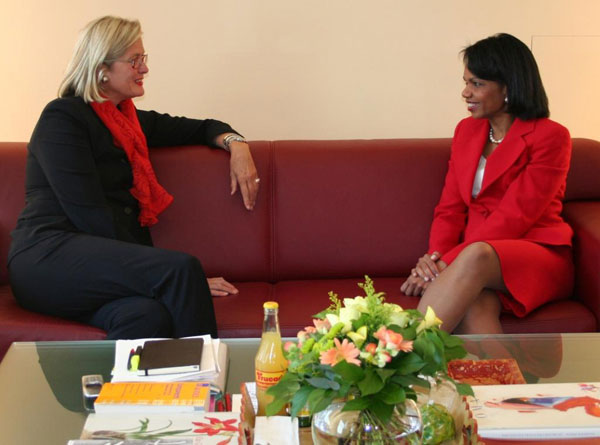
Secretary Rice arrived in Vienna and met with Austrian Foreign Minister Dr. Ursula Plassnik.Secretary Rice arrived in Vienna and met with Austrian Foreign Minister Dr. Ursula Plassnik.
UNDER SECRETARY BURNS: We are very satisfied by the results of today's meetings here in Vienna. We consider them a step forward in our quest to deny Iran a nuclear weapons capability and I think there's no question at the four meetings that Secretary Rice has had at ministerial level with this group, this was by far the most substantive and the most concrete.

I will say this: Because of the nature of the diplomacy and because of the delicate aspect of the negotiations that will now ensue with Iran, I am not going to be giving you the details of the package that was agreed to tonight. I'm not going to give you details of the positive side or the negative side. That was the agreement of everybody in the room, and so the United States will stick to that agreement.

2006/T15-1, Released on June 1, 2006

Related: Keywords State Department, Wednesday, May 31, 2006 Iran Statement by Condoleezza Rice (VIDEO), Thursday, May 18, 2006 Secretary Rice With Prime Minister John Howard (PODCAST), Wednesday, May 10, 2006 Secretary Rice, EU Secretary General Javier Solana on Iran, VIDEO, PODCAST, TEXT, Wednesday, May 03, 2006 Secretary Rice, James Wolfensohn, Gaza Disengagement (PODCAST), Thursday, April 27, 2006 Remarks at Stakeout Secretary Condoleezza Rice, Friday, April 21, 2006 Secretary Rice to Travel to Europe, Friday, April 21, 2006 The Face of the State Department (VIDEO), Thursday, April 13, 2006 Secretary Rice Holds Talks with Equatorial Guinean President, Tuesday, April 11, 2006 State Department Podcast, VIDEO and Text 04/10/06, Wednesday, April 05, 2006 State Department Podcast, VIDEO and Text 04/03/06, Thursday, March 30, 2006 State Department Podcast, VIDEO and Text 03/29/06, Monday, April 03, 2006 Secretary Rice With Foreign Secretary Straw, Baghdad, Friday, March 31, 2006 Rice in Berlin To Discuss Iran with P-5 plus 1, Friday, March 31, 2006 UNHCR Worker’s Death in Sudan Attack,

Thursday, June 01, 2006

Swearing-In Ceremony of CIA Director (VIDEO)

Technorati Tags: and or and , or and or and or and

President Attends Swearing-In Ceremony of CIA Director Michael Hayden, CIA Headquarters, Langley, Virginia 2:00 P.M. EDT. C-SPAN, (C) 2006 National Cable Satellite Corporation.

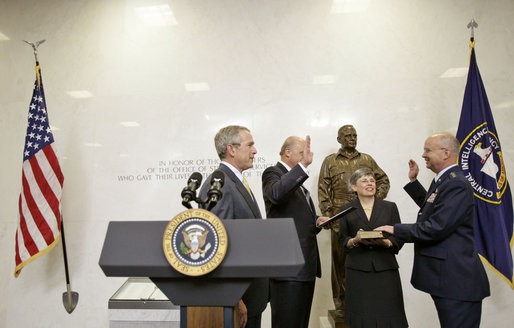
President George W. Bush attends the swearing-in of Gen. Michael Hayden as the Director of the Central Intelligence Agency by Director of National Intelligence John Negroponte at CIA Headquarters in Langley, Va., Wednesday, May 31, 2006. Pictured holding the Bible is Gen. Hayden's wife Jeanine Hayden. White House photo by Eric Draper.President George W. Bush attends the swearing-in of Gen. Michael Hayden as the Director of the Central Intelligence Agency by Director of National Intelligence John Negroponte at CIA Headquarters in Langley, Va.,
Wednesday, May 31, 2006. Pictured holding the Bible is Gen. Hayden's wife Jeanine Hayden. White House photo by Eric Draper.

THE PRESIDENT: Thank you. Thanks for the warm welcome. It's great to be back with the really fine people here at the Central Intelligence Agency.

I'm honored to be here at the swearing-in of Mike Hayden as America's new Director of the CIA. He's such a good man, we're going to swear him in twice -- (laughter) -- yesterday and today.

Mike is a patriot, he's a reformer, he's one of our nation's finest intelligence professionals. I know firsthand how good this guy is; I've worked with him on some really important issues related to the security of the United States. He brings more than two decades of experience in the intelligence field. He is going to be a superb leader for the dedicated men and women of the CIA.

I appreciate Ambassador Negroponte being with us today, the Director of National Intelligence. I want to thank Attorney General Al Gonzales for joining us, and the Director of the FBI, Bob Mueller, for joining us, as well. But most importantly, thank you all for coming.

I'm proud to serve with you. It is such an honor to serve the United States of America and I appreciate your serving along my side to make America secure. The role of the CIA is critical to the security of the United States. This agency is helping to lead the intelligence war against the terrorists who attacked us on September the 11th, 2001. They continue to plot attacks, and together, we are going to stop them.

The role of the CIA is vital to my doing my job. I cannot do my job without the Central Intelligence Agency. This agency remains the principle provider of intelligence analysis to the President, to the Director of National Intelligence, and to senior national security officials in my administration. As Director of the CIA, Mike will continue the reforms needed. America's leaders are going to have the best possible intelligence, and Mike Hayden is going to work with you to see that that's the case.

I've asked Mike to continue to develop the human intelligence capabilities of the CIA which are essential to understanding the plans and intentions of dangerous regimes and terrorist organizations around the world. I've asked Mike to continue improving the analytical skills of the CIA, which apply the best minds to interpret the intelligence that we gather. I'm confident that under Mike's leadership, the CIA will help us stay ahead of America's enemies and win the war on terror.

The men and women who work here at the CIA have got a tough job and a really important job. You must penetrate closed societies and secretive organizations. You must master foreign languages and deal with unfamiliar cultures. Much of your work is secret, and American lives depend on that work remaining secret. America appreciates the good work you're doing, and so do I.

And in Mike Hayden, you have a leader who recognizes your talents, who understands your challenges, and will ensure that you remain the finest intelligence agency in the world.

In his new position, Mike will build on the good work of Director Porter Goss. Nearly two years ago, I asked Porter to take on a tough assignment, the transformation of the CIA. Porter carried out that assignment with skill and determination. He upheld the high standards and proud tradition of the agency. And he leaves behind a CIA that's stronger than the one he found. And Laura and I wish Porter and his family well as they begin a new chapter in their lives.

Mike Hayden succeeds Porter Goss at a time of great change in the world, and great challenge for our intelligence community. Under the leadership of John Negroponte, our intelligence community is growing more integrated and more effective every day. And under the leadership of Mike Hayden, the Central Intelligence Agency will continue to play a critical role in our nation's intelligence enterprise. Mike understands that the CIA must transform to confront new dangers, and do so without slowing the high tempo at which it already operates to protect this country. I'm confident that with Mike Hayden at the helm, the CIA will succeed, and continue to make important contributions to the security of the American people.

As Mike takes on this important assignment, he has my trust, my full trust, and he has the support of a loving family. I'm glad to see his wife, Jeanine, his children and grandchildren, and his father, Harry, and all the other members of the Hayden family who have joined us, as well, today.

I want to thank Mike for agreeing to serve our nation once again, and I look forward to continuing to work with him to do our duty to protect the American people.

Thank you all for coming today. May God bless Mike Hayden, may God bless you all, and may God continue to bless America. (Applause.)

(The oath of office is administered.) (Applause.)

DIRECTOR HAYDEN: Thank you all very much. I will keep this very short. Mr. President, thank you for the honor of placing your confidence in me, and for all of us here and around the world, thank you for the faith you have placed in this agency.

For my family, thank you once again for your continued support. I could not be more grateful. To my new friends and partners here at the Central Intelligence Agency, thank you for the warmth of your welcome over the last 24 hours. The President has laid out in front of us what we have to do, and as I said yesterday in the bubble when I talked to you for the first time, let's just go to work.

Thank you all. (Applause.)

END 2:08 P.M. EDT, For Immediate Release, Office of the Press Secretary, May 31, 2006

RELATED: Keyword, CIA, Thursday, May 18, 2006 General Michael Hayden confirmation hearing (VIDEO), Monday, May 08, 2006 President Nominates General Michael Hayden as Director of the Central Intelligence Agency (VIDEO), Monday, May 08, 2006 LTG Michael V. Hayden, USAF - Biography, Friday, May 05, 2006 President Accepts Resignation from CIA Director Porter Goss (VIDEO), Wednesday, October 19, 2005 President Signs Homeland Security Appropriations Act (VIDEO), Tuesday, July 12, 2005 President Discusses War on Terror at FBI Academy, Thursday, May 19, 2005 Ambassador John Negroponte, General Mike Hayden, Friday, March 04, 2005 President Thanks CIA Employees, Friday, December 17, 2004 Intelligence Reform and Terrorism Prevention Act,

Wednesday, May 31, 2006

Iran Statement by Condoleezza Rice (VIDEO)

Technorati Tags: and or and , or and or , or and , or ,

Statement by Secretary of State Condoleezza Rice, C-SPAN, (C) 2006 National Cable Satellite Corporation, Secretary Condoleezza Rice, Washington, DC, May 31, 2006, Persian Translation [In PDF Format] Get Acrobat Reader

Secretary Rice holds a news conference discussing the nuclear issue with Iran May 31, 2006, at the Department of State in Washington, DC. [AP photo]Secretary Rice holds a news conference discussing the nuclear issue with Iran May 31, 2006, at the Department of State in Washington, DC. [AP photo]
The pursuit by the Iranian regime of nuclear weapons represents a direct threat to the entire international community, including to the United States and to the Persian Gulf region. In defiance of repeated calls from the IAEA Board of Governors and from the Security Council, the Iranian government has accelerated its nuclear program while continuing to conceal its activities from international inspectors.

Working with our international partners, the United States is making every effort to achieve a successful diplomatic outcome, but the international community has made clear that the Iranian regime must not acquire nuclear weapons. The vital interests of the United States, of our friends and allies in the region, and of the entire international community are at risk, and the United States will act accordingly to protect those common interests.

Today, the Iranian regime can decide on one of two paths – one of two fundamentally different futures for its people and for its relationship with the international community.

The Iranian government’s choices are clear. The negative choice is for the regime to maintain its current course, pursuing nuclear weapons in defiance of the international community and its international obligations.

If the regime does so, it will incur only great costs.

We and our European partners agree that path will lead to international isolation and progressively stronger political and economic sanctions.

The positive and constructive choice is for the Iranian regime to alter its present course and cooperate in resolving the nuclear issue, beginning by immediately resuming suspension of all enrichment-related and reprocessing activities, as well as full cooperation with the IAEA and returning to implementation of the Additional Protocol providing greater access for the IAEA.

This path would lead to the real benefit and longer-term security of the Iranian people, the region, and the world as a whole.

The Iranian people believe they have the right to civil nuclear energy. We acknowledge that right. Yet the international agreements Iran has signed make clear that Iran’s exercise of that right must conform with its commitments. In view of its previous violations of its commitments and the secret nuclear program it undertook, the Iranian regime must persuasively demonstrate that it has permanently abandoned its quest for nuclear weapons.

The benefits of this second path for the Iranian people would go beyond civil nuclear energy, and could include progressively greater economic cooperation.

The United States will actively support these benefits both publicly and privately. Furthermore, President Bush has consistently emphasized that the United States is committed to a diplomatic solution to the nuclear challenge posed by the Iranian regime.

We are agreed with our European partners on the essential elements of a package containing both the benefits if Iran makes the right choice, and the costs if it does not. We hope that in the coming days the Iranian government will thoroughly consider this proposal.

Our British, French and German partners have rightly required that Iran fully and verifiably suspend its enrichment and reprocessing activities before the sides can return to negotiations. This is the condition that has been established by the IAEA Board of Governors and by the UN Security Council.

The United States is willing to exert strong leadership to give diplomacy its very best chance to succeed.

Thus, to underscore our commitment to a diplomatic solution and to enhance the prospects for success, as soon as Iran fully and verifiably suspends its enrichment and reprocessing activities, the United States will come to the table with our EU-3 colleagues and meet with Iran’s representatives.

This morning US representatives have conveyed my statement to Iran through the good offices of the Swiss government, and through Iran’s representative to the United Nations.


Given the benefits of this positive path for the Iranian people, regional security, and the nuclear nonproliferation regime, we urge Iran to make this choice for peace -- to abandon its ambition for nuclear weapons.

President Bush wants a new and positive relationship between the American people and the people of Iran -- a beneficial relationship of increased contacts in education, cultural exchange, sports, travel, trade, and investment. The nuclear issue is not the only obstacle standing in the way of improved relations.

The Iranian government supports terror, is involved in violence in Iraq, and is undercutting the restoration of full sovereignty in Lebanon under UN Security Council Resolution 1559. These policies are out of step with the international community and are barriers to a positive relationship between the Iranian people and the people of the United States and the rest of the world.

Iran can and should be a responsible state, not the leading state sponsor of terror. The United States is ready to join the EU-3 to press these and other issues with the Iranian government in addition to our work to resolve the nuclear danger.

At the same time, we will continue to work with our international partners to end the proliferation trade globally, to bar all proliferators from international financial resources, and to end support for terror. We also intend to work with our friends and allies to strengthen their defensive capacity, counterproliferation and counterterrorism efforts, and energy security capabilities.

Those measures present no threat to a peaceful Iran with a transparent, purely civil nuclear energy program, but provide essential protection for the United States, our friends and allies if the Iranian regime chooses the wrong path.

If the Iranian regime believes that it will benefit from the possession of nuclear weapons, it is mistaken. The United States will be steadfast in defense of our forces, and steadfast in defense of our friends and allies who wish to work together for common security.

The Iranian people have a proud past, and merit a great future. We believe the Iranian people want a future of freedom and human rights-– the right to vote, to run for office, to express their views without fear, and to pursue political causes. We would welcome the progress, prosperity, and freedom of the Iranian people.

The United States looks forward to a new relationship between our peoples that advances these goals. We sincerely hope that the Iranian regime will choose to make that future possible.

END

Related: Keywords State Department, Thursday, May 18, 2006 Secretary Rice With Prime Minister John Howard (PODCAST), Wednesday, May 10, 2006 Secretary Rice, EU Secretary General Javier Solana on Iran, VIDEO, PODCAST, TEXT, Wednesday, May 03, 2006 Secretary Rice, James Wolfensohn, Gaza Disengagement (PODCAST), Thursday, April 27, 2006 Remarks at Stakeout Secretary Condoleezza Rice, Friday, April 21, 2006 Secretary Rice to Travel to Europe, Friday, April 21, 2006 The Face of the State Department (VIDEO), Thursday, April 13, 2006 Secretary Rice Holds Talks with Equatorial Guinean President, Tuesday, April 11, 2006 State Department Podcast, VIDEO and Text 04/10/06, Wednesday, April 05, 2006 State Department Podcast, VIDEO and Text 04/03/06, Thursday, March 30, 2006 State Department Podcast, VIDEO and Text 03/29/06, Monday, April 03, 2006 Secretary Rice With Foreign Secretary Straw, Baghdad, Friday, March 31, 2006 Rice in Berlin To Discuss Iran with P-5 plus 1, Friday, March 31, 2006 UNHCR Worker’s Death in Sudan Attack, Friday, March 31, 2006 Statement on China's treatment of Kim Chun-Hee, Thursday, March 30, 2006 State Department Podcast, VIDEO and Text 03/29/06, Thursday, March 23, 2006 State Department Podcast, VIDEO and Text 03/22/06,