


Technorati Tags: President Bush and White House or Museum of Science and Industry and Chicago Illinois or economy and No Child Left Behind Act or Community colleges and G8 or WTO and VIDEO or Press Conference by the President and FBI or U.N. Security Council
Press Conference by the President, Museum of Science and Industry, Chicago, Illinois,
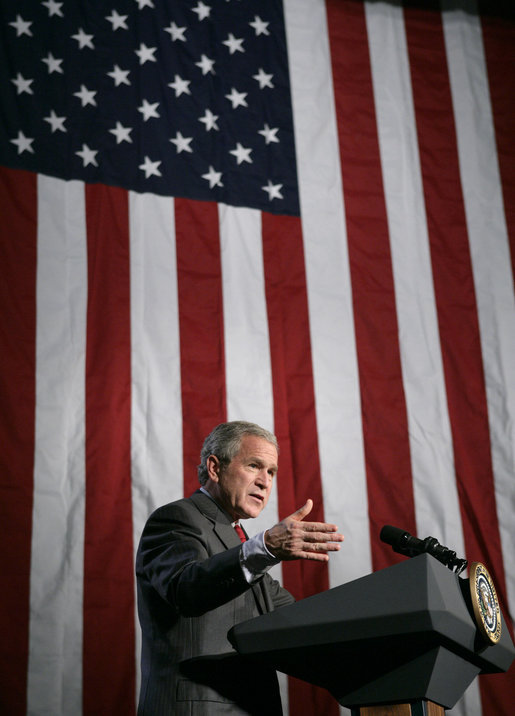 | FULL STREAMING VIDEO, 10:00 A.M. CDT, Source C-SPAN Copyright (C) 2006 National Cable Satellite Corporation In Focus: Jobs & Economy President George W. Bush addresses a news conference at the Museum of Science and Industry in Chicago, Friday, July 7, 2006, speaking on the economy, immigration reform and security issues. White House photo by Eric Draper. |
I do want to thank the trustees of this beautiful museum for opening up your facility for a press conference. I hope it doesn't ruin the atmosphere of the museum. I will try to make sure it doesn't. I'm looking forward to a tour of this museum after the press conference.
I'm sure you're wondering why I would have a press conference in Chicago. It's a fabulous city; plus I like to see what it's like to have a major press conference outside of Washington. It might do me some good. The truth of the matter is it might do the White House press corps some good, as well. So I welcome the Chicago reporters here. Thank you for coming.
I had a fine dinner last night at the Chicago Firehouse, and I did breakfast today at Lou Mitchell's. It's really interesting sites here in Chicago, and a lot of fun going to them. And I want to thank the gracious hospitality of the restauranteurs and the people of Chicago for -- by welcoming me.
I had some conversations with some of the business leaders last night and for breakfast, and I think there's kind of an interesting sense of optimism here in this part of the world, and the statistics bear that out. In the Chicago area, businesses have added over more than 74,000 new jobs over the past two years. And that's positive, it's a good sign. The unemployment rate in this area is 4.3 percent -- that's below the national average. People are working. People are able to find jobs. Illinois created more jobs than any other state in the month of April. So the entrepreneurial spirit is strong here.
One of the things I detected from the business leaders, that there's a sense of optimism which encourages people to invest. And when you invest you create the conditions for job growth. Major companies have announced plans to add even more jobs.
This morning we got some good news -- the nation added 121,000 new jobs for the month of June. That's over 5.4 million jobs since August of 2003; that's 34 months of job increases. In the first quarter, our economy grew at 5.6 percent; productivity is high. People are better off, things are working. And so the fundamental question we face in Washington is how do we keep economic vitality alive. What do we do, what are the policies necessary to keep this growth strong?
And one policy is to keep taxes low. If you raise taxes, you take money out of the pockets of small businesses and entrepreneurs, which makes it harder to increase employment. One of the reasons I'm here at this museum is because one way to make sure we continue to grow the economy is to have a work force that's capable of filling the jobs of the 21st century.
One of the subjects the Mayor and I talked about last night was the No Child Left Behind Act, and what the city of Chicago is doing to hold people to account and have high standards and to offer different choices to parents here in Chicago through charter schools, for example. The Mayor said something interesting -- he said, reading scores are up. That's a good sign. It means people are measuring, and teachers are teaching. And when you have the basics -- the basic foundation for good education laid, then you can focus on math and science.
So, the truth of the matter is we have to make sure our kids have got the math and science skills to fill the jobs of the 21st century. We live in a global economy and an interconnected world, and if we can't provide the employees for the jobs of the 21st century, they're going to go somewhere else. So education is crucial to make sure we're a competitive and vibrant nation.
Job training is really important. The Labor Department, working with the local folks here, have set up one-stop centers in Chicago to help connect workers with employers. You've got a good community college system here. Community colleges are really important to make sure that workers are given the skills to fill the jobs which actually exist. And the Lakeland Community College system is a strong program. There's federal help and there's state help and there's local involvement, all aimed at making sure people have got the capacity to have the -- to fill the jobs. When you have a growing economy like this, there's concern by employers whether or not they're going to be able to find people to do the work. And education is the gateway to make sure that we remain a competitive economy.
I also believe strongly that we've got to open up markets to goods produced here in Illinois, goods and services. One way to make sure this economy of ours grows is to reject protectionism and be confident in our capacity to trade. I'm getting ready to go to the G8, and one of the topics there is going to be the Doha Round of the WTO, which basically -- the commitment is that a world that trades freely is a world in which people are going to be able to find work here at home, and it means we have better capacity to be able to help lift nations out of poverty.
We talked last night about immigration. I found it interesting that the people that were there with the Mayor and me, employees and chamber of commerce-type people ,put immigration as one of the issues they want to talk about. I told them this; I said, first of all, I'll always remember that immigrants have helped shape the character of this nation. We are a land of immigrants. I also reminded them that the system we got today isn't working, and it needs to be changed and reformed.
We're a nation of law, and we can be a compassionate nation when it comes to immigration, and the two don't conflict. So I've talked about a comprehensive immigration plan. People in this country expect us to secure the border, and we will. The way you do that is you add more manpower and you put new technologies on the border to keep people from sneaking across.
But in order to enforce this border, we've got to have a rational way that recognizes there are people sneaking across to do work Americans aren't doing. They're doing jobs Americans are not filling. And my attitude is this: When you find a willing worker and a willing employer, there ought to be a legal way to let somebody come here to work on a temporary basis. It takes pressure off the border. When you got people sneaking across to do work, it puts pressure on a border. If somebody can come in on a legal way, it's going to make it easier for our Border Patrol agents to do their job.
Secondly, one of the serious issues we have, and one of the issues that the -- some of the leaders brought up yesterday was -- the guy said, we really shouldn't be in a position to be document verifiers. And when you make something illegal that people want, it's amazing what happens -- got a whole industry of smugglers and innkeepers and document forgers that sprung up. And so people show up and say, I want to work; the guy says, show me your document, and they don't know whether it's real or not. And we got a Basic Pilot program to help people verify whether documents are real.
But one way to do is if you have a temporary worker program, say, here's a tamper-proof card that will enable our employers to be able to verify whether someone is here legally to do work on a temporary basis, and enable the government to hold people to account for hiring illegal workers. See, it's against the law to hire somebody who is here illegally, and the American people expect us to enforce the law, and we will. But the system needs to be reformed.
I told the workers last night that there are about 11 million people here, more or less, who have been here for a while, that are building families, and they're good workers. And they said, what are you going to do about it? And I said, well, there's two extremes on this issue. One extreme is, kick them out, deport everybody. That's not going to work. It may sound like kind of an interesting sound byte, kind of a nice throwaway line, but it's not going to work. It's impractical.
The other option is to say, well, you're an automatic citizen. That's called amnesty. That won't work. And the reason that won't work is if you grant 8 million or 9 million people who are here illegally automatic citizenship, it means another 8 million or 9 million coming.
The best way to deal with this problem, in my judgment, is to say, look, you're here illegally, there's got to be a consequence. The consequence could be a penalty, a fine. It could be proof that you're not a criminal. In other words, there's got to be ways to say -- make restitution for society for breaking the law; but say to the person, you can get in the citizenship line, but at the back of the line, not at the beginning. See, there are people in line who want to become a citizen of the United States. It doesn't make sense to penalize those who are here legally, playing by the rules, to let people who have been here illegally get ahead of them.
This is a comprehensive plan. Look, the House has passed a bill, the Senate has passed a bill, and we're working in Washington to reconcile the differences. It's hard work. It's not an easy assignment. But I'm confident if we all keep working on it, we can get a comprehensive bill done which will be good for the country, and send the message that we're a land of different folks from different religions and different backgrounds, all united under the great -- the great American ideal.
I spend a lot of time worrying about the war on terror. I think about it every single day. My biggest job, frankly, is to protect the American people, and this is a dangerous world and there are people out there lurking who are trying to figure out ways to hurt us. I know some dismiss that as empty rhetoric; I'm just telling you it's the truth. And therefore, we're doing a lot of stuff in Washington. We're reforming our intelligence services to be able to react better. The FBI is now focusing on counter-terrorist activities. The CIA is developing more human intelligence, which will make it easier to be able to do our duty.
We're also on the offense against the terrorists. We'll keep the pressure on them. We'll bring them to justice before they hurt our people.
The central front in the war on terror is Iraq. And I know Iraq is on the minds of a lot of people here in Chicago. It's hard work. It's hard work because we face an enemy that will keep innocent people in order to achieve an objective, and their objective is to drive us out of Iraq so they can have safe haven from which to launch attacks against modern Muslim nations, so they can spread their ideology of hate. They want us to -- they believe capitalist societies and democracies are inherently weak. They do not believe that we've got the capacity to do the hard work necessary to help the Iraqis succeed.
And they're mistaken. They're just wrong. Success in Iraq is vital for the security of the United States, and success in Iraq is vital for long-term peace. And so, therefore, we'll complete the mission.
But we've got good partners. And Zal Khalilzad came in the other day, who is our Ambassador to Iraq. And he, like me, has confidence in Prime Minister Maliki. He's a guy who can set goals and follow through on those goals. He understands what needs to be done in order to succeed. And he represents the will of 12 million people who went to the polls. That's a pretty interesting sign that the Iraqi people want to live in freedom.
There's been a lot of sacrifice in the war on terror. People have lost life. We've lost, obviously, a lot of lives here on the homeland and we've lost lives overseas. I think of Corporal Ryan Cummings, from right here in the Chicago area. He was an honor student at Hoffman Estates High School. He volunteered for the United States Marine Corps. He served two tours of duty in Iraq, and then he volunteered for a third. Ryan understood the stakes. He understood we must win. And so he said, I'd like to go back. And he was killed in Anbar Province last month.
Our prayers go out to Ryan's family. I marvel at the strength of his mother, when she said, "He wanted to be doing something that made a difference; he was doing what he wanted to do."
I have confidence in the capacity of liberty to transform hostile regions to peaceful regions. And I have confidence in our capacity to win the war on terror because of people like Ryan Cummings are willing to step up and serve this nation.
There's a lot of issues that I'm sure we'll be talking about today -- North Korea and Iran, hopefully the Middle East, maybe some local issues here in Chicago. It's my honor to be here. Thank you for coming. And now I'll start answering some questions, starting with one of the senior members of the press corps -- are you over 60?
Q -- (inaudible) --
THE PRESIDENT: You look like you're about 65. Anyway, go ahead. (Laughter.)
Q Harsh. Mr. President, Japan has dropped the threat of sanctions from its proposed Security Council resolution about North Korea. Why was that necessary? And how do you punish or penalize a country that's already among the poorest and most isolated in the world?
THE PRESIDENT: I think that the purpose of the U.N. Security Council resolution is to send a clear message to the leader of North Korea that the world condemns that which he did. Part of our strategy, as you know, has been to have others at the table; is to say as clearly as possible to the North Korean, get rid of your weapons and there's a better way forward. In other words, there's a choice for him to make. He can verifiably get rid of his weapons programs and stop testing rockets, and there's a way forward for him to help his people.
I believe it's best to make that choice clear to him with more than one voice, and that's why we have the six-party talks. And now that he has defied China and Japan and South Korea and Russia and the United States -- all of us said don't fire that rocket. He not only fired one, he fired seven. Now that he made that defiance, it's best for all of us to go to the U.N. Security Council and say loud and clear, here are some red lines. And that's what we're in the process of doing.
The problem with diplomacy, it takes a while to get something done. If you're acting alone, you can move quickly. When you're rallying world opinion and trying to come up with the right language at the United Nations to send a clear signal, it takes a while.
And so, yesterday, I was on the phone with -- I think I mentioned this to the press conference yesterday -- to Hu Jintao and Vladimir Putin; the day before to President Roh and Prime Minister Koizumi. And Condi, by the way, was making the same calls out there to her counterparts, all aiming at saying, it's your choice, Kim Jong-il, you've got the choice to make.
So we'll see what happens at the U.N. Security Council. I talked to Condi this morning first thing, in anticipation of this question, and she feels good about the progress that can be made there.
Yes.
Q (Inaudible.)
THE PRESIDENT: Well, what matters most of all is for Kim Jong-il to see the world speak with one voice. That's the purpose, really.
Here's the problem, it seems like to me, that there have been agreements with North Korea in the past. There's the '94 agreement. I think you were around here then, Sanger. And then it turns out he didn't live up to the agreement. He said -- in September of '05, there was a joint declaration that talked about lasting peace, and we all signed on to a document that said we'll denuclearize the Korean Peninsula. That's a noble and important goal. This was signed by the five of us plus North Korea. He had also talked about the rocket moratorium. He assured Koizumi in '04, Prime Minister Koizumi, that he would adhere to that. And you just got to wonder whether the man's word means anything. And one way to make sure it does mean something is for nations other than the United States to say the same thing, to speak loud and clear. And that's what you're seeing evolve.
Steve.
Q Thank you, sir. Some experts say North Korea may be launching missiles to attract more concessions. Are you prepared to offer any more concessions beyond that already offered in the six-party format? And have you ruled out the possible military option in responding to them?
THE PRESIDENT: As you know, we want to solve all problems diplomatically. That's our first choice.
What was the first part of your question? This is what happens when your 60 --
Q -- are they trying to -- (inaudible) --
THE PRESIDENT: Look, I don't know -- I don't know what the man's intentions are. I don't know what they are. It's an interesting question: Is he trying to force us to do something by defying the world? If he wants a way forward, it's clear. If he wants to have good relations with the world, he's got to verifiably get rid of his weapons programs like he agreed to do in 1994, stop testing missiles, and there is a way forward. Part of the discussions in September were, here's a way forward. Here's a way for -- he's worried about energy, and our partners at the table said, well, here's an energy proposal for you to consider. And so the choice is his to make.
And I made it very clear to our partners that it seems like to me that the message ought to be one that said, you shouldn't be rewarded for violating that which you've said you're going to do and kind of ignoring what the world has said. And it's just -- whether it be the Iranian issue or the North Korean issue, there is a way forward for these leaders that will lead to a better life for their people and acceptance into the international community. And one of the things we've done in the United States is to work with the coalition to send that message. It's a clear message. He knows what his options are.
Kelly. A couple -- then we'll start working the local thing. Warm up.
Q Hello, Mr. President.
THE PRESIDENT: Yes.
Q I'd like to ask you to speak on the broad implications of that recent Supreme Court case -- not the specifics of the case. But the justices said that you overreached your authority. And your critics have been saying that, too. Given your support and respect for the Court, are you willing to rethink how you use your presidential authority?
THE PRESIDENT: I am willing to abide by the ruling of the Supreme Court. And the Supreme Court said that in this particular case when it comes to dealing with illegal combatants, who were picked up off a battlefield and put in Guantanamo for the sake of our security, that we should work with the United States Congress to develop a way forward. They didn't we couldn't have done -- made that decision, see. They were silent on whether or not Guantanamo -- whether or not we should have used Guantanamo. In other words, they accepted the use of Guantanamo, the decision I made. What they did say was, in terms of going forward, what should the court system look like? How can we use a military commission or tribunal?
And we'll work with the United States Congress. They have said, work with the Congress. I have been waiting for this decision in order to figure out how to go forward. I want to move forward. First of all, I stand by the decision I made in removing these people from the battlefield. See, here's the problem: These are the types of combatants we have never faced before. They don't wear uniforms and they don't represent a nation state. They're bound by an ideology. They swore allegiance to individuals, but not to a nation. The Geneva conventions were set up to deal with armies of nation states. You've got standard rules of war.
So this is new ground. This is different than any President has been through before, in terms of how to deal with these kind of people that you're picking up off a battlefield and trying to protect the American people from.
So we have about 600 or so there, and 200 have been sent back home. We'd like to send more back to their countries of origin. Some need to be tried, and the fundamental question is, how do we try them? And so, in working with the Supreme -- in listening to the Supreme Court, we'll work with Congress to achieve that objective.
And so your question is slightly loaded, which is okay, I'm used to it. But the idea of making the decision about creating Guantanamo in the first place was upheld by the courts. Or let's say, the courts were silent on it.
Let's see -- Jessica. Go ahead and yell it out. Or don't yell it out.
Q It's been three days since North Korea fired those missiles. Yesterday you said you did not know the trajectory of the long-range missile. Can you now tell us where was it was headed? And if it were headed? And if it were headed -- if it had been headed at the United States, how would our national ballistic missile system have taken it down?
THE PRESIDENT: I still can't give you any better answer than yesterday. I can embellish yesterday's answer. It may sound better. No, really, I haven't talked to the Secretary of Defense about that.
Our missile systems are modest, our anti-ballistic missile systems are modest. They're new. It's new research. We've gotten -- testing them. And so I can't -- it's hard for me to give you a probability of success. But, nevertheless, the fact that a nontransparent society would be willing to tee up a rocket and fire it without identifying where it's going or what was on it means we need a ballistic missile system.
So that's about all I can tell you on that. Obviously, it wasn't a satisfactory answer.
Q (Inaudible.)
THE PRESIDENT: Yes, I think we had a reasonable chance of shooting it down. At least that's what the military commanders told me.
Rick. Let's get a little local here, Ricky. Do you consider yourself local or national? Hybrid? Are you a hybrid?
Q It seems trendy --
THE PRESIDENT: Yes, very trendy. You're kind of a trendy guy. Got the gray shirt.
Q Thank you very much. Mr. President, the work of U.S. Attorney Patrick Fitzgerald in prosecuting alleged corruption is well-known here in Chicago, as well as nationally. It's my understanding that technically, he hasn't been reappointed to his position, and serves at your pleasure. Do you have any plans to formally reappoint him to the post, or any position at Department of Justice?
THE PRESIDENT: As a special prosecutor?
Q And would you give us your assessment of the job that he's doing?
THE PRESIDENT: I don't have any plans to reappoint him because I haven't thought about it. I will now think about it, now that you brought it up.
The only -- I can give you an assessment of how I thought he handled the case in Washington. I haven't been following the cases here. I thought in Washington he handled the case with professionalism, he was very professional about it. You didn't see a lot leaks, you didn't see a lot of speculation, you didn't see a lot of people kind of dropping a little crumb here for the press to chew on. And I really thought he handled himself well.
But as far as reappointing him as a special prosecutor, I don't know whether the Attorney General is going to do that, or not. That's his choice to make.
Chris. Or, Paul. Paul.
Q Mr. President, gas prices are high, as you know. Oil is at $75 a barrel. There is a poll that suggests that three in four Americans are not content with your leadership on the issue, and that the State of the Union pitch for alternative fuel technology has fallen flat and is not moving. Why not call for an emergency energy summit and lift the issue to a higher priority?
THE PRESIDENT: Well, I thought addressing the issue at the State of the Union was pretty much lifting it to a high priority. When you include it in the State of the Union it means it's a top priority, and it is.
It took us a while to get in a position where we're reliant upon sources of energy from outside our boundaries, and it's going to take us a while to become less dependent. It just takes a while; things just don't happen instantly. I told the people, if I could lower gasoline prices with a snap of the fingers, I'd do it. And I've been talking about energy independence since I first got elected. And we've made some progress. We made progress by encouraging the spread of ethanol. And I think if you were to look at the facts, ethanol has gone from low market penetration to pretty significant market penetration in selected parts of the country, relatively speaking, particularly in the Midwest.
There is more work to be done. There is a lot of ethanol plants being built as we speak, and there's incentives in government law to do that. We've effected CAFE standards when it comes to light trucks, which will help consumers make a rational decision. We put incentives for people to buy hybrid vehicles in law. If you go out and buy a hybrid vehicle, you get a tax credit.
I happen to believe it's essential for us to promote nuclear power as a way to make us less dependent on natural gas from overseas, for example. Also, this will help us be wise stewards of our environment. We're spending a lot of money on technologies -- battery technologies, for example -- that would enable Chicago residents to drive the first 40 miles on electricity before one would have to use gasoline.
And so we do have a full-blown strategy to make this country less dependent on foreign sources of oil, to help relieve pressure at the gas pump. When the demand for crude oil in China rises, it affects the global price of crude oil, which affects your price of gasoline. And, therefore, the strategy has got to be to diversify away from crude oil.
One of the issues that we're trying to get done here is that if you -- if people are genuinely concerned about the price of gasoline, they ought to be supporting my initiative to encourage the construction of additional refinery capacity. Certainly, it's not the long-term solution, but it's an important solution for the short run. If you have constrained gasoline supplies and demand remains high, you're going to have higher prices of gasoline. We haven't built a new refinery in this country since the early 1970s. And so, the truth of the matter is, I would hope people would contact their members of Congress to insist that they support a -- the bill that we ran up to the Hill, which would have made it much easier to permit and construct refineries.
So we have a comprehensive plan. This is a serious issue. I understand people are paying high gasoline prices here -- it's like a tax. I understand it's like a tax. And we got a strategy to deal with it.
Anna. We're going to work our way down the row here. The Daily Herald, is that one of Pearson's competitors? It is?
Q Well, we compete with everyone. My question is focusing, too, also, on technology. There's been a lot of mergers with companies in the technology industry, and one of the more recent ones was Lucent Technologies with Alcatel, which is French-owned. How do you feel about a lot of the foreign-owned companies buying out U.S. tech companies, especially those that have military contracts?
THE PRESIDENT: We have laws that prevent sensitive technologies from being transferred as a result of sale and/or merger. And we watch that very carefully.
On the broader scale, I have no problem with foreign capital buying U.S. companies; nor do I have a problem with U.S. companies buying foreign companies. That's what free trade is all about. As a matter of fact, there are workers working here in Illinois because of foreign investment. A foreign company takes a look at Illinois, they like the tax structure, they like the governance, they like the work force, and they invest. And when they invest, they create jobs.
A lot of the jobs in America exist as a result of foreign companies investing here in our country. So I believe in opening markets. I do believe in protecting secrets, but we've got laws on the books to prevent secrets from being transferred, or vital technology from being transferred. But I believe in free flows of capital, and I believe in free trade. And that's not a given in the United States. There are people who say, well, we can't compete with China, let's throw up roadblocks, let's protect ourselves. Or, we don't want foreigners coming to invest in our country. I think that would be a mistake. I think that's the early signs of protectionist sentiments, which would mean our economy wouldn't grow.
In my State of the Union -- the very same State of the Union that I addressed the energy problem -- I talked about trends that are worrisome. One trend would be protectionism, and its corollary would be isolationism. An isolationist world basically says, don't worry about what happens overseas, we'll just worry about what happens here at home. Don't worry about HIV/AIDS on the continent of Africa, not our problem. Don't worry about Darfur, it's not our problem. Don't worry about the fact that there's tyrannies in the Middle East, that's not our problem.
The truth of the matter is, all of these issues are our problem, and if we became isolationist, we would not do our duty to protect the American people and kind of lay the foundations for a better world.
People say, well, you know, China is too tough to compete with, let's just throw up tariffs. I completely disagree. I think competition is good and healthy. I think it's important to have a competitive world. It means that people are constantly producing a better product and a better service at a better price, which is good for consumers.
Yes, sir.
Q An aide to Judy Topinka was quoted as saying that given your low approval ratings in the polls, they prefer you to come here in the middle of the night.
THE PRESIDENT: Didn't work. I'm coming to have lunch. (Laughter.)
Q I'm wondering if you're offended by those remarks, and whether or not you think your presence may actually harm Republican candidates when you come out to campaign for them.
THE PRESIDENT: I'm not offended. Personally, I think -- am I offended that you read the person's remarks to me? No, I'm not offended that you were reading that at all, nor am I offended at what the person said. The first I've heard it was just then. And I'm coming to lunch. I think it's going to be a pretty successful fundraiser. And I -- we will hold the House and the Senate. And I've spent a lot of time on the road. I like campaigning, and I'm proud she invited me.
Q (Inaudible) -- approval ratings, do you think that -- (inaudible) --
THE PRESIDENT: That's up to the candidates to decide. I was invited; I gladly came. And I think we're going to have a pretty successful fundraiser for her.
Here's how you win elections. You win elections by believing something. You win elections by having a plan to protect the American people from terrorist attack. You win elections by having a philosophy that has actually produced results -- economic growth, for example -- or kind of changing the school systems for the better, or providing prescription drug coverage for elders. That's how you win elections. And I'm looking forward to these elections. I think you'll be surprised. Or maybe you won't be surprised. You're probably a sophisticated political analyst, you know what's going on.
Q Mr. President, a lot of people here in Chicago tell us that they see an incongruity in your foreign policy. We're involved in a shooting war in Iraq; yet we have a leader in North Korea who has announced his affection for nuclear weapons and no hesitation to use them against the United States. Is your policy consistent between the way you have dealt with Iraq and the way you have dealt with North Korea? And if so, are we headed toward a military action in North Korea? And if so, can this nation sustain military action on three fronts -- Iraq, Afghanistan and North Korea?
THE PRESIDENT: I have always said that it's important for an American President to exhaust all diplomatic avenues before the use of force. Committing our troops into harm's way is a difficult decision. It's the toughest decision a President will ever make. And I fully understand the consequences of doing so.
All diplomatic options were exhausted, as far as I was concerned, with Saddam Hussein. Remember that the U.N. Security Council resolution that we passed when I was the President was one of 16, I think -- 16, 17? Give me a hand here. More than 15. (Laughter.) Resolution after resolution after resolution saying the same thing, and he ignored them. And we tried diplomacy. We went to the U.N. Security Council -- 15-to-nothing vote that said, disarm, disclose or face serious consequences.
I happen to believe that when you say something you better mean it. And so when we signed on to that resolution that said, disclose, disarm or face serious consequences, I meant what we said. That's one way you keep the peace: You speak clearly and you mean what you say.
And so the choice was Saddam Hussein's choice. He could have not fooled the inspectors. He could have welcomed the world in. He could have told us what was going on. But he didn't. And so we moved.
And we're in the diplomatic process now with North Korea; that's what you're seeing happening. Remember, remember, we put a coalition together at the United Nations that said, disclose, disarm, or face serious consequences. It was 15 to nothing. It wasn't a U.S., 1 to 14. It was 15 to nothing; other nations stood up and said the same thing we said.
So we're now working the diplomacy, and you're watching the diplomacy work, not only in North Korea, but in Iran. It's kind of painful in a way for some to watch because it takes a while to get people on the same page. Everybody -- not everybody thinks the exact same way we think. There are different -- words mean different things to different people, and the diplomatic process can be slow and cumbersome. This is why this is probably the fourth day in a row I've been asked about North Korea -- it's slow and cumbersome. Things just don't happen overnight.
But what you're watching is a diplomatic response to a person who, since 1994, has said they're not going to -- he's not going to have a weapon.
Q Do you believe the United States --
THE PRESIDENT: I don't accept that hypothetical question. You're asking me a hypothetical. What I believe is we can solve the problem diplomatically.
Let's see here -- Brett.
Q Mr. President, if the EU does not receive a definitive answer from Iran on the incentives package by next week, do you foresee the G8 summit as being a springboard to bring that issue to the U.N. Security Council? And what do you say to Americans who are frustrated by the familiar roadblocks, it seems, of China and Russia on harsh sanctions?
THE PRESIDENT: I said I wasn't going to answer a hypothetical; now you're trying to get me to answer a hypothetical. The G8 will be an opportunity for those of us involved with this issue to make it clear to the Iranians that they -- we're firm in our resolve for them not to have a nuclear weapon.
I talked to President Putin about North Korea; I also talked to him about Iran. I believe he understands the dangers of the Iranians having a nuclear weapon.
Some nations are more comfortable with sanctions than other nations, and part of the issue we face in some of these countries is that they've got economic interests. And part of our objective is to make sure that national security interests, security of the world interests trump economic interests. And sometimes that takes a while to get people focused in the right direction.
You know, the first step of a diplomatic solution is for there to be a common goal agreed upon by those of us participating in the process. The goal in North Korea is a nuclear weapons-free peninsula -- not just in North Korea, but North and South Korea. And that's an important goal. It's important for the neighborhood to have embraced that goal.
The goal for Iran is for them to have a -- verifiably get rid of their weapons program. The first step, however, is to -- for their verifiable suspension. And by the way, if they will verifiably do which they said they would do in Paris, we will come back to the table. That's what we've said we will do.
And whether or not they -- what their posture is we're finding out as a result of the conversations of Mr. Solana of the EU and Mr. Larijani. I do appreciate Javier Solana's work on this issue. I saw him when I was in Austria, and I thanked him for doing a good job.
Yes. I'm trying to kind of tamp the follow-ups down a little bit here.
Q Do you have a sense of urgency with Iran --
THE PRESIDENT: Do I have a sense of urgency? I have a -- I'm realistic about how things move in the world. Sanger will tell you, he's been covering North Korea since the mid '90s -- these problems don't arise in a nanosecond. It takes a while for a problem to fester and grow, and then it takes a while to solve them diplomatically. That's just the nature of diplomacy. I wish we could solve them overnight. But I'm a realistic -- one thing I'm not going to let us do is get caught in the trap of sitting at the table alone with the North Korean, for example. In my judgment, if you want to solve a problem diplomatically, you need partners to do so.
And a good partner to have at the table with us is China. They're in the neighborhood, got some influence in the neighborhood. Another good partner to have at the table is South Korea. They've got a lot at stake of what happens in North Korea, so it's important to have them at the table, as well. My concern -- I've said this publicly a lot -- my concern about being -- handling this issue bilaterally is that you run out of options very quickly. And sometimes it's easier for the leader of the nontransparent society to turn the tables and make a country like the United States the problem, as opposed to themselves.
The problem in North Korea and the problem in Iran is their leaders have made choices. And what we're saying is, there's a better avenue for you. There's a different route, there's a different way forward for your people.
I said yesterday and I truly mean this I am deeply concerned about the plight of the folks who live in North Korea. I'm concerned about starvation and deprivation. I'm concerned that little children are being denied enough food so they can develop a mental capacity to be citizens of this world. I'm concerned about concentration camps. There is a better way for the people of North Korea, and their leader can make better choices if he truly cares about their plight. And we have made clear what that choice is.
Suzanne.
Q Mr. President, if I could follow up, you say diplomacy takes time --
THE PRESIDENT: Yes, it does.
Q -- but it was four years ago that you labeled North Korea a member of the "axis of evil." And since then it's increased its nuclear arsenal, it's abandoned six-party talks and now these missile launches --
THE PRESIDENT: Let me ask you a question. It's increased it's -- that's an interesting statement: "North Korea has increased its nuclear arsenal." Can you verify that?
Q Well, intelligence sources say -- if you can -- if you'd like to dispute that, that's fine.
THE PRESIDENT: No, I'm not going to dispute, I'm just curious.
Q Our intelligence sources say that it's increased the number -- its nuclear capability --
THE PRESIDENT: -- dangerous -- it has potential danger.
Q It's increased is nuclear capabilities. It's abandoned six-party talks, and it's launched these missiles.
THE PRESIDENT: Yes.
Q Why shouldn't Americans see the U.S. policy regarding North Korea as a failed one?
THE PRESIDENT: Because it takes time to get things done.
Q What objective has the U.S. government achieved when it comes to North Korea? And why does the administration continue to go back to the same platform process if it's not effective in changing North Korea's behavior? Thank you.
THE PRESIDENT: Suzanne, these problems didn't arise overnight, and they don't get solved overnight. It takes a while. Again, I think if you look at the history of the North Korean weapons program, it started probably in the '80s. We don't know -- maybe you know more than I do -- about increasing the number of nuclear weapons. My view is we ought to treat North Korea as a danger, take them seriously. No question that he has signed agreements and didn't stick by them. But that was done during -- when we had bilateral negotiations with him, and it's done during the six-party talks.
You've asked what we've done. We've created a framework that will be successful. I don't -- my judgment is, you can't be successful if the United States is sitting at the table alone with North Korea. You run out of options very quickly if that's the case. In order to be successful diplomatically, it's best to have other partners at the table. You ask what we've done. We got the six-party talks started. And that's a positive development. It's a way to solve this problem diplomatically.
Bill.
Q Mr. President --
THE PRESIDENT: I just thought for a minute you might have known more than I do about -- when you say, definitively say he's increased the number of weapons. I don't think we know that.
Q Maybe you know, but you're not telling.
THE PRESIDENT: That's an option. (Laughter.)
Q Mr. President, you said some time ago that --
THE PRESIDENT: Maybe I don't know and don't want to tell you I don't know. Anyway. (Laughter.)
Q You said some time ago that you wanted Osama bin Laden dead or alive. You later regretted the formulation, but not the thought.
THE PRESIDENT: I regretted the formulation because my wife got on me for talking that way.
Q We suspected as much, sir. (Laughter.) But the question I have -- the question I have is, it appears that the CIA has disbanded the unit that was hunting him down. Is it no longer important to track him down?
THE PRESIDENT: It's just an incorrect story. I mean, we got a -- we got a lot of assets looking for Osama bin Laden. So whatever you want to read in that story, it's just not true, period.
Q -- you're still after him --
THE PRESIDENT: Absolutely. No ands, ifs, or buts. And in my judgment, it's just a matter of time, unless we stop looking. And we're not going to stop looking so long as I'm the President -- not only for Osama bin Laden, but anybody else who plots and plans attacks against the United States of America. We're going to stay on the offense, so long as I'm your President. And my judgment is, if we let up the pressure on them, the world is more dangerous. In the short run, we will bring these people to justice. We will use good intelligence. We will share information with our allies. We will work with friends. We'll bring people to justice. In the long run, the way you defeat this enemy is to spread liberty, and that's what you're seeing unfold.
Yes, sir. You are?
Q Carlos.
THE PRESIDENT: Who are you working for, Carlos?
Q CLTV, the Tribune TV station in town.
THE PRESIDENT: CLTV --
Q I work with Pearson, so --
THE PRESIDENT: You do?
Q Well, thank you, Mr. President. Last summer, when you were here to sign the transportation bill in Denny Hastert's district, you described Mayor Daley as "a great Mayor." If you've read the morning papers, you'll find that Patrick Fitzgerald has secured the conviction of one of the Mayor's top -- former top officials for rigging city jobs to benefit the Mayor's political workers. Does that change your assessment of Mayor Daley's tenure?
THE PRESIDENT: I still think he's a great Mayor. It is a well-run city, and he gets a lot of credit for it. He doesn't get sole credit, but he gets a lot of credit. He's a leader. The thing I like about Daley is he -- when he tells you something, he means it. Like, he told me, he said, we're going to whomp you in the 2000 election. He meant it. (Laughter.) He's a -- yes, I'm proud to call him, friend. I'm proud to have shared my 60th birthday with your Mayor.
Yes, sir? Yes, Mark.
Q Yes, sir. Thank you. Mr. President, three Illinois National Guard units left this week for Iraq, at a time when there's discussion about withdraw or draw-down of troops. What are the families of these Illinois National Guardsmen to expect?
THE PRESIDENT: They expect that their loved one will be participating in a noble and important cause. If I didn't think it was important, I wouldn't have put out the orders to have people go there. And if I didn't think we could win, I wouldn't be there. That's what they can expect. They can expect tough work, tough sledding, and they can expect a grateful Commander-in-Chief and a grateful nation for the sacrifices.
In terms of troop levels, those decisions will be made by General Casey. There's a debate in Washington as to whether or not we set an artificial timetable for withdrawal. That's what it's about in Washington, D.C. And the answer is, absolutely not. You can't win a war if you have an artificial timetable for withdrawal. You can't have people making troop decisions based upon political considerations. It just won't work. It's unfair to those families that were sending -- of the kids we're sending over, and it's unfair to the troops.
Artificial timetable for withdrawal send the wrong message to the Iraqis, they're seeing it's not worth it. There's a lot of Iraqis over there determined -- trying to make up their mind whether they want to be a part of democracy, or whether or not they're going to take to the hills and see what happens. Artificial timetable for withdrawal, an early withdrawal before this finishes sends the message to the enemy, we were right about America. That's what they said. Al Qaeda has said it's just a matter of time before America withdraws. They're weak, they're corrupt, they can't stand it, and they'll withdraw. And all that would do is confirm what the enemy thinks.
And getting out before we finish the job would send a terrible message to the troops who sacrificed. We'll win. We'll achieve our objective, which is a free that can govern itself, defend itself, and sustain itself, and will be an ally in the war on terror. And we're making progress toward that goal.
The problem is that the enemy gets to define success better than we do. See, they'll kill innocent people like that (snaps his fingers), they don't care. Life is not precious to them. And they're willing to kill women and children in order to achieve a tactical objective. And it gets on our TV screens. And people mourn the loss of life. This is a compassionate nation that cares about people, and when they see people die on their TV screens, it sends a signal, well, maybe we're not winning.
We occasionally are able to pop in with great success, like Zarqawi or 12 million people voting. But increasing electricity in Baghdad is not the kind of thing that tends to get on the news, or small business formation is not the kind of thing to get -- or new schools or new hospitals, the infrastructure being rebuilt that had been torn apart. And I'm not being critical. I'm just giving you a fact of something I have to deal with in order to make it clear to the American people that the sacrifice of those families is worth it. We are winning. And a free Iraq is an essential part of changing the conditions which causes the terrorists to be able to recruit killers in the first place.
For a long period of time, our foreign policy was just kind of excuse tyranny and hope for the best. It didn't work. The world may have seemed placid, it may have seemed calm, but beneath the surface was resentment and hatred, out of which came an attack that killed 3,000 of our citizens.
And so I am committed to the spread of liberty. It's, after all, how we were founded. And there's a debate here in the United States that says, well, maybe it's too much for the United States to insist others live in a free world. Maybe that's just too unilateral. I view that as cultural elitism for people who say that. It's like saying, we're okay to be free, but you're not.
I believe freedom is universal, and I believe etched in the soul of every person on the face of the Earth is the desire to be free. And I know that freedom has got the capacity to change regions of the world for the better.
Our press corps is bored with this story, but I'm going to tell it anyway -- the Koizumi story. (Laughter.) That's what you get when you get familiar with people -- they can anticipate your remarks.
I hope you thought it was interesting that Prime Minister Koizumi and I went to Graceland. It was really a lot of fun, wasn't it? It's an interesting part of the development of our relationship, from one in which Japan was the enemy of the United States, and today, the son of a person who fought the Japanese, and the son of a person who resented the United States are close friends. We talk about keeping the peace. We talk about working together to change the world for the better: What do we do? How do we feed people who are hungry? How do we build roads in Afghanistan? What do we do?
And so what happened? What happened was, is that Japan adopted a Japanese-style democracy after World War II, and the conditions of our relationship -- the condition of the country changed, the attitude changed, and our relationship changed.
The Far East was a pretty difficult place. I know we spend a lot of time talking about the Far East today because of North Korea, but if you really look at the development in the Far East, it's pretty remarkable, isn't it? South Korea has emerged into a vibrant capitalist society. Japan has still got a little hangover from their previous activities in the region, but nevertheless, is a thriving partner in peace. Taiwan is making progress. China has got opening markets. Their economy is growing. Their entrepreneurial class is strong. They need to -- the political needs to evolve. But nevertheless, the region is relatively peaceful except for one outpost; one system that's not open and transparent; one system that doesn't respond to the will of the people; one system that's dark, and that's North Korea.
It took a while for that peaceful evolution to occur. And that's what's going to happen in the Middle East. It is. And it's hard work. And I want those parents to know that. These are historic times. We will lose if we leave too early. The stakes of success are vital, but a free Iraq is going to help inspire others to demand what I believe is a universal right of men and women.
General Casey will make the decisions as to how many troops we have there. And that's important for the families to know. It's really important. General Casey is a wise and smart man who has spent a lot of time in Baghdad recently, obviously. And it's his judgment that I rely upon. He'll decide how best to achieve victory and the troop levels necessary to do so.
I spent a lot of time talking to him about troop levels, and I told him this,; I said, you decide, General. I want your judgment, your advice. I don't want these decisions being made by the political noise, by the political moment. It's just unfair to our troops and it's unfair to their families. It's the reasoned judgment of our military commanders that the President must count on in order to achieve a victory that is necessary to help make this country more secure. And that's exactly how I'm going to make my decision.
So if the people are listening, they need to know I'm proud of their -- proud of their families. The cause is noble and necessary. And the size of the troops that will be there will depend upon the sound judgment of our military commanders.
Thank you for this press conference. I've enjoyed it. Appreciate it.
END 10:58 A.M. CDT, For Immediate Release, Office of the Press Secretary, July 7, 2006
Related: Keywords radio address, podcast, Saturday, July 01, 2006 bush radio address 07/01/06 full audio, text transcript, Saturday, June 24, 2006 bush radio address 06/24/06 full audio, text transcript, Saturday, June 17, 2006 bush radio address 06/17/06 full audio, text transcript, Saturday, June 10, 2006 bush radio address 06/10/06 full audio, text transcript, Monday, June 05, 2006 bush radio address 06/03/06 full audio, text transcript, Wednesday, May 31, 2006 bush radio address 05/27/06 full audio, text transcript, Saturday, May 20, 2006 bush radio address 05/20/06 full audio, text transcript, Saturday, May 13, 2006 bush radio address 05/13/06 full audio, text transcript, Saturday, May 06, 2006 bush radio address 05/06/06 full audio, text transcript, Saturday, April 29, 2006 bush radio address 04/29/06 full audio, text transcript, Saturday, April 22, 2006 bush radio address 04/22/06 full audio, text transcript, Saturday, April 15, 2006 bush radio address 04/15/06 full audio, text transcript, Saturday, April 08, 2006 bush radio address 04/08/06 full audio, text transcript, Saturday, April 01, 2006 bush radio address 04/01/06 full audio, text transcript, Saturday, March 25, 2006 bush radio address 03/25/06 full audio, text transcript, Saturday, March 18, 2006 bush radio address 03/18/06 full audio, text transcript, Saturday, March 11, 2006 bush radio address 03/11/06 full audio, text transcript,


