Friday, August 11, 2006

International Initiative to Combat Kleptocracy VIDEO, PODCAST, TEXT

Technorati Tags: and or and , or and or , or and ,, or , and ,

The President's New International Initiative to Combat Kleptocracy, FULL STREAMING VIDEO, file is windows media format, running time is 30:33 PODCAST, file is mp3 in m3u format for streaming playback, running time is 30:33, DOWNLOAD, file is mp3 format for PODCAST, running time is 30:33, Washington, DC, August 10,, 2006

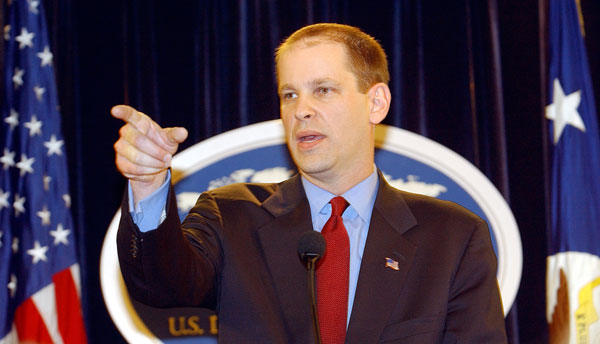
Under Secretary for Economic, Business and Agricultural Affairs Josette Sheeran Shiner speaks to reporters about President Bush's National Strategy to Internationalize Efforts Against Kleptocracy, or high-level corruption, during a press conference at the State Department Thursday, Aug. 10, 2006 in Washington. [© AP/WWP photo]Under Secretary for Economic, Business and Agricultural Affairs Josette Sheeran Shiner speaks to reporters about President Bush's National Strategy to Internationalize Efforts Against Kleptocracy,
or high-level corruption, during a press conference at the State Department Thursday, Aug. 10, 2006 in Washington. [© AP/WWP photo], Fact Sheets: White House or Statement by the President on Kleptocracy and in PDF format State Department and

Josette Sheeran Shiner, Under Secretary for Economic, Business, and Agricultural Affairs; Acting Deputy Assistant Secretary of State for International Narcotics and Law Enforcement Affairs Elizabeth G. Verville; Principal Deputy Assistant Attorney General Matthew W. Friedrich; Treasury Assistant Secretary for Terrorist Financing Pat O'Brien

On-the-Record Briefing, Washington, DC, August 10, 2006

MR. CASEY: Good afternoon, everybody. Welcome to briefing two on the day. Pleasure to have you all here with us. As you know, the President has just announced today a new international initiative to combat kleptocracy, high-level corruption, corruption by high-level officials. We wanted to take this opportunity to have you hear from some of the people who have been involved in putting this initiative together and who will be instrumental in implementing it, starting first and foremost with our own Under Secretary for Economic, Business, and Agricultural Affairs, Josette Shiner, and she's accompanied today by colleagues from the Justice Department, starting with Principal Deputy Assistant Attorney General Matthew Friedrich and from the Treasury Department, Assistant Secretary for Terrorist Financing, Pat O'Brien.

We'll have each of them make a brief presentation to you and then we'll move on to your questions. Madame Under Secretary?

UNDER SECRETARY SHEERAN SHINER: Good afternoon. We're here today to discuss the global fight against kleptocracy, high-level corruption by public officials. And what we're really talking about are those who steal the hopes and the dreams and the futures of their own citizens. As you know, the United States has long fought the war against high-level public corruption but today, we're announcing our efforts in the U.S. Government to take this to a new level.

At the St. Petersburg G-8, we had the first comprehensive statement ever combating kleptocracy and getting the agreement of all the G-8 on the tool box available to us and an agreement to work together to fight kleptocracy, high-level corruption together. And we have formed an interagency team that will be working under the leadership of the President and Secretary Rice to pull together all of our resources in the U.S. Government to make sure that we're deploying a full tool box in the fight against high-level corruption.

Further, we'll continue to work with our international partners and multilateral development organizations to ensure that as we do this work, we return stolen funds to the rightful owners, as we've done in the past, by repatriating funds in countries like Nicaragua and Peru. This is a multi-agency effort, as I mentioned, and today, we -- you will also hear from our colleagues from Treasury and Justice on their piece of this comprehensive strategy.

High-level corruption or kleptocracy, we're focused particularly on that because we feel it's an insidious crime that affects not only individuals, but entire nations, and it constitutes a major threat to international security. But most importantly, it undermines the faith in democracy, the rule of law, it hinders economic development, and contributes to organized crime and terrorism. In village after village throughout the world, when you see citizens that have been denied the benefits of development, have been denied the benefits of economic growth, often at the root and cause of it is high-level corruption and kleptocracy.

Kleptocrats rob their nations and their people of a future. Development dollars are often waylaid to line the pockets of kleptocrats and their cronies. Investment opportunities never materialize in these nations and entire nations stagnate, where right over the border, you see nations that effectively combat corruption attracting in investment and growth and effective use of development dollars. This is especially heinous because those who are most in need are the most vulnerable citizens on earth and those most affected by these crimes.

How much impact do kleptocrats have? Just a few examples; the World Bank estimates that $1 trillion a year is paid every year in bribes. Over 400 billion, according to the UN, has been looted from Africa and stashed away in foreign countries. In Sub-Saharan Africa, we have eight -- about 800 million people, many living on a dollar a day. $400 billion is a lot of money that belongs with the citizens of those nations. Transparency International estimates that former Indonesian President Suharto, for example, embezzled between 15 and 35 billion dollars from his people during his tenure. Ferdinand Marcos and many others, but he was estimated to have embezzled $5 billion from his people. Where is that money coming from? It's coming from the citizens of those countries.

Over the years, the United States has led the effort to form an international regime and action plan to fight corruption. In 1977, a very important action; we enacted the Foreign Corrupt Practices Act and made it illegal for U.S. citizens to bribe foreign officials. We will work to ensure and to advocate and to push for every country on earth to have similar action and laws in place. In the past two years, we have taken 16 enforcement actions under this law.

In 2002, President Bush created the Millennium Challenge Corporation, and in that we provide foreign assistance to countries that can demonstrate that they are effectively combating corruption. We feel that an important prerequisite for effective use of development dollars is ensuring that there are effective measures against corruption. This is one of the first international development programs that makes that a prerequisite of those dollars going into a country. But we’re not making it a pass/fail test with countries. And those countries that are committed to and pass the other qualifications for MCC, we’ve developed threshold programs to help them build capacity to fight corruption.

Corruption is often endemic. It’s also multi-generational. And we are working with our partners in Ukraine, in Philippines and other countries to build in through the MCC threshold program anti-corruption programs. For example, we have approved just in June a $45 million anti-corruption program in the Ukraine and a $21 million anti-corruption program in the Philippines. In USAID, this is a regular part of our development toolbox, and we have anti-corruption reform programs in over 50 countries, and we’ll be working with countries to ensure the effectiveness of those.

In 2004, President Bush issued Presidential Proclamation 7750, which denied kleptocrats and those who bribed them and their families safe haven in the United States. And today, President Bush is announcing this broader strategy to work with our international partners to ensure that there is as much coherence as possible among nations in the use of a effective toolbox against kleptocracy.

This expands on our current efforts that we already have in place in the different agencies, but for the first time, we will pull these together and mobilize and coordinate to ensure, that with our international partners, we are effectively using all the tools in the toolbox.

In the G-8 we were able to get, as I mentioned, for the first time -- we've had statements on anti-corruption -- first time addressing the specific issue of kleptocrats, those in high level in governments who line their pockets with public funds.

Also just last week the Senate committee voted out of committee the UN Convention Against Corruption. This is a critical new toolbox for nations to use to fight corruption and we will be implementing those provisions and in fact many of them we are already incorporating into our toolbox. There's the Inter-American Convention Against Corruption, the OECD Anti-Bribery Convention, which was a piece of the G-8 statement committed to another peer review under the OECD Anti-Bribery Convention, which is very critical.

As part of the strategy, the critical tools will be denying physical and financial safe haven to corrupt officials; we will prevent them through -- from laundering their ill-gotten proceeds; bringing to justice those who bribe foreign officials; and identifying, recovering and returning to the people of these countries the stolen assets that belong to them.

And so today we're putting kleptocrats on notice. We want the world to not be a safe place for kleptocrats and we will take actions just as we have recently done with Belarus.

I would like now to call on Matt to talk to us about efforts at the Department of Justice and then Treasury will make some statements. Thank you.

MR. FRIEDRICH: Good afternoon. When it comes to public corruption, the message that the Attorney General has consistently delivered to prosecutors across this country, that message is that no one is above the law. The strategy that we announce today reinforces our commitment and our responsibility to take that message to the rest of the world.

The Department of Justice brings to the strategy announced today a critical enforcement capacity. This capacity is built on the strength of our relationships with law enforcement partners around the world and years of collaboration in the daily fight against transnational crime. Consistent with the strategy, the Department of Justice will continue to bear responsibility for the investigation and prosecution of kleptocrats, those who bribe them, and the money launderers who facilitate these offenses. We will continue to vigorously enforce our forfeiture laws and recover the proceeds of these crimes. And we will continue to provide foreign governments with anticorruption technical assistance and training.

As you know, the Attorney General has made the enforcement of our laws that preserve the integrity of our public institutions a top priority of the Department. You are all aware of the recent public-corruption prosecutions that the Department has launched over the last year. You may also be aware that the FBI has added some 200 additional agents to its public corruption squads across the United States. Corruption is a subversion of our democratic process, and we will prosecute these offenses wherever we find them.

But our efforts in fighting corruption do not end at our border. For in our increasingly interdependent global economy, the effects of public corruption reverberate beyond any particular locale. The common denominators in the fight against corruption, be it foreign or domestic, are many. Offenders, including kleptocrats, act out of greed to subvert the will of the people, and the result is bad governance for all. We are all offended by examples of so-called "grand corruption," including instances in which distinctions between state and personal property become non-existent for senior officials and public funds are looted on a wholesale basis.

I would like to highlight for you some recent examples of actions the Department of Justice has taken to combat foreign corruption and kleptocracy in particular.

This month, former Ukrainian Prime Minister Pavel Lazarenko is scheduled to be sentenced in federal court in San Francisco as a result of his conviction for money laundering, wire fraud, and related offenses in connection with his abuse of office. We are also engaged in on-going efforts to recover the proceeds of his crimes.

Next, as a result of an investigation and forfeiture action led by the U.S. Attorney’s Office and the FBI in Miami, the Department repatriated to Peru in 2004 more than $20 million connected to the illicit conduct of former president Alberto Fujimori and his associates. The Department’s cooperation with international investigators also helped lead to the capture of Vladimiro Montesinos and the repatriation of millions more in illicitly acquired assets from other jurisdictions.

Next, in collaboration with ICE agents, the U.S. Attorney’s Offices in Miami and Oklahoma City have recovered more than $3.3 million in criminally tainted assets connected to the associates of former Nicaraguan President Aleman. The Treasury Department transferred $2.7 million of those assets back to Nicaragua in 2004.

Also in recent months the Department enforced a United Kingdom restraint order to freeze more than $400,000 in assets connected to a former Nigerian Governor charged with corruption offenses there and money laundering in the UK. This represented the first such use of this enforcement action of its kind under the Patriot Act.

Further, since 2001, we have significantly increased the number of cases the Department has prosecuted under the Foreign Corrupt Practice Act, which makes it a federal crime to bribe foreign government officials for the purpose of obtaining or retaining business, and I fully expect that trend to continue. In 2005, to cite just one example, the Department convicted a U.S. company for violating the FCPA in connection with $3.5 million in illicit payments made to an advisor of the President of Benin. The company paid over $28 million in criminal and civil fines to resolve the Department’s criminal action and a related SEC enforcement action.

The Department is also actively engaged in developing strong international standards to combat corruption and recover the proceeds of kleptocracy. Department attorneys, together with our colleagues from State, were key participants in the negotiation of the UN Convention Against Corruption, including the criminalization and asset recovery articles that targeted kleptocracy specifically. The Justice and State Departments have worked to implement a G-8 initiative on practical measures to enhance international recovery of the proceeds of kleptocracy and ensure accountability and transparency in the repatriation of those recovered assets. Also with support from the State Department, the Justice Department developed and delivered regional conferences in South Africa in 2003 and in May of this year in Miami to bring prosecutors, judges and other foreign authorities together to promote cooperation and best practices in the recovery of proceeds of corruption.

We will work together with our partners, our international partners, in other ways, too. The Department provides anti-corruption training, technical assistance, and equipment to police, prosecutors and judges across the world to assist our foreign colleagues in their efforts to prevent and prosecute public corruption.

The President’s initiative is designed to build upon these efforts to spark even more collaboration in the international fight against kleptocracy. We are actively litigating cases to remove -- to recover the proceeds of foreign official corruption and develop effective and transparent mechanisms for repatriation. We look forward to working with our colleagues at the Departments of State and Treasury and other federal agencies to make the President’s initiative a success.

ASSISTANT SECRETARY O’BRIEN: Good afternoon. One of the key missions of the Treasury Department is to safeguard the U.S. and international financial systems against financial crime. A critical component of this charge is ensuring that the international financial system is not available to kleptocrats seeking to transfer their ill-gotten gains.

The importance of this mission is not only recognized by the United States, but has been stated by our partners around the globe. Indeed, the G8 Leaders just last month underscored the importance of this in their joint statement.

Together with other departments, Departments of Justice and State and DHS, Treasury has actively assisted countries in recovering official assets looted by kleptocrats. At the request of foreign governments, or pursuant to UN Security Council Resolutions and U.S. laws and executive orders, Treasury financial investigators can provide key support in identifying and tracing looted assets to foreign countries. In certain cases Treasury can also be granted specific authority to freeze kleptocrats and their networks out of the U.S. financial system.

For example, on June 19th of this year, President Bush issued Executive Order 13405 - Blocking the Property of Certain Persons Undermining Democratic Processes or Institutions in Belarus. This executive order explicitly incorporated kleptocratic behavior as a basis for designation.

This targeted measure serves as an example of the means available to the U.S. Government to deter other public officials from using the international financial system to move proceeds of grand corruption.

A large part of the Treasury's activities against kleptocracy relate to working to close the vulnerabilities in our financial system. We continue to forge a coalition of international financial centers to strengthen our ability to detect illicit use of the financial system by kleptocrats and other illicit actors.

We do this through a variety of means. We do this through bilateral technical assistance, as well as coordination with international financial institutions, the Financial Action Task Force, and the UN and other international bodies. Playing a critical role in this is the FATF, which is the premier international organization for the development and promotion of standards and norms to combat money laundering and terrorist financing. The FATF standards recognize and reflect the close nexus between money laundering and corruption, as kleptocrats moving their corruption proceeds routinely need to launder funds in order to hide their true origins and move them out of their home country.

The FATF, along with the IMF and World Bank, assess countries' compliance with anti-money laundering and counter-terrorist financing standards. These standards include recommendations requiring enhanced due diligence for politically exposed persons in order to identify and prevent the transfer of illicit proceeds of kleptocracy. Ensuring international compliance with these standards is an important step in ensuring that kleptocrats do not profit from their criminally derived proceeds.

With Treasury leadership, the IMF and World Bank endorsed inclusion of comprehensive AML/CFT assessments as a regular part of all financial sector assessments and ongoing surveillance. We also support the World Bank and IMF efforts to provide technical assistance and training to strengthen AML/CFT regimes worldwide. Treasury, through its financial intelligence unit, the Financial Crimes Enforcement Network, also works to build international capacity for information sharing of financial data to aid investigations. We do this through training and outreach with FIUs worldwide.

Finally, we recognize that an important piece to our national strategy against kleptocrats is establishing an appropriate mechanism to return the assets, and we applaud the World Bank Group's efforts to explore its role in the restitution of looted assets and the responsible management of these recovered assets.

In conclusion, Treasury understands that protecting the financial system from abuse by kleptocrats, and among other illicit financiers, is integral to international financial stability and global security. To this end, we continue to look for closer bilateral and international cooperation. Preventing kleptocrats, terrorists, proliferators, and other rogue actors from using the formal financial system to bankroll their agendas is truly a critical component of our national and economic security.

Thank you.

UNDER SECRETARY SHEERAN SHINER: Any questions?

QUESTION: I noticed you’ve referred to kleptocrats who are no longer in office, like Saddam Hussein, Aleman and Abacha and Fujimori and others. There must be some incumbents who are in that same category. Can you address that?

UNDERSECRETARY SHEERAN SHINER: I think one of our first steps in the strategy will be to work in our inter-agency team and then with our partners to identify those who we think need to be targeted. And really, what we’re saying today is we’re putting kleptocrats on notice. If you’re stealing the funds that legitimately belong to the citizens of your country, we will be organized to act on that. So we’re not here today to announce a list, but we are here to say that the action we’ve taken with Belarus is an example of the kind of action that we seek to take. And the point we want to underscore is this is a development issue. This is essential to the successful development of countries and ending poverty. And we think it’s a critical piece of addressing the systemic issues in countries where we see endemic poverty. So we will be looking at an action plan and working as closely with our G-8 partners and others to have an organized strategy on which and where to target our efforts.

I don’t know if you want to add anything.

Any other questions? Hi.

QUESTION: There still are corrupt officials. And then are there governments that are in effect criminal enterprises in themselves? I know that North Korea has been singled out by the United States for state-sanctioned counterfeiting and smuggling. Is North Korea a particular issue of concern to you?

UNDER SECRETARY SHEERAN SHINER: Well, North Korea is a particular issue of concern on many fronts. But I think you point out something very central here, which is there's all kinds of levels of corruption and we have a supply problem and a demand problem in corruption. What we are really highlighting today, and really putting the international spotlight on in a unique way, is grand corruption -- kleptocracy. And it was interesting in the G-8 -- I negotiated that text -- there wasn't even an agreement on the terminology to address what we've all known and seen over many decades, which is high-level corruption that is often spread throughout a Government where core funds that should be going to the development of a country are being siphoned off for illegal purposes. So the purpose of this effort is to put a unique spotlight on that. And sometimes that involves many in a government and not just an individual, and sometimes it starts at the very top and infuses itself through the whole system.

So what we are saying today is we are putting together those tools. And as you see, it involves really needing all our departments to work together because we all have a piece of that picture, so we will be looking and we expect that in some countries it will be far more endemic and across the board than in others.

Anything you'd add? Any other --

QUESTION: Well, so in other words, there are more -- there are probably, in your opinion, more than one government in existence that is, say corrupt from top to bottom or from top a good ways down on the ladder?

UNDER SECRETARY SHEERAN SHINER: Again, we're not here to put forward lists. But I think -- I think yes. We will be looking across the board throughout the world and we certainly know of countries that have been -- individuals within those nations that have been prosecuted and named and publicly before, whether it's Ferdinand Marcos or Suharto or others. No, high-level corruption hasn't ended in the world and we will be looking at what our first targets will be and moving ahead with that. We think it's not limited to one nation.

Yes.

QUESTION: Is there greater sensitivity to this issue now than there used to be? You mentioned two presidents who routinely came to Washington. They were in power for a long time. They visited the White House -- President Marcos and President Suharto. Is this an issue that is gathering momentum that wasn't there years ago?

UNDER SECRETARY SHEERAN SHINER: I think there's a couple issues here. And one is certainly a widespread understanding among many nations that kleptocracy and high-level corruption undermines an ability of a nation to get on its feet and have long-term development and leads to human suffering and endemic poverty. And so as we look toward meeting the Millennium Challenge goals of halving absolute poverty in the world, you can't do it without addressing this problem. And so I would say that what you have now is far more of a international commitment and global understanding and that's what you saw reflected in that G-8 statement on the unique problem of high-level corruption and misuse of public funds.

So this has been a long-term effort. The U.S., I think has a track record of being a leader in fighting corruption, but this is really taking -- putting a spotlight on the high-level corruption and the efforts to pull together all leading nations and our own interagency team to deploy this as a priority, to target this particular kind of corruption and effect it has on the lives of real people and on the efforts to fight poverty.

Anything you'd add?

ASSISTANT SECRETARY O'BRIEN: No, I'd just add, I think it's important. The Under Secretary has mentioned both the targeting tools that we have, but as well as -- and I've touched on it in my remarks -- the systemic addressing of vulnerabilities; be it promoting greater transparency in the financial system as I spoke about or if it's building government institutions through the Millennium Challenge threshold accounts or whatever. It's trying to prevent and address the lack of institutions and some of the systemic vulnerabilities in addition to having this toolbox of specific actions that we could take against an individual actor.

UNDER SECRETARY SHEERAN SHINER: I think what's also unique is you see in the UN convention and recent actions by the World Bank to put highlight on this issue that it not only will involve leading nations but also leading institutions in pulling this together. And so just this week we saw strong action by the World Bank to look at the issue of contracting and vulnerabilities in that, to take action on it. This is part of our ongoing discussion and to engage with all institutions that can have a role in drying up the possibility for high-level corruption to happen.

QUESTION: It's more than just theoretical that you can have a government with a leader known to be on the take or stealing from the treasury. A government with which the United States has dealings, might be an oil country, might be a country whose support is considered essential in a regional issue or a UN issue. What are you doing with that sort of paradox?

UNDER SECRETARY SHEERAN SHINER: Well, we have a full toolbox and so one of our first steps, and I mentioned the Millennium Challenge Corporation. It's the first program ever that says as a condition of getting help you need to meet the conditions and address corruption. In some cases, if there's a genuine effort to root out corruption, it can't be a pass/fail test and we will work with partner nations to build the capacity to do that. It's a complex challenge in many countries.

And so if you look again at the Millennium Challenge program, we've got threshold programs to work with countries that are willing to do it. I would say there are countries then in a different category who aren't trying to end corruption, who aren't putting in place systemic programs and who perhaps the leaders themselves are participating. And I think that's the particular category we will be looking at using all our tools that we can to ensure that the financial systems of the world and all other tools are not used by these individuals to enable their corruption. And that will be the target of our effort to really make sure that we block at every level possible their ability to take those monies and to store them for their own personal use or expend them for their own personal use.

Any other questions? Thank you.

2006/748 Released on August 10, 2006

Related: Keywords State Department, Thursday, August 10, 2006 State Department Daily Press Briefing, VIDEO, PODCAST, TEXT, 08/10/06, Wednesday, August 09, 2006 Media Stakeout Minister Tarek Mitri Lebanon (VIDEO), Wednesday, August 09, 2006 Media Stakeout Ambassador Dan Gillerman Israel (VIDEO), Wednesday, August 09, 2006 Media Stakeout Ambassador John Bolton (VIDEO), Tuesday, August 08, 2006 Lebanon - Stakeout by Ambassador de La Sablière VIDEO, PODCAST, TEXT, Monday, August 07, 2006 Condoleezza Rice on Mid East Cease-Fire (VIDEO), Friday, August 04, 2006 Condoleezza Rice to the People of Cuba VIDEO, PODCAST, TEXT, Wednesday, July 26, 2006 State Department Daily Press Briefing, VIDEO, PODCAST, TEXT, 07/26/06, Tuesday, July 25, 2006 Condoleezza Rice With Israeli Foreign Minister Livni in Jerusalem, Saturday, July 22, 2006 Condoleezza Rice, Middle East and Europe VIDEO, PODCAST, TEXT, Friday, July 21, 2006 State Department Daily Press Briefing, VIDEO, PODCAST, TEXT, 07/20/06, Thursday, July 20, 2006 Secretary Rice, Patriarch Nasrallah Sfeir, VIDEO, PODCAST, TEXT, Tuesday, July 18, 2006, Evacuation of U.S. Citizens from Lebanon VIDEO, PODCAST, TEXT, Monday, July 17, 2006 For U.S. Citizens Seeking Assistance in Lebanon, VIDEO, PODCAST, TEXT, Saturday, July 15, 2006 U.S. Embassy Information for American Citizens in Lebanon,

Thursday, August 10, 2006

Chertoff, Gonzales, United Kingdom, liquid explosives (VIDEO)

Technorati Tags: and or and , or and , or , and , or , and or

Secretary Chertoff and Attorney General Alberto Gonzales (DHS Photo/Bahler)Remarks by Homeland Security Secretary Michael Chertoff, United States Attorney, General Alberto Gonzales, FBI Director Robert Mueller and Assistant Secretary for TSA Kip Hawley, FULL STREAMING VIDEO

Secretary Chertoff and Attorney General Alberto Gonzales (DHS Photo/Bahler),
For Immediate Release, Office of the Press Secretary, Contact 202-282-8010, Washington, D.C. August 10, 2006.

Secretary Chertoff: Good morning. We'd like to provide you with the latest information that we have on recent events in the United Kingdom, and an update on the actions that we are taking to protect our citizens and to keep air travel safe and secure. We want to be as open as possible with the public about the facts; at the same time, it's important, I'm sure you'll understand, that we preserve confidentiality of matters that are necessary in order to complete this investigation. And we also have to respect the demands of the British legal process, which puts certain restrictions on what can be said about ongoing cases.

As I think you're all aware, British authorities have arrested 21 individuals who are now in custody who are alleged to have engaged in a plot to detonate liquid explosives on board multiple commercial aircraft departing from the United Kingdom and bound for the United States. This plot appears to have been well planned and well advanced, with a significant number of operatives. The terrorists planned to carry the components of the bombs, including liquid explosive ingredients and detonating devices disguised as beverages, electronic devices, or other common objects.

While this operation was centered in Great Britain, it was sophisticated, it had a lot of members, and it was international in scope. This operation is, in some respects, suggestive of an al Qaeda plot, but because the investigation is still underway, we cannot yet form a definitive conclusion. We're going to wait until all the facts are in.

We believe that the arrests in Britain have significantly disrupted this major threat. But we cannot assume that the threat has been completely thwarted, or that we have fully identified and neutralized every member of this terrorist network.

There is currently no indication of any plotting within the United States; nevertheless, as a precaution, the federal government is taking immediate steps to increase security measures, with respect to aviation.

First of all, the United States government has raised the nation's threat level to our highest level of alert -- Severe, or Red -- for commercial flights originating in the United Kingdom and bound for the United States. We've made this adjustment to coordinate our alert level with that currently enforced in Britain. In Britain, as you've heard, they are now operating as their highest level, which is called Critical.

Second, as a precaution against any members of the plot who may still be at large, and recognizing the fact that we still have yet to take the investigation to its conclusion, we want to make sure that there are no remaining threats out there, and we also want to take steps to prevent any would-be copycats who may be inspired to similar conduct. Accordingly we are raising the threat level, or we have raised the threat level, with respect to aviation in general, to High, or Orange. That will cover all in-bound international flights, other than flights from Great Britain, and it will cover all flights within the United States itself.

We're taking some additional specific steps. In light of the nature of the liquid explosive devices which were designed by the plotters, we are temporarily banning all liquids in carry-ons in aircraft cabins. That means no liquids or gels will be allowed in carry-on baggage. Any liquids or gels have to be checked have to be checked as part of baggage to go into the hold. There will be exceptions for baby formula and medicines, but travelers must be prepared to present these items for inspection at the checkpoint, and that will allow us to take a look at them and make sure that they're safe to fly.

We are taking this step of preventing liquids from getting into the cabin to give us time to make adjustments in our current screening tactics, based upon what we learn from this investigation concerning the nature of the devices that these individuals were constructing.

We might also add that in order to expedite and ease the process of going through this new screening regime, travelers would be wise to pack as lightly as possible for their carry-on, and to minimize clutter so that we can make the process go more quickly.

Additionally, the Transportation Security Administration will be implementing a series of additional security measures, some of them visible and some of them not visible, to ensure the security of the traveling public and the nation's transportation system.

TSA is immediately implementing these changes to airport screening, including the prohibition against liquids and gels of any kind in carry-on baggage. And apart from these other measures, federal air marshals are being sent to the United Kingdom to provide expanded mission coverage for flights between the United Kingdom and the United States.

United States Customs and Border Protection will be increasing enforcement efforts in the international arrival areas, including the use of advanced targeting tools; special response teams, including baggage and aircraft search teams; baggage x-ray equipment; specially trained canine units; and explosive detection technology. These measures, again, will be constantly evaluated and updated as circumstances warrant.

Now, we recognize these measures are going to be inconvenient. But they are proportionate to the very real threat to the lives of innocent people that was posed by this plot. And what is important here is that we are taking every prudent step to thwart new tactics of terror. Today, air traffic is safe. And air traffic will remain safe precisely because of the measures we are adopting today. People should be patient, but they need not cancel their travel plans. They simply need to be aware there may be some delays and they may want to check with their carriers to see whether they ought to adjust their arrival times at airports.

As always, we ask the American public to remain aware and vigilant, and report any activity that they think is suspicious to local authorities or other appropriate law enforcement agencies.

The work in this investigation has been a remarkable example of interagency coordination in the federal government. We've had numerous intelligence components and law enforcement components working together seamlessly in a coordinated fashion to address this emerging threat and to take the steps necessary to protect the American public from it. I also have to give special thanks to our partners, the British government. They have been terrific, in terms of close information sharing and close coordination, recognizing that both countries, which are bound together with great common feelings of culture, are also, unfortunately, bound together by being targeted through terror. But because of the close working relationship between the British government and the U.S. government, we have managed to make sure that the people of both countries and the people of the world are safer.

The American public can be assured that the United States government will continue to do everything in its power, under the leadership of President Bush, and in cooperation with our British and other allies, to defend our nations and our world. We will continue to provide updates throughout the day and the next few days, as appropriate.

And now I'd like to turn to Attorney General Gonzales.

Attorney General Gonzales: Thank you, Michael. Let me begin by repeating and emphasizing something that Secretary Chertoff said, and that is, we have a very serious investigation that is proceeding in the United Kingdom. And we want to be very, very careful, as we try to inform and educate the American public, about saying too much that might, in any way, jeopardize that investigation or subsequent prosecution. And so we ask for your patience in asking and receiving information. We'll try to be as forthcoming as we can, as quickly as we can. But again, we don't want to do anything that may, in any way, jeopardize or adversely affect an investigation or prosecution in the United Kingdom, or perhaps even in this country.

Now, since 9/11, the threat reporting has consistently shown that there is a vicious and determined enemy that is intent on harming American lives. And every day is September 12th for those of us tasked with protecting America. And we know that our counterparts abroad feel the same way.

Today's announcement is a true testament to the hundreds of hours of patient work by British authorities. Their vigilance has led to the unraveling of this deadly plot by terror cells based in the U.K. -- a plot, as Mike indicated, designed to detonate bombs aboard commercial airliners en route to the United States, potentially killing hundreds of innocent people. On behalf of the American people, I want to thank the British authorities for their tremendous efforts to disrupt this deadly scheme.

Although the law enforcement investigation is ongoing, I want to update you on the preliminary information that we have available at this time. We will, as Secretary Chertoff indicated, continue to provide additional information as it becomes available. The perpetrators who were arrested overnight were extremists who had gone beyond just stating a desire to kill Americans. Their plotting turned to action as they took several steps to carry out their deadly plan. Their focus appears to have been on the use of liquid explosives.

We are still assessing the links to al Qaeda. However, a plot of this sophistication is suggested of al Qaeda tactics, as Secretary Chertoff mentioned.

From the beginning of the investigation, we have been in constant contact with our counterparts in the U.K. We share the same philosophy of prevention, a sense of urgency to dismantle these terrorist cells before an attack occurs. The FBI and other law enforcement intelligence agencies have worked closely with our colleagues at MI-5 on all aspects of this case, and they have aggressively pursued every domestic lead that has arisen from the intelligence that led to these arrests.

As Secretary Chertoff said, while there is currently no indication of any plotting within the United States, the federal government is taking immediate steps to increase security measures in the aviation sector. The FBI, the Department of Homeland Security and the entire intelligence community will continue to aggressively pursue every lead and shred of intelligence that arises from this or any other terrorism case. This has been our practice since 9/11. And today is no different from any other day, in that sense.

The American people should know that everything that can be done to protect them is being done by law enforcement and intelligence professionals around the country and abroad. We ask that people continue on with their normal lives, but with some extra patience as the professionals do their jobs, especially at the airports around the country.

As we have stated many times before, we are a nation at war. Today's actions are a stark reminder that the threat is real and that we have a deadly enemy who still wakes every morning thinking of new ways to kill innocent men, women and children, and dreams every night about wreaking the destruction on freedom-loving countries.

Our enemies should know that we are just as equally intent on stopping them. We will continue to work around the clock with our colleagues around the world to dismantle their operations one person at a time.

Assistant Secretary Hawley: First, I'd like to thank the traveling public and our partners at the airports and airlines, law enforcement and our own transportation security officers and all the people involved in this change-over. It normally takes us about four weeks to roll out a change at a security checkpoint, and this one came about in a little bit more than four hours in the middle of last night. And so this was a surprise to many of us, and as such is difficult to implement. And I think we are going to see over the next day or two as the public becomes aware and we all get used to the process that it is going to get better, but in the next couple of days, we ask for your patience, and we thank you for your understanding.

This was strong and immediate action, and it was cooperative with -- among airlines, airports, law enforcement to do much more than you can see at the checkpoint. These changes sound complicated, but it is very, very simple. The major change is that passengers are no longer allowed to bring liquids through the checkpoint and onto the plane. That is the big change. Other than that, it is getting used to the new process. And we're very confident that as time goes one, that will occur.

A couple of pointers: de-clutter your bag. If you let the TSOs have a clear view of what's in the bag with their x-ray, you'll move right on through. That is something very easy to do as you pack your bag -- leave the liquids at home, drink them, de-clutter your bag.

And last, I'd say enjoy your trip. I think this is what TSA was created for -- to be flexible, to work with others in the community, to scale up security where needed in certain areas and be flexible and adjustable. And we look forward to delivering on that commitment.

Secretary Chertoff: Let me just echo that. It does seem a little odd maybe to hear somebody say enjoy your trip, but the whole point of this exercise is to continue to maintain the level of safety and security in air travel in this country that we have had since September 11th. Now, sometimes to do that, we have to be taking steps that do cause a little bit of inconvenience. But with patience and with cooperation -- and so far I think we've seen that from the traveling public -- what we will deliver to the public is the thing which is most important, which is the ability get on the plane, get about your business or enjoy your holiday and do so with confidence that we are searching out people who want to do harm to innocent travelers.

Let me just introduce everybody else up here, and then we'll take some questions in various people's area of expertise. We have Marian Blakey, who is the head of the Federal Aviation Administration; you know Bob Mueller, the Director of the FBI; and Scott Redd, who is the head of the NCTC. So with that, if you'll raise your hands, and I'll direct questions.

Yes, Pete.

Question: Mr. Secretary, you talked about the design of the devices by the plotters. Can you say whether they went beyond the design stage and had actually built their devices? And can you say whether they had made reservations, bought tickets? How far along were they?

Secretary Chertoff: I would say that this plot was well advanced. In other words, they had accumulated and assembled the capabilities that they needed, and they were in the final stages of planning before execution. I don't want to get very specific for investigative reasons about each individual step. But this is not a case where this was just in the initial thought stage. There were very concrete steps underway to execute all elements of this plan.

Question: So they had built the bombs?

Secretary Chertoff: I'm not going to get that specific because I'm going to honor that original observation I made about not compromising the British case or the investigation, but they had accumulated the capabilities necessary and they were well on the way. This was a well advanced plan.

Yes.

Question: Secretary Chertoff, you praised British authorities. What do you know about when they learned about this plot? And when did they inform the United States?

Secretary Chertoff: Let me -- again, I'm going to be a little bit circumspect and say that some of the threads which led to this investigation have been pursued by British authorities for a considerable period of time. However, it is only recently -- certainly within the last two weeks, maybe less -- that the investigation revealed that this planning was taking the direction of targeting the United States. And so in that much more recent period of time, we've obviously become much more involved from the United States' standpoint and been working much more closely with the British to follow what appeared to be an accelerating plan to carry out a very, very serious terrorist act.

Yes.

Question: I wonder if we could talk about the upcoming anniversary of 9/11, and whether this was in any way related to that? Was that a possible target date? And if not, can you say anything about when this plot would have come to fruition? And speaking of 9/11, can you compare this plot with that one in terms of scope -- the number of airlines, the number of planes, the number of potential victims and so forth?

Secretary Chertoff: That's about five questions. We're all obviously mindful about September 11th. I can't tell you that that was a particular date that was in the mind of the people involved in this plot, nor can I tell you that they would have waited that long. I think we were really getting quite close to the execution phase. I can tell you our general experience, certainly when you deal with al Qaeda -- and again I want to caution that we've not yet concluded this is al Qaeda -- but our general experience is that they're not necessarily motivated by anniversaries the way sometimes people project.

In terms of seriousness, it's obviously hard to compare a plot that was frustrated, thank God, with a plot that was unfortunately executed. It is reminiscent -- but again, I don't want to overdraw the comparison -- with a plot that was hatched by Khalid Shaykh Muhammad in the 1990s, in which he envisioned detonating bombs on I think it was 11 airliners, many of them traveling over the Pacific. And that's been well publicized, so that's obviously a known historical fact.

Yes.

Question: Mr. Secretary, maybe you -- Mr. Mueller or Mr. Redd might answer this -- if this isn't an al Qaeda footprint, is there any evidence that leads you to believe that there is -- there are other organizations with the capability to do something like this?

Director Mueller: Well, this had the earmarks of an al Qaeda plot. As the Attorney General and Secretary Chertoff have said, we have no indication at this point in time of plotting within the United States aligned at all, or at all intersecting the plotters in the U.K. But that does not mean that there are not others around the world that have the same aspirations and would undertake the same type of plotting.

Question: You mentioned the 11 planes in that -- in the KSM plot -- do you know how many planes were actually targeted in this plot? And can you give us the airlines that were targeted, as well?

Secretary Chertoff: Again, the investigation is still at a relatively early phase. The British are conducting the investigation. I don't feel that we can confidently give you a number. Clearly what was envisioned were multiple explosions in multiple aircraft. But I think it would be speculative for us to come up with a number -- to fix a number onto that.

Question: Can you name the airlines, at all?

Secretary Chertoff: What I prefer to say is this: It's clear that they were searching to look at possible options, in terms of scheduled passenger airline flights. It does appear that towards the end, shortly before we brought this down, they had focused on a number of airlines involved, which have specific routes between Britain and the United States, and which are U.S.-flagged carriers. We have talked to the airlines in question. In fact, we've talked to all the airlines that operate internationally and domestically because we want to make sure that everyone is fully aware of what the dimensions of this planning was. And I can tell you the airlines have been very, very deeply committed to working with us to elevate the level of security to protect their passengers.

Beverly.

Question: Mr. Secretary, there is so much emphasis here on liquids. Was the fear that they were planning actually to assemble a bomb on board the aircraft by mixing liquids?

Secretary Chertoff: I would say certainly one of the considerations or one of the concerns we had is the possibility of bringing on board a number of different components of a bomb, each one of which would be benign, but when mixed together would create a bomb. And as we assess exactly what the design of these devices was or the plan design was, I think it will give us a better ability to tailor our countermeasures in order to pick up what appears to be a quite sophisticated conception of how to execute a terrorist bombing plot.

Yes.

Question: Regardless of whether this does turn out to be al Qaeda or not, could you talk about the suspects in Britain, and whether those people were homegrown folks who -- are British citizens or from Britain, as opposed to people who came from elsewhere and moved there?

Secretary Chertoff: Yes, I think we're going to let -- this is really a sensitive area for the British legal system. I think we're going to let them discuss the nature of the defendants. But I do think a point that's very important is this: This was a very sophisticated plan and operation. This is not a circumstance where you had a handful of people sitting around coming up with dreamy ideas about terrorist plots. The conception, the large number of people involved, the sophisticated design of the devices that were being considered, and the sophisticated nature of the plan all suggests that this group that came together to conspire was very determined and very skilled and very capable.

And the reason I emphasize that is become we are taking some very serious and inconvenient measures, and I think the public is entitled to understand we're doing this because we recognize this was a plot that is certainly about as sophisticated as any we've seen in recent years, as far as terrorism is concerned.

Question: When the threat alert system was created, the Red level was supposed to indicate an imminent threat. Do you believe that there's an imminent threat against the United States at this point? If not, why didn't we just go to code Orange like we did a year ago? And from your viewpoint, what's the difference in operational levels between Red level and Orange level?

Also, a quick follow-up. Are there any concerns about threats against any other modes of transportation in the United States?

Secretary Chertoff: What we tried to do this year, as we did last year with July 7th was to be as precise and sculpted as we could reasonably be, in terms of the alert level. We did go to Orange in the aviation system domestically and every place outside of flights from Britain to the U.S. precisely because we have no specific indication of a threat in those channels of air travel. But given what we don't know, and given the possibility of copycats, we thought it prudent to raise the alert level generally in aviation. We don't believe that logic extends to raising it generally in the country.

Now, as far as Red, the British made a determination -- and obviously they are in the best position, given their knowledge of what's going on in their investigation -- that even with the 21 arrests, it is still prudent to consider the likelihood of attack at being at the highest possible level for travel from Britain to the United States. And I think that, based in significant part, certainly, on that judgment, and with our own assessment, that seemed a prudent step to take with respect to this fairly defined subset of air travel, which was, after all, the objective of a sophisticated plot.

Question: So, in other words, there's no evidence right now to indicate that there's going to be an imminent attack on the United States?

Secretary Chertoff: I would say that with respect to travel from the U.K. to the United States, given the fact that the arrest activities in Britain are still underway, prudence suggests that we treat that particular route of travel -- U.K. to the U.S. -- as being at the highest level of being under threat.

Apart from that, we're certainly at a heightened alert-level elsewhere, but we don't have any specific reason to believe that there is a threat to other routes of air travel. But, again, we always have to be careful that -- we don't necessarily know everything. We're going to learn a lot more in the course of the investigation, and I would rather have more protection and then scale it back as we become more reassured than underestimate the problem and find out, God forbid, that we have made a tragic mistake.

Yes.

Question: Mr. Secretary, because you said the substances were benign, is there any type of detection device that we have or could be created to detect these liquid explosives?

Secretary Chertoff: Well, here's where I'm going to resist the temptation to give a recipe to terrorists about how to try to maximize their ability to succeed. Obviously, we're always assessing and examining the challenge posed by different kinds of improvised explosive devices. We do use various kinds of techniques for different kinds of bomb-making, but when we do see a sophisticated design, we want to make sure that we have properly engineered our countermeasures to be able to detect it.

And so while we're in the process of assessing that -- and, you know, honestly, some of these are pretty difficult -- we want to, frankly, take the most protective stance, and that's why we have, for the time being, excluded liquids from the cabin.

Yes, in the back.

Question: Yes, are the air marshals just going to Britain for flights coming this way, or are they going to other European cities, as well?

Secretary Chertoff: Well, we have air marshals all over the world. We're going to continue to have air marshals operate in the system, but we will be focusing, at least in the short term, on putting extra air marshal resources in this particular route because we know this was the focal point of the conspiracy that is in the process of being disrupted.

Question: Mr. Secretary, just back to the Red versus Orange -- the Red would seem to indicate that you or the British authorities believe that some of the people involved are still at large. Is that the case? Or is this just precautionary?

Secretary Chertoff: I think it's a recognition of the fact that, particularly at this stage of the arrest and the takedown, there is sufficient uncertainty about whether the British have scooped up everybody -- that we do think it's prudent to regard this particular target, this particular route, as still being at the highest level of risk. It doesn't mean that we know for a fact there are people out there who are still active, but as anybody who's been involved in these investigations knows, we're going to learn more things, and the British are going to learn more things in the next hours and days.

And given the amount of planning and effort that was put into this plot, I think it would be a little bit risky to assume that everything is shut down and the threat has gone away. So, you know, we spent a lot of time thinking about this. We certainly put a great deal of weight on the views taken by the British because it is, after all, their investigation. Principally it is their -- the folks who are on the ground, and certainly when they express a concern that prudence requires the highest level of protection and the highest level of concern for this particular route, I think we're well advised to give a lot of weight to that. ###

Related Information: Statement by Homeland Security Secretary Michael Chertoff Announcing a Change to the Nation’s Threat Level for the Aviation Sector, August 10, 2006, Fact Sheet: Guidance For Airline Passengers, August 10, 2006

RELATED: Keywords, Alberto R. Gonzales, Friday, June 23, 2006 Seven Florida Men Charged with Conspiring to Support al Qaeda (VIDEO), Thursday, April 27, 2006 Operation Falcon II (VIDEO), Thursday, January 26, 2006 Gonzales to Lead U.S. Delegation to Honduras Inauguration, Wednesday, January 04, 2006 Jack Abramoff Press Release and VIDEO, Wednesday, November 23, 2005 Attorney General Gonzales on Jose Padilla (VIDEO), Wednesday, July 06, 2005 ATTORNEY GENERAL GONZALES TRAVELS TO BAGHDAD, Sunday, April 24, 2005 DRAM CONSPIRACY, Monday, April 18, 2005 Operation FALCON, Friday, March 11, 2005 ALBERTO R. GONZALES ON THE AL-MOAYAD AND ZAYED CONVICTIONS, Friday, February 25, 2005 Alberto R. Gonzales priorities of Justice, Friday, February 04, 2005 Confirmation Alberto R. Gonzales Attorney General, Wednesday, January 05, 2005 Judiciary Committee Alberto R. Gonzales, Wednesday, November 10, 2004 The Honorable Alberto R. Gonzales,

State Department Daily Press Briefing, VIDEO, PODCAST, TEXT, 08/10/06

Technorati Tags: and or and , or and or , or and ,, or , and ,

Daily Press Briefing, Spokesman Sean McCormack, FULL STREAMING VIDEO, file is windows media format, running time is 16:18 PODCAST, file is mp3 in m3u format for streaming playback, running time is 16:18, DOWNLOAD, file is mp3 format for PODCAST, running time is 16:18, Washington, DC, August 10,, 2006

Department Spokesman Sean McCormack (shown during the  Daily Press Briefing) was sworn in as Assistant Secretary for Public Affairs and Department Spokesman on June 2, 2005. Immediately prior to returning to the State Department, Mr. McCormack served as Special Assistant to the President, Spokesman for the National Security Council, and Deputy White House Press Secretary for Foreign Policy. State Department Photo by Michael Gross.Department Spokesman Sean McCormack (shown during the Daily Press Briefing) was sworn in as Assistant Secretary for Public Affairs and Department Spokesman on June 2, 2005.
Immediately prior to returning to the State Department, Mr. McCormack served as Special Assistant to the President, Spokesman for the National Security Council, and Deputy White House Press Secretary for Foreign Policy. State Department Photo by Michael Gross. TRANSCRIPT:, 12:48 p.m. EDT.

MR. MCCORMACK: Good afternoon, everybody. No opening statements. We can get right into your questions. Who wants to start?

QUESTION: Well, on the terror threats, the French Minister is saying the suspects are of Pakistani origin. Does the U.S. have any idea of the origin or the identity or the nationality of the --

MR. MCCORMACK: Well, I'm sure intelligence and Homeland Security people have a lot of information that, at this point, they are not at liberty to share in public. I think the British authorities made clear that this is still an ongoing investigation and an ongoing operation, so far be it for me to breach their desire not to talk in more detail about this terrorist plot which was apparently foiled. And President Bush has spoken to it. Secretary Rice has been involved in the briefings via the Homeland Security Council meetings both this morning as well as earlier this week.

Our role in this, Barry, is doing what we can, working with the Department of Homeland Security, Department of Justice, and other U.S. Government agencies to support their efforts. Homeland Security has the lead in this regard. The Embassy of London and our consular affairs people here are doing everything that they need to do in terms of helping American citizens who may be waylaid in their travel schedule. Thus far, there have not been -- there really hasn't been any noticeable increase in the number of calls coming into the Embassy of London or to our call center either from families or from -- for travelers.

We are advising -- we have put out a public statement which you all have available to you. I think it has a lot of information in there about what numbers people can call if they are interested in finding about the travel situation. We would advise people before getting -- going out to the airport to check their travel schedules. Because of additional security measures, there are some longer waits. I think people will appreciate the fact that those people doing the additional security checks are doing those for their safety as well as the safety of their fellow passengers.

QUESTION: Is the U.S. Embassy in London functioning the normal way?

MR. MCCORMACK: They are functioning. I believe all offices are open. Barry, of course, in these kind of situations, you know that the emergency action committee gets together, they assess the situation that -- for people not familiar with the term, basically, what it is, it's a -- the heads of the departments of the various parts of the embassy, they get together and talk about the threat situation, assess their security posture based -- against that threat information and if need be, make any changes. I think that they have been in -- done what they think they need to do, Barry. They've been working very closely with British authorities as well.

Okay.

QUESTION: Move to Lebanon?

MR. MCCORMACK: Sure.

QUESTION: Apparently, the French are circulating -- not a new draft, but a new paragraph in a draft resolution that, instead of calling for an immediate Israeli withdrawal, with the cessation of hostilities, would call for -- simply for the start of an Israeli withdrawal. Are you -- apparently, that's been sent to capitals. Have you seen that? Has that been discussed by Secretary Rice? What's the U.S. view on that?

MR. MCCORMACK: We're -- a few things. One, obviously, we are working very, very hard on the diplomacy. Secretary Rice -- I was counting up her phone calls just yesterday and I don't think I have them all, but at least 11 separate phone calls with her counterparts and foreign leaders just yesterday alone. She has also had a number of phone calls today. She's been in contact with John Bolton up in New York, who is working with his French counterpart, as well as other Security Council perm reps. David Welch is in the region. He is in Jerusalem today, I believe. So we're working this issue.

And we believe that we are having good discussions with the French, as well as others, in coming up with a resolution that we think can be implemented effectively, that would bring an end to large-scale violence, as well as lead to a lasting, durable cessation of violence in the region and bring greater stability to that area of the world. We want to make sure that anything that is tabled, that is voted upon is something that meets the criteria that we have talked about for some time. We've talked about the issues of Israeli withdrawal and the timing of the Lebanese armed forces as well as the international forces taking over that territory. That continues to be one of the key issues that we're working on and it's important to get this right, because it's one thing to have words on a piece of paper and it's another thing to have those words be able to be implemented in a way that is effective and gets you to the solution that you want to get to. So we'll continue to work the issue. I don't have any comment for you on specific language.

QUESTION: (Inaudible).

MR. MCCORMACK: I know. There's a big wind-up, it's a big wind-up, so that's what I got for you right now.

QUESTION: Just one follow-up on that?

MR. MCCORMACK: Sure.

QUESTION: Was one of the phone calls yesterday between Rice and Mr. Olmert?

MR. MCCORMACK: Yeah, she did speak with Prime Minister Olmert.

QUESTION: And was he speaking to her in a security cabinet?

MR. MCCORMACK: I don't know. You'll have to ask the Israeli Government where he was when he took the phone call, but they did talk yesterday, yes.

QUESTION: What is the U.S. understanding of what expansion means of Israeli -- expansion of the Israeli efforts in Lebanon?

MR. MCCORMACK: You'll have to talk to the Israeli Government about their military operations, Barry.

QUESTION: Well, I don't mean which town or village.

MR. MCCORMACK: No, no, I understand.

QUESTION: Because the Administration now has taken a turn toward criticizing -- it sounds like criticizing -- speaking out against expansion; the very word, of course, that's used to describe the Israelis' military plans. And I wondered if that is based --

MR. MCCORMACK: I don't know. Where did you get the criticism from?

QUESTION: I think Tony Snow said -- well, criticisms may not be the right word. But, you know, we’d like not to see expansion.

MR. MCCORMACK: Right.

QUESTION: And expansion happens to be the word. So it’s sort of --

MR. MCCORMACK: Well, any time -- I’ll just share with you, Barry, every time I’ve been asked about expansion. My understanding of it is expanding beyond the current theater of operations, which is Lebanon. The question has always come to me in terms of expanding military operations into Syria. And we have heard in public from the Israeli Government that they have no intention of expanding the conflict. In terms of what their intentions are with a more robust ground force operation, you’ll have to talk to the Israelis about that. I’m not going to talk about their military operations.

Libby.

QUESTION: Are there any plans in place for the P-5 Ministers to get together and meet even if a resolution is not quite done yet?

MR. MCCORMACK: I think they have been having -- they have had almost continuous meeting as far as I can tell up there in different configurations. I think that the P-5 did meet yesterday.

QUESTION: At the minister’s level?

MR. MCCORMACK: At the minister’s level? Well, presumably if we had a minister’s level meeting, we would either have agreed upon a resolution or would be very close to agreeing upon a resolution. At this point, we don’t have anything scheduled up in New York, but Secretary Rice is certainly prepared to travel up to New York either to vote on a resolution, or if need be to work out any last-minute details. But I will say that we are fast approaching a time when countries need to take stock of the situation before them, what is -- what the possibilities of a resolution are, a resolution that could be implemented effectively. And the time is coming when countries are going to have to decide one way or the other which course we’re going to take.

We are working that diplomacy very hard and we are hopeful that we can get a resolution that will lead to a durable, lasting cessation of violence.

We've talked quite a bit over the past several weeks about the elements, what the elements of such a resolution would be.

Teri.

QUESTION: Is it your understanding that it will remain as originally envisioned, two resolutions with the -- with more specific details about the makeup of the force and the deployment details in the second resolution?

MR. MCCORMACK: At this point, Teri, it could be one resolution, it could be two resolutions. I think from our point of view, what matters is the outcome and the practical effect on the ground, so I think that people are looking at both of those options at this point.

QUESTION: But there is a significant difference if it's two because then you have a period of waiting in between the resolution that may be passed in the next couple of days and the details on setting up the force, right?

MR. MCCORMACK: Well, again, the long pole on the tent would be how long it takes to generate and deploy an international force. It's not necessarily how long it takes to pass a resolution. You can pass a resolution in 24 hours if you want to. So it's really a matter of -- it's really a matter of the practicalities on the ground, how quickly can you generate and put in place and deploy an international force so it would start to flow in with the Lebanese armed forces so you would have that deploying/withdrawing dynamic underway.

QUESTION: So the U.S. would want at least that much detail, that much certainty about the international force, in the first resolution if there were to be two?

MR. MCCORMACK: Again, we are -- you know, again, we are working on various ways to approach this. The diplomatic situation is fluid. It has been very intense over the past few days. Lots of different drafts going around, lots of different versions of sentences and paragraphs, to get at these ideas, to encapsulate these ideas. So I'm going to defer from any specific comment on any particular approach, only to say that what we are interested in regardless of the mechanism of one versus two resolutions is what is the outcome, what is the practical effect of being able to implement the words on those pieces -- piece of paper or pieces of paper.

QUESTION: Sean, the Israelis said that they were going to wait to start a larger ground offensive to let negotiations play out a little bit more. As far as you understand it, is that a result of heavy U.S. pressure to get them to wait a little bit?

MR. MCCORMACK: The Israeli Government makes its own decisions about military operations and what it does to act in its own self-defense. Those are decisions for Israeli leaders to make.

Lambros.

QUESTION: On Iraq?

MR. MCCORMACK: Sure.

QUESTION: One more on Lebanon?

MR. MCCORMACK: Oh, okay. Sorry.

QUESTION: What's the schedule this afternoon at the UN, as far as you understand?

MR. MCCORMACK: I'm not sure that it has been set. I think that they're -- it can only be described as a number of different meetings ongoing. I can't tell you what has been scheduled for when.

QUESTION: You're not going to participate in the international force in the south of Lebanon, no?

MR. MCCORMACK: That's correct. You know, certainly we will do what we can to help out in terms of the planning of such a force. Assistant Secretary John Hillen -- he's our Assistant Secretary for Political-Military Affairs -- has actually over the past several days been in touch with UN officials about what is required of such a force, what such a force would look like and how to go about generating that force. He's an expert in these kind of matters. He's written extensively on it, has a lot of experience as well, a former military man. So we are participating in that way.

The question of whether or not the United States would have actual boots on the ground, the answer to that is no. There would be -- but there have been a number of countries who have expressed an interest, a real interest in participating in such a force. I think it's understandable that they want to understand a few more of the details and understand exactly what their forces would be asked to do and under whose command. But there are real offers of interest on the table right now.

Lambros.

QUESTION: Turkey.

MR. MCCORMACK: Turkey.

QUESTION: But it's related with Lebanon and Iraq. According to the Turkish press all the U.S. military material, including bombs and ammunition items in your bases in Incirlik which has been closed forever, has been transferred in the recent days to Israel via the soil of Republic of Cyprus for the Israeli war in Lebanon. This claim has been provoked a statement by your Consulate in Adana, Turkey, Eric Green, who stated, "I believe that the allegations that a U.S. military ammunition was being taken to Greek Cyprus are not true." Do you have any idea what it's all about?

MR. MCCORMACK: No. You can talk to the Department of Defense. That sounds like something that they would handle.

QUESTION: And also, the Iraqi city of Kirkuk is disputed from three different group, as you know very well -- Arabs, Kurds and Turkmen -- and the referendum is set up for 2007. But Ankara today is seeking a postponement of the referendum, saying that the demographic structure of Kirkuk has been altered due to a massive Kurds inflow into the city since the U.S. war in Iraq and would distort the outcome in order to become a city controlled totally by the Turkmen. What is the U.S. position vis-à-vis the referendum since, as I understand, Mr. McCormack, you are in favor for a unified and not a partitioned Iraq?

MR. MCCORMACK: You know, we want the Iraqis to work this out. There's a mechanism by which they can do so. Certainly, we are there to offer our advice and counsel. But any lasting and durable solution to the very difficult problem of Kirkuk is going to have to be an Iraqi one. And certainly the Iraqi leadership is aware of that and they are prepared to begin to take a look at how to resolve it.

QUESTION: And one more. According to Kurdish report, Massoud Barzani said for the last two days the Turkish artillery fire PKK targets in northern Iraq and the local villages describe the artillery fire coming from the Turkish side from the border was very heavy. Do you have anything on that?

MR. MCCORMACK: I can't verify those reports. Of course we -- what we have been working very hard to do is to have the trilateral mechanism --

QUESTION: Yes.

MR. MCCORMACK: -- with Iraqi, American and Turkish participation to work out any problems. PKK is a terrorist organization, in our view, and we are dedicated and have dedicated ourselves to working with both governments -- Iraqi and Turkish -- to see that this terrorist organization is dealt with.

QUESTION: Thank you.

MR. MCCORMACK: Sure. Okay.

QUESTION: One more question --

MR. MCCORMACK: No, no.

QUESTION: Important, important, very important.

MR. MCCORMACK: All done.

QUESTION: It's human one, human one.

MR. MCCORMACK: Okay.

QUESTION: A human one.

QUESTION: You don't need him on camera, do you?

QUESTION: It's for Sunday. Twenty-five thousands of HIV/AIDS researchers and advocates are going to gather in Toronto, Canada, Mr. McCormack, for the 16th International AIDS Conference this coming Sunday. The theme of the conference "time to deliver" reflects both the frustration and the hope of the international AIDS community. Any comment for this very important upcoming event, since the U.S. Government is very involved after the (inaudible) in order to find a solution?

MR. MCCORMACK: Look, the only thing that I can say is that I don't think that there's any other American President who's done more to fight the scourge of AIDS. In terms of the resources dedicated to the global fight against AIDS, we have been an early participant in Secretary General Annan's global AIDS fund. We ourselves have dedicated a massive amount of resources to fighting the scourge of AIDS and other diseases around the world.

QUESTION: Thank you, very much.

(The briefing was concluded at 1:02 p.m.), DPB # 134 Released on August 10, 2006

Related: Keywords State Department, Wednesday, August 09, 2006 Media Stakeout Minister Tarek Mitri Lebanon (VIDEO), Wednesday, August 09, 2006 Media Stakeout Ambassador Dan Gillerman Israel (VIDEO), Wednesday, August 09, 2006 Media Stakeout Ambassador John Bolton (VIDEO), Tuesday, August 08, 2006 Lebanon - Stakeout by Ambassador de La Sablière VIDEO, PODCAST, TEXT, Monday, August 07, 2006 Condoleezza Rice on Mid East Cease-Fire (VIDEO), Friday, August 04, 2006 Condoleezza Rice to the People of Cuba VIDEO, PODCAST, TEXT, Wednesday, July 26, 2006 State Department Daily Press Briefing, VIDEO, PODCAST, TEXT, 07/26/06, Tuesday, July 25, 2006 Condoleezza Rice With Israeli Foreign Minister Livni in Jerusalem, Saturday, July 22, 2006 Condoleezza Rice, Middle East and Europe VIDEO, PODCAST, TEXT, Friday, July 21, 2006 State Department Daily Press Briefing, VIDEO, PODCAST, TEXT, 07/20/06, Thursday, July 20, 2006 Secretary Rice, Patriarch Nasrallah Sfeir, VIDEO, PODCAST, TEXT, Tuesday, July 18, 2006, Evacuation of U.S. Citizens from Lebanon VIDEO, PODCAST, TEXT, Monday, July 17, 2006 For U.S. Citizens Seeking Assistance in Lebanon, VIDEO, PODCAST, TEXT, Saturday, July 15, 2006 U.S. Embassy Information for American Citizens in Lebanon,
Wednesday, August 09, 2006

Media Stakeout Minister Tarek Mitri Lebanon (VIDEO)

Technorati Tags: and or and , or and or , or and ,, or , and , or , and , or , and , or ,

Permanent Representative of Lebanon, Minister of Culture and Acting Minister for Foreign Affairs, Tarek MitriMedia Stakeout: Informal comments to the Media by the Permanent Representative of Lebanon, Minister of Culture and Acting Minister for Foreign Affairs, Tarek Mitri, on the situation in the Middle East. FULL STREAMING VIDEO, [Webcast: Archived Video - file is real media format, runing time is 5:56] [English and Arabic]
Permanent Representative of Lebanon, Minister of Culture and Acting Minister for Foreign Affairs, Tarek Mitri. BIOGRAPHY

Related: Keywords State Department, Wednesday, August 09, 2006 Media Stakeout Ambassador Dan Gillerman Israel (VIDEO), Wednesday, August 09, 2006 Media Stakeout Ambassador John Bolton (VIDEO), Tuesday, August 08, 2006 Lebanon - Stakeout by Ambassador de La Sablière VIDEO, PODCAST, TEXT, Monday, August 07, 2006 Condoleezza Rice on Mid East Cease-Fire (VIDEO), Friday, August 04, 2006 Condoleezza Rice to the People of Cuba VIDEO, PODCAST, TEXT, Wednesday, July 26, 2006 State Department Daily Press Briefing, VIDEO, PODCAST, TEXT, 07/26/06, Tuesday, July 25, 2006 Condoleezza Rice With Israeli Foreign Minister Livni in Jerusalem, Saturday, July 22, 2006 Condoleezza Rice, Middle East and Europe VIDEO, PODCAST, TEXT, Friday, July 21, 2006 State Department Daily Press Briefing, VIDEO, PODCAST, TEXT, 07/20/06, Thursday, July 20, 2006 Secretary Rice, Patriarch Nasrallah Sfeir, VIDEO, PODCAST, TEXT, Tuesday, July 18, 2006, Evacuation of U.S. Citizens from Lebanon VIDEO, PODCAST, TEXT, Monday, July 17, 2006 For U.S. Citizens Seeking Assistance in Lebanon, VIDEO, PODCAST, TEXT, Saturday, July 15, 2006 U.S. Embassy Information for American Citizens in Lebanon,
Media Stakeout Ambassador Dan Gillerman Israel (VIDEO)

Technorati Tags: and or and , or and or , or and ,, or , and , or , and , or , and , or ,

Media Stakeout: Informal comments to the Media by the Permanent Representative of Israel to the UN, Ambassador Dan Gillerman, on the situation in the Middle East. FULL STREAMING VIDEO, [Webcast: Archived Video - file is real media format, running time is 9:19] Biography AMBASSADOR DAN GILLERMAN, Permanent Representative of Israel to the United Nations.

Dan Gillerman, Permanent Representative of Israel to the United Nations, delivers an address during the exhibit launch of Dan Gillerman, Permanent Representative of Israel to the United Nations, delivers an address during the exhibit launch of "Auschwitz - the Depth of the Abyss". (UN Photo #NICA 63851 by Eskinder Debebe)
Related: Keywords State Department, Wednesday, August 09, 2006 Media Stakeout Ambassador John Bolton (VIDEO), Tuesday, August 08, 2006 Lebanon - Stakeout by Ambassador de La Sablière VIDEO, PODCAST, TEXT, Monday, August 07, 2006 Condoleezza Rice on Mid East Cease-Fire (VIDEO), Friday, August 04, 2006 Condoleezza Rice to the People of Cuba VIDEO, PODCAST, TEXT, Wednesday, July 26, 2006 State Department Daily Press Briefing, VIDEO, PODCAST, TEXT, 07/26/06, Tuesday, July 25, 2006 Condoleezza Rice With Israeli Foreign Minister Livni in Jerusalem, Saturday, July 22, 2006 Condoleezza Rice, Middle East and Europe VIDEO, PODCAST, TEXT, Friday, July 21, 2006 State Department Daily Press Briefing, VIDEO, PODCAST, TEXT, 07/20/06, Thursday, July 20, 2006 Secretary Rice, Patriarch Nasrallah Sfeir, VIDEO, PODCAST, TEXT, Tuesday, July 18, 2006, Evacuation of U.S. Citizens from Lebanon VIDEO, PODCAST, TEXT, Monday, July 17, 2006 For U.S. Citizens Seeking Assistance in Lebanon, VIDEO, PODCAST, TEXT, Saturday, July 15, 2006 U.S. Embassy Information for American Citizens in Lebanon, Thursday, July 13, 2006, U.S.-India Civil Nuclear Cooperation Initiative, VIDEO, PODCAST, TEXT,

Media Stakeout Ambassador John Bolton (VIDEO)

Technorati Tags: and or and , or and or , or and ,, or , and , or , and , or , and , or ,

John R. Bolton Ambassador Permanent U.S. Representative to the United NationsMedia Stakeout: Informal comments to the Media by the Permanent Representative of the United States of America, Ambassador John Bolton, on the situation in the Middle East. [Webcast: Archived Video - file is real media format, running time is 9:44] FULL STREAMING VIDEO Biography, John R. Bolton Ambassador Permanent U.S. Representative to the United Nations
Related: Keywords State Department, Tuesday, August 08, 2006 Lebanon - Stakeout by Ambassador de La Sablière VIDEO, PODCAST, TEXT, Monday, August 07, 2006 Condoleezza Rice on Mid East Cease-Fire (VIDEO), Friday, August 04, 2006 Condoleezza Rice to the People of Cuba VIDEO, PODCAST, TEXT, Wednesday, July 26, 2006 State Department Daily Press Briefing, VIDEO, PODCAST, TEXT, 07/26/06, Tuesday, July 25, 2006 Condoleezza Rice With Israeli Foreign Minister Livni in Jerusalem, Saturday, July 22, 2006 Condoleezza Rice, Middle East and Europe VIDEO, PODCAST, TEXT, Friday, July 21, 2006 State Department Daily Press Briefing, VIDEO, PODCAST, TEXT, 07/20/06, Thursday, July 20, 2006 Secretary Rice, Patriarch Nasrallah Sfeir, VIDEO, PODCAST, TEXT, Tuesday, July 18, 2006, Evacuation of U.S. Citizens from Lebanon VIDEO, PODCAST, TEXT, Monday, July 17, 2006 For U.S. Citizens Seeking Assistance in Lebanon, VIDEO, PODCAST, TEXT, Saturday, July 15, 2006 U.S. Embassy Information for American Citizens in Lebanon, Thursday, July 13, 2006, U.S.-India Civil Nuclear Cooperation Initiative, VIDEO, PODCAST, TEXT, Thursday, July 13, 2006 Condoleezza Rice, Carlos Gutierrez, Free Cuba, VIDEO, PODCAST, TEXT,
Tuesday, August 08, 2006

Federal Open Market Committee Statement 08/08/06

Technorati Tags: and or and or and or and or and

Federal Open Market Committee Logo
The Federal Open Market Committee decided today to keep its target for the federal funds rate at 5-1/4 percent.

Economic growth has moderated from its quite strong pace earlier this year, partly reflecting a gradual cooling of the housing market and the lagged effects of increases in interest rates and energy prices.

Readings on core inflation have been elevated in recent months, and the high levels of resource utilization and of the prices of energy and other commodities have the potential to sustain inflation pressures. However, inflation pressures seem likely to moderate over time, reflecting contained inflation expectations and the cumulative effects of monetary policy actions and other factors restraining aggregate demand.

Nonetheless, the Committee judges that some inflation risks remain. The extent and timing of any additional firming that may be needed to address these risks will depend on the evolution of the outlook for both inflation and economic growth, as implied by incoming information.

Voting for the FOMC monetary policy action were: Ben S. Bernanke, Chairman; Timothy F. Geithner, Vice Chairman; Susan S. Bies; Jack Guynn; Donald L. Kohn; Randall S. Kroszner; Sandra Pianalto; Kevin M. Warsh; and Janet L. Yellen. Voting against was Jeffrey M. Lacker, who preferred an increase of 25 basis points in the federal funds rate target at this meeting.

Release Date: August 8, 2006, For immediate release.

RELATED: Friday, June 30, 2006 Federal Open Market Committee Statement 06/29/06, Wednesday, May 10, 2006 Federal Open Market Committee Statement 05/10/06, Tuesday, March 28, 2006 Federal Open Market Committee Statement 03/28/06, Wednesday, February 15, 2006 Chairman Ben S. Bernanke, Semiannual Monetary Policy Report, Monday, February 06, 2006 President Attends Swearing-In Ceremony for Federal Reserve Chairman Ben Bernanke VIDEO, Monday, October 24, 2005 Appointment Ben Bernanke Federal Reserve (VIDEO), Monday, October 24, 2005 Biography of Dr. Ben S. Bernanke, Tuesday, June 21, 2005 President Congratulates CEA Chairman Ben Bernanke (VIDEO)

Lebanon - Stakeout by Ambassador de La Sablière VIDEO, PODCAST, TEXT

Technorati Tags: and or and , or and or , or and ,, or , and , or , and , or , and , or ,

Lebanon - Stakeout by Ambassador de La Sablière (August 7, 2006), FULL STREAMING VIDEO, The Ambassador talked to the press on his way to the Council meeting, Listen to PODCAST MP3 ... ... Download file in MP3 Format

Ambassador Jean-Marc de La Sabliere (France), speaking to the press following this evening's Council meeting and vote. (UN Photo #NICA 8017 by Mark Garten)Ambassador Jean-Marc de La Sabliere (France), speaking to the press following this evening's Council meeting and vote. (UN Photo #NICA 8017 by Mark Garten)
As you know there is a Council meeting this morning on the Lebanese/Israeli crisis, and we are going to listen to the the secretariat which is going to update us on the situation on the ground.

The Security Council is really determined to act. Obviously the Franco-American draft is the core of all discussions in the Council and also outside the Council. We want to act in a responsible way.

We circulated a draft a few days ago and we have taken note of the support it has already received in the Security Council. I had a lot of consultations during the week end and I think that the draft resolution has received a lot of support. We have also noticed that the government of Lebanon has made some requests. Many of these requests are about the question of the withdrawal of the Israeli forces and the Shebaa farms. There are other requests of course, but this is the main requests.

We think that the draft resolution we have proposed is a good one for two main reasons.

It addresses the immediate question of the cessation of hostilities. I want to recall and we all have this in mind in the Council that the civilian population is suffering a lot in Lebanon, and also in Israel. 700,000 persons have been displaced in Lebanon. The situation is bad for the civilian population.

This draft also addresses the the issue of a sustainable solution, of a sustainable cease-fire.

So it a good draft and I am going to continue today to continue to improve it. I have said that when we have circulated this text in the Council that it could be improved. So I am going to work today to improve the text. We have to take into account the concerns of all.

Q. How prepared are you when you say you are going to improve it to include the amendments of the Lebanese government ?

I am saying that we have to take into account the concerns of all and this is what we wish to do.

Q. What are you hearing from the meeting of Foreign ministers in Beirut?

The meeting is not finished yet and I am waiting for the end of it. I have received some indications of what is happening in this meeting. We are looking at it very carefully. It is a important meeting and this is why we decided, yesterday, not to push the resolution before the meeting.

We have to listen to what is happening there. I want to recall that it is the Arab league that asked the Council to act. It was two weeks ago or a little more. And for the Council to act means that it has to take into account the concerns of all.

Related: Keywords State Department, Monday, August 07, 2006 Condoleezza Rice on Mid East Cease-Fire (VIDEO), Friday, August 04, 2006 Condoleezza Rice to the People of Cuba VIDEO, PODCAST, TEXT, Wednesday, July 26, 2006 State Department Daily Press Briefing, VIDEO, PODCAST, TEXT, 07/26/06, Tuesday, July 25, 2006 Condoleezza Rice With Israeli Foreign Minister Livni in Jerusalem, Saturday, July 22, 2006 Condoleezza Rice, Middle East and Europe VIDEO, PODCAST, TEXT, Friday, July 21, 2006 State Department Daily Press Briefing, VIDEO, PODCAST, TEXT, 07/20/06, Thursday, July 20, 2006 Secretary Rice, Patriarch Nasrallah Sfeir, VIDEO, PODCAST, TEXT, Tuesday, July 18, 2006, Evacuation of U.S. Citizens from Lebanon VIDEO, PODCAST, TEXT, Monday, July 17, 2006 For U.S. Citizens Seeking Assistance in Lebanon, VIDEO, PODCAST, TEXT, Saturday, July 15, 2006 U.S. Embassy Information for American Citizens in Lebanon, Thursday, July 13, 2006, U.S.-India Civil Nuclear Cooperation Initiative, VIDEO, PODCAST, TEXT, Thursday, July 13, 2006 Condoleezza Rice, Carlos Gutierrez, Free Cuba, VIDEO, PODCAST, TEXT, Thursday, July 13, 2006 Condoleezza Rice, Pakistani Minister of Foreign Affairs Khurshid Mahmood, VIDEO, PODCAST, TEXT, Thursday, July 13, 2006 Condoleezza Rice, British Foreign Secretary, Margaret Beckett VIDEO, PODCAST, TEXT, Wednesday, July 05, 2006 Condeleeza Rice, Turkish Foreign Minister VIDEO, PODCAST, TEXT,