Interview With the New York Post Editorial Board, Secretary Condoleezza Rice, New York City, September 25, 2006 (Editor's Note See FULL STREAMING CLINTON VIDEO users may need to set THIS FOX NEWS COOKIE for link to work)
 | SECRETARY RICE: Well, I think we should go to questions. I would just like to say that on probably the issue that’s been on everybody’s mind, the Middle East, and what’s going on there, |
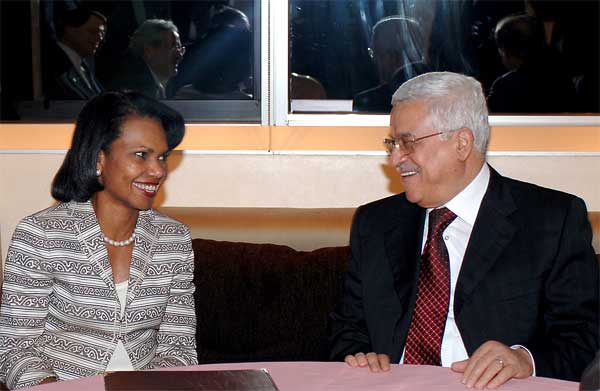 | Siniora in the Lebanese Government and Mahmoud Abbas in the territories. And it probably brought into sharper relief that there isn’t really a gray area here but a sharpening of extremism versus moderation. |
QUESTION: Haven’t you got two or three forces working at once? You’ve got the Shiites trying to come back into their sort of senior position; at the same time you’ve got the kind of side show that is the continuing story of the Palestinian issue; but underneath it all the jihadists (inaudible) Saudi Arabia. If you look (inaudible) decent settlement of the Palestinian issue somehow, and there’s probably hope, then you’ve got to know what to do with Iran, you’re still going to have these terror camps, these madrasas and that have been subsidized by Saudis or perhaps indirectly which are spread throughout and all the way to Indonesia, I mean they’re separate, but interrelated questions, you’re not going to just get the whole thing settled.
SECRETARY RICE: They’re very much interrelated questions. I do think the Shia-Sunni issue is one that has come to the fore more because as democratic processes begin to emerge in one man, one vote, the fact that Shia have either been repressed or oppressed is now coming to the fore. And so you have a place like Iraq which has a majority Shia population and it has – it makes others worry, well, what’s going to be the nature of this government. Well, if it’s the nature of the government that they’re trying to build, which is a national unity government where, yes, Shia is the majority but Sunni interests are represented and Kurdish interests are represented and other interests are represented, that’s going to be a fundamentally different model for how Shia interact in the Middle East than, say, the Iranian model where you have a kind of theocratic government that is imposing its will and then extending its tentacles out throughout the region.
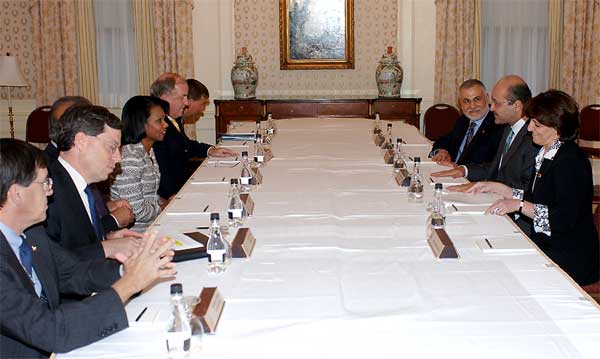 | So it goes again to the importance of Iraq and why it is so important that it emerge as a national unity government where all interests can be represented. I agree with you that solving the Palestinian-Israeli issue, |
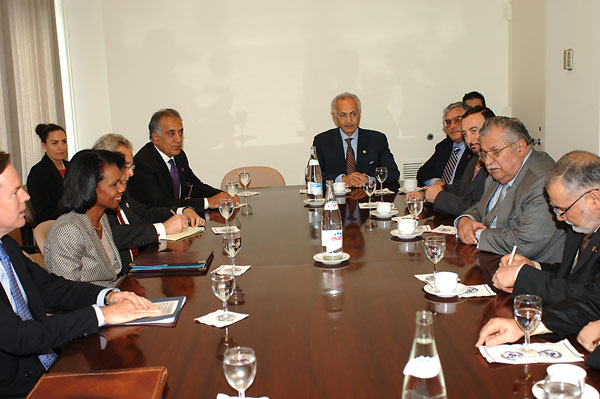 | QUESTION: The question of Iraq has been – has come to the surface again this week with the reports in the Times and Post of the National Intelligence Estimate on the relations between – |
SECRETARY RICE: Well, I think it’s worth looking at how you deal with a situation in which you have a selective leak that gives a particular coloration to what is a very complex issue. But I think the first rebuttal has to be not just that the National Intelligence Estimate is a much more complex argument than is represented in this selective leak, but also to just simply take the argument on head on. You know, when are we going to stop blaming ourselves for the rise of terrorism? And so yes, in – it is absolutely true that now that we’re fighting back, which we did not do, as George Schulz would say, all the way from the ‘80s, now that we’re fighting back, of course they are fighting back too and they are mobilizing and they are recruiting and they are trying to press and to use difficult circumstances to pursue their cause. I don’t think there should be any surprise about that.
But is the better course to leave them unchallenged? You have to remember that the first excuse was our forces in Saudi Arabia at the end of Gulf War I. Then the excuse – by the way, these are people who don’t distinguish between Afghanistan and Iraq. So Afghanistan then was supposedly a place that we were fighting against Muslims, which is how they put it, and so – and they’re trying to make the same argument about Sudan. Wherever you challenge them, they are going to try to recruit on that basis, they are going to try to stir up passions of people who have differences or perhaps people who have no alternative future or perhaps people who can be led down this road by fiery mullahs. They’re going to do it wherever you are.
But that doesn’t mean that you don’t pursue a strategy that in the long term is going to allow you to counter this ideology of hatred by producing different political structures and different political outcomes in the Middle East. And that’s what Iraq offers. We were just talking about the Shia-Sunni issue. You’re never going to have a just Sunni-Shia reconciliation if you don’t have a political system in which the interests of all can be represented, and that’s what Iraq represents.
 | So yes, it’s tough going right now and they’re having – they’re struggling. But they’re struggling, by the way, together – Sunnis and Shias and Kurds. And you know, they give a little bit on this issue |
So I think you take the argument on also just head on. These are people who are – who want to fight against us and they’re going to find a reason. And yes, they will recruit. But it doesn’t mean that you stop pursuing strategies that are ultimately going to stop them.
QUESTION: I’ve heard from intelligence agencies the same story. They said there is a big difference in the radicalization of the Afghanistan campaign and the Iraqi one, but that is no argument against going into Iraq. I mean, we’ve flushed them out to some extent.
SECRETARY RICE: And we’re fighting them in --
QUESTION: And they are sending in people from all those other countries.
SECRETARY RICE: And we’re fighting them – fighting them there.
QUESTION: And now we’ve deprived al-Qaida of a national place, you’ve probably got Iran paying and helping and there’s a lot more money around and this (inaudible) intelligence would indicate that they’re certainly financing any trouble they can.
SECRETARY RICE: I think they are financing a lot of trouble. On al-Qaida, they have got a history of not having very good – of having a lot of troubles themselves with al-Qaida. But what they are doing is that they are clearly in Iraq they’re financing a lot of trouble in the south, which is making it difficult to come to this national unity government.
But you get the impression that there is – it’s about the broader Middle East policy. There was this stable Middle East and somehow the policies of the United States, including the decision to finally take down Saddam Hussein, have destabilized this stable Middle East. What stable Middle East was there that produced the people who flew into the Twin Towers? And so yes, at a time when you challenge and a time when you take them on, they’re going to fight back. But you’re better off taking them on than letting it just rest.
QUESTION: I’ve assumed right or wrongly all along that the Iraq operation and a lot of what we were doing, including Afghanistan, was an attempt to isolate Iran and which is (inaudible) the hub of all the trouble, and is it possible to have peace there without neutralizing Iran one way or the other?
SECRETARY RICE: Oh, I think you do have to neutralize Iran’s policies. I don’t think there’s any doubt about it.
QUESTION: Neutralize Iran.
SECRETARY RICE: Well, neutralize Iran and their reach and their policies and their troublemaking.
QUESTION: So how do we do that?
SECRETARY RICE: Well, you know, I’ve heard a lot about how Iran considers itself to be in a strong position,
 | but if you look at it from Iran’s point of view they have a neighbor in Afghanistan with American forces and they have a neighbor in – and by the way, a lot of other NATO forces now – |
Now, in the short term will they continue to try to make trouble? Yes. But we also have to look at the sort of geostrategic changes that this can bring about in the long term. And in the long term I think it does serve to isolate Iran and to call into question also the very basis on which the Iranian revolution not only rules in Iran but purports to have a broader regional role, which is this theocratic government that Khamenei runs.
QUESTION: In terms of you saying you need to address the argument head on, the fact that the argument has now taken a new twist because in the public eye for the next few weeks at least it is that the counterargument is being made from inside the Government of the United States, and certainly in an election season with Democrats talking about having hearings about the Iraq war, the accusation that not from September 11th but that since May 2003 that America’s security has been damaged by the effort in Iraq is a – seems like an extremely threatening argument for the future of the effort in Iraq should that argument get any purchase in the national imagination. So that’s why I guess Adam mentioned the question of whether or not the NIE will – might be declassified. I mean, don’t specific steps have to be taken to address the specific problem of this story about the NIE?
SECRETARY RICE: Well, I don’t know. You know, the problem is that with the number of leaks that you have, if you declassify every time you have a leak, you’re going to be declassifying a lot. That’s really the unfortunate world in which we currently live.
I don’t know. I haven’t been in Washington and I’m not – I haven’t been talking to John Negroponte and others about how they intend to get a better reading of what the NIE was – some of the other things that the NIE was saying. So perhaps it’s being considered.
But I think this is bigger in effect than the NIE and that specific headline. This is an argument about whether or not what September 11th was about was simply trying to break up al-Qaida the organization, maybe destroy its home base in Afghanistan, and then assume that that was the end of the terrorist threat; or whether or not you had to go to literally the root cause of it and start to change the circumstances that produced it. And that meant policies that had also to pressure allies into broader democratization. It meant policies that to address things like the madrasas that had grown up in important parts of the world and support to terrorism, material support to terrorism that was coming even out of friendly countries – not out of friendly governments, out of friendly countries. And whether or not you have to go to the root of that and literally start to change the basic nature of a Middle East in which there is politics but it’s the politics that’s going on the radical mosques. That’s where the politics is going on. So that’s why Hezbollah emerges strong. That’s why Hamas emerges strong. That’s why there are no strong alternatives on the moderate side because those legitimate channels for the development of moderate political forces were shut off by authoritarianism.
That’s the great debate. And when you hear people say, well, you’re not paying attention to the core of the war on terrorism because you only want – because there’s Iraq you didn’t pay full attention to Afghanistan, that’s what people are saying. And the President has a different view and I have a different view, which is that we are doing all those things about al-Qaida. That’s why the -- taking down the field generals has been so important. We’re doing everything we can to protect the homeland, which is why surveillance is important and interrogation is important. We’re doing what we can to stabilize Afghanistan and that’s why you have NATO fighting in Afghanistan. NATO has not fought ever in this way. So you’re doing all of those things. But the question is: Is that enough? And I believe strongly that you could win all those battles and still have the very circumstances that produced al-Qaida and it’ll just keep replicating itself. Maybe it won’t be al-Qaida. It’ll be something else. Because its roots, its base, will not have been cut out.
For me, the kind of historical analogy – and I realize it’s an imperfect analogy, but the kind of historical analogy is Europe warred for a hundred years, I mean flat out warred for a hundred years between the Napoleonic wars and the outbreak of World War I. We got drawn into World War I but nothing in the basic structure changed in Europe. It was a new rearrangement of the balance of power. And we left and we were right back 30 years later fighting again in Europe.
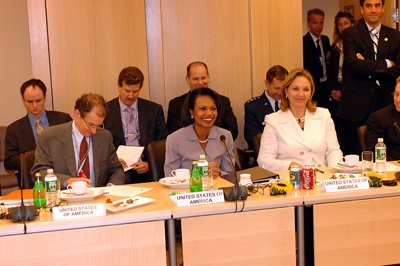 | When after World War II the United States insisted on a different basic structure in Europe, that is a Germany that was democratic and an institution like NATO that changed the basic structure of politics |
So yes, it’s a longer term strategy and it may even have some short-term downsides. But if you don’t look at the longer term, you’re just leaving the problem to somebody else later on. And I think that’s essentially the debate we’re having, but people don’t articulate it in that way. They talk about, you know, you’re not fighting the core of the war on terror. Well, it depends on how you define the core of the war on terror. And the fact that the jihadists are fighting in Iraq in the way that they are, the fact that Zarqawi did talk about Iraq as a central front, means that they understand it. There may be people in the United States who don’t understand it, but they understand it.
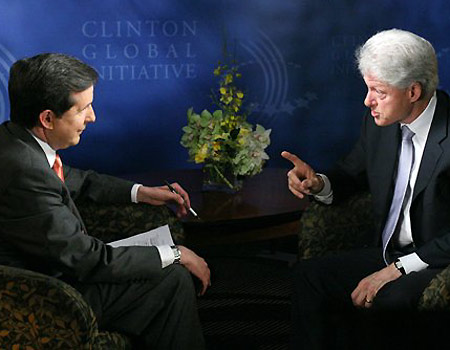 | QUESTION: By now I assume you’ve seen Bill Clinton’s performances. How do you respond to his specific accusation that the eight months before 9/11 the Bush Administration, in his words, didn’t even try to go after al-Qaida? |
| Image © 2006 FOX News Network, LLC. All rights reserved* |
SECRETARY RICE: I’d just say read the 9/11 report. We went through this. We went through this argument. The fact of the matter is I think the 9/11 Commission got it about right. Nobody organized this country or the international community to fight the terrorist threat that was upon us until 9/11. I would be the first to say that because, you know, we didn’t fight the war on terror in the way that we’re fighting it now. We just weren’t organized as a country either domestically or as a leader internationally.
But what we did in the eight months was at least as aggressive as what the Clinton Administration did in the preceding years. In fact, it is not true that Richard Clarke was fired. Richard Clarke was the counterterrorism czar when 9/11 happened and he left when he did not become Deputy Director of Homeland Security some several months later. We were not left a comprehensive strategy to fight al-Qaida. For instance, big pieces were missing, like an approach to Pakistan that might work, because without Pakistan you weren’t going to get Afghanistan. And there were reasons that nobody could think of actually going in and taking out the Taliban, either the Clinton Administration or the Bush Administration, because it’s true you couldn’t get basing rights in Uzbekistan and that was the long pole in the tent.
So I would make the divide September 11, 2001 when the attack on this country mobilized us to fight the war on terror in a very different way. But the notion that somehow for eight months the Bush Administration sat there and didn’t do that is just flatly false. And you know, I think that the 9/11 Commission understood that.
QUESTION: So you’re saying Bill Clinton is a liar?
SECRETARY RICE: No, I’m just saying that, look, there was a lot of passion in that interview and I’m not going to – I would just suggest that you go back and read the 9/11 Commission report on the efforts of the Bush Administration in the eight months, things like working to get an armed Predator that actually turned out to be extraordinarily important, working to get a strategy that would allow us to get better cooperation from Pakistan and from the Central Asians, but essentially continuing the strategy that had been left to us by the Clinton Administration, including with the same counterterrorism czar who was Richard Clarke. But I think this is not a very fruitful discussion because we’ve been through it; the 9/11 Commission has turned over every rock and we know exactly what they said.
QUESTION: Speaking of the role of Pakistan, there were these rumors that popped up over the weekend that there had been a coup over there which Musharraf said didn’t happen. Given how important Pakistan is in that region, what are the thoughts of the Administration as to what is a post-Musharraf Pakistan going to look like. Would there be friendly elements?
SECRETARY RICE: I don’t think it’s even – you know, I don’t think you can even speculate and I think we’re not looking to a post-Musharraf Pakistan. We’ve got in Pakistan in this particular leader somebody who is – who changed Pakistan’s orientation dramatically after September 11th, who has tried in domestic terms to root out some of the extremism that came into Pakistan essentially after the Soviet Union was defeated in Afghanistan, who has sent Pakistani forces into parts of Pakistan that no one had gone into, including the British, and who is a good ally in the war on terror. And I think the future of Pakistan, as Musharraf and his people fully understand, is to de-radicalize elements of the population that were radicalized by the Afghan experience. It’s why education reform is very important in Pakistan. It’s why economic growth is extremely important in Pakistan. And he’s called it enlightened moderation. I think getting a Pakistan that moves away from the course that it was on prior to September 11th is enormously important.
QUESTION: Is he really changing the educational system in Pakistan? Are they changing the education --
SECRETARY RICE: They are clearly trying to improve the oversight of education, but it has to be a Pakistani affair. You know, this isn’t something we can do. But they’re trying clearly to over – to improve that. They are doing it through mechanisms of standards for the madrasas, of improving technical and literacy education and trying to move them away from places where just kind of propaganda is taught. So yes, they have a major educational reform effort underway. It’s hard going, particularly in some of the more remote areas.
QUESTION: It’d be more impressive if it was in Saudi Arabia.
SECRETARY RICE: Well, Saudi Arabia even, I think, understands that their students need to be better trained in skills that meet today’s needs. And it’s one reason that we’ve been pretty strongly working to improve our capability to receive students and do educational exchanges and the like; you give then an incentive for people to change. But yeah, these educational systems need to change. They’re not producing the skills that young people need for the 21st century and I think they recognize that. But --
QUESTION: But they haven’t opened the schools to women, for instance.
SECRETARY RICE: Well, there are schools for women. But no, men and women are educated separately.
QUESTION: In Saudi Arabia.
SECRETARY RICE: There are schools for women, yes. But they’re educated separately.
QUESTION: Speaking of Musharraf, has any – is there any getting to the bottom of the Musharraf-Armitage, ‘bomb them to the Stone Age’ anecdote?
SECRETARY RICE: Rich says he didn’t say it. I don’t know. You know, I wasn’t there. And whatever transpired, the thing I remember most, what the President remembers, which is Colin saying, you know, the Pakistanis are going to go – they’ve made a strategic choice and that’s what was really important. It’s the kind of thing that I think probably makes for interesting memoirs, but --
QUESTION: If we can move a couple of points on the compass to the west, during the recent Lebanese-Israeli war, I guess, we basically gave them – the Israelis about 30 days more or less to do what had to be done. I’m wondering, what did we get in return for that?
SECRETARY RICE: Well, we didn’t sit down with the Israelis and say, "How long do you – I mean, that wasn’t the character of this. We felt that after the Hezbollah attack across the blue line that Israel had to defend itself, had to try and do whatever it could to suppress the capability of Hezbollah to launch against its cities. And they did that for a period of time. I think it became clear at a certain point that the military action alone was not going to solve the problem and frankly the Israelis were caught in just what is a very, very difficult dilemma for anybody who fights a counterterrorism, counterinsurgency war, which is that they didn’t want to fight a war against Lebanon but much of the infrastructure, and not to mention the civilian population, were – it began to be difficult for the Lebanese Government to maintain stability under that kind of military --
QUESTION: Who came to that conclusion first – the United States or the Israelis?
SECRETARY RICE: Well, very early on we did have a discussion with the Israelis about not going to war against Lebanon, going to war against Hezbollah. We had that discussion early on. But it’s difficult when a country – or when a terrorist group uses human shields, which they did, embeds itself in the population, uses the infrastructure to its own advantage. It’s hard to make the separation. But at a certain point, the stability of the Lebanese Government and the Lebanese Government’s ability to extend its authority over the country became more the goal than how much more you could degrade Hezbollah because you weren’t going to be able – they weren’t going to be able to degrade Hezbollah much more without threatening the stability of the Lebanese Government. And a crossover point I think came then where you had to look for a diplomatic solution that would allow the Lebanese Government to extend its authority and that’s what the resolution was about.
QUESTION: Has any damage assessment been done that you’re aware of to indicate militarily or tactically or strategically what kind of harm was done to Hezbollah in – you know, in the war in terms of its forward action?
SECRETARY RICE: I think there’s no doubt that there was some and that a lot of their infrastructure, particularly along the border, was destroyed. And I also think there’s pretty good evidence that even though there are reports – you know, there’s one in the paper today that there are in the south, they don’t have the kind of freedom of movement and capacity to use that territory freely against Israel that they had. And that’s what you really want to prevent.
There is also an arms embargo and finding ways to enforce that I think is really the next big issue. I think we’ve found a pretty good solution for the airport and the seaport and for the sea lanes where there’s a lot of technical assistance from Germany and others. The land border with Syria is more difficult and pressing Syria to understand its obligations that there is a Security Council resolution banning the transfer of weapons to other than the legitimate Lebanese security forces I think is extremely important. But it’s a pretty good – it’s, I think, a reasonably good story so far.
QUESTION: The most sophisticated weapons to appear on the battlefield were particularly the anti-shipping missile that was used against the Israeli patrol boat basically came from Iran, right?
SECRETARY RICE: Right.
QUESTION: Again, leading back to my earlier question of the difficulty – how do you neutralize – because again, it’s just going to --
SECRETARY RICE: Well, you have to go at it from several different directions because while nobody takes any option off the table, there isn’t a particularly good direct way to go after the – to neutralize the Iranian threat so you go after it in several ways. I think of it as kind of concentric circles. In the long term, you’ve got to create a different environment where Iran isn’t able to make that kind of trouble. And if you have a stable Iraq, particularly in the south, they’re just not able to make that kind of trouble. That’s why it is so important that this national reconciliation program that Maliki is talking about gets done, finished, that the militias get disarmed, that the security forces take over. I mean, that will make it a lot harder for Iran to play in troubled waters, so to speak.
Another concentric circle a little bit in is that I think you have to mobilize the neighbors, who were unnerved by what happened in Lebanon and do see the Iranian threat more clearly than they did before. It’s one reason that you got the extraordinary response of Saudi and Egypt and Jordan when Hezbollah first attacked saying basically it was Hezbollah’s fault. And I think you will see that those states will counter Iranian activities in the region and they will put money and resources into moderate forces. The Saudis within days put a $1.5 billion into Lebanon, $1.5 billion to counter Hezbollah and Iran. I think you’ll see more of that. So you have to mobilize the regional states.
Then I think you have to, as you’re strengthening moderates, mobilizing the regional states – the nuclear issue actually provides an opening because if the Iranians do not agree to suspend their nuclear – their enrichment and reprocessing activities, and I have my doubts that they will, the Security Council sanctions will go into effect. They will.
Now, the sanctions probably will not look like – as robust as if the United States had unilaterally written them. But nonetheless, you will have Iran under Chapter 7 action of the Security Council and I think you will start to see that that may have collateral effects on the Iranian economy as people make different investment decisions and different decisions about whether to deal with Iranian assets and the like. And so I think you can bring pressure on them that way.
And then finally, I think you just have to keep speaking to the Iranian people to let them know that they, you know, they’re not alone in their struggle because we believe they want democracy as much as anyone.
Let me just go back to the –
QUESTION: Does that mean, excuse me.
SECRETARY RICE: Yes.
QUESTION: Does that mean now, that the Iranians – the people – are very much anti- the ayatollahs there, but they’re nationalistic and they do combine Iran and the nuclear issue.
SECRETARY RICE: You’re right, which is why we’ve tried to handle the nuclear issue the way we’ve handled it. You might have noted in the President’s speech at the UN when he spoke to the Iranian people, he said you have a right to civil nuclear power. It’s because the government, the regime, is telling the Iranian people that we would deny them technology and civil nuclear power. So we have to speak directly to that. One of the reasons the package was important that the six parties put forward is that it says to the Iranians if you want civil nuclear power and integration into the international system, here it is, you can have that. The only thing you can’t have is a technology that would lead to a nuclear weapon. And so we’ve just got to keep pounding that position.
QUESTION: But even that has (inaudible). They say, you know, Pakistan has a bomb, we’re surrounded by Sunnis with bombs, you know, why shouldn’t we?
SECRETARY RICE: The answer --
QUESTION: A pretty effective argument (inaudible).
SECRETARY RICE: Well, for some. But if you can make it clear that the price for that is isolation, because the other thing that Iranian youth and most Iranians want is integration into the international system, and so making a choice is important here. You can’t have it both ways. You can’t both have the bomb and be integrated into the international system. You can have the technology and be integrated into the international system.
I think you’ll find a number of people who will take that choice and it’s also a reason to continue to see whether within the Iranian Government there are those who want to take a more reasonable course. You notice I didn’t say moderate within the Iranian Government because, you know, we’ve been searching for that 25 years and it doesn’t ever seem to work. But people who have a different – who don’t want a route of confrontation but rather want to find a way out of this, it’s worth looking for.
QUESTION: Just to follow up on Mr. Murdoch’s point, you also have a situation with, say, India, which again is nuclear powered, part of the international system and in a sense we now have an even stronger relationship in terms of working with them. Again, isn’t a signal then being sent to the Iran populace, you know, if India can have it all, why can’t we?
SECRETARY RICE: Well, you know, I’ve never been one who believes that in international politics every situation is the same. It’s not. And you know, I know people make the argument about precedents and I just have to say to people, look, the situations are simply different. For a variety of reasons, prior to the NPT – I’m sorry, just after the NPT India became a nuclear power and got left out of the nuclear club. That’s really what happened. You know, the five who are so-called grandfathered into the NPT – the United States, Russia, China, France and Great Britain – it’s almost an accident of history that they were in, you got the NPT and you were grandfathered in.
Now, that then led to a kind of anomaly, which is you have a state then that never joined the NPT but pursued nuclear weapons, therefore not breaking any of its NPT obligations since it was not party to the NPT, has been very good on proliferation matters for its entire history, and has now – as Mohamed ElBaradei put it, needs to be brought into the broad regime that is controlling proliferation.
With Iran you have a state that signed onto the NPT, has been violating its obligations, including enriching without telling anybody at Natanz; has a terrible proliferation record; was apparently dealing with A.Q. Khan who, the last time I looked, never was very interested in civil nuclear power; and so doesn’t – and by the way, sits in a very volatile region. The situations are just simply very different. And I think most people believe that India can be as a part of a broad proliferation regime actually helpful to the nonproliferation effort. I don’t think there are many people who believe that about Iran.
QUESTION: Speaking of nuclear proliferation, the Japanese are getting a new prime minister, a fellow who has some interesting if not provocative things to say about the Japanese constitution. Are we heading in that direction with them and, if so, what are the consequences or potential consequences?
SECRETARY RICE: I do not think we’re headed in that direction with Japan. I think there are a lot of self-regulating reasons for Japan to remain non-nuclear. It is – the Japanese are very concerned about the North Korean issue and its proliferation activities, which is why the six-party talks really need to get back on track and we need in that – it’s one reason that that particular framework was so important for controlling the nuclear ambitions of North Korea because it has Japan at the table with China, with the United States, with Russia, and I think then forestalls any further nuclearization of the region. And so it’s very – but I would – I don’t think that that’s --
QUESTION: Is the Japanese constitution an anachronism?
SECRETARY RICE: Well, that’s something the Japanese will have to decide. We’ve certainly been able within the current constitutional constraints to enhance defense cooperation with Japan quite dramatically over the last couple of years. Don Rumsfeld and I have had what we called a 2+2 with foreign ministers and defense ministers where we started out a couple of years to write a document that really pretty fundamentally changed the way that we thought about the nature of the alliance and what it was doing, the modernization of the alliance. And I think we’ve done that quite successfully. Japan has served in Iraq. They’ve been able to support the activities in Afghanistan. So I have to say I think it’s been – they’ve been very capable of carrying out enhanced defense responsibilities.
QUESTION: Can’t we do something to really bring Japan and China a bit closer? With a new prime minister, isn’t there an opportunity for some dramatic thing like President Bush to have a summit in Hawaii and invite the new prime minister with the President of China or something? It would look – you know, it would strengthen the ties with Japan certainly and maybe drag the Chinese in a bit more.
SECRETARY RICE: Well, I don’t --
QUESTION: There’s a lot of things going on in China, not all of which are (inaudible).
SECRETARY RICE: No, that’s very true.
QUESTION: And today they just fired their secretary of the party in Shanghai which is a huge – which is like a slap (inaudible).
SECRETARY RICE: Well, I would like to see improvement in Japanese-Chinese relations. There’s no doubt about it. I wouldn’t be surprised if you see some efforts by Mr. Abe at moving the relationship in a --
QUESTION: (Inaudible) before he goes to that shrine and the Chinese there too, you might just get something out of the Chinese. The Chinese are reasonably, you know, self-interested themselves. But their feeling to Japan is very, very, very, deep.
SECRETARY RICE: It is. They did make the point – the Japanese and the Chinese – recently, that they have agreed – it may sound like a minor matter, but it’s not – on some efforts on demarcation in the South China Sea jointly, which would be a very big step forward, actually, for them.
I think you’ll see it start to move. I don’t know that the United States – whether or not our trying to be involved may make it too high-profile for them to move in the measures toward reconciliation that they need to move.
We also sit together in a lot of different fora, as you might imagine. There’s the six-party forum. There’s APEC. There’s ASEAN. And the Japanese and Chinese don’t lack contact. I think that you will see Prime Minister Abe try to make some improvements and I think the Chinese will be receptive to that.
QUESTION: How potentially destabilizing as a practical matter is Hugo Chavez? We have a – you know, he’s got a lot of oil and seems to have adopted the theoretical notion of having regional influence following Castro’s line. Are we – is there reason to be concerned that he will be a destabilizing force?
SECRETARY RICE: Well, there’s reason to be concerned, of course. But just two points. First of all, I think there’s been a backlash about some of his – some of the meddling. You saw it in Peru and you can probably see it in Mexico. And so it’s – his desire to involve himself in the affairs of his neighbors is not always welcome.
But the way that we’ve chosen to deal with this is to spend almost as little time as possible in talking about Chavez and more time talking about our positive agenda for Latin America, which is I think making – it’s making a difference, whether it is the free trade agreements that we’ve signed in the Andean with Colombia and Peru. I think we’ll eventually get the one with Ecuador back on track. When you have had the Central American Free Trade Agreement, when we have had large now Millennium Challenge compacts with Honduras and Nicaragua and most likely with El Salvador pretty soon. We’ve been trying to make sure that our own rhetoric about what we’re doing in Latin America takes account of the fact that what really happened, I think, is that you were getting economic growth, free trade was generally considered a good thing, but it was not having benefits for a lot of people who were marginalized.
And so the importance of making clear that the United States also cares about social welfare populations, education, health, through the kinds of things that we do, for instance, in the Millennium Challenge to alleviate poverty, has become more a part of our conversation with people in Latin America. We of course continue to have excellent relations with Chile. We have very good relations with Brazil. I think in the region it’s not as smooth as perhaps it was several years ago because you’ve had a bit of a growth of populism. But I also don’t think that you’re seeing – I read sometimes stories about Latin America and it’s as if everything’s gone backwards. I just don’t think the facts on the ground bear that out.
QUESTION: The Chavez speech last week combined with the Ahmadi-Nejad speech suggested that on the minds, at least, of some potentates or would-be potentates or something there is a very specific idea about reviving the nonaligned movement or making some kind of alliance to oppose the United States as some kind of counterweight. Is that anything real or is it just rhetorical?
SECRETARY RICE: Well, I don’t – I’ve never quite understood what it is they would be nonaligned against at this point. I mean, you know, the movement came out of the Cold War. People are going to get up and give fiery speeches and say all kinds of things. I think certain realities are certain realities about the nature of the international economic system and what you have to do to be competitive within it, about the nature of the political relationships that you have to have in order to be competitive and to deliver for your people, and about the role of the United States in that complex of issues.
And you know, frankly if the Venezuelans want to stand up and effectively demonstrate that they’re probably not a responsible bet for the Security Council, that’s fine.
QUESTION: I wonder if I might ask you if it’s possible for a Secretary of State to be as instinctive about problem solving as, say, somebody in the National Security Advisor’s office, or does the bureaucratic apparatus of the State Department work as a force against clarity?
SECRETARY RICE: That’s a very interesting question. Gee, I haven’t felt any desire to be less clear. (Laughter.) What do we do? We try to find diplomatic solutions to pretty thorny problems, and it’s the nature of diplomacy that you can’t lay out a course here and say, "And I’m not moving one degree one way or another no matter what." The nature of diplomacy is to try without compromising the critical principles or critical strategic interests to bring others on board to your way of thinking about something.
So, if the Europeans with our – frankly with our blessing wish to explore for a little while, and I want to emphasize a little while – whether there is a two-step way to get the Iranians to suspend their program, we’re perfectly willing to look at that. Now, I could say, oh, absolutely not, we said on this day, tomorrow, we were going to do this. Fine. I could probably force it. To be perfectly honest, I could probably force it.
But, is it better to have people think and believe that you’re prepared to listen to their views and to – if they’ve got a way that they think a problem might be solved, to explore that, I think yes, it’s better. Because, I’ll use the Iranian case because I know there are a lot of people who kind of wondered about the diplomacy around the Iranian case.
We crossed the bridge in July when we passed Resolution 1696 on Iran that said if Iran doesn’t suspend there will be Security Council sanctions. It talks about action under Article 41 of Chapter 7, but that means sanctions. So the deadline was August 31st. Did anybody really believe that in the midst of all of this and the UNGA and so forth and so on that we were going to get a sanctions resolution? No.
So the exploration of this other path seems to me a reasonable thing to do. So I wouldn’t say that it is a lack of clarity, but as – I’m very clear about where we’re going and what we’re doing. It is important in keeping a coalition together to – if people want to explore something that doesn’t move you very far off course to go ahead and explore it. And I think you get into a stronger position that way. I think the Iranians have been very surprised at how well this coalition has held together, and if they don’t suspend they’re going to be surprised again because I think we’ll get a sanctions resolution.
QUESTION: On the Israeli-Palestinian front, the EU seems pretty anxious to get the process restarted and the aid coffers flowing and it’s Washington’s as well. But there’s been some suggestions that they may be willing to recognize a unity Palestinian government that falls short of a clear cut recognition of Israel and renunciation of terrorism we’ve been pressing for.
If so, is the U.S. prepared to stand alone in non-recognition of such a government?
SECRETARY RICE: Well, so far we haven’t had to make that choice because, as you noticed in the Quartet statement, it was pretty clear that we look forward to working with a government that accepted those principles.
I think people understand that we’ve gotten Hamas to a position where they actually are feeling the pinch of not accepting the international consensus. And they are as a result failing in their governance. And it would be a pity to release that pressure and make it easier for them by saying "Oh well, really, it’s only a little bit that you have to do." And so, I think the consensus is pretty strong behind the government, the Palestinian government, having to accept certain principles, and in fact, Mahmoud Abbas himself said that that government would have to accept those principles.
I think what you’re seeing, has less to do with contact with the government, or recognition of the government, or even whether you can negotiate with that government -- growing concern about the toll on the Palestinian population, of the absence of funding for certain segments of the population and ways to try to deal with the effects on the Palestinian population, which is why the temporary mechanism, the TEM, why we agreed that they should look at some expansion of that mechanism to be able to deal with people who are in need, haven’t been paid for long periods of time and so forth.
So I think that’s what you are seeing. It’s not a sense, at least not by most, that you want to change the basis of the – of recognition or dealing with the government, but rather is there any way to deal with what is clearly a deteriorating situation.
QUESTION: But is the Palestinian population holding Hamas responsible?
SECRETARY RICE: Yes. That’s why they are on strike in large numbers. I think for the first time you actually are seeing the Palestinian population hold Hamas responsible, and I think for the first time that’s why Hamas has any interest in a national unity government at all.
And, you’re probably seeing that for the Hamas government that’s actually trying to govern in the territories, this is a more salient problem than for Khaled Mishal sitting up in Damascus, who can be purist about these things.
Now, over time, I think we all hope that Hamas is going to, even if it’s not in a single day, move to a more reasonable position about these issues. Because the very best thing that could happen is if you did have, in the Palestinian political space, a kind of re-centering of Palestinian politics that brought Hamas or some elements of Hamas to the right position, that would be ideal. But I don’t think you’re seeing people who are trying to – most people are not trying to truncate that process. There is a lot of concern about what’s going on in the territories.
QUESTION: Is Castro dead?
SECRETARY RICE: I don’t think so.
QUESTION: Is Bin Laden dead?
SECRETARY RICE: I don’t know.
QUESTION: Is Francisco Franco dead? (Laugher.)
SECRETARY RICE: We could go down the list. Right.
QUESTION: Thank you very much.
SECRETARY RICE: Thank you. Thank you very much.
2006/866, Released on September 26, 2006
Technorati Tags: Condoleezza Rice and President Clinton Video or Chris Wallace and Fox News Video or Bill Clinton and Video or Secretary of State and New York Post
Related: Keywords State Department, Wednesday, September 20, 2006 President Bush Meets with President Abbas, Monday, September 25, 2006 Afghan President Will Meet with Businesses Building Bridges Participants, Thursday, September 21, 2006 State Department Daily Press Briefing, VIDEO, PODCAST, TEXT, 09/21/06, Wednesday, September 20, 2006 Mahmoud Ahmadinejad Iran UN (VIDEO), Tuesday, September 19, 2006 Media Stakeout Ambassador John Bolton 09/18/06 (VIDEO), Tuesday, September 19, 2006 Kristen Silverberg On-the-Record Briefing (VIDEO), Monday, September 18, 2006 Annual Report on International Religious Freedom (VIDEO), Wednesday, September 13, 2006State Department Daily Press Briefing, VIDEO, PODCAST, TEXT, 09/12/06, Monday, September 04, 2006 Media Stakeout Ambassador John Bolton 09/01/06 (VIDEO), Monday, September 04, 2006 Condoleezza Rice American Legion Convention VIDEO, PODCAST, TEXT, Thursday, August 31, 2006 United Nations Daily Press Briefing 08/31/06 (VIDEO), Monday, August 28, 2006Media Stakeout Ambassador John Bolton 08/28/06 (VIDEO), Wednesday, August 23, 2006 Iranian Response to the P5+1 Package, Tuesday, August 22, 2006 Media Stakeout Ambassador John Bolton 08/22/06 (VIDEO), Tuesday, August 22, 2006 Media Stakeout Ambassador John Bolton 08/15/06 (VIDEO),
*image clinton_wallace.jpg fair use. This work is copyrighted and unlicensed. However, it is believed that the use of this work in the article Condoleezza Rice, New York Post, Clinton VIDEO
- To illustrate the object in question
- Where no free equivalent is available or could be created that would adequately give the same information
- On the English-language Republican National Convention Blog, hosted on servers in the United States by beta.blogger.com
To the uploader: this tag is not a sufficient claim of fair use. You must also include the source of the work, all available copyright information, and a detailed fair use rationale. == Fair use for [[Condoleezza Rice, New York Post, Clinton VIDEO]] == The image linked here is claimed to be used under fair use as:
- # it is a historically significant photo of a famous individual;
- # it is of much lower resolution than the original (copies made from it will be of very inferior quality)
- # the photo is only being used for informational purposes.
- # Its inclusion in the article adds significantly to the article because it shows the subject of this article and how the event depicted was very historically significant to the general public.