Tuesday, May 01, 2007

President Bush Vetoes Iraq War Supplemental VIDEO

President George W. Bush issues a statement Tuesday, May 1, 2007, regarding his veto of the Iraq War Supplemental. Speaking from Cross Hall in the White House, the President said, 'We need to give our troops all the equipment and the training and protection they need to prevail... The need to act is urgent.' White House photo by Eric DraperPresident Bush Rejects Artificial Deadline, Vetoes Iraq War Supplemental, Cross Hall FULL STREAMING VIDEO, In Focus: Defense, 6:10 P.M. EDT.

THE PRESIDENT: Good evening. Twelve weeks ago, I asked the Congress to pass an emergency war spending bill that would provide our brave men and women in uniform with the funds and flexibility they need.
Instead, members of the House and the Senate passed a bill that substitutes the opinions of politicians for the judgment of our military commanders. So a few minutes ago, I vetoed this bill.

Tonight I will explain the reasons for this veto -- and my desire to work with Congress to resolve this matter as quickly as possible. We can begin tomorrow with a bipartisan meeting with the congressional leaders here at the White House.

Here is why the bill Congress passed is unacceptable. First, the bill would mandate a rigid and artificial deadline for American troops to begin withdrawing from Iraq. That withdrawal could start as early as July 1st. And it would have to start no later than October 1st, regardless of the situation on the ground.

It makes no sense to tell the enemy when you plan to start withdrawing. All the terrorists would have to do is mark their calendars and gather their strength -- and begin plotting how to overthrow the government and take control of the country of Iraq. I believe setting a deadline for withdrawal would demoralize the Iraqi people, would encourage killers across the broader Middle East, and send a signal that America will not keep its commitments. Setting a deadline for withdrawal is setting a date for failure -- and that would be irresponsible.

Second, the bill would impose impossible conditions on our commanders in combat. After forcing most of our troops to withdraw, the bill would dictate the terms on which the remaining commanders and troops could engage the enemy. That means American commanders in the middle of a combat zone would have to take fighting directions from politicians 6,000 miles away in Washington, D.C. This is a prescription for chaos and confusion, and we must not impose it on our troops.

Third, the bill is loaded with billions of dollars in non-emergency spending that has nothing to do with fighting the war on terror. Congress should debate these spending measures on their own merits -- and not as part of an emergency funding bill for our troops.

The Democratic leaders know that many in Congress disagree with their approach, and that there are not enough votes to override a veto. I recognize that many Democrats saw this bill as an opportunity to make a political statement about their opposition to the war. They've sent their message. And now it is time to put politics behind us and support our troops with the funds they need.

Our troops are carrying out a new strategy with a new commander -- General David Petraeus. The goal of this new strategy is to help the Iraqis secure their capital, so they can make progress toward reconciliation, and build a free nation that respects the rights of its people, upholds the rule of law, and fights extremists and radicals and killers alongside the United States in this war on terror.

In January, General Petraeus was confirmed by a unanimous vote in the United States Senate. In February, we began sending the first of the reinforcements he requested. Not all of these reinforcements have arrived. And as General Petraeus has said, it will be at least the end of summer before we can assess the impact of this operation. Congress ought to give General Petraeus' plan a chance to work.

In the months since our military has been implementing this plan, we've begun to see some important results. For example, Iraqi and coalition forces have closed down an al Qaeda car bomb network, they've captured a Shia militia leader implicated in the kidnapping and killing of American soldiers, they've broken up a death squad that had terrorized hundreds of residents in a Baghdad neighborhood.

Last week, General Petraeus was in Washington to brief me, and he briefed members of Congress on how the operation is unfolding. He noted that one of the most important indicators of progress is the level of sectarian violence in Baghdad. And he reported that since January, the number of sectarian murders has dropped substantially.

Even as sectarian attacks have declined, we continue to see spectacular suicide attacks that have caused great suffering. These attacks are largely the work of al Qaeda -- the enemy that everyone agrees we should be fighting. The objective of these al Qaeda attacks is to subvert our efforts by reigniting the sectarian violence in Baghdad -- and breaking support for the war here at home. In Washington last week, General Petraeus explained it this way: "Iraq is, in fact, the central front of all al Qaeda's global campaign."

Al Qaeda -- al Qaeda's role makes the conflict in Iraq far more complex than a simple fight between Iraqis. It's true that not everyone taking innocent life in Iraq wants to attack America here at home. But many do. Many also belong to the same terrorist network that attacked us on September 11th, 2001 -- and wants to attack us here at home again. We saw the death and destruction al Qaeda inflicted on our people when they were permitted a safe haven in Afghanistan. For the security of the American people, we must not allow al Qaeda to establish a new safe haven in Iraq.

We need to give our troops all the equipment and the training and protection they need to prevail. That means that Congress needs to pass an emergency war spending bill quickly. I've invited leaders of both parties to come to the White House tomorrow -- and to discuss how we can get these vital funds to our troops. I am confident that with goodwill on both sides, we can agree on a bill that gets our troops the money and flexibility they need as soon as possible.

The need to act is urgent. Without a war funding bill, the military has to take money from some other account or training program so the troops in combat have what they need. Without a war funding bill, the Armed Forces will have to consider cutting back on buying new equipment or repairing existing equipment. Without a war funding bill, we add to the uncertainty felt by our military families. Our troops and their families deserve better -- and their elected leaders can do better.

Here in Washington, we have our differences on the way forward in Iraq, and we will debate them openly. Yet whatever our differences, surely we can agree that our troops are worthy of this funding -- and that we have a responsibility to get it to them without further delay.

Thank you for listening. May God bless our troops.

END 6:16 P.M. EDT. For Immediate Release, Office of the Press Secretary, May 1, 2007

Technorati Tags: and or and

John McCain Zeitgeist

John McCain Zeitgeist Campaign 2008 as Posted and un-edited. Updated 24/7. This series will spotlight the republican candidates in real time and we hope with an unbiased view. The parameters are the widest possible to return the most meaningful results. The experiment is ment to capture the Zeitgeist and therefor the true nature of the race. Let the games begin johnmccain.com


More Flickr photos of John McCain

Technorati Tags:

Monday, April 30, 2007

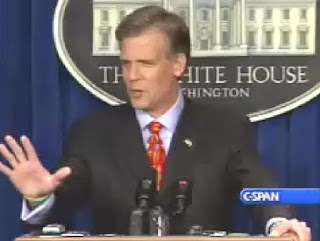
Tony Returns, Press Gaggle by Tony Snow VIDEO

ony Returns, Press Gaggle by Tony Snow 04/30/07Press Gaggle by Tony Snow, FULL STREAMING VIDEO, White House Conference Center Briefing Room, 10:26 A.M. EDT

PRESS CORPS: (Applause.)

Q Where ya been? (Laughter.)
MR. SNOW: Just hanging out. Thank you so much, it's great to be back.

Q We thought Rove double-deleted you. (Laughter.)

MR. SNOW: All right. Well, on that note, let me announce the President's schedule for today. He received normal briefings in the morning. There is ongoing a meeting with the U.S.-EU leaders in the Oval Office right now. There will be a working lunch with the U.S.-EU leaders at noon, and a joint press availability at 1:25 p.m. That will be a two-plus-two-plus two, for those keeping score.

At 2:15 p.m., a meeting with TransAtlantic Business Dialogue. It is something that was set up by the late Secretary of Commerce Ron Brown, designed to promote closer commercial ties between the United States and the European Union, creates a mechanism to encourage input to foster a more closely integrated transatlantic marketplace.

At 3:45 p.m., a photo opportunity with the FIRST award winners. FIRST was founded in 1989 to inspire young people's interest and participation in science and technology. The President will participate in a photo opportunity with winners of the FIRST Robotics Competition -- they are from Baltimore, Maryland.

Let me also just -- some personal comments -- and I'll try not to get choked up, so I'll go slow. You never anticipate this stuff, it just happens. I want to thank everybody in this room. You guys -- (thumbs up.) (Applause.) I'm getting there.

Q We're glad you're here.

MR. SNOW: Thanks. And thanks for the basket. (Laughter.) I want to thank you all. It really meant the world to me. Anybody who does not believe that thoughts and prayers make a difference, they're just wrong.

Q Take your time.

MR. SNOW: I will, thanks -- especially you. Just a couple things about my situation. I'm not trying to feel sorry for myself, I'm just going to stop being choked up, because you guys have been so wonderful.

I'm a very lucky guy. As I told you before, we were, out of an aggressive sense of caution, going to do an exploratory surgery that did indicate that I still have cancer. Now, I know the first reaction of people when they hear the word "cancer" is uh-oh. But we live in kind of a different medical situation than we used to. And I have been blessed to be treated by, supported by some of the finest doctors in the world. What we are going to do -- we had surgery, where we did disclose -- and there are some cancers in the peritoneum and we are going to attack them using chemotherapy -- I'll start chemotherapy this Friday.

The design is to throw it into remission and transform it into a chronic disease. If cancer is merely a nuisance for a long period of time, that's fine with me. There are many people running around -- and I must tell you, I have received a lot of notes from folks who have had far worse cases than I have, who have survived many years with the kind of regimen that we're talking about, which is chemo up front, and then maintenance chemo to continue combating cancer tells.

I won't tell you how it's going to work out, because I don't know. But we obviously feel optimistic, and faith, hope and love are a big part of all of it.

The other thing is that I hope folks out there who may either have cancer or have loved ones with cancer need to know a couple of things. First, don't go it alone. The support I've received from you and from my colleagues at the White House and people around the country has been an enormous source of strength. You can't -- there's no way to quantify it, but you feel it. You feel it in your heart. And in many ways, that may be the most important organ for recovery, to have the kind of spirit and to realize that, in my case, I'm unbelievably lucky and unbelievably blessed -- and really happy to be back.

The other thing is -- so don't go it alone, and the other thing is be of courage. Realize that in an age like ours, things are happening very rapidly in the medical realm. I'm taking a cancer cocktail this time around, a chemo cocktail that's going to contain two agents that were not in broad use two years ago. Things are moving very rapidly, and there's always hope.

Not everybody will survive cancer, but on the other hand, you've got to realize you've got the gift of life, so make the most of it. And that is my view, and I'm going to make the most of my time with you. I'll take questions.

Q Tony, has the White House been alerted when the Iran supplemental is coming down? And how quickly will the President act to veto it?

MR. SNOW: Okay, first, we can cut cameras now, because we have cut to the other portion of our thing.

As far as the Iran supplemental, we have not. So the real question --

Q Iraq.

MR. SNOW: I mean, the Iraq supplemental. Yes. The Iran supplemental would be entirely different. (Laughter.)

Q Did we leave the cameras on? (Laughter.)

Q How much is Iran -- (Laughter.)

MR. SNOW: As one famous host said, "I-r-a-k."

Q Oooh!

Q Oh, we love that. (Laughter.)

Q Are we still rolling? (Laughter.)

MR. SNOW: No, we're not.

No, so we don't know. Again, this is a question --

Q (Inaudible.)

MR. SNOW: No. And this is a question for Capitol Hill. It's now been passed for five days. We're not quite sure why it's been so difficult to convey it one mile up Pennsylvania Avenue, but we will get back to you when we know.

Q And why did the President talk without Hashimi yesterday? Why was he talking to the Deputy Prime Minister instead of the Prime Minister?

MR. SNOW: Well, the President has talked to the Deputy Prime Minister, as you know he's hosted him here, and he's had conversations with him before. Part of -- the President deals with leaders throughout the Iraqi government, and so to speak, with Mr. Al Hashimi, as well.

Q It's not trying to go around the --

Q Has the administration been notified of anyone else who might be resigning, relating to the D.C. madam?

MR. SNOW: Not that I'm aware of.

Q Does the President have any opinion on the departure of Randall Tobias?

MR. SNOW: Well, he's saddened by it, but it was the appropriate thing to do.

Q Tony, welcome back. A question from today's Washington Post. Will the President really take part in the Sharansky conference in Prague when he visits that city June 4th, June 5th?

MR. SNOW: That would -- Andre, I'll get back to you on that.

MR. JOHNDROE: Yes.

MR. SNOW: It's yes. The answer is, yes. Thank you.

Q Tony, can you give us any update on the war czar? It's been weeks and weeks since that story first broke, that you're looking for someone to supplement Mr. Hadley's job.

MR. SNOW: No, but when we have a personnel announcement, we'll make it.

Q Are you having difficulty finding anyone? Because it seemed they wanted someone right away.

MR. SNOW: Again, we're -- I'm not going to get into the process. We'll let you know when we have somebody.

Q The U.S.-EU, are they going to have some sort of global climate change agreement today?

MR. SNOW: Well, again, rather than jumping what you all will be able to hear about, everybody will have statements and questions at 1:25 p.m. But obviously a host of predictable issues before the U.S. and the EU -- economic cooperation, trade, energy, environment, such as climate change, security issues, joint security issues. So last year I know there was a very detailed agenda, and we got through a whole lot of items, and there is a similar situation this year. So I think I'll let the leaders address those in a few minutes.

Q Tony, can we look ahead to tomorrow's "mission accomplished" appearance at Central Command? I'm assuming that this was scheduled with the anniversary in mind.

MR. SNOW: No, it wasn't. No.

Q Really?

MR. SNOW: I don't think so. I did not see anything in the briefing notes that would indicate --

Q What is the -- is there a particular message behind this visit?

MR. SNOW: Yes, it's an annual conference at CENTCOM.

Q Tony, are we winning the war?

MR. SNOW: Are we winning the war?

Q Welcome back. (Laughter.)

MR. SNOW: Yes, exactly, welcome back. (Laughter.) You know, April, we're fighting the war, and it's an important thing to understand that the only way to lose the war is to walk away from it, and that this country not only has made a commitment to the people of Iraq, but the people of Iraq have made a commitment in blood and treasure, as well. And we are working to create a situation where that government, in fact, is going to be able to provide for its citizens, not only economically, but most importantly, a democracy that will respect the rights of all, that will protect those rights, and that will be able to stand tall among the community of nations.

Q How long should we fight the war before we just turn tail --

MR. SNOW: The notion that somehow the United States walks away and there are no consequences I think is the sort of thing that -- it doesn't make any sense. Think of it this way: The United States walks away, who stands to benefit? Answer, terrorists, al Qaeda, the people who are fighting democracy.

One of the reasons -- furthermore, if you are thinking about what goes on within the region, if you are a Middle Eastern power, if you're anybody in the region, and you see this happening, you're going to lose confidence in the United States of America. Let me put it this way: Our allies do not want us simply to leave on a timetable. The Iraqis do not want us to leave. People within the region do not want us to leave, because it does create the possibility of chaos and bloodshed on a horrific scale.

And, furthermore, what it will do is make us less secure as a nation. The fact that it is difficult does not mean that we should walk away from it. As a matter of fact, it is difficult precisely because you have a determined enemy, but we will demonstrate the determination to prevail in Iraq and to help the Iraqis prevail. This is the Iraqis' fight; we are there to assist. And we are building capability on the military side, on the security side, on the economic side and on the diplomatic side. That's part of what will happen in the Baghdad conference.

So the idea -- again, if we turn tail, to use your formulation, what it means is that we weaken ourselves, and we weaken ourselves not only over there, but on our own soil, as well.

Q So you're damned if you do and damned if you don't; you're weakening yourself now, going through equipment, going through troops. And then if you pull out, you damage --

MR. SNOW: No, the fact is, you understand that a military engagement -- if you describe yourself as weakening yourself every time you respond to an enemy, that doesn't strike me as the proper way to frame what happens in a military engagement of that sort. Americans don't like war. We understand that. But Americans also don't like the idea, I don't believe, of a policy that would strengthen al Qaeda, that would strengthen terrorists, that would weaken the United States, and would make us less secure.

It is a tough decision. The President understands that. And it is something that certainly does wear on the American people. But as Commander-in-Chief, the President has a solemn obligation to keep this country safe -- that is in tough times and in good times; that is also when polls are with him and polls are against him. But his obligation is to keep us safe, and he's determined to do that.

Q Why not set benchmarks with -- political benchmarks with consequences, given that there has been so little, if any, progress politically from the Iraqis?

MR. SNOW: Number one, it gets back to what you're saying. If you try to impose timetables, what you end up doing is you say to enemies, you know, all you have to do is create a little bit of chaos.

Q Setting benchmarks, not timetables -- political benchmarks for the Iraqis.

MR. SNOW: Well, if you set a political benchmark with penalties, that would imply that you have a timetable, that you have certain deadlines. A couple of points -- and Secretary Rice made some of these yesterday.

First, the Iraqis, themselves, have set up benchmarks, and they share them. The fact that they do not make progress as rapidly as we might like is frustrating. The President has made it clear, and he said it many times, that the patience of the American people is not unlimited. Meanwhile, as you know, the Iraqis have said -- the Council of Ministers has passed an oil law, and there is still activity along those lines. Some of the other issues may take longer. But the Iraqis share the same goals, and we continue to make it clear to them that they need to do -- they need to take these seriously and they need to move forward as rapidly as possible.

Meanwhile, you also have the situation where terrorists are being pretty clever about it: When things seem to be moving in a certain direction, you go ahead and you set up a series of coordinated bombings that's designed once again to reignite old hatreds between groups, or at least suspicions, and therefore, stall political progress.

So you have a whole series of things that affect the political situation. The Baghdad security plan is designed in a comprehensive way to try to address situations so that you can have more rapid political progress. Do we want to see more rapid political progress? Yes. But do we want to be binding people on the basis of artificial deadlines? No.

Q So you wouldn't rule that out in any sort of --

MR. SNOW: Again, I'm not going to negotiate. What's important right now, when we're talking about the supplemental is, let us give our troops the support they need now. We have already been forced to start reallocating money within the defense budget. By the 15th of this month, it's going to become more acute, and all of a sudden, people say they support the troops are going to have to explain why if they support the troops, number one, they drag their feet on sending a supplemental to the White House. Again, they passed it five days ago. It shouldn't -- it's a pretty simple procedure. In fact, I could walk down and pick it up today. But, apparently, it's still -- some difficulty in making its way from Capitol Hill.

But the President understands that people wanted to make a political statement. Fine. Now step forward rather than having military families suffer and equipment -- not being able to replace equipment as rapidly as necessary or proper, let's go ahead and get on with this and get the bill passed. And the President has made it clear that he wants to sit down with bipartisan leadership, bicameral leadership on Wednesday. He's down at CENTCOM tomorrow, and we'll see how quickly we can get it done. He does feel confident and optimistic that we're going to get --

Q Just a follow up. Isn't it possible, though, that the Bush administration could set up those political benchmarks for the Iraqis without necessarily setting up a military timetable or deadline --

MR. SNOW: Again --

Q -- but use, perhaps, resources, money to pull out some of that if the Iraqis --

MR. SNOW: Again, I think --

Q -- don't manage to meet those requirements.

MR. SNOW: I think what you -- in other words, what you're going to say is, we are going to weaken you if you don't move fast enough. I think the most important thing you've got to do is demonstrate -- number one, you're got to do whatever you can to assist the Iraqis to move quickly. You also have to demonstrate good faith.

A lot of times, you have to ask yourself the question, who are you -- who's behavior are you really going to influence with certain actions? Will you encourage the Iraqis, or will you, in fact, give aid and encouragement to the people who are trying to make the government fail?

Having said that, I'm not going to get up here and start negotiating what may be discussed between the President and bicameral-bipartisan leadership. But he's made it clear what his position is, and he's made it clear for a very long time. People on the Hill have known for three months what the President's position is, and a clear veto message has been out for over a month. And so the fact is the symbolic vote has taken place, everybody come back now; once you finish this up, done your symbolic stuff, come back and do your real work.

Q If the military can't be used as a leverage, then would the administration be willing to use financial aid as a possible leverage if the Iraqi's don't cooperate?

MR. SNOW: Well, I'm not going to -- again, I'm not getting into sort of gaming this other than to say, we work to assist the Iraqis. And the assumption of the question is that the Iraqis don't want progress. They do. It's tough. And, therefore, what you're assuming is they don't really want to do it, but if we punish them, then that will change behavior. And what I'm saying is be careful, because if you set up punishments, you may change behavior for the worse by, in fact, strengthening the hands of the people who want the democracy to fail.

So you have to take all those into account when you're considering policy.

Q A point of order, if I may. You've inserted twice, and alluded a third time, that the fact that they want the same things we do. I would suggest that that's not at all apparent, from their behavior. And if it's not, in fact, the case, then how does --

MR. SNOW: First, you've got 20 million Iraqis. It is pretty clear that al Qaeda -- their behavior does not --

Q I'm not talking about al Qaeda, I'm talking Iraqis.

Q The Iraqi government.

MR. SNOW: Well, the Iraqis -- well, no, again, you take a look -- the Council of Ministers has passed an oil law. Now you have to go through the business of getting something passed by the parliament. I would just point you to Capitol Hill, where things are not moving as rapidly as leaders there thought would happen when they convened this year. No, I'm just saying democracy is not always as prim and predictable as one might think.

The second thing is, if you take a look at the Baghdad security plan, there are 80,000 people providing security in Baghdad right now; the majority of them are Iraqis. Iraqis have been laying down their -- laying their lives on the line. They still continue, after numerous attacks on police and military sites --

Q Yes, but where does the security work? The security works where there are American troops.

MR. SNOW: Well, but you also see that there has been -- well, go to Anbar. What you have seen there is a shift on the part of tribal leaders -- it's been documented in a number of places in recent days that there has, in fact, been tangible improvement because you have seen a change in the behavior on the part of Iraqis who in the past had not been so assertive against al Qaeda.

So I think it's very difficult to generalize. There are situations that -- there are differences in situations, neighborhood to neighborhood, within Baghdad. But if you take a look at what the Iraqi people have done -- risking their lives to vote, risking their lives to serve -- I think it is pretty clear that they do, in fact, want a stable democracy, and it is a tough thing to do.

Q Let me follow up on that. I think it was either today or yesterday in the Post, a story about the removal of some Iraqi commanders who had gone after Shiite militias. I mean, so --

MR. SNOW: And there have also been stories of fractures within the Mahdi army. But let me put it this way: We're aware of the stories and we're concerned about them, and those are the kinds of things we do discuss with the Iraqis. It is vital for the success of an Iraqi democracy to have security forces that will enforce the law fairly, regardless of who you are or regardless of what group you belong to. We've said it many times, and that continues to be a point of emphasis.

Q But then do you guys -- that example, do you see that as lower down the ranks, or is that the Maliki government not wanting to go too aggressively after Shiite militias?

MR. SNOW: Again, it's -- if you've taken a look at what's gone on, there has been aggressive action within Baghdad in Shia neighborhoods. At this point, I don't want to get too far into trying to prospect what may happen. Keep in mind, we are not yet halfway into full deployment within the Baghdad security plan, and we're continuing to work with the government of Iraq. But, again, we're aware of the reports, we're concerned about them, and that will be a focus of conversations.

Q Tony, is the President at all taken aback by what George Tenet is writing and saying? Is he surprised that Tenet feels scapegoated?

MR. SNOW: I don't know -- I can't -- I haven't had a chance to talk with him about it, Mark, but I think -- Secretary Rice made it clear that she was a little surprised, because George Tenet is somebody who served the nation well. And it is a tough business to be director of the Central Intelligence Agency.

But the idea that you're scapegoated was a surprise. He felt strongly about the pre-war intelligence, as did people on both sides of the aisle -- Jay Rockefeller, as well as Jon Kyl. You know, you had three-quarters of the United States Senate standing up and talking -- voting on a war resolution, many people talking about imminent threats. And the intelligence was shared not only within the intelligence community in the United States, with the White House and our intelligence agencies, and the intelligence committees on Capitol Hill, but also foreign intelligence operations.

And, obviously, there were some real problems with that intel, which is one of the reasons why there has also been, on a bipartisan basis, an effort to overhaul in a very comprehensive way the way we go about the business of intelligence. So we do not believe he was scapegoated, but he certainly has his first amendment right to lay out his view.

Q Tony, what Tenet is saying publicly now is what we were being told privately at the time, which was that the CIA's intelligence was not nearly as strong as the advice the President was getting from the Defense Intelligence Agency and others, and that their admonitions were not being listened to, if you will, by the White House.

MR. SNOW: I'm not going to go back and flyspeck, but the fact is that everybody got listened to. And Secretary Rice -- no, Wendell, it's interesting. The notion that somehow going into a time of war that the President would not take seriously every piece of intelligence or opinion he would get from qualified people is preposterous.

Q That's one way of putting it, Tony. But the other way of looking at it is the President would not take as seriously what he did not want to hear.

MR. SNOW: Well, that' not the way he operates. I'm sorry, but the President is not the kind of guy who says, tell me what I want to hear. As a matter of fact, you sit in a meeting and you try to do that, you're not going to get very far. What the President wants and demands of his people is -- are their best opinions and their best advice, and that's the way it operates. So --

Q He got a lot of lousy advice, didn't he?

MR. SNOW: Well, he got some advice that -- you know, it's interesting, Bill, you can say about any war that Commanders-in-Chief got lousy advice, because wars never work out quite the way you planned. But what does have to happen is that you have to follow through so that you do have success.

Q Tony, two for you. One is, could you share with us some thoughts about the White House's view of Prime Minister Olmert? The report on the war in Lebanon just came out fairly critical of his handling of it. How important is he to the Middle East peace process? And what does the President make of him as a leader?

MR. SNOW: Well, obviously, he works very closely with Prime Minister Olmert, and thinks that he's essential in working toward a two-state solution. The President remains committed to it. We're not going to comment on, obviously, internal investigations within the Israeli government.

Q The other is that on January 11th, Secretary Rice said that the Iraqi government had two to three months to convince the population that it would apply security fairly, treat everyone fairly, whether -- regardless of their religious or ethnic background. Do you think it's met that timetable --

MR. SNOW: I don't know, it's -- again, I would defer questions like that, at this juncture, to folks who are closer to the realities on the ground. It is clear that there has been some progress in some areas. But on the other hand, as General Petraeus has also said, it's going to take a while to continue not only deploying folks in support of the Baghdad security plan, these things do take time.

But, Olivier, the core of your question, is this a violent essential element in having a successful Iraqi democracy? The answer is, yes.

Les.

Q Tony, welcome back.

MR. SNOW: Thank you, sir.

Q I will say that you had a skillful substitute.

MR. SNOW: You know what, thank you. I have -- I want to thank -- what a selfish idiot. Dana and everybody else in the press office have done an extraordinary job. And that should have been the first thing out of my mouth, because the support I got from the White House was absolutely astounding. So yes, a star has been born.

Go ahead.

Q Two questions, Tony. Do you, as presidential press secretary, believe that The Washington Post, in its two extensive stories, gave too much coverage to Deputy Secretary of State Randall Tobias or not?

Q Dana, do you want to take this one? (Laughter.)

MR. SNOW: Les, I am here to speak for the President, and I guarantee you he is not going to have an opinion, either. The Washington Post can -- has its own editorial judgment, and we will let it stand.

Q Follow up on that. Ambassador Tobias --

MR. SNOW: You're going to follow up on the question I didn't answer. (Laughter.)

Q Yes. Ambassador Tobias --

Q Good to have you back. (Laughter.)

Q -- told ABC News that he used Deborah Palfrey's escort service for massages, not sex. Do you believe that many, or any American citizens believe that?

MR. SNOW: I don't know. Look, the guy -- I've told you what I'm going to say. We're saddened, and he resigned, and it was the proper thing to do.

Q Thank you, Tony. And welcome back.

MR. SNOW: Thank you.

Q Last night on "60 Minutes," Director Tenet used some unusually strong language about the Valerie Plame business, in which he said that "that was wrong," her unmasking by the White House, and --

MR. SNOW: Wait, I want to step in, because number one, your characterization does not, in fact, square with the facts of trial.

Q Scott Pelley's characterization --

MR. SNOW: Which would be incorrect.

Q All right. So Pelley's characterization, when he said the White House retaliated, was wrong?

MR. SNOW: That's wrong. That's wrong.

Q Okay. And then Tenet said, "The whole business had a chilling effect on his agency." Your response?

MR. SNOW: No, no, no, no. Again, he has his right to free speech and his characterization, but I'm not going to respond to that.

Q Do you expect there to be one on one talks with Iran this week?

MR. SNOW: It's a question that often comes up. There have been a number of occasions, and I've outlined these before, where we have had so-called one on one conversations with Iran in the context of other issues, in Sharm el-Sheikh and other places, where, for instance, if there are to be conversations with the Iranians, these will not be things that betoken a change in the diplomatic status, they will not be on issues that are unrelated to Iraq. And we have had conversations like that with them before. And as a matter of fact, there was at one time an offer to deal on a government-to-government basis on security issues, and it was the Iranians who ended up turning down the offer.

So there may be conversations, but as Secretary Rice said, if there were, they would involve issues such as the impropriety of sending weaponry over the border or the importance of making sure that terrorists are not making their way into the country, the importance of supporting rather than undermining the government of Iraq, and so on. So it is -- it's not the case, in other words, that there would be -- there would not be conversations about other unrelated matters.

Q But she can't control the whole conversation.

MR. SNOW: No, but she can control what she discusses, which is unlike what I'm able to do with --

Q Tony?

MR. SNOW: Go ahead, Mark.

Q Hang on, I thought --

MR. SNOW: Okay, Victoria, yes.

Q And going back to Iraq, given all the things you've said this morning, when, then, do you think could we expect to see U.S. forces out of Iraq?

MR. SNOW: I don't know.

Q Do you have any clue?

MR. SNOW: Again, that's really a question to address to General Petraeus. The fact is, to get up and make predictions, first, is an act of pure folly because you are always hostage to changing events on the ground and changing situations. What we've been trying to do is to respond as nimbly to changing circumstances and also to learn from them. The President has spent a lot of time ordering people to take a good, close look at everything in Iraq and Afghanistan; we've adjusted tactics and strategy -- to get back to our old conversations -- so that we have a more effective approach that, in fact, makes the governments of Iraq and Afghanistan more capable of standing on their own.

What the timetable may be, I don't know. General Petraeus I think is the person who is probably best suited, and he doesn't try to answer that question definitively because it's not humanly possible.

Q What do you make of Saudi King Abdullah refusing to meet with Prime Minister al Maliki?

MR. SNOW: That is -- at this point, that is a dispute between the two nations. We think it's important that nations in the region understand the importance of an Iraqi democracy that can stand up and also can serve as a bulwark against terrorism, which is a threat to all nations in the region, whether they be Sunni, Shia, or other.

Q Just one quick one. You said -- back to Randall Tobias. If, as he says, he just got massages, why is it the proper thing for him to do to resign?

MR. SNOW: Well, he apparently thought that it was the proper thing to do, and I will not get into details because I don't know them. Whew! (Laughter.)

Q Estonia and monuments, are you aware of what's happening there?

MR. SNOW: No, but get back to me, I'll get you an answer.

Q Thank you.

MR. SNOW: Thanks, everybody. Thank you again.

Q Thank you. Welcome back. (Applause.)

END 10:57 A.M. EDT For Immediate Release, Office of the Press Secretary, April 30, 2007.

Technorati Tags: and or and ,

Sunday, April 29, 2007

'Exercise pill' switches on gene that tells cells to burn fat

'Exercise pill' switches on gene that tells cells to burn fat, Makes normal mice resistant to weight gain on high-fat diet.

Genomic regions, transcripts, and products, national library of medicine.
Genomic regions, transcripts, and products
By giving ordinary adult mice a drug - a synthetic designed to mimic fat - Salk Institute scientist Dr. Ronald M. Evans is now able to chemically switch on PPAR-d,
the master regulator that controls the ability of cells to burn fat.
Genomic context, national library of medicine.
Genomic context
Even when the mice are not active, turning on the chemical switch activates the same fat-burning process that occurs during exercise.
The resulting shift in energy balance (calories in, calories burned) makes the mice resistant to weight gain on a high fat diet. PPARD peroxisome proliferator-activated receptor delta

The hope, Dr. Evans told scientists attending Experimental Biology 2007 in Washington, DC, is that such metabolic trickery will lead to a new approach to new treatment and prevention of human metabolic syndrome. Sometimes called syndrome X, this consists of obesity and the often dire health consequences of obesity: high blood pressure, high levels of fat in the blood, heart disease, and resistance to insulin and diabetes.

Dr. Evan’s Experimental Biology presentation on April 30 is part of the scientific program of the American Society for Biochemistry and Molecular Biology.

This chemical switch is not the first success Dr. Evan’s laboratory has had in being able to turn on the PPAR-d switch in adipose or fat cells, activating local metabolism and increasing the amount of calories burned. As a Howard Hughes Medical Investigator at The Salk Institute’s Gene Expression Laboratory, Dr. Evans discovered the role of the gene for PPAR-d, the master regulator of fat metabolism. By permanently turning on this delta switch in mice through genetic engineering, he was able to create a mouse with an innate resistance to weight gain and twice the physical endurance of normal mice. Because they were able to run an hour longer than a normal mouse, they were dubbed "marathon mice."

Subsequent work in the Evans laboratory found that activation of PPAR-d in these mice also suppresses the inflammatory response associated with arthrosclerosis.

But the genetic metabolic engineering that created the marathon mouse is permanent, turned on before birth. While a dramatic proof of concept that metabolic engineering is a potentially viable approach, it offers no help to an adult whose muscles are already formed and who now would benefit greatly from having more active, fat-burning muscles.

That is why the potential of chemical metabolic engineering - possibly a one-a-day pill as opposed to permanent genetic metabolic engineering - is so exciting, says Dr. Evans. In today’s society, too few people get an ideal amount of exercise, some because of medical problems or excess weight that makes exercise difficult. Having access to an "exercise pill" would improve the quality of muscles, since muscles like to be exercised, and increase the burning of energy or excess fat in the body. And that would result in less fatty tissue, lower amounts of fat circulating in the blood, lower blood glucose levels and less resistance to insulin, lowering the risks of heart disease and diabetes.

The ability to chemically engineer changes in metabolism also has given the researchers more insight into how the PPAR-d switch works, says Dr. Evans. Genetically engineering changes in metabolism in the marathon mice triggers both increased fat burning and increased endurance. Adult normal mice that receive the drug to switch on PPAR-d show increased fat burning and resistance to weight gain, but they do not show increased endurance. Dr. Evans says this suggests the delta switch can operate in different modes, and the laboratory is in the process of figuring out exactly how. He hopes his strategy will make it possible. ###

Contact: Sylvia Wrobel ebpress@bellsouth.net 770-270-0989 Federation of American Societies for Experimental Biology

Technorati Tags: and or and or and or

Saturday, April 28, 2007

Mike Huckabee Zeitgeist

Mike Huckabee Zeitgeist Campaign 2008 as Posted and un-edited. Updated 24/7. This series will spotlight the republican candidates in real time and we hope with an unbiased view. The parameters are the widest possible to return the most meaningful results. The experiment is ment to capture the Zeitgeist and therefor the true nature of the race. Let the games begin explorehuckabee.com


More Flickr photos of Mike Huckabee

Technorati Tags:

Freedom Calendar 04/28/07 - 05/05/07

April 28, 1971, Rear Admiral Samuel Lee Gravely becomes first African-American to achieve Flag Rank in U.S. Navy, promoted by President Richard Nixon.

April 29, 1877, Death of Republican Gov. William Brownlow, who led fight for Tennessee’s ratification of 14th Amendment guaranteeing due process and equal protection of the laws.

April 30, 1862, African-American Republicans in New Orleans establish L’Union, first African-American newspaper in South.

May 1, 1981, President Ronald Reagan proclaims first Jewish Heritage Week.

May 2, 1963, Republicans condemn Democrat sheriff of Birmingham, AL for arresting over 2,000 African-American schoolchildren marching for their civil rights.

May 3, 1876, Birth of Isaac Leevy, South Carolina African-American Republican who established Lincoln Emancipation Clubs in 1940s to enable African-Americans to vote.

May 4, 1811, Birth of Republican Harriet Beecher Stowe, author of Uncle Tom’s Cabin.
(editors note: this entry is incorrect. it should read June 14. 1811, thanks to an anonymous poster, see comments)

May 5, 1983, Hispanic Republican Patricia Diaz Dennis appointed by President Ronald Reagan as first Hispanic woman on National Labor Relations Board; later served as FCC Commissioner under Reagan and as Regent of Texas State University under Gov. George W. Bush.

“This country will not be a permanently good place for any of us to live in unless we make it a reasonably good place for all of us to live in.”

Theodore Roosevelt, 26th President of the United States

Technorati Tags: and or and or and or and or and or or and or

Presidential Podcast 04/28/07

Presidential Podcast 04/28/07 en Español. In Focus: Immigration, Click here to Subscribe to Our Republican National Convention Blog Podcast Channel with Odeo Subscribe to Our Odeo or Click here to Subscribe to Our Republican National Convention Blog Podcast Channel with Podnova podnova Podcast Channel and receive the weekly Presidential Radio Address in English and Spanish with select State Department Briefings. Featuring full audio and text transcripts, More content Sources added often so stay tuned.

Technorati Tags: and or and

Bush radio address 04/28/07 full audio, text transcript

President George W. Bush calls troops from his ranch in Crawford, Texas, Thanksgiving Day, Thursday, Nov. 24, 2005. White House photo by Eric Draper.bush radio address 04/28/07 full audio, text transcript. President's Radio Address en Español. In Focus: Immigration
Click here to Subscribe to Our Republican National Convention Blog Podcast Channel with Odeo Subscribe to Our Odeo or Click here to Subscribe to Republican National Convention Blog's PODCAST with podnova podnova Podcast Channel and receive the weekly Presidential Radio Address in English and Spanish with select State Department Briefings. Featuring real audio and full text transcripts, More content Sources added often so stay tuned.

THE PRESIDENT: Good morning. This weekend, I am traveling to Florida to address the graduating class of Miami Dade College. This college serves one of our Nation's most vibrant and diverse communities. Miami is home to people whose families have been in our country for generations -- and to people who have only just arrived. This diversity is one of the great strengths of that city -- and it is one of the great strengths of our country.

The opportunities America offers make our land a beacon of hope for people from every corner of the world. America's ability to assimilate new immigrants has set us apart from other nations. In this country, our origins matter less than our dreams. What makes us Americans is our shared belief in democracy and liberty. Our Nation now faces a critical challenge: to build an immigration system that upholds these ideals and meets America's needs in the 21st century.

In Washington, we are in the midst of an important discussion about immigration. Our current immigration system is in need of reform. We need a system where our laws are respected. We need a system that meets the legitimate needs of our economy. And we need a system that treats people with dignity and helps newcomers assimilate into our society.
We must address all elements of this problem together, or none of them will be solved at all. And we must do it in a way that learns from the mistakes that caused previous reforms to fail. So I support comprehensive immigration reform that will allow us to secure our borders and enforce our laws, keep us competitive in the global economy, and resolve the status of those already here -- without amnesty, and without animosity.

I know convictions run deep on the matter of immigration. Yet I am confident we can have a serious, civil, and conclusive debate. My Administration is working closely with Members of Congress from both sides of the aisle. We are addressing our differences in good faith, and we are working to build consensus. And I am pleased that some of those who had doubts about comprehensive reform last year are now open to supporting it.

There is a desire on the part of Republicans and Democrats alike to get this problem solved. And by working together, we can enact comprehensive immigration reform this year.

Our Nation deserves an immigration system that secures our borders and honors our proud history as a nation of immigrants. By working together, we will enforce our laws and ensure that America forever remains a land of opportunity and a great hope on the horizon.

Thank you for listening.

END

For Immediate Release, Office of the Press Secretary, April 28, 2007

Technorati Tags: and or and

Discurso Radial del Presidente a la Nación 04/28/07

Presidente George W. Bush llama a tropas de su rancho en Crawford, Tejas, día de Thanksgiving, jueves, de noviembre el 24 de 2005.  Foto blanca de la casa de Eric Draper.forre el audio de la dirección de radio 04/28/07 por completo, transcripción del texto. (nota de los redactores: ninguna lengua española mp3 lanzó esta semana, apesadumbrada) PODCAST
Chascar aquí para suscribir a nuestro canal republicano de Blog Podcast de la convención nacional con Odeo Suscribir a nuestro canal de Podcast de Odeo o del podnova Chascar aquí para suscribir a nuestro canal republicano de Blog Podcast de la convención nacional con Podnova y recibir la dirección de radio presidencial semanal en inglés y español con informes selectos del departamento del estado. Ofreciendo transcripciones audio y con texto completo verdaderas, más fuentes contentas agregaron a menudo así que la estancia templó.

Buenos Días. Este fin de semana viajaré a Florida para hablar delante de la clase que se gradúa de la Universidad Miami Dade. Esta universidad sirve a una de las comunidades más vibrantes y diversas de nuestra Nación. En Miami viven personas cuyas familias han estado en nuestro país por generaciones - así como personas que acaban de llegar. Esta diversidad es una de las grandes fuerzas de esa ciudad - y es una de las grandes fuerzas de nuestro país.

Las oportunidades que Estados Unidos ofrece hacen de nuestra tierra un faro de esperanza para personas de todos los rincones del mundo. La capacidad de Estados Unidos de asimilar a nuevos inmigrantes nos pone aparte de las demás naciones. En este país, nuestros orígenes importan menos que nuestros sueños. Lo que nos hace estadounidenses es nuestra creencia compartida en la democracia y la libertad. Nuestra Nación ahora enfrenta un desafío crítico: el de construir un sistema de inmigración que mantenga en alto estos ideales - y que cumpla con las necesidades de Estados Unidos en el siglo 21.

En Washington, estamos en medio de una discusión importante sobre la inmigración. Nuestro actual sistema de inmigración necesita reforma. Necesitamos un sistema donde nuestras leyes sean respetadas. Necesitamos un sistema que satisfaga las necesidades legítimas de nuestra economía. Y necesitamos un sistema que trate a las personas con dignidad y ayude a los recién llegados a asimilarse en nuestra sociedad.

Debemos prestar atención a todos los elementos de este problema juntos - o ninguno será resuelto. Y debemos hacerlo de manera que se aprenda de los errores que hicieron que reformas anteriores fracasaran. Por lo tanto yo apoyo una reforma migratoria integral que nos permita proteger nuestras fronteras y hacer cumplir nuestras leyes, que nos mantenga competitivos en la economía global y que resuelva la situación de los que ya están aquí - sin amnistía y sin animosidad.

Yo sé que hay profundas convicciones en torno a la inmigración. Pero yo confío que podemos tener un debate serio, civil y definitivo. Mi administración está trabajando de cerca con miembros del Congreso de ambos lados del pasillo. Estamos tratando nuestras diferencias en buena fe - y estamos trabajando para crear un consenso. Y me agrada que algunos de los que tenían dudas el año pasado sobre una reforma integral ahora estén dispuestos a apoyarla. Hay un deseo de parte tanto de Republicanos como de Demócratas de que este problema se resuelva. Y trabajando juntos podemos aprobar una reforma migratoria integral este año.

Nuestra Nación merece un sistema de inmigración que proteja a nuestras fronteras - y que honre nuestra historia orgullosa como una Nación de inmigrantes. Trabajando juntos, haremos cumplir nuestras leyes y aseguraremos que Estados Unidos sea siempre una tierra de oportunidad y una gran esperanza en el horizonte.

Gracias por escuchar. ###

Para su publicación inmediata, Oficina del Secretario de Prensa, 28 de abril de 2007

Etiquetas De Technorati: , y

Friday, April 27, 2007

Tom Tancredo Zeitgeist

Tom Tancredo Zeitgeist Campaign 2008 as Posted and un-edited. Updated 24/7. This series will spotlight the republican candidates in real time and we hope with an unbiased view. The parameters are the widest possible to return the most meaningful results. The experiment is ment to capture the Zeitgeist and therefor the true nature of the race. Let the games begin teamtancredo.org


Technorati Tags:

Around the Services David Petraeus 04/27/07 VIDEO

The tree of Liberty needs to be watered from time to time with the blood of patriots and tyrants. Thomas Jefferson 3rd president of US (1743 - 1826)

Around the Services 27 April 2007 A senior military leader says there is progress being seen in Iraq. /SOCOM celebrates 20 years. /Musician John Mellencamp visits servicemembers at Walter Reed Army Medical Center.

Pentagon Briefing 26 April 2007, GEN David Petraeus, Multi-National Force-Iraq Commander GEN David Petraeus speaks with reporters at the Pentagon, providing an update on ongoing security operations in Iraq.

Petraeus: Interrogations Reveal Iranian Influence in Iraq By Sgt. Sara Wood, USA. American Forces Press Service. Biographies: Gen. David H. Petraeus, USA

WASHINGTON, April 26, 2007 – Through interrogations of key detainees in the past month, the United States has learned a great deal about Iranian involvement in terrorist activities in Iraq, specifically the financing and training of insurgent groups, the commander of U.S. forces in Iraq said here today.
The interrogation of leaders and members of the Qazali terror network who have been in detention for more than a month revealed that Iran provided the network substantial funding, training on Iranian soil, advanced explosive munitions and technologies as well as arms and ammunition, and in some cases advice and even a degree of direction, Army Gen. David H. Petraeus, commander of Multinational Force Iraq, said in a Pentagon news conference.

When these terrorists were captured, coalition forces discovered a number of documents describing attacks on U.S. forces, including a 22-page memorandum that detailed the planning, preparation, approval process and conduct of the Jan. 20 attack on the Provincial Joint Coordination Center in Karbala, Iraq, that killed five U.S. soldiers, Petraeus said.

“Our sense is that these records were kept so that they could be handed in to whoever it is that is financing them,” he said. “And there's no question, again, that Iranian financing is taking place through the Quds force of the Iranian Republican Guards Corps.”

The U.S. has learned more about Iranian involvement in Iraq through the detention of one of the heads of the Sheibani network, which brings explosively formed projectiles into Iraq from Iran, Petraeus said. This leader’s brother was in Iraq, and was the conduit who received munitions from Iraq and distributed them among the extremist elements.

“Those munitions, as you know, have been particularly lethal against some of our armored vehicles and responsible for some of the casualties, the more tragic casualties, in attacks on our vehicles,” Petraeus said.

The coalition has not found a link between Iran and the spectacular car bomb attacks in Iraq, Petraeus said, as many of these attacks are conducted by foreign fighters coming into the country through Syria. Also, the U.S. has no evidence that indicates how high in the Iranian government the knowledge of this involvement goes, he said.

Petraeus called Iran’s activities “exceedingly unhelpful” as Iraqi leaders and security forces battle al Qaeda, extremist militias, sectarian violence, and limited political capacity to rebuild society. The situation in Iraq is exceedingly complex and challenging, he said, and while there have been successes under the new security plan, perseverance will be needed for the coming months.

“Success will take continued commitment, perseverance and sacrifice, all to make possible an opportunity for the all-important Iraqi political actions that are the key to long-term solutions to Iraq's many problems,” Petraeus said. “Because we are operating in new areas and challenging elements in those areas, this effort may get harder before it gets easier.”

Technorati Tags: and or and , or and or and , or and or

Thursday, April 26, 2007

Malaria Awareness Day, African Dance and Drums PODCAST VIDEO

President George W. Bush and Mrs. Laura Bush take the stage with the Kankouran West African Dance Company after delivering remarks during a ceremony marking Malaria Awareness Day Wednesday, April 25, 2007, in the Rose Garden. White House photo by Eric Draper.President and Mrs. Bush Discuss Malaria Awareness Day FULL STREAMING VIDEO, Rose Garden Malaria Awareness Day, 2007 and President's Malaria Initiative 1:10 P.M. EDT. PODCAST OF THIS ARTICLE
MRS. BUSH: Welcome, everyone, to the White House. Thank you very much for being a part of this Malaria Awareness Day.

Today, citizens around the world are making a historic commitment to end malaria. In European capitals, parliaments are debating how their governments can help. In Ontario, Canadians are commemorating their first World Malaria Day by raising money for bed nets for Uganda. Across the continent of Africa, people are teaching their families, friends, and neighbors how to protect themselves from this deadly disease.
Here in the United States, concerned citizens are spreading the word about our moral obligation to defeat malaria. This disease claims more than a million lives every year. It devastates people living with HIV/AIDS, pregnant women, babies and children. Somewhere in Africa, a mother loses her baby to malaria every 30 seconds.Members from the Kankouran West African Dance Company performs during a ceremony marking Malaria Awareness Day Wednesday, April 25, 2007, in the Rose Garden. White House photo by Eric Draper.
The American people, through their government, are working to end this epidemic. In 2005, President Bush announced the President's Malaria Initiative -- a five-year, $1.2 billion program to combat malaria in the hardest-hit African nations. So far, the initiative has distributed life-saving medicines, insecticide sprays, and mosquito nets to millions of Africans.

The initiative calls on developed countries, private foundations, religious institutions, volunteer groups, and individual citizens to reduce the suffering and death caused by malaria. The good news is that there's something simple and inexpensive that all of us can do to help. One of the best protections against malaria is a long-lasting, insecticide-treated bed net. Only a fraction of African homes have the mosquito net they need, but any individual who can raise $10 can buy a bed net, and save a life.

Throughout our country, caring citizens are answering this call to help. In sports leagues, in Boys and Girls Clubs, and in church groups, Americans are raising money for mosquito nets. And they're raising awareness about malaria. In school, children are learning about the disease, and what they can do to defeat it. This morning, I visited the Friendship Public Charter School here in Washington, where first graders and I read Nets are Nice. Nets are Nice is a picture book that teaches American children what they can do for children in Africa.

Later, fifth grade students and government officials teamed up to play Malaria Jeopardy. Turns out our Malaria Coordinator, Admiral Ziemer, is a pretty tough competitor. (Laughter.) Inside the gym, the fifth graders had a hoops-shooting contest. For every basket the students made, the NBA and the WNBA's "Nothing But Nets" program donated a bed net to Africa. The kids did so well, "Nothing But Nets" is announcing a contribution of $5,000 dollars to purchase 500 bed nets in Africa. And we have a few of those players here with us today. Where are they? Do you all mind standing up? Thanks so much for being a part of it. (Applause.) Thanks, you all, and thanks to the NBA and the WNBA.

These events encourage kids to reach out to children in Africa, and they instill in our next generation America's compassion for people in need.
President George W. Bush and Mrs. Laura Bush stands with the Kankouran West African Dance Company after delivering remarks during a ceremony marking Malaria Awareness Day Wednesday, April 25, 2007, in the Rose Garden. 'The American people, through their government, are working to end this epidemic,'said President Bush. 'In 2005, President Bush announced the President's Malaria Initiative -- a five-year, $1.2 billion program to combat malaria in the hardest-hit African nations.' White House photo by Eric Draper.Today, I'm delighted to announce a new project. With the Global Business Coalition, the American people -- through the Malaria Initiative, and the President's Emergency Plan for AIDS Relief -- will provide half-a-million bed nets to the nation of Zambia. (Applause.)
President Bush announced Zambia as a PMI focus country in December, at the White House Summit on Malaria. In Zambia -- a country of 10 million people -- there are roughly 4 million documented cases of malaria every year. Adding to the crisis is a high prevalence of HIV/AIDS. More than a million Zambian adults and children are living with HIV -- which means their immune systems are more susceptible to malaria. Malaria kills 50,000 Zambians every year.

Through the new partnership we're announcing today, mosquito nets will be distributed to Zambia's most vulnerable households. With help from the RAPIDS Consortium, they'll reach about 1 million young children, pregnant mothers, and people infected with HIV -- almost 10 percent of Zambia's population. These nets will help mothers sleep soundly at night, knowing that their babies are safe. They'll help people with HIV live positively. And they'll give a country devastated by malaria the promise of good health and renewed hope. Thank you to everyone here who's made this partnership possible.

This summer, I'll visit Zambia to observe the net distribution. And I'm looking forward to traveling throughout Africa, to meet people who are working to overcome malaria and other obstacles to development. On my past trips to Africa, I've heard tragic stories about the human toll of diseases like malaria and HIV/AIDS. But I've also been inspired by the men and women who've told me these stories -- men and women who are determined to secure opportunity, prosperity, and good health for their children.

The American people are proud to stand with them. Our country believes that every life, in every land, has value and dignity. And on this first Malaria Awareness Day, we look to the millions of lives threatened by this disease, and we reaffirm our commitment to saving them.

Thanks to each and every one of you for your work to help defeat malaria. Now I'd like to introduce someone else I know who's determined to end this epidemic: Ladies and gentlemen, my husband, President George W. Bush. (Applause.)

THE PRESIDENT: Thank you for coming. Welcome to the White House. The Rose Garden has witnessed many historic events. This afternoon we gather to mark something completely new, the first ever Malaria Awareness Day in the United States, and I'm glad you're here to join us. (Applause.)

On Malaria Awareness Day, we focus our attention on all who suffer from this terrible disease -- especially the millions on the continent of Africa. We remember the millions more who died from this entirely preventable and treatable disease. As a compassionate nation, we are called to spread awareness about malaria -- and we're called to act. That's what compassionate people do. When they see a problem, they act. And that's what we're here to talk about. On this special day, we renew our commitment to lead the world toward an urgent goal, and that is to turn the tide against malaria in Africa, and around the globe.

I want to thank Laura for being my wife -- (laughter) -- and taking the lead on this. (Applause.) Mr. Secretary, thank you for joining us. Mike Leavitt, the Department of Health and Human Services. Ambassador Randy Tobias. He now runs USAID. Prior to this job, he led America's monumental effort to confront and deal with the HIV/AIDS epidemic on the continent of Africa. Thank you for your leadership. Karen P., it's good to see you. Ambassador Hughes is with us.

Admiral Ziemer. So if you want to solve a problem, you put a problem solver in charge. And that's what Admiral Ziemer does. He's a problem solver. It makes it easier for me, when I say to other nations -- like with President Lula. He came to visit at Camp David. We were trying to figure out ways we could work together to show our hemisphere and the world that Brazil and the United States shares a compassion about people. And so I said, why don't we work together to eradicate malaria in parts of Africa? Call Ziemer. (Laughter.) He'll see to it that the strategy gets implemented. To show that we're a serious nation, we have named a coordinator, somebody in charge. It's important for me and Laura to know that a good man is handling this responsibility to implementing a strategy. Appreciate what you're doing. I know you know that we take this initiative seriously.

Mr. Chairman, Donald Payne, thank you for coming. We're proud you're here. I respect you, and I respect your concern for the people of Africa, and to make sure that the United States of America stays engaged in that continent in a constructive way. It's good to see Chris Smith. Thank you for coming, Chris. We're proud you're here.

I appreciate very much the fact that the World Bank is taking the lead in eradicating poverty in places like Africa, and Paul Wolfowitz, thank you for your leadership of the World Bank. And I appreciate the fact that Ann Veneman is joining us, the Executive Director of UNICEF, which is the largest purchaser of bed nets in the world. These people are here because they're committed to joining us to solve a problem that can be solved.

I also thank other members of my administration here. Thank you for coming and thank you for your interest. I want to thank the members of the diplomatic corps for joining us. I appreciate you coming. I see ambassadors from countries that will be helped by this initiative, and I see ambassadors from countries that we expect to join us in this initiative.

I'm looking forward to -- Mr. Ambassador, to talking to Prime Minister Abe about what Japan can do with the United States to solve this problem. I'm honored you're here. I'm looking forward to seeing the Prime Minister tomorrow evening for dinner. I thank our dance company that will be joining us in a minute. I know you're going to look forward to seeing them; so am I. So I'm warming up out here. (Laughter.) I thank our domestic and international partners. I see so many people who are -- who care about the lives of others, and are willing to do something about it. And I really appreciate you all coming.

As we mark this first Malaria Awareness Day, it makes sense to begin with some facts. Every year, more than a million people die of malaria -- and the vast majority of them are children under five years old. It's a sad statistic. In some countries, malaria takes even more lives than HIV/AIDS. Malaria imposes a crippling economic burden in sub-Saharan Africa, where so many are struggling to lift their families out of poverty.

All of that may seem like a cause for despair. But it's not. The world knows exactly what it takes to treat and prevent malaria. We've seen this disease defeated before, right here in Washington.

I'm sure a lot of citizens don't remember this fact, but about a century ago malaria was a serious problem. The hot and humid summers created a dangerous breeding ground for mosquitoes, and Congress would often flee the capital for months at a time. Other than that, the consequences were all negative. (Laughter.) Some foreign ambassadors to the United States are even reported to have received hardship pay for duties here in Washington. Yet, through the years, because of patient and persistent action, malaria was almost entirely eradicated in Washington and throughout the United States.

In other words, we've solved this problem before. And the fundamental question is, do we have the will to do the same thing on another continent? That's really the question that faces this country and other nations around the world. My commitment is, you bet we have the will. And we've got a strategy to do so.

Defeating malaria is going to be a challenge, but it's not going to require a miracle. That's what I'm here to tell you. It's going to require a smart and sustained campaign.

And so what does that mean? Well, first, it means distributing insecticide-treated bed nets; secondly, expanding indoor insecticide spraying; thirdly, providing anti-malaria medicine to pregnant women, and delivering cutting-edge drugs to people living with the disease. Those are the four steps necessary to achieve our objective.

Thanks to our leadership in science and technology, we have a unique ability to help in all these areas. We have a responsibility to turn that ability into action. When America sees suffering and know that our nation -- when Americans see suffering and know that our nation can help stop it, they expect our government to respond. Most Americans believe in this timeless truth: To whom much is given, much is required, and I believe in that, as well.

We have a strategic interest in reducing death and disease in emerging nations of Africa. Societies with healthy and prosperous people are more likely to be sources of stability and peace, not breeding grounds for extremists and terror. It's in our strategic interests that we follow through on our pledges.

I launched the President's Malaria Initiative in 2005. Through this initiative, as Laura mentioned, we're spending $1.2 billion over five years to provide bed nets and indoor spraying and anti-malaria medicine in 15 heavily effected African countries. We're working toward a historic goal to cut the number of malaria-related deaths in country by half. The Admiral has got a goal. It's a measurable goal.

The key element to this initiative is accountability. It's a realistic agenda with a measurable goal. And today is a good day to report to the American people on the impact their dollars are having. During the first year of our initiative, we expanded malaria protection in more than 6 million Africans. We're still early in the second year, but so far we've reached another 5 million people, and by the end of 2007, we expect to reach a total of 30 million. Admiral, you're doing good work, and the American people deserve a lot of credit for supporting you.

A good effort of our -- of this strategy comes from the Zanzibar islands off the east coast of Tanzania. This area was once a hotbed for malaria infection. Then with the support of our malaria initiative, local residents launched a campaign called "Kataa Malaria," which is Swahili for "Reject Malaria." Workers went door to door to teach people how to use beds -- how to use bed nets. They launched TV and radio ads. They spoke in mosques about malaria prevention and treatment, and the efforts worked.

One Zanzibar island reported that malaria cases during the first nine months of last year dropped by a stunning 87 percent. Another example comes from Senegal on the west coast of Africa. In one village, malaria kills half of all the children before the age of five. Imagine growing up in a village like that, imagine being a mom in a village like that.

Not long ago, it looked like a two-year-old fellow named Demba Balde was going to be one of the unlucky children. His mother took him to the village health hut, which receives funding from our malaria initiative. And thanks to enhanced awareness, correct diagnosis and prompt treatment, young Demba won his battle with malaria.

Every life matters to the American people. Every life is precious. Stories like these are cause for hope, and they would not be possible without the courage and commitment of our partners in Africa. This week, nations across Africa are marking their own Malaria Awareness Days. In Angola, the Ministry of Health is helping to lead a "Caravan for Life" in which health workers travel the countryside in trucks loaded with bed nets and medicines and educational materials.

In Benin, almost a million dollars worth of bed nets and medicines is being distributed at an event in the capital city.

In Mozambique, local residents attended a soccer tournament that featured songs and skits on how to prevent malaria.

We're committed to helping our African partners build on these efforts, and so I want to share with you two new endeavors. First, America will expand our cooperation with the government of Uganda, and the non-profit group Malaria No More, to distribute more than a half-a-million bed nets in Uganda. We're going to focus this distribution on children and pregnant mothers in areas of the country with the greatest vulnerability. And when we're finished with this effort, half of all the households in Uganda will own a bed net to protect against malaria.

The second new commitment is Madagascar. There, we will team up with Malaria No More and the American Red Cross to distribute bed nets to nearly 1.4 million children under the age of five. This delivery campaign will include polio vaccines to promote good overall health for children across the island. We're attacking this problem one spot at a time with a comprehensive strategy.

These efforts are a good start, but on this Malaria Awareness Day, we've got to understand, it's just a start, and there's a lot of work to be done. Nations around this world have a role to play. At the G8, I'm going to raise this issue with our partners around the table. I'm going to remind them, to whom much is given, much is required, and that the United States will lead, and we expect others to follow side-by-side. (Applause.)

Private citizens and organizations have an important role to play. Last December, as Laura mentioned, we held the White House Summit on Malaria to urge more non-profit groups and corporations and individuals to join the effort to wipe out this disease. The response has been encouraging. We're seeing inspiring acts of selflessness from what I've called America's armies of compassion.

There's an interesting development taking place tonight. If you happen to tune into "American Idol," you will see the first ever "Idol Gives Back" campaign. This campaign will urge viewers to donate to a variety of charities, including groups devoted to fighting malaria. For all you "Idol" viewers, join this battle, join the cause to help save lives. I'm not so sure I'm going to watch it tonight, but this show does have a large group of viewers, and I really appreciate the producers for joining us.

Major League Soccer is running a promotional campaign that encourages fans to make a donation to cover the cost of bed nets for a family in Africa. College students on more than 50 campuses are holding "Music to End Malaria" events to generate awareness and raise funds. The Magnum Photos agency has launched a photo narrative that depicts the devastating toll of malaria. Awareness is a part of solving the problem.

You don't have to be a part of an organization to make a difference. In an elementary school in Parkersburg, West Virginia, 63 children raised enough money to buy 15 bed nets. This past Christmas, our family -- some of our family gathered in Camp David, and my brother gave us bed nets as a Christmas gift. You can do the same thing here in America. You can make an individual contribution to save somebody's life.

I want to tell you what this third grader explained -- why he contributed to the program. He said, "I want to fight malaria because it's helpful, and I want to help kids in Africa because it's the right thing to do." And it is the right thing to do. And that's why we're gathered here in the Rose Garden, to commit this nation to doing the right thing, and to call upon citizens in this country to do the right thing.

America is a country that gives medicine to the sick and food to the hungry and protection to the threatened, because it's the right thing to do. Malaria Awareness Day is a chance for me to thank all Americans who have donated to this cause, and urge others to do the same. It's a day to call on nations around the world to join us in a great humanitarian effort. And it's a day to remind our fellow citizens that when you help somebody live a life, it strengthens our soul and enhances our spirit.

Thanks for coming, and God bless. (Applause.)

END 1:34 P.M. EDT. For Immediate Release, Office of the Press Secretary, April 25, 2007

Technorati Tags: and or and , or and or , or and ,, or ,