Press Briefing by National Security Advisor Steven Hadley on the President's Trip to the G8 Summit and Europe FULL STREAMING VIDEO PODCAST of this Article White House Conference Center Briefing Room 12:33 P.M. EDT.
Programme outline of the G8 summit Sun, 03.06.2007
Chancellor Angela Merkel has invited the heads of state and government of the G8 states to meet in Heiligendamm from 6 to 8 June. Here is an overview of the programme.
Wednesday 6 June 2007
11 a.m till 6 p.m.: Arrival of G8 heads of state and government
7.10 p.m.: Reception and informal dinner for the G8 heads of state and government and their partners
Thursday 7 June 2007
9.30 a.m.: Official welcome of the G8 heads of state and government
10.00 a.m.: Working session of G8 heads of state and government, Growth and responsabilty in the global economy / "Heiligendamm process"
Noon: Family photo of G8 heads of state and government
12.15 p.m.: Meeting of G8 heads of state and government with young people from the J8 summit
1.15 p.m.: Working luncheon of G8 heads of state and government, Current foreign policy issues
2.30 p.m.: Opportunity for bilaterals
4.00 p.m.: Working session of G8 heads of state and government, Climate change and energy efficency
7.30 p.m.: Working dinner of G8 heads of state and government, New impetus for the Doha Development Round
9.30 p.m.: Digestif and opportunity for bilaterals
Friday 8 June 2007
9.00 a.m.: Working session of G8 heads of state and government with heads of state and government of Egypt, Algeria, Nigeria, Senegal, South Africa, Ethiopia and
Ghana as well as the Chairman of the Commission of the African Union and
the Secretary General of the UN.
Growth and responsability for Africa: Peace and security, G8 Africa reform partnership, improvement for public health systems. Followed by: Family photo of G8 heads of state and government with Africa outreach representatives
10.45 a.m.: Working session of G8 heads of state and government with heads of state and government of Brazil, China, India, Mexico, South Africa, Growth and responsability in the global economy / "Heiligendamm Process"
climate change
Followed by: Family photo of G8 heads of state and government with with heads of state and government of Brazil, China, India, Mexico, South Africa
Followed by: Family photo of G8 heads of state and government with all present heads of state and government
1.00 p.m.: Working luncheon of G8 heads of state and government with heads of state and government as well as the Secretary General of the UN, the Secretary General
of the OECD, the Vice President of the World Bank, the Director of the IMF,
the Executiv Director of the IEA and the General Director of the WTO
Growth and responsability in the global economy / "Heiligendamm Process"
New impetus for the Doha Development Round
3.00 p.m.: Press conference held by the German G8 presidency, Followed by an opportunity to hold national press conferences.
MR. HADLEY: Good afternoon. On Monday, June 4, the President and Mrs. Bush will depart for the Czech Republic, Germany, Poland, Italy, the Vatican, Albania and Bulgaria. The President is looking forward to this opportunity to meet with friends and allies and strengthen the transatlantic relationship, as well as attend the G8 summit.
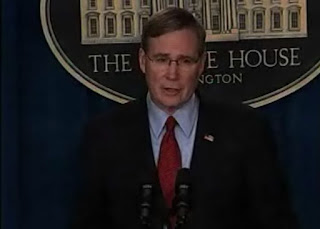 | The President had an opportunity this week to talk about a number of the issues that he will be discussing in Europe. As you know, yesterday he outlined his goals for the G8 summit. He'd like to solidify progress on a common approach to international development, especially in Africa; |
to reinforce G8 support for the war on terror; to recommit to transparency and openness in the global economic system; and to build consensus on climate change.
On Wednesday, the President announced that he would ask Congress to double the U.S. commitment on HIV/AIDS. On Tuesday, the President announced U.S. sanctions on Sudanese entities and individuals in response to Sudan's failure to stop the genocide in Darfur.
The President and Mrs. Bush start the trip in Prague. The United States values the Czech Republic as a close ally with a shared commitment to promoting and defending democratic values. The President appreciates the Czech Republic's contributions in Iraq and Afghanistan, and its interest in cooperation on- missile defense. The President also appreciates the Czech Republic's leadership in promoting freedom in some of the world's most tyrannical societies, such as Burma, Belarus, and Cuba.
In Prague on Tuesday, June 5, the President will meet with the President and the Prime Minister of the Czech Republic, and will also speak at a democracy and security conference about the importance of supporting democratic aspirations. He will meet with current and former dissidents from around the world who have shown the courage of their convictions in the battle for freedom.
In Germany, the President will meet with Chancellor Merkel, as well as attend the G8 summit from Wednesday, June 6 through Friday, June 8. Germany and the United States are working closely together on a range of issues that include Iran, the Israeli-Palestinian situation, the WTO Doha negotiations, Afghanistan development, and climate. The Chancellor is providing strong leadership, and she and the President continue to build a strong relationship.
While at the G8 summit, the President will also have meetings with Prime Minister Blair of Great Britain, President Putin of Russia, and President Sarkozy of France. This will be the President's first meeting with President Sarkozy since the latter was sworn in as President. They first met last September in Washington.
The G8 leaders will have sessions with leaders from a number of African countries. They will also meet with leaders of the so-called G8 outreach countries: that's Brazil, China, India, Mexico, and South Africa.
On Friday afternoon, June 8, the President and Mrs. Bush will travel to Jurata, Poland, to meet with the President of Poland. The United States considers Poland a close ally in the fight against terrorism, and Poland is with us on the ground in Iraq and Afghanistan. The President is pleased in Poland's interest and cooperation on missile defense, and appreciates Poland's leadership in promoting freedom in countries such as Belarus, and in helping young democracies such as Ukraine consolidate their democratic gains.
On Saturday, June 9, there are meetings with the President and Prime Minister of Italy. U.S.-Italian relations are strong and rooted in shared values. Italy is a strong partner on security matters. We continue to cooperate closely on global security and the war on terror. The President appreciates Italy's contributions to international peacekeeping and relief efforts, including in Afghanistan, the Balkans, and Lebanon.
Italy contributes over 2,000 troops to NATO's mission in Afghanistan, 2,000 in Kosovo, and 2,500 to the U.N. peacekeeping force in Lebanon. In the United Nations Security Council, the United States is working with Italy to address challenges from Kosovo to Iran to Lebanon.
The President and Mrs. Bush will meet with His Holiness, Pope Benedict XVI, at the Vatican. The President has great respect for Pope Benedict and his commitment to democracy and human rights worldwide. The President appreciate the Pope's strong stand against terrorism and religious extremism, and looks forward to talking with His Holiness about these and other issues.
On Sunday, June 10, the President and Mrs. Bush will travel to Tirana, Albania. He will be the first President to make an official -- the first sitting President to make an official visit to Albania. He shares the dream of Albania as a vital part of a Europe that is whole, free, and at peace, and as a full-fledged member of the transatlantic community. The President appreciates Albania's partnership in the war on terror in Iraq and Afghanistan, and is grateful for Albania's constructive support for the Kosovo process and the Ahtisaari plan, and for the positive role it plays in the region.
While in Albania, the President will meet with the Prime Ministers of the Adriatic Charter countries -- that would be Albania, Croatia and Macedonia. This is an opportunity to discuss their aspirations to join the NATO Alliance, and discuss regional issues such as Kosovo.
On Monday, June 11, the President will be in Sofia, Bulgaria. Bulgaria is part of the democratic transformation of the Balkans. And the President looks to Bulgaria for its leadership in helping its neighbors on the path to successful democratic transformation. Now part of the EU, as well as NATO, Bulgaria shares core values with the United States, which makes it one of our strongest allies in the region. The President values Bulgaria's partnership in supporting the cause of freedom in Iraq and Afghanistan, and appreciates the sacrifices its soldiers and civilians have made in those causes.
President and Mrs. Bush depart Sofia, Bulgaria, on Monday afternoon, en route Andrews Air Force Base. And with that I'll be glad to answer any questions.
Q Mohamed Elbaradei, the head of the IAEA, said in an interview that -- warned about new crazies who say, let's go and bomb Iran.
MR. HADLEY: He warned about what? I'm sorry, I couldn't hear that.
Q He warned about -- his quote was, "new crazies" --
MR. HADLEY: New crazies?
Q New crazies who say, let's go and bomb Iran. And it's believed by many that he was talking about Vice President Cheney. Do you have any -- regardless, do you have any reaction to his comment?
MR. HADLEY: Well, the international community has made it very clear that they want to resolve the issue of Iran's nuclear aspirations through a diplomatic process. And it's been playing out in front of the international community now for several months.
There was a set of conversations today, as I understand it, between Javier Solana and the National Security Advisor Larijani of the Iranian nation. Those did not, obviously, result in any breakthroughs. My understanding is that those conversations will continue.
But the problem, of course, is that Iran has yet again defied the request of the international community embodied in the second U.N. Security Council resolution, and that raises the prospect of a third resolution in order to increase pressure on Iran and get it to understand that the international community is serious that it needs to suspend its enrichment program and come into a set of negotiations to which the United States would join, which are based on a proposal made by the EU 3, the three key countries of the European Union that have been conducting this negotiation, which would have substantial benefit for the Iranian people and offer prospect of increased prosperity for the Iranian people and greater inclusion in the international community. We think it's in the interest of the Iranian people for their government to accept that proposal and come back into the negotiations. And it's a great regret that the Iranian government, in our view, is not taking into account the real interests of the Iranian people.
So this has been a diplomatic process. It's been involved. The IAEA Board of Governors board involved the United Nations, and involved much of the international community. That's the framework in which the President wants to get this issue resolved.
Q Steve, a question about Russia. Since the President --
MR. HADLEY: Can I say one other thing? We made an announcement today, the President made a statement today, it is not helpful to resolving these outstanding issues we have with Iran, whether it is Iran activity in Iraq that destabilizes that nation, or progress on the nuclear issue, for Iran to be capturing innocent Americans who are in Iran on peaceful business, visiting relatives or other acceptable activity. It's an unfortunate development, and these people need to be let go promptly.
Sorry, David.
Q Just on that point, is there anything the American people should know about efforts that are underway to get them free that are bearing fruit at all, or is this a real stalemate?
MR. HADLEY: Well, one of the things, of course, is these are all very sensitive and it's best that efforts be made out of public view, and it's something that the families are very sensitive about. But we thought it was important today for the President to make clear that, and draw a little attention of the international community to -- and to develop which doesn't, as the President made clear in his statement this morning, doesn't serve the interests of the Iranian people.
Q The question I was going to ask you is about Russia. Since the President famously looked into Putin's soul and saw that he could trust him, this relationship has steadily deteriorated, getting to a point now where there's some pretty hard-nosed language from this administration about the backsliding on democratic reform. So how bad are things, and what is it that this President can do about it?
MR. HADLEY: Well, the -- this is a complicated relationship. It has areas of common effort, such as Iran, where our collaboration has been good, and has increased over time; and it has areas, obviously, of tension, where we disagree. There is an issue about next steps on Kosovo, how to resolve this issue. That is an area where we do not yet have a common view and a common approach. There are issues that have been raised about missile defense and other things.
And it's a complicated relationship, and the course that the President has set, really from the very beginning, is a fairly pragmatic one, with really three pieces. One is, where we have common interests and where it is in both the interests of the United States and Russia to work together, we try to do that. Iran is an example, proliferation is an example, war on terror, there's others. Where there are issues of disagreement, we try and talk candidly and directly with the Russians and the Russian government officials, to try and see if we can reach a common view and a common approach going forward, recognizing that interests diverge.
And, finally, the President has been very clear that while it is clear that Russia's future is in its hands, we believe, obviously for Russia and for any other nation, that true stability and prosperity comes when nations give their people economic freedom, and build the institutions of an enduring democracy. That's our belief, and we've been very clear about that. That's part of the freedom agenda. The President has talked about with many nations about that, and that's obviously part of our dialogue with Russia.
So that's been really the way we have -- the President has set U.S. policy for Russia. That will continue. I think they will have an opportunity to meet, as I said, at the G8. Some of these issues will be discussed, and they will have an opportunity to meet at Kennebunkport on the 1st and 2nd in July.
Q All of that is understandable, but it doesn't appear to be working. I mean, the reality is that this Russian President has decided to walk the other way from this President on a great many issues that President Bush cares about: Iraq, the freedom agenda. You laid out, sort of, the important agenda points; Putin is not listening.
MR. HADLEY: I think that's actually -- if you look at the historical record, that's really not the case. We have reached agreement on an issue where the United States and Russia really started quite apart, which is Iran and the Iran nuclear program, to the point where on the last two U.N. Security Council resolutions we've had a 15-0 vote, where Russia not only has not vetoed, not abstained, but has voted yes.
We've recently, in the Security Council -- the Security Council has acted to establish, under Chapter 7, an international tribunal with respect to Lebanon, to deal with the investigation of the Hariri assassination. Again, that was an issue where Russia and the United States initially had different views. We worked it out. In the end of the day, Russia didn't vote yes, but they didn't veto.
So I think we have a case where -- there are areas where we have been unable to reach agreement, we continue to discuss. But there are also areas where there has been agreement. I would say it is true, the rhetoric has seemed to escalate a little bit in the last several months. And our view is that we ought to be trying to turn that rhetoric down and focus our efforts on identifying areas where we can work together constructively, and trying to manage the differences the best we can.
Q Are you going to turn it down yourself?
Q Can we go back for a second, just to the Americans being detained in Iran, because this question gets asked every day at briefings, and nothing can ever been said. So I'm wondering what, specifically, has happened that prompted the President's statement today? And, also, Americans reading headlines, one day it's how they're seeing the U.S. ambassador and the Iranian ambassador sitting down and talking for the first time in very many years, then it's about the Iranian nuclear position, then it's about detained Americans. What is the current U.S.-Iran relationship, to the extent that there is one at all? And how do these detained Americans fit into that?
MR. HADLEY: The reason the President made this announcement is they've been detained for awhile, but they were charged at the end of last week, beginning of this week. And that represented a escalation on the part of the Iranians. And the President, while he mentioned and talked about their detention at the end of last week, he felt that he ought to say something more this week, in light of the fact that a number of them had been charged.
Look, the issue -- the relationship with Iran is -- in this sense, hasn't changed. There is a long list of things that Iran is doing that are contrary to our interests, contrary to stability in the region, we think contrary to the long-term interests of the Iranian people: it is their support for terror, their pursuit of nuclear aspirations to have a nuclear weapon in defiance of the international community, their disruption of the efforts by the Iraqi people to stabilize their government, their support for Hezbollah worldwide and the pressure they are putting on the legitimate government in Lebanon. There's a lack of constructive role in terms of the Israeli-Palestinian peace.
So it's a long list of things that the Iranians are doing that are disruptive to peace. And what we are trying to do is have an approach that deals with each of them. The nuclear issue is being handled in the way we described earlier. The reason for talking to the Iranians about Iraq was really twofold: one, because the Iraqi people asked us to, and the Iraqi government asked us to, as an effort to try and contribute to the prospect that Iran would change its view and provide -- and start playing a more constructive role in Iraq.
And, secondly, we did it because the sum of the things Iran is doing in Iraq are killing our kids, our men and women in uniform over there. And if there is a way in a direct conversation by our Ambassador, sitting down with the Iranian Ambassador, and explaining clearly how unacceptable that activity is, and that we will hold Iranians in Iraq accountable for that activity, we thought it was an important thing to do: one, to try and contribute to stability in Iraq; and, two, to protect our kids.
Q But is there any degree to which you can have even guarded optimism about the potential to talk based on a meeting like that? Does the detention of the Americans, is that sort of a reality check as to who you're really dealing with?
MR. HADLEY: That's why I mentioned it in my response to Terry's question, which is, it does not help the environment, it does not really advance the interests of the Iranian people, and it underscores the character of this regime, and it underscores the problem we have for those people who say, well, why don't you talk to Iran? It is a good reminder at how difficult this regime is, and of the kinds of policies its pursuing.
Q But you avoided the subject when you did have a one-on-one. Why was it limited to Iraq when these people were prisoners?
MR. HADLEY: We have sent messages both privately and publicly on the issue.
Q Why isn't it part of a big dialogue -- all of our differences?
MR. HADLEY: We are talking -- we think it is very useful to talk about the nuclear issue, in particular, in a broader framework, because the point we want to try and make to the Iranian government is these issues are not just between the United States and Iran. They are issues that Iran has with the entire international community. Their behavior in Iraq is not just about us, it's also about the Iraqi people and their efforts to end the violence and have democracy.
Q What about our behavior in Iraq?
MR. HADLEY: And we're trying to help that government provide a democratic future.
Q Is that destabilizing?
MR. HADLEY: We think it's the key to a positive future for Iraq.
Q Steve, back to Russia? Okay. A couple of questions specifically about the Russian missile firings. One, Putin says regardless of how many anti-missile defenses were set up near the Russian borders, that Russia's missiles can overcome it. They'll simply not succeed -- your defenses. Two, you offered him the chance to share in this technology and to be a partner in it. Russia has turned that down. Why do you think they'd turn it down? Is it a matter of pride for the Russians, or is it a strategic reason?
MR. HADLEY: Of course the deployment that we're talking about in Europe is not about Russia at all. It's not aimed at Russia. The systems we would deploy do not have capability of any significant character against Russian ICBMs destined for the -- that are aimed at the United States. Just doesn't have any capability. It's a very limited capability about other states, like Iran, who are developing ballistic missiles and potentially the weapons of mass destruction that those missiles could deliver. So it's all about Iran.
I have personally been trying, when I've been in the administration, for 17 or 18 years, in various incarnations, to convince first the Soviet government and then the Russian government that they should view missile defense as an element of long-term security for Russia, and that it is a very productive area for cooperation between the United States and Russia.
So Bob Gates' trip to Moscow to offer cooperation in a very concrete way is just the latest in a long line of an effort across Republican and Democratic administrations for 17 years to engage Russia in a productive cooperation with us in missile defense. And I cannot tell you, for the life of me, why they say no.
Q What do they tell you?
MR. HADLEY: It seems to me so obvious an area of cooperation.
Q When they say no to you, how do they explain it?
MR. HADLEY: The explanations for me have never been persuasive.
Q What are the explanations?
MR. HADLEY: I just can't -- I can't do it.
Q What do they tell you?
MR. HADLEY: Well, you'd have to talk to Bob to find what this iteration was. In some of the conversations I've had, there's been a suggestion from time to time that they do see the threat and it would be in their interest. But I think there is an element of this that whether it's political or otherwise, that they can't get themselves to "yes."
Q Do you have a theory behind the reason for the detentions of the Americans in Iran? And I also have a question about the G8, but wanted to ask about that first.
MR. HADLEY: I don't, really. I think it's -- I would be speculating. I think one of the things we have seen in other areas that the Iranian regime is doing a bit of a crackdown on democracy advocates more generally, and I guess -- and it is possible that they have seen these individuals in that context. But this is a regime that denies its people some fundamental rights. And it's one of the things that hopefully will change in that regime over time.
Q Looking ahead to the G8, the President's announcement on climate was received pretty negatively in Europe -- in the press, especially. It's being portrayed as him trying to hijack what Angela Merkel is trying to do on global warming at the G8 summit. And I'm just wondering if you could talk about how that fits in? And have the Germans voiced concerns that this is overshadowing the consensus that she is trying to reach there?
MR. HADLEY: Actually, the President and the German Chancellor spoke today by secure videoconference on this issue. And the President made clear to her, as we tried to make clear -- as the President tried to make clear in his speech yesterday, there has been an ongoing dialogue about what to do with the interconnected challenges of secure energy, sustainable development, economic growth, pollution, and climate change. These are interrelated issues, and interrelated because, as you know, over time the greatest emitters of greenhouse gases will increasingly be developing countries like India and China. So they need to be part of the solution, and they won't be if the price of being part of the solution is they have to forgo development and economic growth for their people.
So there has been a dialogue over time about how to get a framework for a dialogue that includes the India, Chinas of the world, in trying to have a common way forward. This has been a dialogue that really goes back to Gleneagles, when I think for the first time the G8 countries all adopted a common framework for how to think about this problem. And the President wanted to make a contribution to this dialogue, in order to enrich the discussions at the G8.
And what he said to Angela Merkel is that in large measure through her efforts, and the efforts of Tony Blair and others, he was in a position to accept the notion that there needs to be a post-Kyoto regime; that he wants the United States to participate in fashioning that post-Kyoto regime that would apply to the post-2012 period; that there was a recognition that this is a problem that needs to be addressed. He accepted the principle that there should be a global goal in terms of reductions of emissions. He identified a process which would include developing countries to try and develop within the next -- by the end of 2008, in any event, a process that would identify with that goal; that countries need to have national plans that would be transparent, and that they would develop, reflecting their own national situations, and which would be reviewed, and in some sense discussed in a broader international forum.
And he also made it very clear that this is not a competition to the U.N. process, but actually getting these 15 major emitter countries together, and getting some consensus among those countries could be an input to the U.N. process, and enable that U.N. process to succeed.
So it was an effort to find common ground on this issue, and the President thought it would be better for him to lay it out before the G8 meetings, so people can think about it. And the reaction that I've gotten from my counterparts who I talked to in advance about the speech, and what I think the President heard from the Chancellor was positive, and a view that this will be an opportunity to try and narrow the consensus, if you will, and reach greater consensus at the G8.
So I haven't read all the press commentary, but I think in terms of the leaders, what you saw publicly Chancellor Merkel saying yesterday and Prime Minister Blair said yesterday, I think their public comments suggest that this is a contribution.
Q So if it's not eclipsing what she's trying to do, is it a shift, is it a concession?
MR. HADLEY: It is an effort to try and find consensus on the way ahead. There are still some -- there are still some differences. There are some people who think that the G8 countries ought to set the goal. What should be the long-term goal? The G8 countries should set it. Well, that's a little bit inconsistent with the notion that it needs to be -- reflect a broader community, particularly all the emitting countries and some of the key emitting countries like India and China don't sit with the G8.
So there are going to be issues that will be addressed. But it is not a competitor to anybody's proposal. It is an effort to make a contribution to an ongoing dialogue.
Did you want to follow up?
Q There was some fairly sharp criticism from Democrats today. Speaker Pelosi said if the country is not willing to put forth cap and trade legislation, we can't be taken seriously about the issue of global warming. She -- Congressman Markey just returned from Greenland, and basically was sharply critical of the President's proposal from yesterday. Can you address that?
MR. HADLEY: Yes, what the President's proposal did yesterday was to try and establish an international framework. Now, part of that international framework, of course, was that countries will have their own national plans -- and he talked about that -- and their own national targets. And of course, we will have an issue, then, as to what will our national plan be. And that will be a separate debate and discussion that the President will have both with Republicans and Democrats in the Congress.
But what this was designed to do was to put an international framework and an international way forward, recognizing that part of the process is going to have to be national plans, and each of the key countries is going to have to go through their own domestic political processes to develop those national plans. So there's not any inconsistency there.
Q Steve, on Russia before, you were talking about President Putin and saying, well, there's been an escalation in rhetoric. But it seems like it's been more than that when he's comparing the U.S. of imperialism -- he's used the phrase, "Third Reich." When you talk about working with Russia, how do you really work with them as a partner when he's throwing out rhetoric like that?
MR. HADLEY: Well, there's been a lot of press reporting on that. We, of course, talked to the Russians about that specific reference, and they told us that they were not making any comparison between the United States and the Third Reich.
Obviously, the kind of public controversy that provokes is not particularly constructive for U.S.-Russia relations. I think the main thing we have tried to be is in a concrete, problem-solving role between U.S. representatives and Russian representatives. That's what has led to the cooperation we've had on the issue of Iran, that's why we were able to get the Chapter 7 resolution on the Lebanon tribunal. That is the kind of cooperation that is going to be required to figure out a way ahead in terms of Kosovo.
So this is hard work. This is not the first relationship --sometimes even some of our closest friends -- where we do not have agreement across the board, but we have areas of disagreement.
Q But what does it say about the state of the President's foreign policy this late in his administration that somebody who, as was mentioned earlier, he looked into his soul at the beginning? He was seen as a really close ally at the beginning of this administration, and now this is clearly broken.
MR. HADLEY: I think from the very beginning we've said, with respect to Russia -- and I think if you go back in the comments, we've said to Russia, yes, we have aspirations, and we've talked about a strategic partnership with Russia. We did talk in terms of those terms as something we would like to see. We have been able to have areas where we've cooperated together effectively.
But from the very beginning, there have been disagreements. Remember that we now talk about the ABM Treaty. This was an area of disagreement. And the President made clear that we needed to withdraw from the ABM Treaty to pursue ballistic missile defenses, again something we would like to do cooperatively with Russia. But we were able to talk that through and get behind it.
And the President was able to achieve something that people -- you've said, in some sense, could not be done, which is to both withdraw from the ABM Treaty, and get an agreement that would lower dramatically the levels of offensive strategic nuclear weapons on the two sides. The President and Putin were able to work that out.
So it has been a difficult relationship. These are two countries that have different histories, and in some measures, some very differing interests. But we've been able -- and the President has been able to work this relationship in a way that has resulted -- benefits the policies of both countries. And he's committed to try to continue to do that.
Q Can I follow on that, Steve? First of all, did the President raise the Third Reich reference personally with President Putin, or was that done at the staff level? And then I have another question.
MR. HADLEY: It was certainly done, I wouldn't say "staff level," it was done as a pretty senior level. But it was --
Q Not to denigrate you to "staff." (Laughter.) Did the President not raise it with him, personally?
MR. HADLEY: I don't recall -- I don't recall, to be honest. And let me check on that for you and come back to you.
Q And then, secondly, some of your critics -- the administration's critics have said that the President placed too much emphasis on the personal with President Putin, and that if he had paid more attention to the Russia relationship, we might not be in this state of strained relations that we are in today. So how do you respond to that? And what makes you think that by extending yet another personal entreaty, an invitation to Kennebunkport, that you can improve things?
MR. HADLEY: Not just working the personal. We had, for example, and some of you wrote about it, for the entire -- we have had throughout this administration a strategic dialogue with Russia. We've done it in a number of different forums where we have tried to work through issues where we have disagreements. I think Secretary of State Colin Powell, now Secretary of State Condi Rice, has spent a lot of time with their counterparts. I spent a lot of time with my counterpart.
If you look at the cooperation we have in the area, for example, of energy, or the relationships we had, for example, with Under Secretary of State Joseph and the Deputy Foreign Minister Kislyak on a whole array of terrorism and proliferation problems, this has been a relationship that is more than just the relationship between the two men at the top.
But at the same time, I think we should not underestimate the capacity of two leaders who want to find common ground, to be able to lead their respective bureaucracies towards common ground. So I think it is both a relationship based on institutional links that we've talked about, but also it has been served, I think, very well by the relationship between the two men.
Q Is there any chance that the two leaders will be able to bridge the difference on European security, and on the ABM in Europe, and on the CFE in Europe, whatever?
MR. HADLEY: Well, they will certainly talk about these issues. But I think one of the things, we have to recognize that these are not just U.S.-Russia issues. The issue of European security has a lot to do with Europe, and it was interesting to see the reports coming out of the EU-Russia summit here a couple weeks back. Some very difficult issues were identified, and I think some of the European leaders spoke very clearly about areas of difference between Europe and Russia.
So I think this is a dialogue, it is a dialogue between the United States and Russia, but it is also dialogue between the representatives of Europe and Russia, as well.
Q Why is the President speaking at the Sharansky dissident conference? And what is the state of the freedom agenda, given the problems in Iraq, the Middle East, and Russia?
MR. HADLEY: Well, a lot of Iraq is about the freedom agenda, and helping the Iraqi people establish a democratic and free future for themselves. If you look at what we're doing in Afghanistan, again, taking a country that was ruled by the Taliban, and now for the first in its history has an opportunity really to build sustained democratic institutions.
The speech opportunity, the President speaking there was because he was invited, and he thought it was an opportunity to, again, talk about the importance of freedom and democracy; why the President believes it is in the long-term interests of people who not only -- of leaders who not only care about their people, but it is also the basis for a long-term stability. There is a competition in the world between the "isms." It was totalitarianism, it was fascism, now we have various forms of extremism. People are thirsting for a way forward, and they are being, in some sense, enlisted by people who have an extremist view. And the President believes it is very important for us to make clear that democracy and freedom is the antidote to the extremism of the terrorists. And this is an opportunity for him to explain that.
But it's also an opportunity for him to say, freedom is not easy; the history of freedom and democracy over the last two centuries is not a curve that always goes up; that the forces of darkness have a way of fighting back and striking back, and there are setbacks on the road to freedom. And when the President said we need to end tyranny, he wasn't saying it would happen tomorrow. It's a generational struggle.
And I think it's important for him, and he feels it's very important for him both to renew his commitment and the call to the freedom agenda, but also remind people this is a difficult struggle that's going to take time; that countries are going to have to -- and peoples are going to have to find their way to freedom themselves. And freedom and democratic institutions are going to take on the colorations of local history and culture. It's important for him to put that issue again in public view, and that's why the President accepted the invitation.
Q Have you heard the President express a sentiment that he may have misread Putin in the last six years?
MR. HADLEY: No, I've heard him recognize that there are elements and directions there where he has concerns. And one of the things that he has felt that was important for him to maintain a good personal relationship with President Putin is so that he can sit down with him, sometimes one-on-one, and be very candid about his concerns, about the decisions President Putin is making. It's not the President is making President Putin's decisions for him, but the point is, Putin is making some decisions, and the President is very candid asking him questions about those decisions.
So it has been a relationship that he thinks is useful in terms of solving problems and trying to find areas where the two countries can work together.
Thanks very much.
END 1:12 P.M. EDT
Technorati Tags:
President Bush and
G8 Summit or
National Security Advisor Steven Hadley and
Chancellor Merkel or
Public Domain Clip Art and
Nanotechnology Today or
Republican National Convention Blog


 Suscribir a nuestro canal de Podcast de Odeo o del podnova
  y recibir la dirección de radio presidencial semanal en inglés y español con informes selectos del departamento del estado. Ofreciendo transcripciones audio y con texto completo verdaderas, más fuentes contentas agregaron a menudo así que la estancia templó.