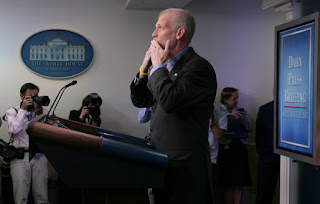
 | Press Briefing by Tony Snow, FULL STREAMING VIDEO. file is windows media format, running time is 48:54. James S. Brady Briefing Room. White House Press Secretary Tony Snow briefs the press and answers questions. 09 12 2007: WASHINGTON, DC: 12:38 P.M. EST. |
MR. SNOW: (Enters to applause.) Well, let me say, back at you. Let me start on an unusual note for a press briefing, just to give a lot of thanks to a lot of people, and I want to start with you.
This job has been the most fun I have ever had, the most satisfying, fulfilling job. I'm sorry I have to leave it, but I have got to say it has been a real honor and a pleasure working with everybody in this room. And I'll miss it. You know, everybody talks about what a horrible job it is to brief the press -- I love these briefings and I'm really going to miss them. On the other hand, it's left in Dana's capable hands and the business of keeping the press informed will continue to be the object of the press office and life will continue, including for me.
Let me begin by doing some thanks, though, for people in the White House. I want to start with Scott McClellan, because when I first came here we had a transition week and Scott could not have been more gracious and helpful -- and simply in learning the difference between a gaggle and a briefing, the first gaggle, as you may recall, an occasional little discomfort. I still remember Ann out in the hall saying, "I can't hear anything you're doing." (Laughter.) So there were some experiments that didn't quite work out the way we wanted, but Scott just could not have been classier or more helpful and I want to thank him.
And thank everybody here in the press office: Dana Perino, Tony Fratto, Scott Stanzel, Gordon Johndroe, Emily Lawrimore, Josh Deckard, Carlton Carroll, Ryan Graham, Pete Seat, Stuart Siciliano, Rachel Williams, Lois Cassano -- who did my makeup on FOX News Sunday for many years, before I came here. I want to thank all the stenos, who I have beleaguered with neologisms, foreign words, obscure words and everything else and sent them scrambling to try to figure out what I was talking about.
And finally, a special thanks to Ed Buckley, who as an assistant has -- anybody who has worked with Ed knows that he is just a delightful guy. One of the real pleasures of working at the White House is you have a lot of very bright, motivated young people who come in, they work hard -- they don't get paid a lot -- but I'll tell you what, they give real service to their country and it is an honor to work with every single one of them. Ed has -- it's just been a delight working with you, and I really appreciate everything you've done.
And with that, let me also add one little --
Q Any regrets? (Laughter.)
MR. SNOW: No, not really. The only regret is that I'm not able to stay longer.
One scheduling note. The President will be making a trip to Quantico on Friday. He will talk a bit about the speech he delivers Thursday night. We will give you details later on that, but that is the reason why I'm not giving a Friday briefing. So this will be the last on camera, but I'll be here all week.
So with that, let's go to questions.
Q Speaker Pelosi said that General Petraeus's strategy amounts to a strategy for an endless war, a war without end. What's the administration's view -- how do you answer that charge?
MR. SNOW: Well, you answer the charge by pointing to General Petraeus's testimony. It's pretty clear that it is not a war without end. As a matter of fact, it is a war that actually has victory as its aim. And victory is defined as helping the Iraqis develop the capability of defending themselves and governing themselves.
It's, furthermore, a strategy -- if you take a look at the way he laid it out before members of Congress, if memory serves, what he was trying to do is talk about ways in which you can reduce the American footprint while increasing the safety and security of the Iraqi people and the stability of the Iraqi government.
Furthermore, it is a strategy that is not strictly military; it has very important developmental components, including the provincial reconstruction teams; it involves not only the military, but State Department and, really, people throughout the federal government. It is one that also has a strong diplomatic component, seeking greater cooperation and interaction with regional powers and regional allies. It is one that has expectations in terms of what the neighbors ought to do, including Iran and Syria.
So I think in order to try to caricature it as a war without end is simply to ignore two days of testimony, including 11 hours yesterday in front of the United States Senate. It's just not true.
Q But you don't have any -- you said that there are no parameters in timing here.
MR. SNOW: Yes. But on the other hand, to say that you don't know when a war is going to end doesn't mean that you don't think it's going to end. The idea that anybody can come up with a firm prediction about precisely how history is going to unfold is simply wrong. But on the other hand, what General Petraeus did lay out was what he thought would be a reasonable schedule for drawing down troops. And we will leave it at that. I'll let General Petraeus argue his own brief. The President will give his analysis tomorrow night.
But I think Speaker Pelosi knows precisely -- well, maybe she doesn't; maybe she just didn't follow General Petraeus's testimony carefully enough -- but there is nothing in his testimony to insinuate that he looks upon this in the way she has characterized it. It sounds like an attempt to try to create a political framework for ignoring the success that has taken place as a result of the surge in recent months, and the fact that General Petraeus's counterinsurgency strategy has worked in ways that have surprised even the U.S. in terms of the development of strong grassroots Iraqi action against al Qaeda, against the Jaish al-Mahdi and other forces.
Q Are you concerned, though, that General Petraeus has now laid out a time line to start withdrawing U.S. troops?
MR. SNOW: Again, General Petraeus was asked to give his honest opinions about what he thought, and that's what he did. And the President has always --
Q But isn't the enemy now going to look at the calendar and say, next July, about 30,000 U.S. troops are coming out, so let's wait and start attacking more then? Let's hold back.
MR. SNOW: Well, two things. First, let the President announce what he plans to do. Secondly, the enemy has been significantly degraded. You're assuming, Ed, that U.S. forces would leave a really strong enemy in place. It has always been the contention here that you time your troop movements related to facts on the ground. And if you have a strong and capable opponent that's capable of sort of waiting and hiding and then inflicting mass destruction, you're not going to leave.
Q But you've consistently said that time lines are only going to help the enemy. Now your commander has finally given at least a partial time line. Why is that not --
MR. SNOW: Well, what the commander has said is that he believes that they can -- they can get five divisions out by next year -- he thinks. He also says that it's still related to conditions on the ground.
Again, Ed, I will let General Petraeus argue his own brief on this. I think he did a pretty capable job of it.
Q Okay. Last thing, though, when you were just saying the surge is succeeding -- and that's basically what he laid out in the testimony -- how can you say it's a success when in about nine months you're going to withdraw maybe up to 30,000 troops? That would just bring you back to the footprint you had in December of 2006.
MR. SNOW: You don't have the same country you had in 2006. You're assuming that nothing has changed. The whole -- what General Petraeus is saying is that you are able to move forces out as a result of success, not simply -- this is not an exercise to get to a number.
Q But if there's so much success, how come you would only be pulling out the troops you pretty much have to take out anyway because Army officials have said that you're going to start running out of troops next summer?
MR. SNOW: Well, you're jumping topics here, so let me --
Q It's all related -
MR. SNOW: Well, let me finish.
Q It's all related.
MR. SNOW: Let me finish the answer, and then you can come back, okay? The answer here is that General Petraeus has said that he thinks it's going to be possible because you're going to have capability among Iraqi forces, you're going to have security, and you do have a completely changed situation on the ground in places like Anbar and Diyala, and you're starting to see metrics everywhere from Baghdad neighborhoods to southern parts of Iraq where people are standing up and taking control of their destinies in ways that they did not do before, and that is a hugely significant development.
Now, in terms of -- I think what you're trying to do is to develop a narrative that says, well, you know what he's really trying to do is he's trying to put lipstick on this thing because he was going to have to remove the troops anyway. Is that what you're -- is that the buried insinuation?
Q I didn't use the lipstick analogy, but you just did. So it seems --
MR. SNOW: No, but is that kind of the thesis here?
Q No, the question is that Army officials have already said publicly that, in fact, you're going to have retention issues, you have rotation issues and that by next spring/next summer you're going to have to start bringing some troops home or you're going to have -- if, God forbid, there's another situation in another part of the world you might not have enough troops. So how can you say the reason why you're potentially pulling out up to 30,000 troops is because you're having so much success on the ground when, in fact, it's because you have to pull them out anyway?
MR. SNOW: No, wrong. You don't have to pull them out. And General Petraeus has made it clear -- see, what you're doing is you're taking unrelated testimony and you're trying to draft it and you're saying, you guys will leave because you have to. Wrong. General Petraeus has made it clear that he -- by the way, this is not a guy who's simply going to try to fake it. His career, his reputation, his honor are on the line. And this is a man who makes decisions based on what he thinks is going to work. And therefore, he will continue to do so.
And in this particular case he is talking about potential drawdowns next year based on conditions on the ground, and they will continue to do so. I will let -- you know, you can take quotes from various generals about --
Q But you had consistently at the beginning said the surge wouldn't last forever, that it had to have an endpoint at some point.
MR. SNOW: Right.
Q So essentially, if this goes through, you're pulling out the troops that you had intended to pull out anyway, because they were temporary -- but you're leaving in at least 130,000. So how can you say there is so much success?
MR. SNOW: Again, Ed, you are assuming that there has been no success, that there have been no changes on the ground in Iraq since the surge began. When the surge began, Anbar was effectively in [the] control of al Qaeda. Diyala was a place where there was gathering strength with al Qaeda. Same thing with Ninevah. You had a number of provinces throughout Iraq where al Qaeda was gaining strength. Since then you have had a dramatic reversal in the fortunes of Anbar province to the extent that people who have been there have talked about how dramatic it is in terms of their perceptions.
And furthermore, you have started to see throughout Iraq a change in the way the Iraqi people are taking a look at it. You cannot argue that there has not been a significant change. There has been. And it has been in part a result of the fact that there is a recognition that the United States has stood by and has provided support for Iraqis and, at the same time, has worked with them to go and develop greater security. This is --
Q My question, then, if there has been such significant change, why can't you pull out more than the surged troops?
MR. SNOW: Because you still have a big country and you still have challenges ahead of you, Ed. Again, the strategy that General Petraeus is pursuing is one that is designed to produce results and to produce the kind of stability that the Iraqi people deserve. It is not one that is gauged at numbers.
Martha.
Q You've said you can't tell when the war will end. General Petraeus said that, as well. But the President has also said it is not an open-ended commitment. So square those things and also tell where the pressure is on the Iraqis' with statements like that?
MR. SNOW: Sure. Number one, you don't know when the war is going to end because you don't know when the war is going to end -- you don't have a crystal ball. I mean, you could have asked Eisenhower when the war was going to end and he wouldn't have known. You could have asked generals and -- the fact is, you just --
Q Right. Right. But you've also said --
MR. SNOW: But when you're asking --
Q -- not open-ended. I mean, certainly you can't predict when something is going to end, but you've said there is no open-ended commitment. So where is the pressure on the Iraqis, in any of this, for change?
MR. SNOW: First, you're assuming that the Iraqis, themselves, don't want change, and I think the events on the ground indicate that the Iraqis, themselves -- especially the grassroots level -- have had a significant change of heart. What you're asking about I think is the political --
Q Right. But at the national level and the benchmarks that everybody seems to have forgotten, the 18 benchmarks -- and now you're talking about Anbar, it's almost you're redefining success.
MR. SNOW: No. Look, benchmarks were something that Congress wanted to use as a metric --
Q You signed off on it.
MR. SNOW: -- and we're going to produce a report. But the fact is that the situation is bigger and more complex, and you need to look at the whole picture.
But let's talk about some pressure on the Iraqis. Number one, I've just talked about the fact that you've got these grassroots movements. Do you not think that people in Iraq, themselves, are putting pressure on the political system? My sense is that they probably are. Number two, the President has made it absolutely clear that he expects to see political progress, and he's made it clear to the Iraqis that within the American political system there is an insistence that the political factions within Iraq figure out how to get together on important pieces of legislation. Again --
Q But, Tony, he's done that for a long time, and there is no real significant political progress on the national level.
MR. SNOW: Well, actually -- General Petraeus and Ambassador Crocker pointed out some interesting things that have been going on at the national level, without necessarily the enactment of national legislation. For instance, there's a lot of talk about the oil law, when do you come up with a hydrocarbon law. Well, it turns out the government has been redistributing oil and natural gas revenues to provinces --
Q It's really their only revenue, right?
MR. SNOW: Well, but they've been doing it. You're asking about --
Q At far lower levels than you wanted them to.
MR. SNOW: Look, they've started doing it sort of de facto. What we would like to see is an oil law passed. You have seen de facto de-Baathification. And the members -- lower levels of the Baath party have, in fact, been readmitted to civil society in other parts of Iraq. You have started to see a recognition that these matters of reconciliation have to take place. Do we want to see more political progress? Absolutely. Absolutely.
Q Are there any mechanisms, any sort of forcing -- anything new that the administration has planned to push the Iraqi government? Or is it just status quo, we're just doing the same thing, having the President call the Iraqi government and say, we want you to move?
MR. SNOW: There is constant communication, and they understand what our strong feelings are. The other thing, once again, is that -- it's pretty clear that very significant things are going on in Iraq, and that there has been real progress. And it is important now for the political figures to catch up with the progress. They seem to be a lagging indicator in some respects. And the President, the ambassador, the generals, people on the ground continue to provide pressure on the Iraqi government.
Q Tony, when the President addresses the nation in the way that he will tomorrow night, it often sets lots of expectations on the part of the public. Is there a concern that with so much discussion about potential for drawing down troops, if there is not the kind of progress on the ground that you foresee, that that will simply be an expectation unfulfilled?
MR. SNOW: No, we tend not to go into these with failure narratives in mind. No, what the President is going to do is he's going to outline what he thinks is the sensible way to proceed in Iraq, based on the facts on the ground and based on developments.
Obviously, when you're in a time of war, you try to game out everything and you try to think of every potential circumstance. You're not always going to be able to foresee everything, and that's why there is no such thing -- when people start talking about time lines, or when are you going to get out, war is a constantly shifting set of engagements, and it's one where you constantly have to adjust and adjust your tactics and your plans and so on. We'll continue to do that. Our people on the ground will continue to adjust.
But what does appear to be the case is that the counter-insurgency strategy is working, and it's the sort of thing that holds a great deal of promise. But there still are large sources of -- there are sources of violence and threats to stability. They have to be -- the allied forces need to continue to address them. There is still a need for political reconciliation. We'll continue to push for that.
We don't want anybody to look through rose-colored glasses, but we would like people to understand that there has been success, and that the challenge is to build -- A, to acknowledge success, and B, to build on it.
Q And will this be sort of replacing September with spring and asking the American people for additional patience?
MR. SNOW: No. Again, if you take a look at what's going on, on Capitol Hill, a lot of people I think have acknowledged that there has, in fact, been progress of a nature that has been surprising to many people. I don't think Congress is going to pull the plug.
And so what you have now is an expectation that you have to have policies that are moving forward. Ambassador Crocker and General Petraeus, themselves, suggested that they come back and continue to brief Congress on how things are going, because they understand the justifiable and keen interest of Congress in figuring out what's going on and whether we're moving in the right direction, and it's important to do that on a regular basis.
John.
Q Petraeus is saying that additional elements of the U.S. government ought to be involved in Iraq. He didn't really say which agencies or elements of the government. Is the President going to talk about that at all?
MR. SNOW: Look, again, back to the cat-and-mouse game; the President will speak what he speaks, and I'll let him do that. But if you take a look at the strategy that we've been using -- and I'm glad you asked the question -- it's not strictly military. A lot of it is developmental. As a matter of fact, the most important parts in many respects is after you've gone into a place, and after you've taken care of violent elements and you've restored peace to the streets, what do you do next? You still have an obligation to provide such things as rule of law, civil society, economic opportunities. There are practical matters in many areas -- you have electricity generation or basic public services that certainly need to be improved and addressed.
So there are a lot of things that still need to be done, and therefore, those are going to require the assistance and expertise of people throughout the United States government, and they're going to be in different departments and agencies.
Quite often you will have provincial reconstruction teams that are military in nature or those that are civilian, but also you've got a lot of them that are mixed, where you have a military component providing not only manpower and labor but also security in various areas, where they're still trying to help the Iraqis develop capabilities in addition to military security capabilities.
Bret.
Q Tony, to try Ed's series of questions a different way. If we assume that the President is going to base any drawdowns on conditions on the ground, as he has said many times, and conditions on the ground perhaps don't continue to move in the right direction and, in fact, the go the other way, is the President prepared to extend deployments beyond 15 months?
MR. SNOW: Number one, I'm not going to presage the President's speech, and number two, I'm not going to play the hypothetical.
Q Well, listen, the Army, as Ed mentioned, says that if you go past spring and summer, you're going to have to extend tours of duty.
MR. SNOW: Understand. Understand. Again, I'm just not going to play the hypothetical game. Continue.
Q Okay. Well, that's 0 for 2. (Laughter.) Here's 3. General Petraeus gave very specific detailed information about evidence that the Iranians are involved inside Iraq. You haven't really gotten into that detail. Are we going to see more of that detail? And how much does it factor into the President's decision to leave the troop levels where they are?
MR. SNOW: Look, at this point, there has been significant Iranian involvement, and it is something that -- at least we know that -- weapons have made their way in from Iran into Iraq. We have made it clear to the Iranians that if they wish to play a constructive security role, they need to address these things.
In a time of war, you are certainly going to take on anybody who is going after you and is trying to kill Americans or other -- or innocent civilians. And so that's simply a battlefield matter. It's something that you take into account.
I'm not going to try to characterize -- for a whole series of reasons, including the fact that it would be of some intelligence value -- exactly how you parse this. But the fact is that anybody who is going after Americans, and anybody who is going after Iraqi civilians, those people are justly subject to being fought on the battlefield.
Q Tony, does the President believe that what he is going to announce tomorrow is a new and changed strategy? Because there are critics who are saying that if he simply accepts and goes along with what General Petraeus told Congress this week on the -- going back to pre-surge levels, that that's not a change, that's nothing different.
MR. SNOW: You know what really strikes me is that there seems to be this attempt to go after General Petraeus in every possible way so that there can be an avoidance of the fact that his strategy is succeeding.
This new line of argument that -- where you're just going back to the same numbers, it was -- you've got to assume that when you have a surge and the number goes up, they are going to go down, and at some point you will reach the level you were at before. And they may continue to go down. I'm going to let the President make whatever announcements he has to make.
But this is an attempt to try to change the subject. The subject is that General Petraeus and Ambassador Crocker came and they talked about a series of things that are going on. They talked about the diplomacy, they talked about the development, they talked about the changes of hearts and minds. And for many Americans, the question long has been, are the Iraqis invested in this; do they give a rip; are they with us in the fight? You bet they are.
Q But --
MR. SNOW: Wait, wait, wait -- so as a result, what people have said is, okay, well, maybe we don't want to take them on, on that, we'll go back and say it's just going back to the prior number. It's a different country. You have the ability to reduce the numbers because there have been changes that reduced the necessity of American involvement. Keep in mind -- there was also an attempt to argue, by the way, that Anbar was not part of the original equation. Go back and look at the President's original speech where he talked about sending 4,000 forces to Anbar precisely because al Qaeda had gone in and was trying to use it as a base of operations, and in fact was going to make it the capital of an al Qaeda fiefdom. That was part of his speech. Those things have succeeded.
So I think what's going on is that there is an attempt to create a cause to get you to ask about numbers, rather than results. But the fact is, the numbers will reflect realities on the ground. The realities on the ground, at least according to General Petraeus, seem to be such that you can start drawing down numbers. Again, I know it's making you crazy, but I'll let the President announce what he has in mind.
Q Just broadly, does he consider this a new and changed strategy that he is going to put forward?
MR. SNOW: He's changed strategy every day -- this also -- I've got to tell you, this is an amazing canard in the sense that you have shifting realities at all times, and you respond to changing facts on the ground. The idea that you have an unchanging strategy -- only a crazy person would fail to adjust strategy on a regular basis based on the realities on the ground. What the President called for was a new way forward that addressed the fact that what we had done before had not worked, in terms of counterinsurgency, and he asked for a new way forward. And it does seem to be working.
Now, I think you need, again, to wait for the President to talk about what he has in mind. What General Petraeus talked about, though, does in fact reflect a change in mission, because you have U.S. forces receding from front-line operations in places like Anbar and Iraqis assuming greater and greater responsibility and authority, which is something that we have wanted all along.
But it is -- at the same time, you still have to address threats and challenges throughout Iraq, and you will have manpower levels that reflect those realities.
Similarly -- it's interesting, because Democrats have said, we want a change in mission -- and there does seem, at least on the part of what General Petraeus was talking about, a change in mission -- they immediately try to inoculate against that argument by saying it's not, but it is. And secondly, that they want adjustment in force structure. You got an adjustment in force structure. This seems to be an opportunity, whether people want to seize it politically, it seems to be an opportunity to get together and do two things: Number one, if you believe in the troops and support them, why do you acknowledge and celebrate their success? I mean, this ought to be a time for people to say, job well done. And the second thing is to ask the question, what do you need? And that is --
Q A lot of people are dying.
MR. SNOW: Because there are bad guys that are out there, Helen, and they don't want to go away.
Q Tony, I know you called it internal politics this morning, but on Russia, does the White House have any thoughts, or what do you make of the appointment of a little-known financial regulator to --
MR. SNOW: Again, we're just not making any further comments on that right now.
Q Was it transparent? Do you expect --
MR. SNOW: Again, I'm just not going to get further --
Q Okay, one other thing. Can you give us an update on where the President is on the Attorney General's nomination? Is he narrowing things down? Has he met with anybody?
MR. SNOW: I'm not going to give you any tick-tock. We don't have -- we don't have a final decision yet. We'll let you know. You're not going to get it today. Be patient.
Q Tony, back to Iraq. Regardless of what the President says tomorrow night, the funding debate is going to continue next week on the Hill. You spoke earlier about benchmarks and said, well, they really don't show the whole picture. Does he still accept that he needs a report on benchmarks, and really do something --
MR. SNOW: Yes, it's the law. Of course he's going to do it.
Q So next spring? In other words --
MR. SNOW: Well, we've got a benchmark report due Saturday.
Q Understood. Will they continue to follow that as the condition for getting the funding that --
MR. SNOW: Well, look, I think a condition for getting the funding is trying to figure out where the strategy is working. I think if you try to -- lash yourself to the benchmarks, you get -- as General Petraeus was pointing out, you could achieve every one of those benchmarks and not be succeeding. So I think what you need to do is take a broad view. They certainly provided valuable input, and that will continue to be a source for people to look at.
Q Are they relevant?
Q Tony, if --
MR. SNOW: I'm sorry, what?
Q Are they relevant then?
MR. SNOW: Not necessarily relevant -- look, number one, it's the law, we're going to abide by it; members of Congress will have to decide how relevant they are. Some of them are -- I mean, as you noted in the first report, some of them not particularly, but it's still -- any inputs you can get to get a fuller appreciation of what's actually going on is helpful.
Q If the troop numbers are based on the reality on the ground, if basically they're based on need, isn't that really the definition of an open-ended commitment, because the reality may not get better. may not get much better. Isn't that really -- doesn't that define an open-ended commitment?
MR. SNOW: If you take a look at the trend lines we have seen, I'm afraid -- I'm happy to report that your hypothesis doesn't hold. What you have seen is a significant degradation not only in the strength, but also in the public view of al Qaeda in Iraq. It has lost what prestige it may have had, and it now has Iraqis openly going after it. So I would contend that what you're trying to do is to set up a scenario that itself flies in the face of the facts that have been accumulating in Iraq over the last six months.
Q If we looked at trend lines -- for the 2000 election we'd have a President Gore. (Laughter.) I mean, trend lines change, and so the fact is, you don't know exactly what the reality on the ground is going to be, and if you're basing the number of troops on that, then it's an open-ended commitment.
MR. SNOW: That is the most -- look, all right, I give up. I give up. We can't give --
Q -- Pelosi used this definition, and it's rejected by the White House, but I'm just trying to see how you can reject that if you're basing it on what's going on, on the ground. Even if things are getting better, you don't know --
MR. SNOW: By that definition, every war in the history of humankind is an open-ended commitment. That is a definition that would define any military engagement as an open-ended commitment.
Q Unless you base leaving on a political situation that may or may not change, that's a finite thing. So Democrats are saying if the political situation doesn't change, the troops are out. That's finite, as opposed to open-ended.
MR. SNOW: I defy you to find in the history of mankind a situation in which an artificial political goal won a war.
Q That's fair enough, but it's still an open-ended commitment.
MR. SNOW: No, it's -- come on. You know better than this. What's happening is that there is an attempt to say, if you don't have the crystal ball and you can't tell us when you're going to leave, it's an open-ended commitment. The fact is that you and I and everybody in this room and everybody in this country understands that the American people don't like war, they don't want to be in a war forever. And it is absolutely impossible -- there has to be progress, and I'm happy to report that there is, and there must continue to be. That's how it works.
Speaker Pelosi knows perfectly well that the American people are going to draw judgments as well on the facts on the ground. What I'm arguing is, you might want to take the blinders off and take a look at what's going on, because there have been significant improvements, and maybe part of the important addition to this debate is, celebrate the troops, what they've done, give them some congratulations for success, and ask the simple question: What do you need to succeed?
April.
Q Tony --
Q But you're not addressing his question, Tony, about the open-ended commitment.
MR. SNOW: Yes, I am, Bill. It's a verbal game.
Q Why is it an open-ended commitment?
MR. SNOW: It is a verbal game.
Q I don't think so.
MR. SNOW: Okay. Bill, can you tell -- yes you do. You absolutely understand it's a verbal game, simply because if I can't give you an absolute date, you define it as an open-ended commitment.
Q We're not looking for an absolute date --
MR. SNOW: Yes, you are.
Q You've said it's not an open-ended commitment.
Q -- he's asking you if this is an open-ended commitment.
MR. SNOW: And I have just made the point to you --
Q Why isn't it an open-ended commitment if we're going to stay until the job is done?
MR. SNOW: Because the job will get done.
Q All right, two things.
Q Let's hope.
Q Two things. What --
MR. SNOW: Wait. Will you concede that there has been an improvement on the ground as a result of the surge?
Q Sure.
MR. SNOW: Thank you.
Q But that's not the point. (Laughter.)
MR. SNOW: It's absolutely -- see, that may not be the point to you, but it is to the people who are fighting.
Q In other words, there's no answer.
MR. SNOW: No, the answer is, when you have success, build on it.
Q Bill, are you finished?
Q For now. (Laughter.)
Q Okay, thank you.
Q Bill, what -- I mean, not Bill -- (laughter.) Anyway, Tony, what --
MR. SNOW: All us white guys -- (laughter.)
Q I did not say that, okay? (Laughter.) The first day and the last day. (Laughter.)
Anyway, Tony, what number draft is the President on for tomorrow night? And also --
MR. SNOW: What number draft? Oh, my goodness, we have gotten into process heaven. Go ahead.
Q Yes, what number is he on?
MR. SNOW: I don't know. The last time I saw, it was in the 20s.
Q In the 20s? Okay. All right, also now, you said the counterinsurgency strategy is working; you're saying, in response to Bill and Keith, you're saying it's a success.
MR. SNOW: No, I'm saying it's succeeding. Please, if it were success, everybody would be coming home and we'd be throwing a -- we'd be doing parades.
Q Okay. But as you know, as you know, many critics of this war, and those who have even supported the war have said this war cannot be won militarily. Does this mean that at this point, the U.S. military is winning in Iraq?
MR. SNOW: General Petraeus and Ambassador Crocker both pointed out that this is not going to be won strictly militarily. I got a question earlier from Helen about other parts of the U.S. government. Military helps solve the security -- resolve security issues and go after those who are trying to destabilize the government through violence and insurgency. On the other hand, you have to build the capability to have a stable civil society. That means acknowledging, recognizing, protecting human rights, developed civil society.
At the same time, let's figure out ways to build an economy, let's restore basic public services. All of those are part of the overall equation. It's not simply enough to address the battlefield issues. But it has always been this administration's contention that the military alone is not sufficient to complete the job in Iraq. It's one of the reasons why we developed the provincial reconstruction teams, of which the President has received a number of reports on those, and those seem to be producing some pretty good results.
Q Again, are we winning? Is the U.S. military winning right now?
MR. SNOW: Is the U.S. military winning right now?
Q If you bringing the surge troops home by the middle of -- by the summer of next year --
MR. SNOW: Well, what you could say is, in fighting al Qaeda in places like Anbar, it's winning. But it is winning because the Iraqi people themselves are standing up. It is not a unilateral U.S. "winning." The most significant change has been that the Iraqis themselves are standing up. They're the ones who are fighting on the front lines. They're the ones who are taking more casualties and kills.
So when you try to talk -- this is not the U.S.'s war to win or lose. Ultimately it is the Iraqi people who are going to have to stand up to the insurgents and have to develop the political will to succeed. It is not going -- the U.S. military is never going to "win the war," but it can create conditions in which the Iraqis can go ahead and establish a government.
Ken.
Q Tony, Speaker Pelosi says a military presence is actually counterproductive to the political process, because as long as we're there, they have no incentive. Anything to that calculation?
MR. SNOW: I just -- the notion is, I suppose, that you make a threat that you're going to walk away and you are going to invite a situation that the National Intelligence Estimate, the Baker-Hamilton commission report, in every analysis of the situation in Iraq says we'll follow, which is complete, bloody chaos, which would lead to regional instability and a less secure America.
So the fact is that Iraqi politicians try to work together, and they continue to be grinding away at a number of these issues. We're going to have to see -- I know everybody says, well, why haven't they done anything yet? Well, you know, it's a good question. Politics, as I pointed out, is messy. Why don't they -- why haven't they passed the appropriations bills in the House and Senate? Well, you know, that's politics.
On the other hand, we expect to see results. We understand Americans' natural impatience about it. But I don't think issuing threats that say, oh, by the way, we're going to pull out so your country dissolves into total violence and bloodshed, that doesn't seem to be -- it's a hard argument to take seriously in that sense, and also, it's one where, if people look at it as you're trying to threaten them, it doesn't reflect the nature of the relationship, which is we're trying to work with the Iraqis to develop a government that can stand on its own. And furthermore, at a time when we're seeing success, I think it would strike the Iraqis as passing strange that the United States would say, now that we're succeeding, we're going to pull out.
Q We're willing to stay there as long as it takes for the political progress?
MR. SNOW: Well, I think the political progress -- look, political progress, what you're really looking for is stability on the ground, you're looking for the conditions I've been laying out before.
We want to see political progress. And my sense is that, again, the American political system will not stand for it if we don't see progress in time. Look, our system is going to react -- the political system is going to react also to realities on the ground in Iraq. And if there is no sense that the Iraqi government is coming along, there are going to be repercussions politically; you know that and I know that.
But on the other hand, the sea change in the views of the Iraqi people themselves being reflected from the ground up is extraordinary and profound. And it's one of the things that you need to take into account when you're measuring what the effects and impacts of American policy would be, especially with regard to what the Baker-Hamilton commission called precipitate withdrawal. I don't think Speaker Pelosi really wants to have precipitate withdrawal. I think what she wants to see is political progress, and so do we.
Q Tony, Senator Obama today is out flying a new plan, his new plan for Iraq, that includes pulling out all combat troops by the end of 2008. I imagine we know your reaction to that. In part, it calls for a constitutional convention he thinks Iraqis ought to have. What do you think about that idea? They were supposed to be changing the constitution in 2006 under the U.S.-brokered agreement in 2005. That hasn't happened. Is there room for some sort of constitutional convention to create political change?
MR. SNOW: I think, again, our aims and objectives remain the same. We certainly think that the Iraqis need to take a look at such matters as provincial elections and also looking at constitutional adjustments. As you know, for the Sunni vote, that's very important. Those continue to be areas of concern, and we continue to push them.
Q Do you think a convention would be a useful forum --
MR. SNOW: Look, I'm not going to respond to campaign documents in a primary season. We'll let Democrats hash it out, and the President and our diplomats and also our people on the ground will continue working with the Iraqi government.
Q The Republicans, including Senator Dole, were saying yesterday that they're not yet satisfied, that they want to see action-forcing measures. Are there action-forcing measures that you think would be --
MR. SNOW: Action-forcing measures with regard to the political side?
Q With regard to the U.S. commitment in Iraq.
MR. SNOW: I'm afraid I'm unfamiliar with Senator Dole's comments. Action-forcing in what way?
Q She found it unsatisfying, the progress that's been made so far, and --
MR. SNOW: I guess I'm trying to figure out if she's talking about military or the political side.
Q She's talking about the U.S. involvement, in terms of military presence there. And she's suggesting that she would be willing to go along with something that would prod the administration to do something further, in terms of pulling troops out and moving to a different mission.
MR. SNOW: I will plead ignorance on that one. It's a little too vague for me to try to react, and so I apologize.
Q And the benchmarks --
MR. SNOW: The benchmarks -- again, I think the most important thing is to figure out, is your policy succeeding, and if it is, how do you build on it, if it's not, how do you fix it.
Q Tony, just --
MR. SNOW: One last one, Martha, and then we'll get to the back of the room.
Q Could you explain -- you said something about General Petraeus talking about changing the mission. Can you just explain how the mission --
MR. SNOW: In other words, what you're talking about is, you had a surge where the U.S. forces were really working the front lines, going directly after al Qaeda, doing a series of operations; strong military actions designed to go after al Qaeda sanctuaries, al Qaeda arms caches, the command and control networks, and all those sorts of things. They were highly-targeted, directed missions.
You've had success in that, and furthermore you've also had the uprising from the grassroots that have helped not only smoke out, but degrade and destroy a lot of the al Qaeda operations in Anbar. Having seen that, you no longer need that sort of a mission in Anbar; you end up having some of the forces come out, and you move again to the mission where you stand back --
Q So just Anbar -- you're just talking about Anbar?
MR. SNOW: Well, again, I will let the President lay out, and also General Petraeus characterize more fully his views of these things, but it is, in fact, a change in mission that is a reflection of success. Where you're talking about moving folks out is where you've had success.
Joni.
Q Is the President disappointed with Prime Minister Abe's resignation? And does he --
MR. SNOW: You asked me that this morning. (Laughter.)
Q I have one more. (Laughter.) And does the administration expect continued support and assistance from Japan in Afghanistan?
MR. SNOW: Well, again, we have a very important working relationship with the Japanese. The President certainly respected his working relationship with Prime Minister Abe. But let's see what happens in Japanese politics. He resigned, you're going to have the formation of a new government, and we look forward to working with them.
Q Tony, President Bush called the South Korean President, Roh Moo-hyun, yesterday. Can you tell us what is content of conversation?
MR. SNOW: No.
Q Thank you.
Q Tony, wait a minute. Come back -- no, wait a minute. Tony, this is the last --
MR. SNOW: Is this a meltdown, Les? (Laughter.) Is this --
Q Let's go, everybody.
Q Really, Tony, none of us in the back have had a chance. You've been in the front. This is your last briefing. You want to go out well.
MR. SNOW: Les, please, be as rude as you want. Go ahead. (Laughter.)
Q No, no.
Q Les is right, actually. There are a lot of us who would like to ask questions.
MR. SNOW: Okay, you know what? We will -- this will be an open-ended commitment. (Laughter.)
Q Thank you very much.
MR. SNOW: So, Terry, I apologize.
Q Thank you very much. I have two questions -- and we will miss you. The New York Times announced that they consider it authoritarian to prosecute the Code Pink disruptors at the Petraeus hearing. The Washington Times notes that Code Pink does not simply want to be heard, it literally screams because it wants to force others to listen. With which --
MR. SNOW: It screams because it wants others to listen? (Laughter.)
Q Which of these --
MR. SNOW: Does that sound familiar or what? (Laughter.)
Q It literally screams because it wants others -- wants to force others to listen. With which of these two Times newspapers does the White House agree?
MR. SNOW: We're not commenting on Code Pink, fortunately for you, because we'd have to apply that same thing to you; they'd be leading you out in vinyl handcuffs.
Q President Jimmy Carter told the Toronto Film Festival that --
MR. SNOW: Oh, come on, Les.
Q Come on.
Q Tony, I just want to get your comment -- these people in the front had six and seven. (Laughter.)
MR. SNOW: They also asked questions that I give a rip about. Go ahead.
Q President Jimmy Carter told the Toronto Film Festival, "I was amazed and almost nauseated to see the encroachment by Israel on Palestinian land and the persecution of the Palestinians. The entire world now feels that America has let the Palestinians down." And my question: Surely the President can't agree with this public disparagement of our ally, Israel, can he?
MR. SNOW: Well, Les, I'm not getting in -- especially Jimmy Carter at Toronto Film Festival.
Q Tony, I wanted to ask you about Russia. Since you wouldn't comment on the change in government, I wanted to ask you a general-type question. The two Presidents in Sydney reportedly discussed continuity in our relations in this election-time period in both countries. Do you think it is feasible to have continuity -- the relationship they have between them, given that both of them will be leaving soon?
MR. SNOW: Yes.
Q Especially now on the American side? How do you ensure that?
MR. SNOW: Let me explain the facts in a democracy, which is, through changes of government, we maintain continuity of relationships -- do it on a regular basis. Here we are talking about a new government in Japan, there's a new government formed, so we will deal with it. And that's the way we handle these things.
Q Tony.
MR. SNOW: Go ahead, Goyal.
Q Tony, first of all, I will really miss you, and wish you all the best, and God bless you.
Q Question, we don't have time.
Q We'll all miss you.
Q My question is, as we go back, remembering 9/11 again, and --
Q -- had a baby. (Laughter.)
MR. SNOW: By the way, folks, let's not extend this so it becomes forced. Go ahead.
Q -- remembering 9/11 again, I know the President has done a great job as far as madrassas are concerned, to close madrassas in Pakistan. But now many think that, and many briefings are saying that not only madrassas, they have become now universities. Many 9/11 families are asking, what are we waiting for to go to these root cause of terrorism?
MR. SNOW: Well, we've made clear our concerns about these things. I mean, come on, you know that, Goyal. We think that anybody who is doing incitement is certainly not serving the cause of peace, and we oppose it.
Q Tony, may I --
MR. SNOW: Connie, I'll call as I point. Yes, go ahead, Paula.
Q I'd just like to ask a question on the economy.
MR. SNOW: Yes.
Q The President has maintained that if you have increases in taxes it could lower economic growth.
MR. SNOW: Yes.
Q But Treasury Secretary Paulson is concerned that this housing downturn will also lower economic growth. Does the President think that tax cuts alone will avert a recession?
MR. SNOW: Well, number one, I think you're leaping to conclusions about a recession. The important thing is what contributes to economic growth and let's strengthen it: low taxes, low regulations, and rewarding people who work hard and also generate value for the economy. That's what you want to do. You want to have an economic system that actually encourages success and productivity.
Q Tony, you said earlier that some of the benchmarks are not that important. Which specific benchmarks --
MR. SNOW: I'm going to have to go back -- there were a couple --
Q -- what were you referring to?
MR. SNOW: If you take a look at the report that was issued in July -- and I apologize, I did not look at it today -- there was one benchmark, for instance, that they said that would actually be harmful to meet this benchmark at that particular juncture. I'll go back and look through it. But there was an acknowledgment in the July report that a couple of the benchmarks didn't quite get at what you needed to. Look, I don't want to disparage benchmarks; they are an input. The question is whether they are sufficient, whether they give you a whole view of what's going on in Iraq, or do they provide a starting point for doing the debate. We think it's important to get all the inputs and all the information available.
Q Does the President also believe, like perhaps you do, that some of the benchmarks are not that important?
MR. SNOW: I didn't say that. I said, if you take a look at the report itself, it says that some of the benchmarks, at least at this juncture, are not entirely appropriate and do not necessarily measure. The President thinks these are -- look, these are a commitment we made. We made a commitment to take a look at the benchmarks. Were they the whole story in Iraq? No. Are they important for considering what's going on in Iraq? Yes. Would you limit your reporting to 18 questions that have been put together by Congress months ago? No. You would ask yourself, what are the full pictures?
So what you do is you start with the notional picture that's created by the benchmarks, and you move forward.
Q You sounded like Rumsfeld in that answer. (Laughter.)
MR. SNOW: Did I really? That's hilarious.
Q Upon your departure, how is your sense of relations between Greece and the United States?
MR. SNOW: Lambros, I'm not prepared for that question today, but it's obviously an important relationship. I'll give you boiler plate, if you want.
Connie.
Q Thanks, Tony. Since this is your last briefing, first of all, thank you for all you --
MR. SNOW: I thought you'd be crying out of nostalgia, now it's just --
Q Thank you.
MR. SNOW: You're really begging this to end. (Laughter.)
Q And I have a quick question on behalf of many of us neglected. Would you please consider suggesting to the President that he broaden his rare press conference questions to include more of us long-serving reporters whom he doesn't call on anymore?
MR. SNOW: Long serving or self serving? (Laughter.)
Q Twenty years, Tony.
MR. SNOW: Oh.
Q Seriously, would you consider taking --
MR. SNOW: Look, I'm not going to tell the President who to call on, Connie.
Q Suggest to the President --
MR. SNOW: Oh, I see, "suggest," okay.
Q -- a bit more flexibility.
MR. SNOW: Okay. That was the question? I extended the press conference for this? (Laughter.)
Okay, John.
Q Thank you, Tony.
MR. SNOW: This, by the way, will be the final question. (Laughter.)
Q He's the sweeper.
Q The cleanup batter, I guess. Just a follow-up question about Secretary Paulson. At the Christian Science Monitor breakfast yesterday, Secretary Paulson commented that France and Germany have cut their corporate income tax even more than the United States, and suggested that that might be an endeavor the administration will pursue. Can you say that --
MR. SNOW: Let's put it this way: We live in a very competitive economic environment globally. If you take a look at what's going on in our economy, increasingly exports are playing a major role in our economic growth. They're growing far more rapidly than imports. And in a global economy, what you need to do is to maintain competitive -- you have to be competitive. That includes such things as regulations, corporate tax rates and so on. And what Secretary Paulson was doing was reflecting our view that we need to be fully fit, because the rest of the world is not sitting still. They understand the challenges of competition in a global environment. They also understand the importance of free trade. And in a situation like that where we are advocating for freer trade around the globe, we also want to make sure that our companies are not placed at a competitive disadvantage.
Q Thank you.
MR. SNOW: Finally, thank you all. (Applause.)
END 1:27 P.M. EDT
For Immediate Release September 12, 2007
Technorati Tags:
President Bush and
White House or
Tony Snow and
VIDEO, or
Dana Perino and
Scott McClellan, or
9/11 White House Moment of Silence VIDEO and
World Trade Center August 2001 and
World Trade Center Computational Nanotechnology VIDEO


 . In Focus: Iraq
  Subscribe to Our Podcast feed or online
  podnova Podcast Channel and receive the weekly Presidential Radio Address in English and Spanish with select State Department Briefings. Featuring real audio and full text transcripts, More content Sources added often so stay tuned.


