Wednesday, October 22, 2008

Secretary Rice Attending Women’s Conference VIDEO


MR. WOOD: Good afternoon, everyone. Welcome to the briefing. Just a couple of things I’d like to point out. Did you see our montage this morning?

QUESTION: Yes.

MR. WOOD: Well, very good. Good. Yeah, as you know, the Secretary is participating in this Women’s Conference in Long Beach today, and she will participate in a luncheon conversation with PepsiCo’s chairman and CEO Indra Nooyi, moderated by CNN’s anchor Campbell Brown. And so you know, the Secretary during her time at the Department, has worked to ensure that women’s empowerment issues such as education, political and economic empowerment, and access to justice are international priorities. And so I just wanted to point that out to you.

And you know, at a time when the Secretary is in California attending this conference, you know, we have become aware of press reports about a women’s rights activist, Esha Momeni, who has been arrested, apparently, and we’re seeking additional information about this case. But you know, we stand with all those in Iran who are working for universal human rights and justice in their countries. So I just wanted to raise that issue with you.

Yes.

QUESTION: Can you give us the spelling on her, please?

MR. WOOD: Sure. First name is Esha, E-s-h-a; last name, M-o-m-e-n-i.

And just one last issue. There were some questions yesterday about the 2000 transition here at the Department, and I just wanted to mention to you that Grant Green, who you remember is Under Secretary for Management, he headed the State Department’s transition team for the incoming administration at that time. Under Secretary for --

QUESTION: For 2000?

MR. WOOD: 2000, right. Under Secretary for Political Affairs Thomas Pickering and Under Secretary for Management Bonnie Cohen were co-chairs of the transition – the Department’s transition team. And Crissy Kinney, whom I think many of you know, she was the Department’s transition coordinator. So we just wanted to get that information to you. We also have a list that we can make available to you of the principal deputy assistant secretaries.

QUESTION: Who is the actual coordinator? Who is the big cheese in this, this time around? Or is it really split three ways?

MR. WOOD: I think it’s – well, I mean, you have Under Secretary Bill Burns and Under Secretary Pat Kennedy along with Dan Smith.

QUESTION: There’s not one? It’s between the three of them?

MR. WOOD: Yes. Among the three, yeah.

Okay. I don’t have any – did you want to follow up on that?

QUESTION: No, not on that.

MR. WOOD: Okay. Go ahead.

QUESTION: On the SOFA.

MR. WOOD: Yeah.

QUESTION: And Secretary Gates’ comments yesterday, Dana Perino’s comments this morning about the door being not shut completely but pretty much only ajar by a little bit. Is that – can you expand at all on what that means?

MR. WOOD: Well, look, as we said yesterday, this text is in front of the Iraqi Government right now. And as we’ve said previously, we believe this is a good text. It’s a text that promotes Iraqi sovereignty as well as allows a legal basis for our troops to operate in Iraq. And we think the Iraqis need to take a decision on this now.

And I don’t have anything really to add from – to what Dana said this morning. But you know, it’s – the Iraqis need to make a decision. The door is not slammed shut, but it’s closing.

QUESTION: But they have made a decision. They’ve asked you for revisions. Or have you – are you still claiming that you – not to have heard back from the Iraqis on what they --

MR. WOOD: As far as I know, we haven’t formally heard back from the Iraqis on this text. But --

QUESTION: Even though it’s now been more than 24 hours since the spokesman for Maliki said that – I mean, you know, publicly said that they wanted to make revisions?

MR. WOOD: Well, all I can tell you is we haven’t received any proposed amendments to that text.

QUESTION: Well, no, I don’t think that they proposed any specific amendments, but they said there were things that they would like to change. Have they not told you that there are things in there that they want changed?

MR. WOOD: Well, as I said, Matt, this is a good text; it’s time for the Iraqis to take a decision on it.

QUESTION: Well, yeah, you said that. But that doesn't answer the question. Are you trying to say that the Iraqis have not come to you and said we would like to make some changes, and that the only --

MR. WOOD: We have not --

QUESTION: You’re only basing your comments now on press reports of what the spokesman said?

MR. WOOD: We have not been officially informed.

QUESTION: What does that mean?

QUESTION: You keep saying formally and officially. I mean, do you truly have no intelligence whatsoever on what they’re interested in trying to do?

MR. WOOD: It’s not a question of that. It’s just until – if and until we get something formal, we’re not going to act on anything. And so what I’m say is, is that we have – there is a text that was worked out by both sides’ negotiators. This is a text that the Iraqi leadership has certainly been aware of, and they’ve been following the progress of it. And we think the time to act on this is now. And we’re running out of time, and that’s why we said that the door is closing. It’s not completely shut, but it’s closing, because December 31 is coming up and we need to have a legal basis in order for our forces to operate.

QUESTION: But there are still two months left. Agreements often get done late in the day. And there is another option, which is to extend the mandate. And therefore, it’s not clear to me why your tone should have shifted so dramatically in insisting that it’s time for them to make up their minds on this. There is still two months to go.

MR. WOOD: Well --

QUESTION: More than, in fact.

MR. WOOD: Well, it’s not a lot of time. This agreement has been negotiated for quite some time, and we think we’ve arrived at a text that protects, as I said, Iraqi sovereignty and also allows us to have a legal basis on which to operate.

QUESTION: Do you see the influence of Iran in the Iraqi refusal to approve this text?

MR. WOOD: Well, I mean, the Iranians have not been playing a real positive role in Iraq for quite some time. I’m not going to make a direct linkage there. But what I’m talking about here right now on this text, it’s a good one. And as I’ve said before, we’re running out of time. Yes, there is – you know, there are two months left, really, before that deadline. But it’s a good agreement. And both sides have worked on this for quite some time, so there are no secrets about what’s in the text. And so the Iraqis need to make a decision.

QUESTION: You are not --

QUESTION: But they have made a decision. This is what I – I’m sorry to harp on this, but I don’t get why you’re pretending not to know that the Iraqis haven’t made a decision. They have. They’ve told you that they can’t – they can’t accept this as it is and they want changes made.

MR. WOOD: Well, a lot of Iraqis have said many things. What we need to have --

QUESTION: This is the spokesman – the cabinet --

MR. WOOD: I understand – I understand what you’re saying, Matt. I clearly understand what you’re saying.

QUESTION: Well --

MR. WOOD: But we have to have something in order to act on, and we have not been provided with any suggested amendments.

QUESTION: So you’re saying that if they want changes, they have to come up with what the changes are –

MR. WOOD: No --

QUESTION: -- and give them to you and say is this okay?

MR. WOOD: No, what I’m saying is, is that if there are amendments or changes they want to make to the text, we haven’t seen them. And what we’re saying to the Iraqis and what I’m saying to you here is that we believe the text that the negotiators agreed on is the text that we’re working from, and we want to see the Iraqis take a decision.

QUESTION: Yeah, but I’m sorry. They have taken a decision.

MR. WOOD: Well, you know, Matt.

QUESTION: You want them to change their mind? You want them to change their decision and accept it? And the decision that – you think that the Iraqis need to take a decision now, and their decision has to be yes --

MR. WOOD: Matt, I’m just --

QUESTION: -- we agree?

MR. WOOD: I don’t have anything more to add on it than I’ve already said.

QUESTION: You said you don’t see any direct linkage with Iran, but do you see even an indirect linkage? Do you see something?

MR. WOOD: Well, you know, as I’ve said, the Iranians have not been playing a positive role in Iraq. That’s well known. And we’ve encouraged them, as have others, for the Iranians to play a positive role. And you know, if there are Iranians who are playing a negative role in terms of encouraging Iraqis not to reach an agreement with the United States, that’s not a good thing.

But our negotiators, as I’ve said, have worked on a text. We believe it’s a good one. And it’s with the Iraqis. And what we want the Iraqis to do is make a decision, and it’s what they need to do.

QUESTION: Can I ask you one other thing?

MR. WOOD: Sure.

QUESTION: You know, is there any – is your sense of urgency over this in any way whatsoever related to the fact that there – you know, assuming a clear election here – will be a president-elect in less than two weeks now and that you want to try to buckle this down now rather than after November the 4th?

MR. WOOD: No, this has nothing to do with the election. It has to do with the fact that we have negotiated for quite some time on this document. And December 31 is – you know, will soon be upon us. And as I said, we’ve got a good agreement. The Iraqis have been well aware of what’s in this agreement. You know, there were senior negotiations of this agreement who were close to Prime Minister Maliki, so there are no secrets here. And what we want to see is the Iraqis take a decision on this text. It’s a good one. I’m sorry for repeating myself, but I need to make that point very strongly.

QUESTION: So the Administration will feel no compunction about negotiating, securing, signing a text after – from November the 5th on? In other words, it’s not something that you’re going to feel should – you should, therefore, consult with the new president and his team on?
MR. WOOD: What this is about is it’s a text that we have negotiated on. We’ve briefed Congress on this. We’re running out of time. As others have said, the door is closing. And you know, it’s time for the Iraqis to step up to the plate and make a decision.

Anything else on Iraq?

QUESTION: Yes.

MR. WOOD: Please.

QUESTION: Do you think the Iraqi Prime Minister is catering to the Iranians’ pressures or playing politics against the Administration?

MR. WOOD: I don’t believe so. But I – you know, can’t speak for Prime Minister Maliki or any of the people in his administration. I can only tell you what our view is with regard to Iran’s role in Iraq and in that region, and it hasn’t been a positive one. And so – yeah, I don’t have anything more to add on Iran’s role.

Anything else on the SOFA?

QUESTION: No. New subject.

MR. WOOD: Lambros, sure.

QUESTION: On Albania. Mr. Wood, numerous American citizen of Northern Epirus origin attempted, in accordance with Albania law, to reclaim their properties. They followed the DOS advice and existing Albania law. Up to the present and (inaudible) U.S. effort, not a single person succeeded in getting the properties back. Is the Department of State prepared to request the Albanian Government to respect its own law?

MR. WOOD: I don’t know. I’ll have to look into that for you, Mr. Lambros. I’ll have to look into it.

QUESTION: You don’t have anything on it?

MR. WOOD: No, I don’t have anything on that at the moment.

QUESTION: Another issue?

MR. WOOD: Another issue? Sure.

QUESTION: Yes, FYROM. A classified DOS document published in Athens proves a secret cooperation between U.S. and FYROM on the name issue. The submitted proposal by Ambassador Nimetz have been suggested by Department of State and was mentioned in a letter sent here at the State Department by your Ambassador to Skopje. Your diplomat has said that the so-called language and nationality would be dealt without participation of Greece. Any (inaudible), Mr. Wood, for what language they are talking about for the Bulgarians – they speak one?

MR. WOOD: Well, Mr. Lambros, I’m not going to comment on an internal State Department cable. But our position on the Macedonia name issue is well known.

QUESTION: May I have a follow-up?

MR. WOOD: Sure.

QUESTION: The last proposal was rejected once again by Skopje. I’m wondering if Secretary Condoleezza Rice is concerned since U.S. want FYROM to become a NATO member in December and another Greek (inaudible) is waiting in the corner?

MR. WOOD: Mr. Lambros, I think we’ve spoken on that issue many times here from the podium.

Samir.

QUESTION: What is the update on the P-5+1? Did they respond to Jalili’s letter, you know, that --

MR. WOOD: Well, the P-5+1 had a conference call last week, I think. And it was basically to follow up on – was it two days ago? Yeah, I’m sorry. I’m losing track of time. I’ve been here such a long time. And it was to talk about the way forward with regard to the P-5+1. Look, and sure the subject of the Jalili letter came up, but I don’t have any further readout for you on it, Samir.

Anything else? Kirit.

QUESTION: Apparently, there was some special forces raid to free an American who was kidnapped in Kabul. Do you know anything about that?

MR. WOOD: No. That’s the first I’d heard of this, sorry.

Let me get someone else. Matt.

QUESTION: This morning, the White House announced that the President’s going to be hosting this – the G-20 leaders. Do you know what the State Department’s involvement in arranging this or --

MR. WOOD: Well, we’ve obviously been in discussions with the White House about this conference.

QUESTION: Well, not with the White House, but I mean, with the people who are coming.

MR. WOOD: I don’t know about specific discussions. I mean, I don’t have that information available, Matt. But look, I mean, we obviously have talked to other governments about this, and so we think it’s going to be a good conference, November 15. And as you know, the night before there’s a dinner. And it just shows how serious we are and others are about dealing with this financial crisis.

Anything else?

QUESTION: Will Secretary Rice – I’m guessing that this will be for Treasury secretaries and, you know, finance ministers and, obviously presidents and prime ministers. Is Secretary Rice going to have any role in this at all?

MR. WOOD: I don’t know at this point if she will have a role in it. But we’ll let you know at the time.

Anything else?

QUESTION: Thank you.

MR. WOOD: Okay, thank you.

(The briefing was concluded at 12:20 p.m.)

dpb # 178

Tags: and

Tuesday, October 21, 2008

President Bush Attends White House Summit on International Development VIDEO PODCAST

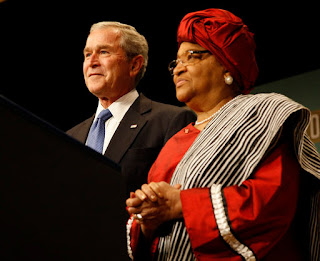
President George W. Bush stands with Liberian President Ellen Johnson Sirleaf

President George W. Bush stands with Liberian President Ellen Johnson Sirleaf before delivering his remarks at the White House Summit on International Development Tuesday, Oct. 21, 2008, in Washington, D.C. President Bush discussed in his remarks core transformational goals of country ownership, good governance, results-based programs and accountability, and the importance of economic growth. White House photo by Eric Draper
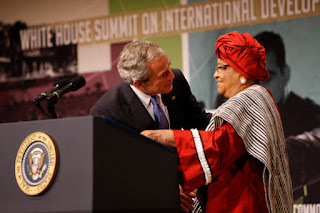
President George W. Bush embraces Liberian President Ellen Johnson Sirleaf

After being introduced President George W. Bush embraces Liberian President Ellen Johnson Sirleaf at the White House Summit Tuesday, Oct. 21, 2008, in Washington, D.C. President Bush discussed in his remarks core transformational goals of country ownership, good governance, results-based programs and accountability, and the importance of economic growth. White House photo by Eric Draper
President Bush Attends White House Summit on International Development FULL STREAMING VIDEOand the PODCAST OF THIS ARTICLE Ronald Reagan Building and International Trade Center Washington, D.C. Fact Sheet: Transforming International Development and In Focus: White House Summit on International Development 1:22 P.M. EDT.

THE PRESIDENT: Thank you, all. Madam President. Madam President I could not think of anybody better to give me dancing lessons than you. (Laughter.) We love you. I love your spirit. I love your leadership. I love the example you set for leaders all across the globe. And it's an honor to be here with you. (Applause.)

And it's an honor to be here with you all. I welcome you to the White House Summit on International Development. It's a summit to herald the outstanding work being done to lift up souls in need. I appreciate the fact that folks in this room represent thousands that are replacing disease with health, dependency with self-reliance, and despair with hope.

The people gathered here come from different countries -- I see we represent different professions -- but we're united by our commitment to charting a new era in development. Today I'm going to talk with you about this new philosophy, about the way it's transforming countries and saving lives, and about why it's essential to continue in the years ahead.

Before I do so, I want to recognize not only the President, but her son, Robert. I suspect your mother tells you what to do like my mother tells me what to do. (Laughter.) As a matter of fact, your mother tells me what to do. (Laughter.) Welcome.


Congressman Donald Payne, we're sure proud you're here; thank you, Mr. Chairman, for coming. (Applause.) Much of the success of the programs we've implemented are due to, one, the generosity of the American people, but also the fine group of people that are implementers: Henrietta Fore, the Administrator of USAID; Rob Mosbacher, President and CEO of OPIC; Ambassador John Danilovich, Millennium Challenge Corporation CEO; Ambassador Mark Dybul, U.S. Global AIDS Coordinator; Rear Admiral Tim Ziemer, U.S. Malaria Coordinator. Thank you all for being leaders. (Applause.)

The second choice to introduce me was Bob Geldof, musician. Of course, he'd have got up and said, I saw him try to sing while in Africa. (Laughter.) I've come to really appreciate Bob Geldof. He is a genuine person who has used his fame to help others in need, and it is a -- it's been a joy to work with you. You know, you and I might look differently, but I think we share the same compassion and the same hopes. And thank you for joining us today. (Applause.)

I want to thank the panelists who have participated in this conference. I do want to welcome members of the Diplomatic Corps; thank you all for coming by today.

You know, we meet today in the middle of a serious global financial crisis. Over the past few weeks, we have seen how the world's economies are more interconnected than ever before. The crisis is having a major impact on working people all over the world -- including many in developing nations.

During times of economic crisis, some may be tempted to turn inward -- focusing on our problems here at home, while ignoring our interests around the world. This would be a serious mistake. America is committed -- and America must stay committed -- to international development for reasons that remain true regardless of the ebb and flow of the markets. We believe that development is in America's security interests. We face an enemy that can't stand freedom. And the only way they can recruit to their hateful ideology is by exploiting despair -- and the best way to respond is to spread hope.

We believe that we ought to remain committed to development because it's in our long-term economic interests. When America helps developing nations rise out of poverty, we create new markets for our goods and services, and better jobs for American workers. And we're committed to development because it's in our moral interests. I strongly believe in the timeless truth: To whom much is given, much is required. We are a blessed nation and I believe we have a duty to help those less fortunate around the world. We believe that power to save lives comes with the obligation to use it. And I believe our nation is better when we help people fight hunger and disease and illiteracy.

For all of these reasons, this administration has made international development one of our biggest priorities. As the President mentioned, we've worked with partner nations -- as well as the World Bank, and the IMF, and the African Development Bank, and the Inter-American Development Bank -- to relieve tens of billions of dollars in debt from some of the world's poorest nations. By relieving crushing debt burdens, it gives people hope. We've also worked with wealthier nations to provide aid in the form of grants instead of loans. For the past eight years, the United States has provided more foreign assistance than at any time in the past half century.

We're using this aid to foster sustainable economic growth, and promote good governance, and advance a model of true partnership that gives poor nations a real stake in their own development. We're encouraging volunteer organizations, local charities, and the faith community to take on an even greater role -- because we strongly believe that they offer a compassion that no government can offer. Most of all, we're insisting on accountability in return for our assistance, so we can assure that our generosity leads to measurable results. You know, for too long, foreign aid was designed to make us feel good. Now, we're ensuring that our resources do good.

This new approach to development is embodied by a revolutionary initiative called the Millennium Challenge Account. See, this program says that the United States will help. But we expect countries that we help to fight corruption and to govern justly. There's nothing more pitiful than to have people's hopes robbed by corrupt government officials. We say to those we want to help support, open markets to trade and investment, and above all, invest in your people's health and education. You see, by tying our aid to these policies, we are encouraging developing nations to make tough economic and political and social reforms. We encourage leaders to respect their citizens, uphold human dignity, and work to earn the trust of their people. This approach is based on a clear conviction: People in the developing world have the capacity to improve their own lives -- and they will rise to meet high standards.

I refuse to accept the development model that says, oh, these people are doomed forever; let's just throw money at the problem. We believe that if you set high standards, good people will rise to meet those standards, regardless of where they live in the world. So the Millennium Challenge Account is a robust program that has invested $6.7 billion in 35 countries around the world. From Albania, to Moldova, to Indonesia, to Mongolia, to Paraguay, to Peru, these partnerships are helping developing nations take charge of their future -- and more importantly, unleash the talents of their people.

For example, this February President Kikwete of Tanzania and I signed a five-year, nearly $700 million compact to improve the country's transportation, energy, and water supply. It's pretty basic needs, isn't it? Transportation, energy and water supply. The partnership will build roads that connect rural Tanzanians to markets and schools and health clinics. It's hard to have a modern society if you can't get your product from rural to urban -- urban centers in your country. It's hard to get doctors to help people in the rural part of the country if you don't have roads to connect health care clinics to those in need. It's going to extend electricity to homes and businesses in some of the most remote areas of the country. It will increase access to clean drinking water, which will help reduce preventable diseases, especially in young children. Through these projects, the Millennium Challenge compact is helping Tanzania build a foundation for success in the 21st century -- and showing the promise of a new era in development.

In the new era of development, America and our partners are helping to meet basic human needs like food and clean water. There's nothing more basic than food and clean water. Since 2002, the United States has provided more than $16 billion in food assistance -- helping to ensure that tens of millions of people around the world do not go hungry. In response to the current global food crisis, we've committed $5.5 billion to address global hunger over the next two years. And that's important. These are stopgap measures. The American people care when they hear people are going hungry around the world. And I want to thank the American people for their generosity.

But as we work to resolve the crisis in the long run, we have got to find better solutions for global hunger in the long-term. In the short run we're helping; in the long term, we're developing a strategy and working with partners to help them grow their own food. There's no other way to put it. The best long-term policy for the United States is to help nations develop their own agricultural industry, so we don't have to deal with global food crisis year in and year out.

And so we supply poor and rural farmers with fertilizer and water-management systems. We distribute better seeds that will boost yields, and invest in research that will make crops like rice and wheat more resistant to drought and pests. You know, one of the really important challenges that this administration has taken on, and future administrations must take on, is to say to other markets around the world: It is okay to import markets to crops grown with biotechnology. A lot of countries are resistant upon introducing these new technologically advanced crops because they fear they're not going to be able to sell their crops elsewhere. And yet these crops will help people realize a vibrant agricultural industry.

I believe that as the United States moves forward, we ought to purchase up to a quarter of our food from local farmers. In other words, of all the food aid we get we ought to take a quarter of that, Donald, and purchase the food directly from local farmers. If it's in our interest to help build a local agricultural industry, then instead of just giving food, we ought to purchase food from the farmers themselves, to help build a vibrant agricultural sector in parts of the world where food is desperately needed. And I support the World Bank's strategy to increase investment in agriculture. (Applause.)

What I'm telling you is there's a better way than just a kind of patchwork approach. It's an approach that basically says we can use our technological advancement and our expertise to help build vibrant agricultural industries in nations where there ought to be crops today.

The United States works with partner nations to deal with the lack of clean water. Last year we dedicated nearly a billion dollars to improve sanitation and water supplies in developing nations. We're also wise enough to enlist the private sector to help, as well.

I want to share with you an interesting program -- for two reasons, one, it's interesting, and two, my wife thought of it -- (laughter) -- or has actually been involved with it; she didn't think of it. But she thought of it for this speech. She has been involved with a public-private partnership called the PlayPumps Alliance. It brings together international foundations and corporations and the U.S. government. Now, catch this: PlayPumps are children's merry-go-rounds attached to a water pump and a storage tank. When the wheel turns, clean drinking water is produced. And as my good wife says, PlayPumps are fueled by a limitless energy source -- (laughter) -- children at play.

The United States is working with our partners to install 4,000 pumps in schools and communities across sub-Sahara Africa, which will provide clean drinking water to as many as 10 million people. It's not that hard to help people get clean drinking water. It takes focus, imagination, and effort. And I call upon all nations around the world to join us. (Applause.)

In the new era of development, America and our partners recognize that education is the gateway to prosperity and essential to any society's long-term success. It's pretty obvious, isn't it? If people are educated, they can read the instructions on a medicine bottle. They can keep receipts for a small business. They can learn about the rights and privileges they have under their country's constitutions. Yet too many people can't read. America and our partners are determined to extend the promise of good education to more people in the developing world.

In the Middle East, USAID has partnered with local officials to start kindergartens in Jordan, taught hundreds of thousands of children about information technology in Morocco, built 70 schools for girls in Egypt.

Through our Africa Education Initiative, as the President mentioned, the United States has trained more than 700,000 teachers. I think you said a million teachers? Yes, I'll go for a million then. (Laughter and applause.) Somewhere between 700,000 and a million. (Laughter.) Distributed more than 10 million textbooks -- somewhere between 10 million and 15 million -- and provided hundreds of thousands of scholarships to help girls go to school.

Last year I announced a new initiative that will devote $425 million to improve education in Ethiopia and Ghana and Honduras and Liberia and Mali and Yemen. Why? Why do we do that? Because the truth of the matter is, we want children to fulfill their God-given potential, is why we do that. And so we're helping to train the doctors and the lawyers and the engineers and entrepreneurs and the women Presidents who will be vital to the future of the developing world. (Applause.)

In the new era of development, America and our partners are helping to lift the burden of deadly disease. In Africa, the treatable and preventable disease of malaria kills one child every 30 seconds. So in 2005 I launched a five-year, $1.2 billion initiative that cut the number of malaria-related deaths in 15 African nations by half.

Through the initiative, we joined with African governments -- notice, "we joined with African governments" -- to design malaria control strategies that will work with their nations. We expect results for the money we spend. And yet we're confident when we work with governments that they can develop the strategy necessary to achieve the objectives. And so we supply the money, and our partner nations work to distribute insecticide-treated bed nets, conduct indoor spraying campaigns, and provide cutting-edge drugs.

The interesting thing about this initiative is it's easy to measure whether or not we're being successful. In the new development agenda, results matter a lot. And therefore, when the United States works with countries, we expect there to be a well-defined strategy and the ability to measure whether or not our money is working. I don't think that's too much to ask, nor do the people who are trying to help think that's too much to ask.

So far, our efforts have reached 25 million people. In places like Zambia, and Ethiopia, and Rwanda, and Zanzibar, the numbers of people sick or dying from malaria have dropped dramatically. We have not only made progress around the edges, we've made dramatic progress in saving lives. I find that the work to defeat malaria is exciting work, and it is inspiring work. And frankly, it's not all that hard to design a strategy to get bed nets to people. And I want to thank my fellow citizens for caring deeply about this initiative. And I want to thank our partners for working hard to make sure that a mom won't have to worry about her child dying because of a mosquito bite. (Applause.)

The President talked about our fight against HIV/AIDS. And it's a noble battle and it's a necessary battle. In 2003, as she had mentioned, we launched PEPFAR. The program is the largest commitment by any nation to combat a single disease in human history. (Applause.) Ambassador Dybul and I believe that the program is effective because it is defined by a few key principles. You know, if you're going to have a new era of development, it's important to have clear definitions. It's one thing just to throw money at the problem, it's another thing to insist upon strategies that actually work. So the emergency plan demands specific measurable targets for progress. His job is to not only put the implementers in place and to find those souls who are on the front lines of saving lives and empower them; his job is to report back to the President and say, "Here is the progress we're making, Mr. President." That way it gives me a chance to say, "Well, if you're not making enough progress Mark, do something differently, please."

It employs a prevention strategy that works: ABC, which means abstinence, be faithful, and use condoms. This isn't guesswork; this is a program that is working. It puts local partners in the lead, because they know the needs of their people best. It enlists new partners from the international community, the private sector and the faith community.

I can't tell you how many people that I've met in the United States who say, "I'm part of PEPFAR, because my church has adopted the program." You know, there's nothing better than having people who hear the universal call to love a brother like you'd like to be loved yourselves on the front line of helping to save lives.

And the United States government is smart enough to enlist the compassion and love and hard work of people in the faith community in the United States to help our brothers and sisters in need. So far, the results are striking. When we launched the initiative in 2003, only 50,000 people in sub-Sahara Africa were receiving anti-retroviral treatment.

Today we support treatment for nearly 1.7 million people in the region, and tens of thousands of more around the world, from Asia, to the Caribbean, to Eastern Europe. PEPFAR has supported care for nearly 7 million people, including millions of orphans and vulnerable children. PEPFAR has allowed nearly 200,000 children in Africa to be born HIV-free. PEPFAR is working. And I want to thank the United States Congress for coming together to re-authorize and dramatically expand this program. (Applause.)

I'm sure that many of you had the same experiences that Laura and I've had in meeting people whose lives have been touched by the initiatives we're talking about today. I'll never forget meeting Harriet Namutebi. She is -- we met her in Africa on our trip five years ago. She lost her brother, her husband, and one of her children to AIDS. She was diagnosed, she locked herself in her room, she refused to eat, and she wanted to die.

But at a clinic supported by PEPFAR, Harriet was given a new lease on life. Counselors at the clinic showed Harriet how to live positively with HIV. A loving soul took this person who was in despair and said, here's a chance for you.

Thanks to the antiretroviral treatments Harriet received, she is now in good health. She cares for four children. She is an enthusiastic member of the clinic's drama group, which educates others about HIV. She is living proof of what people in Africa call the "Lazarus Effect" -- communities once given up for dead are now being brought back to life. And it is a joy to be a part of PEPFAR. (Applause.)

In the new era of development, we are working with partners to unleash the greatest engine of prosperity the world has ever known, and that is free trade. For developing nations, the value of trade is nearly 40 times the value of foreign aid. Let me repeat that: For developing nations, the value of trade is 40 times the value of foreign aid. Isn't that an interesting statistic? What should that tell you? It says if you're interested in helping the developing world, promote trade. That's what it ought to tell you.

According to the World Bank, the complete elimination of barriers to trading goods would boost annual income in developing countries by more than $140 billion. I think that would go a long way, don't you, Madam President?

You know, trade opens growth, ignites growth, but it also produces other benefits. It helps increase transparency. It helps increase the rule of law. During my administration we have worked hard to reduce barriers to trade and investment. When I took office, we had free trade agreements in effect with three nations. Today, we have them with 14 nations; most of them are developing countries. (Applause.)

My predecessor, President Clinton, did a smart thing with the African Growth and Opportunity Act. My administration had the honor of extending that Act. In 2005, I worked with Congress to pass a free trade agreement with the Dominican Republic and nations in Central America -- it's called CAFTA. And although it's still in its early stages, trade between participating countries with the U.S. is up 30 percent since its enactment. Do you know what that means? That means more jobs for workers in those countries. It means more food for families. It means more investment that developing countries need to grow and prosper. That's what that means.

Trade is essential to prosperity in both good economic times and bad. During periods of crisis, like the one we're in now, protectionism may seem like the best way to safeguard wealth. But when major economies try to wall themselves off, they deny themselves the growth that comes from exports and deepen poverty by depriving poor nations of vital markets for their goods. You see, in the midst of this crisis, I believe the world ought to send a clear signal that we remain committed to open markets by reducing barriers to trade across the globe. The recent impasse in the Doha Round of trade talks is disappointing, but that doesn't have to be the final word. And so before I leave office, I'm going to press hard to make sure we have a successful Doha Round. (Applause.)

In this new era of development, countries that make the courageous choice to embrace democracy must realize the economic benefits that go with it. When young democracies do not deliver improvements in their people's daily lives, the people start to lose faith in free societies; that's a fact.

For example, let's talk about our own neighborhood. I believe it's in our interest that we have a good, sound neighborhood. It's in our interest our neighborhood prosper and get along. And we've seen hopeful advances for democracy and free enterprise in North and South America. There's no doubt about it. There's been some amazing advances. Yet there's also voices that challenge free markets and democratic values -- quite loud voices. Some of them have gained a following, because amid the progress in our hemisphere, we also see terrible want. What the campesinos and trabajadores want is -- what they don't need is false populism; what they do need is social justice. And the development aid of the United States has been focused on providing social justice in our neighborhood.

True social justice requires creating new opportunities for prosperity and upward mobility. So working in partnership with Latin American nations, we've helped more than 400,000 poor and disadvantaged children learn to read. We've increased economic opportunity by relieving debt and opening trade, as I mentioned. We've delivered aid that empowers the poor and the marginalized. Since I took office -- with support from the Congress -- the United States has provided nearly $15 billion to the region with a special focus on helping the poor.

True social justice requires government institutions that are fair and effective and free from corruption. You can't have social justice if your government is stealing from you. Since 2001, the United States has doubled our worldwide commitment to programs that foster democracy and good government -- including programs in Latin America. We've entered into the Millennium Challenge Account agreements with six nations in Latin America and the Caribbean -- and a number of other countries are pursuing compacts.

We've worked with countries like El Salvador to train law enforcement officers who can combat criminal gangs. Mexico, we're partnering with the government to stop smugglers who traffic in everything from guns to human beings. Colombia, we've worked closely with President Uribe to defeat the cocaine cartels and narcoterrorists. By the way, it is no coincidence last year that Colombia's economy saw its largest growth in nearly three decades, because that country has got a strong leader willing to take on the FARC.

True social justice requires compassion. And some of the greatest work of compassion in Latin America is being done by the United States military. I don't know if you ever heard of the Navy hospital ship called the Comfort, but it sailed to 12 countries in Latin America and the Caribbean last year. Doctors treated tens of thousands of poor patients, and conducted more than 26,000 surgeries. Dentists and hygienists filled cavities and cared for infections and treated young children. These men and women are showing that the nations of Latin America have a strong partner in the United States of America. They're a part of our efforts to show that the institutions of freedom and capitalism and democracy are not threats to be feared, but the surest path to social justice there is.

From fostering good governance and reform, to alleviating hunger and disease, to advancing education, prosperity and justice, our new approach to development has shown inspiring signs of success. Yet this success can be reversed, and the cost of abandoning our commitments would be far higher than the cost of fulfilling them. So I urge both parties in Congress to ensure that our development efforts remain an enduring priority of the United States. (Applause.)

I call on other members of the G8 and the United Nations, as well as our fellow contributors to the Global Fund, to follow through on their pledges. (Applause.) Corporations and foundations have shared their resources and expertise with the developing world, and I urge them to continue their generosity. Faith-based groups have done amazing work to heal the sick and lift up the suffering, and I urge them to carry on their missions of mercy.

It's amazing what individual Americans have done to help with the new era of development. I got a Christmas gift from one of my little nephews, which was mosquito nets. Thousands of individuals and schoolchildren all across the country are donating $10 to buy a mosquito net to help save a life. There are people who are raising money for HIV/AIDS initiative. There are people who are going on a service mission with their house of worship. These folks are making a huge contribution, and I urge them to continue their good work.

History shows what happens when America combines our great compassion with our steadfast determination. We are a compassionate people and we are a determined people. During a recent visit, a good friend of mine shared his vivid childhood memories of the Marshall Plan. We were standing on the South Lawn. He said he'll never forget the kindness America showed his nation in a time of need, and now that man is the Prime Minister of Italy. And last week, Silvio Berlusconi expressed his enduring loyalty and gratitude to the people of the United States.

It's not hard to imagine what fruits our compassion will yield 60 years from today. We can see it in the faces of Afghan girls going to school for the first time. We can see them in the proud eyes of Latin American workers providing for themselves and for their families. We see them in the joy of new African mothers whose babies are protected from malaria and HIV. We see them in the outpouring of thanks throughout the developing world. I'm just so sorry that not every American could have been with Laura and me to see what we saw in our trip to Africa last year. Schoolchildren sang songs about America's generosity. One shop-owner, I think who was in Liberia, Madam President, painted his stall in our nation's colors. Tens of thousands of people lined the roadsides during our visit, cheering and waving American flags in gratitude to the American people.

I'm honored to be the President of such a nation filled with people -- filled with people of such generosity and goodness. I'm proud to join with all of you in ushering in a new era of development. This is an historic commitment that we all can be proud of -- one that will secure a bright future for our partners in the developing world, one that will make America a better place. God bless you. (Applause.)

END 1:58 P.M. EDT For Immediate Release Office of the Press Secretary October 21, 2008

Tags: and

Monday, October 20, 2008

Governor Sarah Palin (R-AK) Speech in Loveland, Colorado VIDEO

Governor Sarah Palin Republican Vice Presidential candidate Sarah Palin speaks to about 4,000 supporters at a campaign rally for John McCain at the Budweiser Events Center in Loveland, Colorado. Today : Loveland, Colorado : running time 26 min. FULL STREAMING VIDEO
Tags: or and

Sunday, October 19, 2008

Sarah Palin Saturday Night Live (SNL) 10/18/08 VIDEO

Saturday Night Live (SNL) 10/18/08 - Opening bit with Tina Fey, Alec Baldwin, Loren Michaels and Governor Sarah Palin

Saturday Night Live Weekend Update: Palin Rap. Amy Poehler steps in for Governor Sarah Palin

Tags: or and

Saturday, October 18, 2008

Freedom Calendar 10/18/08 - 10/25/08

Negro farmer plowing his field of four acresOctober 18, 1871, After violence against Republicans in South Carolina, President Ulysses Grant deploys U.S. troops to combat Democrat terrorists who formed the Ku Klux Klan.
October 19, 1956, On campaign trail, Vice President Richard Nixon vows: “American boys and girls shall sit, side by side, at any school – public or private – with no regard paid to the color of their skin. Segregation, discrimination, and prejudice have no place in America”.

October 20, 1942, 60 prominent African-Americans issue Durham Manifesto, calling on southern Democrats to abolish their all-white primaries.

October 21, 1837, Birth of Sara Spencer, Secretary of National Woman Suffrage Association; her address to 1876 Republican National Convention was first by a woman before a major party.

October 22, 1868, While campaigning for re-election, Republican U.S. Rep. James Hinds (R-AR) is assassinated by Democrat terrorists who organized as the Ku Klux Klan.

October 23, 1906, President Theodore Roosevelt nominates first Jewish Cabinet member, Republican Oscar Straus, as Secretary of Commerce and Labor.

October 24, 1972, Death of Jackie Robinson, athlete and Republican civil rights activist.

October 25, 1858, U.S. Senator William Seward (R-NY) describes Democratic Party as “inextricably committed to the designs of the slaveholders”; as President Abraham Lincoln’s Secretary of State, helped draft Emancipation Proclamation.

"With courage, born of success achieved in the past, with a keen sense of the responsibility which we shall continue to assume, we look forward to a future large with promise and hope. Seeking no favors because of our color, nor patronage because of our needs, we knock at the bar of justice, asking an equal chance.”

Mary Terrell, African-American Republican and co-founder of the NAACP

Technorati Tags: and or and or and or and or and or or and or

Bush radio address 10/18/08 PODCAST TEXT TRANSCRIPT

President George W. Bush calls troops from his ranch in Crawford, Texas, Thanksgiving Day, Thursday, Nov. 24, 2005. White House photo by Eric Draper.


DOWNLOAD THE MP3 FILE HERE
bush radio address 10/18/08 full audio, text transcript. President's Radio Address en Español In Focus: Economy
Subscribe to the Republican National Convention Blog Podcast Subscribe to Our Podcast feed or online Click here to Subscribe to Republican National Convention Blog's PODCAST with podnova podnova Podcast Channel and receive the weekly Presidential Radio Address in English and Spanish with select State Department Briefings. Featuring real audio and full text transcripts, More content Sources added often so stay tuned.

THE PRESIDENT: Good morning. Our Nation is dealing with a serious financial crisis. Over the past month, Americans have witnessed fast-moving events involving complicated financial issues. I know many of you are concerned about your finances. So this morning, I want to tell you how we're addressing the uncertainty in our economy.

The federal government has responded to this crisis with systematic and aggressive measures to protect the financial security of the American people. These actions will take more time to have their full impact. But they are big enough and bold enough to work.

The primary focus of our efforts is addressing the underlying problem behind the freeze in our credit markets. Earlier this month, Congress passed bipartisan legislation authorizing the Treasury Department to use up to $700 billion to help banks rebuild capital. This week, I announced that the Treasury will use a portion of that money to inject capital directly into banks by purchasing equity shares. This new capital will help banks continue making loans to businesses and consumers. In addition, the Treasury will use part of the $700 billion to purchase some of the troubled assets that are weighing down banks' balance sheets and clogging the financial system. This extraordinary effort is designed with one overriding purpose: to help banks get loans flowing to American consumers and businesses, so they can create jobs and grow our economy.

I know many Americans have reservations about the government's approach, especially about allowing the government to hold shares in private banks. As a strong believer in free markets, I would oppose such measures under ordinary circumstances. But these are no ordinary circumstances. Had the government not acted, the hole in our financial system would have grown larger, families and businesses would have had an even tougher time getting loans, and ultimately the government would have been forced to respond with even more drastic and costly measures later on. So I decided that government had to move, but that government's involvement in individual banks had to have prudent limits.

The government's involvement is limited in size. The government will only buy a small percentage of shares in banks that choose to participate, so that private investors retain majority ownership.

The government's involvement is limited in scope. The government will not exercise control over any private firm, and federal officials will not have a seat around your local bank's boardroom table. The shares owned by the government will have voting rights that can be used only to protect the taxpayer's investment -- not to direct the firm's operations.

The government's involvement is limited in duration. It includes provisions to encourage banks to buy their shares back from the government when the markets stabilize and they can raise money from private investors. This will ensure that banks have an incentive to find private capital to replace the taxpayer's investment -- and to do so quickly.

I know many of you are also concerned about the price tag of this rescue package. Ultimately, we believe the final cost will be significantly less than the initial investment. Many of the troubled assets that the government buys will increase in value as the market recovers. That means the government eventually will be able to resell them for a higher price. In addition, the government will receive quarterly dividends from the equity shares it purchases in financial institutions. If banks do not repurchase these shares within five years, the dividends they owe the government will increase substantially. This provides a clear incentive for banks to buy back their shares, thus returning the money to taxpayers, as soon as possible.

In the long run, the American people can have confidence that our economy will bounce back. America is the best place in the world to start and run a business, the most attractive destination for investors around the globe, and home to the most talented, enterprising, and creative workers in the world. We're a country where all people have the freedom to realize their potential and chase their dreams. This promise has defined our Nation since its founding, this promise will guide us through the challenges we face today, and this promise will continue to define our Nation for generations to come.

Thank you for listening. # # #

For Immediate Release Office of the Press Secretary October 18, 2008

Tags: and

Discurso Radial del Presidente a la Nación 10/18/08

Presidente George W. Bush llama a tropas de su rancho en Crawford, Tejas, día de Thanksgiving, jueves, de noviembre el 24 de 2005.  Foto blanca de la casa de Eric Draper.


Descargar el archivo MP3 aquí
forre el audio de la dirección de radio 10/18/08 por completo, transcripción del texto. (nota de los redactores: ninguna lengua española mp3 lanzó esta semana, apesadumbrada) PODCAST
Chascar aquí para suscribir a nuestro canal republicano de Blog Podcast de la convención nacional con Odeo Suscribir a nuestro canal de Podcast de Odeo o del podnova Chascar aquí para suscribir a nuestro canal republicano de Blog Podcast de la convención nacional con Podnova y recibir la dirección de radio presidencial semanal en inglés y español con informes selectos del departamento del estado. Ofreciendo transcripciones audio y con texto completo verdaderas, más fuentes contentas agregaron a menudo así que la estancia templó.

Buenos Días.

Nuestra Nación está pasando por una grave crisis financiera. Durante el último mes, los estadounidenses han sido testigo de eventos que han sucedido rápidamente relacionados con temas financieros complicados. Sé que muchos de ustedes están inquietos en cuanto a sus finanzas. Quiero decirles cómo estamos enfrentando la incertidumbre en nuestra economía.

El gobierno federal ha respondido a esta crisis con medidas sistemáticas y agresivas para proteger la seguridad financiera del pueblo estadounidense. Estas acciones tomarán más tiempo para alcanzar su impacto pleno. Pero son lo suficientemente grandes y audaces para lograr un resultado.

El enfoque principal de nuestros esfuerzos es de enfrentar el problema fundamental detrás del congelamiento de nuestros mercados crediticios. A principios de este mes, el Congreso aprobó legislación bipartita autorizando al Departamento del Tesoro utilizar hasta 700 mil millones de dólares para ayudar a los bancos a reconstruir su capital. Esta semana yo anuncié que el Tesoro usaría una porción de ese dinero para inyectar capital directamente a los bancos comprando acciones de su capital. Este nuevo capital ayudará a los bancos a seguir prestando a negocios y consumidores. Además, el Tesoro usará parte de los 700 mil millones de dólares para adquirir parte de los valores en dificultad que están agobiando los estados de cuenta de los bancos y atascando el sistema financiero. Este esfuerzo extraordinario está diseñado con un propósito primordial – ayudar a los bancos a facilitar el flujo de préstamos a los consumidores y negocios estadounidenses, a fin de que puedan crear empleos y hacer crecer nuestra economía.

Sé que muchos estadounidenses tienen reservas en cuanto al enfoque del gobierno, sobre todo dejar que el gobierno adquiera acciones de bancos privados. Como fuerte partidario de mercados libres, yo me opondría a tales medidas bajo circunstancias ordinarias. Pero estas no son circunstancias ordinarias. De no haber tomado acción el gobierno, el agujero en nuestro sistema financiero se habría hecho más grande… las familias y los negocios habrían tenido aún más dificultad en obtener préstamos… y eventualmente el gobierno su hubiera visto forzado a responder más adelante con medidas aún más drásticas y costosas. Por lo tanto decidí que el gobierno tenía que actuar, pero que la intervención del gobierno en los bancos individuales debía tener límites prudentes.

La participación del gobierno está limitada en tamaño. El gobierno sólo comprará un pequeño porcentaje de acciones en los bancos que opten por participar, de modo que los inversionistas privados mantengan la mayoría de la propiedad de acciones.

La participación del gobierno está limitada en su alcance. El gobierno no ejercerá control sobre cualquier empresa privada, ni habrá un lugar en la mesa directiva de su banco local para oficiales federales. Las acciones de propiedad del gobierno tendrán derechos de votación que sólo se podrán ejercer para proteger la inversión del contribuyente – no para dirigir las operaciones de la empresa.

La participación del gobierno está limitada en cuanto a duración. Incluye disposiciones para fomentar que los bancos compren sus acciones de vuelta del gobierno cuando se estabilice el mercado y puedan recaudar el dinero de inversionistas privados. Esto asegurará que los bancos tengan un incentivo para encontrar capital privado para reemplazar la inversión del contribuyente – y para hacerlo rápidamente.

Yo sé que muchos de ustedes están preocupados sobre el costo de este paquete de rescate. Muchos de los valores en dificultad que el gobierno compre aumentarán en valor a medida que el mercado se recupere. Esto significa que el gobierno podrá revenderlos a un precio más elevado. Además, el gobierno recibirá dividendos trimestrales de todas las acciones de capital que compre en instituciones financieras. Si los bancos no compran de vuelta estas acciones dentro de cinco años, los dividendos que deban al gobierno aumentarán considerablemente. Esto ofrece un claro incentivo para que los bancos compren de regreso sus acciones – devolviendo de ese modo el dinero a los contribuyentes – lo más pronto posible.

A largo plazo, el pueblo estadounidense puede tener confianza en que nuestra economía se recuperará. Estados Unidos es el mejor lugar del mundo para comenzar y operar un negocio… el destino más atractivo para los inversionistas de todo el mundo… y es donde se encuentran los trabajadores más talentosos, emprendedores y creativos en el mundo. Somos un país donde todas las personas tienen la libertad de realizar su potencial y perseguir sus sueños. Esta promesa ha definido a nuestra Nación desde su fundación… esta promesa nos servirá de guía a través de los desafíos que enfrentamos hoy en día… y esta promesa seguirá definiendo a nuestra Nación por generaciones venideras.

Gracias por escuchar.

Para su publicación inmediata, Oficina del Secretario de Prensa, 18 de octubre de 2008

Etiquetas De Technorati: , y

John McCain's Weekly Radio Address 10/18/08 PODCAST

John McCain and Bobby Jindal


DOWNLOAD THE MP3 FILE HERE
ARLINGTON, VA -- McCain-Palin 2008 today released the text of John McCain's weekly radio address.

John McCain's Weekly Radio Address:
Good morning, this is John McCain, speaking to you a couple of days after the final presidential debate. It was a good contest, and I thought I did pretty well. But let's have a little straight talk: The real winner on Wednesday night was a fellow known to America as Joe the Plumber.

Joe Wurzelbacher is a straight-talking man himself. And his blunt question to Barack Obama, after a recent speech in Ohio, got a clarity out of my opponent that we hadn't heard before.

Joe explained that he works for a small plumbing and heating company. He's been thinking about maybe taking over the business when his boss retires. Problem is, that would make Joe one of millions of small business owners who face a sudden increase in taxes under my opponent's tax plan.

That didn't seem fair to Joe. He wanted to know why Barack Obama plans to raise taxes on folks who are trying to start or grow a business and create jobs for others. And fairness aside, at a time of serious economic crisis, punishing job creators didn't seem like a real good way to kick-start a recovery.

My opponent's answer showed that economic recovery isn't even his top priority. His goal, as Senator Obama put it, is to "spread the wealth around."

You see, he believes in redistributing wealth, not in policies that help us all make more of it. Joe, in his plainspoken way, said this sounded a lot like socialism. And a lot of Americans are thinking along those same lines. In the best case, "spreading the wealth around" is a familiar idea from the American left. And that kind of class warfare sure doesn't sound like a "new kind of politics."

This would also explain some big problems with my opponent's claim that he will cut income taxes for 95 percent of Americans. You might ask: How do you cut income taxes for 95 percent of Americans, when more than 40 percent pay no income taxes right now? How do you reduce the number zero?

Well, that's the key to Barack Obama's whole plan: Since you can't reduce taxes on those who pay zero, the government will write them all checks called a tax credit. And the Treasury will cover those checks by taxing other people, including a lot of folks just like Joe.

In other words, Barack Obama's tax plan would convert the IRS into a giant welfare agency, redistributing massive amounts of wealth at the direction of politicians in Washington. I suppose when you've voted against lowering taxes 94 times, as Senator Obama has done, a new definition of the term "tax credit" comes in handy.

At least in Europe, the Socialist leaders who so admire my opponent are upfront about their objectives. They use real numbers and honest language. And we should demand equal candor from Senator Obama. Raising taxes on some in order to give checks to others is not a tax cut it's just another government giveaway.

What's more, the Obama tax increase would come at the worst possible time for America, and especially for small businesses like the one Joe dreams of owning. Small businesses provide 16 million jobs in America. And a sudden tax hike will kill those jobs at a time when need to be creating more jobs.

Fortunately, America has an alternative to the phony tax cut my opponent started talking about only months ago. The McCain-Palin tax cut is the real thing. Among our other serious tax reforms, we're going to reduce every income tax bill in America, and double the child deduction for every family. We will cut the capital gains tax. And we will cut business taxes to help create jobs, and keep American businesses in America.

As Joe the Plumber has now reminded us all, America didn't become the greatest nation on earth by letting government "spread the wealth around." In this country, we believe in spreading opportunity, for those who need jobs and those who create them. And that is exactly what I intend to do as President of the United States.

Thanks for listening.

Tags: or and

Friday, October 17, 2008

63rd Annual Al Smith Dinner John McCain VIDEO

Presidential candidates Sen. John McCain (R-AZ) and Sen. Barack Obama (D-IL) participate in the 63rd annual Al Smith Dinner.
The event, in honor of the late NY governor, the first Roman Catholic to run for president as nominee of a major party,
is a requisite stop for major politicians. Thursday : Washington, DC : 47 min. C-SPAN FULL STREAMING VIDEO real media format.
RELATED: Tags: or

Thursday, October 16, 2008

McCain Palin Web Ad: Joe The Plumber VIDEO


ARLINGTON, VA -- Today, McCain-Palin 2008 released its latest web ad, entitled "Joe the Plumber." The ad highlights Barack Obama's plans to increase taxes on Americans, even as they seek to build their own small businesses and create jobs. While Barack Obama talks about cutting taxes, his plan is really just a plan to "spread the wealth around" instead of creating new wealth and new opportunity.

Transcript For "Joe The Plumber" (Web :30)

JOHN MCCAIN: I'm John McCain and I approve this message.

ANNCR: Americans are catching...

JOE WURZELBACHER: Your new tax plan is going to tax me more.

BARACK OBAMA: It's not that I want to punish your success. ... I think when you spread the wealth around, it's good for everybody.

ANNCR: Everybody?

Leading papers call Obama's taxes "welfare" ... "government handouts".

Obama raises taxes on seniors, hard working families to give "welfare" to those who pay none.

Just as you suspected, Obama's not truthful on taxes.

AD FACTS: Script For "Joe The Plumber" (Web :30)

JOHN MCCAIN: I'm John McCain and I approve this message. ANNCR: Americans are catching on... JOE WURZELBACHER: Your new tax plan is going to tax me more. BARACK OBAMA: It's not that I want to punish your success. ... I think when you spread the wealth around, it's good for everybody.

Barack Obama: "And I Think When You Spread The Wealth Around, It's Good For Everybody." JOE WURZELBACHER: "I'm a plumber. You know, I work, you know, 10, 12 hours a day. If I buy another truck and add something else to it, and you know, build the company..." OBAMA: "Right." WURZELBACHER: "... you know, I'm getting taxed more and more." OBAMA: "Nobody likes high taxes." WURZELBACHER: "No, not at all." OBAMA: "Right? Of course not. So -- but what's happened is, is that we end up -- we've cut taxes a lot for folks like me who make a lot more than $250,000. We haven't given a break to folks who make less. It's not that I want to punish your success, I just want to make sure that everybody who is behind you, that they've got a chance at success, too. And everybody is so pinched that business is bad for everybody. And I think when you spread the wealth around, it's good for everybody." (FOX News' "On The Record," 10/13/08)

ANNCR: Everybody? Leading papers call Obama's taxes "welfare" ... "government handouts".

The Wall Street Journal Calls Obama's Numerous Refundable Tax Credits "Tens Of Billions Of Dollars In Government Handouts." "For the Obama Democrats, a tax cut is no longer letting you keep more of what you earn. In their lexicon, a tax cut includes tens of billions of dollars in government handouts that are disguised by the phrase 'tax credit.'" (Editorial, "Obama's 95% Illusion," The Wall Street Journal, 10/13/08)

Pittsburgh Tribune-Review: "[T]he One-Third Of All American Working Families Who Pay No Income Taxes Now Will Receive A Government Check Under The Obama Plan. And That Number Could Rise To About 44 Percent Under Obama's Proposal." "The 'tax-cut plan' of Democrat presidential nominee Barack Obama is anything but. In fact, it's nothing more than another liberaled-up wealth-transference program that, in the 'old days,' was known as welfare. ... Just as troubling, however, is this little factoid: Even the one-third of all American working families who pay no income taxes now will receive a government check under the Obama plan. And that number could rise to about 44 percent under Obama's proposal." (Editorial, "Obama's Tax Cut: New Welfare Deal," Pittsburgh Tribune-Review, 10/14/08)

New York Post: "[O]bama's 'Tax Cuts' Really Amount To A Sizable Expansion Of Welfare." "In truth, as The Wall Street Journal detailed yesterday, nearly all of those 'cuts' actually come in the form of 'refundable tax credits,' by which the government in effect writes a check to those who meet certain criteria - even if they don't pay taxes in the first place. In other words, Obama's 'tax cuts' really amount to a sizable expansion of welfare. That leaves American taxpayers to foot the bill - both directly, and through the lost economic opportunity that's sure to follow Obama's promised tax hikes on income, dividends and capital gains." (Editorial, "Ready, Set ... Spend!" New York Post, 10/14/08)

ANNCR: Obama raises taxes on seniors, hard working families to give "welfare" to those who pay none.

Just as you suspected, Obama's not truthful on taxes.

Barack Obama Has Called For Higher Income Taxes, Social Security Taxes, Capital Gains And Dividend Taxes, And Corporate Taxes, As Well As "Massive New Domestic Spending." "Obama's transformation, if you go by his campaign so far, would mean higher income taxes, higher Social Security taxes, higher investment taxes, higher corporate taxes, massive new domestic spending, and a healthcare plan that perhaps could be the next step to a full-scale, single-payer system. Is that what most Americans want, someone who will fulfill a Democratic policy wish list?" (James Pethokoukis, "Barack Hussein Reagan? Ronald Wilson Obama?" U.S. News & World Report's "Capital Commerce" Blog, www.usnews.com, 2/12/08)

Barack Obama Would Raise Capital Gains And Dividend Taxes. "Sen. Obama wants to raise the long-term capital-gains rate for families making more than $250,000 to around 20 percent or somewhat higher but not above the 28 percent level it reached during the Reagan presidency, an Obama economic adviser says. The same rate would apply to most dividend income for these investors." (Tom Herman, "Tax Report Your Tax Bill: How McCain, Obama Differ," The Associated Press, 6/18/08)

Tax Policy Center: Barack Obama Would Raise Taxes On One Out Of Every Three Senior Households. "Even though Senator Obama's plan eliminates individual income taxes for seniors with incomes less than $50,000, his plan would raise taxes for almost 10 million senior households, over a third of the total (not shown in table). On average, seniors would face a tax increase of about 2 percent of income." (Burman et al., "A Preliminary Analysis of the 2008 Presidential Candidates' Tax Plans," The Tax Policy Center, 6/11/08)

Tax Foundation: Seniors "Rely Most On The Stable Flow Of Income That Dividends Provide." "Most debate over whether to extend the reduced rates on dividends and capital gains has focused on the tax benefits of these cuts to high-income taxpayers. What has been largely ignored is the impact these tax policies have on corporations' decisions on how best to distribute their income to shareholders--including senior citizens, who rely most on the stable flow of income that dividends provide. A recent Tax Foundation analysis illustrated that a large number of those benefiting from dividends are seniors and those on the verge of retirement (See www.taxfoundation.org). A further analysis of these seniors earning dividends reveals that lower-income seniors who file tax returns depend more heavily on dividend income than high-income seniors." (Gerald Prante, "The Importance Of Dividend Income For Low-Income Seniors," Tax Foundation, http://www.taxfoundation.org/news/show/1354.html, 2/8/06)

Barack Obama Would Raise Income Taxes. Obama: "[I] would roll back the Bush tax cuts for those making over $250,000." (Sen. Barack Obama, CNN Democrat Presidential Candidate Debate, Manchester, NH, 6/3/07)

U.S. Department Of Treasury: Small Business Owners "Are Frequently Subject To The Highest Individual Income Tax Rates." "Changes in the individual income tax affect most businesses in the United States. That is because taxes on business earnings are often paid through the individual income tax when 'passed-through' to business owners. The business income from sole proprietorships, farm proprietorships, partnerships, S corporations, etc., is all taxed at the owners' individual income tax rates. This year 34 million business owners are expected to receive this type of income and pay tax on this income through the individual income tax. These businesses are typically small and often entrepreneurial in nature, and a source of innovation and risk-taking in the economy. Moreover, these business owners are frequently subject to the highest individual income tax rates." ("Topics Related To The President's Tax Relief," U.S. Department Of Treasu ry, http://www.ustreas.gov/press/releases/reports/president_taxrelief_topics_0508.pdf, May 2008)

Barack Obama Would Raise Social Security Taxes. "Obama's proposal ... would impose social security taxes on income above $250,000 per year. He would continue to exempt income between $102,000 and $250,000 from social security taxes." (Teddy Davis, Sunlen Miller, and Gregory Wallace, "Obama Kisses Billions Goodbye," ABC News' "Political Radar" Blog, blogs.abcnews.com, 6/18/08)

Tags: or and

Wednesday, October 15, 2008

Third Presidential Candidates Debate McCain Obama LIVE STREAMING VIDEO TEXT TRANSCRIPT PODCAST


FULL TEXT TRANSCRIPT in PDF Format

PODCAST Streaming MP3 and PODCAST Download MP3

Third Presidential Debate From Hofstra University, Hempstead, New York (October 15, 2008) FULL STREAMING VIDEO from CSPAN
CNN - Windows Media. and C-SPAN - Windows Media. - FULL STREAMING VIDEO LIVE

Commission on Presidential Debates, John S. McCain III, R, Arizona, Barack Obama (D-IL), moderated by Bob Schieffer, CBS.
Barack ObamaOctober 15, 2008 09:00 PM EDT. Running Time 1:30 LIVE Presidential Candidates Debate at Hofstra University, Hempstead, New York.John McCain
FULL TEXT TRANSCRIPT, STREAMING and MP3 DOWNLOAD for PODCAST. STREAMING VIDEO files will be posted here as soon as they are available

History Will Come Alive at Hofstra University

On October 15, Hofstra University will host the third and final presidential debate of the 2008 election season. This debate, focused on domestic issues, will be televised live around the world.


Leading up to the debate and the 2008 election, Hofstra is proud to host Educate '08, an unprecedented series of lectures, conferences, artistic performances and exhibitions, town hall meetings and interactive forums focused on the issues, history and politics of presidential elections. Educate '08 provides our students, faculty and the entire surrounding community with access to the newsmakers, scholars and policymakers who have unique insight and knowledge of the American political system. Many of our programs and events are free and open to the public, and we encourage you to join us for what will be a fascinating series of events. During spring 2008's Educate '08 schedule, Hofstra hosted more than 30 events, including guests such as Mary Matalin and James Carville, David Gergen, William Kristol and Maureen Dowd, Charlie Cook, and many scholars, historians, journalists and policymakers.

Find out more about Educate '08 by visiting www.hofstra.edu/educate08>

Hofstra University is a dynamic private institution where students can choose from more than 140 undergraduate and 155 graduate programs in liberal arts and sciences, business, communication, education and allied human services, and honors studies, as well as a School of Law. With a student-faculty ratio of 14-to-1, our professors teach small classes averaging 22 students that emphasize interaction, critical thinking and analysis. Hofstra offers a faculty whose highest priority is teaching excellence. The University also provides excellent facilities with state-of-the-art technology, extensive library resources and internship programs that match students’ interests and abilities with appropriate companies and organizations. The Hofstra community is driven, dynamic and energetic, helping students find and focus their strengths to prepare them for a successful future. ###


Tags: or and

Tuesday, October 14, 2008

Paulson, Bernanke,.Bair, Et al, Take Actions to Stabilize Financial Markets VIDEO

Henry M. Paulson, Jr., Ben Bernanke, Sheila C. BairThe President's Working Group on Financial Markets made a statement today on a series of comprehensive actions to strengthen public confidence in our financial institutions and restore functioning of our credit markets.
President's Working Group Announcement on Market Stability Initiative: Treasury Secretary Henry M. Paulson, Jr., Federal Reserve Chairman Ben Bernanke, FDIC Chairman Sheila C. Bair, SEC Chairman Christopher Cox, CFTC Chairman Walter Lukken, OCC Comptroller John Dugan, OTS Director John M. Reich.

View in Real Player Format or you may View in Windows Media

For the hearing impaired, view with captioning: View in Real Player format or you may View in Windows Media

Statement by Secretary Henry M. Paulson, Jr. on Actions to Protect the U.S. Economy

Washington, DC-- Treasury today issued the following statement by Secretary Henry M. Paulson, Jr. on actions to protect the economy and restore confidence and stability to our financial markets:

America is a strong nation. We are a confident and optimistic people. Our confidence is born out of our long history of meeting every challenge we face. Time and time again our nation has faced adversity and time and time again we have overcome it and risen to new heights. This time will be no different.

Today, there is a lack of confidence in our financial system – a lack of confidence that must be conquered because it poses an enormous threat to our economy. Investors are unwilling to lend to banks, and healthy banks are unwilling to lend to each other and to consumers and businesses.

In recent weeks, the American people have felt the effects of a frozen financial system. They have seen reduced values in their retirement and investment accounts. They have worried about meeting payrolls and they have worried about losing their jobs. Families all across our Nation have gone through long days and long nights of concern about their financial situations today, and their financial situations tomorrow. Without confidence that their most basic financial needs will be met, Americans lose confidence in our economy, and this is unacceptable.

President Bush has directed me to consider all necessary steps to restore confidence and stability to our financial markets and get credit flowing again. Ten days ago Congress gave important new tools to the Treasury, the Federal Reserve and the FDIC to meet the challenges posed to our economy. My colleagues and I are working creatively and collaboratively to deploy these tools and direct our powers at this disruption to our economy.

Today we are taking decisive actions to protect the US economy. We regret having to take these actions. Today's actions are not what we ever wanted to do – but today's actions are what we must do to restore confidence to our financial system.

Today I am announcing that the Treasury will purchase equity stakes in a wide array of banks and thrifts. Government owning a stake in any private U.S. company is objectionable to most Americans – me included. Yet the alternative of leaving businesses and consumers without access to financing is totally unacceptable. When financing isn't available, consumers and businesses shrink their spending, which leads to businesses cutting jobs and even closing up shop.

To avoid that outcome, we must restore confidence in our financial system. The first step in that effort is a plan to make capital available on attractive terms to a broad array of banks and thrifts, so they can provide credit to our economy. From the $700 billion financial rescue package, Treasury will make $250 billion in capital available to U.S. financial institutions in the form of preferred stock. Institutions that sell shares to the government will accept restrictions on executive compensation, including a clawback provision and a ban on golden parachutes during the period that Treasury holds equity issued through this program. In addition, taxpayers will not only own shares that should be paid back with a reasonable return, but also will receive warrants for common shares in participating institutions. We expect all participating banks to continue and to strengthen their efforts to help struggling homeowners who can afford their homes avoid foreclosure. Foreclosures not only hurt the families who lose their homes, they hurt neighborhoods, communities and our economy as a whole.

While many banks have suffered significant losses during this period of market turmoil, many others have plenty of capital to get through this period, but are not positioned to lend as widely as is necessary to support our economy. Our goal is to see a wide array of healthy institutions sell preferred shares to the Treasury, and raise additional private capital, so that they can make more loans to businesses and consumers across the nation. At a time when events naturally make even the most daring investors more risk-averse, the needs of our economy require that our financial institutions not take this new capital to hoard it, but to deploy it.

Nine large financial institutions have already agreed to participate in this program. They have agreed to sell preferred shares to the US government, on the same terms that will be available to a broad array of small and medium-sized banks and thrifts across the nation. These are healthy institutions, and they have taken this step for the good of the U.S. economy. As these healthy institutions increase their capital base, they will be able to increase their funding to U.S. consumers and businesses.

I am joined here this morning by Chairman Bernanke and Chairman Bair, who have also taken extraordinary actions to support investor confidence in our financial system, so that funds will again flow through our banks to the U.S. economy. Each of them will describe their actions.

Combined, our actions are extensive, powerful and transformative. They demonstrate that the government will do what is necessary to restore the flow of funds on which our economy depends and will act to avoid, where possible, the failure of any systemically important institution.

These three steps significantly strengthen financial institutions and improve their access to funding, enabling them to increase financing of the consumption and business investment that drive U.S. economic growth. Market participants here and around the world can take confidence from the powerful actions taken today and our broad commitment to the health of the global financial system.

We are acting with unprecedented speed taking unprecedented measures that we never thought would be necessary. But they are necessary to get our economy back on an even keel, and secure the confidence and future of our markets, our economy and the economic well-being of all Americans. -30-

Tags: and or

Monday, October 13, 2008

Neel Kashkari Biography

"I'm a free-market Republican."
Kashkari, at an American Enterprise Institute conference, 09/19/08
Neel Kashkari Biography

US Department of Treasury photo of the assistant secretary for financial stability (hi-res) High Resolution Image
Neel Kashkari (born July 30, 1973) Interim Assistant Secretary of the Treasury for Financial Stability and Assistant Secretary of the Treasury for International Economics and Development.

Neel Kashkari was designated as the Interim Assistant Secretary of the Treasury for Financial Stability on October 6, 2008. In this capacity, Mr. Kashkari oversees the Office of Financial Stability including the Troubled Asset Relief Program.
Mr. Kashkari also continues to hold the position of Assistant Secretary of the Treasury for International Economics and Development, but his International Affairs responsibilities are delegated to Assistant Secretary for International Affairs Clay Lowery while Mr. Kashkari serves as Interim Assistant Secretary for Financial Stability.

Mr. Kashkari joined the Treasury Department in July 2006 as Senior Advisor to U.S. Treasury Secretary Henry M. Paulson, Jr. In that role, he was responsible for developing the President’s Twenty in Ten energy security plan, enhancing Treasury’s engagement with India, particularly in the area of infrastructure development, and developing and executing the Department’s response to the housing crisis, including the formation of the HOPE NOW Alliance, the development of the subprime fast-track loan modification plan, and Treasury’s initiative to kick-start a covered bond market in the United States.
Prior to joining the Treasury Department, Mr. Kashkari was a Vice President at Goldman, Sachs & Co. in San Francisco, where he led Goldman's IT Security Investment Banking practice, advising public and private companies on mergers and acquisitions and financial transactions.


Neel Kashkari Explains Covered Bond Mortgage Finance
Prior to his career in finance, Mr. Kashkari was a R&D Principal Investigator at TRW in Redondo Beach, California where he developed technology for NASA space science missions such as the James Webb Space Telescope. Neel helped create a key latch that was meant to keep the telescope from shaking apart in the "mini-earthquakes" it would experience while in orbit, according to his TRW boss, Scott Texter.

Kashkari rigged devices in the company's Smart Structures Lab that measured distances to a precision of "an atom or two" and proved the telescope would remain stable. "He's a guy who tries to prevent dynamical disturbances, whether they were structural or financial," said Texter, who managed the telescope portion of the project for Northrop Grumman, which acquired the division of TRW working on the NASA contract.

Neel was born in Akron, Ohio, and grew up in Stow, a suburb, his first name can be translated as "blue" but is also an ancient Indian mathematical term for the number 10 trillion. His parents, Chaman and Sheila are Hindus who immigrated from the disputed region of Kashmir in the 1960s. Chaman retired from the University of Akron as an engineering professor has a doctorate in engineering, and won a Presidential award for his work in getting water to African villages, his mother is a pathologist. Neel's older sister Dr. Meera Kelley works with infectious diseases.

Neel attended Stow–Munroe Falls schools and then Western Reserve Academy in Hudson, Ohio, where he participated in football, wrestling and acting. He received departmental honors in mathematics was the Class of 1991's graduation speaker. He was a fan of heavy metal bands like AC/DC, whose lyrics dot his high school yearbook

At the University of Illinois at Urbana-Champaign, Kashkari led the mechanical-engineering portion of the school's entry in the 1997 "Sunrayce", teams designing and building solar-powered vehicles to race from Indianapolis to Colorado Springs. He earned his bachelor's degree and a masters in engineering from the University of Illinois amd his MBA from the Wharton School at the University of Pennsylvania.

Neel and wife Minal live in Silver Spring, Maryland with their dog Winslow and also own a home near San Francisco. Minal is employed as an engineer at Lockheed Martin Corporation which is based in Bethesda.

SOURCES: Tags: