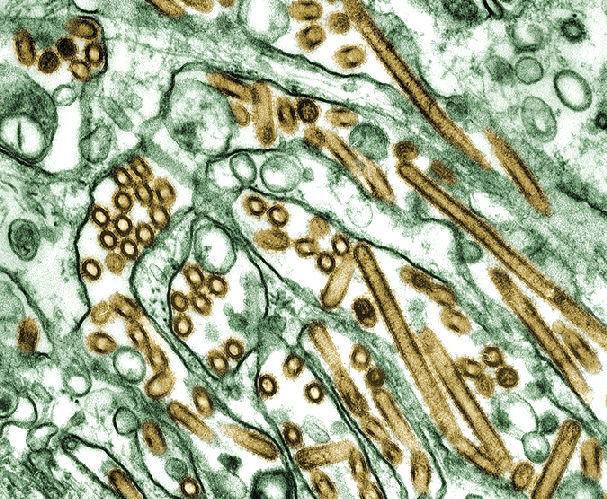
Researchers Reconstruct 1918 Pandemic Influenza Virus; Effort Designed to Advance Preparedness
 | Scientists at the Centers for Disease Control and Prevention have successfully reconstructed the influenza virus strain responsible for the 1918 pandemic, a project that greatly advances preparedness efforts for the next pandemic. |
“This groundbreaking research helps unlock the mystery of the 1918 flu pandemic and is critically important in our efforts to prepare for pandemic influenza,” said CDC Director Dr. Julie Gerberding. “We need to know much more about pandemic influenza viruses. Research such as this helps us understand what makes some influenza viruses more harmful than others. It also provides us information that may help us identify, early on, influenza viruses that could cause a pandemic.”
The work, done in collaboration with Mount Sinai School of Medicine, the Armed Forces Institute of Pathology and Southeast Poultry Research Laboratory, determined the set of genes in the 1918 virus that made it so harmful. Prior to this study, which is published in the Oct. 7 issue of Science, flu experts had little knowledge of what made the 1918 pandemic so much more deadly than the 1957 and 1968 pandemics. This week’s issue of Nature also includes a related article entitled “Characterization of the 1918 influenza virus polymerase genes” which describes the final three gene sequences of the 1918 influenza virus. The work reported in the Nature article was done by scientists at the Armed Forces Institute of Pathology.
The 1918 pandemic killed an estimated 20-50 million people worldwide, including 675,000 in the United States. The pandemic’s most striking feature was its unusually high death rate among otherwise healthy people aged 15-34. During normal seasonal flu outbreaks, severe complications and death are most common among the elderly and young children.
Influenza pandemics occur when a new strain emerges to which people have little or no immunity. Most experts believe another pandemic will occur, but it is impossible to predict which strain will emerge as the next pandemic strain, when it will occur or how severe it will be.
“By identifying the characteristics that made the 1918 influenza virus so harmful, we have information that will help us develop new vaccines and treatments,” said Dr. Terrence Tumpey, the CDC senior microbiologist who recreated the virus. “Influenza viruses are constantly evolving, and that means our science needs to evolve if we want to protect as many people as possible from pandemic influenza.”
In reconstructing the 1918 influenza virus, researchers learned which genes were responsible for making the virus so harmful. This is an important advance for preparedness efforts because knowing which genes are responsible for causing severe illness helps scientists develop new drugs and vaccines (e.g., they can focus their research on those genes).
CDC employed stringent biosafety and biosecurity precautions during research on the 1918 influenza virus. The work was done in a high containment Biosafety Level 3 lab with enhancements that include special provisions to protect both laboratory workers and the public from exposure to the virus. Currently available antiviral drugs have been shown to be effective against influenza viruses similar to the 1918 influenza virus.
All laboratory work was conducted at CDC. The work was supported in part with funding from the U.S. Department of Agriculture and the National Institutes of Health.
To evaluate the benefits of publishing the information contained in these manuscripts and any potential threat from its possible deliberate misuse, both manuscripts were reviewed by the National Science Advisory Board on Biosecurity (NSABB). The NSABB advises the federal government on strategies for the conduct and communication of research that might yield information or technologies that could be misused to threaten public health or national security. The Board was unanimous in its determination that it was critically important to make these findings available to the scientific community at large to not only validate their significance, but also permit further research on the development of diagnostic tests, treatments, and preventative measures.
Source: CDCFor Immediate Release, October 5, 2005 Contact: CDC Media Relations, 404-639-3286
more at 1918 Pandemic and Influenza Virus or CDC and Pandemic and Avian influenza or Bird Flu and H5N1