Sunday, October 16, 2005

Iraqi Constitutional Referendum

President Congratulates Iraqis on Successful Elections, The South Grounds, 12:47 P.M. EDT

THE PRESIDENT: On behalf of the American people, I'd like to congratulate the people of Iraq for the successful completion of a vote on their draft constitution. By all indications, the turnout was greater than the turnout from the last January election, which is good news. By all indications, the Sunnis participated in greater numbers in this election than last time. And that's good news. After all, the purpose of a democracy is to make sure everybody is -- participates in the process.

I'm also pleased, from the initial indications, that the level of violence was considerably less than the last election. That's a tribute to the Iraqis -- forces who we've trained, as well as coalition forces that worked hard to make sure that democracy could move forward in Iraq.

This is a very positive day for the Iraqis and, as well, for world peace. Democracies are peaceful countries. The vote today in Iraq stands in stark contrast to the attitudes and philosophy and strategy of al Qaeda and its terrorist friends and killers. We believe, and the Iraqis believe, the best way forward is through the democratic process. Al Qaeda wants to use their violent ways to stop the march of democracy because democracy is the exact opposite of what they believe is right.

We're making progress toward peace. We're making progress toward an ally that will join us in the war on terror, that will prevent al Qaeda from establishing safe haven in Iraq, and a country that will serve as an example for others who aspire to live in freedom.

So, again, I congratulate the Iraqi people. I thank you for meeting this milestone. Thank you for doing what is right, to set the foundations for peace for future generations to come.

Appreciate it.

END 12:51 P.M. EDT, Immediate Release, Office of the Press Secretary, October 16, 2005

Photo by 2nd Lt. Christopher McComb, 1st Battalion, 71st Cavalry RegimentBAGHDAD — Iraqi citizens young and old display their ink-dipped fingers after the adults cast their ballots during the Constitutional Referendum Oct. 15 near Khadamiyah.
(Photo by 2nd Lt. Christopher McComb, 1st Battalion, 71st Cavalry Regiment) (HiRes Image)

Caption:
An election official checks the registrar for a man's name. Taken On: 10/15/2005, Photographer: Combat Camera

Caption:
An Iraqi is handed his ballot by an election official. Taken On: 10/15/2005, Photographer: Combat Camera

Caption:
An Iraqi folds his ballot before placing it in the ballot box. Taken On: 10/15/2005, Photographer: Combat Camera

Caption:
An Iraqi places the finished ballot inside the ballot box. Taken On: 10/15/2005, Photographer: Combat Camera

Caption:
An Iraqi proudly shows off his ink-stained finger. Taken On: 10/15/2005, Photographer: Combat Camera

Caption:
An Iraqi man places his ballot into the ballot box. Taken On: 10/15/2005, Photographer: Combat Camera

Caption:
An Iraqi proudly shows off her ink-stained finger. Taken On: 10/15/2005, Photographer: Combat Camera

Caption:
An Iraqi woman places her ballot into the ballot box. Taken On: 10/15/2005 Photographer: Combat Camera

Caption:
An Iraqi proudly shows off his ink-stained finger. Taken On: 10/15/2005 Photographer: Combat Camera

Caption:
An Iraqi proudly shows off his ink-stained finger Taken On: 10/15/2005, Photographer: Combat Camera

Caption:
An Iraqi proudly shows off his ink-stained finger. Taken On: 10/15/2005 Photographer: Combat Camera

more at
and or and or and ir or and

FLU VIRUS REPORTED TO RESIST DRUG ENVISIONED FOR PANDEMIC

FLU VIRUS REPORTED TO RESIST DRUG ENVISIONED FOR PANDEMIC, RELATED: Researchers Reconstruct 1918 Pandemic Influenza Virus

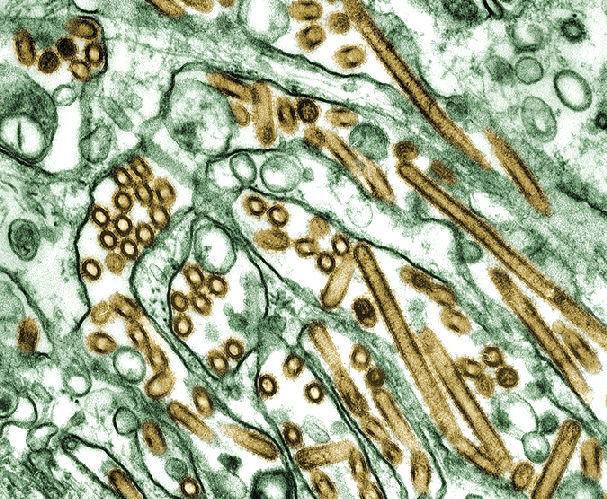
Colorized transmission electron micrograph of Avian influenza A H5N1 viruses (seen in gold) grown in MDCK cells (seen in green).MADISON - An avian influenza virus isolated from an infected Vietnamese girl has been determined to be resistant to the drug oseltamivir, the compound better known by its trade name Tamiflu, and the drug officials hope will serve as the front line of defense for a feared influenza pandemic.
Scientists from the University of Wisconsin-Madison, working with colleagues in Vietnam and Japan, report in a brief communication in next week's edition (Oct. 20, 2005) of the journal Nature that a young girl, provided with a prophylactic dose of the drug after experiencing mild influenza symptoms, developed a strain of the virus that was highly resistant to the drug.

The finding suggests that health officials - now stockpiling millions of doses of the drug to forestall a global outbreak of influenza and buy time to develop and mass produce a vaccine - should also consider other options, according to Yoshihiro Kawaoka, an international authority on influenza and the senior author of the Nature paper.

Recent reports indicate the federal government may spend billions of dollars to stockpile as much as 81 million courses of Tamiflu to forestall a possible influenza pandemic. The government has already stockpiled an estimated 12 to 13 million courses.

"This is the first line of defense," says Kawaoka, a professor in the UW-Madison School of Veterinary Medicine who holds a joint appointment at the University of Tokyo. "It is the drug many countries are stockpiling, and the plan is to rely heavily on it."

The drug would be used to slow the spread of influenza until a vaccine is developed, which may take up to six months.

Tamiflu is delivered orally and works to impede the spread of the virus by binding to and inhibiting one of the surface enzymes the virus uses to exit infected cells of a host. Once inside a host cell, the virus commandeers the cell's reproductive machinery to make new infectious particles that go on to take over other cells. When the drug is at work, Kawaoka explains, "the virus is still able to replicate inside a cell, but is unable to get out and infect other cells."

Oseltamivir, which Kawaoka describes as an "amazing drug," is one of three compounds proven to be effective against influenza. One class, derivatives of the compound adamantine, would be less effective, as some flu viruses have already evolved resistance to it. The other drug, zanamivir, which was developed prior to oseltamivir, is effective, but is formulated as a powder and requires that a clinician provide instructions for use. Thus, it is more cumbersome to administer than the orally delivered Tamiflu.

These flu-fighting drugs, says Kawaoka, are by no means a replacement or alternative to a vaccine. Effective vaccines can confer immunity, preventing the virus from gaining a toehold in the body. But it is unlikely sufficient quantities of a vaccine can be produced and stockpiled prior to the emergence of a new virus in human populations.

If avian influenza does emerge and becomes infectious from human to human - and nearly all experts agree that will happen at some point in the future - an outbreak similar to the 1918 influenza pandemic could occur. That pandemic killed as many as 50 million people, more than died on all the battlefields of World War I. Scientists and vaccine manufacturers would be in a race against time to produce enough doses to forestall disaster. Drugs like Tamiflu, used in combination with quarantine, would be intended to slow the spread of the disease until a vaccine is produced.

Kawaoka says there may not be enough Tamiflu to go around even though countries are stockpiling it. The Wisconsin scientist says that will create a risk of patients sharing the drug and using smaller doses, which could accelerate the emergence of virus resistant to the drug and hamper efforts to contain the spread of the disease.

He says health officials should consider stockpiling zanamivir and recommending that only the therapeutic dosages of Tamiflu be administered to patients.

"We've been watching for this change (in the virus)," Kawaoka says. "This is the first, but we will see others. There's no question about it." ###

- Terry Devitt, (608) 262-8282,
trdevitt@wisc.edu FOR IMMEDIATE RELEASE 10/14/05

CONTACT: Yoshihiro Kawaoka, (608) 265-4925,
kawaokay@svm.vetmed.wisc.edu

more at
and or and and or and or and