Monday, July 17, 2006

For U.S. Citizens Seeking Assistance in Lebanon, VIDEO, PODCAST, TEXT

Technorati Tags: and or and , or and , or , and , or , and ,

For U.S. Citizens Seeking Assistance in Lebanon, Comments by Department Spokesman Sean McCormack: FULL STREAMING VIDEO and M3U for streaming PODCAST, or download the MP3 FILE

Lebanon Situation Update, United States Department of State, Bureau of Consular Affairs, Washington, DC 20520

This information is current as of today, Mon Jul 17 15:41:07 2006.

This Warden Message is to update Americans to the ongoing security concerns in Lebanon. The Embassy is monitoring the situation in Lebanon closely and is reviewing all options for assisting Americans who wish to depart Lebanon. The U.S. Department of State continues to work with the U.S. Department of Defense on a plan to help American citizens safely depart Lebanon. Additional information on departure plans, as it becomes available, will be released via the media, Embassy warden announcements, and on the Embassy website. The Department of State continues to work around the clock to ensure the safety and well-being of its citizens.

Beirut International Airport, which is severely damaged by bombings, remains closed. Americans who wish to depart Lebanon should prepare important travel documents such as a valid U.S. passport, birth certificates, and other civil documents such as marriage certificates, and medical records.

Once U.S.-sponsored travel arrangements are in place, travelers will each be allowed only one small suitcase. We give priority to U.S. citizens but will consider departure assistance to Legal Permanent Residents accompanying a U.S. citizen immediate family member. ONE guardian may accompany an American citizen minor, even if that guardian is not an American. The guardian must have a valid passport and a U.S. visa, if traveling to the U.S. We understand that neither Lebanese nor Americans need a visa to enter Cyprus. Pets will not be allowed to travel.

The Department of State has issued an updated Travel Warning, available at travel.state.gov, alerting American citizens that, due to ongoing security concerns in Lebanon, the U.S. Embassy has been granted authorized departure status. Family members and non-emergency American employees have permission to depart Lebanon.

We continue to urge Americans to remain in a safe location. Although we understand that Syria is willing to admit Americans without visas, there have been reports of damage to the border crossings at Mesnaa and along the northern Lebanon-Syrian border. However, if people encounter difficulty at the border crossing into Syria, they should contact the American Embassy in Damascus at 963-11-333-1342. Americans who attempt such crossings are advised to exercise great caution when traveling on major roads as they are subject to an air strike at any time.

The U.S. Embassy remains open for business; however, Nonimmigrant Visa processing has been suspended. American Citizen Services and Immigrant Visa processing are functioning normally. American citizens are urged to continue to evaluate their personal security and to keep in contact with the U.S. Embassy for continuing information on developments.

For the latest security information, Americans should regularly monitor the Department's web site at travel.state.gov where the current Worldwide Caution Public Announcement, or Travel Warnings and Public Announcements can be found. Up-to-date information on security can also be obtained by calling 1-888-407-4747 toll free in the U.S., or, for callers outside the U.S. and Canada, a regular toll line at 1-202-501-4444. The available time for these numbers of 8:00 a.m. to 8:00 p.m. Eastern Time, Monday through Friday (except U.S./federal holidays) has been extended to 24 hours a day until further notice.

Americans living or traveling in Lebanon who wish assistance departing Lebanon and have not yet registered are encouraged to register with Department of State by calling 888-407-4747 in the United States or 202-501-4444 outside the United States.
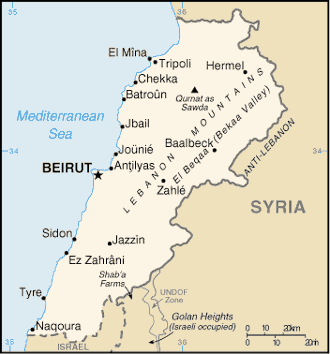
Map of LebanonLebanon has made progress toward rebuilding its political institutions since 1991 and the end of the devastating 15-year civil war. Under the Ta'if Accord - the blueprint for national reconciliation - the Lebanese have established a more equitable political system,
particularly by giving Muslims a greater voice in the political process while institutionalizing sectarian divisions in the government.

Since the end of the war, the Lebanese have conducted several successful elections, most of the militias have been weakened or disbanded, and the Lebanese Armed Forces (LAF) have extended central government authority over about two-thirds of the country. Hizballah, a radical Shi'a organization listed by the US State Department as a Foreign Terrorist Organization, retains its weapons. During Lebanon's civil war, the Arab League legitimized in the Ta'if Accord Syria's troop deployment, numbering about 16,000 based mainly east of Beirut and in the Bekaa Valley.

Damascus justified its continued military presence in Lebanon by citing Beirut's requests and the failure of the Lebanese Government to implement all of the constitutional reforms in the Ta'if Accord. Israel's withdrawal from southern Lebanon in May 2000, however, encouraged some Lebanese groups to demand that Syria withdraw its forces as well. The passage of UNSCR 1559 in early October 2004 - a resolution calling for Syria to withdraw from Lebanon and end its interference in Lebanese affairs - further emboldened Lebanese groups opposed to Syria's presence in Lebanon.

The assassination of former Prime Minister Rafiq HARIRI and 20 others in February 2005 led to massive demonstrations in Beirut against the Syrian presence ("the Cedar Revolution"). Syria finally withdrew the remainder of its military forces from Lebanon in April 2005. In May-June 2005, Lebanon held its first legislative elections since the end of the civil war free of foreign interference, handing a two-thirds majority to the bloc led by Saad HARIRI, the slain prime minister's son. CIA FACTBOOK.

Related: Keywords State Department, Saturday, July 15, 2006 U.S. Embassy Information for American Citizens in Lebanon, Thursday, July 13, 2006, U.S.-India Civil Nuclear Cooperation Initiative, VIDEO, PODCAST, TEXT, Thursday, July 13, 2006 Condoleezza Rice, Carlos Gutierrez, Free Cuba, VIDEO, PODCAST, TEXT, Thursday, July 13, 2006 Condoleezza Rice, Pakistani Minister of Foreign Affairs Khurshid Mahmood, VIDEO, PODCAST, TEXT, Thursday, July 13, 2006 Condoleezza Rice, British Foreign Secretary, Margaret Beckett VIDEO, PODCAST, TEXT, Wednesday, July 05, 2006 Condeleeza Rice, Turkish Foreign Minister VIDEO, PODCAST, TEXT, Monday, June 26, 2006 Secretary Rice With Foreign Affairs Minister of Poland, VIDEO, PODCAST, TEXT, Monday, June 19, 2006 Secretary Condoleezza Rice, Foreign Minister Miguel Angel Moratinos, VIDEO, PODCAST, TEXT, Monday, June 19, 2006 Robert Zoellick Announces Departure VIDEO, PODCAST, TEXT, Friday, June 02, 2006 R. Nicholas Burns, Remarks in Vienna, Austria, Wednesday, May 31, 2006 Iran Statement by Condoleezza Rice (VIDEO), Thursday, May 18, 2006 Secretary Rice With Prime Minister John Howard (PODCAST), Wednesday, May 10, 2006 Secretary Rice, EU Secretary General Javier Solana on Iran, VIDEO, PODCAST, TEXT, Wednesday, May 03, 2006 Secretary Rice, James Wolfensohn, Gaza Disengagement (PODCAST), Thursday, April 27, 2006 Remarks at Stakeout Secretary Condoleezza Rice, Friday, April 21, 2006 Secretary Rice to Travel to Europe, Friday, April 21, 2006 The Face of the State Department (VIDEO), Thursday, April 13, 2006 Secretary Rice Holds Talks with Equatorial Guinean President, Tuesday, April 11, 2006 State Department Podcast, VIDEO and Text 04/10/06, Wednesday, April 05, 2006 State Department Podcast, VIDEO and Text 04/03/06, Thursday, March 30, 2006 State Department Podcast, VIDEO and Text 03/29/06, Monday, April 03, 2006 Secretary Rice With Foreign Secretary Straw, Baghdad, Friday, March 31, 2006 Rice in Berlin To Discuss Iran with P-5 plus 1, Friday, March 31, 2006 UNHCR Worker’s Death in Sudan Attack,

Sunday, July 16, 2006

Raiders of the lost dimension

Technorati Tags: or and or and or and or and or and or and or and or

he National High Magnetic Field Laboratory Logo
Discovery another step toward understanding the quantum mechanics of the universe

Ancient Chinese warriors are yet again helping scientists from the National High Magnetic Field Laboratory and their collaborators unravel some of the mysteries of the natural world.

It all starts with a pigment called Han purple that was used more than 2,000 years ago to color Xi’an terra cotta warriors of the Qian Dynasty. The pigment is known in the scientific world as BaCuSi206 — and when magnet lab scientists exposed it to very high magnetic fields and very low temperatures, it entered a state of matter that is rarely observed.

The most recent research, published in today's issue of the journal Nature, shows that at the lowest temperature point at which the change of state occurs — called the Quantum Critical Point — the Han purple pigment actually loses a dimension: it goes from 3D to 2D. Theoretical physicists have postulated that this kind of dimensional reduction might help explain some mysterious properties of other materials (high temperature superconductors and metallic magnets known as “heavy fermions” for example) near the absolute zero of temperature, but until now, a change in dimension had not been experimentally observed.

We live in three dimensions; up-down, front-back and left-right are the options. A sound wave, for example, “exists” in three dimensions and propagates in all of these directions simultaneously. If we could take a picture it would look like an expanding balloon. A wave in two dimensions looks like ripples on the surface of a pond. Ripples propagate on the surface only; they don’t propagate perpendicular to the surface, which is the third dimension.

“As often happens in science, we found something we weren’t looking for,” said Marcelo Jaime, an experimental physicist at the magnet lab’s Pulsed Field Facility in Los Alamos, N.M. “Much to our surprise, we found that when the temperature is low enough, the transition into the new magnetic state occurs in an unexpected way.”

The experiment was performed at the magnet lab’s DC Field Facility at Florida State University by Neil Harrison from the Pulsed Field Facility and Suchitra Sebastian from Stanford University, in collaboration with a team of scientists from these institutions. (To read more about the paper, "Dimensional Reduction at a Quantum Critical Point," visit the Nature Web site.)

They observed that at high magnetic fields (above 23 tesla) and temperatures between 1 and 3 degrees Kelvin (approximately -460 degrees Fahrenheit), the magnetic waves in three-dimensional crystals of Han purple "exist" in a three-dimensional world as per conventional wisdom. However, below those temperatures, near the quantum limit, one of the dimensions is no longer accessible, with the unexpected consequence that magnetic ripples propagate in only two dimensions. (Kelvin is the temperature scale used by scientists; zero degrees Kelvin is absolute zero, a temperature so low it is experimentally unreachable.)

The magnetic waves in the pigment exist in a unique state of matter called a Bose Einstein condensate (BEC), so named for its theoretical postulation by Satyendra Nath Bose and Albert Einstein. In the BEC state, the individual waves (associated with magnetism from pairs of copper atoms in BaCuSi2O6) lose their identities and condense into one giant wave of undulating magnetism. As the temperature is lowered, this magnetic wave becomes sensitive to vertical arrangement of individual copper layers, which are shifted relative to each other – a phenomenon known as "geometrical frustration." This makes it difficult for the magnetic wave to exist in the third up-down dimension any longer, and leads to a change to a two-dimensional wave, in very much the same way as ripples are confined to the surface of a pond. The theoretical framework that leads to this interpretation was provided by Cristian Batista at LANL.

Other members of the research team include Peter Sharma and Jaime of the National High Magnetic Field Laboratory at LANL, Luis Balicas from the NHMFL at FSU, Ian Fisher of Stanford, and Naoki Kawashima of the University of Tokyo.

“This is truly paramount work,” said Alex Lacerda, associate director for user operations for all three sites of the magnet lab and director of the Pulsed Field Facility. “It takes world-class magnets, instruments and people, all of which the mag lab has, to produce these kinds of landmark results.”

Research such as this could aid in the understanding of processes important for quantum computers. It is believed that this type of computer would operate based on quantum magnetism to perform many different computations at once. Theorists believe this capability could produce answers to mathematical problems much more quickly than is currently possible with conventional computers.

Scientists also think that someday, information gleaned from BEC will help make instruments for very sensitive measurement and tiny structures that are much smaller than computer chips.

The National High Magnetic Field Laboratory develops and operates state-of-the-art, high-magnetic-field facilities that faculty and visiting scientists and engineers use for interdisciplinary research. The laboratory – with branches in Tallahassee and Gainesville, Florida; and Los Alamos, New Mexico – is sponsored by the National Science Foundation and the state of Florida and is the only facility of its kind in the United States. To learn more, please visit magnet.fsu.edu

About Han Purple

Chinese chemists first synthesized the Han purple pigment from barium copper silicates more than 2,000 years ago and used the pigment in pottery, large imperial projects such as the terra cotta warriors, and as a trading coin. Scientists at the magnet lab did not initially know the historical significance of their sample, which precedes both paper and the navigational compass. Historians speculate that the basic know-how necessary to make BaCuSi2O6 was spread by word of mouth from Egypt to China along the legendary “Silk Road.” A similar pigment called Egyptian blue (SrCuSi4O10) was synthesized in Egypt more than 3,500 years ago.

For a photo illustration of the Xi’an terra cotta warriors, please e-mail Susan Ray: sray@magnet.fsu.edu)

Contact: Neil Harrisonnharrison@lanl.gov 505-665-3200 National High Magnetic Field Laboratory Contact: Cristian D. Batista, 505-667-5611, Marcelo Jaime, 505-667-7625

RELATED: Keywords Nanotech, science - Sunday, July 02, 2006 quarks influence proton structure, Sunday, June 04, 2006 New unified force theory predicts measured values of physics, Sunday, Sunday, May 28, 2006 Growing glowing nanowires to light up the nanoworld , Sunday, May 14, 2006 Scientists Create the First Synthetic Nanoscale Fractal Molecule, Sunday, May 14, 2006 World’s tiniest test tubes get teensiest corks, Sunday, May 07, 2006 Blood-Compatible Nanoscale Materials Possible Using Heparin, Sunday, April 30, 2006 Micro-pump is cool idea for future computer chips, Sunday, April 16, 2006 Self-Powered Nanoscale Devices, Sunday, April 09, 2006 Nanopore Method Genome Sequencing, Sunday, April 02, 2006 Quantum dot method rapidly identifies bacteria, March 26, 2006 'Custom' nanoparticles, cancer diagnosis and treatment, Sunday, March 26, 2006, Green nanochemistry, American Chemical Society symposium, Sunday, March 19, 2006 nanotechnologists demonstrate artificial muscles powered by highly energetic fuels, Sunday, Sunday, March 12, 2006 magnetic phenomenon may improve RAM memories, February 26, 2006 Nanoscience study shows that quantum dots 'talk', Sunday, February 26, 2006 Nano-bots to undertake major tasks?, Sunday, February 19, 2006 Nanotech to improve health care delivery, Sunday, February 19, 2006 nano-canary in the nanotoxicology coalmine, Sunday, December 04, 2005 Nano-cages 'fill up' with hydrogen, Sunday, November 13, 2005 Testing toxicity of nanomaterials, Sunday, October 23, 2005 single-molecule car, 'Nanocar', Sunday, August 28, 2005 Writing at the nanoscale, Thursday, May 26, 2005 discontinuous palladium, siloxane self-assembled monolayer, Sunday, May 08, 2005 Center for Nanoscale Materials, Monday, April 25, 2005 Nanomagnets, Nanocomposite, Monday, March 21, 2005 porphyrin tubes may lead to new nanodevices, inexpensive hydrogen fuel.