Friday, January 06, 2006

President's Remarks on International Education (VIDEO)

President's Remarks at U.S. University Presidents Summit on International Education, FULL STREAMING VIDEO, U.S. Department of State Washington, D.C. 3:50 P.M. EST

President George W. Bush returns the 'Hook'em Horns' hand gesture back to audience members, Thursday, Jan. 5, 2006, as he is being introduced by U.S. Secretary of State Condoleezza Rice at the State Department, prior to his remarks to the U.S. University Presidents Summit on International Education. The gesture was in recognition of the University of Texas football team's victory over the University of Southern California in the Rose Bowl, Wednesday evening. White House photo by Kimberlee HewittPresident George W. Bush returns the "Hook'em Horns" hand gesture back to audience members, Thursday, Jan. 5, 2006, as he is being introduced by U.S. Secretary of State Condoleezza Rice at the State Department,
prior to his remarks to the U.S. University Presidents Summit on International Education. The gesture was in recognition of the University of Texas football team's victory over the University of Southern California in the Rose Bowl, Wednesday evening. White House photo by Kimberlee Hewitt

THE PRESIDENT: Thank you all. Madam Secretary, it's your building, you can give my speech, if you want to. (Laughter.)

But first, our nation sends our deepest sympathies to Ariel Sharon. He lies immobilized in an Israeli hospital. We pray for his recovery. He's a good man, a strong man, a man who cared deeply about the security of the Israeli people and a man who had a vision for peace. May God bless him.

Madam Secretary, thanks for having me. I'm here to let the good folks know here how strongly I support the national security language initiative. I've had a little problem with the language in the past, so -- (laughter.) If you've got room in the initiative for me, let me know. (Laughter.) Condi said, come on by, we've got a bunch of university presidents here. And I said, great, just so long as we don't have to compare transcripts. (Laughter.) She's the Ph.D., I'm the President. (Laughter and applause.)

She's a heck of a Secretary of State, though. And Don Rumsfeld is a heck of a Secretary of the Defense, and I want to thank you both for joining together on this initiative. It's interesting, isn't it, that the State Department and the Defense Department are sponsoring a language initiative. It says something about the world we live in. I felt certain that the Secretary of Education would be here. After all, we're talking about education. And I want to thank you for being here, Margaret. But I also find it's interesting you're sitting next to John Negroponte, who is the Director of National Intelligence.

In other words, this initiative is a broad-gauged initiative that deals with the defense of the country, the diplomacy of the country, the intelligence to defend our country, and the education of our people. And it's an important initiative, and I'm going to tell you why in a second. But thank you for joining your -- together to make this happen.

I want to thank Deputy Secretary of State Bob Zoellick, and I want to thank the Chairman of the Senate Foreign Relations Committee, Senator Lugar from Indiana. Senator Pat Roberts from Kansas is with us. I think you'll find this interesting: He has promoted the advanced study of foreign languages through the Pat Roberts Intelligence Scholars Program. Thanks for doing that.

And I want to thank Congressman Rush Holt for being here, as well. Thank you for coming, Rush. Thanks for taking time.

I appreciate all the Ambassadors who are here. I'm scanning the room. I see a few familiar faces, and thanks for serving. What the heck are you doing here? Like, you're supposed to be -- (laughter.) The deal was overseas. (Laughter.)

We're living in extraordinary times. I wish I could report to you the war on terror was over. It's not. There is still an enemy that lurks, that wants to hurt us. I hate to report that to the American people, but my duty is to lay it out as plainly as I possibly can. And that's the truth.

And so the fundamental question is, how do we win? What do we do? Well, in the short-term, our strategy is to find them and bring them to justice before they hurt us. In other words, we've got to stay on the offense. We've got to be unyielding and never give them a, you know, a breath of fresh air, never give them a hope that they can succeed. It's the only way to do it. We must defeat them in foreign battlefields so they don't strike us here at home.

And that's one of the reasons why the Secretary of Defense is here. He wants his young soldiers who are the front lines of finding these killers to be able to speak their language and be able to listen to the people in the communities in which they live. That makes sense, doesn't it, to have a language-proficient military -- to have people that go into the far reaches of this world and be able to communicate in the villages and towns and rural areas and urban centers, to protect the American people.

We need intelligence officers who, when somebody says something in Arabic or Farsi or Urdu knows what they're talking about. That's what we need. We need diplomats -- when we send them out to help us convince governments that we've got to join together and fight these terrorists who want to destroy life and promote an ideology that is so backwards it's hard to believe. These diplomats need to speak that language.

So our short-term strategy is to stay on the offense, and we've got to give our troops, our intelligence officers, our diplomats all the tools necessary to succeed. That's what people in this country expect of our government. They expect us to be wise about how we use our resources, and a good use of resources is to promote this language initiative in K through 12, in our universities. And a good use of resources is to encourage foreign language speakers from important regions of the world to come here and teach us how to speak their language.

You're going to hear a lot about the specifics of the program. What I'm trying to suggest to you that this program is a part of a strategic goal, and that is to protect this country in the short-term and protect it in the long-term by spreading freedom. We're facing an ideological struggle, and we're going to win. Our ideology is a heck of a lot more hopeful than theirs.

You can't have an ideology that works if you say to half the population in a part of the world, you have no rights. You can't say to a group of people, my ideology is better than freedom, and if you speak out you're going to get -- you'll be tortured.

You see, freedom is the ideology that wins. We got to have confidence in that as we go out. But you can't win in the long run for democracy unless you've got the capacity to help spread democracy. You see, we got to convince people of the benefits of a free society. I believe everybody desires to be free. But I also know people need to be convincing -- convinced -- I told you I needed to go to language school. (Laughter.) And you can't convince people unless you can talk to them. And I'm not talking to them right now directly; I'm talking through an interpreter on some of these Arabic TV stations.

But we need people in America who can go and say to people, living in freedom is not the American way of life, it is a universal way of life. We're not saying your democracy has to be like yours. We're just saying give your people a chance to live in a free society; give women a chance to live freely; give young girls a chance to be educated and realize their full potential.

And the best way to do that is to have those of us who understand freedom be able to communicate in the language of the people we're trying to help. In order to convince people we care about them, we've got to understand their culture and show them we care about their culture. When somebody comes to me and speaks Texan, I know they appreciate the Texas culture. (Laughter.) I mean, somebody takes time to figure out how to speak Arabic, it means they're interested in somebody else's culture. Learning a language -- somebody else's language is a kind gesture. It's a gesture of interest. It really is a fundamental way to reach out to somebody and say, I care about you. I want you to know that I'm interested in not only how you talk but how you live.

In order for this country to be able to convince others, people have got to be able to see our true worth in our heart. And when Americans learn to speak a language, learn to speak Arabic, those in the Arabic region will say, gosh, America is interested in us. They care enough to learn how we speak.

One of the great programs we've got here in America in terms of people understanding how we think and how we act is these scholarships we provide to our universities. I know this isn't the topic the Secretary assigned me to talk about, but it's one I'm going to talk about anyway. We want young kids from around the world coming to our universities. It's in our national interest that we solve visa issues and make sure that -- (applause.) We have been calibrating the proper balance after September the 11th, and I fully understand some of your frustrations, particularly when you say the balance wasn't actually calibrated well. But we're going to get it right, because the more youngsters who come to America to get educated, the more likely it is people in the world will understand the true nature of America.

You can't figure out America when you're looking on some of these TV stations -- you just can't -- particularly given the message that they spread. Arabic TV does not do our country justice. They put out some kind -- sometimes put out propaganda that just is -- just isn't right, it isn't fair, and it doesn't give people the impression of what we're about. You bring somebody here to college, it doesn't matter what's on TV, they see firsthand the compassion of the United States of America. They get to see firsthand that we don't discriminate based upon religion. They get to see firsthand the multicultural society in which we live, all united under the fabric of freedom. That's what they get to see.

And so I'm working with Condi, and she's working with others, to work with you, to make sure these youngsters are able to come to our universities. I'll tell you what's really neat, is to sit down with leaders from around the world, welcome them in the Oval Office or go to their office, they say, you know, Mr. President, I went to Texas A and M, or I went to Stanford -- like President Toledo of Peru. I mean, it is -- it makes it so much easier to conduct foreign policy and diplomacy when you've got that common ground of being able to talk about a university experience here in the United States. It makes it so much easier to be able to advance the interests of this country when you're dealing with a leader who doesn't have a preconceived notion about what America is all about, because he spent time studying here in the United States.

We're going to teach our kids how to speak important languages. We'll welcome teachers here to help teach our kids how to speak languages. But we're also going to advance America's interests around the world and defeat this notion about our -- you know, our bullying concept of freedom by letting people see what we're about. Let them see firsthand the decency of this country.

And so, Madam Secretary, in front of these presidents, you and I vow that we'll find that proper balance between security and letting people come to our universities for the good of this country.

I -- there is no doubt in my mind we will win the war on terror. There's no doubt in my mind that Afghanistan will remain a democracy and serve as an incredible example. For those of you in education, you might remember this was a country that refused to educate young girls. And now, young girls in most of Afghanistan are going to school.

Iraq -- we'll succeed in Iraq. It's tough. And the reason it's tough is because a handful of killers wants to stop the advance of freedom for a reason. Democracy in the heart of the Middle East is a major defeat to their ideology and their ambitions.

And it's hard work. What you're seeing on your TV screen is hard work. But we've done, as Condi said, hard work before. We have defeated fascism in the past. We defeated communism in the past. And we will defeat this ideology of hatred. But it's going to take all the tools at our disposal.

One of the stories I like to share with people is this. I -- one of my best buddies in international politics is Prime Minister Koizumi of Japan. He's an interesting person. Elvis was his favorite singer, for example. (Laughter.)

Every time I meet with him, it strikes me as an amazing fact of history that Number 41, President 41, at age 18 fought the Japanese, and 43, his son, is sitting down with the Prime Minister working on keeping the peace. It's amazing to me. And something happened between 41 going into combat and 43 talking to the Prime Minister whether it be about troops in Iraq to help this young democracy flourish in the heart of the Middle East, or whether it be dealing with the leader of North Korea who is starving his people to death, and how do we solve that? What do we do about it?

And what happened was that the Japanese adopted a Japanese-style democracy. It wasn't an American-style democracy; it was Japanese-style democracy. And that society, that form of government was able to convert an enemy to an ally. And that's what's happening. I live it when I talk to the Prime Minister. I see it firsthand. It's a real part of my family's life.

Someday, an American President is going to sit down and thank this generation for having the willpower and the determination to see to it that democracy has a chance to flourish in a part of the world that is desperate for democracy. Someday somebody is going to say -- (applause) -- somebody someday will say we're able to more likely keep the peace because this generation of Americans had confidence in our capacity to work with others to spread freedom.

And that's what we're facing today, and the stakes are high. It's an exciting time to be here in Washington, D.C. It's a fantastic opportunity to serve our country. And I want to thank those of you who are serving it in government. And I want to thank those of you who serve it through higher education. There's no greater gift to give a child than the chance to succeed and realize his or her dreams. And you're doing that.

Appreciate you giving me a chance to come by and tell you what's on my mind. My God bless our country. (Applause.)

END 4:00 P.M. EST, For Immediate ReleaseOffice of the Press SecretaryJanuary 5, 2006

more at
and or and or and or and or and or

Related: Keyword VIDEO, Wednesday, January 04, 2006
President Discusses War on Terror Following Pentagon Briefing (VIDEO, Monday, December 19, 2005 President's Address to the Nation (VIDEO) 12/18/05, Wednesday, December 14, 2005 Iraqi Elections, Victory in the War on Terror (VIDEO), Monday, December 12, 2005 President Discusses War on Terror and Upcoming Iraqi Elections (VIDEO), Thursday, September 01, 2005 W Asks Poppi and Bubba for Hurricane Relief (VIDEO), Friday, September 02, 2005 President Heads to Katrina Affected Areas (VIDEO), Saturday, September 03, 2005 Navy Personnel, Family Helpline, Pentagon Briefing (VIDEO), Saturday, September 03, 2005 President Addresses Nation, Katrina Relief (VIDEO), Saturday, September 03, 2005 FEMA Afternoon Operational Briefing (VIDEO), Monday, September 05, 2005 William Rehnquist (VIDEO), Monday, September 05, 2005 American Red Cross (VIDEO), Monday, September 05, 2005 Roberts Chief Justice (VIDEO), Tuesday, September 06, 2005 President Meets with Cabinet (VIDEO), Tuesday, September 06, 2005 Press Briefing Scott McClellan (VIDEO) 09/06/05, Wednesday, September 07, 2005 Bush-Clinton Katrina Fund. (VIDEO), Wednesday, September 07, 2005 President, Voluntary Organizations (VIDEO), Wednesday, September 07, 2005 Students and School Districts (VIDEO),

Thursday, January 05, 2006

President Meets with Current & Former Secretaries of State and Defense

President Meets with Current & Former Secretaries of State and Defense, The Roosevelt Room 10:31 A.M. EST

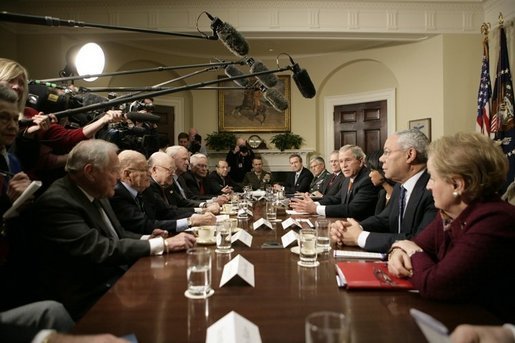
President George W. Bush speaks with reporters following a meeting Thursday, Jan. 5, 2006 in the Roosevelt Room at the White House with former Secretaries of State and Secretaries of Defense from both Republican and Democratic administrations. White House photo by Eric Draper.President George W. Bush speaks with reporters following a meeting Thursday, Jan. 5, 2006 in the Roosevelt Room at the White House with former Secretaries of State and Secretaries of Defense
from both Republican and Democratic administrations. White House photo by Eric Draper.

THE PRESIDENT: It's been my honor to host former Secretaries of State and Secretaries of Defense from Republican administrations and Democratic administrations here at the White House. I've asked Secretary Rice and Secretary Rumsfeld and Ambassador Khalilzad and General Casey to bring these men and women up to date on our strategy for victory in Iraq.

I've also had a chance to listen to their concerns, their suggestions about the way forward. Not everybody around this table agree with my decision to go into Iraq, I fully understand that. But these are good solid Americans who understand that we've got to succeed now that we're there. And I'm most grateful for the suggestions that have been given. We take to heart the advice; we appreciate your experience and we appreciate you taking time out of your day.

We have a dual track strategy for victory. On the one hand, we will work to have a political process that says to all Iraqis, the future belongs to you. And on the other hand, we'll continue to work on the security situation there. The main thrust of our success will be when the Iraqis are able to take the fight to the enemy that wants to stop their democracy, and we're making darn good progress along those lines.

Again, I want to thank you all for coming. I appreciate your interest. I appreciate you being such a solid citizen of our country.

END 10:33 A.M. EST For Immediate Release, Office of the Press Secretary, January 5, 2006

more at
and or and or and or and or and or

Related: Keyword Iraq, Wednesday, January 04, 2006
President Discusses War on Terror Following Pentagon Briefing (VIDEO, Monday, December 19, 2005 President's Address to the Nation (VIDEO) 12/18/05, Thursday, December 15, 2005 President, McCain, Warner, Discusses Interrogation, Wednesday, December 14, 2005 Iraqi Elections, Victory in the War on Terror (VIDEO), Monday, December 12, 2005 President Discusses War on Terror and Upcoming Iraqi Elections (VIDEO), Sunday, July 17, 2005 Soldiers charged with assault on suspected insurgents, Sunday, July 24, 2005 Iraqi, American Women Discuss Constitution, Women's Rights, Thursday, July 28, 2005 Killing of Algerian Diplomats to Iraq, Saturday, August 06, 2005 Operation Quick Strike, Monday, August 08, 2005 The Independent Inquiry Committee into the Iraq Oil-for-Food Programme, Thursday, August 11, 2005 President Meets with Defense and Foreign Policy Teams, Friday, August 12, 2005 Interview of the President by Israeli Television, Monday, August 15, 2005 Iraq Draft Constitution, Monday, August 15, 2005 U.S. Support for Women in Iraq, Tuesday, August 16, 2005 President's Statement Iraqi Draft Constitution, Tuesday, August 16, 2005 Zalmay Khalilzad, U.S. Ambassador to Iraq, Wednesday, August 17, 2005 Condoleezza Rice, Iraqi National Assembly, Iraqi Constitution, Monday, August 22, 2005 Iraq's National Assembly pass draft constitution, Tuesday, August 23, 2005 President Discusses Iraqi Constitution, Tuesday, August 23, 2005 Secretary Condoleezza Rice Iraqi Draft Constitution, Thursday, August 25, 2005 Two Infantry Battalions to Deploy to Iraq for Election, Friday, August 26, 2005 Iraqi Constitution Drafting Process, Monday, August 29, 2005 President, Hurricane Katrina, Iraqis Draft Constitution, Wednesday, September 07, 2005 President to Welcome Iraqi President Jalal Talabani, Tuesday, September 13, 2005 Bush, Talabani (VIDEO), Wednesday, November 30, 2005 Strategy for Victory in Iraq (Strategy for Victory in Iraq (VIDEO), Monday, December 05, 2005 Rice war on terror (Audio MP3), Wednesday, December 07, 2005 President Discusses War on Terror (VIDEO),

Wednesday, January 04, 2006

Jack Abramoff Press Release and VIDEO

Department of Justice Press Conference on Jack Abramoff FULL STREAMING VIDEO, (1/3/2006)

Department of Justice Press Release on Jack Abramoff (1/3/2006), Former Lobbyist Jack Abramoff Pleads Guilty to Charges, Involving Corruption, Fraud Conspiracy, and Tax Evasion

WASHINGTON, D.C. – Former lobbyist Jack A. Abramoff has pleaded guilty to a three-count information charging him with conspiracy, aiding and abetting honest services mail fraud, and tax evasion, Assistant Attorney General Alice S. Fisher of the Criminal Division announced today. Abramoff, 47, entered his plea today in U.S. District Court in the District of Columbia, before Judge Ellen Segal Huvelle. Under the terms of a plea agreement, Abramoff faces up to 30 years in prison, a fine of more than $750,000 and mandatory restitution estimated to be approximately $26.7 million. Abramoff has agreed to cooperate with law enforcement officials in an ongoing criminal investigation. Abramoff’s former business partner, Michael Scanlon, previously pleaded guilty in this investigation and is cooperating with law enforcement officials. According to the plea agreement signed by Abramoff, from 1994 through early 2004 he was employed in the Washington, D.C. offices of two law firms. During this time, Abramoff lobbied public officials in the federal government, principally members of Congress.

He also sought to further his client’s interests through grassroots work, public relations services and election campaign support. The information charges Abramoff with receiving undisclosed kickbacks from Scanlon, who owned and operated Capital Campaign Strategies, LLC (CCS). Abramoff and Scanlon conspired to defraud four Native American Indian tribes that either operated or were interested in operating gaming casinos. Each of these four clients, which were tribes located in Mississippi, Louisiana, Texas, and Michigan, hired Abramoff through his employers to give advice regarding how best to limit competition from competing casinos or, in one instance, to re-open a previously closed casino. Once Abramoff had established a relationship with the tribal clients, he recommended Scanlon and CCS as the primary provider for grassroots work and public relations services.

As Abramoff and Scanlon knew, the clients relied on Abramoff’s recommendation because of his expertise in these matters. As part of the scheme described in the information and plea agreement, Abramoff and Scanlon charged fees that incorporated huge profit margins and then split the net profits in a secret kickback arrangement. As both men knew, the secrecy of the kickback arrangement was crucial to the success of their scheme, and Scanlon and Abramoff concealed the arrangement from the tribal clients. Scanlon also formed other companies which were used essentially to receive funds from clients for work performed by CCS and others.

Abramoff also admitted that as one means of accomplishing results for their clients, he, Scanlon, and others engaged in a pattern of corruptly providing things of value to public officials, including trips, campaign contributions, and meals and entertainment, with the intent to influence acts by the public officials that would benefit Abramoff and Abramoff’s clients. For example, Abramoff and Scanlon provided things of value to a public official (described as Representative #1) and members of his staff, including, but not limited to, a lavish trip to Scotland to play golf on world-famous courses, tickets to sporting events and other entertainment, regular meals at Abramoff’s upscale restaurant, and campaign contributions for the Representative, his political action committee, his campaign committee, and other political committees on behalf of the Representative. At the same time, and in exchange for these things of value, Scanlon and Abramoff sought and received the Representative’s agreement to perform directly and through others a series of official acts, including but not limited to agreements to support and pass legislation, and agreements to place statements in the Congressional Record.

Count Two of the criminal information charged Abramoff with aiding and abetting honest services fraud for arranging with a Texas Indian tribe to solicit another Indian tribe to mail a $50,000 payment, in order to assist Abramoff in paying for the golf trip he offered and provided to Representative #1 and some of his staff members. As stipulated in the agreement, through Abramoff’s scheme with Scanlon as well as several frauds he committed with others not including Scanlon, Abramoff received approximately $25 million in undisclosed criminal kickbacks and other fraudulently obtained funds. The tax evasion charge stems largely from Abramoff’s failure to report and pay taxes on income payments which he attempted to hide by causing them to be sent instead to certain non-profit entities that he controlled. Abramoff used the unreported income for his personal benefit and to carry out the fraud and corruption schemes described in the plea agreement and information. Abramoff also admitted that, in order to carry out his tax evasion, he caused others to prepare false invoices and false entries in books and records of certain non-profit entities and he caused them to file false reports with the Internal Revenue Service. Through this conduct, Abramoff evaded payment of approximately $1.7 million in federal income tax from 2001 to 2003.

“Government officials and governmental action are not for sale,” said Assistant Attorney General Fisher. “The Justice Department will aggressively investigate and prosecute these types of cases, which have such a devastating impact on the public’s trust of the government. We will not shy away from this responsibility.”

“Today’s plea is the result of determined efforts by United States investigators and attorneys working to vindicate the trust the American people deserve to have in the institutions of their government, including the tax system that supports it,” said Eileen J. O’Connor, Assistant Attorney General for the Tax Division. “People who enrich themselves by engaging in illegal activities compound their crimes by failing to pay taxes on their ill-gotten gains.”

“Beyond the illegal evasion of $1.7 million in taxes owed, one of the most disturbing elements of this whole sordid story is the blatant misuse of charities in a scheme to peddle political influence,” said IRS Commissioner Mark W. Everson. “At the IRS, one of our four service-wide enforcement priorities is deterring abuse within tax-exempt entities for tax avoidance or other unintended purposes.”

“Today’s pleas are not a victory, but rather milestones in ensuring that our citizens are indeed provided honest government services,” said FBI Assistant Director Chris Swecker of the Criminal Investigative Division. “This has been a lengthy and exhaustive investigation involving multiple FBI Field Offices, the Internal Revenue Service, and Inspectors General of the Department of Interior and General Services Administration. Protecting the interests of our government processes is the number one criminal priority of the FBI.. No criminal resources of the FBI will be spared in support of this important mission. ”

The Inspector General for the Department of the Interior, Earl E. Devaney, said, “As a partner in this task force for over two years, our focus has been on ensuring the integrity of both the Department’s programs and the officials who oversee them. To the extent that Mr. Abramoff can shed light in this regard, we welcome today’s events.” This case is being prosecuted by Trial Attorneys Mary K. Butler and M. Kendall Day of the Public Integrity Section, which is headed by Chief Noel L. Hillman; Guy D. Singer and Nathaniel B. Edmonds of the Fraud Section, which is headed by Acting Chief Paul E. Pelletier; and Stephanie D. Evans of the Tax Division’s Southern Criminal Enforcement Section, which is headed by Chief Bruce M. Salad. The case was investigated by various law enforcement agencies, including Special Agents of the Federal Bureau of Investigation, Internal Revenue Service Criminal Investigation Division, General Services Administration Office of Inspector General, and the Department of the Interior Office of the Inspector General. Abramoff has also been indicted by a federal grand jury in the Southern District of Florida. The Miami prosecution is being handled by U.S. Attorney R. Alexander Acosta and Assistant U.S. Attorneys Lawrence D. LaVecchio and Paul F. Schwartz.

### 06-002 FOR IMMEDIATE RELEASETUESDAY, JANUARY 3, 2006
USDOJ.GOV

more at
or and or and or and

Related: Keywords Attorney General Alberto R. Gonzales, Wednesday, November 23, 2005
Attorney General Gonzales on Jose Padilla (VIDEO), Friday, February 25, 2005 Alberto R. Gonzales priorities of Justice, Friday, March 11, 2005 ALBERTO R. GONZALES ON THE AL-MOAYAD AND ZAYED CONVICTIONS, Monday, April 18, 2005 Operation FALCON, Sunday, April 24, 2005 DRAM CONSPIRACY, Wednesday, July 06, 2005 ATTORNEY GENERAL GONZALES TRAVELS TO BAGHDAD

President Discusses War on Terror Following Pentagon Briefing (VIDEO)

President Discusses War on Terror Following Pentagon Briefing, FULL STREAMING VIDEO The Pentagon 11:24 A.M. EST

President George W. Bush gestures as he addresses his remarks on the global war on terror, Wednesday, Jan. 4, 2006, to an audience at the Pentagon, following a Department of Defense briefing with Secretary of Defense Donald Rumsfeld and Joint Chiefs of Staff General Peter Pace. White House photo by Eric DraperPresident George W. Bush gestures as he addresses his remarks on the global war on terror, Wednesday, Jan. 4, 2006, to an audience at the Pentagon, following a Department of Defense briefing .
with Secretary of Defense Donald Rumsfeld and Joint Chiefs of Staff General Peter Pace. White House photo by Eric Draper,

THE PRESIDENT: Today our nation mourns those who lost their lives in the mining accident in West Virginia. We send our prayers and heartfelt condolences to the loved ones whose hearts are broken. We ask that the good Lord comfort them in their time of need.

I want to thank the Governor of West Virginia for showing such compassion, and I want to thank those who risked their lives to save those miners for showing such courage. May God bless the good people of West Virginia.

I just finished an important meeting, a briefing with members of my national security team, a briefing hosted by Secretary Don Rumsfeld and General Pete Pace. We spent time talking about this war on terror, the global war on terror. And to make sure that my team understood the progress we've made and the challenges ahead, the Secretary asked three of our commanders to join in the briefing: Generals Abizaid, Casey and General Dempsey.

I want to tell the American people that I am most impressed by the caliber of these generals. They are smart, they are capable, they are visionary and they're working hard to win this global war. We also were able to speak to one of our fine ambassadors, Ambassador Khalilzad, from Baghdad, as well.

During our briefing we talked about the areas of concern in this global war on terror, recognizing that the enemy, which has an ideology of hate and a desire to kill, lurks in parts around the world. I assured the generals that this administration would do everything in our power to bring these enemies to justice.

We also spent time talking about the two major fronts in this war on terror, and that would be Iraq and Afghanistan. In Iraq, 2005 was a year of progress toward meeting our goal of victory. If you really think about it, there was three important elections that took place, and in an atmosphere that some predicted wouldn't yield democracy. We had the January elections, we had the constitution elections, we had elections last December when nearly 11 million people defied the terrorists to vote. The turnout in that country was 70 percent. Part of our strategy for defeating the enemy in Iraq is for there to be a viable political process. And when 70 percent of the people show up to vote, that's a good sign. See, people are saying, I want to participate in the democratic process. The Iraqis showed great courage.

Now, we look forward to the process, obviously, moving on. The formation of a unity government is going to be important to the stability of the future of Iraq. Before that happens, obviously you've got to finish counting the votes. And that's going to happen over the next couple of weeks. And then the government -- they're beginning to form the government under their new constitution. It takes a two-third vote of the parliament for certain top officials to assume office. And to form this inclusive government, the Iraqi leaders must compromise and negotiate and build consensus, and this is going to take some time.

What the American people will see during the weeks ahead is a political process unfold; that people will be making decisions not based upon who has got the biggest gun, but who has got the capacity to rally the will of the people. And that's positive. Democracies are an important part of our winning the war on terror. Democracies yield an ideology that is based on an ideology that says, people are free -- free to choose. The ideology of the enemy says, a few people will choose, and if you don't like what we tell you to believe in, we'll kill you, or -- or treat you harshly.

And I want the American people to remember what life was like for the poor people in Afghanistan under the Taliban. The Taliban had no hopeful vision. They're vision was, if you don't agree with us, we'll take you in the public square and whip you. They're vision was, women don't have rights. They're vision was a dark and dim vision, which stands in stark contrast to the vision based upon freedom and democracy.

The second part of our strategy is to -- in Iraq, a strategy for victory, is to train the Iraqis so they can take the fight against the few who would stop the progress of many. And during this election, we were briefed about the security forces during the election. The commanders talked about more than 215,000 Iraqi soldiers and police that secured the country. That was an increase, by the way, of 85,000 since January of 2005. General Casey labeled the performance of the troops as superb.

Before the elections there was a number of joint operations to lay the groundwork for a peaceful election. The Iraqis were in the lead on election day. In other words, they were responsible for the security of the elections. We were in a position to help them, but they were responsible for securing the voting booths. And they did a fine job. The number of attacks during the election were down dramatically. They performed. And that's part of our calibrating whether or not the Iraqi troops are becoming more capable. Numbers are one thing, but the ability to perform is another. And during these elections, the Iraqi troops showed our commanders on the ground and showed the American people that they're becoming more and more capable of performing their duty to provide security to the Iraqi people.

Now, you've got to understand that just because the elections went forward that doesn't mean these Saddamists, Zarqawi types are going to lay down their arms. They're not. There will still be violence. And there will still be some who believe that they can affect the political outcome of Iraq through violent means. We understand that. And we're going to stay on the offense against these - "we" being coalition forces, as well as the Iraqi forces. But the recent elections have served as a real defeat for the rejectionists, and the Saddamists and al Qaeda types. Sunni Arabs who had boycotted the process, joined the process. And as they did so, those who want to stop the progress of freedom are becoming more and more marginalized inside of Iraq.

So in 2006, the mission is to continue to hand over more and more territory and more and more responsibility to Iraqi forces. A year ago there was only a handful of Iraqi army and police battalions ready for combat, ready to take the lead; today, there are more than 125 Iraqi combat battalions fighting the enemy, and 50 of those are in the lead. That's progress. And it's important progress, and it's an important part of our strategy to win in Iraq. And as these forces become more battle-hardened and take the lead, we're going to see continued confidence in the Iraqi people of the Iraqis being able to defend themselves, and that's important. And as we see more of these Iraqi forces in the lead, we'll be able to continue with our desire, our stated strategy that says as Iraqis stand up, we'll stand down.

The commanders have recently determined that we can reduce our combat forces in Iraq from 17 to 15 brigades. And the reason they were able to do so is because the Iraqis are more capable. The adjustment is underway. This adjustment will result in a net decrease of several thousand troops below the pre-election baseline of 138,000 U.S. troops in Iraq. The decrease comes in addition to a reduction of about 20,000 troops who were in Iraq to assist with security during the December elections.

Later this year, if Iraqis continue to make progress on the security and political sides that we expect, we can discuss further possible adjustments with the leaders of a new government in Iraq. But my decisions will be based upon conditions on the ground and the recommendation of our commanders, not based by false political timetables in Washington, D.C. I'm not going to let politics get in the way of doing the right thing in Iraq, and the American people have got to understand that.

We've also got the opportunity to change our composition of our forces inside Iraq. In 2006, we expect Iraqis will take more and more control of the battle space, and as they do so, we will need fewer U.S. troops to conduct combat operations around that country. More of our forces will be dedicated to training and supporting the Iraqi units. In the coming year, we will continue to focus on helping Iraqis improve their logistics and intelligence capabilities so more Iraqi units can take the fight and can sustain themselves in the fight.

We're also going to spend a lot of time on police training. An important part of our strategy is not only to have a competent Iraqi army, but police forces that are capable of earning the confidence of the Iraqi citizens. To restore security, Iraq has got to have capable police forces. And the recent reports of abuses by some of the Iraqi police units are troubling, and that conduct is unacceptable. Our commanders understand that, the Secretary understands that, and I know that.

To stop such abuses and increase the professionalism of the Iraqi police, General Dempsey, who is in charge of training, and others are working with the Iraqis to continue making adjustments in the way the forces are trained. First, we're going to work with the Iraqi government to increase the training Iraqi police recruits receive in human rights and the rule of law, so they understand the role of the police in a democratic society.

Second, we're training Iraqi police with a program that has been effective with the Iraqi army. In other words, when we find something that works, we'll do it. And if we find something that's not working, we change -- and that is to embed coalition transition teams inside Iraqi special police units. Embedding our folks inside Iraqi army units has worked. One reason why these Iraqi units are better able to take the lead is because they've worked side-by-side with American specialists and experts, some of our best troops. So we're going to embed these type of soldiers with the Iraqi police forces, as well.

These transition teams will be made up of our officers, as well as noncommissioned officers. The coalition teams will go in the field with the police; they'll provide real-time advice and important assistance on patrol and during operations. And between operations they're going to train the Iraqi officers; they're going to help them become increasingly capable and professional so they can serve and protect all the Iraqi people without discrimination.

As we train not only the soldiers, but the police, our special units will continue hunting down al Qaeda and their affiliates. See, al Qaeda thinks they can use Iraq as a safe haven from which to launch attacks. That's their stated objective. I'm not making this up. Nobody in -- this is what Zawahiri and Zarqawi discussed. They said, let's drive America out of Iraq so we can use Iraq as a safe haven. We're going to train Iraqis, we'll train their army and train their police, and at the same time, we've got some of the finest soldiers ever on the hunt to bring Zarqawi and his buddies to justice.

The second front is in Afghanistan. The second major front in this global war against these terrorists is in Afghanistan, where we've made steady progress on the road to democracy. Karzai got elected; there's a sitting parliament. It's amazing how far Afghanistan has come from the days of the Taliban. General Abizaid told us in our briefing that new democracy is being increasingly defended by a capable Afghan army and police. The Afghan national army is now nearly 27,000 soldiers who are trained and equipped. General Abizaid tells us these soldiers are tough in battle. They want to defend their homeland. There are some 55,000 Afghan police officers on the beat. They're taking the fight to the enemy. They're working side-by-side with coalition forces to protect this new democracy.

They're receiving a lot of international support through the NATO Alliance. The NATO-led international security assistance force has now about 9,000 troops in the country that represents all 26 NATO allies and 10 non-NATO nations. In other words, the international community is stepping up. Like they have in Iraq, they're stepping up in Afghanistan, as well. In 2006, the force levels will increase by up to another 6,000 forces, to a total of approximately 15,000 personnel. In other words, you're going to see in 2006 an increase of international force inside of Afghanistan.

As NATO takes on a larger role in Afghanistan and as the capability of Afghan forces continues to grow, the United States will reduce force levels in Afghanistan from 19,000 to 16,500 this year. In other words, our strategy has been to provide a strong commitment to provide stability so democracy can flourish. And then as others, including Afghan troops, as well as NATO troops, step in, we step back. We're going to continue to conduct anti-terrorist operations in Afghanistan, as well. This is a part of a global war against the terrorist network.

I said after September the 11th we would do everything in our power to bring justice to the enemy that attacked the American people, and I meant it. And part of chasing down the Taliban and al Qaeda is to find them where they hide. And just like in Iraq, we're going to have our special forces stay on the hunt. And we'll continue training at the same time.

There's a lot of work to be done in this war on terror, but the American people can be rest assured this administration understands the task, and understands the challenges, and understands our obligation to protect you, to protect the American people.

During the past year we lost some really good folks who wore the uniform of the United States of America. We pray for their loved ones. We pray for the comfort of those who had a sorrowful holiday season because a seat at the table was empty. And we vow to those that we will complete our mission: We will lay that foundation of peace for generations to come; that we'll do our duty to protect this country by not only bringing justice to an enemy that wants to do us harm, but by spreading freedom and democracy.

Thank you very much.

END 11:46 A.M. EST, For Immediate Release, Office of the Press Secretary, January 4, 2006

more at
and or and or and or and or and or

Related: Keyword Iraq, Monday, December 19, 2005
President's Address to the Nation (VIDEO) 12/18/05, Thursday, December 15, 2005 President, McCain, Warner, Discusses Interrogation, Wednesday, December 14, 2005 Iraqi Elections, Victory in the War on Terror (VIDEO), Monday, December 12, 2005 President Discusses War on Terror and Upcoming Iraqi Elections (VIDEO), Sunday, July 17, 2005 Soldiers charged with assault on suspected insurgents, Sunday, July 24, 2005 Iraqi, American Women Discuss Constitution, Women's Rights, Thursday, July 28, 2005 Killing of Algerian Diplomats to Iraq, Saturday, August 06, 2005 Operation Quick Strike, Monday, August 08, 2005 The Independent Inquiry Committee into the Iraq Oil-for-Food Programme, Thursday, August 11, 2005 President Meets with Defense and Foreign Policy Teams, Friday, August 12, 2005 Interview of the President by Israeli Television, Monday, August 15, 2005 Iraq Draft Constitution, Monday, August 15, 2005 U.S. Support for Women in Iraq, Tuesday, August 16, 2005 President's Statement Iraqi Draft Constitution, Tuesday, August 16, 2005 Zalmay Khalilzad, U.S. Ambassador to Iraq, Wednesday, August 17, 2005 Condoleezza Rice, Iraqi National Assembly, Iraqi Constitution, Monday, August 22, 2005 Iraq's National Assembly pass draft constitution, Tuesday, August 23, 2005 President Discusses Iraqi Constitution, Tuesday, August 23, 2005 Secretary Condoleezza Rice Iraqi Draft Constitution, Thursday, August 25, 2005 Two Infantry Battalions to Deploy to Iraq for Election, Friday, August 26, 2005 Iraqi Constitution Drafting Process, Monday, August 29, 2005 President, Hurricane Katrina, Iraqis Draft Constitution, Wednesday, September 07, 2005 President to Welcome Iraqi President Jalal Talabani, Tuesday, September 13, 2005 Bush, Talabani (VIDEO), Wednesday, November 30, 2005 Strategy for Victory in Iraq (Strategy for Victory in Iraq (VIDEO), Monday, December 05, 2005 Rice war on terror (Audio MP3), Wednesday, December 07, 2005 President Discusses War on Terror (VIDEO),

Tuesday, January 03, 2006

President Signs 14 House and Senate Resolutions

President Signs House and Senate Resolutions, On Friday, December 30, 2005, the President signed into law:

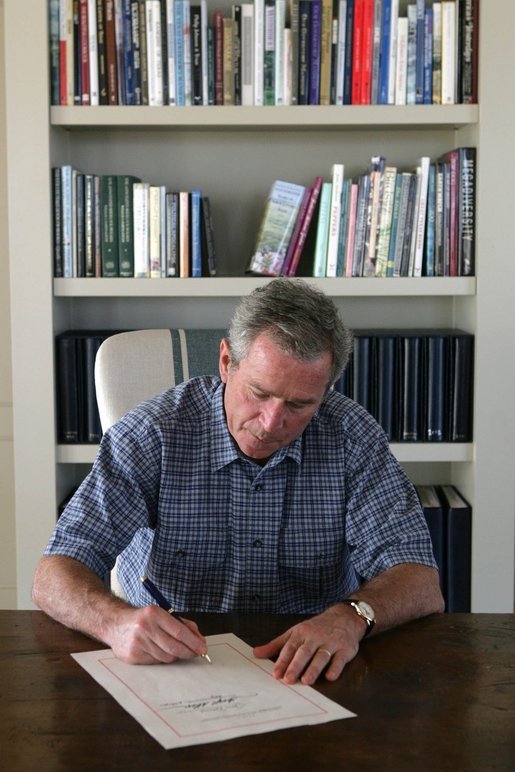
President George W. Bush signs into law H.R. 3010, the 'Departments of Labor, Health and Human Services, and Education, and Related Agencies Appropriations Act, 2006' from the Bush ranch Friday, Dec. 30, 2005, in Crawford, Texas. White House photo by Shealah Craighead H.R. 2863, the "Department of Defense, Emergency Supplemental Appropriations to Address Hurricanes in the Gulf of Mexico, and Pandemic influenza Act, 2006," which provides FY 2006 appropriations for DOD Military programs. The bill contains FY 2006 funding for war-related expenses for the first part of the year; contains funding to support relief and reconstruction efforts related to the hurricanes in the Gulf of Mexico and funds the initiative to prepare for the pandemic influenza.
Finally, the bill contains a one percent across-the-board reduction to FY 2006 discretionary programs across the Government, excluding emergencies and the Department of Veterans Affairs.

H.R. 3010, the "Departments of Labor, Health and Human Services, and Education, and Related Agencies Appropriations Act, 2006," which provides FY 2006 appropriations for the Departments of Labor, Health and Human Services, and Education; and other smaller agencies;

H.R. 4525, the "Second Higher Education Extension Act of 2005," which extends programs authorized under the Higher Education Act of 1965;

H.R. 4579, which extends current law provisions prohibiting group health plans and insurance issuers from imposing certain limits on mental health coverage;

H.R. 4635, the "TANF and Child Care Continuation Act of 2005," which extends certain welfare programs that expire on December 31, 2005,"

S. 205, the "Buffalo Soldiers Commemoration Act 2005," which authorizes the American Battle Monuments Commission to establish a memorial in or around the City of New Orleans to honor the Buffalo Soldiers;

S. 652, the "Benjamin Franklin National Memorial Commemoration Act of 2005," which authorizes the Secretary of the Interior to provide a grant to the Franklin Institute to rehabilitate the Benjamin Franklin National Memorial;

S. 1238, the "Public Lands Corps Healthy Forests Restoration Act of 2005," which amends the Public Lands Corps Act of 1993 to authorize annual appropriations for the Corps and to establish priorities for project activity,"

S. 1281, the "National Aeronautics and Space Administration Authorization Act of 2005," which authorizes appropriations for the National Aeronautics and Space Administration for FYs 2007 and 2008; provides authorities to achieve the President's Vision for Space Exploration; and amends numerous NASA authorities, including those related to the Space Shuttle and the International Space Station.

S. 1310, which modifies an easement to allow expansion of a natural gas pipeline in the Delaware Water Gap National Recreation Area and extends the authority and increases the fee for commercial vehicle access through that Area;

S. 1481, which makes corrections and other modifications to the American Indian Probate Reform Act;

S. 1892, which extends the statute of limitations to December 31, 2006, for the filing of claims by Indian tribes against the Federal Government related to the management of trust accounts;

S. 1988, which authorizes the transfer to the Republic of Korea of items in the Department of Defense War Reserve Stockpile; and

S. 2167, which extends from December 31, 2005, to February 3, 2006, the sunset of temporary authorities under the USA PATRIOT Act and the "lone wolf" provision of the Intelligence Reform and Terrorism Prevention Act.

# # # For Immediate Release, Office of the Press Secretary, December 30, 2005

more at
and or and , or and , or , and , or , and , or

Related: Keywords H.R. Tuesday, October 19, 2004
Provisional Ballots, Early Voting, and 10,000 Lawyers, Monday, December 06, 2004 Bill # H.R.10 intelligence community, Sunday, December 12, 2004 House and Senate Resolutions, Thursday, December 23, 2004 Statement on House and Senate Resolutions, Saturday, January 08, 2005 H.R.241 tax charitable contributions relief tsunami, Tuesday, January 11, 2005 bush H.R. 241 tax deduction tsunami relief, Friday, February 11, 2005 H.R.418 REAL ID Act of 2005, Monday, February 21, 2005 .256 Bankruptcy Reform Bill, Wednesday, March 09, 2005 S.148 United States Boxing Commission, Sunday, March 13, 2005 H.R. 1220 Veterans’ Compensation Cost-of-living Adjustment Act of 2005, Wednesday, March 16, 2005 H.R.1268 Emergency Supplemental Appropriations Act, Friday, March 18, 2005 Protection of Incapacitated Persons Act of 2005 H. R. 1332 Friday, March 25, 2005 H.R. 1160, S. 384, Friday, April 01, 2005 Foreign Operations, Export Financing, and Related Programs Appropriations Act, Friday, April 01, 2005 H.R. 1270, Friday, April 15, 2005 H.R.1134 Internal Revenue Code of 1986, Thursday, April 21, 2005 H. R. 6 Energy Policy Act of 2005, Tuesday, April 26, 2005 House Floor Report 04/26/05, Thursday, April 28, 2005 H.R.748 Child Interstate Abortion Notification Act, Friday, April 29, 2005 H.R. 787

Monday, January 02, 2006

President Visits Brooke Army Medical Center

President George W. Bush speaks with the press on Sunday, January 1, 2006, at Brooke Army Medical Center in San Antonio, TX. During his visit to the Medical Center, the President presented nine soldiers with a Purple Heart Award and visited with wounded soldiers and their families. White House photo by Shealah CraigheadPresident George W. Bush speaks with the press on Sunday, January 1, 2006, at Brooke Army Medical Center in San Antonio, TX. During his visit to the Medical Center, the President presented nine soldiers with a Purple Heart Award and visited with wounded soldiers and their families. White House photo by Shealah Craighead
President Visits Troops at Brooke Army Medical Center, Brooke Army Medical Center, San Antonio, Texas, 12:05 P.M. CST

THE PRESIDENT: Happy New Year to you all. Thanks. I can't think of a better way to start 2006 then here at this fantastic hospital -- a hospital that's full of healers and compassionate people who care deeply about our men and women in uniform. It's also full of courageous young soldiers, Marines, airmen -- men and women who are serving our country and making great sacrifice. I'm just overwhelmed by the great strength of character of not only those who have been wounded, but of their loved ones, as well. And so, thank you all for bringing great credit to our country.

As you can possibly see, I have an injury myself -- not here at the hospital, but in combat with a Cedar. I eventually won. The Cedar gave me a little scratch. As a matter of fact, the Colonel asked if I needed first aid when she first saw me. I was able to avoid any major surgical operations here, but thanks for your compassion, Colonel.

I've been thinking long and hard about 2006. My hopes, of course, are for peace around the world. I'll continue to work as hard as I can to lay that foundation for peace. And also my hope is that this country remains as prosperous as it was in 2005. We had a very strong economy, and we'll work to keep the economy as strong as it possibly can, so anybody that wants to find a job can find one.

With that, I'll be glad to answer a couple of questions. Toby. Or, Deb. You are Deb, right?

Q Yes, sir. Mr. President, were you aware of any resistance to the launching of the NSA program at high levels of your administration, and if so, how did that influence your decision to approve it?

THE PRESIDENT: First of all, the NSA program is an important program in protecting America. We're at war, and as Commander-in-Chief, I've got to use the resources at my disposal, within the law, to protect the American people. And that's what we're doing.

The NSA program is one that listens to a few numbers, called from the outside of the United States and of known al Qaeda or affiliate people. In other words, the enemy is calling somebody and we want to know who they're calling and why. And that seems to make sense to me, as the Commander-in-Chief, if my job is to protect the American people.

This program has been reviewed, constantly reviewed, by people throughout my administration. And it still is reviewed. It has got -- not only has it been reviewed by Justice Department officials, it's been reviewed by members of the United States Congress. It's a vital, necessary program.

Now, some say, well, maybe this isn't a war; maybe this is just a law enforcement operation. I strongly disagree. We're at war with an enemy that wants to hurt us again, and the American people expect the Commander-in-Chief to protect them, and that's exactly what I intend to do.

Toby.

Q Mr. President, as we start the New Year, what is your outlook for U.S. troop withdrawal from Iraq in 2006?

THE PRESIDENT: The conditions on the ground will dictate our force level. As the Iraqis are able to take more of the fight to the enemy, our commanders on the ground will be able to make a different assessment about the troop strength. And I'm going to continue to rely upon those commanders, such as General Casey, who is doing a fabulous job and whose judgment I trust, and that will determine -- his recommendations will determine the number of troops we have on the ground in Iraq.

Q In 2004, when you were doing an event about the Patriot Act, in your remarks you had said that any wiretapping required a court order, and that nothing had changed. Given that we now know you had prior approval for this NSA program, were you in any way misleading?

THE PRESIDENT: I was talking about roving wire taps, I believe, involved in the Patriot Act. This is different from the NSA program. The NSA program is a necessary program. I was elected to protect the American people from harm. And on September the 11th, 2001, our nation was attacked. And after that day, I vowed to use all the resources at my disposal, within the law, to protect the American people, which is what I have been doing, and will continue to do. And the fact that somebody leaked this program causes great harm to the United States.

There's an enemy out there. They read newspapers, they listen to what you write, they listen to what you put on the air, and they react. And it seems logical to me that if we know there's a phone number associated with al Qaeda and/or an al Qaeda affiliate, and they're making phone calls, it makes sense to find out why. They attacked us before, they will attack us again if they can. And we're going to do everything we can to stop them.

Yes, Ed.

Q Mr. President, with this program, though, what can you say to those members of the public that are worried about violations of their privacy?

THE PRESIDENT: Ed, I can say that if somebody from al Qaeda is calling you, we'd like to know why. In the meantime, this program is conscious of people's civil liberties, as am I. This is a limited program designed to prevent attacks on the United States of America. And I repeat, limited. And it's limited to calls from outside the United States to calls within the United States. But they are of known -- numbers of known al Qaeda members or affiliates. I think most Americans understand the need to find out what the enemy is thinking. And that's what we're doing.

We're at war with a bunch of cold-blooded killers who will kill on a moment's notice. And I have a responsibility, obviously, to act within the law, which I am doing. It's a program that's been reviewed constantly by Justice Department officials, a program to which the Congress has been briefed, and a program that is, in my judgment, necessary to win this war and to protect the American people.

Last question. Mike.

Q Mr. President, in August you said that Katrina could -- the effects of it could test the strongest faith. I'm sure of some of the things that you saw today, that's the case, as well. What do you tell a young soldier or his young wife about how a loving God could permit or cause some of the things you saw today?

THE PRESIDENT: First of all, Mike, I'm conscious not to be trying to substitute myself for God. I am, on the other hand, inspired by the mom who told me upstairs that she prays every day and believes in the miracle of healing; that I think we see God's work here every day. I think when you find nurses and doctors who work around the clock, who come in at a moment's notice to save a life, I happen to believe there's a lot of divine inspiration to that kind of dedication and work. The parents I saw or the wives I saw, many of them were in prayer on a regular basis for their loved one.

And, you know, war is terrible. There's horrible consequences to war -- that's what you see in this building. On the other hand, we also see people who say, I'd like to go back in, Mr. President, what we're doing is the right thing, because many of these troops understand that by defeating the enemy there, we don't have to face them here. And they understand that by helping the country and the Middle East become a democracy, we are, in fact, laying the foundation for future peace. And, I, as the Commander-in-Chief, I am resolved to make sure that those who have died in combats' sacrifice are not in vain. And I am resolved to make sure that these kids who are recovering here, that have suffered terrible injury, that their injuries are not in vain by completing the mission and laying that foundation for peace for generations to come. And I'm optimistic we'll achieve that objective.

Thank you all very much.

END 12:16 P.M. CST, For Immediate Release, Office of the Press Secretary, January 1, 2006

more at
and or and , or and , or , and ,

Related: Keywords radio address, podxast, radio address, podxast, Saturday, December 24, 2005
bush radio address 12/24/05 full audio, text transcript, Saturday, December 17, 2005 bush radio address 12/17/05 full VIDEO, text transcript, Sunday, December 04, 2005 Presidential Podcast 12/03/05, Saturday, December 03, 2005 bush radio address 12/03/05 full audio, text transcript, November 26, 2005 Presidential Podcast 11/26/05, Saturday, November 26, 2005 bush radio address 11/26/05 full audio, text transcript, Saturday, November 19, 2005 Presidential Podcast 11/19/05, Saturday, November 19, 2005 Freedom Calendar 11/19/05 - 11/26/05, Saturday, November 12, 2005 Presidential Podcast 11/12/05, Saturday, November 12, 2005 bush radio address 11/12/05 full audio, text transcript, Saturday, November 05, 2005 Presidential Podcast 11/05/05, Saturday, November 05, 2005 bush radio address 11/05/05 full audio, text transcript, Saturday, October 29, 2005 bush radio address 10/29/05 full audio, text transcript, Saturday, October 22, 2005 Presidential Podcast 10/22/05, Saturday, October 15, 2005 Presidential Podcast 10/15/05, Saturday, October 08, 2005 bush radio address 10/08/05 full audio, text transcript, Saturday, October 01, 2005 bush radio address 10/01/05 full audio, text transcript, Saturday, September 24, 2005 bush radio address 09/24/05 full audio, text transcript, Saturday, September 17, 2005 bush radio address 09/17/05 full audio, text transcript