Daily Press Brefing, J. Adam Ereli, Deputy Spokesperson, file is MP3 for PODCAST, running time is 47:11 , Washington, DC, February 21, 2006
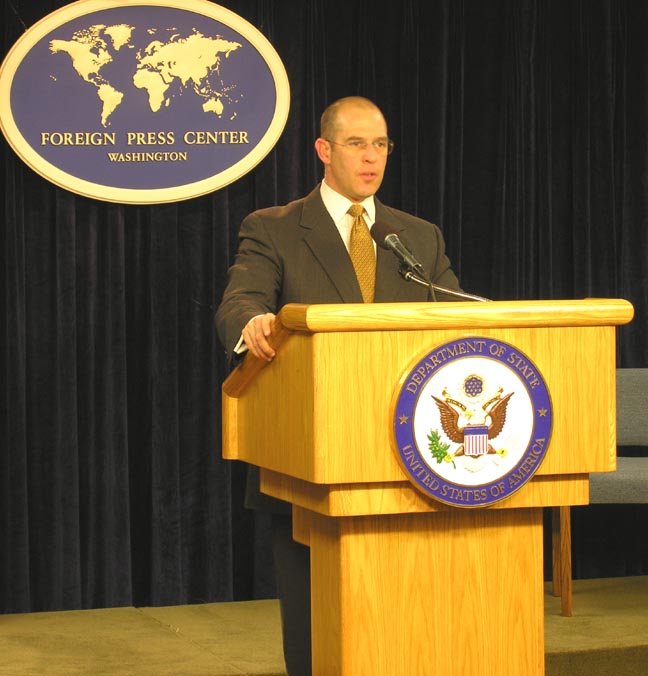 | J. Adam Ereli became Deputy Spokesman of the Department of State on September 2, 2003. In this capacity, he oversees the Office of Press Relations, Office of Regional Media Outreach, the Foreign Press Centers, and the Press Office at USAID. Previously, Mr. Ereli served as Deputy Chief of Mission at the U.S. Embassy in Doha, Qatar, from 2000 to 2003. |
Mr. Ereli earned a B.A. in History from Yale University in 1982 and an M.A. in International Relations from the Fletcher School of Law and Diplomacy in 1989. Before entering the Foreign Service, he worked as a journalist and human rights activist in Paris, France. He speaks French and Arabic.
TRANSCRIPT:, 1:19 p.m. EST
MR. ERELI: Welcome, everybody. Let me begin with an update on assistance to the Philippines. The United States has been very moved and is very concerned by the tragedy in the Philippines as a result of the mudslides. And I wanted just to let you know what we've done to help the Philippines respond to this disaster. Today we've provided more than $260,000 to the relief effort. This includes $100,000 to the Philippine Red Cross, an airlift of supplies, including blankets, water purification and dispensing equipment. We've also provided through the military elements of the 31st Marine Expeditionary Unit to the area. In that unit there are 1,600 Marines, 16 helicopters that are engaged in search and recovery operations, as well as, I think, 334 Marines on the ground actually doing work to dig out.
We'll continue working closely with the Philippine authorities in responding to this disaster. And that's it.
QUESTION: Last I heard, Marines hadn't begun any digging or begun any searching, so to speak. They were in the area. You may have fresher information. Are American Marines actually burrowed into the mud, trying to rescue these missing people or are they on standby in case they could be of some help?
MR. ERELI: My information is that as of today, we've got 1,630 U.S. military personnel at the disaster site.
QUESTION: But are they conducting search operations or are they just there?
MR. ERELI: Yes, yes. They're conducting search and rescue operations.
QUESTION: They're actually trying to get to the people.
MR. ERELI: Yeah.
QUESTION: Also the number of helicopters, I can't believe -- well, I mean, you said -- I thought I heard you say 1,600 helicopters.
MR. ERELI: No, 1,600 personnel, 16 helicopters --
QUESTION: Okay.
MR. ERELI: -- are among the assets involved in this operation from the Marine Expeditionary Unit.
QUESTION: A change of subject. On the six-party talks, since South Korean officials are saying that they believe that talks will resume in March or April. Do you have anything on that -- any indication from any of the parties when they may resume?
MR. ERELI: I don't have anything that specific to update you on with regard to the six-party talks. Obviously, contacts among the parties continue. The Chinese Vice Foreign Minister is here today, as a matter of fact. He'll be meeting with Deputy Secretary Zoellick, Assistant Secretary Hill. They'll be talking about a number of issues. First and foremost, I think the upcoming visit of President Hu in April, but I expect that the six-party talks would also -- the issue of six-party talks would also come up in their discussions. We obviously remain eager to see a resumption of talks. We continue to consult with our partners in the process about how to achieve that objective. At this point, however, I'm not aware of any dates that have been decided upon.
QUESTION: If it should turn out that there is more information, would you please let us know by the end of the day?
MR. ERELI: If there's something to update you, I'll make every effort to do that.
QUESTION: I appreciate it. And what date is the President coming to Washington?
MR. ERELI: He's coming in April. I don't know. I'll check and see if there is a specific date.
QUESTION: Yeah. None has been announced. I thought you might want to get ahead of the curve.
MR. ERELI: Don't want to get ahead of the White House.
QUESTION: No, God. God, no. How about --
QUESTION: Do you have a name?
QUESTION: What?
QUESTION: A name for the Vice Foreign Minister?
MR. ERELI: His name is Yang Jiechi.
QUESTION: Could you spell it?
MR. ERELI: Yang, Y-a-n-g; Jiechi, J-i-e-c-h-i. I think that would be fairly obvious, but in case you didn't get it.
QUESTION: Oh, sure.
QUESTION: J-e-i?
MR. ERELI: J-i-e-c-h-i.
QUESTION: Of course. The usual spelling.
QUESTION: I can help*.
MR. ERELI: Please. (Laughter.)
QUESTION: Jiechi.
MR. ERELI: Say it again, please?
QUESTION: Yang Jiechi.
MR. ERELI: Like she said. (Laughter.)
QUESTION: What is he, the deputy what?
MR. ERELI: He's the vice foreign minister.
QUESTION: Vice Foreign Minister?
QUESTION: Vice Foreign Minister.
QUESTION: Do you know whether Minister Yang also discussed Taiwan issue with Assistant Secretary? They met this morning already.
MR. ERELI: I don't have a readout of the meeting so I'll see what I can get you for it after the briefing.
QUESTION: Mladic. Very confusing reports. Do you know more than we all seem to know, that he's either been apprehended or that he hasn't?
MR. ERELI: I've not --
QUESTION: He's either going to Tuzla or he isn't, that he's not been arrested or that he's been arrested? It's very confusing at this point, but it's early.
MR. ERELI: I don't have any new information to share with you. I've seen the reports. I'm not aware that there's any change in the status of Mladic. He continues to be a fugitive from justice. We continue to call on the Government of Serbia to take action to bring him to justice. As for latest developments in the case, again, I'm not aware of anything new but I'd refer you to the Government of Serbia for confirmation or denial.
QUESTION: And/or the news agency.
MR. ERELI: Or the --
QUESTION: They're showing it on the news there. But you're not aware that he's been apprehended, let alone formally arrested?
MR. ERELI: Yes, to both. We're not aware of either.
Anything more on that?
QUESTION: Yeah. What's the status of Serbia's money right now? I understand there was a deadline of sorts this week.
MR. ERELI: Let me check and see if I've got something for you. I'm not aware of --
QUESTION: Could you?
MR. ERELI: I'm not aware of the issue.
QUESTION: Okay.
QUESTION: On Middle East, Adam, over the weekend the Israeli cabinet moved to withhold the customs and tax monies that they collect on behalf of the Palestinians. Already we had a fairly furious reaction from Mr. De Soto, the UN envoy, who said that was not appropriate especially since we're still at the interim government level and we haven't moved to a Hamas government level. What is the U.S. position on that move and the timing of the move?
MR. ERELI: Yeah. The U.S. position is this is a sovereign decision for the Government of Israel to make. I would note to the Government of Israel also said that they're mindful of the humanitarian needs of the Palestinian people and will act with those concerns at heart. And I would also note as we said yesterday, the Secretary had a conversation with her Quartet partners yesterday. And we will be looking at ways to continue to support the interim government of the Palestinian Authority. And finally, that all of us have the same objective, which is to support the Palestinian people but not support a terrorist organization and that's the guiding criteria for our actions as we move forward.
QUESTION: If I can just --
MR. ERELI: Quartet.
QUESTION: Oh, Okay. It's still standing tall, united yet.
MR. ERELI: Tall and united.
QUESTION: If I can just follow up on that. Tall and united in their January 30th statement, they specifically mentioned that they wanted efforts and would make sure to have efforts to facilitate the interim government. Now, the Israelis took their move, while the interim government is still in power. We're not in a Hamas government. Is there disappointment, at least with the timing, the thought that the Israelis might have been --
MR. ERELI: No. I think this is -- again, this is a decision made by the Government of Israel. We understand that decision.
Sir.
QUESTION: On Mexico.
QUESTION: No. On this issue.
MR. ERELI: Sir.
QUESTION: (Inaudible) Hamas has said yesterday that America money was not that important for the Palestinian people, since most of the U.S. money was spent on non-Palestinian bodies. Do you have any comment on that?
MR. ERELI: The United States has a strong and admirable record of support for the Palestinian people and for their aspirations for statehood and to support their efforts to achieve a negotiated settlement with Israel. Obviously that remains our goals, the goals of the Quartet and we believe the goals of the Palestinian people, so we will continue to look for ways that we can help bring about this vision through our diplomacy, through our assistance. There is a new reality, however, that we have to deal with and that is -- that reality is a political party that has close links to terror, being elected to the majority of the Palestinian legislative council.
So while our goals haven't changed -- those goals being an independent Palestinian state that can live in peace and security side by side with Israel, some of the ingredients in the mix have. So the challenge before us is how do we support Palestinian national aspirations? How do we address the humanitarian needs of the Palestinian people, while at the same time dealing with a new political reality?
And I think the response is pretty clear-cut. You see it in the statement from the Quartet. You see it our discussions over the weekend and you've seen it in the Secretary's remarks to the Arab media on Friday and again in her press conference today, which is that the choices Hamas has to make: recognize Israel, reject violence, respect agreements previously entered into. And we have, I think, the possibility of helping to achieve Palestinian national aspirations. As long as you've got one foot in terror and one foot in politics, then it's very hard to get anywhere.
Yes, ma'am.
QUESTION: Has the Palestinian Authority yet returned the $50 million that you asked them to return? And what stage is the review and are you asking for any other funds that you believe should be --
MR. ERELI: I'll have to check on where exactly the money is. We have asked for it back; the Palestinian Authority has agreed to give it back. I don't know if that fund transfer has actually taken place or whatever mechanical actions are taken -- have taken, but I'll check and just get you a specific answer on that.
On the question of the review of assistance, that is ongoing. I'm not aware that there are any other sort of funds outstanding that have been transferred to the Palestinians that would qualify to be recalled. All of our aid, as you know, with the exception of the $50 million that was provided in direct assistance goes through NGOs and there's a pipeline and so you can regulate it that way. I think what we're -- again, what we're doing right now is to see what kind of assistance qualifies as humanitarian, what kind of assistance would qualify as going to organizations or entities or activities that are controlled by Hamas and therefore come under some of the legal restrictions that are before us and that'll take some time to sort out but we're moving forward on it, mindful of the reality that looms ahead of us.
QUESTION: Just a follow up. Have you asked any NGOs to give back any of the funds that you may have given --
MR. ERELI: Not that I'm aware of.
Yes.
QUESTION: Adam, a high-tech center was planned for Gaza through Intel Corporation. Is this now void with the Hamas victory? Of course, in light of what just developed with Dubai this is also a question perhaps with security concerns?
MR. ERELI: I'm not aware of the specific project you're referring to. If it's a project that is funded through U.S. Government taxpayer money, then obviously it's going to come under this review and we want to assess whether it meets the definition of humanitarian assistance or assistance that goes to a Hamas-led government. That's the criteria that we're going to apply to what we're looking at. If it's a private sector project with private-sector money, that's a commercial decision that companies make and they're responsible to their shareholders. What we're doing is looking at taxpayer funds because we're accountable to the American people and to Congress for those funds.
Yes.
QUESTION: I have a (inaudible) on Ms. Dibble's visit to Lebanon?
MR. ERELI: Deputy Assistant Secretary Liz Dibble left for the region on Sunday; she's there as part of this review. She'll obviously be meeting with our Consulate staff as well as the NGO community. I don't have any update for you beyond that.
QUESTION: The criticism of reports, you know, you know the action to turn that over to the UAE. Criticism seems to be rising. The Senate Republican leader has joined with Democrats across the board, any second thoughts about it? Anything you want to say about that criticism?
MR. ERELI: First, I think it's important to point out that our concern as -- our first concern -- our first priority is security of the homeland and protecting America from any attack and that's what guides us in our decisionmaking on this. A second point is, we will be working with members of Congress to respond to their concerns and to lay out our thinking and the facts as they have guided us throughout this process.
Let me lay out you for you a couple of those facts, which are important. First of all, and this is something my colleague at the Treasury Department spoke to today as well. There's a careful review of foreign investment in the United States through the Committee on Foreign Investment in the United States and that review was conducted in this case as well, well before the current brouhaha and that review involves a number of government agencies. In this case it was expanded to include the Departments of Transportation and Energy. And during that review each party to the process brings to the table any concerns that they might have, any issues that they are worried about or that they feel need to be looked into.
In this case, specifically, I would note that the intelligence community's Risk Acquisition Center, which is under the office of Director of National Intelligence, prepared an assessment to determine if any derogatory information existed on this acquire and whether the acquire would take any action -- might take any action to threaten national security. And as a result of this very thorough, very exhaustive, very careful review by all the stakeholders, including the Department of Homeland Security, it was decided that there was no objection on national security grounds for this transaction going forward.
I would also point out that nothing in this acquisition has anything to do with the responsibility for security in American ports. That remains very firmly in the hands of Department of Homeland Security. What we're talking about is management of some port operations. Department of Homeland Security has had good relations with the Dubai ports role in the past. And I would note, as the Secretary noted in her remarks on Friday, that from a counterterrorism point of view, we've had a strong and effective partnership with the UAE and those are some of the facts, I think, that are important to bear in mind when looking at this case.
QUESTION: On Hamas.
MR. ERELI: Yes.
QUESTION: On the Hamas visit to Turkey. Mr. Sean McCormack said on Friday that you had not, by the time, gotten a readout from the Turks on the contact and since then have you gotten that readout? And also, given the fact that Hamas has been maintaining its hard-line position on everything, are you satisfied with the Turkish explanation?
MR. ERELI: I'll check to see what readout we've received from the Turkish Government about the meetings with Hamas. As Assistant Secretary McCormack indicated to you, Turkey is a strong partner in the war on terror. We have close cooperation with it on issues related to the peace process as well and Turkey is itself a victim of terror attacks. So I think we have every understanding in every consensus of views going into the meeting that the message would be a strong one to Hamas, that they had to make a choice and the choice should be renunciation of terror.
Yeah.
QUESTION: Change of subject? Venezuela, do you have any reaction to President Chavez's remarks about the Secretary?
MR. ERELI: No.
QUESTION: Was that (inaudible) answer, do you think? (Laughter.)
MR. ERELI: I just think that responding to the remarks dignifies them in a way that I don't want to do.
Yeah.
QUESTION: Change of subject? On Iraq?
QUESTION: Can I ask just one more?
QUESTION: Yeah, you can.
QUESTION: Just on the remarks about the potential cut-off of oil.
MR. ERELI: I've seen it before. Don't -- not aware that there's anything to back them up.
QUESTION: You're not worried about -- I mean, they do supply -- I mean, the percentage of the oil (inaudible) States. Is there any worry about that that threat would be carried out?
MR. ERELI: At this point, it's rhetorical and I haven't seen any moves that would lead us to believe that there's any action that's being prepared to be taken.
QUESTION: As you know, in Mexico, there is a huge effort to rescue 65 miners. I would like to know if the Mexican Government had requested some assistance to the U.S. Government and or the U.S. Government have offered some sort of support?
MR. ERELI: Obviously, our thoughts and prayers are with the trapped miners and their families. We hope for a successful rescue. We are, of course, always ready to help our or Mexican friends and partners, should they need it. At this point, the Mexican Government has not requested assistance from us.
QUESTION: Also, do you have any date for a possible meeting of President Fox to the United States to --
MR. ERELI: Again, I'd refer you to White House for the latest on planning -- with meetings between the presidents.
Teri.
QUESTION: On Iraq, Ambassador Khalilzad yesterday said that the U.S. is not going to invest the resources of the American people to build forces run by people who are sectarian, et cetera, et cetera. A couple of times he said, you know, we have to make our own decisions (inaudible) of their decisions. This is sounding almost like the Hamas money. What did Khalilzad mean and is the U.S. really basing their continued support on what kind of government the Iraqis put in place?
MR. ERELI: Ambassador Khalilzad is stating our longstanding position, one that I think he articulated very well in an editorial submitted to the Los Angeles Times earlier this month. What the United States is looking for in Iraq is a national unity government. The fact is we're coming out of these elections and a long period of campaigning and political processes that in some respects emphasized sectarianism over unity; different parties, different groups appealing to their constituents to get votes. Well, on the upside, that campaigning, that political dynamic produced unprecedented turnout in the January 15th -- I'm sorry, in the December 15th elections. And we saw groups from all of Iraq's political factions come out and express their preferences for an elected government. That's important, it's positive and the Iraqi people deserve praise and congratulations for that kind of commitment to democracy.
Now the challenge before us and before the international community and the Iraqis is to, in forming the government, put aside some of the sectarian differences that came out during the campaign and put together a government that, number one, includes representatives of all the political factions so that nobody feels excluded, even though they've got significant representation in parliament. And number two, that once meeting that composition criteria that they act in ways that serve the welfare of all Iraqis as opposed to favoring one community over another community. And that's the task before, first and foremost, the Iraqis as they move towards forming this government. And as Prime Minister Jafari stated today, that remains their goal and the purpose to which they are committed. And second of all, as Ambassador Khalilzad is asked to be involved, asked to provide views, asked to provide advice and counsel and suggestions, that's the direction that he's going to take as well.
So I think that, frankly, it's stating the obvious to say that American help for Iraq is designed to help all Iraqis, regardless of their political affiliation, regardless of their tribal affiliation. And what we are trying to do in providing them that support is to generate the kind of cooperation, dialogue, compromise and seeing this interaction that can help create the kind of Iraq that Iraqis are looking for.
QUESTION: And otherwise US aid will be cut off or what kind of support was he talking about?
MR. ERELI: I think the Ambassador was making the point that I just made. That the U.S. -- U.S. assistance is not designed to favor one group or another group, it's designed to help all Iraqis promote the national goals. The goals of a representative government that includes all Iraq's political factions and is not intended to support one group or another and agendas that are different than the agendas of the elected Government of Iraq.
QUESTION: (Inaudible) as he did yesterday, in raising the possibility of withdrawal of American support?
MR. ERELI: Well, I'm explaining to you the U.S. approach to this; I'm not conducting the negotiations. I'm not going to lay out conditions for those negotiations.
QUESTION: Thank you.
MR. ERELI: Mm-hmm.
QUESTION: Boxes and boxes of State Department records have been withdrawn from the shelves at the National Archives.
MR. ERELI: Mm-hmm.
QUESTION: Is this denying the American people a sense of their own history?
MR. ERELI: Oh, I certainly wouldn't put it that way. There's a process for declassification that is conducted, regulated by the Department of State on documents in our -- that we have. We review the documents. We determine whether those threats to national -- whether declassifying them would compromise national security. And if we determine that there is no such compromise, we declassify them. Obviously, our interest is in being as transparent and open as possible.
In this case, we declassified a bunch of documents. Subsequent to that declassification, there were some agencies that came back and said, ah, wait a minute, we have some concerns. And in response to those concerns, I think they were reclassified. This happens from time to time. It's certainly not a question of trying to deny the American public access to information and we always try to maintain a balance between being open but protecting national security. There are guidelines for this kind of process. And in this case there were some documents that others had a problem with, so the decision was made to reclassify them.
Yeah.
QUESTION: Separate -- different subject on Sudan.
QUESTION: I'd like to continue, please.
QUESTION: Sure.
QUESTION: I'm sorry. But there's some question whether this impulse to reclassify is an attempt to protect the government from political embarrassment rather than protecting national security.
MR. ERELI: Yeah. I think those concerns are unwarranted, but I would refer you -- obviously, with regard to the specifics of why these individual agencies wanted their documents reclassified, I'd refer you to those agencies. The other ones I think they could provide you with the details of the grounds for reclassification.
Yeah.
QUESTION: Yeah. On Sudan, are you hopeful of getting a resolution through the UN this week through the Security Council on Sudan and what do you hope that's going to contain? Are you looking for a very strong international force to go into the Darfur region to help end what the Secretary herself said was a continuing genocide.
MR. ERELI: Rehatting the African Mission in -- African Union Mission in Sudan, AMIS, into a UN force and combining it with the existing UN force in Southern Sudan, is an important priority for the United States as well as all of us who are concerned about the ongoing violence in Darfur. It is something that we are committed to, that we are working closely with the African Union on, with NATO, with the UN on and the Security Council on. When specific actions will be taken as part of this effort is a little bit difficult to say right now. Whether there will be Security Council Resolutions introduced this week or next week or whenever, I can't say. I think, obviously, what the United States wants to see is action taken quickly in order to address an unacceptable status quo which involves continuing violence in Darfur.
Now what are the elements of the actions underway? First of all, you've got, frankly, a strong and committed African Union force in place right now. And I think we should all pay due homage to that force for risking their lives, for suffering casualties and for getting into Darfur in a timely way and providing effective interventions that have prevented the kind of large-scale atrocities in violence that we saw before they were there. That's an important development and something the AU deserves a lot of credit for. But let's remember, it was never intended to be an open-ended force. And it was always envisioned that there would be a transition to something else.
Now what we're looking at is an expanded force, both in terms of numbers and capabilities and under a UN banner. The African Union Peace and Security Committee approved in principle this rehatting last month. That was an important step forward. The entire AU will be considering it soon and we look forward to their support and cooperation in the rehatting operation. It will certainly require an important AU contribution and that certainly is envisioned. That as part of this new force, there would be a significant, central role for the AU.
There is a UN assessment team in Darfur or in Sudan looking at the logistical needs. We are eager to hear their report so that we can begin some of the more concrete planning, further rehatting. And finally, I would point out that there is -- there continue to be peace talks in Darfur, which we -- I'm sorry -- peace talks in Abuja, which we shouldn't neglect to mention, simply because as you all know, peacekeeping can be an effective stop-gap measure to contain the violence, but true long-term stability in Darfur can only come as part of a political settlement of differences between groups in Darfur and the Central government and outsiders who are, frankly, in some cases, not helping the situation. So that's why Abuja continues to be an important peace of the diplomacy here and why it's noteworthy that representatives of all the rebel groups have returned to Abuja and are working under -- without help and with the help of the AU on our framework agreements on peace, security and wealth sharing.
QUESTION: Do you think that the UN Assessment Team has been taking too long and sort of dragging its feet on making recommendations? And also have you heard from the Sudanese Government as to what they would like to you do because you have to get their permission first before any international force can be launched? And the AU has to make the request as well.
MR. ERELI: As I said, we eagerly await the report of the UN assessment mission. We'd like it to be as soon as possible, just because there's an urgency to the matter. People are dying in Darfur and we need to act to stop it. This is something the Secretary General has spoken to. It's something the President has spoken to. It's something that all of us in the U.S. Government feel very strongly and quite emotionally about. So we want to move forward on the -- we don't want the logistics and mechanics. It's important to get that right, but there is an urgency to it.
As far as cooperation of AU and the Government of Sudan go, yeah, that's absolutely necessary. And as I said before the AU, their Peace and Security Commission, has endorsed this idea and we're working with the AU, as we always have been from the very beginning, to make it a partner in this enterprise. Because it's important for all of us that the AU -- the AU has already demonstrated important and welcome capabilities in bringing peace -- or helping to bring peace to Darfur. We want to build on those capabilities, not only in Darfur but also to strengthen the institutional capabilities of the AU and this is a good way to do that.
And as far as Sudan goes, Sudan was supportive of AMIS and should the Security Council decide to rehat AMIS as a UN force, we would look for the Government of Sudan to be supportive of that as well.
QUESTION: Could I just follow up on that, Adam? The United States has said that it was making a priority of its presidency at the Security Council to get this resolution passed.
MR. ERELI: Mm-hmm.
QUESTION: And I think John Bolton said it, Deputy Zoellick said it, the President said it, the Secretary said it.
MR. ERELI: Right.
QUESTION: And it hasn't happened and we only have a week to go and you're saying it may not happen. Where has been --
MR. ERELI: I can't promise you that there's going to be a resolution introduced in the next week. I can say that whether we're the president or not of the Security Council, the United States will push to marshal international efforts in support of peace in Darfur, including a rehatting of AMIS into a UN force.
QUESTION: But my question was with so much push behind it from the United States, where was the blockage? The Secretary in her testimony suggested it was the African Union who hadn't even made a request. Is that where the problem was?
MR. ERELI: I'd say there are a lot of elements to this undertaking. I tried to outline some of them in my earlier remarks. I don't know if I'd call it blockage so much as a lot of moving parts and you've got to get them all in synch at different stages along the way. I think that the question to look at is -- the question is not "if" but "when" and obviously for us, the sooner the better. But we also need to get all the ducks lined up in a row so that the outcome is what we all want.
QUESTION: Do you have the support of China on this, because at one stage China was not entirely behind all your plans for Darfur?
MR. ERELI: At this point, I don't think that's an issue.
Sir.
QUESTION: On Bolivia, the reports suggesting that based on the experience with Venezuela the U.S. is taking a completely different approach towards Evo Morales. Would you like to comment on that and where the State Department sees relations with Bolivia heading?
MR. ERELI: Yeah. I saw the article. I think we've been pretty consistent in saying, number one, we want a good relationship with Bolivia; it's a relationship that's important to us and one that we're going to work to develop and work to support. I would note that Assistant Secretary Shannon has been to Bolivia twice, I believe, attending the inauguration of President Morales; they have spoken. I think that we've gotten off to a positive start in some respects. We are engaged in a dialogue with the Morales administration on a number of areas of mutual interest, including something you mentioned in the article -- counter-narcotics cooperation. And I think the United States and Bolivia share a commitment to fighting narcotics trade and illegal activity.
QUESTION: Is it a different approach?
MR. ERELI: It's an approach based on cooperation, on mutual respect, and on shared interests. That was the approach before and it continues to be the approach. So frankly, I think the relationship is characterized more by continuity than by departures from previous approaches.
QUESTION: So you have no problem with Morales's "yes" to coca and "no" to cocaine policy?
MR. ERELI: Without commenting on the specifics, I think both the United States and Bolivia share a common view of te importance of fighting counter-narcotics.
Who have we not got? Mr. Lambros.
QUESTION: Mr. Ereli, on Cyprus. The Russian Times reported today the former inter alia called a DOS official with a condition of anonymity, "the U.S. is begin direct trade to northern Cyprus for the first time since it was occupied by Turkey never to partition the island. We are laying the foundation. We provide direct aid to facilitate direct flights" something which caused strong reaction by the Cypriot ambassador to the United States (inaudible). In the same paper who said, "Open (inaudible) would be de facto recognition of occupied Cyprus. Such conducts downgrades the legitimacy of our government. It's almost a new colonialism." Any comment on that?
MR. ERELI: I think you know what our policy is with regard to northern Cyprus. We are seeking to take measures to ease the economic isolation of that part of the island so that they do not suffer as a result of the rejection of the Annan plan and the referendum. There are a number of steps we're taking. I'm not aware of the specific that you cite. I'll see if there's anything -- if I have anything more on them.
QUESTION: A follow-up. About this (inaudible) trade ties, since according to 30 declassified DOS documents of 2004 in my possession on this crucial issue it leaves the other day to a prominent American Greek leader via the Freedom of Information Act are verifying this affair of conducts on the direct trade and flights between the United States and the Turkish-occupied area of Cyprus.
MR. ERELI: I'm not aware of any change in U.S. policy on either of those issues.
Yes, ma'am.
QUESTION: NSC official Dennis Wilder went to Taiwan last week to persuade Taiwan's President Chen not to abolish the National Unification Council. And we learned that President Chen already rejected the U.S. proposal. Also know that the State Department communicated with Taiwan on this issue on a day-to-day basis. So can you tell then what kind of message you're getting from Taiwan, so far? Has the decision been made?
MR. ERELI: I'm not going to speak for the officials in Taiwan. I'm not aware of the specific visit that you mentioned. I'd refer you to the White House for the NSC to comment on travels by its officials. As far as our discussions with Taiwan go, I think it won't surprise you to learn that in all other discussions, we reiterate the view that Taiwan needs to refrain from taking actions which can be seen as unilateral efforts to change the status quo, that they need to move to address the issues they have with respect to China through dialogue. And that's our consistent message in our dealings with the Taiwanese.
QUESTION: President Chen decides to go ahead to scrap the Council, will the U.S. take any punitive measures to actually convey --
MR. ERELI: Not my comfortable -- I'm not comfortable speculating on that hypothetical. I think we will be guided by our policy which is based on the Taiwan Relations Act and the declarations that you're familiar with.
QUESTION: What about the reunification office? Should it remain in existence or not?
MR. ERELI: Let me get you a considered opinion on that.
Yeah.
QUESTION: Is there any place for Secretary Rice and Assistant Secretary Welch to visit the Palestinian territories?
MR. ERELI: Not on this trip.
Yeah.
QUESTION: Adam, on Hamas again. Their top leader who's based in Damascus went to Tehran over the weekend. He was given an audience, I believe, with the supreme religious leader. And the Iranians were talking about the possibility of filling a funding void that might be created if other parties cut off aid to the Palestinians. And I'm wondering is this -- if you're concerned about -- this has created a void into which Iran might jump. Is this causing the U.S. some concern?
MR. ERELI: I'd refer you to the Secretary's comments on precisely this question in her remarks to the press on Friday. And she made the point that the U.S. position to anybody dealing with Hamas, whether it be Iran or any of the others, is our efforts should be directed at getting them to renounce terror and to recognize Israel. Now we all know Iran has a pretty bad record on both those accounts. And we certainly would look to them to do the right thing. But in the final analysis, again, the choice is up to Hamas.
Yeah.
QUESTION: On Kosovo, Mr. Ereli. Anything on the talks which started yesterday in Vienna to transfer Kosovo, a Serbian territory to the Albanians by unilateral (inaudible)?
MR. ERELI: (Laughter.) Well, I'll
QUESTION: (Inaudible) the reality, please.
MR. ERELI: The reality is that yesterday, February 20th, UN Status envoy Martti Ahtisaari convened a meeting in Vienna between the leaders of Kosovo and Serbia. This was the first direct dialogue between the parties since the future status process began in November. They discussed how the decentralization of the government can better protect the rights of Kosovo's minorities and improve the delivery of public services to all of Kosovo's citizens. I'd expect there to be further meetings on decentralization in the coming weeks. I think that this is preliminary to actually getting into discussions about final status.
QUESTION: Follow-up. This is a follow-up. Since you are supporting this (inaudible), why you don't try to convince the Kosovar Albanians to leave as a minority in Serbia Montenegro like other minorities in so many other countries, such as the 15 percent Greeks in Albania, the 20 percent Kurds in Turkey, the 12 percent Turks in Bulgaria, the 18 percent of Albanians in FYROM and so on and so on?
MR. ERELI: You know, it's not -- we're not going to dictate the future of this territory for its people. That's for its people to decide. And it should be based on adequate protections for minority rights and to be acceptable to all the people of Kosovo. That's what's going to be successful, not solutions imposed from the outside.
Thanks.
(The briefing was concluded at 2:06 p.m.), DPB #28
more at Dubai and State Department or PHILIPPINES and Palestinian, or Mudslides and UNITED ARAB EMIRATES or Condoleezza Rice, or U.S. Port Operation and SUDAN, or NORTH KOREA, and VENEZUELA, or ISRAEL,
Related: Keywords State Department, Monday, February 13, 2006 State Department Podcast and Text 02/10/06, Thursday, February 09, 2006 State Department Podcast and Text 02/08/06, Friday, January 27, 2006 State Department Podcast and Text 01/25/06, Friday, January 27, 2006 Rice on Palestinian Elections (PODCAST), Tuesday, January 24, 2006 State Department Podcast and Text 01/23/06 , Friday, January 20, 2006 State Department Podcast and Text 01/19/06, Thursday, January 19, 2006 Secretary Rice, South Korean Foreign Minister PODCAST 01/19/06, Wednesday, January 18, 2006 State Department Podcast, Text 01/17/05,