Tuesday, May 09, 2006

Vice President Cheney and Lithuanian President Valdus Adamkus

Technorati Tags: and or and ot and or and or

Vice President Cheney and Lithuanian President Valdus Adamkus Make Remarks in the Blue Hall, The Palace of the President of Lithuania, Vilnius, Lithuania, 5:46 P.M. (Local)

Vice President Dick Cheney listens to Lithuanian President Valdus Adamkus during a bilateral meeting held at the Presidential Palace in Vilnius, Lithuania, Wednesday, May 3, 2006. During the meeting the two leaders discussed their mutual determination to further the rise of democracy in the region. White House photo by David Bohrer.Vice President Dick Cheney listens to Lithuanian President Valdus Adamkus during a bilateral meeting held at the Presidential Palace in Vilnius, Lithuania, Wednesday, May 3, 2006.
During the meeting the two leaders discussed their mutual determination to further the rise of democracy in the region. White House photo by David Bohrer.

PRESIDENT ADAMKUS: Welcome -- I definitely can say this is a historic meeting for us since you are the first Vice President of the United States to visit Lithuania. But at the same time, I have to say that President Bush was a little bit ahead of you in the same room.

And I believe this is a very important occasion since we gather, I believe, the European leaders who are committed to seek the changes, especially in Eastern Europe, to accept the basic principles -- which the Western world definitely has accepted and already -- probably talking about United States for a couple hundred years already have as the basic principles for self-governing. But what's very important, Mr. Vice President, I believe that your presence because that shows I would say that in a world, we don't have big divisions to start the ideals and principles of democracy are -- and we are basically here to unite our efforts, in this case presenting those ideas to the people who were denied probably for centuries, too -- looking east. We know the experience of the 20th century, and this is a great opportunity for us probably to unite all our efforts just to accomplish what undoubtedly the human beings after the 20th century tragedy is really looking forward. So we welcome. We're grateful that you are representing the United States and showing a great interest for the common purpose.

VICE PRESIDENT CHENEY: Well, thank you very much, Mr. President. I and my colleagues are delighted to be here. We want to thank you for hosting this conference. I think it's a great opportunity to remind everyone, really, of the enormous strides that they've made in recent years in terms of having more and more of the world's population live in freedom and democracy, which you've achieved here in Lithuania and throughout the region. And it's really remarkable over the last 15 years in light of the -- we can be here today to recognize that success. But equally important, this is an opportunity for all of us to rededicate ourselves to continuing to promote freedom and democracy as values that are universal. And there are still parts of the world, including in this region, where people don't enjoy the full benefits of those values. And I want to, on behalf of the President and the American people, also thank you. Lithuania has been a great friend and ally for the United States, a full member of NATO now, actively involved in using your resources and your moral authority in supporting those opportunities -- not only in this part of the world, but in places like Afghanistan and Iraq, as well, too. We are deeply appreciative of your commitment and your leadership, and delighted to be here today to participate in what I think is an historic conference.

END 5:50 P.M. (Local), For Immediate Release, Office of the Vice President, May 3, 2006

Relared: Keywords Vice President Cheney, Monday, April 17, 2006 Vice President Cheney and Mrs. Cheney Release 2005 Income Tax Return, Thursday, February 16, 2006 Interview of the Vice President by Brit Hume (VIDEO), Wednesday, February 15, 2006 Update by the Office of the Vice President, Saturday, January 21, 2006 Vice President, Neil Cavuto, FOX News (VIDEO), Friday, January 13, 2006 Vice President to Travel to Egypt and Saudi Arabia, Friday, January 06, 2006 Vice President's Remarks on Iraq and the War on Terror (VIDEO), Thursday, November 17, 2005 Vice President's Remarks 11/16/05, Monday, October 31, 2005 Vice President appointed David S. Addington chief of staff, Saturday, October 29, 2005 Vice President's Statement on Libby Resignation, Friday, October 28, 2005 Resignation of Scooter Libby (VIDEO, Tuesday, October 04, 2005 Remarks by the Vice President to Second Marine Expeditionary Force, Monday, September 26, 2005 Statement on Vice President Cheney's Medical Procedure, Tuesday, September 06, 2005 President Meets with Cabinet (VIDEO), Thursday, August 11, 2005 President Meets with Defense and Foreign Policy Teams (VIDEO), Tuesday, July 26, 2005 Vice President at Dinner for Vito Fossella, Saturday, July 09, 2005 President, VP Signs Book of Condolence at British Embassy, Thursday, May 12, 2005 Vice President, A Nation Honors Nancy Reagan, Saturday, April 16, 2005 Vice President Dick Cheney and Mrs. Cheney Release 2004 Income Tax Return

Monday, May 08, 2006

President Nominates General Michael Hayden as Director of the Central Intelligence Agency (VIDEO)

Technorati Tags: or or and or and or and or

President Nominates General Michael Hayden as Director of the Central Intelligence Agency, FULL STREAMING VIDEO, The Oval Office, 9:31 A.M. EDT, Fact Sheet: General Michael V. Hayden: the Right Leader for the CIA

President George W. Bush announces his nomination of Gen. Michael V. Hayden as the next Director of the Central Intelligence Agency Monday, May 8, 2006, in the Oval Office as Ambassador John Negroponte, Director of National Intelligence, looks on. Said the President of Gen. Hayden: 'He's the right man to lead the CIA at this critical moment in our nation's history.' White House photo by Paul Morse.President George W. Bush announces his nomination of Gen. Michael V. Hayden as the next Director of the Central Intelligence Agency Monday, May 8, 2006, in the Oval Office as Ambassador John Negroponte,
Director of National Intelligence, looks on. Said the President of Gen. Hayden: "He's the right man to lead the CIA at this critical moment in our nation's history." White House photo by Paul Morse .

THE PRESIDENT: Good morning. Today I'm pleased to nominate General Mike Hayden as the next Director of the Central Intelligence Agency. Mike Hayden is supremely qualified for this position. I've come to know him well as our nation's first Deputy Director of National Intelligence. In that position, he's worked closely with our Director of National Intelligence, John Negroponte, to reform America's intelligence capabilities to meet the threats of a new century.

Mike has more than 20 years of experience in the intelligence field. He served for six years as Director of the National Security Agency, and thus brings vast experience leading a major intelligence agency to his new assignment. He also served as Commander of the Air Intelligence Agency, as Director of the Joint Command and Control Warfare Center, and as Deputy Chief of Staff of the United States and U.N. Forces in Korea.

He's held senior positions at the Pentagon, the U.S. European Command, the National Security Council, and served behind the Iron Curtain in our embassy in Bulgaria during the Cold War.

Mike knows our intelligence community from the ground up. He has been both a provider and a consumer of intelligence. He's overseen the development of both human and technological intelligence. He has demonstrated an ability to adapt our intelligence services to the new challenges of the war on terror. He's the right man to lead the CIA at this critical moment in our nation's history.

It's my honor to welcome Mike's wife, Jeanine, and their family to the Oval Office. I want to thank them for their willingness to support Mike Hayden in his long service to the United States.

With the agreement of the Senate, Mike will succeed a great patriot in Director Porter Goss. Under Porter's leadership, the CIA launched a five-year plan to strengthen the agency's human intelligence capabilities. This plan involves increasing the number of operatives and sources in the field, and building up the agency's analytical capabilities, so the hardworking men and women of the CIA have the resources they need to penetrate closed societies and secretive organizations.

Porter also played a vital role in shaping the new relationship between the CIA and the new Director of National Intelligence. And this process benefited greatly from the decades-long friendship between him and Director Negroponte.

Porter took on a critical job at a critical moment in our nation's history. He instilled a sense of professionalism in the CIA and maintained the high standards of this vital agency at a time of transition and transformation. Throughout his public life, Porter Goss has been a man of accomplishment and integrity, and America appreciates his service.

I'm confident that Mike Hayden will continue the reforms that Porter has put in place and provide outstanding leadership to meet the challenges and threats of a dangerous new century. Mike Hayden was unanimously confirmed by the Senate last year for his current post, and I call on the Senate to confirm him promptly as the Director of the Central Intelligence Agency.

The work of the CIA has never been more important to the security of the American people. America faces determined enemies who struck our nation on September the 11th, 2001, and who intend to attack our country again. To stop them we must have the best possible intelligence. The men and women of the CIA are working around the clock and around the world, in dangerous conditions to gain information that is vital to securing our nation. I appreciate their dedicated service. And so does Mike Hayden.

In Mike Hayden, the men and women of the CIA will have a strong leader who will support them. He will ensure they have the resources they need to do their jobs. He will enforce the secrecy and accountability that are critical to the security of the American people.

Mike, I appreciate your many years of service to our country. We're grateful that you've agreed to step forward and serve once again. Thank you very much.

GENERAL HAYDEN: Mr. President, thank you for those kind words and for the confidence that you and Ambassador Negroponte have shown to me in nominating me for this position. There's probably no post more important in preserving our security and our values as a people than the head of the Central Intelligence Agency.

When I returned from Korea in 1999 to take the position at NSA, I was befriended most of all by two people -- George Tenet, who was then DCI, and Porter Goss, then Chairman of the House Intelligence Committee. Both of these men befriended me and mentored me and supported me. And I will always be in their debt, especially now that I find that I've been nominated to be their successor. If I'm confirmed, I know that I will be standing on their shoulders.

In the confirmation process, I look forward to meeting with members of the Congress, better understanding their concerns and working with them to move the American intelligence community forward. This is simply too important not to get absolutely right.

To the men and women of the Central Intelligence Agency, if I'm confirmed, I would be honored to join you and work with so many good friends. Your achievements are frequently under-appreciated and hidden from the public eye, but you know what you do to protect the republic.

And finally, to my wife, Jeanine, and the other members of my family, thank you yet again for agreeing to continue your sacrifices. I can never repay you enough.

Thank you.

THE PRESIDENT: Congratulations, Mike. Thank you very much. Appreciate it.

Thank you all.

END 9:38 A.M. EDT, For Immediate Release, Office of the Press Secretary, May 8, 2006

RELATED: Keywords announced his intention to nominate, Thursday, April 20, 2006 President to nominate four, appoint sixteen and designate one, Friday, April 07, 2006 President to nominate one appoint five and designate one, Friday, April 07, 2006 President to nominate three and designate one, Friday, April 07, 2006 President to nominate three and appoint two, Friday, April 07, 2006 President to nominate one, Friday, April 07, 2006 President to nominate seven, appoint eight and designate one, Monday, March 06, 2006 President has nominated four and designated one, Monday, March 06, 2006 President names three individuals to serve in his Administration, Monday, March 06, 2006 4 Nominations Sent to the Senate, Friday, March 03, 2006 4 Nominations Sent to the Senate, Friday, March 03, 2006 President to nominate one and appoint seven, Monday, February 20, 2006 President to nominate one and appoint three 02/16/06, Monday, February 20, 2006 Nominations Sent to the Senate 02/14/06, Monday, February 20, 2006 President to nominate four and appoint twelve, Monday, February 20, 2006 President to nominate one and appoint three 02/10/06, Friday, February 03, 2006 President to nominate five, appoint four, designate one, Wednesday, January 18, 2006 President to nominate ten appoint four individuals and designate one,

LTG Michael V. Hayden, USAF - Biography

Technorati Tags: or or and or and or and or

Biography, Lieutenant General Michael V. Hayden, United States Air Force.

Picture of the 15th Director, National Security Agency/Chief, Central Security Service (NSA/CSS), Lt Gen Michael V. Hayden, USAFLieutenant General Michael V. Hayden, USAF, served as the Director, National Security Agency/Chief, Central Security Service (NSA/CSS), Fort George G. Meade, MD, from March 1999 to April 2005.
As the Director of NSA and Chief of CSS, he was responsible for a combat support agency of the Department of Defense with military and civilian personnel stationed worldwide.

General Hayden entered active duty in 1969 after earning a bachelor's degree in history in 1967 and a master's degree in modern American history in 1969, both from Duquesne University. He is a distinguished graduate of the Reserve Officer Training Corps program. The General has served as Commander of the Air Intelligence Agency and Director of the Joint Command and Control Warfare Center, both headquartered at Kelly Air Force Base, TX. He has also served in senior staff positions in the Pentagon; Headquarters U.S. European Command, Stuttgart, Germany; the National Security Council, Washington, DC; and the U.S. Embassy in the People's Republic of Bulgaria. Prior to his current assignment, the General served as Deputy Chief of Staff for United Nations Command and U.S. Forces Korea, Yongsan Army Garrison.

EDUCATION:
1967 Bachelor of Arts degree in history, Duquesne University, Pittsburgh, PA

1969 Master's degree in modern American history, Duquesne University, Pittsburgh, PA

1975 Academic Instructor School, Maxwell Air Force Base, AL

1976 Squadron Officer School, Maxwell Air Force Base, AL

1978 Air Command and Staff College, Maxwell Air Force Base, AL

1980 Defense Intelligence School (postgraduate intelligence curriculum), Defense Intelligence Agency, Bolling Air Force Base, Washington, DC

1983 Armed Forces Staff College, Norfolk, VA

1983 Air War College, Maxwell Air Force Base, AL

ASSIGNMENTS:
January 1970 - January 1972 - Analyst and briefer, Headquarters Strategic Air Command, Offutt Air Force Base, NE

January 1972 - May 1975 - Chief, Current Intelligence Division, Headquarters 8th Air Force, Andersen Air Force Base, Guam

May 1975 - July 1975 - Student, Academic Instructor School, Maxwell Air Force Base, AL

July 1975 - August 1979 - Academic Instructor and Commandant of Cadets, Reserve Officer Training Corps Program, St. Michael's College, Winooski, VT

August 1979 - June 1980 - Student, Defense Intelligence School (Postgraduate Intelligence Curriculum), Defense Intelligence Agency, Bolling Air Force Base, Washington, DC

June 1980 - July 1982 - Chief of Intelligence, 51st Tactical Fighter Wing, Osan Air Force Base, South Korea

June 1982 - January 1983 - Student, Armed Forces Staff College, Norfolk, VA

January 1983 - July 1984 - Student, Air Attache Training, Washington, DC

July 1984 - July 1986 - Air Attache, U.S. Embassy, Sofia, People's Republic of Bulgaria

July 1986 - September 1989 - Politico-Military Affairs Officer, Strategy Division, Headquarters U.S. Air Force, The Pentagon, Washington, DC

September 1989 - July 1991 - Director for Defense Policy and Arms Control, National Security Council, Washington, DC

July 1991 - May 1993 - Chief, Secretary of the Air Force Staff Group, Office of the Secretary of the Air Force, Headquarters U.S. Air Force, The Pentagon, Washington, DC

May 1993 - October 1995 - Director, Intelligence Directorate, Headquarters U.S. European Command, Stuttgart, Germany

October 1995 - December 1995 - Special Assistant to the Commander, Headquarters Air Intelligence Agency, Kelly Air Force Base, TX

January 1996 - September 1997 - Commander, Air Intelligence Agency, and Director, Joint Command and Control Warfare Center, Kelly Air Force Base, TX

September 1997 - March 1999 - Deputy Chief of Staff, United Nations Command and U.S. Forces Korea, Yongsan Army Garrison, South Korea

March 1999 - May 2005 - Director, National Security Agency/Chief, Central Security Service, Ft. George G. Meade, MD

MAJOR AWARDS AND DECORATIONS:
Defense Distinguished Service Medal
Defense Superior Service Medal with Oak Leaf Cluster
Legion of Merit
Bronze Star Medal
Meritorious Service Medal with Two Oak Leaf Clusters
Air Force Commendation Medal
Air Force Achievement Medal

EFFECTIVE DATES OF PROMOTION:
Second Lieutenant -- 2 Jun 1967
First Lieutenant -- 7 Jun 1970
Captain -- 7 Dec 1971
Major -- 1 Jun 1980
Lieutenant Colonel -- 1 Feb 1985
Colonel -- 1 Nov 1990
Brigadier General -- 1 Sep 1993
Major General -- 1 Oct 1996
Lieutenant General -- 1 May 1999

RELATED: Keywords announced his intention to nominate, Monday, May 08, 2006 President Nominates General Michael Hayden as Director of the Central Intelligence Agency (VIDEO), Thursday, April 20, 2006 President to nominate four, appoint sixteen and designate one, Friday, April 07, 2006 President to nominate one appoint five and designate one, Friday, April 07, 2006 President to nominate three and designate one, Friday, April 07, 2006 President to nominate three and appoint two, Friday, April 07, 2006 President to nominate one, Friday, April 07, 2006 President to nominate seven, appoint eight and designate one, Monday, March 06, 2006 President has nominated four and designated one, Monday, March 06, 2006 President names three individuals to serve in his Administration, Monday, March 06, 2006 4 Nominations Sent to the Senate, Friday, March 03, 2006 4 Nominations Sent to the Senate, Friday, March 03, 2006 President to nominate one and appoint seven, Monday, February 20, 2006 President to nominate one and appoint three 02/16/06, Monday, February 20, 2006 Nominations Sent to the Senate 02/14/06, Monday, February 20, 2006 President to nominate four and appoint twelve, Monday, February 20, 2006 President to nominate one and appoint three 02/10/06, Friday, February 03, 2006 President to nominate five, appoint four, designate one, Wednesday, January 18, 2006 President to nominate ten appoint four individuals and designate one,

Bush Statetement on Darfur (VIDEO)

Technorati Tags: and or and , or and , or , and , or and or

President Discusses Peace Agreement in Sudan, FULL STREAMING VIDEO, The Roosevelt Room, 11:43 A.M. EDT, In Focus: Africa
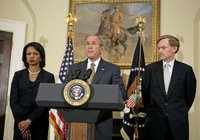
President George W. Bush delivers a statement on Darfur in the Roosevelt Room Monday, May 8, 2006. Standing with the President are State Secretary Condoleezza Rice and State Deputy Secretary Robert Zoellick. 'About 200,000 people have died from conflict, famine and disease,' said the President. 'And more than 2 million were forced into camps inside and outside their country, unable to plant crops, or rebuild their villages. I've called this massive violence an act of genocide, because no other word captures the extent of this tragedy.' White House photo by Paul Morse.President George W. Bush delivers a statement on Darfur in the Roosevelt Room Monday, May 8, 2006. Standing with the President are State Secretary Condoleezza Rice and State Deputy Secretary Robert Zoellick.
"About 200,000 people have died from conflict, famine and disease," said the President. "And more than 2 million were forced into camps inside and outside their country, unable to plant crops, or rebuild their villages. I've called this massive violence an act of genocide, because no other word captures the extent of this tragedy." White House photo by Paul Morse.

THE PRESIDENT: I want to thank Secretary of State Condoleezza Rice for joining me, and I also want to thank Deputy Secretary of State Bob Zoellick. He has just briefed me on his trip to Abuja, where he has played a very important role in setting up a peace agreement between the government of Sudan and a major rebel group in the Darfur region.

Congratulations on a job well done, Bob. Thank you.

Last week we saw the beginnings of hope for the people of Darfur. The government of Sudan and the largest rebel group signed an agreement and took a step toward peace. Many people worked hard for this achievement. I'm particularly grateful for the leadership of President Obasanjo of Nigeria and President Sassou-Nguesso of Congo. Deputy Secretary Zoellick told me of their really fine work, and I had the honor of calling both of them to thank them over the phone the other day. Their personal hands-on involvement was vital.

We're still far away from our ultimate goal, which is the return of millions of displaced people to their homes so they can have a life without fear. But we can now see a way forward.

Sudan is one of the most diverse nations in Africa and one of the most troubled countries in the world. A 22-year-old civil war between north and south took more than 2 million lives before a peace agreement was made that the United States helped to broker. About the same time, another conflict was raging in the west, and that's in Sudan's vast Darfur region.

Darfur rebel groups had attacked government outposts. To fight that rebellion, Sudan's regime armed and unleashed a horse-mounted militia called the Janjaweed, which targeted not only rebels, but the tribes thought to be supporting them. The Janjaweed murdered men, and they raped women, and they beat children to death. They burned homes and farms, and poisoned wells. They stole land to graze their own herds. Hundreds of villages were destroyed, leaving a burnt and barren landscape.

About 200,000 people have died from conflict, famine and disease. And more than 2 million were forced into camps inside and outside their country, unable to plant crops, or rebuild their villages. I've called this massive violence an act of genocide, because no other word captures the extent of this tragedy.

A cease-fire was declared in this conflict in April 2004, but it has been routinely violated by all sides. The Janjaweed continued to attack the camps and rape women who ventured outside the fences for food and firewood. The government took no effective action to disarm the militias. And the rebels sometimes attacked food convoys and aid workers.

An African Union force of about 7,200 from the region has done all it can to keep order, by patrolling an area nearly the size of Texas, and they have reached the limits of their capabilities. With the peace agreement signed on Friday, Darfur has a chance to begin anew. Sudan's government has promised to disarm the Janjaweed by mid-October, and punish all those who violate the cease-fire. The main rebel group has agreed to withdraw into specified areas. Its forces will eventually be disarmed, as well, and some of its units will be integrated into the national army and police.

The African Union will meet a week from today, urge its members to help implement this new agreement.

Our goal in Darfur is this: We want civilians to return safely to their villages and rebuild their lives. That work has begun and completing it will require even greater effort by many nations. First, America and other nations must act to prevent a humanitarian emergency, and then help rebuild that country. America is the leading provider of humanitarian aid, and this year alone we account for more than 85 percent of the food distributed by the World Food Program in Sudan.

But the situation remains dire. The World Food Program has issued an appeal for funds necessary to feed six million people over the next several months. The United States has met our commitment, but other major donors have not come through. As a result, this month the World Food Program was forced to cut rations by half.

So I proposed in the emergency supplemental before Congress to increase food aid to Sudan by another $225 million. I hope Congress will act swiftly on this true emergency. To get food to Darfur quickly I've directed USAID to ship emergency food stockpiles. I've directed five ships and ordered them to be loaded with food and proceed immediately to Port Sudan. I've ordered the emergency purchase of another 40,000 metric tons of food for rapid shipment to Sudan. These actions will allow the World Food Program to restore full food rations to the people of Darfur this summer.

Americans who wish to contribute money to help deliver relief to the people of Darfur can find information about how to do so by going to the USAID website at www.usaid.gov, and clicking on the section marked "Helping the Sudanese People."

Moving forward, we cannot keep people healthy and fed without other countries standing up and doing their part, as well. The European Union, and nations like Canada, the United Kingdom, The Netherlands and Japan have taken leadership on other humanitarian issues, and the people of Darfur urgently need more of their help now.

In addition, the government of Sudan must allow all U.N. agencies to do their work without hindrance. They should remove the visa and travel restrictions that complicate relief efforts. And all sides must cease attacks on relief workers.

And finally, the United States will be an active participant in the Dutch-led reconstruction and development conference. And it's an important conference. It will take place within the next couple of months, to help the people get back on their feet so they can live normal lives in Darfur.

Second, America and other nations must work quickly to increase security on the ground in Darfur. In the short-term, the African Union forces in Darfur need better capabilities. So America is working with our NATO allies to get those forces immediate assistance in the form of planning, logistics, intelligence support and other help. And I urge members of the alliance to contribute to this effort.

In the longer-term, the African Union troops must be the core of a larger military force that is more mobile and more capable, which generates better intelligence and is given a clear mandate to protect the civilians from harm. So I'm dispatching Secretary Rice to address the U.N. Security Council tomorrow. She's going to request a resolution that will accelerate the deployment of U.N. peacekeepers into Darfur. We're now working with the U.N. to identify countries that contribute those troops so the peacekeeping effort will be robust.

I've called on President -- I just called President Bashir of Sudan, both to commend him on his work for this agreement, and to urge the government to express clear support for a U.N. force. The vulnerable people of Darfur deserve more than sympathy. They deserve the active protection that U.N. peacekeepers can provide.

In recent weeks, we've seen drastically different responses to the suffering in Darfur. In a recent audio tape, Osama bin Laden attacked American efforts in Sudan and urged his followers to kill international peacekeepers in Darfur. Once again, the terrorists are attempting to exploit the misery of fellow Muslims and encourage more death. Once again, America and other responsible nations are fighting misery and helping a desperate region come back to life. And once again, the contrast could not be more clear.

In late 2004 in Darfur, the Janjaweed attacked a village of a woman named Zahara. They raped her, murdered her husband, and set fire to their home. One of the attackers told her, "This year there's no god except us. We are your god now." But you and I know that at all times, in all places, there is a just God who sides with the suffering, and calls us to do the same. America will not turn away from this tragedy. We will call genocide by its rightful name, and we will stand up for the innocent until the peace of Darfur is secured.

Thank you.

END 11:56 A.M. EDT, For Immediate Release, Office of the Press Secretary, May 8, 2006

Related: Keywords: Africa, Monday, May 01, 2006 Status of Darfur Peace Negotiations in Abuja, Saturday, April 29, 2006 President Meets with Darfur Advocates (VIDEO), Thursday, April 06, 2006 Inauguration Thomas Yay Boni of Benin, Wednesday, March 29, 2006 President Bush Welcomes President Obasanjo of Nigeria, Monday, March 27, 2006 President Bush to Welcome Nigerian President, Thursday, March 23, 2006 President Welcomes President Sirleaf of Liberia (VIDEO), Thursday, March 16, 2006 President to Welcome President of the Republic of Liberia, Wednesday, January 18, 2006 First Lady After Liberia Inauguration,

Sunday, May 07, 2006

Lying Is Exposed By Micro-Expressions We Can't Control

Technorati Tags: or and or and or and or and or

Lying Is Exposed By Micro-Expressions We Can't Control, Research into tiny muscle movements proves useful in anti-terror investigations

BUFFALO, N.Y. -- When trying to lie your way through any situation, keep a tight rein on your zygo maticus major and your orbicularis oculi. They'll give you away faster than a snitch.

So says social psychologist Mark Frank, whose revolutionary research on human facial expressions in situations of high stakes deception debunks myths that have permeated police and security training for decades. His work has come to be recognized by security officials in the U.S. and abroad as very useful tool in the identification and interrogation of terrorism suspects.

By applying computer technology to the emotion-driven nature of nonverbal communication, Frank, a professor of communication in the School of Informatics at the University at Buffalo, has devised methods to recognize and accurately read the conscious and unconscious behavioral cues that suggest deceit.

His research already is employed by investigative bodies around the world and, Frank says, "It can be applied to the training of security checkpoint personnel to help them identify and decode 'hot spots,' the subtle conversational cues and fleeting flashes of expression that betray buried emotions or suggest lines of additional inquiry."

Frank notes that a large body of prior research has elaborated and sharpened Darwin's observations about the evolutionarily-derived nature of emotion and its expression.

In fact, Frank's mentor during his post-doctoral years at the University of California, San Francisco, was Paul Ekman, the world's foremost expert in reading facial expressions. Ekman conducted extensive cross-cultural research and found that a wide range of facial expressions related to specific emotions are identical from culture to culture.

He found that subjects' tics, furrows, smirks, frowns, smiles and wrinkles as they emerge in assorted combinations offer surprisingly accurate windows to the emotions.

"Fleeting facial expressions are expressed by minute and unconscious movements of facial muscles like the frontalis, corregator and risorius," Frank says, "and these micro-movements, when provoked by underlying emotions, are almost impossible for us to control."

Ekman and his colleague Wallace Friesen came up with a numbering system for all of these movements: for example, left and right eyebrows up is 1; down, 2; eyebrows pulled together, 4; upper eyelid raised, 5, and so on and related them to expressions of various emotion that are found the world over.

Building on their research, Frank has identified and isolated specific and sometimes involuntary movements of the 44 human facial muscles linked to fear, distrust, distress and other emotions related to deception.

Then, in a project for the National Science Foundation, he developed computer programs that automated Ekman's numbering process, making it possible to identify automatically every facial expression, including those tied to deceit, shown by subjects in taped interviews. Before this automation was developed, it took up to three hours of playing, rewinding and replaying, videotapes to analyze a single minute of blinks and twitches.

Frank's system has proven successful in identifying suspects involved in conventional criminal and potentially criminal behavior. It is now being tested for use in identifying potential terrorists.

"I want to make it clear that one micro-expression or collection of them is not proof of anything," Frank says. "They have meaning only in the context of other behavioral cues, and even then are not an indictment of an individual, just very good clues."

J.J. Newberry, formerly of the federal Bureau of Alcohol, Tobacco and Firearms, calls Frank and his methods "uncanny."

They are so effective that although he does not advertise his work nor actively solicit contracts in the field, Frank been asked to assist judges; health and police agencies, including the Los Angeles Police Department, the U.S. Federal Judiciary, the Bureau of Alcohol, Tobacco and Firearms and Department of Homeland Security, and other legal, medical and law enforcement communities from Singapore to Scotland Yard.

Since 9/11, a variety of federal government agencies have provided funding for Frank, although he declines to discuss the precise nature of his current research until it is complete and published.

In the course of his work with various investigative units, Frank says that, in addition to teaching them how to recognize behavioral cues, he has successfully advocated the use of a "rapport building" style of communication in interviews, because it is much more effective than the hostile/accusatory styles used in the past.

Frank says he began to develop identification skills when he was bouncer in a Buffalo bar. He says he trained himself to spot behavior that suggested that patrons were underage, packing a .22 or itching for a fight. He developed a sixth sense that allowed him to spot potential troublemakers by the way they looked when they walked in – "like they were trying to get away with something," he says. These were, for the individuals in question, high-stakes situations.

He honed his skills during years of research by staring at miles of videotape (sometimes in slow motion) in which crooks, sneaks and killers proclaimed their innocence, or hundreds of volunteer student liars tried to earn a little cash by successfully deceiving their interviewers.

"This identification skill is one that some police employ successfully. They work in a high-stakes profession that helps them develop what they would call an acute intuitive sense," says Frank, the son of a Buffalo police officer

"What we have done is quantify it, automate it, prove its effectiveness and teach it very effectively."
Contact: Patricia Donovan pdonovan@buffalo.edu 716-645-5000 x1414 University at Buffalo

Related: Keyword biology, Sunday, April 30, 2006 Mothers often have inaccurate perceptions of their children's body weight, Sunday, April 16, 2006 Other people influence us and we don't even know it!, Tuesday, January 04, 2005 The Cassini-Huygens mission to Saturn, Sunday, March 20, 2005 Agriculture Secretary Mike Johanns, bovine spongiform encephalopathy (BSE), Thursday, March 24, 2005 Fish Oil Holds Promise in Alzheimer's Fight, Sunday, April 10, 2005 National Human Genome Research Institute (NHGRI), Friday, April 15, 2005 Study uncovers bacteria's worst enemy , Sunday, May 01, 2005 Yes, it is an exoplanet 2M1207 system, Friday, May 20, 2005 a polysaccharide called hyaluronan, Tuesday, May 24, 2005 pseudoneglect phenomenon, Friday, June 03, 2005 DOE JGI sequences DNA from extinct cave bear, Monday, June 06, 2005 From a Few Wild Ancestors, a Citrus Cornucopia, Tuesday, June 07, 2005 NHGRI Selects 13 More Organisms for Genome Sequencing, Sunday, July 24, 2005 Prehistoric Native Americans maize cultivation , Sunday, July 31, 2005 Protein 97 Synapse-associated (SAP97), Sunday, August 07, 2005 universal flu vaccine, Sunday, August 07, 2005 Smoking gun for Alzheimer's disease, Sunday, August 07, 2005 placental tissue, embryonic stem cells, Sunday, August 21, 2005 female senior faculty are still rare, Sunday, September 18, 2005 more rain would benefit New Orleans,

Blood-Compatible Nanoscale Materials Possible Using Heparin

Technorati Tags: or and or and or and or and or and or and or and or

Blood-Compatible Nanoscale Materials Possible Using Heparin

Caption: Image displays blood compatibility of carbon nanotube when coated with heparin. Credit: Rensselaer/Robert Linhardt, Usage Restrictions: Credit: Rensselaer/Robert Linhardt, Related news release: Blood-compatible nanoscale materials possible using heparin.Caption: Image displays blood compatibility of carbon nanotube when coated with heparin. Credit: Rensselaer/Robert Linhardt, Usage Restrictions: Credit: Rensselaer/Robert Linhardt.
Related news release: Blood-compatible nanoscale materials possible using heparin.

TROY, N.Y. — Researchers from Rensselaer Polytechnic Institute have engineered nanoscale materials that are blood compatible using heparin, an anticoagulant. The heparin biomaterials have potential for use as medical devices and in medical treatments such as kidney dialysis.

The researchers prepared several materials with heparin composites or coatings, including carbon nanotubes, nanofibers, and membranes with nanosized pores, and then demonstrated the materials’ high compatibility with blood. Heparin is a common therapeutic used to maintain blood flow or prevent clotting during medical procedures and treatments.

The researchers demonstrated the composite heparin membrane with nanopores could work as an artificial kidney, or dialyzer, by filtering the blood and maintaining its flow. The presence of this blood-compatible dialyzer could potentially eliminate the need for systemic administration of heparin to the patient during kidney dialysis, the researchers say.

The heparin-coated membranes are described in a paper titled “Ionic Liquid-Derived Blood Compatible Membranes for Kidney Dialysis,” published online Apr. 24 in advance of print in the Journal of Biomedical Materials Research.

“These heparin composite membranes and fibers and coated carbon nanotubes are an enabling technology,” says Saravanababu Murugesan, a recent doctoral graduate in chemical and biological engineering at Rensselaer and lead author of the paper. “Our results show these novel materials have great promise in the development of improved medical devices that are blood compatible.”

The research team is led by Robert Linhardt, the Ann and John H. Broadbent Jr. ’59 Senior Constellation Professor of Biocatalysis and Metabolic Engineering at Rensselaer, and includes collaboration with Pulickel Ajayan, the Henry Burlage Professor of Materials Science and Engineering, and Omkaram “Om” Nalamasu, professor of materials science and engineering, at Rensselaer. Additional co-authors of the paper are Shaker Mousa, director of the Pharmaceutical Research Institute at Albany College of Pharmacy, and Aravind Vijayaraghavan, a recent doctoral graduate in materials science and engineering at Rensselaer. Funding for this research was provided by the National Institutes of Health.

Recent results related to this work have been published online in the journals Langmuir (“Blood Compatible Nanotubes – Nano-based Neoproteoglycans,” Mar. 11, 2006) and Biomacromolecules (“Preparation of Biopolymer Fibers by Electrospinning from Room Temperature Ionic Liquids,” Jan. 26, 2006). Provisional patents have been filed by Rensselaer Polytechnic Institute.

Research in Linhardt’s group at the Center for Biotechnology and Interdisciplinary Studies at Rensselaer focuses on complex carbohydrates such as heparin. After determining the structure of these molecules, researchers study their biological activities to establish a structure-activity relationship that may reveal lead compounds for new drug development. Recent discoveries include a synthetic method for preparation of heparin in quantities large enough for use in medical treatment.

Biotechnology and Interdisciplinary Studies at RensselaerAt Rensselaer, faculty and students in diverse academic and research disciplines are collaborating at the intersection of the life sciences, the physical sciences, and engineering to encourage discovery and innovation. Rensselaer’s four biotechnology research constellations - biocatalysis and metabolic engineering, functional tissue engineering and regenerative medicine, biocomputation and bioinformatics, and integrative systems biology - engage a multidisciplinary mix of faculty and students focused on the application of engineering and physical and information sciences to the life sciences. Ranked among the world’s most advanced research facilities, the Center for Biotechnology and Interdisciplinary Studies at Rensselaer provides a state-of-the-art platform for collaborative research and world-class programs and symposia.

About Rensselaer: Rensselaer Polytechnic Institute, founded in 1824, is the nation’s oldest technological university. The university offers bachelor’s, master’s, and doctoral degrees in engineering, the sciences, information technology, architecture, management, and the humanities and social sciences. Institute programs serve undergraduates, graduate students, and working professionals around the world. Rensselaer faculty are known for pre-eminence in research conducted in a wide range of fields, with particular emphasis in biotechnology, nanotechnology, information technology, and the media arts and technology. The Institute is well known for its success in the transfer of technology from the laboratory to the marketplace so that new discoveries and inventions benefit human life, protect the environment, and strengthen economic development.

Contact: Tiffany Lohwater lohwat@rpi.edu 518-276-6542 Rensselaer Polytechnic Institute

Related: Keyword Nanotech Sunday, Sunday, April 30, 2006 Micro-pump is cool idea for future computer chips, Sunday, April 16, 2006 Self-Powered Nanoscale Devices, Sunday, April 09, 2006 Nanopore Method Genome Sequencing, Sunday, April 02, 2006 Quantum dot method rapidly identifies bacteria, March 26, 2006 'Custom' nanoparticles, cancer diagnosis and treatment, Sunday, March 26, 2006, Green nanochemistry, American Chemical Society symposium, Sunday, March 19, 2006 nanotechnologists demonstrate artificial muscles powered by highly energetic fuels, Sunday, Sunday, March 12, 2006 magnetic phenomenon may improve RAM memories, February 26, 2006 Nanoscience study shows that quantum dots 'talk', Sunday, February 26, 2006 Nano-bots to undertake major tasks?, Sunday, February 19, 2006 Nanotech to improve health care delivery, Sunday, February 19, 2006 nano-canary in the nanotoxicology coalmine, Sunday, December 04, 2005 Nano-cages 'fill up' with hydrogen, Sunday, November 13, 2005 Testing toxicity of nanomaterials, Sunday, October 23, 2005 single-molecule car, 'Nanocar', Sunday, August 28, 2005 Writing at the nanoscale, Thursday, May 26, 2005 discontinuous palladium, siloxane self-assembled monolayer, Sunday, May 08, 2005 Center for Nanoscale Materials, Monday, April 25, 2005 Nanomagnets, Nanocomposite, Monday, March 21, 2005 porphyrin tubes may lead to new nanodevices, inexpensive hydrogen fuel

CH-47 CRASHES IN KUNAR PROVINCE, BAGRAM AIRFIELD, Afghanistan

Technorati Tags: and or and , or and , or , and , or and or

BAGRAM AIRFIELD, Afghanistan – A CH-47 Chinook helicopter crashed late yesterday evening while conducting combat operations near Asadabad in Kunar Province. Nine personnel were aboard the aircraft including passengers and crew. Casualties cannot be confirmed at this time. Rescue and recovery operations are ongoing. The crash is not a result of enemy action.

The CH - 47 was conducting operations on a mountain top landing zone when the crash occurred. Additional aircraft and crews were also at the landing zone and confirmed that enemy forces did not cause the crash.

“Our hearts and prayers go out to the families and comrades of the Soldiers who were involved in this crash, ”said Maj. Gen. Benjamin C. Freakley, commander of Combined Joint Task Force – 76. “We must honor the courage and dedication of our Soldiers by continuing our commitment to bringing peace and stability to the Afghan people.”

For more information please contact COMBINED FORCES COMMAND – AFGHANISTAN COALITION PRESS INFORMATION CENTER KABUL, AFGHANISTAN APO AE 09356 cfc-a.centcom.mil

News Desk: 011-937-07-223-758 Press Center: 011-937-07-276-545 Kabul-Presscenter@cfc-a.centcom.mil

Created at 5/6/2006 9:44 AM by Joe P. Vermette, Last modified at 5/6/2006 10:05 AM by Joe P. Vermette Title: CH-47 CRASHES IN KUNAR PROVINCE, Release Date: 5/6/2006, Release Number: 06-05-06P

NEWS RELEASE, HEADQUARTERS UNITED STATES CENTRAL COMMAND, 7115 South Boundary Boulevard, MacDill AFB, Fla. 33621-5101, Phone: (813) 827-5894; FAX: (813) 827-2211; DSN 651-5894

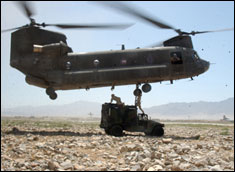
Soldiers sling-load a vehicle to a CH-47 Chinook helicopter during an operation near Bagram, Afghanistan. The Soldiers are assigned to the 25th Infantry Division, supporting the Joint Logistics Command during Operation Enduring Freedom. This photo appeared on www.army.mil. July 29, 2004 by Sgt. 1st Class Sandra WatkinsKeoughSoldiers sling-load a vehicle to a CH-47 Chinook helicopter during an operation near Bagram, Afghanistan. The Soldiers are assigned to the 25th Infantry Division, supporting the Joint Logistics Command during Operation Enduring Freedom.
This photo appeared on www.army.mil, July 29, 2004 by Sgt. 1st Class Sandra Watkins Keough Download Full High Resolution Image

Related: Keywords CENTCOM, Thursday, March 16, 2006 Iraqi Security Forces, Coalition Launch 'Operation Swarmer', Tuesday, February 15, 2005 Recruitment drive for Iraqi Army draws thousands, Tuesday, March 01, 2005 Iraqi Soldiers kill, capture terrorist, Sunday, March 06, 2005 e-mail helps Iraqi citizens report insurgent activity, Monday, March 07, 2005 Iraqi troops flush Samarra of insurgents, Tuesday, March 08, 2005 Iraqi Army, Police Force’s Emergency Response Unit,

Saturday, May 06, 2006

President Bush Welcomes President Vázquez of Uruguay (VIDEO)

Technorati Tags: and or and , or

President Bush Welcomes President Vázquez of Uruguay to the White House, FULL STREAMING VIDEO, The Oval Office, 11:09 A.M. EDT. In Focus: Global Diplomacy

President George W. Bush and President Tabare Vazquez of Uruguay talk with the press in the Oval Office Thursday, May 4, 2006. White House photo by Eric Draper.PRESIDENT BUSH: Bienvenidos. It's been a distinct pleasure to welcome the President to the Oval Office. We've had a very extensive conversation about -- we talked about a lot of subjects.
We talked about the human condition. We talked about our mutual desire to improve lives through good education and health care. I assured the President that the billions of dollars of aid that we spend in the neighborhood are all aimed at justice and giving people a chance to realize their dreams.

We talked about ways to make sure there's better student exchanges between our countries. It made a lot of sense; after all, the President was educated -- or received some education in my home state of Texas, at M.D. Anderson.

We talked about extending our commercial relations. One of the interesting topics that the President brought up was renewable energy, a subject that is very dear to my heart and necessary for our country. And finally, I shared some thoughts with the President about my deep desire to help countries become free so that this world is more peaceful.

I -- in short, it was a very extensive dialogue. And finally, he shared with me the joy of being a grandfather. Obviously, he's a good man, because he's got such pride in his family.

And so I welcome you here, sir. Thank you for coming.

PRESIDENT VAZQUEZ: Mr. President, thank you very much for your kindest attention. It's, for us, a great opportunity to speak -- but I speak Spanish.

PRESIDENT BUSH: Si. (Laughter.)

PRESIDENT VAZQUEZ: Y tu tambien.

(As translated.) Thank you, very much, Mr. President. I want to thank you very much for your welcome. This is one more show of friendship that has been a very deep friendship between our countries from the very beginning.

We've had a very kind and extensive exchange of opinions with President Bush. First of all, we recalled the bilateral investment treaty that was recently signed by our two countries in which we have -- and we have now also agreed to work to expand, intensify, and strengthen our trade relations. In fact, our technical people are going to be meeting within the framework of our joint commission in a few months in Montevideo, and we've agreed that we are going to be kicking off work at that time.

I will not extend on the points that have -- the items that have already been referred to by the President, but I do want to thank you very much.

And to the Uruguayan people who are listening to me, I want to say to all of you, without exception, without exclusions, together we will continue to work jointly on this path that we have undertaken in order to further the standard of life with our people, through education, through health care, through more and better jobs, and through decent salaries for all our people, and to truly insert Uruguay on the path of globalization.

Thank you, very much.

PRESIDENT BUSH: Gracias, senior. Gracias.

END 11:16 A.M. EDT, For Immediate Release, Office of the Press Secretary, May 4, 2006

RELATED: Keywords, President to Welcome, Monday, April 24, 2006 President Bush to Host Danish Prime Minister Anders Fogh Rasmussen, Wednesday, April 12, 2006 President Bush to Welcome German Chancellor Merkel, Wednesday, April 12, 2006 President Bush welcomes Ghana President John A. Kufuor, Wednesday, March 29, 2006 President Bush Welcomes President Obasanjo of Nigeria, Thursday, March 23, 2006 President Welcomes President Sirleaf of Liberia (VIDEO), Friday, March 17, 2006 President Welcomes Irish Prime Minister Ahern (VIDEO), Saturday, February 11, 2006 President Bush Welcomes President of Poland (VIDEO), Friday, February 10, 2006 President Bush Welcomes King Abdullah (VIDEO),

Freedom Calendar 05/06/06 - 05/13/06

Technorati Tags: and or and or and or and or and or or and or

May 6, 1960, President Dwight Eisenhower signs Republicans’ Civil Rights Act of 1960, overcoming 125-hour, around-the-clock filibuster by 18 Senate Democrats.

May 7, 1990, President George H. W. Bush proclaims first Asian/Pacific American Heritage Month.

May 8, 2003, Speaker Dennis Hastert, Senate Majority Leader Bill Frist, and other Republican leaders gather at Frederick Douglass National Historic Site, announce $1 million restoration effort.

May 9, 2001, President George W. Bush nominates Miguel Estrada to be first Hispanic to serve on U.S. Court of Appeals for D.C. Circuit; Democrats in Senate successfully filibuster nomination.

May 10, 1866, U.S. House passes Republicans’ 14th Amendment guaranteeing due process and equal protection of the laws to all citizens; 100% of Democrats vote no.

May 11, 1949, Birth of African-American Republican and sharecropper’s daughter Janice Rogers Brown, nominated by President George W. Bush as Judge of the U.S. Court of Appeals.

May 12, 1850, Birth of U.S. Senator Henry Cabot Lodge (R-MA), whose 1890 Federal Elections Bill enforcing African-American voting rights passed House on party-line vote but was defeated in Senate by a Democrat filibuster.

May 13, 1983, President Ronald Reagan designates first national observance of American Indian Day.

“A healthy republican government must rest upon individuals, not upon classes or sections. As soon as it becomes government by a class or by a section, it departs from the old American ideal.”

Theodore Roosevelt, 26th President of the United States

SOURCE:
Republican Freedom Calendar

Related: Keywords Freedom Calendar, Saturday, April 29, 2006 Saturday, April 22, 2006
Freedom Calendar 04/22/06 - 04/29/06, Saturday, April 15, 2006 Freedom Calendar 04/15/06 - 04/22/06, Saturday, April 08, 2006 Freedom Calendar 04/08/06 - 04/15/06, Saturday, April 01, 2006 Freedom Calendar 04/01/06 - 04/08/06, Saturday, March 25, 2006 Freedom Calendar 03/25/06 - 04/01/06, Saturday, March 18, 2006 Freedom Calendar 03/18/06 - 03/25/06, Saturday, March 11, 2006 Freedom Calendar 03/11/06 - 03/18/06, Saturday, March 04, 2006 Freedom Calendar 03/04/06 - 03/11/06, Saturday, February 25, 2006 Freedom Calendar 02/18/06 - 03/04/06, Saturday, February 18, 2006 Freedom Calendar 02/18/06 - 02/25/06, Saturday, February 11, 2006 Freedom Calendar 02/11/06 - 02/18/06, Saturday, February 04, 2006 Freedom Calendar 02/04/06 - 02/11/06, Saturday, January 28, 2006 Freedom Calendar 01/28/06 - 02/04/06, Saturday, January 21, 2006 Freedom Calendar 01/21/06 - 01/28/06, Saturday, January 14, 2006 Freedom Calendar 01/14/06 - 01/21/06, Saturday, January 07, 2006 Freedom Calendar 01/07/06 - 01/14/06, Saturday, December 31, 2005 Freedom Calendar 12/31/05 - 01/07/06, Saturday, December 24, 2005 Freedom Calendar 12/24/05 - 12/31/05,

Presidential Podcast 05/06/06

Technorati Tags: and or

Presidential Podcast 05/06/06 en Español

Subscribe to My Odeo Channel Subscribe to Our Odeo Podcast Channel and receive the Presidential Radio Address each week. Featuring real audio and full text transcript

Related: Keywords radio address, podcast, Saturday, April 22, 2006 Presidential Podcast 04/22/06, Saturday, April 15, 2006 Presidential Podcast 04/15/06, Saturday, April 08, 2006 Presidential Podcast 04/08/06, Saturday, Saturday, April 01, 2006 Presidential Podcast 04/01/06, March 18, 2006 Presidential Podcast 03/18/06, Saturday, March 11, 2006 bush radio address 03/11/06 full audio, text transcript, Saturday, March 04, 2006 bush radio address 03/04/06 full audio, text transcript, Saturday, February 25, 2006 bush radio address 02/25/06 full audio, text transcript, Saturday, February 18, 2006 bush radio address 02/18/06 full audio, text transcript, Saturday, February 04, 2006 bush radio address 02/04/06 full audio, text transcript, Saturday, January 28, 2006, bush radio address 01/28/06 full audio, text transcript, Saturday, January 21, 2006 bush radio address 01/21/06 full audio, text transcript, Saturday, January 14, 2006 bush radio address 01/14/06 full audio, text transcript, Saturday, January 07, 2006 bush radio address 01/07/06 full audio, text transcript, Saturday, December 31, 2005 bush radio address 12/31/05 full audio, text transcript, Saturday, December 24, 2005 bush radio address 12/24/05 full audio, text transcript,

bush radio address 05/06/06 full audio, text transcript

Technorati Tags: and or

President George W. Bush calls troops from his ranch in Crawford, Texas, Thanksgiving Day, Thursday, Nov. 24, 2005. White House photo by Eric Draper.bush radio address 05/06/06 full audio, text transcript PODCAST

President's Radio Address en Español In Focus: Medicare
Subscribe to My Odeo Channel Subscribe to Our Odeo Podcast Channel and receive the Presidential Radio Address each week. Featuring real audio and full text transcript.

THE PRESIDENT: Good morning.

Today I want to talk with you about the new Medicare prescription drug coverage that went into effect at the start of this year. Everyone on Medicare is eligible for this new coverage, but the enrollment deadline of May 15th is just over a week away. For those of you with Medicare who have not yet signed up, it is important for you to review your options and choose a plan. By enrolling before the deadline, you can ensure the lowest possible premiums and start saving on your prescription drug bills.

Many of you have already made the wise decision to enroll. Since the new coverage went into effect, more than 30 million Americans now have prescription drug coverage through the Medicare program, and more are enrolling each week. Recent surveys show that the vast majority of seniors are satisfied with the program, and for good reason.

Competition in the prescription drug market has been stronger than expected, and costs for seniors are lower than expected. The average premium that seniors pay is a third less than had been expected -- just $25 per month, instead of $37 per month. The typical person with Medicare who previously had no drug coverage will now spend about half of what he or she used to spend on prescription drugs, saving an average of $1,100 per year.

Low-income seniors receive extra help. For them, Medicare will now cover, on average, more than 95 percent of the costs of their prescription drugs. Thanks to this new coverage, America's seniors are now getting the modern medicine they need, at prices they can afford.

Prescription drug coverage under Medicare is also giving our seniors more and better choices for their health care. Instead of having to accept a "one size fits all" plan, seniors are now choosing from a variety of drug plans, and they're finding the one that best fits their needs. Most seniors are able to choose their plans that have low premiums, low or no deductibles, fixed co-payments for most drugs, and affordable coverage to fill in coverage gaps.

Medicare prescription drug coverage is a great deal for seniors. So today, I am encouraging those of you who still have not enrolled to take a look at your options and sign up before the May 15th deadline in order to ensure the lowest premiums. Even if you do not have significant drug expenses now, you should consider joining a Medicare drug plan to protect yourself against high prescription drug bills down the road.

There are many ways you can get help to choose a drug plan and enroll. You can ask your doctor or pharmacist for help. You can speak with a Medicare counselor 24 hours a day at 1-800-MEDICARE. You can enroll online by visiting the official Medicare website at Medicare.gov. If you need help enrolling, citizens' groups like AARP and NAACP, faith-based organizations, health professionals, and pharmacies are working to answer questions. Between now and May 15th, events will be held across the country to answer your questions and help you enroll for the new drug coverage. And if you have family or friends on Medicare, you can help too. Helping can be as simple as showing an older neighbor how to fill out a form, helping a senior use the Internet, or making a call for your mom or dad.

I was proud to sign Medicare prescription drug coverage into law. Because we acted, America now has a Medicare system to fit the needs of the 21st century, and millions of American seniors and persons with disabilities are now saving a lot of money and receiving the modern health care they deserve. Over the coming days, we will continue working to make sure that everyone with Medicare has a chance to save money and enjoy the peace of mind that this new drug coverage brings.

Thank you for listening.

END For Immediate Release, Office of the Press Secretary, May 6, 2006

Related: Keywords radio address, podcast, Saturday, April 29, 2006
bush radio address 04/29/06 full audio, text transcript, Saturday, April 22, 2006 bush radio address 04/22/06 full audio, text transcript, Saturday, April 15, 2006 bush radio address 04/15/06 full audio, text transcript, Saturday, April 08, 2006 bush radio address 04/08/06 full audio, text transcript, Saturday, April 01, 2006 bush radio address 04/01/06 full audio, text transcript, Saturday, March 25, 2006 bush radio address 03/25/06 full audio, text transcript, Saturday, March 18, 2006 bush radio address 03/18/06 full audio, text transcript, Saturday, March 11, 2006 bush radio address 03/11/06 full audio, text transcript, Saturday, March 04, 2006 bush radio address 03/04/06 full audio, text transcript, Saturday, February 25, 2006 bush radio address 02/25/06 full audio, text transcript, Saturday, February 18, 2006 bush radio address 02/18/06 full audio, text transcript, Saturday, February 04, 2006 bush radio address 02/04/06 full audio, text transcript, Saturday, January 28, 2006, bush radio address 01/28/06 full audio, text transcript, Saturday, January 21, 2006 bush radio address 01/21/06 full audio, text transcript, Saturday, January 14, 2006 bush radio address 01/14/06 full audio, text transcript, Saturday, January 07, 2006 bush radio address 01/07/06 full audio, text transcript,