Wednesday, July 12, 2006

President Bush Discusses Mid-Session Review (VIDEO)

Technorati Tags: or or and or and or and or and or and

President Bush Discusses Mid-Session Review, FULL STREAMING VIDEO, East Room Fact Sheet: Strong Economic Growth and Fiscal Discipline Help Reduce Budget Deficit, 9:45 A.M. EDT.
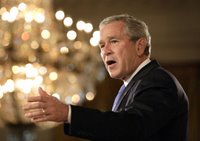
President George W. Bush delivers remarks on the Mid-Session Review, Tuesday, July 11, 2006, in the East Room at the White House. White House photo by Eric Draper.President George W. Bush delivers remarks on the Mid-Session Review, Tuesday, July 11, 2006, in the East Room at the White House. White House photo by Eric Draper.
THE PRESIDENT: Thank you. Thanks for coming. The White House is the people's house, and I'm here to talk about the people's money. We're glad you're here. As you know, every year my administration produces a budget that lays out our priorities and our goals. And every summer the Office of Management and Budget releases a report called the Mid-Session Review that tells the American people how much progress we're making towards meeting our fiscal goals.

Today OMB Director Rob Portman released the latest review. I'm pleased to report that it's got some good news for the American taxpayer. This economy is growing, federal taxes are rising [sic], and we're cutting the federal deficit faster than we expected.

This good news is no accident. It's the result of the hard work of the American people and sound policies in Washington, D.C. This morning I'm going to discuss the way forward, I'll explain why our pro-growth policies are vital to our efforts to reduce the federal deficit, what my administration is doing to work with Congress to eliminate wasteful spending, and why we need to confront the unsustainable growth in entitlement spending.

I appreciate our new Secretary of the Treasury, Hank Paulson, joining us today. Mr. Secretary, you've been on the job one day and you've got a pretty strong record. (Laughter and applause.) I'm proud that Rob Portman is here, and he brought his lad with him. (Laughter and applause.) I thank the Senate President Pro-Temp, Senator Ted Stevens, for joining us. Senator, thanks for coming. I'm proud you're here. Thank you for your leadership. I also want to thank David Dreier, Conrad Burns -- Senator Conrad Burns, excuse me --

SENATOR BURNS: That's okay. (Laughter.)

THE PRESIDENT: -- Congressman Joe Knollenberg, Ander Crenshaw, Marilyn Musgrave, thank you all for coming. Pence is with us, thanks for coming. I'm proud you're here, Mike. Thank you all for taking time to be here to hear this good news. You're responsible, in many ways, for creating the conditions for the good news we're about to talk about.

When I came to Washington, taxes were too high, and the economy was headed into a recession. Some said the answer was to centralize power in Washington, and let the politicians make the decisions about what to do with the people's money. That was one point of view.

We had a different point of view. I believe that the economy prospers when we trust the American people to make their own decisions about how to save, spend and invest. So starting in 2001, my administration worked with the United States Congress and we delivered the largest tax relief since Ronald Reagan was in the White House. We cut rates for everyone who pays income taxes. We reduced the marriage penalty, we doubled the child tax credit, and we cut the death tax. We cut the tax paid by most small businesses because we understand that most new jobs are created by small businesses. And we encouraged economic expansion by cutting taxes on dividends and capital gains.

Together, these tax cuts left nearly $1.1 trillion in the hands of American workers and families and small business owners, and they used this money to help fuel an economic resurgence that's now in its 18th straight quarter of growth. The tax cuts we passed work. (Applause.)

Last year, our economy grew at 3.5 percent, and in the first quarter of this year, it grew at an annual rate of 5.6 percent. Over the past three years, our economy has grown by more than $1.3 trillion, an amount that is larger than the size of the entire Canadian or South Korean economy.

Since August 2003, the U.S. economy has added more than 5.4 million new jobs. Our unemployment rate is down to 4.6 percent. People are working. Behind these numbers, there are American workers who start each day with hope because they have a job to help them build a better life. Behind these numbers there are more families with more money in the bank for college tuition, or a down payment on their homes. Behind these numbers are small business owners who are hiring more workers, expanding their businesses and realizing the great promise of our country.

Our job in Washington is to keep this expansion growing -- going, and to promote pro-growth policies that let Americans keep more of their hard-earned paychecks and aid us in reducing our fiscal deficit.

In order to reduce the deficit, you got to set priorities. And in working with Congress, we've set clear priorities. And the number one priority of this administration and this Congress is to make sure men and women who are defending the security of the United States and helping to spread peace through the spread of liberty get all the help they need from our government. We will always fund the troops in harm's way. (Applause.)

In an age when terrorists have attacked our country and want to hurt us again, we will do everything in our power to protect the American homeland. Those are the clear priorities of this administration, and the clear priorities of the United States Congress.

Fighting a war on terror and defending the homeland imposes great costs, and those costs have helped create budget deficits. Our responsibility is to win this war on terror, and to keep the economy growing. And those are the kind of policies we have in place. Some in Washington say we had to choose between cutting taxes and cutting the deficit. You might remember those debates. You endured that rhetoric hour after hour on the floor of the Senate and the House. Today's numbers show that that was a false choice. The economic growth fueled by tax relief has helped send our tax revenues soaring. That's what's happened.

When the economy grows, businesses grow, people earn more money, profits are higher, and they pay additional taxes on the new income. In 2005, tax revenues grew by $274 billion, or 14.5 percent; it's the largest increase in 24 years. (Applause.) Based on tax collections to date, the Treasury projects that tax revenues for this year will grow by $246 billion, or an 11 percent increase. The increase in tax revenues is much better than we had projected, and it's helping us cut the budget deficit.

One of the most important measures of our success in cutting the deficit is the size of the deficit in relation to the size of our economy. Think of it like a mortgage. When you take out a home loan, the most important measure is not how much you borrow, it is how much you borrow compared to how much you earn. If your income goes up, your mortgage takes up less of your family's budget. Same is true of our national economy. When the economy expands, our nation's income goes up and the burden of the deficit shrinks.

And that's what's happening today. Thanks to economic growth and the rise in tax revenues, this year the deficit will shrink to 2.3 percent of GDP. That's about the same as the average over the past 40 years.

Here are some hard numbers: Our originial projection for this year's budget deficit was $423 billion. That was a projection. That's what we thought was going to happen. That's what we sent up to the Congress, here's what we think. Today's report from OMB tells us that this year's deficit will actually come in at about $296 billion. (Applause.)

That's what happens when you implement pro-growth economic policies. We faced difficult economic times. We cut the taxes on the American people because we strongly believe that the American people should lead us out of recession. Our small businesses flourished, people invested, tax revenue is up, and we're way ahead of cutting the deficit -- federal deficit in half by 2009.

As a matter of fact, we're a year ahead of fulfilling a pledge that I told the Congress and the American people. I said to the American people, give this plan a chance to work. We worked with Congress to implement this plan. I said, we can cut the federal deficit in half by 2008 -- or 2009. We're now a full year ahead of schedule. Our policies are working, and I thank the members of Congress for standing with us.

See, we cannot depend on just a growing economy, though, to keep cutting the deficit. That's just one part of the equation. We also got to cut out wasteful spending. See, it's okay to create revenue growth; that's good. But if we spend all that revenue growth on wasteful programs, it's not going to help us meet our objectives. And so the second half of the equation is for this administration to continue working with the Congress to be wise about how we spend the people's money.

Every year, Congress votes to fund the day-to-day spending of the federal government. That's called discretionary spending. In other words, the Congress decides how much to spend on these types of programs on an annual basis. Every year since I took office, we've reduced the growth of discretionary spending that's not related to the military or homeland security. I told you, our priorities are military and protecting the homeland. But on other programs, we've reduced the growth of that discretionary spending. The last two budgets have actually cut this kind of spending.

The philosophy is clear: Every American family has to set priorities and live within its budget, and so does the federal government. And I thank the members of Congress for making the tough votes, setting priorities, and doing the hard work on behalf of the taxpayers of this country.

We made good progress with the emergency spending bill that Congress approved in June. You might remember the debate leading up to that supplemental bill. And there was a good constructive debate. And I weighed in. I said that we got to make sure that the emergency funding in the bill supported our troops and provided help to citizens that were hit by last year's hurricanes and to prepare for the dangers of an outbreak of pandemic flu.

The onset -- I also set limits that I thought were acceptable. In other words, we came up with our view of what would be a rational spending limit for this important piece of legislation. And I made it clear to the Congress, they sent me a bill that went over the limit, I'd veto it. We got good relations with Congress. People took that threat seriously because I meant it. Congress responded by removing nearly $15 billion in spending that had been added to the bill. By meeting the limit I'd set, Congress ensured funding for vital programs and provided a good example of fiscal discipline.

The next test is whether or not we can get a line-item veto out of the United States Senate. A line-item veto is an important tool for controlling spending. See, it will allow the President to target unnecessary spending that sometimes lawmakers put into large bills. Today when a lawmaker loads up a good bill with wasteful spending, I don't have any choices. I either sign the bill with the bad spending or veto the whole bill that's got good spending in it. And I think it would be wise if we're seriously -- seriously concerned about wasteful spending to enable the executive branch to interface effectively with the legislative branch to eliminate that kind of wasteful spending.

And so we've proposed a line-item veto that the House of Representatives passed. Under this proposal, the President can approve spending that's necessary; redline spending that's not; and send back the wasteful, unnecessary spending to the Congress for a prompt up or down vote. In other words, it's a collaborative effort between the two branches of government, all aimed at making sure we can earn the trust of the taxpayers.

Listen, the line-item veto works. Forty-three governors of both parties have this authority, and they use it effectively to help restrain spending in their state budgets. I've talked to some of these governors, used to be a governor. I know what I'm talking about when it comes to line-item veto being an effective tool. The line-item veto provides a lot of advantages, and one of them is it acts as a deterrent. See, when legislators think they can slip their individual items in a spending bill without notice, they do it.

If they think that they're going to try to slip something in that gets noticed, it means they're less likely to try to do so. We want to make sure that the system we have here in Washington is transparent and above-board and fair to the people's -- taxpayer's money.

And one way to do so is to make sure that the President can work with the Congress through the line-item veto proposal I submitted. I strongly urge the United States Senate to take this matter up and pass it into law. (Applause.)

We're dealing with the short-term deficit. But there's another challenge that we face. In the long-run, the biggest challenge to our nation's economic health is the unsustainable growth in spending for entitlement programs; mandatory programs such as Social Security, Medicare, and Medicaid. Millions of our fellow Americans rely on these programs for retirement health care needs. They're important programs. But the spending for these programs is growing faster than inflation, faster than the economy, and faster than our ability to pay for them.

To solve the problem, we need to cut entitlement spending. We need to do something about it, is what we need to do. One reason Secretary Paulson agreed to join this administration is because he wants to get something done about these entitlement programs, and I want -- and I want to work with him.

You know it's so much easy [sic] just to shove these problems down the road. The easy fix is to say, let somebody else deal with it. This administration is going to continue trying to work with Congress to deal with these issues. That's why I ran for office in the first place, to confront big problems and to solve them. That's why Henry Paulson made the tough decision to leave the comfort of private life to come in and do something good for this country. And the United States Congress needs to feel that same sense of obligation. The time of playing politics with Social Security and Medicare and Medicaid is over. We need to fix this for younger generations of Americans to come. (Applause.)

I'm optimistic about the future of this country, because I'm optimistic about the -- because I understand the nature of the people we got here. I mean, we are an entrepreneurial people. We're a hard-working, decent group of citizens. And the role of government is to foster the entrepreneurial spirit. It's to encourage people. And one way you do that is to keep people's taxes low, let them keep more of their own money.

We've got great faith in the people's ability to spend their money wiser than the federal government can do. And our faith in the people has been proven by the numbers we're talking about today.

We said we got an economic issue, and we're going to let you have more of your own money to help us recover from recession, the stock market correction and terrorist attacks and war and natural disasters, and the people haven't let us down, have they? This economy is strong.

We also said, let's just be patient about solving this federal deficit; we're not going to take money out of your pocket; let's grow our way out of it; let's keep -- let's set priorities when it comes to spending, and keep the people's taxes low, and these revenues will catch up into our Treasury, and they have. And we're reducing that federal deficit, through the people's hard work and the wise policies in Washington, D.C.

Today is a good day for the American taxpayer. Tax relief is working, the economy is growing, revenues are up, the deficit is down, and all across this great land, Americans are realizing their dreams and building better futures for their families.

I want to thank you all for supporting our policies. Thank you for giving me a chance to come to visit with you. I thank the members of Congress for doing good work. God bless you all. (Applause.)

END 10:05 A.M. EDT, For Immediate Release, Office of the Press Secretary, July 11, 2006

RELATED: Keywords, Department of the Treasury, Monday, July 10, 2006 Swearing-In Ceremony Henry Paulson (VIDEO), Wednesday, June 28, 2006 President Discusses Line-Item Veto (VIDEO), Friday, June 23, 2006 Terrorist Finance Tracking Program (VIDEO), Tuesday, May 30, 2006 President Nominates Henry Paulson for Treasury (VIDEO), Thursday, May 18, 2006 President Signs Tax Relief Extension Reconciliation Act of 2005, Thursday, March 09, 2006 President Signs USA PATRIOT Act (VIDEO), Thursday, March 17, 2005 President's Statement on World Bank and Paul Wolfowitz, Sunday, March 13, 2005 Treasury Department Launches Social Security Web Site,

Tuesday, July 11, 2006

President Bush, Slovenian Prime Minister Janša (VIDEO)

Technorati Tags: and or and or and or and

President Bush Welcomes Slovenian Prime Minister Janša to the White House, FULL STREAMING VIDEO, The Oval Office In Focus: Global Diplomacy, 10:51 A.M. EDT

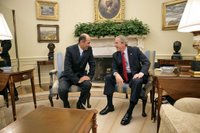
President George W. Bush meets with Prime Minister Janez Jansa of Slovenia in the Oval Office Monday, July 10, 2006. President George W. Bush meets with Prime Minister Janez Jansa of Slovenia in the Oval Office Monday, July 10, 2006. "I really appreciate the fact that you have made the courageous decision to help two young democracies,
Afghanistan and Iraq, succeed. Your contributions in Afghanistan and Iraq will make a difference in achieving peace. And so thank you for that very much," said the President in his remarks to the press." White House photo by Eric Draper.

PRESIDENT BUSH: Mr. Prime Minister, thank you for coming. It's been a really fascinating discussion we've had. First, I want to thank you for your friendship. I thank you for your leadership. I really appreciate the fact that you have made the courageous decision to help two young democracies, Afghanistan and Iraq, succeed. Your contributions in Afghanistan and Iraq will make a difference in achieving peace. And so thank you for that very much.

I really appreciate your briefing on your neighborhood. The Prime Minister is a man who has got a clear vision, he understands how to explain problems in a way that will help yield results. And so the fact that you talked about the Balkans in such clear fashion will help us work with you to achieve certain objectives. I want to thank you for that.

I fondly remember my visit to your beautiful country. It was a spectacular visit. I came back to the States and I told people that if you really want to see an interesting slice of heaven, go to Slovenia. It's got a country that's got a lot to it. But the most important thing, it's got wonderful people. And I look forward to working with you, Mr. Prime Minister. I'm confident that by working together we can improve the lives of our respective peoples, as well as improve the lives of those who are struggling against forms of government that won't allow them to have free expression, won't allow them to self govern.

And so welcome to the White House, and thank you for your wonderful meeting.

PRIME MINISTER JANŠA: (As translated.) Mr. President, thank you very much for inviting me and my delegation to the White House. We still remember your visit in Slovenia, and we hope to continue with good cooperation in the future.

I found very useful your information regarding the development of events in the region of Western Balkans. I'm glad we share the same views regarding the prospectus of -- in Western Balkans regarding the security and also the NATO. In spite of the fact that Slovenia is a small country, it completed its allotment of troops in the NATO operations.

Based on the fact that we got a lot of help in our entering the NATO, and European Union, we got a lot of help. We feel that now it's our obligation that we help others to do the same. As I mentioned before, Slovenia will be presiding the European Union in 2008, during which time there will be a summit between the European Union countries and the United States. We would be very happy if we would come welcome you then to Slovenia.

PRESIDENT BUSH: Thanks for coming. Appreciate it, very much. Thank you.

END 10:54 A.M. EDT, For Immediate Release, Office of the Press Secretary, July 10, 2006

RELATED: Keyword, BALKANS Tuesday, May 09, 2006 Vice President's Remarks with Prime Minister Ivo Sanader of Croatia, Tuesday, May 09, 2006 Vice President's Remarks with President Nursultan Nazarbayev of Kazakhstan, Tuesday, May 09, 2006 Vice President's Remarks with Ukrainian President Viktor, Yushchenko, Tuesday, May 09, 2006 Vice President Cheney and Lithuanian President Valdus Adamkus,

RELATED: Keyword, Hungary, Wednesday, June 14, 2006 President Bush to Visit Budapest, Hungary, Thursday, March 16, 2006 President Attends Celebration of Hungarian Contributions to Democracy, Friday, October 07, 2005 President Meets with Prime Minister Gyurcsány of Hungary (VIDEO), Saturday, September 24, 2005 President Presents Medal of Honor to Corporal Tibor "Ted" Rubin (VIDEO, Sunday, July 17, 2005 President to Welcome Hungarian Prime Minister

RELATED: Keyword, BELARUS, Thursday, August 25, 2005 Belarus Incident with U.S. Diplomat, Thursday, August 04, 2005 Belarus: Actions Taken Against Union of Belarusian Poles, Friday, June 03, 2005 Belarusian: Mikhail Marinich, Valeriy Levonevsky, Aleksandr Vasilyev, Sergey Skrebets, and Andrey Klimov, Thursday, May 19, 2005 Belarus Expulsion of Polish Diplomat, Thursday, December 30, 2004 Boucher Belarus Mikhail Marinich,

Monday, July 10, 2006

Commission for Assistance to a Free Cuba

Technorati Tags: and or and or and or and

President's Statement on Second Report of the Commission for Assistance to a Free Cuba. Fact Sheet: Commission for Assistance to a Free Cuba Report to the President

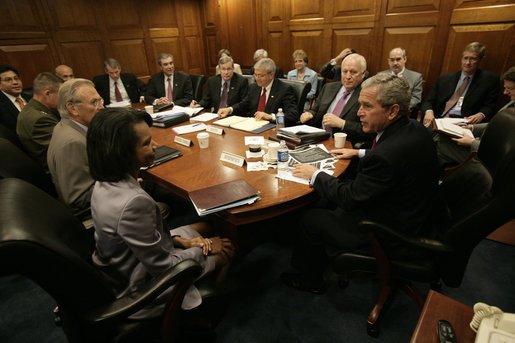
President George W. Bush meets with the National Security Council Wednesday, July 5, 2006, in the Situation Room at the White House to discuss the second report of the Commission for Assistance to a Free Cuba. White House photo by Eric Draper.President George W. Bush meets with the National Security Council Wednesday, July 5, 2006, in the Situation Room at the White House to discuss the second report of the Commission for Assistance to a Free Cuba.
White House photo by Eric Draper.

Today I approved the second report of the Commission for Assistance to a Free Cuba. I also approved a Compact with the People of Cuba, which outlines how the United States will support the Cuban people as they transition from the repressive control of the Castro regime to freedom and a genuine democracy.

The report demonstrates that we are actively working for change in Cuba, not simply waiting for change. I call on all our democratic friends and allies around the world to join us in supporting freedom for the Cuban people. I applaud the work of the Commission, co-chaired by Secretary Rice and Secretary Gutierrez.

# # # For Immediate Release, Office of the Press Secretary, July 10, 2006

RELATED: Keywords radio address, podcast, Saturday, July 01, 2006 Presidential Podcast 07/01/06, Saturday, June 24, 2006 Presidential Podcast 06/24/06, Saturday, June 17, 2006 Presidential Podcast 06/17/06, Saturday, June 10, 2006 Presidential Podcast 06/10/06, Saturday, June 03, 2006 Presidential Podcast 06/03/06, Saturday, May 27, 2006 Presidential Podcast 05/27/06, Saturday, May 20, 2006, Presidential Podcast 05/20/06, Saturday, May 13, 2006 Presidential Podcast 05/13/06, Saturday, April 22, 2006 Presidential Podcast 04/22/06, Saturday, April 15, 2006 Presidential Podcast 04/15/06, Saturday, April 08, 2006 Presidential Podcast 04/08/06, Saturday, Saturday, April 01, 2006 Presidential Podcast 04/01/06, March 18, 2006 Presidential Podcast 03/18/06, Saturday, March 11, 2006 bush radio address 03/11/06 full audio, text transcript, Saturday, March 04, 2006 bush radio address 03/04/06 full audio, text transcript, Saturday, February 25, 2006 bush radio address 02/25/06 full audio, text transcript, Saturday, February 18, 2006 bush radio address 02/18/06 full audio, text transcript, Saturday

Swearing-In Ceremony Henry Paulson (VIDEO)

Technorati Tags: or or and or and or and or and or and

President Bush Participates in Swearing-In Ceremony for Secretary of the Treasury, Henry Paulson, Department of the Treasury, FULL STREAMING VIDEO, Washington, D.C. 11:15 A.M. EDT

President George W. Bush shakes the hand of Henry Paulson after nominating him Tuesday, May 30, 2006, as Treasury Secretary to replace Secretary John Snow, right, who announced his resignation. White House photo by Shealah Craighead.President George W. Bush shakes the hand of Henry Paulson after nominating him Tuesday, May 30, 2006, as Treasury Secretary to replace Secretary John Snow, right, who announced his resignation.
White House photo by Shealah Craighead.

THE PRESIDENT: Thank you all. Please be seated. Thanks for coming. Good morning. Thank you for being here. I'm pleased to be here at the Department of the Treasury to stand in one of its most historic rooms. A hundred years ago, the vaults of the Cash Room were stacked from floor to ceiling with bank notes and coins and bullion -- right here in this room. Today there is no longer any cash in this room; there's a lot of talent in this room. But this historic space reminds us of our responsibility to treat the people's money with respect. And in a few moments, Chief Justice John Roberts will swear in a man that every American can have faith in -- Hank Paulson. (Applause.)

Hank comes to his position with a lifetime of experience in business and finance. He has an intimate knowledge of global markets. He will work to keep this economy of ours competitive and growing, and he will work to ensure fair treatment for America's goods and services across the world.

We welcome his family here -- his wife, Wendy, and his mom, Marianna; his son Merritt, and daughter Amanda; and the other members of the Paulson family who have joined us. Thanks for coming. We join them in congratulating Hank as he is sworn in as America's 74th Secretary of the Treasury.

I appreciate the Chief Justice joining us today. I appreciate the members of my Cabinet who are here to welcome your new colleague. I want to thank Deputy Secretary Bob Kimmitt, and all the folks who work here at the Department of Treasury. You're getting a good boss. You're getting somebody you can work with and respect.

I appreciate the Chairman of the U.S. Federal Reserve -- Chairman Bernanke is with us. Thanks for coming, Ben. Mind if I still call you, Ben? (Laughter.) I appreciate the House Majority Leader, John Boehner, joining us. Thanks for coming, John. I appreciate the ranking member of the House Budget Committee, Congressman John Spratt. Thanks for coming, John. I appreciate you all joining us here today. I want to thank my friend, Don Evans, former Secretary of the Commerce, joining us. Welcome.

The Treasury Department is one of the oldest in the federal government, and every person who leads this department walks in the footsteps of our first Treasury Secretary, Alexander Hamilton. In more -- in the more than two centuries since he led this department, his role has expanded and his responsibilities have increased. Today, the Treasury Secretary is responsible for policies effecting global financial markets, international trade and investment, taxes and spending, and other issues of vital importance to America's ability to compete in a worldwide economy. The Treasury Secretary also oversees the minting of the U.S. currency, the management of public finances, and the enforcement of important laws, including our efforts to crack down on terrorist financing.

As Treasury Secretary, Hank Paulson will be my leading policy advisor on a broad range of domestic and international economic issues, and he will be the principal spokesman for my administration's economic policies. He is supremely qualified to take on these important responsibilities. He has served as chairman and chief executive officer of one of the world's leading financial firms, the Goldman Sachs Group. His decades of experience have given him a keen insight into the workings of our global economy. As he showed in his Senate confirmation hearings, he has the ability to explain complex economic issues in clear terms. People understand him when he talks. His nomination received strong bipartisan support. He was confirmed unanimously by the United States Senate.

Hank is being sworn in in an optimistic time for our country and for our workers. In the first quarter of 2006, our economy grew at an annual rate of 5.6 percent. That's the fastest growth in two-and-a-half years. We've added more than 5.4 million new jobs since August of 2003. The national unemployment rate is down to 4.6 percent. Consumers and businesses are confident in the future. Productivity is high. That's leading to higher wages and a higher standard of living for our people. And I look forward to working with Hank Paulson to keep this economy growing, and to keep creating jobs and enhance opportunity for our people.

We have a broad agenda to pursue. Our first challenge is to keep taxes low. Hank shares my philosophy that the economy prospers when we trust the American people to save, spend and invest their money as they see fit. Hank understands that cutting taxes have helped launch the strong economic expansion that is lifting the lives of millions of Americans. And he will work with the United States Congress to maintain a pro-growth, low-tax environment so we can keep our expansion growing.

Our second challenge is to bring federal spending under control. We'll continue to cut wasteful and unnecessary spending in the annual budget. Hank Paulson understands we also need to rein in the growth of spending for entitlement programs, like Social Security and Medicare and Medicaid. We have a problem with these programs. They're growing fast -- they're growing at a rate faster than inflation, faster than the economy, and faster than we can afford. If Congress does not act, these vital programs will be jeopardized and unfairly burden future generations. And so we'll continue to call on the Congress to work with us to preserve important programs like Social Security and Medicare and Medicaid for our children and our grandchildren.

The third challenge is to expand opportunities for American workers and businesses to compete in a global economy. Hank understands that the fastest growing markets for American goods and services are overseas, and that so long as the playing field is level, American workers and businesses can compete with anybody. So we will work to open up new markets to American products, and to ensure that our trading partners play by the rules and respect intellectual property rights, and maintain market-based exchange rates for their currencies.

Our fourth challenge is to prevent the federal government from burdening our economy with excessive regulations that will drive jobs and capital overseas. As one of the nation's most accomplished investment bankers, Hank understands how important it is to maintain our openness to foreign investment, and to keep America an attractive place to do business. So he's going to be a watchdog to prevent creeping over-regulation that burdens our economy and costs America jobs.

Our fifth challenge is to keep America competitive by fostering a spirit that rewards innovation and risk-taking and enterprise. America is the most innovative nation in the world because our free enterprise system unleashes the talent and creativity of our people. Hank will be a champion for our country's small businesses and entrepreneurs. And he's going to work to ensure that the American Dream is within reach of every one of our citizens.

As he pursues this agenda, Hank will build on the firm foundation laid by Secretary John Snow. John is a good fellow, he's a good man and a fine public servant. And he assumed leadership of this department at a difficult time for our economy. During his tenure, John oversaw a strong economic resurgence that created millions of jobs for our families and made America's economy the fastest growing in the industrialized world.

John has also been an important leader in the war on terror. He directed the Treasury Department's efforts to crack down on terrorist financing, including a vital program to track terrorists' use of the international banking system. John Snow has helped make America safer and more prosperous, and I'm grateful for his distinguished service.

I'm also grateful that Hank Paulson has agreed to succeed John. He grew up on an Illinois farm. He rose to one of the highest positions on Wall Street, and now he's about to be sworn in as the Treasury Secretary of the United States of America. He's shown his talent and initiative as a leader in the private sector, and today he's showing his character and patriotism by leaving his career to serve our country. I'm grateful that Hank has answered the call to service.

The men and women of this department will have an outstanding leader in Hank Paulson. I look forward to working with -- welcome him to our Cabinet. I'm looking forward to working with him for the good of our country. And now I ask Chief Justice John Roberts to administer the oath. (Applause.)

(Secretary Paulson takes the oath of office.) (Applause.)

SECRETARY PAULSON: Mr. President, thank you for those very kind remarks, and for giving me an opportunity to serve as America's 74th Treasury Secretary. I appreciate the trust you have placed in me to lead the Treasury Department at a time when we must ensure that our economy remains strong, our markets remain competitive, and our workers have the opportunity to realize their full economic potential.

To my family -- and especially Wendy, my wife and best friend of 37 years -- thank you very much for your support as I return to public service after 32 years in the private sector.

Wendy and I are also very pleased to have on stage with us today my mother, Marianna, our son, Merritt, and our daughter, Amanda. Also here are a number of very close friends and family members, including my brother, Dick, and my sister, Kate, and we all -- all of us in our family fondly remember our late father, Merritt, who was an amateur historian and a real Alexander Hamilton fan.

Thank you also very much, Chief Justice Roberts, for administering the oath of office. And thank you to all of my Cabinet colleagues, my friends and colleagues from Goldman Sachs, members of Congress, and other distinguished guests, thank you very much for attending this ceremony today.

Now, as I begin my first day at the Treasury Department, I remember those who have preceded me in this post. Throughout our nation's history, my predecessors here have helped to build an economy and a financial system that are the envy of the modern world. Mr. President, I assure you I'm a hundred percent committed to building on these past achievements and to doing my very best to ensure that our economy remains the model of strength, flexibility and openness.

I look forward to working with you in collaboration with your other economic advisors, my Cabinet colleagues, members of both parties of Congress, and the great professionals at Treasury. One of my very first priorities will be forging a close working relationship with Treasury's career professionals.

Under your leadership, Mr. President, our economy has achieved steady growth and has created millions of jobs. This growth has been achieved despite the stiff challenges of terrorist attacks, an economic downturn, corporate scandals, and devastating natural disasters. And as you've pointed out, there are still a number of challenges ahead of us and very important goals to be met.

The American economic system and our workers have always been winners, and they will continue to win. Our job is to help them do just that. We need to pursue economic and regulatory policies that are responsive to today's world and to the challenges and goals you have set forward. And, of course, as we pursue these goals, we must always remember that the strength of the U.S. economy is linked to the strength of the global economy. It is very critical for the United States to remain actively engaged with our economic partners, and it's in our interest to advance those policies that will help to build a more prosperous world. Doing so contributes to our economic progress, as well as our national security.

If we retreat from the global stage, the void is likely to be filled by those who do not share our commitment to economic reform. Instead, we must work to expand trade and investment, work to reform and modernize international financial markets, and be vigilant in identifying and managing potential financial vulnerability.

Mr. President, thank you again for the nomination, and thank you very much for coming here today. And now I'm looking forward to getting to work. Thank you. (Applause.)

END 11:31 A.M. EDT For Immediate Release, Office of the Press Secretary, July 10, 2006

RELATED: Keywords, Department of the Treasury, Wednesday, June 28, 2006 President Discusses Line-Item Veto (VIDEO), Friday, June 23, 2006 Terrorist Finance Tracking Program (VIDEO), Tuesday, May 30, 2006 President Nominates Henry Paulson for Treasury (VIDEO), Thursday, May 18, 2006 President Signs Tax Relief Extension Reconciliation Act of 2005, Thursday, March 09, 2006 President Signs USA PATRIOT Act (VIDEO), Thursday, March 17, 2005 President's Statement on World Bank and Paul Wolfowitz, Sunday, March 13, 2005 Treasury Department Launches Social Security Web Site,
Presidential Podcast 07/08/06

Technorati Tags: and or and or and or and or and or

Presidential Podcast 07/08/06 en Español

Click here to Subscribe to Our Republican National Convention Blog Podcast Channel with Odeo Subscribe to Our Odeo or Click here to Subscribe to Our Republican National Convention Blog Podcast Channel with Podnova podnova Podcast Channel and receive the weekly Presidential Radio Address in English and Spanish with select State Department Briefings. Featuring real audio and full text transcripts, More content Sources added often so stay tuned.

RELATED: Keywords radio address, podcast, Saturday, July 01, 2006 Presidential Podcast 07/01/06, Saturday, June 24, 2006 Presidential Podcast 06/24/06, Saturday, June 17, 2006 Presidential Podcast 06/17/06, Saturday, June 10, 2006 Presidential Podcast 06/10/06, Saturday, June 03, 2006 Presidential Podcast 06/03/06, Saturday, May 27, 2006 Presidential Podcast 05/27/06, Saturday, May 20, 2006, Presidential Podcast 05/20/06, Saturday, May 13, 2006 Presidential Podcast 05/13/06, Saturday, April 22, 2006 Presidential Podcast 04/22/06, Saturday, April 15, 2006 Presidential Podcast 04/15/06, Saturday, April 08, 2006 Presidential Podcast 04/08/06, Saturday, Saturday, April 01, 2006 Presidential Podcast 04/01/06, March 18, 2006 Presidential Podcast 03/18/06, Saturday, March 11, 2006 bush radio address 03/11/06 full audio, text transcript, Saturday, March 04, 2006 bush radio address 03/04/06 full audio, text transcript, Saturday, February 25, 2006 bush radio address 02/25/06 full audio, text transcript, Saturday, February 18, 2006 bush radio address 02/18/06 full audio, text transcript, Saturday, February 04, 2006 bush radio address 02/04/06 full audio, text transcript,

Discurso Radial del Presidente a la Nación 07/08/06

Etiquetas De Technorati: , y , o y , o , o y o y

Presidente George W. Bush llama a tropas de su rancho en Crawford, Tejas, día de Thanksgiving, jueves, de noviembre el 24 de 2005.  Foto blanca de la casa de Eric Draper.forre el audio de la dirección de radio 07/08/06 por completo, transcripción del texto. PODCAST

Discurso Radial del Presidente. en Español
Chascar aquí para suscribir a nuestro canal republicano de Blog Podcast de la convención nacional con Odeo Suscribir a nuestro canal de Podcast de Odeo o del podnova Chascar aquí para suscribir a nuestro canal republicano de Blog Podcast de la convención nacional con Podnova y recibir la dirección de radio presidencial semanal en inglés y español con informes selectos del departamento del estado. Ofreciendo transcripciones audio y con texto completo verdaderas, más fuentes contentas agregaron a menudo así que la estancia templó.

EL PRESIDENTE: Buenos Días. Esta semana visité la ciudad de Chicago. En esa gran ciudad y en todo Estados Unidos, nuestra economía fuerte y creciente está creando empleos y trayendo prosperidad a un mayor número de nuestros ciudadanos.

En el área de Chicago, los negocios han añadido más de 74,000 empleos nuevos en los últimos dos años - y en Illinois, la tasa de desempleo ha caído al 4.6 por ciento, la tasa más baja allí en más de cinco años y medio. También tenemos buenas noticias sobre nuestra economía nacional. El viernes supimos que la economía estadounidense creó 121,000 nuevos empleos en Junio - y ha creado más de 5.4 millones de empleos desde Agosto del 2003. Ahora hemos añadido empleos durante 34 meses consecutivos - y la tasa de desempleo está en 4.6 por ciento. En el primer trimestre del 2006, nuestra economía creció a una tasa anual impresionante del 5.6 por ciento. Esto sigue a nuestro crecimiento económico del 3.5 por ciento en 2005 - la tasa de mayor crecimiento de cualquier país industrializado importante. Y como nuestros impuestos están bajos, nuestros trabajadores se están quedando con una mayor porción de lo que ganan.

Detrás de cada una de estas estadísticas positivas hay un sin fin de historias - historias de trabajadores que comienzan cada día con esperanza puesto que tienen un empleo que les ayudará a forjar una mejor vida, historias de familias con más dinero en el banco para pagar matrículas universitarias o el pago inicial para la compra de una casa, historias de dueños de pequeños negocios que saben que pueden contratar a más trabajadores y crecer con confianza. Nuestra expansión económica está enalteciendo las vidas de millones de estadounidenses - y para que esta expansión continúe debemos mantener las políticas pro-crecimiento y de bajos impuestos que ayudaron a lanzarla en primer lugar. El alivio tributario que entregamos ha servido para dar rienda suelta al espíritu empresarial de Estados Unidos y mantener nuestra economía como la envidia del mundo - por lo cual seguiré trabajando con el Congreso para hacer permanente ese alivio tributario.

Nuestra economía también está prosperando porque Estados Unidos sigue siendo la nación más innovadora del mundo. Durante mi viaje a Illinois visité una compañía llamada Cabot Microelectronics, que fabrica productos para la manufactura de "chips" semiconductores y otros componentes de alta tecnología. Empresas de vanguardia como Cabot están creando buenos empleos para nuestros trabajadores y ayudando a mantener a Estados Unidos competitivo en la economía global. A fin de ayudar a compañías como Cabot a mantener la ventaja competitiva de nuestro país, he propuesto mi Iniciativa de Competitividad Estadounidense. Esta iniciativa ofrecerá el doble de financiamiento federal para investigación en áreas prometedoras tales como nanotecnología, supercomputación y fuentes alternativas de energía. La iniciativa también promoverá una inversión más audaz por el sector privado en tecnología, y ayudará a asegurar que cada niño estadounidense tenga las habilidades en matemáticas y ciencia que sean necesarias para los empleos del mañana. El mes pasado, la Cámara de Representantes aprobó el financiamiento pleno para el componente de investigación básica de esta iniciativa. Le pido al Senado que haga igual que la Cámara de Representantes, a fin de que Estados Unidos pueda permanecer una nación innovadora que compite con confianza.

Los estadounidenses están viviendo momentos de gran esperanza - y de gran oportunidad. Si mantenemos bajos nuestros impuestos, si mantenemos competitivo a nuestro país y si mantenemos a esta Nación acogedora, contribuiremos a nuestra prosperidad - y crearemos un mejor Estados Unidos para generaciones futuras.

Gracias por escuchar. ###

Para su publicación inmediata, Oficina del Secretario de Prensa, 8 de julio de 2006

Relacionado: Dirección de radio de las palabras claves, podcast, Sábado 1 de julio de 2006 Discurso Radial del Presidente a la Nación 07/01/06, Sábado 24 de junio de 2006 Discurso Radial del Presidente a la Nación 06/24/06, Sábado 17 de junio de 2006 Discurso Radial del Presidente a la Nación 06/17/06, Sábado 10 de junio de 2006 Discurso Radial del Presidente a la Nación 06/10/06, Lunes 5 de junio de 2006 Discurso Radial del Presidente a la Nación 06/03/06, Miércoles 31 de mayo de 2006 Discurso Radial del Presidente a la Nación 05/27/06, Sábado 20 de mayo de 2006 Discurso Radial del Presidente a la Nación 05/20/06, Sábado 13 de mayo de 2006 Discurso Radial del Presidente a la Nación 05/13/06, Sábado 6 de mayo de 2006 Discurso Radial del Presidente a la Nación 05/06/06 , Sábado 29 de abril de 2006 Discurso Radial del Presidente a la Nación 04/29/06, Sábado, De Abril El 22 De 2006 Discurso Radial del Presidente a la Nación 04/22/06, Sábado, De Abril El 15 De 2006 Discurso Radial del Presidente a la Nación 04/15/06, Sábado, De Abril El 08 De 2006 Discurso Radial del Presidente a la Nación 04/08/06, Monday, April 03, 2006 Rice urge progreso en cuanto a gobierno en Iraq, Saturday, April 01, 2006 Discurso Radial del Presidente a la Nación 04/01/06, Lunes, De Marcha La 27 De 2006 Declaraciones Del Presidente Después De Reunión Sobre La Reforma Inmigratoria, sábado, de marcha la 25 de 2006 Discurso Radial del Presidente a la Nación 03/18/06,

Sunday, July 09, 2006

Supernova leaves behind mysterious object

Technorati Tags: or and or and or and or and or and or and or

2000-year-old star explosion, Credits: ESA/XMM-Newton/A.De Luca (INAF-IASF )This image, obtained thanks to ESA's XMM-Newton X-ray telescope on 23 August 2005, shows the aftermath of a 2000-year-old star explosion. In the heart of the central blue dot in this image, smaller than a pinpoint, likely lies a neutron star only about 20 kilometers across.
The nature of this object is like nothing detected before. Scientists from the Istituto Nazionale di Astrofisica (INAF) in Milan have detected unusual X-ray pulsations. Understanding the central source's true nature will lead to new insights about supernovae, neutron stars and their evolution.

Credits: ESA/XMM-Newton/A.De Luca (INAF-IASF ), Download HI-RES JPG Size: 2.227 kb

Thanks to data from ESA’s XMM-Newton satellite, a team of scientists taking a closer look at an object discovered over 25 years ago have found that it is like none other known in our galaxy.

The object is in the heart of supernova remnant RCW103, the gaseous remains of a star that exploded about 2 000 years ago. Taken at face value, RCW103 and its central source would appear to be a textbook example of what is left behind after a supernova explosion: a bubble of ejected material and a neutron star.
A deep, continuous 24.5-hour observation has revealed something far more complex and intriguing, however. The team, from the Istituto di Astrofisica Spaziale e Fisica Cosmica (IASF) of the Istituto Nazionale di Astrofisica (INAF) in Milan, Italy, has found that the emission from the central source varies with a cycle that repeats itself every 6.7 hours. This is an astonishingly long period, tens of thousands of times longer than expected for a young neutron star. Also, the object's spectral and temporal properties differ from an earlier XMM-Newton observation of this very source in 2001.

"The behaviour we see is especially puzzling in view of its young age, less than 2 000 years," said Andrea De Luca of IASF-INAF, the lead author. "It is reminiscent of a multimillion-year-old source. For years we have had a sense that the object is different, but we never knew how different until now."


The object is called 1E161348-5055, which the scientists have conveniently nicknamed 1E (where E stands for Einstein Observatory which discovered the source). It is embedded nearly perfectly in the centre of RCW 103, about 10 000 light years away in the constellation Norma. The near-perfect alignment of 1E in the centre of RCW 103 leaves astronomers rather confident that the two were born in the same catastrophic event.

When a star at least eight times more massive than our sun runs out of fuel to burn, it explodes in an event called a supernova. The stellar core implodes, forming a dense nugget called a neutron star or, if there's enough mass, a black hole. A neutron star contains about a sun's worth of mass crammed into a sphere only about 20 kilometres across.

Scientists have searched for years for 1E's periodicity in order to learn more about its properties, such as how fast it is spinning or whether it has a companion.

"Our clear detection of such a long period together with secular variability in X-ray emission makes for a very weird source," said Patrizia Caraveo of INAF, a co-author and leader of the Milano Group. "Such properties in a 2000-year-old compact object leave us with two probable scenarios, essentially a source that is accretion-powered or magnetic-field-powered."

1E could be an isolated magnetar, an exotic subclass of highly magnetized neutron stars. Here, the magnetic field lines act as brakes for the spinning star, liberating energy. About a dozen magnetars are known. But magnetars usually spin several times per minute. If 1E is spinning only once every 6.67 hours, as the period detection indicates, the magnetic field needed to slow the neutron star in just 2000 years would be too big to be plausible.

A standard magnetar magnetic field could do the trick, however, if a debris disk, formed by leftover material of the exploded star, is also helping to slow down the neutron star spin. This scenario has never been observed before and would point to a new type of neutron star evolution.

Alternatively, the long 6.67-hour period could be the orbital period of a binary system. Such a picture requires that a low-mass normal star managed to remain bound to the compact object generated by the supernova explosion 2000 year ago. Observations do allow for a companion of half the mass of our Sun, or even smaller.

But 1E would be an unprecedented example of a low-mass X-ray binary system in its infancy, a million times younger than standard X-ray binary systems with light companions. Young age is not the only peculiarity of 1E. The source's cyclic pattern is far more pronounced than that observed for dozens of low-mass X-ray binary systems calling for some unusual neutron star feeding process.

A double accretion process could explain its behaviour: The compact object captures a fraction of the dwarf star's wind (wind accretion), but it is also able to pull out gas from the outer layers of its companion, which settles in an accretion disc (disc accretion). Such an unusual mechanism could be at work in an early phase of the life of a low-mass X-ray binary, dominated by the effects of the initial, expected, orbital eccentricity.

"RCW 103 is an enigma," said Giovanni Bignami, director of CESR,Toulouse, and co-author. "We simply don't have a conclusive answer to what is causing the long X-ray cycles. When we do figure this out, we're going to learn a lot more about supernovae, neutron stars and their evolution."

Had the star exploded in the northern sky, Cleopatra could have seen it and considered it to be an omen of her unhappy end, Caraveo said. Instead the explosion took place deep in the southern sky, and no one recorded it. Nevertheless, the source is a good omen for X-ray astronomers hoping to learn about stellar evolution.

Note to editors

The findings appear on the 6 July 2006 issue of Science Express. The article, titled "A long-period, violently-variable X-ray source in a young SNR", is by A. De Luca, P.A. Caraveo, S. Mereghetti and A. Tiengo (INAF-IASF Milano, Italy), and G.F. Bignami (CESR, CNRS-UPS, Toulouse, France, and Università degli Studi di Pavia, Italy).

The authors work builds upon observations by Gordon Garmire of Pennsylvania State University and Eric Gotthelf of Columbia University who have studied the source with Einstein, ROSAT, ASCA and Chandra and already found hints of a long period.

For more information: ESA - Space Science - Home

Patrizia Caraveo, INAF-IASF Milano, Italy, Email: pat@iasf-milano.inaf.it

Andrea De Luca, INAF-IASF Milano, Italy, Email: deluca@iasf-milano.inaf.it

Norbert Schartel, ESA XMM-Newton Project Scientist, Email: norbert.schartel@sciops.esa.int

RELATED: Keyword, Supernova, Sunday, June 11, 2006 Massive-star supernovae found to be major space dust factories, Sunday, April 23, 2006 DEADLY ASTRONOMICAL EVENT NOT LIKELY TO HAPPEN IN OUR GALAXY,

People more likely to help others they think are 'like them'

Technorati Tags: or and or and or and or and or ,

Personality and Social Psychology Bulletin LogoPeople more likely to help others they think are 'like them'
Study results reported in Personality and Social Psychology Bulletin.

Feelings of empathy lead to actions of helping – but only between members of the same group – according to a recent study in the July issue of Personality and Social Psychology Bulletin, an official publication of the Society for Personality and Social Psychology, published by SAGE Publications.

The research, led by Stefan Stürmer of the University of Kiel, is presented in the article "Empathy-Motivated Helping: The Moderating Role of Group Membership." The article discusses two different studies, one using a real-world, intercultural scenario and the other using a mixture of people with no obvious differences besides gender. Researchers concluded that, while all the people felt empathy for someone in distress, they only tended to assist if the needy person was viewed as a member of their own "in-group."

The first study, using a real-world intercultural scenario, split German and Muslim male participants into culturally-defined groups. When everyone learned that another participant was having difficulty finding housing, they all felt empathy for the other regardless of what group they were in. However, when asked about their intentions to help the participant, empathy had a stronger impact when the other was categorized as a member of their in-group.

To further substantiate the findings from the first study, the second study created "minimal" in-groups and out-groups using a mixture of male and female participants without obvious cultural differences. As in the first study, when participants learned that another participant needed financial help due to the loss of money and a credit card, they all felt empathy, but actual assistance was provided only when the distressed person was a member of their in-group. ###

Research grants for these studies were provided by the National Institute of Mental Health and Deutsche Forschungsgemeinschaft. Go to: pspb.sagepub.com/cgi/reprint/ to access the article in the July issue of Personality and Social Psychology Bulletin at no charge for a limited time. To contact the researchers, email Stefan Stürmer at: stuermer@psychologie.uni-kiel.de.

About Personality and Social Psychology BulletinFor over 30 years, the official monthly journal of the Society for Personality and Social Psychology (SPSP), Personality and Social Psychology Bulletin (PSPB) has provided an international forum for the rapid dissemination of original empirical papers in all areas of personality and social psychology. SPSP counts more than 4,500 researchers, educators, and students in its membership worldwide. To contact the Executive Officer of SPSP, please phone David Dunning at (607) 255-6391, or email at spsp@cornell.edu. online pspb.sagepub.com and spsp.org

About SAGESAGE Publications is a leading international publisher of journals, books, and electronic media for academic, educational, and professional markets. Since 1965, SAGE has helped inform and educate a global community of scholars, practitioners, researchers, and students spanning a wide range of subject areas including business, humanities, social sciences, and science, technology and medicine. SAGE Publications, a privately owned corporation, has principal offices in Thousand Oaks, California, London, United Kingdom, and New Delhi, India. sagepublications.com

Contact: Judy Erickson media.inquiries@sagepub.com online SAGE Publications

RELATED: Keyword biology, Sunday, July 09, 2006 Jefferson Team Designs Program that Helps Elderly Live Longer, Sunday, July 02, 2006 Gabapentin cools hot flashes as well as estrogen, Sunday, June 25, 2006 Estrogen plays different role during stress in black and white teens, Sunday, June 25, 2006 Our grip on reality is slim, Sunday, May 21, 2006 Genome doesn't start with 'G', Sunday, May 07, 2006 Lying Is Exposed By Micro-Expressions We Can't Control, Sunday, April 30, 2006 Mothers often have inaccurate perceptions of their children's body weight, Sunday, April 16, 2006 Other people influence us and we don't even know it!, Tuesday, January 04, 2005 The Cassini-Huygens mission to Saturn, Sunday, March 20, 2005 Agriculture Secretary Mike Johanns, bovine spongiform encephalopathy (BSE), Thursday, March 24, 2005 Fish Oil Holds Promise in Alzheimer's Fight, Sunday, April 10, 2005 National Human Genome Research Institute (NHGRI), Friday, April 15, 2005 Study uncovers bacteria's worst enemy , Sunday, May 01, 2005 Yes, it is an exoplanet 2M1207 system, Friday, May 20, 2005 a polysaccharide called hyaluronan, Tuesday, May 24, 2005 pseudoneglect phenomenon, Friday, June 03, 2005 DOE JGI sequences DNA from extinct cave bear, Monday, June 06, 2005 From a Few Wild Ancestors, a Citrus Cornucopia, Tuesday, June 07, 2005 NHGRI Selects 13 More Organisms for Genome Sequencing, Sunday, July 24, 2005 Prehistoric Native Americans maize cultivation ,

Jefferson Team Designs Program that Helps Elderly Live Longer

Technorati Tags: or and or and or and or and or and or and

Thomas Jefferson University Hospital Logo
Jefferson Team Designs Program that Helps Elderly Perform Daily Living Tasks and Live Longer

A Thomas Jefferson University team has found that a personalized program of occupational and physical therapy – plus modifications in the home – can go a long way to help elderly individuals continue to live independently and also live longer.

Laura Gitlin, Ph.D., director of the Center for Applied Research on Aging and Health at Thomas Jefferson University in Philadelphia and her team reported previously that a brief six-visit program consisting of physical therapy, occupational therapy, home modification and some instruction in problem-solving helped elderly individuals in performing daily activities. After six months, those of the 319 men and women ages 70 and older enrolled in the study who received the intervention had fewer difficulties with daily living tasks, especially personal care activities such as bathing and going to the toilet, than those who did not receive the help. Intervention participants were less afraid of falling, had more confidence in their abilities to manage everyday activities and used more effective coping strategies.

In a 14-month followup study, Dr. Gitlin, who is professor of occupational therapy at the College of Health Professions of Thomas Jefferson University, and her co-workers report in the current issue of the Journal of the American Geriatric Society that the efforts had an even larger benefit. They found that 1 percent of those receiving the intervention had died, compared to 10 percent in the control group. During the same 14-month period, of 31 participants who had been previously hospitalized and who received the intervention, none died. In contrast, in the control group, 21 percent who had been hospitalized died.

“These results appear to confirm that we are helping people address functional difficulties that in turn offsets further decline,” Dr. Gitlin says. “As people age, they often confront difficulties in carrying out everyday activities due to age-related changes and chronic diseases which can have significant functional consequences. Chronic conditions such as heart disease, stroke, arthritis and diabetes often result in older people having problems with daily tasks such as bathing, dressing and preparing meals.

“It may become harder to get out of a chair or get dressed,” says Dr. Gitlin. “When you begin to have functional difficulties, it is very much associated with fear of falling. This is a serious syndrome among the elderly, resulting in other negative consequences, including activity limitations, depression and isolation. People often begin to restrict activities, which has a spiral down effect. We were interested in affecting how people thought and solved their daily functional problems, helping build their confidence by introducing effective coping strategies, making homes safer and improving performance.”

The six-month intervention consisted of five “contacts” by an occupational therapist (four 90-minute visits and one phone call) and one physical therapy visit for 90 minutes.

For example, if a person was having difficulty preparing meals, Dr. Gitlin’s team developed strategies to improve this. “We focused on performance and how individuals thought about an activity,” she explains, “and helped people problem solve.”

“We can teach older people strategies that appear to have a survivorship benefit,” Dr. Gitlin says. “These findings are very important and suggest that occupational therapy and physical therapy should be integrated in the care of older people who have functional difficulties and chronic conditions.”

Thomas Jefferson University Hospital Phone: 215-955-6300 Published: 7-6-2006

Media Only Contact: Steven Benowitz

RELATED: Keyword biology, Sunday, July 02, 2006 Gabapentin cools hot flashes as well as estrogen, Sunday, June 25, 2006 Estrogen plays different role during stress in black and white teens, Sunday, June 25, 2006 Our grip on reality is slim, Sunday, May 21, 2006 Genome doesn't start with 'G', Sunday, May 07, 2006 Lying Is Exposed By Micro-Expressions We Can't Control, Sunday, April 30, 2006 Mothers often have inaccurate perceptions of their children's body weight, Sunday, April 16, 2006 Other people influence us and we don't even know it!, Tuesday, January 04, 2005 The Cassini-Huygens mission to Saturn, Sunday, March 20, 2005 Agriculture Secretary Mike Johanns, bovine spongiform encephalopathy (BSE), Thursday, March 24, 2005 Fish Oil Holds Promise in Alzheimer's Fight, Sunday, April 10, 2005 National Human Genome Research Institute (NHGRI), Friday, April 15, 2005 Study uncovers bacteria's worst enemy , Sunday, May 01, 2005 Yes, it is an exoplanet 2M1207 system, Friday, May 20, 2005 a polysaccharide called hyaluronan, Tuesday, May 24, 2005 pseudoneglect phenomenon, Friday, June 03, 2005 DOE JGI sequences DNA from extinct cave bear, Monday, June 06, 2005 From a Few Wild Ancestors, a Citrus Cornucopia, Tuesday, June 07, 2005 NHGRI Selects 13 More Organisms for Genome Sequencing, Sunday, July 24, 2005 Prehistoric Native Americans maize cultivation ,

Saturday, July 08, 2006

Freedom Calendar 07/08/06 - 07/15/06

July 8, 1970, In special message to Congress, President Richard Nixon calls for reversal of policy of forced termination of Native American rights and benefits.

July 9, 1955, Republican attorney E. Frederic Morrow becomes first African-American executive in White House; served as advisor to President Dwight Eisenhower.

July 10, 1805, Birth of U.S. Senator Jacob Howard (R-MI), co-author of the 14th Amendment; wrote first state Republican Party platform, condemning Democrats’ pro-slavery policies.

July 11, 1952, Republican Party platform condemns “duplicity and insincerity” of Democrats in racial matters.

July 12, 1974, Republican National Chairman George H. W. Bush establishes Republican National Hispanic Assembly.

July 13, 1868, Louisiana Republican Oscar Dunn, a former slave, becomes nation’s first African-American Lt. Governor.

July 14, 1884, Republicans criticize Democratic Party’s nomination of racist U.S. Senator Thomas Hendricks (D-IN) for vice president; he had voted against the 13th Amendment banning slavery.

July 15, 1980, NAACP President Benjamin Hooks addresses Republican National Convention; previously appointed by President Richard Nixon in 1972 as first African-American member of U.S. Civil Rights Commission

"And one thing I can tell, Mr. President, your freedom agenda does, indeed, work. I mean, you can see it in Georgia. We are seeing it in Iraq. And please stay there, please fight there until the end. We will stay with you there, whatever it takes, because your success in Iraq is success for countries like Georgia. It's a success for every individual that loves freedom, every individual that wants security, to live in more secure world for himself, herself or their children. And whatever it takes to help you,"

President of Georgia Mikheil Saakashvili, Wednesday, July 05, 2006

SOURCE: Republican Freedom Calendar

Technorati Tags: and or and or and or and or and or or and or

Related: Keywords Freedom Calendar, Saturday, July 01, 2006 Freedom Calendar 07/01/06 - 07/08/06, Saturday, June 24, 2006 Freedom Calendar 06/24/06 - 07/01/06, Saturday, June 17, 2006 Freedom Calendar 06/17/06 - 06/24/06, Saturday, June 10, 2006 Freedom Calendar 06/10/06 - 06/17/06, Sunday, June 04, 2006 Freedom Calendar 06/03/06 - 06/10/06, Saturday, May 27, 2006 Freedom Calendar 05/27/06 - 06/03/06, Saturday, May 20, 2006 Freedom Calendar 05/20/06 - 05/27/06, Saturday, May 13, 2006 Freedom Calendar 05/13/06 - 05/20/06, Saturday, May 06, 2006 Freedom Calendar 05/06/06 - 05/13/06, Saturday, April 29, 2006 Saturday, April 22, 2006 Freedom Calendar 04/22/06 - 04/29/06, Saturday, April 15, 2006 Freedom Calendar 04/15/06 - 04/22/06, Saturday, April 08, 2006 Freedom Calendar 04/08/06 - 04/15/06, Saturday, April 01, 2006 Freedom Calendar 04/01/06 - 04/08/06, Saturday, March 25, 2006 Freedom Calendar 03/25/06 - 04/01/06, Saturday, March 18, 2006 Freedom Calendar 03/18/06 - 03/25/06, Saturday, March 11, 2006 Freedom Calendar 03/11/06 - 03/18/06, Saturday, March 04, 2006 Freedom Calendar 03/04/06 - 03/11/06, Saturday, February 25, 2006 Freedom Calendar 02/18/06 - 03/04/06, Saturday, February 18, 2006 Freedom Calendar 02/18/06 - 02/25/06,

bush radio address 07/08/06 full audio, text transcript

Technorati Tags: and or and or and or and or and or

President George W. Bush calls troops from his ranch in Crawford, Texas, Thanksgiving Day, Thursday, Nov. 24, 2005. White House photo by Eric Draper.bush radio address 07/08/06 full audio, text transcript. PODCAST and In Focus: Jobs and Economy

President's Radio Address en Español
Click here to Subscribe to Our Republican National Convention Blog Podcast Channel with Odeo Subscribe to Our Odeo or Click here to Subscribe to Republican National Convention Blog's PODCAST with podnova podnova Podcast Channel and receive the weekly Presidential Radio Address in English and Spanish with select State Department Briefings. Featuring real audio and full text transcripts, More content Sources added often so stay tuned.

THE PRESIDENT: Good morning. This week I visited the city of Chicago. In that great city, and across America, our strong and growing economy is creating jobs and delivering prosperity to more of our people.

In the Chicago area, businesses have added more than 74,000 new jobs over the past two years. And in Illinois, the unemployment rate has fallen to 4.6 percent, the lowest rate there in over 5-and-a-half years.

We have good news about our national economy, as well. On Friday, we learned that the American economy created 121,000 new jobs in June, and it has created over 5.4 million jobs since August 2003. We now have added jobs for 34 straight months, and the unemployment rate is 4.6 percent.

In the first quarter of 2006, our economy grew at an impressive annual rate of 5.6 percent. This follows our economic growth of 3.5 percent in 2005, the fastest rate of any major industrialized nation. And because taxes are low, our workers are keeping more of the money they earn.

Behind each of these positive statistics are countless stories -- stories of workers who start each day with hope because they have a job that will help them build a better life; stories of families with more money in the bank for college tuition, or a down payment on a home; stories of small business owners who know they can hire more workers and grow with confidence.

Our economic expansion is lifting the lives of millions of Americans, and to keep this expansion going, we must maintain the pro-growth, low-tax policies that helped to launch it in the first place. The tax relief we delivered has helped unleash the entrepreneurial spirit of America and kept our economy the envy of the world. So I will continue to work with Congress to make that tax relief permanent.

Our economy is also thriving because America remains the world's most innovative nation. During my trip to Illinois, I visited a company called Cabot Microelectronics, which makes products for manufacturing semiconductor chips and other high-tech components. Cutting-edge firms like Cabot are creating good jobs for our workers and helping to keep America competitive in the global economy.

To help companies like Cabot maintain our nation's competitive edge, I proposed my American Competitiveness Initiative. This initiative will double federal funding for research in promising areas such as nanotechnology, supercomputing, and alternative energy sources. The initiative will also encourage bolder private sector investment in technology, and help ensure that every American child has the math and science skills needed for the jobs of tomorrow.

Last month, the House of Representatives approved full funding for the basic research component of this initiative. I urge the Senate to follow the House's lead, so America can remain an innovative nation that competes with confidence.

Americans are living in times of great hope and great opportunity. By keeping our taxes low, keeping our country competitive, and keeping this a welcoming nation, we will add to our prosperity, and we will create a better America for future generations.

Thank you for listening.

END, For Immediate Release, Office of the Press Secretary, July 8, 2006

Related: Keywords radio address, podcast, Saturday, July 01, 2006 bush radio address 07/01/06 full audio, text transcript, Saturday, June 24, 2006 bush radio address 06/24/06 full audio, text transcript, Saturday, June 17, 2006 bush radio address 06/17/06 full audio, text transcript, Saturday, June 10, 2006 bush radio address 06/10/06 full audio, text transcript, Monday, June 05, 2006 bush radio address 06/03/06 full audio, text transcript, Wednesday, May 31, 2006 bush radio address 05/27/06 full audio, text transcript, Saturday, May 20, 2006 bush radio address 05/20/06 full audio, text transcript, Saturday, May 13, 2006 bush radio address 05/13/06 full audio, text transcript, Saturday, May 06, 2006 bush radio address 05/06/06 full audio, text transcript, Saturday, April 29, 2006 bush radio address 04/29/06 full audio, text transcript, Saturday, April 22, 2006 bush radio address 04/22/06 full audio, text transcript, Saturday, April 15, 2006 bush radio address 04/15/06 full audio, text transcript, Saturday, April 08, 2006 bush radio address 04/08/06 full audio, text transcript, Saturday, April 01, 2006 bush radio address 04/01/06 full audio, text transcript, Saturday, March 25, 2006 bush radio address 03/25/06 full audio, text transcript, Saturday, March 18, 2006 bush radio address 03/18/06 full audio, text transcript, Saturday, March 11, 2006 bush radio address 03/11/06 full audio, text transcript,