Friday, July 14, 2006

President Bush and German Chancellor Merkel Participate in Press Availability

Technorati Tags: and or and and and or and or and or

President Bush and German Chancellor Merkel Participate in Press Availability, Town Hall, Stralsund, Germany, 12:34 P.M. (Local), President's Trip to Germany and Russia.
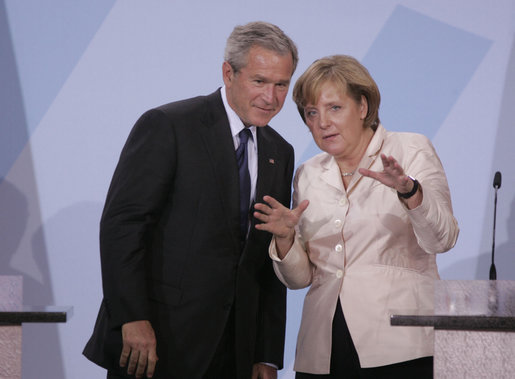
President George W. Bush and Chancellor Angela Merkel hold a joint press conference in Stralsund, Germany, Thursday, July 13, 2006. White House photo by Paul Morse.CHANCELLOR MERKEL: (As translated.) Ladies and gentlemen, I am delighted to be able to welcome the President of the United States here to Stralsund yet again. We had a lengthy conversation right now in the Office of the Mayor.
We felt very much at home here in this beautiful city. We talked about all of the different issues on the global agenda.
People crowd the town square of Stralsund, Germany, as Chancellor Angela Merkel welcomes President George W. Bush and Laura Bush Thursday, July 13, 2006. We shall, later on, see a little bit more of the countryside here, of the city itself. I am really pleased to be able to show to the President of the United States how matters have developed here,
with some problems still existing, but also with problems we've coped with quite successfully. And it's such a great thing to have this lovely weather for our visits.
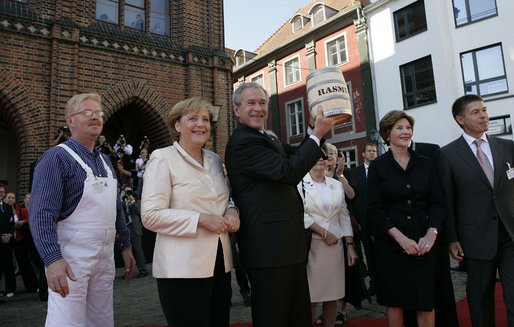
Standing with German Chancellor Angela Merkel, President George W. Bush holds up a ceremonial gift of a barrel of herring in Stralsund, Germany, Thursday, July 13, 2006. Mrs. Bush is pictured at the right. White House photo by Eric Draper.Just now, in our talks, we talked at great length about international issues. Unfortunately, there are quite a lot of problems that we need to deal with and for whose solution we feel responsible.
The first and foremost, on top of the agenda is certainly Iran. The international community actually submitted a very substantial, very fundamental offer to Iran, starting from the firm view that Iran should not be in possession of a nuclear weapon, but that, on the other hand, Iran should have -- should know good development. So far we have not received any sort of reaction from the Iranian leadership as to how their position is on this offer.
Mrs. Laura Bush is seated between Stralsund Mayor Harald Lastovka and German Chancellor Angela Merkel during the welcoming ceremony Thursday, July 13, 2006, in honor of the visit by President George W. Bush and Laura Bush to Stralsund, Germany. White House photo by Eric Draper.And this is why it was only consistent that yesterday the foreign ministers decided yet again to show clearly, also through a resolution in the U.N. Security Council, that should Iran not in any way reply to this offer
and accept this offer, we, unfortunately have to embark on a new course. The door has not been closed, but Iran must know that those who have submitted this offer are willing -- and this is the success of yesterday's meeting -- Russia, China, the E3, and the United States of America -- all of them together are willing to act in concert and to show this clearly through their action in the Security Council.
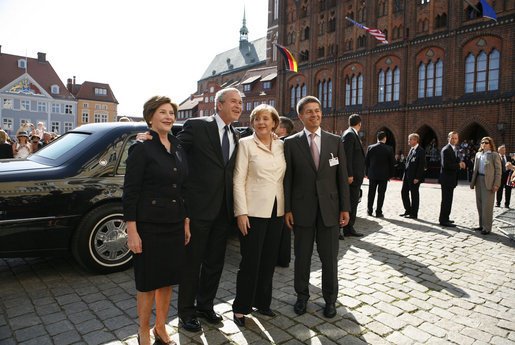
President George W. Bush and Laura Bush participate in an arrival ceremony with German Chancellor Angela Merkel and her husband Joachim Sauer in Stralsund, Germany, Thursday, July 13, 2006. White House photo by Paul Morse.We also addressed the very disturbing situation in the Middle East, and it fills us with concern and we have also stated clearly that everything needs to be done in order to come back to a peaceful resolution.
We need to remind all of us again how this escalation started, with the kidnaping of a soldier, through rockets -- for the firing of missiles against Israeli territory. And we can only urge all parties, appeal to all parties to stop, to cease violence and to also release the kidnaped soldier, and to stop this firing of missiles at Israeli territory.
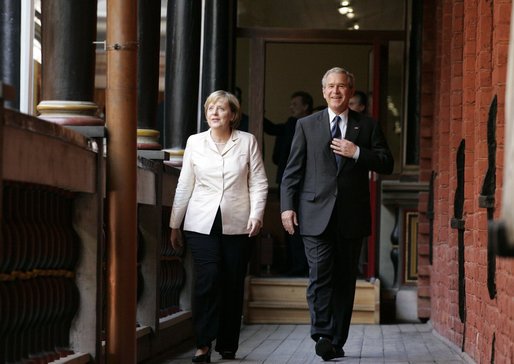
Chancellor Angela Merkel and President George W. Bush walk to their meeting after the arrival ceremony in Stralsund, Germany, Thursday, July 13, 2006. White House photo by Paul Morse.We would like to appeal to the powers in the region to see to it that further escalation is warded off, and that, first and foremost, the root causes of this conflict are removed.
And only in this way will a negotiating process become possible again. We have every interest in seeing the Lebanese government be strengthened and this government being able to pursue its policies in a sensible and secure environment.
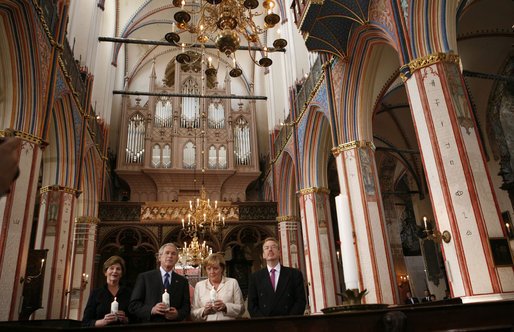
President George W. Bush and Laura Bush stand with German Chancellor Angela Merkel and Pastor Peter Neumann in St. Nikolai Church in Stralsund, Germany, Thursday, July 13, 2006. White House photo by Paul Morse.We also addressed matters of trade, global trade. Here we -- and I'm saying this from a German perspective -- have a common interest in seeing this world round be a successful one, this world trade round.
But that means there has to be movement on all sides. And we're expecting a reasonable, sensible offer by the G20, because this is where movement is necessary. Europe and others have submitted far-reaching proposals, and we would like to explore every possibility of these negotiations, but that means, as I said, movement on all sides. And here I see that the G20 has to deliver.
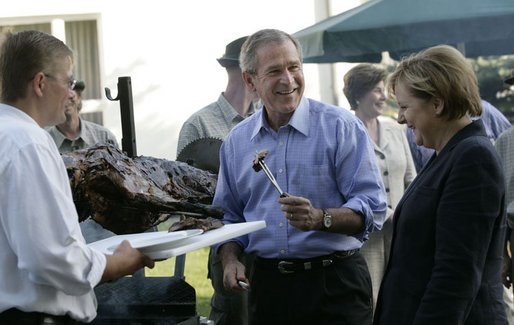
President George W. Bush enjoys a bit of barbeque Thursday, July 13, 2006, as he joins Chancellor Angela Merkel for a barbeque in Trinwillershagen. The President and Mrs. Laura Bush are scheduled to depart Germany Friday for St. Petersburg, Russia. White House photo by Eric Draper.We also addressed those issues that will be on the agenda at the G8 in St. Petersburg. Here, first and foremost, energy policy, secure energy supply, was at the top of the agenda. We addressed African issues,
Darfur and the Congo mission. We, as Germans, as you know, have taken out a commitment as regards Congo. We also, however, see the situation in Darfur as a threatening one.
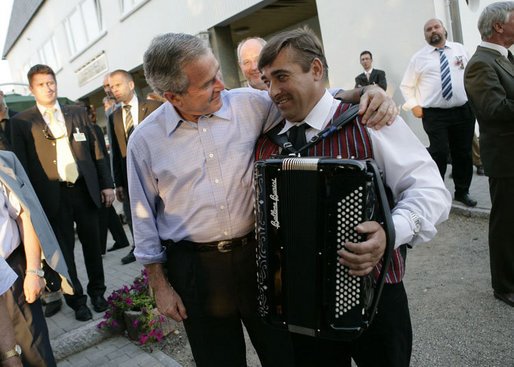
President George W. Bush puts his arm around an accordian player Thursday, July 13, 2006, after an evening barbeque in Trinwillershagen, Germany, hosted by Chancellor Angela Merkel. White House photo by Eric Draper.We found that there is a lot that we agree on, as regards our common responsibilities, responsibilities that we see for the two of us the world over. And I, for one, think that as regards,
for example, Iran, this responsibility ought to be shouldered by more and more countries -- that goes for Russia, that goes for China. It will only be if we act in concert that we will be able to vanquish the tyrants, remove dictatorships and contain those who sponsor terrorism. And Germany would like to give its contribution to that.
President George W. Bush joins members of the Jagdhornblaser Baremerhagen Band Thursday, July 13, 2006, prior to dinner in Trinwillershagen, Germany. The President and Mrs. Laura Bush depart Germany Friday for Russia and the G8 Summit. White House photo by Eric Draper.PRESIDENT BUSH: Chancellor, thank you very much. Thanks for the invitation. This is a beautiful part of the world, and Laura and I are so honored to come to your constituency and meet some of the friendly people who live here.
I remember you coming to the Oval Office, and you said, if you are coming to Germany, this is the part of Germany I want you to see. And now I can see why you suggested it. I'm looking forward to the feast you're going to have tonight. I understand I may have the honor of slicing the pig.

We had a good discussion -- it's more than a discussion, it's really a strategy session, is the way I'd like to describe it. We talked about a lot of subjects. We talked about the Middle East and Iran, and I briefed the Chancellor on North Korea. We talked about Iraq and Afghanistan, as well.

But when we talked about the issues, it's important for you to understand we're really trying to figure out how to work together to solve problems. And I appreciate -- appreciate the Chancellor's judgment a lot. It's an interesting conversation, you know, when you toss out what may seem to be a problem that's insoluble, and all of a sudden, two people start thinking about how to solve it, solve the problem. And that's what we're doing.

You know, on the Iranian issue, for example, the last time that we were together we talked -- spent a lot of time on Iran, and the Chancellor was wondering whether or not the United States would ever come to the table to negotiate with the Iranians. You made that pretty clear to me that you thought it was something -- an option we ought to consider, which I did. And I made it clear to the Iranians that if they were to do what they said they would do, which is to stop enrichment in a verifiable fashion, we're more than pleased to come back to the table.

There's no question that this issue can be solved diplomatically, and there's no question that it can be solved diplomatically with Germany and the United States strategizing as how to solve it. And I want to thank the Chancellor's leadership on this issue. It's really important for Europe to speak with one common voice. And it's important for Angela and myself to work with Vladimir Putin, which we will do at the G8, to continue to encourage him to join us in saying to the Iranians loud and clear, we're not kidding, it's a serious issue, the world is united in insisting that you not have a nuclear weapons program.

We talked about the Israeli-Palestinian and Israeli issues with Hezbollah, and our common desire to work together to help bring peace to that troubled region.

My attitude is this: There are a group of terrorists who want to stop the advance of peace. And those of -- who are peace-loving must work together to help the agents of peace -- Israel, President Abbas, and others -- to achieve their objective. You got to understand when peace advances, it's in the terrorists' interests in some cases to stop it. And that's what's happening.

We were headed toward the road map, things looked positive, and terrorists stepped up and kidnaped a soldier, fired rockets into Israel. Now we've got two more kidnapings up north. Hezbollah doesn't want there to be peace. The militant arm of Hamas doesn't want there to be peace. And those of us who do want peace will continue to work together to encourage peace.

We talked about North Korea. I assured the Chancellor that I'm committed to the six-party talks and that the five of us in the six-party talks will work to convince North Korea to come back to the table. I'm hopeful that we can get some U.N. action on North Korea.

We did talk about Doha, the trade round, and it's -- look, these trade rounds are difficult to negotiate with; we've all got our own interests. But the good news is we do share a common desire to open up markets. Germany is a great exporter. It's in Germany's interest that tariffs be reduced around the world. It's in our interests that tariffs be reduced around the world. And I committed to what I told the world back last September, we will reduce agricultural subsidies. But all we want is fair treatment when it comes to market access.

I'm optimistic we can still get something done on the Doha Round. It's going to take work, but G8 is a good place for us to continue the dialogue, and we will.

And I guess that's about all -- we discussed a lot of things, in other words. And thank you for having me. I'm looking forward to that pig tonight. (Laughter.)

I'll be glad to answer a couple of questions. Do you want to start her off?

Q Chancellor, you spoke about charting a new course as regards a response to the Iranian conflict. What new course will that be? You talked about the results of the foreign ministers' meeting where they will appeal to the Security Council. What sort of action will there be? Again, just a resolution that only demands certain things, or is the objective a resolution that will then actually threaten sanctions of a specific nature? This question is also addressed to the President.

CHANCELLOR MERKEL: Well, essentially what we're talking about here is not a totally new process, it's just another phase. We have waited patiently whether Iran will examine this offer and in which way it will react. So far we have not had any sort of reliable reaction. And for us, the precondition for talks has always been suspension of the enrichment activities, and a precondition for talks has always been, well, we will then, under the circumstances, not react with sanctions. But through this common action, we are now making clear, because we are not receiving a reply, that there will be a concerted action and that there will be specific steps. And we're defining what steps these will be if Iran continues to let us wait with its response.

So we wanted to demonstrate yet again that the international community is willing to show resolve to pursue this strategy further in every direction. Iran has received a proposal that I think is a very substantive one, a very good one, one that is good for the development of its own country, of its own interests -- is in its own interests. But if Iran should not reply, if they think they can prevaricate in the hope of the international community being split, then this proves them wrong. And this is why I am so happy about the conclusion of that meeting of the foreign ministers.

PRESIDENT BUSH: This notion that the Iranians must understand that they can't wait us out and can't hope to split a coalition -- and so the first step is to go to the United Nations and speak with as common a voice as possible.

Your question really is, how fast should the process move along? And my attitude is, the answer to that is, it should move as fast as necessary to make it effective, which is a non-answer, admittedly. But the truth of the matter is, diplomacy takes a lot of work, and there are different interests involved here. We do share a common goal of no nuclear weapon and no program. And, by the way, we've already sanctioned Iran, so we've got a different position than others. It's easy for me to espouse sanctions, since it's already a fait accompli. But we understand other nations have got -- there's a pace to this diplomacy. And I assured the Chancellor that the United States will continue to work to make sure the process is steady as it moves forward.

The key first step is, common goal, which is no nuclear weapon or program, and united message to the Iranians. I truly think they're trying to wait us out. They think it's a matter of time before people lose their nerve, or a matter of time before different interests are able to influence the process. And I think they're going to be sorely mistaken. I think they're going to be disappointed that this coalition is a lot firmer than they think.

It is in our interests to make sure they don't have a weapon. It would be dangerous if the Iranians had a nuclear weapon. And that's a recognizable fact now. So I appreciate the Chancellor's position on this.

Yes, Terry.

Q Madam Chancellor, Mr. President. Terry Hunt with the AP. Looking ahead to St. Petersburg, I'd like to ask you, do you think that Russia is honoring human rights and democratic freedoms and has a responsible approach to energy security?

And, Mr. President, were you surprised by President Putin replying to Vice President Cheney's criticism, saying that it was an "unsuccessful hunting shot?"

PRESIDENT BUSH: Did I think it was a clever response? It was pretty clever. Actually, quite humorous -- not to dis my friend, the Vice President. I don't know, do you want to start with this? I'd be glad to -- (laughter.) No, I think our job is to continually remind Russia that if he wants to do -- have good relations, that she ought to share common values with us. We share common values -- free press is a common value we share. And I've expressed my opinion to President Putin. You might remember my visit with him in Slovakia where I was quite pointed in my concerns about whether or not there is a free and vibrant press in Russia. We share concerns about the ability for people to go to the town square and express their opinions, and whether or not dissent is tolerated, whether or not there's active political opposition.

And so I will continue to carry that message. My own view of dealing with President Putin, though, is that nobody really likes to be lectured a lot, and if you want to be an effective person, what you don't go is scold the person publicly all the time; that you remind him where we may have a difference of opinion, but you do so in a respectful way, so you can then sit down and have a constructive dialogue.

And that's exactly how I'm going to continue my relations with President Putin. I'll be firm about my belief in certain democratic institutions; I'll be firm in my belief about the need for there to be an active civil society and NGOs should be allowed to function in Russia without intimidation. But I'm also going to be respectful of the leader of an important country. And I may not tell you exactly what I talked to him about in private. And I would hope that he wouldn't tell you what he talks to me about in private.

But, yes, we've got issues. Listen, we've got common problems that we need to work together to solve -- North Korea and Iran are two. And we've also got -- I hope he continues to understand that it's in his country's interest to implement the values that Germany and Russia -- Germany and the United States share.

CHANCELLOR MERKEL: Well, first as to the issue of energy security, I can safely say that, looking at Germany over the past few decades, Russia has always proved to be a reliable supplier of energy. They have always abided by the treaties that we signed. But we would wish -- and I've addressed this with the Russian President -- that they actually bring the energy charter to its completion, that is to say, commit themselves to it, because then we would have a greater degree of certainty and security that we understand our common commitments on this.

As regards -- a strategic link between Russia and Europe, obviously, is of tremendous importance. It's important because we need energy supplies from Russia. And this is why we shall work towards Russia accepting that charter, that energy charter, so that we get a legitimate charter that is also based on contracts. But again, it has to be said that Russia has always been a reliable supplier.

As to democracy and human rights, during my visit to Russia I met with a number of representatives of non-governmental organizations. We discussed what is desirable, what ought to be there as regards Russia's further development, and what needs to be addressed, time and again, and let me tell you that I talked to the President about these issues.

I think also we ought to have an open, confidential dialogue. We should not sort of speak loudly and in public about certain issues; that we have different ideas about how a pluralist society, a democratic society ought to work; that there ought to be a strong opposition is certainly one of the realities of life. There are differences of opinion between Russia and the European Union. We would wish for Russia to embark on a path that leads to a lively and very pluralistic political landscape, that they enter into a dialogue with their civil society, which is at yet not there, for many reasons.

But we would like to share with them also the experience that we've made with democracy, that pluralism in a democracy, last but not least, actually enhances stability in a country. And that is an experience that we have made, and that is a very strong force which drives reform processes forward. For example, we've seen that in German unity. It's sometimes complicated to bring those decision-making processes forward in a democracy, but then you receive the necessary legitimacy. And that is the experience that informs us in our talks.

Q A question addressed to you both. You talked about the Middle East, and what is your assessment of the military action of Israel in Lebanon? The French Foreign Minister already said it is disproportionate. Does that give you cause for Europe or the United States to intervene?

And apart from the pig, Mr. President, what sort of insights have you been able to gain as regards East Germany? -- (inaudible) --

CHANCELLOR MERKEL: Neither have I, but apparently a camera team was there when it was shot. So apparently it is already there, physically. (Laughter.) I hope it's actually roasting; otherwise we won't be able to eat it tonight.

Well, as to the violence in the Middle East, particularly as regards Lebanon, I think that one needs to be very careful to make a clear distinction between the root causes and the consequences of something. So we started here from a case of kidnaping of a soldier, and one of the other root causes also is the activity of Hezbollah. And it's most important for the Israeli government to be strengthened, but it is also clearly shown that these incursions, such as the kidnaping of soldiers, is not acceptable.

And the parties to that conflict obviously have to use proportionate means, but I am not at all for sort of blurring the lines between the root causes and the consequences of an action. There has to be a good reaction now, not from the Israeli government, but from those who started these attacks in the first place.

PRESIDENT BUSH: -- to help calm the situation, we've got diplomats in the region. Secretary of State Rice, who is here, is on the phone talking to herf counterparts. I'll be making calls.

I gave you my initial impression earlier, and that is that it's a sad situation where -- when there is a very good chance for there to be a two-state solution enacted -- that is two states living side-by-side in peace -- it's really sad where people are willing to take innocent life in order to stop that progress. As a matter of fact, it's pathetic.

And having said that, Israel has a right to defend herself. Every nation must defend herself against terrorist attacks and the killing of innocent life. It's a necessary part of the 21st century.

Secondly, we -- whatever Israel does, though, should not weaken the Siniora government in Lebanon. We're concerned about the fragile democracy in Lebanon. We've been working very hard through the United Nations and with partners to strengthen the democracy in Lebanon. The Lebanese people have democratic aspirations, which is being undermined by the actions and activities of Hezbollah.

Thirdly, Syria needs to be held to account. Syria is housing the militant wing of Hamas. Hezbollah has got an active presence in Syria. The truth of the matter is, if we really want there to be -- the situation to settle down, the soldiers need to be returned, and President Assad needs to show some leadership toward peace.

To answer your question about the involvement, we will be involved diplomatically, and are involved diplomatically.

Steve.

Q Thank you, sir. Just to follow up --

PRESIDENT BUSH: Follow up on?

Q On both of these. Does it concern you that the Beirut airport has been bombed? And do you see a risk of triggering a wider war?

And on Iran, they've, so far, refused to respond. Is it now past the deadline, or do they still have more time to respond?

PRESIDENT BUSH: I thought you were going to ask me about the pig.

Q I'm curious about that, too. (Laughter.)

PRESIDENT BUSH: The pig? I'll tell you tomorrow after I eat it.

The Iranian issue is -- will be taken to the U.N. Security Council. We said that we have -- to the Iranians, we said, here's your chance to move forward, and we'd like a response in a reasonable period of time. And we meant what we said. One of the important things about moving toward the Security Council, it shows that when we say something, we mean it. In order for -- to help solve these problems, you just can't say things and not mean it. And so when we spoke, we said, reasonable period of time; weeks not months -- that's what we explained to the Iranians. They evidently didn't believe us. And so now we're going to go to the Security Council, and we're united in doing that.

Q Their deadline has passed --

PRESIDENT BUSH: Their deadline passed, right. That's why we're going to the U.N. Security Council.

Q -- have time?

PRESIDENT BUSH: Oh, they've got plenty of time. I mean, the U.N. Security Council, they've got time to react. They've got time to make a decision. By the way, it's their choice. We've made our choice. It's the Iranian choice. And as Angela mentioned, there was an offer put on the table, a reasonable offer for them to make the choice as to the way forward.

And our choice is, look, we want to have relations with you, but you're not going to have a weapon or the capacity to make a weapon. It would be incredibly dangerous if we -- five years from now, Iran shows up with a nuclear weapon and threatens people in the neighborhood, and they're going to say, where were you? What were you doing during that period of time? And that's what we're working on.

And so time -- that's -- when we said, weeks not months, we meant it. And now we're heading to the U.N. Security Council. They can show up any time and say, wait a minute, now we'd like to go back and negotiate, now -- take a look at the interests. We're not precluding any further negotiations with the Iranians.

In order for us to come to the table, however, what they must do is verifiably show that they're not enriching, like they said they would do earlier. This is not a -- this is not a new statement by them. They agreed to this in Paris. All we're asking them to do is to honor what they said they would do in the past in a verifiable fashion.

The rest of your four-part question?

Q Sorry about that, sir.

PRESIDENT BUSH: That's okay, it just -- it's a bad habit.

Q Does the Beirut -- the attack on the Beirut airport, does that concern you, and are you concerned about triggering a wider Middle East war?

PRESIDENT BUSH: As I mentioned, my biggest concern is whether or not actions taken will weaken the Siniora government. Democracy in Lebanon is an important part of laying a foundation for peace in that region. We have worked really hard to get Syria out of Lebanon -- U.N. Resolution 1559, and it's follow-up Resolution 1680 were manifestations of the work of the international community to get Syria out of Lebanon. We've always felt that a democracy in Lebanon is important for the Lebanese people, and it's important for the region.

So the concern is that any activities by Israel to protect herself will weaken that government. And we have made that -- or topple that government -- and we've made it clear in our discussions.

Having said all that, people need to protect themselves. There are terrorists who will blow up innocent people in order to achieve tactical objectives. In this case, the objective is to stop the advance of peace -- which is a remarkable statement, isn't it? Willing to kill to stop peace.

We have a good chance to get a two-state solution, two democracies living side-by-side in peace. It is a clear and achievable vision. There is a way forward called the road map to achieve that vision. What will prevent that vision from being achieved is -- are terrorist activities, and that's what you're seeing taking place.

Thank you all.

CHANCELLOR MERKEL: Thank you.

END 1:03 P.M. (Local), For Immediate Release, Office of the Press Secretary, July 13, 2006

Related: Keyword Germany, Friday, June 30, 2006 , Wednesday, April 12, 2006 President Bush to Welcome German Chancellor Merkel, Friday, January 13, 2006 President Bush, German Chancellor Merkel (VIDEO), Friday, February 04, 2005 Condoleezza Rice Tony Blair Jack Straw Gerhard Schroeder, Saturday, February 05, 2005 Secretary Rice Europe and the Middle East, Wednesday, February 23, 2005 Bush Schröder Exchange Toasts, Wednesday, March 02, 2005 Sale of U.S. Military Equipment from Germany to Greece, Tuesday, March 08, 2005 Nazi Medical Experiments, Friday, March 18, 2005 GERMANY PARTNERS WITH IRAQ, UNITED ARAB EMIRATES FOR TRAINING, Sunday, May 08, 2005 President Honors and Commemorates Veterans in the Netherlands, Friday, May 20, 2005 President to Welcome German Chancellor Schroeder, Tuesday, May 24, 2005 pseudoneglect phenomenon, Monday, June 27, 2005 President Welcomes German Chancellor, Thursday, July 21, 2005 William Robert Timken, Jr Ambassador to Germany, Tuesday, September 20, 2005 Simon Wiesenthal - A Short Biography, Thursday, October 06, 2005 German-American Day, 2005,Thursday, December 01, 2005, President Bush to Welcome German Chancellor Merkel, Tuesday, December 21, 2004 President to Germany, Slovak Republic,

Thursday, July 13, 2006

U.S.-India Civil Nuclear Cooperation Initiative, VIDEO, PODCAST, TEXT

Technorati Tags: and or and , or and , or , and , or , and , or , and ,

U.S.-India Civil Nuclear Cooperation Initiative

Secretary Condoleezza Rice, Inaugural Meeting of the American Association of Physicians of Indian Origin and the Asian-American Hotel Owners Association, Washington, DC, July 10, 2006, FULL STREAMING VIDEO, , M3u PODCAST, MP3 for download

Thank you very much, Dr. Suvas Desai, for that wonderful introduction. I've gotten a lot of grief about that Esquire poll. But you did it so nicely that I feel good. (Laughter.) Thank you very much.

I'd also like to recognize Ambassador Sen. Thank you very much for all of the work that you do on behalf of U.S.-Indian relations. I want to thank Congressman Ackerman for being here and your great support for our efforts on behalf of U.S.-Indian relations. Of course, David Mulford probably gets the prize for the longest travel. (Applause.) Richard Boucher didn't travel as far but he's very important also to our relationship (applause) and I'd like to thank you Mr. Ash Patel and Dr. Hemant Patel for the work that you're doing and to Fred Schwartz for having me here. It's a delight to join with you to talk about President Bush's vision for the U.S.-India relationship. I want to tell you that we consider strengthening and expanding and deepening the U.S.-India relationship to be one of the President’s signature foreign policy initiatives.

As all of you can attest, there is a new spirit of partnership between India and the United States and that spirit of partnership arises, first and foremost, from our people, from deep ties and shared aspirations that bind our democratic societies. Two million people of Indian descent live in the United States today. They're decent and industrious people like you, who staff hotels and hospitals and own and operate hotels. I can tell you that they contribute to the intellectual capital of universities. I've dealt with many of those people in my time as an academic at Stanford. These are people who are debating the great issues of our time and adding, not only to the wealth of our nation, but also to the character of our country. (Applause.)

They're nurturing dreams for a better life and they're working hard and they're playing by the rules and they're sharing their successes with people who are less fortunate than themselves. And in doing so, American Indians -- Indian Americans are making America more American.

I know that many of you first came to the United States perhaps as students. And to the great benefit of this society, you chose to remain here in America: to live and to work and to raise your families. As a college professor, I'm deeply committed to ensuring that America remains open and welcoming as a country, even as we secure our borders. In fact, you should know that more Indians are studying in the United States right now than at any other time in our history -- 80,000 this year alone. (Applause.)

And of course our partnership of peoples runs both ways, because there are thousands of Americans who are living in India -- in cities like Delhi and Mumbai and in Bangalore. They are taking part in India’s rich culture. They are becoming active members of Indian society. And they're doing their part to build a partnership that touches fields as diverse as agriculture and health and commerce and defense and science and technology and education.

The relations between our people point a way forward for cooperation between our governments. India, the world’s largest democracy, is a natural partner for the United States, the world’s oldest democracy. India’s society -- and I've experienced this personally -- is open and free and transparent and stable and multi-ethnic and multi-religious. India is a democracy that is characterized by individual freedom, by the rule of law, by civilian control of the military and by lively politics. (Laughter.)

India will soon become the world’s most populous nation, as well as one of the world’s five largest economies. And of course, as a rising global power, India can be a pillar of stability in a rapidly changing Asia and a strategic partner for the United States as we meet the challenges of the 21st century.

America and India share so much in common, but during the past half century, our two nations have not lived up to the promise. This is something that President Bush set out to change from the very beginning. I can tell you that seven years ago, when I first became his Foreign Policy Advisor and we began to talk about what he might do if he became President -- that was back when his first name was still governor. We said that if he was elected he wanted one of his administration's top priorities to be to transform the relationship with India. And that's exactly what he's done. We’ve invested the necessary capital to build a global partnership with India – a partnership founded on strategic success and strategic interests, common democratic ideals, a partnership that will advance the cause of peace and freedom and opportunity in this new century. As President Bush said during his landmark visit to India in March: “The United States and India…are now closer than ever, and the partnership between our free nations has the power to transform the world.”

A key to unlocking the full promise of this partnership is the Civil Nuclear Cooperation Initiative that President Bush and Prime Minister Singh put forward in July. Consider where the United States and India were before we launched this initiative: We had a difficult relationship in many ways. We had failed nonproliferation policies and we had the wrong incentives on energy security and environmental protection. The main obstacle to enhanced cooperation, of course, was India’s unique nuclear record -- the fact that it had developed nuclear weapons, yet had never signed the Nonproliferation Treaty but it had never proliferated its nuclear technology. By addressing India’s unique situation, creatively and responsibly, our civil-nuclear initiative will elevate our partnership to a new strategic level. That’s the first benefit, and as I see it, there are four more.

The initiative will enhance energy security. India is a nation of over one billion people, with an economy growing at approximately 8 percent per year. This country is now the world's sixth largest energy consumer and its massive appetite for energy is of course growing. Diversifying India's energy sector will help it to meet the ever increasing needs of its people and, just as importantly, ease its reliance on hydrocarbons from unstable sources like Iran. This is good for India and it's good for the United States.

Third, this initiative will benefit the environment. As I said, India's carbon emissions are growing rapidly as it works to meet its development needs, mostly through fossil fuels. A better alternative for the world that we share would be one to help India develop clean, environmentally free nuclear energy and that is exactly what this initiative will do.

Fourth, this initiative will create opportunities for American jobs. Civil nuclear cooperation with India will open a new market for American entrepreneurs and workers, which would create thousands of new jobs, directly and indirectly, within the United States. By helping India's economy grow, we would thus be helping our own.

Finally, this initiative will add to the stability and security of our world. As I said back in April, when I testified on Capitol Hill, the United States greatly values and unequivocally supports the international nuclear nonproliferation regime, the cornerstone of which is the Nonproliferation Treaty. We desire to strengthen this regime, which is why we believe that India’s continued isolation from it is the wrong policy.

Let me be clear: We do not support India joining the Nonproliferation Treaty as a nuclear weapon state. Rather, the goal of our initiative is to include India, for the first time ever, in the global nonproliferation regime. By requiring India to place two-thirds of its existing and planned civil nuclear reactors under the watchful eye of the International Atomic Energy Agency, this initiative would be a net gain for the cause of nonproliferation worldwide. I would just note that this is not the position of the U.S. Government alone. It is also the opinion of governments in Great Britain and France and Russia. And I would also add that it is the opinion of Dr. Mohamed ElBaradei, the custodian of global nonproliferation.

In recent months, my team and I have worked tirelessly with the Congress to fully implement our initiative with India. We've spent countless hours meeting with senators and congressmen of both parties -- hearing their concerns, making our case and reaching agreement. And as I’m sure you know, less than two weeks ago, both the Senate Foreign Relations Committee and the House International Relations Committee passed legislation in support of this initiative by overwhelming bipartisan margins. (Applause.) This would not have been possible without the good will and the hard work of individuals from both sides of the aisle, and again, thank you Congressman Ackerman, for you work. (Applause.) I would also especially like to thank Chairman Henry Hyde and Congressman Tom Lantos in the House and Senators Richard Lugar and Joe Biden.

Of course, our work is not yet done. The enabling legislation must now be voted on by the full bodies of both houses. So we are hard at work with both houses of Congress, especially with the India caucuses. And we are encouraging both the Senate and House to vote on the civil nuclear initiative this month, before the summer recess. (Applause.)

As we work to win passage of the initiative through our own democratic process, I want to note that we are mindful that this decision has also not been easy for Prime Minister Singh and for India. Some in India perhaps want to keep America at arm’s length. And the Prime Minister has had his own domestic fights against protectionism, but to his great credit he has won support for the civil nuclear initiative in India. Now, we look forward to India fulfilling its remaining commitments under the agreements that we made on July 18th of last year.

Ladies and Gentlemen: When President Bush visited India in March, he spoke of his desire “to strengthen the bonds of trust between our two great nations.” As the President and the rest of the Administration continue working to build a partnership of trust and respect between our governments, we are bolstered by the deep wells of good will that exist between our peoples. More than anyone else, it is Indian-Americans like yourselves who have been instrumental in building this trust and this good will. This has been a lifetime of labor of love for you, in which you have bridged old gaps of misunderstanding through new ties of work and friendship and family and community. You have brought our people closer together. You have taught us to respect each other. You have taught us to appreciate each other's contributions. You have made America better by your contributions. (Applause). Now our governments are beginning to move down the hopeful path of partnership that you have charted for us.

India and the United States can accomplish great things together in this new century. We can define this new era not as “the American century”, not as “the Indian century” -- but as freedom’s century. This is the great calling of our new partnership. And on behalf of President Bush, I want to thank all of you for standing with us in support of this vision.

Thank you very much.

2006/669, Released on July 10, 2006

Related: Keywords State Department, Thursday, July 13, 2006 Condoleezza Rice, Carlos Gutierrez, Free Cuba, VIDEO, PODCAST, TEXT, Thursday, July 13, 2006 Condoleezza Rice, Pakistani Minister of Foreign Affairs Khurshid Mahmood, VIDEO, PODCAST, TEXT, Thursday, July 13, 2006 Condoleezza Rice, British Foreign Secretary, Margaret Beckett VIDEO, PODCAST, TEXT, Wednesday, July 05, 2006 Condeleeza Rice, Turkish Foreign Minister VIDEO, PODCAST, TEXT, Monday, June 26, 2006 Secretary Rice With Foreign Affairs Minister of Poland, VIDEO, PODCAST, TEXT, Monday, June 19, 2006 Secretary Condoleezza Rice, Foreign Minister Miguel Angel Moratinos, VIDEO, PODCAST, TEXT, Monday, June 19, 2006 Robert Zoellick Announces Departure VIDEO, PODCAST, TEXT, Friday, June 02, 2006 R. Nicholas Burns, Remarks in Vienna, Austria, Wednesday, May 31, 2006 Iran Statement by Condoleezza Rice (VIDEO), Thursday, May 18, 2006 Secretary Rice With Prime Minister John Howard (PODCAST), Wednesday, May 10, 2006 Secretary Rice, EU Secretary General Javier Solana on Iran, VIDEO, PODCAST, TEXT, Wednesday, May 03, 2006 Secretary Rice, James Wolfensohn, Gaza Disengagement (PODCAST), Thursday, April 27, 2006 Remarks at Stakeout Secretary Condoleezza Rice, Friday, April 21, 2006 Secretary Rice to Travel to Europe, Friday, April 21, 2006 The Face of the State Department (VIDEO), Thursday, April 13, 2006 Secretary Rice Holds Talks with Equatorial Guinean President, Tuesday, April 11, 2006 State Department Podcast, VIDEO and Text 04/10/06, Wednesday, April 05, 2006 State Department Podcast, VIDEO and Text 04/03/06, Thursday, March 30, 2006 State Department Podcast, VIDEO and Text 03/29/06, Monday, April 03, 2006 Secretary Rice With Foreign Secretary Straw, Baghdad, Friday, March 31, 2006 Rice in Berlin To Discuss Iran with P-5 plus 1, Friday, March 31, 2006 UNHCR Worker’s Death in Sudan Attack,

Condoleezza Rice, Carlos Gutierrez, Free Cuba, VIDEO, PODCAST, TEXT

Technorati Tags: and or and , or and , or , and , or , and , or , and ,

Second Report of the Commission for Assistance to a Free Cuba and the Compact With the Cuban People

Secretary Condoleezza Rice, Briefing with Secretary of Commerce Carlos Gutierrez and Cuba Transition Coordinator Caleb McCarry, Washington, DC, July 10, 2006, 11:20 a.m. EDT. FULL STREAMING VIDEO, M3u PODCAST, MP3 for download

SECRETARY RICE: Good morning. Today we are pleased to release the Compact with the People of Cuba and the Second Report to the President of the Commission for Assistance to a Free Cuba. Under President Bush's leadership, the United States is keeping our promise to marshal our resources and our expertise and to encourage all nations to join with us in supporting the right of all Cubans to define a future of freedom and democracy for themselves and for their country.

This Compact and the Second Report's recommendations reflect America's resolve to stand with Cuba's brave opposition leaders, men and women, who speak for those Cubans who are forced into fearful silence but who remain free in their hearts and in their minds.

The Commission's recommendations include concrete support for democratic change in Cuba. Under a new two-year $80 million program, we are stepping up our efforts along multiple fronts. We are increasing our determination to break the regime's information blockade and we are offering support for the efforts of Cubans to prepare for the day when they will recover their sovereignty and can select a government of their choosing through free and fair multi-party elections.

We are laying the groundwork to offer specific substantial assistance for a democratic transition in Cuba, including humanitarian aid and support for the recovery of those fundamental democratic rights and economic freedoms that lead to prosperity.

The Commission's Second Report keeps the promise that the United States has made to the people of Cuba. You have no greater friend than America. You can always count on our support and we will be ready to stand with you through the process of transformation to your democratic future.

I would now ask my co-chair, Secretary Carlos Gutierrez of the Department of Commerce, to speak about our direct message of hope through the Compact with the people of Cuba. Carlos.

SECRETARY GUTIERREZ: Thank you. Good morning. Under the leadership of President Bush and Secretary Rice this morning we released the Second Report of the Commission for Assistance to a Free Cuba and a Compact with the People of Cuba. The Compact is a message of hope and reassurance to Cubans that they can count on our concrete aid in areas like humanitarian needs, economic recovery and free and fair elections. The people of Cuba have a choice: economic and political freedom and opportunity or more political repression and economic suffering under the current regime.

The United States stands ready to work with the people of Cuba, to attain political and economic liberty. We pledge to help the Cuban people and a new transitioned Cuban government as it moves away from a totalitarian communist dictatorship and toward a free and representative democracy. To support a Cuban transition government, we pledge to provide emergency food, water, fuel and medical equipment. We pledge to help rebuild Cuba's shattered economy. We pledge to respect the right of the Cuban people to be secure in their homes. We pledge to encourage assistance from other countries, associations and private companies. And we pledge to discourage third parties from intervening to obstruct the will of the Cuban people.

We will do all this and more, provided we are asked by a Cuban transition government that is committed to dismantling all instruments of state repression and implementing internationally respected human rights and fundamental freedoms, including organizing free and fair elections for a democratically elected new Cuban government within a period of no more than 18 months. The report and its recommendations are intended to support the Compact with the People of Cuba. The Administration of President Bush is committed to accompany Cubans through a transition to political and economic freedom.

The people of Cuba have suffered too much and for too long and deserve so much more than what they have today. Thank you.

SECRETARY RICE: And now we will turn over the microphone to Caleb McCarry who has been the Coordinator for Assistance to a Free Cuba and he will do a more detailed report on the report.

MR. MCCARRY: Good morning. I also have some brief introductory remarks and then I'd be happy to answer your questions.

Cubans need to know that there is hope. And as Secretary Rice and Secretary Gutierrez have said, "A compact with the Cuban people is a straightforward message of hope, directly addressed to Cubans." The Second Report of the Commission for Assistance to a Free Cuba builds upon the recommendations of the Commission's first report and it represents the work of over 100 participants from 17 federal departments and agencies over the course of several months. The report sets forth specific assistance and programs the United States can offer to help Cubans rapidly recover their sovereignty through free and fair multi-party elections. It contains seven chapters and a series of recommendations designed to help Cubans secure real and lasting change in their country.

The report directs actions we can take now to develop appropriate plans to support a democratic transition tomorrow. The report broadly summarizes resources and expertise the U.S. Government could make available to a Cuban transition government that releases all political prisoners, is committed to free and fair elections and asks for our help. The report recommends a substantial increase in our efforts, in concert with other nations, to empower Cubans to define a democratic future for their country.

The report recognizes that the international community and Cubans abroad will have an important role to play in Cuba's transition. As a community of free nations, now is the time to intensify our efforts to stand with the Cuban people as they work to secure liberty, prosperity, and reconciliation when Cuba becomes free. Cubans in Cuba, at great personal risk, are already talking about a democratic transition for their country. It is what Cubans say about the future of Cuba that truly matters.

The opposition movement is creating momentum for democratic change in Cuba. With our offer of advice and assistance to all who seek democratic change in Cuba, we hope to add to this momentum. The report's recommendations also put the regime's henchmen that are orchestrating violent attacks on the opposition and other independent groups through so-called actos de repudio on notice that they will be denied visas.

This is an ongoing process to assist Cubans in their transition to freedom. We will need to update and adapt our preparations to keep pace with the Cubans themselves. This will ensure that when asked, we will be able to offer appropriate support that meets needs identified by Cubans. We hope that this report will find resonance with the people of Cuba, the world's democracies and the people of the United States. Together, we can reassure the Cuban people that they can count on democratic allies as they move to see their sovereign will ultimately expressed through free and fair multi-party elections.

Thank you for your attention. I'd be happy to answer questions. Yes, please.

QUESTION: You talk about a compact with the Cuban people, but the word, compact, kind of insinuates that it's agreed upon by both parties. What makes you think that the Cuban people are interested in U.S. help? And as you know, there's been many -- much speculation that Fidel Castro's brother, Raul, is set to take his place. And so how do you expect to stop the continuation of the repressive regime and try and get the U.S. assistance for a democratic Cuba flowing in?

MR. MCCARRY: Okay. Well, first, I'll answer the first part of your question. Most Cubans in Cuba, having lived under 47 years of dictatorship, want change. And it is Cubans themselves who are talking about a democratic transition. Independent Cubans, opposition leaders have been presenting their proposals and plans and ideas for democratic change to the Cuban people.

What we are doing is offering our support for the right of Cubans to define a democratic future for their country.

In terms of the second part of your question, we are providing several kinds of support now. One is very specifically, as this report does and as the Compact with the Cuban People does, to speak very clearly about our support for the right of Cubans to define a democratic future for their nation.

The report also contains a series of recommendations for the kinds of assistance that we anticipate that a Cuban transition government that is dedicated to restoring fundamental rights to the Cuban people, releasing political prisoners and is dedicated to holding free and fair elections might want to request from the United States.

It's very important to underscore that this offer of assistance is that; it's an offer.

QUESTION: I'm sorry, if I could just follow up. I mean, you talk as if the Cuban people have a choice to determine their own future. As you know from the repression of the regime, right now they don't have that choice and it's very unrealistic to expect in the eyes of many Cuba experts that the day after the demise of Fidel Castro himself or of his regime that they'll have any more of that choice. So how much of this is kind of wishful thinking on the part of the Administration that Cubans are actually going to be able to even ask for assistance?

MR. MCCARRY: Cubans are asking. Cubans are demanding their rights. Cubans are asking their government to give them freedoms that Americans take for granted in our own nation.

I'll give you a specific example. Guillermo Fariñas is an independent journalist. It also happens his background is that he's a wounded Angola war veteran. And he's been on a protracted hunger strike. What for? He's asking for uncensored internet access for ordinary Cubans. Cubans are making their demands known to the government and it is they who will define a democratic future for their country. And the Compact and the report are a very concrete expression of the support of the United States for their efforts.

QUESTION: What is the reference that Mr. Guttierez made to the 18 months? Can you explain what he meant by this?

MR. MCCARRY: Obviously, the sooner that sovereignty can be returned to the Cuban peace through free and fair multiparty elections, the greater the chances will be for peace and stability in Cuba. I think that that's apparent. The 18-month period also refers to guidelines which are contained in U.S. law regarding the provision of U.S. assistance for a transition.

Go ahead.

QUESTION: Can you just elaborate a little bit more on the $80 million assistance, or the Cuba fund? Does that include -- what's included and what's not, because the U.S. Government is already providing something on the order of $35 million a year to TV and Radio Marti and then there's maybe $8 or $9 million more that go through USAID programs. So what is in it and what is out of it?

MR. MCCARRY: Well, I think that -- let me just say this is a new commitment by President Bush and this Administration to provide over two years $80 million in additional assistance to empower and support Cubans as they lead the way towards a democratic transition in their country.

Specifically, some of the items that are included in the report are support for independent civil society on the island. This is increasing support that -- the kinds of support that we currently provide, funding for education and exchanges for Cubans, efforts to break the Castro regime's blockade and expand the Cuban people's access to independent information, including through the internet, support for international efforts at strengthening civil society and transition planning, providing equipment so that Cubans can receive international broadcasts and be aware of reports from independent media, expanding third-country broadcasting to Cuba, including new and expanded programming to reach a larger audience, particularly reaching young people in Cuba, support for -- and training and equipment and equipping independent print and radio and TV journalists. As you know, independent journalists operate under conditions where they're subject to repression and arrest in Cuba for exercising their rights as journalists. These are the kinds of things that are included.

QUESTION: Is TV Marti -- I'm sorry, the current budget of TV Marti is not part of this $80 million, then?

MR. MCCARRY: Not the current budget, but there will be additional funds for --

QUESTION: TV Marti?

MR. MCCARRY: TV Marti programming.

QUESTION: Through this $80 million?

MR. MCCARRY: Yes, that's correct.

QUESTION: A draft of the report mentions classified annexes. Is there a part of this report that will not be made public?

MR. MCCARRY: Yes, there is.

QUESTION: And -- okay. Could you also address -- your colleagues spoke earlier about helping a transition government keep security in Cuba. That implies, possibly, some sort of American military or police assistance. Can you talk at all about what sort of military security plans you have in place? And do you envisage any possible, sort of, confrontation with Venezuela over Cuba in that respect?

MR. MCCARRY: Well, the report, in terms of perspective recommendations, does include a recommendation regarding providing support during a transition, as authorized by U.S. law, to assist the Cuban security forces in making the transition to working under a democratic government. That --

QUESTION: Does that involve the deployment of U.S. forces?

MR. MCCARRY: That's -- I just gave you the -- recited the part of the report that does refer to, prospectively, in the future with a transition government, the kinds of assistance that might be provided.

In the back.

QUESTION: (Off-mike.)

MR. MCCARRY: Well, if I can get back to -- let me get back to that. The report does speak, you will see it when you get the copies and read it, to the relationship between Venezuela and the dictatorship in Cuba. And I think the report actually refers specifically to the fact that the current regime in Havana is working with like-minded governments, particularly Venezuela, to build a network of political and financial support that is, of course, designed to forestall any external pressure to change.

In the back.

QUESTION: You mentioned one of the preconditions, one of the three preconditions for aid would have to be a request for help. What form might that request actually take?

MR. MCCARRY: Well, obviously, you know, this would be at some point in the future when the President determines that, in accordance with U.S. law, a transition government is in place that meets the requirements that are outlined in U.S. law. It would have to be -- I think the point we're making here is that we want to help the Cuban people and we want to help a transition government that is committed to free and fair elections so that the sovereignty of the Cuban people will be returned to them and they can freely elect a government -- a democratic government of their choosing. But what our assistance -- you know, is an offer and it is -- and if requested, the United States will be prepared to respond.

QUESTION: Can you talk about the additional assistance to civil society. What form does it take and is it channeled through exile organizations and if such, do you have a list of the ones that are going to be recipients to send money to Cuba? And also, are you concerned at all that by increasing the U.S. support and so openly stating your goal, you are, in fact, causing the Cuban Government to go -- to increase the repression against the ones that are receiving the aid and just say that they're U.S. agents and just jail them and neutralize them?

MR. MCCARRY: Well, several points. You know, one, of course, this is --

QUESTION: Can you also say it in Spanish?

MR. MCCARRY: Oh, okay. (In Spanish.)

QUESTION: Well, I'd like the rest to hear, but -- you know --

MR. MCCARRY: Okay, I'll try to -- there were several questions there, so I'll try to remember what you asked. The first point is that -- you know, this is about the President's freedom agenda. This is a fundamental issue for U.S. foreign policy. Also, what's very important to understand is the kinds of assistance that are talked about in this report -- the kinds of assistance that not only our government, but other governments provide to support democratic organizations around the world, democratic and independent organizations. What I can tell you is that this assistance and the implementation of the assistance will be fully consistent with our current efforts.

And finally, with regard to the last part of your question, we know that the regime finds it threatening when people are free to read books and to write and express themselves and when people receive uncensored access to the internet and when people receive information provided to them through broadcasts. But it's very important that we and other nations do provide this kind of assistance and help to support Cubans as they themselves think through their own future. After all, it's very important what they have to say and it's -- and what they have to say about their future. Thank you.

QUESTION: In moments where North Korea is launching missiles and Iran is enriching uranium, how much of a threat is Fidel Castro? Isn't he more of a symbolic threat to the U.S. than a real threat to national security?

MR. MCCARRY: Well, let me just say this. An undemocratic Cuba is a destabilizing influence in our hemisphere and we are certain that a free and prosperous Cuba will be a friend of the United States and will be welcomed back into the inter-American community of democracies.

QUESTION: And is it a destabilizing influence in our hemisphere and you -- and the report says that he's trying to subvert other countries in Latin America. Which are those countries and what is he trying exactly to do with the help of Chavez?

MR. MCCARRY: I think I'd just answer your question with what the report says, which is that there are clear signs the regime is using money provided by the Chavez government in Venezuela to reactivate its networks in the hemisphere to subvert democratic governments.

QUESTION: And can’t you say which countries he's trying to subvert or --

MR. MCCARRY: That's as much as I can say on that.

QUESTION: Isn't it the case that reports such as this and -- you know, tightening U.S. sanctions is actually to the benefit of the Cuban Government? They use such actions to turn their people against the United States?

MR. MCCARRY: We believe that the Cuban people know that the United States stands with them and that the United States supports their aspiration to be free. I had someone tell me the other day that the longstanding policy of the United States to support those who have suffered oppression in Cuba brings honor on our country.

QUESTION: When you talk about a transition government, I mean, how do you determine when there is a transition government in place? I mean, just to go back to the whole idea of Raul taking over. I mean, are you looking to democratic forces in the country to say, "We are the transition government, recognize us." I mean, it could -- until those -- you know, non-repressive forces in the country -- that could be a long time. When do you say this is a transition government?

MR. MCCARRY: Well, obviously, the Cuban people have to define their future. And let me say this; you know, there are matters that are very important, and that are fundamental, and which we will not compromise, such as -- and they're laid out in our law: the release of political prisoners, commitment to hold free and fair elections.

But let me say this, and again, this is from the report, what we cannot support. We cannot support a Cuban Government that does not allow its citizen to freely elect its leaders -- their leaders. U.S. support will not be made available to a government that adopts economic or other policies suggest a change, but which do not actually achieve the goal of dismantling the repressive regime and making a full transition to democracy.

In the back.

QUESTION: Fidel Castro has an important birthday coming up and I'm just asking to what extent this initiative is intended to pressure the government now, to what extent it's anticipating nature taking its course, if you will? And since we're all here together, can you give us an assessment of how you think Fidel Castro is faring as he approaches 80?

MR. MCCARRY: Actually, I'm far more concerned about how the Cuban people are faring under this dictatorship. Let us remember this is an extremely repressive regime that seeks to stamp out, dissent an independent thought at every turn. The timing of this report has to do entirely with our commitment to deepen our support for the Cuban people as they lead the way to a democratic transition in Cuba.

QUESTION: The last time the Commission issued a report, it led to very widespread travel restrictions, especially -- including for Americans, cutting off a lot of exchange programs, cutting off religious trips down to Cuba. Has that had any benefit for you? I'm struck by the fact that you're now talking about increasing educational exchanges for Cubans.

MR. MCCARRY: Obviously, these restrictions are intended to do two things. First of all, of course, is to deny revenue to the regime that it would use otherwise to sustain itself and repress the Cuban people.

And also there's a positive aspect that isn't talked about much about what our efforts are intended to do, and that is frankly to focus attention on support for independent organizations and activity on the island.

QUESTION: Kind of a follow-up on a previous question. One of the first paragraphs on the report says that the ties between the support that the Cuban Government gets from Hugo Chavez has allowed it to begin its interference in Latin American governments and nations. Can you expand that a little bit, please.

MR. MCCARRY: Actually, I'll refer you back to the text of the report on that.

Let's see, I don't think you asked a question.

QUESTION: In 2000 the United States allowed some exemptions to sanctions against Cuba by allowing some food and agricultural products to be sold directly to Cuba. There are now Senate -- members of the Senate who are cosponsoring a bill to allow U.S. oil companies to bid for offshore drilling off the coast of Cuba. What kind of impact would that have? You just spoke previously about trying to deny revenue to the regime. What kind of impact revenue-wise would such drilling have for Castro?

MR. MCCARRY: Well, let me just say I'm here to brief on this report. That particular issue is not addressed in this report. But obviously all of the restrictions which were put in place under the first report remain in place under -- as we move forward with this report.

QUESTION: There are no increased strengthening of sanctions?

MR. MCCARRY: There are no new sanctions in this report; however, what there are are a series, you'll see as you read the report, of recommendations for better enforcement of our current restrictions to ensure compliance.

QUESTION: In a transition government in Cuba, my question to you is do you consider all the military personnel in Cuba as members of the repressive regime or -- I understand the U.S. Government has -- have any contact with other generals in Cuba that are not radicals as Fidel.

MR. MCCARRY: I would draw your attention to -- and I mentioned it in my opening remarks -- one of the new recommendations which we'll be implementing is to identify those persons who are involved in orchestrating violent actos de repudio, or attacks, mob attacks, on independent groups and on the opposition in Cuba. And this of course would include anyone in the security forces, including the military.

QUESTION: Yes, Secretary of State has talked about a international community support for this plan. What kind of support from the international community would you expect?

MR. MCCARRY: Well, certainly what we're emphasizing is that all democratic nations, we believe, would agree that the Cuban people have the right to define a democratic future for their country. And it is our hope that working together we can all work to support the Cuban people in that right.

Let's see. Okay, Pablo.

QUESTION: I have a question regarding the Helms-Burton law. This report suggests a tighter or more vigorous enforcement -- at least that was in the draft -- of Title IV. Can you expand on what does that mean -- a more vigorous enforcement, because it seems to be enforcement's been very light. Only some companies have been subject to this visa denial process.

And also in Title III it says that countries -- there's language in there that suggests that countries that are not collaborating or cooperating on the transition could be sanctioned. Does this mean sort of Venezuelan -- the oil company, maybe PDVSA -- invest Venezuela and they're not seen as, you know, being compliant, they could be sanctioned? Exactly what does that mean?

MR. MCCARRY: I think I would just leave the language in the report stand as it is.

QUESTION: Can you say whether you've had any contact at all with members of the Cuban Government over this report? Are you going to somehow hand it over, discuss it with them or reach out to them in any way at all, or is there no contact whatsoever with anyone within the government?

MR. MCCARRY: The report will be available on cafc.gov and anyone can access it.

QUESTION: Do you guys have any contact with them?

MR. MCCARRY: No.

QUESTION: I'm just -- I'm a little bit unclear on how the Administration sees a -- what a democratic transition will look like. Who does it? Who takes over? How do they do it?

MR. MCCARRY: That's to be defined by Cubans and --

QUESTION: But you must have, you know, scenarios for what will happen.

MR. MCCARRY: It really is Cubans that will have to define their democratic future. If you read the report, it's very clear the kinds of things that will be, from our perspective, will be necessary steps for a Cuban transition government to take in order, if it wishes to ask for our help, in order for us to be able to provide that assistance.

QUESTION: Can I make a quick follow-up?

MR. MCCARRY: Okay.

QUESTION: (In Spanish.)

MR. MCCARRY: (In Spanish.)

QUESTION: (In Spanish.)

2006/664, Released on July 10, 2006

Related: Keywords State Department, Thursday, July 13, 2006 Condoleezza Rice, Pakistani Minister of Foreign Affairs Khurshid Mahmood, VIDEO, PODCAST, TEXT, Thursday, July 13, 2006 Condoleezza Rice, British Foreign Secretary, Margaret Beckett VIDEO, PODCAST, TEXT, Wednesday, July 05, 2006 Condeleeza Rice, Turkish Foreign Minister VIDEO, PODCAST, TEXT, Monday, June 26, 2006 Secretary Rice With Foreign Affairs Minister of Poland, VIDEO, PODCAST, TEXT, Monday, June 19, 2006 Secretary Condoleezza Rice, Foreign Minister Miguel Angel Moratinos, VIDEO, PODCAST, TEXT, Monday, June 19, 2006 Robert Zoellick Announces Departure VIDEO, PODCAST, TEXT, Friday, June 02, 2006 R. Nicholas Burns, Remarks in Vienna, Austria, Wednesday, May 31, 2006 Iran Statement by Condoleezza Rice (VIDEO), Thursday, May 18, 2006 Secretary Rice With Prime Minister John Howard (PODCAST), Wednesday, May 10, 2006 Secretary Rice, EU Secretary General Javier Solana on Iran, VIDEO, PODCAST, TEXT, Wednesday, May 03, 2006 Secretary Rice, James Wolfensohn, Gaza Disengagement (PODCAST), Thursday, April 27, 2006 Remarks at Stakeout Secretary Condoleezza Rice, Friday, April 21, 2006 Secretary Rice to Travel to Europe, Friday, April 21, 2006 The Face of the State Department (VIDEO), Thursday, April 13, 2006 Secretary Rice Holds Talks with Equatorial Guinean President, Tuesday, April 11, 2006 State Department Podcast, VIDEO and Text 04/10/06, Wednesday, April 05, 2006 State Department Podcast, VIDEO and Text 04/03/06, Thursday, March 30, 2006 State Department Podcast, VIDEO and Text 03/29/06, Monday, April 03, 2006 Secretary Rice With Foreign Secretary Straw, Baghdad, Friday, March 31, 2006 Rice in Berlin To Discuss Iran with P-5 plus 1, Friday, March 31, 2006 UNHCR Worker’s Death in Sudan Attack,

Condoleezza Rice, Pakistani Minister of Foreign Affairs Khurshid Mahmood, VIDEO, PODCAST, TEXT

Technorati Tags: and or and , or and , or , and , or , and , or , and ,

Discussing U.S.-Pakistan Relations

Secretary Condoleezza Rice, Remarks by Secretary Rice and Pakistani Minister of Foreign Affairs Khurshid Mahmood, Washington, DC, July 10, 2006, FULL STREAMING VIDEO, , M3u PODCAST, MP3 for download

SECRETARY RICE: Good morning. I'm very pleased to welcome Foreign Minister Kasuri from Pakistan. We will have an extensive discussion of our broad and deep strategic relationship with Pakistan. I was, as you know, just in Pakistan. But this is an opportunity to have a more expanded discussion of the many issues in U.S.-Pakistani relations. After we've had a chance to talk here, we will go upstairs for lunch and meet some members of our delegation. So welcome. It's great to have you here.

FOREIGN MINISTER KASURI: Thank you. It's a great pleasure to be here and I entirely agree with the Secretary. We do have a very broad and deep relationship and President Bush's recent visit to Pakistan further broadened it. And in fact now we have an architecture for cooperation and I'm looking forward to discussing with Secretary Rice some of the details in that -- detailed plan of action that will bring our countries further closer. Thank you.

QUESTION: Madame Secretary, there has apparently been an agreement between China and Japan that there will be a postponement in the vote on the Japanese-sponsored resolution about North Korea in the UN Security Council. Does this reflect a difficulty in trying to get that unified response that you've been talking about? If not, what should we think it reflects?

SECRETARY RICE: Well, let's remember that we are in a significantly different position than we were several years ago when the problem of North Korea was in very many ways an American problem. This is now clearly an issue for the international community particularly for the five parties that have been a part of the six-party talks. We are proceeding along multiple diplomatic fronts. We, of course, are having discussions in the Security Council about a very important resolution to send a message to North Korea that it is not possible for it to continue in its current behavior, the latest installment of which was the missile launch.

Yes, the Japanese have agreed that it would be wise to allow China some time to have the diplomatic mission that China has launched to North Korea to perhaps take effect to see if the North Koreans can be convinced by the Chinese that it is in time -- that it is indeed time to resume the six-party talks, that it is time to recommit to the September 19th agreement that the six parties signed, and that they should return to the status quo ante and resume their moratorium on missile launches. We've had very extensive and intensive diplomacy over this weekend and we believe, too, that this is the best course because while we are in the Security Council, it is also important that China, in particular, which has considerable influence with North Korea have this opportunity to let their diplomatic mission work. So that is what is going on here.

QUESTION: Are the allies still committed to a resolution vote?

SECRETARY RICE: Well, the allies, the people who have put forward this resolution -- and by the way, there are a number of cosponsors of this resolution -- believe very strongly that North Korea has to have a message from the international community that their current course is destructive and will isolate them. But we do think that the Chinese mission to North Korea has some promise and we would like to let that play out.

QUESTION: Days, not weeks?

SECRETARY RICE: Thank you. Thank you very much.

QUESTION: Madame Secretary, on Iraq, how concerned are you about the latest surge in violence. Does this mean that Maliki's moment of opportunity is slipping away?

SECRETARY RICE: No one could have expected that just within weeks of coming to power that the Iraqi Government would have been able to stop the violence and to completely address a difficult security situation. But this is a very active campaign now with Iraqi security forces, with coalition security forces, fully supported and committed to by a unity government that has the backing of the Iraqi people and there are determined killers there, determined people who really do want to make life difficult and to arrest the democratic progress that Iraq is making. But I'm quite certain that the combination of a strong government and the security forces that are now engaged in the security plan for Baghdad will be able to bring this situation under control. Thank you.
2006/665

Released on July 10, 2006

Related: Keywords State Department, Thursday, July 13, 2006 Condoleezza Rice, British Foreign Secretary, Margaret Beckett VIDEO, PODCAST, TEXT, Wednesday, July 05, 2006 Condeleeza Rice, Turkish Foreign Minister VIDEO, PODCAST, TEXT, Monday, June 26, 2006 Secretary Rice With Foreign Affairs Minister of Poland, VIDEO, PODCAST, TEXT, Monday, June 19, 2006 Secretary Condoleezza Rice, Foreign Minister Miguel Angel Moratinos, VIDEO, PODCAST, TEXT, Monday, June 19, 2006 Robert Zoellick Announces Departure VIDEO, PODCAST, TEXT, Friday, June 02, 2006 R. Nicholas Burns, Remarks in Vienna, Austria, Wednesday, May 31, 2006 Iran Statement by Condoleezza Rice (VIDEO), Thursday, May 18, 2006 Secretary Rice With Prime Minister John Howard (PODCAST), Wednesday, May 10, 2006 Secretary Rice, EU Secretary General Javier Solana on Iran, VIDEO, PODCAST, TEXT, Wednesday, May 03, 2006 Secretary Rice, James Wolfensohn, Gaza Disengagement (PODCAST), Thursday, April 27, 2006 Remarks at Stakeout Secretary Condoleezza Rice, Friday, April 21, 2006 Secretary Rice to Travel to Europe, Friday, April 21, 2006 The Face of the State Department (VIDEO), Thursday, April 13, 2006 Secretary Rice Holds Talks with Equatorial Guinean President, Tuesday, April 11, 2006 State Department Podcast, VIDEO and Text 04/10/06, Wednesday, April 05, 2006 State Department Podcast, VIDEO and Text 04/03/06, Thursday, March 30, 2006 State Department Podcast, VIDEO and Text 03/29/06, Monday, April 03, 2006 Secretary Rice With Foreign Secretary Straw, Baghdad, Friday, March 31, 2006 Rice in Berlin To Discuss Iran with P-5 plus 1, Friday, March 31, 2006 UNHCR Worker’s Death in Sudan Attack,

Condoleezza Rice, British Foreign Secretary, Margaret Beckett VIDEO, PODCAST, TEXT

Technorati Tags: and or and , or and , or , and , or , and , or , and ,

Sharing a Vision of Peace, Justice, and Democracy for the World

Secretary Condoleezza Rice, Remarks by Secretary Rice and British Foreign Secretary, Margaret Beckett Following Meeting, Washington, DC July 10, 2006 4:15 p.m. EDT) FULL STREAMING VIDEO, M3u PODCAST, MP3 for download

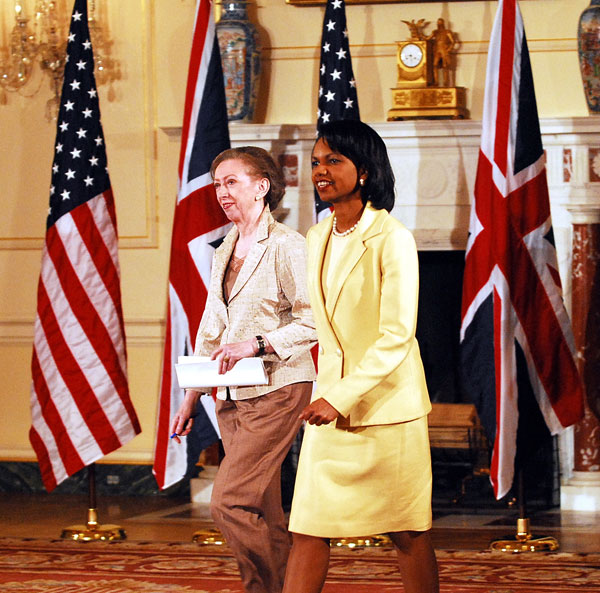
Ben Franklin Room, Washington, DC, July 11, 2006, Secretary Rice with the Right Honorable Margaret Beckett, M.P., Secretary of State for Foreign and Commonwealth Affairs of the United Kingdom of Great Britain and Northern Ireland after Bilateral.  State Department photo by Michael Gross.Ben Franklin Room, Washington, DC, July 11, 2006, Secretary Rice with the Right Honorable Margaret Beckett, M.P., Secretary of State for Foreign and Commonwealth Affairs of the United Kingdom
of Great Britain and Northern Ireland after Bilateral. State Department photo by Michael Gross.

SECRETARY RICE: Good afternoon. It is really my great pleasure to welcome Foreign Secretary Margaret Beckett to the United States and to the State Department. We have met on a number of occasions, but this is my first opportunity to welcome you to Washington, Margaret. And indeed we've had very productive discussions already concerning the wide variety of issues on which the United States and the United Kingdom cooperate. It's not surprising that perhaps there is no broader and deeper agenda than the one between the United States and the UK because we have no more important strategic partner than the United Kingdom.

We have had an opportunity to discuss the diplomacy and the upcoming diplomacy with Iran and our great hopes that the Iranian regime will give an answer to the very fruitful and very productive efforts that have been undertaken by the European-3+3.

We have had an opportunity to discuss the situation in North Korea. We have had an opportunity to talk about Afghanistan and Iraq, about the Middle East, and of course about a number of bilateral issues with the United States and the United Kingdom.

But more importantly, we continue to talk about how to make greater progress on the march of liberty and freedom and democracy worldwide, something that we of course share with Great Britain because we share values and we share a common desire to see those values spread because they are after all the basis for a permanent security, the basis for real security, the basis for real peace and the basis for real justice in the world.

And so, Margaret, it is really a delight to have you here and I look forward to many more conversations, including the fact that we will briefly, very shortly, meet again in Paris. And so welcome.

BRITISH FOREIGN SECRETARY BECKETT: Thank you very much. And it is a genuine and very real pleasure to be here again in Washington, but to be here for the first time as Foreign Secretary and with you, Condi. And we've talked, as you say, on many occasions and in many different cities but not, as it happens, before in this one. And I entirely share all the sentiments that you've expressed about the strength and the value of the relationship between our two countries, and in particular about that it is based on those shared values and that shared need to see the spread of peace and justice and democracy across the world.

And you've said quite rightly the range of issues that we've discussed together. I'd just like to perhaps pick up on particular on two: Iran and the position in the Middle East.

With regard to Iran, again I think I would wholeheartedly endorse what you said. The Iranians have said that they wish to be able to pursue access to civil nuclear power. Then if they do, I believe that the discussions that we have had, the proposals that have been put to them by the international community are proposals which should meet with a warm and a ready welcome. And we very much look forward -- all of us I think -- to hearing soon from the Iranians an official response to the proposals we've put to them. And if they have queries and concerns, we look forward to them being properly raised so that they can be dealt with so the international community can begin to have that reassurance about Iran's intentions that is very much an issue of concern.

And with regard to the Middle East, we are very mindful of the period of time since the Israeli soldier has been abducted. I spoke recently to President Abbas and shared with him our view, which I know you share, that we want to see that soldier returned unharmed and speedily and that we want to see the easing of those conflicts in the Middle East so that people can return to the path of negotiation, which is in the end the only way to any kind of peaceful solution.

SECRETARY RICE: Thank you.

MR. MCCORMACK: We have time for a couple questions. The first is Anne Gearan with AP.

QUESTION: A question for you both, please, on Iran. Last week came and went without the answer you hoped for. It's not clear what will happen this week or even by the time of the G-8. Do you sense a sense of drift here? Is Iran essentially stringing you all along? And at what point does their non-answer become an answer and what do you do?

SECRETARY RICE: Well, first of all, we will have an opportunity to meet with our colleagues in Paris on July 12th, at which time, as the G-8 statement said, we will assess the situation. It is very clear that the Iranians have before them a very beneficial proposal, a proposal that would be beneficial for their energy needs, but a proposal that has wider-ranging implications as well for trade and other matters. And it is really time to get an authoritative answer to that proposal.

Nevertheless, when we were in Vienna, as Secretary Beckett was the host when she noted that there are really two paths here, we hope that the Iranians choose the path before them for cooperation. But of course, we can always return to the other path, should we need to, and that path, as described by the Secretary was, of course, the path to the Security Council. Now it's our great hope that we are going to get an authoritative answer, but this is something that we're going to take up and consider when we meet in Paris.

Margaret, do you want to --

SECRETARY BECKETT: Not really. I think all I can do is really to say how much I agree with that. We have -- we went to a great deal of trouble. The original proponents of these moves were the EU-3, but Secretary Rice and our other colleagues were very keen to see that we had a stronger set of proposals as possible. We worked on those proposals and we had actually pretty much the basis of agreement when we met in New York, but we decided we wanted to put further work in to deepen and strengthen the proposals that we could put to Iran so that there was a real incentive for Iran to return to the path of negotiation. And we all very much hope that they will do so, but as Secretary Rice says, we will be meeting again in Paris, hopefully to discuss how we take those negotiations forward.

QUESTION: Do you feel, though, that you're being strung along?

SECRETARY BECKETT: Well, let's see what comes in the next few days. The Iranians have now had good time to look very carefully and in depth what is, to be fair, a detailed set of proposals. They have said on a number of occasions that there are, although not to us but they have been reported as saying in the media that there are ambiguities, there are questions. Fine, let's get those ambiguities and questions resolved so that we can move towards negotiation.

MR. MCCORMACK: Jonathan.

QUESTION: Thank you. A question for both the Foreign Secretary and the Secretary of State. Britain has just announced sending an extra 900 troops to Afghanistan. Is this evidence that the coalition has seriously underestimated the strength of a resurgent Taliban? And on the wider point, coalition forces have now been in that country for five years yet the security situation seems to be getting worse, not better. People will be wondering: How long does it take to build a nation, to restore Afghanistan to some security?

SECRETARY BECKETT: Well, that's a good stab at asking an unanswerable question: How long does it take to build a nation? But no, I think it wouldn't be right to say that we had seriously underestimated the difficulties that would arise in the south. I think clear indications have been given that there is perhaps a slightly stronger reaction, stronger force coming forward again from the Taliban than people had perhaps anticipated quite so speedily. But one of the main reasons, as I understand it, and of course my colleague has been making this statement in the House of Commons only today, is that there has been an increasing recognition that actually it would be good to do more infrastructure and on some of the concrete deliverables on the ground, so to speak, in order to help to underpin people's personal security and improve their daily lives in Afghanistan. And the bulk of the forces who are intended now to go in are people like engineers, with all their expertise in terms of such issues as infrastructure.

With regard to the general position though, yes, you're right, it is five years. But it is also true that the position was extremely difficult, that the Afghan people were in really pretty dire circumstances. President Karzai and his government are doing a tremendous job trying to bring together national unity, trying to create a greater degree of confidence. And as I say, these extra troops are going in to try and help put some of those -- better services, better support available on the ground. And I think that will be welcome. It doesn't mean the job is almost done. It will take time. But we are getting there.

SECRETARY RICE: I would only add that it was a country that has been through 25 years of civil war, including the period of the Soviet invasion, including of course the absolutely brutal and extraordinarily destructive reign of the Taliban, including a period of time in which that territory then became a base for al-Qaida which went then to attack the United States and others. And so the question that I would have is: Why wouldn't we spend five years securing a democratic Afghanistan, a country that has now through the Bonn process that was launched by the international community, a process that has led to the election now of a parliament, the election of a president of Afghanistan, the unification of the country, the building of Afghan national forces, the beginning of the reconstruction of Afghanistan, the deployment of forces to provincial reconstruction teams that are out around the entire country helping to extend the writ of the central government, the involvement of NATO in very large numbers to help and bring security. And yes, Afghanistan still has determined enemies, but this -- I would take this Afghanistan any day over the Afghanistan which we found when we, the British and others liberated the Afghan people from one of the worst regimes of the 20th and 21st centuries.

And so yes, it will take some time. Yes, there are still security problems in the country. But I would also be very careful not to confuse what is happening in the south with a strategic threat to the Afghan Government, that this is of course a group of Taliban that, yes, may have come back a little bit stronger, as Margaret said, than people anticipated. But they are being fought and fought fiercely and they are losing hugely in having confronted now coalition forces in that part of the country.

And to the degree that more forces are needed for construction, reconstruction or even for security, I think what this shows is that the coalition is prepared to do what it takes to completely secure Afghanistan. Because an Afghanistan that is a secure and fierce fighter in the war on terrorism, as this Afghanistan has the potential to be, is going to make a very big difference not just to Afghanistan but to all of South Central Asia; and indeed, as we found when al-Qaida had Afghanistan as a base, it will make a very big difference to international security and world peace as well.

Thank you.

2006/671, Released on July 10, 2006

Related: Keywords State Department, Wednesday, July 05, 2006 Condeleeza Rice, Turkish Foreign Minister VIDEO, PODCAST, TEXT, Monday, June 26, 2006 Secretary Rice With Foreign Affairs Minister of Poland, VIDEO, PODCAST, TEXT, Monday, June 19, 2006 Secretary Condoleezza Rice, Foreign Minister Miguel Angel Moratinos, VIDEO, PODCAST, TEXT, Monday, June 19, 2006 Robert Zoellick Announces Departure VIDEO, PODCAST, TEXT, Friday, June 02, 2006 R. Nicholas Burns, Remarks in Vienna, Austria, Wednesday, May 31, 2006 Iran Statement by Condoleezza Rice (VIDEO), Thursday, May 18, 2006 Secretary Rice With Prime Minister John Howard (PODCAST), Wednesday, May 10, 2006 Secretary Rice, EU Secretary General Javier Solana on Iran, VIDEO, PODCAST, TEXT, Wednesday, May 03, 2006 Secretary Rice, James Wolfensohn, Gaza Disengagement (PODCAST), Thursday, April 27, 2006 Remarks at Stakeout Secretary Condoleezza Rice, Friday, April 21, 2006 Secretary Rice to Travel to Europe, Friday, April 21, 2006 The Face of the State Department (VIDEO), Thursday, April 13, 2006 Secretary Rice Holds Talks with Equatorial Guinean President, Tuesday, April 11, 2006 State Department Podcast, VIDEO and Text 04/10/06, Wednesday, April 05, 2006 State Department Podcast, VIDEO and Text 04/03/06, Thursday, March 30, 2006 State Department Podcast, VIDEO and Text 03/29/06, Monday, April 03, 2006 Secretary Rice With Foreign Secretary Straw, Baghdad, Friday, March 31, 2006 Rice in Berlin To Discuss Iran with P-5 plus 1, Friday, March 31, 2006 UNHCR Worker’s Death in Sudan Attack,

Wednesday, July 12, 2006

Cheneys welcomed fifth grandchild

Technorati Tags: and or and ot and or and or

Today Vice President Dick Cheney and his wife Mrs. Lynne Cheney welcomed their fifth grandchild, Richard Jonathan Perry. He weighed 7 pounds, 4 ounces and was born at 11:19 a.m. at Sibley Memorial Hospital in Washington, D.C., July 11, 2006. His parents are Liz Cheney and Phil Perry, the daughter and son-in-law of the Cheneys. White House photo by David Bohrer.Today Vice President Dick Cheney and his wife Mrs. Lynne Cheney welcomed their fifth grandchild, Richard Jonathan Perry. He weighed 7 pounds, 4 ounces and was born at 11:19 a.m. at Sibley Memorial Hospital in Washington, D.C., July 11, 2006.
His parents are Liz Cheney and Phil Perry, the daughter and son-in-law of the Cheneys. White House photo by David Bohrer.

Relared: Keywords Vice President Cheney, Monday, July 03, 2006 Vice President Cheney NASCAR America Supports You., Sunday, July 02, 2006 Interview of the Vice President Fox Sports Daytona, Tuesday, May 09, 2006 Vice President's Remarks with Prime Minister Ivo Sanader of Croatia, Tuesday, May 09, 2006 Vice President's Remarks with President Nursultan Nazarbayev of Kazakhstan, Tuesday, May 09, 2006 Vice President's Remarks with Ukrainian President Viktor, Yushchenko, Tuesday, May 09, 2006 Vice President Cheney and Lithuanian President Valdus Adamkus, Monday, April 17, 2006 Vice President Cheney and Mrs. Cheney Release 2005 Income Tax Return, Thursday, February 16, 2006 Interview of the Vice President by Brit Hume (VIDEO), Wednesday, February 15, 2006 Update by the Office of the Vice President, Saturday, January 21, 2006 Vice President, Neil Cavuto, FOX News (VIDEO), Friday, January 13, 2006 Vice President to Travel to Egypt and Saudi Arabia, Friday, January 06, 2006 Vice President's Remarks on Iraq and the War on Terror (VIDEO), Thursday, November 17, 2005 Vice President's Remarks 11/16/05, Monday, October 31, 2005 Vice President appointed David S. Addington chief of staff, Saturday, October 29, 2005 Vice President's Statement on Libby Resignation, Friday, October 28, 2005 Resignation of Scooter Libby (VIDEO, Tuesday, October 04, 2005 Remarks by the Vice President to Second Marine Expeditionary Force,

Bombing Attacks in Kashmir and Mumbai

Technorati Tags: or or and or and or and or and

President's Statement on Explosions on Commuter Rail Lines in Mumbai

Police officers check the bags of passengers in a train at the Sealdah railway station in Calcutta, India, Wednesday, July 12, 2006. [© AP/WWP]On behalf of the American people, Laura and I send our deepest condolences to the friends and families of the victims of today's brutal attacks on commuter rail passengers in Mumbai.
The United States stands with the people and the Government of India and condemns in the strongest terms these atrocities, which were committed against innocent people as they went about their daily lives. Such acts only strengthen the resolve of the international community to stand united against terrorism and to declare unequivocally that there is no justification for the vicious murder of innocent people.

# # # For Immediate Release, Office of the Press Secretary, July 11, 2006

Secretary Condoleezza Rice, Statement by Secretary of State Condoleezza Rice, Washington, DC, July 11, 2006
People stand near the carriage of a train that was destroyed in a bomb explosion in Bombay, India, Tuesday, July 11, 2006. [© AP/WWP] from US State DepartmentThe United States condemns today’s horrific terrorist attacks in Kashmir and Mumbai. Many people have lost their lives and many others have been injured. Our thoughts and prayers are with the victims and their families.
There is no political cause that can justify the murder of innocent people. The United States stands with India in the war against terror. Those responsible for these terrible acts should be swiftly brought to justice.

2006/673, Released on July 11, 2006

RELATED: Keywords, Train, Bombing. Saturday, August 13, 2005 National Threat Level Mass Transit Sector, Friday, July 29, 2005 London, Five suspects arrested - 29/07/05, Friday, July 29, 2005 Nine arrested in Tooting, London, Friday, July 29, 2005 Four men arrested in West Midlands, Thursday, July 28, 2005 Image of Shepherd's Bush suspect, Tuesday, July 26, 2005 Wanted Person London Bombings, Monday, July 25, 2005 London Police make a further arrest, Sunday, July 24, 2005 US Coordinates with UK on Counterterrorism, Saturday, July 23, 2005 Most Wanted for London Incidents 21/07/05, Friday, July 22, 2005 Press conference - 15:45 - 22/07/05 London Bombing, Friday, July 22, 2005 Man shot at Stockwell tube station London, Thursday, July 21, 2005 London Police Appeal for Assistance - Can you help?, Thursday, July 21, 2005 London Press conference at 17.45 21 July, Thursday, July 21, 2005 London transport incidents, Incidents in London 21 July, Tuesday, July 19, 2005 Police investigation continues into the 7/7 bombings, Saturday, July 16, 2005 London Bombs Emails in circulation - advice to the public, Friday, July 15, 2005 London bombs, Trafalgar Square vigil, Thursday, July 14, 2005 pictures of Hasib Hussain released, Thursday, July 14, 2005 'One week anniversary' bombings appeal, Tuesday, July 12, 2005 London: Search warrants issued under the Terrorism Act 2000, Monday, July 11, 2005 London bombs, Sunday, July 10, 2005 London Metropolitan Police Service - Appeal for images, Saturday, July 09, 2005 bush radio address 07/09/05 full audio, text transcript, Saturday, July 09, 2005 President, VP Signs Book of Condolence at British Embassy, Friday, July 08, 2005 Metropolitan Police response to terrorist attack in London, Friday, July 08, 2005 The very latest on the London bombings, Friday, July 08, 2005 statement by Ken Livingstone, Mayor of London, Friday, July 08, 2005 Rudolph Giuliani praises emergency services,