


President Discusses War on Terror and Upcoming Iraqi Elections, FULL STREAMING VIDEO, Park Hyatt Philadelphia, Philadelphia, Pennsylvania 11:16 A.M. EST
Fact Sheet: Democracy in Iraq
In Focus: National Security
In Focus: Renewal in Iraq
Fact Sheet: Democracy in Iraq
THE PRESIDENT: Thank you all. (Applause.) Thank you. Thanks for the warm welcome. Thank you for the chance to come and speak to the Philadelphia World Affairs Council. This is an important organization that has, since 1949, has provided a forum for debate and discussion on important issues. I've come to discuss an issue that's really important, and that is victory in the war on terror.
And that war started on September the 11th, 2001, when our nation awoke to a sudden attack. Like generations before us, we have accepted new responsibilities, we're confronting dangers with new resolve. We're taking the fight to those who attacked us and to those who share their murderous vision for future attacks. We will fight this war without wavering, and we'll prevail.
The war on terror will take many turns, and the enemy must be defeated on many -- on every battlefield, from the streets of Western cities to the mountains of Afghanistan, to the tribal regions of Pakistan, to the islands of Southeast Asia and to the Horn of Africa. Yet the terrorists have made it clear that Iraq is the central front in their war against humanity, so we must recognize Iraq is the central front in the war on terror
Last month, my administration released a document called the "National Strategy for Victory in Iraq" -- and in recent weeks I've been discussing our strategy with the American people. At the U.S. Naval Academy, I spoke about our efforts to defeat the terrorists and train Iraqi security forces so they can provide safety for their own citizens. Last week before the Council on Foreign Relations, I explained how we are working with Iraqi forces and Iraqi leaders to help Iraqis improve security and restore order, to rebuild cities taken from the enemy, and to help the national government revitalize Iraq's infrastructure and economy. Today I'm going to speak in depth about another vital element of our strategy: our efforts to help the Iraqi people build a lasting democracy in the heart of the Middle East. I can think of no better place to discuss the rise of a free Iraq than in the heart of Philadelphia, the city where America's democracy was born.
I want to thank the -- Buntzie Churchill and Bill Sasso for letting me come. Thank you all for welcoming me. I got something to say, I'm looking forward to saying it here. I'm traveling with United States Senators -- they're always quick to hop a ride on Air Force One. (Laughter.) Particularly when they don't have to reimburse the government. (Laughter.) But I'm proud to be a friend of Arlen Specter and Rick Santorum. They're fine, honorable members of the United States Senate. (Applause.) I'm also pleased that Jim Gerlach and Mike Fitzpatrick and Joe Pitts of the United States Congress are with us. Thanks for serving. Thanks for being here. (Applause.)
A few blocks from here stands Independence Hall, where our Declaration of Independence was signed and our Constitution was debated. From the perspective of more than two centuries, the success of America's democratic experiment seems almost inevitable. At the time, however, that success didn't seem so obvious or assured.
The eight years from the end of the Revolutionary War to the election of a constitutional government were a time of disorder and upheaval. There were uprisings, with mobs attacking courthouses and government buildings. There was a planned military coup that was defused only by the personal intervention of General Washington. In 1783, Congress was chased from this city by angry veterans demanding back-pay, and they stayed on the run for six months. There were tensions between the mercantile North and the agricultural South that threatened to break apart our young republic. And there were British loyalists who were opposed to independence and had to be reconciled with America's new democracy.
Our founders faced many difficult challenges -- they made mistakes, they learned from their experiences, and they adjusted their approach. Our nation's first effort at governing -- a governing charter, the Articles of Confederation, failed. It took years of debate and compromise before we ratified our Constitution and inaugurated our first president. It took a four-year civil war, and a century of struggle after that, before the promise of our Declaration was extended to all Americans.
It is important to keep this history in mind as we look at the progress of freedom and democracy in Iraq. No nation in history has made the transition to a free society without facing challenges, setbacks, and false starts. The past two-and-a-half years have been a period of difficult struggle in Iraq, yet they've also been a time of great hope and achievement for the Iraqi people.
Just over two-and-a-half years ago, Iraq was in the grip of a cruel dictator who had invaded his neighbors, sponsored terrorists, pursued and used weapons of mass destruction, murdered his own people, and for more than a decade, defied the demands of the United Nations and the civilized world. Since then, the Iraqi people have assumed sovereignty over their country, held free elections, drafted a democratic constitution, and approved that constitution in a nationwide referendum. Three days from now, they go to polls for the third time this year, and choose a new government under the new constitution.
It's a remarkable transformation for a country that has virtually no experience with democracy, and which is struggling to overcome the legacy of one of the worst tyrannies the world has known. And Iraqis achieved all this while determined enemies use violence and destruction to stop the progress. There's still a lot of difficult work to be done in Iraq, but thanks to the courage of the Iraqi people, the year 2005 will be recorded as a turning point in the history of Iraq, the history of the Middle East, and the history of freedom.
As the Iraqi people struggle to build their democracy, adversaries continue their war on a free Iraq. The enemy in Iraq is a combination of rejectionists and Saddamists and terrorists. The rejectionists are ordinary Iraqis, mostly Sunni Arabs, who miss the privileged status they had under the regime of Saddam Hussein. They reject an Iraq in which they're no longer the dominant group. We believe that over time most of this group will be persuaded to support a democratic Iraq led by a federal government that is strong enough to protect minority rights, and we're encouraged that many Sunnis plan to actively participate in this week's election.
The Saddamists are former regime loyalists who harbor dreams of returning to power, and they're trying to foment anti-democratic sentiment amongst the larger Sunni community. Yet they lack popular support, and over time, they can be marginalized and defeated by the people and security forces of a free Iraq.
The terrorists affiliated with or inspired by al Qaeda are the smallest, but most lethal group. Many are foreigners coming to fight freedom's progress in Iraq. They are led by a brutal terrorist named Zarqawi -- al Qaeda's chief of operations in Iraq -- who has stated his allegiance to Osama bin Laden. The terrorists' stated objective is to drive U.S. and coalition forces out of Iraq and gain control of that country, and then use Iraq as a base from which to launch attacks against America, overthrow moderate governments in the Middle East, and establish a totalitarian Islamic empire that reaches from Spain to Indonesia.
The terrorists in Iraq share the ideology of the terrorists who struck the United States on September the 11th. They share the ideology with those who blew up commuters in London and Madrid, murdered tourists in Bali, and killed workers in Riyadh, and slaughtered guests at a wedding in Amman, Jordan. This is an enemy without conscience, and they cannot be appeased. If we were not fighting and destroying this enemy in Iraq, they would not be leading quiet lives as good citizens. They would be plotting and killing our citizens, across the world and here at home. By fighting the terrorists in Iraq, we are confronting a direct threat to the American people, and we will accept nothing less than complete victory. (Applause.)
We are pursuing a comprehensive strategy in Iraq. Our goal is victory, and victory will be achieved when the terrorists and Saddamists can no longer threaten Iraq's democracy, when the Iraqi security forces can provide for the safety of their own citizens, and when Iraq is not a safe haven for terrorists to plot new attacks against our nation.
Our strategy in Iraq has three elements: On the economic side, we're helping the Iraqis restore their infrastructure, reform their economy, and build the prosperity that will give all Iraqis a stake in a free and peaceful Iraq. On the security side, coalition and Iraqi forces are on the offense against the enemy. We're working together to clear out areas controlled by the terrorists and Saddam loyalists, and leaving Iraqi forces to hold territory taken from the enemy. And as we help Iraqis fight these enemies, we are working to build capable and effective Iraqi security forces, so they can take the lead in the fight, and eventually take responsibility for the safety and security of their citizens without major foreign assistance.
We're making steady progress. The Iraqi forces are becoming more and more capable. They're taking more responsibility for more and more territory. We're transferring bases to their control so they can take the fight to the enemy. And that means American and coalition forces can concentrate on training Iraqis, and hunting down the high-value targets like the terrorist Zarqawi and his associates.
Today, I want to discuss the political element of our strategy: our efforts to help the Iraqis build inclusive democratic institutions that will protect the interests of all the Iraqi people. By helping Iraqis to build a democracy, we will win over those who doubted they had a place in a new Iraq, and undermine the terrorists and Saddamists. By helping Iraqis to build a democracy, we will gain an ally in the war on terror. By helping Iraqis build a democracy, we will inspire reformers across the Middle East. And by helping Iraqis build a democracy, we will bring hope to a troubled region, and this will make the American people more secure.
From the outset, the political element of our strategy in Iraq has been guided by a clear principle: Democracy takes different forms in different cultures. Yet in all cultures, successful free societies are built on certain common foundations -- rule of law, freedom of speech, freedom of assembly, a free economy, and freedom to worship. Respect for the belief of others is the only way to build a society where compassion and tolerance prevail. Societies that lay these foundations not only survive, but thrive. Societies that do not lay these foundations risk backsliding into tyranny.
When our coalition arrived in Iraq, we found a nation where almost none of these basic foundations existed. Decades of brutal rule by Saddam Hussein had destroyed the fabric of Iraqi civil society. Under Saddam, Iraq was a country where dissent was crushed. A centralized economy enriched a dictator instead of the people; secret courts meted out repression instead of justice; and Shia Muslims, and Kurds and other groups were brutally oppressed. And when Saddam Hussein's regime fled Baghdad, they left behind a country with few civic institutions in place to hold Iraq society together.
To fill the vacuum after liberation, we established the Coalition Provisional Authority. The CPA was ably led by Ambassador Jerry Bremer, and many fine officials from our government volunteered to serve in the EPA -- CPA. While things did not always go as planned, these men and women did a good job under extremely difficult and dangerous circumstances -- helping to restore basic services, making sure food was distributed, and reestablishing government ministries.
One of the CPA's most important tasks was bringing the Iraqi people into the decision-making process of their government after decades of tyrannical rule. Three months after liberation, our coalition worked with the United Nations and Iraqi leaders to establish an Iraqi Governing Council. The Governing Council gave Iraqis a voice in their own affairs, but it was unelected. It was subordinate to the CPA and, therefore, it did not satisfy the hunger of Iraqis for self-government. Like free people everywhere, Iraqis wanted to be governed by leaders they had elected, not foreign officials.
So in the summer of 2003, we proposed a plan to transfer sovereignty to the Iraqi people. Under this plan, the CPA would continue to govern Iraq while appointed Iraqi leaders drafted a constitution, put that constitution before the people, and then held elections to choose a new government. Only when that elected government took office would the Iraqis regain their sovereignty.
This plan met with the disapproval of the Iraqis. They made it clear that they wanted a constitution that was written by elected leaders of a free Iraq, and they wanted sovereignty placed in Iraqi hands sooner. We listened, and we adjusted our approach. In November of 2003, we negotiated a new plan with the Governing Council, with steps for an accelerated transition to Iraqi self-government. Under this new plan, a Transitional Administrative Law was written by the Governing Council and adopted in March of 2004. This law guaranteed personal freedoms unprecedented in the Arab world, and set forth four major milestones to guide Iraq's transition to a constitutional democracy.
The first milestone was the transfer of sovereignty to an Iraqi interim government by the end of June 2004. The second was for Iraqis to hold free elections to choose a transitional government by January of 2005. The third was for Iraqis to adopt a democratic constitution, which would be drafted no later than August 2005, and put before the Iraqi people in a nationwide referendum no later than October. And the fourth was for Iraqis to choose a government under that democratic constitution, with elections held December 2005.
The first milestone was met when our coalition handed over sovereignty to the Iraqi leaders on June 28th, 2004 -- two days ahead of schedule. In January 2005, Iraqis met the second milestone when they went to the polls and chose their leaders in free elections. Almost eight-and-a-half million Iraqis defied the car bombers and assassins to cast their ballots, and the world watched in awe as jubilant Iraqis danced in the street and held ink-stained fingers and celebrated their freedom.
The January elections were a watershed event for Iraq and the Middle East, yet they were not without flaws. One problem was the failure of the vast majority of Sunni Arabs to vote. When Sunnis saw a new 275-member parliament taking power in which they had only 16 seats, many realized that their failure to participate in the democrat process had hurt their chances and hurt their groups -- it hurt their constituencies. And Shia and Kurdish leaders who had won power at the polls saw that for a free and unified Iraq to succeed, they needed Sunni Arabs to be part of the government. We encouraged Iraq's leaders to reach out to Sunni leaders, and bring them into the governing process. When the transitional government was seated in the spring of this year, Sunni Arabs filled important posts, including a vice president, a minister of defense, and the speaker of the National Assembly.
The new government's main political challenge -- next political challenge was to meet the third milestone, which was adopting a democratic constitution. Again, Iraq's leaders reached out to Sunni Arabs who had boycotted the elections and included them in the drafting process. Fifteen Sunni Arab negotiators and several Sunni Arab advisors joined the work of the constitutional drafting committee. After much tough debate, representatives of Iraq's diverse communities drafted a bold constitution that guarantees the rule of law, freedom of assembly, property rights, freedom of speech and the press, women's rights, and the right to vote. As one Arab scholar put it, the Iraqi constitution marks "the dawn of a new age in Arab life."
The document that initially emerged from the committee did not unify Iraqis, and many Sunnis on the constitutional committee did not support the draft. Yet Iraq's leaders continued working to gain Sunni support. And thanks to last-minute changes -- including a new procedure for considering amendments to the constitution next year -- a deal was struck four days before the Iraqis went to the polls. The revised constitution was endorsed by Iraq''s largest Sunni party. It was approved in referendum that attracted over a million more voters than in the January elections. Many Sunnis voted against the constitution, but Sunnis voted in large numbers for the first time. They joined the political process. And by doing so, they reject the violence of the Saddamists and rejectionists. Through hard work and compromise, Iraqis adopted the most progressive, democratic constitution in the Arab world.
On Thursday, Iraqis will meet their fourth milestone. And when they do go to the polls and choose a new government under the new constitution, it will be a remarkable event in the Arab world. Despite terrorist violence, the country is buzzing with signs and sounds of democracy in action. The streets of Baghdad, and Najaf and Mosul, and other cities are full of signs and posters. The television and radio air waves are thick with political ads and commentary. Hundreds of parties and coalitions have registered for this week's elections, and they're campaigning vigorously. Candidates are holding rallies and laying out their agendas and asking for the vote.
Our troops see this young democracy up close. First Lieutenant Frank Shriley of Rock Hall, Maryland, says, "It's a cool thing riding around Baghdad and seeing the posters -- it reminds me of being home during election time. After so many years of being told what to do, having a real vote is different."
Unlike the January elections, many Sunnis are campaigning vigorously for office this time around. Many Sunni parties that opposed the constitution have registered to compete in this week's vote. Two major Sunni coalitions have formed, and other Sunni leaders have joined national coalitions that cross religious, ethnic, and sectarian boundaries. As one Sunni politician put it, this election "is a vote for Iraq; we want a national Iraq, not a sectarian one."
To encourage broader participation by all Iraqi communities, the National Assembly made important changes in Iraq's electoral laws that will increase Sunni representation in the new assembly. In the January elections, Iraq was one giant electoral district, so seats in the transitional assembly simply reflected turnout. Because few Sunnis voted, their communities were left with little representation. Now, Iraq has a new electoral system, where seats in the new Council of Representatives will be allocated by province and population -- much like our own House of Representatives. This new system is encouraging more Sunnis to join in the democratic process because it ensures that Sunnis will be well-represented, even if the terrorists and Saddamists try to intimidate voters in the provinces where most Sunnis live.
More Sunnis are involved because they see Iraqi democracy succeeding. They have learned a lesson of democracy: They must participate to have a voice in their nation's affairs. A leading Sunni who had boycotted the January vote put it this way: "The Sunnis are now ready to participate." A Sunni sheik explains why Sunnis must join the process: "In order not to be marginalized, we need power in the National Assembly." As more Sunnis join the political process, the Saddamists and remaining rejectionists will be marginalized. As more Sunnis join the political process, they will protect the interests of their community.
Like the Shia and Kurds, who face daily attacks from the terrorists and Saddamists, many Sunnis who join the political process are being targeted by the enemies of a free Iraq. The Iraqi Islamic Party -- a Sunni party that boycotted the January vote and now supports elections -- has seen its offices bombed. And a party leader reports that at least 10 members have been killed since the party announced it would field candidates in Thursday's elections. Recently a top Sunni electoral official visited the Sunni stronghold of Baquba. He went to encourage local leaders to participate in the elections. During his visit, a roadside bomb went off. It rattled his convoy, but it didn't stop it. He says this about the attempt on his life: "The bomb is nothing [compared to] what we're doing. What we're doing is bigger than the bomb."
By pressing forward and meeting their milestones, the Iraqi people have built momentum for freedom and democracy. They've encouraged those outside the process to come in. At every stage, there was enormous pressure to let the deadlines slide, with skeptics and pessimists declaring that Iraqis were not ready for self-government. At every stage, Iraqis proved the skeptics and pessimists wrong. At every stage, Iraqis have exposed the errors of those in our country and across the world who question the universal appeal of liberty. By meeting their milestones, Iraqis are defeating a brutal enemy, rejecting a murderous ideology, and choosing freedom over terror.
This week elections won't be perfect, and a successful vote is not the end of the process. Iraqis still have more difficult work ahead, and our coalition and the new Iraqi government will face many challenges, including in four critical errors -- areas: ensuring Iraqi security, forming an inclusive Iraqi government, encouraging Iraqi reconciliation, and maintaining Iraqi democracy in a tough neighborhood.
The first key challenge is security. As democracy takes hold in Iraq, the terrorists and Saddamists will continue to use violence. They will try to break our will and intimidate the Iraqi people and their leaders. These enemies aren't going to give up because of a successful election. They understand what is at stake in Iraq. They know that as democracy takes root in that country, their hateful ideology will suffer a devastating blow, and the Middle East will have a clear example of freedom and prosperity and hope.
So our coalition will continue to hunt down the terrorists and Saddamists. We'll continue training Iraqi security forces to take the lead in the fight, and defend their new democracy. As the Iraqi security forces stand up, coalition forces can stand down. And when victory is achieved, our troops will then return home with the honor they have earned.
The second key challenge is forming an inclusive government that protects the interests of all Iraqis, and encourages more in the rejectionist camp to abandon violence and embrace politics. Early next year, Iraq's new parliament will come to Baghdad and select a prime minister, and a presidency council, and a cabinet of ministers. Two-thirds of the new parliament must agree on the top leadership posts, and this will demand negotiation and compromise. It will require patience by America and our coalition allies. This new government will face many tough decisions on issues such as security and reconstruction and economic reform. Iraqi leaders will also have to review and possibly amend the constitution and ensure that this historic document earns the broad support of all Iraqi communities. By taking these steps, Iraqi leaders will build a strong and lasting democracy. This is an important step in helping to defeat the terrorists and the Saddamists.
The third key challenge is establishing rule of law and the culture of reconciliation. Iraqis still have to overcome longstanding ethnic and religious tensions, and the legacy of three decades of dictatorship. During the regime of Saddam Hussein, Shia, Kurds and other groups were brutally oppressed, and for some there is now a temptation to take justice into their own hands. Recently, U.S. and Iraqi troops have discovered prisons in Iraq where mostly Sunni men were held, some of whom have appeared to have been beaten and tortured. This conduct is unacceptable, and the Prime Minister and other Iraqi officials have condemned these abuses, an investigation has been launched, and we support these efforts. Those who committed these crimes must be held to account.
We will continue helping Iraqis build an impartial system of justice that protects all of Iraq's citizens. Millions of Iraqis are seeing their independent judiciary in action, as their former dictator, Saddam Hussein, is put on trial in Baghdad. The man who once struck fear in the hearts of Iraqis has heard his victims recount the acts of torture and murder that he ordered. One Iraqi watching the proceedings said: "We all feel happiness about this fair trial." Slowly but surely, with the help of our coalition, Iraqis are replacing the rule of a tyrant with the rule of law, and ensuring equal justice for all their citizens.
Oh, I know some fear the possibility that Iraq could break apart and fall into a civil war. I don't believe these fears are justified. They're not justified so long as we do not abandon the Iraqi people in their hour of need. Encouraging reconciliation and human rights in a society scarred by decades of arbitrary violence and sectarian division is not going to be easy and it's going to happen overnight. Yet the Iraqi government has a process in place to resolve even the most difficult issues through negotiate, debate and compromise. And the United States, along with the United Nations and the Arab League and other international partners, will support these efforts to help resolve these issues. And as Iraqis continue to develop the habits of liberty, they will gain confidence in the future, and ensure that Iraqi nationalism trumps Iraqi sectarianism.
A fourth key challenge is for Iraqis to maintain their newfound freedoms in a tough neighborhood. Iraq's neighbor to the east, Iran, is actively working to undermine a free Iraq. Iran doesn't want democracy in Iraq to succeed because a free Iraq threatens the legitimacy of Iran's oppressive theocracy. Iraq's neighbor to the west, Syria, is permitting terrorists to use that territory to cross into Iraq. The vast majority of Iraqis do not want to live under an Iranian-style theocracy, and they don't want Syria to allow the transit of bombers and killers into Iraq -- and the United States of America will stand with the Iraqi people against the threats from these neighbors. (Applause.)
We'll continue to encourage greater support from the Arab world and the broader international community. Many Arab states have kept the new Iraq at arms' distance. Yet as more Arab states are beginning to recognize that a free Iraq is here to stay, they're starting to give Iraq's new government more support. Recently, Saudi Arabia, Egypt, and Jordan have welcomed the Iraqi Prime Minister on official visits. Last month, the Arab League hosted a meeting in Cairo to promote national reconciliation among Iraqis, and another such meeting is planned for next year in Baghdad.
These are important steps, and Iraq's neighbors need to do more. Arab leaders are beginning to recognize that the choice in Iraq is between democracy and terrorism, and there is no middle ground. The success of Iraqi democracy is in their vital interests because if the terrorists prevail in Iraq, they will then target other Arab nations.
International support for Iraq's democracy is growing, as well. Other nations have pledged more than $13 billion in assistance to Iraq, and we call on them, those who have pledged assistance, to make good on their commitments. The World Bank recently approved its first loan to Iraq in over 30 years, lending the Iraqi government $100 million to improve the Iraqi school system. The United Nations is playing a vital role in Iraq -- they assisted in last January's elections, and the negotiations for the constitution, and in the recent constitutional referendum. And at the request of the Iraqi government, the U.N. Security Council unanimously approved a resolution extending the mandate of the multinational force in Iraq through 2006. Earlier this year, the European Union co-hosted a conference for more than 80 countries and international organizations, so they can better coordinate their efforts to help Iraqis rebuild their nation. Whatever differences there were over the decision to liberate Iraq, all free nations now share a common interest -- building an Iraq that will fight terror, and be a source of stability and freedom in a troubled region of the world.
The challenges ahead are complex and difficult, yet Iraqis are determined to overcome them and build a free nation. And they require our support. Millions of Iraqis will put their lives on the line this Thursday in the name of liberty and democracy. And 160,000 of America's finest are putting their lives on the line so Iraqis can succeed. The American and Iraqi people share the same interests and the same enemies -- and by helping democracy succeed in Iraq, we bring greater security to our citizens here at home.
The terrorists know that democracy is their enemy, and they will continue fighting freedom's progress with all the hateful determination they can muster. Yet the Iraqi people are stepping forward to claim their liberty, and they will have it. When the new Iraqi government takes office next year, Iraqis will have the only constitutional democracy in the Arab world, and Americans will have a partner for peace and moderation in the Middle East.
People across the broader Middle East are drawing, and will continue to draw inspiration from Iraq's progress, and the terrorists' powerful myth is being destroyed. In a 1998 fatwa, Osama bin Laden argued that the suffering of the Iraqi people was justification for his declaration of war on America. Now bin Laden and al Qaeda are the direct cause of the Iraqi people's suffering. As more Muslims across the world see this, they're turning against the terrorists. As the hope of liberty spreads in the Middle East, the terrorists will lose their sponsors, lose their recruits, and lose the sanctuaries they need to plan new attacks.
A free Iraq is not going to be a quiet Iraq -- it will be a nation full of passionate debate and vigorous political activity. It will be a nation that continues to face some level of violence. Yet Iraqis are showing they have the patience and the courage to make democracy work -- and Americans have the patience and courage to help them succeed.
We've done this kind of work before; we must have confidence in our cause. In World War II, the free nations defeated fascism and helped our former adversaries, Germany and Japan, build strong democracies -- and today, these nations are allies in securing the peace. In the Cold War, free nations defeated communism, and helped our former Warsaw Pact adversaries become strong democracies -- and today, nations of Central and Eastern Europe are allies in the war on terror.
Today in the Middle East, freedom is once again contending with a totalitarian ideology that seeks to sow anger and hatred and despair. And like fascism and communism before, the hateful ideologies that use terror will be defeated by the unstoppable power of freedom. (Applause.)
And the advance of freedom in the Middle East requires freedom in Iraq. By helping Iraqis build a lasting democracy, we will spread the hope of liberty across a troubled region, and we'll gain new allies in the cause of freedom. By helping Iraqis build a strong democracy, we're adding to our own security, and, like a generation before us, we're laying the foundation of peace for generations to come.
Not far from here where we gather today is a symbol of freedom familiar to all Americans -- the Liberty Bell. When the Declaration of Independence was first read in public, the Liberty Bell was sounded in celebration, and a witness said: "It rang as if it meant something." Today, the call of liberty is being heard in Baghdad and Basra, and other Iraqi cities, and its sound is echoing across the broader Middle East. From Damascus to Tehran, people hear it, and they know it means something. It means that the days of tyranny and terror are ending, and a new day of hope and freedom is dawning.
Thank you for letting me come. (Applause.)
I thought I might answer some questions. (Laughter.) Yes, ma'am.
Q Since the inception of the Iraqi war, I'd like to know the approximate total of Iraqis who have been killed. And by Iraqis I include civilians, military, police, insurgents, translators.
THE PRESIDENT: How many Iraqi citizens have died in this war? I would say 30,000, more or less, have died as a result of the initial incursion and the ongoing violence against Iraqis. We've lost about 2,140 of our own troops in Iraq.
Yes.
Q Mr. President, thank you --
THE PRESIDENT: I'll repeat the question. If I don't like it, I'll make it up. (Laughter and applause.)
Q -- Thank you for coming to the city where liberty was born. Central to your policy in Iraq is the role of the Iraqis. We hear widely different tales about how the Iraqis are doing in their own area of defense. Could you give us your perspective on how they're doing, how well the military is doing, what you feel the capability is to do the task that you want them to do, to include some of the widely different impressions that we hear about.
THE PRESIDENT: No, I appreciate that. When we first began training -- our strategy all along has been to train Iraqis so they can take the fight and succeed in what we're trying to do, which is a democracy -- a democracy which will serve as an example for others; a democracy which will join us in the fight on terror; a democracy which will help us prevent other countries from becoming safe haven for terrorists who still want to kill us. That's -- that was our objective. And all along we wanted the Iraqis to be able to do -- take the fight.
When we first got going we said we'll train an army that will be able to deal with external threats, and a civil defense corps that will be able to deal with internal threats. And the problem with that strategy was that the internal threats were a heck of a lot more severe than the external threats, and the army -- the civilian corps we trained was not properly trained and equipped.
So we adjusted. We trained everybody for the army and -- recognizing that the army is going to have to not only take the fight to the enemy -- or the new army take the fight to the enemy, but when we clear enemies out of places like Mosul, that there has to be an Iraqi army presence to earn the confidence of the people.
When the war first got going, we'd move into Mosul, clear out an enemy, leave, and the enemy would return. And so the Iraqi people had no confidence in the future. They were -- they didn't dare, for example, tell coalition forces or Iraqi forces the names of those who were killing their citizens because they didn't have the confidence there would be a force to protect them. And so we began the process of clearing out and holding with more and more trained Iraqi forces. And now the Iraqi forces are helping to rebuild these cities. Democracy is only going to succeed if people say, my life is going to be better. I mean, no different a campaign here -- you know, vote for me, I want to help improve your life.
And that's what -- and so the strategy has been to -- let me say, we adjusted our strategy, and there's about 200,000-plus capable units. Now, not all of them are ready to take the fight to the enemy. In order to have a division or a battalion ready to fight, you've got to be able to communicate, you've got to be able to move, you've got to be able to have logistical supplies. But more and more of the Iraqis are in the lead in the fight, and more and more Iraqis are being trained so they can hold the positions once we clear.
We are not completed -- we haven't completed the job of training the Iraqis. But what is beginning to happen is, is that you're beginning to see our troops step back from the fight. I don't know if you realize, we had some 90 bases in Iraq, and I think we've closed about 40 -- or turned over -- closed or turned over 40 of those bases to the Iraqis. In other words, our profile is beginning to move back as the Iraqis get trained up -- so that we can continue working on training, and also help them chase down Zarqawi and his buddies. They're -- these guys are very tough and they're cold-blooded killers.
The enemy has got one weapon. See, they can't defeat us militarily. What they can do is they can -- and will -- kill innocent people in the hopes of trying to get the United States of America to leave the battlefield early. The only way we can lose is if we lose our nerve. And they know that. And they've stated that publicly.
And -- but the training is going much better than it was in the first year. The -- and we've just got more to do, and we need to do it, because a free Iraq, again, will be an important ally in this war. This is a global struggle we're in. It's -- this isn't an enemy that is isolated, kind of angry group of people. These are people that have got a totalitarian vision. They've got designs and ambitions. They've laid out their strategy and they explained their tactics. And we've got to listen to them and take them seriously. And part of their tactics is to create vacuums so that their hateful ideology flows in.
They -- listen, the attack of September the 11th was a part of a broad strategy to get us to retreat from the world. And that -- people say, well, he's making it up that they want to establish a totalitarian empire that stretches from Spain to Indonesia. I'm telling you what they said; not me. This is what Zawahiri has said -- the number-two man in al Qaeda. It seems like to me we need to take it seriously when the enemy says something.
Kind of getting off subject, here, but -- yes, sir.
Q Mr. President, I'm a proud U.S. citizen, naturalized, and card-carrying Republican. I voted for you both times. I grew in India, a Sunni. In fact, the President of the Republic of India is a Sunni. And I think it's a great testimony to this nation that was -- the vision of which was laid out within a few -- half a mile of here, that somebody like me can be in a position of leadership and be successfully engaged in contributing to the current and future economic well-being of this nation. Mr. President, I support your efforts in Iraq. But I'd like to know what are we going to do in the broader battle in creating a favorable image and reaching out to people across the world, so that people like me all over the world can be passionate supporters of the United States.
THE PRESIDENT: Yes, I appreciate that. First of all, success will help the image of the United States. Look, I recognize we got an image issue, particularly when you got television stations, Arabic television stations that are constantly just pounding America, creating -- saying America is fighting Islam, Americans can't stand Muslims, this is a war against a religion. And we've got to, obviously, do a better job of reminding people that ours is not a nation that rejects religion; ours is a nation that accepts people of all faith, and that the great strength of America is the capacity for people to worship freely.
It's difficult. I mean, their propaganda machine is pretty darn intense. And so we're constantly sending out messages, we're constantly trying to reassure people, but we're also -- we're also acting. And that's what's important for our citizens to realize. Our position in the world is such that I don't think we can retreat. I think we have a duty and an obligation to use our vast influence to help.
I cite two examples of where I think it will make a big -- of where American image in the Muslim world will be improved. One is the tsunami. The tsunamis hit; it was the United States military, through the USS Abraham Lincoln, that provided the logistical organization necessary to get the -- to get the -- to save a lot of lives. We moved. A lot of people kind of sat around and discussed; not us. We saw a problem and we moved.
Same in Pakistan. The earthquake in Pakistan is devastating. The United States of America was first on the scene. We got a lot of kids flying choppers all around that country providing help and aid.
And so I guess what I'm saying to you is, is that a proper use of influence that helps improve people's lives is the best way to affect -- to change the image of country, and to defeat the propaganda. Having said all that, a lot of people want to come to America. The image may be bad, but give them a chance, all you who want to come to America, raise your hand -- there's a lot wanting to come. That's another issue, which is immigration reform.
But thank you for that. One thing America must never do is lose our capacity to take people from all walks of life and help them become an American, first and foremost. That's what distinguishes us from other cultures and other nations. You can come from wherever you are, and I can come from Texas, and we both share the same deal -- we're Americans first and foremost. I happen to be a Methodist. You're a Sunni. (Laughter.)
Yes, ma'am.
Q Mr. President, I would like to know why it is that you and others in your administration keep linking 9/11 to the invasion of Iraq when no respected journalist or Middle Eastern expert confirmed that such a link existed.
THE PRESIDENT: What did she -- I missed the question. Sorry. I didn't -- I beg your pardon, I didn't hear you. Seriously.
Q I would like to know why you and others in your administration invoke 9/11 as justification for the invasion of Iraq --
THE PRESIDENT: Yes --
Q -- when no respected journalists or other Middle Eastern experts confirm that such a link existed.
THE PRESIDENT: I appreciate that. 9/11 changed my look on foreign policy. I mean, it said that oceans no longer protect us, that we can't take threats for granted; that if we see a threat, we've got to deal with it. It doesn't have to be militarily, necessarily, but we got to deal with it. We can't -- can't just hope for the best anymore.
And so the first decision I made, as you know, was to -- was to deal with the Taliban in Afghanistan because they were harboring terrorists. This is where the terrorists planned and plotted. And the second decision, -- which was a very difficult decision for me, by the way, and it's one that I -- I didn't take lightly -- was that Saddam Hussein was a threat. He is a declared enemy of the United States; he had used weapons of mass destruction; the entire world thought he had weapons of mass destruction. The United Nations had declared in more than 10 -- I can't remember the exact number of resolutions -- that disclose, or disarm, or face serious consequences. I mean, there was a serious international effort to say to Saddam Hussein, you're a threat. And the 9/11 attacks extenuated that threat, as far as I -- concerned.
And so we gave Saddam Hussein the chance to disclose or disarm, and he refused. And I made a tough decision. And knowing what I know today, I'd make the decision again. Removing Saddam Hussein makes this world a better place and America a safer country. (Applause.)
Last question. I've actually got something to do. (Laughter.) You're paying me all this money, I'd better get back to work. (Laughter.)
Hold on a second. Got a guy here.
Q Mr. President, I'm from the Phelps School; I'm a supporter of yours.
THE PRESIDENT: Oops, that kind of prejudices your question. (Laughter.)
Q Well I have a question for you. Do you feel that since invading Iraq, the threat of terrorism on U.S. soil has been reduced significantly?
THE PRESIDENT: I think it's been reduced; I don't think we're safe. What will really give me confidence to say that we're safe is when I can tell the American people we've got the capacity to know exactly where the enemy is moving. This is a different kind of war. These people hide. They -- they're patient and they're sophisticated. And that's why our intelligence-gathering is really important.
You know, occasionally they come out and want to fight like they're doing in Iraq. This guy, Zarqawi, has sworn his allegiance to bin Laden. He has -- he's declared his intentions. But there's a lot of them who lurk and hide. And what we've really got to do is continue to hone our intelligence-gathering to make sure that we can, as best as possible, understand their intents and watch their movements. And this requires international cooperation.
I will tell you the international cooperation, when it comes to sharing intelligence, is good. It requires us being able to cut off their money and move money around. They can't -- it turns out, they can't launch attacks without money. And so we're doing the best we can to work with others to find out where their money is moving. And that way, it will be a -- give us a chance to find out where they are.
The long run in this war is going to require a change of governments in parts of the world. It's -- and this is why it's very important for me to continue to remind the American people about what's taking place in history. One of my favorite stories is to tell people about -- or go-bys -- is to tell people about my relationship with Koizumi, Prime Minister Koizumi of Japan. He's an interesting guy. He likes Elvis, for example, which is -- (laughter) -- interesting -- (laughter). He's a friend. He's also a friend when it comes to peace. He's a reliable, steady ally when it comes to dealing with North Korea. North Korea is a country that has declared boldly they've got nuclear weapons, they counterfeit our money, and they've starving their people to death. And it's good to have an ally that understands human rights and the condition of the human being are vital for this world and world peace.
And yet, 60 years ago, my dad fought against the Japanese -- many of your relatives did, as well. They were the sworn enemy of the United States. I find it amazing -- I don't know if you find it amazing -- I find it amazing that I sit down with this guy, strategizing about how to make the world a more peaceful place when my dad and others fought him.
And so what happened? Now, 60 years seems like a long time, particularly if you're 59, like me. (Laughter.) But it's not all that long in history, when you think about it. And what happened was a Japanese-style democracy emerged. Democracies yield the peace. That's what history has shown us. That's what I tried to say in my peroration in this speech. That's a long word. I'm doing it for Senator Specter here. (Laughter and applause.) Just showing off, Senator. Just trying to look good in front of the folks here at home. (Laughter.) But it's an accurate portrayal of what has happened. Democracies yield the peace.
So the fundamental question is, do we have the confidence and universal values to help change a troubled part of the world. If you're a supporter of Israel, I would strongly urge you to help other countries become democracies. Israel's long-term survival depends upon the spread of democracy in the Middle East. I recognize people have -- (applause) -- I fully recognize that some say it's impossible, that maybe only a certain kind of people can be -- can accept democracy. I just -- I reject that. I don't agree with that. I believe democracy -- the desire to be free is universal. That's what I believe. And if you believe that, then you've got to act on it. That doesn't mean militarily. But that means using the influence of the United States to work with others to help -- to help freedom spread.
And that's what you're seeing in Iraq. And it's hard. It's hard for a country that has come from dictatorship two-and-a-half years ago to become a democracy. It is hard work. There's a lot of resentment and anger and bitterness. But I believe it's going to happen. And the only way it won't happen is if we leave, if we lose our nerve, if we allow the terrorists to achieve their objective. The only way we can lose this is for us to say to the terrorists, maybe you aren't dangerous, after all -- you know, by leaving, maybe that you'll become hospitable, decent citizens of the world. That's not reality. And my job as the President is to see the world the way it is, not the way we hope it is. (Applause.)
I, again, want to thank you for giving me the chance to come and deliver this speech. I'm grateful for your interest. May God bless you all, and may God continue to bless America. (Applause.)
END 12:14 P.M. EST, For Immediate Release, Office of the Press Secretary, December 12, 2005
more at President Bush and Iraq or al Qaeda and terrorists or Iraqi security forces and Iraqi police or Middle East or VIDEO and Iraqi Elections or War on Terror
Related: Keyword Iraq, Sunday, July 17, 2005 Soldiers charged with assault on suspected insurgents, Sunday, July 24, 2005 Iraqi, American Women Discuss Constitution, Women's Rights, Thursday, July 28, 2005 Killing of Algerian Diplomats to Iraq, Saturday, August 06, 2005 Operation Quick Strike, Monday, August 08, 2005 The Independent Inquiry Committee into the Iraq Oil-for-Food Programme, Thursday, August 11, 2005 President Meets with Defense and Foreign Policy Teams, Friday, August 12, 2005 Interview of the President by Israeli Television, Monday, August 15, 2005 Iraq Draft Constitution, Monday, August 15, 2005 U.S. Support for Women in Iraq, Tuesday, August 16, 2005 President's Statement Iraqi Draft Constitution, Tuesday, August 16, 2005 Zalmay Khalilzad, U.S. Ambassador to Iraq, Wednesday, August 17, 2005 Condoleezza Rice, Iraqi National Assembly, Iraqi Constitution, Monday, August 22, 2005 Iraq's National Assembly pass draft constitution, Tuesday, August 23, 2005 President Discusses Iraqi Constitution, Tuesday, August 23, 2005 Secretary Condoleezza Rice Iraqi Draft Constitution, Thursday, August 25, 2005 Two Infantry Battalions to Deploy to Iraq for Election, Friday, August 26, 2005 Iraqi Constitution Drafting Process, Monday, August 29, 2005 President, Hurricane Katrina, Iraqis Draft Constitution, Wednesday, September 07, 2005 President to Welcome Iraqi President Jalal Talabani, Tuesday, September 13, 2005 Bush, Talabani (VIDEO), Wednesday, November 30, 2005 Strategy for Victory in Iraq (Strategy for Victory in Iraq (VIDEO), Monday, December 05, 2005 Rice war on terror (Audio MP3), Wednesday, December 07, 2005 President Discusses War on Terror (VIDEO),
Monday, December 12, 2005
President Discusses War on Terror and Upcoming Iraqi Elections (VIDEO)
0
comments
||
||

Sunday, December 11, 2005
40,000-year-old human footprints
Alleged 40,000-year-old human footprints in Mexico much, much older than thought
Berkeley -- Alleged footprints of early Americans found in volcanic rock in Mexico are either extremely old - more than 1 million years older than other evidence of human presence in the Western Hemisphere - or not footprints at all, according to a new analysis published this week in Nature.
The study was conducted by geologists at the Berkeley Geochronology Center and the University of California, Berkeley, as part of an investigative team of geologists and anthropologists from the United States and Mexico.
Earlier this year, researchers in England touted these "footprints" as definitive proof that humans were in the Americas much earlier than 11,000 years ago, which is the accepted date for the arrival of humans across a northern land-bridge from Asia.
These scientists, led by geologist Silvia Gonzalez of Liverpool's John Moores University, dated the volcanic rock at 40,000 years old. They hypothesized that early hunters walked across ash freshly deposited near a lake by volcanoes that are still active in the area around Puebla, Mexico. The so-called footprints, subsequently covered by more ash and inundated by lake waters, eventually turned to rock.
But Paul Renne, director of the Berkeley Geochronology Center and an adjunct professor of earth and planetary science at UC Berkeley, and his colleagues in Mexico and at Texas A&M University report in the Dec. 1 issue of Nature a new age for the rock: about 1.3 million years.
"You're really only left with two possibilities," Renne said. "One is that they are really old hominids - shockingly old - or they're not footprints."
Renne's colleagues are Michael R. Waters, director of the Center for the Study of the First Americans at Texas A&M University; Joaquin Arroyo-Cabrales and Mario Perez-Campa of the Mexican National Institute of Anthropology and History; Patricia Ochoa Castillo of the Mexican National Museum of Anthropology; and UC Berkeley graduate students Joshua M. Feinberg and Kim B. Knight. The Berkeley Geochronology Center, located a block from the UC Berkeley campus, is one of the world's preeminent anthropological dating laboratories.
Paleoanthropologist Tim White, professor of integrative biology at UC Berkeley, is familiar with the "so-called footprints" and knows Renne well, frequently collaborating with him in the dating of million-year-old sediments in an area of Ethiopia where White has excavated numerous fossils of human ancestors. He is not surprised at the new finding.
"The evidence (the British team) has provided in their arguments that these are footprints is not sufficient to convince me they are footprints," said White, who did not contribute to the new work that Renne's group is reporting in Nature. "The evidence Paul has produced by dating basically means that this argument is over, unless indisputable footprints can be found sealed within the ash."
Renne determined the new date using the argon/argon dating technique, which reliably dates rock as young as 2,000 years or as old as 4 billion years. The British-led researchers, however, relied mainly on carbon-14 dates of overlying sediments. Carbon-14 cannot reliably date materials older than about 50,000 years.
The idea for another test that, it turns out, throws more cold water on the footprint hypothesis came to Renne one morning in the shower. Many rocks retain evidence of their orientation at the moment they cool in the form of iron oxide grains magnetized in a direction parallel to the Earth's magnetic field at the time of cooling. Because the Earth's field has repeatedly flipped throughout the planet's history, it is possible to date rock based on its magnetic polarity.
Feinberg found that the rock grains in the volcanic ash had polarity opposite to the Earth's polarity today. Since the last magnetic pole reversal was 790,000 years ago, the rock must be at least that age. Because the Earth's magnetic polarity changes, on average, every 250,000 years, the argon/argon date is consistent with a time between 1.07 and 1.77 million years ago when the Earth's polarity was opposite to that of today.
Moreover, Feinberg found that each individual grain in the rock is magnetized in the same direction, meaning that the rock has not been broken up and reformed since it was deposited. This makes extremely unlikely the possibility that the original ash had been weathered into sand that early humans walked through before the sand was welded into rock again.
"Imagine two-millimeter-wide BBs cemented together where they're touching," Feinberg said. "The paleomagnetic data tell us that these things did not move around at all since they were deposited. They haven't been eroded and redeposited anywhere else. They fell while they were still hot, which raises the question of the validity of the footprints. If they were hot, why would anybody be walking on them?"
The British researchers, funded by the United Kingdom's Natural Environment Research Council, have promoted their hypothesis widely, most prominently at a July 4, 2005, presentation and press conference at the Royal Society's Summer Science Exhibition 2005 in London. The team, which includes Gonzalez as well as Professor David Huddart from John Moores University, also involves scientists from Bournemouth University, the University of Oxford and the Australian National University. They have yet to publish a peer-reviewed analysis of the footprints.
In all, the British team claims to have found 250 footprints - mostly human, but also dog, cat and cloven-hoofed animal prints - in a layer of volcanic ash deposited in a former lake bed now exposed near a reservoir outside Puebla. Its dating techniques returned a date of 40,000 years ago, in contrast to the oldest accepted human fossil from the Americas, an 11,500-year-old skull. This makes the rock "one of the most important areas in the study of early human occupation in the Americas and would support a much earlier human migration than is currently accepted," the team wrote.
One of the team members, Matthew Bennett of Bournemouth, was quoted on a Royal Society Web site as saying, "Accounting for the origin of these footprints would require a complete rethink on the timing, route and origin of the first colonization of the Americas."
Renne, Knight, Waters and the Mexico City archeologists visited the site at the Toluquilla quarry last year while collecting rocks from another anthropological site across the reservoir. Renne noted that the black, basaltic rock is very tough and is mined in slabs for building. Pre-Columbian Mexicans also constructed buildings from the rock, which they called xalnene, meaning "fine sand" in the Nahuatl language. Today, trucks headed toward the quarry routinely drive across the xalnene tuff in which the alleged footprints are found, and the rock itself is pockmarked with many depressions in addition to the alleged footprints.
"They're scattered all over, with no more than two or three in a straight line," which would be expected if someone had walked through the ash, Renne said. If the depressions were footprints, they could not have been made by modern humans, he noted, since even in Africa, Homo sapiens did not appear until about 160,000 years ago. Given the age of the volcanic rock and lacking other evidence of early human ancestors in the Americas 1.3 million years ago, the researchers wrote in their paper, "we consider such a possibility to be extremely remote."
Many paleontologists have withheld judgment on the alleged footprints, awaiting good geological dates, Feinberg said. "With this study, we're trying to nip any misrepresentation in the bud." ###
The research was supported by the Center for the Study of the First Americans, the North Star Archaeological Research Program and the Berkeley Geochronology Center
Contact: Robert Sanders rsanders@berkeley.edu 510-643-6998 University of California - Berkeley
more at Anthropology or technology and Biology and extinct or evolution and Science and ecology and Archaeological or Archaeology and geology or paleontology
Related: Keyword anthropology, Thursday, March 10, 2005 El Salvador's Pre-Columbian Heritage, Friday, May 06, 2005 transition from Neandertals to modern humans, Friday, May 20, 2005 fate of the Neandertals, Friday, June 03, 2005 DOE JGI sequences DNA from extinct cave bear, Sunday, August 07, 2005 extinction of giant ground sloths, Sunday, August 21, 2005 Peru's ancient bureaucrats used knotted-string devices as ledgers, Sunday, October 02, 2005 Rapid evolution of the quagga, Sunday, October 02, 2005 Site Q — found in Guatemala, Sunday, November 20, 2005 Elite women brewed a beer-like drink,
0
comments
||
||
Saturday, December 10, 2005
Dr. Kamal Labwani
Statement by the Press Secretary on a Call for the Release of Dr. Kamal Labwani and Other
As we commemorate Human Rights Day, we call attention to the continued imprisonment in Syria of Dr. Kamal Labwani and the many other prisoners of conscience whom the Syrian authorities have denied the fundamental right to freedom of opinion and expression. Dr. Labwani was arrested by Syrian authorities in Damascus on November 8, 2005, upon his return from Paris and Washington, DC. While in Washington, Dr. Labwani participated in a cultural exchange program organized by the Department of State and attended a meeting at the White House.
President Bush calls on the Syrian Government to immediately and unconditionally release Dr. Labwani and all other prisoners of conscience, including Habib Saleh and Nizar Rastanawi, as well as those arrested after the Damascus Spring: Arif Dalilah, Riad Seif, Mamun al-Homsi, Walid al Bunni, Habib Issa, and Fawaz Tello. The imprisonment of these and other Syrian prisoners of conscience is just one example of the government of Syria's ongoing repression of the Syrian people. The Syrian Government must cease its harassment of Syrians peacefully seeking to bring democratic reform to their country. The United States stands with the Syrian people in their desire for freedom and democracy.
### For Immediate Release, Office of the Press Secretary, December 10, 2005
more at President Bush and White House or Dr. Kamal Labwani and Kamal Labwani or Syrian and Syria
Related: Keyword Syria, Monday, February 14, 2005 Death of Rafik Hariri, Tuesday, February 15, 2005 U.S. Recalls Ambassador to Syria, Monday, February 28, 2005 Lebanon, Syria, Monday, February 28, 2005 Lahoud Accepts Karami Resignation Beirut, Tuesday, March 01, 2005 President Bashar al-Assad, Wednesday, March 02, 2005 United States and France on Lebanon, Saturday, March 05, 2005 Syria Announces Full Withdrawal from Lebanon, Sunday, March 06, 2005 Mohammad Hosni Mubarak, Hamad Ben Issa Al-Khalifa, Wednesday, March 09, 2005 President of the Republic General Emile Lahoud,
0
comments
||
||
Presidential Podcast 12/10/05
Presidential Podcast 12/10/05 Subscribe to Our Odeo Podcast Channel and receive the Presidential Radio Address each week. Featuring real audio amd full text transcript
more at President Bush and White House or Patriot Act and methamphetamine or al Qaeda
Related: Keywords radio address, podxast, Sunday, December 04, 2005 Presidential Podcast 12/03/05, Saturday, December 03, 2005 bush radio address 12/03/05 full audio, text transcript, November 26, 2005 Presidential Podcast 11/26/05, Saturday, November 26, 2005 bush radio address 11/26/05 full audio, text transcript, Saturday, November 19, 2005 Presidential Podcast 11/19/05, Saturday, November 19, 2005 Freedom Calendar 11/19/05 - 11/26/05, Saturday, November 12, 2005 Presidential Podcast 11/12/05, Saturday, November 12, 2005 bush radio address 11/12/05 full audio, text transcript, Saturday, November 05, 2005 Presidential Podcast 11/05/05, Saturday, November 05, 2005 bush radio address 11/05/05 full audio, text transcript, Saturday, October 29, 2005 bush radio address 10/29/05 full audio, text transcript, Saturday, October 22, 2005 Presidential Podcast 10/22/05, Saturday, October 15, 2005 Presidential Podcast 10/15/05, Saturday, October 08, 2005 bush radio address 10/08/05 full audio, text transcript, Saturday, October 01, 2005 bush radio address 10/01/05 full audio, text transcript, Saturday, September 24, 2005 bush radio address 09/24/05 full audio, text transcript, Saturday, September 17, 2005 bush radio address 09/17/05 full audio, text transcript
1 comments
||
||
bush radio address 12/10/05 full audio, text transcript
bush radio address 12/10/05 full audio, text transcript PODCAST
President's Radio Address
THE PRESIDENT: Good morning. This week members of a House and Senate conference committee reached an agreement on reauthorization of the Patriot Act. Since its passage after the attacks of September the 11th, 2001, the Patriot Act has proved essential to fighting the war on terror and preventing our enemies from striking America again.
This week's agreement would renew all 16 provisions of the Patriot Act that are scheduled to expire at the end of this month -- and it would make 14 of these provisions permanent. It reauthorizes critical national security tools, while bolstering the Patriot Act's significant protections of civil liberties. It also includes provisions to fight crime and terrorism at America's seaports, and tougher criminal penalties and increased resources to combat the dangerous spread of methamphetamine abuse throughout our country.
I applaud the conference committee for its good work. Now Congress needs to finish the job. Both the Senate and the House need to hold a prompt vote, and send me a bill renewing the Patriot Act so I can sign it into law.
Over the past four years, the Patriot Act has been a strong weapon for going after the terrorists. America's law enforcement and intelligence personnel have put the Patriot Act to wise and effective use while protecting our civil liberties. They have used the law to prosecute terrorist operatives and supporters or break up terror cells in New York, Oregon, Virginia, California, Texas, and Ohio. The Patriot Act has accomplished exactly what it was designed to do -- it has protected American liberty and saved American lives.
By renewing the Patriot Act, we will ensure that our law enforcement and intelligence officers have the tools they need to protect our citizens. The Patriot Act tore down the legal and bureaucratic wall that kept law enforcement and intelligence authorities from sharing vital information about terrorist threats. Now law enforcement and intelligence officers are working together.
The Patriot Act also allowed federal investigators to pursue terrorists with the same tools they already use against other criminals. For example, before the Patriot Act, it was easier to track the phone calls of a drug dealer than the phone calls of a terrorist. Before the Patriot Act, it was easier to get the credit card receipts of a tax cheat than those of an al Qaeda bankroller. The Patriot Act ended these double standards. The theory is straightforward: If we have good tools to fight street crime and fraud, then law enforcement should have at least the same tools to fight terrorism.
The Patriot Act is helping America defeat our enemies while safeguarding civil liberties for all our people. The judicial branch has a strong oversight role in the application of the Patriot Act. Under the act, law enforcement officers need a federal judge's permission to wiretap a foreign terrorist's phone or search his property. Congress also oversees our use of the Patriot Act. Attorney General Gonzales delivers regular reports on the Patriot Act to the House and the Senate.
The valuable protections of the Patriot Act will expire at the end of this month if Congress fails to act, but the terrorist threats will not expire on that schedule. In the war on terror, we cannot afford to be without this vital law for a single moment. So I urge Congress to approve the conference committee agreement promptly and reauthorize the Patriot Act.
Thank you for listening.
END For Immediate Release, December 10, 2005
more at President Bush and White House or Patriot Act and methamphetamine or al Qaeda
Related: Keywords radio address, podxast, Sunday, December 04, 2005 Presidential Podcast 12/03/05, Saturday, December 03, 2005 bush radio address 12/03/05 full audio, text transcript, November 26, 2005 Presidential Podcast 11/26/05, Saturday, November 26, 2005 bush radio address 11/26/05 full audio, text transcript, Saturday, November 19, 2005 Presidential Podcast 11/19/05, Saturday, November 19, 2005 Freedom Calendar 11/19/05 - 11/26/05, Saturday, November 12, 2005 Presidential Podcast 11/12/05, Saturday, November 12, 2005 bush radio address 11/12/05 full audio, text transcript, Saturday, November 05, 2005 Presidential Podcast 11/05/05, Saturday, November 05, 2005 bush radio address 11/05/05 full audio, text transcript, Saturday, October 29, 2005 bush radio address 10/29/05 full audio, text transcript, Saturday, October 22, 2005 Presidential Podcast 10/22/05, Saturday, October 15, 2005 Presidential Podcast 10/15/05, Saturday, October 08, 2005 bush radio address 10/08/05 full audio, text transcript, Saturday, October 01, 2005 bush radio address 10/01/05 full audio, text transcript, Saturday, September 24, 2005 bush radio address 09/24/05 full audio, text transcript, Saturday, September 17, 2005 bush radio address 09/17/05 full audio, text transcript
0
comments
||
||
Freedom Calendar 12/10/05 - 12/17/05
December 10, 1869, Republican Gov. John Campbell of Wyoming Territory signs first-in-nation law granting women right to vote and to hold public office.
December 11, 1895, African-American Republican and former U.S. Rep. Thomas Miller (R-SC) denounces new state constitution written to disenfranchise African-Americans.
December 12, 2003, President George W. Bush nominates African-American Alphonso Jackson as U.S. Secretary of Housing and Urban Development.
December 13, 2001, “No Child Left Behind” Act to improve public education for all children passes House; signed into law by President George W. Bush.
December 14, 1829, Birth of African-American Republican John Langston; served as
diplomat in four Republican administrations, and in U.S. House (R-VA).
December 15, 2000, President-elect George W. Bush nominates Colin Powell as first African-American Secretary of State.
December 16, 2003, President George W. Bush signs law creating National Museum of African American History and Culture.
December 17, 2000, Republican Alberto Gonzales named as first Hispanic to serve as White House Counsel by President George W. Bush.
“This government will meet its responsibility to help those in need. But policies that increase dependency, break up families, and destroy self-respect are not progressive; they're reactionary. Despite our strides in civil rights, blacks, Hispanics, and all minorities will not have full and equal power until they have full economic power.”
Ronald Reagan, 40th President of the United States
SOURCE: 2005 Republican Freedom Calendar more at President Bush and Freedom Calendar or Republican and Republicans or African-Americans and Hispanic or right to vote and Civil Rights
Related: Keywords Freedom Calendar, December 03, 2005 Freedom Calendar 12/03/05 - 12/10/05, Saturday, November 26, 2005 Freedom Calendar 11/26/05 - 12/03/05, Saturday, November 19, 2005 Freedom Calendar 11/19/05 - 11/26/05, Saturday, November 12, 2005 Freedom Calendar 11/12/05 - 11/19/05, Saturday, November 05, 2005 Freedom Calendar 11/05/05 - 11/12/05, Saturday, October 29, 2005 Freedom Calendar 10/29/05 - 11/05/05, Saturday, October 22, 2005 Freedom Calendar 10/22/05 - 10/028/05, Saturday, October 15, 2005 Freedom Calendar 10/15/05 - 10/022/05, Thursday, September 29, 2005 The Opelousas Massacre, Saturday, October 08, 2005 Freedom Calendar 10/08/05 - 10/015/05 , Saturday, October 01, 2005 Freedom Calendar 10/01/05 - 10/08/05, Saturday, September 24, 2005 Freedom Calendar 09/24/05 - 10/01/05, Saturday, September 17, 2005 Freedom Calendar 09/17/05 - 09/24/05, Saturday, September 10, 2005 Freedom Calendar 09/10/05 - 09/17/05
0
comments
||
||
Friday, December 09, 2005
President Bush and Austria Chancellor Wolfgang Schuessel
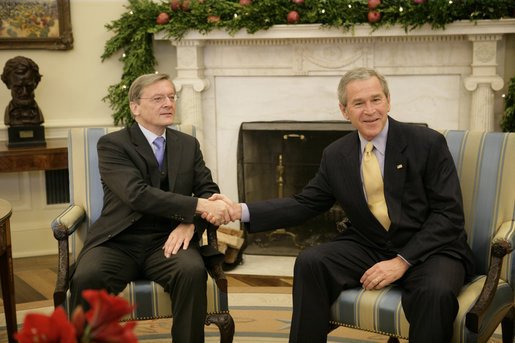 | President George W. Bush and Austria Chancellor Wolfgang Schuessel exchange handshakes during the Chancellor's visit Thursday, Dec. 8, 2005, to the White House. White House photo by Eric Draper |
Related: Keyword Austria Wednesday, November 23, 2005 President to Welcome Austrian Chancellor Wolfgang Schuessel, Tuesday, May 10, 2005 50th Anniversary of the Austrian State Treaty, Keyword European Union , Tuesday, December 21, 2004 President to Germany, Slovak Republic, Thursday, February 17, 2005 Campaign and Election in Moldova, Friday, February 18, 2005 Condoleezza Rice, Dutch Foreign Minister Bot video, Monday, February 21, 2005 President Brussels, Belgium 2/21/05, Monday, February 21, 2005 Bush and Chirac on Lebanon, Tuesday, February 22, 2005 U S and the E U Iraq Conference, Tuesday, February 22, 2005 President Meets with E.U. Leaders Justus Lipsius Brussels, Wednesday, February 23, 2005 Bush Schröder Exchange Toasts, Wednesday, February 23, 2005 Fact Sheets on U.S.-EU Cooperation
0
comments
||
||
Democrats’ Plan For Iraq, “Retreat and Defeat" (VIDEO)
RNC Releases setting the record straight, New Web Ad On The Democrats’ Plan For Iraq, “Retreat and Defeat”, FULL STREAMING VIDEO, Contact: Tracey Schmitt, 202-863-8614, Friday, December 09, 2005
WASHINGTON – The Republican National Committee today unveiled its new web ad entitled “Democrats: Retreat and Defeat on Iraq.” The ad will also be sent to supporters, grassroots activists and all GOP State Parties. The video highlights statements by Democrat leaders Howard Dean, Barbara Boxer and John Kerry on their strategy in Iraq.
Democrats Have A Plan For Iraq: Retreat and Defeat,
Howard Dean: The idea that we’re going to win this war is an idea that unfortunately is just plain wrong. (San Antonio's WOAI's Website, woai.com, Accessed 12/5/05)
Barbara Boxer: So there’s no specific timeframe but I would say the withdrawal ought to start now, right after the elections December 15th. (Fox News’ “Fox News Sunday,” 12/4/05)
John Kerry: There is no reason Bob that young American soldiers need to be going into the homes of Iraqis in the dead of night terrorizing kids and children, you know, women. (CBS’ “Face The Nation,” 12/4/05)
Our Country Is At War, Our Soldiers Are Watching And Our Enemies Are Too
Message To Democrats: Retreat And Defeat Is Not An Option
Paid for by the Republican National Committee. Not Authorized By Any Candidate Or Candidate Committee. gop.com
more at President Bush or VIDEO and White House or RNC and GOP or Howard Dean and Barbara Boxer or John Kerry and Iraq
Related: Keywords, setting the record straight, Joe Wilson, Monday, November 14, 2005 Sen. Kennedy On Iraq, Monday, November 14, 2005 The Washington Post On Pre-War Intelligence, Monday, November 14, 2005 Senator Levin on Iraq, Wednesday, November 16, 2005 New York Times on Pre-War Intelligence, Thursday, November 17, 2005 Democrats on Iraq (Video), Monday, November 28, 2005 Sen. Biden Adopts Administration's Plan for Victory, Thursday, July 14, 2005 Joe Wilson's Top Ten Worst Inaccuracies And Misstatements, Friday, July 15, 2005 Joe Wilson vs.Select Committee on Intelligence, Sunday, July 17, 2005 From The New York Times???,
0
comments
||
||
Thursday, December 08, 2005
President and Mrs. Bush Menorah Lighting (VIDEO)
President and Mrs. Bush Participate in Menorah Lighting Ceremony, FULL STREAMING VIDEO, Bookseller's Area, 5:37 P.M. EST
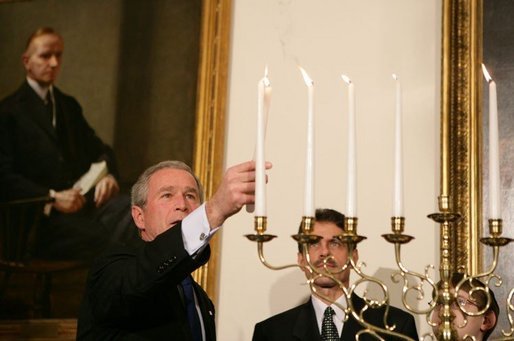 | President George W. Bush participates in the Menorah lighting at the White House with Rabbi Joshua Skoff and members of the Skoff family, Tuesday, Dec. 6, 2005, prior to the annual White House Hanukkah reception. White House photo by Kimberlee Hewitt |
More than 2,000 years ago, the ancient land of Israel was conquered, and Jewish people were forbidden to pray, observe their religious customs, or study the Torah. In response, a patriot named Judah Maccabee led a revolt against the enemy army. Their numbers were small, yet their courage in defense of their faith was powerful -- and they were triumphant.
When the Maccabees returned to reclaim their holy temple, the oil that should have lasted only one day instead burned for eight days. During Hanukkah, Jews across the world signify this miracle by lighting the menorah. This act commemorates the victory of freedom over oppression, and of hope shining through darkness. Today, that light still burns in Jewish homes and synagogues everywhere. And, today, that light will burn here in the White House.
Laura and I are honored to have a beautiful menorah here from Park Synagogue in Cleveland, Ohio. Rabbi Skoff, thank you very much for sharing it with us. I also want to thank Rabbi Barry Gelman for his prayer and thank him for his deep compassion. As he mentioned, he is the rabbi from the United Orthodox Synagogue in Houston, whose members did so much to help the victims of Hurricane Katrina. I want to thank the West Point Jewish Cadet Choir for being here with us this evening. Our nation is grateful to the American troops of all faiths who are serving our country around the world, and who are away from their families this holiday.
The word "Hanukkah" and the Hebrew word for education both come from the same root word that means "to dedicate." And earlier today, I met with some of the leaders from our nation's Jewish day schools. As educators who dedicate themselves to teaching the faith and to teaching, they are fulfilling the true lesson of Hanukkah every day of the year. Just as the Maccabees reclaimed their holy temple, these teachers help ensure that Jewish traditions are passed from generation to generation.
Tonight, as we prepare to light the candles, we are grateful for our freedoms as Americans, especially the freedom to worship. We are grateful that freedom is spreading to still new regions of the world, and we pray that those who still live in the darkness of tyranny will some day see the light of freedom.
And now I invite Rabbi Skoff and his daughter and family to join me for the symbolic lighting of the White House menorah. The honor is yours. Thank you.
END 5:41 P.M. EST, For Immediate Release, Office of the Press Secretary, December 6, 2005
more at President Bush or VIDEO and White House or Laura Bush and Menorah Lighting or Hanukkah and Maccabees or Maccabees
Related: Keyword Jews, Friday, December 10, 2004 President Bush Menorah Lighting, Tuesday, April 19, 2005 Passover Message, 5765, Friday, June 24, 2005 NAZI GUARD JOHN DEMJANJUK IS RULED REMOVABLE, Thursday, September 15, 2005 President's Remarks Jewish Life in America, Tuesday, September 20, 2005 Simon Wiesenthal: 'The Conscience of the Holocaust', Dies in Vienna at 96, Tuesday, September 20, 2005 Simon Wiesenthal - A Short Biography, Saturday, September 24, 2005 President Jewish Coalition 20th Anniversary (VIDEO), Saturday, October 01, 2005 Rosh Hashanah, 5766, Wednesday, October 12, 2005 Presidential Message: Yom Kippur, 5766,
0
comments
||
||


